


Abstract
The growing reliance on AI-powered EdTech solutions has prompted educators at all levels to rethink teaching and learning methodologies. This shift has fostered a renewed partnership among teachers, students, and society, repositioning AI from a passive support tool into a proactive agent in the classroom. This transformation calls for teachers to exercise leadership and judgement in guiding students’ use of AI, emphasising both responsible practices and ethical considerations within their broader socio-cultural contexts. To harness this potential, we leveraged AI-based solutions within the AECT academic association to reinterpret UNESCO’s four foundational pillars of learning, thereby impacting the broader educational community. This initiative underscores literacy in educational communities emerging from intra-national and international inequity. Hence, it is imperative to examine the exigency of fundamental rights in relation to ethics and norms to uphold the innovative opportunities of AI in education globally. In this regard, this study connects the Pedagogical AI-Tact concept to bridge the gap between theory and practice, fostering both interest and ethical engagement across diverse educational communities. This study valuably upholds Margaret Mead’s proposal that every child deserves universal educational rights, a principle in harmony with justice and freedom.
1. Introduction
A walk through the organic realm necessitates a profound awareness of education, as it transcends beyond schools into the broader spectrum of life. Education serves as a developmental process over time, establishing an adaptive filter that connects to societal progress. In the pre-computer era, EdTech evolved from the magic lantern in the mid-1800s—popularised for educational projection after earlier inventions—to the overhead projector in the 1930s, coexisting with practitioners in the classroom and inspiring improved teaching methods and enhanced students’ learning abilities (Muttappallymyalil et al., 2016; Romero, 2023; Wegerif & Major, 2024). More important than merely having these tools in the classroom were the decisions teachers made about how to deploy them effectively (Wegerif & Major, 2024). This study presents pedagogy as a prescriptive instructional strategy that should be provided to every child. But its mere existence relies on a trustworthy cultivation often seen as difficult: ‘Still it is true that to educate a nature man among cultivated men must entail as much trouble on the educator, as it afterwards will on the pupil to live in the middle of so heterogeneous a society’ (Herbart, 1895; Moos & Uljens, 2023). Just as Herbart foresaw, this theoretical insight explicitly synthesised collective actions and new visions, what Margaret Mead asserted as a ‘sense of community’ for changing the world (Hester, 2023).
Margaret Mead shared Aristotle’s approach to inquiry about human rationality while highlighting the link between humanity and nature, combining ethical and social reflections in contrast to prevailing modern views that advocate for a value-neutral human society (Connell, 2019; Hester, 2023). This engagement promotes social education by providing opportunities that encourage learners to develop a sense of moral responsibility for their own actions. However, AI governance remains unready to harness AI’s transnational benefits (Olugbade, 2025; Walter, 2024; Zhu et al., 2025). In this standard-setting landscape, we introduce UNESCO’s four pillars of education and ethical affirmations captured through the Pedagogical AI-Tact framework (UNESCO, 2023b; Okada et al., 2025). This focus promotes practical morals and self-observation based on guidelines and rules solicited by teachers’ evaluative judgements and instructional decision-making, which aims to extend pedagogical principles across community boundaries. From this perspective, we reflect on AECT as the leading international organisation in EdTech, aiming to close the equity gap among its members across countries through sustained growth, diversification, and global collaboration (Hsu & Wang, 2019; Leary et al., 2023). Integrating computational resources into the classroom curriculum initiated a clear shift in how visual models and collaborative discourse contribute to students’ cognitive development and learning (Nersessian, 1995). On the one hand, this shift tailored individual competencies with increased freedom and the ability to organise the timing and spaces of learning.
On the other hand, it affected the direct interaction time between teachers and students, set to diminish further to less than half of their working hours. The reason for this is that EdTech itself is a form of pedagogy, which is why it would not be possible to instil pedagogical methods without technology (Dron, 2021). This line of reasoning enables the harnessing of on-the-spot pedagogical strategies as AI extenders in education. Nonetheless, AI-powered EdTech continues to strive for literacy equality and the protection of educational rights, with shortcomings frequently stemming from bias, a lack of teacher agency, and inadequate contextualization (Filiz et al., 2025; Nazaretsky et al., 2022; Viberg et al., 2024; Zhang & Zhang, 2024). Such challenges underscore the critical need for robust ethical frameworks and comprehensive AI literacy initiatives for both educators and students to ensure equitable and effective integration of AI in learning environments (Daher, 2025).
In oral societies, however, learning is embedded in communal performance, mnemonic formulas, and face-to-face exchange rather than in texts or screens. This evolution echoes Mead’s ethnographic approach, in which she meticulously observed how different cultures structure learning and socialisation (Dillon, 2001). Moreover, we underscore EdTech AI trends to scaffold the following research questions:
- How can AI-powered EdTech support teachers in promoting literacy equality in society while upholding educational rights?
- How to empower teachers to make informed ethical judgements that balance AI’s engagement in the learning process?
Consequently, it is essential to empower AI within predefined ethical and legal boundaries. In this capacity, AI systems should relinquish their decision-making role in education, given algorithmic profiling, and foster students’ thoughts and emotions in an inclusive environment that promotes a sense of belonging and diversity. Teachers often struggle to instil ethics in the classroom due to their lack of practical frameworks, ineffective training and teacher autonomy (Al-Zahrani, 2024; Çelik, 2022). Therefore, adequate monitoring and regulations are necessary to mitigate potential AI risks, including interactivity, biased algorithms, and existential risks that can either directly cause or exacerbate existing risks (Marchant, 2019).
2. Methodology
This study employed a conceptual analysis methodology (Firdaus, 2025; Renz & Vladova, 2021) grounded in philosophical inquiry (Pérez et al., 2024) to examine the intersection of pedagogical tact, artificial intelligence, and educational equity. The theoretical approach draws upon hermeneutic traditions (Stenalt & Mathiasen, 2024), particularly engaging with the pedagogical philosophies of Johann Friedrich Herbart (Berberich et al., 2020) and Max van Manen (van Manen, 2016a) to construct the Pedagogical AI-Tact framework. The research scope encompasses the examination of AI-powered educational technologies within international educational contexts, specifically focusing on the AECT community and UNESCO’s four pillars of learning. The methodology integrates document analysis (Bešić et al., 2025; Nguyen et al., 2022) of policy frameworks, ethical guidelines, and educational standards from supranational organisations such as UNESCO, UNICEF, and the European Union. As a conceptual study with philosophical foundations, no empirical data collection involving human participants was conducted; instead, the analysis synthesised existing theoretical constructs with contemporary developments in EdTech to propose an educational framework. The analytical method employed critical synthesis (Mouta et al., 2024), examining the relational dynamics between teachers, students, and AI systems through the lens of pedagogical tact theory. This approach enabled the development of a theoretical model that bridges educational theory and practice while addressing the ethical implications of AI integration across diverse learning environments (Creely & Janssen, 2025). The analysis prioritised understanding the “how” and “why” of pedagogical relationships in AI-mediated contexts rather than quantitative measurement.
3. The Rise of AI in Education
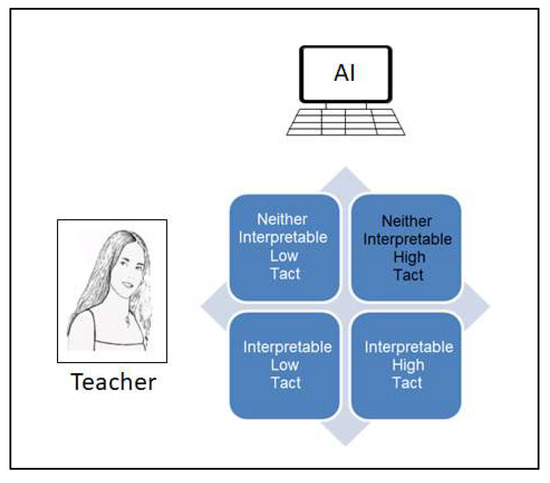
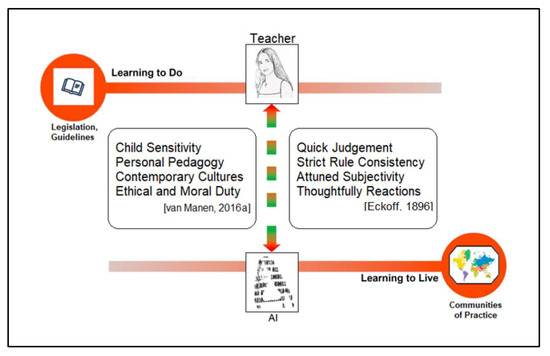
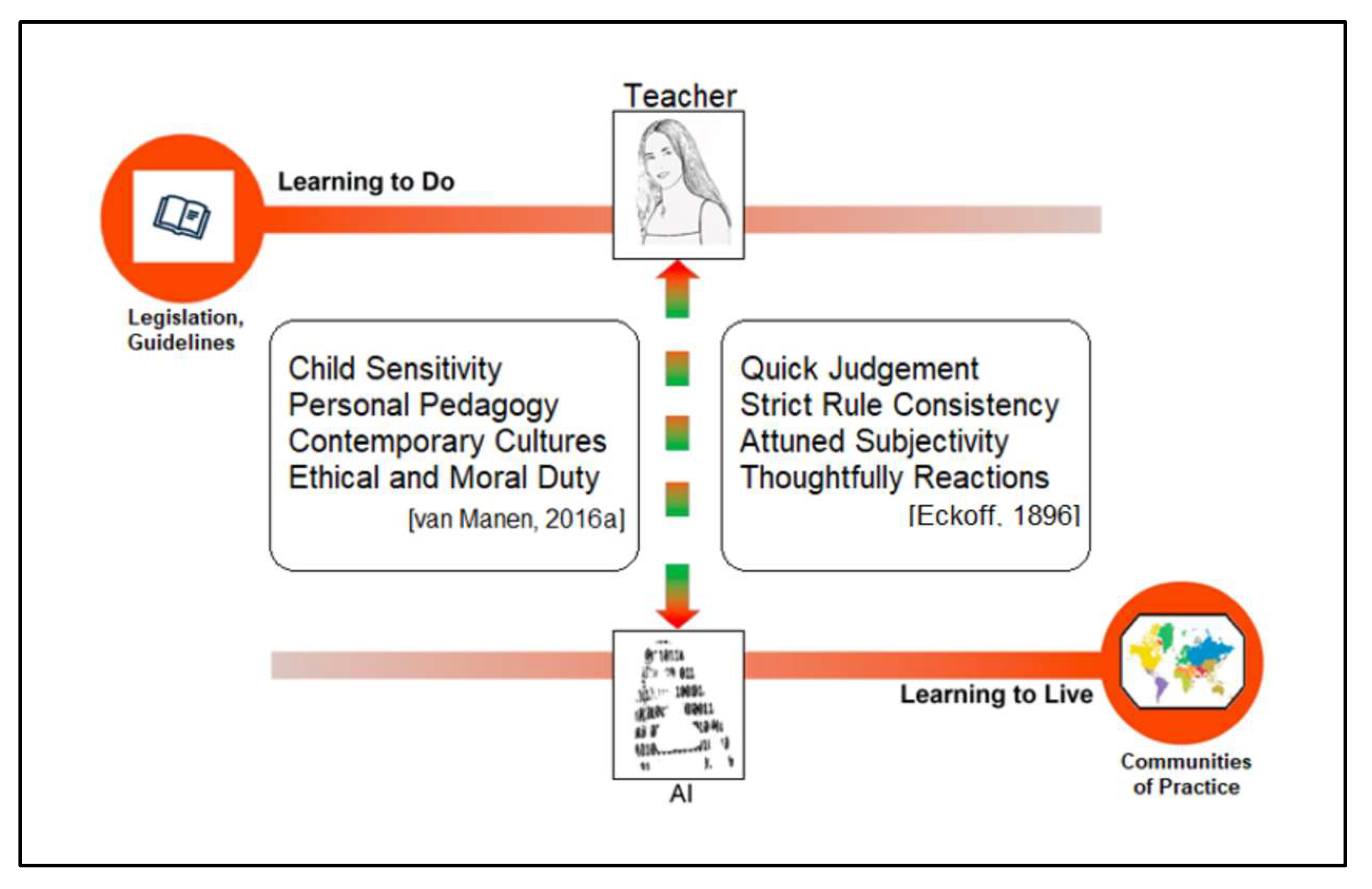
With the advent of personal computers, education underwent a digital transformation that reshaped skill requirements and established learning paradigms bridging real-world contexts with classroom practices (Mhlanga, 2024). Likewise, the rise of AI affirmed an ‘automation-based on associations’ model, in which automated reasoning is based on associations among data patterns, or ‘automating decisions,’ reaching far beyond traditional EdTech tools (Cardona et al., 2023). This assistive role focuses on exploring the open-the-box conceptual decomposition that makes reasoning inspectable and more interpretable (Russell & Norvig, 2010). Pedagogical explanation matters when tutoring and feedback systems are implemented in the classroom, especially when such systems are capable of ‘Intelligent behaviour connects perception of the environment to action appropriate for the goal of the actor’ amid learning (Novak, 2006). Since the level on interpretability is influenced across the network by a number of layers, understanding the learned patterns of knowledge is quite complex without applying explicit rules or processes (Ali et al., 2023). Therefore, the authenticity of learning rests a vital task to target (Figure 1).
Figure 1.
Overview of AI interpretability–tact trade-off.
This understanding of AI’s expanding role necessitates a deeper examination of its agency. Drawing on Luciano Floridi’s philosophy, AI systems can be conceptualised as ‘artificial agents’ capable of performing morally relevant actions, even leading to ‘artificial good’ or ‘artificial evil’ (Floridi, 2005). Floridi posits that AI can exhibit ‘agency without intelligence,’ challenging the anthropocentric view that agency is exclusively human (Floridi, 2025). This perspective distinguishes between moral responsibility, which typically requires intentions, and moral accountability, which can be ascribed to AI for its impact, irrespective of its internal states (Floridi, 2005, 2013).
Furthermore, Bruno Latour’s Actor-Network Theory offers a framework for understanding AI not as a mere tool but as an ‘actant’ within complex sociotechnical networks (Redaelli, 2023). In ANT, both human and non-human entities (such as AI algorithms) contribute to collective action and outcomes, blurring the boundaries of traditional agency (Meulen & Bruinsma, 2018). Technologies are not neutral instruments but active participants that mediate and transform actions within a ‘collective,’ where human agency is intertwined with the ‘agentic materiality’ of AI (Kouppanou, 2022). This perspective urges us to acknowledge AI’s capacity to modify behaviour and shape environments, thereby distributing agency across human-AI collaborations. The effectiveness of AI in EdTech, especially with the advent of Large Language Models, is significantly enhanced by specific architectural and deployment strategies. Two critical techniques are fine-tuning and Retrieval-Augmented Generation.
Fine-tuning involves adapting a pre-trained LLM to a specific educational task or domain by further training it on a smaller, specialised dataset (Choi et al., 2025). This process, which can employ methods like Supervised Fine-Tuning or parameter-efficient techniques such as LoRA, allows LLMs to generate more relevant, accurate, and contextually appropriate responses for pedagogical applications (J. Lee et al., 2024; Y. Lee, 2024; Kochmar et al., 2023). Retrieval-Augmented Generation is another powerful technique that addresses limitations of LLMs, such as their reliance on static knowledge bases and their tendency to ‘hallucinate’ (generate factually incorrect information) (Blachnik & Chmielewski, 2025; Quinn et al., 2024). RAG systems combine an LLM’s generative capabilities with external, authoritative knowledge sources. In an educational setting, RAG ensures that AI-generated content is reliable, drawing directly from verified curriculum materials or academic research, thereby enhancing the factual accuracy and trustworthiness of AI in learning (Gao et al., 2023; Sharma, 2025). This hybrid approach mitigates factual errors by up to 50% and significantly boosts student engagement by 25–35% (Reddy et al., 2019).
Education as a Socio-Cultural Practice
In terms of interpretation ‘the authenticity of the teacher’s selfhood in relation to both the content and the student’s own self’ is only what is left in ‘a faint [less interpretable] half-unconscious moral tact secure that the interest of the action ends away from the bad towards the good, the just, the right’ (Friesen, 2018; Herbart, 1895). Amid this bounded autonomy, the Pedagogical Tact concept remains an active driver of situational confidence, pedagogical thoughtfulness, creative ability, and values (van Manen, 2016a). Since ‘education belongs in the realm of culture’, tact adds inclusion and functionality, as well as a contemporary cultural drive (Friesen, 2018).
Potentially, this expansion leaves a growing imprint on national cultures and catalyses a cultural renaissance enriched by shared pedagogy and ethical stewardship. Although this initiative would nurture a collective vision and strategic approach, the outcome is neither automatic nor uniform across national entities. In view of a broader participation, Margaret Mead foresaw this transformation:
When we look about us among different civilisations and observe the vastly different styles of life to which the individual has been made to conform and to which he has been made to contribute, we take new hope for humanity and its potentialities.(Dillon, 2001)
Mead valued education on a global scale with enriched cultural diversity by nurturing shared values and mutual respect to enhance communal living. Her vision and ideas were ahead of their time in advocating for personal, direct learning experiences as a way to raise children. Mead’s viewpoint of education as a transformative world-shaping activity was shared by others. Hannah Arendt conceived education as the act of introducing each new generation into a shared world, a world they inherit and must, in turn, renew. She famously wrote that education is the point at which we decide whether we love the world enough to assume responsibility for it and, by that very act, save it from inevitable ruin (Cooper, 2016). In designing Mead’s transitional journey, our research focus places education in an “in-between” space, which is further widened by the “AI-driven” EdTech transformation shaping education and child development. This path explores the sense of ethical richness in print-literate societies, often taken for granted and overlooked in technology itself. At this point, we shift our emphasis to compelling international and supranational EdTech bodies that share core ethical values and societal implications. In educational ethics, international organisations (e.g., UN, UNESCO, OECD, World Bank) primarily establish monitoring tools for academic integrity and research ethics, while allowing national and institutional adaptation (Prinsloo et al., 2025;). While supranational associations (e.g., the EU) combine binding regulations with ethics bodies and treaties with extensive research programmes (e.g., Erasmus, Horizon) that directly shape practice and funding in member states (Kalafat Çat et al., 2025). The practical implications that affect education on national and global scales do not lend themselves to a coordinated effort to harness their benefits, since both international organisations and supranational associations stand outside scholarship and practice. Hence, the pedagogical choice stands ‘between doing ethical things and doing things ethically’ (Holmes et al., 2021). On the former, AETC can promote and complement the future of education as a practice-oriented, peer-reviewed association composed of educators, K-12 teachers, and education researchers that can draw on instructional design and synchronous learning from a ‘culturally responsive technology’ (Dalle et al., 2024). On the latter, while preserving AETC’s central position on the professional preparation of educators, we merge the unique insights of Herbart and van Manen to design AI-mediated educational experiences grounded in the pedagogical tact and practical sagacity.
According to Herbart, tact is a moral-rational principle linking educational theory to practice (Eckoff, 1896). In contrast, for van Manen, tact should not merely facilitate the transformation of theory into practice but rather assist educators in bridging the gap between (van Manen, 2016b). Since we described technology as pedagogy, the tact approach enhances AI representational and communicative practices from within (from looking at the keypad to typing on it) in a symbiotic form of human-technology connection between perception and action. Both Herbart and van Manen elevate the teacher’s capacity for quick, sensitive judgement at every given moment. In this setting, educational frames are interrelated, and AI-mediated interactions are woven into the fabric of the learning experience, rather than isolated elements.
4. AI in EdTech: Transforming Society
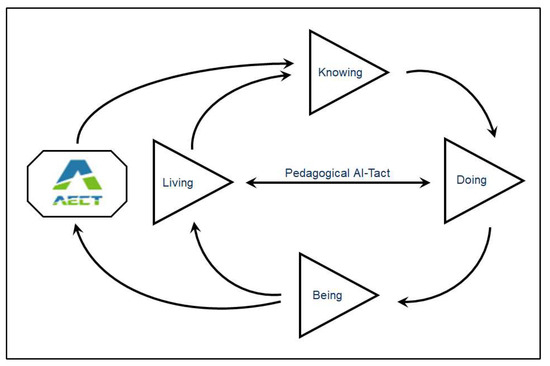
In a world driven by literacy, literate and non-literate learners alike navigate not merely “print” and “oral” communication but an overwhelming mixture of digital technologies (Abueva et al., 2024). This entanglement of technology and education evolves rapidly, often customised to economic literacy indicators rather than to convergent pedagogy (Versteijlen & Groesbeek, 2024; Welsandt et al., 2024). Consequently, risks to every child’s fundamental educational rights—including equitable internet access and the ability to seize new opportunities—appear higher than ever, with nearly one-third of the global population (2.6 billion people) lacking internet connectivity, exacerbating digital and AI divides particularly among vulnerable groups like girls, rural populations, and marginalised communities (UNESCO, 2023a, 2025; Rajasekaran et al., 2024). We thus extend our inquiry to the global reach of the AECT International Convention, which integrates ethical theory, empirical research, and proven practices to enrich knowledge, support learning outcomes, and optimise performance through strategic design, management, and implementation of teaching and learning resources (Leary et al., 2023; Piña, 2018). Attracting a diverse international audience from dozens of countries, the convention continues to grow, sustaining AECT’s premier status as a leader in educational technology (Leary et al., 2023; Piña, 2018). Building on this foundation, we propose an academic framework that unfolds tactful pedagogical dispositions—grounded in intelligent-TPACK for ethical AI integration (Çelik, 2022)—to feed UNESCO’s four pillars of learning (“Learning to Know,” “Do,” “Be,” and “Live Together”) via the AECT web in Figure 2 (Okada et al., 2025). While Pedagogical AI-Tact fosters “Doing” capacity and “Living” harmony through human-centred AI practices (Okada et al., 2025; Pérez et al., 2024), AECT’s role remains implicit, rooted in trust, obviating the need for iterative loops.
Figure 2.
The Educational Framework: The interlinking of the Pedagogical AI-Tact within the UNESCO Pillars of Learning and the AECT web.
The educational framework has the potential to serve two educational purposes: the participation of teachers in nurturing students’ development of education-based competencies, on the one hand, and the capability to bring about social transformation, on the other. In this sense, the role of education unfolds from individual learners in search of their roots to globally connected communities, as Delors defined:
… education is at the heart of both personal and community development; its mission is to enable each of us, without exception, to develop all our talents to the full and to realise our creative potential, including responsibility for our own lives and achievement of our personal aim.(Mortimore, 1998)
This implementation is intended to combine the relation of theory and practice, which correlates with van Manen’s pedagogical tact, which bears the daily realities of the teacher-children’s relations grounded in relational ethics, fidelity, love, trust, interdependence, and the acceptance of their caring responsibility for their child and each other (van Manen, 2016a). Accordingly, we reveal a sustained pedagogical engagement within the four pillars of learning, where each pillar consolidates renewed learning approaches for societal needs (UNESCO, 2015).
Knowing—“Learning to Know”
The primary emphasis would be placed on gathering general knowledge and understanding, as well as the opportunity to study and work with AI in depth on core subjects. Cursory information from the AETC website is considered in sustaining educational equality. This integration would enable the creation of a digital educational identity through an in-depth analysis of economic and societal developments.
Doing—“Learning to Do”
This pillar entails acquiring competencies to enable individuals to handle unforeseen situations within a collegiate student community. At any given moment, individual reflections are thoroughly judged as a certainty of belief. This is afforded by information blended with Pedagogical AI-tact theory and practice, which enables them to bind together around a responsible pedagogical foundation.
Being—“Learning to Be”
This developmental pillar concerns the ability to acquire individual skills and personal responsibility, grounded in one’s own values, judgement, and beliefs. The interlink with the pillar of doing allows examination of the rational tenets elaborated in the notion of citizenship education.
Living—“Learning to Live Together”
In this pillar, equal attention is paid to the broader community through promotion of social cohesion and societal harmony. We address specific needs arising from different educational roles, drawing on insights and contributions to foster creative knowledge. This consideration addresses the universality of linking theory to practice in the context of educational AI, where it establishes itself.
From a practical perspective, AI-powered educational technologies enhance and extend the four foundational dimensions of learning defined in the UNESCO Delors report. By embedding adaptive algorithms, intelligent feedback, and immersive tools, AI EdTech can personalise, deepen, and broaden the impact of each pillar on learners. This flexibility would not only detect the nature of the oral or written modes commonly observed but also delve into alleged primitive cultures while promoting children’s rights within AI governance principles. In addition, because literacy and culture are deeply intertwined, AI EdTech can extend education to indigenous communities without making them feel discriminated against or humiliated, as they have the same educational rights as non-indigenous communities. This process brings something bigger than the individual, transcending Mead’s championed quest to reach a larger, culturally diverse audience through education. By establishing an intercultural-based education, indigenous communities will gain access to inclusive, equitable, quality schooling and lifelong learning (UNESCO, 2016).
5. The Ethics of Educational Equity
5.1. The Pedagogical AI-Tact
The introduction of the Pedagogical AI-Tact educational concept, drawn from Herbart’s (Pädagogischer Takt) is developed as a way of articulating teachers’ theory and practice into an ordered and purposeful setting:
… the educator must prepare not his future action in individual cases so much as himself must prepare his head as well as his heart to correctly receive, perceive, feel, and judge the phenomena awaiting him and the situation in which he will be placed.(Eckoff, 1896)
This primer brings in students’ accomplishments and places them in the teacher’s heart. Given that teachers enact rules and principles with care, we turn to van Manen’s concept of pedagogical tact ‘good educator’s behaviour’, which he describes as a caring reflection that overcomes the divide between theory and practice. In his view, tact is not about making split-second decisions but about cultivating presence and sensitivity. We reconceive tact as an ongoing mindfulness that guides teachers’ thoughtful interactions with children and young people (van Manen, 2016a). This reflection enhances the teacher’s awareness of reacting thoughtfully towards students through a sense of care, thereby expounding the enriched ethical significance. The pure ethical form evolves in ‘general ethics as a form of thinking, reflecting, and moral reasoning’ (van Manen, 2016a). That said, we are encouraged by Herbart and van Manen’s thoughtful approach to discerning teachers’ capacity and moral reflections, the ‘quick and easy’ supporting role of AI and the tactful ability to construct learning. The Pedagogical AI-Tact (Figure 3) reveals a conciliatory mode of decision and reaction between the teacher and students, with interactive AI filling the gap between pedagogical theory and practice.
Figure 3.
The Pedagogical AI-Tact: A balancing relation between the teacher, students and AI (van Manen, 2016a; Eckoff, 1896).
We depicted AI as a source of knowledge that relies on the teacher’s tactical role, guiding the success or failure of the pedagogical process. Herein, we reiterate the AI exemption in decision-making due to the inability to distinguish between experiences that would be plain to students. This confounds with specific human rights violations, especially when ‘a particular decision cannot be foreseen ex-ante but also not thoroughly analysed ex-post’ (Kriebitz, 2023). While prevailing from norms, a character swift of a moral order for students that ‘exalt them into living enthusiasm’ (Eckoff, 1896). This, then, suggests that AI development must strike a balance between its human impacts and economic gains, remaining consistent with human rights, justice, and the boundaries of individual freedom.
5.2. Ethics and Interactivity
The history of AI has advanced remarkably, from ELIZA’s pattern matching in the 1960s to transformer-based GPT models. Yet, global AI governance lacks unified ethical principles or legal frameworks. Analysing 17 principal groups, we find that Transparency/Explainability/Auditability were the most emphasised, while Children & Adolescents’ Rights were the least (Corrêa et al., 2023), raising concerns about unequal prioritisation. Transparency counters biases by making systems interpretable beyond black boxes (Castelvecchi, 2016); explainability offers human-like justifications (Michel, 2020); and auditability ensures accountability. In education, these enhance pedagogy amid classroom disruptions.
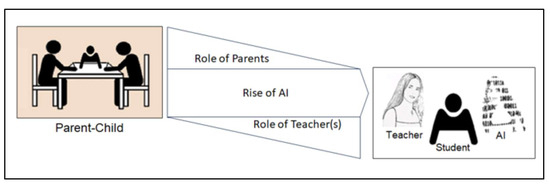
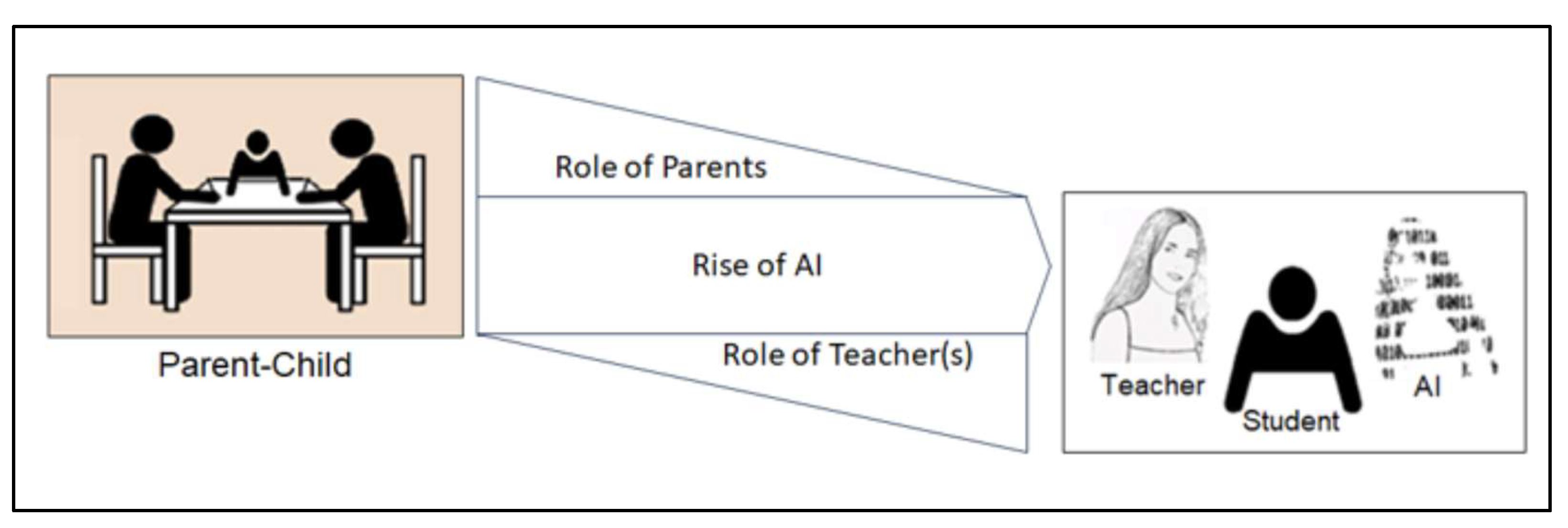
Children hold rights to survival, development, protection, and participation per the UN Convention on the Rights of the Child (Hanson et al., 2024). Still, over 262 million children—disproportionately girls—lack schooling, with two-thirds of illiterate adults being women (Hanson et al., 2024). This reinforces the aim of education to sustain human dignity (UNESCO, 2015). AI must uphold privacy, safety, and security (Kaesling, 2023), averting societal dysfunction and motivational deficits from digital interactions, which reshape cognition and psyche while fostering positive ‘interactive thought.’ Childhood moral frameworks thus extend into adulthood. This assertion holds that declining parental ethical guidance not only reshapes students’ family relations but also places greater responsibility for ethical judgments on teachers (Figure 4).
Figure 4.
The changing responsibilities between parents and teachers.
Contemporary AI in education has trended toward increasingly generalised systems that recommend solutions with real ethical implications. Predictive assistants, advanced chatbots, and adaptive-learning platforms illustrate how AI is expanding across diverse educational practices. This growth requires continuous hybrid teacher-and-family feedback loops to manage and optimise the operability of educational platforms.
The discourse on ‘opening the black box’ of AI—making its operations transparent, explainable, and auditable—is crucial for ethical deployment and fostering trust (Castelvecchi, 2016; Michel, 2020). This aligns with foundational principles in Artificial Intelligence, as highlighted by Russell and Norvig, who emphasise that the ability to obtain reasons or justifications for an AI system’s actions and outputs is a key issue in the field (Preece, 2018; Russell & Norvig, 1995). For educational AI, this means moving beyond opaque algorithms to systems whose decision-making processes can be understood and, when necessary, challenged by educators and learners alike (Graziani et al., 2022). Such interpretability enables educators to evaluate AI’s pedagogical alignment, identify potential biases, and ensure that AI’s ‘intelligent processing’ supports rather than undermines learning goals.
6. Discussion
In this section, we outline the results of our educational enquiry in relation to the research questions. In addressing the first research question regarding educational equity and rights, we focus on overcoming common barriers through AI-powered EdTech, guided by integrating AECT and Delors’ four pillars of learning.
This augmentation does not entail replacing teachers or curriculum, but it amplifies them through the following:
- Personalising content and pace based on individual needs.
- Providing real-time factfinding and feedback.
- Enabling immersive, hands-on practice through simulations.
- Connecting learners globally for richer cultural exchange.
AI EdTech elevates each pillar whilst preserving pedagogical goals and cultural context, empowers teachers’ flexibility without overriding their judgement and prepares students to face multifaceted and interconnected challenges. From the perspective of the second research question regarding how to enable teachers’ ethical judgements, the focus veered on their reasoning, thoughtfulness and ability to “feel” the student engaged in the learning process. The study highlighted the basis of Herbart and van Manen’s expanded moral tact among teachers, as opposed to international/supranational standards that can provide relevant foundation rules but also treat students as Jacob Muth voiced ‘an organisational category … only work against tact’ [and] ‘obstruct the possibility of tactful action’ (Friesen, 2018). This tactful source, tailored by AECT, can comprehensively address ethics and integrity in the classroom.
Although we are moving toward more culturally responsive AI tools in the classroom, teachers are increasingly acknowledging the difficulties in deploying didactic AI that truly tackles inequality and privilege (Cardona et al., 2023). By explicating this reflection through formalised moral teaching practices, the result is a kind of knowledge that lacks valence, as Annette Baier claimed:
…[morality] is seriously endorsed only in their studies, not in the moral education they give their children, nor in their reflective attitude to their own past moral education, nor even in their attitude to how they teach their own courses in moral philosophy.(Calhoun, 2004)
This epistemic condition raises the question of democracy impacting human existence in the world of computational learning. Grounded in civil rights ideals, this exemplary essentialism continues to fuel a narrative struggle against AI design biases. Thus, it demands that ethics inflect every stage of technology’s lifecycle from design and deployment to operational use. Each niche intersects with the EdTech development cycle, from AECT academic and theoretical dissemination to ISTE deepening research-based best practices, both tailoring equitable approaches across different communities.
7. Conclusions
Integrating various AI strategies from a pedagogical standpoint, while considering social identity boundaries and self-formative practices, will promote well-being and confidence within the educational community. In this context, teachers must loosen their conservative approaches and rethink the impacts of AI on the development of a collective identity. A similar discussion arises when students request that teachers articulate ideas shaped by AI, often leading to a misinterpretation of the original intent. Just as schoolchildren are inspired to display their posters on the wall, the move of AI into the classroom must capture the transforming architectural role rather than instilling sparse narrative elements or fragments within the learning environment. In fact, we endorsed the concept of pedagogical tact to frame AI ethics within contemporary educational principles, thereby fostering trust and equality in learning communities. We compelled Margaret Mead to formulate a collective educational vision that incorporates universal teaching practices, thereby upholding the right to education for every child in every AI educational programme. While AECT standards and guidelines are widely adopted, ongoing dialogue with other intergovernmental and global bodies ensures its primary role in promptly diversifying available “click technologies” into “instructional technology” with clear, tactful pedagogical significance.
Author Contributions
Conceptualization, investigation and writing—original draft preparation, A.C.; writing—review and editing, P.T. and P.I. All authors have read and agreed to the published version of the manuscript.
Funding
This research received no external funding.
Institutional Review Board Statement
Not applicable.
Informed Consent Statement
Not applicable.
Data Availability Statement
This study did not generate or analyse any new data, since it is a concept with deep philosophical roots, which does not generate empirical data.
Conflicts of Interest
The authors declare no conflicts of interest.
Abbreviations
The following abbreviations are used in this manuscript:
| AECT | Association for Educational Communications and Technology |
| AI | Artificial Intelligence |
| ANT | Actor-Network Theory |
| BEA | Building Educational Applications |
| EdTech | Educational Technology |
| EU | European Union |
| GPT | Generative Pre-training |
| IEAI | Institute for Ethics in Artificial Intelligence |
| ISTE | International Society for Technology in Education |
| LLM | Large Language Model |
| LoRA | Low-Rank Adaptation |
| NLP | Natural Language Processing |
| OECD | Organisation for Economic Co-operation and Development |
| RAG | Retrieval-Augmented Generation |
| TPACK | Technological Pedagogical And Content Knowledge |
| TUM | Technical University of Munich |
| UNESCO | United Nations Educational, Scientific and Cultural Organization |
| UNICEF | United Nations Children’s Fund |
References
- Abueva, N., Zhussupova, A., Massakova, S., Buzelo, A., & Abuyev, O. (2024). Analyzing the formation of metacompetence in students using EdTech in the learning process: An economic perspective. Economic Annals-ХХI, 208, 27. [Google Scholar] [CrossRef] [Scilit]
- Ali, S., Abuhmed, T., El–Sappagh, S., Muhammad, K., Alonso, J. M., Confalonieri, R., Guidotti, R., Ser, J. D., Díaz-Rodríguez, N., & Herrera, F. (2023). Explainable artificial intelligence (XAI): What we know and what is left to attain trustworthy artificial intelligence. Information Fusion, 99, 101805. [Google Scholar] [CrossRef] [Scilit]
- Al-Zahrani, A. M. (2024). Unveiling the shadows: Beyond the hype of AI in education. Heliyon, 10(9), e30696. [Google Scholar] [CrossRef] [Scilit]
- Berberich, N., Nishida, T., & Suzuki, S. (2020). Harmonizing artificial intelligence for social good. Philosophy & Technology, 33(4), 613. [Google Scholar] [CrossRef] [Scilit]
- Bešić, E., Schulz, L., & Schmid-Meier, C. (2025). Inclusion and equity in artificial intelligence (AI): Analysis of educational policies in Austria, Germany, and Switzerland. Research Square (Research Square), 1–20. [Google Scholar] [CrossRef] [Scilit]
- Blachnik, M., & Chmielewski, J. (2025). Comparison of large language models supporting the polish language in terms of faithfulness in retrieval-augmented generation applications. Annals of Computer Science and Information Systems, 43, 111. [Google Scholar] [CrossRef] [Scilit]
- Calhoun, C. (2004). Subjectivity and emotion. In Thinking about feeling: Contemporary philosophers on emotion (pp. 107–122). Oxford Academic. [Google Scholar] [CrossRef] [Scilit]
- Cardona, M. A., Rodrí guez, R., & Ishmael, C. (2023). Artificial intelligence and the future of teaching and learning. Office of Educational Technology, U.S. Department of Education. Available online: https://www.ed.gov/sites/ed/files/documents/ai-report/ai-report.pdf (accessed on 21 November 2025).
- Castelvecchi, D. (2016). Can we open the black box of AI? Nature, 538(7623), 20. [Google Scholar] [CrossRef] [Scilit] [PubMed]
- Choi, Y., Asif, M. A., Han, Z., Willes, J., & Krishnan, R. G. (2025). Teaching llms how to learn with contextual fine-tuning. arXiv, arXiv:2503.09032. [Google Scholar] [CrossRef] [Scilit]
- Connell, S. M. (2019). Aristotle for the modern ethicist. Ancient Philosophy Today, 1(2), 192. [Google Scholar] [CrossRef] [Scilit]
- Cooper, J. (2016). The Routledge encyclopaedia of educational thinkers. Routledge. [Google Scholar] [CrossRef] [Scilit]
- Corrêa, N. K., Galvão, C., Santos, J. W., Pino, C. D., Pinto, E. P., Barbosa, C., Massmann, D., Mambrini, R., Galvão, L., Terem, E., & de Oliveira, N. (2023). Worldwide AI ethics: A review of 200 guidelines and recommendations for AI governance. Patterns, 4(10), 100857. [Google Scholar] [CrossRef] [Scilit]
- Creely, E., & Janssen, K. (2025). Onto-epistemological understandings of generative artificial intelligence in education. International Journal of Changes in Education, 2(2), 55–65. [Google Scholar] [CrossRef] [Scilit]
- Çelik, İ. (2022). Towards intelligent-TPACK: An empirical study on teachers’ professional knowledge to ethically integrate artificial intelligence (AI)-based tools into education. Computers in Human Behavior, 138, 107468. [Google Scholar] [CrossRef] [Scilit]
- Daher, R. F. (2025). Integrating AI literacy into teacher education: A critical perspective paper. Discover Artificial Intelligence, 5(1), 217. [Google Scholar] [CrossRef] [Scilit]
- Dalle, J., Aydın, H., & Wang, C. X. (2024). Cultural dimensions of technology acceptance and adaptation in learning environments. Journal of Formative Design in Learning, 8(2), 99. [Google Scholar] [CrossRef] [Scilit]
- Dillon, W. S. (2001). Margaret mead (1901–1978). Prospects, 31(3), 447. [Google Scholar] [CrossRef] [Scilit]
- Dron, J. (2021). Educational technology: What it is and how it works. AI & Society, 37(1), 155. [Google Scholar] [CrossRef] [Scilit]
- Eckoff, W. J. (1896). Herbart’s ABC of sense-perception and minor pedagogical works. In Medical entomology and zoology. Japan Society of Medical Entomology and Zoology. [Google Scholar]
- Filiz, O., Kaya, M. H., & Adıgüzel, T. (2025). Teachers and AI: Understanding the factors influencing AI integration in K-12 education. Education and Information Technologies, 30(13), 17931. [Google Scholar] [CrossRef] [Scilit]
- Firdaus, T. (2025). The philosophical construction of educational science in relation to posthumanism and transhumanism in artificial intelligence. Turkish Academic Research Review—Türk Akademik Araştırmalar Dergisi [TARR], 10(1), 70. [Google Scholar] [CrossRef] [Scilit]
- Floridi, L. (2005). Information ethics, its nature and scope. ACM SIGCAS Computers and Society, 35(2), 3. [Google Scholar] [CrossRef] [Scilit]
- Floridi, L. (2013). Artificial agents and their moral nature. In Philosophy of engineering and technology (p. 185). Springer Nature (Netherlands). [Google Scholar] [CrossRef] [Scilit]
- Floridi, L. (2025). AI as agency without intelligence: On artificial intelligence as a new form of artificial agency and the multiple realisability of agency thesis. Philosophy & Technology, 38(1), 30. [Google Scholar] [CrossRef] [Scilit]
- Friesen, N. (2018). Embodying tact in teaching. Philosophy of Education, 74, 301. [Google Scholar] [CrossRef] [Scilit]
- Gao, Y., Xiong, Y., Gao, X., Jia, K., Pan, J., Bi, Y., Dai, Y., Sun, J., & Wang, H. (2023). Retrieval-augmented generation for large language models: A survey. arXiv, arXiv:2312.10997. [Google Scholar] [CrossRef] [Scilit]
- Graziani, M., Dutkiewicz, L., Calvaresi, D., Amorim, J. P., Yordanova, K., Vered, M., Nair, R., Abreu, P. H., Blanke, T., Pulignano, V., Prior, J. O., Lauwaert, L., Reijers, W., Depeursinge, A., Andrearczyk, V., & Müller, H. (2022). A global taxonomy of interpretable AI: Unifying the terminology for the technical and social sciences. Artificial Intelligence Review, 56(4), 3473. [Google Scholar] [CrossRef] [Scilit] [PubMed]
- Hanson, K., Liefaard, T., Ruggiero, R., Patrizi, E., Klep, K., & Opoka, L. (Eds.). (2024). Convention on the rights of the child. In International children’s rights instruments (pp. 12–30). Brill. [Google Scholar] [CrossRef] [Scilit]
- Herbart, J. F. (1895). The science of education: Its general principles deduced from its aim and the aesthetic revelation of the world (Vol. 21). DC Heath & Company. [Google Scholar]
- Hester, J. P. (2023). Humanity as community: A prescription for the ethically possible. Journal of Values-Based Leadership, 17(1), 6. [Google Scholar] [CrossRef] [Scilit]
- Holmes, W., Porayska-Pomsta, K., Holstein, K., Sutherland, E., Baker, T. T., Shum, S. B., Santos, O. C., Rodrigo, M. M. T., Cukurova, M., Bittencourt, I. I., & Koedinger, K. R. (2021). Ethics of AI in education: Towards a community-wide framework. International Journal of Artificial Intelligence in Education, 32(3), 504. [Google Scholar] [CrossRef] [Scilit]
- Hsu, Y., & Wang, C. X. (2019). Educational technology research with international perspectives and cultural contexts. TechTrends, 63(3), 238. [Google Scholar] [CrossRef] [Scilit]
- Kaesling, K. (2023). A rights-based approach to children’s digital participation in the multi-level system of the European Union. In Juridicum—Schriften zum medien-, informations- und datenrecht (pp. 73–110). Springer. [Google Scholar] [CrossRef] [Scilit]
- Kalafat Çat, A., Yetgin, M. A., & Sarker, J. I. (2025). Navigating modern digital communication ethics and law. IGI Global Scientific Publishing. [Google Scholar] [CrossRef] [Scilit]
- Kochmar, E., Burstein, J., Horbach, A., Laarmann-Quante, R., Madnani, N., Tack, A., Yaneva, V., Yuan, Z., & Zesch, T. (Eds.). (2023). Proceedings of the 18th workshop on innovative use of NLP for building educational applications (BEA 2023). Association for Computational Linguistics. [Google Scholar] [CrossRef] [Scilit]
- Kouppanou, A. (2022). The posthumanist challenge to teaching or teaching’s challenge to posthumanism: A neohumanist proposal of nearness in education. Discourse: Studies in the Cultural Politics of Education, 43(5), 766–784. [Google Scholar] [CrossRef] [Scilit]
- Kriebitz, A. (2023). IEAI TUM school of social sciences and technology: Research brief. Available online: https://www.ieai.sot.tum.de/wp-content/uploads/2023/04/Research-Brief_AIHumanRights_April2023_Final_V2.pdf (accessed on 25 June 2025).
- Leary, H., Stefaniak, J. E., Clark-Stallkamp, R., Watson, G. S., Dietzel, R., & Doyle, R. (2023). The AECT centennial: Origins, trends, and implications for the future of educational technology. TechTrends, 67(5), 764. [Google Scholar] [CrossRef] [Scilit]
- Lee, J., Hicke, Y., Yu, R., Brooks, C., & Kizilcec, R. F. (2024). The life cycle of large language models: A review of biases in education. arXiv, arXiv:2407.11203. [Google Scholar] [CrossRef] [Scilit]
- Lee, Y. (2024). Development of open large language models for artificial intelligence digital textbooks. TEM Journal, 13(4), 2773–2783. [Google Scholar] [CrossRef] [Scilit]
- Marchant, G. E. (2019). “Soft law” governance of artificial intelligence. eScholarship (California Digital Library). Available online: https://escholarship.org/uc/item/0jq252ks (accessed on 20 September 2025).
- Meulen, S., & Bruinsma, M. (2018). Man as ‘aggregate of data’. AI & Society, 34(2), 343. [Google Scholar] [CrossRef] [Scilit]
- Mhlanga, D. (2024). Digital transformation of education, the limitations and prospects of introducing the fourth industrial revolution asynchronous online learning in emerging markets. Discover Education, 3(1), 32. [Google Scholar] [CrossRef] [Scilit]
- Michel, A. H. (2020). The black box, unlocked: Predictability and understandability in military AI. UNIDIR. [Google Scholar] [CrossRef] [Scilit]
- Moos, L., & Uljens, M. (2023). Non-affirmative theory of education and bildung. In Educational governance research. Springer International Publishing. [Google Scholar] [CrossRef] [Scilit]
- Mortimore, P. (1998). Learning: The treasure within report to UNESCO of the international commission on education for the twenty-first century. Higher Education Policy, 11(1), 97. [Google Scholar] [CrossRef]
- Mouta, A., Llorente, A. M. P., & Sánchez, E. M. T. (2024). Uncovering blind spots in education ethics: Insights from a systematic literature review on artificial intelligence in education. International Journal of Artificial Intelligence in Education, 34, 1166–1205. [Google Scholar] [CrossRef] [Scilit]
- Muttappallymyalil, J., Mendis, S., John, L. J., Shanthakumari, N., Sreedharan, J., & Shaikh, R. B. (2016). Evolution of technology in teaching: Blackboard and beyond in medical education. Nepal Journal of Epidemiology, 6(3), 588–594. [Google Scholar] [CrossRef] [Scilit]
- Nazaretsky, T., Ariely, M., Cukurova, M., & Alexandron, G. (2022). Teachers’ trust in AI -powered educational technology and a professional development program to improve it. British Journal of Educational Technology, 53(4), 914. [Google Scholar] [CrossRef] [Scilit]
- Nersessian, N. J. (1995). Opening the black box: Cognitive science and history of science. Osiris, 10, 194. [Google Scholar] [CrossRef] [Scilit]
- Nguyen, A., Ngo, H. N., Hong, Y., Dang, B., & Nguyen, B. T. (2022). Ethical principles for artificial intelligence in education. Education and Information Technologies, 28(4), 4221. [Google Scholar] [CrossRef] [Scilit]
- Novak, G. S., Jr. (2006). CS 381K: Artificial intelligence: Lecture notes 2006. Available online: https://www.cs.utexas.edu/~novak/cs381k.html (accessed on 21 April 2025).
- Okada, A., Sherborne, T., Panselinas, G., & Kolionis, G. (2025). Fostering transversal skills through open schooling supported by the CARE-KNOW-DO pedagogical model and the UNESCO AI competencies framework. International Journal of Artificial Intelligence in Education, 35, 1953–1998. [Google Scholar] [CrossRef] [Scilit]
- Olugbade, O. (2025). In search of a global governance mechanism for Artificial Intelligence (AI): A collective action perspective. Global Public Policy and Governance, 5(2), 139. [Google Scholar] [CrossRef] [Scilit]
- Pérez, R. M. F., Sagrado, A. L., González, E. O., & de Bedout, L. F. (2024). Implicaciones filosóficas, éticas y pedagógicas del uso de la inteligencia artificial en educación. Digital Education Review, 45, 29. [Google Scholar] [CrossRef] [Scilit]
- Piña, A. A. (2018). AECT instructional design standards for distance learning. TechTrends, 62(3), 305. [Google Scholar] [CrossRef] [Scilit]
- Preece, A. (2018). Asking ‘why’ in AI: Explainability of intelligent systems—Perspectives and challenges. Intelligent Systems in Accounting Finance & Management, 25(2), 63. [Google Scholar] [CrossRef] [Scilit]
- Prinsloo, C., Ramashego, S. M., Visagie, R., & Tjano, N. (2025). Balancing academic freedom and research integrity through virtue ethics in the use of AI in open distance education. South African Journal of Higher Education, 39(4), 236–262. [Google Scholar] [CrossRef] [Scilit]
- Quinn, D., Nouri, M., Patel, N., Salihu, J., Salemi, A., Lee, S., Zamani, H., & Alian, M. (2024). Accelerating retrieval-augmented generation. arXiv, arXiv:2412.15246. [Google Scholar] [CrossRef] [Scilit] [PubMed]
- Rajasekaran, S., Adam, T., & Tilmes, K. (2024). Digital pathways for education: Enabling greater impact for all. World Bank Group. Available online: https://openknowledge.worldbank.org/entities/publication/9673fd74-1bf4-4693-b45f-374a64464c63 (accessed on 5 October 2025). [CrossRef] [Scilit]
- Redaelli, R. (2023). Different approaches to the moral status of AI: A comparative analysis of paradigmatic trends in Science and Technology Studies. Discover Artificial Intelligence, 3(1), 25. [Google Scholar] [CrossRef] [Scilit]
- Reddy, S., Chen, D., & Manning, C. D. (2019). CoQA: A conversational question answering challenge. Transactions of the Association for Computational Linguistics, 7, 249. [Google Scholar] [CrossRef] [Scilit]
- Renz, A., & Vladova, G. (2021). Reinvigorating the discourse on human-centered artificial intelligence in educational technologies. Technology Innovation Management Review, 11(5), 5. [Google Scholar] [CrossRef] [Scilit]
- Romero, J. E. (2023). The use of technical aid resources in the history of education: Sharing anecdotic and historical events. Arts & Humanities Open Access Journal, 5(2), 117. [Google Scholar] [CrossRef] [Scilit]
- Russell, S., & Norvig, P. (1995). Artificial intelligence: A modern approach. Choice Reviews Online, 33(3), 33. [Google Scholar] [CrossRef] [Scilit]
- Russell, S., & Norvig, P. (2010). EBOOK: Artificial intelligence, a modern approach (3rd ed.). Pearson Education. Available online: https://opaclib.inaba.ac.id/index.php?p=show_detail&id=2603 (accessed on 21 November 2025).
- Sharma, C. (2025). Retrieval-augmented generation: A comprehensive survey of architectures, enhancements, and robustness frontiers. arXiv, arXiv:2506.00054. [Google Scholar] [CrossRef] [Scilit]
- Stenalt, M. H., & Mathiasen, H. (2024). Towards teaching-sensitive technology: A hermeneutic analysis of higher education teaching. International Journal of Educational Technology in Higher Education, 21(1), 17. [Google Scholar] [CrossRef] [Scilit]
- UNESCO. (2015). Rethinking education: Towards a global common good? In UNESCO ebooks. UNESCO. [Google Scholar] [CrossRef] [Scilit]
- UNESCO. (2016). Education 2030: Incheon declaration and framework for action for the implementation of sustainable development goal 4: Ensure inclusive and equitable quality education and promote lifelong learning opportunities for all. Report, 83. ED-2016/WS/28. UNESCO.
- UNESCO. (2023a). Global Education Monitoring Report 2023: Technology in education: A tool on whose terms? UNESCO. [Google Scholar] [CrossRef] [Scilit]
- UNESCO. (2023b). Guidance for generative AI in education and research. In UNESCO ebooks. UNESCO. [Google Scholar] [CrossRef] [Scilit]
- UNESCO. (2025). AI and education: Protecting the rights of learners. In UNESCO ebooks. UNESCO. [Google Scholar] [CrossRef] [Scilit]
- van Manen, M. (2016a). Pedagogical tact. Routledge. [Google Scholar] [CrossRef] [Scilit]
- van Manen, M. (2016b). The tact of teaching. Routledge. [Google Scholar] [CrossRef] [Scilit]
- Versteijlen, M., & Groesbeek, M. J. (2024). Perspective chapter: Educational technology under scrutiny in higher education—A framework for balancing environmental, economic and social aspects in a blended design. In IntechOpen eBooks. IntechOpen. [Google Scholar] [CrossRef] [Scilit]
- Viberg, O., Kizilcec, R. F., Wise, A. F., Jivet, I., & Nixon, N. (2024). Advancing equity and inclusion in educational practices with AI-powered educational decision support systems (AI-EDSS). British Journal of Educational Technology, 55(5), 1974. [Google Scholar] [CrossRef] [Scilit]
- Walter, Y. (2024). Managing the race to the moon: Global policy and governance in Artificial Intelligence regulation—A contemporary overview and an analysis of socioeconomic consequences. Discover Artificial Intelligence, 4(1), 14. [Google Scholar] [CrossRef] [Scilit]
- Wegerif, R., & Major, L. (2024). A dialogic theory of educational technology. In Education and dialogue in polarized societies: Dialogic perspectives in times of change (pp. 121–142). Oxford Academic. [Google Scholar] [CrossRef] [Scilit]
- Welsandt, N. J., Fortunati, F., Winther, E., & Abs, H. J. (2024). Constructing and validating authentic assessments: The case of a new technology-based assessment of economic literacy. Empirical Research in Vocational Education and Training, 16(1), 4. [Google Scholar] [CrossRef] [Scilit]
- Zhang, J., & Zhang, Z. Y. (2024). AI in teacher education: Unlocking new dimensions in teaching support, inclusive learning, and digital literacy. Journal of Computer Assisted Learning, 40(4), 1871. [Google Scholar] [CrossRef] [Scilit]
- Zhu, Y., Zhu, Z., & Xu, W. (2025). Cross-border higher education cooperation under the dual context of artificial intelligence and geopolitics: Opportunities, challenges, and pathways. Frontiers in Education, 10, 1656518. [Google Scholar] [CrossRef] [Scilit]
Disclaimer/Publisher’s Note: The statements, opinions and data contained in all publications are solely those of the individual author(s) and contributor(s) and not of MDPI and/or the editor(s). MDPI and/or the editor(s) disclaim responsibility for any injury to people or property resulting from any ideas, methods, instructions or products referred to in the content. |
© 2026 by the authors. Licensee MDPI, Basel, Switzerland. This article is an open access article distributed under the terms and conditions of the Creative Commons Attribution (CC BY) license.