

Preparing Pre-Service Teachers for Family Engagement: Perspectives on Training, Challenges and Self-Efficacy



Abstract
1. Introduction
1.1. State of the Art
1.2. Current Study
- (a)
- identify profiles of preservice teachers based on their perceptions of preparation for family engagement; and
- (b)
- examine differences between these profiles in relation to anticipated difficulties and self-efficacy.
2. Materials and Methods
2.1. Participants and Context
2.2. Instruments and Data
- Foundational frameworks that systematised school-initiated practices and parent roles (e.g., Epstein’s Theory of Overlapping Spheres of Influence).
- Contemporary scholarship critical of school-centric approaches, which redefines the goal as family engagement, a relational, reciprocal process focused on learning across contexts and recognising family agency (e.g., Goodall & Montgomery, 2014; Pushor, 2012).
2.2.1. Training Evaluation Scale (TES)
2.2.2. Anticipated Difficulties Scale (ADS)
2.2.3. Self-Efficacy Scale (SES)
2.3. Procedure and Data Analysis
3. Results
3.1. Latent Profile Analysis (LPA) of Training Evaluation Perceptions in Initial Teacher Education
Characteristics of the Identified Profiles
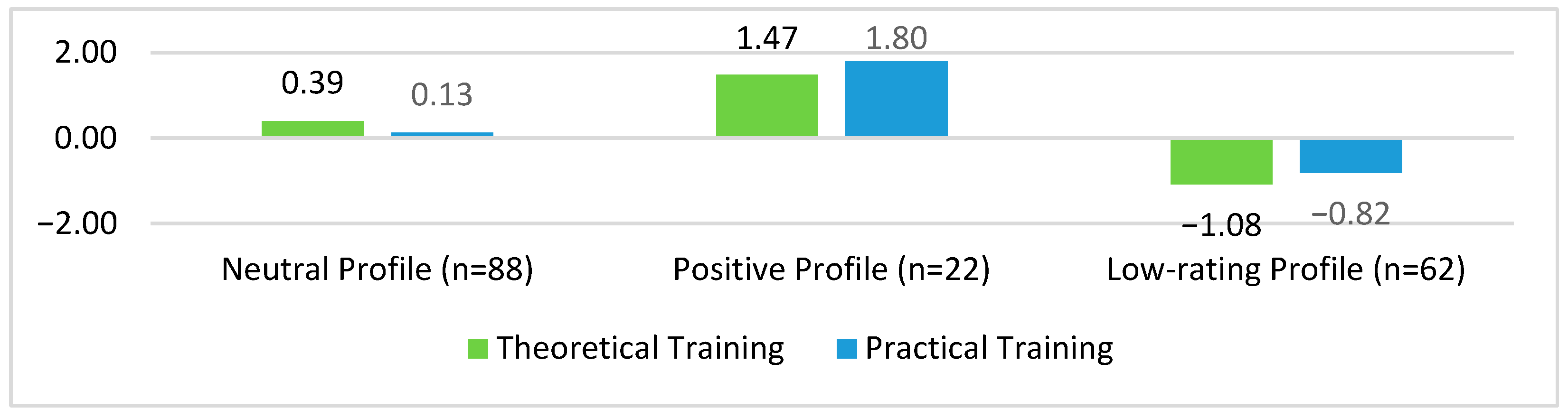
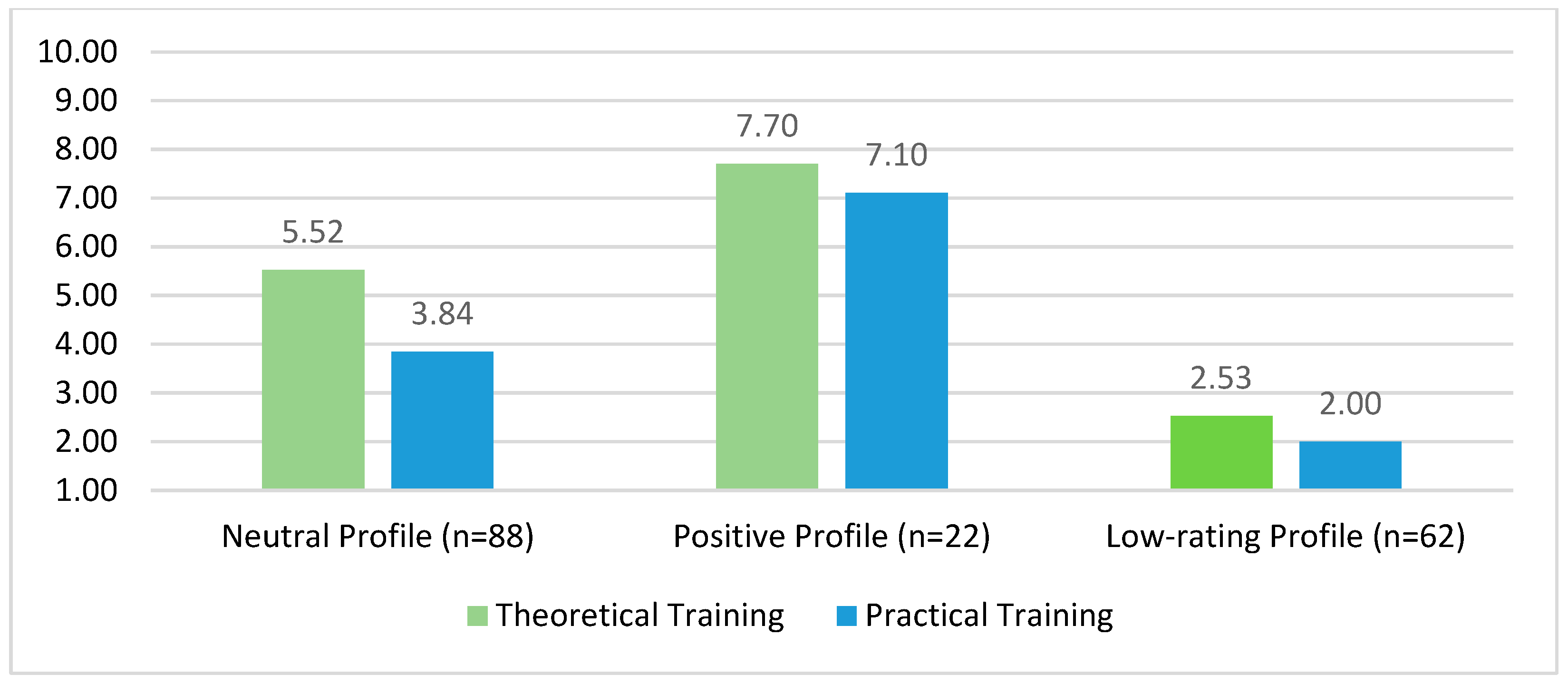
- Profile 1 (n = 88, n = 45 ECE/n = 43 ECE1CBE) represents an intermediate group, providing a moderate evaluation of the training received. It shows relatively low scores on both dimensions, suggesting that participants rated the theoretical and practical training as only slightly above average, with higher scores for theoretical training. In our view, this pattern suggests a cohort that may have encountered core concepts of family–school collaboration but perceives a significant gap in opportunities to develop applied, relational competencies, a gap underscored as critical by contemporary engagement scholars. This group was labelled the Neutral Profile.
- Profile 2 (n = 22, n = 5 ECE/n = 17 ECE1CBE) represents the most positive evaluations of the training received. It has the highest scores among the three profiles. Although these scores are not exceptionally high (around 7/10), they are substantially higher than those of the other profiles, which hover around or below the midpoint. This group likely represents students who perceive their ITE as offering a more balanced and comprehensive introduction to family engagement, integrating theoretical knowledge with practical skill development. This group was labelled the Positive Profile.
- Profile 3 (n = 62, n = 33 ECE/n = 29 ECE1CBE) reflects the lowest evaluations of the TES. It shows negative scores on both dimensions, indicating that participants judged the theoretical and practical training as insufficient. These preservice teachers perceive their training as largely inadequate in providing either the foundational knowledge or the practical tools necessary for engaging families, indicating a potential systematic experience of omission or insufficiency in their curriculum regarding this domain. This group was labelled the Low-rating Profile.
3.2. Differences Between Identified Profiles in Anticipated Difficulties and Self-Efficacy
3.2.1. Anticipated Difficulties in Promoting Family Engagement—Comparative Analysis of the Three Training Profiles
3.2.2. Self-Efficacy in Promoting Family Engagement—Comparative Analysis of the Three Training Profiles
3.2.3. Relationships Between Training, Anticipated Difficulties, and Self-Efficacy
4. Discussion
4.1. Portraits of Preparedness: Critically Interpreting the Training Profiles
4.2. Differences Between Profiles in Anticipated Difficulties and Self-Efficacy
4.3. An Interconnected Cycle: Training, Efficacy, and Anticipated Difficulties
Limitations, Implications and Future Directions
5. Conclusions
Author Contributions
Funding
Institutional Review Board Statement
Informed Consent Statement
Data Availability Statement
Conflicts of Interest
Abbreviations
| FE | Family Engagement |
| ITE | Initial teachers’ education |
| ECE | Early childhood education master’s degree |
| EC1CBE | Early childhood & first cycle of basic education master’s degree |
| TES | Training evaluation scale |
| ADS | Anticipated difficulties scale |
| SES | Self-efficacy scale |
| EFA | Exploratory factor analysis |
| CFA | Confirmatory factor analysis |
| LPA | Latent profile analysis |
| WLSMV | Weighted Least Squares Mean and Variance-adjusted |
| MANOVA | Multivariate Analysis of Variance |
| ANOVA | Analysis of Variance |
References
- Alaçam, N., & Olgan, R. (2018). Pre-service early childhood teachers’ beliefs concerning parent involvement: The predictive impact of their general self-efficacy beliefs and perceived barriers. Education 3-13, 47(5), 555–569. [Google Scholar] [CrossRef] [Scilit]
- Alanko, A. (2018). Preparing pre-service teachers for home–school cooperation: Exploring Finnish teacher education programmes. Journal of Education for Teaching, 44(3), 321–332. [Google Scholar] [CrossRef] [Scilit]
- Amatea, E. S., Mixon, K., & McCarthy, S. (2013). Preparing future teachers to collaborate with families contributions of family systems counselors to a teacher preparation program. The Family Journal, 21(2), 136–145. [Google Scholar] [CrossRef] [Scilit]
- Antony-Newman, M. (2023). Teachers and school leaders’ readiness for parental engagement: Critical policy analysis of Canadian standards. Journal of Teacher Education, 75(3), 321–333. [Google Scholar] [CrossRef] [Scilit]
- Antony-Newman, M. (2024). Preparing teachers for parent engagement: Role of teacher educators in Canada. Educational Review, 77(5), 1422–1438. [Google Scholar] [CrossRef] [Scilit]
- Auerbach, S. (2012). School leadership for authentic family and community partnerships: Research perspectives for transforming practice. Routledge. [Google Scholar]
- Bachman, H. F., & Beard, K. S. (2025). Family engagement efficacy beliefs of educators: Confirming a new measure. Teachers and Teaching, 1–18. [Google Scholar] [CrossRef] [Scilit]
- Bandura, A. (1997). Self-efficacy: The exercise of control. Worth Publishers. [Google Scholar]
- Bandura, A. (2012). On the functional properties of perceived self-efficacy revisited. Journal of Management, 38, 9–44. [Google Scholar] [CrossRef] [Scilit]
- Bauml, M., & Kyzar, K. (2025). “I can do this!” How early childhood teacher education influences preservice teachers’ confidence for teaching. Journal of Early Childhood Teacher Education, 46(2), 345–363. [Google Scholar] [CrossRef] [Scilit]
- Baxter, G., & Kilderry, A. (2022). Family school partnership discourse: Inconsistencies, misrepresentation, and counter narratives. Teaching and Teacher Education, 109, 103561. [Google Scholar] [CrossRef] [Scilit]
- Bronfenbrenner, U. (1979). The ecology of human development: Experiments by nature and design. Harvard University Press. [Google Scholar]
- Bronfenbrenner, U., & Ceci, S. J. (1994). Nature-nurture reconceptualized in developmental perspective: A bioecological model. Psychological Review, 101(4), 568–586. [Google Scholar] [CrossRef] [PubMed]
- Brown, A. L., Harris, M., Jacobson, A., & Trotti, J. (2014). Parent teacher education connection: Preparing preservice teachers for family engagement. The Teacher Educator, 49(2), 133–151. [Google Scholar] [CrossRef] [Scilit]
- Bush, T. (2012). Authenticity in research: Reliability, validity and triangulation. In A. R. J. Briggs, M. Coleman, & M. Morrison (Eds.), Research methods in educational leadership and management (3rd ed., pp. 75–89). Sage. [Google Scholar]
- Castro, M., Expósito-Casas, E., López-Martín, E., Lizasoain, L., Navarro-Asencio, E., & Gaviria, J. L. (2015). Parental involvement on student academic achievement: A meta-analysis. Educational Research Review, 14, 33–46. [Google Scholar] [CrossRef] [Scilit]
- Chen, F., Curran, P. J., Bollen, K. A., Kirby, J., & Paxton, P. (2008). An empirical evaluation of the use of fixed cutoff points in RMSEA test statistic in structural equation models. Sociological Methods & Research, 36(4), 462–494. [Google Scholar] [CrossRef] [Scilit]
- Chung, L.-C., Marvin, C. A., & Churchill, S. L. (2005). Teacher factors associated with preschool teacher-child relationships. Journal of Early Childhood Teacher Education, 25(2), 131–142. [Google Scholar] [CrossRef] [Scilit]
- Cox-Peterson, A. (2011). Educational Partnerships. Connecting schools, families, and the community. SAGE. [Google Scholar]
- Darling-Hammond, L. (2006). Constructing 21st-century teacher education. Journal of Teacher Education, 57(3), 300–314. [Google Scholar] [CrossRef] [Scilit]
- Darling-Hammond, L. (2021). Defining teaching quality around the world. European Journal of Teacher Education, 44(3), 295–308. [Google Scholar] [CrossRef] [Scilit]
- de Bruïne, E. J., Willemse, T. M., D’Haem, J., Griswold, P., Vloeberghs, L., & van Eyende, S. (2014). Preparing teacher candidates for family-school partnerships. European Journal of Teacher Education, 37(4), 409–425. [Google Scholar] [CrossRef] [Scilit]
- de Bruïne, E. J., Willemse, T. M., Franssens, J., van Eynde, S., Vloeberghs, L., & Vandermarliere, L. (2018). Small-scale curriculum changes for improving pre-service teachers’ preparation for family-school partnerships. Journal of Education for Teaching, 44(3), 381–396. [Google Scholar] [CrossRef] [Scilit]
- Duraku, Z. H., Blakaj, V., Likaj, E. S., Boci, L., & Shtylla, H. (2022). Professional training improves early education teachers’ knowledge, skills, motivation, and self-efficacy. Frontiers in Education, 7, 1–11. [Google Scholar] [CrossRef] [Scilit]
- Eccles, J. S., & Harold, R. D. (1993). Parent-school involvement during the early adolescent years. Teachers College Record, 94(3), 568–587. [Google Scholar] [CrossRef] [Scilit]
- Epstein, J. L. (1987). Toward a theory of family-school connections: Teacher practices and parent involvement across the school years. In K. Hurrelmann, F. X. Kaufmann, & F. Losel (Eds.), Social intervention: Potential and constraints (pp. 121–136). DeGruyter. [Google Scholar]
- Epstein, J. L. (2010). School/family/community partnerships: Caring for the children we share. Phi Delta Kappan, 92(3), 81–96, (Original work published 1995). [Google Scholar] [CrossRef] [Scilit]
- Epstein, J. L. (2011). School, family, and community partnerships: Preparing educators and improving schools (2nd ed.). Westview Press. [Google Scholar]
- Epstein, J. L. (2018). School, family, and community partnerships in teachers’ professional work. Journal of Education for Teaching, 44(3), 397–406. [Google Scholar] [CrossRef] [Scilit]
- Epstein, J. L., & Sanders, M. G. (2006). Prospects for change: Preparing educators for school, family, and community partnerships. Peabody Journal of Education, 81(2), 81–120. [Google Scholar] [CrossRef] [Scilit]
- Epstein, J. L., Sanders, M. G., Sheldon, S. B., Simon, B. S., Salinas, K. C., Jansorn, N. R., Van Voorhis, F. L., Martin, C. S., Thomas, B. G., Greenfeld, M. D., Hutchins, D. J., & Williams, K. J. (2019). School, family, and community partnerships: Your handbook for action, fourth edition and handbook CD. Corwin Press. [Google Scholar]
- Epstein, J. L., & Sheldon, S. (2019). The importance of evaluating programs of school, family and community partnerships. Aula Abierta, 48(1), 31–42. [Google Scholar] [CrossRef] [Scilit]
- Evans, M. P. (2013). Educating preservice teachers for family, school, and community engagement. Teaching Education, 24(2), 123–133. [Google Scholar] [CrossRef] [Scilit]
- Fan, X., & Chen, M. (2001). Parental involvement and students’ academic achievement: A meta-analysis. Educational Psychology Review, 13(1), 1–22. [Google Scholar] [CrossRef] [Scilit]
- Flores, M. A. (2024). Fifty years of initial teacher education in Portugal: Looking back, looking forward. Journal of Education for Teaching, 50(5), 852–869. [Google Scholar] [CrossRef] [Scilit]
- Garcia, D. C. (2004). Exploring connections between the construct of teacher efficacy and family involvement practices: Implications for urban teacher preparation. Urban Education, 39(3), 290–315. [Google Scholar] [CrossRef] [Scilit]
- Goodall, J. (2018). Leading for parental engagement: Working towards partnership. School Leadership & Management, 38(2), 143–146. [Google Scholar] [CrossRef] [Scilit]
- Goodall, J., & Montgomery, C. (2014). Parental involvement to parental engagement: A continuum. Educational Review, 66(4), 399–410. [Google Scholar] [CrossRef] [Scilit]
- Graham-Clay, S. (2024). Difficult conversations with parents: Practical skills for teachers. School Community Journal, 34(1), 61–84. [Google Scholar]
- Hascher, T., & Hagenauer, G. (2016). Openness to theory and its importance for pre-service teachers’ self-efficacy, emotions, and classroom behaviour in the teaching practicum. International Journal of Educational Research, 77, 15–25. [Google Scholar] [CrossRef] [Scilit]
- Henderson, A. T., Mapp, K. L., & SEDL National Center for Family and Community Connections with Schools. (2002). A new wave of evidence: The impact of school, family, and community connections on student achievement. Annual synthesis. National Center for Family and Community Connections with Schools. Available online: https://www.scirp.org/reference/referencespapers?referenceid=796577 (accessed on 5 May 2025).
- Hepburn, S.-J., Trompf, M., Hodges, J., MacLeod, L. M., Ma, T., Teng, J., Johnson, A., Boyle, C., & Sanders, M. (2025). Creating a positive home-school partnership through professional learning for teachers—A scoping review of the international literature. Teaching and Teacher Education, 165, 105127. [Google Scholar] [CrossRef] [Scilit]
- Hoover-Dempsey, K. V., & Sandler, H. M. (1995). Parental involvement in children’s education: Why does it make a difference? Teachers College Record, 97(2), 310–331. [Google Scholar] [CrossRef] [Scilit]
- Hoover-Dempsey, K. V., & Sandler, H. M. (1997). Why do parents become involved in their children’s education? Review of Educational Research, 67(1), 3–42. [Google Scholar] [CrossRef]
- Hoover-Dempsey, K. V., Walker, J. M. T., Sandler, H. M., Whetsel, D., Green, C. L., Wilkins, A. S., & Closson, K. (2005). Why do parents become involved? Research findings and implications. The Elementary School Journal, 106(2), 105–130. [Google Scholar] [CrossRef] [Scilit]
- Hornby, G. (2011). Parental involvement in childhood education: Building effective school-family partnerships. Springer. [Google Scholar]
- Hu, L., & Bentler, P. M. (1999). Cutoff criteria for fit indexes in covariance structure analysis: Conventional criteria versus new alternatives. Structural Equation Modeling, 6(1), 1–55. [Google Scholar] [CrossRef] [Scilit]
- Huertas, C. V., & López-Larrosa, S. (2014). Creencias sobre la relación familia-escuela. Cambios en el futuro profesorado tras recibir formación específica. Revista de Estudios e Investigación en Psicología y Educación, 1(2), 111–121. Available online: https://www.redalyc.org/articulo.oa?id=695276974002 (accessed on 19 November 2025). [CrossRef] [Scilit]
- Ishimaru, A. M. (2019). From family engagement to equitable collaboration. Educational Policy, 33(2), 350–385. [Google Scholar] [CrossRef] [Scilit]
- Ishimaru, A. M. (2020). Just schools: Building equitable collaborations with families and communities. Teachers College Press. [Google Scholar]
- Jeynes, W. H. (2007). The relationship between parental involvement and urban secondary school student academic achievement: A meta-analysis. Urban Education, 42(1), 82–110. [Google Scholar] [CrossRef] [Scilit]
- Jeynes, W. H. (2012). A meta-analysis of the efficacy of different types of parental involvement programs for urban students. Urban Education, 47(4), 706–742. [Google Scholar] [CrossRef] [Scilit]
- Jeynes, W. H. (2024). A meta-analysis: The association between increased use of communicative technology and parental involvement and the relationship with academic achievement. Urban Education, 60(6), 1499–1529. [Google Scholar] [CrossRef] [Scilit]
- Jeynes, W. H. (2025). What we now know about parental engagement, which will guide the future. Education and Urban Society, 57(5), 444–461. [Google Scholar] [CrossRef] [Scilit]
- Jones, C. (2020). Don’t forget the parents: Preparing trainee teachers for family–school partnership. Practice, 2(1), 68–85. [Google Scholar] [CrossRef] [Scilit]
- Kenny, D. A., Kaniskan, B., & McCoach, D. B. (2014). The performance of RMSEA in models with small degrees of freedom. Sociological Methods & Research, 44(3), 486–507. [Google Scholar] [CrossRef] [Scilit]
- Kim, S. (2022). Fifty years of parental involvement and achievement research: A second-order meta-analysis. Educational Research Review, 37, 100463. [Google Scholar] [CrossRef] [Scilit]
- Kline, R. B. (2016). Principles and practice of structural equation modeling (4th ed.). Guilford Press. [Google Scholar]
- Mapp, K. L., & Kuttner, P. J. (2013). Partners in education: A dual capacity-building framework for family-school partnerships partners education in A dual capacity-building framework for family-school partnerships. U.S. Department of Education. Available online: https://www.researchgate.net/publication/290447281_Partners_in_Education_A_Dual_Capacity-Building_Framework_for_Family-School_Partnerships (accessed on 17 September 2025).
- Mata, L., Pacheco, P., Brito, A. T., Pereira, M., & Cabral, S. (2022). Envolvimento das famílias no processo educativo: Perspetiva de futuros profissionais. Revista Portuguesa De Educação, 35(2), 263–290. [Google Scholar] [CrossRef] [Scilit]
- Morris, D. B., Usher, E. L., & Chen, J. A. (2017). Reconceptualizing the sources of teaching self-efficacy: A critical review of emerging literature. Educational Psychology Review, 29(4), 795–833. [Google Scholar] [CrossRef] [Scilit]
- Mouraz, A., Leite, C., & Fernandes, P. (2014). A formação inicial de professores em Portugal decorrente do processo de Bolonha: Uma análise a partir do “olhar” de professores e de estudantes. Revista Portuguesa De Pedagogia, 46(2), 189–209. [Google Scholar] [CrossRef] [Scilit] [PubMed]
- Muchnik-Rozanov, Y., & Levin, O. (2024). Bridging the gap between preservice teachers’ theoretical and practical knowledge through simulations of teacher-parent interactions. Asia-Pacific Journal of Teacher Education, 52(5), 622–640. [Google Scholar] [CrossRef] [Scilit]
- Nathans, L., Brown, A., Harris, M., & Jacobson, A. (2020). Preservice teacher learning about parent involvement at four universities. Educational Studies, 48(4), 529–548. [Google Scholar] [CrossRef] [Scilit]
- Petrovic, Z., Clayton, O., Matthews, J., Wade, C., Tan, L., Meyer, D., Gates, A., Almendingen, A., & Cann, W. (2019). Building the skills and confidence of early childhood educators to work with parents: Study protocol for the partnering with parents cluster randomised controlled trial. BMC Medical Research Methodology, 19(1), 197. [Google Scholar] [CrossRef] [Scilit]
- Pushor, D. (2012). Tracing my research on parent engagement: Working to interrupt the story of school as protectorate. Action in Teacher Education, 34(5–6), 464–479. [Google Scholar] [CrossRef] [Scilit]
- Pushor, D. (2015). Walking alongside: A pedagogy of working with parents and family in canada. In International teacher education: Promising pedagogies (Vol. 22B). Emerald Group Publishing Limited. [Google Scholar] [CrossRef] [Scilit]
- Sadownik, A. R., & Višnjić Jevtić, A. (2023). Why a re-theorisation of more-than-parental involvement in ECEC is needed. In A. R. Sadownik, & A. Višnjić Jevtić (Eds.), (Re)theorising more-than-parental involvement in early childhood education and care (pp. 1–19). Springer International Publishing. [Google Scholar] [CrossRef] [Scilit]
- Saltmarsh, S., Barr, J., & Chapman, A. (2015). Preparing for parents: How Australian teacher education is addressing the question of parent-school engagement. Asia Pacific Journal of Education, 35(1), 69–84. [Google Scholar] [CrossRef] [Scilit]
- Sebastian, R., & Paulick, J. (2024). “Build that relationship”: Supporting preservice teachers’ engagement with families. School Community Journal, 34(2), 179–199. Available online: https://files.eric.ed.gov/fulltext/EJ1451060.pdf (accessed on 18 June 2025).
- Skaalvik, E. M., & Skaalvik, S. (2009). Does school context matter? Relations with teacher burnout and job satisfaction. Teaching and Teacher Education, 25(3), 518–524. [Google Scholar] [CrossRef] [Scilit]
- Smith, T. E., & Sheridan, S. M. (2019). The effects of teacher training on teachers’ family-engagement practices, attitudes, and knowledge: A meta-analysis. Journal of Educational and Psychological Consultation, 29(2), 128–157. [Google Scholar] [CrossRef] [Scilit]
- Smith, T. E., Sheridan, S. M., Kim, E. M., Park, S., & Beretvas, S. N. (2020). The effects of family-school partnership interventions on academic and social-emotional functioning: A meta-analysis exploring what works for whom. Educational Psychology Review, 32(2), 511–544. [Google Scholar] [CrossRef] [Scilit]
- Van Nuland, S., Dinitsa-Schmidt, S., Flores, M. A., Hordatt Gentles, C., la Velle, L., & Ruttenberg-Rozen, R. (2024). Changes in teacher education provision: Comparative experiences internationally. Journal of Education for Teaching, 50(2), 341–366. [Google Scholar] [CrossRef] [Scilit]
- Walker, J. M. T., & Dotger, B. H. (2012). Because wisdom can’t be told: Using comparison of simulated parent–teacher conferences to assess teacher candidates’ readiness for family-school partnership: Using comparison of simulated parent–teacher conferences to assess teacher candidates’ readiness for family-school partnership. Journal of Teacher Education, 63(1), 62–75. [Google Scholar] [CrossRef] [Scilit]
- Wertheim, C., & Leyser, Y. (2002). Efficacy beliefs, background variables, and differentiated instruction of Israeli prospective teachers. The Journal of Educational Research, 96(1), 54–63. [Google Scholar] [CrossRef] [Scilit]
- Zeichner, K. (2012). The turn once again toward practice-based teacher education. Journal of Teacher Education, 63, 376–382. [Google Scholar] [CrossRef] [Scilit]



| #No. | Log Likelihood | #df | AIC | BIC | SABIC | LMR | BLRT | VL-LRT | Entropy | SCF |
|---|---|---|---|---|---|---|---|---|---|---|
| 2 | −682.079 | 7 | 1378.158 | 1400.19 | 1378.025 | 0.0425 | <0.001 | 0.0362 | 0.752 | 28.49% |
| 3 | −653.029 | 10 | 1326.058 | 1357.533 | 1325.868 | 0.001 | <0.001 | 0.0006 | 0.833 | 12.79% |
| 4 | −638.941 | 13 | 1303.882 | 1344.799 | 1303.635 | 0.5807 | <0.001 | 0.5663 | 0.827 | 12.79% |
| 5 | −627.348 | 16 | 1286.695 | 1337.055 | 1286.391 | 0.0038 | <0.001 | 0.0029 | 0.857 | 7.56% |
| 6 | −619.724 | 19 | 1277.448 | 1337.25 | 1277.087 | 0.0047 | <0.001 | 0.0034 | 0.88 | 1.16% |
| 7 | −613.837 | 22 | 1271.675 | 1340.92 | 1271.257 | 0.242 | <0.001 | 0.2166 | 0.856 | 1.16% |
| 8 | −605.026 | 25 | 1260.052 | 1338.74 | 1259.577 | 0.1435 | <0.001 | 0.1294 | 0.898 | 1.16% |
| Variable | M | SD | 1 | 2 | 3 | 4 | 5 | 6 |
|---|---|---|---|---|---|---|---|---|
| 1. TES—Theoretical | 4.72 | 2.02 | — | |||||
| 2. TES—Practical | 3.60 | 1.95 | 0.68 ** | — | ||||
| 3. ADS—Communication | 3.50 | 1.62 | −0.05 | 0.13 | — | |||
| 4. ADS—Formal situations & parenting | 4.90 | 1.62 | −0.11 | −0.15 | 0.64 ** | — | ||
| 5. ADS—Differentiated engagement | 4.50 | 1.79 | −0.07 | −0.07 | 0.72 ** | 0.64 ** | — | |
| 6. SES—Self-efficacy | 7.06 | 1.70 | 0.26 ** | 0.18 * | −0.25 ** | −0.34 ** | −0.24 ** | — |
Disclaimer/Publisher’s Note: The statements, opinions and data contained in all publications are solely those of the individual author(s) and contributor(s) and not of MDPI and/or the editor(s). MDPI and/or the editor(s) disclaim responsibility for any injury to people or property resulting from any ideas, methods, instructions or products referred to in the content. |
© 2026 by the authors. Licensee MDPI, Basel, Switzerland. This article is an open access article distributed under the terms and conditions of the Creative Commons Attribution (CC BY) license.
Share and Cite
Cabral, S.; Mata, L.; Peixoto, F. Preparing Pre-Service Teachers for Family Engagement: Perspectives on Training, Challenges and Self-Efficacy. Educ. Sci. 2026, 16, 83. https://doi.org/10.3390/educsci16010083
Cabral S, Mata L, Peixoto F. Preparing Pre-Service Teachers for Family Engagement: Perspectives on Training, Challenges and Self-Efficacy. Education Sciences. 2026; 16(1):83. https://doi.org/10.3390/educsci16010083
Chicago/Turabian StyleCabral, Sónia, Lourdes Mata, and Francisco Peixoto. 2026. "Preparing Pre-Service Teachers for Family Engagement: Perspectives on Training, Challenges and Self-Efficacy" Education Sciences 16, no. 1: 83. https://doi.org/10.3390/educsci16010083
APA StyleCabral, S., Mata, L., & Peixoto, F. (2026). Preparing Pre-Service Teachers for Family Engagement: Perspectives on Training, Challenges and Self-Efficacy. Education Sciences, 16(1), 83. https://doi.org/10.3390/educsci16010083