


Abstract
This paper presents the development of an Impact Framework for STEAM education created as part of a project to support systemic, evidence-based reform. The framework was derived from an extensive synthesis of data collected through policy mapping, national and European strategy reviews, comparative case studies, and three stakeholder consultations with educators, industry representatives, and policymakers. The analysis used thematic synthesis, root cause analysis, and impact mapping to link the identified challenges with their causes, proposed actions, and measurable indicators. The resulting framework is organised into four interconnected domains: Policy and Governance, Institutional Conditions and Infrastructure, Educator Competence and Resources, and Collaboration Ecosystem, each linked to specific stakeholders, proposed solutions, and anticipated benefits. By consolidating diverse evidence into a coherent logic chain, the framework provides a practical and adaptable tool for guiding reforms that strengthen the coherence, inclusivity, and sustainability of STEAM education across various contexts.
1. Introduction
Across Europe, STEAM education is increasingly recognised as a catalyst for innovation, sustainability, and inclusive growth. By blending science, technology, engineering, the arts, and mathematics into interdisciplinary learning, it has the potential to equip learners with transversal competences such as problem-solving, creativity, systems thinking, and collaboration, skills essential for addressing complex societal and economic challenges (Zhang & Jia, 2024; Chappell et al., 2025). A growing body of research emphasises its transformative capacity not only in enhancing academic outcomes, but also in fostering civic engagement, industry readiness, and social equity (Nyaaba et al., 2024; Carter et al., 2021; Allina, 2018; Perales & Aróstegui, 2024).
However, despite its strategic importance, the adoption of STEAM education remains uneven and fragmented. Most national reforms have concentrated on subject-specific curriculum updates or isolated pilot projects, rather than fully embedding STEAM principles into educational ecosystems (Mazzeo-Ortolani, 2025). This fragmentation is reflected in divergent definitions of STEAM, inconsistent levels of integration across disciplines, and a lack of common quality standards (European Commission, 2025; Belbase et al., 2022). Without a coherent, system-wide approach that links policy design, institutional structures, teacher professional development, and cross-sector collaboration, STEAM risks remaining a collection of isolated initiatives rather than a sustained driver of transformation (Chappell et al., 2025; Anisimova et al., 2018).
Persistent barriers are well-documented in the literature: limited infrastructure and resources (Herro et al., 2019; Spyropoulou et al., 2025), insufficient professional development opportunities (Spyropoulou & Kameas, 2024; Milara & Orduña, 2024), weak school–industry collaboration (Watters et al., 2016), underrepresentation of women and other marginalised groups in STEAM fields (Meoli et al., 2024; Charlesworth & Banaji, 2019; Kricorian et al., 2020), and the lack of inclusive pedagogical strategies for learners with disabilities (Ariza & Hernández Hernández, 2025; Andrés et al., 2025). These challenges, combined with the absence of robust monitoring and evaluation mechanisms (Pokropek, 2024), limit the scalability of good practices and impede systemic reform.
This study responds to that need by presenting a multi-level Impact Analysis Framework for STEAM education. Developed within the The SEER project (Horizon), the framework links empirical evidence to policy-relevant actions at the macro (policy and governance), meso (institutional and organisational), and micro (classroom and pedagogical) levels. The Framework synthesises findings from policy mapping, stakeholder engagement, and best practice analysis to define strategic priorities for STEAM adoption in Europe, while translating this strategic vision into operational, measurable pathways for change. Drawing on data from project results, including surveys, focus groups, and case studies, the framework connects systemic gaps to root causes, enabling conditions, and impact indicators.
This article advances the discussion on systemic STEAM reform by:
- Presenting an Impact Analysis Framework that aligns with European and national strategic goals.
- Demonstrating how identified systemic gaps can be linked to root causes, enabling conditions, and measurable impact indicators.
- Offering actionable guidance for policymakers, institutional leaders, and educators seeking to drive coherent, long-term change.
2. Materials and Methods
2.1. Methodology
To evaluate the potential for systemic transformation of STEAM education in Europe, this study applies a structured impact analysis methodology that integrates principles from logic models, theory of change, and contribution analysis. This combined approach enables mapping of causal relationships between identified challenges and anticipated outcomes in both policy and practice. It is particularly suited to complex education systems, where change depends on multiple interacting factors and diverse stakeholders. The approach begins with logic modelling to articulate the causal sequence linking inputs, activities, outputs, short- and medium-term outcomes, and long-term systemic impacts (Funnell & Rogers, 2011). This provides both a visual and conceptual representation of the change pathway. Theory of change is then applied to make explicit the underlying assumptions, contextual factors, and enabling conditions required for these pathways to be effective (Connell & Kubisch, 1998). Complementing these, contribution analysis assesses the plausibility that the identified actions and enabling conditions will lead to the intended outcomes, even in non-linear and multi-actor environments (Mayne, 2017). This methodological triangulation aligns with the EU Better Regulation Toolbox1, which promotes evidence-based and impact-oriented policymaking grounded in stakeholder engagement and measurable indicators.
2.2. Data Sources
This research is based on the analysis of the deliverables and outcomes of the European programme’s three work packages. WP1 results included policy mapping and comparative analysis of national STEAM strategies and frameworks. Specifically, an extensive report on STEAM education was utilised, which encompassed a review of literature, practices, and EU STEAM policies, as well as a qualitative analysis of funded STEAM programmes, drawing on eight national case studies and the analysis of more than 800 STEAM-related projects. WP2 results comprised reports from case studies, seminars, and focus groups involving various stakeholders, including 10 focus groups and 5 thematic seminars. In addition, WP3 included research through three targeted surveys designed to identify challenges, needs, collaboration patterns, and stakeholder perspectives on STEAM education, covering pre-service and in-service teachers, policymakers, and industry representatives. These surveys engaged over 700 educators, more than 30 industry representatives, and participants from six policy-focused country cases. The instruments examined perceived needs, collaboration practices, and systemic barriers associated with implementing STEAM education. In addition to identifying competence gaps and resource limitations, WP3 provided insight into how educators interpret and apply STEAM approaches in their daily practice, as well as how stakeholders perceive the future potential and barriers to STEAM integration. The detailed design and statistical results of these instruments are presented in the project deliverables. This study builds upon these validated datasets to develop and apply the STEAM Impact Framework. Thus, the findings served as a key evidence base for defining impact domains and indicators, enabling the development of a grounded and stakeholder-informed framework. The deliverables are available on the project website.2
2.3. Data Analysis
This study employed the thematic analysis approach (Clarke & Braun, 2014) to analyse and code the results derived from the deliverables of the European project. Initially, the key findings of each deliverable were coded separately, focusing on areas such as inclusion, curriculum coherence, teachers’ professional development, infrastructure, funding opportunities, and industry collaboration. Subsequently, cross-report triangulation was conducted to verify the consistency of the findings. Once the thematic categories were defined, they were revised and grouped to reflect the structural areas relevant for policy reform and system transformation.
The analytical process commenced with a thematic synthesis of qualitative and quantitative data derived from surveys, policy mapping, and case studies. Following Clarke and Braun’s (2014) six-phase model, the process involved iterative familiarisation with the dataset, generation of initial codes, organisation of codes into candidate themes, and refinement of these themes to ensure conceptual clarity and consistency. By systematically coding evidence across multiple data sources, recurring patterns of challenges, enablers, and systemic needs were identified while preserving stakeholder-specific nuances.
To move beyond surface-level descriptions, a modified root cause analysis was conducted, drawing inspiration from the “5 Whys” technique (Gangidi, 2019), which was adapted to account for the complexity of education systems. This adaptation enabled the identification of deeper structural and cultural drivers, such as fragmented governance, short-term funding cycles, or misaligned teacher training frameworks, that underpin more visible barriers like insufficient infrastructure or lack of instructional resources. By distinguishing proximate issues from their root causes, this stage provided a diagnostic foundation for subsequent solution design.
The final analytical phase applied impact mapping to connect each identified challenge and its underlying cause with targeted interventions, relevant stakeholder groups, desired systemic changes, and measurable indicators. This approach, inspired by established logic modelling and theory of change practices (Funnell & Rogers, 2011; Mayne, 2017), provides a structured way to visualise how specific actions contribute to broader educational outcomes. Each challenge was therefore linked to its root cause, associated stakeholders, proposed solutions, anticipated benefits, and indicators for monitoring progress and impact.
The STEAM impact indicators were developed through a comprehensive review of relevant European frameworks, complemented by literature on competence frameworks and studies proposing specific STEAM-related indicators (National Research Council, 2013; Means et al., 2015; Kim & Kim, 2016; National Science Board, 2023; Ussher et al., 2023; Redd et al., 2024; Spyropoulou & Kameas, 2024). Based on this synthesis, the proposed indicators were organised into four interrelated categories. Student Outcomes include indicators related to cognitive skills, socio-emotional development, and transversal competences such as creativity, collaboration, and problem-solving. Teacher Development focuses on professional learning, self-efficacy, and the transformation of teaching practices. Educational System indicators capture dimensions such as resource allocation, policy support, and mechanisms for programme monitoring and improvement. Finally, Broader Societal Impact indicators address increased interest in STEAM careers, enhanced community engagement and partnerships, and contributions to innovation, sustainability, and social well-being. Together, these categories provide a structured and measurable approach for assessing systemic change in STEAM education across levels. The outcome of this process was a STEAM Impact Analysis Matrix, in which each row represents a complete logic chain linking all the aforementioned factors.
3. Results
This section presents the results following the analytical sequence outlined in Section 2.3. The findings are organised according to the main stages of the analysis: thematic synthesis, root cause analysis, and impact mapping. Each subsection builds on the previous one, illustrating how the identified challenges were synthesised into systemic gaps, linked to their underlying causes, and translated into actionable components of the Impact Framework.
3.1. Challenges and Gaps
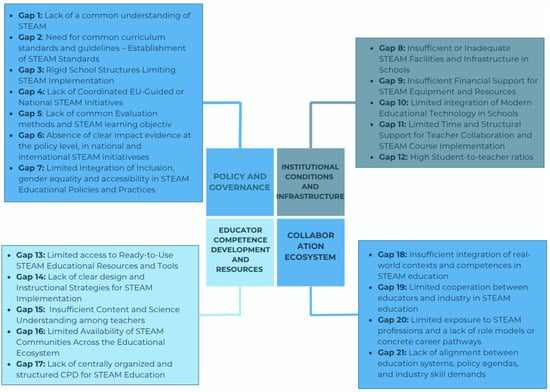
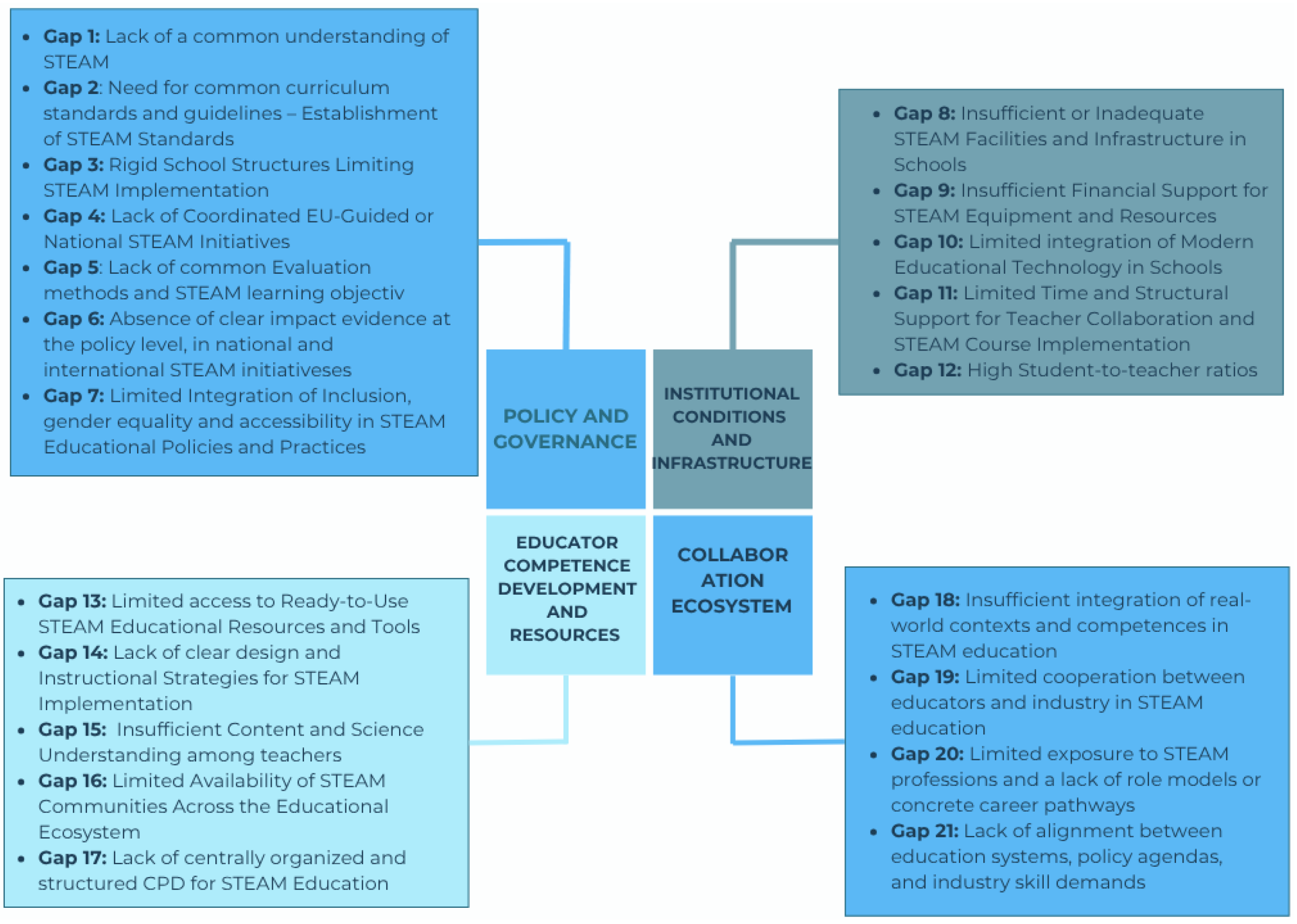
Based on the analysis of the overall reports and deliverables from multiple Work Packages, STEAM education across the European Union appears to face several persistent challenges and systemic gaps. These challenges appear to both reveal the existing gaps in STEAM education and highlight proposals and actions that can lead to the desired outcomes. These challenges (or gaps) represent the first analytical step described in Section 2.3, which involves identifying systemic barriers that hinder the effective implementation of STEAM education. The overall aim of the research was to develop an Impact Framework that suggests actions and changes based on systematic research findings. This section presents the identified challenges and needs, grouped into four domains of change: Policy and Governance, Institutional Conditions and Infrastructure, Educator Competence Development and Resources, and Collaboration Ecosystem. In total, 21 gaps were identified and are summarised in Figure 1. Each domain highlights specific issues and examples drawn from triangulated data, illustrating how the findings connect to the structure of the Impact Framework.
Figure 1.
Impact Analysis Framework—Domain categories and system gaps for STEAM education.
The Policy and Governance domain concerns the overarching frameworks and strategic orientations that guide how STEAM education is interpreted and implemented across Europe. The analysis reveals inconsistencies in policy alignment and fragmented governance structures that prevent coherent scaling and sustainability. Persistent issues include the absence of shared curriculum standards, limited integration of European and national strategies, and insufficient mechanisms for long-term monitoring and evaluation. Stakeholders emphasise the need for more coordinated frameworks that balance flexibility with common principles, thereby ensuring greater policy coherence and a long-term commitment to STEAM reform.
The Institutional Conditions and Infrastructure domain addresses the organisational and operational settings that shape how STEAM education functions at the school level. Gaps in this area relate to inadequate learning environments, rigid timetabling, and unequal access to resources. Many schools still lack well-equipped laboratories, makerspaces, and adaptable classroom settings that allow for hands-on, project-based learning. Strengthening institutional capacity and ensuring equitable access to physical and digital infrastructure are key prerequisites for enabling meaningful interdisciplinary teaching and learning.
The Educator Competence Development and Resources domain focuses on the professional learning needs of educators, as well as their access to pedagogical tools and peer networks that support effective STEAM implementation. Across Europe, professional development opportunities remain fragmented, often short-term, and not tailored to interdisciplinary contexts. Limited collaboration with higher education and industry further restricts teachers’ exposure to current STEAM practices. Structured, sustained, and inclusive professional development, supported by open resources and communities of practice, is necessary to empower teachers as central agents of educational change.
Finally, the Collaboration Ecosystem domain highlights the persistent disconnect between formal education systems and real-world contexts, including labour markets, cultural sectors, and innovation ecosystems. Many educators lack opportunities or institutional mechanisms to engage with external partners, which limits students’ exposure to authentic, practice-based STEAM learning. Establishing long-term partnerships and cross-sector collaborations can strengthen relevance, innovation, and inclusion, ensuring that STEAM education remains responsive to societal and economic needs across Europe. The relative emphasis of each gap was established through triangulated qualitative analysis, drawing on survey responses, interviews, and policy mapping results. While the framework does not quantify frequency, recurring patterns across multiple stakeholder groups, particularly in areas of policy coherence, teacher professional development, and infrastructure, indicate that these challenges were consistently prioritised and widely recognised throughout the dataset.
3.2. Root Causes
Following the identification of the challenges and gaps in STEAM education, the next stage of the analysis focused on uncovering their underlying causes, corresponding to the second analytical point described in Section 2.3. This step was essential for moving beyond surface-level descriptions and developing a deeper understanding of the systemic factors shaping current conditions. The root cause analysis provided the foundation for designing targeted, scalable, and sustainable interventions that address not only the barriers themselves but also why they persist. The analysis situates these causes within a three-level structure, macro, meso, and micro, reflecting their interconnected nature.
At the macro level, root causes are linked to European and national strategies, governance mechanisms, and funding models. They include fragmented policy coordination, short-term project-based funding, limited monitoring and evaluation systems, and insufficient strategic alignment between education, innovation, and employment policies. These conditions contribute to conceptual fragmentation and hinder the sustainability of STEAM initiatives across Member States.
At the meso level, institutional and organisational barriers are evident. Common issues include rigid school timetables, limited financial and infrastructural resources, weak leadership support, and a lack of mechanisms for cross-sector collaboration. Together, these factors restrict opportunities for co-teaching, team planning, and hands-on learning, conditions necessary for effective STEAM implementation.
At the micro level, root causes relate to teachers’ daily practice, competences, and confidence. Educators often report low self-efficacy in designing interdisciplinary lessons, insufficient exposure to inquiry-based approaches, and limited access to continuous professional development and peer networks. Traditional assessment practices that prioritise memorisation over creativity, systems thinking, and collaboration further reinforce these challenges.
By examining these interrelated levels together, the analysis highlights how macro-level policy fragmentation cascades into institutional constraints and classroom realities, underscoring the need for coherent, multi-level strategies for change.
3.3. Enabling Conditions
This section corresponds to the third step of the analysis described in Section 2.3, focusing on the enabling factors that support the transition from identified challenges and root causes to systemic change. While the previous sections examined barriers and their origins, this stage identifies the cross-cutting conditions that must be in place for sustainable STEAM transformation. These enabling factors act as the connecting element in the logic chain, linking causes with potential actions and outcomes, and are relevant across macro, meso, and micro levels.
Strategic policy coherence and long-term planning are fundamental prerequisites for effective STEAM reform. Sustainable change depends on coherent national frameworks, cross-ministerial collaboration, and stable funding mechanisms that align with European policy objectives, such as those of the European Commission and the European Education Area. These efforts can help ensure stronger coordination between European and national initiatives, as well as greater stakeholder confidence in the long-term implementation.
Another key enabler is curricular flexibility and pedagogical autonomy. Rigid curricula and assessment systems frequently inhibit interdisciplinary teaching. Flexible curriculum guidelines, recognition of co-teaching, and assessment frameworks that value transversal competences may support local adaptation, experimentation, and learner-centred innovation.
Teacher empowerment and sustained professional development are equally critical. Data indicate the need for structured, ongoing CPD aligned with STEAM competences, supported by peer mentoring, co-design opportunities, and collaboration with teacher education institutions and industry partners. Such initiatives can enhance educators’ confidence, competence, and collaboration capacity.
At the institutional level, inclusive school cultures and supportive leadership create the environment necessary for innovation. Training school leaders in inclusive, interdisciplinary approaches and embedding STEAM goals into institutional development plans can foster a shared responsibility and promote continuous improvement.
Finally, cross-sectoral partnerships and community engagement represent a cornerstone of long-term impact. Systemic collaboration among schools, industry, and communities can strengthen the real-world relevance of STEAM learning, enrich resources, and enhance career awareness and opportunities. To ensure that these partnerships evolve and remain effective, monitoring, evaluation, and the effective use of data are essential. Developing meaningful indicators and feedback mechanisms allows policymakers and schools to assess progress and adjust strategies based on evidence.
3.4. STEAM Education Impact Analysis Matrix
Building on the previous analytical steps, this section introduces the STEAM Education Impact Analysis Matrix, which consolidates the findings into an integrated model of systemic change. As illustrated in Figure 1, the matrix is organised into four interrelated domains: Policy and Governance, Institutional Conditions and Infrastructure, Educator Competence Development and Resources, and Collaboration Ecosystem.
Each domain includes a logical sequence that connects identified challenges to root causes, relevant stakeholders, proposed actions, and measurable indicators. This structure provides a coherent overview of how evidence-based interventions can contribute to progress across different levels of the education system. The matrix thus functions as both a diagnostic tool, highlighting structural weaknesses, and a planning instrument that supports policymakers, institutions, and practitioners in aligning actions with intended outcomes. A detailed description of the corresponding indicators and examples of implementation mechanisms is provided in Appendix A. The main text focuses on presenting the overall structure and logic of the framework, allowing for a clear understanding of how challenges translate into targeted reforms and measurable change.
3.4.1. Domain: Policy and Governance
The analysis reveals that many Member States still lack a shared definition of STEAM, common curriculum standards or objectives, and coordinated mechanisms to integrate European initiatives, such as the Digital Education Action Plan, the European Education Area, GreenComp, and the STEM Education Strategic Plan, into national policy agendas. Other systemic issues include rigid school structures that restrict interdisciplinary approaches, limited coordination of EU-guided and national STEAM initiatives, the absence of common evaluation frameworks, insufficient evidence of impact at the policy level, and underdeveloped strategies for inclusion, gender equality, and accessibility. For example, schools may wish to strengthen STEAM education or to establish collaborations with other organisations. However, this is often not feasible due to the lack of collaboration opportunities and the rigidity of the school structures. In such cases, both educators and schools are discouraged from participating in STEAM initiatives.
Table 1 presents the Policy and Governance domain of the Impact Framework in full, illustrating how each identified challenge is connected to a complete logic chain from evidence to measurable outcomes.
Table 1.
STEAM Impact Analysis Matrix for Policy and Governance Domain.
3.4.2. Domain: Institutional Conditions and Infrastructure
The second domain of the Impact Analysis Matrix focuses on Institutional Conditions and Infrastructure, encompassing the organisational, physical, and digital environments in which STEAM education takes place. While policy frameworks provide strategic direction, schools and universities are where implementation occurs, and where enabling or constraining factors most tangibly influence teaching and learning. Across Europe, institutional barriers persist in hindering the delivery of inclusive and high-quality STEAM education. Many schools lack adequately equipped laboratories, makerspaces, and adaptable classrooms that support experimentation and collaboration. Limited funding, uneven resource allocation, and administrative rigidity often amplify disparities, especially in rural or under-resourced regions.
Additionally, inflexible timetables and high student–to–teacher ratios limit opportunities for interdisciplinary teaching and peer collaboration. For instance, a school aiming to introduce robotics or sustainability projects may face challenges due to the absence of suitable lab space, limited technical equipment, or insufficient time for teachers to collaborate on planning.
The Impact Matrix (Table 2) captures such examples by tracing each challenge to its underlying cause, the relevant stakeholders involved, and the corresponding actions. It also includes indicators such as improvements in teacher collaboration, infrastructure investment, and student engagement, illustrating how the framework can be used to monitor systemic progress over time.
Table 2.
STEAM Impact Analysis Matrix for Institutional Conditions and Infrastructure Domain.
3.4.3. Educator Competence Development and Resources
The third domain of the Impact Analysis Matrix highlights that teachers are the key drivers of meaningful change in STEAM education. No policy or infrastructure investment can succeed without educators who are confident, well-supported, and equipped to implement interdisciplinary and inclusive practices. The analysis reveals that many teachers are eager to innovate, but they face persistent structural and professional barriers. Gaps in both initial and continuous teacher education limit their ability to integrate STEAM approaches effectively. Continuous Professional Development (CPD) opportunities are often fragmented, short-term, or generic, offering little focus on interdisciplinary teaching, design-based learning, or digital and sustainability competences. Teachers also report challenges in accessing quality-assured, ready-to-use teaching materials and in connecting theoretical knowledge to real-world contexts. Furthermore, peer learning and mentoring structures, such as Communities of Practice, remain limited and unsystematic, which reduces opportunities for collaboration and professional growth.
For instance, a teacher aiming to combine mathematics, art, and coding into a robotics project may lack not only the necessary resources but also the peer and institutional support to sustain such an initiative. This example illustrates the close interdependence between competence development and access to pedagogical tools.
The Impact Matrix (Table 3) captures these dynamics by linking each identified gap to its underlying causes, key stakeholders, and targeted interventions. It proposes actions such as embedding STEAM competences into teacher education programmes, expanding structured CPD provision, and creating shared repositories of teaching resources. The corresponding indicators enable policymakers and institutions to monitor progress through improvements in teacher confidence, collaboration, and the quality of classroom implementation.
Table 3.
STEAM Impact Analysis Matrix for Educator Competence Development and Resources Domain.
3.4.4. Domain: Collaboration Ecosystem
The fourth domain links STEAM education with industry, research, and real-world contexts. While many schools across Europe have made efforts to introduce workplace relevance into their teaching, findings show that these connections often remain limited, ad hoc, and overly dependent on individual teacher initiatives rather than being embedded within national strategies or school structures. The gap between classroom learning and real-life application is one of the most persistent systemic barriers to delivering meaningful, competence-based STEAM education. Too often, curricula emphasise theoretical knowledge without offering sufficient opportunities for students to engage with authentic challenges, industry-standard tools, or professional role models. This disconnect not only weakens student engagement and motivation but also limits their understanding of the diverse career pathways that STEAM fields can offer.
Across the data sources, several interrelated challenges emerged: weak partnerships between schools and industry, minimal exposure of students to STEAM professions, outdated curricula misaligned with current labour market needs, and a lack of structured opportunities for educators to interact with real-world practices. In many cases, teachers reported limited access to practically applicable resources or professional development activities that would enable them to integrate workplace contexts into their lessons. At the same time, industry stakeholders highlighted missed opportunities for co-developing curricula, offering internships, and shaping competences that are directly relevant to the future workforce. For example, a secondary school may run an occasional STEAM career day, but without sustained collaboration with local companies, universities, and research centres, students’ exposure to professional STEAM contexts remains superficial. Similarly, while some EU projects, such as “STE(A)MIT”, have created job profile platforms, these resources are not yet universally adopted or systematically integrated into school programmes.
The Impact Matrix (Table 4) for this domain brings together the identified gaps and root causes, along with proposals for strengthening the collaboration ecosystem. Suggested actions include developing long-term school–industry partnerships, embedding real-world competences into curricula, establishing accessible career platforms, and aligning education systems more closely with labour market needs. Together, these measures provide a structured basis for policymakers, educators, and industry actors to co-create meaningful and sustainable collaboration models.
Table 4.
STEAM Impact Analysis Matrix for Collaboration Ecosystem Domain.
4. Discussion and Implications
This study contributes to ongoing efforts to strengthen science and STEAM education by proposing a structured and action-oriented Impact Framework that bridges empirical evidence with systemic policy and practice reform. While the challenges identified, such as fragmented governance, limited teacher training, and weak school–industry collaboration, are not new, the innovation of this work lies in its ability to connect these longstanding issues within a coherent, multi-level logic chain that links root causes to actionable and measurable solutions. In doing so, this study builds on and extends the legacy of major European reform initiatives such as Science Education Now: A Renewed Pedagogy for the Future of Europe (Rocard et al., 2007) and Science Education in Europe: Critical Reflections (Osborne & Dillon, 2008), which highlighted the urgent need to renew science teaching through inquiry-based pedagogy, strengthen teacher professional development, and promote greater policy coherence across Member States. It further aligns with recent European policy developments that emphasise interdisciplinarity, competence-based learning, and inclusion—principles that underpin current strategic priorities, including the STEM Education Strategic Plan (European Commission, 2025), the Education and Training Monitor (European Commission, 2024), and the JRC Guide on STEM and STEAM Integration (Mazzeo-Ortolani, 2025). Complementary research by the European Commission’s Joint Research Centre (Pokropek, 2024) and recent frameworks (Carter et al., 2021; Chappell et al., 2025) highlight similar priorities: connecting policy and pedagogy through innovation, interdisciplinarity, and teacher empowerment.
Beyond policy, the need for inclusive and socially responsive STEAM learning environments has been well documented (Milanovic et al., 2023; Nyaaba et al., 2024; Spyropoulou et al., 2024). Studies continue to reveal persistent gender imbalances and barriers for students with disabilities (Meoli et al., 2024; Charlesworth & Banaji, 2019; Kricorian et al., 2020; Ariza & Hernández Hernández, 2025; Andrés et al., 2025). By integrating these strands, the Impact Framework extends previous reform calls by providing a systemic and measurable model that links policy intent with implementation mechanisms and evaluation processes. It thus contributes to bridging a long-standing gap between research-based recommendations and the operational realities of European education systems. In addition, by embedding stakeholder perspectives, it also reflects a bottom-up understanding of gaps and priorities, translating these into a shared framework for coordinated action at all levels.
4.1. Urgent and Cross-Cutting Priorities
The analysis highlights three priority domains requiring immediate action:
- Policy Coherence and Shared Frameworks: The absence of a common definition and coherent curriculum standards continues to fragment STEAM implementation across Europe. Addressing this gap is urgent because it underpins all other challenges. A shared European framework, anchored in competence development and inclusive design, would facilitate alignment between policy, teacher education, and classroom practice (Mazzeo-Ortolani, 2025).
- Teacher Empowerment and Professional Learning: Evidence shows that teachers remain the most critical agents of change, yet they often operate without structured professional pathways or adequate resources (Chappell et al., 2025; Spyropoulou et al., 2025). Immediate investment in national and regional continuous professional development (CPD), coupled with collaborative models such as Communities of Practice, can accelerate change within existing systems (Spyropoulou & Kameas, 2024).
- Institutional Conditions and Infrastructure: Many schools still lack modern laboratories, flexible timetables, or resources necessary for project-based learning (Milanovic et al., 2023). Investment in equitable access to infrastructure—both physical and digital—must accompany pedagogical reform, as technical capacity directly influences teacher innovation and student engagement.
- Collaboration Ecosystem: Collaboration with industry, education and research institutions remains weak and uneven, despite its proven impact on relevance and learner engagement (Watters et al., 2016; Allina, 2018). Embedding partnerships into school structures, rather than treating them as project-based add-ons, can make STEAM learning more authentic and sustainable.
These priority areas interact dynamically: policy coherence sets the conditions, educator support enables implementation, and real-world collaboration sustains innovation. Addressing them simultaneously can yield greater system-wide efficiency than tackling them in isolation.
4.2. Implications for Practice and Policy
At a conceptual level, the Impact Framework provides a novel structure for understanding STEAM reform as a multi-level ecosystem rather than a sequence of isolated interventions. It translates the complexity of educational change into a usable model that articulates causal pathways from evidence to impact. The logic chain approach, linking gaps, causes, actions, benefits, and indicators, provides both diagnostic and planning value. This systematic approach distinguishes the framework from previous mapping or policy reviews by offering a direct bridge between research and actionable policy.
Practically, the framework’s design enables adaptation at multiple levels:
- At the policy level, it can inform the revision of national strategies, ensuring alignment with European initiatives such as the STEM Education Strategic Plan (European Commission, 2025).
- At the institutional level, schools and universities can apply it to prioritise reforms in leadership, timetabling, and infrastructure that facilitate interdisciplinary work.
- At the educator level, it provides a reference for aligning CPD, curriculum design, and classroom implementation with broader systemic goals.
- At the industry level, it supports the design of sustainable partnerships that extend learning beyond the classroom, fostering innovation and employability skills.
4.3. Towards Scalable and Sustainable Change
The findings highlight the need for immediate and coordinated action across all levels of the education system. At the European level, expert working groups could support the harmonisation of frameworks and assessment tools. At the national level, ministries could use the framework to identify structural bottlenecks and monitor policy coherence. At the institutional level, leadership development, flexible timetabling, and equitable resource allocation are essential. At the classroom level, teachers must be equipped to design interdisciplinary, inclusive, and inquiry-driven learning experiences that foster student engagement and learning.
In essence, the Impact Framework offers both a conceptual lens and a practical roadmap for future reform. It does not claim to solve persistent challenges overnight, but it provides a structured, evidence-informed mechanism to connect policy ambition with educational reality. By translating stakeholder insights into a common language of action and impact, it enables countries, institutions, and educators to move from fragmented experimentation to strategic, system-wide transformation.
5. Limitations and Next Steps
While the Impact Framework offers a comprehensive and evidence-based approach to driving systemic change in STEAM education, several limitations should be acknowledged. First, the work was developed as part of the The SEER project, drawing on data collected through its defined scope, time frame, and stakeholder networks. As such, the representation of some countries, regions, or demographic groups may be uneven, and the findings reflect the contexts and priorities captured during the project’s lifecycle. Nevertheless, this represents a first attempt to consolidate diverse strands of evidence, policy analysis, stakeholder consultation, and practitioner perspectives into a single, coherent framework that spans macro, meso, and micro levels. In doing so, it provides a foundation for further refinement and validation. Second, while the framework identifies measurable indicators, these have yet to be tested to assess their predictive validity and practical applicability across diverse educational contexts.
It should also be noted that the framework was developed within a European policy context, shaped by agendas such as the European Education Area and the Digital Education Action Plan. These priorities may reflect a competence-based, innovation-oriented ideology consistent with EU strategies. Additionally, while the framework recommends greater coherence and shared standards in STEAM education, it is important to acknowledge that curriculum traditions across Europe vary significantly. Some national curricula are prescriptive and detailed, whereas others are open and outcome-based, granting teachers greater autonomy. These structural and cultural differences are deeply rooted and not easily harmonised. As such, future adaptation of the framework should remain sensitive to national curriculum philosophies, balancing standardisation with local flexibility and professional discretion.
Future applications should therefore test the framework’s adaptability across different cultural and policy contexts to ensure inclusivity and global relevance. Future research should pilot and refine the framework across various settings, assess the validity of indicators, and further explore the mechanisms that support sustained collaboration among education, policy, and industry.
6. Conclusions
This study developed and presented the Impact Analysis Framework as a practical, evidence-based tool to support the systemic transformation of STEAM education in Europe. Grounded in triangulated data from educators, policymakers, industry stakeholders, and comprehensive policy and practice mapping, the Framework connects identified gaps and root causes to targeted stakeholder actions, anticipated benefits, and measurable indicators. Its multi-level design, spanning macro, meso, and micro dimensions, ensures that recommendations address both structural reform and the day-to-day realities of teaching and learning. Within this structure, the Impact Analysis Matrix serves as the operational component of the Framework, translating its conceptual model into a practical tool that visually maps the relationships between challenges, causes, actions, and indicators. Together, the Framework and the Matrix provide a coherent mechanism for aligning evidence, policy, and practice.
The value of this approach lies in its ability to bridge strategy and implementation, offering policymakers a roadmap for coherent reform, curriculum designers clear guidance for aligning content with real-world competences, and educators actionable pathways for enhancing pedagogy and professional growth. By emphasising shared definitions, robust infrastructure, inclusive practices, and industry engagement, the Framework directly addresses stakeholder-identified needs and aligns with EU education priorities such as the Digital Education Action Plan, the European Education Area, and the STEM Education Strategic Plan.
Ultimately, achieving meaningful and sustainable change in STEAM education will require coordinated action across all levels of the system, supported by continuous monitoring and adaptive learning. The STEAM Impact Framework provides a foundation for such action, linking evidence to strategy, and strategy to impact, while inviting further research and collaboration to refine, adapt, and scale its use. Through this approach, STEAM education can evolve from a collection of isolated initiatives into a coherent, inclusive, and future-oriented component of European education systems.
Author Contributions
Conceptualization, N.S.; methodology, N.S.; software, N.S. and M.I.; validation, N.S., M.I. and A.K.; formal analysis, N.S. and M.I.; investigation, N.S.; resources, N.S. and M.I.; data curation, N.S. and M.I.; writing—original draft preparation, N.S. and M.I.; writing—review and editing, N.S., M.I. and A.K.; visualization, N.S. and M.I.; supervision, A.K.; project administration, N.S.; funding acquisition, A.K. All authors have read and agreed to the published version of the manuscript.
Funding
This research and APC were (co)funded by the HORIZON program of the European Commission: The SEER (STE(A)M Education European Roadmap) and grant number 101058569. Views and opinions expressed are, however, those of the author(s) only and do not necessarily reflect those of the European Union or European Commission. Neither the European Union nor the granting authority can be held responsible for them.
Institutional Review Board Statement
Not applicable.
Informed Consent Statement
Not applicable.
Data Availability Statement
The research builds upon data already collected and reported within the official deliverables of the The SEER project. The data presented in this study are available in https://www.scientix.eu/community/partner-projects/the-seer/publications (accessed on 9 November 2025).
Acknowledgments
We would like to thank all SEER partners for their collaboration and support throughout the project. Their contributions to project deliverables provided essential background material for this study.
Conflicts of Interest
The authors declare no conflicts of interest.
Appendix A
Table A1.
STEAM Impact Indicators.
Notes
| 1 | https://commission.europa.eu/law/law-making-process/better-regulation/better-regulation-guidelines-and-toolbox_en (accessed on 9 November 2025). |
| 2 | https://www.scientix.eu/community/partner-projects/the-seer/publications (accessed on 9 November 2025). |
References
- Allina, B. (2018). The development of STEAM educational policy to promote student creativity and social empowerment. Arts Education Policy Review, 119(2), 77–87. [Google Scholar] [CrossRef] [Scilit]
- Andrés, J., Alejandro, D., & Eduardo, D. (2025). Inclusive education through technology: A systematic review of types, tools and characteristics. Frontiers in Education, 10, 1527851. [Google Scholar] [CrossRef] [Scilit]
- Anisimova, T. I., Shatunova, O. V., & Sabirova, F. M. (2018). STEAM-education as innovative technology for industry 4.0. Nauchnyi Dialog, (11), 322–332. [Google Scholar] [CrossRef] [Scilit]
- Ariza, J. Á., & Hernández Hernández, C. (2025). A systematic literature review of research-based interventions and strategies for students with disabilities in STEM and STEAM education. International Journal of Science and Mathematics Education, 23(7), 2863–2893. [Google Scholar] [CrossRef] [Scilit]
- Belbase, S., Mainali, B. R., Kasemsukpipat, W., Tairab, H., Gochoo, M., & Jarrah, A. (2022). At the dawn of science, technology, engineering, arts, and mathematics (STEAM) education: Prospects, priorities, processes, and problems. International Journal of Mathematical Education in Science and Technology, 53(11), 2919–2955. [Google Scholar] [CrossRef] [Scilit]
- Carter, C. E., Barnett, H., Burns, K., Cohen, N., Durall, E., Lordick, D., Nack, F., Newman, A., & Ussher, S. (2021). Defining STEAM approaches for higher education. European Journal of STEM Education, 6(1), 13. [Google Scholar] [CrossRef] [Scilit] [PubMed]
- Chappell, K., Hetherington, L., Juillard, S., Aguirre, C., & Duca, E. (2025). A framework for effective STEAM education: Pedagogy for responding to wicked problems. International Journal of Educational Research Open, 9, 100474. [Google Scholar] [CrossRef] [Scilit]
- Charlesworth, T. E. S., & Banaji, M. R. (2019). Gender in science, technology, engineering, and mathematics: Issues, causes, solutions. The Journal of Neuroscience, 39(37), 7228–7243. [Google Scholar] [CrossRef] [Scilit]
- Clarke, V., & Braun, V. (2014). Thematic analysis. In T. Teo (Ed.), Encyclopedia of critical psychology (pp. 1947–1952). Springer. [Google Scholar] [CrossRef] [Scilit]
- Connell, J. P., & Kubisch, A. C. (1998). Applying a theory of change approach to the evaluation of comprehensive community initiatives: Progress, prospects, and problems. In K. Fulbright-Anderson, A. C. Kubisch, & J. P. Connell (Eds.), New approaches to evaluating community initiatives (Vol. 2, pp. 15–44). Aspen Institute. [Google Scholar]
- European Commission. (2024). Education and training monitor 2024: Comparative report. Publications Office of the European Union. Available online: https://op.europa.eu/webpub/eac/education-and-training-monitor/en/ (accessed on 9 November 2025).
- European Commission. (2025). A STEM education strategic plan: Skills for competitiveness and innovation. COM(2025) 89 final. Publications Office of the European Union. Available online: https://education.ec.europa.eu/sites/default/files/2025-03/STEM_Education_Strategic_Plan_COM_2025_89_1_EN_0.pdf (accessed on 9 November 2025).
- Funnell, S. C., & Rogers, P. J. (2011). Purposeful program theory: Effective use of theories of change and logic models. John Wiley & Sons. [Google Scholar]
- Gangidi, P. (2019). A systematic approach to root cause analysis using 3 × 5 why’s technique. International Journal of Lean Six Sigma, 10(1), 295–310. [Google Scholar] [CrossRef] [Scilit]
- Herro, D., Quigley, C., & Cian, H. (2019). The challenges of STEAM instruction: Lessons from the field. Action in Teacher Education, 41(2), 172–190. [Google Scholar] [CrossRef] [Scilit]
- Kim, B. H., & Kim, J. (2016). Development and validation of evaluation indicators for teaching competency in STEAM education in Korea. Eurasia Journal of Mathematics, Science and Technology Education, 12(7), 1909–1924. [Google Scholar] [CrossRef] [Scilit]
- Kricorian, K., Seu, M., Lopez, D., Ureta, E., & Equils, O. (2020). Factors influencing participation of underrepresented students in STEM fields: Matched mentors and mindsets. International Journal of STEM Education, 7(1), 16. [Google Scholar] [CrossRef] [Scilit]
- Mayne, J. (2017). Theory of change analysis: Building robust theories of change. Canadian Journal of Program Evaluation, 32(2), 155–173. [Google Scholar] [CrossRef] [Scilit]
- Mazzeo-Ortolani, G. (2025). STEM and STEAM education, and disciplinary integration: A guide to informed policy action. JRC141438. Publications Office of the European Union. [Google Scholar]
- Means, B., House, A., Chen, E., & Smerdon, B. (2015). Measuring the monitoring progress K-12 STEM education indicators: A road map. SRI International. [Google Scholar]
- Meoli, A., Piva, E., & Righi, H. (2024). Missing women in STEM occupations: The impact of university education on the gender gap in graduates’ transition to work. Research Policy, 53(8), 105072. [Google Scholar] [CrossRef] [Scilit]
- Milanovic, I., Molina Ascanio, M., Bilgin, A. S., Kirsch, M., Beernaert, Y., Kameas, A., Saygın, S., Dancheva, T., Sayed, Y., Xhomaqi, B., Covernton, E., Sangiuliano, M., Agaliotis, I., Colli, A., Abrantes, S., Damjanoska, K., Quarta, B., Roig-Vila, R., Niewint-Gori, J., … Gras-Velázquez, A. (2023). Inclusive STEM learning environments: Challenges and solutions. Scientix Observatory. Available online: https://www.scientix.eu/documents/10137/121801/Scientix-STNS_Inclusive-STEMLearning-Enviroments-Ready-for-publication.pdf/9f8ebd46-a84f-feac-8bb3-748e3a7f582f (accessed on 9 November 2025).
- Milara, I. S., & Orduña, M. C. (2024). Possibilities and challenges of STEAM pedagogies. arXiv, arXiv:2408.15282. Available online: https://arxiv.org/abs/2408.15282 (accessed on 9 November 2025).
- National Research Council. (2013). Monitoring progress toward successful K-12 STEM education: A nation advancing? The National Academies Press. [Google Scholar] [CrossRef] [Scilit]
- National Science Board. (2023). Elementary and secondary STEM education. NSB-2023-31. National Science Foundation. [Google Scholar]
- Nyaaba, M., Akanzire, B. N., & Mohammed, S. H. (2024). Prioritizing STEAM education from the start: The path to inclusive and sustainable STEAM education. International Journal of STEM Education for Sustainability, 4(1), 54–69. [Google Scholar] [CrossRef] [Scilit]
- Osborne, J., & Dillon, J. (2008). Science education in Europe: Critical reflections (Vol. 13). The Nuffield Foundation. [Google Scholar]
- Perales, F. J., & Aróstegui, J. L. (2024). The STEAM approach: Implementation and educational, social and economic consequences. Arts Education Policy Review, 125(2), 59–67. [Google Scholar] [CrossRef] [Scilit]
- Pokropek, A. (2024). STEM competences, challenges, and measurements: A literature review (G. Mazzeo Ortolani, Z. Karpinski, & F. Biagi, Eds., European Commission, Joint Research Centre; JRC138618). Publications Office of the European Union. [Google Scholar] [CrossRef]
- Redd, K., Estrada, M., Nembhard, H. B., & Ngai, C. (2024). Eight indicators for measuring equitable student success in STEM. Change: The Magazine of Higher Learning, 56(3), 4–14. [Google Scholar] [CrossRef] [Scilit]
- Rocard, M., Csermely, P., Jorde, D., Lenzen, D., Walberg-Henriksson, H., & Hemmo, V. (2007). Science education now: A new pedagogy for the future of Europe (EU 22845). European Commission.
- Spyropoulou, N., & Kameas, A. (2024). Augmenting the impact of STEAM education by developing a competence framework for STEAM educators for effective teaching and learning. Education Sciences, 14(1), 25. [Google Scholar] [CrossRef] [Scilit]
- Spyropoulou, N., Mathiopoulos, K., & Kameas, A. (2025). “We believe in STEAM education, but we need support”: In-service teachers’ voices on the realities of STEAM implementation. Education Sciences, 15(10), 1300. [Google Scholar] [CrossRef] [Scilit]
- Spyropoulou, N., Sakellaropoulou, G., & Kameas, A. (2024). Bridging STEAM and inclusive education in the SpicE project. In INTED2024 Proceedings (pp. 7732–7736). IATED. [Google Scholar] [CrossRef] [Scilit]
- Ussher, S., Burns, K., Carter, C., Stint, C., & Veart, L. (2023). An evaluation framework for STEAM processes: A methodology to assess the effect and effectiveness of STEAM activities developed by the STEAM INC project. Birmingham City University. [Google Scholar]
- Watters, J., Pillay, H., & Flynn, M. (2016). Industry–school partnerships: A strategy to enhance education and training opportunities. Queensland University of Technology. Available online: https://eprints.qut.edu.au/98390/ (accessed on 9 November 2025).
- Zhang, C., & Jia, B. (2024). Enriching STEAM education with visual art: Education benefits, teaching examples, and trends. Discover Education, 3(1), 247. [Google Scholar] [CrossRef] [Scilit]

Disclaimer/Publisher’s Note: The statements, opinions and data contained in all publications are solely those of the individual author(s) and contributor(s) and not of MDPI and/or the editor(s). MDPI and/or the editor(s) disclaim responsibility for any injury to people or property resulting from any ideas, methods, instructions or products referred to in the content. |
© 2025 by the authors. Licensee MDPI, Basel, Switzerland. This article is an open access article distributed under the terms and conditions of the Creative Commons Attribution (CC BY) license (https://creativecommons.org/licenses/by/4.0/).