


Abstract
In order to improve maximum power point tracking (MPPT) and energy extraction in grid-connected photovoltaic (PV) systems under various climatic conditions, this research proposes a Secretary Bird Optimization-tuned Super-Twisting Sliding Mode Controller (SBOA–STSMC). The efficacy of traditional MPPT and adaptive control techniques is frequently compromised by nonlinear dynamics, abrupt changes in irradiance, and partial shading. In order to overcome these restrictions, the suggested method uses the Secretary Bird Optimization Algorithm (SBOA) to optimize STSMC parameters, resulting in improved disturbance rejection and transient response. Five increasingly difficult simulation scenarios are used to evaluate the controller. A single-array grid-connected system under stepwise irradiance fluctuations, combined irradiance–temperature disturbances, severe atmospheric dynamics, and low-irradiance operation are examined in Scenarios 1–4. The performance of adaptive controllers tuned using the Harmony Search Algorithm (HSA) and Invasive Weed Optimization (IWO) is compared with the traditional Incremental Conductance approach. In the fifth scenario, which deals with dynamic partial shading in a dual-array arrangement, the suggested approach is contrasted with HSA-based and IWO-based adaptive controllers and the traditional Perturb and Observe (P&O) technique. Furthermore, a sensitivity analysis is carried out for ±50% parameter modifications, demonstrating a small change in the total injected energy. An additional severe-disturbance test under rapid irradiance variations is performed, together with a ±50% sensitivity analysis of the grid-side choke inductance under the same severe profile. Statistical repeatability is further evaluated through 30 independent runs of the SBOA. A separate statistical comparison based on 30 independent runs of SBOA, TLBO, and PSO is also performed using the Wilcoxon rank-sum test, supporting the superior and consistent performance of SBOA. In addition, real-time validation is conducted using a Speedgoat real-time platform to demonstrate the practical implementation capability of the proposed controller. The results confirm improved dynamic response, reduced oscillations, enhanced robustness, and increased energy injected into the grid across all considered operating conditions.
1. Introduction
Growing environmental concerns and stringent emission regulations increasingly threaten the long-term sustainability of conventional fossil-fuel-based power generation. Consequently, renewable energy resources have become indispensable components of modern power systems. Among these resources, photovoltaic (PV) technology has gained particular prominence due to its environmental compatibility, zero direct emissions, modular structure, and relatively low operation and maintenance costs. However, despite these advantages, the large-scale integration of PV systems introduces several technical challenges, particularly with respect to voltage stability, frequency regulation, and overall power system dynamic performance. Therefore, careful assessment and the implementation of appropriate control and optimization strategies are essential to ensure secure and reliable grid operation.
In parallel with grid-integration concerns, maximizing the energy harvested from PV systems remains a fundamental objective. This goal is typically achieved through Maximum Power Point Tracking (MPPT) techniques, which continuously adjust the operating point of the PV array to extract maximum available power under varying environmental conditions. Conventional MPPT methods, such as Incremental Conductance (IC) and Perturb and Observe (P&O), have been extensively studied and widely implemented due to their simplicity and ease of realization. Numerous investigations have evaluated their performance under different irradiance and temperature conditions, highlighting both their effectiveness and inherent limitations, particularly under rapidly changing or partial-shading scenarios [1]. The authors of [2] present a comprehensive review and comparative evaluation of fast maximum power point tracking (FMPPT) techniques for PV systems, emphasizing methods capable of rapidly converging to the maximum power point (MPP) under dynamic irradiance conditions. The study systematically surveys 96 FMPPT approaches and classifies them into major categories, including variable step-size hill-climbing methods, numerical optimization techniques, and soft-computing-based approaches. From this extensive pool, ten representative algorithms are selected and implemented within a unified simulation and experimental framework to ensure fair comparison. Performance is evaluated under steady-state and dynamic irradiance profiles compliant with the EN50530:2010 standard [3], using metrics such as tracking speed, accuracy, and power loss. The results indicate that no single method is universally optimal; instead, performance strongly depends on operating conditions and design parameters, such as maximum step size. While certain numerical and adaptive hill-climbing methods demonstrate superior transient performance, others provide enhanced robustness or implementation simplicity. Overall, this study establishes a structured benchmarking platform and provides practical guidance for selecting FMPPT algorithms based on application requirements. Building upon the challenges associated with partial-shading and dynamic operating conditions, the authors of [4] propose an on-grid PV control framework that integrates global MPPT with inverter controller tuning using a single metaheuristic optimization technique, namely the Golf Optimization Algorithm (GOA). Under partial shading, the presence of bypass diodes results in multi-peak P–V characteristics, which may cause conventional MPPT methods such as P&O to converge to local maxima. To address this issue, GOA, a gradient-free and game-inspired optimization algorithm, is employed to reliably locate the global maximum power point (GMPP). Additionally, the same optimization framework is utilized to tune the PI parameters of the grid-connected inverter, targeting reductions in DC-link voltage error, current regulation error, and harmonic distortion. Simulation results demonstrate that GOA achieves tracking efficiencies of approximately 99.8%, with improved transient response and reduced power ripple. Furthermore, optimized inverter control enhances DC-link stability and significantly reduces total harmonic distortion (THD). These findings highlight the effectiveness of joint optimization strategies in simultaneously improving energy extraction and power quality. Similarly, the authors of [5] introduce four hybrid MPPT algorithms that combine Particle Swarm Optimization (PSO) and Genetic Algorithm (GA) techniques with conventional P&O and IC methods. These hybrid approaches aim to overcome the slow dynamic response and steady-state oscillations associated with traditional MPPT algorithms. Simulation results reveal that GA–P&O, GA–IC, PSO–P&O, and PSO–IC achieve efficiencies of up to 98.8% and significantly reduce settling time compared to standalone methods. The adaptive tuning of step-size parameters via metaheuristic optimization enhances both tracking speed and stability. Nevertheless, the authors emphasize the need for real-time validation prior to large-scale deployment.
Extending toward intelligent control strategies, the authors of [6] provide a comprehensive review and experimental benchmarking of artificial intelligence (AI)-based global MPPT (GMPPT) techniques under partial-shading conditions. The study evaluates fuzzy logic control (FLC), artificial neural networks (ANN), adaptive neuro-fuzzy inference systems (ANFIS), and PSO-based approaches, comparing their performance in terms of tracking speed, efficiency, robustness, and computational complexity. A modified PSO-based GMPPT algorithm is proposed, incorporating adaptive inertia weights and acceleration coefficients to improve convergence. Real-time validation results demonstrate faster tracking, higher efficiency, and reduced oscillations compared with other AI-based methods, indicating that modified PSO offers a practical balance between performance and implementation complexity. Complementary comparative research in [7] evaluates ten conventional and AI-based MPPT techniques under realistic dynamic environmental conditions. The findings confirm that AI-based approaches, particularly ANFIS and hybrid ANN–PSO methods, achieve efficiencies exceeding 99% with improved robustness and reduced oscillations, outperforming conventional P&O and INC techniques. However, classical methods remain attractive for low-cost and less complex applications. In [8], a fuzzy logic-enhanced P&O (Fuzzy P&O) algorithm is proposed for grid-connected PV systems. By dynamically adjusting the perturbation step size based on instantaneous power and voltage variations, the method mitigates steady-state oscillations and improves convergence speed. Simulation results verify enhanced MPPT performance, stable DC-link voltage, near-unity power factor, and improved grid-current quality.
At the utility scale, ref. [9] investigates a 5 MW grid-connected PV plant and compares conventional P&O with an ANN–PSO-based MPPT strategy under realistic meteorological conditions. The ANN–PSO approach demonstrates superior tracking accuracy, enhanced stability, and higher overall energy yield, confirming its scalability for large PV installations. Broader reviews in [10,11] categorize MPPT techniques based on convergence speed, cost, complexity, and operating range, emphasizing that algorithm selection should depend on environmental conditions, system scale, and computational constraints. Meanwhile, detailed modeling studies such as [12] reaffirm the practicality and robustness of P&O under both steady and dynamic conditions, despite inherent oscillations. Beyond algorithmic considerations, environmental and operational factors significantly influence PV system performance. Studies in [13,14] highlight the impacts of temperature, dust accumulation, humidity, and shading on system efficiency and performance ratio. Experimental results from large-scale PV installations confirm that proper maintenance, cleaning, cooling strategies, and tracking systems are essential complements to advanced MPPT techniques, particularly in harsh climates such as desert environments.
Modern MPPT techniques have recently been applied to enhance PV system performance under variable climatic conditions. These include dichotomous-search-based MPPT [15], nonlinear single-sensor control for PV-storage systems [16], simplified control algorithms tested under real climatic conditions [17], and adaptive FOCV with robust IMRAC control for experimentally validated standalone PV systems [18]. These studies highlight the continued interest in improving MPPT robustness, implementation simplicity, and energy-extraction performance.
To provide a clearer critical comparison of the existing approaches, Table 1 summarizes their principal advantages, limitations, computational complexity, robustness, convergence characteristics, and implementation requirements.
Table 1.
Comparative assessment of representative MPPT and control strategies.
As summarized in Table 1, existing MPPT and control approaches involve different trade-offs in tracking performance, computational complexity, robustness, convergence, and implementation requirements. Conventional methods are simple and computationally efficient, while metaheuristic and intelligent approaches can improve tracking performance at the cost of greater computational effort and parameter tuning. STSMC offers strong robustness, reduced chattering, and fast convergence, but its performance depends on appropriate controller-parameter selection.
Despite recent progress, important gaps remain in systematic controller tuning, energy-oriented performance evaluation, robustness assessment under diverse operating conditions, and real-time validation. Many studies also rely on limited test scenarios and do not simultaneously consider efficiency, robustness, computational burden, and power-quality indicators.
In this context, the novelty of the present work is not simply the use of SBOA as another metaheuristic optimizer. Instead, SBOA is integrated with STSMC as an offline energy-oriented tuning framework that determines the principal controller parameters by maximizing the accumulated active energy injected into the utility grid. SBOA is selected because its exploration and exploitation mechanisms are suitable for the nonlinear and coupled tuning problem considered here, without claiming universal superiority over HSA, IWO, PSO, GA, or GOA.
Accordingly, the main contributions are: (i) offline SBOA-based tuning of the principal STSMC parameters using accumulated injected energy as the optimization objective; (ii) evaluation under five operating scenarios, including dynamic partial shading; (iii) comparative validation using two PV system configurations against conventional and optimization-based MPPT approaches; (iv) parameter-sensitivity analysis and statistical repeatability assessment over 30 independent SBOA runs, together with an additional severe-disturbance test and ±50% grid-side choke-inductance sensitivity assessment; and (v) real-time validation using a Speedgoat real-time platform to assess the practical implementation capability of the proposed SBOA–STSMC.
The remainder of this paper is organized as follows. Section 2 presents the system configuration and modeling of the grid-connected photovoltaic system, including the description of the two PV array configurations and the associated power conversion stages. Section 3 introduces the control strategy and problem formulation, where the Super-Twisting Sliding Mode Controller (STSMC) is developed and the optimization objective for parameter tuning is defined. The procedures of the proposed Secretary Bird Optimization Algorithm (SBOA) are detailed in Section 4, highlighting the exploration and exploitation mechanisms used to determine the optimal controller parameters. Section 5 discusses simulation outcomes, sensitivity analysis, statistical repeatability, comparative performance analysis, severe-disturbance and grid-interface parameter robustness and real-time validation. Five different operating scenarios, including constant temperature with stepwise irradiance, simultaneous irradiance and temperature variations, aggressive environmental disturbances, reduced irradiance conditions, and dynamic partial shading are carried out. Finally, the main conclusions are summarized in Section 6.
2. System Configuration and Modeling
Two system configurations are considered in this study to evaluate the effectiveness and robustness of the proposed control and optimization framework under different operating conditions.
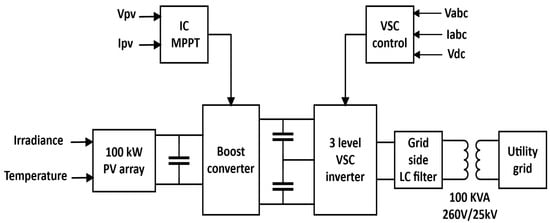
System Configuration 1 represents a grid-connected photovoltaic plant rated at 100 kW [1]. The plant consists of 66 parallel strings, where each string is composed of five series-connected photovoltaic modules. The PV array is interfaced with a DC–DC boost converter responsible for maximum power point tracking. The DC-link voltage is regulated through a grid-connected inverter. A three-level Neutral Point Clamped (NPC) inverter topology is employed to improve power quality and reduce harmonic distortion. An output filter is implemented to attenuate switching harmonics before connecting the system to the utility grid through a 260 V/25 kV transformer, as illustrated in Figure 1. The module specifications are shown in Table 2 [1]. In addition, System Configuration 1 is used in Scenarios 1–4 to assess controller performance under varying irradiance and temperature conditions.
Figure 1.
Schematic layout of PV System Configuration 1 under irradiance and temperature variations.
Table 2.
Main parameters of the grid-connected PV system.
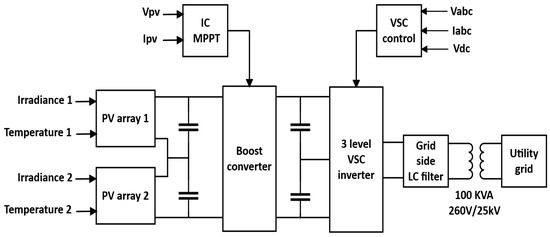
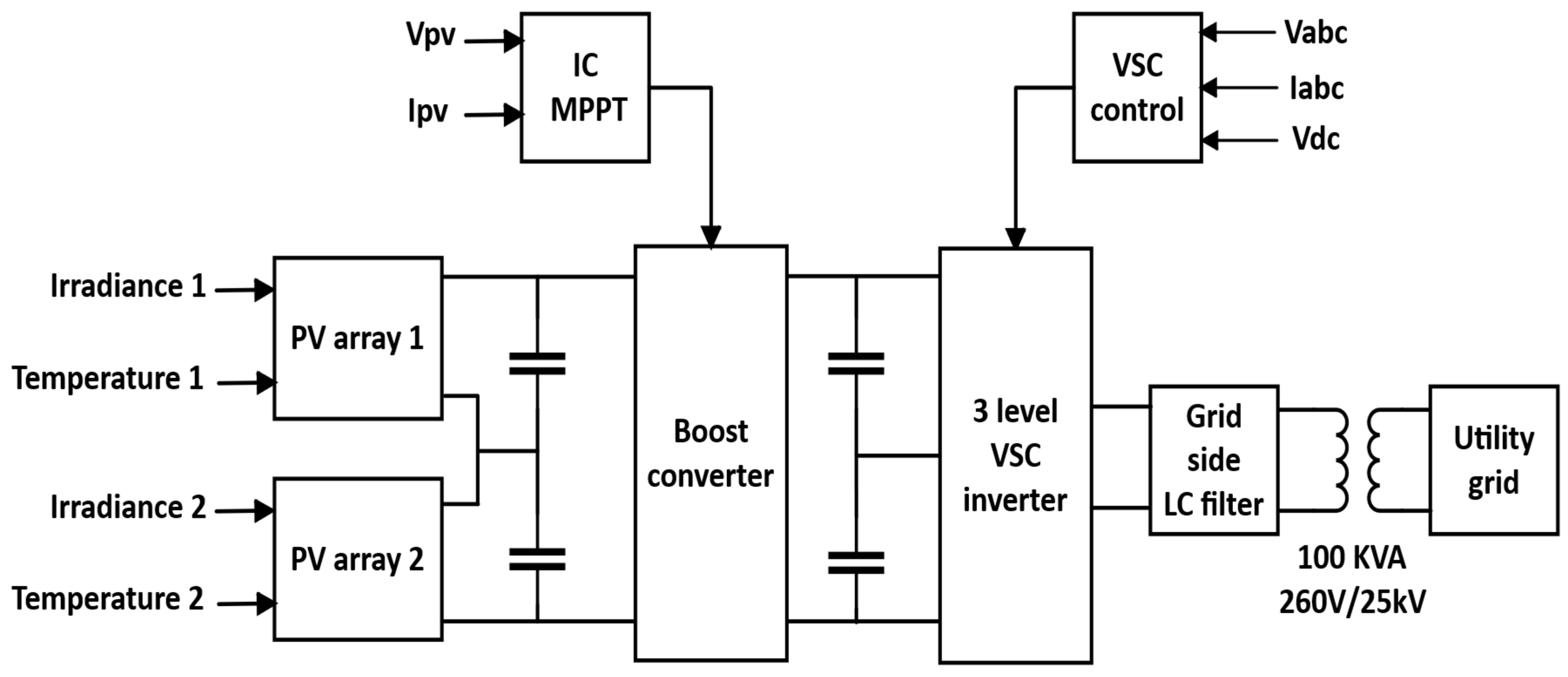
In contrast, System Configuration 2 corresponds to a modified grid-connected structure designed to evaluate performance under dynamic partial-shading conditions [19,25]. In this configuration, the system consists of two photovoltaic arrays, each rated at 100 kW, integrated within the same grid-interface architecture. While the control structure remains unchanged, the introduction of dynamic partial-shading results in multi-peak P–V characteristics and increased nonlinear behavior. The configuration of System Configuration 2 is illustrated in Figure 2. System Configuration 2 was adopted in Scenario 5 to examine the ability of the proposed optimization-based control strategy to maintain reliable global maximum power point tracking during shading transitions.
Figure 2.
Schematic layout of PV System Configuration 2 with dual PV arrays subjected to dynamic partial-shading conditions (DPSCs).
Both system configurations are modeled in MATLAB/Simulink R2024a, and identical environmental profiles are applied to all controllers to ensure a fair and consistent comparative evaluation.
3. Control Strategy and Problem Definition
The control strategy adopted in this work is based on the Super-Twisting Sliding Mode Control (STSMC) algorithm to achieve robust and fast maximum power point tracking for grid-connected photovoltaic (PV) systems operating under rapidly varying irradiance, temperature, and grid disturbances. Conventional linear controllers often exhibit degraded performance in the presence of uncertainties, while classical first-order sliding mode control suffers from chattering, which is undesirable in PWM-driven power-electronic converters. The STSMC algorithm overcomes these limitations by providing finite-time convergence, strong robustness against matched disturbances, and a continuous control signal suitable for practical implementation [20,21].
The control design is based on the duty-cycle adjustment signal generated by the MPPT algorithm. The sliding variable is defined as follows:
where denotes the duty-cycle correction signal generated by the Incremental Conductance MPPT algorithm according to the instantaneous position of the PV operating point relative to the maximum power point, denotes its time derivative, and λ is a design coefficient that determines the relative weighting between the duty-cycle correction signal and its rate of change. The correction direction is determined from the PV power–voltage gradient, for which = 0 at the MPP; therefore, the duty cycle corresponding to the MPP does not need to be calculated explicitly, since the controller adjusts the duty cycle iteratively according to the Incremental Conductance condition until the MPP is reached.
The Incremental Conductance algorithm evaluates the PV operating point according to the condition at the MPP and generates the duty-cycle correction signal Δd(t). This correction signal is not applied directly to the PWM generator; instead, Δd(t) and dΔd(t)/dt are used to construct the sliding variable. The STSMC subsequently processes these signals and generates the control action u(t), which modifies the converter duty-cycle command. The resulting duty ratio is limited by the saturation block to the admissible range 0 ≤ D ≤ 1 before being applied to the PWM generator. Thus, Δd(t) represents the MPPT correction information, whereas u(t) represents the STSMC control action used to regulate the actual converter duty ratio.
The selected sliding surface is suitable for this MPPT application because the boost-converter duty cycle directly governs the PV operating point, while the correction signal and its rate of change provide fast and smooth convergence under rapid environmental variations. This structure is selected because enforcing s(t) = 0 yields first-order stable error dynamics. Accordingly, Δd(t) converges exponentially to zero with a time constant . Therefore, although λ is not a physical parameter of the PV system, it has a clear control-design interpretation because it determines the desired convergence rate of the duty-cycle correction signal. A larger value of λ leads to faster convergence but may increase sensitivity to measurement noise and control aggressiveness, whereas a smaller value provides smoother but slower tracking. This sliding-variable structure is widely adopted in sliding mode control of power-electronic systems due to its simplicity and effectiveness [21,22]. Based on the sliding variable defined in (1), the super-twisting control law is formulated as follows:
where is the control signal applied to the PWM generator, and are controller gains, and is an auxiliary internal state introduced to ensure continuity of the control action. The nonlinear term proportional to guarantees finite-time convergence of the sliding variable, while the auxiliary dynamics compensate for bounded uncertainties and external disturbances. Compared to first-order sliding mode control, this structure significantly reduces chattering and eliminates the need for direct differentiation of the sliding variable. The control law in Equations (2) and (3) corresponds to the classical super-twisting algorithm originally proposed by Levant, which guarantees convergence of both the sliding variable and its derivative in finite time [20,21,22].
For stability analysis, the system dynamics associated with the sliding variable are expressed in the general form [20,21,22]:
where denotes the system control gain relating the control input to the derivative of the sliding variable, and represents lumped uncertainties and external disturbances arising from modeling inaccuracies, atmospheric variations, and grid-side perturbations [23,24]. It is assumed that the disturbances are bounded such that
where is a known upper bound of the uncertainty magnitude. In addition, the control gain is assumed to be bounded away from zero according to the following equation:
where is the minimum admissible value of the control gain. Under these assumptions, the stability of the super-twisting algorithm is guaranteed provided that the controller gains satisfy the following sufficient conditions [26,27]:
In the present study, Φ and Gm represent the theoretical bounds required by the sufficient stability conditions of the super-twisting algorithm. Specifically, Φ is the upper bound of the lumped uncertainty φ(t), while Gm is the minimum admissible value of the control gain G(t). These quantities are not explicitly identified as fixed numerical parameters but represent the bounds assumed in the stability analysis. If the actual uncertainty φ(t) exceeds Φ, or if G(t) falls below Gm, the sufficient finite-time convergence conditions are no longer guaranteed, and larger transient deviations or degraded tracking performance may occur. Extreme grid faults and disturbances outside the investigated operating range are therefore considered limitations of the present study. It should be noted that these inequalities represent sufficient finite-time convergence conditions for the adopted super-twisting sliding-variable formulation rather than a complete converter-level stability proof [26,27].
To further clarify the finite-time convergence mechanism of the proposed STSMC, a Lyapunov-based interpretation of the super-twisting algorithm is provided [27,28]. The transformed variables are defined as:
where represents the sliding variable and represents the auxiliary internal state of the super-twisting controller. The transformed state vector is used for the Lyapunov stability analysis. A quadratic Lyapunov candidate function is selected as:
where is a positive-definite matrix selected according to the super-twisting stability conditions, and is the transformed state vector [28,29]. Under the bounded uncertainty assumption in (5), the positive control-gain condition in (6), and the sufficient gain conditions in (7) and (8), the derivative of the Lyapunov function satisfies:
where is a positive convergence coefficient determined by the controller gains and system bounds. Since the Lyapunov function is positive definite and its derivative satisfies the finite-time convergence condition in (12), the transformed state vector converges to the origin in finite time [28,29]. Integrating (12) gives:
which provides the following upper bound on the settling time:
where denotes the finite-time convergence bound and is the initial value of the Lyapunov function.
When the above boundedness assumptions and gain conditions are satisfied, the closed-loop system trajectories converge to the sliding surface in finite time and remain insensitive to matched uncertainties thereafter [26,27,28,29]. It is emphasized that the controller gains and are selected as strictly positive values [29,30]. Therefore, the STSMC structure provides the underlying stability and disturbance-rejection mechanism, while the SBOA optimization process determines the controller parameters , , and according to the selected energy-based objective function.
A block diagram of the STSMC integrated into the control strategy is shown in Figure 3, illustrating the key components and the control structure.
Figure 3.
Converter control circuit integrating MPPT and STSMC strategy.
4. Procedures of the Secretary Bird Optimization Algorithm (SBOA)
4.1. SBOA Overview and Initialization
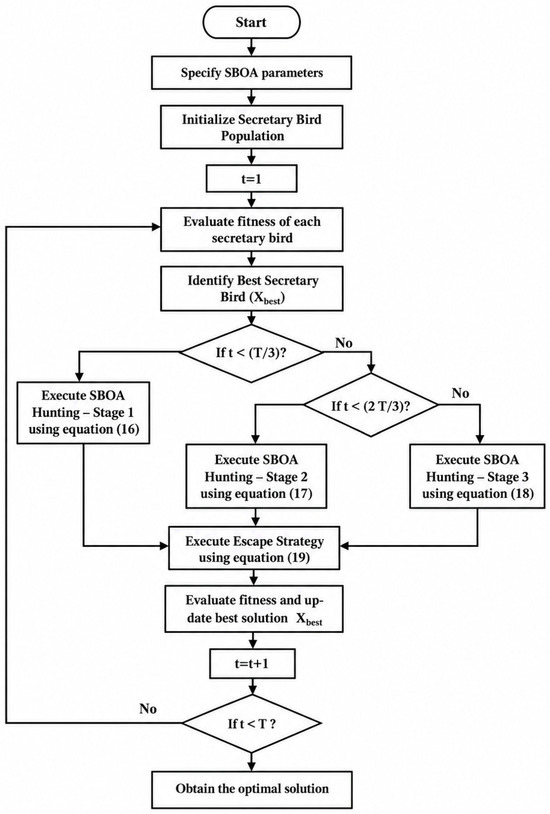
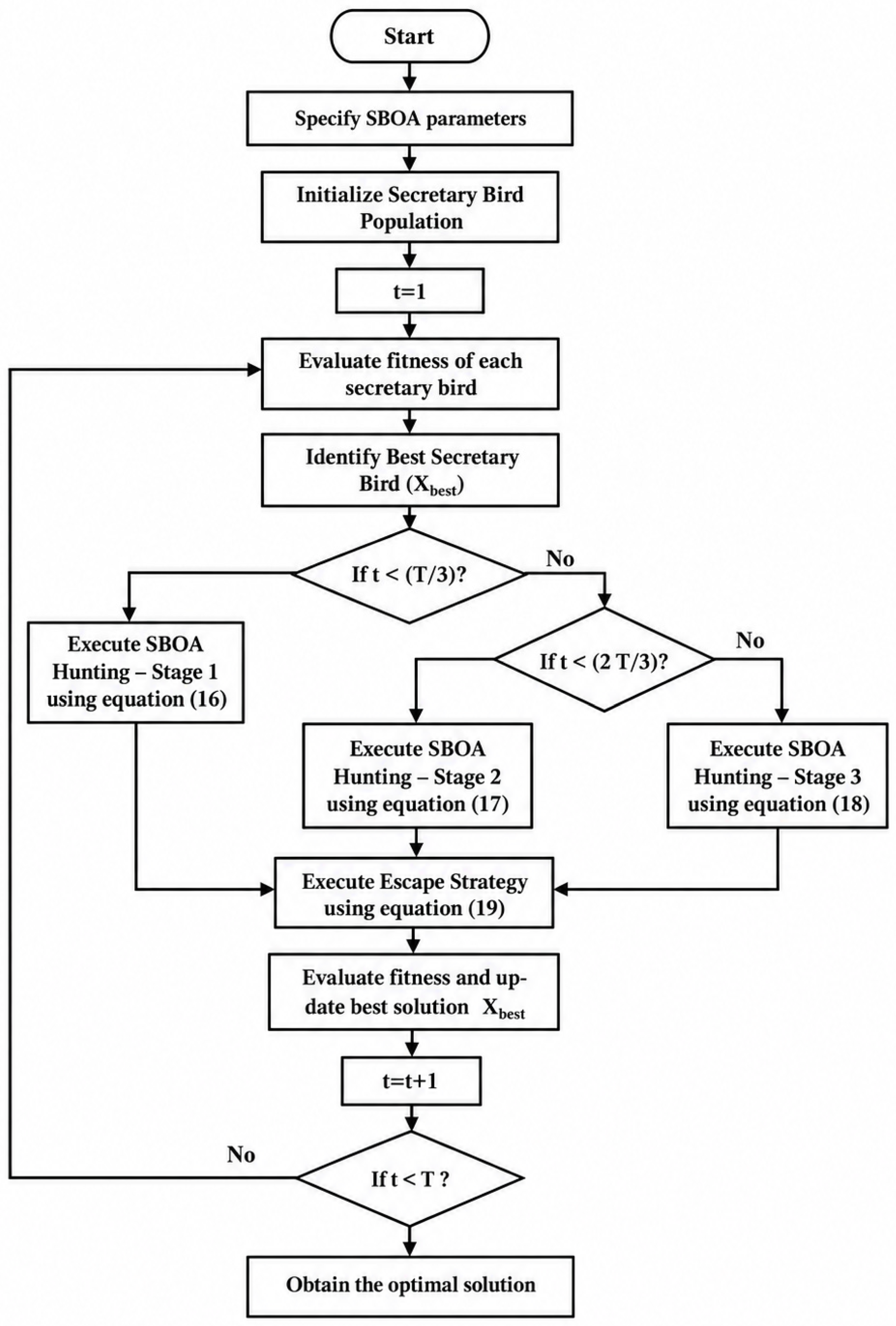
The Secretary Bird Optimization Algorithm (SBOA) is a recent population-based metaheuristic inspired by the intelligent hunting and survival behaviors of secretary birds in their natural environment. These birds are well known for their unique ability to detect, pursue, and neutralize prey—particularly snakes—using a combination of wide-area exploration, focused attack strategies, and rapid escape maneuvers. Motivated by these behaviors, SBOA integrates both exploration and exploitation mechanisms to efficiently solve complex and nonlinear optimization problems [31]. The algorithm achieves a balanced search process by alternately emphasizing global exploration through random and differential movements and local exploitation through adaptive intensification around promising solutions. A schematic overview of the SBOA is presented in Figure 4.
Figure 4.
Flow diagram of the Secretary Bird Optimization Algorithm (SBOA).
At the beginning of the optimization process, an initial population of secretary birds is randomly generated within the predefined search space to ensure sufficient diversity among candidate solutions. This initialization step is mathematically expressed as:
where denotes the position of the -th secretary bird in the -th dimension, and represent the lower and upper bounds of the decision variables, respectively, is a uniformly distributed random number, is the population size, and is the problem dimensionality [31,32].
4.2. Hunting and Escape Strategies
Following initialization, the SBOA optimization process is governed by two main behavioral phases: the hunting strategy (exploration phase) and the escape strategy (exploitation phase). The hunting strategy is divided into three successive stages that simulate the secretary bird’s approach toward prey capture, with each stage activated according to the iteration ratio , where is the current iteration and is the maximum number of iterations. In the first hunting stage, corresponding to , secretary birds actively search for prey over wide areas. This behavior is modeled using a differential evolution-based update rule that enhances population diversity and global exploration [33]:
where and are two randomly selected individuals from the population and is a uniformly distributed random vector. This mechanism allows the algorithm to explore unexplored regions of the search space efficiently [34,35]. In the second hunting stage, defined by , the algorithm transitions toward a more exploitative behavior, mimicking the prey consumption phase. In this stage, candidate solutions are guided toward the current best position using Brownian motion to refine local search [31]:
where denotes the best solution found so far. The stochastic term is a random variable drawn from a standard normal distribution with zero mean and unit variance, introducing Brownian motion characteristics into the search process. This stochastic perturbation enhances convergence accuracy while maintaining controlled randomness [31]. The third hunting stage is activated when , representing the attacking phase. In this phase, Lévy-flight dynamics are employed to enhance the algorithm’s ability to escape local optima while accelerating convergence toward the global optimum [32]:
where RL = WL × Levy(Dim), RL denotes the weighted Lévy-flight vector, WL is the Lévy-flight weighting coefficient, and Levy(Dim) denotes the Lévy-flight vector. The Lévy-flight process generates occasional long jumps to enhance global exploration and reduce the possibility of trapping in local optima. The characteristics of these jumps are governed by the Lévy scale constant s, which controls the scale of the generated steps, and the Lévy exponent η, which characterizes the Lévy distribution. The adopted values of WL, s, and η are summarized in Table 3 following the original SBOA formulation [31].
Table 3.
SBOA optimization settings.
In addition to the hunting strategy, SBOA incorporates an escape strategy that models the secretary bird’s rapid reaction to predators, which serves as the exploitation phase of the algorithm. This phase updates the candidate solutions using one of two adaptive mechanisms selected probabilistically:
where is a Brownian random vector, is a uniformly distributed random number, is a randomly selected individual, and . The threshold value of 0.5 provides equal probability for selecting either escape mechanism, following the original SBOA formulation [31]. The first case simulates camouflage behavior near the best solution, while the second represents sudden escape or flight, enhancing exploitation while preserving diversity [31,33].
4.3. SBOA-Based STSMC Parameter Tuning
In this study, the Secretary Bird Optimization Algorithm (SBOA) is employed to tune the parameters of the Super-Twisting Sliding Mode Controller (STSMC) by solving a single-objective energy maximization problem. Let the vector of tunable controller parameter is as follows:
where and are the super-twisting gains, and is the sliding-surface coefficient defining the system error dynamics. The optimization objective is formulated as maximizing the total electrical energy injected into the grid over a fixed evaluation horizon :
where represents the grid-side active power regulated by the STSMC parameterized by . All candidate controllers are evaluated under identical irradiance and temperature profiles to ensure a fair and consistent comparison of optimization performance. From a practical implementation perspective, the SBOA is employed in this work as an offline optimization tool to determine the STSMC parameters before real-time operation. Therefore, the population-based optimization process is not executed during online controller operation, and the computational burden imposed on the real-time platform is limited to the implementation of the optimized STSMC control law. This makes the proposed approach more suitable for practical realization using DSP- or microcontroller-based control platforms.
To improve reproducibility, the principal SBOA settings are summarized in Table 3. The algorithm-specific parameters were selected according to the original SBOA formulation [31]. A population of 20 candidates and 100 iterations were used for the three-dimensional optimization problem, with termination at the maximum iteration limit. For each candidate, the grid-side active power is integrated over the complete evaluation interval, and the parameter set yielding the maximum accumulated injected energy is retained as the optimum.
The STSMC parameter search bounds are summarized in Table 4. Their selection follows the super-twisting design and stability principles discussed in Section 3 [26,28]. Since the appropriate parameter magnitudes depend on system dynamics, signal scaling, disturbance bounds, and convergence requirements, sufficiently wide positive search intervals were adopted for the considered PV system.
Table 4.
Search bounds for the optimized STSMC parameters.
The SBOA optimization is performed offline. With 20 candidates and 100 iterations, approximately 2000 solutions are evaluated per run. On a Dell G3 laptop with an Intel Core i7 processor, the complete optimization required about 36 min, corresponding to approximately 1.08 s per evaluation. Since the optimized STSMC parameters remain fixed during operation, this computational cost does not affect the real-time controller execution.
4.4. Investigated Operating Scenarios
To systematically evaluate the proposed SBOA–STSMC under different operating conditions, five test scenarios are considered. Their main characteristics and evaluation objectives are summarized in Table 5.
Table 5.
Summary of the five operating scenarios.
5. Simulation Outcomes and Discussion
This section evaluates the performance of the proposed Secretary Bird Optimization-tuned Super-Twisting Sliding Mode Controller (SBOA–STSMC) under five distinct simulation scenarios representing typical operating disturbances in grid-connected photovoltaic (PV) systems. In addition to the simulation-based evaluation, statistical repeatability, parameter sensitivity, an additional severe-disturbance robustness test, grid-interface parameter sensitivity, and real-time validation are considered to provide a broader assessment of the consistency, robustness, and practical implementation capability of the proposed approach.
The controller parameters, namely the sliding-surface coefficient λ and the super-twisting gains K1 and K2, are optimally tuned using the Secretary Bird Optimization Algorithm (SBOA). The optimization process is carried out with a population size of 20 candidate solutions over 100 iterations, where the objective function is formulated to maximize the total injected grid energy. To ensure a fair comparison, the IWO- and HSA-based controllers are implemented according to the parameter configurations reported in [19], without retuning or structural modification.
Since the main objective of this work is to maximize the energy extracted from the PV system and injected into the utility grid, the comparative assessment is primarily based on accumulated injected energy. Scenario 1 is additionally assessed using MPPT efficiency, steady-state power ripple, and grid-current THD. From a control perspective, transient tracking behavior, controller robustness, parameter sensitivity, and real-time implementation are also examined to assess the dynamic and practical performance of the proposed STSMC. For the remaining scenarios, accumulated injected energy (kW·s) is retained as the principal quantitative performance index.
In Scenarios 1–4, System Configuration 1 is used to compare the proposed SBOA–STSMC with the classical Incremental Conductance method and the IWO- and HSA-based controllers under progressively more demanding operating conditions. Scenario 5 uses System Configuration 2 under dynamic partial shading and compares the proposed controller with the classical P&O, IWO-based, and HSA-based controllers. The optimized SBOA–STSMC parameters for Scenarios 1–4 and Scenario 5 are summarized in Table 6.
Table 6.
Optimized SBOA–STSMC parameters for different scenarios.
Following the five-scenario evaluation, sensitivity analysis is performed for ±50% variations in K1, K2, and λ. An additional severe-disturbance test is also conducted using rapid irradiance variations without retuning the controller parameters, followed by a ±50% sensitivity assessment of the grid-side choke inductance under the same severe profile. Statistical repeatability is further assessed over 30 independent SBOA runs. A separate statistical comparison is also performed using 30 independent runs of SBOA, TLBO, and PSO, with the Wilcoxon rank-sum test used to evaluate the significance of the performance differences. Finally, real-time validation using a Speedgoat real-time platform is performed to assess the practical implementation capability of the proposed controller.
5.1. Scenario 1: Constant Temperature with Variable Irradiance
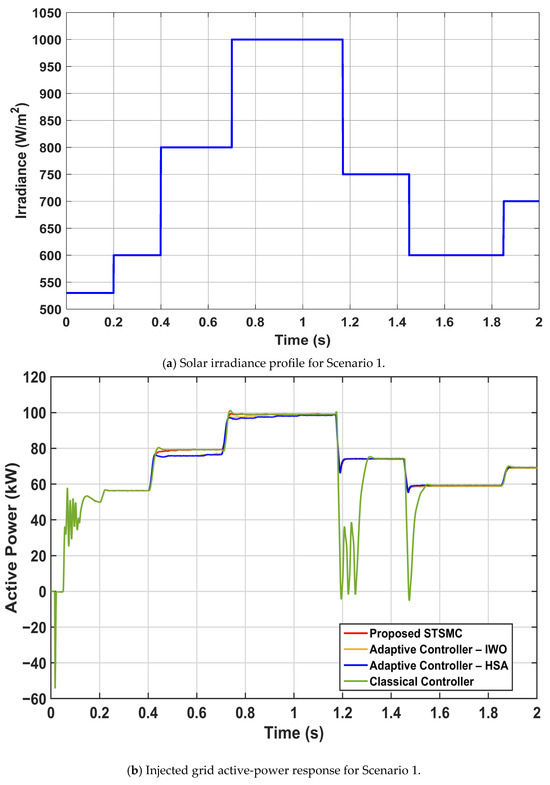
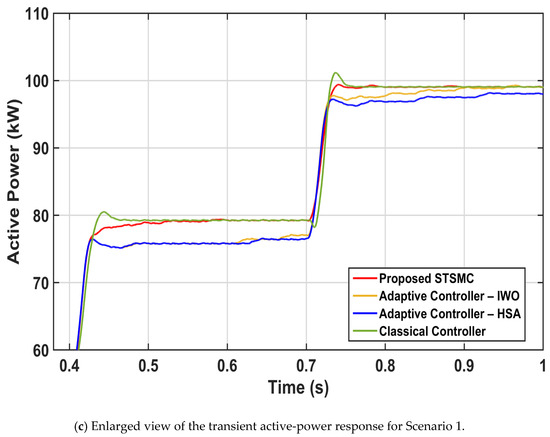
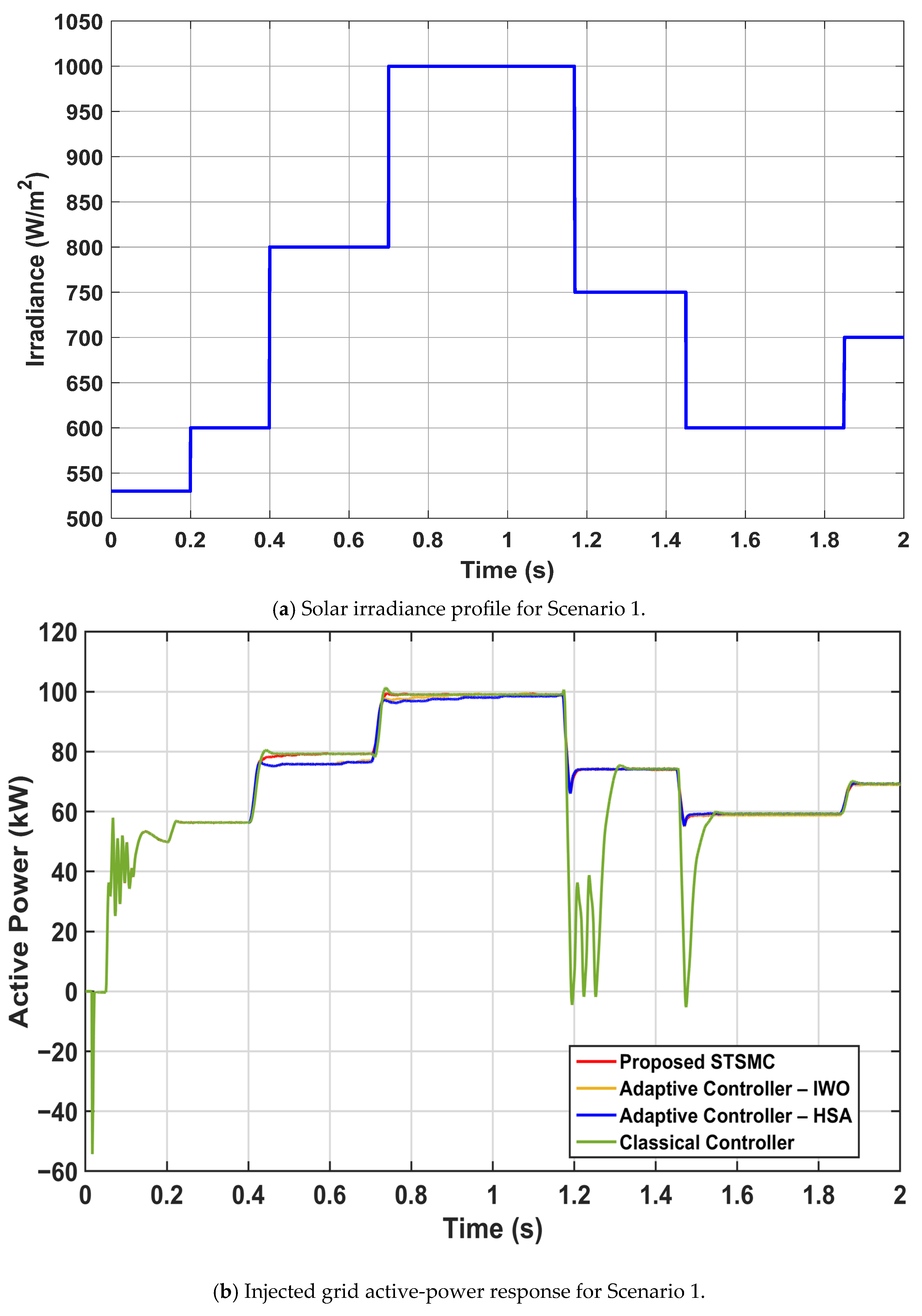
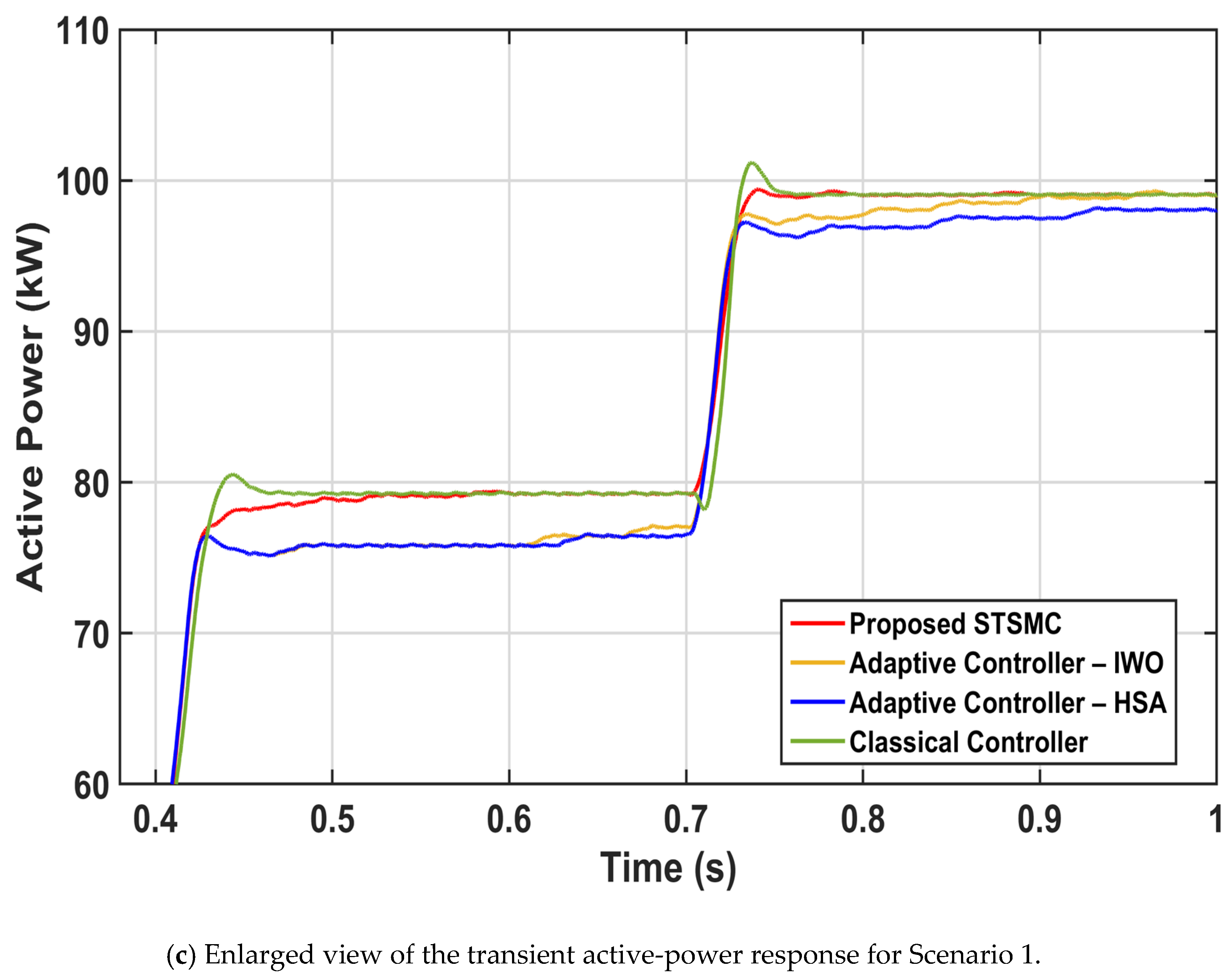
In the first scenario, the photovoltaic (PV) system operates under constant-temperature conditions, while the solar irradiance varies stepwise, as depicted in Figure 5a. The corresponding injected grid power responses of the different controllers are illustrated in Figure 5b, whereas a zoomed-in transient view is provided in Figure 5c to highlight the dynamic differences during irradiance transitions. The proposed STSMC is compared with IWO-based and HSA-based adaptive controllers [19] and the classical controller.
Figure 5.
Performance of the grid-connected PV system under variable irradiance conditions in Scenario 1: (a) solar irradiance profile; (b) injected grid active-power response; and (c) magnified active-power response.
As shown in Figure 5b, the classical controller exhibits pronounced oscillations following abrupt irradiance changes. The IWO- and HSA-based controllers improve the transient response, but residual oscillations remain, as highlighted in Figure 5c. In contrast, the proposed SBOA–STSMC provides smoother dynamics and faster convergence toward the maximum power point.
To provide a more comprehensive quantitative assessment, four performance indices are considered under Scenario 1: MPPT efficiency, accumulated injected energy, steady-state power ripple, and grid-current total harmonic distortion (THD). MPPT efficiency is commonly used to assess the effectiveness of the tracking algorithm in extracting the available photovoltaic power, while power ripple reflects the oscillatory behavior around the operating point [5,6,7]. For grid-connected PV systems, grid-current THD provides an indication of the quality of the current injected into the utility grid [4,8]. Accumulated injected energy represents the overall energy delivered to the grid over the complete operating profile and therefore provides an integrated measure of tracking and transient performance [9].
The quantitative values of these indices for the investigated controllers are summarized in Table 7.
Table 7.
Quantitative performance comparison of the investigated controllers under Scenario 1.
As shown in Table 7, the proposed SBOA–STSMC achieves the highest MPPT efficiency of 97.34% and the highest accumulated injected energy of 142.1 kW·s. It also provides the lowest steady-state power ripple of 0.7%, compared with 4.3%, 1.2%, and 1.5% for the classical, HSA-based, and IWO-based controllers, respectively. The grid-current THD remains low at 1.925%, with comparable values of 1.927%, 1.989%, and 1.970% for the classical, HSA-based, and IWO-based controllers, respectively. These results confirm that the proposed controller improves energy extraction and tracking smoothness without adversely affecting grid-current harmonic quality.
Since the SBOA objective function is formulated to maximize the accumulated active energy injected into the utility grid, injected energy is adopted as the principal quantitative comparison index for the remaining operating scenarios.
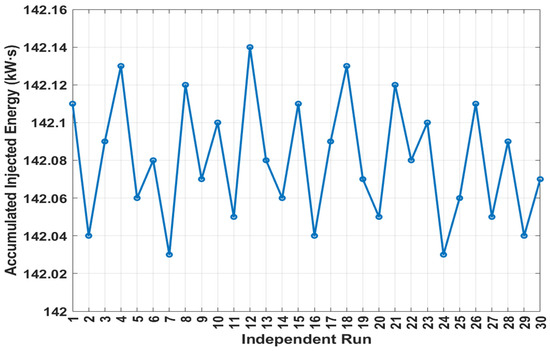
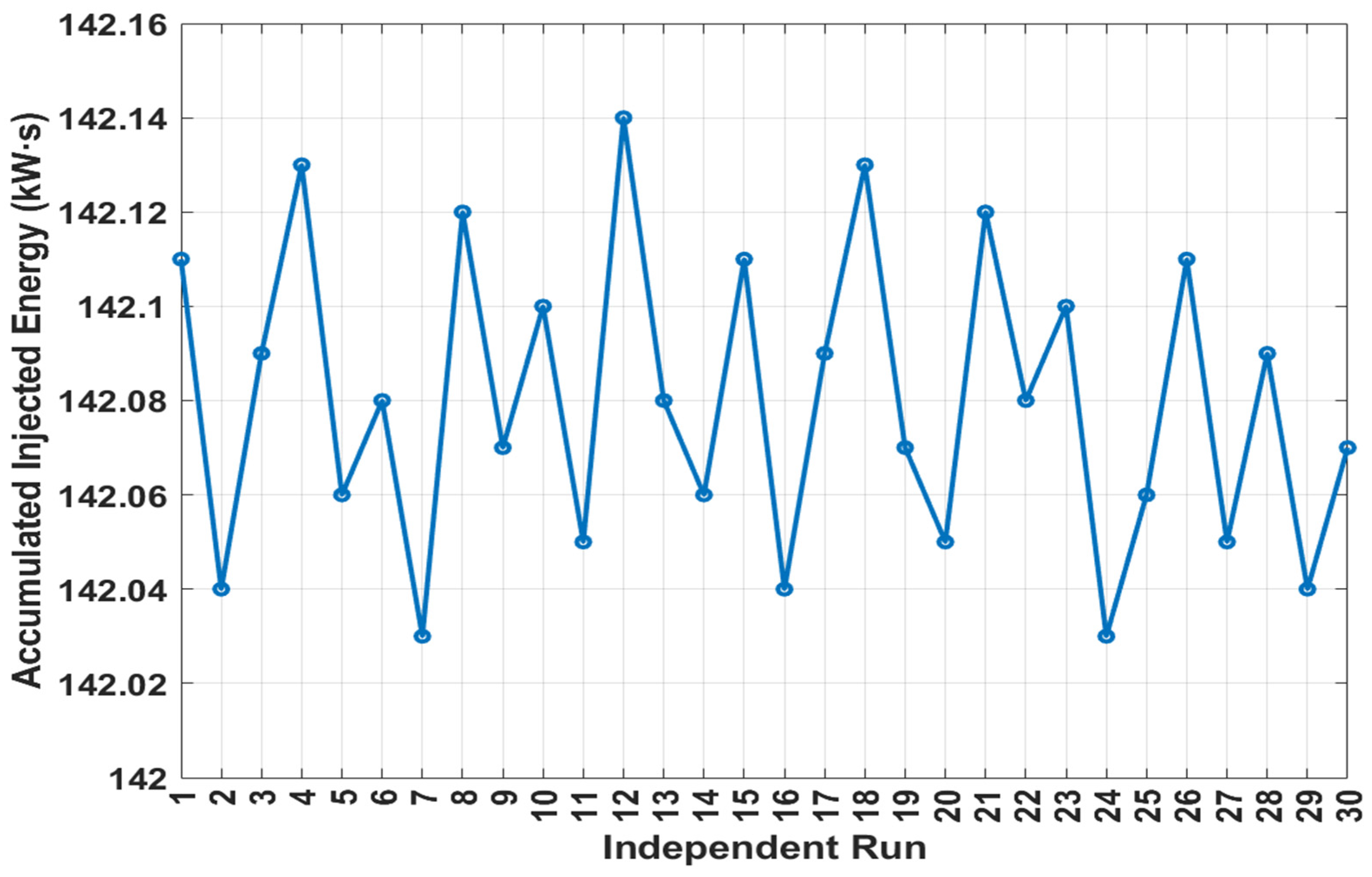
To further assess the repeatability of the proposed optimization approach, the SBOA was executed independently for 30 runs under identical Scenario 1 operating conditions. The accumulated injected energy obtained from each run was statistically evaluated in terms of the minimum, maximum, average, standard deviation, and variance. Figure 6 presents the accumulated injected energy obtained over the 30 independent runs, while the corresponding statistical indicators are summarized in Table 8. The limited dispersion among the obtained values indicates good consistency and repeatability of the proposed SBOA-based optimization.
Figure 6.
Accumulated injected energy obtained by the proposed SBOA–STSMC over 30 independent optimization runs under Scenario 1 operating conditions.
Table 8.
Statistical analysis of the proposed SBOA–STSMC over 30 independent optimization runs.
As shown in Figure 6 and Table 8, the accumulated injected energy obtained from the 30 independent SBOA runs remains within a narrow range of 142.03–142.14 kW·s, with an average value of 142.08 kW·s. The low standard deviation of 0.03195 kW·s and variance of 1.021 × 10⁻³ (kW·s)2 indicate limited dispersion among the independent runs. These results demonstrate the high repeatability and consistency of the proposed SBOA-based optimization approach under the considered operating conditions of Scenario 1.
5.2. Scenario 2: Simultaneous Irradiance and Temperature Variations
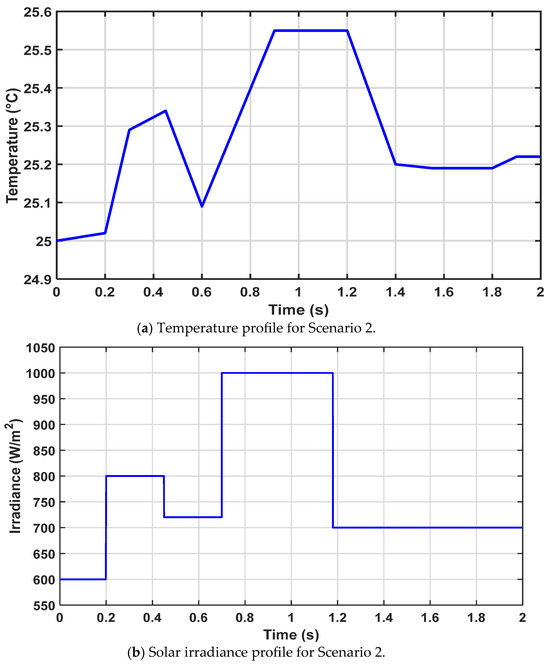
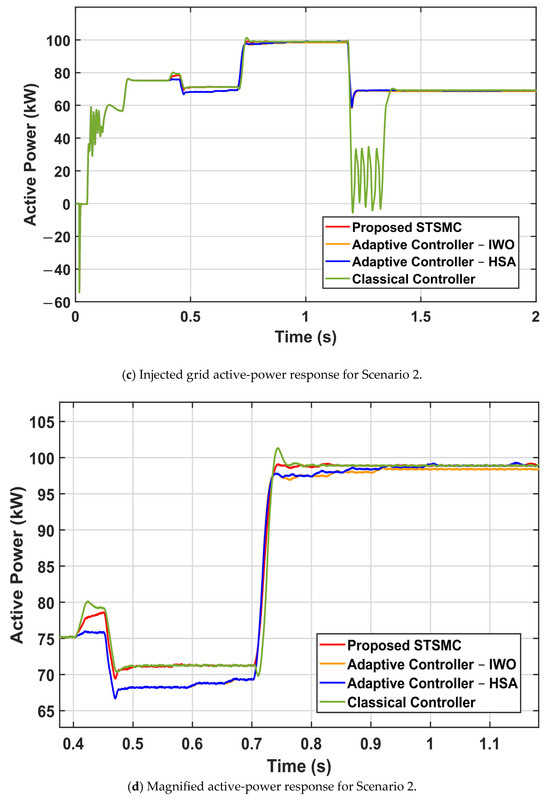
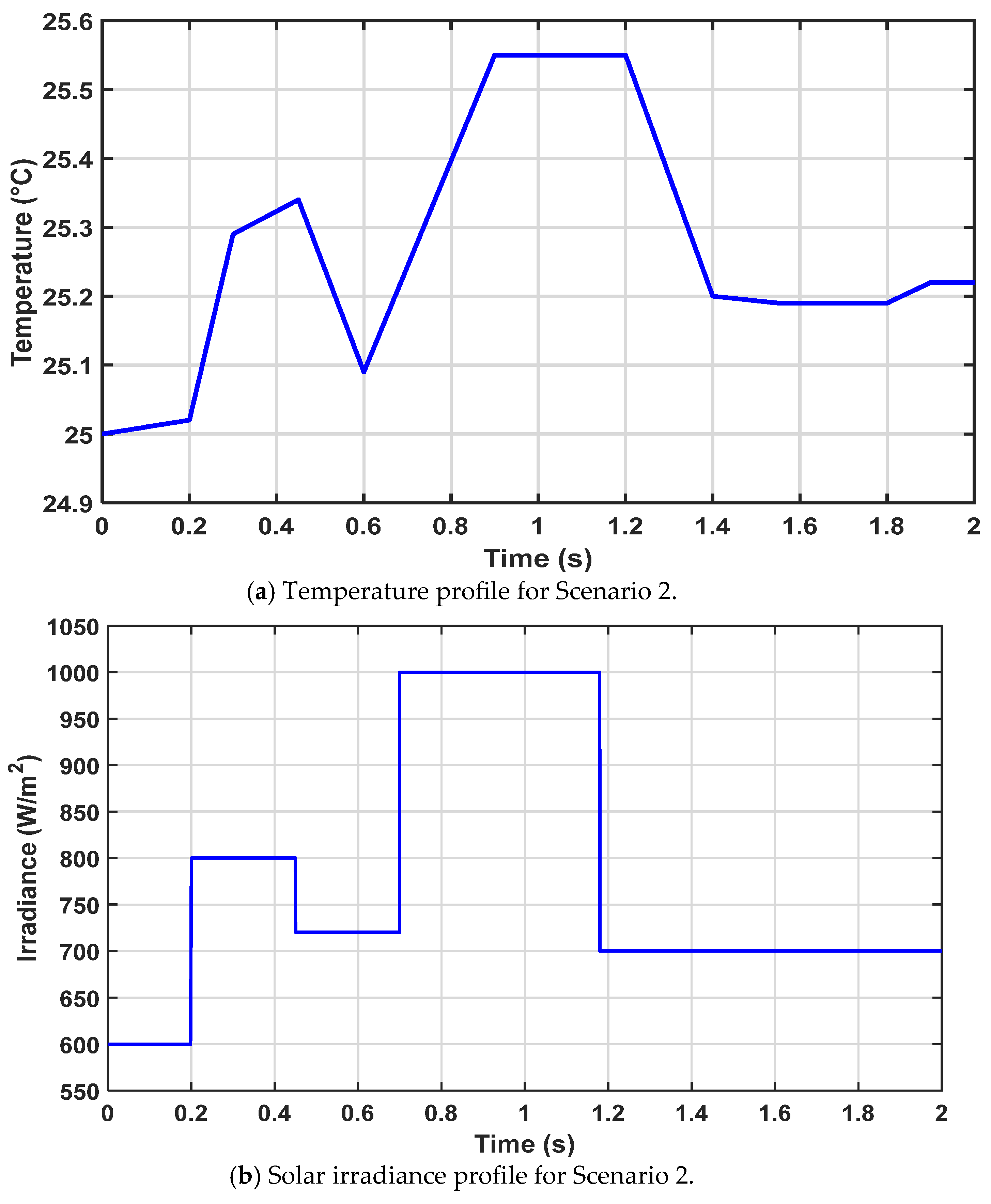
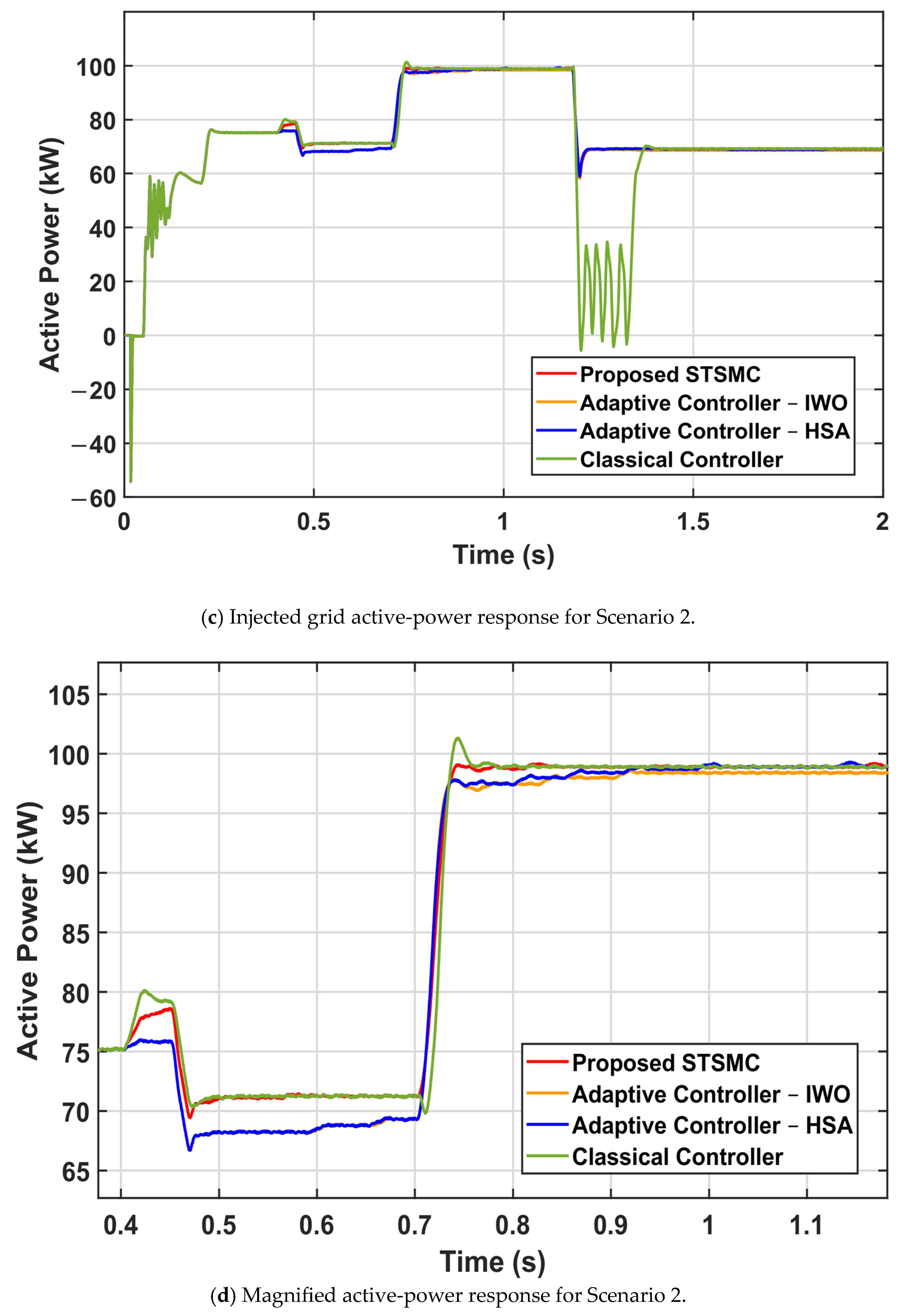
In the second scenario, both temperature and solar irradiance vary simultaneously, as illustrated in Figure 7a and Figure 7b, respectively. The corresponding injected grid power responses are presented in Figure 7c, while a zoomed-in transient view is provided in Figure 7d to emphasize dynamic behavior during rapid environmental changes.
Figure 7.
Performance of the grid-connected PV system under simultaneous irradiance and temperature variations: (a) temperature profile; (b) solar irradiance profile; (c) injected grid active-power response; and (d) magnified active-power response.
Under combined atmospheric disturbances, the classical controller exhibits pronounced oscillations and fails to maintain stable maximum power tracking. Although the IWO- and HSA-based adaptive controllers improve the overall transient performance compared to the classical approach, noticeable deviations and residual oscillations persist, particularly during abrupt irradiance and temperature variations, as clearly observed in the zoomed response of Figure 7d. Unlike these approaches, the proposed SBOA–STSMC controller maintains stable operation with superior disturbance-rejection capability and smoother dynamic transitions. The total injected energy reaches 147.7 kW·s compared to 146.7 kW·s for the HSA-based controller, 146.2 kW·s for the IWO-based controller, and 139.8 kW·s for the classical controller. This corresponds to an improvement exceeding 5.6% over the classical approach. These results confirm that SBOA effectively optimizes the STSMC parameters, thereby enhancing robustness and energy capture efficiency under simultaneous irradiance and temperature variations.
5.3. Scenario 3: Severe Dynamic Environmental Conditions
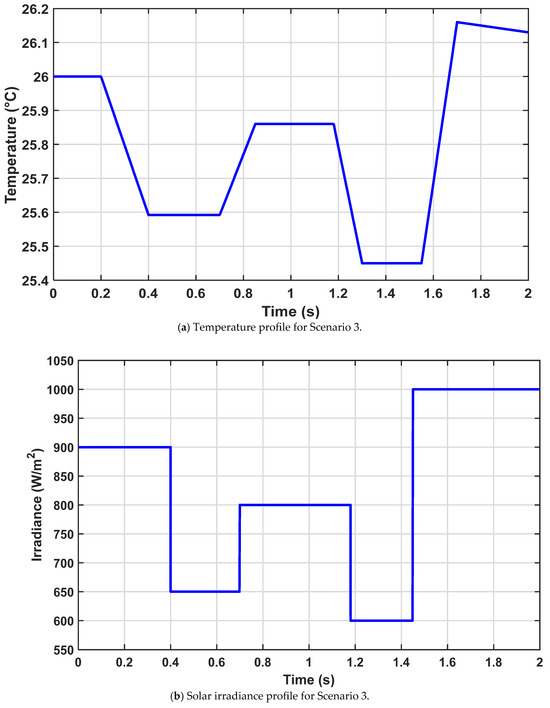
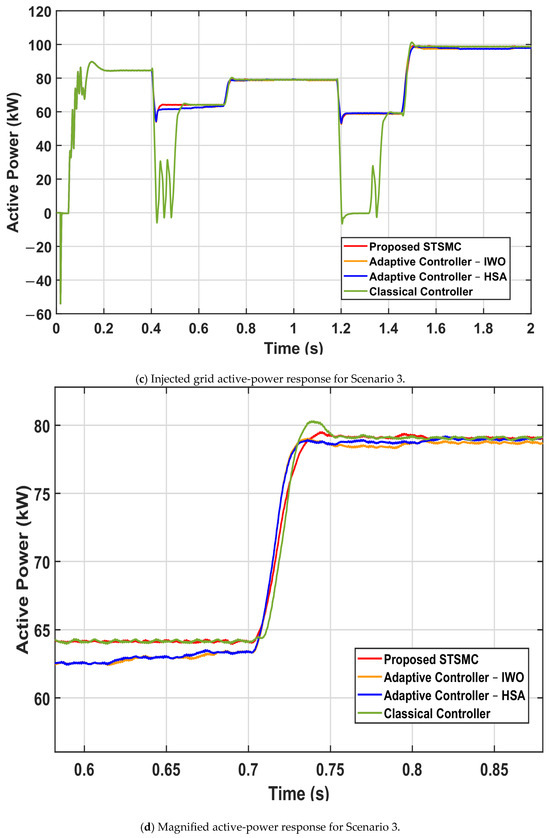
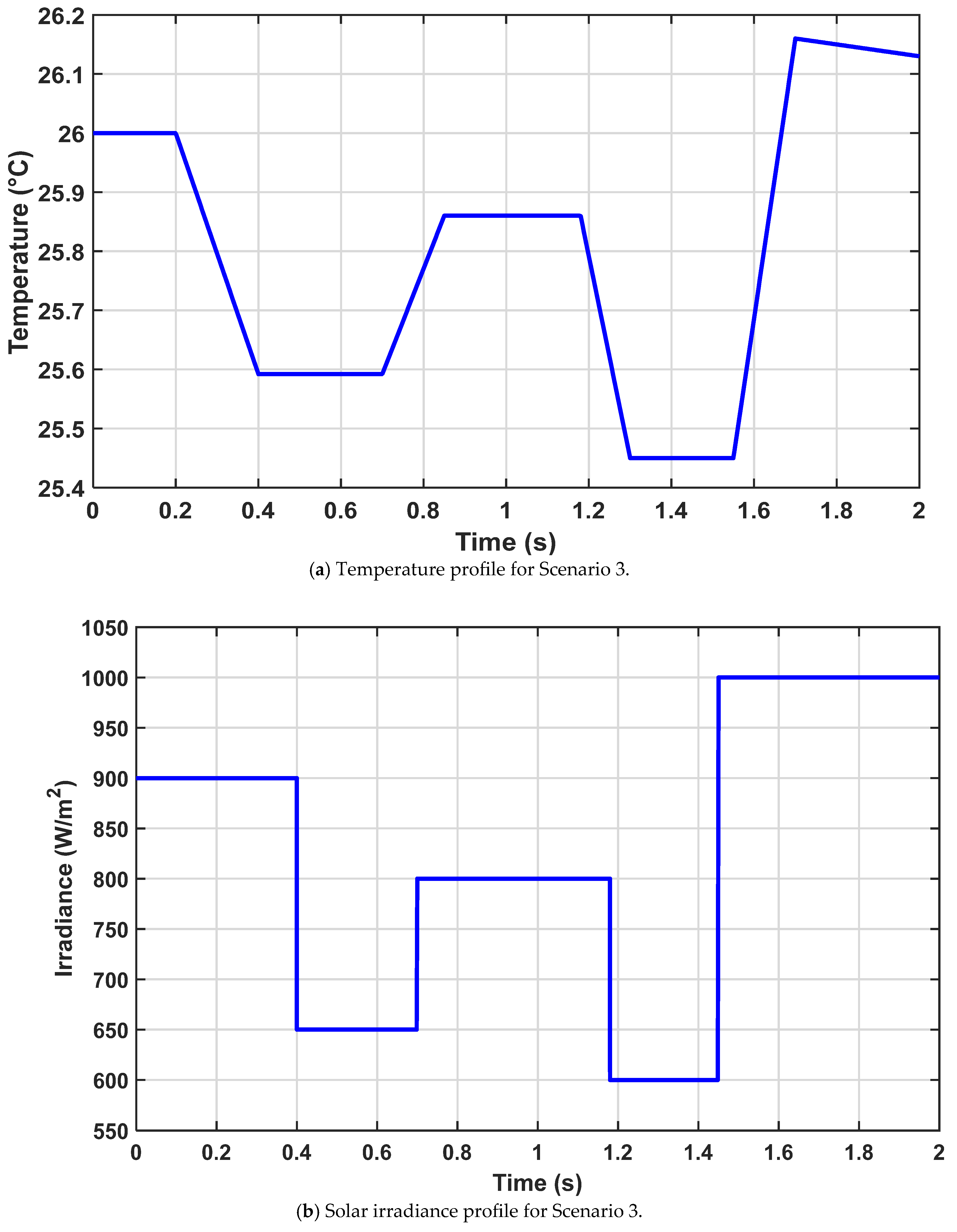
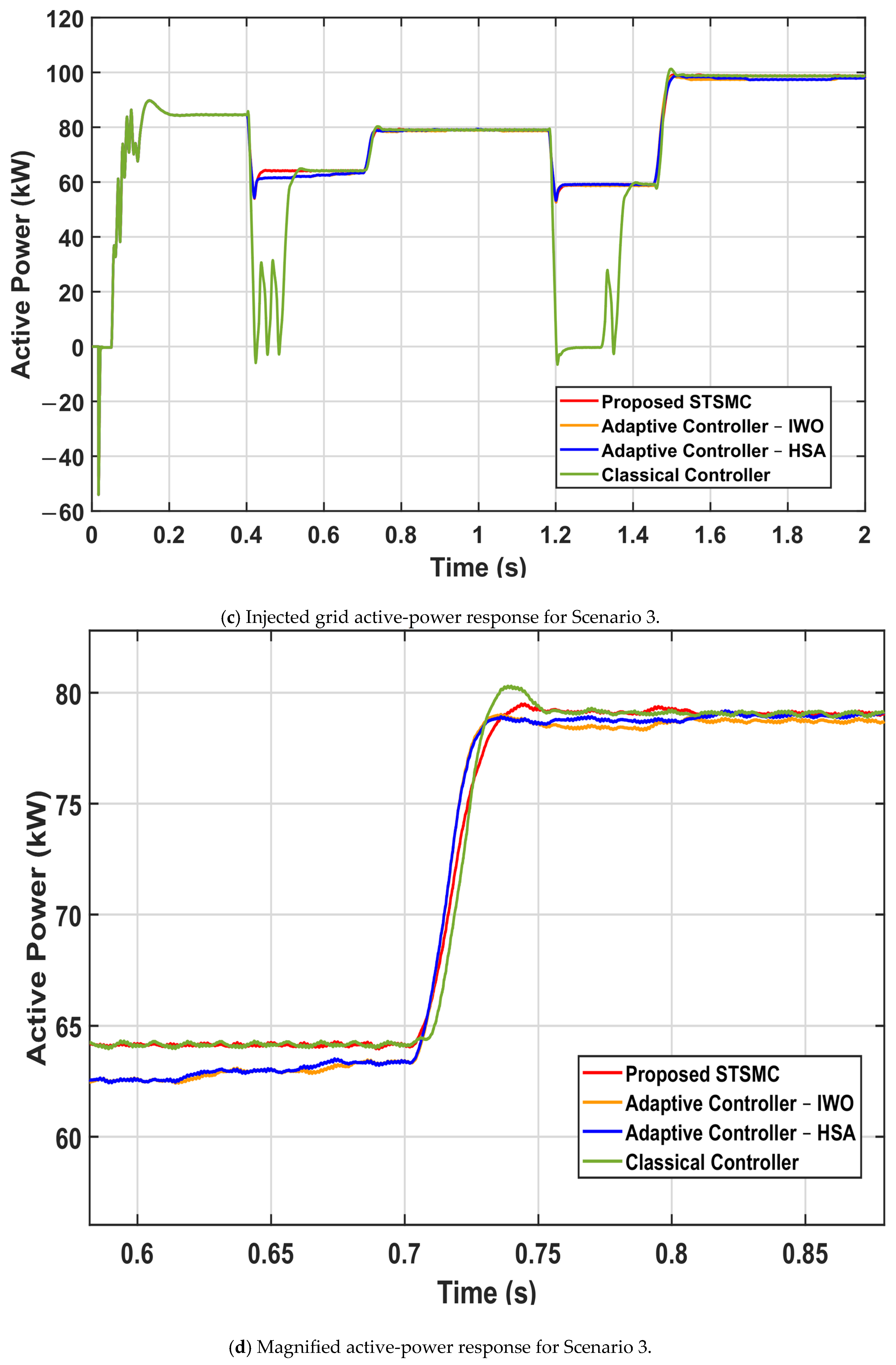
To further evaluate system robustness, aggressive and rapid variations in both temperature and solar irradiance were introduced, as depicted in Figure 8a and Figure 8b, respectively. The corresponding injected grid power responses are illustrated in Figure 8c, while a zoomed-in transient view is presented in Figure 8d to highlight the dynamic performance under severe disturbances.
Figure 8.
Performance of the grid-connected PV system under severe dynamic environmental conditions: (a) temperature profile; (b) solar irradiance profile; (c) injected grid active-power response; and (d) magnified active-power response.
Under these highly dynamic operating conditions, the superiority of the proposed approach becomes more pronounced. The classical controller exhibits large oscillations, prolonged settling time, and delayed recovery following abrupt environmental changes, resulting in significant energy losses. Although the IWO- and HSA-based adaptive controllers enhance the transient response compared to the classical method, noticeable oscillatory behavior and transient deviations remain evident, particularly during rapid atmospheric fluctuations, as shown in Figure 8d. In contrast, the proposed SBOA–STSMC achieves the highest accumulated injected energy of 154.2 kW·s, compared to 153.3 kW·s for the HSA-based controller, 153 kW·s for the IWO-based controller, and 140 kW·s for the classical controller. The improvement over the classical controller exceeds 10%, clearly demonstrating the strong robustness and finite-time convergence characteristics of the SBOA-optimized STSMC under severe disturbances. The results presented in Figure 8c,d confirm that the proposed optimization strategy provides superior dynamic stability, enhanced disturbance-rejection capability, and improved energy harvesting performance under aggressive environmental variations.
5.4. Scenario 4: Low Irradiance with Rapid Transitions
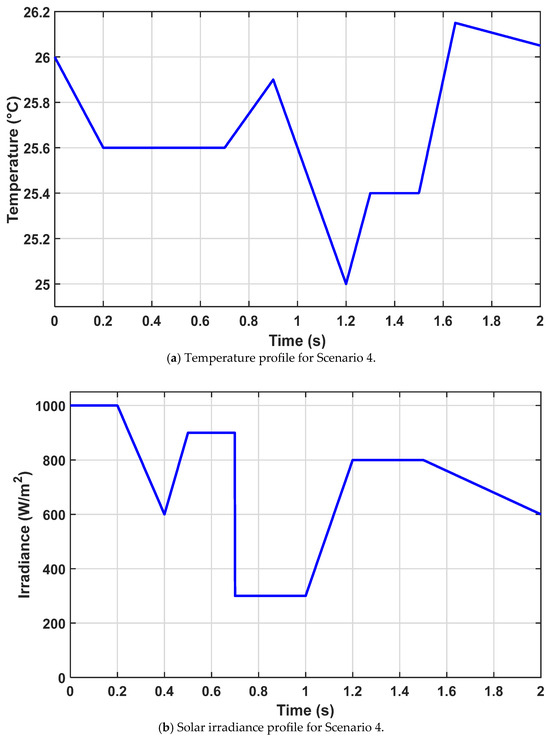
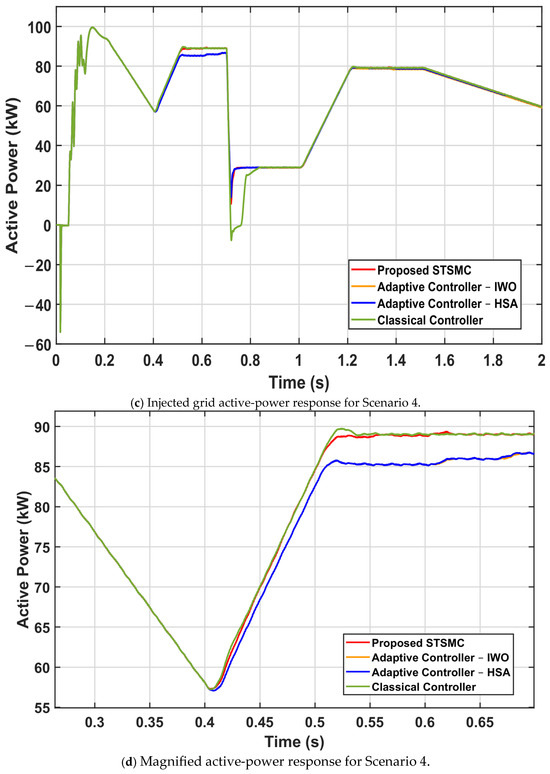
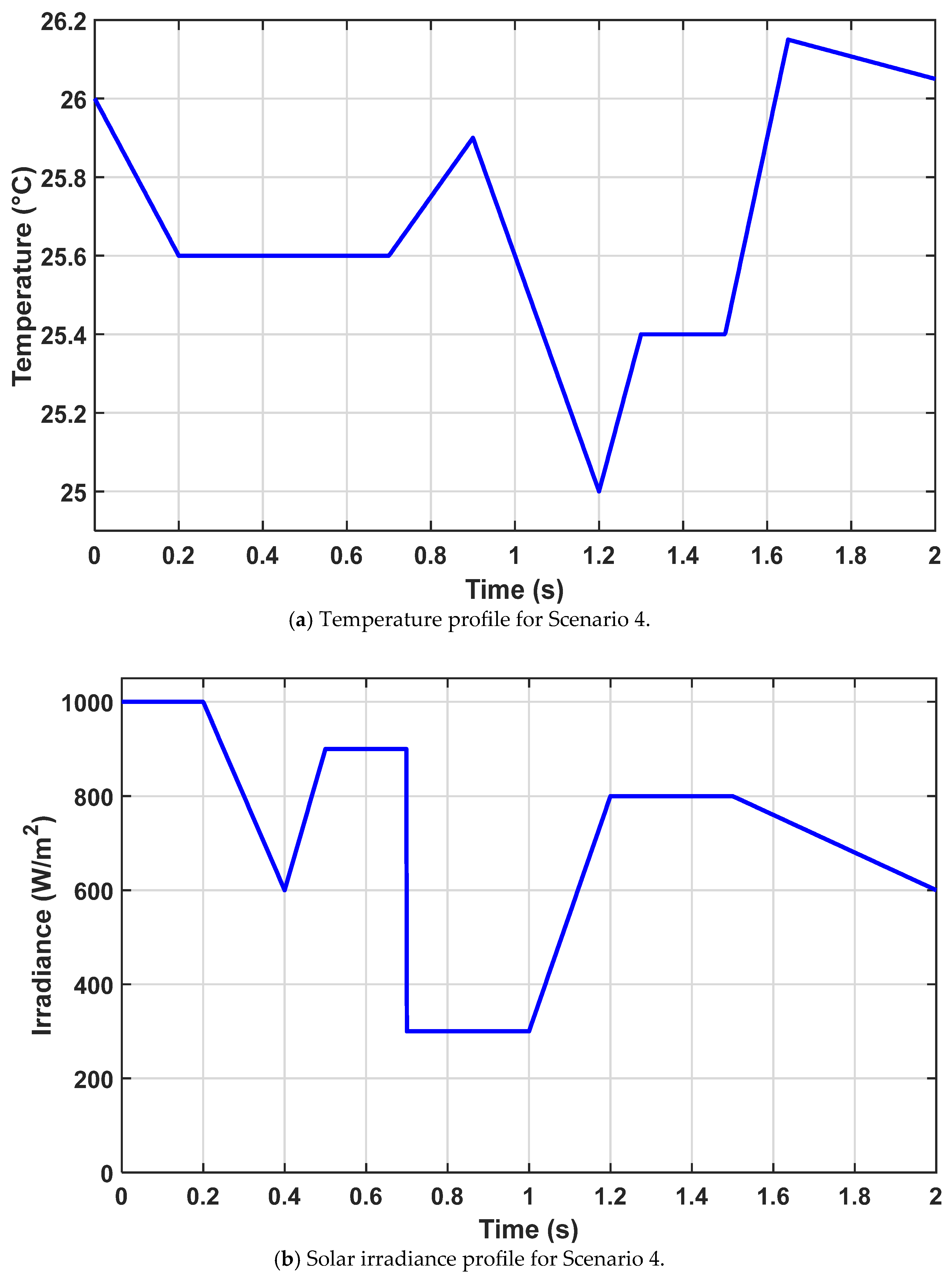
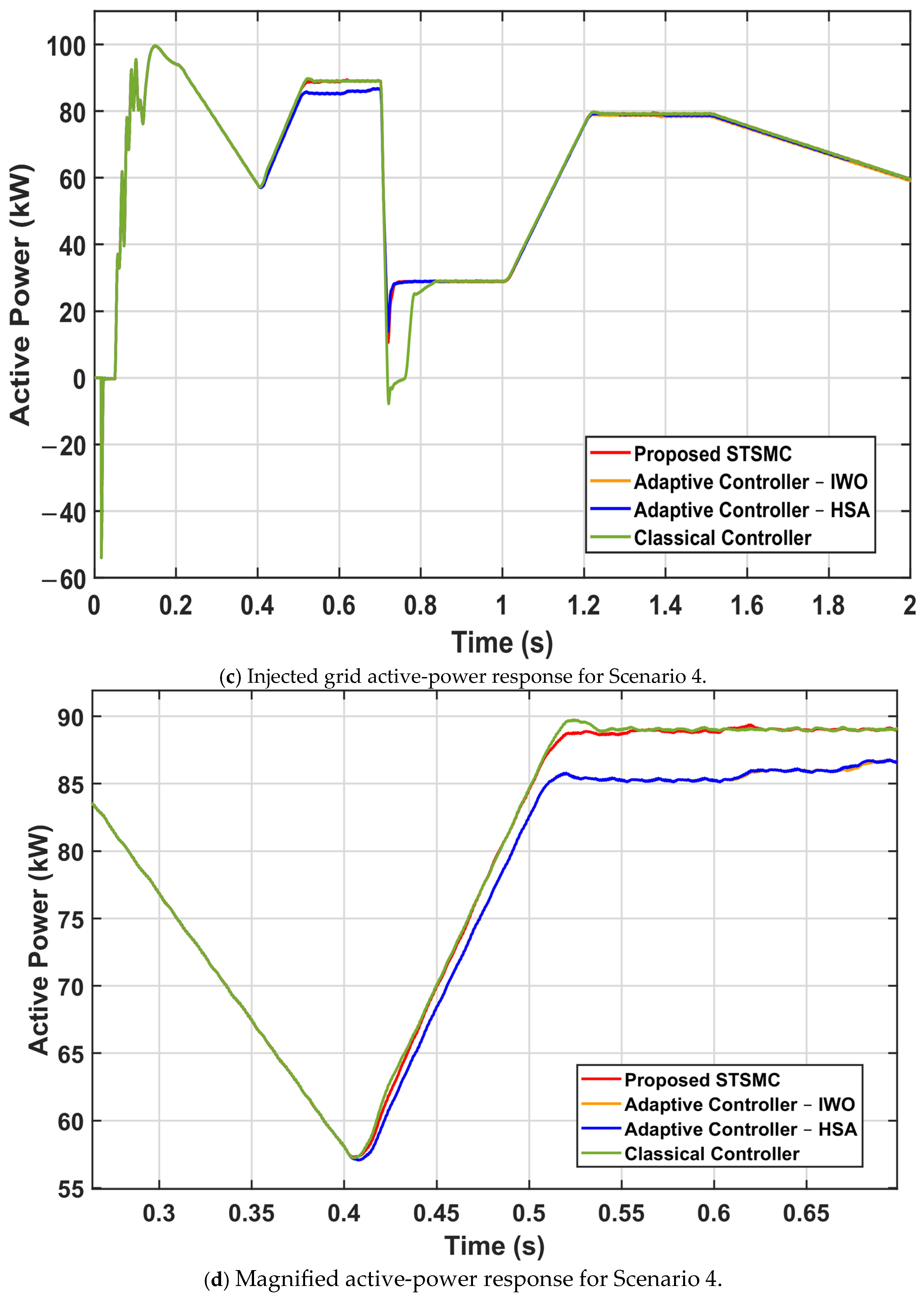
Under reduced irradiance conditions with abrupt environmental transitions, the corresponding temperature and irradiance profiles are illustrated in Figure 9a and Figure 9b, respectively. The resulting injected grid power responses are presented in Figure 9c, while a zoomed-in transient view is provided in Figure 9d.
Figure 9.
Performance of the grid-connected PV system under low-irradiance conditions with rapid transitions: (a) temperature profile; (b) solar irradiance profile; (c) injected grid active-power response; and (d) magnified active-power response.
In this operating regime, the performance differences among the controllers become relatively narrower compared to previous scenarios. Nevertheless, the proposed SBOA–STSMC consistently achieves the highest accumulated injected energy of 129.9 kW·s, outperforming the HSA-based controller (128.9 kW·s), the IWO-based controller (128.7 kW·s), and the classical controller (128.2 kW·s). Although the relative improvement is smaller under reduced irradiance levels, the proposed controller maintains the smoothest transient response and most stable convergence behavior, as clearly observed in the zoomed-in response of Figure 9d. The consistent superiority across diverse operating conditions confirms the robustness and reliability of the SBOA-based parameter tuning strategy for enhanced energy extraction.
5.5. Scenario 5: Two-Array System Under Dynamic Partial Shading
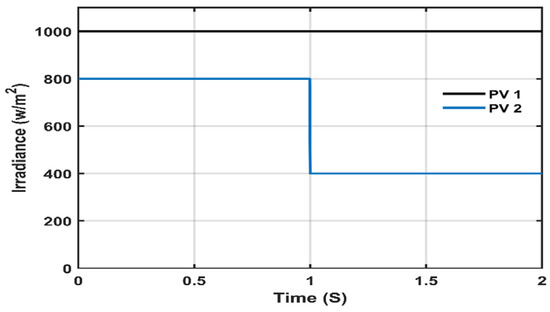
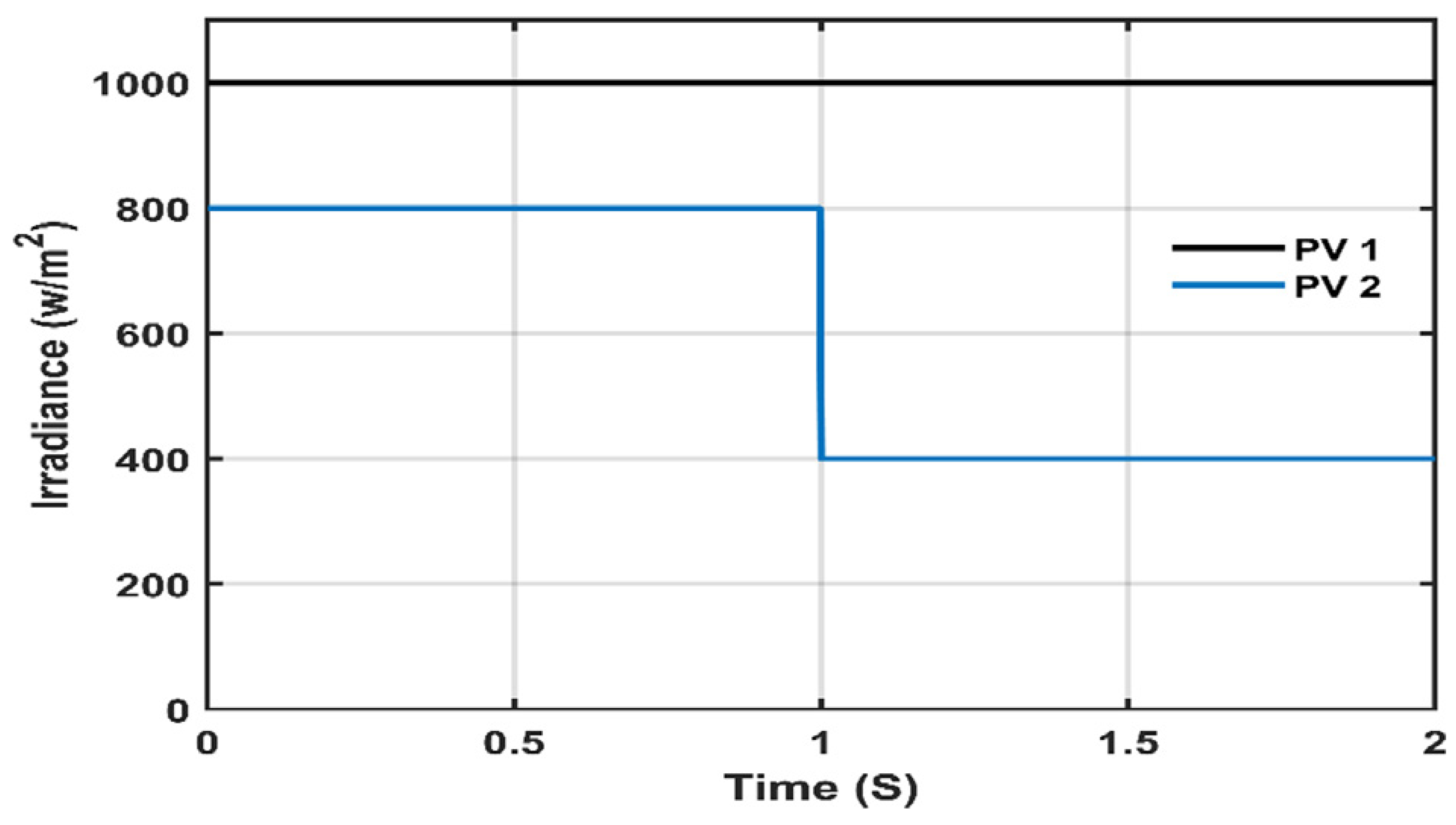
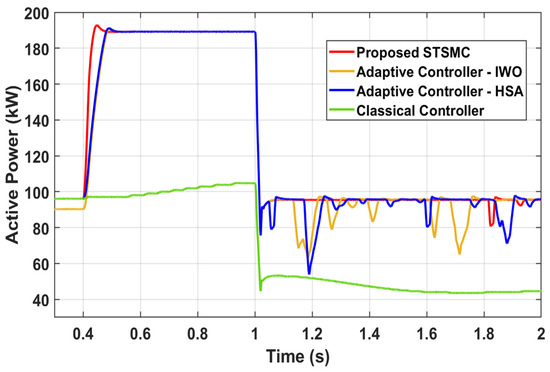
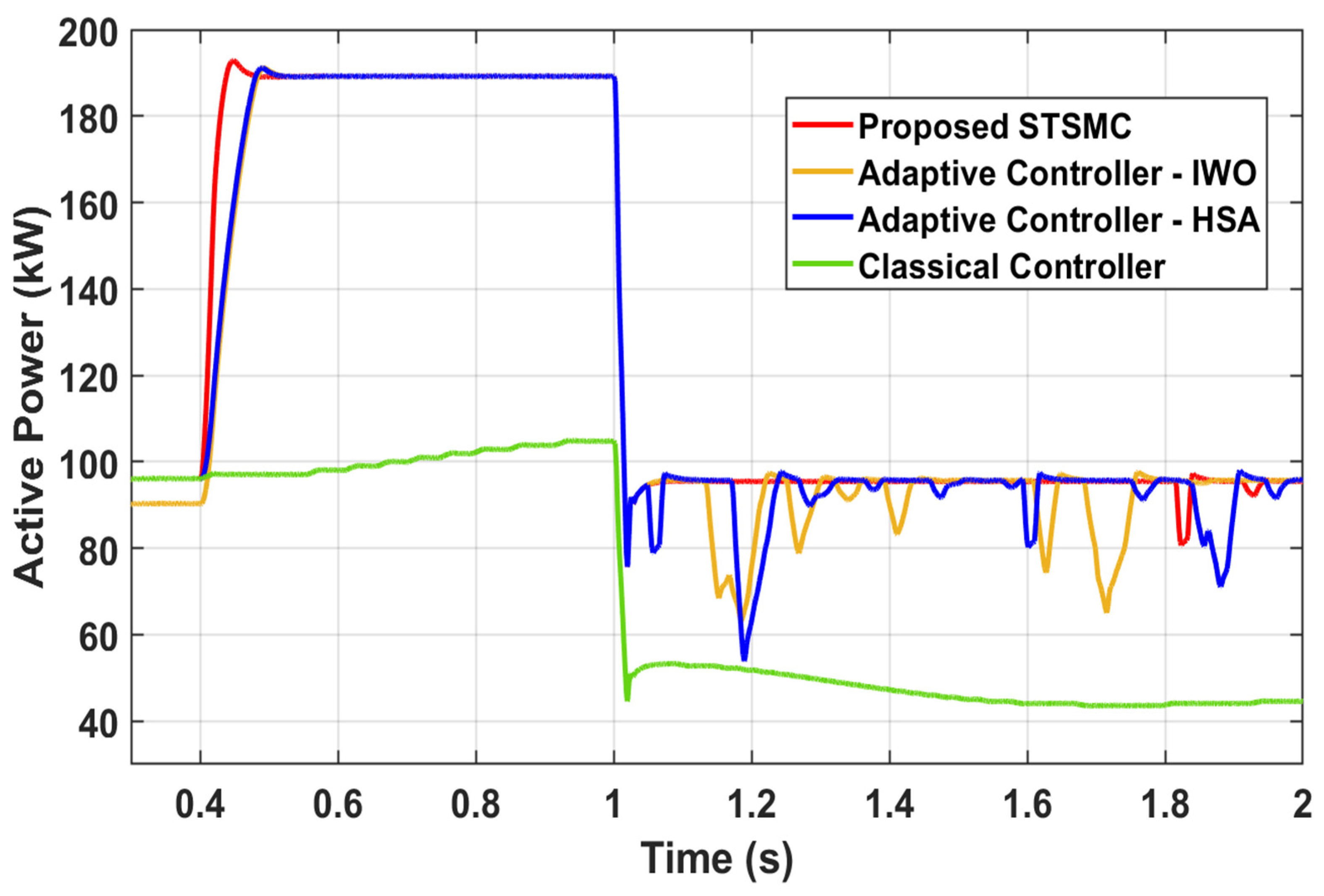
In the fifth scenario, System Configuration 2, illustrated in Figure 2, is considered. This configuration consists of a two-array photovoltaic system operating under dynamic partial-shading conditions. The temperature is assumed to be constant at 25 °C as in [19,25]. The applied irradiance patterns are presented in Figure 10, while the corresponding injected grid power responses are shown in Figure 11. The performance of the proposed SBOA–STSMC is evaluated in comparison with the HSA-based adaptive controller [19], the IWO-based controller, and the classical P&O controller [25].
Figure 10.
Solar irradiance profile for Scenario 5 (two-array system under dynamic partial shading).
Figure 11.
Power injected into the grid for Scenario 5 (two-array system under dynamic partial shading).
In the present study, dynamic partial shading is simulated by applying different irradiance levels to the two PV arrays, as shown in Figure 10. PV1 operates at a constant irradiance of 1000 W/m2, whereas PV2 is subjected to 800 W/m2 from 0 to 1 s and then reduced to 400 W/m2 from 1 to 2 s. This mismatch in irradiance between the two arrays creates a nonuniform operating condition and therefore represents a dynamic partial-shading scenario. Under such conditions, the MPPT task becomes more challenging because the controller must continuously adapt to the irradiance mismatch while maintaining operation in the high-power region.
The results show that the proposed SBOA–STSMC maintains a more stable active-power response during the irradiance transition, which supports improved energy extraction compared with the benchmark methods under the considered partial-shading condition.
Under partial-shading conditions, the P–V characteristics exhibit multiple local maxima, significantly increasing the complexity of global maximum power point tracking (MPPT) [36,37]. In this nonlinear operating regime, the classical controller fails to maintain global peak tracking and becomes trapped around local maxima during shading transitions. As clearly observed in Figure 11, the injected power of the classical controller drops substantially after shading is introduced, resulting in a pronounced reduction in accumulated energy. Although the HSA-based adaptive controller and IWO-based controller improve tracking performance compared with the classical approach, they still exhibit lower accumulated injected energy than the proposed SBOA–STSMC under the investigated partial-shading condition. In contrast, the proposed SBOA–STSMC maintains stable operation and provides the highest accumulated injected energy throughout the dynamic shading process. The total injected energy reaches 243.1 kW·s, compared with 238.4 kW·s for the HSA-based controller and 235.1 kW·s for the IWO-based controller, representing improvements of approximately 2.0% and 3.4%, respectively. Furthermore, it exhibits a significant energy gain over the classical P&O controller, which achieves 143.1 kW·s and suffers from large tracking errors induced by the multi-peak characteristics. These results demonstrate that SBOA-based parameter optimization enhances the controller’s capability to handle nonlinear multi-peak characteristics and provides improved energy extraction under dynamic partial-shading conditions. A summary of the injected energy values for all controllers across the five scenarios is presented in Table 9.
Table 9.
Summary of injected energy (kW·s) for all controllers across Scenarios 1–5.
5.6. Sensitivity Analysis of the Optimized STSMC Parameters
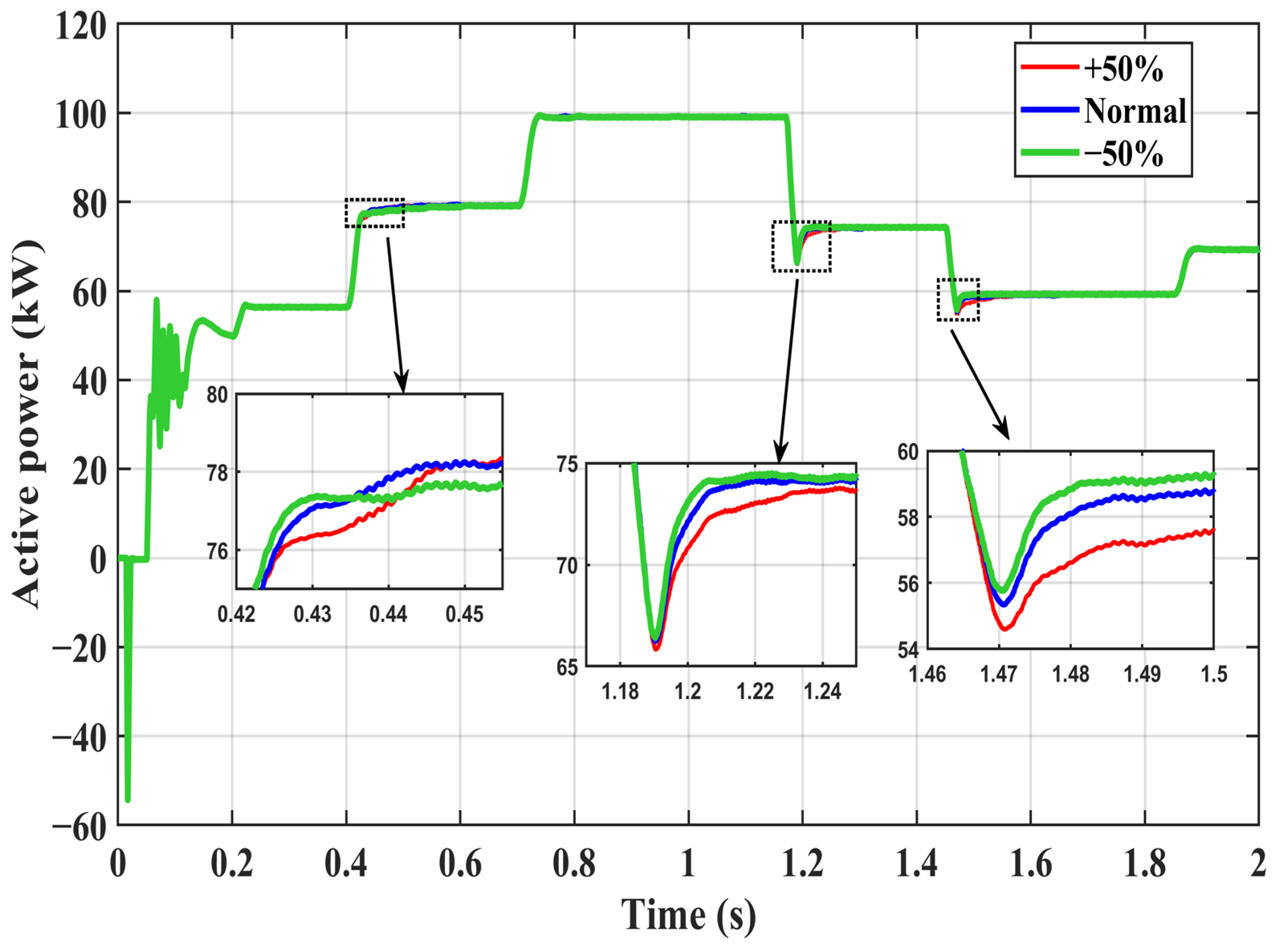
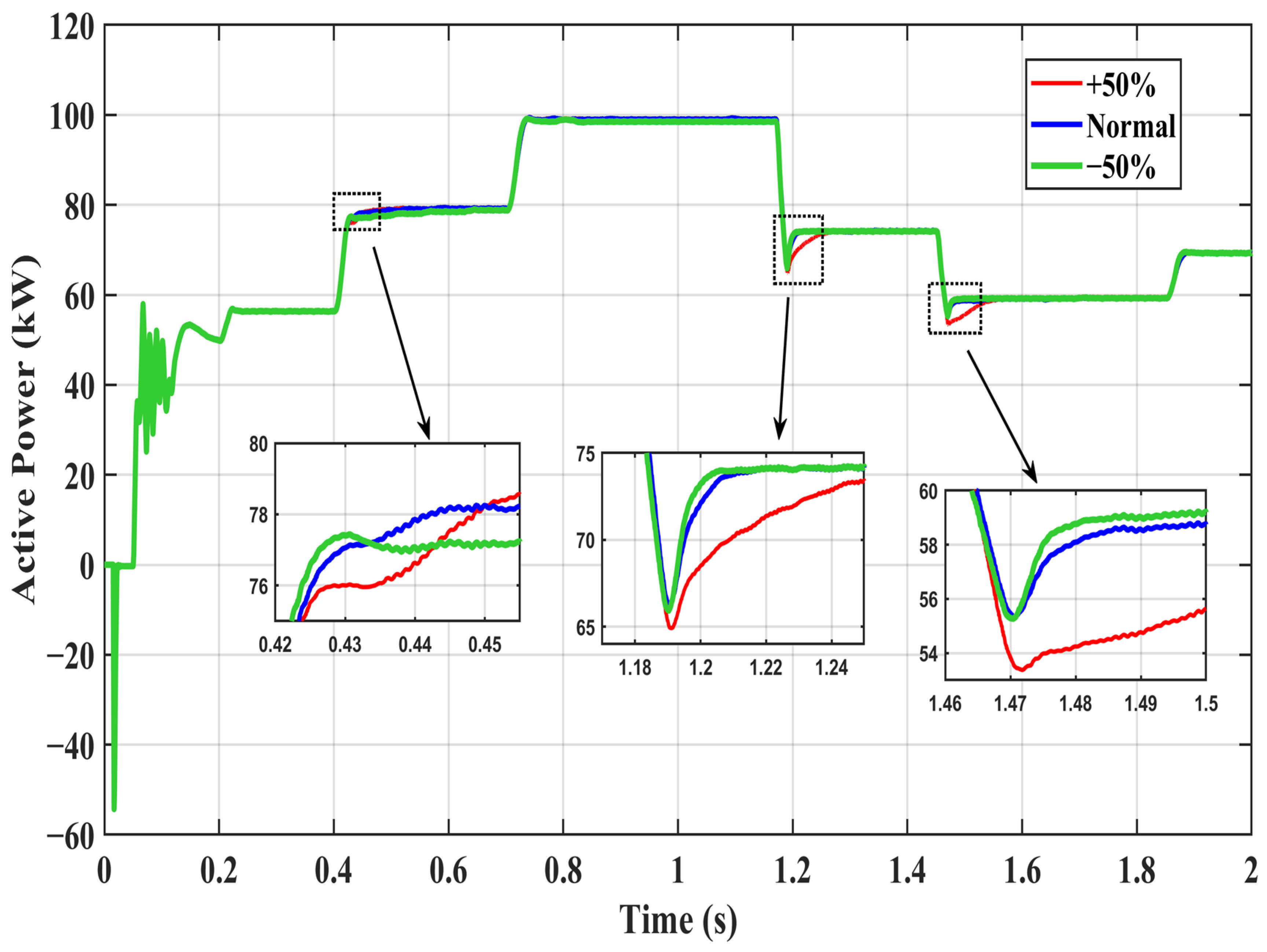
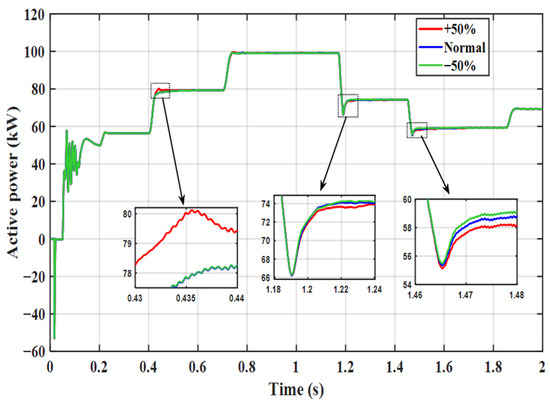
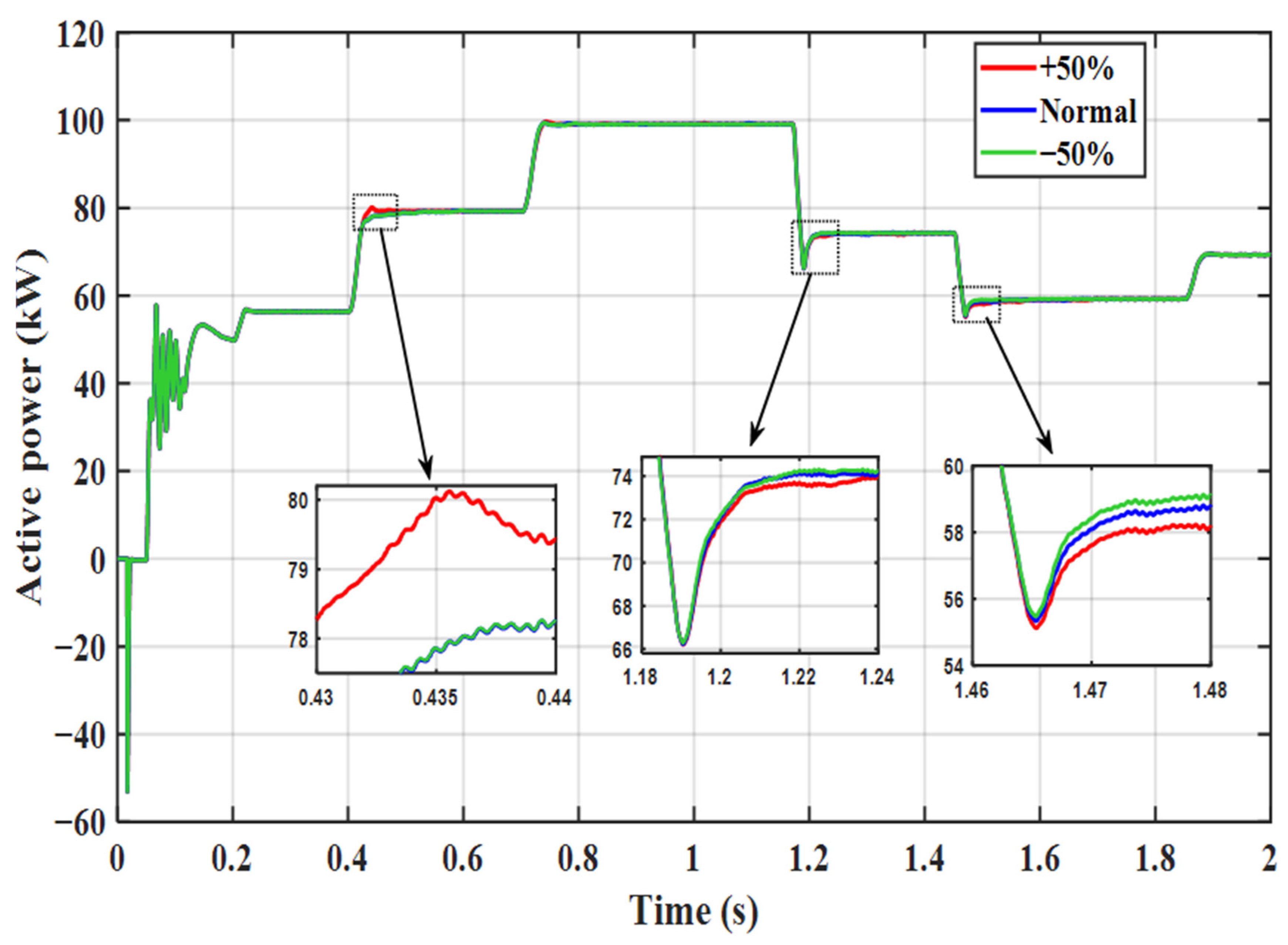
To further assess the robustness of the optimized controller gains, a sensitivity analysis was performed for the main STSMC parameters, namely K1, K2 and λ. The analysis was carried out based on the Scenario 1 irradiance profile under constant-temperature conditions. Each parameter varied independently by ±50% around its optimized value, while the remaining two parameters were kept fixed at their nominal optimized values. The purpose of this analysis is to evaluate whether large deviations in the controller gains significantly affect the energy-extraction and MPPT performance of the proposed SBOA–STSMC.
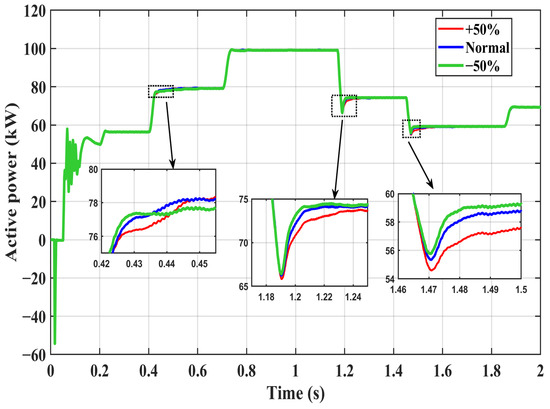
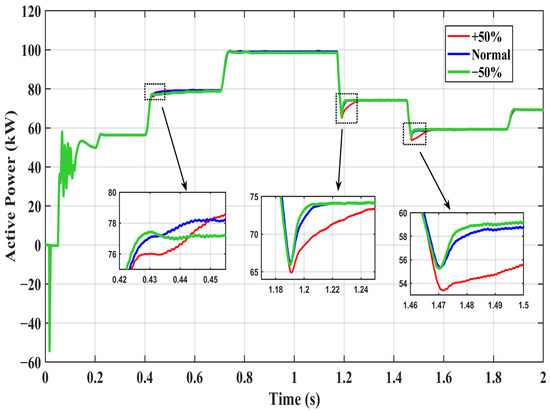
Figure 12, Figure 13 and Figure 14 show the active-power responses corresponding to the sensitivity analysis of K1, K2 and λ respectively. As shown in these figures, the active-power responses remain very close to the nominal case despite the large parameter variations. In addition, the accumulated injected grid energy shows only minor changes compared with the nominal optimized case. To provide an additional quantitative robustness assessment, the MPPT efficiency was also evaluated for each parameter variation, as summarized in Table 10. The injected energy remains within 141.77–142.10 kW·s, compared with 142.14 kW·s for the nominal case, while the MPPT efficiency remains within 97.06–97.30%, compared with 97.34% for the nominal optimized case. These results indicate that the proposed controller is not highly sensitive to variations in the optimized parameters and that the selected SBOA-based gains lie within a wide stable operating range.
Figure 12.
Sensitivity analysis of under parameter variation based on Scenario 1 irradiance profile under constant-temperature conditions.
Figure 13.
Sensitivity analysis of K1 under parameter variation based on Scenario 1 irradiance profile under constant-temperature conditions.
Figure 14.
Sensitivity analysis of K2 under parameter variation based on Scenario 1 irradiance profile under constant-temperature conditions.
Table 10.
Quantitative sensitivity analysis of the SBOA–STSMC under ±50% variations in K1, K2 and λ.
The results also confirm that moderate or even relatively large deviations in K1, K2 and λ do not noticeably degrade the main objective of the proposed controller, which is maximum energy extraction. Therefore, the sensitivity analysis supports the robustness of the proposed SBOA–STSMC against parameter variations and possible implementation inaccuracies.
It should be noted that the sensitivity analysis focuses on the accumulated injected energy, MPPT efficiency, and active-power response because the primary aim of this work is optimal power extraction. Transient indices such as settling time and overshoot are not used as optimization objectives in the present study and are considered as future extensions within a multi-objective optimization framework.
5.7. Real-Time Validation
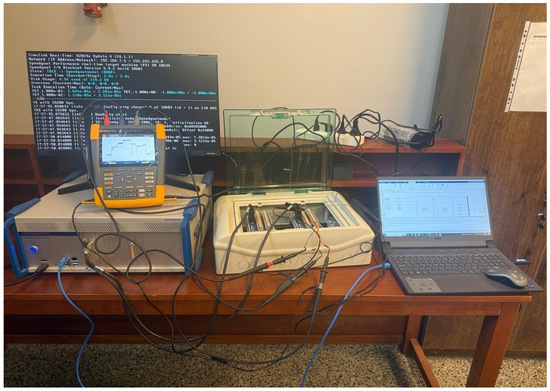
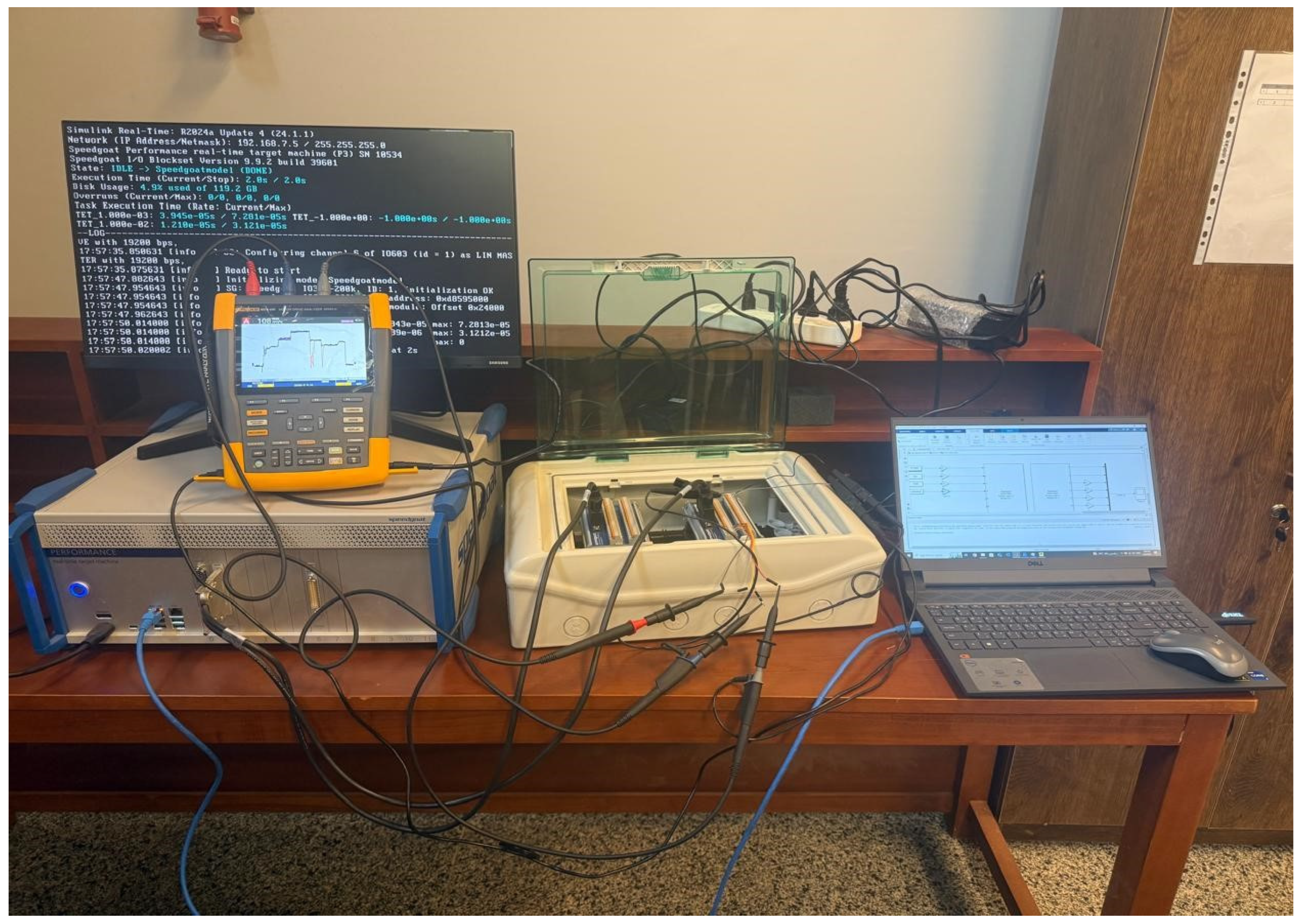
To further assess the practical applicability and real-time implementation capability of the proposed control strategy, real-time experiments were conducted. The experimental platform is shown in Figure 15. The developed control model was deployed from the host computer to the Speedgoat real-time target and executed in real time. The Speedgoat input/output channels were connected through the external I/O interface unit, which provides signal routing and conditioning between the real-time target and the external measurement equipment. The corresponding real-time output signals were then monitored and recorded using the Fluke ScopeMeter. This arrangement allows the proposed control strategy to be evaluated under real-time execution and physical I/O conditions rather than exclusively through offline MATLAB/Simulink simulations.
Figure 15.
Real-time experimental setup based on the Speedgoat real-time target platform.
The online implementation of the optimized STSMC requires basic arithmetic operations together with evaluation of the square-root and sign functions and numerical integration of the auxiliary state. The controller was executed in real time on the Speedgoat target platform using a sampling period of 100 μs, confirming that the computational requirements are compatible with the adopted real-time sampling rate. Since the present implementation was performed on the Speedgoat real-time platform rather than on a specific embedded microcontroller or DSP, processor-specific FLOP counts and CPU utilization are not reported and are left for future embedded-platform evaluation.
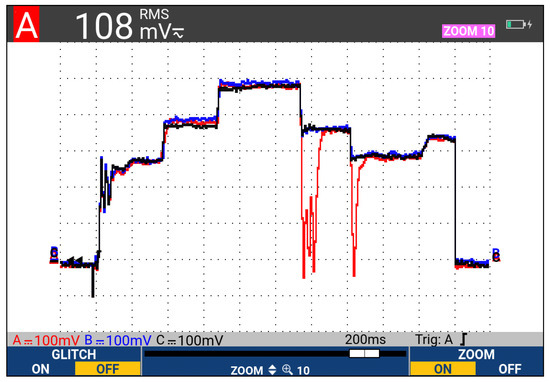
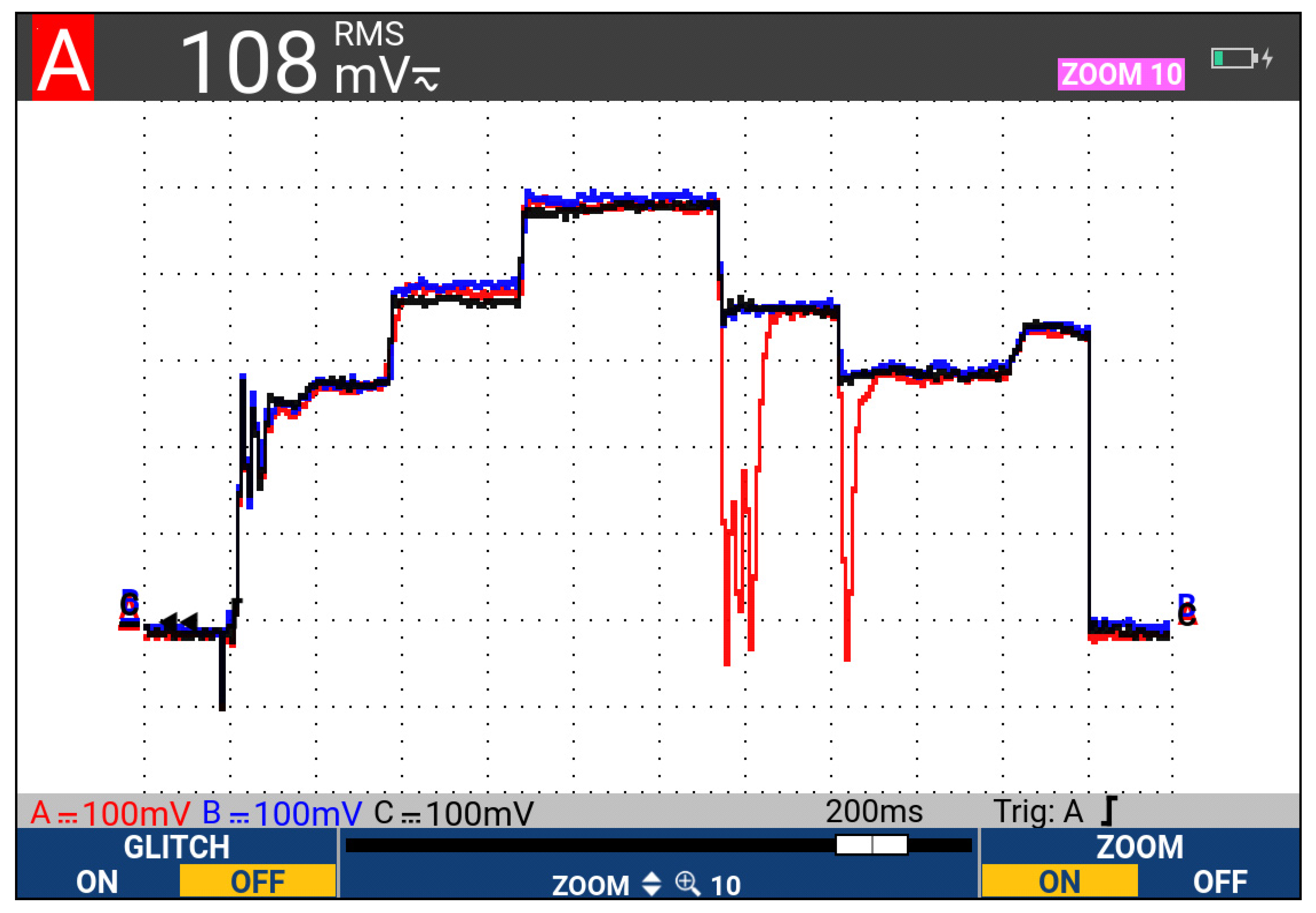
The real-time validation was performed under the operating conditions of Scenario 1, characterized by stepwise irradiance variations at constant temperature. Three control approaches were experimentally evaluated: the proposed SBOA–STSMC, the HSA-based controller, and the classical controller. The corresponding real-time measured responses obtained from Speedgoat implementation are presented in Figure 16.
Figure 16.
Real-time responses under the Scenario 1 operating profile: Channel A (red), classical controller; Channel B (blue), HSA-based controller; and Channel C (black), proposed SBOA–STSMC.
As shown in Figure 16, all three controllers follow the imposed stepwise operating changes. However, the classical controller (Channel A, red) exhibits the most pronounced transient deviations following abrupt changes. The HSA-based controller (Channel B, blue) improves the dynamic response and reduces these deviations. In comparison, the proposed SBOA–STSMC (Channel C, black) exhibits the smoothest real-time response with reduced transient deviations during the operating transitions. These real-time observations are consistent with the trends obtained from the corresponding MATLAB/Simulink results and provide additional experimental evidence of the real-time implementation capability of the proposed SBOA–STSMC.
5.8. Severe-Disturbance and Grid-Interface Parameter Robustness
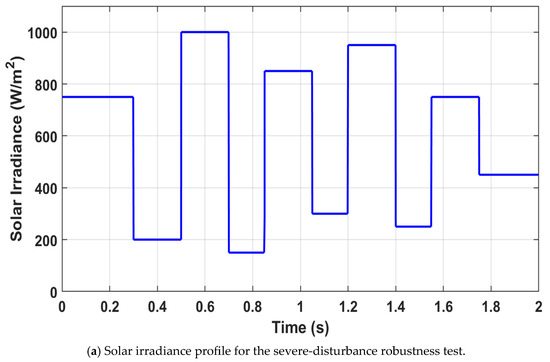
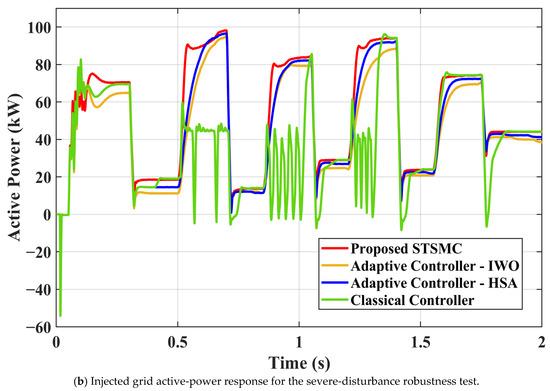
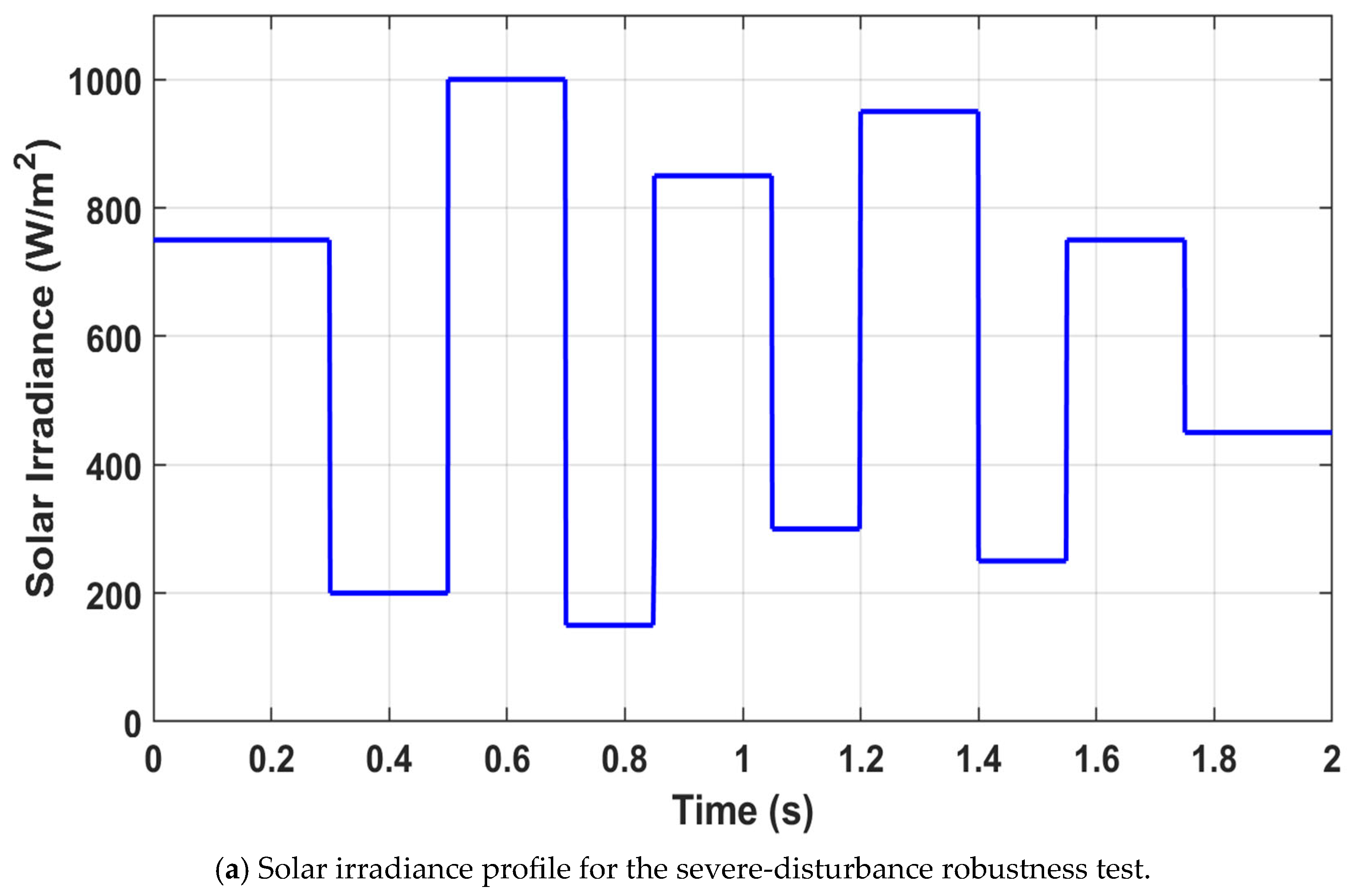
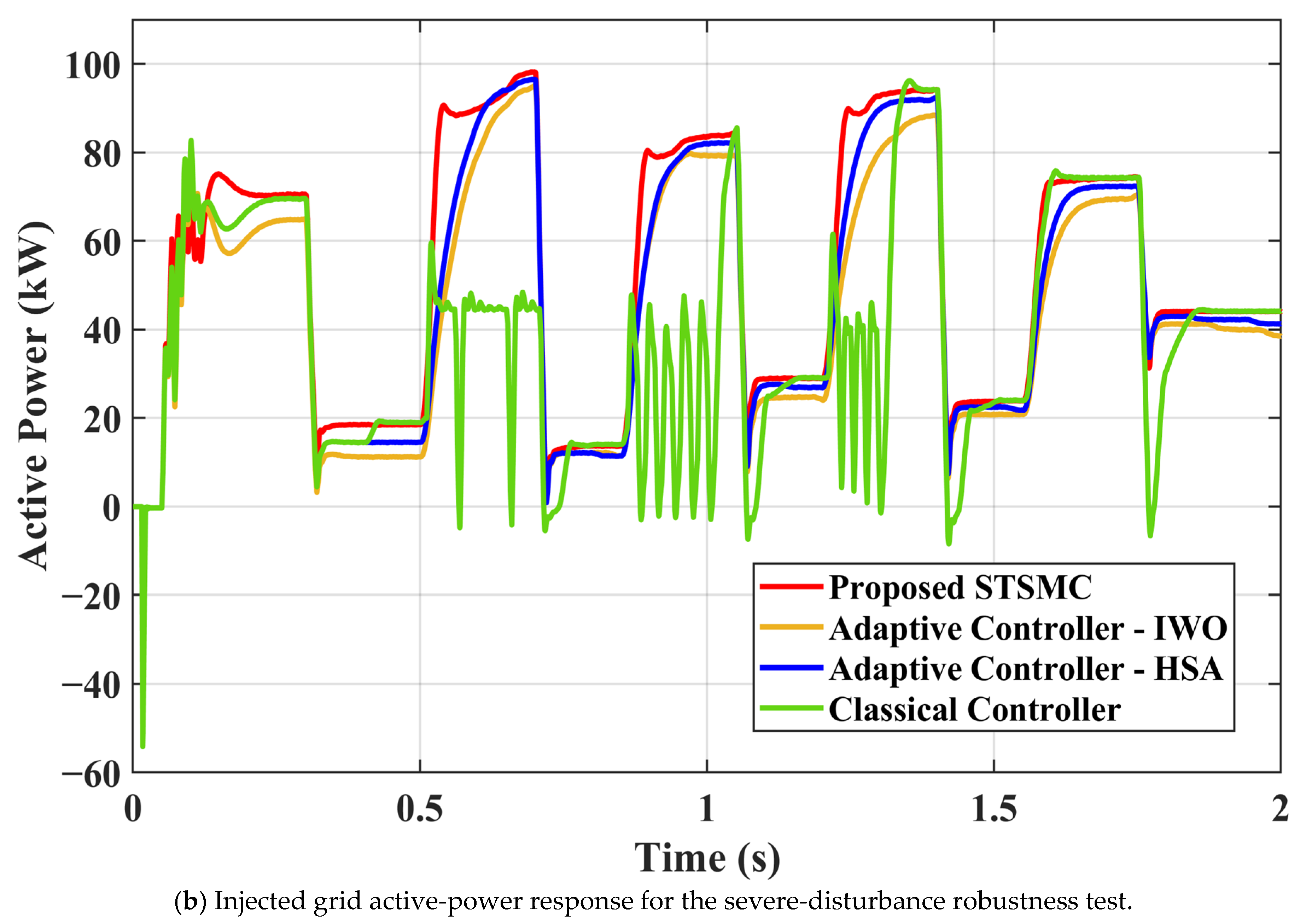
To further evaluate the robustness of the investigated controllers under highly demanding operating conditions, an additional severe irradiance profile was applied to System Configuration 1, as shown in Figure 17a. The temperature was maintained constant at 25 °C throughout the test. The irradiance was subjected to repeated abrupt variations over the 2 s simulation interval to impose severe and rapidly changing operating conditions. The controller parameters for all investigated methods were kept identical to those used in Scenario 1, without retuning, and the same severe irradiance profile was applied to all controllers to ensure a consistent comparison. The grid active-power response for this severe-disturbance is shown in Figure 17b.
Figure 17.
Performance of the grid-connected PV system under the severe-disturbance robustness test: (a) solar irradiance profile; and (b) injected grid active-power response.
As shown in Figure 17b, the proposed SBOA–STSMC maintains effective active-power tracking throughout the severe irradiance variations and exhibits reduced transient deterioration compared with the benchmark controllers. The accumulated injected energy reaches 105.1 kW·s for the proposed SBOA–STSMC, compared with 91.32 kW·s for IWO, 97.49 kW·s for HSA, and 76.63 kW·s for the classical controller. These values correspond to improvements of approximately 15.1%, 7.8%, and 37.2% over IWO, HSA, and the classical controller, respectively. The benchmark responses also exhibit larger transient deviations during several abrupt irradiance transitions, whereas the proposed controller preserves a smoother and more consistent power response. These results provide additional evidence of the robustness of the proposed controller under severe and rapidly varying environmental conditions.
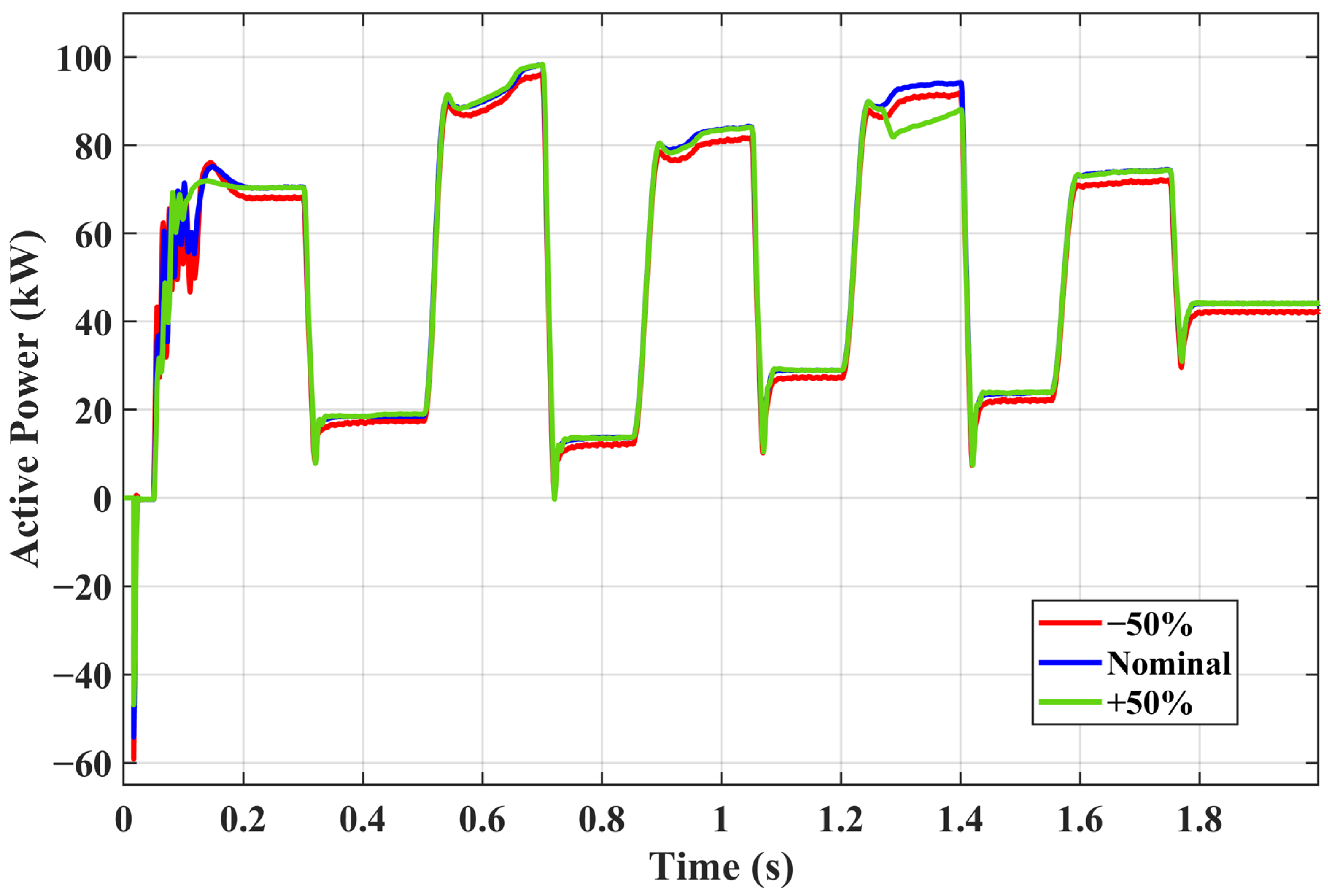
To further assess robustness against physical grid-interface parameter uncertainty, the grid-side choke inductance was varied by ±50% from its nominal value of 500 μH, while maintaining the same severe irradiance profile and the same controller parameters used in Scenario 1. The investigated values were 250 μH, 500 μH, and 750 μH, corresponding to −50%, nominal, and +50% cases, respectively. As shown in Figure 18, the active-power responses remain closely comparable despite the substantial inductance variation, with the main differences occurring during the transient intervals following abrupt irradiance changes.
Figure 18.
Sensitivity of the proposed SBOA–STSMC to grid-side choke inductance under the severe irradiance profile: 250 μH (−50%), 500 μH (nominal), and 750 μH (+50%).
The accumulated injected energy is 105.1 kW·s for the nominal case, 101.3 kW·s for the −50% case, and 104.0 kW·s for the +50% case. Thus, the maximum reduction relative to the nominal condition is approximately 3.6%, despite a ±50% variation in the choke inductance. This limited degradation demonstrates that the proposed SBOA–STSMC maintains satisfactory power-tracking and energy-extraction performance under substantial grid-interface parameter uncertainty.
5.9. Optimization Algorithm Selection and Statistical Validation
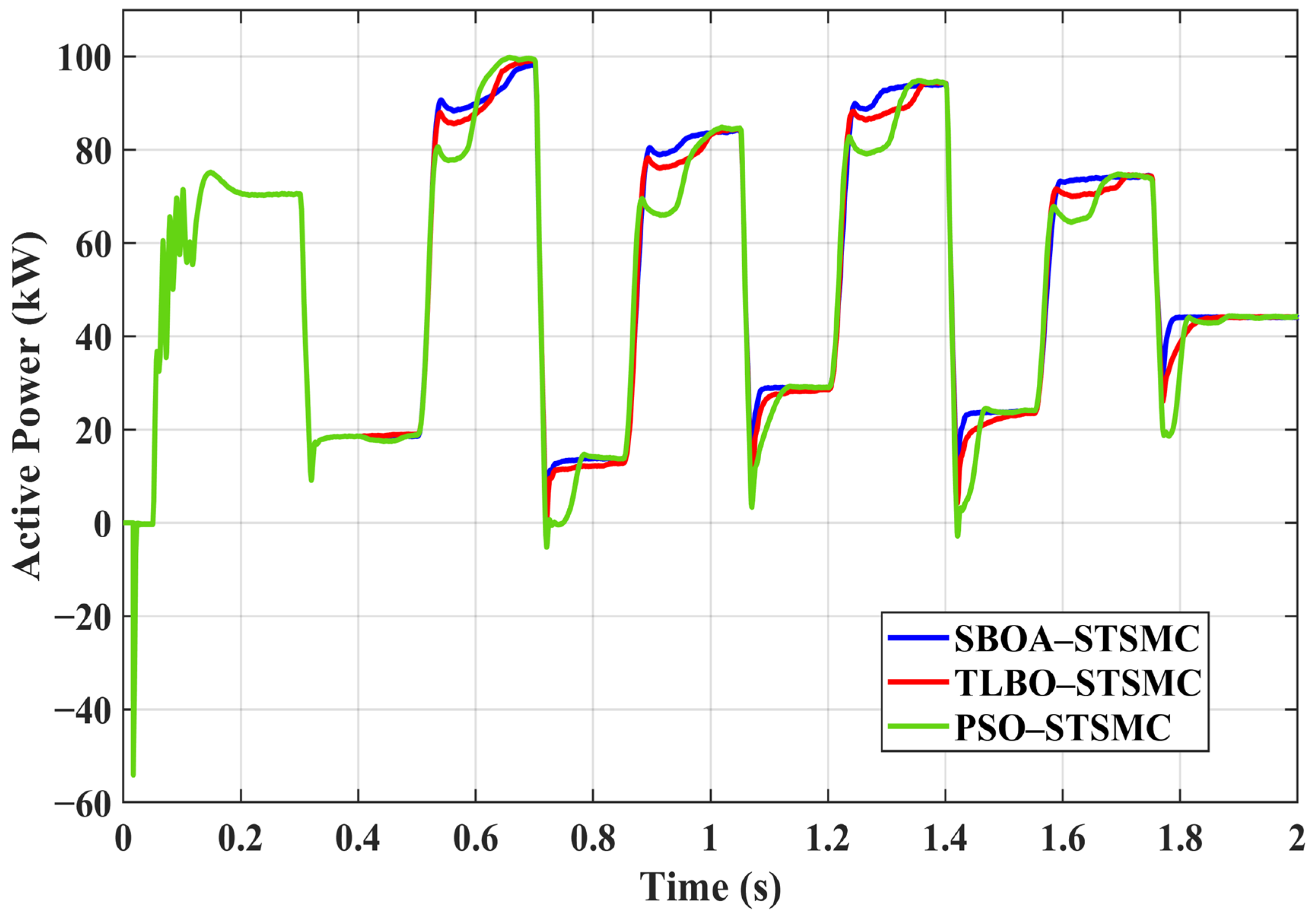
The Secretary Bird Optimization Algorithm (SBOA) was selected for offline tuning of the STSMC parameters because of its effective balance between exploration and exploitation, which supports an efficient search of the controller-parameter space and reduces the possibility of premature convergence [31]. Its performance was compared with Particle Swarm Optimization (PSO), selected as a classical and well-established benchmark, and Teaching–Learning-Based Optimization (TLBO), selected as a comparatively recent population-based technique with a simple two-stage teacher–learner search process and a broad record of successful application in engineering optimization problems. All three algorithms were applied to the same STSMC under identical optimization conditions, using accumulated active energy as the objective function. Each algorithm was independently executed 30 times. The statistical performance obtained from the 30 runs is summarized in Table 11.
Table 11.
Statistical performance over 30 independent runs.
As shown in Table 11, SBOA achieved the highest mean accumulated energy and the lowest standard deviation, indicating improved performance and greater consistency over the 30 independent runs. TLBO showed intermediate performance, while PSO provided the lowest mean value and the highest variation.
To verify whether the observed differences are statistically significant, a nonparametric Wilcoxon rank-sum test was applied to all pairwise comparisons at a significance level of , following the statistical comparison framework recommended for evolutionary and swarm-intelligence algorithms [38]. In Table 12, denotes the rank-sum statistic, is the tie-corrected standardized test statistic, is the associated probability under the null hypothesis, and indicates a statistically significant difference at the selected significance level.
Table 12.
Wilcoxon rank-sum test results.
Table 12 shows that all pairwise comparisons yield with , confirming statistically significant differences among the three optimization methods. Among the evaluated algorithms, SBOA achieved the best overall performance, followed by TLBO, while PSO showed the lowest performance. For the dynamic comparison, the controller parameter set corresponding to the maximum accumulated energy obtained by each optimizer was selected. These optimal STSMC parameters are listed in Table 13.
Table 13.
Optimal STSMC parameters corresponding to the maximum accumulated energy.
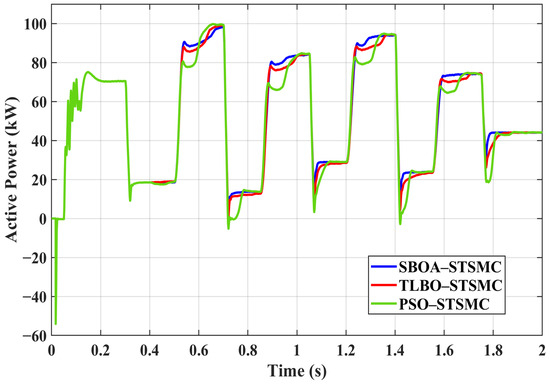
Using the parameter sets in Table 13, the three tuned STSMC controllers were evaluated under the same severe irradiance condition. Their dynamic responses are compared in Figure 19, where the SBOA-tuned controller achieves the highest accumulated active energy, followed by TLBO and PSO.
Figure 19.
Comparative dynamic response of STSMC optimized by PSO, TLBO, and SBOA under severe irradiance variations.
These results support the selection of SBOA for tuning the proposed controller, as it consistently achieved the highest accumulated energy together with the lowest run-to-run variation among all evaluated algorithms.
6. Conclusions
This study presented a Secretary Bird Optimization-tuned Super-Twisting Sliding Mode Controller (SBOA–STSMC) to enhance maximum power point tracking (MPPT) and energy extraction in grid-connected photovoltaic systems operating under diverse environmental conditions. By integrating higher-order sliding mode control with SBOA-based parameter optimization, the proposed framework systematically maximized the injected grid energy through an offline optimization process implemented with a population size of 20 candidates over 100 iterations. The controller performance was evaluated under five simulation scenarios of progressively increasing complexity, including stepwise irradiance variations, simultaneous irradiance and temperature disturbances, severe dynamic atmospheric changes, low-irradiance transitions, and dynamic partial shading using a dual-array configuration. In Scenarios 1–4, the proposed approach was compared with the classical Incremental Conductance method and adaptive STSMC controllers tuned using IWO and HSA. In Scenario 5, the comparison included the classical Perturb and Observe (P&O) method, the IWO-based controller, and the HSA-based controller under partial-shading conditions. In addition, a sensitivity analysis was performed under parameter variations for K1, K2, and λ. The results showed negligible change in the accumulated injected energy, indicating that the optimized gains lie within a wide stable operating range. An additional severe-disturbance test using rapid irradiance variations was also performed without retuning the controller parameters. Under this condition, the proposed SBOA–STSMC achieved 105.1 kW·s, compared with 97.49 kW·s for HSA, 91.32 kW·s for IWO, and 76.63 kW·s for the classical controller. Robustness against grid-interface parameter uncertainty was further assessed by varying the grid-side choke inductance by ±50% from its nominal value of 500 μH, with a maximum energy reduction of approximately 3.6%. In addition, the 30 independent SBOA runs demonstrated good repeatability with limited dispersion in the accumulated injected energy. A separate statistical comparison using 30 independent runs of SBOA, TLBO, and PSO was also conducted, and the Wilcoxon rank-sum test confirmed statistically significant differences among the three optimization algorithms. Real-time experiments using the Speedgoat platform under Scenario 1 further confirmed the practical implementation capability of the proposed controller and reproduced the performance trends observed in the MATLAB/Simulink results.
Across all investigated cases, the proposed SBOA–STSMC consistently achieved the highest injected energy. Quantitatively, energy extraction improved by approximately 5% under irradiance variation, exceeded 5% under simultaneous irradiance–temperature disturbances, and surpassed 10% under severe dynamic atmospheric conditions relative to classical approaches. Under partial shading with multi-peak power–voltage characteristics, the proposed controller maintained reliable global maximum power point tracking and achieved an approximately 2% higher injected energy compared to the HSA-based controller and an approximately 3.4% higher injected energy than the IWO-based controller, while significantly outperforming the classical method. In Scenario 1, MPPT efficiency, steady-state power ripple, and grid-current THD were also evaluated to provide additional assessment of tracking effectiveness, output smoothness, and grid-side power quality. The results confirm that SBOA effectively identifies optimal STSMC parameters that enhance transient response, reduce oscillatory behavior, and improve steady-state energy performance. Unlike conventional tuning methods, the proposed framework maintains robustness across varying environmental conditions without requiring retuning. The severe-disturbance and grid-interface uncertainty tests further support the robustness of the proposed controller under rapid environmental variations and parameter uncertainty. Overall, the results demonstrate that the proposed SBOA–STSMC provides an effective optimization-based MPPT control approach for the investigated grid-connected PV system under the considered operating conditions.
Future work will focus on multi-objective optimization considering energy extraction, grid-current quality, and switching losses. Further studies will investigate the effects of computational delay, PWM resolution, sensor noise, and converter losses to further improve the practical robustness of the proposed controller.
Author Contributions
Conceptualization, M.A.S. and A.O.B.; methodology, M.A.S.; software, A.O.B.; validation, A.H.E.-E., M.A.A. and A.O.B.; formal analysis, M.A.S.; investigation, M.A.S.; resources, A.O.B.; data curation, A.H.E.-E.; writing—original draft preparation, M.A.S.; writing—review and editing, M.A.A.; visualization, A.H.E.-E.; supervision, M.A.A.; project administration, A.O.B. All authors have read and agreed to the published version of the manuscript.
Funding
This research received no external funding.
Data Availability Statement
The original contributions presented in this study are included in the article. Further inquiries can be directed to the corresponding author.
Acknowledgments
The authors would like to thank the Center of Energy (COE) at Ain Shams University for providing the equipment used in this research.
Conflicts of Interest
The authors declare no conflicts of interest.
Abbreviations
The following abbreviations are used in this manuscript:
| ANFIS | Adaptive Neuro-Fuzzy Inference System |
| ANN | Artificial Neural Network |
| FLC | Fuzzy Logic Controller |
| FMPPT | Fast Maximum Power Point Tracking |
| GMPPT | Global Maximum Power Point Tracking |
| GWO | Grey Wolf Optimizer |
| HSA | Harmony Search Algorithm |
| INC | Incremental Conductance Method |
| IWO | Invasive Weed Optimization |
| MPPT | Maximum Power Point Tracking |
| PLL | Phase-Locked Loop |
| PSO | Particle Swarm Optimization |
| PWM | Pulse Width Modulation |
| PV | Photovoltaic |
| SBOA | Secretary Bird Optimization Algorithm |
| SOA | Seagull Optimization Algorithm |
| STSMC | Super-Twisting Sliding Mode Control |
References
- Mokhtar, M.; Marei, M.I.; Attia, M.A. Hybrid SCA and adaptive controller to enhance the performance of grid-connected PV system. Ain Shams Eng. J. 2021, 12, 3775–3781. [Google Scholar] [CrossRef] [Scilit]
- Liu, Y.-H.; Chen, G.-J.; Liu, C.-L.; Su, C.-Y. Comprehensive review on fast maximum power point tracking algorithms for solar power generation systems. Ain Shams Eng. J. 2024, 15, 103093. [Google Scholar] [CrossRef] [Scilit]
- EN 50530:2010; Overall Efficiency of Grid Connected Photovoltaic Inverters. European Committee for Electrotechnical Standardization (CENELEC): Brussels, Belgium, 2010.
- EL-Banna, M.H.; Hammad, M.R.; Megahed, A.I.; AboRas, K.M.; Alkuhayli, A.; Gowtham, N. On-grid optimal MPPT for fine-tuned inverter based PV system using golf optimizer considering partial shading effect. Alex. Eng. J. 2024, 103, 180–196. [Google Scholar] [CrossRef] [Scilit]
- Hasan, M.G.; Uddin, M.A.; Ferdous, A.H.M.I.; Sadeque, M.G. Enhanced maximum power point tracking using hybrid GA and PSO algorithms for solar PV systems. Results Eng. 2025, 28, 107708. [Google Scholar] [CrossRef] [Scilit]
- Rukhsar; Ajmal, A.M.; Yang, Y. Global maximum power point tracking of photovoltaic systems using artificial intelligence. Energies 2025, 18, 3036. [Google Scholar] [CrossRef] [Scilit]
- Khan, M.; Raza, M.A.; Faheem, M.; Sarang, S.A.; Panhwar, M.; Jumani, T.A. Conventional and artificial intelligence based maximum power point tracking techniques for efficient solar power generation. Eng. Rep. 2024, 6, e12963. [Google Scholar] [CrossRef] [Scilit]
- Mohammed, Z.; Kaoutar, T.; Abdelghani, E.O.; Belkacem, T. Enhancing grid-connected photovoltaic power system performance using fuzzy P&O approach. Eng. Proc. 2025, 112, 25. [Google Scholar] [CrossRef] [Scilit]
- Ali, A.H.; Najafi, A. Optimization and performance improvement of grid-connected PV plant based on ANN-PSO and P&O algorithms. Int. Trans. Electr. Energy Syst. 2022, 2022, 1278492. [Google Scholar] [CrossRef] [Scilit]
- Babaa, S.E.; Armstrong, M.; Pickert, V. Overview of maximum power point tracking control methods for PV systems. J. Power Energy Eng. 2014, 2, 59–72. [Google Scholar]
- Ali, M.H.; Zakaria, M.; El-Tawab, S. A comprehensive study of recent maximum power point tracking techniques for photovoltaic systems. Sci. Rep. 2025, 15, 14269. [Google Scholar] [CrossRef] [Scilit] [PubMed]
- Sadick, A. Maximum power point tracking simulation for photovoltaic systems using perturb and observe algorithm. In Solar Radiation—Enabling Technologies, Recent Innovations, and Advancements for Energy Transition; IntechOpen: London, UK, 2023. [Google Scholar]
- Shaik, F.; Lingala, S.S.; Veeraboina, P. Effect of various parameters on the performance of solar PV power plant: A review and the experimental study. Sustain. Energy Res. 2023, 10, 6. [Google Scholar] [CrossRef] [Scilit]
- Hazem, T.; Cheghib, H.; Fezzani, A.; Kahoul, N.; Sari, M.R.; Lafta Rashid, F.; Ameen, A.; Kezzar, M.; Mahariq, I. Performance evaluation of grid connected photovoltaic pilot plant in Saharan climate using experimental and numerical analysis. Sci. Rep. 2025, 15, 32488. [Google Scholar] [CrossRef] [Scilit] [PubMed]
- Moustaine, F.Z.; Elmahni, L.; Belghiti, H.; ELAidi Idrissi, Y.; Hani, A.A. A novel MPPT approach based on dichotomous search for solar PV systems: Design, implementation, and performance evaluation under variable climatic conditions. Arab. J. Sci. Eng. 2026, 51, 7569–7588. [Google Scholar] [CrossRef] [Scilit]
- Belghiti, H.; Kandoussi, K.; Harrison, A.; Benbba, R.; El Otmani, R.; Chellakhi, A.; Sadek, E.M. Efficient and robust control of a standalone PV-storage system: An integrated single sensor-based nonlinear controller with TSCC-battery management. J. Energy Storage 2024, 95, 112630. [Google Scholar] [CrossRef] [Scilit]
- Belghiti, H.; Kandoussi, K.; Harrison, A.; Moustaine, F.Z.; Sadek, E.M. Simplified control algorithm for stable and efficient standalone PV systems: An assessment based on real climatic conditions. Comput. Electr. Eng. 2024, 120, 109695. [Google Scholar] [CrossRef] [Scilit]
- Belghiti, H.; Kandoussi, K.; Harrison, A.; Moustaine, F.Z.; El Otmani, R.; Sadek, E.M.; Bajaj, M.; Mohammadi, S.A.D. A novel adaptive FOCV algorithm with robust IMRAC control for sustainable and high-efficiency MPPT in standalone PV systems: Experimental validation and performance assessment. Sci. Rep. 2024, 14, 31962. [Google Scholar] [CrossRef] [Scilit] [PubMed]
- Omar, O.A.M.; Badra, N.; Attia, M.A. Enhancement of on-grid PV system under irradiance and temperature variations using new optimized adaptive controller. Int. J. Electr. Comput. Eng. 2018, 8, 2650–2660. [Google Scholar] [CrossRef] [Scilit]
- Levant, A. Sliding order and sliding accuracy in sliding mode control. Int. J. Control 1993, 58, 1247–1263. [Google Scholar] [CrossRef] [Scilit]
- Levant, A. Higher-order sliding modes, differentiation and output-feedback control. Int. J. Control 2003, 76, 924–941. [Google Scholar] [CrossRef] [Scilit]
- Levant, A. Homogeneity approach to high-order sliding mode design. Automatica 2005, 41, 823–830. [Google Scholar] [CrossRef] [Scilit]
- Utkin, V.; Guldner, J.; Shi, J. Sliding Mode Control in Electro-Mechanical Systems, 2nd ed.; CRC Press: Boca Raton, FL, USA, 2009. [Google Scholar]
- Rezkallah, M.; Sharma, S.; Chandra, A.; Singh, B. Lyapunov function and sliding mode control approach for the solar-PV grid interface system. IEEE Trans. Ind. Electron. 2017, 64, 785–795. [Google Scholar] [CrossRef] [Scilit]
- Benaissa, O.M.; Hadjeri, S.; Zidi, S.A. Modeling and simulation of grid connected PV generation system using MATLAB/Simulink. Int. J. Power Electron. Drive Syst. 2017, 8, 392–401. [Google Scholar] [CrossRef] [Scilit]
- Levant, A. Universal single-input-single-output (SISO) sliding-mode controllers with finite-time convergence. IEEE Trans. Autom. Control 2001, 46, 1447–1451. [Google Scholar] [CrossRef] [Scilit]
- Levant, A. Principles of 2-sliding mode design. Automatica 2007, 43, 576–586. [Google Scholar] [CrossRef] [Scilit]
- Moreno, J.A.; Osorio, M. Strict Lyapunov functions for the super-twisting algorithm. IEEE Trans. Autom. Control 2012, 57, 1035–1040. [Google Scholar] [CrossRef] [Scilit]
- Shtessel, Y.; Edwards, C.; Fridman, L.; Levant, A. Sliding Mode Control and Observation; Birkhäuser: New York, NY, USA, 2014. [Google Scholar]
- Shtessel, Y.; Taleb, M.; Plestan, F. A novel adaptive-gain supertwisting sliding mode controller: Methodology and application. Automatica 2012, 48, 759–769. [Google Scholar] [CrossRef] [Scilit]
- Fu, Y.; Liu, D.; Chen, J.; He, L. Secretary bird optimization algorithm: A new metaheuristic for solving global optimization problems. Artif. Intell. Rev. 2024, 57, 123. [Google Scholar] [CrossRef] [Scilit]
- Qin, S.; Liu, J.; Bai, X.; Hu, G. A multi-strategy improvement secretary bird optimization algorithm for engineering optimization problems. Biomimetics 2024, 9, 478. [Google Scholar] [CrossRef] [Scilit] [PubMed]
- Sanjalawe, Y.; Al-E’mari, S.; Abualhaj, M.; Makhadmeh, S.N.; Alsharaiah, M.A.; Hijazi, D.H. Recent advances in secretary bird optimization algorithm, its variants and applications. Evol. Intell. 2025, 18, 65. [Google Scholar] [CrossRef] [Scilit]
- Wang, F.; Wang, B. Multi-strategy improved Secretary Bird Optimization Algorithm. J. Comput. Commun. 2025, 13, 90–107. [Google Scholar] [CrossRef]
- Wang, X.; Wei, P.; Li, Y. Enhanced secretary bird optimization algorithm with multi-strategy fusion and Cauchy–Gaussian crossover. Sci. Rep. 2025, 15, 23163. [Google Scholar] [CrossRef] [Scilit] [PubMed]
- EL-Ebiary, A.H.; Marei, M.I.; Mokhtar, M. Data-driven optimal adaptive MPPT techniques for grid-connected photovoltaic systems. Ain Shams Eng. J. 2025, 16, 103318. [Google Scholar] [CrossRef] [Scilit]
- Hafez, A.O.; Attia, M.A.; EL-Ebiary, A.H. Enhanced adaptive control techniques for extracting maximum power from photovoltaic system. Sci. Rep. 2025, 15, 41459. [Google Scholar] [CrossRef] [Scilit] [PubMed]
- Derrac, J.; García, S.; Molina, D.; Herrera, F. A practical tutorial on the use of nonparametric statistical tests as a methodology for comparing evolutionary and swarm intelligence algorithms. Swarm Evol. Comput. 2011, 1, 3–18. [Google Scholar] [CrossRef] [Scilit]



Disclaimer/Publisher’s Note: The statements, opinions and data contained in all publications are solely those of the individual author(s) and contributor(s) and not of MDPI and/or the editor(s). MDPI and/or the editor(s) disclaim responsibility for any injury to people or property resulting from any ideas, methods, instructions or products referred to in the content. |
© 2026 by the authors. Licensee MDPI, Basel, Switzerland. This article is an open access article distributed under the terms and conditions of the Creative Commons Attribution (CC BY) license.