


Abstract
Financial literacy has become critical for mitigating everyday financial risks and sustaining saving behavior, particularly in professions with stable but often constrained income such as teaching. This study examines whether financial literacy predicts teachers’ saving habits indirectly through financial practices, and whether technological access may be associated with the link between practices and saving. Using a cross-sectional survey of 180 teachers from public educational institutions in the Jequetepeque Valley (Peru) in 2025, we tested a moderated mediation model (PROCESS Model 14). Financial literacy showed a strong positive association with financial practices, while its direct effect on saving habits was not significant after controls. The indirect effect through financial practices was significant across levels of technological access; however, the moderation effect of technological access was only marginally significant (p = 0.057) and the index of moderated mediation did not reach statistical significance at α = 0.05, indicating that the moderating role of technology requires further investigation. Overall, the results suggest that financial knowledge alone does not predict saving habits: the effect operates through consistent financial practices, and digital access may facilitate the continuity of these practices. The study contributes to financial risk management research in teacher populations and to Sustainable Development Goals (SDGs) 4, 8, and 9 in rural educational contexts.
1. Introduction
1.1. Context and Problem Statement
Financial literacy is increasingly recognized as a core capability for managing everyday financial risks (e.g., debt accumulation, income shocks, health expenses, and retirement planning) and for sustaining intertemporal decisions such as saving. Evidence across countries suggests that financial literacy remains uneven and, in many settings, insufficient to cope with complex and digitalized financial markets (Mireku et al., 2023; Morgan & Trinh, 2019; Widjaja et al., 2020). In practical terms, lower financial literacy is associated with less planned financial behavior and weaker persistence in saving goals over time (Dewi et al., 2020).
This challenge is particularly relevant for teachers. Beyond their role as educators, teachers are workers whose financial well-being shapes their ability to absorb shocks and sustain long-term plans. Empirical studies in different contexts show that teachers’ financial literacy is associated with measurable financial behaviors, although the magnitude of these associations varies across sociodemographic profiles and institutional settings (Nemeth et al., 2022; Paneda & Albay, 2025; Sel & Sözer, 2020; Zulaihati et al., 2020).
At the same time, teachers increasingly operate in environments where financial decision-making and professional tasks are mediated by technology. Teaching and enacting financial literacy in such settings can create opportunities (e.g., access to digital tools) but also barriers (e.g., unequal digital access or skills). This makes teachers an informative population for examining how knowledge is translated into practice (Harter, 2021; Lina et al., 2025; Muchran et al., 2023; Ndlovu, 2024).
In parallel, the digitalization of financial services and the expansion of FinTech solutions have reshaped how individuals’ budget, pay, compare products, access credit, and automate savings. Recent work suggests that technology—and the ability to use it for financial purposes—can change spending and saving behavior by reducing frictions and supporting monitoring. It can also amplify biases and impulsive decisions (Başar et al., 2025; Neves et al., 2023; Varlamova et al., 2020). Consequently, technological access becomes an enabling (or constraining) condition for turning financial intentions into stable financial practices and, eventually, saving habits (Módosné Szalai et al., 2025). From a sustainable development perspective, these dynamics connect digital inclusion (Sustainable Development Goal [SDG] 9) with household financial resilience and decent work outcomes (SDG 8) in a key educational workforce (SDG 4).
1.2. Empirical Background and Research Gap
A growing body of research reports a positive association between financial literacy and saving behavior across populations. Higher literacy tends to be linked with more prudent decisions, stronger financial planning, and a higher propensity to save (Hernández Mejía & Moreno García, 2025; Mireku et al., 2023; Morgan & Trinh, 2019; Widjaja et al., 2020). Over the last decade, however, the debate has shifted from whether financial literacy matters to how it matters—namely, through the day-to-day practices that translate knowledge into behavior.
Two empirical streams are particularly relevant for the model tested here. First, mediation-focused studies suggest that the effect of general financial literacy on saving may operate through actionable financial behaviors or through digital financial literacy. For instance, evidence indicates that digital financial literacy can mediate the relationship between financial literacy and saving behavior (Kim et al., 2025), and that financial behavior is a key mechanism linking literacy, confidence, and well-being (Sajid et al., 2024). Related research also shows that social and digital media environments can shape financial behavior pathways that ultimately affect financial outcomes (Faturohman et al., 2024).
Second, the literature on digitalization and financial inclusion emphasizes that the technological environment can condition financial behavior. Digital financial literacy has been associated with current and future saving behavior (Anwar, 2025; Jabar & Delayco, 2024), and with FinTech adoption and digital financial behavior (Başar et al., 2025; Hung & Khoi, 2025). These findings imply that access to devices, connectivity, and usable digital tools may strengthen the effectiveness of financial practices (e.g., budgeting, monitoring expenses, and automating transfers) in supporting consistent saving.
Despite this progress, three gaps remain. First, in teacher populations, most studies describe literacy levels or compare profiles rather than testing process-based models that integrate mechanisms and boundary conditions (Nemeth et al., 2022; Paneda & Albay, 2025). Second, technology-related variables are often modeled as direct predictors, whereas their role as moderators that can strengthen or weaken the effect of financial practices on saving is less examined (Neves et al., 2023; Varlamova et al., 2020).
Third, moderated mediation frameworks that test both the mechanism (financial practices) and the boundary condition (technological access) in a single model remain scarce in applied research, especially in Latin American teacher samples. Addressing these gaps matters for risk and financial management because saving habits buffer household shocks and support financial resilience.
This study makes three contributions. Theoretically, it specifies financial practices as the behavioral mechanism linking financial literacy to saving habits and tests technological access as a boundary condition on the practice-to-saving pathway. This process perspective responds to calls for mechanism-based models that move beyond simple direct associations, particularly in under-studied professional groups and in emerging digital-finance environments (Hayes, 2015; Morgan & Trinh, 2019; Pillai et al., 2025; Sajid et al., 2024).
Practically, the findings indicate that teacher-focused initiatives should prioritize actionable routines—budgeting, monitoring, goal-based saving—and ensure usable digital access that helps sustain those routines over time. Methodologically, the study applies a conditional process approach (PROCESS Model 14) with Johnson–Neyman probing to provide an interpretable test of when and how financial literacy translates into saving-related behavior, and it speaks to SDGs 4, 8, and SDG 9 through the educational and digital-inclusion dimensions of the mechanism.
What distinguishes this study from prior mediation-based work is the specific population and context. Most evidence on the financial literacy–saving pathway draws on general adult or student samples with relatively unconstrained income.
Public school teachers in a rural Peruvian setting represent a different case: stable but modest income, high job security, and limited access to formal financial advice. In this context, the translation from financial knowledge to saving routines faces practical constraints that differ from those documented elsewhere, which makes the mediating role of financial practices analytically interesting. The moderated mediation framework extends prior work by testing whether digital access conditions this mechanism—a question not previously examined in Latin American teacher samples.
1.3. Theoretical Basis, Hypotheses, and Contributions
This study draws on the COM-B model (Michie et al., 2011), which posits that behavior results from the interaction of Capability (C), Opportunity (O), and Motivation (M). In this study, financial literacy represents cognitive capability, financial practices represent enacted behavior, and technological access represents an environmental opportunity that can facilitate or constrain those practices. The habit literature adds a temporal dimension: when financial practices are repeated in stable contexts, they can become more automatic and require less cognitive effort (Wood & Rünger, 2016; Gardner et al., 2012). Together, these frameworks imply that financial literacy is associated with saving habits indirectly through financial practices, and that this pathway may depend on technological access.
Financial literacy is treated as a multidimensional construct encompassing knowledge, attitudes, and behaviors (Dewi et al., 2020; Turco et al., 2023), whereas saving habits are understood as relatively stable saving-oriented patterns shaped by the interplay of reflective and impulsive processes (Strack & Deutsch, 2004; Allom et al., 2018).
Because financial literacy and financial practices both contain behavioral elements, explicit conceptual separation is necessary. Following Lusardi and Mitchell (2014) and Dewi et al. (2020), financial literacy is treated as a capability construct—what a person knows, values, and is disposed to do. Financial practices refer to repeated, concrete actions such as budgeting, tracking debts, and planning expenditure. This distinction is theoretical and was taken into account in the measurement assessment reported later in the manuscript.
Based on this framework, we propose that financial literacy (X) is positively associated with saving habits (Y), but that a meaningful portion of this association operates through financial practices (M). We further hypothesize that technological access (W) may condition the relationship between practices and saving by enabling monitoring, automation, and reduced transaction frictions in day-to-day financial management (Módosné Szalai et al., 2025; Neves et al., 2023; Sadok & Elouaourti, 2025; Varlamova et al., 2020).
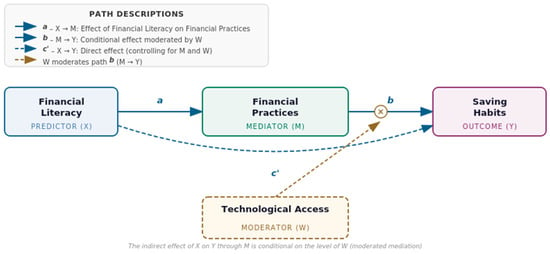
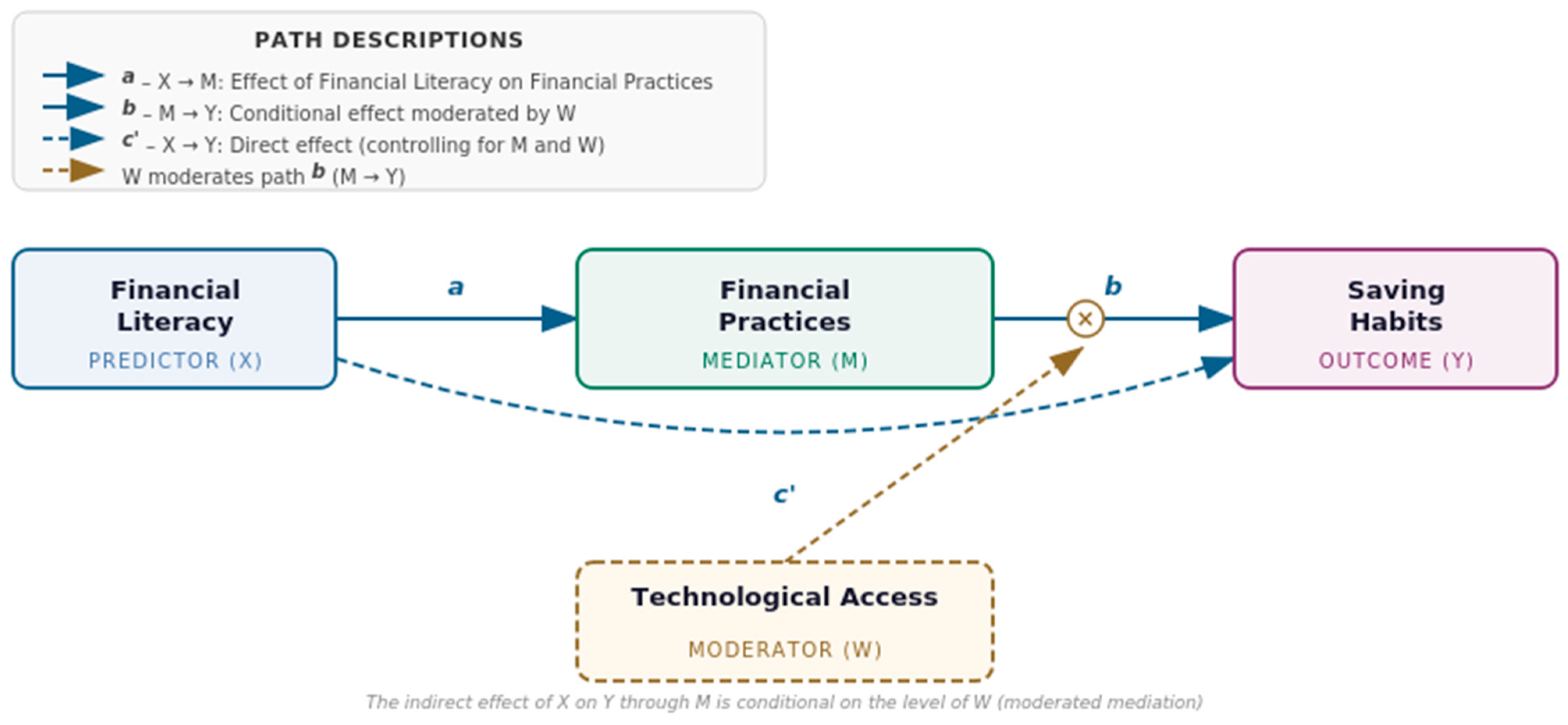
Based on this framework, we state the following hypotheses, consistent with the moderated mediation model estimated in this study (Figure 1):
Figure 1.
Conceptual model (moderated mediation; PROCESS Model 14) (Hayes, 2015).
H1.
Financial literacy is positively associated with saving habits.
H2.
Financial literacy is positively associated with financial practices.
H3.
Financial practices are positively associated with saving habits.
H4.
Financial practices mediate the relationship between financial literacy and saving habits.
H5.
Technological access moderates the relationship between financial practices and saving habits, such that the association is stronger at higher levels of technological access.
H6.
The indirect effect of financial literacy on saving habits through financial practices is conditional on technological access (moderated mediation).
2. Materials and Methods
2.1. Study Design
This study adopted a quantitative, non-experimental, cross-sectional design with an explanatory correlational scope. The objective was to test a moderated mediation model in which financial literacy (X) predicts teachers’ saving habits (Y) indirectly through financial practices (M), while technological access (W) moderates the relationship between financial practices and saving habits (Figure 1).
2.2. Variables and Measurement
Four self-reported constructs were measured using a structured questionnaire (Appendix A): financial literacy (independent variable), financial practices (mediator), saving habits (dependent variable), and technological access (moderator). Financial practices were operationalized as routine money-management behaviors (e.g., budgeting, monitoring debts, planning spending), consistent with prior work on financial management practices (Mang’ana et al., 2024; Nolan et al., 2024). The full questionnaire (items and response options) is provided in Appendix A.
Throughout the manuscript, the four constructs are abbreviated as follows: financial literacy (CF), financial practices (PF), saving habits (HA), and technological access (AT). These two-letter codes correspond to the original Spanish labels of the validated instrument (cultura financiera, prácticas financieras, hábitos de ahorro, acceso tecnológico) and are retained throughout all tables and figures for traceability with the data file.
All items were assessed on a five-point Likert scale (1 = strongly disagree to 5 = strongly agree). For each construct, item scores were aggregated into a composite score (higher values indicate higher levels of the construct). The questionnaire comprised 18 items in total.
The saving habits scale comprises four items (Appendix A, “Savings culture”): (1) regularly saving a portion of income, (2) setting short- and long-term saving goals, (3) viewing saving as an essential practice, and (4) willingness to reduce discretionary spending to maintain savings. These items capture the behavioral regularity and goal-directedness relevant to H1, H3, H4, and H6.
Accordingly, H1 tests whether financial literacy predicts the composite saving score; H3 tests whether financial practices predict it; H4 tests the mediated pathway; and H5–H6 test the moderated and moderated-mediation effects. The four-item scale reflects the habit-formation and planning dimensions emphasized in the theoretical framework (Allom et al., 2018; Wood & Rünger, 2016). It does not, however, capture broader wealth-management outcomes such as investment participation or asset diversification; this boundary is acknowledged in the Discussion (Section 4).
2.3. Participants and Sampling
The participants were teachers from public educational institutions in the Jequetepeque (La Libertad, Peru). Eligibility criteria included active primary and secondary school teachers (appointed or contracted). Teachers from early childhood education and higher education were excluded. Given the small size of the accessible population, a census approach was used, and all eligible teachers were invited. The final analytical sample comprised N = 180 teachers.
2.4. Data Collection Procedure
Data were collected over a three-week period in 2025 using a survey methodology. The questionnaire was administered in mixed mode: online (54 responses) and face to face on paper (126 responses).
Prior to fieldwork, the instrument underwent content validation through expert judgment by a panel of seven specialists with graduate-level expertise in financial education, educational psychology, and psychometrics. Content validity was assessed using the Hernández-Nieto (2002) content validity coefficient (CVC), which yielded an overall agreement of 87% across clarity, relevance, and coherence criteria, exceeding the recommended threshold of 80%. A pilot test with 20 participants was conducted to verify clarity and estimate internal consistency.
To evaluate potential measurement invariance across administration modes, independent samples t-tests were conducted comparing online (n = 54) and face-to-face (n = 126) respondents on the four construct scores. Results are presented in Table 1.
Table 1.
Measurement invariance test by administration mode (online vs. face-to-face).
2.5. Reliability and Validity
Internal consistency was assessed using Cronbach’s alpha (α), and convergent validity was examined using composite reliability (CR) and average variance extracted (AVE). Discriminant validity was evaluated using the Fornell–Larcker criterion (Fornell & Larcker, 1981). Construct validity was assessed through confirmatory factor analysis (CFA) using Analysis of Moment Structures (AMOS) version 26.0. The four-factor measurement model showed acceptable fit: χ2(129) = 198.47, p < 0.001; χ2/df = 1.54; comparative fit index (CFI) = 0.962; Tucker–Lewis index (TLI) = 0.954; root mean square error of approximation (RMSEA) = 0.055 (90% confidence interval [CI] [0.039, 0.070]); standardized root mean square residual (SRMR) = 0.048. All fit indices met conventional thresholds (CFI/TLI ≥ 0.90; RMSEA ≤ 0.08; SRMR ≤ 0.08), supporting the factorial structure of the measurement model (Hu & Bentler, 1999).
As shown in Table 2 and Table 3, reliability was acceptable to high across constructs (α = 0.810–0.959), and convergent-validity indicators met conventional cutoffs. Given the narrow and theoretically coherent content of each scale, the high alpha values are interpreted as internal consistency rather than item redundancy.
Table 2.
Sociodemographic characteristics of the sample (teachers).
Table 3.
Reliability and convergent validity of the measurement instruments.
To address common method bias (CMB), an unmeasured latent method construct (ULMC) was tested within the CFA. The fit difference between models with and without the method factor was negligible (ΔCFI < 0.01), suggesting that CMB does not materially distort the findings (Podsakoff et al., 2003). Consistent with the two-step approach recommended by Anderson and Gerbing (1988), the measurement model was evaluated before the conditional process analyses. PROCESS was then used because it provides bias-corrected bootstrap inference for indirect and conditional indirect effects (Hayes, 2015).
Because all variables were measured with the same self-report instrument in a single session and with identical response scales, CMB was assessed explicitly. Harman’s single-factor test showed that a single unrotated factor explained 38.42% of the total variance, below the conventional 50% threshold. Inter-construct correlations were also below 0.75, suggesting that shared method variance does not dominate the results (Bagozzi et al., 1991).
Harman’s test is limited when used alone (Podsakoff et al., 2003; Richardson et al., 2009); therefore, the ULMC procedure was also applied within the CFA. Because the change in model fit was negligible (ΔCFI < 0.01), common method variance does not appear to materially alter the pattern of findings. The single-source, self-report design nonetheless remains a limitation, and future studies should incorporate multi-source data or objective financial records where feasible.
2.6. Statistical Analysis
Descriptive statistics were used to summarize the study variables and the sample characteristics. The hypotheses were tested using ordinary least squares (OLS) regression within a conditional process framework. Analyses were performed in IBM SPSS Statistics version 31 using the PROCESS macro (Model 14) (Hayes, 2015). Indirect effects were estimated with bias-corrected bootstrap confidence intervals based on 5000 resamples. For the moderation component, conditional effects at representative levels of the moderator (mean and ±1 SD) were computed, and the Johnson–Neyman technique was used to identify regions of significance. Continuous predictors were mean centered prior to constructing interaction terms. Statistical significance was set at α = 0.05.
Sociodemographic variables (sex, age group, years of experience, and employment status) were examined as potential covariates. Preliminary analyses indicated that none of these variables showed statistically significant bivariate associations with the dependent variable (saving habits): sex (t(178) = 0.89, p = 0.375), age group (F(3, 176) = 1.12, p = 0.342), years of experience (F(3, 176) = 0.94, p = 0.423), and employment status (t(178) = 1.21, p = 0.228). Given these null associations and the need to preserve parsimony and statistical power, they were not included as covariates in the final analysis (Hayes, 2015).
This decision is also consistent with the COM-B framework, in which capability, behavior, and opportunity are the primary constructs of interest. Including non-theorized covariates would add complexity without clear explanatory value (Becker, 2005). Robustness checks with these covariates are recommended for future replications.
2.7. Ethical Considerations
Authorization to conduct the study was obtained from the educational institution prior to data collection. Participation was voluntary, and all respondents provided informed consent. Survey responses were collected anonymously and treated as confidential; data were used exclusively for academic research purposes.
2.8. Sample Size and Power Analysis (G*Power)
A priori statistical power analysis was conducted in G*Power 3.1 (Faul et al., 2009) to estimate the minimum sample required to detect small effects in the key interaction term of the moderated mediation model. We specified a linear multiple regression framework (F tests; fixed model; R2 increase). Assuming a small effect size (f2 = 0.045), α = 0.05, and power (1 − β) = 0.80, we tested one predictor (the interaction term) in a model with four predictors in total (financial literacy, financial practices, technological access, and the interaction term). Under these parameters, the minimum required sample was approximately N = 180.
In this study, the accessible population consisted of 180 teachers from public educational institutions in the Jequetepeque Valley (Perú), which meets the minimum required sample size; therefore, the study was adequately powered to detect the hypothesized interaction effect. Nevertheless, future replications should aim to exceed this threshold (e.g., N ≥ 250) to increase statistical power for detecting smaller effect sizes, to accommodate more complex models with additional covariates, and to improve external validity through multi-site sampling. It is also worth noting that N = 180, while meeting the minimum threshold for a small interaction effect (f2 = 0.045), is borderline for detecting weaker interaction effects. The marginal significance of the PF × AT interaction (p = 0.057) may therefore partly reflect insufficient power rather than a true absence of moderation. This should be considered when interpreting the moderation results.
2.9. Descriptive Statistics, Correlations, and Multicollinearity Diagnostics
To improve presentation, descriptive statistics, the correlation matrix, and multicollinearity diagnostics are reported separately in Table 4, Table 5 and Table 6. Inter-construct correlations ranged from r = 0.42 (CF–HA) to r = 0.74 (CF–PF), and all reported VIF values were below 5.0, indicating no problematic multicollinearity (Hair et al., 2019).
Table 4.
Descriptive statistics and scale bounds of the study variables (N = 180).
Table 5.
Correlation matrix for the study variables (N = 180).
Table 6.
Variance inflation factors for the predictors included in the second-stage regression.
3. Results
The moderated mediation model is estimated through two regression equations. The first stage regresses financial practices on financial literacy:
PF = i1 + a·CF + e1
The second stage regresses saving habits on financial literacy, financial practices, technological access, and their product term:
HA = i2 + c′·CF + b1·PF + b2·AT + b3·(PF × AT) + e2
The conditional indirect effect of CF on HA through PF is a function of AT:
ω(AT) = a·(b1 + b3·AT)
All continuous predictors were mean centered before constructing the interaction term (Hayes, 2015).
3.1. Sociodemographic Characteristics
As shown in Table 2, the sample was predominantly female (61.7%). The largest age group was 50–59 years (45.0%), followed by 40–49 years (23.3%). Most respondents reported university education (71.7%), and 26.7% had postgraduate studies. Teaching experience was concentrated in the 10–19 years and ≥30 years categories (31.7% each). All participants reported internet access and daily internet use.
Although internet access and daily use were universal in the binary profile variables, the technological access construct used in the moderation analysis was a four-item composite scale (Appendix A) covering frequency of access, type of device used, ability to use digital financial applications, and perceived utility of technology for financial management. The composite still showed meaningful variation (M = 15.83, SD = 3.37) within its 4–20 scale range, which supports its treatment as a continuous moderator. The relatively high mean nonetheless suggests a ceiling-leaning distribution that may attenuate the detectable interaction effect.
3.2. Instrument Reliability
Table 3 summarizes internal consistency and convergent-validity diagnostics. Reliability was acceptable to high across constructs (α = 0.810–0.959). Convergent validity indicators were also above conventional thresholds (CR ≥ 0.80; AVE ≥ 0.50), supporting the use of composite construct scores in subsequent analyses. Discriminant validity was supported by the Fornell–Larcker criterion, as the square root of the AVE for each construct exceeded its correlations with the other constructs (Table 7).
Table 7.
Discriminant validity (Fornell–Larcker criterion).
3.3. Inferential Analysis
3.3.1. Direct Effects (H1–H2)
The direct effect of financial literacy on saving habits was not statistically significant (β = 0.098, t(175) = 0.767, p = 0.446; 95% CI [−0.157, 0.352]) (Table 8).
Table 8.
Direct effect of financial literacy on saving habits, controlling for financial practices and technological access.
Financial literacy had a positive and highly significant effect on financial practices (β = 0.537, t(178) = 8.425, p < 0.001), explaining 55.0% of the variance in financial practices (R2 = 0.550) (Table 9).
Table 9.
Direct effect of financial literacy on financial practices.
3.3.2. Moderation and Conditional Effects (H3 and H5)
The effect of financial practices on saving habits varied across levels of technological access. The conditional effects were statistically significant at low, mean, and high technological access and increased monotonically (β = 0.445, 0.593, and 0.741, respectively; Table 10).
Table 10.
Conditional effects of financial practices on saving habits across levels of technological access.
These increasing point estimates should be interpreted descriptively rather than as confirmatory evidence of moderation. Moderation depends on the interaction term, and the PF × AT interaction was only marginally significant (β = 0.044, p = 0.057).
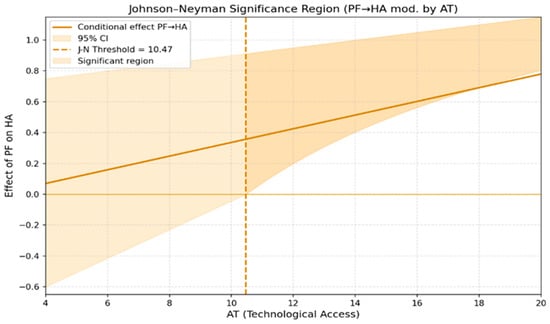
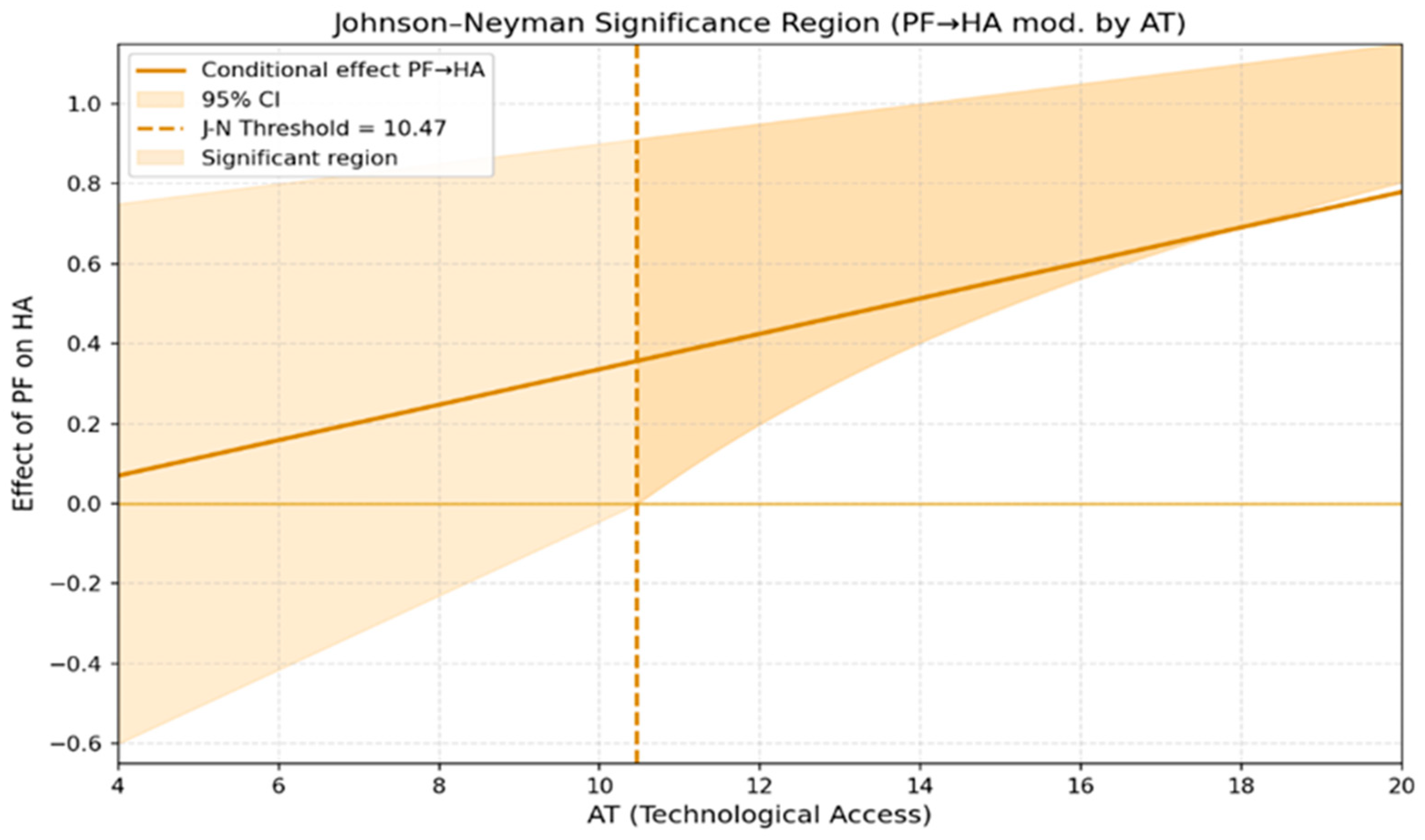
Figure 2 shows that higher technological access is associated with a larger point estimate for the association between financial practices and saving habits. The Johnson–Neyman analysis indicates that the effect becomes statistically significant above the critical threshold (AT ≈ 10.47), covering approximately 92% of the sample.
Figure 2.
Johnson–Neyman significance region for the effect of financial practices on saving habits moderated by technological access. Note. PF = financial practices; HA = saving habits; AT = technological access; CI = confidence interval. The figure shows the conditional effects of PF on HA at representative levels of AT (the sample mean and ±1 standard deviation). The Johnson–Neyman region of significance starts at approximately AT = 10.47 (≈92% of the sample). The shaded band represents the 95% CI of the conditional effect. The area to the right of the vertical line indicates AT values where the effect of PF on HA is statistically significant (p < 0.05). The darker shaded area to the right of the J-N threshold corresponds to the visual overlap between the 95% CI band and the J-N significant region; in this zone, the conditional effect of PF on HA is both statistically significant (p < 0.05) and bounded by its 95% CI.
3.3.3. Indirect Effects and Moderated Mediation (H4 and H6)
The indirect effect of financial literacy on saving habits through financial practices was statistically significant at low, mean, and high technological access (bootstrap 95% CIs excluded zero). Indirect effects were larger at higher levels of technological access (Table 11).
Table 11.
Conditional indirect effects of financial literacy on saving habits through financial practices.
As summarized in Table 12, the direct effect was not statistically significant (p = 0.446), whereas all conditional indirect effects were statistically significant.
Table 12.
Comparison of direct and indirect effects of financial literacy on saving habits.
The interaction between financial practices and technological access was marginally significant (β = 0.044, t(175) = 1.948, p = 0.057) and accounted for an additional ΔR2 = 0.033 in saving habits (Table 13).
Table 13.
Interaction effect of financial practices × technological access on saving habits.
The full model explained 52.1% of the variance in saving habits (R2 = 0.521; Table 14). Although the conditional indirect effects increased with technological access, the index of moderated mediation (IMM = 0.024; bootstrap 95% CI [−0.003, 0.047]) included zero, indicating that moderated mediation was not supported at α = 0.05.
Table 14.
Moderated mediation model: financial literacy → financial practices → saving habits, moderated by technological access.
3.4. Model Fit and Hypothesis Testing Summary
To support editorial consistency and facilitate interpretation, Table 11 summarizes model fit and explained variance for the first stage and second-stage regressions, and Table 15 consolidates the hypothesis tests based on the conditional process estimates. A condensed summary of the hypothesis testing decisions is presented in Table 16.
Table 15.
Model fit and goodness-of-fit diagnostics for the regression models.
Table 16.
Summary of hypothesis testing.
Overall, three hypotheses were supported (H2–H4). The direct effect of financial literacy on saving habits (H1), the moderation effect (H5), and moderated mediation (H6) were not supported at α = 0.05, although the interaction showed a marginal trend in the expected direction.
4. Discussion
Across teachers in Jequetepeque Valley (Peru), financial literacy did not show a statistically significant direct association with saving habits once financial practices and technological access were accounted for (Table 8). By contrast, financial literacy strongly predicted financial practices (Table 9), and financial practices were positively related to saving habits, with larger conditional effects at higher levels of technological access (Table 10). The indirect effect of financial literacy on saving habits through financial practices was significant at low, mean, and high technological access (Table 11). Although the practices × technology interaction was marginal (Table 13), the index of moderated mediation was not statistically different from zero (Table 14), suggesting that technological access primarily conditions the second-stage practice–saving relationship rather than the overall indirect pathway. This nuanced pattern is also consistent with cautionary perspectives in the literature, which note that financial literacy alone does not automatically translate into adaptive financial outcomes and may even produce unintended consequences when not accompanied by concrete behavioral routines (Kawamura et al., 2021).
This pattern supports a process interpretation: financial knowledge appears insufficient for sustained saving unless it is translated into repeated money-management routines. In this sample, financial literacy was linked to saving mainly through financial practices, which is consistent with research that treats behavioral channels and habit formation as proximal drivers of saving outcomes (Allom et al., 2018; Dewi et al., 2020; Mireku et al., 2023; Yeo et al., 2024). The strong CF → PF association also aligns with studies showing that literacy and training are related to budgeting, monitoring, and planning routines that support financial resilience and well-being (İlbasmış et al., 2025; Sajid et al., 2024; She et al., 2023).
The full mediation pattern is consistent with Sajid et al. (2024), who report that financial behavior fully mediates the literacy–well-being relationship, and with Dewi et al. (2020), who find that the behavioral component of literacy is more strongly related to planned financial conduct than knowledge alone. By contrast, Morgan and Trinh (2019) report a direct literacy–saving association in Cambodia and Vietnam. The difference may reflect the more constrained income and institutional context of Peruvian public school teachers, where saving appears to depend less on literacy alone than on the formation of stable routines. The weaker moderation pattern compared with Başar et al. (2025) may also reflect the restricted variation in technological access observed in this sample.
The conditional slopes indicate that technological access can amplify the behavioral link between practices and saving, plausibly by lowering transaction frictions and enabling monitoring, reminders, and (where available) automation. While the interaction term did not meet the 0.05 threshold, its direction and the Johnson–Neyman probe suggest that the practice–saving association is most reliable for teachers with at least moderate access (Figure 2; Table 10). This interpretation is compatible with studies linking digital financial literacy, FinTech use, and digital financial behaviors to saving outcomes and financial well-being (Anwar, 2025; Başar et al., 2025; Hung & Khoi, 2025; Neves et al., 2023).
From a risk and financial management perspective, saving habits function as a household-level buffer against income and expenditure shocks. The results therefore point to interventions that combine capability building (financial knowledge and attitudes) with practice-oriented components (routine budgeting, tracking, and goal-based saving) and with enabling digital infrastructure.
In SDG terms, the mediation result speaks most directly to SDG 4 (Quality Education) because it highlights the need to translate knowledge into practical competencies. The significant indirect effect across levels of technological access also relates to SDG 8 (Decent Work and Economic Growth) by pointing to financial routines as a mechanism for household resilience. The suggestion that technology-enabled environments may strengthen these routines is relevant to SDG 9 (Industry, Innovation and Infrastructure), although that interpretation remains tentative because the interaction did not reach the conventional α = 0.05 threshold (Hernández Mejía & Moreno García, 2025; Morgan & Trinh, 2019).
Several limitations qualify these findings. The study is cross-sectional and restricted to a census of public-school teachers in the Jequetepeque Valley (N = 180), which limits causal inference and external validity. The estimates are associational and should not be interpreted as causal effects.
Reverse causality remains possible: individuals who save consistently may, through repeated financial decision-making, acquire higher literacy and firmer routines. The hypothesized direction is grounded in theory—the COM-B framework positions capability as antecedent to behavior, and the habit literature places repeated behavior upstream of automaticity (Michie et al., 2011; Wood & Rünger, 2016)—but cross-sectional data cannot rule out reciprocal dynamics.
The observed pattern is nonetheless more consistent with a capability-to-behavior-to-habit sequence than with a purely reverse-causal account. The direct CF → HA path was not significant (β = 0.098, p = 0.446), whereas the indirect path through practices was robust. This is not an identification test, but it reduces the plausibility that the results are driven only by savers learning after the fact. Future work should therefore use longitudinal or quasi-experimental designs.
Omitted-variable threats also remain. Income level, financial socialization, and institutional saving incentives may confound the observed associations. In addition, the findings are specific to this rural coastal Peruvian context and should not be generalized directly to urban teachers, private institutions, or other countries without replication.
A further boundary concerns the outcome variable. Portfolio theory (Markowitz, 1952) addresses how individuals allocate wealth across assets, whereas the present study focuses only on saving habits. For a rural teacher workforce on fixed salaries, the more immediate question is whether any surplus is accumulated at all; saving is analytically upstream of allocation. A fuller test of portfolio-theoretic predictions would require a population with meaningful access to investable assets and outcomes such as emergency-fund adequacy, voluntary pension contributions, and formal investment adoption. Future research should therefore test the model in larger, multi-site samples, use longitudinal designs, and incorporate objective financial outcomes when feasible.
5. Conclusions
This study provides preliminary evidence that financial literacy is associated with teachers’ saving habits primarily through financial practices rather than through a direct pathway. Once financial practices and technological access were considered, the direct effect of financial literacy on saving habits was not statistically significant, whereas the indirect effect through practices was significant across levels of technological access. This reinforces the idea that saving behavior depends on converting knowledge into routinized financial actions and habit formation (Allom et al., 2018; Mireku et al., 2023; Yeo et al., 2024).
From a risk and financial management perspective, strengthening teachers’ saving habits requires interventions that are practice-oriented (budgeting, monitoring, and goal-setting routines) and supported by accessible digital infrastructure and usable tools. These results align with research emphasizing financial behavior as a central mechanism for financial well-being and the potential role of digital environments in shaping saving-related actions (Anwar, 2025; Neves et al., 2023; Sajid et al., 2024).
Given the cross-sectional design and the single-institution sample, findings should be interpreted cautiously and validated in larger, multi-site studies. Future research could examine temporal dynamics of habit formation, use objective measures of financial outcomes, and extend conditional process models to other professional groups, including more advanced analytics when appropriate (Zhu, 2025; Hayes, 2015).
Based on the findings, context-specific recommendations are proposed for public educational institutions and local education authorities (UGEL) in the Jequetepeque Valley, as well as for financial regulators and service providers operating in similar rural coastal settings. Because the sample is census-based and geographically specific, these recommendations should be interpreted as locally grounded rather than broadly generalizable. The emphasis is on translating financial knowledge into daily practices and using digital access to support saving habits, in line with SDG 4, SDG 8, and SDG 9.
For schools and UGEL, a teacher-focused financial capability program with continuous coaching and peer support should be implemented. Content should prioritize actionable routines such as budgeting, expense tracking, debt monitoring, and goal-based saving, which are central for sustained financial behavior change (Harter, 2021; Nemeth et al., 2022; Paneda & Albay, 2025).
Include digital financial literacy modules that train teachers to use apps and platforms for budgeting, monitoring, and automated transfers. Address usability and confidence, since digital behavior depends on both skills and self-assessment, and can reinforce saving-related routines (Anwar, 2025; Módosné Szalai et al., 2025; Neves et al., 2023).
For financial regulators (e.g., the Superintendence of Banking, Insurance and Private Pension Funds), expand and target financial education campaigns for teachers, explicitly incorporating practice-based components and digital-finance guidance. Such initiatives may strengthen behavioral pathways that underpin financial well-being (Sajid et al., 2024; She et al., 2023).
For financial institutions and FinTech providers, develop savings tools tailored to teachers (e.g., goal-setting features, reminders, transparent progress dashboards, and low-friction deposit options). Product design should consider how digital environments influence financial behavior, particularly under uncertainty, and should support responsible decision-making (Başar et al., 2025; Sadok & Elouaourti, 2025; Varlamova et al., 2020).
Methodologically, future studies should expand the sample and implement multi-site designs to improve external validity. Longitudinal data would allow stronger causal inference and a direct test of habit formation over time, while conditional process models can be extended to alternative moderators or mediators (Hayes, 2015; Yeo et al., 2024). Future research could also adopt advanced econometric techniques to address potential endogeneity, such as joint estimation using copulas (Park & Gupta, 2012).
Finally, at the policy level, consider incentives for participation in financial education and digital financial literacy programs as part of teacher-development policies. This could strengthen household financial resilience and reduce vulnerability to shocks by promoting consistent saving practices (Hernández Mejía & Moreno García, 2025; Morgan & Trinh, 2019).
Author Contributions
Conceptualization, T.M.L.R.; methodology, M.A.A.B.; software, M.A.A.B.; validation, M.A.A.B.; formal analysis, M.A.A.B.; investigation, M.A.A.B.; resources, T.M.L.R.; data curation, M.A.A.B.; writing—original draft preparation, T.M.L.R.; writing—review and editing, T.M.L.R.; visualization, T.M.L.R.; supervision, M.A.A.B.; project administration, T.M.L.R. All authors have read and agreed to the published version of the manuscript.
Funding
This research received no external funding.
Institutional Review Board Statement
Ethical review and approval were waived for this study because it did not involve any sensitive personal data, clinical procedures, or identifiable personal information. The research was conducted in accordance with the ethical regulations of the Institute for Research in Science and Technology, César Vallejo University (Campus Chepén, Peru). Participation was entirely voluntary, and all data were collected anonymously and used exclusively for academic research purposes. The specific approval details are maintained by the Institute for Research in Science and Technology, César Vallejo University.
Informed Consent Statement
Informed consent for participation was obtained from all subjects involved in the study. Prior to data collection, all participants were fully informed about the nature and purpose of the research, the voluntary nature of their participation, the anonymity of their responses, and the exclusive use of the data for academic research purposes. No personally identifiable information was recorded at any stage of the data collection process. The study was conducted in accordance with the ethical principles established by the Institute for Research in Science and Technology of César Vallejo University. Participants were free to withdraw at any time without consequence. Signed consent forms were obtained from each participant before the administration of the survey instrument, both in the online and face-to-face modalities.
Data Availability Statement
The original contributions presented in this study are included in the article. Further inquiries can be directed to the corresponding author.
Conflicts of Interest
The authors declare no conflicts of interest.
Appendix A. Questionnaire
Response scale: 1 = TDS (Totally Disagree), 2 = DS (Disagree), 3 = ND (Neither Agree nor Disagree), 4 = A (Agree), 5 = TDA (Totally Agree).
Table A1.
Questionnaire items and response scale.
References
- Allom, V., Mullan, B. A., Monds, L., Orbell, S., Hamilton, K., Rebar, A. L., & Hagger, M. S. (2018). Reflective and impulsive processes underlying saving behavior and the additional roles of self-control and habit. Journal of Neuroscience, Psychology, and Economics, 11(3), 135–146. [Google Scholar] [CrossRef] [Scilit]
- Anderson, J. C., & Gerbing, D. W. (1988). Structural equation modeling in practice: A review and recommended two-step approach. Psychological Bulletin, 103(3), 411–423. [Google Scholar] [CrossRef]
- Anwar, M. M. (2025). How digital financial literacy and social media usage build saving behavior among Generation Z. Asia-Pacific Journal of Business Administration. Advanced online publication. [Google Scholar] [CrossRef] [Scilit]
- Bagozzi, R. P., Yi, Y., & Phillips, L. W. (1991). Assessing construct validity in organizational research. Administrative Science Quarterly, 36(3), 421–458. [Google Scholar] [CrossRef] [Scilit]
- Başar, D., Keskin, H., Esen, E., Merter, A. K., & Balcıoğlu, Y. S. (2025). Digital financial literacy and savings behavior: A comprehensive cross-country analysis of FinTech adoption patterns and economic outcomes across 12 nations. Borsa Istanbul Review, 25(Suppl. S1), 59–72. [Google Scholar] [CrossRef] [Scilit]
- Becker, T. E. (2005). Potential problems in the statistical control of variables in organizational research: A qualitative analysis with recommendations. Organizational Research Methods, 8(3), 274–289. [Google Scholar] [CrossRef] [Scilit]
- Dewi, V. I., Febrian, E., Effendi, N., Anwar, M., & Nidar, S. R. (2020). Financial literacy and its variables: The evidence from Indonesia. Economics and Sociology, 13(3), 133–154. [Google Scholar] [CrossRef] [Scilit]
- Faturohman, T., Megananda, T. B., & Ginting, H. (2024). Improving financial wellbeing in Indonesia: The role of social media as a mediating factor in financial behavior. Cogent Social Sciences, 10(1), 2319374. [Google Scholar] [CrossRef] [Scilit]
- Faul, F., Erdfelder, E., Buchner, A., & Lang, A.-G. (2009). Statistical power analyses using G*Power 3.1: Tests for correlation and regression analyses. Behavior Research Methods, 41(4), 1149–1160. [Google Scholar] [CrossRef] [Scilit]
- Fornell, C., & Larcker, D. F. (1981). Evaluating structural equation models with unobservable variables and measurement error. Journal of Marketing Research, 18(1), 39–50. [Google Scholar] [CrossRef] [Scilit]
- Gardner, B., de Bruijn, G.-J., & Lally, P. (2012). Habit, identity, and repetitive action: A prospective study of binge-drinking in UK students. British Journal of Health Psychology, 17(3), 565–581. [Google Scholar] [CrossRef] [Scilit] [PubMed]
- Hair, J. F., Black, W. C., Babin, B. J., & Anderson, R. E. (2019). eBook: Multivariate data analysis (8th ed.). Cengage Learning. [Google Scholar]
- Harter, C. (2021). Breaking it down: Disaggregated personal finance test scores of teachers and students. Citizenship, Social and Economics Education, 20(3), 216–233. [Google Scholar] [CrossRef] [Scilit]
- Hayes, A. F. (2015). An index and test of linear moderated mediation. Multivariate Behavioral Research, 50(1), 1–22. [Google Scholar] [CrossRef] [Scilit]
- Hernández Mejía, S., & Moreno García, E. (2025). Ahorro para emergencias, la inclusión y la educación financiera en México. Revista Mexicana de Economía y Finanzas Nueva Época REMEF, 20(2), e1252. [Google Scholar] [CrossRef] [Scilit]
- Hernández-Nieto, R. A. (2002). Contributions to statistical analysis. Universidad de Los Andes. [Google Scholar]
- Hu, L., & Bentler, P. M. (1999). Cutoff criteria for fit indexes in covariance structure analysis: Conventional criteria versus new alternatives. Structural Equation Modeling: A Multidisciplinary Journal, 6(1), 1–55. [Google Scholar] [CrossRef] [Scilit]
- Hung, D. T., & Khoi, T. D. M. (2025). The impact of digital financial literacy on the adoption of financial technology in rural areas of Vietnam. Decision Science Letters, 14, 877–886. [Google Scholar] [CrossRef] [Scilit]
- İlbasmış, M., Altın, H., & Yılmaz, B. (2025). Can financial literacy training improve financially responsible behavior? Experimental evidence from Turkish undergraduates. Borsa Istanbul Review, 25(Suppl. S2), 137–145. [Google Scholar] [CrossRef] [Scilit]
- Jabar, M. A., & Delayco, M. L. C. (2024). Does digital financial literacy matter for current and future saving behavior among rural SME entrepreneurs? Government regulations awareness as a moderator. Theoretical and Practical Research in Economic Fields, 15(4), 939–951. [Google Scholar] [CrossRef] [Scilit]
- Kawamura, T., Mori, T., Motonishi, T., & Ogawa, K. (2021). Is financial literacy dangerous? Journal of the Japanese and International Economies, 60, 101131. [Google Scholar] [CrossRef] [Scilit]
- Kim, O. V. T., Thuy, T. T. N., Khanh, L. D., Thanh, M. P. T., Thi, Q. N., & Minh, T. N. T. (2025). The impact of financial literacy on saving behavior of elderly people: The mediating role of digital financial literacy. Humanities and Social Sciences Letters, 13(1), 45–55. [Google Scholar] [CrossRef] [Scilit]
- Lina, R. I., Rahman, M. H., & Islam, M. S. (2025). Savings behavior of college teachers: A comparative study among private and government colleges in Bangladesh. Economics and Finance Letters, 12(1), 71–85. [Google Scholar] [CrossRef] [Scilit]
- Lusardi, A., & Mitchell, O. S. (2014). The economic importance of financial literacy: Theory and evidence. Journal of Economic Literature, 52(1), 5–44. [Google Scholar] [CrossRef] [Scilit]
- Mang’ana, K. M., Hokororo, S. J., & Ndyetabula, D. W. (2024). Agri-SME managers’ perception of financial management practices in Tanzania. Scientific African, 26(1), e02405. [Google Scholar] [CrossRef] [Scilit]
- Markowitz, H. (1952). Portfolio selection. The Journal of Finance, 7(1), 77–91. [Google Scholar] [CrossRef] [Scilit] [PubMed]
- Michie, S., van Stralen, M. M., & West, R. (2011). The behaviour change wheel: A new method for characterising and designing behaviour change interventions. Implementation Science, 6(1), 42. [Google Scholar] [CrossRef] [Scilit] [PubMed]
- Mireku, K., Appiah, F., & Agana, J. A. (2023). Is there a link between financial literacy and financial behaviour? Cogent Economics & Finance, 11(1), 2188712. [Google Scholar] [CrossRef] [Scilit]
- Morgan, P. J., & Trinh, L. Q. (2019). Determinants and impacts of financial literacy in Cambodia and Viet Nam. Journal of Risk and Financial Management, 12(1), 19. [Google Scholar] [CrossRef] [Scilit]
- Módosné Szalai, S., Jenei, S., & Németh, E. (2025). Knowledge or confidence? Exploring the interplay of financial literacy, digital financial behavior, and self-assessment in the FinTech era. FinTech, 4(4), 75. [Google Scholar] [CrossRef] [Scilit]
- Muchran, M., Masrullah, Soraya, Z., Mardiana, A., Aswad, H. N., Varil, & Andini, A. (2023). The interplay between financial literacy, financial technology and financial behaviour of high school teachers in an emerging economy. Academic Journal of Interdisciplinary Studies, 12(4), 139–151. [Google Scholar] [CrossRef] [Scilit]
- Ndlovu, V. P. (2024). Secondary teachers’ experiences of enacting financial literacy/accounting in a technology-rich environment. African Identities, 22(3), 664–680. [Google Scholar] [CrossRef] [Scilit]
- Nemeth, E., Beres, D., Huzdik, K., Deak-Zsoter, B., & Meszaros, A. (2022). Teachers’ financial literacy. Public Finance Quarterly, 67(1), 7–32. [Google Scholar] [CrossRef] [Scilit]
- Neves, C., Oliveira, T., Santini, F., & Gutman, L. (2023). Adoption and use of digital financial services: A meta-analysis of barriers and facilitators. International Journal of Information Management Data Insights, 3(2), 100201. [Google Scholar] [CrossRef] [Scilit]
- Nolan, J., Hogan, T., & Hayden, M. (2024). Financial literacy practices on family farms. Journal of Rural Studies, 112(1), 103468. [Google Scholar] [CrossRef] [Scilit]
- Paneda, M. G. P., & Albay, E. M. (2025). Financial literacy of secondary school teachers in the Department of Education–Division of La Union. International Journal of Evaluation and Research in Education, 14(4), 2521–2529. [Google Scholar] [CrossRef] [Scilit]
- Park, S., & Gupta, S. (2012). Handling endogenous regressors by joint estimation using copulas. Marketing Science, 31(4), 567–586. [Google Scholar] [CrossRef] [Scilit]
- Pillai, R., Kumar, P., Kumar, N., & Tabash, M. (2025). Decoding financial behaviour through cognitive and digital pathways: A hybrid SEM–ANN study among Indian working women. Borsa Istanbul Review, 25(1), 87–100. [Google Scholar] [CrossRef] [Scilit]
- Podsakoff, P. M., MacKenzie, S. B., Lee, J.-Y., & Podsakoff, N. P. (2003). Common method biases in behavioral research: A critical review of the literature and recommended remedies. Journal of Applied Psychology, 88(5), 879–903. [Google Scholar] [CrossRef] [Scilit] [PubMed]
- Richardson, H. A., Simmering, M. J., & Sturman, M. C. (2009). A tale of three perspectives: Examining post hoc statistical techniques for detection and correction of common method variance. Organizational Research Methods, 12(4), 762–800. [Google Scholar] [CrossRef] [Scilit]
- Sadok, H., & Elouaourti, Z. (2025). The cash vs. digital paradox: Why financial literacy matters in uncertain times. Borsa Istanbul Review, 25(Suppl. S1), 45–52. [Google Scholar] [CrossRef] [Scilit]
- Sajid, M., Mushtaq, R., Murtaza, G., Yahiaoui, D., & Pereira, V. (2024). Financial literacy, confidence and well-being: The mediating role of financial behavior. Journal of Business Research, 182, 114791. [Google Scholar] [CrossRef] [Scilit]
- Sel, B., & Sözer, M. A. (2020). The examination of primary school teachers’ financial literacy attitudes and behaviors in terms of different variables. Elementary Education Online, 19(4), 1987–1997. [Google Scholar] [CrossRef] [Scilit]
- She, L., Waheed, H., Lim, W. M., & E-Vahdati, S. (2023). Young adults’ financial well-being: Current insights and future directions. International Journal of Bank Marketing, 41(2), 333–368. [Google Scholar] [CrossRef] [Scilit]
- Strack, F., & Deutsch, R. (2004). Reflective and impulsive determinants of social behavior. Personality and Social Psychology Review, 8(3), 220–247. [Google Scholar] [CrossRef] [Scilit]
- Turco, E., Robba, M., & Iannello, P. (2023). La Multidimensional Financial Literacy Scale: Proposta di un nuovo strumento per la misurazione della financial literacy [The Multidimensional Financial Literacy Scale: Proposal of a new tool for measuring financial literacy]. Ricerche di Psicologia, 46(3), 64–88. [Google Scholar] [CrossRef] [Scilit]
- Varlamova, J., Larionova, N., & Kukushkina, O. (2020). How digital technologies affect consumers’ financial behavior. Rivista Internazionale di Scienze Sociali, 128(3), 321–344. [Google Scholar] [CrossRef] [Scilit]
- Widjaja, I., Arifin, A. Z., & Setini, M. (2020). The effects of financial literacy and subjective norms on saving behavior. Management Science Letters, 10, 3635–3642. [Google Scholar] [CrossRef] [Scilit]
- Wood, W., & Rünger, D. (2016). Psychology of habit. Annual Review of Psychology, 67, 289–314. [Google Scholar] [CrossRef] [Scilit]
- Yeo, K. H. K., Lim, W. M., & Yii, K. J. (2024). Financial planning behaviour: A systematic literature review and new theory development. Journal of Financial Services Marketing, 29, 979–1001. [Google Scholar] [CrossRef] [Scilit]
- Zhu, A. Y. F. (2025). Unlocking financial literacy with machine learning: A critical step to advance personal finance research and practice. Technology in Society, 81(1), 102797. [Google Scholar] [CrossRef] [Scilit]
- Zulaihati, S., Susanti, S., & Widyastuti, U. (2020). Teachers’ financial literacy: Does it impact on financial behaviour? Management Science Letters, 10(3), 653–658. [Google Scholar] [CrossRef] [Scilit]

Disclaimer/Publisher’s Note: The statements, opinions and data contained in all publications are solely those of the individual author(s) and contributor(s) and not of MDPI and/or the editor(s). MDPI and/or the editor(s) disclaim responsibility for any injury to people or property resulting from any ideas, methods, instructions or products referred to in the content. |
© 2026 by the authors. Licensee MDPI, Basel, Switzerland. This article is an open access article distributed under the terms and conditions of the Creative Commons Attribution (CC BY) license.