


Language Beliefs of English Teachers in Norway: Trajectories in Transition?


Abstract
1. Introduction
1.1. Multilingualism
1.2. English as a Lingua Franca
1.3. Language Teacher Cognition
1.4. Previous Research in Norway
1.5. Aim of the Study
- What are English teachers’ beliefs and self-reported practices about the English language and English language use when teaching in multilingual classrooms in Norway?
- What factors influence English teachers’ beliefs and self-reported practices about the English language and English language use when teaching in multilingual classrooms in Norway?
2. Research Design and Methodology
2.1. Methods
2.2. Data Analysis
2.3. Research Context
2.4. Participants
3. Results
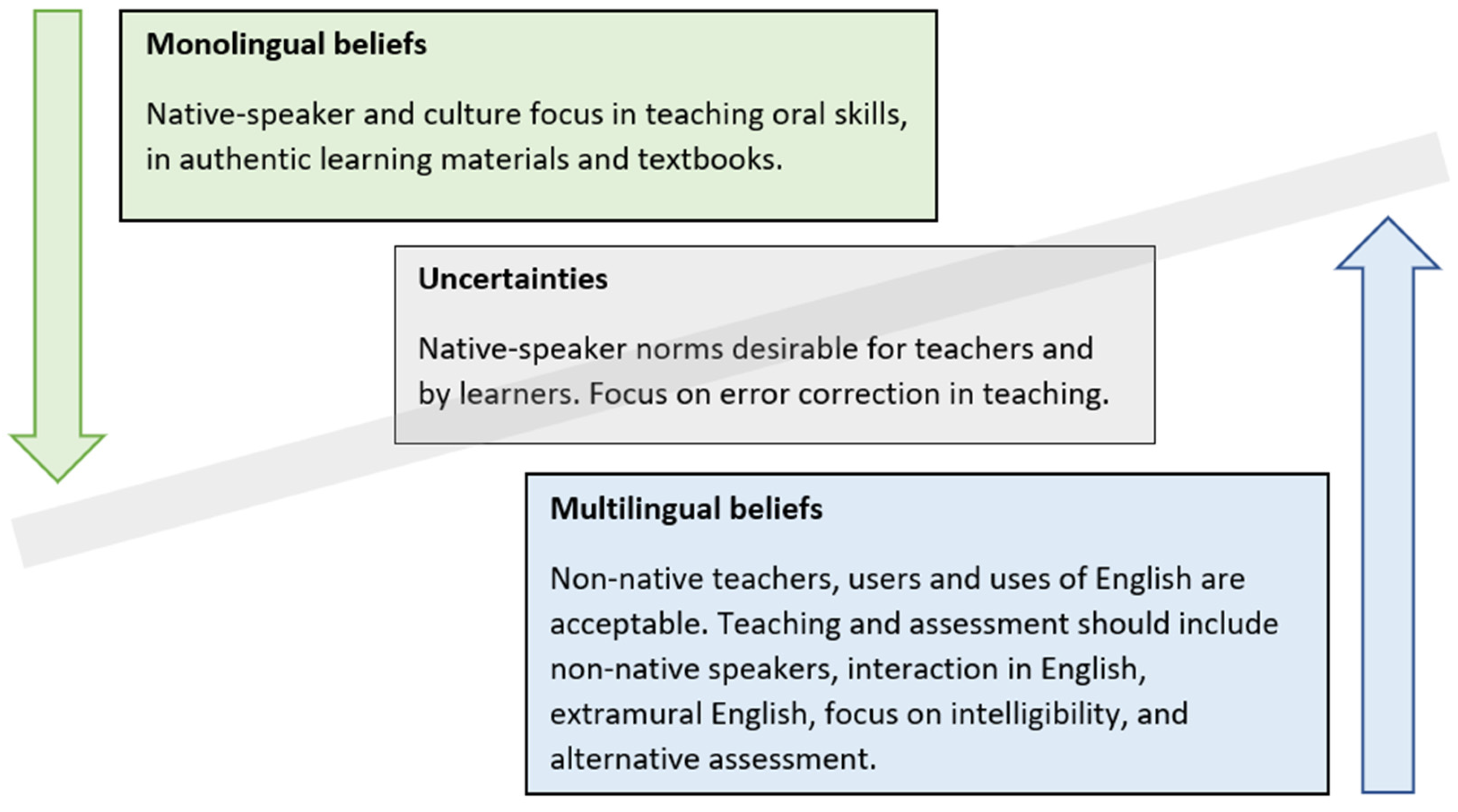
3.1. Teacher Beliefs and Reported Practices
3.1.1. Teacher Beliefs about English Use
3.1.2. Teacher Beliefs and Practices about English Use in Assessment
3.1.3. Teachers’ Self-Reported Practices for English Use
3.1.4. Teachers’ Reported Practices for English Use in Teaching Materials and Resources
3.2. Factors Influencing Teacher Beliefs and Practices
3.2.1. Teacher Age
3.2.2. Learner Age Group
3.2.3. Teacher Gender
4. Discussion
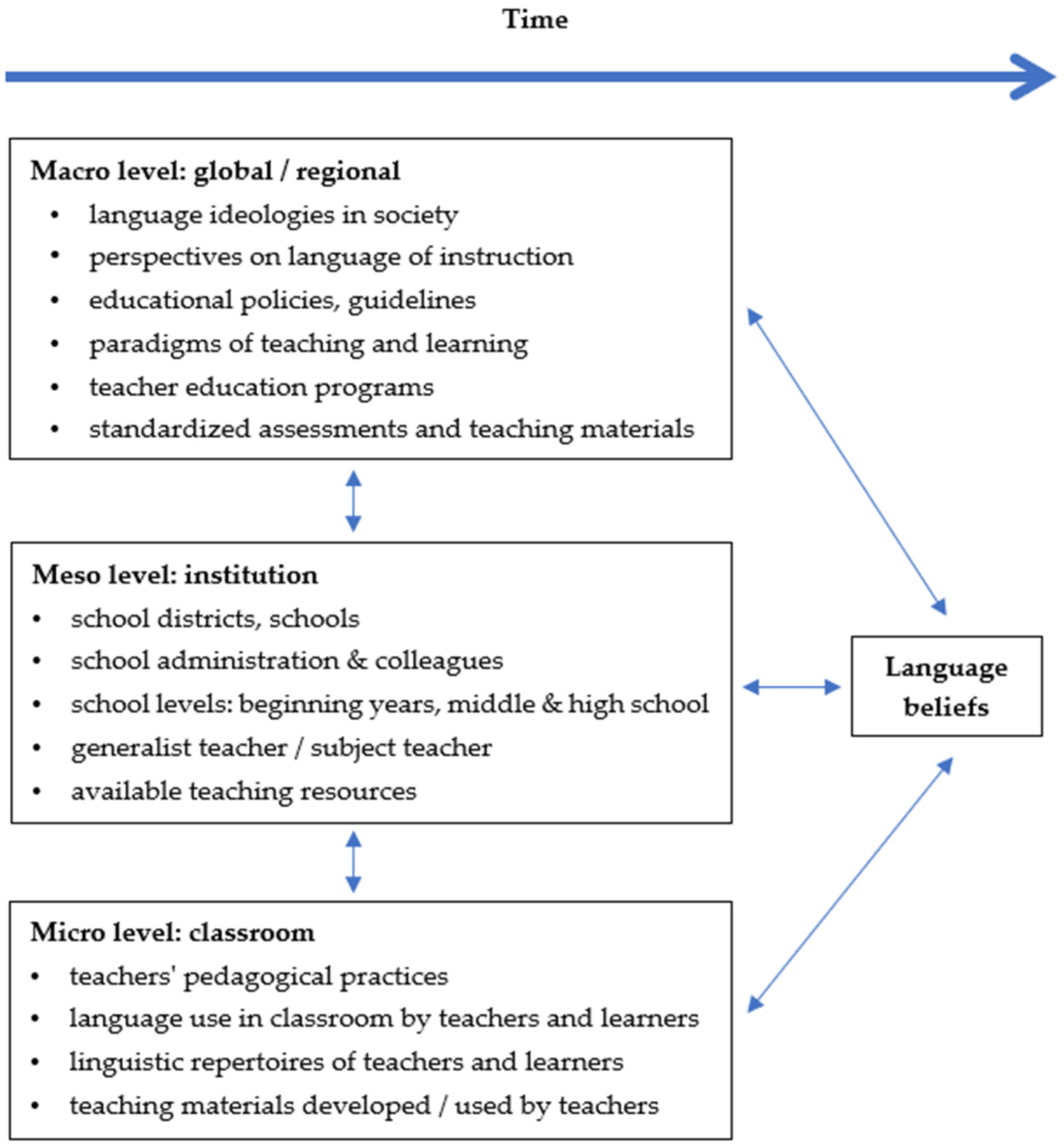
Complex Multifaceted Ecologies
5. Conclusions
Author Contributions
Funding
Institutional Review Board Statement
Informed Consent Statement
Data Availability Statement
Acknowledgments
Conflicts of Interest
Appendix A. Survey Items and Themes
| Part A: Biographical Information |
| Q1 Age |
| Q2 Gender |
| Q4 Education/qualifications |
| Q5 First language(s) |
| Q6 Other languages |
| Q7 Age range of learners |
| Part B: Characteristics of the Multilingual Context |
| Q8 People with different language backgrounds live in the country where I live and work. |
| Q9 I know the language education policies (e.g., what the language curricula specify) in country I live and work in. |
| Q10 The school where I teach supports the social integration of learners of migrant backgrounds with special programs and/or events. |
| Q11 The average percentage of multilingual learners in my classrooms is approximately |
| Part C: Teacher Beliefs and Reported Practices about English Use in the Multilingual Teaching Context |
| Teacher Beliefs about English Use in Teaching Practices |
| Q30 Teachers of English should have native-like pronunciation. |
| Q31 Non-native teachers can be good language models. |
| Q32 I am comfortable with my own accent. |
| Q33 My learners prefer being taught by native English speakers. |
| Q36 It is important that I integrate examples of English used by non-native speakers in my teaching. |
| Q39 The current status of English as a global language implies that non-native uses of English are as valid as native uses of English. |
| Teacher Beliefs and Practices about English Use in Assessment |
| Q23 In my teaching, I incorporate methods of alternative assessment (e.g., self assessment and peer assessment). |
| Q34 My role as a teacher of English is to correct my learners’ incorrect uses of English. |
| Q37 English language standard tests should also include interactions involving non-native speakers. |
| Q38 When assessing their own learners’ spoken and written production and interactions, teachers should mainly focus on what is intelligible. |
| Teachers’ Reported Teaching Practices for English Use |
| Q14 In my class I give learners several opportunities to interact in English. |
| Q18 I expose my learners to uses of English similar to those they may be exposed to outside the classroom. |
| Q20 I teach standard (British or American) English pronunciation to my learners. |
| Q24 During my English classes I allow my learners to also use languages other than English. |
| Teachers’ Reported Practices for English Use in Teaching Materials and Resources |
| Q12 The coursebook(s) which I use in my class(es) focus/es on the way native English speakers (e.g., British, American, Australian) use the language. |
| Q13 Cultures relevant to my learners, including those of migrant backgrounds, are included in the coursebook(s) which I use in my class(es). |
| Q16 The coursebook(s) which I use in my class(es) include/s topics related to English-speaking-countries traditions, cultures, art, history, and values. |
| Q19 I develop my own additional teaching materials to address the needs and wants of my multilingual learners. |
| Q21 In my teaching, I use authentic materials (TV series, films, songs, etc.) involving predominantly native speakers of English. |
| Q22 In my teaching, I use authentic materials (TV series, films, songs, etc.) involving predominantly non-native speakers of English. |
| Q25 In my experience, my learners are exposed to communication involving non-native speakers of English through teaching materials used in the classroom. |
| Q35 Teachers should use authentic materials in teaching. |
References
- Alisaari, Jenni, Leena Maria Heikkola, Nancy Commins, and Emmanuel O. Acquah. 2019. Monolingual Ideologies Confronting Multilingual Realities. Finnish Teachers’ Beliefs about Linguistic Diversity. Teaching & Teacher Education 80: 48–58. [Google Scholar] [CrossRef] [Scilit]
- Angelovska, Tanja, Anna Krulatz, and Dragana Surkalovic. 2020. Predicting EFL Teacher Candidates’ Preparedness to Work with Multilingual Learners: Snapshots from Three European Universities. European Journal of Applied Linguistics and TEFL 9: 183–208. [Google Scholar]
- Aronin, Larissa, and David Singleton. 2008. Multilingualism as a New Linguistic Dispensation. International Journal of Multilingualism 5: 1–16. [Google Scholar] [CrossRef] [Scilit]
- Bailey, Benjamin. 2007. Heteroglossia and Boundaries. In Bilingualism: A Social Approach. Edited by Monica Heller. London: Palgrave Macmillan, pp. 257–74. [Google Scholar]
- Bayyurt, Yasemin, and Martin Dewey. 2020. Locating ELF in ELT. ELT Journal 74: 369–76. [Google Scholar] [CrossRef] [Scilit]
- Bayyurt, Yasemin, and Nicos C. Sifakis. 2015. Developing an ELF-aware Pedagogy: Insights from a Self-Education Programme. In New Frontiers in Teaching and Learning English. Edited by Paola Vettorel. Newcastle upon Tyne: Cambridge Scholars Publishing, pp. 55–76. [Google Scholar]
- Bayyurt, Yasemin, Yavuz Kurt, Elifcan Öztekin, Luis Guerra, Lili Cavalheiro, and Ricardo Pereira. 2019. English Language Teachers’ Awareness of English as a Lingua Franca in Multilingual and Multicultural Contexts. Eurasian Journal of Applied Linguistics 5: 185–202. [Google Scholar] [CrossRef] [Scilit]
- Beiler, Ingrid Rodrick. 2020. Negotiating Multilingual Resources in English Writing Instruction for Recent Immigrants to Norway. TESOL Quarterly: A Journal for Teachers of English to Speakers of Other Languages and of Standard English as a Second Dialect 54: 5–29. [Google Scholar] [CrossRef] [Scilit]
- Beiler, Ingrid Rodrick. 2021. Marked and Unmarked Translanguaging in Accelerated, Mainstream, and Sheltered English Classrooms. Multilingua 40: 107–38. [Google Scholar] [CrossRef] [Scilit]
- Beisbart, Claus. 2021. Complexity in Multilingualism (Research). Language Learning 71: 39–79. [Google Scholar] [CrossRef] [Scilit]
- Bernstein, Katie A., Sultan Kilinc, Megan Troxel Deeg, Scott C. Marley, Kathleen M. Farrand, and Michael F. Kelley. 2021. Language Ideologies of Arizona Preschool Teachers Implementing Dual Language Teaching for the First Time: Pro-multilingual Beliefs, Practical Concerns. International Journal of Bilingual Education and Bilingualism 24: 457–80. [Google Scholar] [CrossRef] [Scilit]
- Berthele, Raphael. 2021. The Extraordinary Ordinary: Re-engineering Multilingualism as a Natural Category. Language Learning 71: 80–120. [Google Scholar] [CrossRef] [Scilit]
- Bialystok, Ellen. 2016. Bilingual Education for Young Children: Review of the Effects and Consequences. International Journal of Bilingual Education and Bilingualism 21: 666–79. [Google Scholar] [CrossRef] [Scilit] [PubMed]
- Birello, Marilisa, Júlia Llompart-Esbert, and Emilee Moore. 2021. Being Plurilingual Versus Becoming a Linguistically Sensitive Teacher: Tensions in the Discourse of Initial Teacher Education Students. International Journal of Multilingualism 18: 586–600. [Google Scholar] [CrossRef] [Scilit]
- Blommaert, Jan. 2010. The Sociolinguistics of Globalization. Cambridge Approaches to Language Contact. Cambridge: Cambridge University Press. [Google Scholar]
- Borg, Simon. 2003. Teacher Cognition in Language Teaching: A Review of Research on What Language Teachers Think, Know, Believe, and Do. Language Teaching 36: 81–109. [Google Scholar] [CrossRef] [Scilit]
- Borg, Simon. 2006. Teacher Cognition and Language Eeducation: Research and Practice. London: Continuum. [Google Scholar]
- Borg, Simon. 2009. Language Teacher Cognition. In The Cambridge Guide to Second Language Teacher Education. Edited by Anne Burns and Jack C. Richards. Cambridge: Cambridge University Press, pp. 163–71. [Google Scholar]
- Borg, Simon. 2012. Current Approaches to Language Teacher Cognition esearch: A Methodological Analysis. In Researching Language Teacher Cognition and Practice: International Case Studies. Edited by Roger Barnard and Anne Burns. Blue Ridge Summit: Multilingual Matters, pp. 163–71. [Google Scholar]
- Borg, Simon. 2019. Language Teacher Cognition: Perspectives and Debates. In Second Handbook of English Language Teaching. Edited by Xuesong Gao. Cham: Springer International Publishing, pp. 1149–70. [Google Scholar]
- Bransford, John, Sharon Derry, David Berliner, and Karen Hammerness. 2005. Theories of Learning and Their Roles in Teaching. In Preparing Teachers for a Changing World. Edited by Linda Darling-Hammond and John Bransford. San Francisco: Jossey-Bass, pp. 40–87. [Google Scholar]
- Braun, Virginia, and Victoria Clarke. 2012. Thematic Analysis. In APA Handbook of Research Methods in Psychology, Vol 2: Research Designs: Quantitative, Qualitative, Neuropsychological, and Biological. Edited by Harris Cooper, Paul M. Camic, Debra L. Long, Abigail T. Panter, David Rindskopf and Kenneth J. Sher. Washington, DC: American Psychological Association, pp. 57–71. [Google Scholar]
- Brevik, Lisbeth M., and Ulrikke Rindal. 2020. Language Use in the Classroom: Balancing Target Language Exposure with the Need for Other Languages. TESOL Quarterly 54: 925–53. [Google Scholar] [CrossRef] [Scilit]
- Bronfenbrenner, Urie. 1979. The Ecology of Human Development. Cambridge: Harvard University Press. [Google Scholar]
- Burner, Tony, and Christian Carlsen. 2017. English Isntruction in Introductory Classes in Norway. In Kvalietet og kreativitet i klasserommet. Edited by Kåre Kverndokken, Norunn Askeland and Henriette Hogga Siljan. Bergen: Fagbokforlaget, pp. 193–208. [Google Scholar]
- Burner, Tony, and Christian Carlsen. 2019. Teacher Qualifications, Perceptions and Practices Concerning Multilingualism at a School for Newly Arrived Students in Norway. International Journal of Multilingualism 19: 35–49. [Google Scholar] [CrossRef] [Scilit]
- Burns, Anne, Donald Freeman, and Emily Edwards. 2015. Theorizing and Studying the Language-Teaching Mind: Mapping Research on Language Teacher Cognition. The Modern Language Journal 99: 585–601. [Google Scholar] [CrossRef] [Scilit]
- Calafato, Raees. 2020. Language Teacher Multilingualism in Norway and Russia: Identity and Beliefs. European Journal of Education 55: 602–17. [Google Scholar] [CrossRef] [Scilit]
- Calafato, Raees. 2021. Teachers’ Reported Implementation of Multilingual Teaching Practices in Foreign Language Classrooms in Norway and Russia. Teaching and Teacher Education 105: 103401. [Google Scholar] [CrossRef] [Scilit]
- Callies, Marcus, Stefanie Hehner, Philipp Meer, and Michael Westphal, eds. 2022. Glocalising Teaching English as an International Language. London: Routledge. [Google Scholar]
- Canagarajah, Suresh. 2006. Changing Communicative Needs, Revised Assessment Objectives: Testing English as an International Language. Language Assessment Quarterly 3: 229–42. [Google Scholar] [CrossRef] [Scilit]
- Canagarajah, Suresh. 2011. Translanguaging in the Classroom: Emerging Issues for Research and Pedagogy. Applied Linguistics Review 2: 1–28. [Google Scholar] [CrossRef] [Scilit]
- Cenoz, Jasone. 2003. The Additive Effect of Bilingualism on Third Language Acquisition: A Review. International Journal of Bilingualism 7: 71–87. [Google Scholar] [CrossRef] [Scilit]
- Cenoz, Jasone, and Durk Gorter. 2020. Pedagogical Translanguaging: An Introduction. System 92: 102269. [Google Scholar] [CrossRef] [Scilit]
- Cenoz, Jasone, and Durk Gorter. 2022. Pedagogical Translanguaging. Cambridge: Cambridge University Press. [Google Scholar]
- Choi, Koun, and Yongcan Liu. 2020. Challenges and Strategies for ELF-aware Teacher Development. ELT Journal 74: 442–52. [Google Scholar] [CrossRef] [Scilit]
- Christison, MaryAnn, Anna Krulatz, and Yeşim Sevinc. 2021. Supporting Teachers of Multilingual Young Learners: Multilingual Approach to Diversity in Education (MADE). In Facing Diversity in Child Foreign Language Education. Second Language Learning and Teaching. Edited by Joanna Rokita-Jaśkow and Agata Wolanin. Cham: Springer, pp. 271–89. [Google Scholar]
- Chumak-Horbatsch, Roma. 2019. Using Linguistically Appropriate Practice: A Guide for Teaching in Multilingual Classrooms. Bristol: Multilingual Matters. [Google Scholar]
- Chvala, Lynell. 2020. Teacher Ideologies of English in 21st Century Norway and New Directions for Locally Tailored ELT. System 94: 102327. [Google Scholar] [CrossRef] [Scilit]
- Cogo, Alessia, Fan Fang, Stefania Kordia, Nicos Sifakis, and Sávio Siqueira. 2022. Developing ELF Research for Critical Language Education. AILA Review 34: 187–211. [Google Scholar] [CrossRef] [Scilit]
- Council of Europe. 2001. Common European Framework of Reference for Languages: Learning, Teaching, Assessment. Cambridge: Press Syndicate of the University of Cambridge. [Google Scholar]
- Council of Europe. 2020. Common European Framework of Reference for Languages; Learning, Teaching, Assessment—Companion Volume. Strasbourg: Council of Europe Publishing. [Google Scholar]
- De Angelis, Gessica. 2011. Teachers’ Beliefs about the Role of Prior Language Knowledge in Learning and How These Influence Teaching Practices. International Journal of Multilingualism 8: 216–34. [Google Scholar] [CrossRef] [Scilit]
- De Bot, Kees, Carol Jaensch, and María del Pilar García Mayo. 2015. What is Special about L3 Processing? Bilingualism 18: 130–44. [Google Scholar] [CrossRef] [Scilit]
- De Costa, Peter I., and Bonny Norton. 2017. Introduction: Identity, Transdisciplinarity, and the Good Language Teacher. The Modern Language Journal 101: 3–14. [Google Scholar] [CrossRef] [Scilit]
- De Korne, Haley. 2012. Towards New Ideologies and Pedagogies of Multilingualism: Innovations in Interdisciplinary Language Education in Luxembourg. Language and Education 26: 479–500. [Google Scholar] [CrossRef] [Scilit]
- Dewey, Martin, and Inmaculada Pineda. 2020. ELF and Teacher Education: Attitudes and Beliefs. ELT Journal 74: 428–41. [Google Scholar] [CrossRef] [Scilit]
- Dörnyei, Zoltán, and Tatsuya Taguchi. 2010. Questionnaires in Second Language Research: Construction, Administration, and Processing. Florence: Taylor & Francis Group. [Google Scholar]
- Douglas Fir Group. 2016. A Transdisciplinary Framework for SLA in a Multilingual World. The Modern Language Journal 100: 19–47. [Google Scholar] [CrossRef] [Scilit]
- Erling, Elizabeth J., and Emilee Moore. 2021. Introduction–Socially Just Plurilingual Education in Europe: Shifting Subjectivities and Practices through Research and Action. International Journal of Multilingualism 18: 523–33. [Google Scholar] [CrossRef] [Scilit]
- European Commission. 2017. Rethinking Language Education in Schools. Luxembourg: Publications Office of the European Union. [Google Scholar]
- European Commission. 2018a. Teaching Careers in Europe: Access, Progression and Support. Eurydice Report. Luxembourg: Publications Office of the European Union. [Google Scholar]
- European Commission. 2018b. Council Recommendations on Improving the Teaching and Learning of Languages. Available online: https://ec.europa.eu/education/education-in-the-eu/council-recommendation-on-improving-the-teaching-and-learning-of-languages_en (accessed on 10 October 2021).
- Flognfeldt, Mona Evelyn. 2018. Teaching and Learning English in Multilingual Early Primary Classrooms. In Den viktige begynneropplæringen. Edited by Kirsten Palm and Eva Michaelsen. Oslo: Universitetsforlaget, pp. 229–48. [Google Scholar]
- Flognfeldt, Mona Evelyn, Dina Tsagari, Dragana Šurkalović, and Theresé Tishakov. 2020. The Practice of Assessing Norwegian and English Language Proficiency in Multilingual Elementary School Classrooms in Norway. Language Assessment Quarterly 17: 519–40. [Google Scholar] [CrossRef] [Scilit]
- Galloway, Nicola. 2018. ELF and ELT Teaching Materials. In The Routledge Handbook of English as a Lingua Franca. Edited by Jennifer Jenkins, Will Baker and Martin Dewey. London: Routledge, pp. 468–80. [Google Scholar]
- Galloway, Nicola, and Takuya Numajiri. 2020. Global Englishes Language Teaching: Bottom-Up Curriculum Implementation. TESOL Quarterly: A Journal for Teachers of English to Speakers of Other Languages and of Standard English as a Second Dialect 54: 118–45. [Google Scholar] [CrossRef] [Scilit]
- García, Ofelia. 2009. Bilingual Education in the 21st Century: A Global Perspective. Malden and Oxford: Wiley/Blackwell. [Google Scholar]
- García, Ofelia. 2019. Decolonizing Foreign, Second, Heritage and First Languages. In Decolonizing Foreign Language Education. Edited by Donaldo Macedo. New York: Routledge, pp. 152–66. [Google Scholar]
- García, Ofelia, and Li Wei. 2014. Translanguaging: Language, Bilingualism and Education. London: Palgrave Macmillan UK, Palgrave Pivot. [Google Scholar]
- García, Ofelia, and Ricardo Otheguy. 2020. Plurilingualism and Translanguaging: Commonalities and Divergences. International Journal of Bilingual Education and Bilingualism 23: 17–35. [Google Scholar] [CrossRef] [Scilit]
- García, Ofelia, Nelson Flores, Kate Seltzer, Li Wei, Ricardo Otheguy, and Jonathan Rosa. 2021. Rejecting Abyssal Thinking in the Language and Education of Racialized Bilinguals: A Manifesto. Critical Inquiry in Language Studies 18: 203–28. [Google Scholar] [CrossRef] [Scilit]
- Haukås, Åsta. 2016. Teachers’ Beliefs about Multilingualism and a Multilingual Pedagogical Approach. International Journal of Multilingualism 13: 1–18. [Google Scholar] [CrossRef] [Scilit]
- Haukås, Åsta, and Sarah Mercer. 2021. Exploring Pre-service Language Teachers’ Mindsets Using a Sorting Activity. Innovation in Language Learning and Teaching, 1–13. [Google Scholar] [CrossRef] [Scilit]
- Herdina, Philip, and Ulrike Jessner. 2002. A Dynamic Model of Multilingualism: Perspectives of Change in Psycholinguistics. Bristol: Channel View Publications. [Google Scholar]
- Hoff-Jenssen, Reidun, Mari Odberg Bjerke, and Hilde Wågsås Afdal. 2020. Begynneropplæring—Et kjent, men uklart begrep: En analyse av læreres perspektiver. Nordisk Tidsskrift for Pedagogikk og Kritikk 6: 143–57. [Google Scholar] [CrossRef] [Scilit]
- Holliday, Adrian. 2015. Native-Speakerism: Taking the Concept Forward and Achieving Cultural Belief. In (En)Countering Native-Speakerism. Edited by Anne Swan, Pamela Aboshiha and Adrian Holliday. London: Palgrave Macmillan, pp. 11–25. [Google Scholar]
- Hornberger, Nancy H. 2002. Multilingual Language Policies and the Continua of Biliteracy: An Ecological Approach. Language Policy 1: 27–51. [Google Scholar] [CrossRef] [Scilit]
- Hornberger, Nancy H., and David Cassels Johnson. 2007. Slicing the Onion Ethnographically: Layers and Spaces in Multilingual Language Education Policy and Practice. TESOL Quarterly 41: 509–32. [Google Scholar] [CrossRef] [Scilit]
- Hsieh, Hsiu-Fang, and Shannon E. Shannon. 2005. Three Approaches to Qualitative Content Analysis. Qualitative Health Research 15: 1277–88. [Google Scholar] [CrossRef] [Scilit] [PubMed]
- Hult, Francis M. 2014. How Does Policy Influence Language in Education? In Language in Education: Social Implications. Edited by Rita Elaine Silver and Soe Marlar Lwin. London: Continuum, pp. 159–75. [Google Scholar]
- Iversen, Jonas. 2017. The Role of Minority Students’ L1 When Learning English. Nordic Journal of Modern Language Methodology 5: 35–47. [Google Scholar] [CrossRef] [Scilit]
- Jenkins, Jennifer. 2015. Repositioning English and Multilingualism in English as a Lingua Franca. Englishes in Practice 2: 49–85. [Google Scholar] [CrossRef] [Scilit]
- Jenkins, Jennifer. 2017. Not English but English-within-Multilingualism. In New Directions for Research in Foreign Language Education. Edited by Simon Coffey and Ursula Wingate. New York: Routledge, pp. 65–78. [Google Scholar]
- Jenkins, Jennifer, Alessia Cogo, and Martin Dewey. 2011. Review of Developments in Research into English as a Lingua Franca. Language Teaching 44: 281–315. [Google Scholar] [CrossRef] [Scilit]
- Jessner, Ulrike. 1999. Metalinguistic Awareness in Multilinguals: Cognitive Aspects of Third Language Learning. Language Awareness 8: 201–9. [Google Scholar] [CrossRef] [Scilit]
- Jessner, Ulrike. 2008. A DST Model of Multilingualism and the Role of Metalinguistic Awareness. The Modern Language Journal 92: 270–83. [Google Scholar] [CrossRef] [Scilit]
- Johnson, Karen E. 2009. Second Language Teacher Education: A Sociocultural Perspective. ESL & Applied Linguistics Professional Series; London: Routledge. [Google Scholar]
- Jørgensen, J. Normann. 2008. Polylingual Languaging Around and Among Children and Adolescents. International Journal of Multilingualism 5: 161–76. [Google Scholar] [CrossRef] [Scilit]
- Kouvdou, Androniki, and Dina Tsagari. 2018. Towards an ELF-aware Alternative Assessment Paradigm in EFL Contexts. In ELF for EFL Contexts. Edited by Nicos Sifakis and Natasha Tsantila. Blue Ridge Summit: Multilingual Matters, pp. 227–46. [Google Scholar]
- Kroskrity, Paul. 2010. Language Ideologies—Evolving Perspectives. In Society and Language Use. Edited by Jürgen Jaspers, Jan-Ola Östman and Jef Verschueren. Amsterdam: John Benjamins Publishing Company. [Google Scholar]
- Krulatz, Anna, and Anne Dahl. 2016. Baseline Assessment of Norwegian EFL Teacher Preparedness to Work with Multilingual Students. Journal of Linguistics and Language Teaching 7: 199–218. [Google Scholar]
- Kubanyiova, Magdalena, and Anne Feryok. 2015. Language Teacher Cognition in Applied Linguistics Research: Revisiting the Territory, Redrawing the Boundaries, Reclaiming the Relevance. The Modern Language Journal 99: 435–49. [Google Scholar] [CrossRef] [Scilit]
- Kulturdepartementet. 2021. Lov om språk (Språklova). Oslo: Kulturdepartementet. [Google Scholar]
- Leung, Constant, and Guadalupe Valdes. 2019. Translanguaging and the Transdisciplinary Framework for Language Teaching and Learning in a Multilingual World. Modern Language Journal 103: 348–70. [Google Scholar] [CrossRef] [Scilit]
- Li, Li. 2020. Language Teacher Cognition. London: Palgrave Macmillan. [Google Scholar]
- Long, Michael H. 2005. Second Language Needs Analysis. Cambridge and New York: Cambridge University Press. [Google Scholar]
- Lopriore, Lucilla. 2015. ELF and Early Language Learning: Multiliteracies, Language Policies and Teacher Tducation. In Current Perspectives on Pedagogy for English as a Lingua Rranca. Edited by Yasemin Bayyurt and Sumru Akcan. Berlin, Munchen and Boston: De Gruyter, pp. 69–86. [Google Scholar]
- Lopriore, Lucilla. 2021. Needs Analysis. In The handbook to English as a Lingua Franca Practices for Inclusive Multilingual Classrooms. Edited by Lili Cavalheiro, Luis Guerra and Ricardo Pereira. Apartado: Edições Húmus. [Google Scholar]
- Lund, Ragnhild, and Theresé Tishakov. 2017. “I Feel Much More Confident Now.” Om Engelsklærere og Vidreutdanning. In Kvalitet og kreativitet i klasserommet. Edited by Kåre Kverndokken, Norunn Askeland and Henriette Hogga Siljan. Bergen: Fagbokforlaget, pp. 171–92. [Google Scholar]
- Martin-Jones, Marily, Adrian Blackledge, and Angela Creese, eds. 2012. The Routledge Handbook of Multilingualism. London: Routledge. [Google Scholar]
- Mauranen, Anna. 2006. Signaling and Preventing Misunderstanding in English as Lingua Franca Communication. International Journal of the Sociology of Language, 123–50. [Google Scholar] [CrossRef] [Scilit]
- Mauranen, Anna. 2018. Conceptualising ELF. In The Routledge Handbook of English as a Lingua Franca. Edited by Jennifer Jenkins, Will Baker and Martin Dewey. New York: Routledge, pp. 7–24. [Google Scholar]
- May, Stephen. 2013. The Multilingual Turn: Implications for SLA, TESOL, and Bilingual Education. London: Taylor & Francis Group. [Google Scholar]
- Miles, Mathew B., A. Michael Huberman, and Johnny Saldana. 2019. Qualitative Data Analysis, 4th ed. Thousand Oaks: Sage. [Google Scholar]
- Norges Offentlige Utredninger. 2003. I Første Rekke. Forstrerket Kvalietet i en Grunnopplæring for Alle. Oslo: Statens forvaltningstjeneste. [Google Scholar]
- Ortega, Lourdes. 2019. SLA and the Study of Equitable Multilingualism. The Modern Language Journal 103: 23–38. [Google Scholar] [CrossRef] [Scilit]
- Oslo Kommune Statistikkbanken. 2021. Andel Minoritetsspråklige Elever i Grunnskolen. Available online: https://statistikkbanken.oslo.kommune.no/webview/ (accessed on 10 October 2021).
- Otheguy, Ricardo, Ofelia García, and Wallis Reid. 2015. Clarifying Translanguaging and Deconstructing Named Languages: A Perspective from Linguistics. Applied Linguistics Review 6: 281. [Google Scholar] [CrossRef] [Scilit]
- Otsuji, Emi, and Alastair Pennycook. 2009. Metrolingualism: Fixity, Fluidity and Language in Flux. International Journal of Multilingualism 7: 240–54. [Google Scholar] [CrossRef] [Scilit]
- Padwad, Amol, and Krishna Dixit. 2011. Continuing Professional Development. An Annotated Bibliography. New Delhi: British Council. [Google Scholar]
- Pajares, M. Frank. 1992. Teachers’ Beliefs and Educational Research: Cleaning Up a Messy Construct. Review of Educational Research 62: 307–32. [Google Scholar] [CrossRef]
- Pennycook, Alastair. 2010. Language as a Local Practice. New York: Routledge. [Google Scholar]
- Perlic, Biljana. 2019. Lærerkompetanse i Grunnskolen. Hovedresultater 2018/2019. Oslo: Statistisk sentralbyrå. [Google Scholar]
- Phipps, Simon, and Simon Borg. 2009. Exploring Tensions between Teachers’ Grammar Teaching Beliefs and Practices. System 37: 380–90. [Google Scholar] [CrossRef] [Scilit]
- Poza, Luis. 2017. Translanguaging: Definitions, Implications, and Further Needs in Burgeoning Inquiry. Berkeley Review of Education 6: 101–28. [Google Scholar] [CrossRef] [Scilit]
- Richards, Jack C., and Thomas S. C. Farrell. 2005. Professional Development for Language Teachers: Strategies for Teacher Learning. Cambridge Language Education. Cambridge: Cambridge University Press. [Google Scholar]
- Ricklefs, Mariana Alvayero. 2021. Variables Influencing ESL Teacher Candidates’ Language Ideologies. Language and Education 35: 1–15. [Google Scholar] [CrossRef] [Scilit]
- Rodríguez-Izquierdo, Rosa M., Inmaculada González Falcón, and Cristina Goenechea Permisán. 2020. Teacher Beliefs and Approaches to Linguistic Diversity. Spanish as a Second Language in the Inclusion of Immigrant Students. Teaching & Teacher Education 90: 103035. [Google Scholar] [CrossRef] [Scilit]
- Rokita-Jaśkow, Joanna, and Agata Wolanin, eds. 2021. Facing Diversity in Child Foreign Language Education. Second Language Learning and Teaching. Cham: Springer. [Google Scholar]
- Rose, Heath, Jim McKinley, and Nicola Galloway. 2021. Global Englishes and Language Teaching: A Review of Pedagogical Research. Language Teaching 54: 157–89. [Google Scholar] [CrossRef] [Scilit]
- Sarandi, Hedayat. 2020. ELF in the Context of Iran: Examining Iranian In-Service Teachers’ Attitudes. İran Bağlamında İngilizce Ortak İletişim Dili (ELF): Görev yapan İngilizce Öğretmenlerin Tutumlarının İncelemesi 14: 69–86. [Google Scholar]
- Seidlhofer, Barbara. 2011. Understanding English as a Lingua Franca. Oxford: Oxford University Press. [Google Scholar]
- Seidlhofer, Barbara. 2018. Standard English and Dynamics of ELF Variation. In The Routledge Handbook of English as a Lingua Franca. Edited by Jennifer Jenkins, Will Baker and Martin Dewey. London: Routledge, pp. 456–67. [Google Scholar]
- Sifakis, Nicos C. 2014. ELF Awareness as an Opportunity for Change: A Transformative Perspective for ESOL Teacher Education. Journal of English as a Lingua Franca 3: 317–35. [Google Scholar] [CrossRef] [Scilit]
- Sifakis, Nicos C. 2017. ELF Awareness in English Language Teaching: Principles and Processes. Applied Linguistics 40: 288–306. [Google Scholar] [CrossRef] [Scilit]
- Sifakis, Nicos C., and Natasha Tsantila. 2019. English as a Lingua Franca for EFL Contexts. Bristol: Multilingual Matters. [Google Scholar]
- Sifakis, Nicos C., and Yasemin Bayyurt. 2018. ELF-aware Teaching, Learning and Teacher Development. In The Routledge Handbook of English as a Lingua Franca. Edited by Jennifer Jenkins, Will Baker and Martin Dewey. New York: Routledge, pp. 456–67. [Google Scholar]
- Språkrådet. 2021. Takk og Språklov. Available online: https://www.sprakradet.no/Vi-og-vart/hva-skjer/Aktuelt/2021/takk-og-spraklov/ (accessed on 10 October 2021).
- Statistics Norway. 2021a. Immigrants and Norwegian-born to Immigrant Parents. Available online: https://www.ssb.no/en/befolkning/innvandrere/statistikk/innvandrere-og-norskfodte-med-innvandrerforeldre (accessed on 10 October 2021).
- Statistics Norway. 2021b. Ansatte i Barnehage og Skole. Available online: https://www.ssb.no/utdanning/barnehager/statistikk/ansatte-i-barnehage-og-skole (accessed on 10 October 2021).
- Sundqvist, Pia, Henrik Gyllstad, Marie Källkvist, and Erica Sandlund. 2021. Mapping Teacher Beliefs and Practices about Multilingualism: The Development of the MultiBAP Questionnaire. In Pedagogical Translanguaging: Theoretical, Methodological and Empirical Perspectives. Edited by Päivi Juvonen and Marie Källkvist. Bristol: Multilingual Matters, pp. 101–38. [Google Scholar]
- Šurkalović, Dragana. 2014. Forbereder Grunnskolelærerutdanningen Engelsklærere for Undervisning i Engelsk som Tredjespråk i Norge? Acta didactica Norge 8: 1–17. [Google Scholar] [CrossRef] [Scilit]
- Svendsen, Bente Ailin. 2021. Flerspråklighet. Til Begeistring og Besvær. Oslo: Gyldendal. [Google Scholar]
- Utdanningsdirektoratet. 1998. Act Relating to Primary and Secondary Education and Training (Education Act). Oslo: Utdanningsdirektoratet. [Google Scholar]
- Utdanningsdirektoratet. 2013. Curriculum in English. Oslo: Utdanningsdirektoratet. [Google Scholar]
- Utdanningsdirektoratet. 2020a. National Curriculum. Oslo: Utdanningsdirektoratet. [Google Scholar]
- Utdanningsdirektoratet. 2020b. Curriculum in English. Oslo: Utdanningsdirektoratet. [Google Scholar]
- Utdanningsdirektoratet. 2020c. Core Curriculum—Values and Principles for Primary and Secondary Education. Oslo: Utdanningsdirektoratet. [Google Scholar]
- Utdanningsdirektoratet. n.d. Vurderingspraksis—Vurdering for Læring. Available online: https://www.udir.no/laring-og-trivsel/vurdering/ (accessed on 10 October 2021).
- Vázquez, Borja Manzano. 2016. Teacher Development for Autonomy: An Exploratory Review of Language Teacher Education for Learner and Teacher Autonomy. Innovation in Language Learning and Teaching 12: 387–98. [Google Scholar] [CrossRef] [Scilit]
- Widdowson, Henry G. 1994. The Ownership of English. TESOL Quarterly 28: 377–89. [Google Scholar] [CrossRef] [Scilit]
- Widdowson, Henry G. 2003. Defining Issues in English Language Teaching. Oxford: Oxford University Press. [Google Scholar]
- Yuvayapan, Fatma. 2019. Translanguaging in EFL Classrooms: Teachers’ Perceptions and Practices. İngilizce derslerinde dil alaşımı: Öğretmenlerin tutumları ve uygulamaları 15: 678–94. [Google Scholar] [CrossRef] [Scilit]

| Gender | Education Level | Age of Teacher | Age of Learners | ||||||||
|---|---|---|---|---|---|---|---|---|---|---|---|
| N | % | N | % | N | % | N | % | ||||
| Male | 19 | 17.3% | Relevant BA | 80 | 73.4% | ≤25 | 7 | 6.4% | 6–10 | 36 | 32.7% |
| Female | 91 | 82.7% | Relevant MA | 18 | 16.5% | 26–35 | 21 | 19.2% | 11–13 | 61 | 55.5% |
| Total: 110 teachers of English | L1 | 36–45 | 44 | 40.0% | 14–15 | 24 | 21.8% | ||||
| Norwegian | 95 | 86.4% | 46–55 | 29 | 26.4% | 16–18 | 24 | 21.8% | |||
| Other | 15 | 13.6% | ≥56 | 9 | 8.2% | 18+ | 18 | 16.4% | |||
| Question | Strongly disagree | Disagree | Neither A nor D | Agree | Strongly agree | |||||
| N | % | N | % | N | % | N | % | N | % | |
| Q30 Teachers should have NS * pronunciation | 1 | 1% | 24 | 22% | 44 | 40% | 37 | 34% | 3 | 3% |
| Q33 Learners prefer NS teachers | 3 | 12% | 24 | 22% | 59 | 54% | 12 | 11% | 1 | 1% |
| Q31 NNS * teachers are good language models | 0 | 0% | 0 | 0% | 6 | 6% | 58 | 53% | 45 | 41% |
| Q32 I am comfortable with own accent | 0 | 0% | 1 | 1% | 9 | 8% | 54 | 50% | 45 | 41% |
| Q39 NN * uses of English are as valid as N * uses | 2 | 2% | 11 | 10% | 19 | 17% | 58 | 53% | 19 | 17% |
| Q36 It is important to integrate NNS examples | 1 | 1% | 6 | 6% | 23 | 21% | 57 | 52% | 22 | 20% |
| Question | Strongly disagree | Disagree | Neither A nor D | Agree | Strongly agree | |||||
| N | % | N | % | N | % | N | % | N | % | |
| Q34 Role: correct learners’ incorrect uses of English | 10 | 9% | 37 | 34% | 31 | 28% | 29 | 27% | 2 | 2% |
| Q37 Tests should include interactions involving NNS | 1 | 1% | 8 | 7% | 41 | 38% | 47 | 43% | 12 | 11% |
| Q38 Assessment should focus on intelligibility | 3 | 3% | 15 | 14% | 39 | 36% | 42 | 39% | 10 | 9% |
| Never | Rarely | Sometimes | Often | Always | ||||||
| Q23 Incorporate alternative assessment | 0 | 0% | 8 | 7% | 44 | 40% | 35 | 32% | 22 | 20% |
| Question | Strongly disagree | Disagree | Neither A nor D | Agree | Strongly agree | |||||
| N | % | N | % | N | % | N | % | N | % | |
| Q14 Give opportunities to interact in English | 1 | 1% | 0 | 0% | 5 | 5% | 53 | 49% | 50 | 46% |
| Never | Rarely | Sometimes | Often | Always | ||||||
| Q18 Expose learners to extramural English | 0 | 0% | 4 | 4% | 38 | 35% | 56 | 51% | 11 | 10% |
| Q20 Teach standard English pronunciation | 2 | 2% | 9 | 8% | 13 | 12% | 43 | 39% | 42 | 39% |
| Q24 Allow use of languages other than English | 3 | 3% | 20 | 18% | 44 | 40% | 32 | 29% | 10 | 9% |
| Question | Never | Rarely | Sometimes | Often | Always | |||||
| N | % | N | % | N | % | N | % | N | % | |
| Q19 Develop materials for MLL * | 1 | 1% | 7 | 6% | 34 | 31% | 43 | 39% | 24 | 22% |
| Q21 Use authentic materials with NS | 0 | 0% | 0 | 0% | 22 | 20% | 57 | 52% | 30 | 28% |
| Q22 Use authentic materials with NNS | 7 | 6% | 36 | 33% | 47 | 43% | 16 | 15% | 3 | 3% |
| Q25 Learners exposed to NNS through learning materials | 3 | 3% | 32 | 29% | 46 | 42% | 24 | 22% | 4 | 4% |
| Coursebooks used focus on/include: | Strongly disagree | Disagree | Neither A nor D | Agree | Strongly agree | |||||
| Q12 NS | 3 | 3% | 12 | 11% | 15 | 14% | 57 | 52% | 22 | 20% |
| Q16 English-speaking countries and cultures | 1 | 1% | 0 | 0% | 10 | 9% | 52 | 48% | 46 | 42% |
| Q13 Migrant cultures | 13 | 12% | 36 | 33% | 28 | 26% | 30 | 28% | 2 | 2% |
| Q35 Should use authentic materials | 2 | 2% | 5 | 5% | 17 | 16% | 54 | 50% | 31 | 28% |
Publisher’s Note: MDPI stays neutral with regard to jurisdictional claims in published maps and institutional affiliations. |
© 2022 by the authors. Licensee MDPI, Basel, Switzerland. This article is an open access article distributed under the terms and conditions of the Creative Commons Attribution (CC BY) license (https://creativecommons.org/licenses/by/4.0/).
Share and Cite
Tishakov, T.; Tsagari, D. Language Beliefs of English Teachers in Norway: Trajectories in Transition? Languages 2022, 7, 141. https://doi.org/10.3390/languages7020141
Tishakov T, Tsagari D. Language Beliefs of English Teachers in Norway: Trajectories in Transition? Languages. 2022; 7(2):141. https://doi.org/10.3390/languages7020141
Chicago/Turabian StyleTishakov, Theresé, and Dina Tsagari. 2022. "Language Beliefs of English Teachers in Norway: Trajectories in Transition?" Languages 7, no. 2: 141. https://doi.org/10.3390/languages7020141
APA StyleTishakov, T., & Tsagari, D. (2022). Language Beliefs of English Teachers in Norway: Trajectories in Transition? Languages, 7(2), 141. https://doi.org/10.3390/languages7020141

