


Abstract
Designing long-range aircraft for 2050 is a complex, multi-disciplinary challenge requiring integration of technical performance with sustainability objectives, including environmental responsibility, economic viability, circularity, and social acceptance. Existing studies on stakeholder needs in aviation are limited, focusing on specific groups, technical requirements, or individual aircraft concepts, resulting in a fragmented understanding of sustainability-driven needs. This study addresses this gap by systematically identifying stakeholders who influence long-range aircraft development and deriving 191 stakeholder needs, organized into coherent categories spanning manufacturers, operators, passengers, regulators, communities, and energy suppliers. Needs were classified across technical, environmental, economic, circular, and social dimensions, based on a comprehensive review of academic and grey literature, regulatory documents, and industry sources. The resulting framework provides a structured, reproducible approach to support conceptual aircraft design and requirement definition within the European EXAELIA project. By integrating multi-dimensional stakeholder expectations early in the design process, this approach facilitates aircraft development that is technically robust, environmentally sustainable, economically viable, circular, and socially inclusive, demonstrating the value of a stakeholder-driven method for sustainable systems engineering.
1. Introduction
Designing the long-range aircraft that will operate in 2050 presents a profound and multi-disciplinary challenge. Such aircraft refer to concepts expected to enter service around 2050, designed to meet stricter environmental, operational, and economic requirements than current aircraft. They are anticipated to integrate advanced propulsion, higher aerodynamic efficiency, sustainable fuels or alternative energy, and improved lifecycle performance. Operating in a more complex aviation ecosystem with tighter regulations and evolving passenger expectations, these aircraft require a broader consideration of stakeholder needs in early design stages. Therefore, the decision-making process for innovative aircraft configurations involves multiple stakeholders with diverse needs and interests and spans disciplines beyond aeronautics alone, reflecting the inherently collaborative and multidisciplinary nature of aircraft design [1]. Future aircraft should integrate traditional operational and performance objectives with broader imperatives such as environmental responsibility, economic viability, circular economy principles, and social acceptance [2]. A holistic sustainability-driven perspective is therefore required—one that goes beyond conventional design metrics and embeds long-term value, lifecycle thinking, and stakeholder expectations into the earliest conceptual phases of development [3,4]. Implementing such an approach necessitates identifying stakeholder needs that are comprehensive, encompassing technical, environmental, social, and economic dimensions, to ensure that all relevant perspectives are considered from the outset.
Currently, however, most conceptual design efforts remain heavily weighted toward technical and operational aspects. While conceptual design software provides powerful trade-off analysis and optimization tools [5] it often cannot fully account for holistic needs or evaluation criteria that support sustainability objectives. As a result, innovation may be constrained and evolving societal and environmental demands may not be adequately addressed. Broadening the scope of needs identification early in the process is therefore crucial for shaping aircraft that are both sustainable and competitive. The importance of broadening the scope of needs identification has been recognized, particularly regarding passenger expectations, marketing priorities, safety, and security, which are increasingly incorporated through customer-driven approaches [6,7]; however, this is less common for environmental and other sustainability-related considerations.
Various methodologies have been applied to systematically capture stakeholder needs. Typically, the process involves first identifying stakeholders and classifying them according to type and importance, followed by eliciting their needs through interviews, historical data analysis, and industry information. These include brainstorming, questionnaires, interviews, prototypes, simulations, and Quality Function Deployment (QFD) methods [8]. Structured systems engineering approaches, such as those advocated by the International Council on Systems Engineering (INCOSE), support the elicitation, analysis, and translation of stakeholder needs into aircraft requirements, especially for sustainable air transport system design [9,10].
A notable work in holistic stakeholder needs-identification in the aviation sector includes the FUTPRINT50 project. This project has highlighted the diversity of stakeholders involved in aircraft development. FUTPRINT50 has focused on a regional hybrid-electric aircraft and applied a systems engineering approach to derive needs relating not only to performance and regulations but also to environmental and market considerations [11]. Key stakeholders identified included EU citizens, authorities, operators, airports, air traffic management providers, energy suppliers, and passengers, with EU citizens considered as customers funding sustainable transport initiatives and passengers as primary system users [11].
Other studies have further emphasized the integration of stakeholder needs into early design processes. For instance, multi-day visits to Airbus, Rolls-Royce, and GKN Aerospace Engine Systems Sweden allowed researchers to gather data through semi-structured interviews with managers, engineers, and IT experts, capturing requirements related to hardware, software, and service development [12]. Similar investigations in regional aircraft programs have identified key stakeholders such as OEMs, airlines, engine manufacturers, certification authorities, MRO providers, passengers, and the market, with a number of about 25 needs being typically catalogued [13]. These studies illustrate that a structured, holistic approach—taking into account broader sustainability objectives as seen in policy frameworks such as the Fly the Green Deal [14]—is essential for identifying the full range of stakeholder needs that will inform the design of future long-range aircraft [9].
Despite the insights provided by the afore-mentioned works, several gaps remain since they tend to focus on a limited subset of stakeholders or emphasize technical and operational requirements, while broader environmental, economic, circular economy, and social dimensions are only partially addressed. Existing methodologies often capture stakeholder needs in isolation or without a systematic classification, which limits their usefulness for guiding the conceptual design of sustainable long-range aircraft.
This study addresses these gaps by systematically identifying stakeholders that directly or indirectly influence the development of the future long-range aircraft and deriving their needs. Stakeholder identification is conducted through a comprehensive review of academic and grey literature, regulatory documents, industry sources, and relevant research projects. Once identified, stakeholders are grouped into meaningful categories and subgroups, to provide a clear and systematic representation of the stakeholder landscape relevant to long-range aircraft development. In this context, a stakeholder need is defined as a qualitative expression of an expectation, concern, or desired outcome articulated by an actor who influences or is affected by the aircraft lifecycle. Stakeholder needs are solution-neutral and may span technical, operational, environmental, economic, or social dimensions. In contrast, requirements are formal, measurable, and verifiable specifications derived from these needs during subsequent systems engineering processes. While requirement development lies beyond the scope of this paper, establishing a structured and comprehensive understanding of stakeholder needs is a prerequisite for informing conceptual design and requirement definition.
The systematically captured needs offer a solid foundation for the next phase, where they will guide the design and evaluation criteria for future long-range aircraft. These requirements are being studied within the EXAELIA project [15], which focuses on developing the next generation of long-range aircraft by exploring innovative technologies, optimizing performance, and ensuring sustainability for future aviation.
In large-scale systems such as future aircraft, systematically identifying stakeholder needs is an important step that informs requirement definition, system architecture development, and early design decisions. While the case study focuses on future long-range aircraft concepts, the main contribution of this work is a structured framework for identifying and organizing stakeholder needs across multiple sustainability dimensions, supporting the integration of stakeholder perspectives into early-stage aircraft design.
The current paper is structured as follows: following the introduction (Section 1), Section 2 discusses the methodology used to identify and classify the relevant stakeholders and their needs. Section 3 presents the actual needs and analyzes them based on their classification. Section 4 provides a discussion on the implications of these needs for requirements development, which will inform conceptual design, as well as the associated challenges and limitations. Section 5 presents the conclusions and main findings.
2. Methodology
This work focuses on the systematic elicitation, filtering, and structuring of stakeholder needs relevant to the conceptual design phase of long-range aircraft targeting service entry around 2050. The study does not include quantitative requirement prioritization, detailed aircraft configuration design, or full trade-off optimization, which are addressed in subsequent phases of the EXAELIA project. The presented stakeholder analysis should therefore be interpreted as a foundational and extensible basis for future design and assessment activities rather than a final or exhaustive definition of all possible stakeholder expectations.
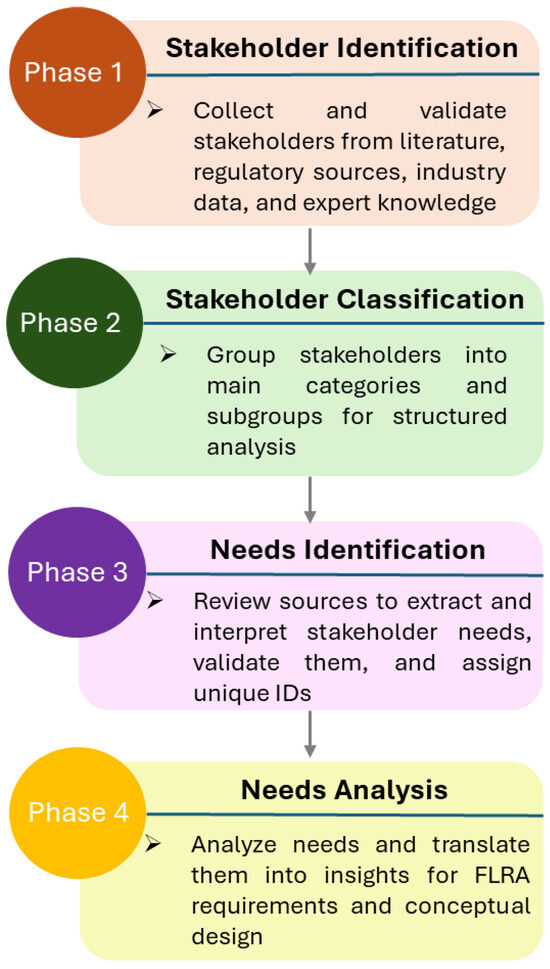
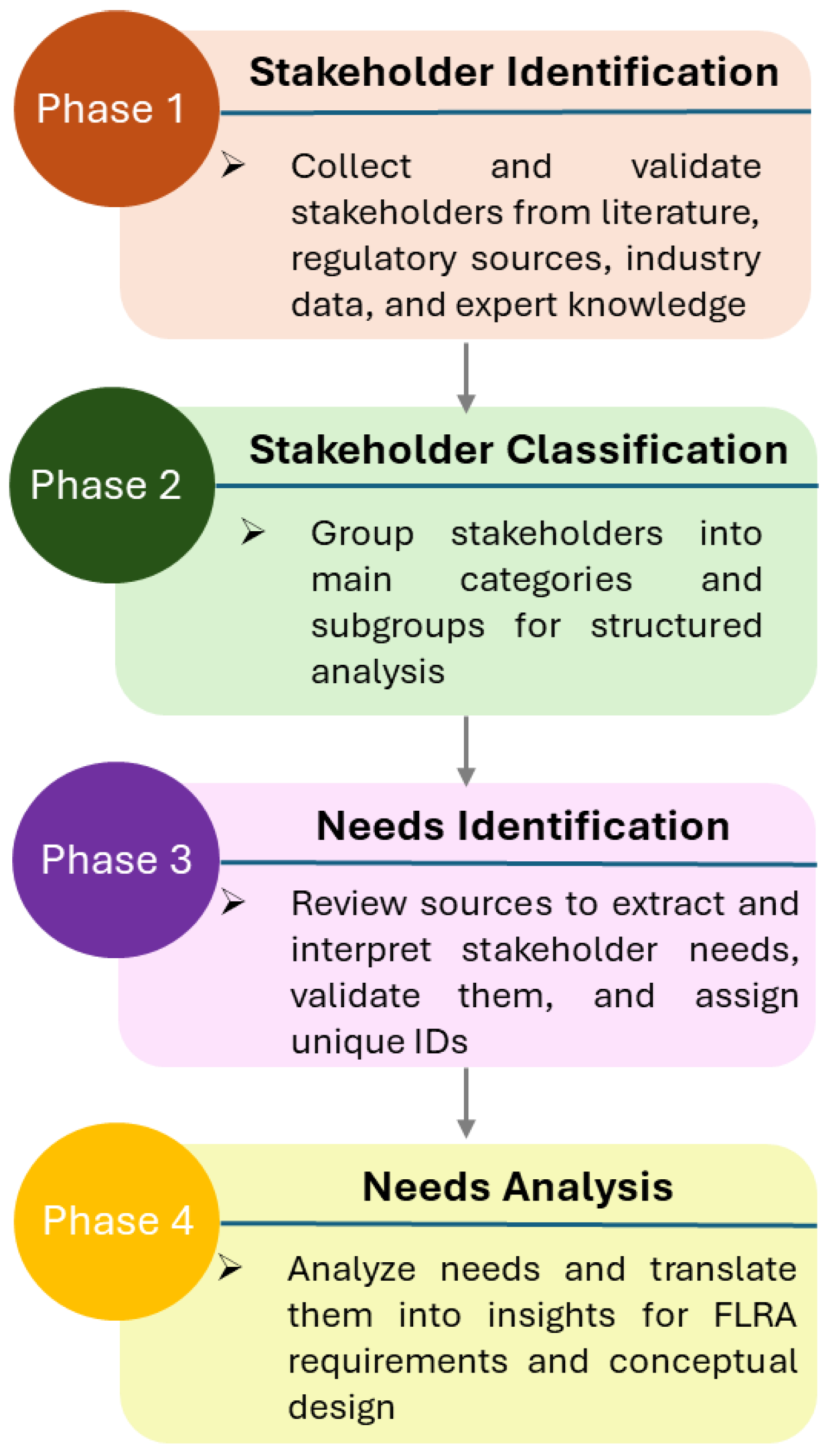
The stakeholder-driven methodology adopted in this study follows a structured, two-layered and multi-step approach designed to ensure comprehensive coverage of all actors and needs relevant to the conceptual design of future long-range aircraft (FLRA) targeting entry into service around 2050. The methodology, as illustrated in Figure 1, is structured into four sequential phases to ensure a comprehensive and systematic approach to stakeholder-driven aircraft design:
Figure 1.
Methodology workflow for identifying and analyzing stakeholder needs for the FLRA.
Stakeholder Identification (Phase 1): All actors who are directly involved in, or indirectly affected by, the aircraft lifecycle are systematically recognized. Relevant literature and background information are also collected to inform the identification process.
Stakeholder Classification (Phase 2): Identified stakeholders are organized using a two-layer hierarchical structure. The primary layer defines the main stakeholder categories associated with each need, while the secondary layer introduces sub-categories that refine stakeholder groupings within each main category.
Stakeholder Needs Identification (Phase 3): Building on the structured stakeholder foundation, needs are systematically derived from literature, regulatory documents, industry standards, and project-specific sources.
Needs Analysis (Phase 4): Retained needs undergo a structured analysis to support their translation into aircraft requirements, evaluation criteria, and design implications for subsequent conceptual design phases.
2.1. Stakeholder Identification and Classification
The identification of stakeholders (Phase 1) is a critical step in the development of future long-range aircraft, aiming to systematically recognize all actors who are directly involved in or indirectly affected by the aircraft lifecycle. Early identification enables the systematic collection and analysis of stakeholder needs, expectations, and constraints, forming the foundation for defining comprehensive system requirements.
The stakeholder identification process combined the authors’ domain expertise and long-term engagement within the EXAELIA project with evidence gathered from academic literature, regulatory frameworks, industry reports, and prior research initiatives. Expert knowledge was operationalized through iterative stakeholder mapping and cross-checking against documented stakeholder groups reported in the literature and relevant aviation projects. Stakeholders were categorized according to their direct or indirect influence on long-range aircraft development, operation, regulation, and societal impact. This triangulated approach reduced subjectivity and supported the completeness of the stakeholder set, ensuring that both prominent and less-visible actors—including manufacturers, operators, passengers, regulators, communities, and energy suppliers—were systematically captured, thereby providing a robust foundation for subsequent needs elicitation.
Stakeholder selection was guided by the objective of capturing a broad and representative spectrum of perspectives and expertise relevant to sustainable aircraft development. Identification criteria included involvement in aircraft design and manufacturing, interaction with aircraft operations and lifecycle processes, exposure to environmental or social impacts, regulatory or financial influence, and contribution to enabling technologies or infrastructure. Based on these criteria, stakeholders were organized into structured categories (Phase 2) reflecting their roles and influence. The principal stakeholder categories considered in this study are summarized in Table 1.
Table 1.
Main stakeholder categories.
The applied approach captures the diversity of stakeholder perspectives across technical, economic, social, and environmental dimensions, supporting the development of next-generation aircraft that are sustainable, competitive, and socially responsible. For effective management and analysis, stakeholders are grouped based on their roles, interests, and influence on aircraft development. Such categorization facilitates communication, prioritization of requirements, and targeted engagement with specific stakeholder groups, ensuring that all relevant perspectives are considered throughout the design and development process.
2.2. Stakeholders Needs Identification
Building upon the stakeholder grouping established in Section 2.1, stakeholder needs for the Future Long-Range Aircraft (FLRA) were identified through a structured qualitative synthesis (Phase 3). This approach combined needs explicitly extracted from the literature and documentary sources with additional needs inferred through expert interpretation within the EXAELIA context. Literature-derived needs were systematically compiled and traceable to their sources, while expert-inferred needs were formulated to consolidate overlapping statements, address gaps not explicitly documented, and ensure completeness across technical, environmental, economic, circular, and social dimensions. Agreement among contributing experts was achieved through iterative review and consensus discussions, thereby reducing subjectivity and enhancing reproducibility.
The supporting literature review followed a mixed and iterative approach. An initial body of sources informed stakeholder identification and validation, while a second, more targeted review focused on extracting stakeholder-specific needs. To improve transparency and reproducibility, searches were conducted using keywords such as “aircraft stakeholders,” “aviation sustainability,” “stakeholder needs,” “stakeholder expectations,” “passenger expectations,” “aircraft conceptual design,” “aircraft design requirements,” “future aviation 2050,” “long-range aircraft,” “sustainable air transport requirements,” “circular economy aviation,” “environmental impact aviation,” “societal impact aviation,” and “eco-efficient aircraft” across academic databases, regulatory publications, industry reports, and European research project outputs. All sources were iteratively screened and cross-checked to ensure comprehensive coverage of both stakeholder groups and their associated needs. Specifically, each source was reviewed to identify which stakeholder groups were addressed and which needs were reported. The identified needs were then cross-compared across all sources to verify that each stakeholder group had been represented and that recurring needs were consistently captured. When discrepancies or gaps were found—such as a stakeholder group mentioned in one source but not others—additional sources were consulted. This iterative process ensured that all relevant stakeholder groups and their associated needs were systematically captured, minimizing the risk of omission and providing a robust foundation for subsequent requirement derivation.
The literature review encompassed seventy peer-reviewed journal articles, seventeen technical reports from research and regulatory bodies (e.g., Flightpath 2050, DESTINATION 2050, Fly the Green Deal, ICAO), and seventeen online sources, including industry reports, white papers, and other relevant publications. These sources were published primarily between 2010 and 2025, a period reflecting the increasing research focus on aviation sustainability and future aircraft concepts. The selection criteria were based on relevance to aviation sustainability, aircraft design, stakeholder analysis, or future aviation system development. This approach ensured that the collected literature represented a balanced combination of academic research, regulatory perspectives, industry insights, and research project outcomes, providing a comprehensive foundation for identifying stakeholder needs.
During this process, it was observed that the same stakeholder needs were frequently identified across multiple sources, reinforcing their significance and providing confidence in their inclusion. Each extracted need was systematically documented and assigned a unique identification (ID) number to ensure clarity, traceability, and reproducibility.
This methodology captures a broad and multidimensional spectrum of stakeholder needs, providing a robust, evidence-based foundation to support the development of design requirements, including top-level aircraft requirements (TLARs). While the direct impact on TLARs will be determined during subsequent requirement engineering and conceptual design phases, the structured capture of stakeholder needs ensures that all relevant perspectives are systematically considered, establishing a comprehensive baseline for the future long-range aircraft. Moreover, while additional needs may emerge as the aviation ecosystem evolves, the current process establishes a comprehensive and solid baseline for informing the top-level requirements and conceptual design of a future long-range aircraft
It should be also noted that while the full set of 191 needs captures the broad spectrum of stakeholder expectations, only those directly relevant to the overall aircraft design—rather than aspects related to the wider air transport system—were selected for the next phase, where they inform the derivation of top-level and sustainability-related aircraft requirements.
3. Results
3.1. Stakeholder Overview
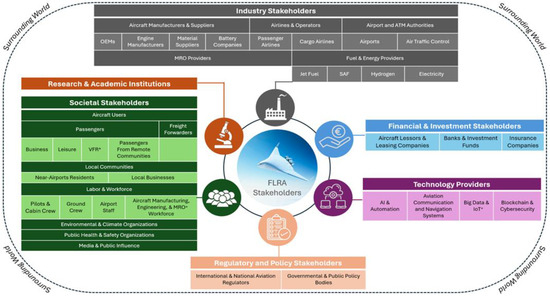
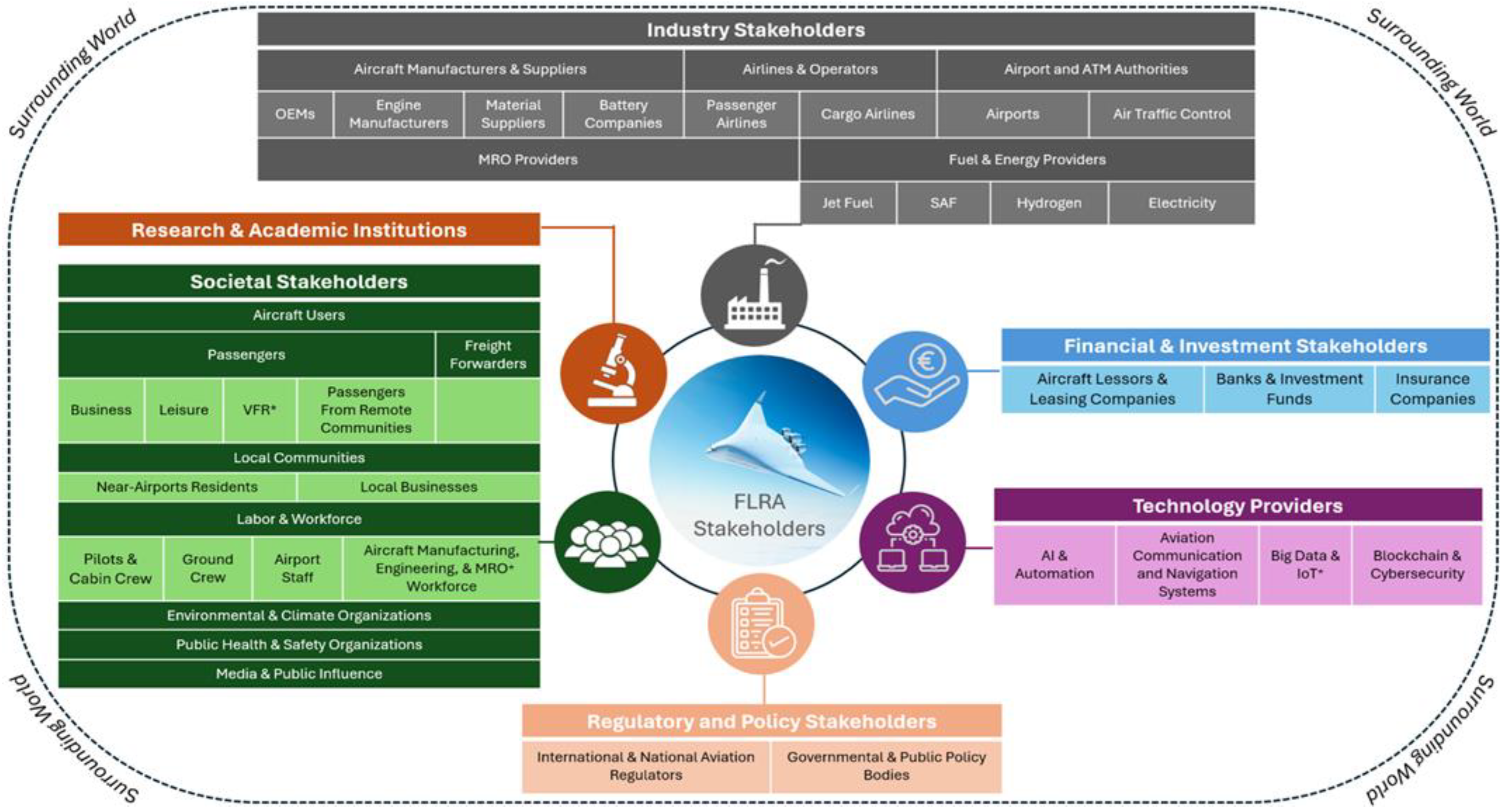
The stakeholders identified in this study have been grouped into distinct categories based on their roles, interests, and influence on the development of future long-range aircraft (FLRA), as schematically illustrated in Figure 2. The main stakeholder categories are as follows:
Figure 2.
Stakeholder landscape for future long-range aircraft (VFR: Visiting for Friends and Relatives; MRO: Maintenance, Repair and Overhaul, IoT: Internet of Things).
Industrial Stakeholders: This group comprises 13 subgroups, including aircraft manufacturers, OEMs, engine and material suppliers, battery companies, airlines (passenger and cargo), airports, air traffic management authorities, and MRO providers. They are directly involved in the design, production, operation, and maintenance of the aircraft.
Regulatory and Policy Stakeholders: This category comprises 2 subgroups, encompassing aviation regulatory authorities, such as ICAO, EASA, and FAA, as well as broader governmental and public policy bodies, including the European Commission. These stakeholders establish and enforce safety, environmental, and operational regulations, ensuring compliance with evolving legal frameworks and sustainability targets.
Societal Stakeholders: This group comprises 14 subgroups, representing individuals and organizations impacted by or interested in the development and operation of FLRA. It includes passengers—business, leisure, visiting friends and relatives (VFR), and travelers from remote communities—as well as freight forwarders. Local communities near airports, including residents and businesses, are also represented. The labor and workforce segment includes pilots, cabin crew, ground crew, airport staff, and the manufacturing, engineering, and maintenance workforce. The workforce is included within societal stakeholders rather than industrial stakeholders because the focus is on the human perspective—their well-being, skills, and working conditions—rather than organizational decision-making or operational authority, which is represented by the manufacturing entities themselves. Environmental and climate organizations (e.g., Greenpeace) and public health and safety bodies (e.g., WHO) ensure alignment with broader sustainability and health objectives. Media and public influence entities, including social media platforms, also play a key role in shaping public perception and awareness.
Research and Academic Institutions: This group involves universities, research centers, and academic organizations that contribute by providing scientific knowledge, technological innovation, independent analysis, and education and training for the future aviation workforce.
Financial and Investment Stakeholders: This group comprises three subgroups, including aircraft lessors and leasing companies, banks, investment funds, and insurance companies. They provide the financial resources and risk management mechanisms necessary for development, acquisition, and operation, influencing funding decisions, cost efficiency, and long-term economic viability.
Technology Providers: This group comprises four subgroups and includes companies and organizations specializing in advanced technologies whose expertise is transversal across multiple industries rather than specific to aviation, which justifies their classification as a distinct stakeholder category. It encompasses providers of artificial intelligence (AI) and automation solutions, communication and navigation systems (e.g., Thales), as well as experts in big data, the Internet of Things (IoT), blockchain, and cybersecurity. These stakeholders provide technologies and expertise that are applicable across multiple industries, enabling innovations in aircraft performance, safety, operational efficiency, and resilience, while remaining distinct from traditional aviation-specific industrial roles.
3.2. Stakeholder Needs
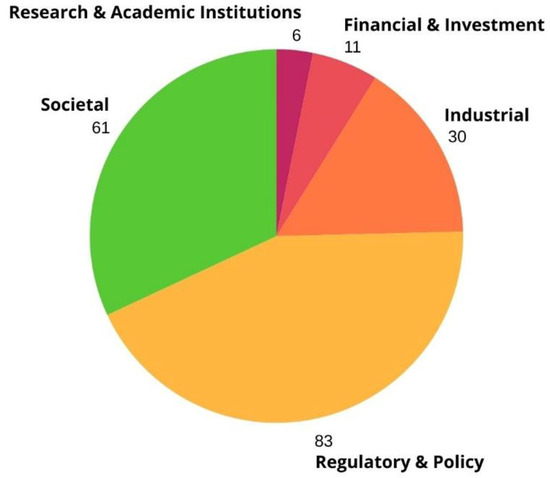
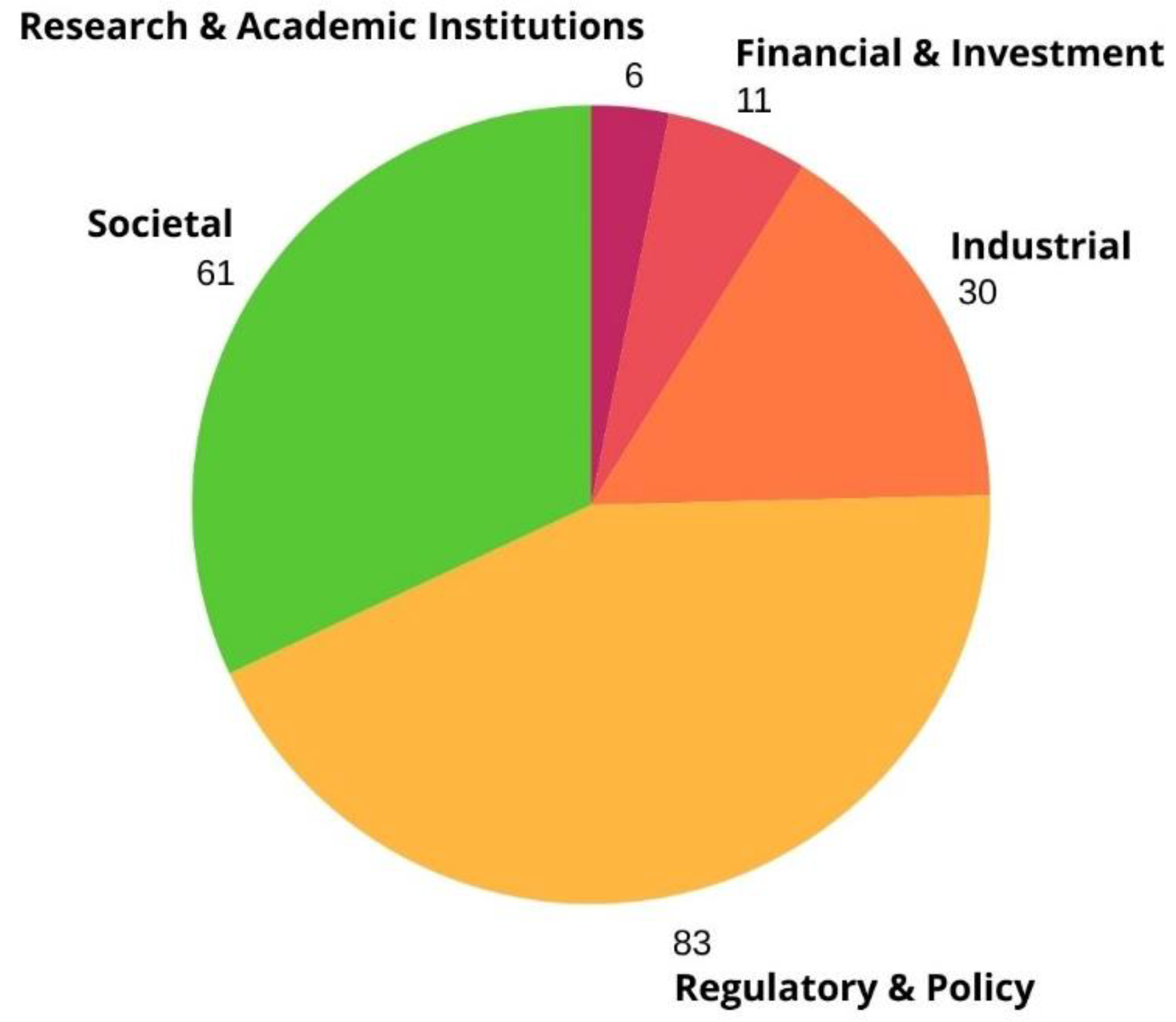
Figure 3 presents the distribution of the needs among the main stakeholders’ categories (Societal, Industrial, Research and Academic, Financial and Investment, Technology Providers, Regulatory and Policy stakeholders). The distribution shows that the stakeholder needs for the FLRA are predominantly associated with Regulatory and Policy stakeholders, accounting for 83 out of 191 total needs. Societal stakeholders follow with 61 identified needs, reflecting strong emphasis on sustainability, passenger experience, and public expectations. Industrial stakeholders contribute 30 needs, primarily related to the fundamental aspects of aircraft design, while Financial and Investment (11) and Research and Academic Institutions (6) stakeholders had a more focused but essential presence in shaping innovation and funding priorities. No explicit needs were identified for Technology and Innovation Providers because their contributions are generally enabling or cross-cutting in nature, supporting the implementation of other stakeholders’ requirements rather than generating unique, independent needs. As a result, the requirements associated with these stakeholders are implicitly captured, mainly within the Industrial stakeholders category. It should be noted that not all identified needs carry an equal level of influence on the aircraft design, so the number of needs per stakeholder category does not necessarily indicate dominance in shaping the design.
Figure 3.
Needs distribution among the different stakeholders.
The following sections present illustrative needs for each stakeholder category and analyze their relevance in the context of holistic sustainability and sustainable aircraft design (Phase 4). The tables presented below (Table 2, Table 3, Table 4, Table 5 and Table 6) serve a dual purpose. First, they provide a structured summary of illustrative needs for each stakeholder category, highlighting recurring themes and cross-cutting concerns such as environmental sustainability, operational efficiency, safety, and social well-being. Second, they function as a bridge between stakeholder input and conceptual aircraft design: by organizing needs by category, sub-category, and theme, the tables enable systematic translation of stakeholder expectations into top-level and system-level aircraft requirements. Approximate counts are provided to illustrate the relative emphasis of each theme, while the narrative highlights overlaps and interconnections across needs. Together, the tables and accompanying analysis clarify the significance of stakeholder requirements and their contribution to a holistic, sustainability-driven aircraft design process. The detailed list of the identified needs, their relationship with stakeholders and the relevant literature source is presented in Appendix A.
Table 2.
Illustrative needs of societal stakeholders.
Table 3.
Illustrative needs of industrial stakeholders.
Table 4.
Illustrative needs of regulatory and policy stakeholders.
Table 5.
Illustrative needs of research and academic institutions.
Table 6.
Illustrative needs of financial and investment stakeholders.
3.2.1. Societal Stakeholders Needs
The societal stakeholder needs identified encompass the immediate functional and operational requirements of passengers and local communities, as well as broader considerations related to workforce well-being, environmental impact, and sustainable aviation development. Analysis of societal stakeholder needs highlights several recurring themes that inform future long-range aircraft design. Passenger experience and comfort are the most frequent, including seating, cabin cleanliness, accessibility, in-flight services, and connectivity (~15–17 needs). Operational reliability and accessibility, such as on-time performance, long-distance coverage, and baggage handling, are also prominent (~10 needs). Environmental sustainability and noise reduction appear across passengers, communities, and regulators (~6–7 needs), while community and economic benefits—including local business growth, public transport, and workforce training—are represented in ~8 needs. Labor and workforce concerns, such as job security, safe working conditions, and reskilling for emerging technologies, account for ~10–12 needs. Cross-cutting safety, public health, and regulatory compliance needs are also evident. These themes demonstrate that societal stakeholders prioritize a combination of passenger comfort, operational reliability, environmental responsibility, workforce welfare, and regulatory compliance, providing a structured foundation for integrating social considerations into conceptual aircraft design. The numbers reported for each theme are approximate due to overlapping needs, variations in granularity, and subjective assignment of needs to categories. Some needs may address multiple aspects simultaneously (e.g., passenger comfort and environmental impact), making exact counts dependent on the classification rules applied. Table 2 presents illustrative needs of societal stakeholders.
3.2.2. Industrial Stakeholders Needs
Industrial stakeholder needs encompass the operational, technological, and economic requirements of aircraft manufacturers, suppliers, airlines, MRO providers, and fuel and energy companies. Analysis of industrial stakeholder needs reveals several dominant themes that guide the design, operation, and sustainability of future long-range aircraft. Aircraft performance and safety emerge as the most frequent category, covering range, speed, take-off and landing performance, payload, weight distribution, and structural integrity (~12–14 needs). Economic competitiveness and operational efficiency, including minimizing operational and production costs, fleet efficiency, and manufacturer competitiveness, are also highly represented (~8–10 needs). Environmental sustainability is another recurring theme, with needs related to emissions reduction, waste minimization, compliance with global regulations, and net-zero operations for airports and MRO providers (~8 needs). Adaptation to new technologies—such as alternative propulsion systems, hydrogen, SAF, and automated manufacturing—appears in ~5–6 needs, reflecting the industrial sector’s focus on innovation and future readiness. Finally, passenger comfort and connectivity (~3–4 needs) also appear, highlighting the interplay between operational performance and societal expectations. Overall, these themes show that industrial stakeholders prioritize aircraft performance, safety, economic and operational efficiency, environmental responsibility, and technological innovation, forming a structured basis for translating stakeholder expectations into top-level and system-level aircraft requirements. The counts of industrial stakeholder needs by theme are approximate, as some needs span multiple operational, technical, or economic aspects, and the granularity of need statements varies. Consequently, exact numbers depend on how needs are assigned to categories, and some needs may contribute to more than one theme simultaneously. Table 3 presents illustrative needs of Industrial stakeholders.
3.2.3. Regulatory and Policy Stakeholders Needs
Regulatory and policy stakeholder needs capture the requirements and expectations of authorities, regulators, and policy bodies responsible for aviation safety, environmental compliance, and strategic planning. These needs capture the broader societal goals of sustainable, safe, and resilient aviation systems, ensuring that technological innovations align with regulatory frameworks and public interests. Analysis of regulatory and policy stakeholder needs highlights several key priorities shaping the future aviation ecosystem. Safety, security, and compliance are dominant themes, encompassing requirements for robust certification, risk mitigation, continuous descent operations, cybersecurity, and operational safety (~15–20 needs). Environmental and sustainability objectives are strongly represented, including emissions reduction, energy efficiency, noise mitigation, circular economy and ecodesign principles (~15–18 needs). Operational efficiency and connectivity are also central, covering air traffic management, multimodal integration, punctuality, infrastructure compatibility, and seamless mobility (~10–12 needs). Innovation, research, and workforce development appear frequently, reflecting the importance of supporting technological advancement, education, and high-skilled job creation (~6–8 needs). Finally, public engagement, transparency, and societal acceptance emerge as recurring concerns (~5–6 needs), emphasizing the need for communication, information sharing, and trust-building with affected communities. Overall, regulatory and policy stakeholders prioritize safe, sustainable, and efficient aviation operations, while enabling technological innovation, workforce development, and societal engagement, forming a structured basis for translating these expectations into high-level requirements and governance frameworks. Once again, the counts of regulatory and policy stakeholder needs by theme are approximate, as many needs address multiple domains—such as safety, environmental impact, innovation, and social objectives—and some needs overlap across categories. Exact numbers depend on how needs are assigned and grouped, and certain needs contribute to more than one thematic area simultaneously. Table 4 presents illustrative needs of Regulatory and Policy stakeholders.
3.2.4. Research and Academic Institutions Needs
Research and academic institutions play a key role in advancing sustainable aviation by driving innovation, generating knowledge, and fostering collaboration. Their needs include securing funding for next-generation propulsion and low-TRL disruptive technologies, promoting interdisciplinary and industry–academia partnerships, and conducting research on lifecycle-based and circular economy design approaches. They also focus on ensuring the economic viability of green technologies through cost-efficiency and scalability studies, as well as supporting social inclusivity, workforce upskilling, and enhanced passenger experience. Collectively, these needs highlight the central role of research and academia in enabling a sustainable, innovative, and socially responsible future aviation system. Table 5 presents illustrative needs of this stakeholder group.
3.2.5. Financial and Investment Stakeholders
Financial and investment stakeholders, including aircraft lessors, leasing companies, banks, investment funds, and insurers, focus on the economic and financial performance of future aircraft. Their needs emphasize high return on investment, long-term profitability, and strong residual value, alongside regulatory compliance and sustainability features that align with evolving market trends. They also require aircraft to be fuel-efficient, low-maintenance, and operationally flexible to support leasing and financing strategies, while insurers prioritize advanced safety features and reliable maintenance records to minimize liability and financial risk. Collectively, these needs highlight the importance of financial viability, risk management, and market adaptability in guiding sustainable and commercially competitive aircraft development. Table 6 presents illustrative needs of Financial and Investment stakeholders.
4. Discussion
The present study systematically identifies stakeholder needs across social, environmental, industrial, regulatory, financial, and technological domains. While previous research has examined future aircraft concepts, fuel efficiency, and environmental performance, these studies often did not capture the full range of stakeholder needs across social, economic, and technological dimensions. By addressing this gap, the current research incorporates the perspectives of a broad spectrum of stakeholders—including passengers, local communities, labor and workforce, regulatory bodies, financial investors, research institutions, and technology providers—emphasizing holistic sustainability considerations that integrate economic, social, operational, and environmental factors. An initial comparison with classical Top-Level Aircraft Requirements (TLARs) highlights a key contrast: traditional TLARs focus primarily on technical and operational performance—range, speed, payload, take-off and landing capabilities, fuel efficiency, and regulatory compliance—while largely omitting broader social, environmental, and human-centered considerations. Passenger comfort, accessibility, noise reduction, workforce well-being and reskilling, circular economy practices, and community benefits are underrepresented in classical TLARs, underscoring the added value of a stakeholder-driven approach in shaping more comprehensive and sustainability-oriented aircraft design requirements.
The analysis of stakeholder needs for future long-range aircraft demonstrates the value of a holistic, multi-dimensional approach. Societal stakeholders emphasize passenger experience, community well-being, workforce welfare, and environmental responsibility, highlighting the human-centered and social dimensions of sustainable aviation. Industrial stakeholders focus on aircraft performance, safety, operational efficiency, economic competitiveness, environmental compliance, and adaptation to new technologies, underscoring the technical and operational priorities. Regulatory and policy stakeholders drive safety, security, environmental sustainability, operational efficiency, innovation, and public engagement, reflecting the governance and societal oversight requirements. Research and academic institutions contribute needs that enable innovation, interdisciplinary collaboration, and sustainable technology development, while financial and investment stakeholders prioritize economic viability, market adaptability, and risk management. Technology providers, although not associated with explicit needs, play a cross-cutting enabling role in implementing innovations across industrial and societal expectations. Collectively, these results illustrate that integrating diverse stakeholder perspectives provides a robust foundation for translating social, environmental, economic, and technological considerations into comprehensive aircraft requirements, enabling the development of future aircraft that are not only technically feasible but also socially acceptable, environmentally responsible, and economically sustainable.
The analysis identifies significant patterns, distributions, and cross-cutting themes across multiple stakeholder groups. Environmental sustainability emerges as a dominant concern, reflecting regulatory pressures and societal expectations to reduce greenhouse gas emissions, noise, and local environmental impacts. Economic and operational priorities remain critical for industry and financial stakeholders, emphasizing the need to balance sustainability objectives with cost-effectiveness, market competitiveness, and operational feasibility.
Several needs consistently appear across different stakeholder groups, revealing shared priorities such as regulatory compliance, operational efficiency, safety, and human-centered considerations, including passenger comfort, accessibility, workforce well-being, and skills development. Identifying these convergences enables a more nuanced understanding of where stakeholder interests align and where trade-offs or prioritization decisions may be required. Conversely, areas of divergence—such as differing emphases between industrial efficiency and social/environmental considerations—highlight potential conflicts that aircraft designers and policymakers must address.
Direct comparisons with similar studies are limited, as, to the authors’ knowledge, FUTPRINT50 project is currently the only initiative that has addressed future aircraft sustainability from a system-level perspective, while a fully holistic, multi-stakeholder approach covering social, economic, operational, and environmental dimensions has not been extensively explored. Most existing research focuses primarily on technological solutions aimed at reducing environmental impacts, such as advanced propulsion concepts, alternative fuels, or aerodynamic improvements. While FUTPRINT50 project [11] provides valuable insights into future aviation technologies and environmental performance, the present study complements this by systematically identifying and structuring stakeholder needs across the aviation ecosystem. This highlights the novelty of the current work, which emphasizes a stakeholder-driven approach that captures a broad range of sustainability considerations in early aircraft design phases.
Despite its comprehensive approach, the study has several limitations. Stakeholder coverage, while broad, may underrepresent certain groups such as emerging technology startups, small regional operators, and niche passenger segments. The data sources used, primarily literature, reports, and prior studies, may have introduced regional or sectoral biases, and the importance of some stakeholder needs may evolve rapidly due to technological advances or regulatory changes. A further limitation of the study is that the identified stakeholder needs are presented as a comprehensive baseline without assigning quantitative importance or prioritization. Due to the qualitative nature of many stakeholder expectations and the diversity of stakeholder groups, assessing relative importance at this early stage is challenging. In practical aircraft development processes, prioritization is typically performed in later stages using techniques such as stakeholder weighting, multi-criteria decision analysis, or requirement prioritization frameworks. Future research could apply these methods to determine the most critical stakeholder needs and support more targeted design decisions. Finally, classifying needs by stakeholder type, secondary subcategories, and relevance to aircraft systems involves interpretive judgments, introducing potential subjectivity that could influence prioritization.
5. Conclusions and Future Work
This study provides a systematic and comprehensive analysis of stakeholder needs for future sustainable aircraft, covering a broad spectrum of participants including passengers, local communities, workforce and labor organizations, regulatory authorities, financial and investment stakeholders, research institutions, and technology providers. These needs reflect both primary and secondary stakeholder perspectives, highlighting interdependencies, potential trade-offs, and opportunities for innovation in aircraft design.
The main contribution of this work lies in the development of a structured approach that systematically translates stakeholder expectations into key insights for sustainable aircraft development. Unlike previous studies, which often focused on isolated dimensions such as fuel efficiency, emissions, or economic performance, this approach considers environmental, social, and economic factors while also accounting for operational and technological feasibility. By linking stakeholder needs to key insights, the approach supports a needs-driven, sustainability-oriented process [3,4] that can inform innovation, regulatory compliance, and societal acceptance.
The analysis highlights clear patterns and cross-cutting priorities among the identified stakeholder needs, most notably the consistent emphasis on environmental sustainability, operational efficiency, and economic viability across multiple stakeholder groups. Environmental considerations—such as emissions reduction, noise mitigation, and improved resource efficiency—emerge as key expectations particularly from regulatory bodies, societal stakeholders, and policy-related actors, reflecting the growing importance of sustainability in aviation development. At the same time, operational stakeholders, including airlines and manufacturers, place strong emphasis on operational efficiency, reliability, and lifecycle cost performance, indicating the need for design solutions that balance environmental objectives with practical and economic constraints. The findings demonstrate that integrating stakeholder perspectives during the early design stages is essential for developing aircraft concepts that are not only technically feasible but also aligned with societal expectations, regulatory trends, and market demands. Furthermore, the structured identification and synthesis of stakeholder needs provide a transparent baseline that can support requirement definition and prioritization during conceptual aircraft design. In particular, the results can inform the formulation of top-level aircraft requirements and guide trade-off analyses between sustainability, performance, and cost objectives. The study therefore contributes a methodological approach that facilitates the systematic incorporation of stakeholder perspectives into early design processes. At the same time, it acknowledges that quantitative prioritization or weighting of individual needs—using approaches such as multi-criteria decision-making methods or expert-based evaluation—may be applied in subsequent design phases. This ensures that the conclusions are actionable and directly linked both to the analytical process presented in this study and to future design and decision-support activities.
Looking forward, the results of this study offer a basis for the EXAELIA project to explore how stakeholder needs may inform the development of formal design requirements and conceptual aircraft solutions. Future steps include prioritizing the identified needs, developing measurable and verifiable aircraft design requirements using systematic approaches, and integrating these into model-based systems engineering processes.
Author Contributions
Conceptualization, D.M. and A.F.; methodology, D.M., H.P., B.P., L.P., E.S. and L.B.; software, D.M. and H.P.; validation, B.P., S.P., L.P., P.P., E.S., J.P. and L.B.; formal analysis, D.M. and H.P.; investigation, D.M., H.P., E.S., B.P., L.P. and L.B.; resources, S.P. and A.F.; data curation, D.M. and A.F.; writing—original draft preparation, D.M., S.P. and A.F.; writing—review and editing, S.P., L.P., L.B., P.P., E.S., L.S., J.P., B.P., A.P. and A.F.; visualization, D.M., A.P. and A.F.; supervision, A.F. and S.P.; project administration, A.F.; funding acquisition, S.P. All authors have read and agreed to the published version of the manuscript.
Funding
The present work is funded by the European Union, under GA number 101191922 (EXAELIA). Views and opinions expressed are, however, those of the authors only and do not necessarily reflect those of the European Union or the European Climate, Infrastructure and Environment Executive Agency. Neither the European Union nor the granting authority can be held responsible for them.

Data Availability Statement
The original contributions presented in this study are included in the article. Further inquiries can be directed to the corresponding authors.
Conflicts of Interest
Author James Page was employed by Austrian Institute of Technology. The remaining authors declare that the research was conducted in the absence of any commercial or financial relationships that could be construed as a potential conflict of interest.
Appendix A
The detailed list of the identified needs, their relationship with stakeholders and the relevant literature sources are presented in Appendix A (Table A1). Each need is assigned a unique ID to facilitate identification, traceability, and link with the derived requirements. Additionally, each need is evaluated to determine whether it is directly related to the aircraft system, rather than to airport infrastructure, airline operations, or air traffic services (ATS). This screening helps identify those needs that can be translated into requirements with the potential to drive the aircraft design during the conceptual and subsequent design phases. The stakeholder identification in the study follows a structured, two-layered approach to ensure comprehensive coverage of all relevant groups. The first layer identifies the main stakeholder category to which each need is associated. The subsequent layer (sub-categories) progressively narrows down the stakeholder group within the main category, providing a more specific classification.
Table A1.
Detailed list of FLRA stakeholder needs.
References
- Iemma, U.; Vitagliano, F.P.; Centracchio, F. A multi-objective design optimisation of eco-friendly aircraft: The impact of noise fees on airplanes sustainable development. Int. J. Sustain. Eng. 2017, 11, 122–134. [Google Scholar] [CrossRef]
- Markatos, D.N.; Pantelakis, S.G. Implementation of a Holistic MCDM-Based Approach to Assess and Compare Aircraft, under the Prism of Sustainable Aviation. Aerospace 2023, 10, 240. [Google Scholar] [CrossRef]
- Markatos, D.N.; Pantelakis, S.G. Assessment of the Impact of Material Selection on Aviation Sustainability, from a Circular Economy Perspective. Aerospace 2022, 9, 52. [Google Scholar] [CrossRef]
- Filippatos, A.; Markatos, D.; Theochari, A.; Pantelakis, S. Integrating Sustainability in Aircraft Component Design: Towards a Transition from Eco-Driven to Sustainability-Driven Design. Aerospace 2025, 12, 140. [Google Scholar] [CrossRef]
- Hosseini, S.; Vaziry-Zanjany, M.A.; Ovesy, H.R. A Framework for Aircraft Conceptual Design and Multidisciplinary Optimization. Aerospace 2024, 11, 273. [Google Scholar] [CrossRef]
- Esdras, G.; Liscouët-Hanke, S. Development of Core Functions for Aircraft Conceptual Design: Methodology and Results. In Proceedings of the Canadian Aeronautics and Space Institute AERO 2015 Conference, Montreal, QC, Canada, 19–21 May 2015. [Google Scholar]
- Hall, A.; Mayer, T.; Wuggetzer, I.; Childs, P. Future aircraft cabins and design thinking: Optimisation vs. win-win scenarios. Propuls. Power Res. 2013, 2, 85–95. [Google Scholar] [CrossRef]
- He, Y.; Li, H.; Zhang, X.; Shi, Y.; Chen, F. Stakeholder’s Needs Analysis Methodology For Civil Aircraft Projects. J. Phys. Conf. Ser. 2021, 1827, 012117. [Google Scholar] [CrossRef]
- Paletti, L.; Boggero, L.; Wende, G.; Nagel, B. Translating the Concept of Sustainability for the Determination of Requirements for the Design of Future Aircraft. 2024. Available online: https://www.icas.org/ICAS_ARCHIVE/ICAS2024/data/preview/ICAS2024_0042.htm (accessed on 12 January 2026).
- Cartile, A.; Marsden, C.; Liscouët-Hanke, S. Digital Transformation in Aircraft Design and Certification: Developing Requirements for Modeling Regulatory Documentation. Aerospace 2025, 12, 724. [Google Scholar] [CrossRef]
- Eisenhut, D.; Moebs, N.; Windels, E.; Bergmann, D.; Geiß, I.; Reis, R.; Strohmayer, A. Aircraft Requirements for Sustainable Regional Aviation. Aerospace 2021, 8, 61. [Google Scholar] [CrossRef]
- Eres, M.H.; Bertoni, M.; Kossmann, M.; Scanlan, J. Mapping customer needs to engineering characteristics: An aerospace perspective for conceptual design. J. Eng. Des. 2014, 25, 64–87. [Google Scholar] [CrossRef]
- Mandorino, M.; Della Vecchia, P.; Nicolosi, F.; Corcione, S.; Trifari, V.; Cerino, G.; Fioriti, M.; Cabaleiro, C.; Lefebvre, T. Regional jet retrofitting design: From stakeholders’ needs and system’s requirements to MDAO workflow formulation. In Proceedings of the 33rd Congress of the International Council of the Aeronautical Sciences, ICAS 2022, Stockholm, Sweden, 4–9 September 2022. [Google Scholar]
- Fly the Green Deal—Publications Office of the EU. Available online: https://op.europa.eu/en/publication-detail/-/publication/69dfdaf4-07d5-11ed-acce-01aa75ed71a1/language-en (accessed on 15 January 2026).
- Kos, J.; Mertens, C.; Peerlings, B.; Schmollgruber, P.; Iannelli, P.; Gronowska, M.; Zill, T. Flying Testbeds to Accelerate the Development of Disruptive Long Range Aircraft. In Proceedings of the 10th CEAS Aerospace Europe Conference, Turin, Italy, 1–4 December 2025. [Google Scholar]
- Kurtulmuşoğlu, F.B.; Can, G.F.; Tolon, M. A voice in the skies: Listening to airline passenger preferences. J. Air Transp. Manag. 2016, 57, 130–137. [Google Scholar] [CrossRef]
- Zachariah, R.A.; Sharma, S.; Kumar, V. Systematic review of passenger demand forecasting in aviation industry. Multimed. Tools Appl. 2023, 82, 46483–46519. [Google Scholar] [CrossRef]
- Munoz, C.; Laniado, H. Airline choice model for international round-trip flights: The role of travelers’ satisfaction and personality traits. Res. Transp. Econ. 2021, 90, 101121. [Google Scholar] [CrossRef]
- Improving Passenger Experience Through Smart Airport Design|GEMS. Available online: https://www.gmrgems.com/blogs/improving-passenger-experience-through-smart-airport-design (accessed on 12 January 2026).
- Andrade, A.; Escudero, M.; Parker, J.; Bartolucci, C.; Seriani, S.; Aprigliano, V. Perceptions of people with reduced mobility regarding universal accessibility at bus stops: A pilot study in Santiago, Chile. Case Stud. Transp. Policy 2024, 16, 101190. [Google Scholar] [CrossRef]
- Ban, H.-J.; Kim, H.-S. Understanding Customer Experience and Satisfaction through Airline Passengers’ Online Review. Sustainability 2019, 11, 4066. [Google Scholar] [CrossRef]
- Brindisi, A.; Concilio, A. Passengers’ Comfort Modeling Inside Aircraft. J. Aircr. 2008, 45, 2001–2008. [Google Scholar] [CrossRef]
- Dos Santos, I.; Da Silva, S.L.; Camarotto, J.A.; Vidotti, H.G.M. Accessibility for passengers with hidden disabilities in air transport: A literature review. J. Air Transp. Res. Soc. 2024, 3, 100033. [Google Scholar] [CrossRef]
- Chang, Y.-C.; Chen, C.-F. Meeting the needs of disabled air passengers: Factors that facilitate help from airlines and airports. Tour. Manag. 2012, 33, 529–536. [Google Scholar] [CrossRef]
- Martín-Domingo, L.; Adiloğlu-Yalçınkaya, L.; Ertürk, M.; Farkić, J. Existing barriers and suggested solutions for dealing with air passengers with specific access requirements: A systematic literature review. Res. Transp. Bus. Manag. 2024, 53, 101104. [Google Scholar] [CrossRef]
- Mahmoud, N.S.A.; Jung, C.; Al Qassimi, N. Evaluating the aircraft noise level and acoustic performance of the buildings in the vicinity of Dubai International Airport. Ain Shams Eng. J. 2022, 14, 102032. [Google Scholar] [CrossRef]
- Biedermann, M.; Papatheodorou, A.; Prowle, M.; Bulatovic, I. High Reliability Organisations in a Changing World: The Case of Air Traffic Control. Res. Transp. Bus. Manag. 2024, 53, 101099. [Google Scholar] [CrossRef]
- Lawton, R.N.; Fujiwara, D. Living with aircraft noise: Airport proximity, aviation noise and subjective wellbeing in England. Transp. Res. Part D Transp. Environ. 2016, 42, 104–118. [Google Scholar] [CrossRef]
- Qu, F.; Li, Z.; Zhang, T.; Huang, W. Soundscape and subjective factors affecting residents’ evaluation of aircraft noise in the communities under flight routes. Front. Psychol. 2023, 14, 1197820. [Google Scholar] [CrossRef]
- Brunelle-Yeung, E.; Masek, T.; Rojo, J.J.; Levy, J.I.; Arunachalam, S.; Miller, S.M.; Barrett, S.R.H.; Kuhn, S.R.; Waitz, I.A. Assessing the impact of aviation environmental policies on public health. Transp. Policy 2014, 34, 21–28. [Google Scholar] [CrossRef]
- Rupcic, L.; Pierrat, E.; Saavedra-Rubio, K.; Thonemann, N.; Ogugua, C.; Laurent, A. Environmental impacts in the civil aviation sector: Current state and guidance. Transp. Res. D Transp. Environ. 2023, 119, 103717. [Google Scholar] [CrossRef]
- Faber, J.; Raphaël, S. CO2 Emissions of Private Aviation in Europe. Available online: www.cirium.com/ (accessed on 13 January 2026).
- Barrett, S.R.H.; Britter, R.E.; Waitz, I.A. Global Mortality Attributable to Aircraft Cruise Emissions. Environ. Sci. Technol. 2010, 44, 7736–7742. [Google Scholar] [CrossRef]
- Hauptvogel, D.; Kuhlmann, J.; Richard, I.; Emanuely, C.; Schreckenberg, D.; Quehl, J.; Rothmund, T.; Bartels, S. Fairness perspectives of airport residents: A qualitative approach. Transp. Res. Interdiscip. Perspect. 2024, 27, 101221. [Google Scholar] [CrossRef]
- Cristea, A.D. The role of aviation networks for urban development. J. Reg. Sci. 2023, 63, 947–980. [Google Scholar] [CrossRef]
- Mandle, P.B.; Mansel, D.M.; Coogan, M.A. Use of Public Transportation by Airport Passengers. Transp. Res. Rec. 2000, 1703, 83–89. [Google Scholar] [CrossRef]
- Le, T.T.; Sharma, P.; Bora, B.J.; Tran, V.D.; Truong, T.H.; Le, H.C.; Nguyen, P.Q.P. Fueling the future: A comprehensive review of hydrogen energy systems and their challenges. Int. J. Hydrogen Energy 2023, 54, 791–816. [Google Scholar] [CrossRef]
- Perry, M.L.; de Graaf, S. Overview of safety challenges associated with integration of hydrogen-based propulsion systems for climate neutral aviation. J. Phys. Conf. Ser. 2024, 2716, 012001. [Google Scholar] [CrossRef]
- Koroniotis, N.; Moustafa, N.; Schiliro, F.; Gauravaram, P.; Janicke, H. A Holistic Review of Cybersecurity and Reliability Perspectives in Smart Airports. IEEE Access 2020, 8, 209802–209834. [Google Scholar] [CrossRef]
- Revised and Updated DESTINATION 2050 Roadmap Report Published—Nederlands Lucht-en Ruimtevaartcentrum. Available online: https://www.nlr.org/newsroom/nieuws/revised-and-updated-destination-2050-roadmap-report-published/ (accessed on 15 January 2026).
- Button, K.; Yuan, J. Airfreight Transport and Economic Development: An Examination of Causality. Urban Stud. 2012, 50, 329–340. [Google Scholar] [CrossRef]
- Cidell, J. The role of major infrastructure in subregional economic development: An empirical study of airports and cities. J. Econ. Geogr. 2014, 15, 1125–1144. [Google Scholar] [CrossRef]
- Przegalinska, A.; Triantoro, T.; Kovbasiuk, A.; Ciechanowski, L.; Freeman, R.B.; Sowa, K. Collaborative AI in the workplace: Enhancing organizational performance through resource-based and task-technology fit perspectives. Int. J. Inf. Manag. 2024, 81, 102853. [Google Scholar] [CrossRef]
- Katiraee, N.; Calzavara, M.; Finco, S.; Battaïa, O.; Battini, D. Assembly line balancing and worker assignment considering workers’ expertise and perceived physical effort. Int. J. Prod. Res. 2022, 61, 6939–6959. [Google Scholar] [CrossRef]
- Boyd, C.; Bain, P. ‘Once I Get You Up There, Where the Air is Rarified’: Health, Safety and the Working Conditions of Airline Cabin Crews. New Technol. Work. Employ. 1998, 13, 16–28. [Google Scholar] [CrossRef]
- Genovese, M.; Cigolotti, V.; Jannelli, E.; Fragiacomo, P. Current standards and configurations for the permitting and operation of hydrogen refueling stations. Int. J. Hydrogen Energy 2023, 48, 19357–19371. [Google Scholar] [CrossRef]
- Deng, Q.; Santos, B.F.; Verhagen, W.J. A novel decision support system for optimizing aircraft maintenance check schedule and task allocation. Decis. Support Syst. 2021, 146, 113545. [Google Scholar] [CrossRef]
- Pantelakis, S.; Tserpes, K. Revolutionizing Aircraft Materials and Processes; Springer International Publishing: Cham, Switzerland, 2020. [Google Scholar] [CrossRef]
- Greenpeace. Flying Towards Climate Failure. June 2022. Available online: https://climatechange.issuelab.org/resource/flying-towards-climate-failure-an-analysis-of-the-seven-biggest-european-airline-groups (accessed on 13 January 2026).
- IATA—Health and Safety. Available online: https://www.iata.org/en/programs/safety/health/ (accessed on 13 January 2026).
- Meyer, M.J.; Mordukhovich, I.; Wellenius, G.A.; Mittleman, M.A.; McCracken, J.P.; Coull, B.A.; McNeely, E. Changes in heart rate and rhythm during a crossover study of simulated commercial flight in older and vulnerable participants. Front. Physiol. 2019, 10, 1339. [Google Scholar] [CrossRef]
- Görlich, Y.; Stadelmann, D. Mental Health of Flying Cabin Crews: Depression, Anxiety, and Stress Before and During the COVID-19 Pandemic. Front. Psychol. 2020, 11, 581496. [Google Scholar] [CrossRef]
- COVID-19′s Impact on Airports & Recovery 2023|ACI World. Available online: https://aci.aero/2023/02/22/the-impact-of-covid-19-on-airportsand-the-path-to-recovery-industry-outlook-for-2023/ (accessed on 13 January 2026).
- Tepylo, N.; Straubinger, A.; Laliberte, J. Public perception of advanced aviation technologies: A review and roadmap to acceptance. Prog. Aerosp. Sci. 2023, 138, 100899. [Google Scholar] [CrossRef]
- Okine, E.A.; Zarei, E.; Roggow, B.J. Exploring the intellectual insights in aviation safety research: A systematic literature and bibliometric review. Saf. Sci. 2023, 170, 106354. [Google Scholar] [CrossRef]
- Yedavalli, P.; Mooberry, J. An Assessment of Public Perception of Urban Air Mobility (UAM). Airbus. Available online: https://www.airbus.com/sites/g/files/jlcbta136/files/2022-07/Airbus-UTM-public-perception-study%20-urban-air-mobility.pdf (accessed on 13 January 2026).
- Kim, S.-B.; Park, J.-W. A study on the importance of airline selection attributes by airline type: An emphasis on the difference of opinion in between Korean and overseas aviation experts. J. Air Transp. Manag. 2017, 60, 76–83. [Google Scholar] [CrossRef]
- Certification Specifications (CSs)/Detailed Specifications (DSs)|EASA. Available online: https://www.easa.europa.eu/en/document-library/certification-specifications/group/cs-25-large-aeroplanes (accessed on 13 January 2026).
- CS-25 Amendment 27—Review of Aeroplane Performance Requirements for Air Operations and Regular Update of CS-25|EASA. Available online: https://www.easa.europa.eu/en/document-library/certification-specifications/cs-25-amendment-27 (accessed on 13 January 2026).
- How Does the FAA Certify Aircraft?|Federal Aviation Administration. Available online: https://www.faa.gov/aircraft/air_cert/airworthiness_certification (accessed on 13 January 2026).
- European Aviation Environmental Report 2025|EASA. Available online: https://www.easa.europa.eu/en/domains/environment/eaer (accessed on 13 January 2026).
- Fröhler, B.M.H.J.; Häßy, J.; Abu-Zurayk, M. Development of a medium/long-haul reference aircraft. CEAS Aeronaut. J. 2023, 14, 693–713. [Google Scholar] [CrossRef]
- Nangia, R.K. Efficiency parameters for modern commercial aircraft. Aeronaut. J. 2006, 110, 495–510. [Google Scholar] [CrossRef]
- Henderson, R.P.; Martins, J.R.R.A.; Perez, R.E. Aircraft conceptual design for optimal environmental performance. Aeronaut. J. 2012, 116, 1–22. [Google Scholar] [CrossRef]
- Risse, K.; Stumpf, E. Conceptual aircraft design with hybrid laminar flow control. CEAS Aeronaut. J. 2014, 5, 333–343. [Google Scholar] [CrossRef]
- Vijayanandh, R.; Senthilkumar, S.; Rajkumar, R.; Kumar, A.; Kumar, M.S.; Kumar, J.D.; Kumar, K.M.K.; Prakash, R.A. Conceptual design and computational investigations of fixed wing unmanned aerial vehicle for medium-range applications. In Autonomous and Connected Heavy Vehicle Technology; Academic Press: Cambridge, MA, USA, 2022; pp. 353–374. [Google Scholar] [CrossRef]
- Abrantes, I.; Ferreira, A.F.; Magalhães, L.B.; Costa, M.; Silva, A. The impact of revolutionary aircraft designs on global aviation emissions. Renew. Energy 2024, 223, 119937. [Google Scholar] [CrossRef]
- de Vries, R.; Brown, M.T.; Vos, R. A preliminary sizing method for hybrid-electric aircraft including aero-propulsive interaction effects. In Proceedings of the 2018 Aviation Technology, Integration, and Operations Conference, Atlanta, GA, USA, 25–29 June 2018. [Google Scholar] [CrossRef]
- Karpuk, S.; Liu, Y.; Elham, A. Multi-Fidelity Design Optimization of a Long-Range Blended Wing Body Aircraft with New Airframe Technologies. Aerospace 2020, 7, 87. [Google Scholar] [CrossRef]
- Re, F. Viability and state of the art of environmentally friendly aircraft taxiing systems. In Electrical Systems for Aircraft, Railway and Ship Propulsion; IEEE: New York, NY, USA, 2012. [Google Scholar] [CrossRef]
- Jupp, J.A. The design of future passenger aircraft—The environmental and fuel price challenges. Aeronaut. J. 2016, 120, 37–60. [Google Scholar] [CrossRef]
- Dhara, A.; Lal, J.M. Sustainable Technology on Aircraft Design: A Review. IOP Conf. Ser. Earth Environ. Sci. 2021, 889, 012068. [Google Scholar] [CrossRef]
- Mcdonald, R.A.; German, B.J.; Takahashi, T.; Bil, C.; Anemaat, W.; Chaput, A.; Vos, R.; Harrison, N. Future aircraft concepts and design methods. Aeronaut. J. 2021, 126, 92–124. [Google Scholar] [CrossRef]
- Green, J.E. Greener by Design—The technology challenge. Aeronaut. J. 2002, 106, 57–113. [Google Scholar] [CrossRef]
- Kotzem, M.; Wöhler, S.; Burschyk, T.; Hesse, C.; Hellbrück, S.; Zill, T. Conceptual Aircraft Design of a Research Baseline with Direct Liquid Hydrogen Combustion. In Proceedings of the 34th Congress of the International Council of the Aeronautical Sciences, Florence, Italy, 9–13 September 2024. [Google Scholar]
- Künnen, J.-R.; Strauss, A.K.; Ivanov, N.; Jovanović, R.; Fichert, F. Leveraging demand-capacity balancing to reduce air traffic emissions and improve overall network performance. Transp. Res. Part A Policy Pract. 2023, 174, 103716. [Google Scholar] [CrossRef]
- Baxter, G.; Srisaeng, P.; Wild, G.; Baxter, G.; Srisaeng, P.; Wild, G. Sustainable Airport Waste Management: The Case of Kansai International Airport. Recycling 2018, 3, 6. [Google Scholar] [CrossRef]
- Raimundo, R.J.; Baltazar, M.E.; Cruz, S.P.; Raimundo, R.J.; Baltazar, M.E.; Cruz, S.P. Sustainability in the Airports Ecosystem: A Literature Review. Sustainability 2023, 15, 12325. [Google Scholar] [CrossRef]
- Zengerling, Z.L.; Dal Gesso, S.; Linke, F.; Clococeanu, M.; Gollnick, V.; Peter, P.; Matthes, S.; Baspinar, B.; Ozkol, I.; Noorafza, M.; et al. Operational Improvements to Reduce the Climate Impact of Aviation—A Comparative Study from EU Project ClimOP. Appl. Sci. 2023, 13, 9083. [Google Scholar] [CrossRef]
- Net Zero CO2 Emissions|EASA. Available online: https://www.easa.europa.eu/en/domains/environment/eaer/airports/net-zero-co2-emissions (accessed on 15 January 2026).
- Airports Council International Europe|ACI EUROPE—Net Zero. Available online: https://www.aci-europe.org/netzero (accessed on 15 January 2026).
- Zhao, T.; Escribano-Macias, J.; Zhang, M.; Fu, S.; Feng, Y.; Elhajj, M.; Majumdar, A.; Angeloudis, P.; Ochieng, W.Y. Enhancing air traffic operational efficiency by reducing network scale. Aerosp. Traffic Saf. 2024, 1, 10–19. [Google Scholar] [CrossRef]
- Sustainability in MRO: Green Practices and Innovations—Royale International. Available online: https://www.royaleinternational.com/2023/11/sustainability-in-mro-green-practices-and-innovations/ (accessed on 15 January 2026).
- Sustainable Practices in Aerospace MRO. Available online: https://www.aerospacedefenserevieweurope.com/news/sustainable-practices-in-aerospace-mro-nwid-1334.html (accessed on 15 January 2026).
- Transition Toward a Sustainable MRO Business in Aviation—Lufthansa Consulting. Available online: https://lhconsulting.com/company/news/article/transition-toward-a-sustainable-mro-business-in-aviation (accessed on 15 January 2026).
- Sustainability in MRO: Reducing Waste and Emissions in Maintenance Operations—HACE. Available online: https://hace.aero/sustainability-in-mro-reducing-waste-and-emissions-in-maintenance-operations/ (accessed on 15 January 2026).
- Chireshe, F.; Petersen, A.M.; Ravinath, A.; Mnyakeni, L.; Ellis, G.; Viljoen, H.; Vienings, E.; Wessels, C.; Stafford, W.H.L.; Bole-Rentel, T.; et al. Cost-effective sustainable aviation fuel: Insights from a techno-economic and logistics analysis. Renew. Sustain. Energy Rev. 2025, 210, 115157. [Google Scholar] [CrossRef]
- Contestabile, M.; Offer, G.J.; Slade, R.; Jaeger, F.; Thoennes, M. Battery electric vehicles, hydrogen fuel cells and biofuels. Which will be the winner? Energy Environ. Sci. 2011, 4, 3754–3772. [Google Scholar] [CrossRef]
- Undavalli, V.; Olatunde, O.B.G.; Boylu, R.; Wei, C.; Haeker, J.; Hamilton, J.; Khandelwal, B. Recent advancements in sustainable aviation fuels. Prog. Aerosp. Sci. 2023, 136, 100876. [Google Scholar] [CrossRef]
- Bhuiyan, M.H.; Siddique, Z. Hydrogen as an alternative fuel: A comprehensive review of challenges and opportunities in production, storage, and transportation. Int. J. Hydrog. Energy 2025, 102, 1026–1044. [Google Scholar] [CrossRef]
- Supporting Policies for Sustainable Aviation Fuels: Key Areas for Further Research. Available online: https://www.resources.org/common-resources/supporting-policies-for-sustainable-aviation-fuels-key-areas-for-further-research/ (accessed on 15 January 2026).
- How Automation is Revolutionizing the Aerospace Industry|Neural Concept. Available online: https://www.neuralconcept.com/post/how-automation-is-revolutionizing-the-aerospace-industry (accessed on 15 January 2026).
- Gehlhoff, F.; Nabizada, H.; Weigand, M.; Beers, L.; Ismail, O.; Wenzel, A.; Fay, A.; Nyhuis, P.; Lagutin, W.; Röhrig, M. Challenges in Automated Commercial Aircraft Production. IFAC-PapersOnLine 2022, 55, 354–359. [Google Scholar] [CrossRef]
- Flightpath 2050—Publications Office of the EU. Available online: https://op.europa.eu/en/publication-detail/-/publication/296a9bd7-fef9-4ae8-82c4-a21ff48be673/language-en (accessed on 15 January 2026).
- Sustainable & Smart Mobility—Mobility and Transport. Available online: https://transport.ec.europa.eu/transport-themes/eu-mobility-transport-achievements-2019-2024/sustainable-smart-mobility_en (accessed on 15 January 2026).
- IATA—IATA and Partners Release Aviation Net Zero Roadmaps Comparative Review. Available online: https://www.iata.org/en/pressroom/2024-releases/2024-04-17-01/ (accessed on 15 January 2026).
- Aviation Noise Impact Management Through Novel Approaches. Available online: https://cordis.europa.eu/project/id/769627 (accessed on 15 January 2026).
- Leylekian, L.; Covrig, A.; Maximova, A. Aviation Noise Impact Management: Technologies, Regulations, and Societal Well-being in Europe; Springer International Publishing: Berlin/Heidelberg, Germany, 2022. [Google Scholar] [CrossRef]
- Moenck, K.; Koch, J.; Rath, J.-E.; Büsch, L.; Gierecker, J.; Kähler, F.; Kalscheuer, F.; Masuhr, C.; Kipping, J.; Prünte, P.; et al. Industry 5.0 in aircraft production and MRO: Challenges and opportunities. CEAS Aeronaut. J. 2025, 17, 43–67. [Google Scholar] [CrossRef]
- EASN—European Aerospace Science Network. Available online: https://www.easn.net/?q=news_view_article&id=422 (accessed on 15 January 2026).
- EASN, Position of EASN’s National Contact Points on the Situation Concerning Disruptive Upstream Research in Europe. Available online: https://www.easn.net/files/news/Position_of_EASN_NCP_on_the_situation_concerning_disruptive_upstream_research_in_Europe.pdf (accessed on 13 January 2026).
- National Aircraft Finance Association|Keep Your Cash and Soar: 10 Advantages of Aircraft Financing. Available online: https://www.nafa.aero/articles/keep-your-cash-and-soar-10-advantages-of-aircraft-financing (accessed on 15 January 2026).
- Aircraft Leasing—Efficient Risk Management—LCI Aviation. Available online: https://www.lciaviation.com/news-views/aircraft-leasing-efficient-risk-management/ (accessed on 15 January 2026).
- Guide to Aircraft Leasing|Air Charter Service. Available online: https://www.aircharterservice.com/group-charter/guide-to-acmi (accessed on 15 January 2026).
- Justin, C.Y.; Mavris, D.N. Aircraft and engine economic evaluation for fleet renewal decision-making and maintenance contract valuation. Proc. Inst. Mech. Eng. G J. Aerosp. Eng. 2015, 229, 2051–2055. [Google Scholar] [CrossRef]
- Sustainability Regulations Reshape Aviation Finance Strategy—Cirium. Available online: https://www.cirium.com/thoughtcloud/impact-of-sustainability-regulations-for-aviation-finance-as-industry-targets-greener-future/ (accessed on 15 January 2026).
- As Europe Relaxes ESG Rules, Aviation Stakeholders Stay the Course—The Irish Times. Available online: https://www.irishtimes.com/advertising-feature/2025/05/29/as-europe-relaxes-esg-rules-aviation-stakeholders-stay-the-course/ (accessed on 15 January 2026).
- Aviation Finance Trends in 2025: Threats and Opportunities. Available online: https://fyorin.com/blog/aviation-finance-trends-2025 (accessed on 15 January 2026).
- Bank’s First Investment in Sustainable Aviation with ZeroAvia|Scottish National Investment Bank. Available online: https://www.thebank.scot/banks-first-investment-in-sustainable-aviation-with-zeroavia (accessed on 15 January 2026).
- Flouris, T.; Hayes, P.; Pukthuanthong-Le, K.; Thiengtham, D.; Walker, T. Recent Developments in the Aviation Insurance Industry. Risk Manag. Insur. Rev. 2009, 12, 227–249. [Google Scholar] [CrossRef]
- Aviation Insurance|AIG US. Available online: https://www.aig.com/home/risk-solutions/business/specialty-risks/aviation (accessed on 15 January 2026).
- Tips for Reducing Aviation Insurance Premiums—Avion Insurance. Available online: https://avioninsurance.com/tips-for-reducing-aviation-insurance-premiums/ (accessed on 15 January 2026).
- What to Know About Insuring an Aircraft. Available online: https://patriotgis.com/insights/blog/what-to-know-about-insuring-an-aircraft (accessed on 15 January 2026).

Disclaimer/Publisher’s Note: The statements, opinions and data contained in all publications are solely those of the individual author(s) and contributor(s) and not of MDPI and/or the editor(s). MDPI and/or the editor(s) disclaim responsibility for any injury to people or property resulting from any ideas, methods, instructions or products referred to in the content. |
© 2026 by the authors. Licensee MDPI, Basel, Switzerland. This article is an open access article distributed under the terms and conditions of the Creative Commons Attribution (CC BY) license.