Article

Harmonic Frequency Analysis of Asynchronous Motion in a Rubbing Rotor System with Flexible Casing Constraint

1
Key Laboratory of Light-Duty Gas-Turbine, Institute of Engineering Thermophysics, Chinese Academy of Sciences, Beijing 100045, China
2
University of Chinese Academy of Sciences, Beijing 101408, China
3
National Key Laboratory of Science and Technology on Advanced Light-Duty Gas-Turbine, Beijing 100190, China
*
Author to whom correspondence should be addressed.
Aerospace 2026, 13(3), 298; https://doi.org/10.3390/aerospace13030298
Submission received: 10 February 2026 / Revised: 13 March 2026 / Accepted: 17 March 2026 / Published: 23 March 2026
(This article belongs to the Special Issue Aircraft Structural Dynamics)

Abstract

Rotor-flexible casing rubbing can induce strong nonlinear dynamics in rotor systems. This study investigates the harmonic frequency characteristics of a rubbing rotor system with a flexible casing constraint. A nonlinear rub-impact model combined with a finite element-based rotor–casing coupling framework is developed to evaluate system responses under concentric and eccentric configurations. The harmonic components of rotor and casing vibrations are analyzed over a range of rotational speeds. Results show that, under concentric conditions, harmonic frequencies originate from rubbing-induced asynchronous motion. The harmonic sub-frequencies observed in the spectrum correspond to lobed rotor orbits formed during the transition from synchronous to asynchronous motion under continuous rubbing forces. Under eccentric rotor–casing alignment, the vibration spectrum becomes more complex and exhibits frequency clustering. The results provide insight into harmonic generation mechanisms and highlight the role of casing flexibility in rubbing-induced asynchronous motion.

1. Introduction

Rotor–stator rubbing is a common fault in rotating machinery and has long been a central topic in rotor dynamics and machinery diagnostics. The interaction between the rotor and stator introduces strong nonlinearities into the system, which can lead to complex vibration responses. Among these phenomena, non-synchronous whirl is a typical manifestation of rubbing and is often accompanied by complicated motion trajectories and rich harmonic components. These features significantly increase the difficulty of system identification and vibration control. Therefore, understanding the mechanisms responsible for harmonic generation in rubbing rotor systems is essential for reliable fault detection and for improving the structural integrity of rotating machinery.
Extensive studies have investigated rubbing dynamics from multiple perspectives.
At the local contact scale, many works have focused on blade–casing interaction. Kou et al. [1] developed a bladed drum rotor model to study high-temperature rubbing and revealed the influence of coupled thermal effects. Zeng et al. [2] proposed a local mechanical model to predict blade–casing rubbing forces and validated it experimentally. Casing vibration responses under blade–casing rubbing have also been investigated through numerical and experimental approaches [3,4,5], while Ding et al. [6] analyzed the coupling between rotor unbalance and rubbing and demonstrated its influence on fractional and high-order frequency components.
Rubbing in multi-rotor and dual-rotor systems has also attracted considerable attention. Yang et al. [7] established a dual-rotor model including eccentric turbine disks and fixed-point rubbing and validated the results using a dedicated test rig. Studies on inter-shaft rub impact have shown that such faults can shift resonance points, increase harmonic content, and may even induce self-excited vibrations [8,9]. Coupling faults involving misalignment and rubbing further enrich nonlinear vibration responses [10,11]. Using three-dimensional finite element models, Yu et al. [12,13] demonstrated how rub impact modifies modal characteristics and excites additional resonances in aero-engine dual-rotor systems.
In terms of vibration-based diagnosis, several studies have proposed methods to extract rubbing features from vibration signals. Wang et al. [14] developed a variational mode decomposition approach for rub-impact detection. Liu et al. [15,16] introduced diagnostic indicators based on nonlinear output frequency response functions combined with stochastic resonance. Zhang et al. [17] applied a semi-analytical harmonic balance method with Floquet theory to analyze periodic responses and stability. Other studies have shown that harmonic evolution and intrawave frequency modulation provide useful indicators for rubbing faults [18,19].
The mechanisms of whirl and backward whirl under rubbing have also been widely investigated. Kang et al. [20] analyzed backward whirl characteristics in rubbing dual-rotor systems. Analytical studies have further clarified stick–slip oscillations and bifurcation mechanisms associated with dry-friction-induced backward whirl [21]. Combined numerical and experimental investigations have demonstrated that rub impact and clearance geometry significantly influence post-resonance backward whirl behavior [22,23,24].
Nonlinear vibration and bifurcation phenomena constitute another major research theme. Using Jeffcott-type models and specially designed stator structures, Chu and co-workers [25,26] revealed several routes to chaos under full rubbing conditions. Other studies have shown that rubbing can generate complex trajectories, rich harmonic spectra, and diverse nonlinear responses in rotor–stator systems [27,28,29]. Stability analyses of multi-spool rotors further demonstrate that parameters such as contact stiffness, friction coefficient, and clearance significantly affect bifurcation behavior [30,31]. Additional works have investigated intermittent contact and non-smooth bifurcations using both analytical models and experimental rigs [32,33,34]. Zhao et al. [35] proposed a dimension-reduction incremental harmonic balance method to efficiently capture nonlinear rubbing responses in dual-rotor systems.
Despite these extensive efforts, a clear distinction should be made between rigid casing and flexible casing rubbing models. In rigid casing formulations, the stator is usually represented as a rigid ring or as an elastically supported but kinematically simplified boundary. Such models are effective for investigating contact nonlinearity, intermittent contact, bifurcation, and backward whirl behavior in reduced-order systems [25,26,27,28,30,32,33,34,35]. However, they cannot adequately represent the distributed deformation of the casing, the spatial redistribution of contact forces, or the feedback of casing vibration on rotor motion during rubbing. By contrast, flexible casing models retain the structural flexibility of the stator through shell-based or three-dimensional finite element descriptions, making it possible to capture casing vibration, local contact-state variation, and the resulting influence on modal characteristics and harmonic response [3,4,5,12,13,36]. Therefore, the difference between the two formulations is not merely a modeling detail, but directly affects whether harmonic generation is interpreted as a local rubbing nonlinearity alone or as a coupled rotor casing dynamic process. From this perspective, the role of casing flexibility in asynchronous motion and harmonic frequency redistribution still requires further clarification.
Against this background, the present work examines, in detail, the asynchronous vibration characteristics of an overhung rotor system with a flexible casing constraint. Asynchronous motion refers to response components that are not synchronized with the rotational excitation frequency (1X), that is, non-1X frequency components appearing in the system response. A flexible-constraint stiffness model is established using the finite element method, and the corresponding dynamic equations of the overhung rotor incorporating these flexible constraints are derived. On this basis, the influence of flexible constraints on the rotor response is investigated from the perspective of harmonic frequency distribution. In particular, this study aims to clarify how casing flexibility modifies the asynchronous motion induced by rub impact under both concentric and eccentric rotor–stator configurations.

2. Dynamic Modeling for a Rotor System with Flexible Constraints

The flexible casing constraints introduced by intermittent rub impact are detailed in this section. A rub-impact model and the corresponding governing equations that describe the rotor’s behavior under these flexible constraints are established.

2.1. Rub-Impact Model

A novel rub-impact model is presented, capturing the coupled effects between the overhung rotor and flexible casing. The assumptions related to this rub-impact model are as follows:
(1)
The bladed assembly is simplified as a rigid body carrying the equivalent mass, and the motion of the disk is characterized by a representative node at the disk center.
(2)
The coupling effect between the rotor and stator is taken into account, and the stator casing is modeled using flexible shell elements.
(3)
During the blade–casing contact process, multiple mechanical behaviors occur, including impact, friction, rebound, and separation.
(4)
Contact between the rotor disk and the casing generates normal and tangential rubbing forces at the contact interface. The normal force is described using a linear elastic contact model, while the tangential force is characterized by a Coulomb friction model.
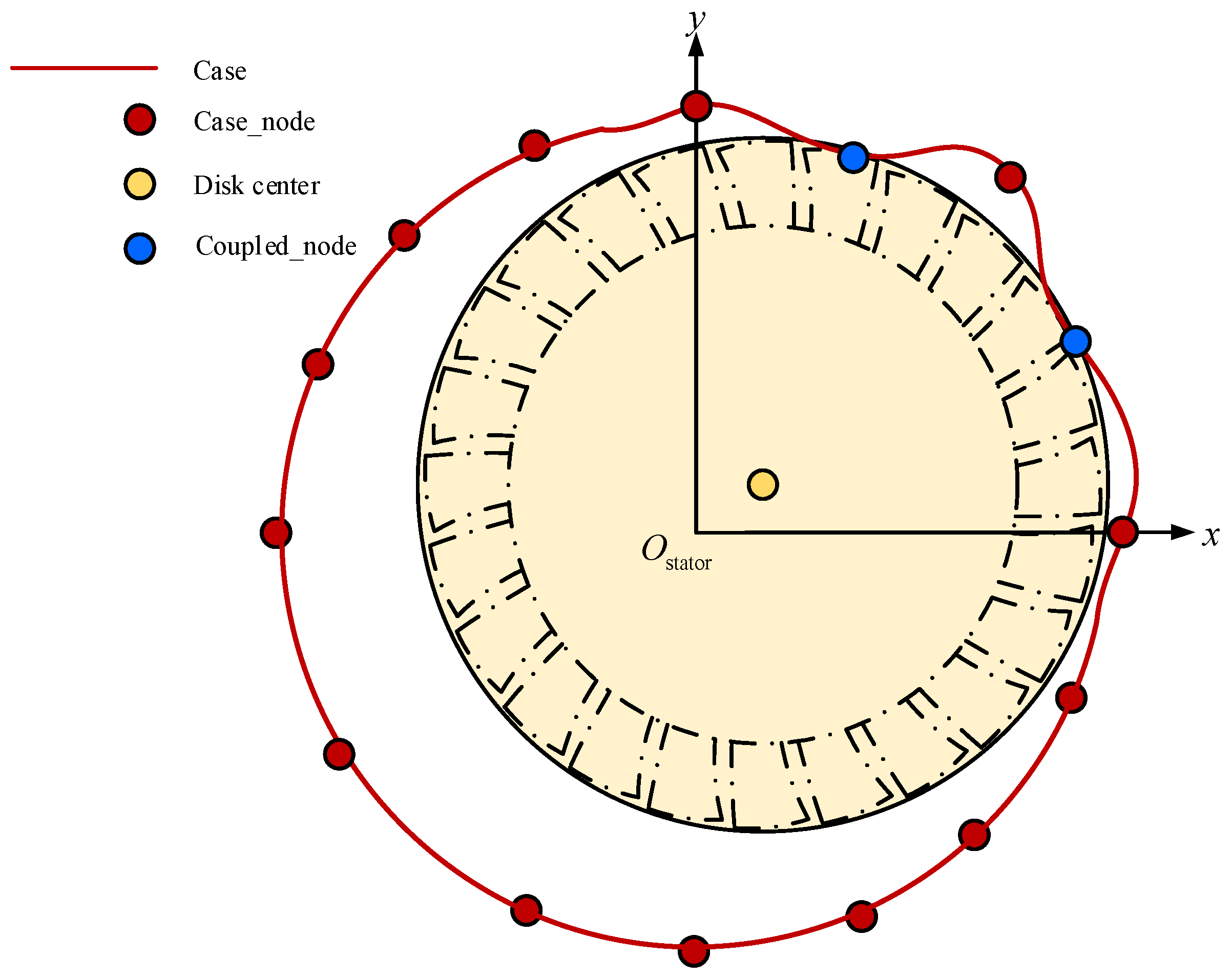
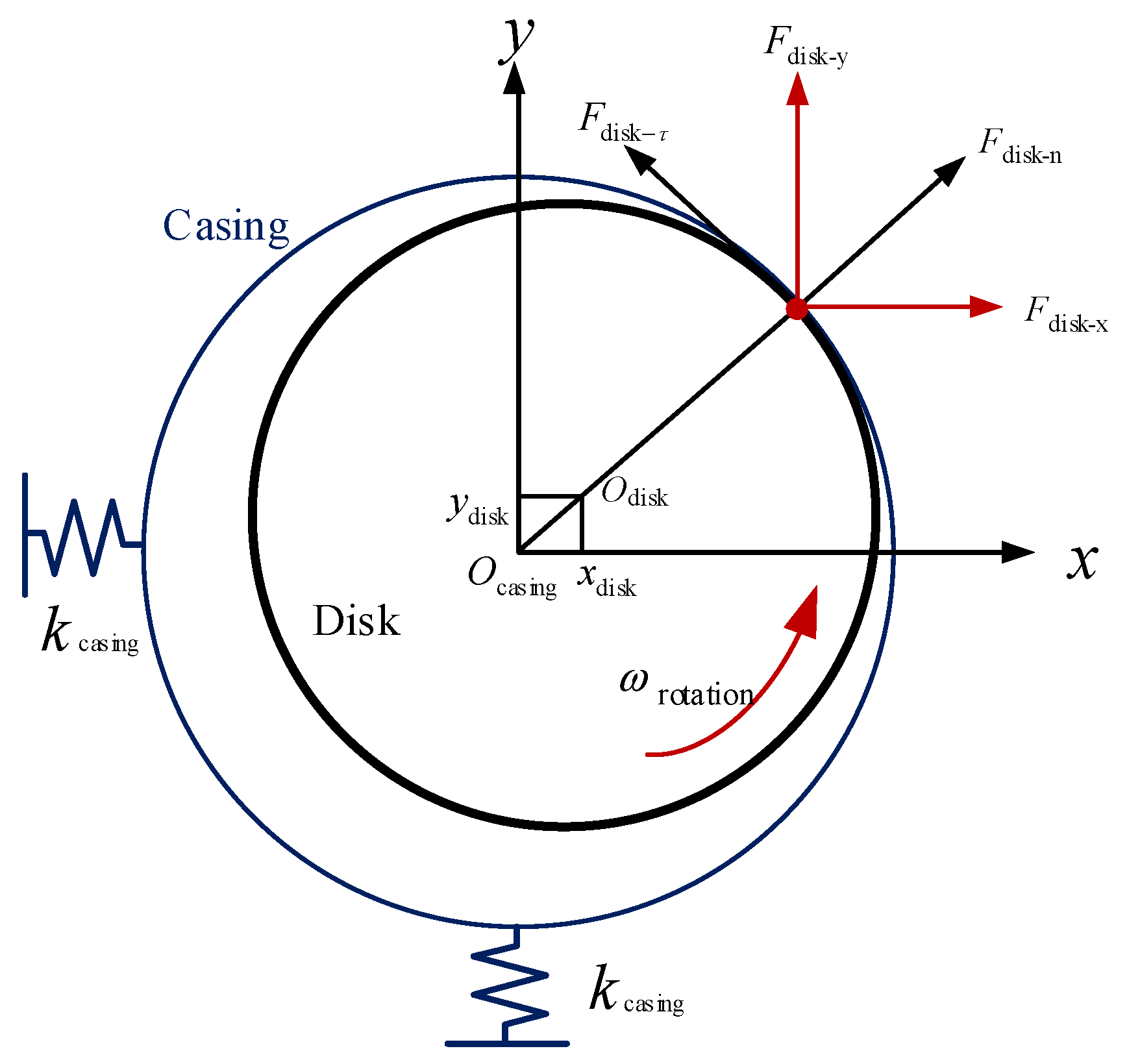
The cross-section of the rub-impact model is illustrated in Figure 1. The motion of the rotor is represented by the disk center node, while the stator’s motion is modeled using shell elements, with nodes evenly distributed along the case. The rub impact is defined by the relative position between the disk center node and the case node. A static coordinate system is established, with the origin of the coordinate system (Ostatic) set at the center of the case.
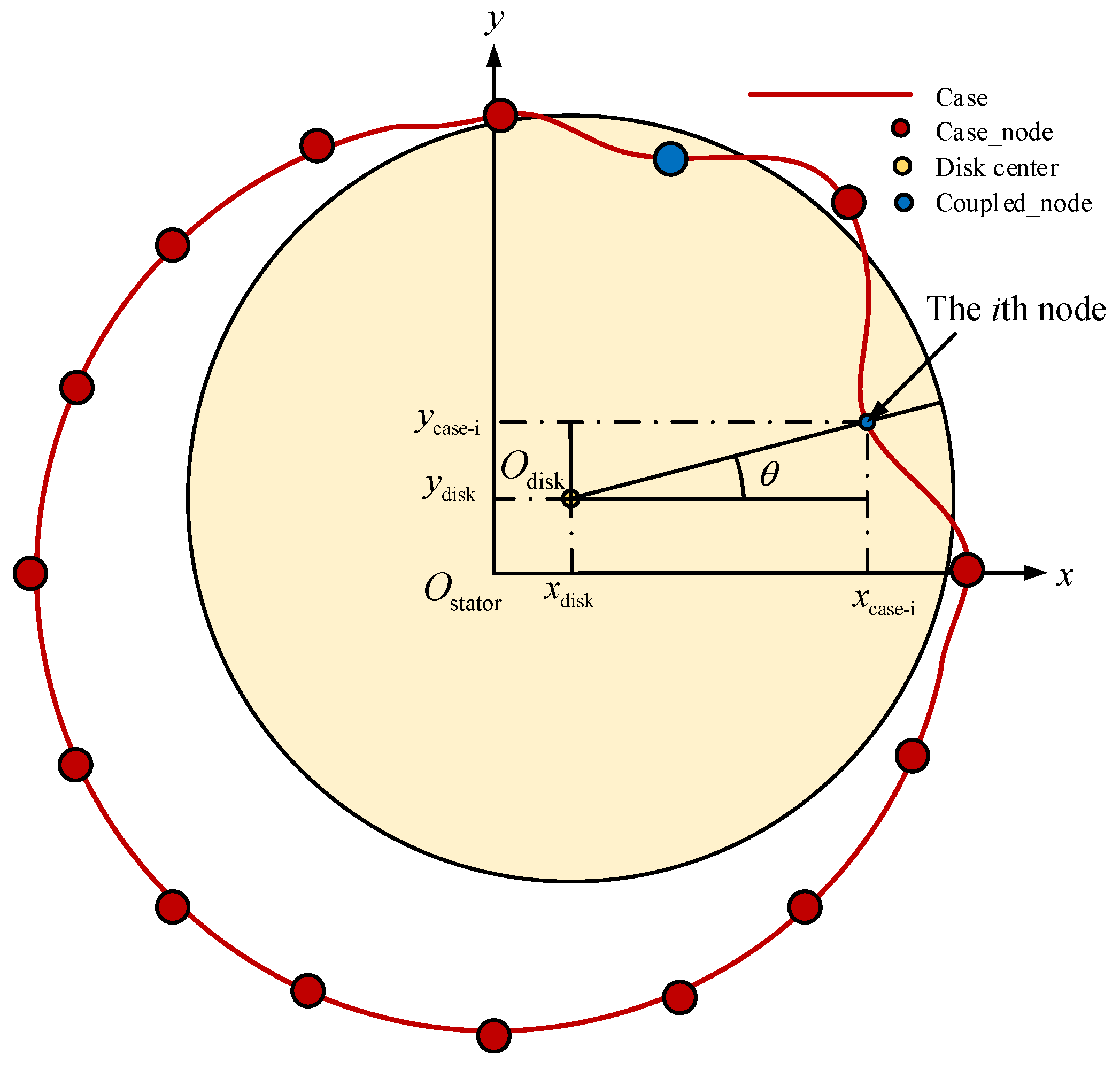
Taking a representative instant as an example, as shown in Figure 2, rub impact occurs when the rotor comes into contact with the stator. It can be observed that two casing nodes, highlighted in blue, are coupled with the disk. Taking one of the coupled stator nodes as an example, its position is denoted as (xcase-i, ycase-i), while the position of the disk is denoted as (xdisk, ydisk). The distance between the case node and the point disk center is represented as r = x case - i x disk 2 + y case - i y disk 2 , with cos θ = x case - i x disk / x case - i x disk 2 + y case - i y disk 2 , sin θ = y case - i y disk / x case - i x disk 2 + y case - i y disk 2 .
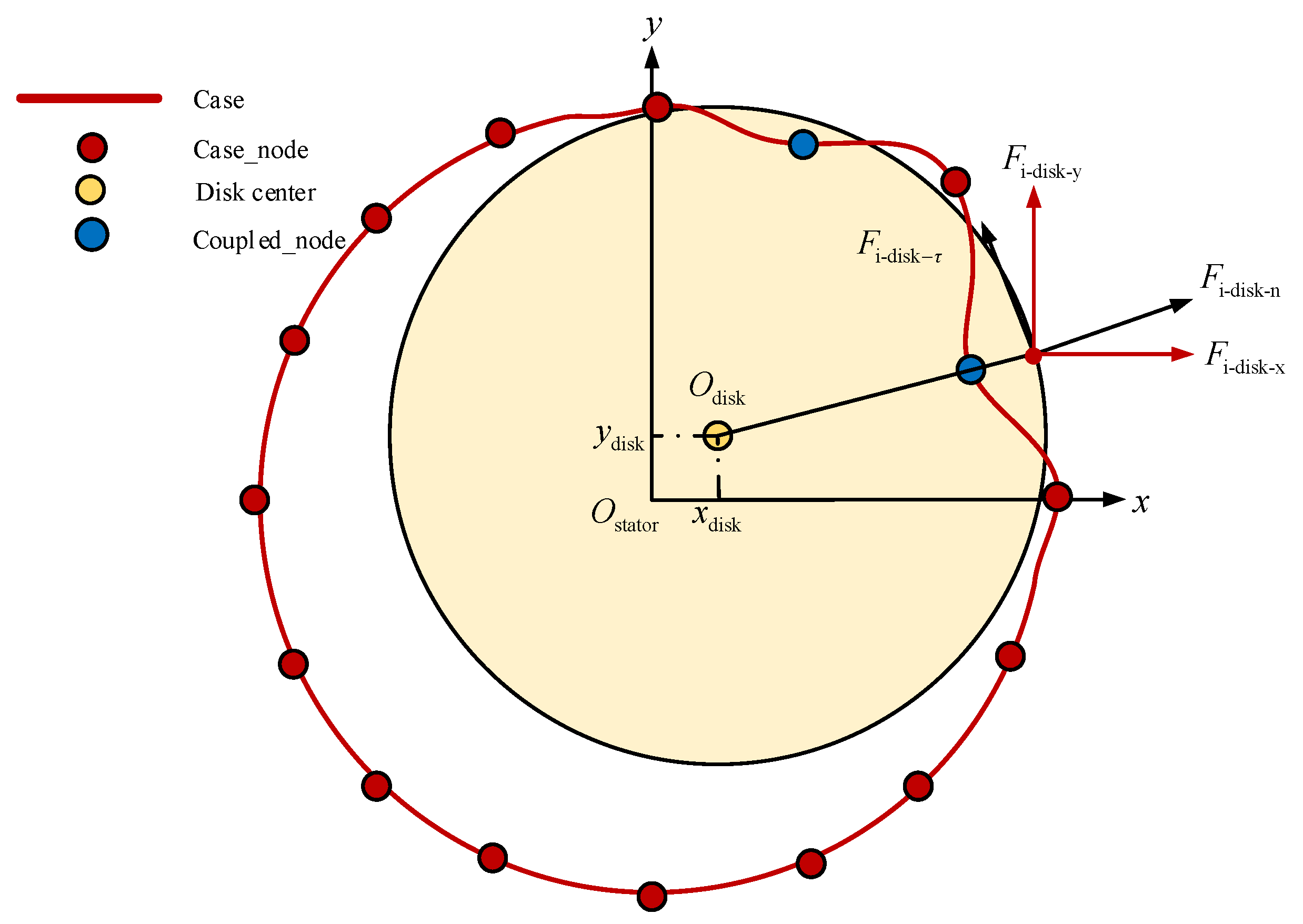
The rub-impact behavior at the ith contact point generates forces in the normal direction F i - disk - n and the tangential direction F i - disk - τ , which are applied to the disk, as shown in Equation (1) and Figure 3. The horizontal and vertical interaction forces F i - disk - x and F i - disk - y can be obtained through coordinate transformation, as shown in Equation (2).
F i - disk - n = H R disk r k casing R disk r F i - disk - τ = F i - disk - n μ
F i - disk - x = H R disk r k casing R disk r cos θ sign v rel - disk μ sin θ F i - disk - y = H R disk r k casing R disk r sign v rel - disk μ cos θ + sin θ
where v rel - disk = ω rotation R disk + Ω r disk is the relative speed of the disk at the contact point, ω rotation is the rotational speed of the rotor, R disk is the radius of the disk, Ω is the whirling angular frequency of the rotor, r disk is the whirling amplitude of the disk with r disk = x disk 2 + y disk 2 , μ is the friction coefficient, H ( · ) is the Heaviside function which is shown in Equation (3), and sign ( · ) is the sign function which is shown in Equation (4).
H x = 0   x 0 1   x > 0
sign ( · ) = 1   x < 0 0   x = 0 1   x > 0  
The reaction force applied at the ith case node can be obtained as below
F i _ x _ c a s e = F i _ disk - x F i _ y _ c a s e = F i _ disk - y
According to the above method, all action forces applied at the disk can be combined and transformed at the disk center node without considering the added torsional moment. Thus, the combined force at the disk center can be calculated as in Equation (6).
F x = i = 1 n F i _ disk - x , F y = i = 1 n F i _ disk - y
In the subsequent establishment of the dynamic equation, the rubbing force on the disk can be applied to the corresponding disk nodes and casing nodes.

2.2. Dynamic Governing Equation for Flexible-Constraint Rotor

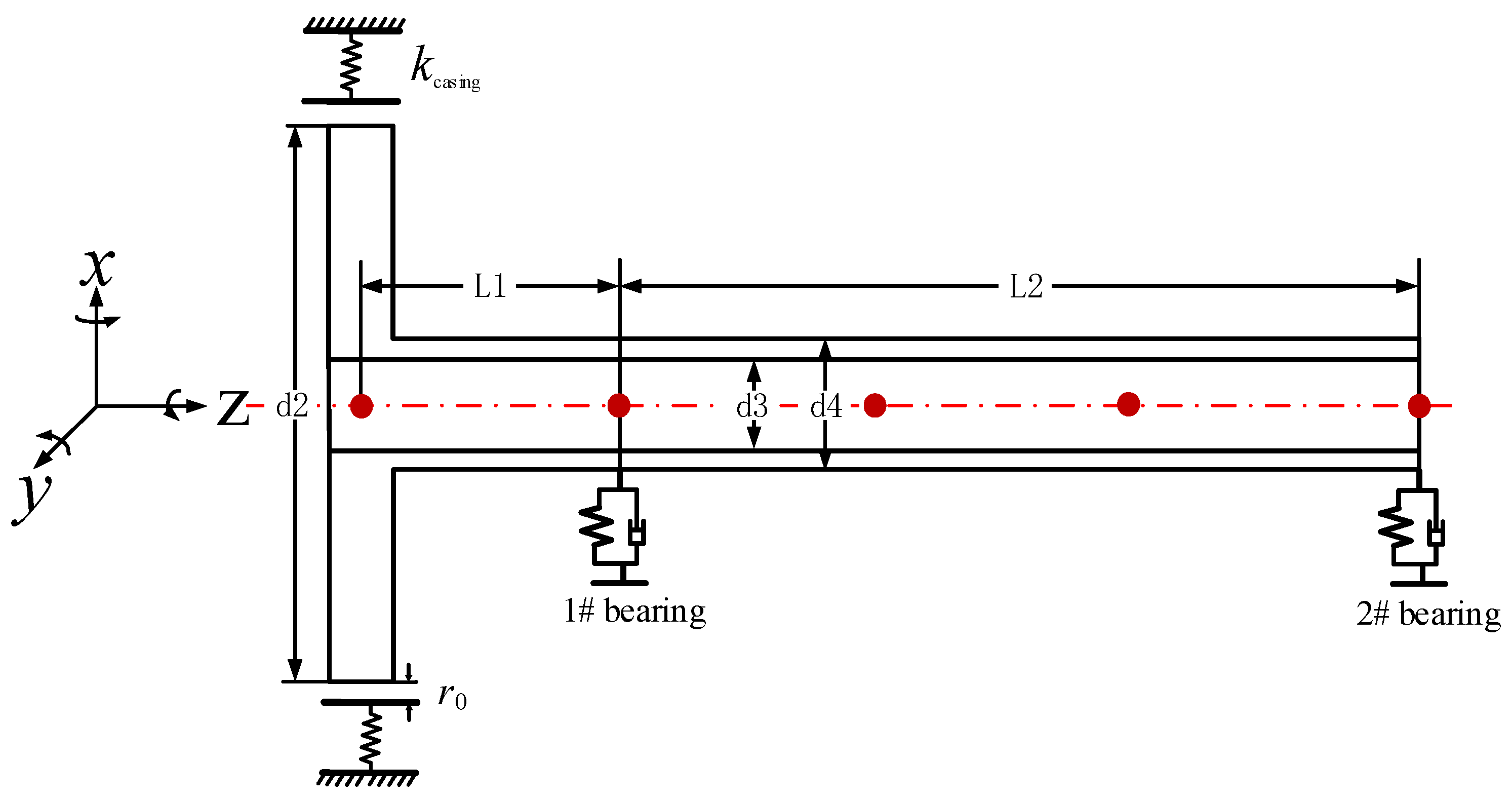
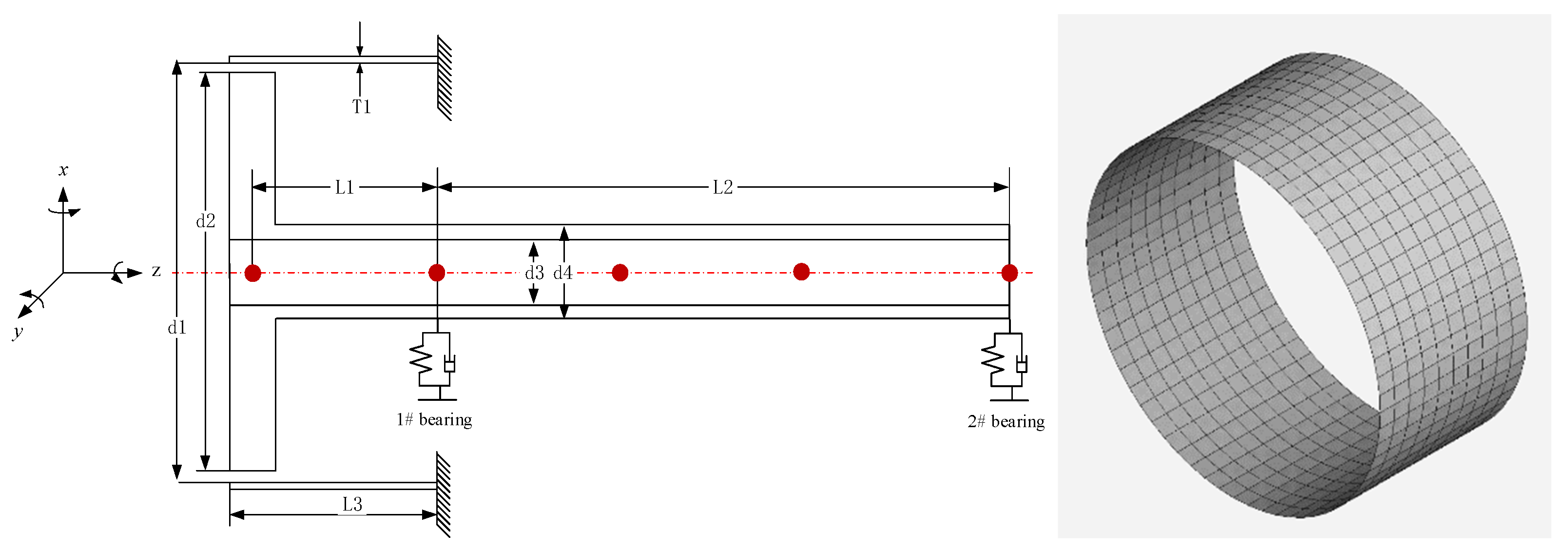
In this study, an overhung fan rotor supported by two bearings is employed, as shown in Figure 4. The corresponding rotor parameters are also summarized in Table 1. The finite element method is employed to derive the dynamic governing equations of the model. The shaft is segmented into four Timoshenko beam elements and five nodes. The disk is represented using lumped mass elements. The bearings are modeled as linear stiffness and damping elements. The casing is established by shell elements. In this study, both the rotor model and the casing model were established in commercial finite element software, and the corresponding system matrices were extracted for subsequent analysis. The main extension of the present work is the introduction of the rotor–stator rubbing model on top of the linear rotor and linear casing models, which leads to the final coupled nonlinear dynamic model. The rub-impact model developed in Section 2.1 is applied to the corresponding nodes of the rotor and the casing. Ultimately, the dynamic governing equation of the model is presented as Equation (7).
M r 0 0 M c q ¨ r q ¨ c + C r + G r 0 0 C c q ˙ r q ˙ c + K r 0 0 K c q r q c = f t rub _ r f t rub _ c + f t unb 0
where M r and M c are the rotor and casing mass matrices; C r and C c are the damping matrices; G r is the gyroscopic matrix; K r and K c are the stiffness matrices; f t rub _ r and f t rub _ c denote the rub-impact forces applied to the rotor and casing, respectively; and f t unb is the unbalance force.
The model relies on the following assumptions:
(1)
The casing is modeled with shell elements to reflect distributed flexibility.
(2)
Bearings are idealized as linear stiffness–damping supports.
(3)
Nonlinearity arises solely from the rub-impact interface between the casing nodes and the disk node.
The parameters of the rotor model are detailed in Table 1.

3. Rubbing Characteristics Under Different Rub Modes

The dynamic response of the rotor–stator system is investigated as a function of rotor–stator concentricity. Perfect concentricity, though idealized, is taken as a reference condition. The contact vibration characteristics are first analyzed for the concentric case, and then the effect of a prescribed eccentricity is examined.

3.1. The Model Characteristics of the Rotor System

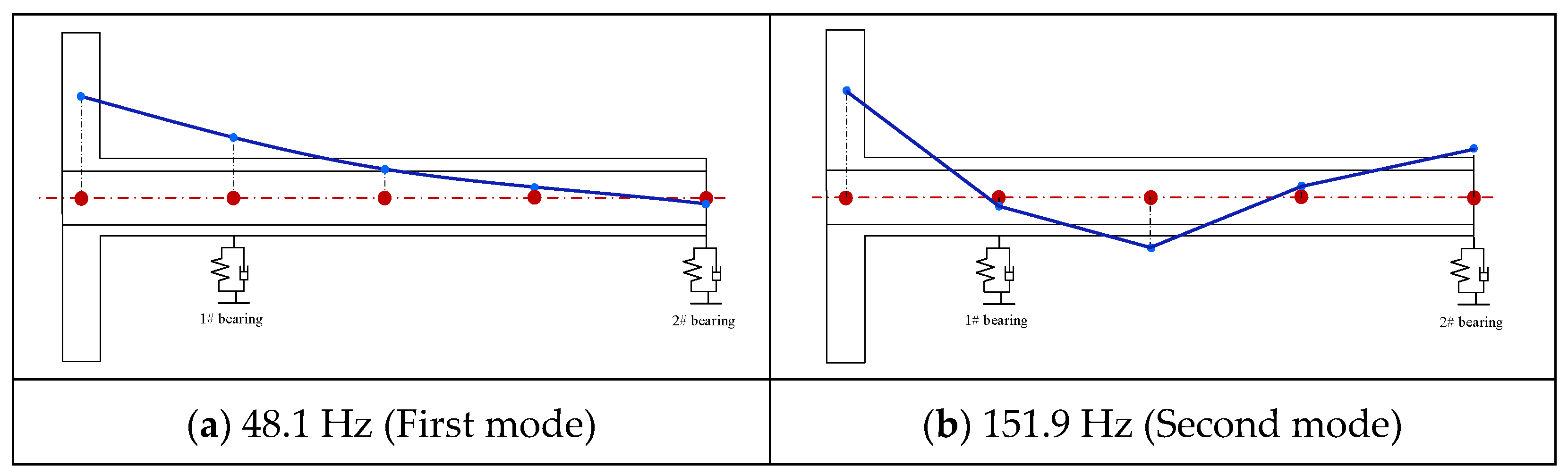
To evaluate the effect of the flexible constraint, the modal frequencies of the unconstrained rotor system are first calculated, with the corresponding critical speeds and mode shapes shown in Figure 5. The first critical speed is 48.1 Hz (2886 rpm), corresponding to the disk pitching mode, and the second is 151.9 Hz (7310 rpm), corresponding to the overall rotor bending mode. Because the first mode exhibits significant disk-tip displacement, where rubbing is more likely to occur, the subsequent analysis focuses on this mode.
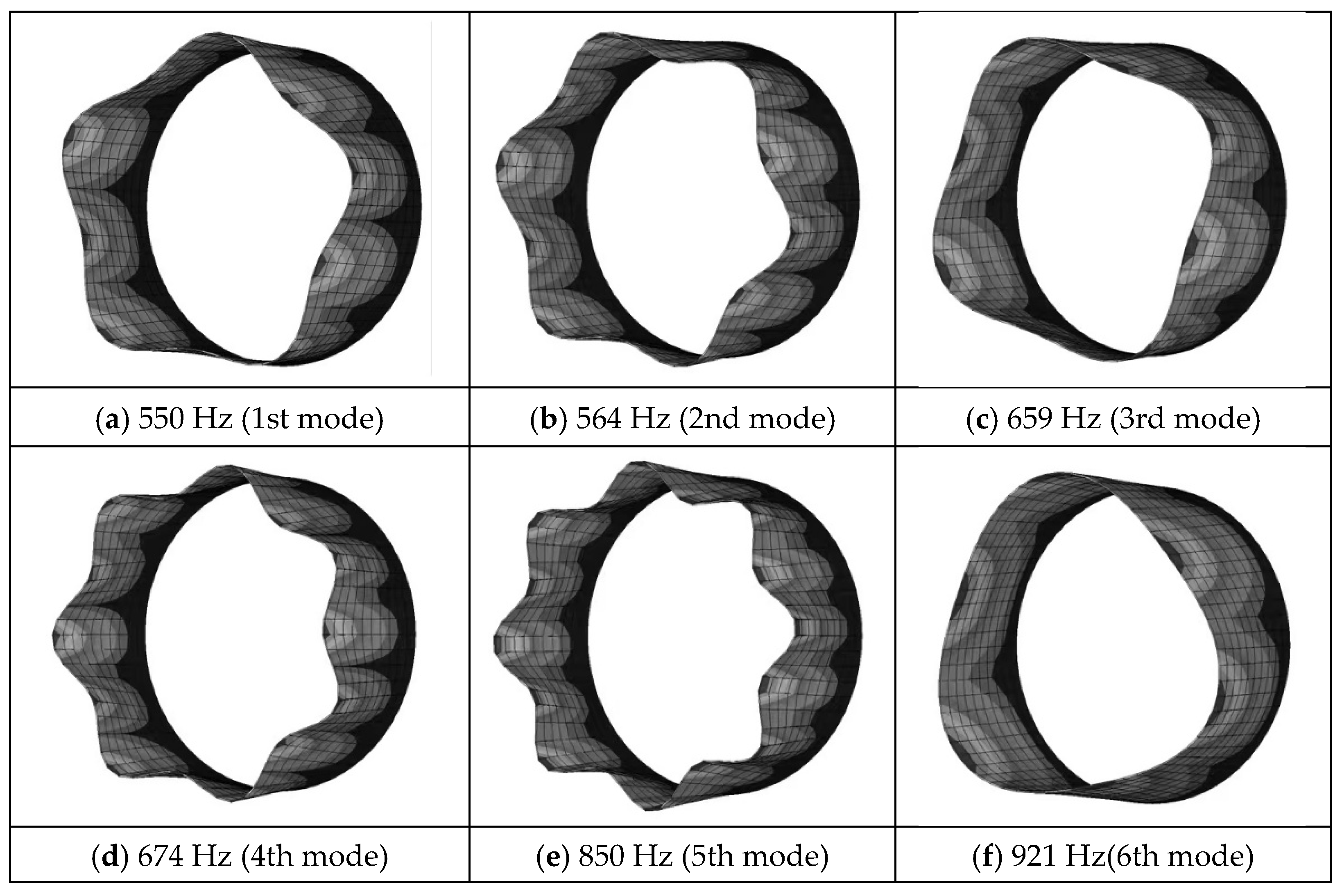
A set of representative casing mode shapes obtained from the finite element model is shown in Figure 6. The results illustrate that the flexible casing exhibits a variety of circumferential vibration patterns, with modal frequencies ranging from 550 Hz to 921 Hz. The lower-order modes (e.g., 550 Hz and 564 Hz) display fewer circumferential waves and larger global deformation, while the intermediate modes (e.g., 659 Hz and 674 Hz) show increased wave numbers and more localized deformation regions. The higher-order modes (850 Hz and 921 Hz) present even more complex circumferential undulations and reduced deformation amplitudes. These mode shapes highlight the significant flexibility of the casing structure and indicate that casing vibrations may induce rich harmonic components when interacting with the rotor during rubbing events.

3.2. The Rub-Impact Response at the Stator–Rotor Concentric Initial State

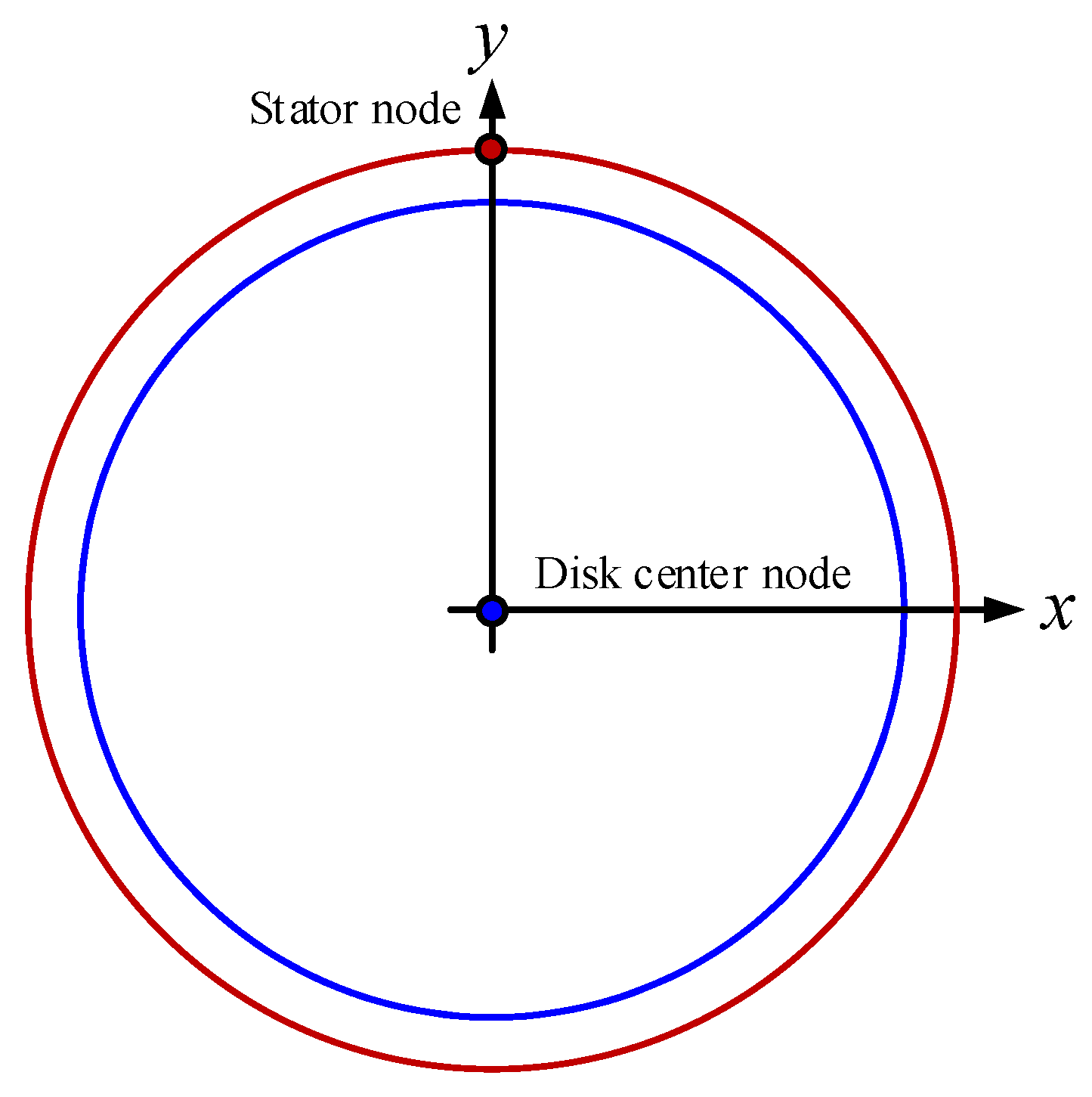
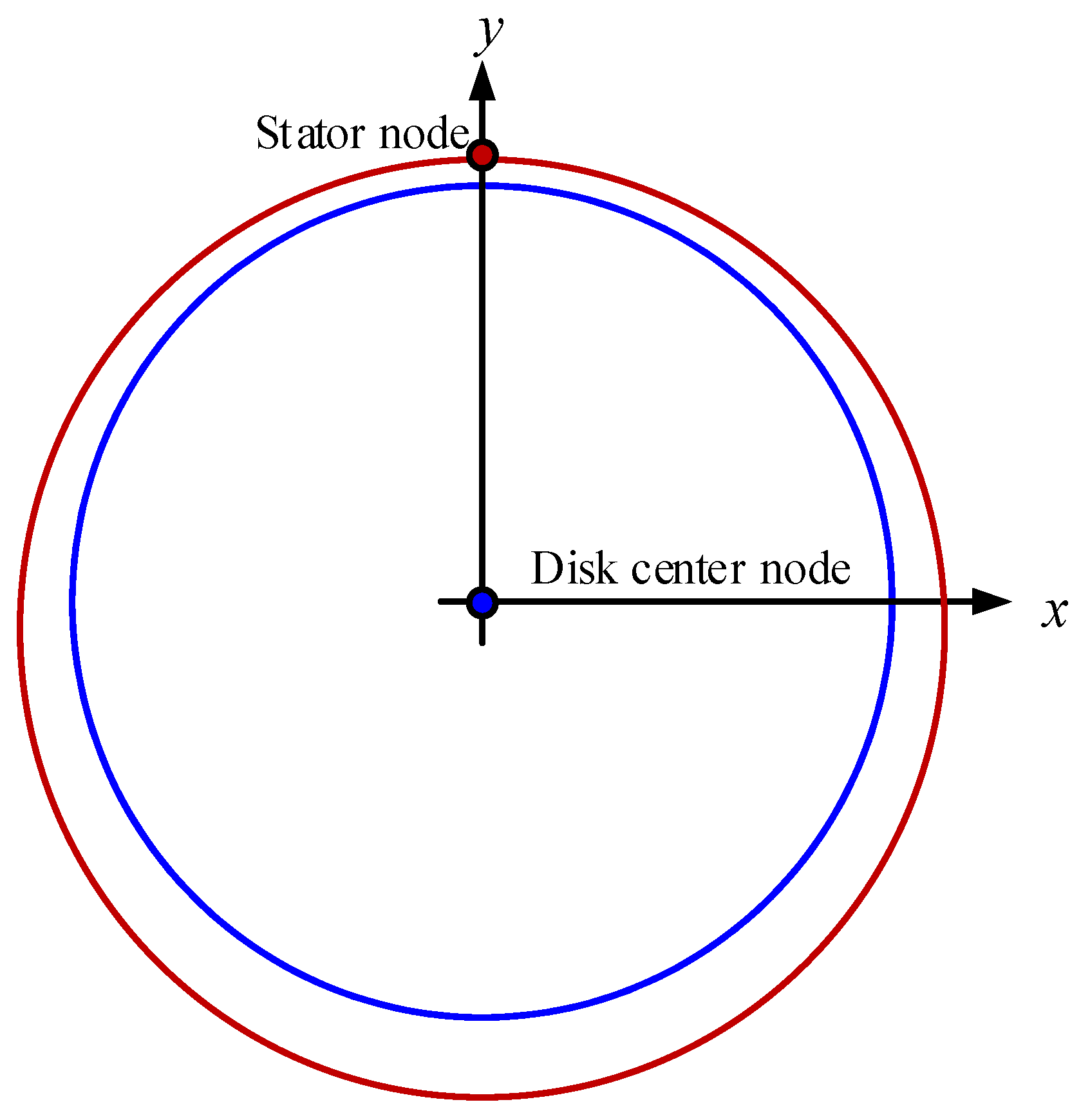
As shown in Figure 7, in the initial state, the casing and rotor are concentric, with the gap between the casing and the rotor disk remaining constant along the circumferential direction. The rotor’s response is represented by the displacement of the disk center node, while one node of the casing finite element model, named as the stator node, is selected to represent the casing’s response.
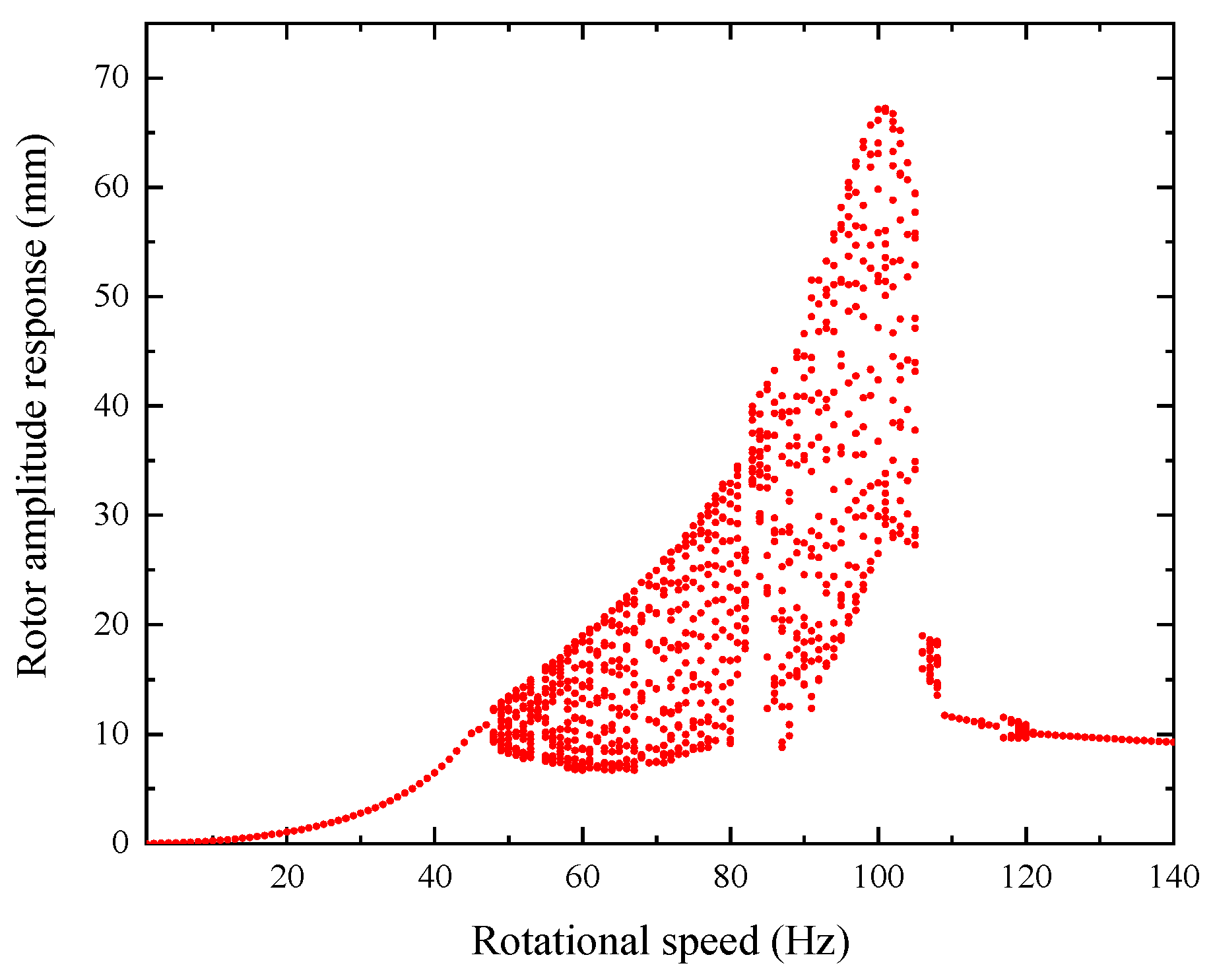
The steady-state amplitude response at different rotational speeds is obtained by numerical integration. For each speed, the motion period is identified, and the corresponding disk amplitude in each period is plotted in Figure 8, with the last thirty revolutions shown. The bifurcation diagram indicates that the amplitude of the disk center node is nearly constant in the non-rubbing region. Once the rotor passes through the first critical speed, the disk amplitude increases and eventually exceeds the radial clearance. As the amplitude grows further, the cycle-to-cycle response becomes irregular. The dynamic characteristics in these speed ranges are therefore analyzed in greater detail.

3.2.1. The Dynamic Response at a Rotational Speed of 47 Hz

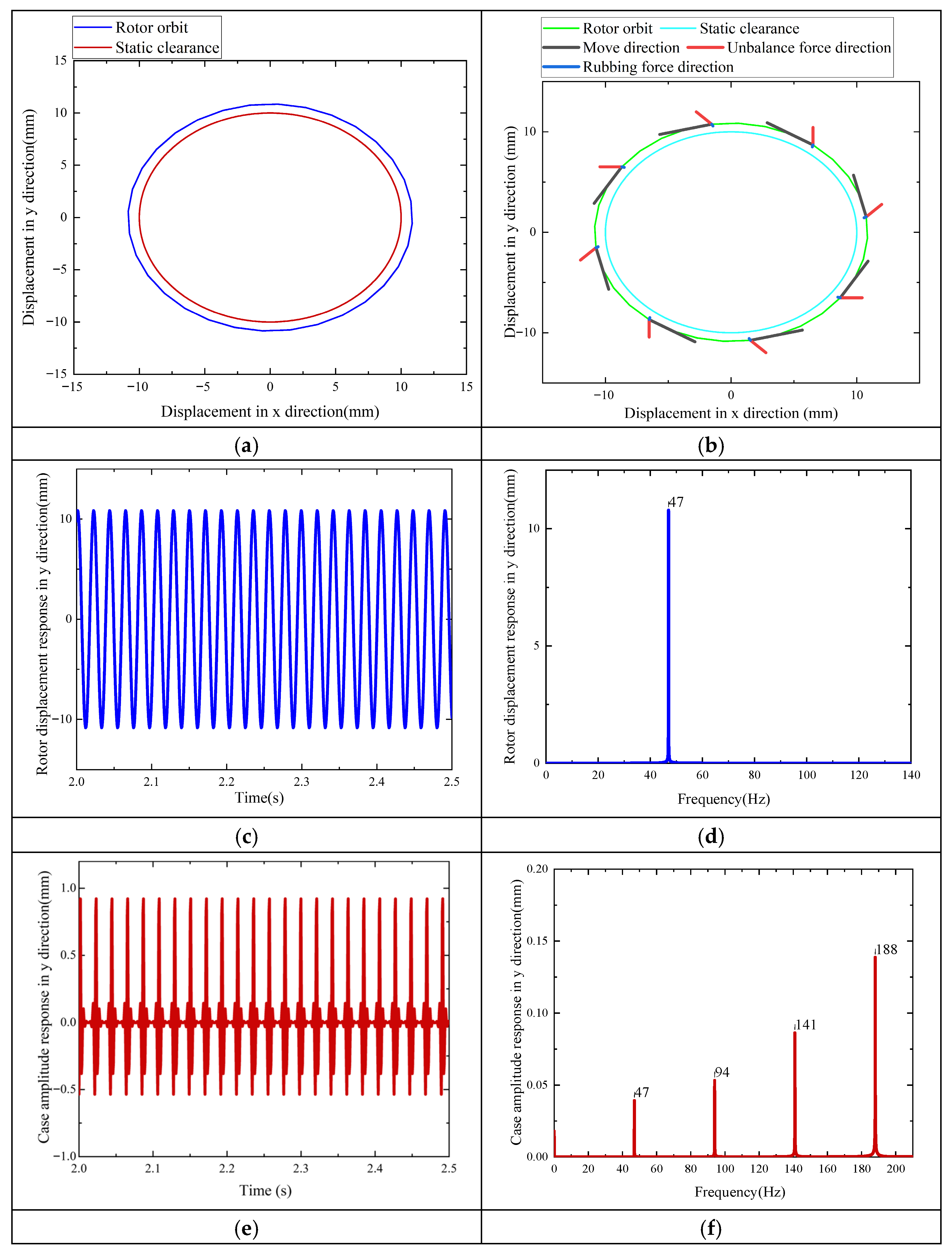
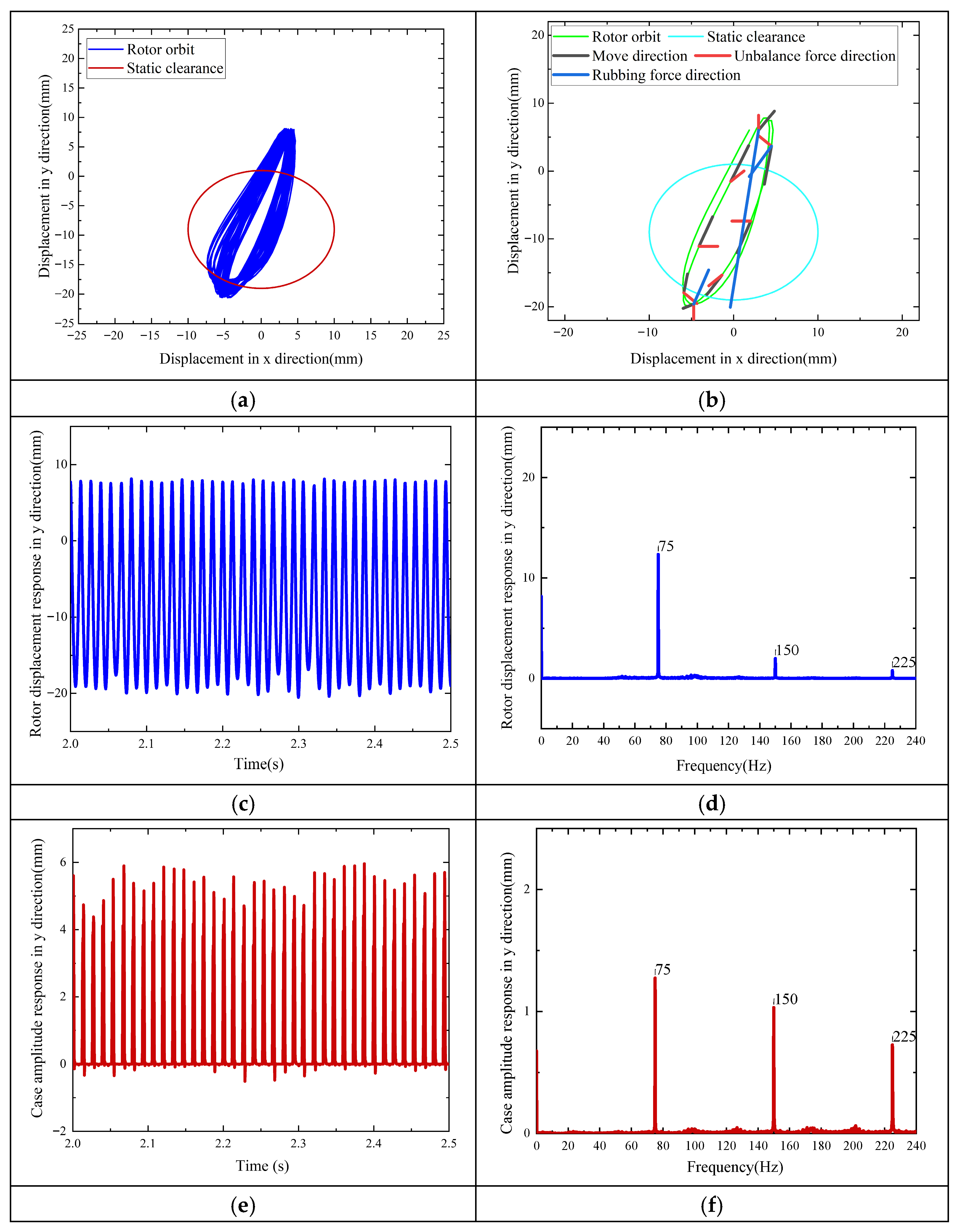
The dynamic responses of the stator node and the disk center node at 47 Hz are shown in Figure 9. The orbit in Figure 9a indicates slight full-annular rubbing, while the force distribution in Figure 9b shows that the rubbing force is much smaller than the unbalance force. Therefore, the rotor dynamics are still mainly governed by synchronous unbalance excitation, and the rubbing interaction only introduces a weak additional constraint. This is confirmed by the nearly sinusoidal displacement response of the disk center node in Figure 9c and the dominant 1X peak in Figure 9d.
By contrast, the stator response shows stronger nonlinear characteristics. Under continuous rubbing, the contact force is transmitted from the rotor to the flexible casing. Because of casing flexibility, this contact-induced excitation is manifested not only at 1X but also through enhanced higher-order harmonics. Consequently, clear 2X, 3X, and 4X components appear in the stator spectrum in Figure 9f, and their amplitudes exceed that of the 1X component. This suggests that, at 47 Hz, weak rubbing is insufficient to alter the predominantly synchronous rotor motion, but it is sufficient to excite evident harmonic components in the flexible casing response.

3.2.2. The Dynamic Response at a Rotational Speed of 70 Hz

The dynamic response at 70 Hz is shown in Figure 10. At this speed, the system changes from weak continuous rubbing to intermittent rubbing. As shown in Figure 10a, the rotor repeatedly contacts and separates from the stator, indicating that the rubbing interaction acts as a time-varying nonlinear excitation rather than a weak continuous constraint. The force distribution in Figure 10b further shows that, although the unbalance force remains dominant, the rubbing force increases significantly compared with the 47 Hz case. Under the combined action of synchronous unbalance excitation and intermittent contact force, the rotor orbit develops a petal-shaped pattern, which indicates the loss of purely synchronous motion.
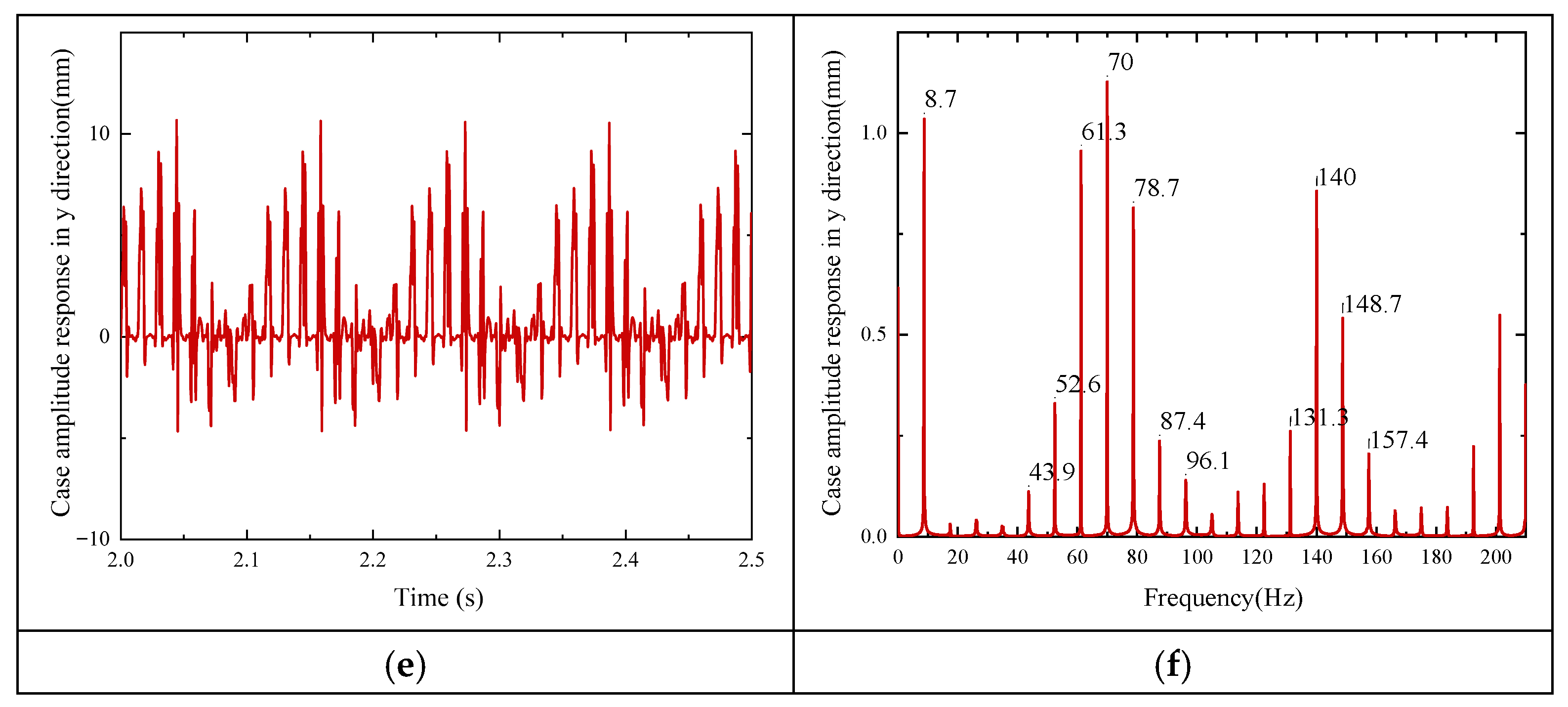
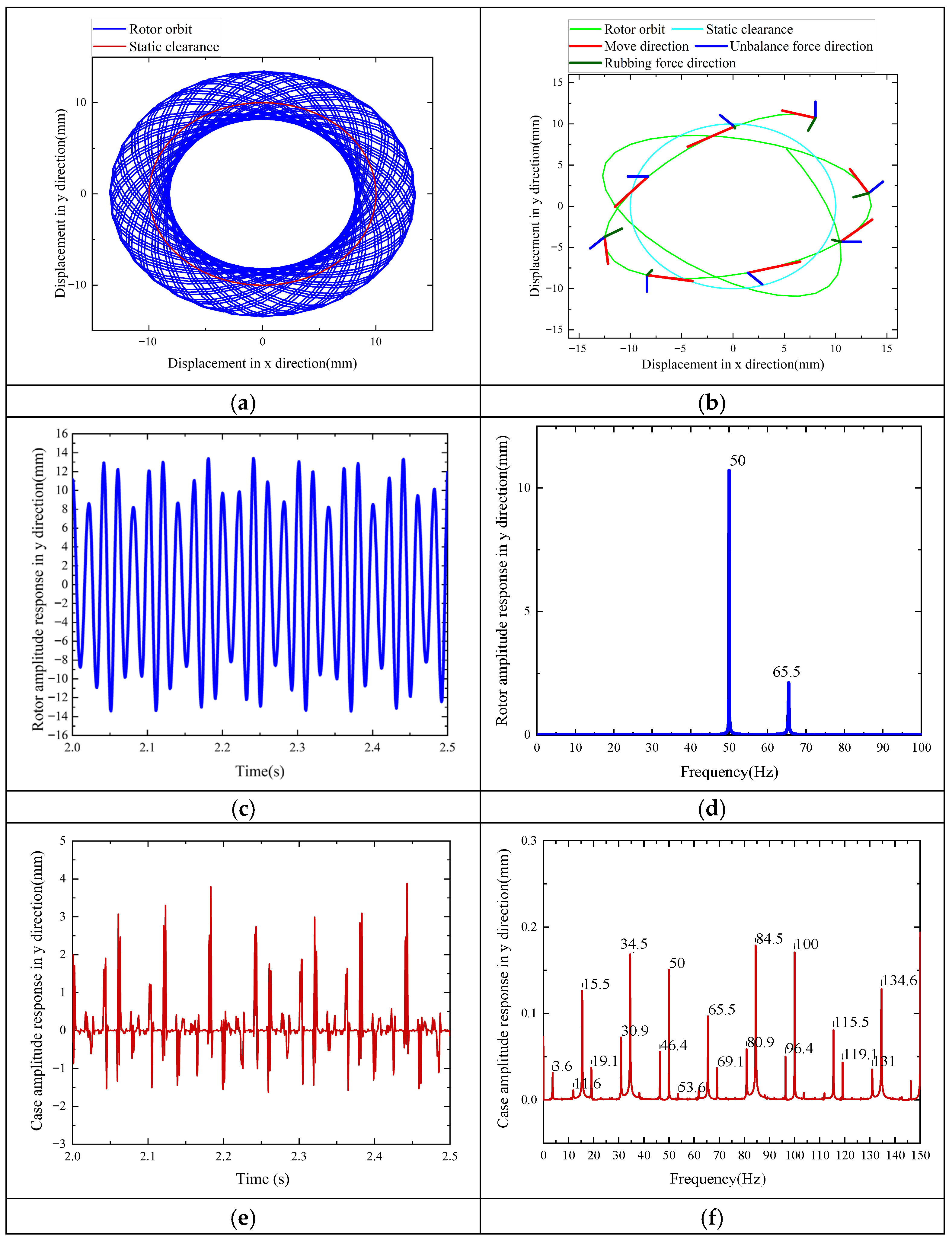
This change is also reflected in the frequency response. In Figure 10d, in addition to the 1X component at 70 Hz, an additional asynchronous component appears at 78.7 Hz, showing that intermittent rubbing introduces a new non-synchronous vibration frequency into the rotor response. The stator spectrum in Figure 10f contains not only 1X and 2X components but also multiple sideband-like components around them. These frequency components indicate that the intermittent contact force causes modulation and frequency coupling between the rotational excitation and the contact-induced asynchronous motion. As a result, the response at 70 Hz is characterized by stronger nonlinearity, multi-frequency interaction, and more complex rotor–stator coupling than that at 47 Hz.

3.2.3. The Dynamic Response at a Rotational Speed of 80 Hz

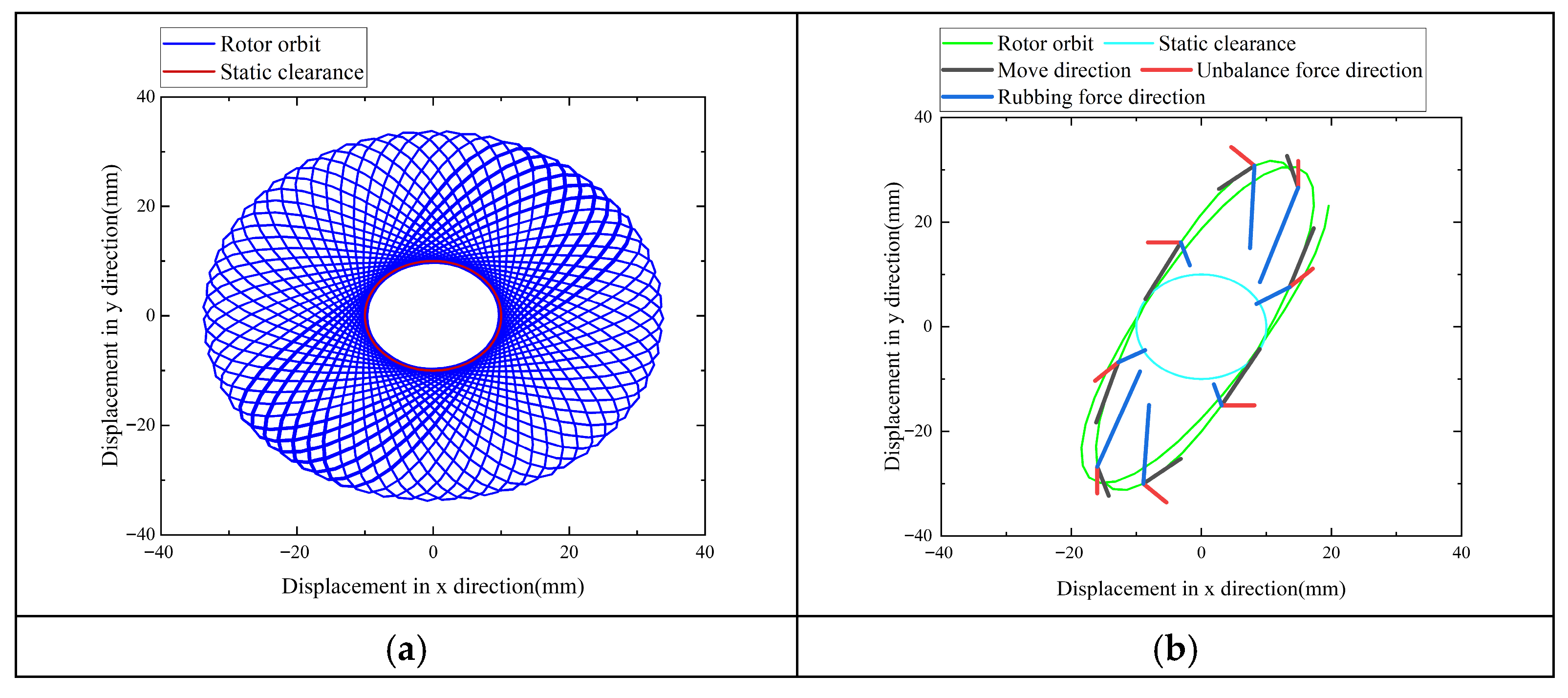
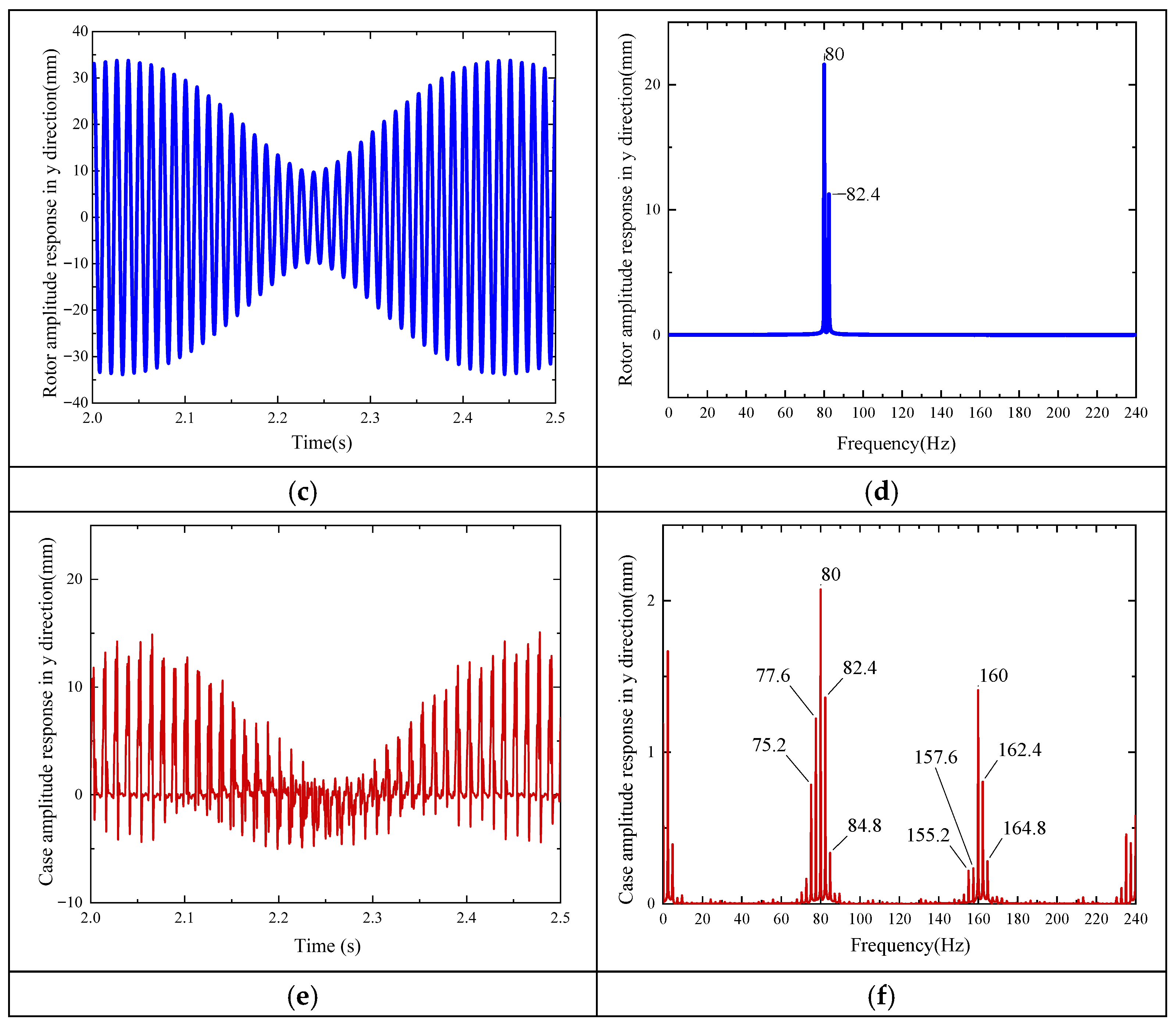
The dynamic response at 80 Hz is shown in Figure 11. At this speed, the system enters a continuous-contact regime. As shown in Figure 11a, the disk center orbit is close to the clearance circle, indicating sustained rotor–stator contact. Meanwhile, the force distribution in Figure 11b shows that the rubbing force becomes comparable to the unbalance force. This means that the rotor response is determined by the combined action of synchronous unbalance excitation and continuous time-varying contact force.
This mechanism is reflected in the spectral response. In Figure 11d, in addition to the 1X component at 80 Hz, an additional off-synchronous component appears at 82.4 Hz, showing that continuous rubbing introduces a non-synchronous frequency into the rotor motion. In Figure 11f, the stator response contains not only the 1X and 2X components but also multiple sideband components distributed around them. These components indicate that the continuous rubbing constraint produces modulation and frequency coupling between the main synchronous excitation and the contact-induced off-synchronous motion. Compared with the 70 Hz case, the response at 80 Hz is characterized by stronger continuous coupling and clearer sideband structures around the dominant frequencies.

3.2.4. The Dynamic Response at a Rotational Speed of 100 Hz

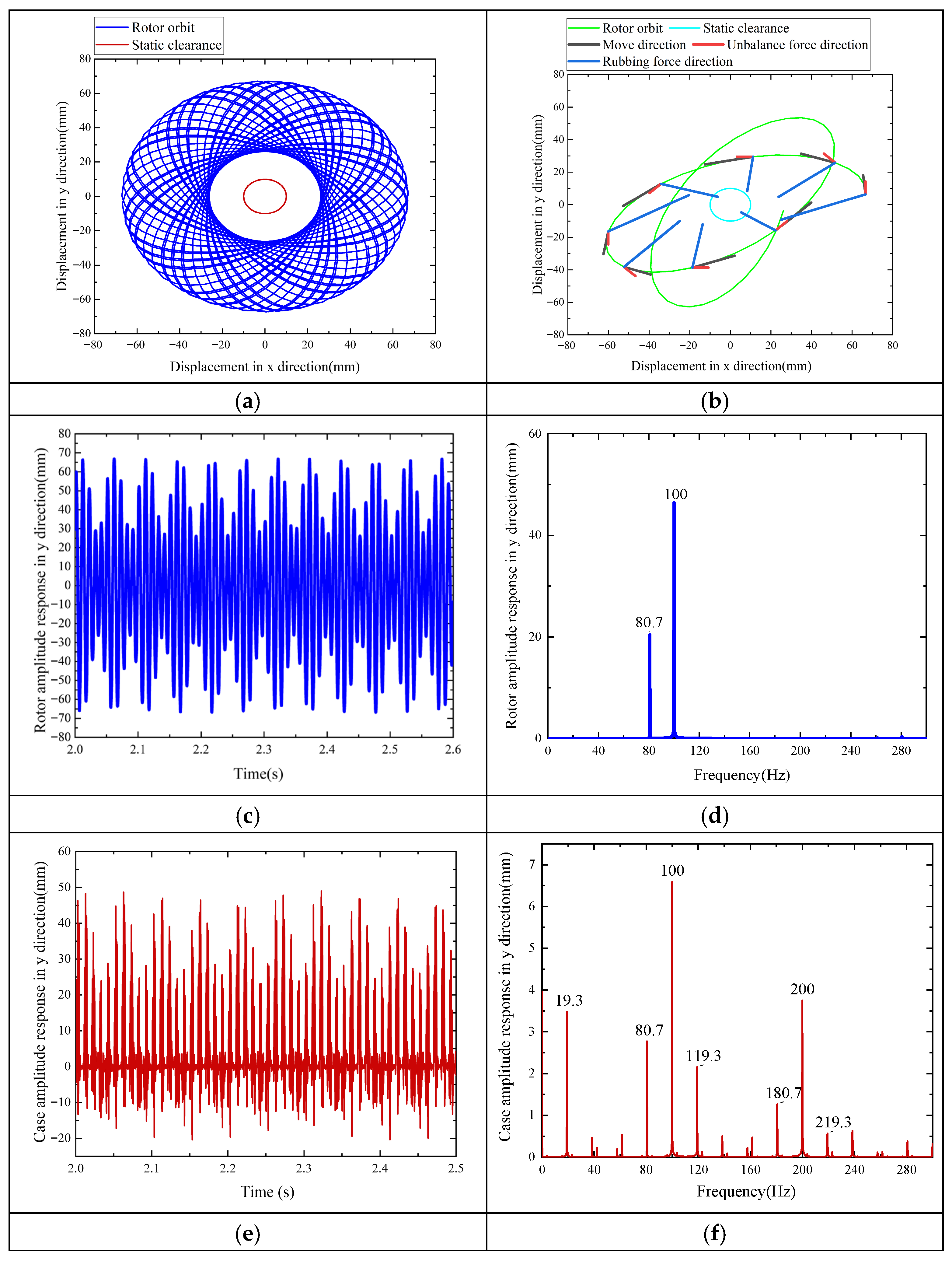
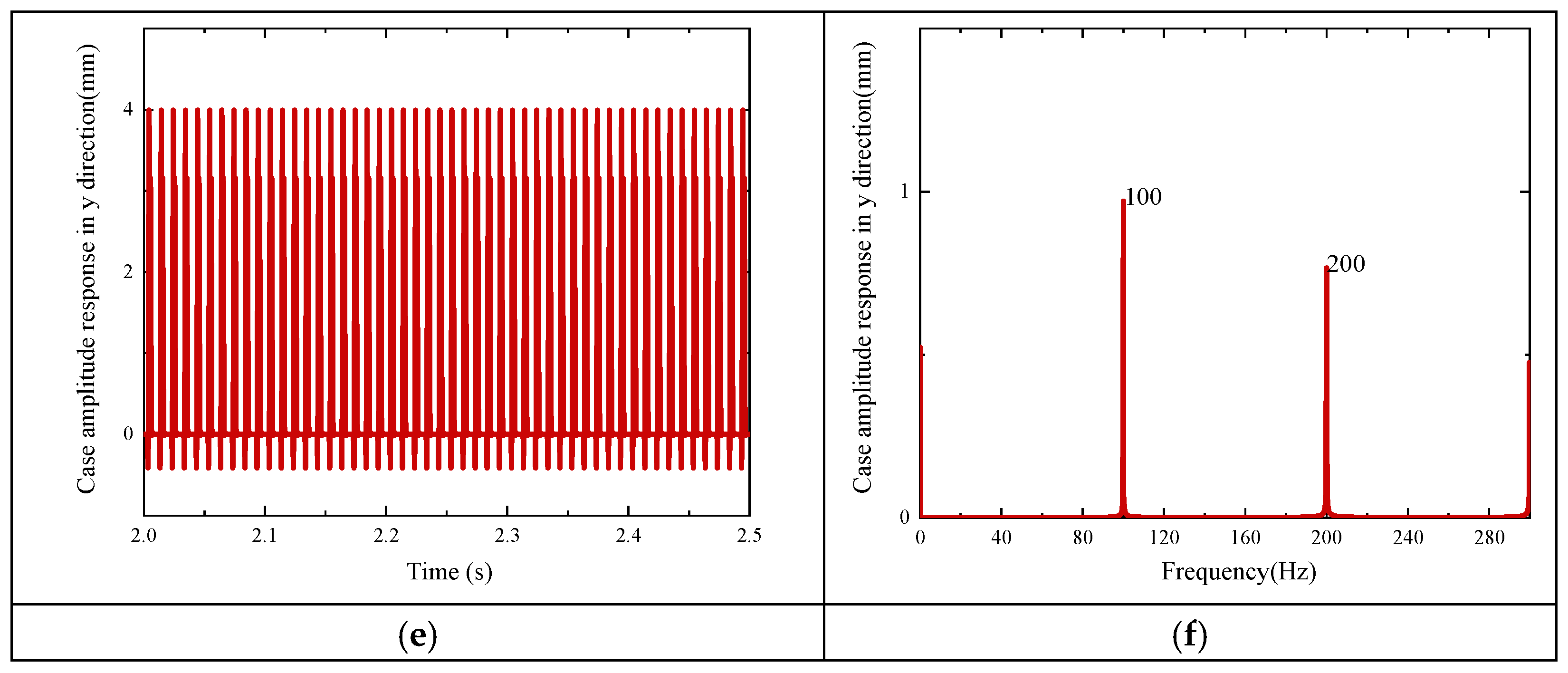
The dynamic response at 100 Hz is shown in Figure 12. At this speed, the enlarged orbit in Figure 12a indicates that the system has entered a strong rubbing regime. The force comparison in Figure 12b further shows that the rubbing force becomes larger than the unbalance force. Therefore, the rotor dynamics are primarily controlled by the rubbing constraint rather than by the synchronous unbalance excitation. This mechanism is confirmed by the frequency response. In Figure 12d, the dominant component is located at 80.7 Hz, which is lower than the rotational frequency of 100 Hz, indicating that the rotor motion becomes predominantly off-synchronous under strong rubbing. In Figure 12f, the stator response still retains the 1X and 2X components but also contains several additional coupled components at 19.3 Hz, 119.3 Hz, 180.7 Hz, and 219.3 Hz. These results indicate stronger frequency coupling and a further enrichment of the nonlinear response. Overall, as the rotational speed increases, the rubbing state evolves from intermittent rubbing to continuous rubbing and finally to strong rubbing, while the dominant excitation shifts from unbalance-controlled to rubbing-dominated.

3.3. Mechanism Analysis of the Harmonic Frequency

3.3.1. The Relationship Between the Harmonic Frequency and the Unbalance Frequency

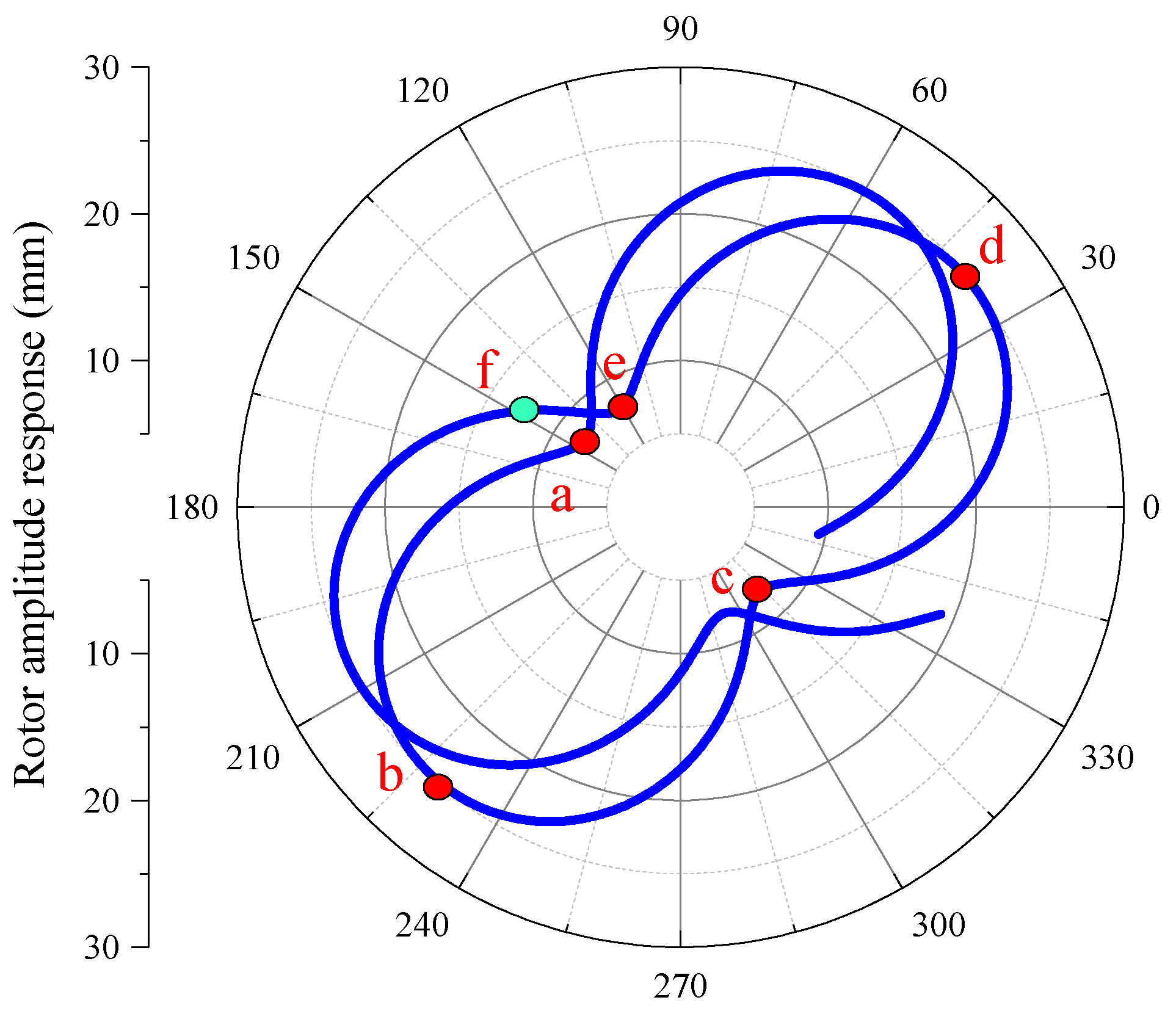
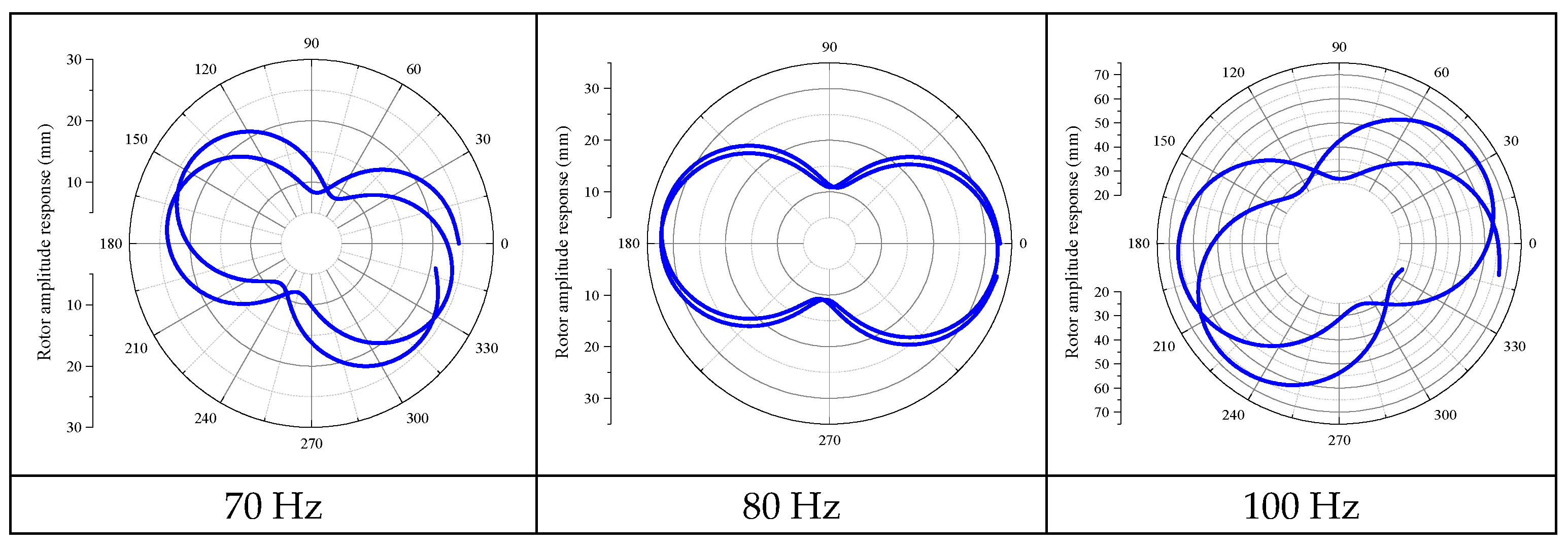
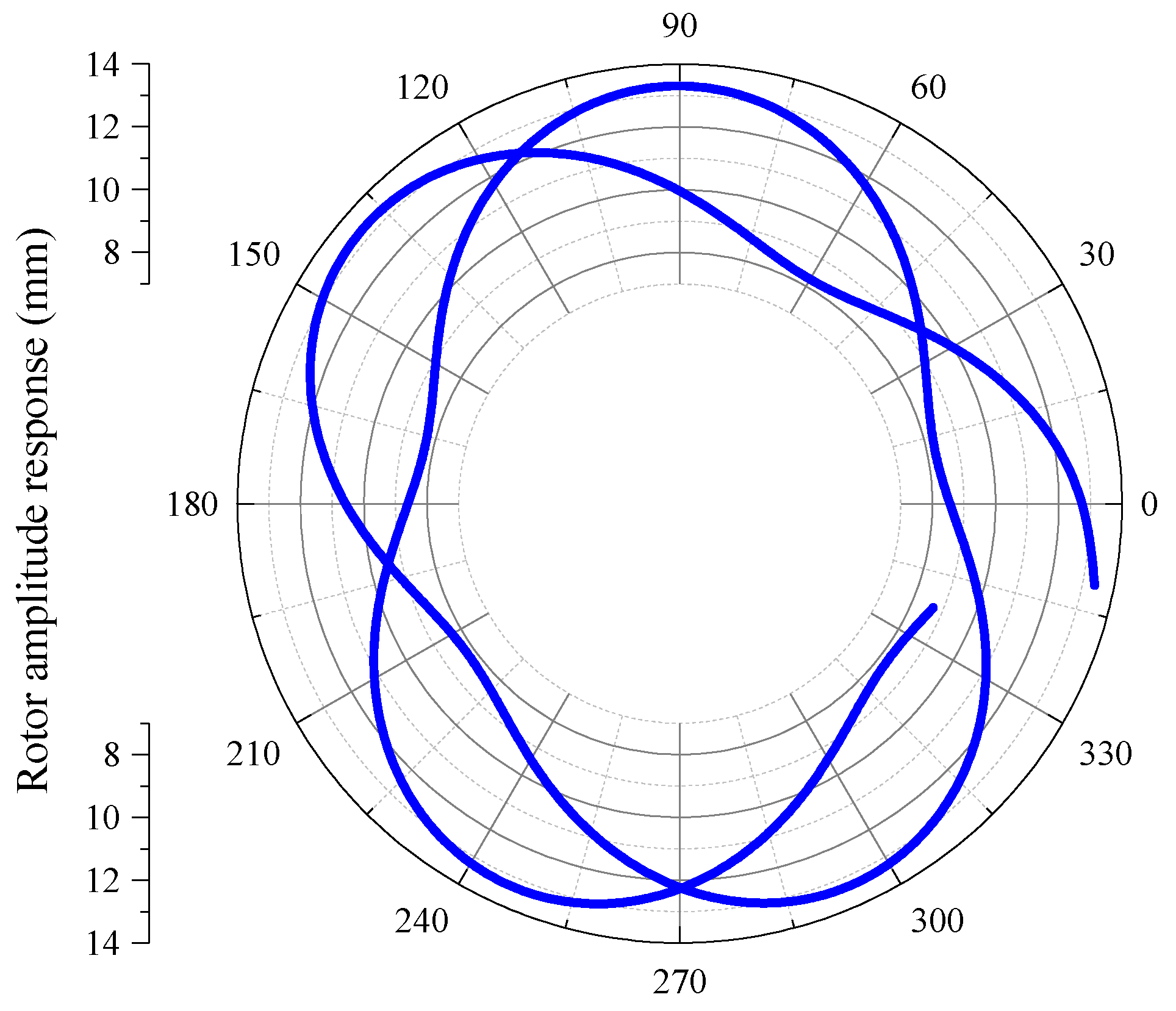
During intermittent rub impact, the effective radial constraint imposed by the casing becomes strongly time-varying because the rotor repeatedly contacts and separates from the casing. As a result, the rotor motion is no longer a nearly circular synchronous whirl but exhibits a periodic modulation of orbit amplitude. To clarify the role of this flexible constraint, the relationship between harmonic frequency and disk center trajectory at 70 Hz is analyzed in polar coordinates, as shown in Figure 13. In this representation, the radius denotes the instantaneous amplitude of the disk center, and the polar angle denotes time, so that one full revolution corresponds to one shaft rotation period, 1/70 s. Over the representative segment a–b–c–d–e–f, the amplitude increases from a minimum at point a to a maximum at point b as the rotor is pressed against the casing, and then decreases as the rotor rebounds and separates, finally returning to the initial level at point f. Therefore, a–b–c–d–e–f represents one complete rotational cycle. By contrast, the shorter segment a–b–c–d–e already completes one full amplitude-modulation cycle, corresponding to a period of approximately 1/78.7 s. Since this modulation period is shorter than the shaft rotational period, the associated harmonic frequency is higher than the excitation frequency. This indicates that, in the intermittent rubbing regime, the time-varying flexible constraint introduces an additional off-synchronous component above 1X.
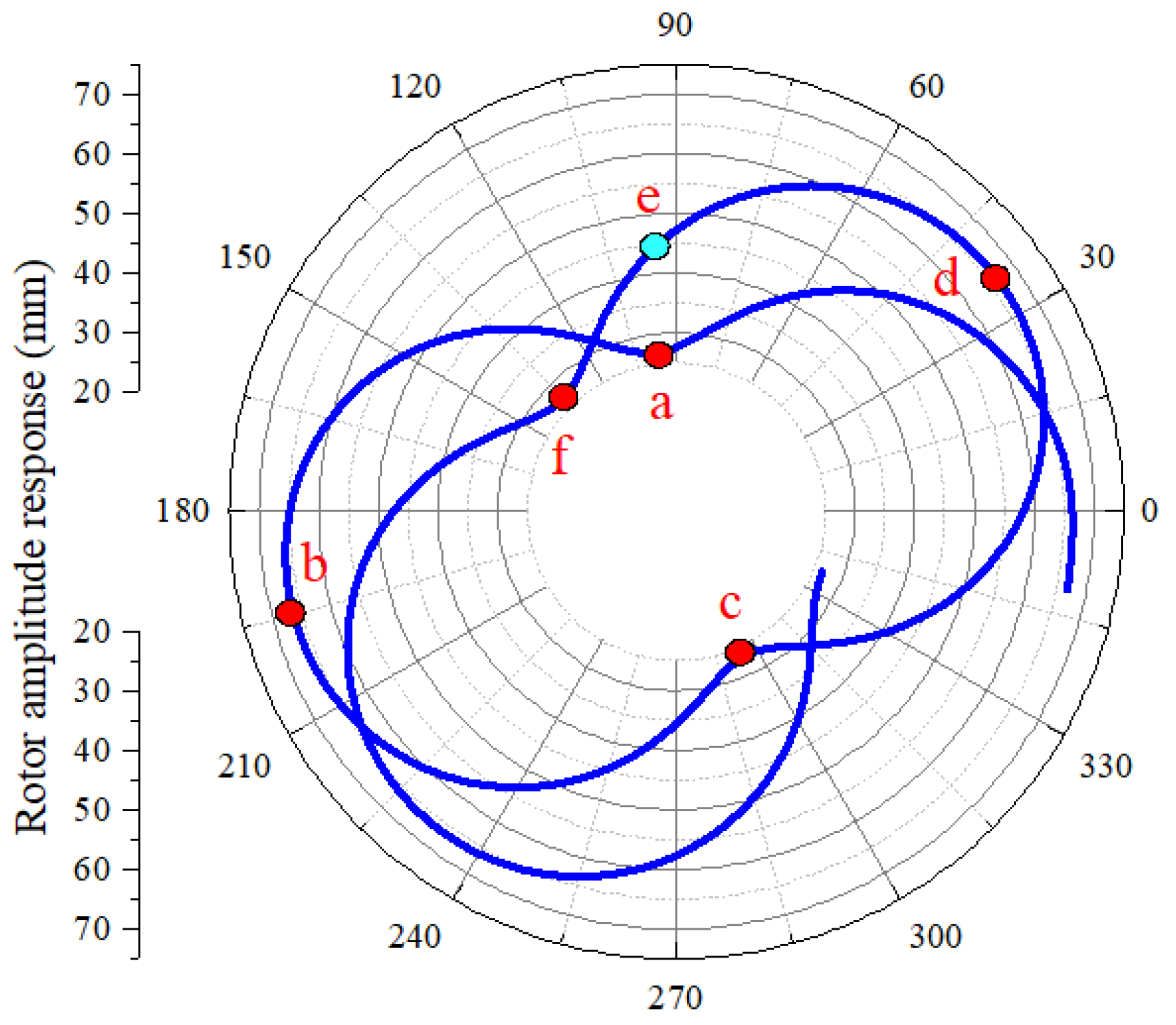
The polar-coordinate representation of the disk center amplitude at 100 Hz is shown in Figure 14. One full path a–b–c–d–e–f corresponds to one shaft rotation period of 1/100 s, whereas the shorter path a–b–c–d–e already completes one full amplitude-modulation cycle, corresponding to a period of approximately 1/80.7 s. Because this modulation period is longer than the shaft rotational period, the resulting harmonic frequency is lower than the excitation frequency of 100 Hz. This shows that, in the strong-rubbing regime, the rotor motion is governed more by the rubbing-induced constraint than by the synchronous rotational excitation.
The rub-impact response in the initial concentric stator–rotor configuration at a rotational speed of 60 Hz is provided in Appendix A. As the response exhibits trends similar to those observed at other rotational speeds, it is not repeated here; readers are referred to Appendix A for the complete calculation results.
Furthermore, the specific harmonic frequency is governed by the period of amplitude modulation of the rotor motion. In other words, it depends on the time required for the rotor amplitude to complete one full cycle from minimum to maximum and back to minimum. When this modulation period is longer than the excitation period, the resulting harmonic frequency is lower than the excitation frequency; when it is shorter, the resulting harmonic frequency is higher than the excitation frequency.

3.3.2. The Relationship Between the Harmonic Frequency and Asynchronous Motion

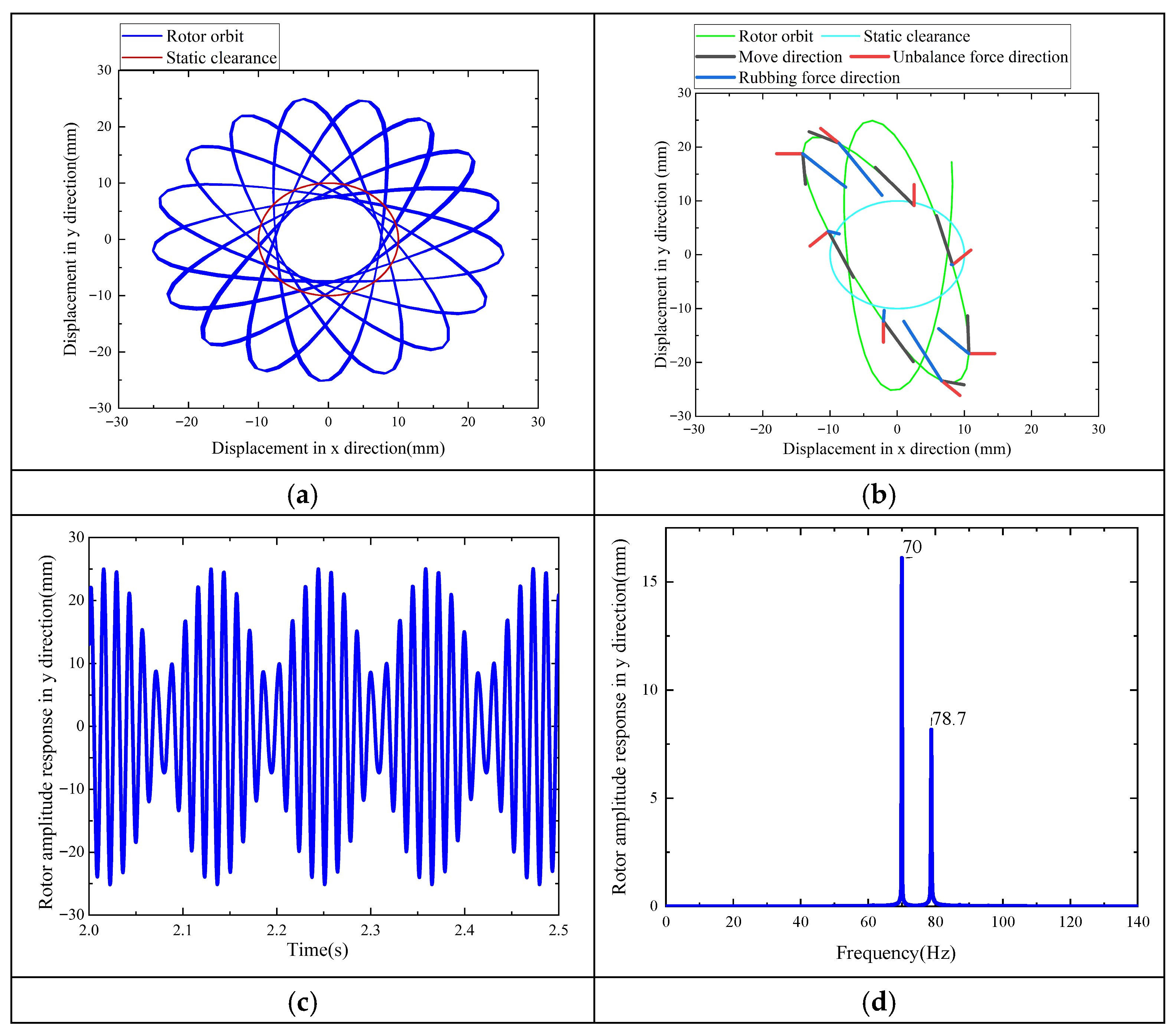
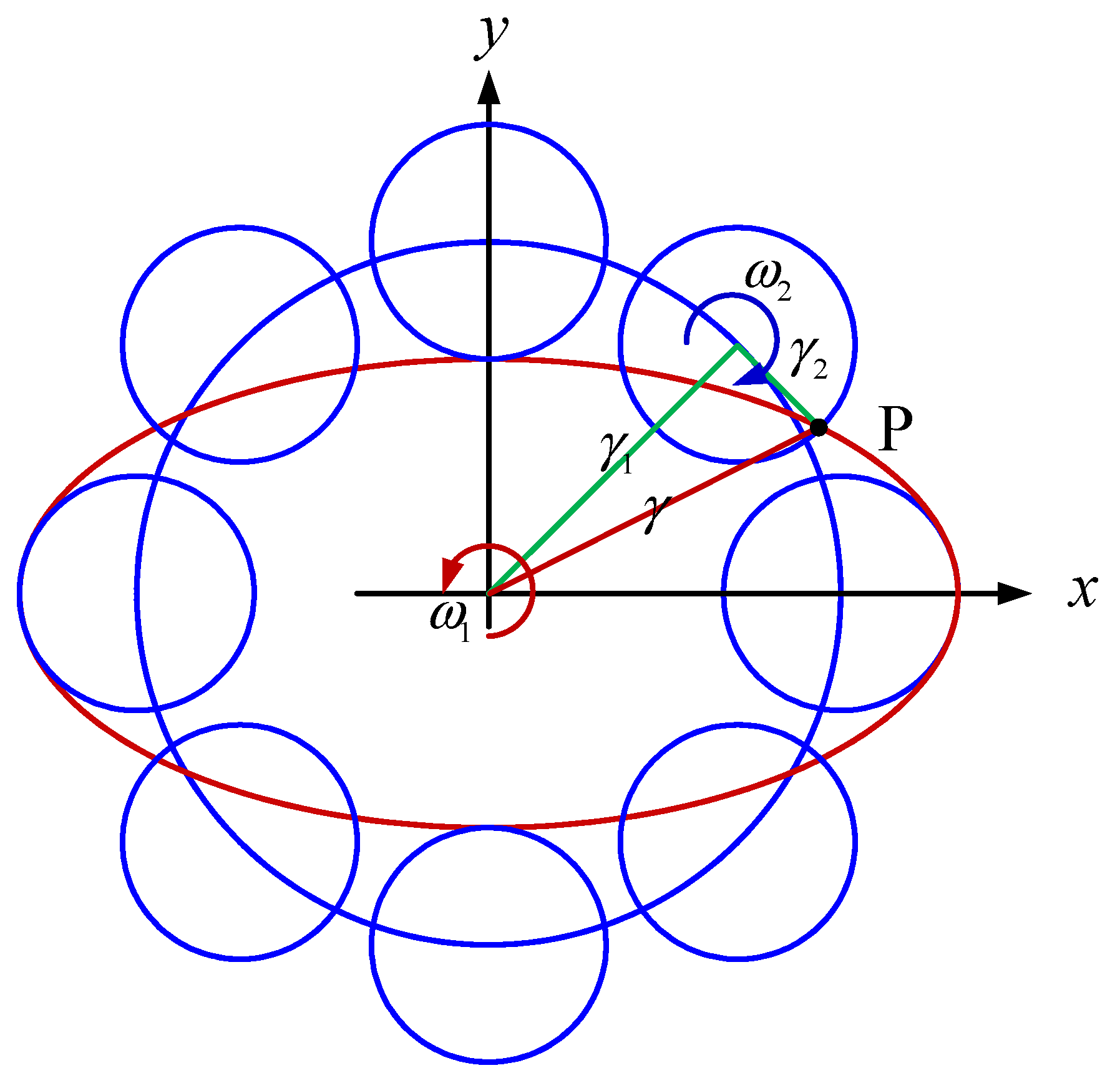
This section aims to investigate the intrinsic relationship between the harmonic frequencies and the motion trajectory of a rubbing rotor system. A simplified mathematical description of asynchronous motion is introduced. In this model, asynchronous motion is represented as the superposition of two sinusoidal periodic components, as illustrated in Figure 15. The motion of a representative point P, which traces the rotor trajectory, can be expressed as Equation (8)
P x = γ 1 cos ω 1 t + γ 2 cos ω 2 t P y = γ 1 sin ω 1 t + γ 2 sin ω 2 t
where ω 1 = ω 2 , γ 1 / γ 2 = 3 , ω 1 represents the unbalance excitation frequency, ω 2 represents the harmonic frequency caused by the rubbing, γ 1 is the amplitude of the unbalance excitation frequency, and γ 2 is the amplitude of the rubbing excitation frequency. We assume that when the rotational excitation frequency matches the harmonic frequency, the trajectory of the rotor forms an ellipse, as shown in Figure 15.
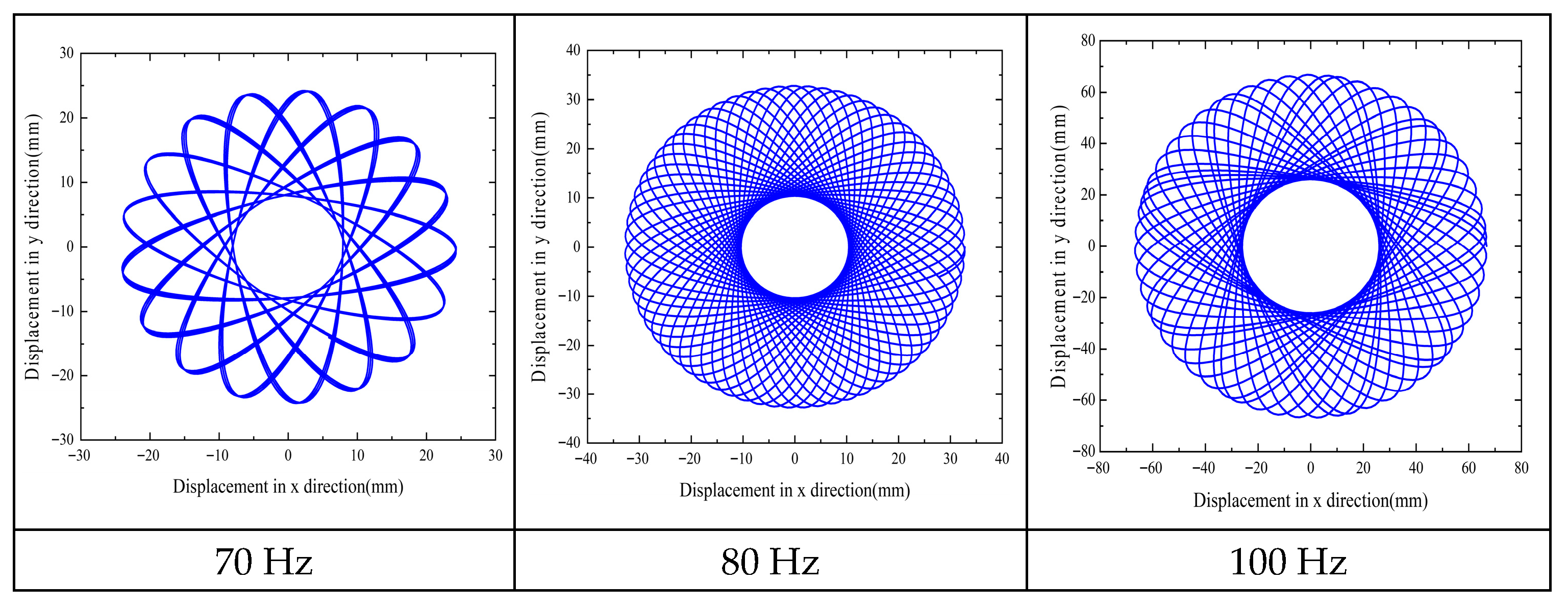
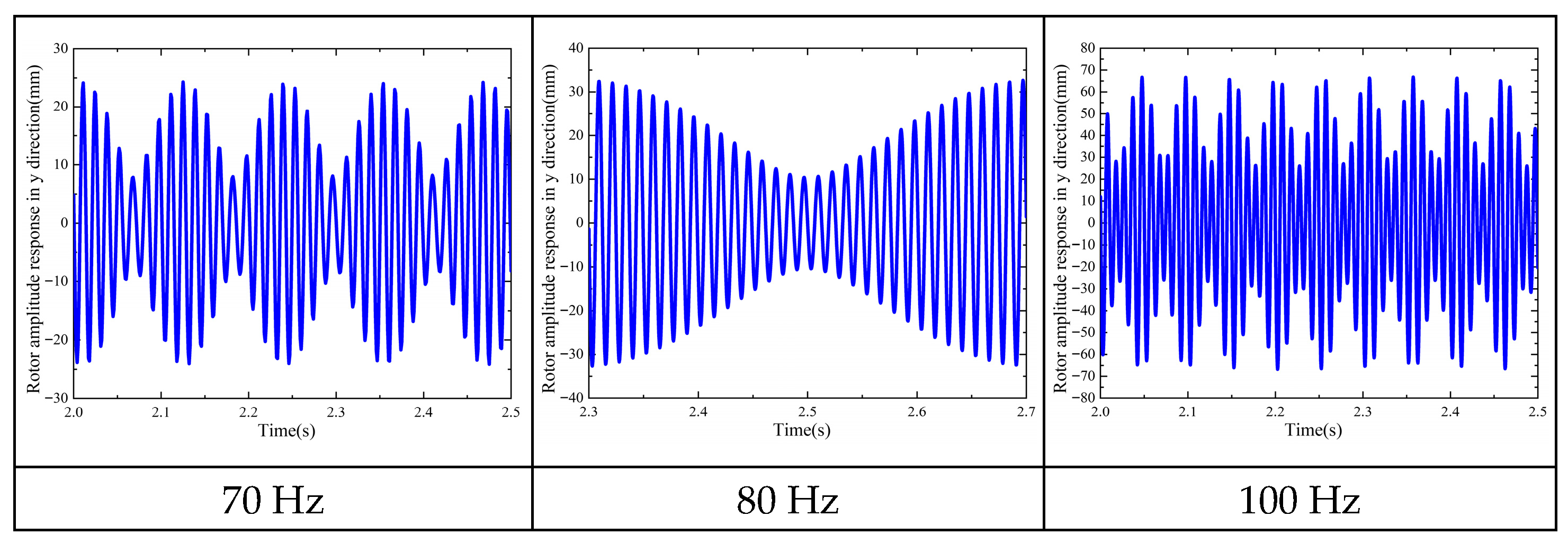
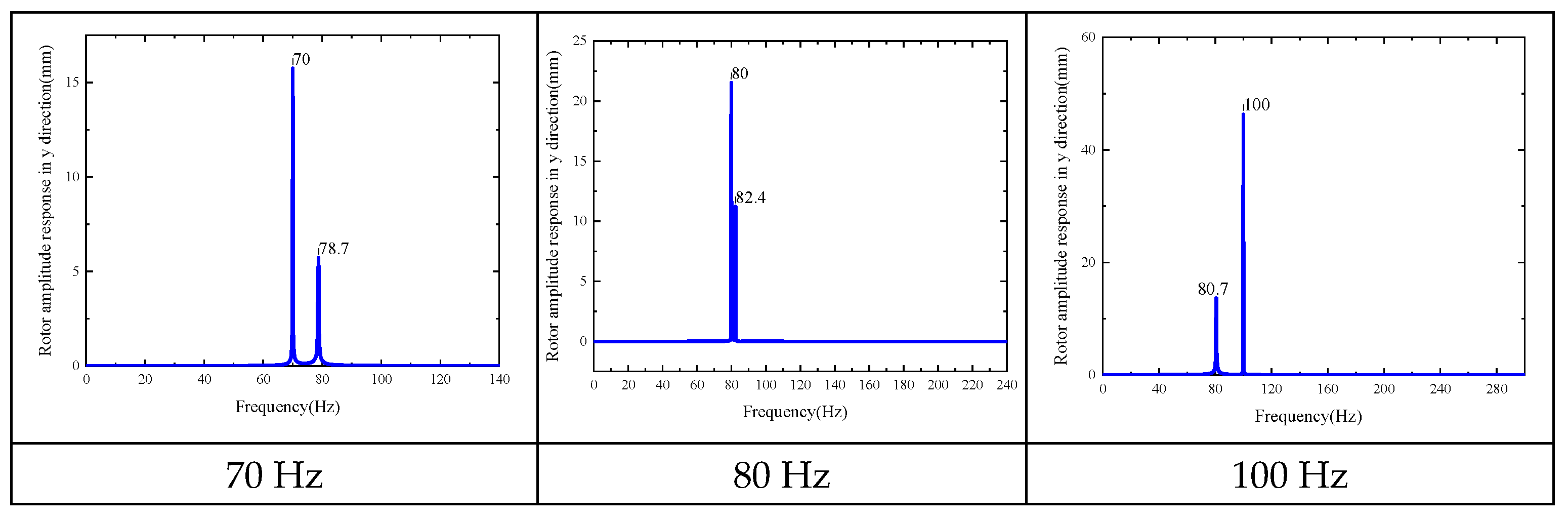
When the rotational excitation frequency is different from the harmonic frequency, the rotor trajectory exhibits a characteristic petal-shaped orbit, as illustrated in Figure 16, Figure 17, Figure 18 and Figure 19 for different parameter combinations. These figures present a comparison between the synthesized motion and the numerical rotor response in terms of orbit shape, y-direction displacement history, and corresponding frequency spectrum. The comparison shows that the sinusoidal superposition model can effectively capture the principal features of the asynchronous rotor motion under the investigated conditions.

3.4. The Rub-Impact Response at the Stator–Rotor Eccentric Initial State

As shown in Figure 20, the rotor and stator are initially eccentric, resulting in a non-uniform circumferential clearance between the rotor disk and the stator casing. The maximum clearance is 15 mm and the minimum clearance is 5 mm. The rotor response is described by the displacement of the disk center node, whereas the stator response is represented by a selected stator node.

3.4.1. The Dynamic Response at a Rotational Speed of 55 Hz

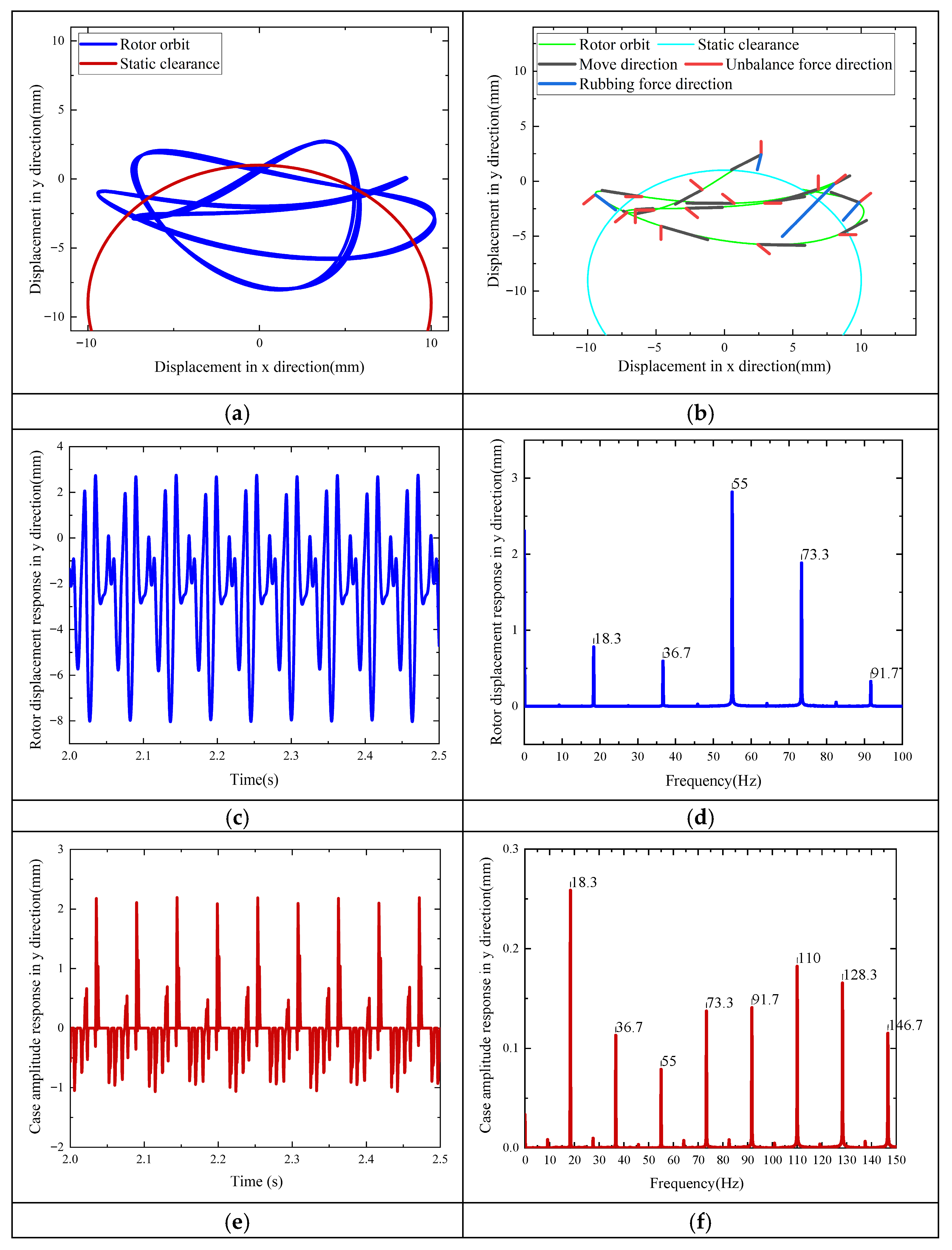
The dynamic response at 55 Hz is shown in Figure 21. As shown in Figure 21a, the disk center orbit reflects the eccentric rubbing condition, and the red curve denotes the non-uniform initial clearance. Because of this eccentricity, the rotor–stator contact is spatially non-uniform and varies with rotor position, which results in strongly time-varying rubbing and friction forces, as shown in Figure 21b. This mechanism is reflected in the frequency response. In Figure 21d, the rotor spectrum contains several distinct components at 18.3 Hz, 36.7 Hz, 73.3 Hz, and 91.7 Hz, showing that the rotor response is no longer governed mainly by the synchronous rotational excitation. In Figure 21f, the stator spectrum exhibits a similar clustered distribution, with dominant components at 18.3 Hz, 36.7 Hz, 73.3 Hz, 91.7 Hz, 128.3 Hz, and 146.7 Hz. These results suggest that eccentric rubbing enhances rotor–stator interaction and leads to more complex nonlinear multi-frequency coupling.

3.4.2. The Dynamic Response at a Rotational Speed of 65 Hz

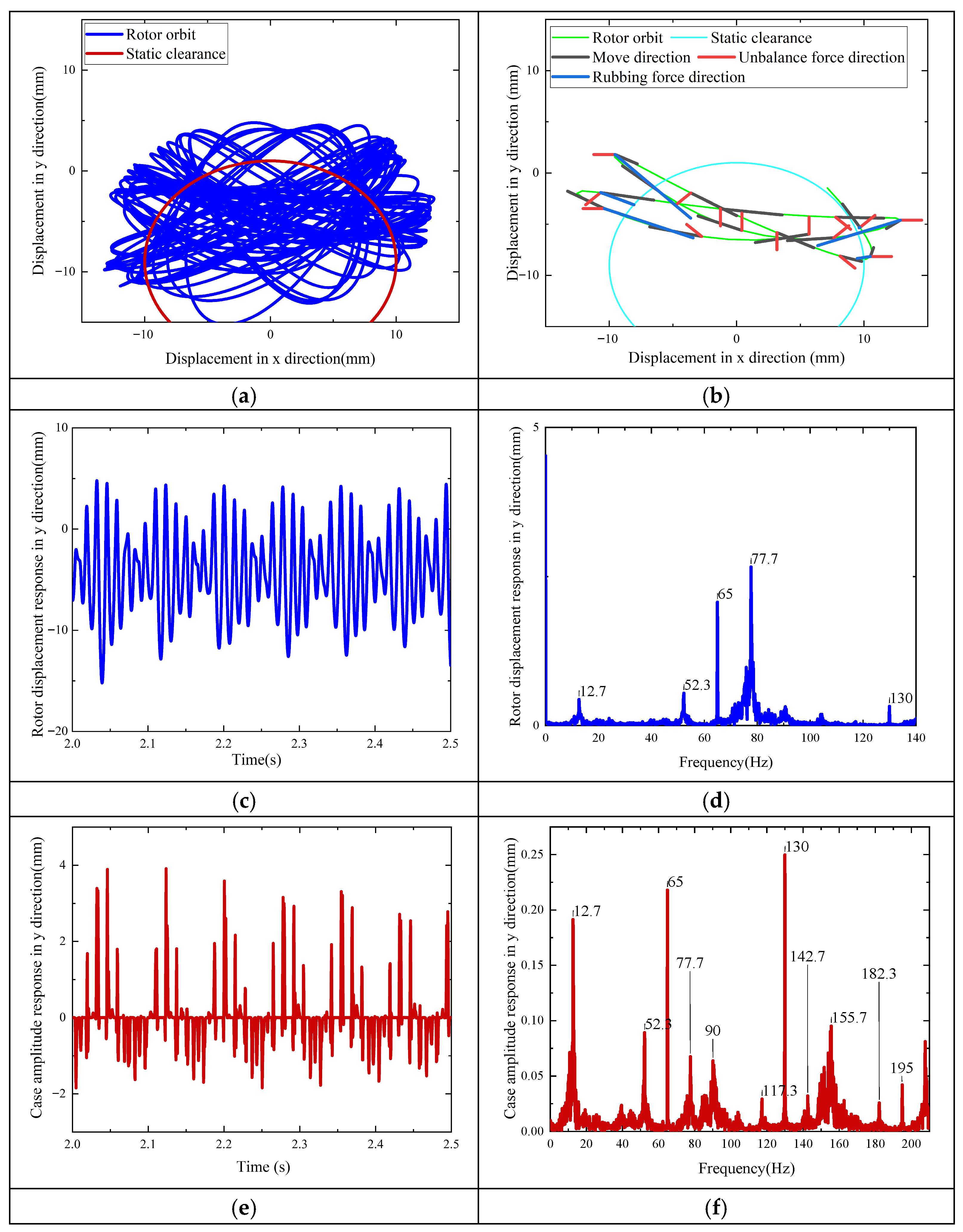
At 65 Hz, the response characteristics of the rotor system are shown in Figure 22. The orbit in Figure 22a shows that the contact region on the stator further expands, and the rotor motion becomes more irregular, indicating a stronger eccentric rubbing state. Because of the non-uniform clearance, the rotor is subjected to a more significant time-varying rubbing constraint, which increasingly modifies the synchronous response. This mechanism is confirmed by the spectral results. In Figure 22d, the dominant component appears at 77.7 Hz, and its amplitude exceeds that of the rotational frequency at 65 Hz, showing that the rotor response is dominated by an off-synchronous component induced by eccentric rubbing. In Figure 22f, the stator spectrum also exhibits multiple coupled components at 12.7 Hz, 52.3 Hz, 77.7 Hz, 117.3 Hz, 142.7 Hz, 155.7 Hz, and 182.3 Hz. These results indicate stronger nonlinear interaction and richer frequency coupling in the eccentric rubbing condition.

3.4.3. The Dynamic Response at a Rotational Speed of 75 Hz

At 75 Hz, the response characteristics of the rotor system are shown in Figure 23. Compared with the lower-speed eccentric rubbing cases, the orbit in Figure 23a becomes more regular, indicating a reduction in the irregularity of the rotor motion. Correspondingly, the rotor spectrum in Figure 23d is dominated by the 1X component at 75 Hz and its 2X and 3X harmonics. The stator response in Figure 23f exhibits the same dominant spectral structure. This indicates that the system response at 75 Hz is mainly controlled by synchronous excitation, with rubbing-induced nonlinearity appearing primarily in the form of higher-order harmonics.

3.4.4. The Dynamic Response at a Rotational Speed of 90 Hz

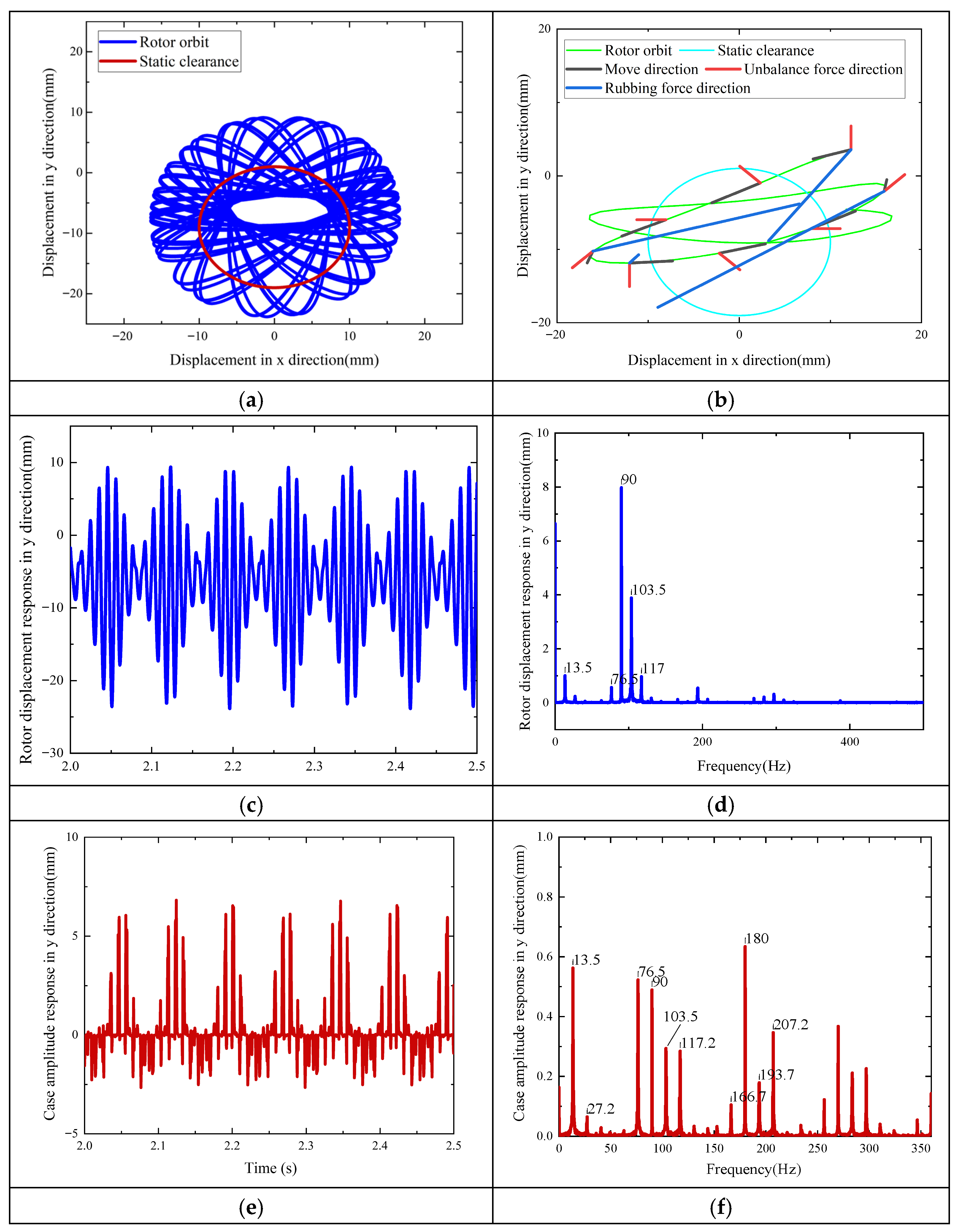
At 90 Hz, the response characteristics of the rotor system are shown in Figure 24. The orbit in Figure 24a is qualitatively similar to that of the concentric strong-rubbing case, indicating that, once rubbing becomes strong enough, the rotor motion is determined mainly by the rubbing constraint rather than by the initial eccentricity. Therefore, the orbit pattern is controlled primarily by the contact state. This mechanism is confirmed by the spectral results. In Figure 24d, the rotor response contains dominant components at 76.5 Hz, 103.5 Hz, and 117 Hz. In Figure 24f, the stator spectrum exhibits multiple pronounced components at 13.5 Hz, 27.2 Hz, 76.5 Hz, 103.5 Hz, 117.2 Hz, 166.7 Hz, 193.7 Hz, and 207.2 Hz. These frequency components indicate stronger nonlinear interaction and richer multi-frequency coupling in the eccentric strong-rubbing regime.
The rub-impact response in the initial eccentric stator–rotor configuration at a rotational speed of 100 Hz is provided in Appendix B. As the response exhibits trends similar to those observed at other rotational speeds, it is not repeated here; readers are referred to Appendix B for the complete calculation results.

3.5. Comparative Analysis

To perform a comparative analysis and clarify the dynamic characteristics of the flexible casing constraint, a traditional rigid cylindrical rubbing model is established, as shown in Figure 25.
The stator is modeled as a massless rigid ring supported by elastic supports, with a support stiffness of k casing . The friction coefficient between the rigid ring and the rotor surface during contact is μ . The initial clearance between the rotor and the stator is r 0 . Although this model is relatively simple, it can capture the fundamental characteristics of the rotor system and reflect the essential features of rubbing. Therefore, it has been widely used in theoretical studies of rubbing rotor systems [13,37].
The cross-section in the disk location is shown in Figure 26. The rubbing behavior results in forces along the normal direction F disk - n and tangential direction F disk - τ , which are applied on the disk, as shown in Equation (9). The horizontal and vertical interaction forces F disk - x and F disk - y can be obtained by coordinate transformation, as shown in Equation (10).
F disk - n = H r disk r 0 k casing r disk r 0 F disk - τ = F disk - n μ disk
F disk - x = H r disk r 0 k casing 1 r 0 r disk x disk sign v rel - disk μ disk y disk F disk - y = H r disk r 0 k casing 1 r 0 r disk sign v rel - disk μ disk x disk + y disk
where r disk is the whirling amplitude of the disk with r disk = x disk 2 + y disk 2 , r 0 is the clearance between the casing and disk, μ disk is the friction coefficient, v rel - disk = ( ω rotation + θ ˙ z - disk ) R disk Ω r disk is the relative speed of the disk at the contact point, Ω is the whirling angular frequency of the rotor, ω rotation is the rotational speed of the rotor, H ( · ) is the Heaviside function which is shown in Equation (11), and sign ( · ) is the sign function which is shown in Equation (12).
H x = 0   x 0 1   x > 0
sign ( · ) = 1   x < 0 0   x = 0 1   x > 0  
In this model, the stator structure is simplified as a conventional casing structure, and the parameters are set as follows: r 0 = 10   mm , k casing = 1 E 7   N / m , μ = 0.1 , and rotational speed = 70 Hz.
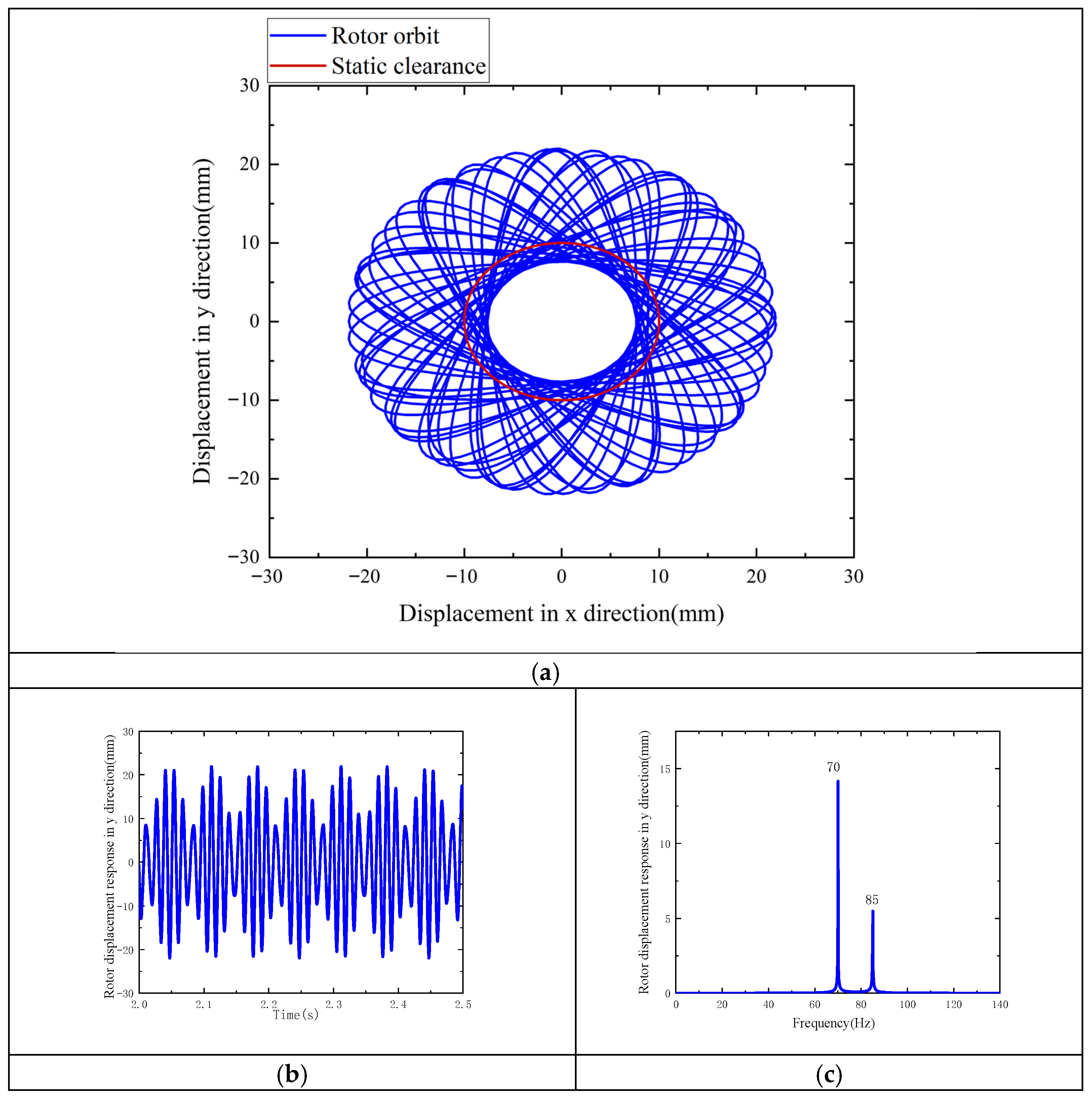
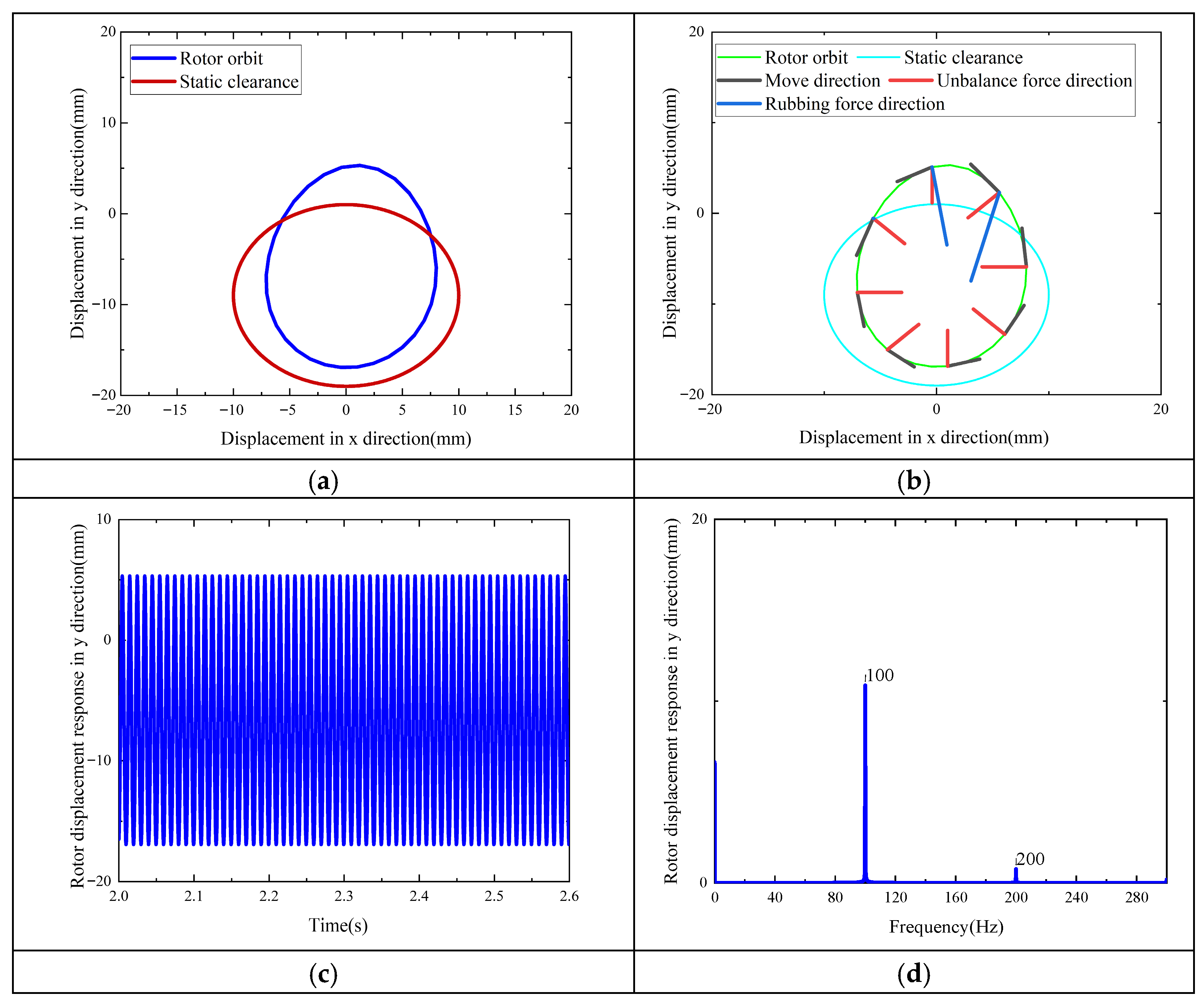
The dynamic response of the stator node and disk center node at a rotational speed of 70 Hz in traditional rotor mode is shown in Figure 27. The comparison shows that both the conventional model and the present flexible casing model exhibit non-synchronous whirl trajectories and corresponding harmonic frequency components under rubbing conditions. This indicates that the occurrence of asynchronous motion is not unique to the flexible casing model and thus supports the physical rationality of the predicted response. At the same time, because the rigid-stator model cannot capture the dynamic response of the casing, it is unable to reflect the stator-side vibration characteristics and the coupling effects introduced by casing flexibility. Therefore, the comparison further highlights the role of flexible casing constraints in enriching the system dynamics and supports the research gap emphasized in this study.

4. Conclusions

In this study, we examined non-synchronous motion and the associated harmonic components in a rubbing rotor system with a flexible casing constraint. By relating the rotational excitation load to the disk trajectory, the rotor–stator responses were compared across rubbing regimes and across concentric and eccentric rotor–stator configurations. Key findings are summarized as follows:
(1) Harmonic frequency generation during rub impact is primarily associated with the rotor’s asynchronous motion, rather than a purely synchronous response driven by unbalance.
(2) As rotational speed increases and rubbing becomes more severe, the contact regime evolves from intermittent impact–contact–separation to continuous contact, accompanied by a clear change in orbit pattern and excitation-load composition.
(3) The generation of harmonic frequencies essentially originates from the change in the rotor motion state under rubbing. The harmonic sub-frequency components observed in the spectrum correspond, in essence, to the lobed pattern of the rotor orbit. The formation of this lobed orbit results from the continuous action of the rubbing force, which causes the rotor motion to gradually evolve from synchronous motion to asynchronous motion.
(4) Under eccentric clearance (misalignment) conditions, rotor–stator interaction becomes more complex and is characterized by clustered harmonic bands and combined components, reflecting the non-smooth and strongly nonlinear nature of the contact.

5. Limitations and Future Work

The present study is subject to several limitations. The contact model adopts simplified assumptions, including a constant friction coefficient and an idealized contact stiffness, and does not account for wear evolution, thermal effects, or time-varying surface conditions during rubbing. In addition, the casing/support representation is simplified, and factors such as local compliance, assembly tolerances, joint effects, and higher-mode coupling are not fully included. These simplifications may influence the detailed spectral amplitudes and the exact thresholds of regime transitions. Moreover, the rotor is modeled with beam elements, which are suitable for capturing the global dynamic characteristics but have limited capability in describing local contact deformation. Therefore, the current model is intended mainly to reveal the mechanism and trend of harmonic evolution rather than to provide high-precision prediction of local contact behavior. Since the conclusions are drawn from simulations over selected parameter ranges, further experimental validation and broader parametric investigations are still needed to assess the generality of the proposed interpretation.

Author Contributions

Conceptualization, D.L.; methodology, D.L.; software, D.L.; validation, D.L. and Y.F.; formal analysis, D.L..; investigation, D.L. and Y.F.; resources, D.L. and Y.F.; data curation, X.L.; writing—original draft preparation, D.L.; writing—review and editing, D.L.; visualization, D.L.; supervision, D.L. and Y.F.; project administration, X.L.; funding acquisition, X.L.. All authors have read and agreed to the published version of the manuscript.

Funding

This work was supported by the Strategic Priority Research Program of the Chinese Academy of Sciences (XDB1280100) (XDC0140000).

Data Availability Statement

The datasets generated and analyzed during the current study are available from the corresponding author on reasonable request.

Conflicts of Interest

The author declares no competing interests.

Appendix A

The rub-impact response at the stator–rotor concentric initial state at a rotational speed of 60 Hz.
Figure A1. The dynamic response of the stator node and disk center node at a rotational speed of 60 Hz. (a) The trajectory of the disk center node. (b) The force distribution of the disk center node. (c) The displacement response of the disk center node in the time domain in the y direction. (d) The displacement response of the disk center node in the frequency domain in the y direction. (e) The displacement response of the stator node in the time domain in the y direction. (f) The displacement response of the stator node in the frequency domain in the y direction.
Aerospace 13 00298 g0a1
Figure A2. The amplitude of the disk center node changes with time at a rotational speed of 60 Hz.
Aerospace 13 00298 g0a2

Appendix B

The rub-impact response at the stator–rotor eccentric initial state at a rotational speed of 100 Hz.
Figure A3. The dynamic response of the stator node and disk center node at a rotational speed of 100 Hz. (a) The trajectory of the disk center node. (b) The force distribution of the disk center node. (c) The displacement response of the disk center node in the time domain in the y direction. (d) The displacement response of the disk center node in the frequency domain in the y direction; (e) The displacement response of the stator node in the time domain in the y direction; (f) The displacement response of the stator node in the frequency domain in the y direction.
Aerospace 13 00298 g0a3aAerospace 13 00298 g0a3b

References

  1. Kou, H.; Zhang, Y.; Lee, H.P.; Shi, Y.; Du, J.; Zhu, Z.; Zhang, F.; Zeng, L. Rubbing features of the bladed drum rotor under a novel coupled axial-radial thermal effect. Acta Mech. Sin. 2024, 40, 523034. [Google Scholar] [CrossRef]
  2. Zeng, Z.; Zhang, D.; Tong, R.; Xu, H. Experimental investigation and analytical modeling for blade-casing rubbing force. Mech. Syst. Signal Process. 2022, 167, 108548. [Google Scholar] [CrossRef]
  3. Wang, H.F.; Chen, G.; Song, P.P. Simulation analysis of casing vibration response and its verification under blade–casing rubbing fault. J. Vib. Acoust. 2016, 138, 031004. [Google Scholar] [CrossRef]
  4. Zeng, J.; Zhao, C.; Ma, H.; Cui, X.; Sun, W.; Luo, Z. Dynamic response characteristics of the shaft-blisk-casing system with blade-tip rubbing fault. Eng. Fail. Anal. 2021, 125, 105406. [Google Scholar] [CrossRef]
  5. Chen, G. Simulation of casing vibration resulting from blade–casing rubbing and its verifications. J. Sound Vib. 2016, 361, 190–209. [Google Scholar] [CrossRef]
  6. Ding, K.; Wang, Z.; Lu, X.; Zhang, J.; Ma, L. Vibration investigation of rotor system with unbalance and blade-casing rubbing coupling faults. J. Vibroeng. 2020, 22, 353–365. [Google Scholar] [CrossRef]
  7. Yang, Y.; Cao, D.; Wang, D.; Jiang, G. Fixed-point rubbing characteristic analysis of a dual-rotor system based on the Lankarani–Nikravesh model. Mech. Mach. Theory 2016, 103, 202–221. [Google Scholar] [CrossRef]
  8. Wang, Z.; Sun, R.; Liu, Y.; Yao, Y.; Tian, J. Analysis of nonlinear vibration characteristics and whirl behavior of dual-rotor systems with inter-shaft rub impact. Mathematics 2024, 12, 1436. [Google Scholar] [CrossRef]
  9. Fu, C.; Zhu, W.; Zheng, Z.; Sun, C.; Yang, Y.; Lu, K. Nonlinear responses of a dual-rotor system with rub-impact fault subject to interval uncertain parameters. Mech. Syst. Signal Process. 2022, 170, 108827. [Google Scholar] [CrossRef]
  10. Tang, H.; Ren, Y.; Xiang, J.; Kumar, A. Numerical and experimental analysis of rotor-bearing system for axial piston pump with misalignment–rubbing coupling fault. J. Sound Vib. 2023, 559, 117786. [Google Scholar] [CrossRef]
  11. Kuan, L.; Hui, C.; Wentao, Z.; Haopeng, Z.; Kaifu, Z.; Chao, F. Nonlinear dynamic behavior of a dual-rotor bearing system with coupling misalignment and rubbing faults. Meas. Sci. Technol. 2022, 34, 014005. [Google Scholar] [CrossRef]
  12. Yu, P.; Chen, G.; Li, L. Modal analysis strategy and nonlinear dynamic characteristics of complicated aero-engine dual-rotor system with rub-impact. Chin. J. Aeronaut. 2022, 35, 184–203. [Google Scholar] [CrossRef]
  13. Yu, P.; Wang, C.; Hou, L.; Chen, G. Dynamic characteristics of an aeroengine dual-rotor system with inter-shaft rub-impact. Mech. Syst. Signal Process. 2022, 166, 108475. [Google Scholar] [CrossRef]
  14. Wang, Y.; Markert, R.; Xiang, J.; Zheng, W. Research on variational mode decomposition and its application in detecting rub-impact fault of the rotor system. Mech. Syst. Signal Process. 2015, 60–61, 243–251. [Google Scholar] [CrossRef]
  15. Liu, Y.; Zhao, Y.; Li, J.; Ma, H.; Yang, Q.; Yan, X. Application of weighted contribution rate of nonlinear output frequency response functions to rotor rub-impact. Mech. Syst. Signal Process. 2020, 136, 106518. [Google Scholar] [CrossRef]
  16. Liu, Y.; Li, J.; Feng, K.; Zhao, Y.; Yan, X.; Ma, H. A novel fault diagnosis method for rotor rub-impact based on nonlinear output frequency response functions and stochastic resonance. J. Sound Vib. 2020, 481, 115421. [Google Scholar] [CrossRef]
  17. Zhang, L.; Yuan, Q.; Ma, X.; Hou, X.; Li, Z.; Zhang, J.; Wang, X. Research on rub-impact rotor vibration of hydraulic generating set based on HB-AFT method. Nonlinear Dyn. 2023, 111, 7417–7431. [Google Scholar] [CrossRef]
  18. Hu, A.; Xiang, L.; Zhang, Y. Experimental study on the intrawave frequency modulation characteristic of rotor rub and crack fault. Mech. Syst. Signal Process. 2019, 118, 209–225. [Google Scholar] [CrossRef]
  19. Taher, G.A.F.; Rabeih, E.A.; El-Mongy, H. Experimental and numerical study of lateral vibration of a rotor–stator rubbing system. Int. J. Dyn. Control 2024, 12, 3139–3154. [Google Scholar] [CrossRef]
  20. Kang, Y.; Cao, S.; Hou, Y.; You, Z.; Ma, Q. Analysis of backward whirl characteristics of rubbing dual-rotor systems. Acta Mech. 2023, 234, 5269–5299. [Google Scholar] [CrossRef]
  21. Wang, S.; Hong, L.; Jiang, J. Analytical prediction on stick-slip whirling oscillations induced by dry friction between a rotating imbalanced rotor and a flexibly supported stator. J. Sound Vib. 2021, 511, 116333. [Google Scholar] [CrossRef]
  22. Hou, Y.; Cao, S.; Kang, Y. Analysis of reverse whirl characteristics of a rub-impact rotor system. AIAA J. 2025, 63, 668–686. [Google Scholar] [CrossRef]
  23. Abdul Nasar, R.; Al-Shudeifat, M.A. Impact of rotor-stator rub-impact on post-resonance backward whirl excitation. In Proceedings of the ASME International Mechanical Engineering Congress and Exposition (IMECE 2022), Columbus, OH, USA, 30 October–3 November 2022. Volume 5: Dynamics, Vibration, and Control, paper V005T07A007, IMECE2022-95354. [Google Scholar]
  24. Behzad, M.; Alvandi, M. Friction-induced backward rub of rotors in non-annular clearances: Experimental observations and numerical analysis. Tribol. Int. 2020, 152, 106430. [Google Scholar] [CrossRef]
  25. Chu, F.; Zhang, Z. Bifurcation and chaos in a rub-impact Jeffcott rotor system. J. Sound Vib. 1998, 210, 1–18. [Google Scholar] [CrossRef]
  26. Chu, F.; Lu, W. Experimental observation of nonlinear vibrations in a rub-impact rotor system. J. Sound Vib. 2005, 283, 621–643. [Google Scholar] [CrossRef]
  27. Ma, H.; Zhao, Q.; Zhao, X.; Han, Q.; Wen, B. Dynamic characteristics analysis of a rotor–stator system under different rubbing forms. Appl. Math. Model. 2015, 39, 2392–2408. [Google Scholar] [CrossRef]
  28. Ma, H.; Shi, C.; Han, Q.; Wen, B. Fixed-point rubbing fault characteristic analysis of a rotor system based on contact theory. Mech. Syst. Signal Process. 2013, 38, 137–153. [Google Scholar] [CrossRef]
  29. Ma, H.; Shi, C.; Han, Q.; Wen, B. Dynamic characteristics analysis of a rotor system with two types of limiters. Int. J. Mech. Sci. 2014, 88, 192–201. [Google Scholar] [CrossRef]
  30. Prabith, K.; Krishna, I.R.P. The stability analysis of a two-spool rotor system undergoing rub-impact. Nonlinear Dyn. 2021, 104, 941–969. [Google Scholar] [CrossRef]
  31. Prabith, K.; Krishna, I.R.P. Response and stability analysis of a two-spool aero-engine rotor system undergoing multi-disk rub-impact. Int. J. Mech. Sci. 2022, 213, 106861. [Google Scholar] [CrossRef]
  32. Popprath, S.; Ecker, H. Nonlinear dynamics of a rotor contacting an elastically suspended stator. J. Sound Vib. 2007, 308, 767–784. [Google Scholar] [CrossRef]
  33. Chipato, E.T.; Shaw, A.D.; I Friswell, M.; Crespo, R.S. Experimental study of rotor-stator contact cycles. J. Sound Vib. 2021, 502, 116097. [Google Scholar] [CrossRef]
  34. Wang, S.; Hong, L.; Jiang, J. Nonsmooth behavior of sliding bifurcations in a general piecewise smooth rotor/stator rubbing system. Int. J. Bifurc. Chaos 2021, 31, 2150085. [Google Scholar] [CrossRef]
  35. Zhao, Q.; Liu, J.; Yuan, J.; Jiang, H.; Gao, L.; Zhu, J.; Yao, H.; Wen, B. Dynamic response analysis of dual-rotor system with rubbing fault by dimension reduction incremental harmonic balance method. Int. J. Struct. Stab. Dyn. 2022, 22, 2250150. [Google Scholar] [CrossRef]
  36. Trébinjac, I.; Vixège, C. Experimental analysis of the rotor stator interaction within a high pressure centrifugal compressor. J. Therm. Sci. 2002, 11, 1–9. [Google Scholar]
  37. Liu, D.; Hong, J. Failure analysis of backward whirl motion in an aero-engine rotor. Eng. Fail. Anal. 2021, 128, 105620. [Google Scholar] [CrossRef]
Figure 1. Cross-sectional schematic of the disk–casing rub-impact model.
Aerospace 13 00298 g001
Figure 2. Schematic of the compressor disk–casing rubbing model and contact geometry.
Aerospace 13 00298 g002
Figure 3. Schematic of the disk–casing rub-impact interaction and force components.
Aerospace 13 00298 g003
Figure 4. Schematic diagram of the overhung rotor–casing system and its main geometric parameters.The red dot represents a node.
Aerospace 13 00298 g004
Figure 5. First two mode shapes and corresponding critical speeds of the unconstrained rotor system.The red dot represents a node.
Aerospace 13 00298 g005
Figure 6. First six mode shapes and corresponding natural frequencies of the casing system.
Aerospace 13 00298 g006
Figure 7. Relative positions of the disk center node and stator node.The red color represents the casing profile, and the blue color represents the disk profile.
Aerospace 13 00298 g007
Figure 8. The bifurcation response of the disk center node at different rotational speeds.
Aerospace 13 00298 g008
Figure 9. Dynamic responses of the disk center node and stator node at a rotational speed of 47 Hz. (a) The trajectory of the disk center node. (b) The force distribution of the disk center node. (c) The displacement response of the disk center node in the time domain in the y direction. (d) The displacement response of the disk center node in the frequency domain in the y direction. (e) The displacement response of the stator node in the time domain in the y direction. (f) The displacement response of the stator node in the frequency domain in the y direction.
Aerospace 13 00298 g009
Figure 10. The dynamic response of the stator node and disk center node at a rotational speed of 70 Hz. (a) The trajectory of the disk center node. (b) The force distribution of the disk center node. (c) The displacement response of the disk center node in the time domain in the y direction. (d) The displacement response of the disk center node in the frequency domain in the y direction. (e) The displacement response of the stator node in the time domain in the y direction. (f) The displacement response of the stator node in the frequency domain in the y direction.
Aerospace 13 00298 g010aAerospace 13 00298 g010b
Figure 11. The dynamic response of the stator node and the disk center node at a rotational speed of 80 Hz. (a) The trajectory of the disk center node. (b) The force distribution of the disk center node. (c) The displacement response of the disk center node in the time domain in the y direction. (d) The displacement response of the disk center node in the frequency domain in the y direction. (e) The displacement response of the stator node in the time domain in the y direction. (f) The displacement response of the stator node in the frequency domain in the y direction.
Aerospace 13 00298 g011aAerospace 13 00298 g011b
Figure 12. The dynamic response of the stator node and disk center node at a rotational speed of 100 Hz under the stator-rotor concentric initial state. (a) The trajectory of the disk center node. (b) The force distribution of the disk center node. (c) The displacement response of the disk center node in the time domain in the y direction. (d) The displacement response of the disk center node in the frequency domain in the y direction. (e) The displacement response of the stator node in the time domain in the y direction. (f) The displacement response of the stator node in the frequency domain in the y direction.
Aerospace 13 00298 g012
Figure 13. The amplitude of the disk center node changing with time.
Aerospace 13 00298 g013
Figure 14. The amplitude of the disk center node changing with time at a rotational speed of 100 Hz.
Aerospace 13 00298 g014
Figure 15. The sinusoidal synthetic rotor motion trajectory.
Aerospace 13 00298 g015
Figure 16. The trajectory of the disk center node.
Aerospace 13 00298 g016
Figure 17. The displacement response of the disk center node in the time domain in the y direction.
Aerospace 13 00298 g017
Figure 18. The displacement response of the disk center node in the frequency domain in the y direction.
Aerospace 13 00298 g018
Figure 19. The amplitude of the disk center node changing with time.
Aerospace 13 00298 g019
Figure 20. The position of the disk center node and the stator node.The red line represents the initial stator profile, and the blue line represents the disk profile.
Aerospace 13 00298 g020
Figure 21. The dynamic response of the stator node and the disk center node at a rotational speed of 55 Hz. (a) The trajectory of the disk center node. (b) The force distribution of the disk center node. (c) The displacement response of the disk center node in the time domain in the y direction. (d) The displacement response of the disk center node in the frequency domain in the y direction. (e) The displacement response of the stator node in the time domain in the y direction. (f) The displacement response of the stator node in the frequency domain in the y direction.
Aerospace 13 00298 g021
Figure 22. The dynamic response of the stator node and the disk center node at a rotational speed of 65 Hz. (a) The trajectory of the disk center node. (b) The force distribution of the disk center node. (c) The displacement response of the disk center node in the time domain in the y direction. (d) The displacement response of the disk center node in the frequency domain in the y direction. (e) The displacement response of the stator node in the time domain in the y direction. (f) The displacement response of the stator node in the frequency domain in the y direction.
Aerospace 13 00298 g022
Figure 23. The dynamic response of the stator node and the disk center node at a rotational speed of 75 Hz. (a) The trajectory of the disk center node. (b) The force distribution of the disk center node. (c) The displacement response of the disk center node in the time domain in the y direction. (d) The displacement response of the disk center node in the frequency domain in the y direction. (e) The displacement response of the stator node in the time domain in the y direction. (f) The displacement response of the stator node in the frequency domain in the y direction.
Aerospace 13 00298 g023
Figure 24. The dynamic response of the stator node and the disk center node at a rotational speed of 90 Hz. (a) The trajectory of the disk center node. (b) The force distribution of the disk center node. (c) The displacement response of the disk center node in the time domain in the y direction. (d) The displacement response of the disk center node in the frequency domain in the y direction. (e) The displacement response of the stator node in the time domain in the y direction. (f) The displacement response of the stator node in the frequency domain in the y direction.
Aerospace 13 00298 g024
Figure 25. Traditional rotor rubbing model.The red dot indicates the position of the node.
Aerospace 13 00298 g025
Figure 26. The cross-section of the disk location.
Aerospace 13 00298 g026
Figure 27. The dynamic response of the stator node and disk center node at a rotational speed of 70 Hz in traditional rotor mode. (a) The trajectory of the disk center node. (b) The displacement response of the disk center node in the time domain in the y direction. (c) The displacement response of the disk center node in the frequency domain in the y direction.
Aerospace 13 00298 g027
Table 1. The parameter of the rotor system with flexible constraints.
Geometry parametersL1200 mm
L2600 mm
L3200 mm
T15 mm
d1400 mm
d2380 mm
d360 mm
d470 mm
Material parametersYoung’s modulus2.1 × 105 MPa
Density7800 kg/m3
Poisson’s ratio0.3
Finite modelingBearing 1 support stiffness1 × 107 N/m
Bearing 2 support stiffness1 × 107 N/m
Bearing 1 damping1000 Ns/m
Bearing 2 damping1000 Ns/m
Shell elements distributionAxial distribution number10
Circumferential distribution number64
Disclaimer/Publisher’s Note: The statements, opinions and data contained in all publications are solely those of the individual author(s) and contributor(s) and not of MDPI and/or the editor(s). MDPI and/or the editor(s) disclaim responsibility for any injury to people or property resulting from any ideas, methods, instructions or products referred to in the content.