


Abstract
Cold stress severely restricts rice (Oryza sativa L.) growth and productivity, particularly during seedling establishment, yet the roles of Group III WRKY transcription factors in cold adaptation remain poorly understood. Here, we characterized OsWRKY40, a cold-inducible WRKY transcription factor, using transgenic overexpression and knockout lines, subcellular localization, transcriptional activation assays, DAP-seq, dual-luciferase reporter assays, autophagy assays and ROS staining, ABA response analysis, and haplotype analysis. OsWRKY40 overexpression enhanced seedling survival under cold stress, whereas knockout mutants showed increased sensitivity. OsWRKY40 localized to the nucleus and activated multiple cold-responsive genes, including OsATG8b, thereby promoting autophagy and improving ROS-scavenging capacity. Altered OsWRKY40 expression also affected ABA-responsive seedling growth. Natural variation analysis identified two major haplotypes with differential transcriptional activation activity and cold tolerance. Together, these findings reveal OsWRKY40 as a central cold-responsive transcriptional regulator linking autophagy, antioxidant defense, ABA-responsive seedling growth, and natural variation, highlighting its potential value for improving rice seedling cold tolerance.
1. Introduction
Rice (Oryza sativa L.) is one of the most important staple crops worldwide and serves as a model plant for studying growth, development, and stress responses in monocots [1]. In the context of global climate change, cold stress remains a major constraint on stable yield and the expansion of rice cultivation, particularly in high-latitude and high-altitude regions [2]. Cold stress adversely affects rice growth and survival at the seedling stage while reducing seed-setting rate and grain yield at the booting stage [3,4]. At the cellular level, cold stress disrupts membrane integrity and organelle homeostasis, impairs photosynthetic efficiency, and induces excessive accumulation of reactive oxygen species (ROS), leading to oxidative damage and cellular dysfunction [1,5,6,7]. Plants have evolved complex enzymatic antioxidant systems to maintain ROS homeostasis under stress conditions. Major antioxidant enzymes, including superoxide dismutase (SOD), catalase (CAT), ascorbate peroxidase (APX), and peroxidase (POD), play essential roles in ROS metabolism and limiting oxidative damage under abiotic stress [8].
In addition to antioxidant systems, autophagy has emerged as an important mechanism for limiting oxidative damage through the selective removal of damaged organelles and oxidized proteins [9,10]. Among core autophagy-related proteins, ATG8 plays a central role in autophagosome formation and cargo recognition and is widely used as a marker of autophagy activity. The rice homolog OsATG8b is positively correlated with autophagic activity [11,12]. Genetic evidence from multiple plant species further highlights the importance of autophagy in stress tolerance. In Arabidopsis thaliana, rice, and wheat (Triticum aestivum), disruption of key autophagy-related genes compromises tolerance to heat, drought, salt, and oxidative stresses, often accompanied by excessive ROS accumulation and impaired cellular homeostasis [13,14,15,16]. Although autophagy has been implicated in the removal of damaged proteins under various abiotic stresses [17], its precise role in rice cold tolerance and its upstream regulatory mechanisms remain largely unclear.
The WRKY transcription factor family is one of the largest in plants and plays central roles in regulating stress-responsive gene expression through binding to W-box cis-elements in target promoters [18,19]. In rice, numerous WRKY transcription factors have been implicated in responses to biotic and abiotic stresses, including cold stress. For example, OsWRKY71 positively regulates seedling-stage cold tolerance, whereas OsWRKY53 and OsWRKY63 negatively regulate cold adaptation through distinct molecular pathways [20,21,22]. Similarly, AtWRKY41 acts as a negative regulator of cold tolerance in Arabidopsis by repressing CBF expression [23]. Beyond their roles in stress-responsive transcription, WRKY transcription factors have also been implicated in the regulation of cellular redox homeostasis. In Arabidopsis, several WRKY members, including WRKY25 and WRKY33, are induced by oxidative stress and hydrogen peroxide and contribute to ROS detoxification by modulating the expression of genes encoding antioxidant enzymes, including peroxidases and glutathione S-transferases [24,25,26]. Given the central role of ROS signaling and detoxification in cold adaptation, WRKY-mediated regulation of ROS homeostasis may represent an important mechanism underlying stress tolerance. Despite the established roles of autophagy and ROS homeostasis in plant stress responses, whether WRKY transcription factors are involved in the transcriptional regulation of both processes during cold stress remains largely unknown.
This study aimed to elucidate the role of OsWRKY40, a Group III WRKY transcription factor, in rice cold tolerance and explore its potential involvement in coordinating multiple cold-responsive processes. To this end, we characterized the cold-responsive expression pattern and biological function of OsWRKY40 using overexpression and knockout lines. DAP-seq analysis was employed to identify potential downstream targets of OsWRKY40, and we further analyzed the expression changes of related candidate genes, as well as physiological responses associated with autophagy and ROS homeostasis. Furthermore, we analyzed natural variation in OsWRKY40 and examined its association with cold tolerance among rice accessions. This study provides insights into the transcriptional regulation of rice cold tolerance and the potential role of WRKY transcription factors in coordinating multiple cold-responsive processes.
2. Materials and Methods
2.1. Plant Materials and Growth Conditions
Rice cultivar Zhonghua11 (ZH11) and Nicotiana benthamiana were used as experimental materials in this study. Rice seedlings were grown in growth chambers under controlled conditions of 10 h light (20,000 lux, 28 °C) and 14 h dark (26 °C). Tobacco seedlings were cultured under 14 h light (20,000 lux, 25 °C) and 10 h dark (22 °C). The relative humidity for both species was maintained at 75%. Plants at the mature stage were grown in the transgenic experimental field in Chunhua Town, Changsha County, Hunan Province, China. Experiments were conducted at Hunan Agricultural University and the Yuelushan Laboratory.
2.2. Generation of Transgenic Plants
Knockout lines were generated using the CRISPR/Cas9 genome editing system. Single-guide RNAs (sgRNAs) targeting OsWRKY40 were designed and cloned into CRISPR/Cas9 vectors, followed by Agrobacterium-mediated transformation of rice calli. Homozygous knockout lines were used for subsequent experiments.
For the generation of overexpression lines, the coding sequence (CDS) of OsWRKY40 was cloned into the pCAMBIA1300 vector to construct the overexpression vector. The construct was introduced into rice calli via Agrobacterium-mediated transformation. Homozygous overexpression lines with high expression levels were obtained through hygromycin screening and qRT-PCR analysis.
2.3. Stress Treatments
For seedling-stage cold treatment, mature wild-type and transgenic seeds were surface-sterilized with 1% sodium hypochlorite for 25 min, thoroughly rinsed, and then soaked at 30 °C for 3 days to induce germination. Germinated seeds were sown in 96-well seedling plates and cultured in Yoshida nutrient solution for 2 weeks, after which seedlings were subjected to cold treatment in a growth chamber with a 10 h light (20,000 lux, 4 °C)/14 h dark (4 °C) photoperiod for 5 days, followed by a 7-day recovery period under normal growth conditions.
For booting-stage cold treatment, seeds were germinated and sown in the field, and seedlings were transplanted into pots after one month (three plants per pot, five pots per line). When the distance between the flag leaf auricle and the penultimate leaf auricle ranged from −5 to 0 cm, plants were considered to be at the booting stage corresponding approximately to the pollen mother cell meiosis stage, and panicles were tagged for cold treatment. The plants were then transferred to a growth chamber and subjected to 18 °C cold treatment for 10 days, followed by transfer to outdoor conditions for natural maturation. Ten plants per line were randomly selected to investigate agronomic traits. The growth chamber conditions were set as 12 h light (20,000 lux, 18 °C)/12 h dark (18 °C).
For abscisic acid (ABA) treatment, three concentrations (0, 2, and 10 μM) were selected based on previous studies in rice [27]. Newly germinated wild-type and transgenic seeds were cultured in ABA solutions of different concentrations for 10 days, after which shoot length was measured and recorded.
2.4. Sampling, RNA Extraction, and qRT-PCR
For cold-induced expression patterns, shoot and root tissues were collected from two-week-old ZH11 seedlings at different time points following cold treatment. For tissue-specific expression analysis, samples included leaves and roots of two-week-old ZH11 seedlings, as well as leaves, panicles, stems, and leaf sheaths from field-grown plants at the heading and booting stages under normal management conditions. Samples used for downstream target gene expression analysis were uniformly collected from the leaf tissues of two-week-old seedlings after cold treatment. Total RNA was extracted using RNA-easy Isolation Reagent (Vazyme, Nanjing, China), and cDNA was synthesized with HiFiScript All-in-one RT Master Mix for qPCR (Cowin, Taizhou, China). qRT-PCR reactions were performed using Hieff® qPCR SYBR Green Master Mix (Yeasen, Shanghai, China) on a CFX Connect Real-Time System (BIO-RAD, Hercules, CA, USA). The primers used for qRT-PCR in this study are listed in Table S1. Ubiquitin was used as an internal reference, and each sample included three biological replicates.
2.5. Subcellular Localization, Luciferase Complementation Imaging Assay, and Dual-Luciferase Reporter Assay
The CDS of OsWRKY40 was cloned into the pCAMBIA2300 vector to generate an OsWRKY40-GFP fusion expression construct, which, together with the nuclear localization marker OsbZIP52-mRFP, was co-transformed into Agrobacterium tumefaciens strain GV3101. The bacterial suspension was infiltrated into N. benthamiana leaves, incubated in the dark at 28 °C for 12 h, followed by normal growth for 24 h, and fluorescence signals were observed using a Zeiss laser confocal microscope (ZEISS, Jena, Germany).
For the Luciferase complementation imaging (LCI) assays, nLUC-OsATG8b and cLUC-OsWRKY40 constructs were transformed into GV3101, mixed, and infiltrated into N. benthamiana leaves. D-luciferin potassium salt (Coolaber, Beijing, China) was applied, and the leaves were kept in the dark for 10 min before fluorescence signals were detected using a Tanon 5200T chemiluminescence imaging system (Tanon, Shanghai, China).
For the Dual-luciferase reporter (Dual-LUC) assays, the effector construct pCAMBIA1300-OsWRKY40 and the reporter constructs pGREENII 0800-Pro:OsATG8b/OsPIL16/OsUGT90A1 were transformed into GV3101 and GV3101(pSoup), respectively. After resuspension, the bacterial suspensions were mixed and infiltrated into N. benthamiana leaves. Luciferase activity was measured using the TransDetect Dual-Luc Pro Luciferase Reporter Assay Kit (TransGen, Beijing, China), and relative LUC/REN ratios were used for quantitative analysis.
2.6. Yeast One-Hybrid and Transcriptional Activation Assay
For the yeast one-hybrid (Y1H) assay, the CDS of OsWRKY40 was cloned into the pGADT7 vector as the prey construct. Synthetic W-box elements (TTGACC and TTGACT, each repeated three times) were inserted into the pHis2 vector as bait constructs. The bait and prey vectors were co-transformed into the yeast strain Y187. Transformants were plated on SD/−Trp/−Leu/−His medium supplemented with 100 mM 3-amino-1,2,4-triazole (3-AT) and incubated at 28 °C in the dark for 3 days.
For the transcriptional activation assay, the full-length OsWRKY40 CDS and various deletion fragments were cloned into the pGBKT7 vector and transformed into the yeast strain AH109. Transformants were plated on SD/−Trp/−His/−Ade medium and incubated at 28 °C in the dark for 3 days. For β-galactosidase (β-gal) activity assays, yeast cells were cultured to the logarithmic phase, harvested, and lysed by freeze–thaw cycles. Cell lysates were incubated with o-nitrophenyl-β-D-galactopyranoside (ONPG) in Z buffer at 30 °C. After color development, reactions were terminated by adding Na2CO3, and absorbance was measured at OD420 and OD600. Enzyme activity was calculated using the following formula: 1000 × OD420/(t × V × OD600).
2.7. DAB and NBT Staining, Antioxidant Enzyme Activity Assays, and MDC Staining
Leaves from equivalent positions of two-week-old wild-type and transgenic plants were collected after one day of cold treatment. Accumulation of H2O2 and O2− was detected using DAB and NBT staining kits (Coolaber, Beijing, China). The activities of SOD and POD were measured using corresponding assay kits (BOXBIO, Beijing, China).
Autophagy in rice leaves was detected by monodansylcadaverine (MDC) staining following the method described by Wang et al. [28]. Fluorescence signals were observed using a Zeiss laser confocal microscope (ZEISS, Jena, Germany).
2.8. DNA Affinity Purification Sequencing Sampling and Analysis
For DNA affinity purification sequencing (DAP-seq) analysis, the OsWRKY40 coding sequence was cloned into a HaloTag fusion protein expression vector. The OsWRKY40-HaloTag fusion protein was expressed in vitro using a cell-free protein expression system. Genomic DNA was extracted from rice plant material, fragmented, and used to construct a DNA library. The expressed fusion protein was incubated with the genomic DNA library, and protein-bound DNA fragments were captured using affinity magnetic beads. A negative control containing magnetic beads without the addition of the target protein was included. An input DNA library was also used as a control. The captured DNA fragments were recovered, amplified, and subjected to high-throughput sequencing.
Two technical replicate DAP-seq libraries and the corresponding input control were sequenced on an Illumina NovaSeq platform using paired-end 150 bp sequencing. Raw reads were filtered using fastp with default parameters, and the resulting clean reads were aligned to the rice reference genome using BWA-MEM. Peak calling was performed using MACS3. Peaks identified from the two technical replicates were merged using HOMER, and the resulting peaks were annotated using ChIPseeker. Peaks located within the region 2 kb upstream of the transcription start site (TSS) were classified as promoter-associated peaks. For target gene assignment, each peak was associated with the gene corresponding to the nearest TSS, based on the peak summit position or, when the summit was unavailable, the peak midpoint. Motif enrichment analysis was performed using MEME-ChIP.
2.9. Haplotype Association Analysis
Haplotype association analysis was performed using seedling-stage survival rate after cold treatment in 103 accessions of the United States Department of Agriculture (USDA) Rice mini-core Collection, combined with OsWRKY40 sequence variation data reported by Schläppi et al. [29]. Haplotype classification and association analysis were conducted using R (version 4.4.2).
2.10. Protein Library Screening
Potential interacting proteins of OsWRKY40 were identified using the yeast two-hybrid (Y2H) system. The pGBKT7-OsWRKY40 bait construct was first generated and transformed into the AH109 yeast strain. Autoactivation tests indicated that 75 mM 3-AT was required in the synthetic dropout (SD) medium to suppress background growth. The bait strain was then used to screen a rice cDNA library. Positive colonies were subjected to colony PCR and sequencing. After BLAST analysis and removal of redundant sequences, candidate interacting proteins were identified. All positive clones were further confirmed on SD/−Trp/−Leu/−His/−Ade medium supplemented with 75 mM 3-AT and X-α-Gal.
2.11. Data Analysis and Visualization
All experiments were performed with at least three biological replicates. Statistical analyses were conducted using Student’s t-test and one-way or two-way ANOVA. Graphs were generated using GraphPad Prism 10, Adobe Illustrator 2021, and R (version 4.4.2). All primers used for gene cloning and vector construction are listed in Table S1.
2.12. Accession Numbers
The accession numbers of the genes used in this study are listed below: OsWRKY40 (LOC_Os11g02530), OsATG8b (LOC_Os04g53240), OsUGT90A1 (LOC_Os04g24110), OsPIL16 (LOC_Os05g04740), OsCTS11 (LOC_Os11g40600), OsPRX38 (LOC_Os03g13210), OsMSD1 (LOC_Os05g25850), and Osrboh1 (LOC_Os01g25820).
3. Results
3.1. OsWRKY40 Positively Regulates Seedling-Stage Cold Tolerance in Rice
WRKY transcription factors are widely involved in plant responses to abiotic stresses. To identify WRKY genes that may participate in rice cold tolerance, we first examined the cold-responsive expression patterns of Group III WRKY genes. According to the TENOR database, OsWRKY40 was strongly induced by low temperature, with transcript abundance increasing approximately 60-fold after 24 h of cold treatment (Figure S1). This marked induction suggested that OsWRKY40 may be involved in rice responses to cold stress.
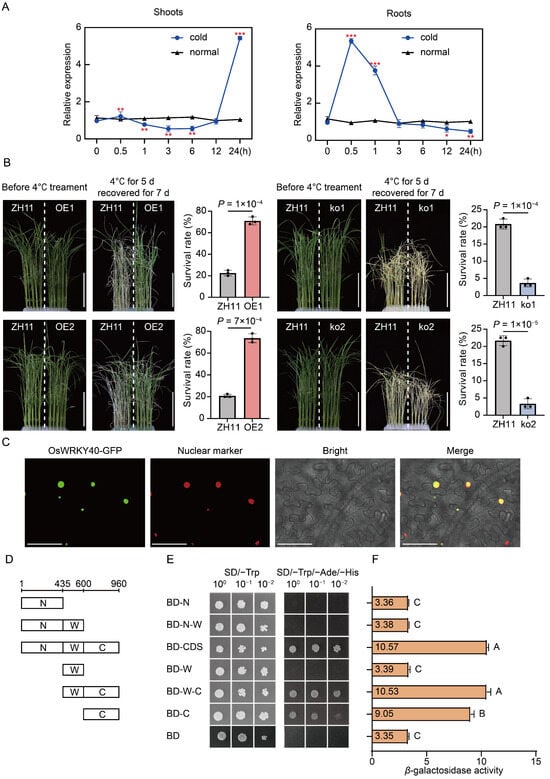
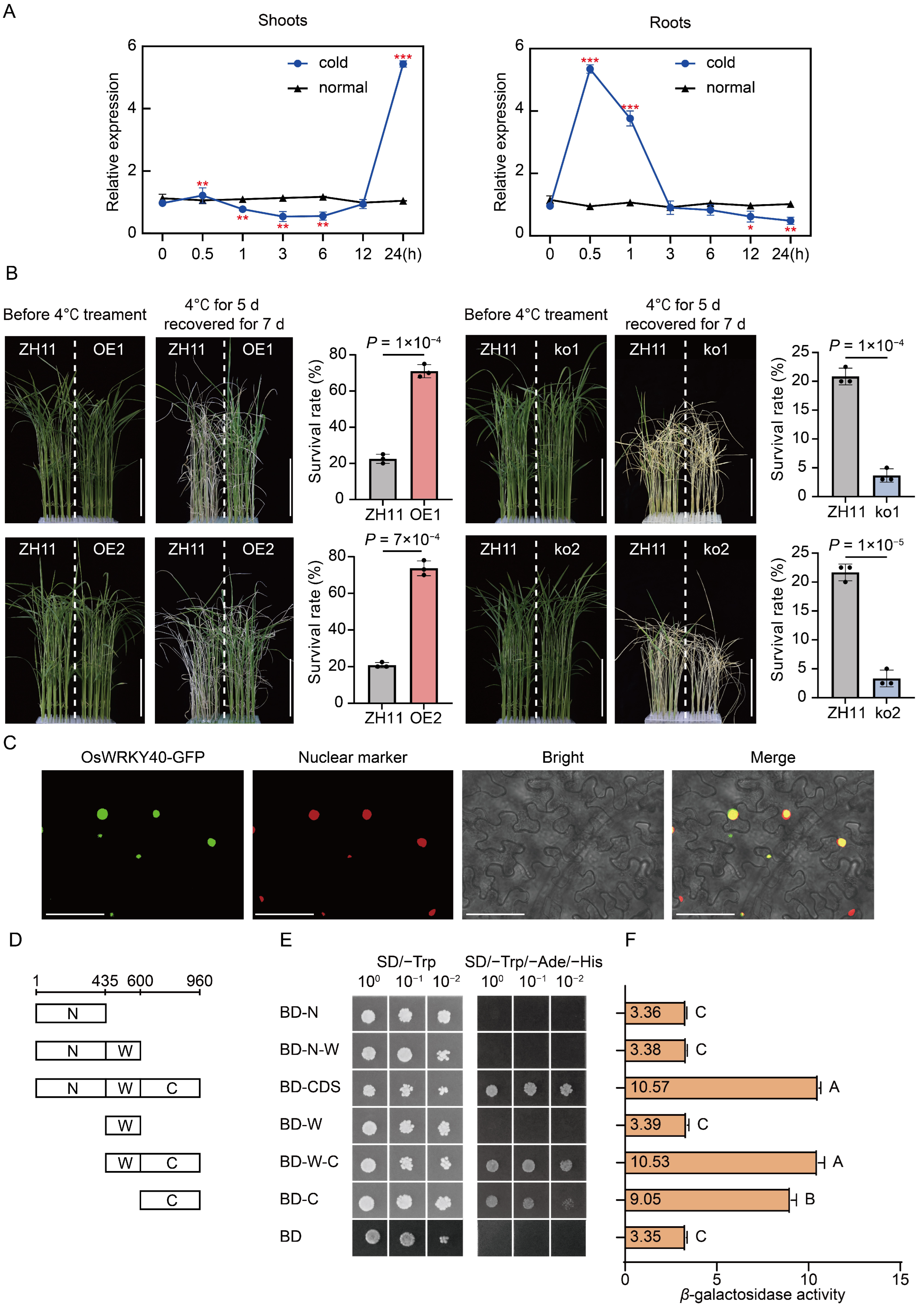
To confirm this expression pattern, we performed qRT-PCR analysis using shoots and roots of two-week-old ZH11 seedlings exposed to cold stress. OsWRKY40 was rapidly induced in both tissues, but the induction pattern differed between shoots and roots. In shoots, OsWRKY40 expression gradually increased and reached a peak at 24 h, whereas in roots, transcript levels increased sharply within 0.5 h after cold treatment (Figure 1A). These results indicate that OsWRKY40 responds rapidly to cold stress and may function in both aboveground and underground tissues during early cold adaptation. Tissue-specific expression analysis further showed that OsWRKY40 was expressed in multiple rice tissues, with relatively high expression at the seedling stage (Figure S2A). This expression profile is consistent with a potential role in seedling-stage cold stress responses.
Figure 1.
OsWRKY40 is a cold-induced nucleus-localized transcription factor that positively regulates rice (Oryza sativa L.) seedling cold tolerance. (A) Expression patterns of OsWRKY40 in shoots (left) and roots (right) under cold stress. Asterisks denote statistical significance (*, p < 0.05; **, p < 0.01; ***, p < 0.001). (B) Cold treatment of wild-type and transgenic rice lines at the seedling stage. Scale bar = 5 cm. (C) Subcellular localization of OsWRKY40. Green fluorescence indicates the OsWRKY40-GFP signal, red fluorescence indicates the nuclear marker signal, and the bright-field image shows cell morphology. Scale bar = 75 μm. (D) Schematic diagram of OsWRKY40 and its truncated fragments. N, W, and C represent the N-terminal region, WRKY domain, and C-terminal region of the OsWRKY40 protein, respectively, and numbers indicate nucleotide positions. (E) Transcriptional activation assay of full-length and truncated OsWRKY40 proteins. Yeast transformants were spotted on SD/−Trp and SD/−Trp/−Ade/−His media, and different dilution gradients were used to detect transcriptional activation activity. SD/−Trp, synthetic dropout medium lacking tryptophan; SD/−Trp/−Ade/−His, synthetic dropout medium lacking tryptophan, adenine, and histidine. (F) β-Galactosidase activity assay. Data are presented as mean ± SD (n = 3). Different uppercase letters indicate significant differences among groups (p < 0.01). SD, standard deviation.
To investigate the biological function of OsWRKY40, we generated OsWRKY40-overexpressing lines and CRISPR/Cas9-mediated knockout mutants in the ZH11 background. qRT-PCR confirmed that OsWRKY40 transcript levels were substantially increased in the overexpression lines (Figure S2B). Sequence analysis of the knockout lines revealed frameshift mutations that caused premature translational termination, indicating loss of OsWRKY40 function (Figure S2C). These materials were then used to evaluate cold tolerance.
Under normal growth conditions, no obvious growth differences were observed among the wild type, overexpression lines, and knockout mutants at the seedling stage. After cold treatment, however, the three genotypes showed clear differences in survival rates. OsWRKY40-overexpressing plants displayed improved recovery, with survival rates approximately 50 percentage points higher than those of the wild type, whereas oswrky40 knockout mutants were more sensitive to cold stress, with survival rates approximately 18 percentage points lower than those of the wild type (Figure 1B). These opposite phenotypes in gain- and loss-of-function lines demonstrate that OsWRKY40 positively regulates rice cold tolerance at the seedling stage.
We further examined whether OsWRKY40 also affects cold tolerance at the reproductive stage. In contrast to the clear seedling-stage phenotype, no significant differences were detected among the wild type, overexpression lines, and knockout mutants under reproductive-stage cold treatment (Figure S3). Together, these results indicate that OsWRKY40 mainly contributes to cold tolerance during the seedling stage rather than the reproductive stage.
3.2. OsWRKY40 Functions as a Nucleus-Localized Transcriptional Activator
Since OsWRKY40 encodes a WRKY transcription factor, we next examined its subcellular localization. An OsWRKY40-GFP fusion construct was transiently expressed in Nicotiana benthamiana leaves together with the nuclear marker OsbZIP52-mRFP. Confocal microscopy showed that the GFP fluorescence signal fully overlapped with the nuclear marker signal (Figure 1C). No obvious GFP signal was detected outside the nucleus, indicating that OsWRKY40 is localized in the nucleus, consistent with its predicted function as a transcription factor.
We then examined whether OsWRKY40 has transcriptional activation activity. Full-length OsWRKY40 was fused with the GAL4 DNA-binding domain and expressed in yeast. Yeast cells carrying the OsWRKY40 fusion protein grew on selective medium and activated reporter expression, whereas cells carrying the empty vector failed to grow under the same conditions (Figure 1D,E). These results indicate that OsWRKY40 possesses transcriptional activation activity.
To determine which region is responsible for this activity, OsWRKY40 was divided into different fragments, including the N-terminal region, the WRKY domain-containing region, and the C-terminal region (Figure 1D,E). Yeast assays showed that only the fragment containing the C-terminal region retained transcriptional activation activity, whereas fragments lacking this region showed little or no activation capacity (Figure 1E). β-Gal activity assays further confirmed that the C-terminal region contributed most strongly to reporter activation (Figure 1F). These results demonstrate that OsWRKY40 is a nucleus-localized transcriptional activator and its C-terminal region is required for transcriptional activation.
3.3. OsWRKY40 Binds W-Box Elements and Regulates Cold-Responsive Genes
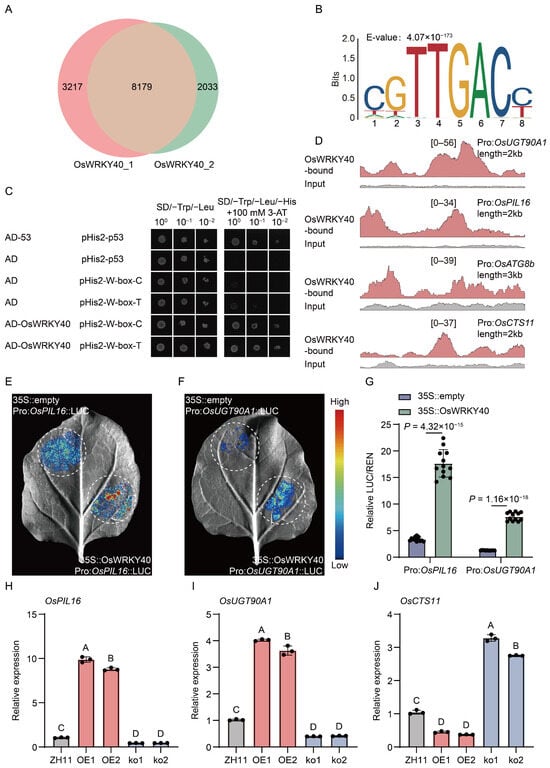
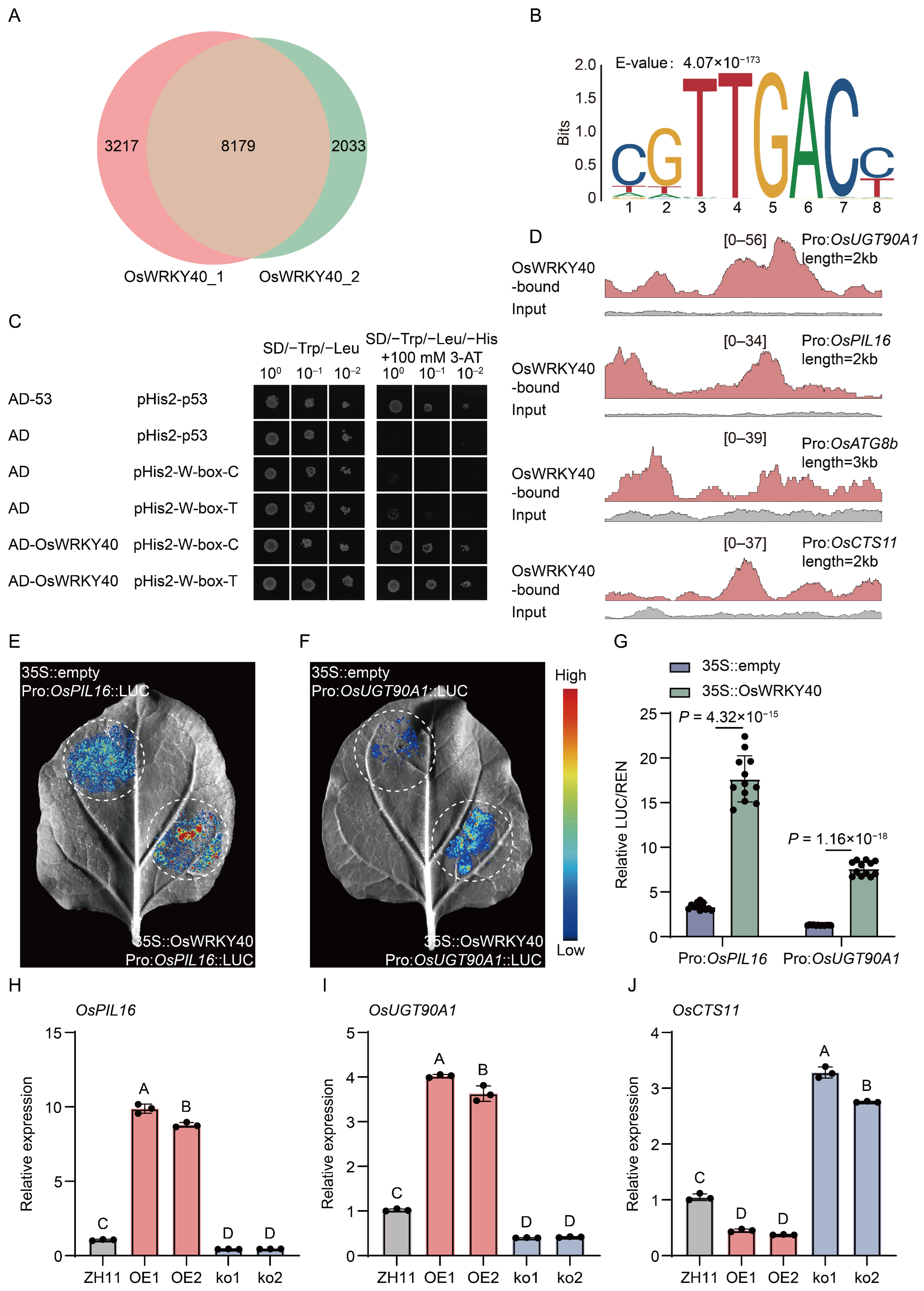
To identify potential downstream targets of OsWRKY40, we performed DAP-seq. More than 8000 putative OsWRKY40-binding genes were identified (Figure 2A), suggesting that OsWRKY40 may regulate a broad transcriptional network. Motif enrichment analysis showed that W-box elements, the canonical binding sites of WRKY transcription factors, were highly enriched in OsWRKY40-bound regions (Figure 2B). This result supports the reliability of the DAP-seq dataset and indicates that OsWRKY40 likely recognizes target promoters through W-box motifs.
Figure 2.
OsWRKY40 regulates downstream cold-responsive genes. (A) Overlap of target genes identified in two DAP-seq replicates of OsWRKY40. (B) Motif enrichment analysis of OsWRKY40-binding sites identified by DAP-seq. (C) Y1H assay showing the binding of OsWRKY40 to the W-box element. AD, pGADT7 activation domain vector; SD/−Trp/−Leu, synthetic dropout medium lacking tryptophan and leucine; SD/−Trp/−Leu/−His, synthetic dropout medium lacking tryptophan, leucine, and histidine. (D) Visualization of OsWRKY40-binding peaks in the promoter regions of downstream target genes. Peak tracks within the same group are displayed at the same vertical scale. (E,F) Dual-LUC assays showing the effects of OsWRKY40 on the promoter activities of OsPIL16 (E) and OsUGT90A1 (F). (G) Relative LUC/REN activity. Reporter constructs (Pro:OsPIL16-LUC or Pro:OsUGT90A1-LUC) were co-transformed with the indicated effector constructs (empty vector or OsWRKY40). Data are presented as mean ± SD (n = 12). (H–J) Relative expression of downstream genes. Gene expression was normalized to Ubiquitin and calculated using the 2−ΔΔCt method. Data are presented as mean ± SD (n = 3). Different uppercase letters indicate significant differences among groups (p < 0.01). SD, standard deviation.
Gene ontology enrichment analysis showed that putative OsWRKY40 targets were significantly enriched in stress-related biological processes and molecular functions, including oxidoreductase activity, peroxidase activity, and redox-related pathways (Figure S4). These enriched categories are consistent with the cold-sensitive phenotype of oswrky40 mutants and suggest that OsWRKY40 may regulate cold tolerance through multiple downstream processes, including oxidative stress responses.
To validate the DNA-binding ability of OsWRKY40, Y1H assays were performed using W-box-containing sequences. OsWRKY40 was able to bind these sequences in yeast (Figure 2C), confirming that OsWRKY40 directly recognizes W-box elements. Based on the DAP-seq data and stress-related functional annotations, several candidate target genes were selected for further validation, including OsUGT90A1, OsPIL16, OsCTS11, and OsATG8b (Figure 2D). These genes are associated with hormone-related metabolism, growth or light-related regulation, and autophagy-related stress responses, respectively.
Dual-LUC assay showed that OsWRKY40 significantly activated the promoters of OsUGT90A1 and OsPIL16, which have been reported as positive regulators of seedling-stage cold tolerance [30,31] (Figure 2E–G), indicating that OsWRKY40 can transcriptionally regulate these genes. Consistently, qRT-PCR analysis showed that OsUGT90A1 and OsPIL16 were upregulated in OsWRKY40-overexpressing plants but downregulated in oswrky40 knockout mutants under cold stress (Figure 2H,I). These expression patterns support the conclusion that these genes act downstream of OsWRKY40.
We also examined OsCTS11, a reported negative regulator of cold tolerance. In contrast to OsUGT90A1 and OsPIL16, OsCTS11 expression was reduced in OsWRKY40-overexpressing lines and increased in oswrky40 mutants (Figure 2J). This opposite pattern suggests that OsWRKY40 may promote cold tolerance not only by activating positive stress-responsive genes but also by suppressing or indirectly reducing the expression of negative regulators. Taken together, these results indicate that OsWRKY40 functions as an upstream regulator of multiple cold-responsive genes and may coordinate several pathways related to hormone responses, growth regulation, autophagy, and redox balance.
3.4. OsWRKY40 Activates OsATG8b and Promotes Autophagy Under Cold Stress
Among the candidate OsWRKY40 targets identified by DAP-seq, OsATG8b was selected for further analysis because ATG8 proteins are core components of the autophagy pathway. Autophagy is important for cellular recycling and stress adaptation, especially under conditions that cause protein damage, organelle injury, or metabolic imbalance. Therefore, we investigated whether OsWRKY40 affects autophagy by regulating OsATG8b.
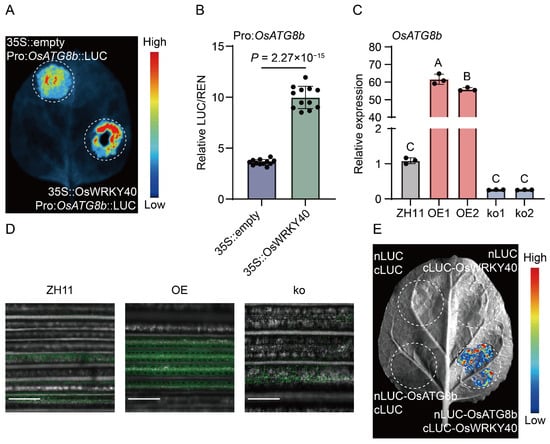
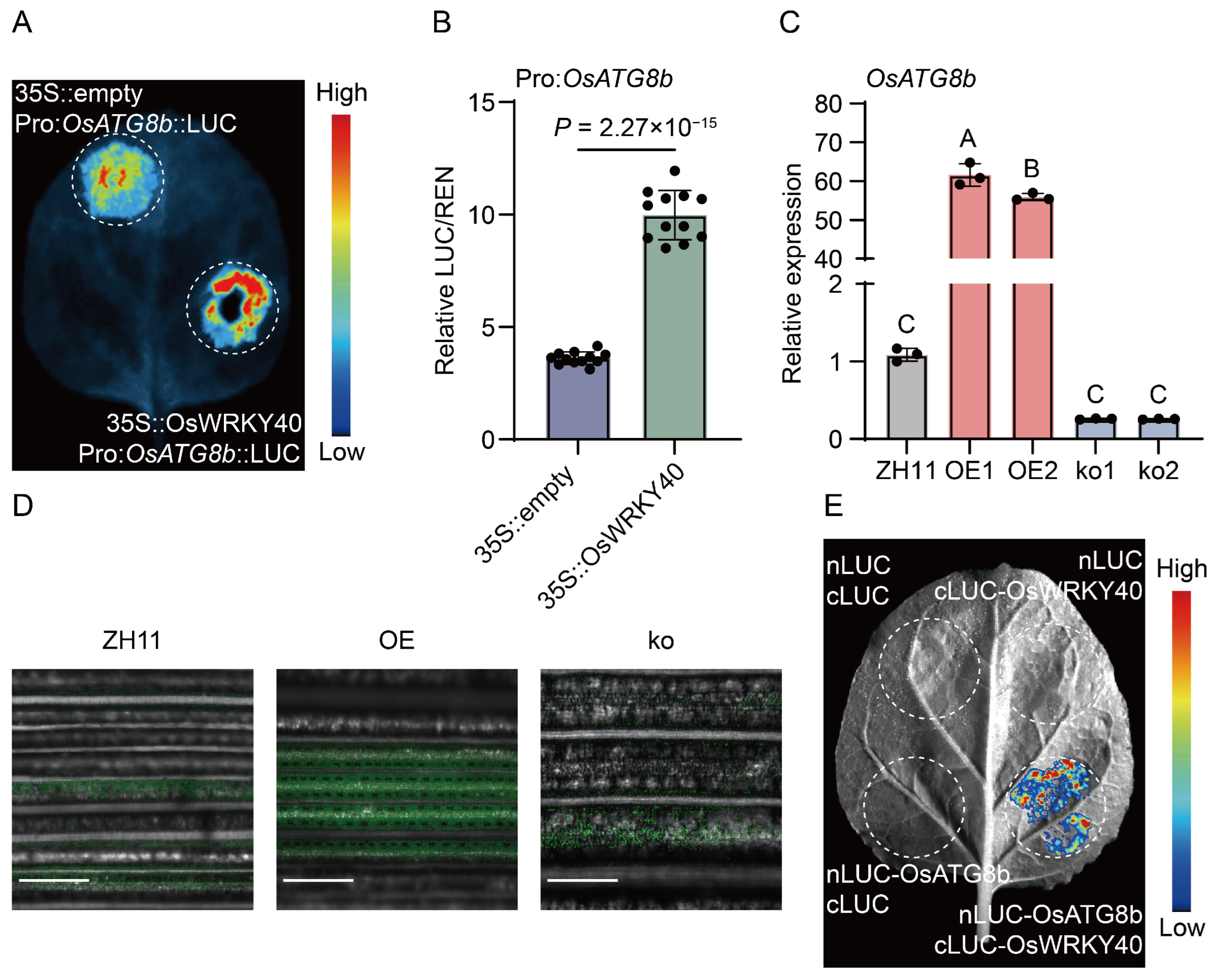
The Dual-LUC assay showed that co-expression of OsWRKY40 significantly increased the activity of the OsATG8b promoter (Figure 3A,B), indicating that OsWRKY40 can activate OsATG8b transcription. qRT-PCR analysis further showed that OsATG8b transcript levels were higher in OsWRKY40-overexpressing lines but lower in oswrky40 mutants under cold stress (Figure 3C). These results suggest that OsATG8b is transcriptionally regulated by OsWRKY40 during cold treatment.
Figure 3.
OsWRKY40 transcriptionally activates OsATG8b to promote autophagy. (A) Dual-LUC assay showing the effect of OsWRKY40 on the transcriptional activity of the OsATG8b promoter. 35S:empty was used as the effector control, and Pro:OsATG8b-LUC was used as the reporter construct. (B) Relative LUC/REN activity. The Pro:OsATG8b-LUC reporter vector was co-transformed with the indicated effector vector (empty vector or OsWRKY40). Data are presented as mean ± SD (n = 12). SD, standard deviation. (C) Relative expression of OsATG8b. Gene expression was normalized to Ubiquitin and calculated using the 2−ΔΔCt method. Data are presented as mean ± SD (n = 3). Different uppercase letters indicate significant differences among groups (p < 0.01). SD, standard deviation. (D) MDC staining for visualization of autophagic activity. Scale bar = 400 μm. (E) LCI assay showing the interaction between OsWRKY40 and OsATG8b. nLUC and cLUC were used as negative controls. nLUC and cLUC represent the N-terminal and C-terminal fragments of luciferase, respectively.
To determine whether changes in OsATG8b expression were associated with altered autophagic activity, we performed MDC staining. Under cold stress, OsWRKY40-overexpressing plants showed stronger MDC fluorescence than wild type, whereas oswrky40 mutants showed weaker fluorescence (Figure 3D). Because MDC is widely used as an indicator of autophagic activity, these results indicate that autophagic activity is enhanced in OsWRKY40-overexpressing plants and reduced in oswrky40 mutants. Thus, OsWRKY40 positively regulates autophagy under cold stress, at least partly through activation of OsATG8b expression.
In addition to transcriptional regulation, Y2H screening identified OsATG8b as a potential OsWRKY40-associated protein. LCI assays further detected luminescence signals when OsWRKY40 and OsATG8b were co-expressed (Figure 3E), suggesting that the two proteins may associate in planta. However, the functional significance of this possible interaction remains unclear. Based on the current data, the most direct evidence supports a transcriptional regulatory relationship in which OsWRKY40 activates OsATG8b expression and promotes autophagy during cold stress.
3.5. OsWRKY40 Improves ROS Homeostasis Under Cold Stress
Cold stress often induces excessive accumulation of ROS, which can cause oxidative damage and reduce plant survival. Because DAP-seq and GO enrichment analyses suggested that OsWRKY40 target genes are associated with oxidoreductase and peroxidase activities, we examined whether OsWRKY40 affects ROS accumulation under cold stress.
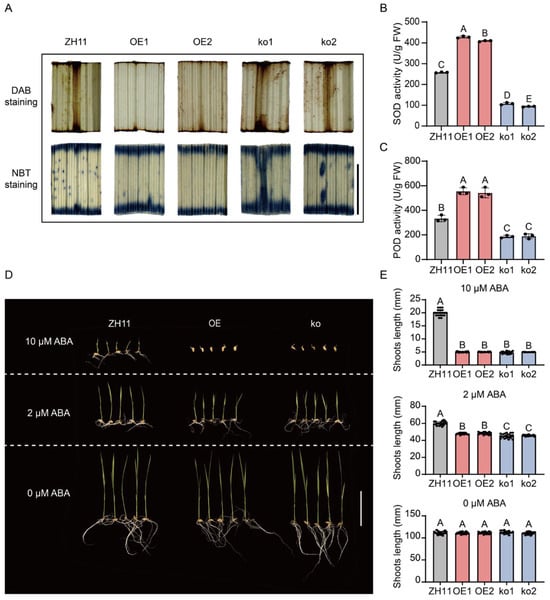
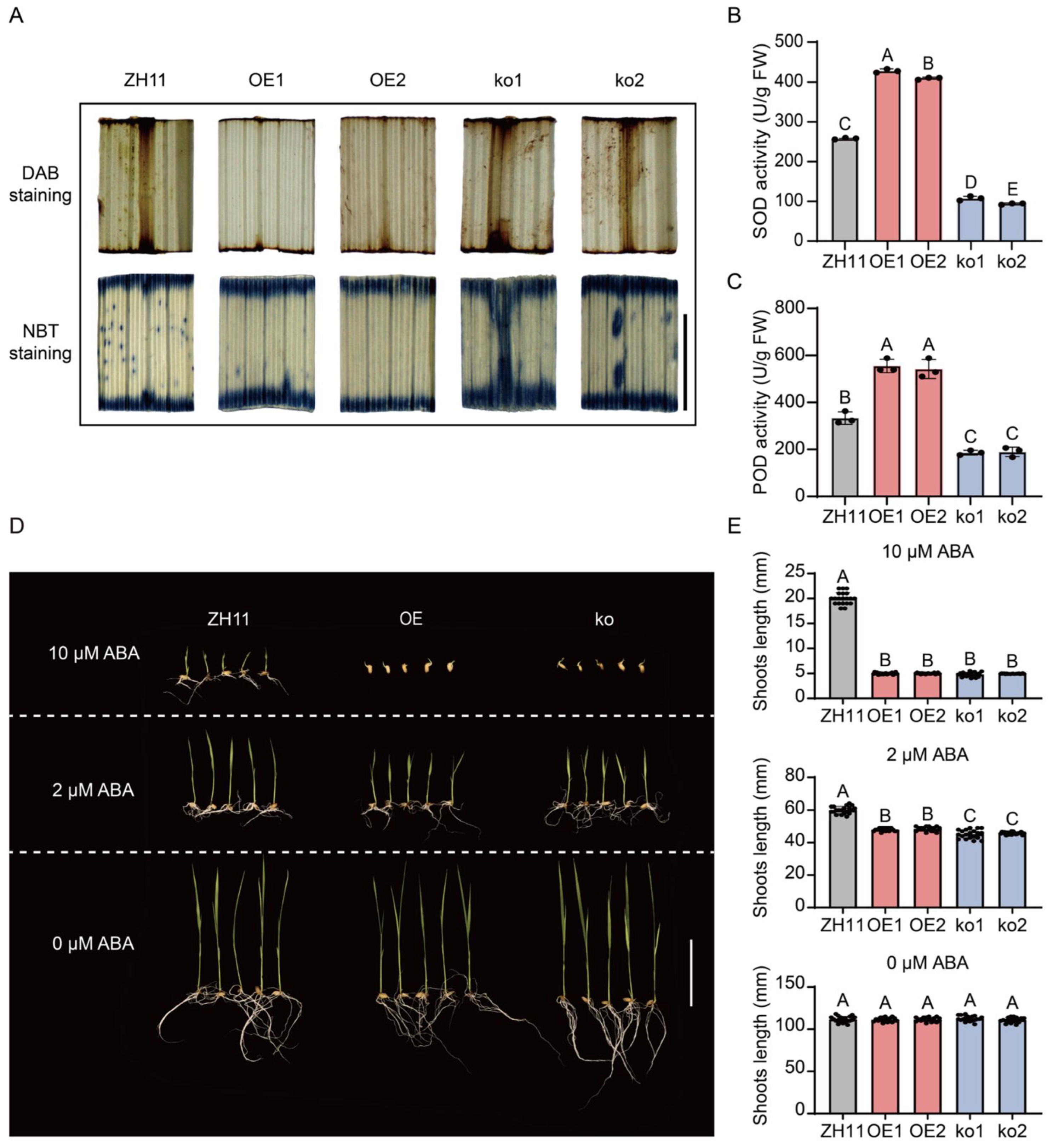
DAB staining was used to detect hydrogen peroxide (H2O2) accumulation. After cold treatment, OsWRKY40-overexpressing plants showed weaker DAB staining than wild type, whereas oswrky40 knockout mutants showed stronger staining (Figure 4A). This result indicates that H2O2 accumulation was reduced in overexpression lines but increased in knockout mutants. Similar results were obtained by NBT staining, which reflects superoxide (O2−) accumulation. OsWRKY40-overexpressing plants showed weaker NBT staining, whereas oswrky40 mutants accumulated more O2− under cold stress (Figure 4A). These staining results demonstrate that OsWRKY40 reduces cold-induced ROS accumulation.
Figure 4.
OsWRKY40 enhances ROS scavenging and affects ABA sensitivity in rice. (A) H2O2 and O2− accumulation detected by DAB and NBT staining, respectively. DAB and NBT staining were performed using leaves from the same batch of seedlings under identical treatment conditions. Scale bar = 0.5 cm. (B) SOD activity in wild-type and OsWRKY40 transgenic rice lines after cold treatment. (C) POD activity in wild-type and OsWRKY40 transgenic rice lines after cold treatment. Data are presented as mean ± SD (n = 3). Different uppercase letters indicate significant differences among groups (p < 0.01). (D) Seedling phenotypes after treatment with different concentrations of ABA. Scale bar = 5 cm. (E) Statistical analysis of shoot length of seedlings under different ABA concentrations. Data are presented as mean ± SD (n = 20). Different uppercase letters indicate significant differences among groups (p < 0.01). SD, standard deviation.
We then measured antioxidant enzyme activities to determine whether the altered ROS levels were associated with ROS-scavenging capacity. The activities of SOD and POD were higher in OsWRKY40-overexpressing lines than in wild type, whereas both activities were lower in oswrky40 mutants (Figure 4B,C). These results suggest that OsWRKY40 enhances antioxidant capacity under cold stress.
Consistent with the enzyme activity data, the expression levels of antioxidant-related genes, including OsMSD1 and OsPRX38, were increased in OsWRKY40-overexpressing plants and decreased in oswrky40 mutants (Figure S5A,B). By contrast, the expression of Osrboh1, which is associated with ROS production, did not differ significantly among the genotypes (Figure S5C). These results suggest that OsWRKY40 overexpression is associated with increased antioxidant enzyme activities and reduced ROS accumulation under cold stress. Overall, OsWRKY40 enhances antioxidant enzyme activity and activates ROS-scavenging-related genes, thereby limiting excessive ROS accumulation under cold stress.
3.6. OsWRKY40 Is Involved in ABA-Responsive Seedling Growth
ABA is an important hormone involved in plant responses to abiotic stresses, including cold stress. Because several OsWRKY40-regulated genes were related to stress and hormone-associated pathways (Figure S6), we examined whether OsWRKY40 affects ABA responses at the seedling stage.
Wild-type, OsWRKY40-overexpressing, and oswrky40 knockout seedlings were grown under different ABA concentrations. In the absence of ABA, no obvious differences in shoot growth were observed among the genotypes (Figure 4D,E), indicating that altered OsWRKY40 expression does not strongly affect seedling growth under normal conditions. After ABA treatment, shoot growth was inhibited in all genotypes. However, both OsWRKY40-overexpressing lines and oswrky40 mutants showed altered ABA sensitivity compared with wild type (Figure 4D,E).
Interestingly, both gain- and loss-of-function lines appeared more sensitive to ABA than wild type. These results suggest that altered OsWRKY40 expression affects ABA-responsive seedling growth, although its role in ABA responses does not follow a simple linear positive or negative regulatory pattern. The potential relationship between OsWRKY40 and ABA signaling, particularly in the context of cold stress responses, remains to be further investigated.
3.7. Natural Variation in OsWRKY40 Is Associated with Rice Cold Tolerance
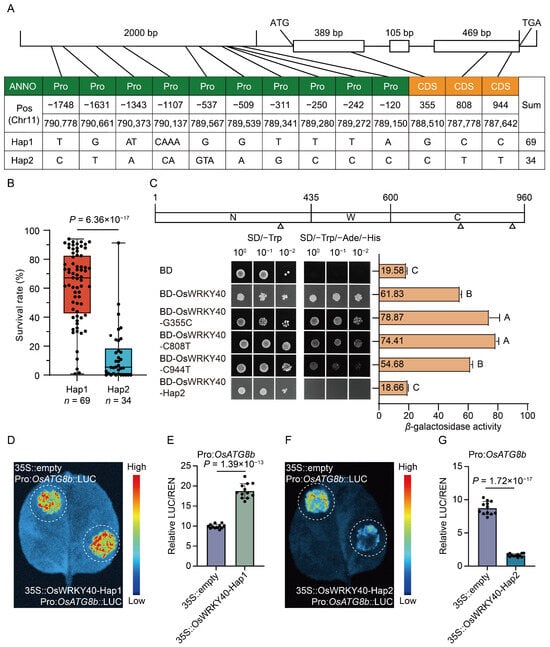
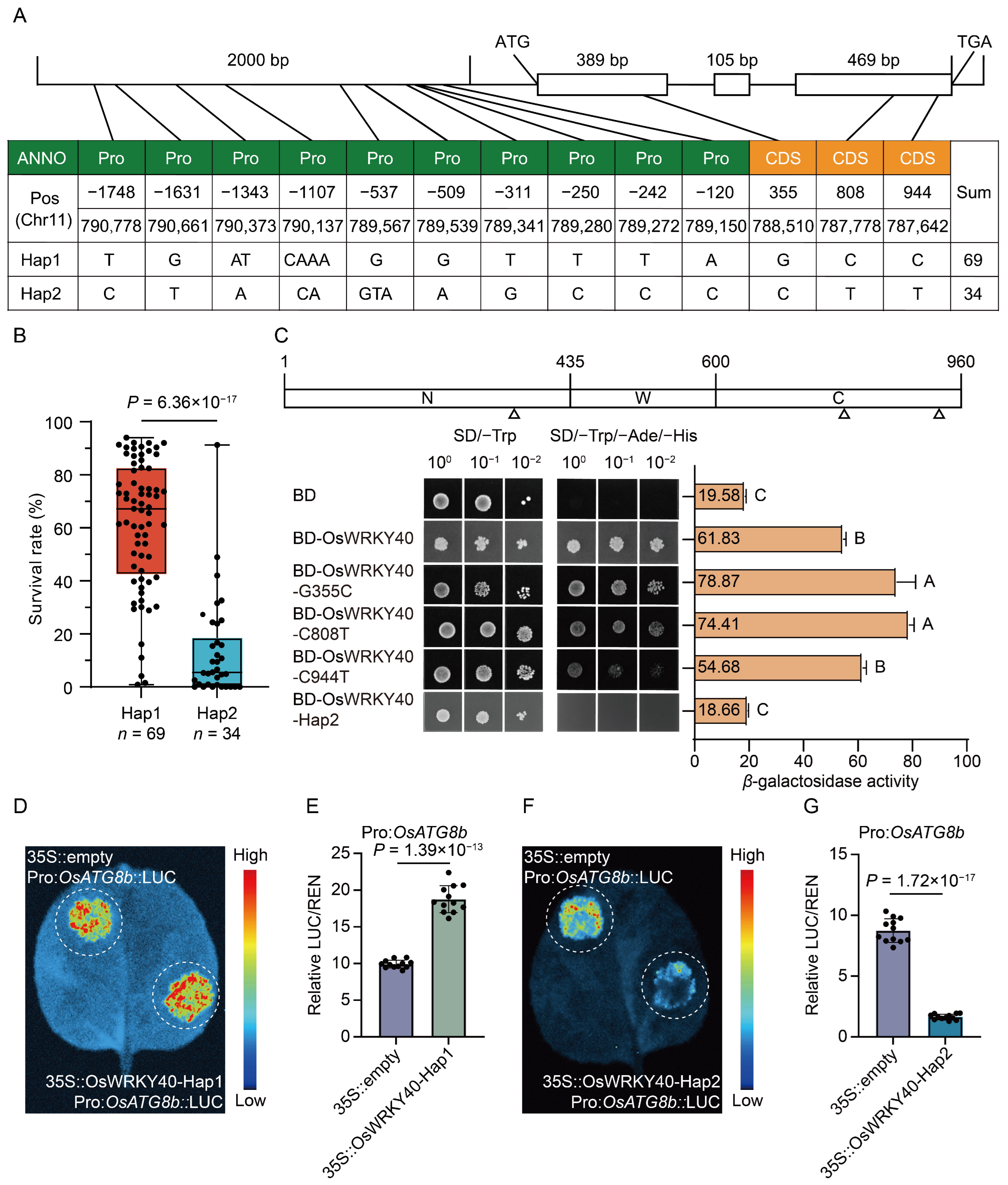
To determine whether natural variation in OsWRKY40 is associated with cold tolerance in rice germplasm, we analyzed sequence polymorphisms in the OsWRKY40 genomic region. Sequence comparison identified ten polymorphisms in the promoter region and three nonsynonymous single nucleotide polymorphisms in the coding region (Figure 5A). Based on these variations, two major haplotypes, designated Hap1 and Hap2, were identified. The presence of polymorphisms in both promoter and coding regions suggests that natural variation may affect OsWRKY40 function through changes in gene expression, protein activity, or both.
Figure 5.
Haplotype variation of OsWRKY40 determines cold tolerance differences. (A) Schematic diagram of the structural features of OsWRKY40 haplotypes in the mini-core population. Green represents the promoter region, and yellow represents the CDS region. (B) Survival rates of different OsWRKY40 haplotypes under cold stress. (C) Transcriptional activation assay and β-galactosidase activity assay of OsWRKY40 variants carrying individual or combined non-synonymous substitutions. Yeast transformants were serially diluted and spotted onto SD/−Trp and SD/−Trp/−Ade/−His media to assess transcriptional activation activity, and β-galactosidase activity was quantified. Black triangles indicate non-synonymous mutations in the CDS. SD/−Trp, synthetic dropout medium lacking tryptophan; SD/−Trp/−Ade/−His, synthetic dropout medium lacking tryptophan, adenine, and histidine. Data are presented as mean ± SD (n = 3). Different uppercase letters indicate significant differences among groups (p < 0.01). (D,E) Dual-LUC assay and relative LUC/REN activity showing the effect of OsWRKY40-Hap1 on the activity of the OsATG8b promoter. (F,G) Dual-LUC assay and relative LUC/REN activity showing the effect of OsWRKY40-Hap2 on the activity of the OsATG8b promoter. Data are presented as mean ± SD (n = 12). Different uppercase letters indicate significant differences among groups (p < 0.01).
We next compared cold tolerance between accessions carrying different haplotypes. Accessions with Hap1 showed higher survival rates under cold stress than those carrying Hap2 (Figure 5B), indicating that Hap1 is associated with stronger cold tolerance. Geographic and subspecies distribution analysis further showed that Hap1 was enriched in japonica accessions and in rice varieties from relatively cold-adapted regions, whereas Hap2 was more frequent in indica accessions and tropical regions (Figure S7A–C). This distribution pattern is consistent with the phenotypic difference between Hap1 and Hap2 and suggests that OsWRKY40 variation may have contributed to adaptation to different thermal environments.
To test whether the nonsynonymous coding SNPs affect OsWRKY40 protein function, the three amino acid substitutions were introduced individually or in combination into the Hap1 background. Subcellular localization analysis showed that all mutant proteins remained localized in the nucleus (Figure S8A), indicating that these substitutions do not affect nuclear localization. Transcriptional activation assays showed that individual substitutions had limited effects on OsWRKY40 activity, whereas the triple mutation significantly reduced transactivation activity (Figure 5C). Thus, the combined coding variations may weaken the transcriptional activation capacity of OsWRKY40.
We further examined whether these mutations affected the association between OsWRKY40 and OsATG8b. The interaction was not obviously altered by the mutations (Figure S8B), suggesting that the functional difference between haplotypes is more likely related to transcriptional activation activity than to protein interaction with OsATG8b. Consistently, Dual-LUC assays showed that Hap1 activated the OsATG8b promoter more strongly than Hap2 (Figure 5D–G). These results suggest that Hap1 may enhance cold tolerance by increasing the transcriptional activation of downstream stress-responsive genes such as OsATG8b.
Together, these findings indicate that natural variation in OsWRKY40 is associated with differences in seedling-stage cold tolerance. Hap1 represents a potentially favorable candidate haplotype with stronger transcriptional activation capacity and an association with higher cold survival in the analyzed rice population, suggesting that OsWRKY40 may have potential value for improving seedling-stage cold tolerance in rice breeding, although the observed association may be influenced by population structure.
4. Discussion
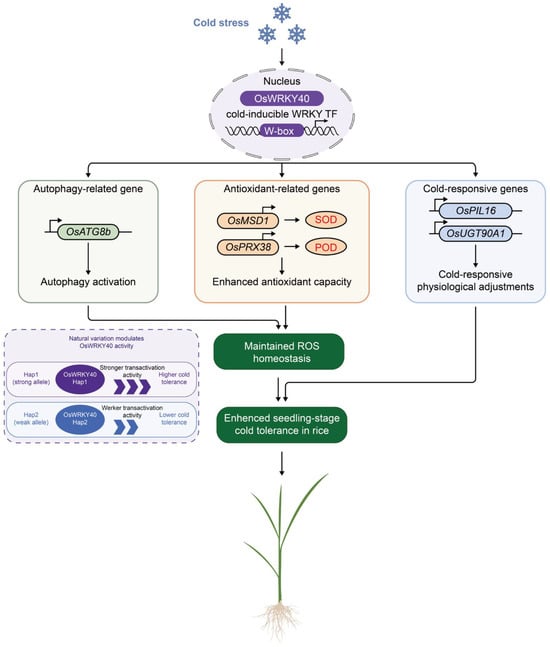
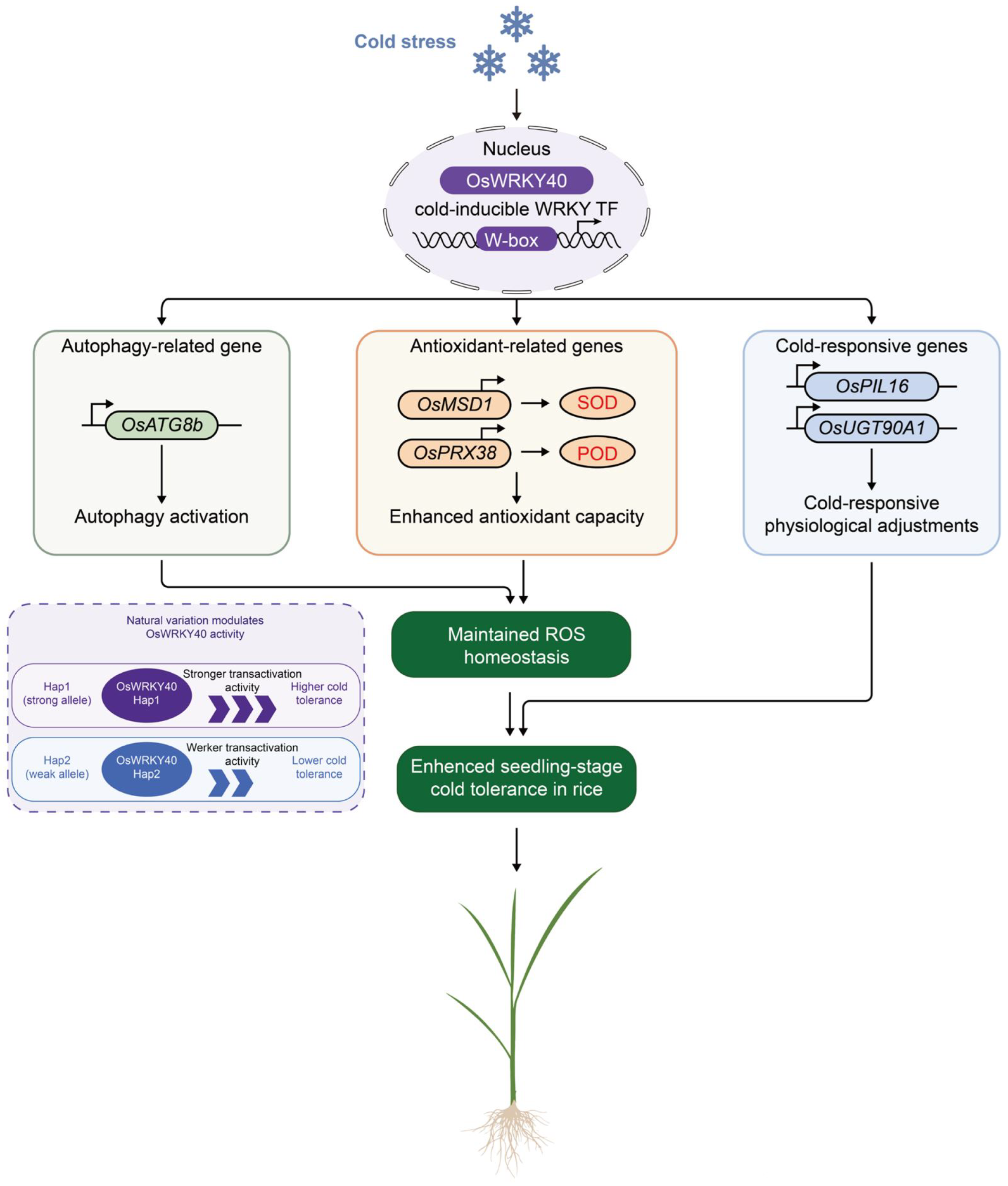
This study systematically revealed the central positive regulatory role of the Group III WRKY transcription factor OsWRKY40 in rice seedling-stage cold tolerance and accordingly proposed a multilayered cold-tolerance regulatory model centered on OsWRKY40 (Figure 6). As a transcriptional activator, OsWRKY40 enhances rice adaptation to cold stress by coordinately activating the autophagy pathway, the antioxidant defense system, and multiple known cold-responsive genes, thereby promoting cold tolerance at multiple regulatory levels.
Figure 6.
Proposed model of OsWRKY40-mediated regulation of rice cold tolerance. Based on the genetic, molecular, and physiological evidence presented in this study, OsWRKY40 is proposed to act as an important regulator of cold tolerance in rice. Under cold stress, OsWRKY40 directly activates the autophagy-related gene OsATG8b and promotes the expression of downstream genes involved in antioxidant defense and cold adaptation, including OsMSD1, OsPRX38, OsPIL16, and OsUGT90A1. These coordinated responses enhance autophagy activity, strengthen antioxidant capacity, and maintain ROS homeostasis, thereby improving seedling-stage cold tolerance. Furthermore, natural allelic variation in OsWRKY40 modulates its transactivation activity, thereby contributing to differences in cold tolerance.
4.1. OsWRKY40 Coordinates Autophagy and ROS Homeostasis During Rice Cold Adaptation
WRKY transcription factors constitute one of the largest transcription factor families in plants and exhibit diverse and sometimes contrasting roles in cold stress responses [32,33]. In rice, certain members such as OsWRKY71 and OsWRKY76 act as positive regulators of cold tolerance [20,22,34], whereas others, including OsWRKY45 [35], OsWRKY61 [36], and OsWRKY53 [21], function as negative regulators, highlighting the functional divergence of WRKY-mediated regulatory networks in cold adaptation. In this study, OsWRKY40 was identified as a cold-inducible Group III WRKY transcription factor with nuclear localization and transcriptional activation activity. Genetic analyses demonstrated that OsWRKY40 positively regulates seedling-stage cold tolerance in rice, as overexpression lines showed enhanced survival under cold stress, whereas knockout mutants displayed increased sensitivity.
Cold stress is well known to induce excessive accumulation of ROS, which disrupt cellular homeostasis and cause oxidative damage if not properly controlled [7]. In OsWRKY40-overexpressing plants, reduced accumulation of H2O2 and O2− was observed under cold treatment, indicating improved ROS homeostasis. This phenotype was accompanied by increased activities of antioxidant enzymes such as SOD and POD, together with elevated expression of OsMSD1 and OsPRX38, whereas expression of the ROS-producing gene Osrboh1 remained largely unchanged. Collectively, these observations suggest that OsWRKY40 primarily enhances ROS-scavenging capacity rather than directly suppressing ROS production, consistent with a transcriptional regulatory role in strengthening antioxidant defense systems during cold stress.
Beyond its role in ROS detoxification, cellular homeostasis during cold stress also depends on autophagy-mediated quality control and recycling processes [37,38]. Although autophagy has been implicated in multiple abiotic stress responses [39], few transcriptional regulators controlling cold-induced autophagy have been characterized in rice. Here, DAP-seq analysis identified OsATG8b as a potential target of OsWRKY40. Y1H assays further demonstrated that OsWRKY40 recognizes W-box elements, while Dual-LUC assays confirmed its ability to activate the OsATG8b promoter. Together, these results support the direct transcriptional regulation of OsATG8b by OsWRKY40. Consistently, OsWRKY40 overexpression enhanced autophagic activity under cold stress, whereas autophagy was reduced in knockout plants, indicating that OsWRKY40 positively regulates autophagy through transcriptional activation of OsATG8b. The identification of OsATG8b as a direct target of OsWRKY40 provides a mechanistic link between transcriptional regulation and autophagy activation during rice cold responses.
ROS and autophagy are tightly interconnected in plant stress responses, forming a feedback network in which ROS can induce autophagy, while autophagy in turn limits ROS accumulation by removing damaged cellular components [40,41]. In this context, the reduced ROS levels observed in OsWRKY40-overexpressing plants are consistent with the enhanced autophagic activity detected under cold stress. Thus, antioxidant enzymes and autophagy likely function in a coordinated and complementary manner, where antioxidant systems directly detoxify ROS and autophagy maintains organelle integrity to prevent excessive ROS production. Nevertheless, the mechanistic relationship between autophagy activation and ROS detoxification remains unresolved in the present study. Although OsWRKY40 overexpression simultaneously enhanced autophagic activity, increased SOD and POD activities, and reduced ROS accumulation under cold stress, our data do not provide direct evidence that autophagy is responsible for the observed enhancement of antioxidant capacity or ROS scavenging. It therefore remains unclear whether OsATG8b-mediated autophagy directly regulates ROS homeostasis, indirectly affects antioxidant enzyme activities, or functions in parallel with antioxidant pathways downstream of OsWRKY40. Future studies using autophagy-deficient genetic backgrounds and pharmacological inhibition approaches will be required to dissect the causal relationships among autophagy, antioxidant defense systems, and ROS homeostasis during rice cold adaptation. In addition, whether the OsWRKY40-mediated regulatory network functions similarly under other abiotic stresses, or interacts with developmental stage-specific signaling pathways, remains an important question for future investigation.
4.2. Natural Variation and Breeding Potential of OsWRKY40
Haplotype-based breeding strategies provide an effective approach for utilizing natural genetic variation in crop improvement. Previous studies have demonstrated that allelic variation in transcription factors can significantly affect agronomic traits. For example, variation in OsGATA8 influences nitrogen use efficiency and tillering [42], while OsDROT1 haplotypes are associated with drought tolerance [43].
In this study, OsWRKY40 haplotypes were found to be associated with both cold tolerance and geographic distribution. The cold-tolerant haplotype Hap1 is predominantly present in high-latitude japonica rice, whereas the more sensitive Hap2 is mainly found in indica accessions, suggesting that OsWRKY40 has been shaped by environmental selection during rice adaptation.
Functional analysis indicates that Hap1 contains three nonsynonymous SNPs that enhance the transcriptional activation capacity of OsWRKY40, particularly its ability to regulate OsATG8b. This provides a molecular explanation for the observed differences in cold tolerance between haplotypes. Similar allele-dependent functional divergence of WRKY transcription factors has been reported in other species, such as Populus tomentosa [44], highlighting the broader relevance of transcription factor variation in environmental adaptation.
Collectively, these findings suggest that OsWRKY40-Hap1 represents a potentially favorable candidate allele associated with higher cold survival and exhibits stronger transcriptional activation capacity. However, its apparent association with improved cold tolerance may be partially influenced by population structure, particularly given its enrichment in japonica accessions. Therefore, the independent contribution of OsWRKY40-Hap1 to natural variation in rice cold tolerance requires further investigation. Nevertheless, these findings provide a basis for further exploring the potential of OsWRKY40 natural variation in rice breeding programs.
Supplementary Materials
The following supporting information can be downloaded at https://www.mdpi.com/article/10.3390/plants15223623/s1. Figure S1: Expression patterns of Group III WRKY transcription factors in rice roots under cold stress; Figure S2: Expression patterns of OsWRKY40 and characterization of transgenic rice lines; Figure S3: OsWRKY40 does not affect cold tolerance at the booting stage; Figure S4: GO enrichment analysis of OsWRKY40 target genes identified by DAP-seq; Figure S5: OsWRKY40 regulates the expression of ROS-scavenging and ROS-producing genes in rice; Figure S6: KEGG enrichment analysis of OsWRKY40 target genes identified by DAP-seq; Figure S7: Distribution frequency, geographical distribution, and subpopulation composition of OsWRKY40 haplotypes; Figure S8: Subcellular localization of OsWRKY40 haplotype-associated mutant proteins and interaction between OsWRKY40-Hap2 and OsATG8b; Table S1: Primers and sequences used in this study.
Author Contributions
Conceptualization: N.Y., C.L. and M.D.; methodology: H.Z., D.Z., L.L., C.Z., H.W., X.D. and R.Z.; investigation: H.Z., D.Z., L.L., C.Z., H.W., J.Y., X.D., L.B., R.Z. and Y.L.; formal analysis: H.Z., D.Z. and L.B.; data curation: H.Z., D.Z., L.L., J.Y. and Y.L.; visualization: H.Z., D.Z. and J.Y.; validation: H.Z. and D.Z.; resources: H.W., N.Y., C.L. and M.D.; writing—original draft: H.Z.; writing—review and editing: H.Z., D.Z., N.Y., C.L. and M.D.; funding acquisition: C.L. and M.D.; project administration: M.D.; supervision: N.Y., C.L. and M.D. All authors have read and agreed to the published version of the manuscript.
Funding
This work was supported by Yuelushan Laboratory Breeding Program (Grant No. YLS-2025-ZY02003), National Natural Science Foundation of China–Hunan Joint Fund (Grant No. U21A201755), Intelligent Breeding of Rice Multi-omics Big Data (Grant No. 2023ZJ1080), Natural Science Foundation of Changsha (kq2402111), and Natural Science Foundation of Hunan Province (Grant No. 2026JJ20034).
Data Availability Statement
All raw sequencing data generated in this study have been deposited in the China National Center for Bioinformation (CNCB) Big Sub database under accession number CRA041863. All other datasets are available within the manuscript and Supplementary Materials.
Acknowledgments
We thank Bluescape Hebei Biotech Co., Ltd. (Baoding, China) for providing the DAP-seq service.
Conflicts of Interest
The authors declare no conflicts of interest.
References
- Liu, C.T.; Ou, S.J.; Mao, B.G.; Tang, J.Y.; Wang, W.; Wang, H.R.; Cao, S.Y.; Schläppi, M.R.; Zhao, B.R.; Xiao, G.Y.; et al. Early Selection of bZIP73 Facilitated Adaptation of Japonica Rice to Cold Climates. Nat. Commun. 2018, 9, 3302. [Google Scholar] [CrossRef] [Scilit] [PubMed]
- Foley, J.A.; Ramankutty, N.; Brauman, K.A.; Cassidy, E.S.; Gerber, J.S.; Johnston, M.; Mueller, N.D.; O’Connell, C.; Ray, D.K.; West, P.C.; et al. Solutions for a Cultivated Planet. Nature 2011, 478, 337–342. [Google Scholar] [CrossRef] [Scilit] [PubMed]
- Liu, C.T.; Schläppi, M.R.; Mao, B.G.; Wang, W.; Wang, A.J.; Chu, C.C. The bZIP73 Transcription Factor Controls Rice Cold Tolerance at the Reproductive Stage. Plant Biotechnol. J. 2019, 17, 1834–1849. [Google Scholar] [CrossRef] [Scilit] [PubMed]
- Li, J.H.; Zhang, Z.Y.; Chong, K.; Xu, Y.Y. Chilling Tolerance in Rice: Past and Present. J. Plant Physiol. 2022, 268, 153576. [Google Scholar] [CrossRef] [Scilit] [PubMed]
- Hirotsu, N.; Makino, A.; Yokota, S.; Mae, T. The Photosynthetic Properties of Rice Leaves Treated with Low Temperature and High Irradiance. Plant Cell Physiol. 2005, 46, 1377–1383. [Google Scholar] [CrossRef] [Scilit] [PubMed]
- Lee, D.G.; Ahsan, N.; Lee, S.H.; Lee, J.J.; Bahk, J.D.; Kang, K.Y.; Lee, B.H. Chilling Stress-Induced Proteomic Changes in Rice Roots. J. Plant Physiol. 2009, 166, 1–11. [Google Scholar] [CrossRef] [Scilit] [PubMed]
- Gill, S.S.; Tuteja, N. Reactive Oxygen Species and Antioxidant Machinery in Abiotic Stress Tolerance in Crop Plants. Plant Physiol. Biochem. 2010, 48, 909–930. [Google Scholar] [CrossRef] [Scilit] [PubMed]
- Dvořák, P.; Krasylenko, Y.; Zeiner, A.; Šamaj, J.; Takáč, T. Signaling Toward Reactive Oxygen Species-Scavenging Enzymes in Plants. Front. Plant Sci. 2021, 11, 618835. [Google Scholar] [CrossRef] [Scilit] [PubMed]
- Xiong, Y.; Contento, A.L.; Nguyen, P.Q.; Bassham, D.C. Degradation of Oxidized Proteins by Autophagy during Oxidative Stress in Arabidopsis. Plant Physiol. 2007, 143, 291–299. [Google Scholar] [CrossRef] [Scilit] [PubMed]
- Avin-Wittenberg, T. Autophagy and Its Role in Plant Abiotic Stress Management. Plant Cell Environ. 2019, 42, 1045–1053. [Google Scholar] [CrossRef] [Scilit] [PubMed]
- Fracchiolla, D.; Sawa-Makarska, J.; Martens, S. Beyond Atg8 Binding: The Role of AIM/LIR Motifs in Autophagy. Autophagy 2017, 13, 978–979. [Google Scholar] [CrossRef] [Scilit] [PubMed]
- Zhen, X.X.; Xu, F.; Zhang, W.Z.; Li, N.; Li, X. Overexpression of Rice Gene OsATG8b Confers Tolerance to Nitrogen Starvation and Increases Yield and Nitrogen Use Efficiency (NUE) in Arabidopsis. PLoS ONE 2019, 14, e0223011. [Google Scholar] [CrossRef] [Scilit] [PubMed]
- Liu, Y.; Xiong, Y.; Bassham, D.C. Autophagy Is Required for Tolerance of Drought and Salt Stress in Plants. Autophagy 2009, 5, 954–963. [Google Scholar] [CrossRef] [Scilit] [PubMed]
- Shin, J.H.; Yoshimoto, K.; Ohsumi, Y.; Jeon, J.; An, G. OsATG10b, an Autophagosome Component, Is Needed for Cell Survival against Oxidative Stresses in Rice. Mol. Cells 2009, 27, 67–74. [Google Scholar] [CrossRef] [Scilit] [PubMed]
- Zhou, J.; Wang, J.; Cheng, Y.; Chi, Y.J.; Fan, B.F.; Yu, J.Q.; Chen, Z.X. NBR1-Mediated Selective Autophagy Targets Insoluble Ubiquitinated Protein Aggregates in Plant Stress Responses. PLoS Genet. 2013, 9, e1003196. [Google Scholar] [CrossRef] [Scilit] [PubMed]
- Yue, J.Y.; Wang, Y.J.; Jiao, J.L.; Wang, H.Z. Silencing of ATG2 and ATG7 Promotes Programmed Cell Death in Wheat via Inhibition of Autophagy under Salt Stress. Ecotoxicol. Environ. Saf. 2021, 225, 112761. [Google Scholar] [CrossRef] [Scilit] [PubMed]
- Chi, C.; Li, X.M.; Fang, P.P.; Xia, X.J.; Shi, K.; Zhou, Y.H.; Zhou, J.; Yu, J.Q. Brassinosteroids Act as a Positive Regulator of NBR1-Dependent Selective Autophagy in Response to Chilling Stress in Tomato. J. Exp. Bot. 2020, 71, 1092–1106. [Google Scholar] [CrossRef] [Scilit] [PubMed]
- Ramamoorthy, R.; Jiang, S.-Y.; Kumar, N.; Venkatesh, P.N.; Ramachandran, S. A Comprehensive Transcriptional Profiling of the WRKY Gene Family in Rice Under Various Abiotic and Phytohormone Treatments. Plant Cell Physiol. 2008, 49, 865–879. [Google Scholar] [CrossRef] [Scilit] [PubMed]
- Rushton, P.J.; Somssich, I.E.; Ringler, P.; Shen, Q.J. WRKY Transcription Factors. Trends Plant Sci. 2010, 15, 247–258. [Google Scholar] [CrossRef] [Scilit] [PubMed]
- Kim, C.Y.; Vo, K.T.X.; Nguyen, C.D.; Jeong, D.H.; Lee, S.K.; Kumar, M.; Kim, S.R.; Park, S.H.; Kim, J.K.; Jeon, J.S. Functional Analysis of a Cold-Responsive Rice WRKY Gene, OsWRKY71. Plant Biotechnol. Rep. 2016, 10, 13–23. [Google Scholar] [CrossRef] [Scilit]
- Tang, J.Q.; Tian, X.J.; Mei, E.Y.; He, M.L.; Gao, J.W.; Yu, J.; Xu, M.; Liu, J.L.; Song, L.; Li, X.F.; et al. WRKY53 Negatively Regulates Rice Cold Tolerance at the Booting Stage by Fine-Tuning Anther Gibberellin Levels. Plant Cell 2022, 34, 4495–4515. [Google Scholar] [CrossRef] [Scilit] [PubMed]
- Zhang, M.X.; Zhao, R.R.; Huang, K.; Huang, S.Z.; Wang, H.T.; Wei, Z.Q.; Li, Z.; Bian, M.D.; Jiang, W.Z.; Wu, T.; et al. The OsWRKY63-OsWRKY76-OsDREB1B Module Regulates Chilling Tolerance in Rice. Plant J. 2022, 112, 383–398. [Google Scholar] [CrossRef] [Scilit] [PubMed]
- Wang, X.; Li, Z.Y.; Shi, Y.T.; Liu, Z.Y.; Zhang, X.Y.; Gong, Z.Z.; Yang, S.H. Strigolactones Promote Plant Freezing Tolerance by Releasing the WRKY41-Mediated Inhibition of CBF/DREB1 Expression. EMBO J. 2023, 42, e112999. [Google Scholar] [CrossRef] [Scilit] [PubMed]
- Jiang, Y.; Deyholos, M.K. Functional Characterization of Arabidopsis NaCl-Inducible WRKY25 and WRKY33 Transcription Factors in Abiotic Stresses. Plant Mol. Biol. 2009, 69, 91–105. [Google Scholar] [CrossRef] [Scilit] [PubMed]
- Chen, L.G.; Song, Y.; Li, S.J.; Zhang, L.P.; Zou, C.S.; Yu, D.Q. The Role of WRKY Transcription Factors in Plant Abiotic Stresses. Biochim. Biophys. Acta Gene Regul. Mech. 2012, 1819, 120–128. [Google Scholar] [CrossRef] [Scilit] [PubMed]
- Phukan, U.J.; Jeena, G.S.; Shukla, R.K. WRKY Transcription Factors: Molecular Regulation and Stress Responses in Plants. Front. Plant Sci. 2016, 7, 760. [Google Scholar] [CrossRef] [Scilit] [PubMed]
- Zhang, D.; Ding, X.; Wang, Z.; Li, W.; Li, L.; Liu, L.; Zhou, H.; Yu, J.; Zheng, C.; Wu, H.; et al. A C2H2 Zinc Finger Protein, OsZOS2-19, Modulates ABA Sensitivity and Cold Response in Rice. Plant Cell Physiol. 2025, 66, 753–765. [Google Scholar] [CrossRef] [Scilit] [PubMed]
- Wang, Y.; Yu, B.J.; Zhao, J.P.; Guo, J.B.; Li, Y.; Han, S.J.; Huang, L.; Du, Y.M.; Hong, Y.G.; Tang, D.Z.; et al. Autophagy Contributes to Leaf Starch Degradation. Plant Cell 2013, 25, 1383–1399. [Google Scholar] [CrossRef] [Scilit] [PubMed]
- Schläppi, M.R.; Jackson, A.K.; Eizenga, G.C.; Wang, A.J.; Chu, C.C.; Shi, Y.; Shimoyama, N.; Boykin, D.L. Assessment of Five Chilling Tolerance Traits and GWAS Mapping in Rice Using the USDA Mini-Core Collection. Front. Plant Sci. 2017, 8, 957. [Google Scholar] [CrossRef] [Scilit] [PubMed]
- He, Y.; Li, Y.; Cui, L.; Xie, L.; Zheng, C.; Zhou, G.; Zhou, J.; Xie, X. Phytochrome B Negatively Affects Cold Tolerance by Regulating OsDREB1 Gene Expression through Phytochrome Interacting Factor-like Protein OsPIL16 in Rice. Front. Plant Sci. 2016, 7, 1963. [Google Scholar] [CrossRef] [Scilit] [PubMed]
- Shi, Y.; Phan, H.; Liu, Y.; Cao, S.; Zhang, Z.; Chu, C.; Schläppi, M.R. Glycosyltransferase OsUGT90A1 Helps Protect the Plasma Membrane during Chilling Stress in Rice. J. Exp. Bot. 2020, 71, 2723–2739. [Google Scholar] [CrossRef] [Scilit] [PubMed]
- Pradhan, S.K.; Pandit, E.; Nayak, D.K.; Behera, L.; Mohapatra, T. Genes, Pathways and Transcription Factors Involved in Seedling Stage Chilling Stress Tolerance in Indica Rice through RNA-Seq Analysis. BMC Plant Biol. 2019, 19, 352. [Google Scholar] [CrossRef] [Scilit] [PubMed]
- Yan, T.; Sun, M.; Su, R.; Wang, X.Z.; Lu, X.D.; Xiao, Y.H.; Deng, H.B.; Liu, X.; Tang, W.B.; Zhang, G.L. Transcriptomic Profiling of Cold Stress-Induced Differentially Expressed Genes in Seedling Stage of Indica Rice. Plants 2023, 12, 2675. [Google Scholar] [CrossRef] [Scilit] [PubMed]
- Yokotani, N.; Sato, Y.; Tanabe, S.; Chujo, T.; Shimizu, T.; Okada, K.; Yamane, H.; Shimono, M.; Sugano, S.; Takatsuji, H.; et al. WRKY76 Is a Rice Transcriptional Repressor Playing Opposite Roles in Blast Disease Resistance and Cold Stress Tolerance. J. Exp. Bot. 2013, 64, 5085–5097. [Google Scholar] [CrossRef] [Scilit] [PubMed]
- Tao, Z.; Kou, Y.J.; Liu, H.B.; Li, X.H.; Xiao, J.H.; Wang, S.P. OsWRKY45 Alleles Play Different Roles in Abscisic Acid Signalling and Salt Stress Tolerance but Similar Roles in Drought and Cold Tolerance in Rice. J. Exp. Bot. 2011, 62, 4863–4874. [Google Scholar] [CrossRef] [Scilit] [PubMed]
- Wang, H.; Jia, Y.; Bai, X.; Gong, W.; Liu, G.; Wang, H.; Xin, J.; Wu, Y.; Zheng, H.; Liu, H.; et al. Whole-Transcriptome Profiling and Functional Prediction of Long Non-Coding RNAs Associated with Cold Tolerance in Japonica Rice Varieties. Int. J. Mol. Sci. 2024, 25, 2310. [Google Scholar] [CrossRef] [Scilit] [PubMed]
- Xie, Z.P.; Klionsky, D.J. Autophagosome Formation: Core Machinery and Adaptations. Nat. Cell Biol. 2007, 9, 1102–1109. [Google Scholar] [CrossRef] [Scilit] [PubMed]
- Marshall, R.S.; Vierstra, R.D. Autophagy: The Master of Bulk and Selective Recycling. Annu. Rev. Plant Biol. 2018, 69, 173–208. [Google Scholar] [CrossRef] [Scilit] [PubMed]
- Liu, Y.M.; Bassham, D.C. Autophagy: Pathways for Self-Eating in Plant Cells. Annu. Rev. Plant Biol. 2012, 63, 215–237. [Google Scholar] [CrossRef] [Scilit] [PubMed]
- Williams, B.; Njaci, I.; Moghaddam, L.; Long, H.; Dickman, M.B.; Zhang, X.R.; Mundree, S. Trehalose Accumulation Triggers Autophagy during Plant Desiccation. PLoS Genet. 2015, 11, e1005705. [Google Scholar] [CrossRef] [Scilit] [PubMed]
- Yamauchi, S.; Mano, S.; Oikawa, K.; Hikino, K.; Teshima, K.M.; Kimori, Y.; Nishimura, M.; Shimazaki, K.; Takemiya, A. Autophagy Controls Reactive Oxygen Species Homeostasis in Guard Cells That Is Essential for Stomatal Opening. Proc. Natl. Acad. Sci. USA 2019, 116, 19187–19192. [Google Scholar] [CrossRef] [Scilit] [PubMed]
- Wu, W.; Dong, X.O.; Chen, G.M.; Lin, Z.X.; Chi, W.C.; Tang, W.J.; Yu, J.; Wang, S.S.; Jiang, X.Z.; Liu, X.L.; et al. The Elite Haplotype OsGATA8-H Coordinates Nitrogen Uptake and Productive Tiller Formation in Rice. Nat. Genet. 2024, 56, 1516–1526. [Google Scholar] [CrossRef] [Scilit] [PubMed]
- Sun, X.M.; Xiong, H.Y.; Jiang, C.H.; Zhang, D.M.; Yang, Z.L.; Huang, Y.P.; Zhu, W.B.; Ma, S.S.; Duan, J.Z.; Wang, X.; et al. Natural Variation of DROT1 Confers Drought Adaptation in Upland Rice. Nat. Commun. 2022, 13, 4265. [Google Scholar] [CrossRef] [Scilit] [PubMed]
- Fang, Y.Y.; Wang, D.; Xiao, L.; Quan, M.Y.; Qi, W.N.; Song, F.Y.; Zhou, J.X.; Liu, X.; Qin, S.T.; Du, Q.Z.; et al. Allelic Variation in Transcription Factor PtoWRKY68 Contributes to Drought Tolerance in Populus. Plant Physiol. 2023, 193, 736–755. [Google Scholar] [CrossRef] [Scilit] [PubMed]
Disclaimer/Publisher’s Note: The statements, opinions and data contained in all publications are solely those of the individual author(s) and contributor(s) and not of MDPI and/or the editor(s). MDPI and/or the editor(s) disclaim responsibility for any injury to people or property resulting from any ideas, methods, instructions or products referred to in the content. |
© 2026 by the authors. Licensee MDPI, Basel, Switzerland. This article is an open access article distributed under the terms and conditions of the Creative Commons Attribution (CC BY) license.