Review

Genus Amorphophallus: A Comprehensive Overview on Phytochemistry, Ethnomedicinal Uses, and Pharmacological Activities

by
Fahadul Islam
1,†,
Rafiuddin Khan Labib
2,
Mehrukh Zehravi
3,*,†,
Mashia Subha Lami
2,
Rajib Das
2,
Laliteshwar Pratap Singh
4,
Jithendar Reddy Mandhadi
5,
P. Balan
6,
Jishan Khan
7,
Sharuk L. Khan
8,
Firzan Nainu
9,
Mohamed H. Nafady
10,
Safia Obaidur Rab
11,
Talha Bin Emran
1,12,13 and
Polrat Wilairatana
14,*,†
1
Department of Pharmacy, Faculty of Allied Health Sciences, Daffodil International University, Dhaka 1207, Bangladesh
2
Department of Pharmacy, Faculty of Pharmacy, University of Dhaka, Dhaka 1000, Bangladesh
3
Department of Clinical Pharmacy, College of Dentistry & Pharmacy, Buraydah Private Colleges, Buraydah 51418, Saudi Arabia
4
Department of Pharmaceutical Chemistry, Narayan Institute of Pharmacy, Gopal Narayan Singh University, Sasaram 821305, India
5
Department of Pharmaceutical Chemistry, Faculty of Pharmaceutical Sciences, Assam Down Town University (AdtU), Gandhinagar 781026, India
6
Department of Pharmaceutical Chemistry, The Erode College of Pharmacy, Erode 638112, India
7
Department of Pharmacy, International Islamic University Chittagong, Kumira, Chittagong 4318, Bangladesh
8
Department of Pharmaceutical Chemistry, N.B.S. Institute of Pharmacy, Ausa 413520, India
9
Department of Pharmacy, Faculty of Pharmacy, Hasanuddin University, Makassar 90245, Indonesia
10
Faculty of Applied Health Science Technology, Misr University for Science and Technology, Giza 12568, Egypt
11
Department of Clinical Laboratory Sciences, College of Applied Medical Sciences, King Khalid University, Abha 61421, Saudi Arabia
12
Department of Pathology and Laboratory Medicine, Warren Alpert Medical School, Brown University, Providence, RI 02912, USA
13
Legorreta Cancer Center, Brown University, Providence, RI 02912, USA
14
Department of Clinical Tropical Medicine, Faculty of Tropical Medicine, Mahidol University, Bangkok 10400, Thailand
*
Authors to whom correspondence should be addressed.
These authors contributed equally to this work.
Plants 2023, 12(23), 3945; https://doi.org/10.3390/plants12233945

Submission received: 2 October 2023 / Revised: 20 November 2023 / Accepted: 21 November 2023 / Published: 23 November 2023
(This article belongs to the Special Issue Valuable Sources of Bioactive Natural Products from Plants)

Abstract

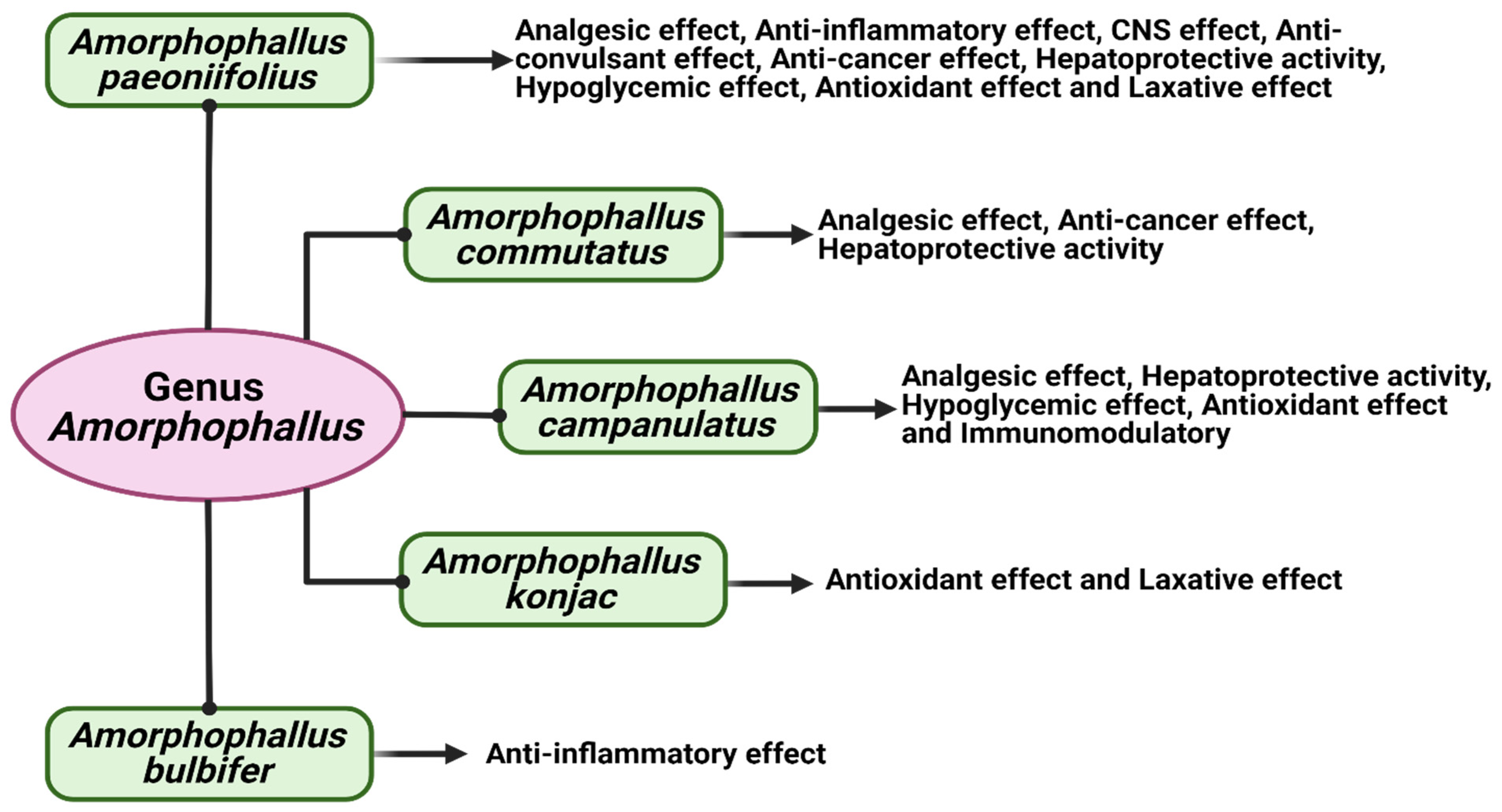
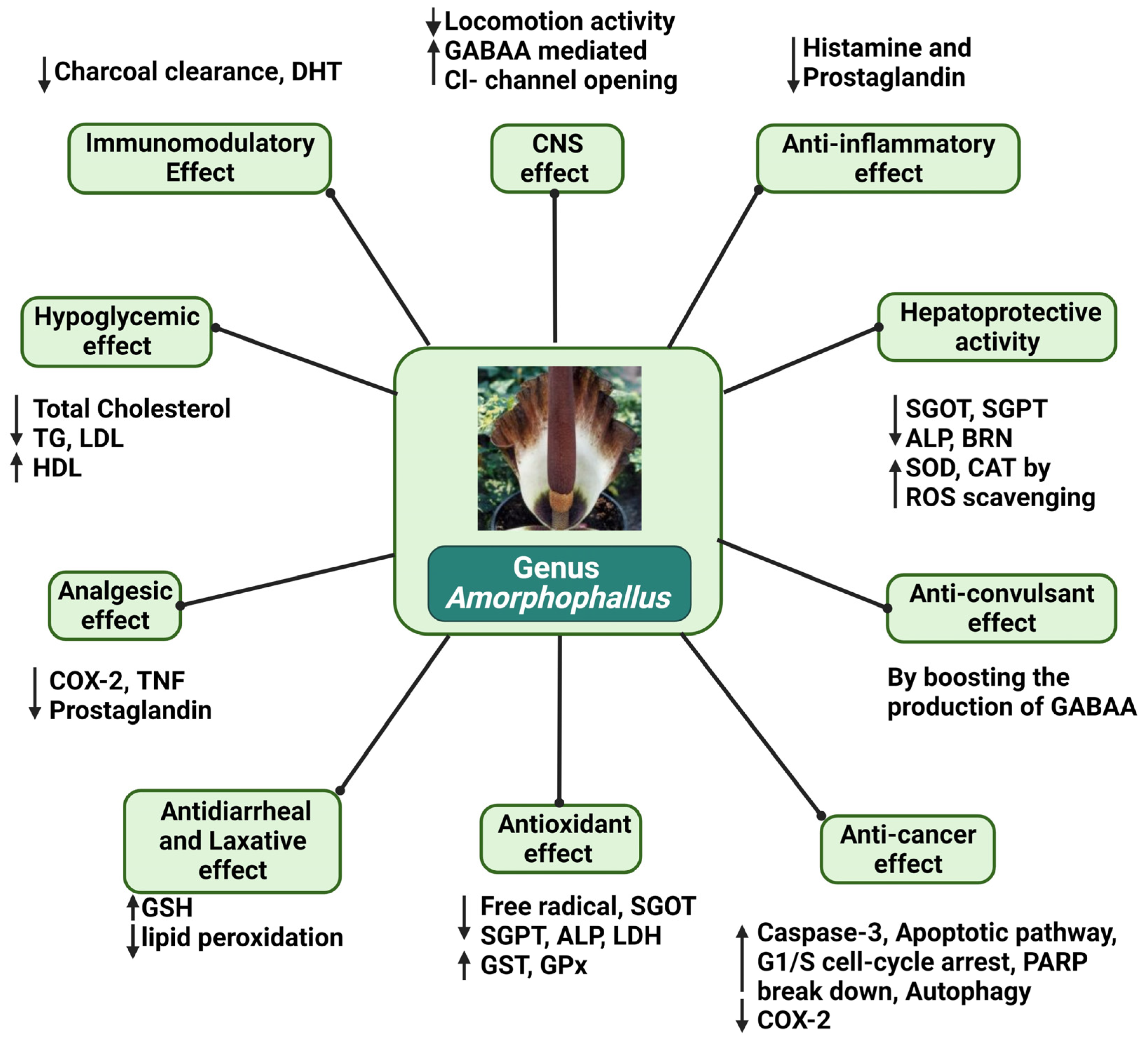
The genus Amorphophallus belongs to the family Araceae. Plants belonging to this genus are available worldwide and have been used in traditional medicines since ancient times, mainly in Ayurveda and Unani medical practices. Amorphophallus species are an abundant source of polyphenolic compounds; these are accountable for their pharmacological properties, such as their analgesic, neuroprotective, hepatoprotective, anti-inflammatory, anticonvulsant, antibacterial, antioxidant, anticancer, antiobesity, and immunomodulatory effects, as well as their ability to prevent gastrointestinal disturbance and reduce blood glucose. Moreover, Amorphophallus species contain numerous other classes of chemical compounds, such as alkaloids, steroids, fats and fixed oils, tannins, proteins, and carbohydrates, each of which contributes to the pharmacological effects for the treatment of acute rheumatism, tumors, lung swelling, asthma, vomiting, abdominal pain, and so on. Additionally, Amorphophallus species have been employed in numerous herbal formulations and pharmaceutical applications. There has been no extensive review conducted on the Amorphophallus genus as of yet, despite the fact that several experimental studies are being published regularly discussing these plants’ pharmacological properties. So, this review discusses in detail the pharmacological properties of Amorphophallus species. We also discuss phytochemical constituents in the Amorphophallus species and their ethnomedicinal uses and toxicological profiles.
Keywords: Amorphophallus; Araceae; traditional medicine; ethnopharmacology; phytochemistry; ethnobotany Amorphophallus; Araceae; traditional medicine; ethnopharmacology; phytochemistry; ethnobotany