

You are currently viewing a new version of our website. To view the old version click .

Biomolecules, Volume 14, Issue 4

April 2024 - 125 articles

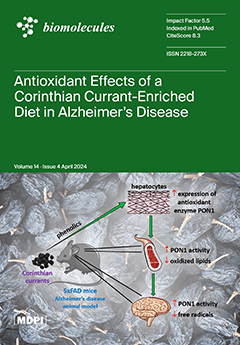
Cover Story: The administration of dietary Corinthian currant in a mouse model of Alzheimer’s disease using 5xFAD increases the activity of the antioxidant enzyme Paraoxonase-1 (PON1) and reduces oxidative stress in circulation and the brain during the early stages of the disease. However, during the later stages of the disease, no beneficial effects are observed. The increased activity of PON1 in plasma can be attributed to the capacity of Corinthian currant phenolics to increase PON1 expression in hepatocytes, the major source of this enzyme in organisms. Given that oxidative stress starts early in the progression of Alzheimer’s disease, the current findings suggest that any intervention with Corinthian currants should commence in the early stages of disease pathogenesis before the onset of significant neurodegeneration. View this paper
  • Issues are regarded as officially published after their release is announced to the table of contents alert mailing list .
  • You may sign up for email alerts to receive table of contents of newly released issues.
  • PDF is the official format for papers published in both, html and pdf forms. To view the papers in pdf format, click on the "PDF Full-text" link, and use the free Adobe Reader to open them.

Articles (125)

  • Article
  • Open Access
4 Citations
2,802 Views
18 Pages

The Role of Tenascin-C on the Structural Plasticity of Perineuronal Nets and Synaptic Expression in the Hippocampus of Male Mice

  • Ana Jakovljević,
  • Vera Stamenković,
  • Joko Poleksić,
  • Mohammad I. K. Hamad,
  • Gebhard Reiss,
  • Igor Jakovcevski and
  • Pavle R. Andjus

22 April 2024

Neuronal plasticity is a crucial mechanism for an adapting nervous system to change. It is shown to be regulated by perineuronal nets (PNNs), the condensed forms of the extracellular matrix (ECM) around neuronal bodies. By assessing the changes in th...

  • Case Report
  • Open Access
1 Citations
3,529 Views
17 Pages

Phenotypic Variability of Andersen–Tawil Syndrome Due to Allelic Mutation c.652C>T in the KCNJ2 Gene—A New Family Case Report

  • Maria Elena Onore,
  • Esther Picillo,
  • Paola D’Ambrosio,
  • Salvatore Morra,
  • Vincenzo Nigro and
  • Luisa Politano

22 April 2024

Andersen–Tawil syndrome (ATS) is a multisystem channelopathy characterized by periodic paralysis, ventricular arrhythmias, prolonged QT interval, and facial dysmorphisms occurring in the first/second decade of life. High phenotypic variability...

  • Article
  • Open Access
2 Citations
2,692 Views
12 Pages

22 April 2024

In this study, we introduce electrospun polydioxanone (PDO) nonwoven fabrics as a platform for the delivery of adeno-associated virus (AAV) vectors for transduction and genome editing by adhering them to organ surfaces, including the heart. AAV vecto...

  • Article
  • Open Access
4 Citations
3,383 Views
17 Pages

21 April 2024

Rett Syndrome (RTT) is a progressive X-linked neurodevelopmental disorder with no cure. RTT patients show disease-associated symptoms within 18 months of age that include developmental regression, progressive loss of useful hand movements, and breath...

  • Article
  • Open Access
4 Citations
2,217 Views
19 Pages

21 April 2024

Ethyl (S)-4-chloro-3-hydroxybutyrate ((S)-CHBE) is an important chiral intermediate in the synthesis of the cholesterol-lowering drug atorvastatin. Studying the use of SpyTag/SpyCatcher and SnoopTag/SnoopCatcher systems for the asymmetric reduction r...

  • Review
  • Open Access
12 Citations
6,188 Views
38 Pages

Recent Findings on Therapeutic Cancer Vaccines: An Updated Review

  • Sara Sheikhlary,
  • David Humberto Lopez,
  • Sophia Moghimi and
  • Bo Sun

21 April 2024

Cancer remains one of the global leading causes of death and various vaccines have been developed over the years against it, including cell-based, nucleic acid-based, and viral-based cancer vaccines. Although many vaccines have been effective in in v...

  • Review
  • Open Access
5 Citations
3,594 Views
19 Pages

21 April 2024

Glycogen synthase kinase 3-beta (GSK3β) is a highly conserved protein kinase originally involved in glucose metabolism, insulin activity, and energy homeostasis. Recent scientific evidence demonstrated the significant role of GSK3β in regul...

  • Article
  • Open Access
3 Citations
2,613 Views
17 Pages

Caspase-1 Deficiency Modulates Adipogenesis through Atg7-Mediated Autophagy: An Inflammatory-Independent Mechanism

  • Yumeng Wang,
  • Gaojun Chen,
  • Min Xu,
  • Yewei Cui,
  • Weijiong He,
  • Hongxiang Zeng,
  • Ting Zeng,
  • Rui Cheng and
  • Xi Li

20 April 2024

Obesity stands as a significant risk factor for type 2 diabetes, hyperlipidemia, and cardiovascular diseases, intertwining increased inflammation and decreased adipogenesis with metabolic disorders. Studies have highlighted the correlation between Ca...

  • Review
  • Open Access
7 Citations
3,676 Views
24 Pages

19 April 2024

Adenosine triphosphate (ATP) acts as the universal energy currency that drives various biological processes, while nucleic acids function to store and transmit genetic information for all living organisms. Liquid–liquid phase separation (LLPS)...

  • Article
  • Open Access
6 Citations
2,846 Views
21 Pages

Mitochondrial DNA and Inflammation Are Associated with Cerebral Vessel Remodeling and Early Diabetic Kidney Disease in Patients with Type 2 Diabetes Mellitus

  • Ligia Petrica,
  • Florica Gadalean,
  • Danina Mirela Muntean,
  • Dragos Catalin Jianu,
  • Daliborca Vlad,
  • Victor Dumitrascu,
  • Flaviu Bob,
  • Oana Milas,
  • Anca Suteanu-Simulescu and
  • Mihaela Glavan
  • + 9 authors

19 April 2024

Cerebrovascular disease accounts for major neurologic disabilities in patients with type 2 diabetes mellitus (DM). A potential association of mitochondrial DNA (mtDNA) and inflammation with cerebral vessel remodeling in patients with type 2 DM was ev...

of 13

Get Alerted

Add your email address to receive forthcoming issues of this journal.

XFacebookLinkedIn
Biomolecules - ISSN 2218-273X