You are currently viewing a new version of our website. To view the old version click .

Universe, Volume 7, Issue 8

August 2021 - 61 articles

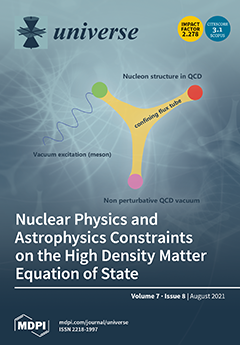
Cover Story: Focusing on the nuclear force acting in dense nuclear matter and its equation of state, we take several typical snapshots of evolution of the theory of nuclear forces. We start from original ideas in the 1930s and move through to its overwhelming diversity today, supported by modern observational and terrestrial data in the multimessenger era, as well as by new mathematical techniques and computer power. Despite the admirable effort both in theory and measurement, multiple models dependent on a large number of correlated parameters exist, which cannot be constrained by data, not yet accurate nor sensitive enough to identify the theory closest to reality. The role of microphysics in the theories is severely limited or neglected, mostly deemed to be too difficult to tackle. Novel approaches, based on more fundamental ideas and less parameters, should be developed to make progress. View this paper
  • Issues are regarded as officially published after their release is announced to the table of contents alert mailing list .
  • You may sign up for email alerts to receive table of contents of newly released issues.
  • PDF is the official format for papers published in both, html and pdf forms. To view the papers in pdf format, click on the "PDF Full-text" link, and use the free Adobe Reader to open them.

Articles (61)

  • Article
  • Open Access
8 Citations
2,507 Views
11 Pages

Lepton-Antineutrino Entanglement and Chiral Oscillations

  • Victor A. S. V. Bittencourt,
  • Alex E. Bernardini and
  • Massimo Blasone

9 August 2021

Dirac bispinors belong to an irreducible representation of the complete Lorentz group, which includes parity as a symmetry yielding two intrinsic discrete degrees of freedom: chirality and spin. For massive particles, chirality is not dynamically con...

  • Review
  • Open Access
1 Citations
2,887 Views
16 Pages

8 August 2021

Sixty years of study of energetic particle abundances have made a major contribution to our understanding of the physics of solar energetic particles (SEPs) or solar cosmic rays. An early surprise was the observation in small SEP events of huge enhan...

  • Review
  • Open Access
1 Citations
1,968 Views
26 Pages

7 August 2021

In this review, we revisit our approach to constructing an effective theory for Abelian and Non-Abelian gauge theories in 4D. Our goal is to have an effective theory that provides a simple classical picture of the main qualitatively important feature...

  • Article
  • Open Access
1 Citations
1,968 Views
7 Pages

6 August 2021

In this paper, intergalactic electromagnetic cascades are used as a probe of cosmic ray sources. This is achieved as follows. In extragalactic space, cosmic rays initiate electromagnetic cascades, in which gamma-ray and neutrino emission arises. We u...

  • Article
  • Open Access
3 Citations
2,178 Views
20 Pages

Traces of Anisotropic Quasi-Regular Structure in the SDSS Data

  • Andrei I. Ryabinkov and
  • Alexander D. Kaminker

6 August 2021

The aim of this study is to search for quasi-periodical structures at moderate cosmological redshifts z ≲ 0.5. We mainly use the SDSS DR7 data on the luminous red galaxies (LRGs) with redshifts 0.16 ≤ z ≤ 0.47. At first, we analyze features (peaks) i...

  • Review
  • Open Access
10 Citations
3,239 Views
30 Pages

Classical and Quantum f(R) Cosmology: The Big Rip, the Little Rip and the Little Sibling of the Big Rip

  • Teodor Borislavov Vasilev,
  • Mariam Bouhmadi-López and
  • Prado Martín-Moruno

6 August 2021

The big rip, the little rip and the little sibling of the big rip are cosmological doomsdays predicted by some phantom dark-energy models that could describe the future evolution of our universe. When the universe evolves towards either of these futu...

  • Article
  • Open Access
7 Citations
2,953 Views
15 Pages

A New Ionospheric Index to Investigate Electron Temperature Small-Scale Variations in the Topside Ionosphere

  • Alessio Pignalberi,
  • Igino Coco,
  • Fabio Giannattasio,
  • Michael Pezzopane,
  • Paola De Michelis,
  • Giuseppe Consolini and
  • Roberta Tozzi

6 August 2021

The electron temperature (Te) behavior at small scales (both spatial and temporal) in the topside ionosphere is investigated through in situ observations collected by Langmuir Probes on-board the European Space Agency Swarm satellites from the beginn...

  • Review
  • Open Access
10 Citations
2,588 Views
17 Pages

Quantum and Classical Cosmology in the Brans–Dicke Theory

  • Carla R. Almeida,
  • Olesya Galkina and
  • Julio César Fabris

5 August 2021

In this paper, we discuss classical and quantum aspects of cosmological models in the Brans–Dicke theory. First, we review cosmological bounce solutions in the Brans–Dicke theory that obeys energy conditions (without ghost) for a universe filled with...

  • Communication
  • Open Access
2 Citations
1,705 Views
10 Pages

On Gauge Invariance of the Bosonic Measure in Chiral Gauge Theories

  • Gabriel de Lima e Silva,
  • Thalis José Girardi and
  • Sebastião Alves Dias

4 August 2021

Gauge invariance of the measure associated with the gauge field is usually taken for granted, in a general gauge theory. We furnish a proof of this invariance, within Fujikawa’s approach. To stress the importance of this fact, we briefly review gauge...

  • Article
  • Open Access
2,182 Views
15 Pages

4 August 2021

There is a drag force on objects moving in the background cosmological metric, known from galaxy cluster dynamics. The force is quite small over laboratory timescales, yet it applies in principle to all moving bodies in the universe. The drag force c...

of 7

Get Alerted

Add your email address to receive forthcoming issues of this journal.

XFacebookLinkedIn
Universe - ISSN 2218-1997