


Abstract
Background/Objectives: Functional dependence is highly prevalent among institutionalized older adults and represents a major challenge for long-term care. Evidence regarding its associated clinical and functional factors in Ecuador remains limited. This study aimed to examine the associations of physical performance, chronic conditions, and biochemical markers with functional independence among institutionalized older adults in Ecuador. Methods: An analytical cross-sectional study was conducted in two long-term care facilities in Ecuador. Of 352 initially considered participants, 316 were included in the analytical sample. Physical performance was assessed using the Short Physical Performance Battery (SPPB), and functional status was evaluated using the Barthel Index. Sociodemographic characteristics, chronic diseases, psychiatric diagnostic categories, and biochemical markers were examined. Multivariable logistic regression was used to estimate adjusted associations with functional independence. Results: Among 316 participants (mean age: 80.5 ± 8.8 years), 269 (85.1%) exhibited functional dependence. Dependent participants had lower SPPB scores than independent participants (1.5 ± 2.4 vs. 5.9 ± 2.9). Higher SPPB scores were associated with greater odds of functional independence (OR = 1.67; 95% CI: 1.47–1.95; p < 0.001), whereas type 2 diabetes mellitus was associated with lower odds (OR = 0.35; 95% CI: 0.12–0.94; p = 0.048). Age was not statistically significant after adjustment. Biochemical markers showed substantial descriptive overlap between functional groups. Conclusions: Physical performance was strongly associated with functional independence among institutionalized older adults in Ecuador, whereas the adjusted inverse association observed for type 2 diabetes mellitus was exploratory and should be interpreted with caution. Because the cross-sectional design precludes causal inference and the number of independent participants was small, these findings warrant confirmation in longitudinal studies.
1. Introduction
Population aging represents a major challenge for healthcare systems worldwide, owing to the increasing burden of chronic diseases, multimorbidity, frailty, and functional limitations. Within this context, healthy aging has increasingly been conceptualized in terms of functional ability rather than solely the absence of disease [1,2]. According to the World Health Organization (WHO), functional ability results from the interaction between intrinsic capacity and environmental characteristics. Intrinsic capacity encompasses physical and mental domains, including locomotion, vitality, cognition, psychological well-being, and sensory function [3,4]. Preserving functional independence is therefore a central component of healthy aging and comprehensive geriatric care.
Functional dependence, commonly reflected in limitations in basic activities of daily living (ADLs), is particularly relevant among older adults residing in long-term care facilities. These individuals frequently experience multiple chronic conditions, mobility impairments, and varying degrees of physical and cognitive limitations that may compromise their autonomy [5,6]. Previous research has documented functional decline among nursing home residents, highlighting the importance of identifying clinical and functional characteristics associated with loss of independence [5,6]. Understanding these associations may contribute to comprehensive geriatric assessment and inform strategies aimed at maintaining functional ability in institutionalized populations.
Physical performance is a clinically relevant dimension of functional independence. The Short Physical Performance Battery (SPPB), which assesses standing balance, gait speed, and chair-stand performance, provides an objective measure of lower-extremity function [7,8]. Longitudinal studies have shown that poorer physical performance is associated with subsequent disability and other adverse outcomes among older adults [8,9,10,11]. The validity and reliability of the SPPB have been evaluated in different older adult populations, including Latin American and institutionalized populations, supporting its applicability across diverse clinical settings [12,13,14]. Functional dependence can also be assessed using the Barthel Index, a standardized instrument measuring independence in basic ADLs [15,16,17]. Although the SPPB and Barthel Index evaluate related aspects of physical functioning, they capture different dimensions of performance and everyday functional independence. Their combined assessment may provide complementary information about the functional status of institutionalized older adults.
Chronic diseases and multimorbidity represent additional factors potentially associated with functional dependence. Multimorbidity, commonly defined as the coexistence of two or more chronic conditions, is highly prevalent among older adults and is associated with substantial clinical complexity [18]. A systematic review and meta-analysis reported a pooled multimorbidity prevalence of approximately 43% in Latin America and the Caribbean, although estimates varied considerably across populations and definitions [18]. Evidence also indicates an association between multimorbidity and disability, with the burden and specific combinations of chronic conditions potentially influencing functional outcomes [19,20]. Longitudinal research has further examined the potential contribution of inflammatory and metabolic processes to the relationship between multimorbidity and functional disability [21]. These findings support the relevance of examining both chronic disease burden and individual clinical conditions when assessing functional status in older adults. In the present study, the evaluation of chronic conditions focuses on highly prevalent diseases with potential functional implications, specifically type 2 diabetes mellitus, anaemia, and osteoarthritis.
In addition to clinical conditions, biochemical parameters may provide complementary information about physiological alterations associated with physical decline. Previous studies have explored hematological, metabolic, and inflammatory biomarkers in relation to frailty and sarcopenia, suggesting potential links between biological processes and impaired physical function [22,23]. Renal function has also been investigated in relation to frailty among older adults [24], while thyroid hormone alterations have been examined as potential correlates of frailty [25]. Nevertheless, evidence concerning the associations of biochemical parameters with functional dependence remains heterogeneous, and findings from community-dwelling or hospitalized populations may not be directly generalizable to institutionalized older adults. Specifically, this study focuses on parameters assessing renal function, lipid metabolism, hepatic enzymes, and thyroid hormones, which have been previously investigated in relation to frailty and physical decline.
Despite growing evidence concerning physical performance, chronic diseases, and biological factors associated with functional decline, their combined assessment remains insufficiently characterized in Latin American contexts. The novelty of this study lies in providing evidence from an underrepresented demographic, specifically institutionalized older adults in Ecuador, thereby expanding the clinical understanding of functional independence in this specific regional setting. Examining these factors within long-term care settings may contribute to a more comprehensive understanding of functional independence and its associated clinical characteristics. Therefore, this study aimed to examine the relationship between functional independence as the primary outcome and three sets of clinical and functional variables: physical performance, specific chronic conditions, and biochemical markers, among older adults residing in two long-term care facilities in Ecuador.
2. Materials and Methods
2.1. Study Design and Setting
This was a multicenter, analytical, cross-sectional observational study based on the assessment of older adults living in two long-term residential care centers in Ecuador. The research was conducted at the Hogar del Corazón de Jesús in Guayaquil and the Hogar San Pedro in Alausí, with data collection taking place between January and May 2026. The study was structured in accordance with the Strengthening the Reporting of Observational Studies in Epidemiology (STROBE) guidelines for cross-sectional observational studies.
A convenience sampling approach was utilized, enrolling all eligible residents available within the facilities during the data collection period. Consequently, an a priori sample size calculation was not performed.
Participants included older adults, defined for this study as individuals aged 65 years or older, residing in one of the participating institutions during the data collection period. Inclusion criteria required an assessment of functional dependence using the Barthel Index and the availability of sufficient clinical information to determine the presence or absence of the physical conditions under study. Records were excluded if they lacked sufficient information to establish the functional outcome (n = 6), contained inconsistencies preventing valid interpretation (n = 11), or were missing data across essential covariates (n = 19). The final sample consisted of 316 participants.
The presence of respiratory or neurological diseases was not considered an exclusion criterion. The study aimed to evaluate a representative sample of the institutionalized population, which inherently presents with complex multimorbidity. Participants were included regardless of their baseline functional status to capture the full spectrum of dependence typical in long-term care settings.
2.2. Sociodemographic Variables
Age, age group, sex, education level, and profession were recorded. Age was analyzed as a continuous quantitative variable in the multivariable models, whereas age group was primarily used to provide a descriptive characterization of the population. Education level was classified according to the categories recorded in the database. Profession was used as a sociodemographic characteristic and grouped into broad categories to avoid excessively small frequencies.
Chronological age was systematically verified for all participants using official Ecuadorian national identification cards (cédulas de identidad) and institutional admission records cross-referenced with the national civil registry, ensuring the accuracy of the recorded ages, including for those with exceptional longevity.
Although sex, educational attainment, and profession were recorded in the institutional records, only chronological age was included in the multivariable logistic regression model to preserve parsimony, given the limited number of functionally independent participants.
2.3. Chronic Diseases and Definition of Multimorbidity
Although a comprehensive list of chronic conditions was recorded and multimorbidity was calculated, the final multivariable logistic regression model retained only specific individual conditions (type 2 diabetes mellitus, anaemia, and osteoarthritis). These three conditions were selected using a purposeful variable selection approach [26] because they demonstrated statistical significance or strong clinical relevance in the preliminary bivariate analyses. Furthermore, the existing literature consistently identifies these specific conditions—particularly diabetes and osteoarthritis—as substantial contributors to physical disability, mobility impairment, and loss of functional independence in older adults [27,28].
2.4. Biochemical Markers
Nine biochemical markers were analyzed: creatinine, total cholesterol, triglycerides, glutamic-oxaloacetic transaminase (TGO/AST), glutamic-pyruvic transaminase (TGP/ALT), gamma-glutamyl transferase (GGT), thyroid-stimulating hormone (TSH), triiodothyronine (T3), and thyroxine (T4). Values were obtained from available laboratory records and retained in the originally reported units. The distribution of each biomarker was assessed prior to analysis using descriptive measures and graphical representation. Extreme and potentially influential values were identified. Extreme values were not automatically excluded; their inclusion was determined through a plausibility review. Biomarkers were analyzed as continuous variables to preserve quantitative information during preliminary evaluations. However, due to the limited number of participants in the functionally independent group, and the extensive overlap between functional groups, biochemical markers were not entered into the model to avoid overfitting and compromising model stability.
2.5. Physical Performance Assessment
Physical performance was assessed using the three components of the SPPB (balance, gait speed, and chair-stand test). Each component was scored from 0 to 4 points; when data for all three components were available, an overall score ranging from 0 to 12 points was calculated, with higher values indicating better physical performance. Records identified as “not assessable” were distinguished from a score of zero. In accordance with standard SPPB guidelines, participants who were physically unable to attempt or complete a specific test component were assigned a score of zero for that domain.
2.6. Balance
Balance was assessed using a progressive sequence of positions (feet together, semi-tandem position, and tandem position). The tandem position was evaluated based on the ability to maintain it for the established duration, distinguishing between a performance of 10 s or less and one exceeding 10 s, in accordance with the protocol used. The final score for the balance component was determined based on the progression achieved by each participant and the time maintained in the corresponding position.
2.7. Gait Speed
Gait speed was assessed by measuring the time required to walk 4 m. Scoring was as follows: 4 points: <4.82 s; 3 points: 4.82–6.20 s; 2 points: 6.21–8.70 s; 1 point: >8.70 s; 0 points: unable to perform the test. In addition to the 0–4 score, walking time in seconds was retained as a continuous variable whenever available.
2.8. Chair-Stand Test
Lower-limb functional capacity was assessed using the chair-stand test. Scoring was as follows: 4 points: <11.19 s; 3 points: 11.20–13.69 s; 2 points: 13.70–16.69 s; 1 point: 16.70–59.0 s; 0 points: >60 s or unable to perform the test. The recorded time was also retained as a continuous variable for supplementary analyses.
2.9. Assessment of Functional Dependence
Functional dependence was assessed using the Barthel Index, with a total score ranging from 0 to 100 points. The classification used was: total dependence (0–20 points), severe dependence (21–60 points), moderate dependence (61–90 points), mild dependence (91–99 points), and independence (100 points). For the multivariable analysis, functional status was dichotomized into a binary outcome variable coded as 1 for functional independence (100 points) and 0 for functional dependence (<100 points, reference category).
3. Statistical Analysis
3.1. Statistical Analysis Was Conducted in Stages
First, the population characteristics were described. Categorical variables were expressed as absolute frequencies and percentages. Quantitative variables were described using the mean and standard deviation for approximately normal distributions, or the median and interquartile range for skewed distributions. Next, the distribution of functional dependence levels and the prevalence of each chronic disease and multimorbidity were assessed. Finally, bivariate analyses were performed to explore the relationship between the level of dependence and sociodemographic characteristics, chronic diseases, biomarkers, and physical performance components. For this purpose, univariable Generalized Linear Models (GLM) were utilized to estimate crude Odds Ratios (OR) and their 95% confidence intervals. Bivariate analyses were considered exploratory and did not serve as the sole criterion for selecting variables for the multivariable models.
3.2. Primary Multivariable Model
Prior to model specification, an extensive exploratory data analysis was conducted using scatterplot matrices. This graphical approach allowed for the visual assessment of data distributions, the identification and management of severe outliers, and the preliminary detection of multicollinearity among continuous covariates, ensuring the stability of the final logistic regression model. The analytical approach involved comparing functionally dependent and independent participants to identify clinical and physical factors associated with functional status. The primary outcome was functional independence (Barthel Index = 100, coded as 1), with functional dependence (Barthel Index < 100, coded as 0) serving as the reference category. Associations between the variables of interest and functional independence were estimated using multivariable logistic regression. Associations were expressed as odds ratios (OR) and 95% confidence intervals (95% CI). The model was specified based on a clinically informed approach and exploratory data analysis rather than automated selection. The final adjustment set (age, total SPPB score, type 2 diabetes mellitus, anaemia, and osteoarthritis) was specified a priori based on clinical plausibility and the established geriatric literature rather than bivariate screening alone. Given the limited number of functionally independent participants (n = 47), including nine additional continuous biochemical markers in the multivariable logistic regression model would have caused severe overfitting and compromised model stability. Consequently, and in light of their extensive descriptive overlap between functional groups, biochemical markers were retained for descriptive and exploratory analyses only, rather than entered into the parsimonious multivariable model.
Institutional clustering across the two participating facilities was not modelled via multilevel regression because random-effects estimation is statistically unstable with only two clusters, and adding further fixed effects was avoided to preserve model parsimony.
Missing data were handled using a complete case analysis approach, given the low proportion of missingness in the primary variables of interest. Model diagnostics were performed for the final multivariable logistic regression model. Multicollinearity was assessed using variance inflation factors (VIFs), discrimination was evaluated via the area under the receiver operating characteristic curve (AUC) with DeLong 95% confidence intervals, and calibration was examined using the Hosmer–Lemeshow goodness-of-fit test and the Brier score. Potentially influential observations were identified using Cook’s distance (D > 4/n) and standardised residuals (|r| > 3). To assess the robustness of the primary estimates against sparse data bias and influential observations, two sensitivity analyses were conducted: Firth’s penalised maximum likelihood logistic regression and a re-estimation of the primary model excluding flagged influential cases. Diagnostic and sensitivity analyses were performed in R [29].
3.3. Ethical Considerations
The study was approved by the Human Research Ethics Committee of Luis Vernaza Hospital (27-EO-CEISH-HLV) prior to the commencement of the research. The research was conducted in accordance with the ethical principles applicable to research involving human subjects and the Declaration of Helsinki. Data were handled confidentially, and anonymization procedures were used to protect the participants’ identities.
4. Results
The study population consisted of 316 older adults, of whom 269 (85.1%) were functionally dependent and 47 (14.9%) were functionally independent. The mean age was 80.5 ± 8.8 years, slightly higher in the dependent group compared to the independent group (81.0 ± 8.8 vs. 77.5 ± 8.2 years). The 65–74 age group was the most common (49.7%), although the proportion of participants aged 90 years or older was higher among the dependent group than the independent group (17.1% vs. 6.4%). Physical performance, assessed using the SPPB, was considerably lower in dependent participants, both in the total score (1.5 ± 2.4 vs. 5.9 ± 2.9) and in its components: gait speed (0.4 ± 0.6 vs. 1.4 ± 1.0), chair-stand ability (0.4 ± 0.8 vs. 1.8 ± 1.2), and balance (0.7 ± 1.2 vs. 2.7 ± 1.3). Among comorbidities, arterial hypertension was the most frequent in the total population (55.4%), followed by hypothyroidism (37.7%) and type 2 diabetes mellitus (24.1%). Anemia was also more frequent in the dependent group (21.2% vs. 12.8%), whereas the proportion of participants without chronic diseases was higher among the independent group (17.0% vs. 8.2%). Regarding psychiatric diagnoses, organic mental disorders were more frequent among dependent participants (33.8% vs. 12.8%), whereas the absence of a psychiatric diagnosis predominated in the independent group (59.6% vs. 38.3%). Laboratory parameters showed relatively similar mean values between the two groups, with slightly higher concentrations of total cholesterol and triglycerides among independent participants. Overall, the most marked descriptive differences between the groups were observed in physical performance, age distribution, the presence of organic mental disorders, and the absence of chronic diseases (Table 1).
Table 1.
Sociodemographic, Clinical, Functional, and Biochemical Characteristics of Institutionalized Older Adults According to Functional Status (N = 316).
The multivariate logistic regression model, adjusted for demographic and clinical factors to evaluate the determinants of functional independence (Barthel Index), showed that physical performance, assessed via the total SPPB score, demonstrated a strong positive association with functional independence. For every additional point on this test, the odds of a patient maintaining functional independence increased significantly by 67% (OR = 1.67, 95% CI: 1.47–1.95, p < 0.001).
Concurrently, the presence of Type 2 Diabetes Mellitus was associated with a significant reduction in the odds of independence (OR = 0.35, 95% CI: 0.12–0.94, p = 0.048). Notably, when the model was subjected to this simultaneous adjustment, the isolated effect of chronological age was no longer statistically significant (OR = 0.95, 95% CI: 0.91–1.00, p = 0.08), as in comorbidities such as osteoarthritis (OR = 2.93, p = 0.0758) and anemia (OR = 1.02, p = 0.9780). However, this finding must be interpreted with extreme caution. The association was derived from a very small number of independent participants with diabetes (n = 7), resulting in large confidence intervals. Consequently, this result should be considered exploratory and hypothesis-generating rather than a definitive clinical conclusion (Table 2).
Table 2.
Unadjusted and Adjusted Logistic Regression Analyses of Factors Associated with Functional Independence among Institutionalized Older Adults.
Results of the Exploratory Analysis of Relationships Between Clinical and Biochemical Variables and Functional Status
Model diagnostics indicated no multicollinearity among predictors (VIF range: 1.01–1.09). The adjusted model demonstrated strong discrimination (AUC = 0.87, 95% CI [0.80, 0.93]) and adequate calibration (Hosmer–Lemeshow χ2(8) = 11.85, p = 0.158; Brier score = 0.081). Although 23 observations exceeded the screening threshold (Cook’s D > 4/n or |standardized residual| > 3), the maximum Cook’s distance was 0.080, well below the conventional threshold of 1.0. In the sensitivity analysis using Firth’s penalized logistic regression, the direction and magnitude of the associations remained consistent with the primary model for total SPPB (OR = 1.64, 95% CI [1.44, 1.90], p < 0.001), type 2 diabetes mellitus (OR = 0.38, 95% CI [0.13, 0.98], p = 0.045), age (OR = 0.96, 95% CI [0.91, 1.00], p = 0.077), anaemia (OR = 1.06, 95% CI [0.35, 2.87], p = 0.917), and osteoarthritis (OR = 2.91, 95% CI [0.88, 9.00], p = 0.078). Excluding the 23 flagged cases (18 functionally independent and 5 functionally dependent; 8 with type 2 diabetes mellitus, including 6 independent participants, leaving only 1 independent participant with diabetes) preserved the direction of the primary associations for total SPPB (OR = 2.51, 95% CI [1.80, 3.52], p < 0.001) and type 2 diabetes mellitus (OR = 0.03, 95% CI [0.001, 0.65], p = 0.026), while age reached statistical significance (OR = 0.91, 95% CI [0.83, 0.99], p = 0.034); however, the shift in effect magnitude—especially for type 2 diabetes mellitus—and the substantially wider confidence intervals demonstrate sensitivity to these exclusions and reduced precision.
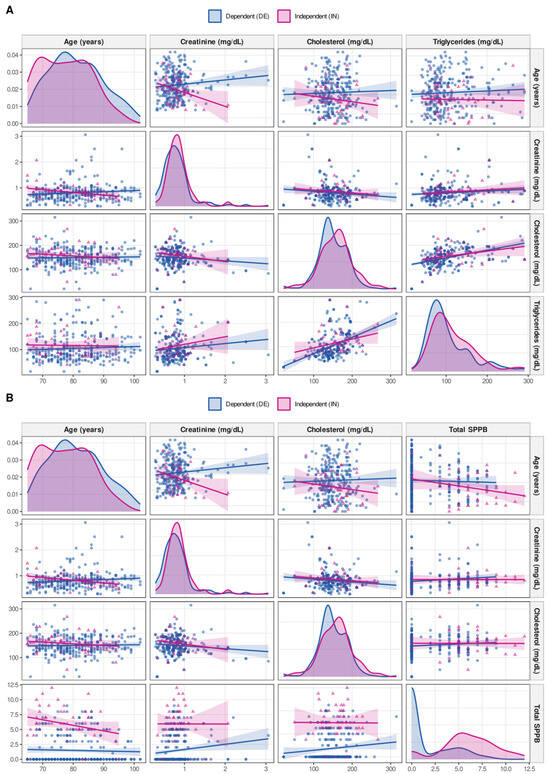
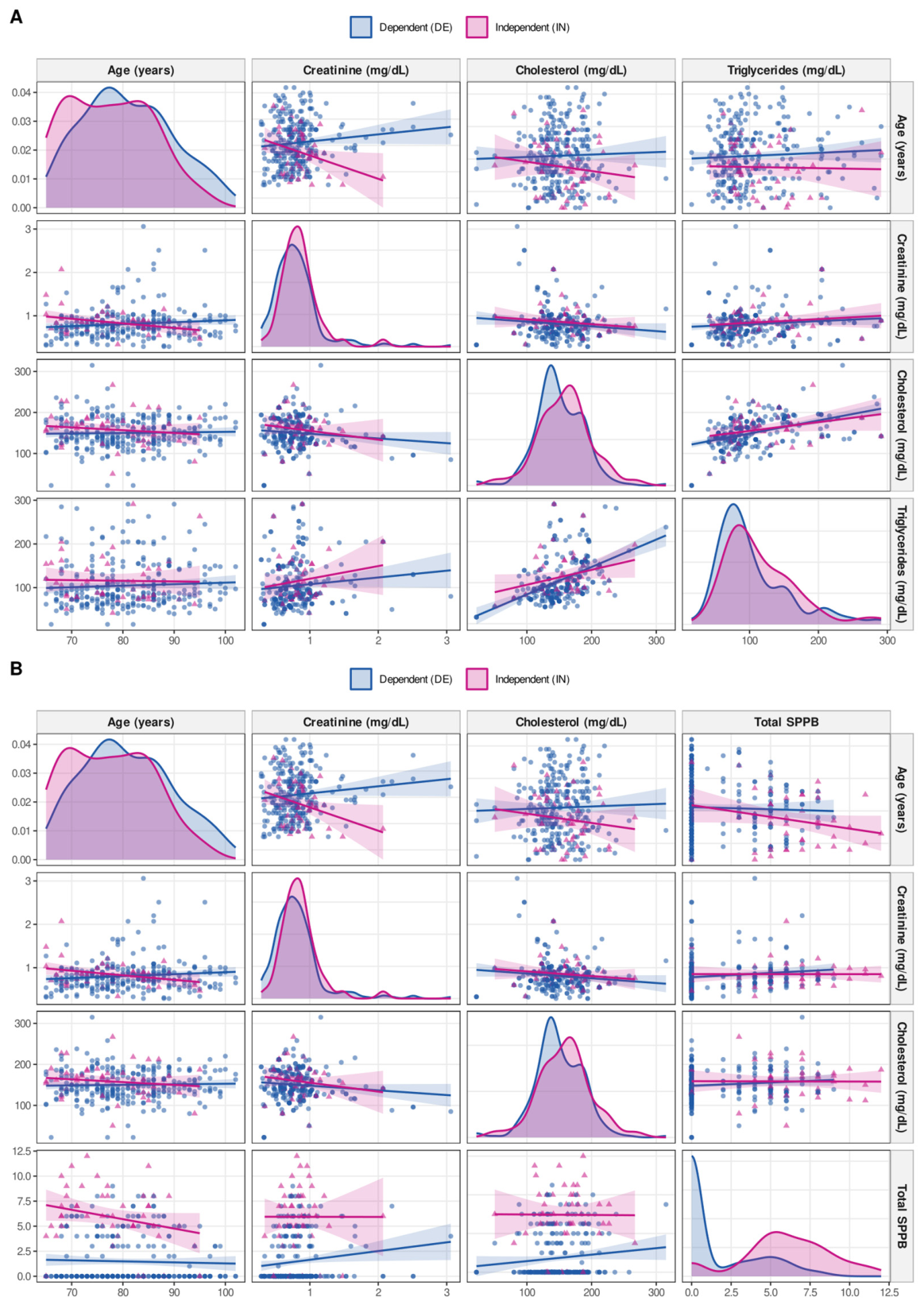
Exploratory analysis using scatter plot matrices (Figure 1) allowed for the characterization of bivariate relationships and the distributions of sociodemographic, biochemical, and physical performance variables according to functional status, as defined by the Barthel Index. The age distribution showed differences between the groups, with a higher concentration of older participants among those with functional dependence, whereas the distributions of creatinine, cholesterol, triglycerides, thyroid hormones (T3, T4, and TSH), and liver enzymes (GGT, AST, and ALT) showed extensive overlap between the two groups, with no clearly discernible visual differences. In contrast, the total SPPB score showed a marked descriptive separation: dependent participants were concentrated primarily at low scores, particularly zero, while independent participants showed higher scores, with the greatest concentration between 8 and 10 points. Additionally, an apparent positive association was observed between cholesterol and triglycerides, as well as between AST and ALT, consistent with the expected correlation between certain metabolic and hepatic parameters. Overall, these matrices suggest that physical performance exhibits a more evident descriptive differentiation based on functional status than the biochemical markers evaluated (Figure 1/Supplementary Figure S1). This distribution was anticipated, given the inherent clinical overlap between physical performance limitations and dependence in basic activities of daily living.
Figure 1.
Scatterplot matrices of age, biochemical parameters, and physical performance stratified by functional status among institutionalized older adults. (A) Age, serum creatinine, total cholesterol, and triglycerides; (B) age, serum creatinine, total cholesterol, and total Short Physical Performance Battery (SPPB) score. The matrices display pairwise scatterplots and marginal distributions for functionally dependent (DE, blue circles) and functionally independent (IN, magenta triangles) participants, classified according to the Barthel Index. Fitted trend lines and shaded uncertainty bands are shown for exploratory visualization.
5. Discussion
5.1. Physical Performance and Functional Independence
Our results indicate that physical performance, assessed using the SPPB, was strongly associated with functional independence among institutionalized older adults after multivariable adjustment. Each additional point in the total SPPB score was associated with 67% higher odds of functional independence, after adjustment for selected demographic and clinical characteristics. This finding is consistent with the foundational evidence provided by Guralnik et al. [7], who demonstrated the relevance of objective physical performance measures for identifying disability and predicting adverse health outcomes, and with their subsequent prospective study [8], which established an association between lower-extremity performance and subsequent disability over four years. Similar findings have been reported in longitudinal investigations involving older adult populations [9]. Furthermore, the meta-analysis by Pavasini et al. [11], involving more than 16,000 older adults, demonstrated an association between poorer SPPB performance and increased all-cause mortality, reinforcing the prognostic relevance of physical performance assessments.
The clinical applicability of the SPPB is further supported by studies examining its validity and reliability in institutionalized older adults [14], as well as validation studies conducted in Colombia [13] and populations from Brazil and Quebec [12]. Systematic reviews evaluating its psychometric properties have also provided evidence supporting its use in assessing physical performance among older adults [30]. In addition, gait speed has been identified as a clinically relevant indicator of adverse health outcomes, including survival [31], while studies conducted in clinical settings have highlighted the value of objective physical performance measures for assessing functional limitations and subsequent health outcomes [10]. Evidence from sarcopenia research further emphasizes the relationship between impaired physical function, disability, and mortality [32].
Collectively, these findings support the clinical relevance of objective physical performance assessment in older adults. In our study, the association between SPPB scores and functional independence remained statistically significant after adjustment, whereas the association with chronological age was no longer statistically significant. However, this finding should not be interpreted as evidence that physical performance mediates the relationship between age and functional status. Rather, it suggests that physical performance provides relevant information about functional independence beyond the demographic and clinical characteristics included in the model. Given the cross-sectional design, the direction and temporal sequence of these associations cannot be established.
5.2. Institutionalization and Functional Decline
The high prevalence of functional dependence observed in our study highlights the considerable functional care needs of older adults residing in long-term care institutions. Although chronological age was inversely associated with functional independence in the unadjusted analysis, this association was no longer statistically significant after adjustment for physical performance and selected clinical conditions. This finding suggests that chronological age alone may not adequately characterize differences in functional status among institutionalized older adults. Previous investigations have shown that objective physical performance assessments can identify clinically relevant differences in functional vulnerability, including among individuals without substantial limitations in activities of daily living [7,8].
Within institutional settings, Palese et al. [5] reviewed evidence concerning functional decline among nursing home residents, emphasizing the complexity of functional changes in long-term care populations. Similarly, Jerez-Roig et al. [6] examined factors associated with functional decline among Brazilian nursing home residents, including cognitive impairment, continence-related limitations, and hospitalization. These studies provide an important context for interpreting our findings, as they highlight the contribution of multiple clinical and functional characteristics to the health status of institutionalized older adults.
Furthermore, studies evaluating the validity and reliability of the SPPB across different populations [12,13,30] support its usefulness as an objective measure of lower-extremity physical performance. Its application alongside instruments assessing activities of daily living may contribute to a more comprehensive characterization of functional status in institutionalized populations. Nevertheless, the SPPB and the Barthel Index assess related but distinct dimensions of functioning, and their association should not be interpreted as evidence of equivalence between the two measures.
The distinction between functional dependence, frailty, and comorbidity is also relevant when interpreting these findings. Fried et al. [33] emphasized the conceptual differences among these conditions and the importance of distinguishing them in geriatric research and clinical practice. Likewise, evidence on functional decline in nursing home residents [5] underscores the need to consider the complexity of functional vulnerability in institutional care. In this context, our findings support the relevance of comprehensive geriatric assessment, while recognizing that the cross-sectional design does not allow the identification of functional decline trajectories or the effects of institutionalization over time.
When considering strategies to address functional decline, it is vital to distinguish between cross-sectional associations and longitudinal intervention effectiveness. As demonstrated by Ciaccioni et al. [34], there are distinct modifiable determinants of physical activity and sedentary behavior across community and healthcare settings. While our findings highlight an association between physical performance and independence, implementing practical interventions in long-term care requires accounting for these setting-specific determinants to effectively preserve functional ability.
5.3. Multimorbidity and Specific Chronic Diseases
In the adjusted multivariable model, type 2 diabetes mellitus was associated with lower odds of functional independence. This finding is consistent with the broader literature documenting relationships between chronic disease burden, multimorbidity, and functional limitations among older adults. Barnett et al. [35] highlighted the complexity of multimorbidity and its implications for healthcare delivery, particularly in populations with substantial chronic disease burden. Similarly, systematic reviews and meta-analyses have documented associations between multimorbidity and disability in older populations [19,20].
Evidence suggests that functional outcomes may be influenced not only by the number of coexisting chronic conditions but also by their specific combinations. In particular, patterns involving cardiometabolic and other chronic diseases have been investigated in relation to disability and limitations in activities of daily living [20]. A meta-analysis examining disability among older adults with multimorbidity also reported a substantial burden of disability within this population [19]. These findings highlight the relevance of considering the clinical characteristics and combinations of chronic conditions when examining functional status.
In our study, the association between type 2 diabetes mellitus and lower odds of functional independence remained statistically significant after adjustment for age, physical performance, anemia, and osteoarthritis. Nevertheless, this finding should be interpreted cautiously, as the cross-sectional design prevents causal inference and the observed association may be influenced by unmeasured factors, including disease duration, glycemic control, diabetes-related complications, and treatment characteristics. Furthermore, although multimorbidity was considered in the descriptive characterization of the population, the final multivariable model included selected individual chronic conditions rather than a global multimorbidity measure. Therefore, our results should not be interpreted as demonstrating an independent association between overall multimorbidity burden and functional independence.
Additional evidence concerning multimorbidity [20,33,36] and the adverse health outcomes associated with sarcopenia [32] underscores the importance of considering physical performance and chronic disease burden within a comprehensive geriatric assessment. In this context, evaluating type 2 diabetes mellitus alongside objective physical performance measures may help characterize functional status among institutionalized older adults, although longitudinal evidence is required to determine its clinical utility. Further longitudinal investigations are needed to clarify these relationships and evaluate their potential implications for preserving functional independence.
5.4. Physical Performance, Age, and Clinical and Biochemical Markers
Exploratory scatterplot analyses showed differences in the age distributions of functionally dependent and independent participants. Although dependent participants tended to be older, the graphical distributions alone do not establish an independent association between age and functional status. Previous research has highlighted the relevance of lower-extremity performance and physical function in explaining differences in disability and functional outcomes among older adults [8,10]. These observations suggest that functional status should be interpreted in relation to multiple clinical and physical characteristics rather than chronological age alone.
The most prominent graphical finding was the marked separation in total SPPB scores between the functional groups. Dependent participants showed a greater concentration of lower scores, including values near zero, whereas independent participants generally exhibited higher physical performance scores. This pattern is consistent with previous studies demonstrating the clinical relevance of lower-extremity performance measures for identifying functional limitations and adverse health outcomes [8,10]. Moreover, research on frailty has emphasized the importance of physical characteristics, including reduced strength and mobility, in the assessment of vulnerability among older adults [37].
However, the interpretation of these findings requires consideration of the conceptual relationship between the SPPB and the Barthel Index. Although the instruments assess different dimensions of functioning, both incorporate aspects related to mobility and physical ability. Therefore, the observed association may partly reflect shared functional characteristics rather than entirely independent constructs. This consideration is particularly relevant when interpreting the magnitude of the association observed in the multivariable model.
Regarding biochemical parameters, the exploratory analyses showed considerable overlap in the distributions of creatinine, total cholesterol, triglycerides, gamma-glutamyl transferase (GGT), aspartate aminotransferase (AST), and alanine aminotransferase (ALT) between functionally dependent and independent participants. Similarly, thyroid-related parameters, including triiodothyronine (T3), thyroxine (T4), and thyroid-stimulating hormone (TSH), exhibited largely overlapping distributions. Additional exploratory analyses of thyroid hormone and liver enzyme distributions according to functional status are presented in Supplementary Figures S1 and S2, respectively. These observations suggest that the evaluated biochemical parameters did not display a marked visual separation according to functional status in the study population. Nevertheless, the absence of clear graphical differences does not demonstrate equivalence between groups or exclude potentially relevant associations after adjustment for confounding factors.
Biomarkers were initially collected and described because they are routinely evaluated in comprehensive geriatric assessments and have theoretical links to physical frailty. However, to preserve model parsimony and avoid severe overfitting given the limited number of functionally independent participants, all nine biochemical markers were retained for descriptive and exploratory analyses rather than entered into the multivariable model. Consequently, this exclusion does not establish the absence of independent associations between these biomarkers and functional independence.
From a methodological perspective, the exploratory matrices suggested a positive relationship between AST and ALT, consistent with the biological relationship between these hepatic enzymes. Such correlations may be relevant when selecting variables for multivariable analyses because strongly associated covariates can introduce redundancy and affect the precision of regression estimates. However, graphical relationships alone are insufficient to establish multicollinearity. As discussed by Vatcheva et al. [38], multicollinearity in epidemiological regression analyses requires appropriate diagnostic evaluation, which may include correlation matrices and variance inflation factors (VIFs).
In the present study, the biochemical parameters were not included in the reported final multivariable model; therefore, their independent associations with functional independence cannot be established from that analysis. Overall, the exploratory findings reinforce the descriptive relevance of physical performance while highlighting the need for further investigations incorporating comprehensive biochemical assessments and appropriately specified multivariable models.
6. Strengths and Limitations
This study has several strengths, including the evaluation of older adults from two long-term care facilities in Ecuador and the integration of objective physical performance measures, functional independence assessments, clinical conditions, and biochemical parameters. The use of standardized instruments, such as the SPPB and the Barthel Index, provides complementary information regarding physical performance and independence in basic activities of daily living.
An additional strength is the generation of novel empirical evidence from the underrepresented context of Ecuadorian long-term care facilities. The study adds descriptive evidence indicating that objective physical performance and selected chronic conditions are associated with functional independence beyond chronological age alone in this population.
Nevertheless, several limitations should be acknowledged. First, the cross-sectional design precludes establishing causal or temporal relationships between the variables examined. Second, the inclusion of participants from only two institutions limits the generalizability of the findings to other long-term care settings. Third, the exclusion of participants and the use of available clinical and laboratory records may have introduced selection and information bias. Additionally, the substantial class imbalance (n = 47 independent participants) and small cell sizes for specific covariates—particularly type 2 diabetes (n = 7) and osteoarthritis (n = 7)—introduced a risk of sparse data bias, yielded wide confidence intervals, and reduced model stability. Although Firth’s penalized logistic regression yielded estimates consistent with the primary model, the shift in effect magnitude and the wider confidence intervals after excluding the 23 flagged observations indicate that the magnitude of the adjusted estimates—particularly for type 2 diabetes mellitus—is sensitive to influential cases and must be interpreted with caution. Although defining functional independence strictly as a Barthel Index score of 100 reflects the standard clinical criterion for complete autonomy in basic activities of daily living, this dichotomisation contributed to the observed class imbalance; future studies should examine ordinal categories of dependence or alternative clinical thresholds.
Residual confounding cannot be excluded, as potentially relevant factors—including sex, educational attainment, nutritional status, medication use, severity of chronic diseases, and cognitive impairment—were not incorporated into the final model. Furthermore, the available psychiatric diagnostic categories (F00–F09) did not permit the identification of specific neurocognitive disorders or the severity of cognitive decline.
Also, institutional clustering across the two facilities could not be accounted for in the multivariable model, which may have resulted in slightly underestimated standard errors, and unmeasured confounders—particularly the severity of cognitive impairment—may have influenced the observed associations. Finally, the exploratory nature of the biochemical analyses limits conclusions regarding the independent associations between individual biomarkers and functional independence.
Despite these limitations, the findings contribute to the characterization of functional independence and its associated clinical factors among institutionalized older adults in Ecuador.
7. Conclusions
Physical performance was positively associated with functional independence among institutionalized older adults in Ecuador, while an exploratory inverse association was observed for type 2 diabetes mellitus after multivariable adjustment. Given the small number of functionally independent participants and the cross-sectional design, these associations—particularly for type 2 diabetes mellitus—must be interpreted cautiously and do not establish causality. Although chronological age showed an association with functional status in the unadjusted analysis, it was not statistically significant after adjustment for physical performance and selected clinical conditions.
Exploratory biochemical analyses revealed substantial overlap between functional groups, without establishing the absence of independent associations. These cross-sectional findings support the descriptive value of assessing objective physical performance alongside chronic conditions in comprehensive geriatric evaluations, while underscoring the need for longitudinal studies to determine their prognostic and clinical utility. Further longitudinal studies are warranted to clarify temporal relationships and identify factors associated with changes in functional independence among institutionalized older adults.
Supplementary Materials
The following supporting information can be downloaded at: https://www.mdpi.com/article/10.3390/diseases14120445/s1, Figure S1: Scatterplot matrix of age and thyroid hormone parameters stratified by functional status among institutionalized older adults; Figure S2: Scatterplot matrix of age and liver enzyme parameters stratified by functional status among institutionalized older adults.
Author Contributions
Conceptualization, J.A.V.F., J.J.H.Á., A.S., I.D.C.P., R.V.S., R.I.O.C. and J.A.R.; methodology, J.A.V.F.; validation, J.J.H.Á.; formal analysis, J.A.V.F. and A.S.; investigation, J.A.V.F., J.J.H.Á. and I.D.C.P.; resources, R.I.O.C.; data curation, A.S.; writing—original draft preparation, J.A.V.F., J.J.H.Á., I.D.C.P., R.V.S. and R.I.O.C.; writing—review and editing, J.A.V.F., R.V.S. and J.A.R.; visualization, J.A.V.F., J.J.H.Á., R.V.S. and R.I.O.C.; supervision, R.V.S.; project administration, J.A.V.F., I.D.C.P. and R.V.S. All authors have read and agreed to the published version of the manuscript.
Funding
This research received no external funding.
Institutional Review Board Statement
The study was conducted in accordance with the Declaration of Helsinki and approved by the Human Research Ethics Committee of Luis Vernaza Hospital (CEISH-HLV; approval code: 27-EO-CEISH-HLV, 26 February 2026).
Informed Consent Statement
Written informed consent was obtained from all participants. For institutionalised individuals diagnosed with organic mental disorders or those who lacked the cognitive capacity to provide informed consent, explicit written surrogate consent was obtained from their legally authorised representatives or designated family members. These procedures were conducted in strict accordance with the protective protocols for vulnerable populations mandated and approved by the Human Research Ethics Committee of Luis Vernaza Hospital.
Data Availability Statement
The raw data supporting the conclusions of this article will be made available by the corresponding author. The data are not publicly available due to strict privacy and ethical restrictions concerning the vulnerable institutionalised older adult population evaluated in this study.
Conflicts of Interest
The authors declare no conflicts of interest.
References
- World Health Organization. Integrated Care for Older People (ICOPE): Guidance for Person-Centred Assessment and Pathways in Primary Care, 2nd ed.; World Health Organization: Geneva, Switzerland, 2025; Available online: https://www.who.int/publications/i/item/9789240103726 (accessed on 3 October 2026).
- World Health Organization. World Report on Ageing and Health; World Health Organization: Geneva, Switzerland, 2015; Available online: https://www.who.int/publications/i/item/9789241565042 (accessed on 6 October 2026).
- Cesari, M.; de Carvalho, I.A.; Thiyagarajan, J.A.; Cooper, C.; Martin, F.C.; Reginster, J.Y.; Vellas, B.; Beard, J.R. Evidence for the domains supporting the construct of intrinsic capacity. J. Gerontol. Ser. A 2018, 73, 1653–1660. [Google Scholar] [CrossRef] [Scilit] [PubMed]
- World Health Organization. Integrated Care for Older People: Guidelines on Community-Level Interventions to Manage Declines in Intrinsic Capacity; World Health Organization: Geneva, Switzerland, 2017; Available online: https://www.who.int/publications/i/item/9789241550109 (accessed on 3 October 2026).
- Palese, A.; Menegazzi, G.; Tullio, A.; Zigotti Fuso, M.; Hayter, M.; Watson, R. Functional decline in residents living in nursing homes: A systematic review of the literature. J. Am. Med. Dir. Assoc. 2016, 17, 694–705. [Google Scholar] [CrossRef] [Scilit] [PubMed]
- Jerez-Roig, J.; de Brito Macedo Ferreira, L.M.; Torres de Araújo, J.R.; Costa Lima, K.C. Functional decline in nursing home residents: A prognostic study. PLoS ONE 2017, 12, e0177353. [Google Scholar] [CrossRef] [Scilit] [PubMed]
- Guralnik, J.M.; Simonsick, E.M.; Ferrucci, L.; Glynn, R.J.; Berkman, L.F.; Blazer, D.G.; Scherr, P.A.; Wallace, R.B. A short physical performance battery assessing lower extremity function: Association with self-reported disability and prediction of mortality and nursing home admission. J. Gerontol. 1994, 49, M85–M94. [Google Scholar] [CrossRef] [Scilit] [PubMed]
- Guralnik, J.M.; Ferrucci, L.; Simonsick, E.M.; Salive, M.E.; Wallace, R.B. Lower-extremity function in persons over the age of 70 years as a predictor of subsequent disability. N. Engl. J. Med. 1995, 332, 556–561. [Google Scholar] [CrossRef] [Scilit] [PubMed]
- Guralnik, J.M.; Ferrucci, L.; Pieper, C.F.; Leveille, S.G.; Markides, K.S.; Ostir, G.V.; Studenski, S.; Berkman, L.F.; Wallace, R.B. Lower extremity function and subsequent disability: Consistency across studies, predictive models, and value of gait speed alone compared with the short physical performance battery. J. Gerontol. Ser. A 2000, 55, M221–M231. [Google Scholar] [CrossRef] [Scilit] [PubMed]
- Studenski, S.; Perera, S.; Wallace, D.; Chandler, J.M.; Duncan, P.W.; Rooney, E.; Fox, M.; Guralnik, J.M. Physical performance measures in the clinical setting. J. Am. Geriatr. Soc. 2003, 51, 314–322. [Google Scholar] [CrossRef] [Scilit] [PubMed]
- Pavasini, R.; Guralnik, J.; Brown, J.C.; di Bari, M.; Cesari, M.; Landi, F.; Vaes, B.; Legrand, D.; Verghese, J.; Wang, C.; et al. Short Physical Performance Battery and all-cause mortality: Systematic review and meta-analysis. BMC Med. 2016, 14, 215. [Google Scholar] [CrossRef] [Scilit] [PubMed]
- Freire, A.N.; Guerra, R.O.; Alvarado, B.; Guralnik, J.M.; Zunzunegui, M.V. Validity and reliability of the Short Physical Performance Battery in two diverse older adult populations in Quebec and Brazil. J. Aging Health 2012, 24, 863–878. [Google Scholar] [CrossRef] [Scilit] [PubMed]
- Gómez, J.F.; Curcio, C.L.; Alvarado, B.; Zunzunegui, M.V.; Guralnik, J. Validity and reliability of the Short Physical Performance Battery (SPPB): A pilot study on mobility in the Colombian Andes. Colomb. Med. 2013, 44, 165–171. [Google Scholar] [CrossRef] [Scilit]
- Santamaría-Peláez, M.; González-Bernal, J.J.; Da Silva-González, Á.; Medina-Pascual, E.; Gentil-Gutiérrez, A.; Fernández-Solana, J.; Mielgo-Ayuso, J.; González-Santos, J. Validity and reliability of the Short Physical Performance Battery tool in institutionalized Spanish older adults. Nurs. Rep. 2023, 13, 1354–1367. [Google Scholar] [CrossRef] [Scilit] [PubMed]
- Mahoney, F.I.; Barthel, D.W. Functional evaluation: The Barthel Index. Md. State Med. J. 1965, 14, 61–65. [Google Scholar] [PubMed]
- Collin, C.; Wade, D.T.; Davies, S.; Horne, V. The Barthel ADL Index: A reliability study. Int. Disabil. Stud. 1988, 10, 61–63. [Google Scholar] [CrossRef] [Scilit] [PubMed]
- González, N.; Bilbao, A.; Forjaz, M.J.; Ayala, A.; Orive, M.; Garcia-Gutierrez, S.; Las Hayas, C.; Quintana, J.M. OFF (Older Falls Fracture)-IRYSS Group. Psychometric characteristics of the Spanish version of the Barthel Index. Aging Clin. Exp. Res. 2018, 30, 489–497. [Google Scholar] [CrossRef] [Scilit] [PubMed]
- Huaquía-Díaz, A.M.; Chalán-Dávila, T.S.; Carrillo-Larco, R.M.; Bernabe-Ortiz, A. Multimorbidity in Latin America and the Caribbean: A systematic review and meta-analysis. BMJ Open 2021, 11, e050409. [Google Scholar] [CrossRef] [Scilit] [PubMed]
- Zhang, J.; Sun, Y.; Li, A. The prevalence of disability in older adults with multimorbidity: A meta-analysis. Aging Clin. Exp. Res. 2024, 36, 186. [Google Scholar] [CrossRef] [Scilit] [PubMed]
- Marengoni, A.; Akugizibwe, R.; Vetrano, D.L.; Roso-Llorach, A.; Onder, G.; Welmer, A.K.; Calderón-Larrañaga, A. Patterns of multimorbidity and risk of disability in community-dwelling older persons. Aging Clin. Exp. Res. 2021, 33, 457–462. [Google Scholar] [CrossRef] [Scilit] [PubMed]
- Botoseneanu, A.; Markwardt, S.; Quiñones, A.R. Multimorbidity and functional disability among older adults: The role of inflammation and glycemic status—An observational longitudinal study. Gerontology 2023, 69, 826–838. [Google Scholar] [CrossRef] [Scilit] [PubMed]
- Picca, A.; Coelho-Junior, H.J.; Calvani, R.; Marzetti, E.; Vetrano, D.L. Biomarkers shared by frailty and sarcopenia in older adults: A systematic review and meta-analysis. Ageing Res. Rev. 2022, 73, 101530. [Google Scholar] [CrossRef] [Scilit] [PubMed]
- Wang, J.; Maxwell, C.A.; Yu, F. Biological processes and biomarkers related to frailty in older adults: A state-of-the-science literature review. Biol. Res. Nurs. 2019, 21, 80–106. [Google Scholar] [CrossRef] [Scilit] [PubMed]
- Inenaga, K.; Kourogi, Y.; Kimura, H.; Toida, T. Renal function and comprehensive frailty in community-dwelling older adults: Cross-sectional and longitudinal analyses. Clin. Exp. Nephrol. 2026, 30, 1169–1178. [Google Scholar] [CrossRef] [Scilit] [PubMed]
- Chia, W.C.; Chen, Y.C.; Xiu, S.L.; Wang, S.T. Thyroid hormones and frailty in older adults: Systematic review and dose–response meta-analysis. BMC Geriatr. 2025, 25, 104. [Google Scholar] [CrossRef] [Scilit] [PubMed]
- Bursac, Z.; Gauss, C.H.; Williams, D.K.; Hosmer, D.W. Purposeful selection of variables in logistic regression. Source Code Biol. Med. 2008, 3, 17. [Google Scholar] [CrossRef] [Scilit] [PubMed]
- Kalamegam, S.; Shah, P.B.; Damodaran, A. Diabetes and Functional Impairment in Osteoarthritis: Investigating Correlations, Associations, and Progression. Cureus 2024, 16, e64493. [Google Scholar] [CrossRef] [Scilit] [PubMed]
- Sinclair, A.J.; Conroy, S.P.; Bayer, A.J. Impact of diabetes on physical function in older people. Diabetes Care 2008, 31, 233–235. [Google Scholar] [CrossRef] [Scilit] [PubMed]
- R Core Team. R: A Language and Environment for Statistical Computing; R Foundation for Statistical Computing: Vienna, Austria, 2026. [Google Scholar] [CrossRef] [Scilit]
- Kameniar, K.; Mackintosh, S.; Van Kessel, G.; Kumar, S. The psychometric properties of the Short Physical Performance Battery to assess physical performance in older adults: A systematic review. J. Geriatr. Phys. Ther. 2024, 47, 43–54. [Google Scholar] [CrossRef] [Scilit] [PubMed]
- Studenski, S.; Perera, S.; Patel, K.; Rosano, C.; Faulkner, K.; Inzitari, M.; Brach, J.; Chandler, J.; Cawthon, P.; Connor, E.B.; et al. Gait speed and survival in older adults. JAMA 2011, 305, 50–58. [Google Scholar] [CrossRef] [Scilit] [PubMed]
- Beaudart, C.; Zaaria, M.; Pasleau, F.; Reginster, J.Y.; Bruyère, O. Health outcomes of sarcopenia: A systematic review and meta-analysis. PLoS ONE 2017, 12, e0169548. [Google Scholar] [CrossRef] [Scilit] [PubMed]
- Fried, L.P.; Ferrucci, L.; Darer, J.; Williamson, J.D.; Anderson, G. Untangling the concepts of disability, frailty, and comorbidity: Implications for improved targeting and care. J. Gerontol. Ser. A 2004, 59, 255–263. [Google Scholar] [CrossRef] [Scilit] [PubMed]
- Ciaccioni, S.; Compernolle, S.; Lerfald, M.; Palumbo, F.; Fadda, F.; Toma, G.; Akpinar, S.; Borodulin, K.; Caglar, E.; Cardon, G.; et al. Modifiable determinants of older adults’ physical activity and sedentary behavior in community and healthcare settings: A DE-PASS systematic review and meta-analysis. Eur. Rev. Aging Phys. Act. 2025, 22, 9. [Google Scholar] [CrossRef] [Scilit] [PubMed]
- Barnett, K.; Mercer, S.W.; Norbury, M.; Watt, G.; Wyke, S.; Guthrie, B. Epidemiology of multimorbidity and implications for health care, research, and medical education: A cross-sectional study. Lancet 2012, 380, 37–43. [Google Scholar] [CrossRef] [Scilit] [PubMed]
- Marengoni, A.; Angleman, S.; Melis, R.; Mangialasche, F.; Karp, A.; Garmen, A.; Meinow, B.; Fratiglioni, L. Aging with multimorbidity: A systematic review of the literature. Ageing Res. Rev. 2011, 10, 430–439. [Google Scholar] [CrossRef] [Scilit] [PubMed]
- Fried, L.P.; Tangen, C.M.; Walston, J.; Newman, A.B.; Hirsch, C.; Gottdiener, J.; Seeman, T.; Tracy, R.; Kop, W.J.; Burke, G.; et al. Frailty in older adults: Evidence for a phenotype. J. Gerontol. Ser. A 2001, 56, M146–M156. [Google Scholar] [CrossRef] [Scilit] [PubMed]
- Vatcheva, K.P.; Lee, M.; McCormick, J.B.; Rahbar, M.H. Multicollinearity in regression analyses conducted in epidemiologic studies. Epidemiology 2016, 6, 227. [Google Scholar] [CrossRef] [PubMed]

Disclaimer/Publisher’s Note: The statements, opinions and data contained in all publications are solely those of the individual author(s) and contributor(s) and not of MDPI and/or the editor(s). MDPI and/or the editor(s) disclaim responsibility for any injury to people or property resulting from any ideas, methods, instructions or products referred to in the content. |
© 2026 by the authors. Licensee MDPI, Basel, Switzerland. This article is an open access article distributed under the terms and conditions of the Creative Commons Attribution (CC BY) license.