


Abstract
Objective: The aim of this study was to assess changes in physical performance and anthropometric outcomes in patients with breast cancer and overweight or obesity scheduled for delayed breast reconstruction after total mastectomy, and to compare outcomes in participants engaged in adapted physical activity (APA) delivered in hospital-based versus community-based settings. We further explored the evolution of quality of life and the relationship between excessive adiposity and the risk of sarcopenia in those patients. Methods: We conducted a retrospective monocentric study in a comprehensive cancer care centre. The cohort included 30 adult patients with overweight or obesity who had undergone total mastectomy for breast cancer and were referred for APA and nutritional management as part of a delayed breast reconstruction pathway. Results: The mean age of participants was 51 ± 8 years, with a median BMI of 32.5 [29.1; 34.3] kg/m2. Patients showed a significant reduction in visceral fat level, a significant increase of 1.54 kg in handgrip strength, and performed 3.37 supplementary repetitions on the sit-to-stand test between baseline and final assessment. No significant changes in the patients’ quality of life were observed. No significant changes were observed in the other anthropometric measures (body weight, adiposity, and muscle mass) or physical performance (unipedal stance test, 6-min walk test) outcomes. The APA delivery modality did not influence the changes in physical performance and anthropometric measures, except for muscle mass. Increased adiposity was associated with a higher risk of sarcopenia. Conclusions: Participating in APA permitted a gain in muscle strength and changes in anthropometric outcomes. The way APA was delivered did not influence the observed changes. Given the risk of muscle loss in this population, exercise modality should focus on resistance training.
1. Introduction
Breast cancer is the most common female cancer worldwide [1]. In France, approximately 62,000 new cases are diagnosed annually, and an estimated 913,000 women are living with or have a history of breast cancer [2]. Surgery is the primary treatment modality for breast cancer, with nearly 57,000 women undergoing breast cancer surgery each year in France, of which 22,000 involve total mastectomy [3]. Following mastectomy, breast reconstruction, whether performed immediately or delayed, is considered an integral component of comprehensive breast cancer treatment.
Numerous studies have demonstrated that overweight, obesity, or weight gain during breast cancer treatment, as well as decreased physical activity (PA), are associated with poor survival in patients with breast cancer [4,5]. In contrast, regular PA after diagnosis has been associated with an absolute, unadjusted reduction in mortality risk of 6% at 10 years. In this setting, PA has proven to be feasible and safe and may improve breast cancer survival [6]. Moreover, although delayed breast reconstruction (DBR) is a safe and effective option following mastectomy, several patient- and treatment-related factors may increase postoperative morbidity or limit reconstructive options. Poor physical fitness and low levels of PA may adversely affect perioperative outcomes by contributing to reduced functional reserve, increased metabolic dysfunction, and delayed recovery. In addition, obesity and associated cardiometabolic complications are among the most consistently reported risk factors and have been associated with higher rates of surgical-site infection, wound-healing complications, seroma formation, and reoperation [7]. Patients with overweight, obesity, or weight gain during treatment may have an increased 10-year mortality ratio compared to patients with a normal weight trajectory, as it was demonstrated that each 5-pound weight gain postdiagnosis was associated with a 12% increase in all-cause mortality [6].
Furthermore, the decrease in muscle strength and function poses a challenge in breast cancer management. Caan et al. reported, in a study involving more than 3200 patients with breast cancer, that one-third of them experienced low muscle mass during cancer medical care. Low skeletal muscle mass on CT was independently associated with higher all-cause mortality (HR 1.41, 95% CI 1.18–1.69) in patients with nonmetastatic breast cancer [8]. Low muscle mass is defined as skeletal muscle mass below age-, sex-, and BMI-specific reference values. It differs from sarcopenia, which is defined as a pathological loss of muscle strength and function relative to age- and sex-specific norms.
Moreover, surgical techniques for mastectomy and breast reconstruction can lead to neuromuscular, musculoskeletal, or lymphovascular side effects, leading to poorer postoperative functional status [9]. Klassen et al. described that patients who underwent surgery for breast cancer experience reduced shoulder flexibility, lower strength in upper extremities, and increased muscular fatigue, compared to healthy individuals [10]. Negative consequences on psychological wellness due to the cancer and the treatment are also well described [11].
Consequently, optimization of modifiable risk factors through lifestyle interventions and prehabilitation strategies may improve surgical readiness and postoperative outcomes in women undergoing DBR.
Adapted physical activity (APA) is well-suited in this context, thereby enabling patients to carry out PA, considering their specific needs, bearing in mind the potential side effects associated with cancer treatment. Although APA interventions have been increasingly investigated in breast cancer care, evidence regarding their role in the context of DBR remains limited. Previous studies have primarily focused on prehabilitation before oncological surgery or rehabilitation following breast cancer treatment and reconstructive surgery, demonstrating the potential benefits of APA for physical function, recovery, prevention of cardiometabolic complications, and quality of life [12,13,14,15,16]. However, these findings cannot be directly extrapolated to patients undergoing DBR, particularly those with overweight or obesity, who may face specific challenges related to physical fitness, body composition, and postoperative recovery. To date, the potential benefits of a structured APA intervention implemented before DBR in this specific population remain insufficiently investigated.
Regarding the delivery of APA, both hospital-based and community-based programs can be implemented and are recommended, although hospital-based programs are not necessarily accessible to all patients due to logistical constraints, as set out in recent guidelines [17].
In this context, a dedicated unit, the HJ8 unit, was created at the Centre Léon Bérard Cancer Centre in Lyon to provide APA and nutritional management for patients with cancer and overweight or obesity throughout their cancer care. The unit has a wide-ranging role, encompassing patient assessment during day-hospital stays, inpatient management, and referral to external care facilities. Patients can be managed throughout their entire cancer care pathway within HJ8, from diagnosis and treatment to the post-treatment period.
The main aim of this study was to explore changes in physical performance and anthropometric outcomes in patients with breast cancer scheduled for DBR. The second objective was to explore whether changes in physical performance and anthropometric outcomes and quality of life differed between patients participating in hospital-based or community-based APA programs. We further explored the relationship between excessive adiposity and the risk of sarcopenia in those patients.
2. Materials and Methods
2.1. Study Design and Population
We conducted a retrospective monocentric study in the Leon Bérard Comprehensive Cancer Centre, Lyon, France. The cohort included adult women (≥18 years), with a BMI ≥ 25 kg/m2, managed between January 2021 and May 2026 in the HJ8.
Eligible patients were required to have undergone a total mastectomy for breast cancer and to be referred to the HJ8 unit for APA and nutritional management, as part of a DBR care pathway. To be included in the present analyses, patients were required to have completed initial and final day-hospital assessments.
2.2. HJ8
The HJ8 program is centered on multidisciplinary day-hospital assessments and follow-up visits, with a standardized assessment performed at both the baseline and follow-up visits. During the baseline visit, patients attend consultations with an APA trainer, a dietitian, and a sports medicine physician. The APA trainer assesses the patient’s PA habits, including activities of daily living, leisure-time PA, and participation in sports and recreational PA. He also assesses the patient’s functional abilities, with the patient performing a 6-min walk test (6MWT) [18], a 30-s sit-to-stand test (STS) [19], a handgrip strength (HG) test for each upper limb [20], and a unipedal stance test (UST) [21]. Handgrip strength was measured using a Jamar hydraulic hand dynamometer (Sammons Preston, Bolingbrook, IL, USA), with the patient seated, shoulder adducted, elbow flexed at 90°, and forearm in neutral position. Three trials were performed on each hand; the best value per hand was recorded in kilograms, and the mean of the right- and left-hand values was used for analysis. The dietitian performs a comprehensive dietary assessment, including dietary habits, protein intake, and weight history. A low-protein diet is defined as an estimated protein intake inferior to 0.65 g/kg/j [22]. Anthropometric measurements (weight and height) and body composition parameters are assessed by bioelectrical impedance analysis (BIA) using a Tanita MC-780 (Tanita Corporation, Tokyo, Japan), including adiposity, visceral fat level (VFL), and skeletal muscle mass [23]. VFL, a BIA-derived parameter of visceral adiposity, is considered abnormal when exceeding 7.
The physician collects the patient’s personal and family medical history, evaluates biological cardiometabolic risk factors, and prescribes relevant blood tests if no recent results within the past 6 months are available. A clinical examination is performed, including cardiopulmonary, abdominal, and musculoskeletal assessments. The physician used the GRASP tool to explore the risk of sarcopenia. This tool compares each patient’s handgrip strength with age- and sex-specific normative values and expresses the result as a Z-score. A Z-score below −2 was considered indicative of probable sarcopenia. Reference values were derived from the normative dataset of Dodds et al., which pooled grip strength data from twelve British cohort studies across the life course [24,25].
Each professional delivers motivational counseling, tailored to the patient’s needs as identified during consultations, throughout the day-hospital visits, ensuring a personalized approach. The quality of life and PA behavior of the patients are also assessed by the APA trainer, using two validated scores: the FACT-G7 score, which demonstrated high accuracy in cancer patients [26], and the Ricci-Gagnon score [27], a highly accurate method for determining patients’ PA.
Following the initial day-hospital assessment, patients are referred, according to their needs and preferences, to healthcare professionals providing exercise and APA interventions, in accordance with the French National Authority for Health (HAS) guidelines on PA and APA [28]. Physiotherapy can be prescribed when postoperative neuromuscular, musculoskeletal, or lymphovascular complications require specific management. Patients in the hospital-based group received a 5-month APA program comprising one or two sessions per week, combining resistance training and aerobic training. Activities included machine-based training on rowing ergometers, stationary bikes, treadmills, stair climbers, and resistance training machines, as well as aerobic dance, Pilates, Nordic walking, and aqua aerobics.
Patients in the community-based group exercised in facilities that run their own programs, which had been identified beforehand as offering the same type of exercise. Some patients also exercised independently. For the purpose of this study, the frequency and intensity of PA practiced by patients, independently of the APA setting (hospital-based or community-based), were scored retrospectively from the PA history recorded by the APA trainer during a standardized interview. Two physicians independently rated each patient’s PA, blinded to each other’s assessment, to the APA setting and to the timing of the assessment. PA frequency was categorized as very occasional, occasional, or frequent, and PA intensity as none to low, low to moderate, or moderate to high. In case of discordance, a third sports medicine physician adjudicated the final score. This physician-based classification is distinct from the Ricci-Gagnon score, which was completed by patients to estimate their overall level of physical activity.
Nutritional counseling is provided by the centre’s dietitians and individualized according to the data collected during the day-hospital assessments, each patient’s needs, and the stage of the care pathway, in line with the World Cancer Research Fund (WCRF) recommendations.
During the follow-up day-hospital assessment, performed approximately 6 months after baseline, patients are re-evaluated by the same multidisciplinary team using the same protocol as at the baseline visit. Changes in dietary habits and PA patterns are recorded, including the frequency, duration, and intensity of PA. Body composition is reassessed by BIA, and physical fitness tests are repeated.
When specific needs related to the cancer care pathway or other medical, physical, or nutritional issues are identified by the medical team or the patient during the initial day-hospital assessment, supplementary consultations with relevant healthcare professionals can be provided between the baseline and follow-up assessments throughout the care pathway.
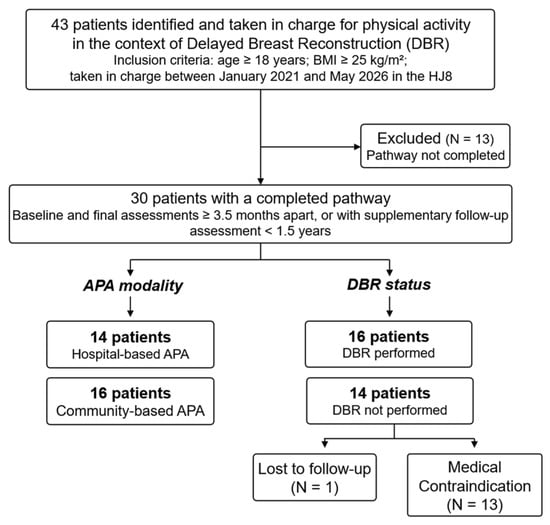
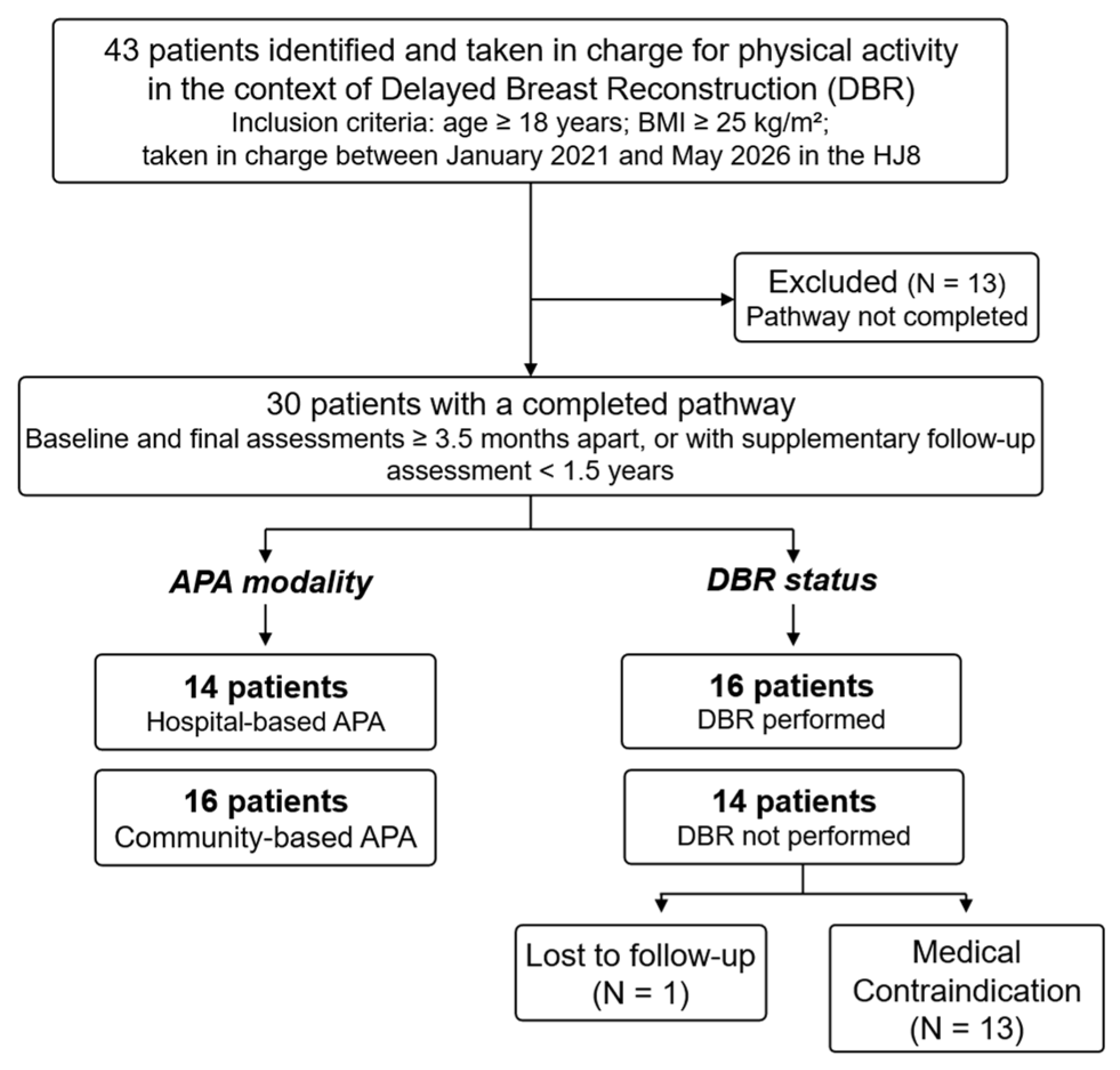
The study flowchart is presented in Figure 1.
Figure 1.
Flow Chart.
2.3. Data Collection
Data were extracted from digital medical records, as part of care provided in connection with the care pathway for PA, including demographic and anthropometric measures, vital signs, and physical performance parameters.
2.4. Statistical Analysis
All statistical analyses were performed using R software (RStudio, version 4.4.1). The normality of continuous variables was assessed using the Shapiro–Wilk test. Changes in continuous variables were evaluated using one-sample Student’s t-tests. When normality assumptions were not met, non-parametric methods were used. The normality of change scores was assessed using both the Shapiro–Wilk test and graphical inspection of histograms and Q-Q plots. As several change scores showed deviations from normality, non-parametric tests were used for between-group comparisons.
Missing data were handled using a complete-case approach. Given the exploratory nature of the study and the limited sample size (n = 30), no imputation procedure was applied. Each analysis was performed using all available observations for the outcome of interest. Consequently, the number of participants included varied across analyses according to the amount of missing data for each variable.
Associations between continuous variables were assessed using Spearman’s rank correlation coefficient, as some variables did not follow a normal distribution. Comparisons between independent groups of patients were performed using the Mann–Whitney U test (Wilcoxon rank-sum test). Factors associated with the risk of sarcopenia were investigated using logistic regression analyses, including both univariate models and a multivariable model adjusted for age and body mass index (BMI). Results are presented as odds ratios (ORs) with 95% confidence intervals (95% CIs). Statistical significance was set at a two-sided p-value < 0.05.
Given the limited number of participants classified as being at risk of sarcopenia (n = 5), the multivariable logistic regression analyses were considered exploratory and hypothesis-generating. Results were therefore interpreted with caution.
2.5. Ethical Considerations
This study complied with the Declaration of Helsinki and the General Data Protection Regulation (EU GDPR 2016/679). This study complies with reference methodology MR004 (R201-004-789, 15 October 2026) of the French National Data Protection Authority and was registered by the Data Protection Officer of the Leon Berard Cancer Centre on the activity registry of the institution. Non-opposition was obtained from all subjects involved in the study.
3. Results
The study flowchart is presented in Figure 1. The patients’ baseline demographic, anthropometric, and physical performance characteristics are presented in Table 1, and their medical history in Table 2, as well as a comparison of the repartition of these characteristics between the patients participating in hospital-based or community-based APA. The mean age of the 30 participants was 51 ± 8 years. The median BMI was 32.5 [29.1; 34.3] kg/m2, with a median adiposity of 37.9 [34.6; 41.6] % of their total weight. Most patients had an unfavorable cardiometabolic profile, presenting with at least one of the following: dyslipidemia, insulin resistance or diabetes, hypertension, or MASLD. More than half of the patients were physically active at baseline according to their Ricci-Gagnon Score. The median FACT-G7 score was 17.5 [15.8; 20.0]. Low protein intake was observed in 22 of the 30 patients (73.3%).
Table 1.
Baseline demographic, anthropometric, and physical performance characteristics of patients according to APA modality (Hospital-based vs. Community-based).
Table 2.
Baseline medical history of patients according to APA modality (hospital-based vs. community-based).
Regarding their treatment, one-third had received neoadjuvant chemotherapy, and two-thirds had received adjuvant chemotherapy or radiation therapy. More than half of them were on hormone therapy. Half of the patients involved in the study (15/30) experienced post-mastectomy complications. The average time between mastectomy and reconstructive surgery was more than two years. Most patients underwent DBR after the care pathway using the DIEP technique.
No significant difference was observed between the characteristics of the two groups at baseline.
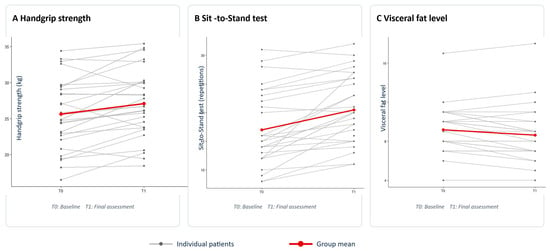
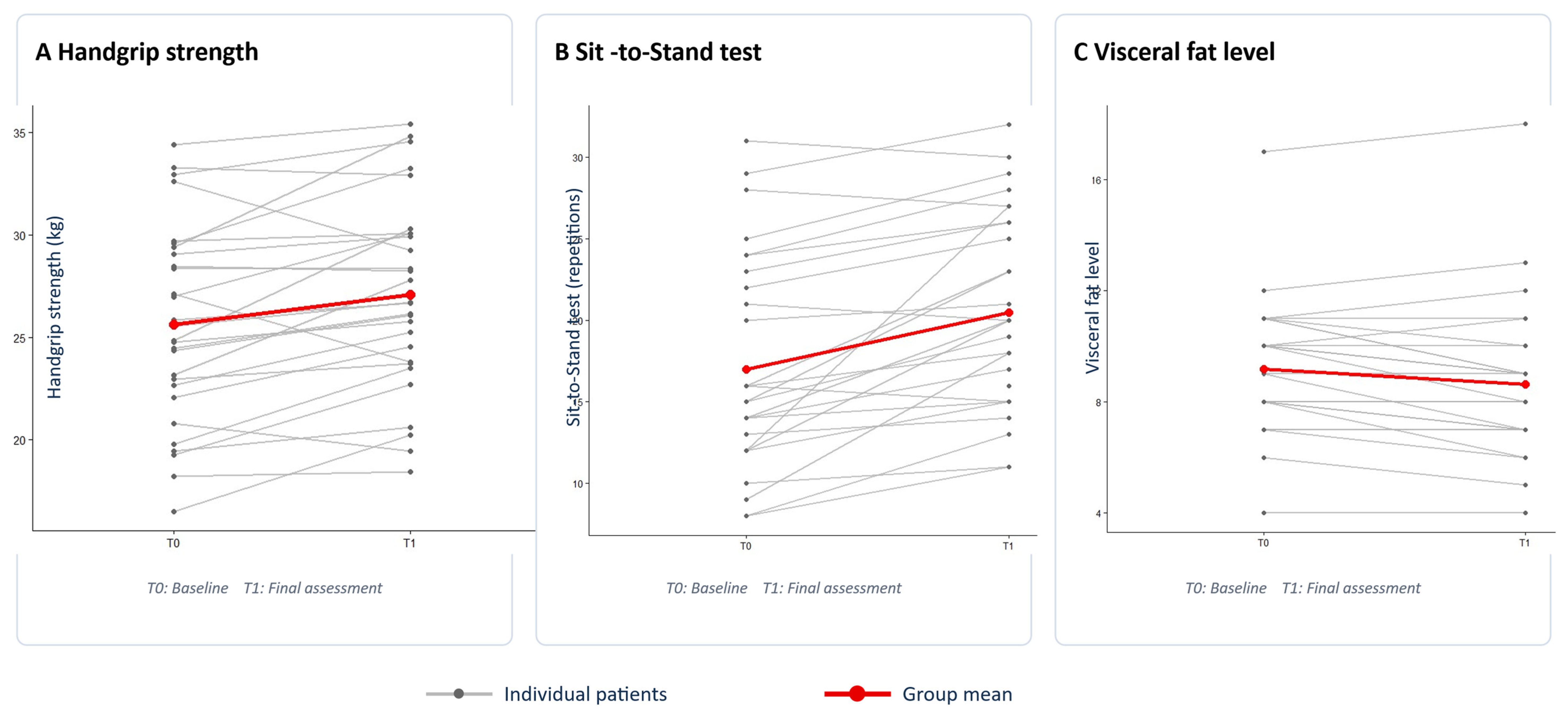
Changes in physical performance and anthropometric outcomes, quality of life, PA level, and nutritional behavior between the initial and final day-hospital assessments are presented in Table 3. Patients showed a significant reduction in visceral fat level, a significant increase in handgrip strength of 1.54 kg, and performed 3 supplementary repetitions on the sit-to-stand test between baseline and the final assessment (Figure 2). No significant changes were found in weight, muscle mass, adiposity, 6MWT performance, UST, PA level, and quality of life. The prevalence of a low-protein diet decreased from 73.3% (22/30) at baseline to 46.7% (14/30) at follow-up, corresponding to an absolute reduction of 26.7 percentage points. The change did not reach statistical significance according to McNemar’s exact test (OR = 0.27, 95% CI 0.05–1.03; p = 0.057). Physical activity frequency and intensity, did not differ between groups at baseline or at the final assessment (Table S1 and Table S2).
Table 3.
Changes in physical performance, anthropometric outcomes, quality of life, PA level, and nutritional behavior between the initial and final day-hospital assessments.
Figure 2.
Changes in physical performance (handgrip strength (A); sit-to-stand test (B)) and visceral fat (C) between the initial and final day-hospital assessments.
Patients participating in hospital-based APA showed a median decrease in muscle mass of 1.30 kg during follow-up, while those participating in community-based APA showed a median increase in muscle mass of 0.30 kg. No significant differences were observed in changes in weight, adiposity, VFL, HG, 6MWT, STS, UST, nutritional behavior, PA level, and quality of life (Table 4).
Table 4.
Changes in physical performance, anthropometric outcomes, quality of life, PA level, and nutritional behavior between the initial and final day-hospital assessments in patients participating in hospital-based or community-based APA.
No statistically significant difference was observed between patients who benefited from the usual follow-up and those who benefited from supplementary day-hospital follow-up, regarding changes in dietary habits, anthropometric parameters except for muscle mass, physical performance, PA level, and quality of life (Table S3).
Among the 30 patients studied, 5 (16.6%) presented a risk of sarcopenia. The median adiposity of patients identified as at risk of sarcopenia was higher (42.6% [42.1; 44.9%]) compared to the median adiposity of patients who were not identified as at risk of sarcopenia (37.6% [34.4; 40.2%]). In univariable analysis, adiposity was associated with the risk of sarcopenia (OR 1.41, 95% CI 1.08–2.12, p = 0.033). No significant associations were observed for age or BMI. In the multivariable model adjusted for age and BMI, adiposity remained positively associated with the risk of sarcopenia, although the association was no longer statistically significant (OR 4.85, 95% CI 0.15–188.00, p = 0.128). The wide confidence intervals reflect the limited precision of the estimates (Table S4).
No significant differences were observed between patients who received concurrent physiotherapy in addition to APA management and those who did not (Table S5).
4. Discussion
This study explored changes in physical performance and anthropometric outcomes in patients with breast cancer and overweight or obesity scheduled for DBR. Most patients had an unfavorable associated cardiometabolic profile, as they presented with at least a history of dyslipidemia, insulin resistance or diabetes, hypertension, or MASLD. From baseline to final assessment, patients showed a significant reduction in visceral fat level and a significant increase in upper and lower limb strength. No significant differences were observed between patients participating in hospital-based APA and those participating in community-based APA, except for muscle mass, which decreased in the hospital-based APA group whereas it increased in the community-based APA group. Furthermore, increased adiposity was associated with a higher risk of sarcopenia.
The increasing prevalence of overweight and obesity and associated cardiometabolic complications requires specific consideration for this patient profile, as it represents both a major risk factor and a predictor of negative outcomes of DBR [29], as well as a higher 10-year mortality rate. In this context, physical activity has been shown to be feasible and safe, may improve survival in breast cancer [6], and may reduce postoperative complications [7], while enhancing the patient’s functional capacity. In our study, visceral adiposity decreased significantly between baseline and the final assessment, with a borderline decrease in both weight and adiposity. These changes are reported descriptively and do not allow conclusions on postoperative complication rates. Tailored APA may nonetheless be a relevant component of the management of patients with overweight or obesity, aiming to prevent the side effects associated with cardiometabolic comorbidities and surgical treatment and potentially supporting the success of the reconstructive procedure, a hypothesis that remains to be tested in prospective studies.
In the whole cohort, patients improved their ability to stand up from a seated position repeatedly, with more than 3 additional repetitions achieved between baseline and the final assessment. This goes beyond the threshold of 2 repetitions, which corresponds to the minimum clinically significant difference observed in physical exercise programs [30]. We also observed a significant increase in upper limb strength on the handgrip test. Given that handgrip strength has been shown to be inversely associated with cancer mortality [31], this finding may be clinically relevant, although the prognostic impact of a change in grip strength after APA remains to be established. Our findings are consistent with the study by Winters-Stone et al., involving 114 patients with cured breast cancer, randomized into 3 groups by exercise type (aerobic training, resistance training, or stretching). The patients carried out 6 months of supervised exercise followed by 6 months of unsupervised exercise; all groups improved in muscle strength and functional ability scores during both phases of the trial [32].
However, we found a significant reduction in muscle mass in the hospital-based APA group compared to the community-based APA group, although this loss of muscle mass had no impact on muscle strength, as the overall trend was an increase in muscle strength within the cohort. This may be explained by the limited amount of muscle-strengthening exercise in the hospital-based setting, which emphasizes endurance training. However, exercise exposure, adherence, and nutritional intake (notably protein intake) were not objectively recorded, so this finding should be considered exploratory. This finding deserves attention, as decreased muscle strength and function pose a challenge in the management of breast cancer in patients with overweight or obesity. The underlying risk is sarcopenic obesity, defined as the coexistence of sarcopenia and a BMI > 30 kg/m2, whose morbidity and mortality implications are well described in the 2022 ESPEN and EASO guidelines. Given its impact on patients’ quality of life, functional capacity and life expectancy, sarcopenic obesity should be regarded as an autonomous pathology and therefore subject to more systematic screening [33].
These considerations raise the question of the optimal type of exercise. In their meta-analysis of 28 studies, Gebruers et al. showed that resistance training provided the best results in functional ability gains after breast cancer, whether performed alone or combined with aerobic training [34], particularly among female patients treated for breast cancer [35]. Resistance training may lead to greater improvements in muscle strength and functional ability than aerobic or flexibility training. Furthermore, resistance exercises have been shown to be an effective rehabilitation strategy for improving shoulder function in patients with breast cancer managed after surgery [36], which is worth underlining given that half of our patients presented postoperative complications following their initial breast surgery, comprising shoulder functional impairment.
Although taking part in a rehabilitation program following DBR helps reduce the risk of postoperative complications, implementation in everyday practice remains poor: Mazuquin et al. estimated that only half of patients undergoing breast reconstruction, both in the UK and in Brazil, are routinely referred to exercise care [37]. PA level did not change between baseline and the final assessment. However, promoting PA before or after surgery remains a challenge. Romero et al. reported that, among 629 patients newly diagnosed with cancer, 79% described a decrease in PA since their diagnosis [38]. From this perspective, maintaining regular PA during breast cancer treatment may be considered an achievement in itself, as described elsewhere [39].
In our study, community-based APA was either supervised or unsupervised, which precludes any comparison of adherence according to supervision status, although few patients were physically inactive. Supervision might, however, influence adherence: in a study involving 160 women treated for breast cancer, Courneya et al. found a 95% adherence rate with 123 min per week of supervised exercise, compared with 79% and 77 min per week for unsupervised exercise [40].
Apart from muscle mass, we did not find any difference between the two APA settings, whether hospital-based or community-based. Our results are consistent with the study by Struszczak et al., involving 30 breast cancer survivors (mean age 57 years) randomized to supervised or out-of-hospital exercise, in whom adiposity was assessed by BIA, VO2max by cardiopulmonary exercise testing, lower body strength by the sit-to-stand test, and functional ability by the 6-min walk test: the setting in which patients exercised did not affect changes in any of the measured outcomes [41].
We observed no statistical differences between patients who received standard follow-up and those who underwent supplementary day-hospital assessments, except for changes in muscle mass. This is consistent with McGhee et al., who showed, in 231 Australian women (mean age 55 years) practicing APA during breast cancer therapy, that the duration of follow-up did not affect exercise-induced changes [15].
These considerations could argue in favor of a more efficient allocation of staff time: the hospital team would focus on assessment and referral, while APA delivery could be delegated to community settings, allowing more patients to be assessed with the same level of human resources, albeit placing greater demands on community-based APA facilities. Such an organization would improve access to APA, free up medical time, and limit the burden of hospital visits for patients.
We did not find any significant difference in patients’ quality of life between baseline and the final day-hospital assessment. Moreover, the median FACT-G7 score observed in our study reflected patients with clinically significant symptoms/concerns [26]. Previous studies have demonstrated limited changes in FACT-G7 scores during oncological care [42], which may partly explain our negative finding, whereas the beneficial effect of PA on quality of life in patients treated for breast cancer is now well established. PA leads to a significant improvement in the quality of life of patients treated for breast cancer, as well as a reduction in anxiety, and appears to lower the risk of depression, as highlighted by Sun et al. in their meta-analysis of 20 studies including a total of 1228 patients with breast cancer [43].
Strengths and Limitations
Our study has several strengths. It focused on patients with breast cancer and overweight or obesity, a profile frequently encountered in clinical practice but often excluded or diluted in oncology rehabilitation studies. Notably, more than two-thirds of our patients presented with a history of cardiometabolic complications, a profile associated with a high risk of poor outcomes in the management of breast cancer. Our results therefore provide insight into this population, in whom exercise and nutritional management are particularly relevant.
The diversity of APA practices within our cohort—delivered both in a hospital unit dedicated to this purpose and in community settings, including unsupervised practice—allowed an original comparison of hospital-based and community-based APA delivery in patients with breast cancer and overweight or obesity. To our knowledge, such a comparison has not been previously reported in this population. The distribution of APA modalities, reflecting patient preference and feasibility in clinical practice rather than study allocation, may enhance the external validity of our findings. Although adherence could not be precisely quantified, particularly in the community-based group, the Ricci-Gagnon score provides an estimate of patients’ overall level of physical activity, irrespective of group. These results are corroborated by the PA frequency and intensity scoring performed specifically for the purpose of this study, which was similar between the two groups, both at baseline and at the final assessment.
Our study has certain limitations. Baseline characteristics of the hospital-based and community-based groups were compared descriptively. Given the small, non-randomized sample (n = 30), the absence of statistically significant differences at baseline cannot be taken as evidence of equivalence, and clinically relevant imbalances may have acted as confounders of the observed between-group differences. Its design does not allow causal inference, and the absence of randomization may have introduced selection bias, as APA modality was chosen according to patient preference and feasibility rather than allocation. Furthermore, the small sample size may have limited the ability to detect statistically significant differences. However, our findings suggest that improvements in physical performance may be achievable in patients managed in routine care for APA prior to scheduled DBR, whether in community-based or hospital-based settings. In addition, the analysis was restricted to patients who completed the pathway and both day-hospital assessments, which may have introduced completer bias, as patients who dropped out may differ in motivation, health status, or PA practice. The dose of the intervention (frequency, intensity, duration and content of sessions) varied between patients, particularly in the community-based group, and was not objectively recorded. Co-interventions, such as nutritional counseling, dietary changes, oncological treatments or other rehabilitation, were not controlled and may have contributed to the observed changes. Community-based APA delivery should therefore be regarded as a hypothesis to be tested rather than as a clinical recommendation.
The retrospective design implies that data were collected as part of routine care rather than for research purposes. Both day-hospital assessments were standardized, and the study relied on validated tests and methods assessing patients’ functional status, all performed in routine day-hospital care, ensuring homogeneous, reliable, and comparable evaluations. The combined use of validated tests and methods provides a comprehensive assessment of functional capacity, as recommended for patients with chronic conditions [44] and, specifically, for the assessment of pre-operative exercise capacity in cancer [45]. Body composition was assessed by bioelectrical impedance analysis (BIA), a reliable alternative to dual-energy X-ray absorptiometry for estimating adiposity and muscle mass, now widely used in routine practice [23].
Moreover, some patients have not undergone reconstruction to date, but we must keep in mind that in France, only 28% of women who undergo total mastectomy benefit from reconstruction [3]. Moreover, some patients who had not yet undergone surgery were still awaiting a surgical decision, while only a few patients had been deemed unsuitable for surgery. The DBR enabled the initial selection of patients, but subsequently some underwent the procedure whilst others did not, within very different timeframes, which are ultimately unrelated to our project results. DIEP reconstruction was performed in the majority of DBR patients (70%), consistent with the standard institutional approach for patients with overweight or obesity.
Only five participants were classified as being at risk of sarcopenia according to the GRASP screening tool. Consequently, the multivariable logistic regression analyses should be considered exploratory and hypothesis-generating. The small number of events may have resulted in model instability, overfitting, and imprecise effect estimates, as reflected by the wide confidence intervals observed for several predictors. Therefore, these findings should be interpreted cautiously and confirmed in larger studies.
Although this pilot study does not allow firm conclusions to be drawn, it provides preliminary hypothesis-generating data regarding both the changes in anthropometric and physical parameters observed in this population and the type of APA that should be implemented in this context. Larger prospective studies are warranted to confirm these hypotheses and to determine the optimal modalities of APA delivery.
5. Conclusions
Our retrospective study suggests that in patients with breast cancer and concurrent overweight or obesity, a care pathway combining APA and nutritional management delivered in routine care before scheduled DBR could provide clinically meaningful benefits, namely increased muscle strength and reduced visceral adiposity. The way APA was delivered, whether in hospital-based or community-based settings, did not show differences in terms of changes in anthropometric parameters, PA level, quality of life, and physical performance. Given the risk of muscle loss, the exercise modality should focus on resistance training, adapted to the patient’s physical limitations and preferences. Further research is needed to develop systematic referral processes for standardized functional assessment. Moreover, future research is warranted to assess the impact of physical performance and body composition parameters on clinical and surgical outcomes of delayed breast reconstruction.
Supplementary Materials
The following supporting information can be downloaded at: https://www.mdpi.com/article/10.3390/diseases14120444/s1, Table S1. Distribution of frequency by APA group at baseline (T0) and follow-up (T1). Table S2. Distribution of intensity by APA group at baseline (T0) and follow-up (T1). Table S3. Comparison of changes in physical performance, anthropometric outcomes, quality of life, PA level, and nutritional behavior from the initial to the final day-hospital assessment between patients receiving standard follow-up or supplementary assessment. Table S4. Association between adiposity and sarcopenia risk in univariate and multivariate logistic regression. Table S5. Comparison of changes in physical performance, anthropometric outcomes, quality of life, PA level, and nutritional behavior from the initial to the final day-hospital assessment between patients receiving standard follow-up or concurrent physiotherapy care.
Author Contributions
Conceptualization, O.P., P.M. and L.P.; methodology, O.P. and P.M.; software, O.P.; validation, O.P. and L.P.; formal analysis, C.T.; investigation, L.P.; data curation, L.P.; writing—original draft preparation, L.P.; writing—review and editing, O.P., P.M., B.F., M.-A.D., M.H. and L.P.; visualization, L.P. and C.T.; supervision, O.P.; project administration, L.P. All authors have read and agreed to the published version of the manuscript.
Funding
This research received no external funding.
Institutional Review Board Statement
The study was conducted in accordance with the Declaration of Helsinki and approved by the Institutional Review Board of Leon Berard Cancer Centre [This study complies with reference methodology MR004 (R201-004-789, 15 October 2026) of the French National Data Protection Authority and was registered by the Data Protection Officer].
Informed Consent Statement
Non-opposition was obtained from all subjects involved in the study.
Data Availability Statement
The data presented in this study are available on request from the corresponding author due to ethical restrictions.
Acknowledgments
During the preparation of this manuscript, the authors used Claude AI, Opus 5.5, to generate the pictograms featured in the graphical summary. The authors have reviewed and edited the output and take full responsibility for the content of this publication.
Conflicts of Interest
The authors declare no conflicts of interest.
Abbreviations
The following abbreviations are used in this manuscript:
| APA | Adapted Physical Activity |
| BIA | Bioelectrical Impedance Analysis |
| BMI | Body Mass Index |
| DBR | Delayed Breast Reconstruction |
| DIEP | Deep Inferior Epigastric Perforator |
| HAS | Haute Autorité de Santé |
| HG | Handgrip |
| HTN | Hypertension |
| MASLD | Metabolic dysfunction-Associated Steatotic Liver Disease |
| PA | Physical Activity |
| SOC | Socio-Occupational Category |
| STS | Sit-to-Stand Test |
| UST | Unipedal Stance Test |
| VFL | Visceral Fat Level |
| 6MWT | 6-Minute Walk Test |
References
- Kim, J.; Harper, A.; McCormack, V.; Sung, H.; Houssami, N.; Morgan, E.; Mutebi, M.; Garvey, G.; Soerjomataram, I.; Fidler-Benaoudia, M.M. Global patterns and trends in breast cancer incidence and mortality across 185 countries. Nat. Med. 2025, 31, 1154–1162. [Google Scholar] [CrossRef] [Scilit] [PubMed]
- Panorama des Cancers en France—Édition 2026; l’Institut National du Cancer (INCa): Boulogne-Billancourt, France, 2026.
- Vincent, L.; Laville, C.; Jacinto, S.; Coutant, C.; Burnier, P. Actualisation des indications et techniques de reconstruction mammaire immédiate, notamment en cas de radiothérapie adjuvante. Gynécologie Obs. Fertil. Sénologie 2024, 52, 165–169. [Google Scholar] [CrossRef] [Scilit] [PubMed]
- Friedenreich, C.M.; Stone, C.R.; Cheung, W.Y.; Hayes, S.C. Physical Activity and Mortality in Cancer Survivors: A Systematic Review and Meta-Analysis. JNCI Cancer Spectr. 2019, 4, pkz080. [Google Scholar] [CrossRef] [Scilit] [PubMed] [PubMed Central]
- Raghavendra, A.; Sinha, A.K.; Valle-Goffin, J.; Shen, Y.; Tripathy, D.; Barcenas, C.H. Determinants of Weight Gain During Adjuvant Endocrine Therapy and Association of Such Weight Gain with Recurrence in Long-term Breast Cancer Survivors. Clin. Breast Cancer 2018, 18, e7–e13. [Google Scholar] [CrossRef] [Scilit] [PubMed]
- Picon-Ruiz, M.; Morata-Tarifa, C.; Valle-Goffin, J.J.; Friedmanuel, E.R.; Slingerlalnd, J.M. Obesity and adverse breast cancer risk and outcome: Mechanistic insights and strategies for intervention. CA A Cancer J. Clin. 2017, 67, 378–397. [Google Scholar] [CrossRef] [Scilit] [PubMed]
- Benziane, A.; Mesdag, V.; Bogart, E.; Petitnicolas, C.; Defoort, C.; Boulanger, L.; Chauvet, M.; Le Deley, M.; Régis, C.; Hannetbicque, A. Impact of Body Mass Index on Surgical Outcomes After Delayed Breast Reconstruction. J. Surg. Oncol. 2026. [Google Scholar] [CrossRef] [Scilit] [PubMed]
- Caan, B.J.; Feliciano, E.M.C.; Prado, C.M.; Alexeeff, S.; Kroenke, C.H.; Bradshaw, P.; Quesenberry, C.P.; Weltzien, E.K.; Casteillo, J.A.L.; Olobatuyi, T.A.; et al. Association of Muscle and Adiposity Measured by Computed Tomography With Survival in Patients with Nonmetastatic Breast Cancer. JAMA Oncol. 2018, 4, 798–804. [Google Scholar] [CrossRef] [Scilit] [PubMed]
- Marco, E.; Trépanier, G.; Chang, E.; Mauti, A.; Jones, J.M.; Zhong, T. Postmastectomy Functional Impairments. Curr. Oncol. Rep. 2023, 25, 1445–1453. [Google Scholar] [CrossRef] [Scilit] [PubMed]
- Klassen, O.; Schmidt, M.E.; Ulrivch, C.M.; Schner Etweiss, A.; Potthoff, K.; Steindorf, K.; Wiskemann, J. Muscle strength in breast cancer patients receiving different treatment regimes. J. Cachexia Sarcopenia Muscle 2017, 8, 305–316. [Google Scholar] [CrossRef] [Scilit] [PubMed]
- Andersen, I.S.; Jensen, D.M.R.; Grosen, K.; Bennedsgaard, K.T.; Ventzel, L.; Finnerup, N.B. Body image and psychosocial effects in women after treatment of breast cancer: A prospective study. Am. J. Surg. 2024, 237, 115895. [Google Scholar] [CrossRef] [Scilit] [PubMed]
- Roberts, C.K.; Hevener, A.L.; Barnard, R.J. Metabolic syndrome and insulin resistance: Underlying causes and modification by exercise training. Compr. Physiol. 2013, 3, 1–58. [Google Scholar] [CrossRef] [Scilit] [PubMed]
- Fernandez-Rodriguez, E.J.; Sanchez-Gomez, C.; Mendez-Sanchez, R.; Recio-Rodriguardoez, J.I.; Puente-Gonzalez, A.S.; Gonzalez-Sanchez, J.; Cruz-Hernandez, J.J.; Rihuet E-Galve, M.I. Multimodal Physical Exercise and Functional Rehabilitation Program in Oncological Patients with Cancer-Related Fatigue—A Randomized Clinical Trial. Int. J. Environ. Res. Public Health 2023, 20, 4938. [Google Scholar] [CrossRef] [Scilit] [PubMed]
- Ligibel, J.A.; Bohlkennifer, K.; May, A.M.; Clinton, S.K.; Demark-Wahnefried, W.; Gilchrist, S.C.; Irwin, M.L.; Late, M.; Mansfield, S.; Marshall, T.F.; et al. Exercise, Diet, and Weight Management During Cancer Treatment: ASCO Guideline. J. Clin. Oncol. 2022, 40, 2491–2507. [Google Scholar] [CrossRef] [Scilit] [PubMed]
- McGhee, D.E.; Steele, J.R. Physical side-effects following breast reconstructive surgery impact physical activity and function. Support. Care Cancer 2021, 29, 787–794. [Google Scholar] [CrossRef] [Scilit] [PubMed]
- Del Rosal Jurado, A.; González Sánchez, M.; Cuesta Vargas, A.I. Physical prehabilitation in patients with breast cancer: A systematic review. Support. Care Cancer 2025, 33, 71. [Google Scholar] [CrossRef] [Scilit] [PubMed]
- Avancini, A.; Borsati, A.; Toniolo, L.; Ciurnelli, C.; Belluomini, A.; Budolfsen, T.; Lillelund, C.; Milella, M.; Quist, M.; Pilotto, S. Physical activity guidelines in oncology: A systematic review of the current recommendations. Crit. Rev. Oncol. 2025, 210, 104718. [Google Scholar] [CrossRef] [Scilit] [PubMed]
- Ishaaya, E.; Yee, N.; DeCato, E.A.W. Six-Minute Walk Testing: Performance, Properties, and Clinical Applications. Clin. Chest Med. 2025, 46, 467–479. [Google Scholar] [CrossRef] [Scilit] [PubMed]
- Bowman, A.; Denehy, L.; Benjemyaa, A.; Crowe, J.; Bruns, E.; Hall, T.; Traill, A.; Edbrooke, L. Feasibility and safety of the 30-second sit-to-stand test delivered via telehealth: An observational study. PM&R J. Inj. Funct. Rehabil. 2023, 15, 31–40. [Google Scholar] [CrossRef] [Scilit] [PubMed]
- Vaishya, R.; Misraju Et, A.; Vaish, A.; Ursino, N.; D’ambrosi, R. Hand grip strength as a proposed new vital sign of health: A narrative review of evidences. J. Health Popul. Nutr. 2024, 43, 7. [Google Scholar] [CrossRef] [Scilit] [PubMed]
- Springer, B.A.; Marin, R.; Cyhan, T.; Robaerats, A.H.; EtGill, A.W. Normative values for the unipedal stance test with eyes open and closed. J. Geriatr. Phys. Ther. 2007, 30, 8–15. [Google Scholar] [CrossRef] [Scilit] [PubMed]
- Pedersen, A.N.; Kondrup, J.; Børsheim, E. Health effects of protein intake in healthy adults: A systematic literature review. Food Nutr. Res. 2013, 57, 21245. [Google Scholar] [CrossRef] [Scilit] [PubMed]
- Ballesteros-Pomar, M.D.; González-Arnáiz, E.; Maza, B.P.-D.; Barajas-Galindo, D.; Ariadel-Cobo, D.; González-Roza, L.; Cano-Rodríaguez, D. Bioelectrical impedance analysis as an alternative to dual-energy x-ray absorptiometry in the assessment of fat mass and appendicular lean mass in patients with obesity. Nutrition 2022, 93, 111442. [Google Scholar] [CrossRef] [Scilit] [PubMed]
- Dodds, R.M.; Syddall, H.E.; Cooper, R.; Benzeval, M.; Deary, I.J.; Dennison, E.M.; Der, G.; Gale, C.R.; Inskip, H.M.; Jagger, C.; et al. Grip strength across the life course: Normative data from twelve British studies. PLoS ONE 2014, 9, e113637. [Google Scholar] [CrossRef] [Scilit] [PubMed]
- CHU Clermont-Ferrand GRASP L’aide au Diagnostic de la Sarcopénie. Available online: https://grasp.chu-clermontferrand.fr/os (accessed on 15 April 2026).
- Yanez, B.; Pearman, T.; Lis, C.G.; Beaumont, J.L.; Cella, D. The FACT-G7: A rapid version of the functional assessment of cancer therapy-general (FACT-G) for monitoring symptoms and concerns in oncology practice and research. Ann. Oncol. 2013, 24, 1073–1078. [Google Scholar] [CrossRef] [Scilit] [PubMed]
- Reychler, G.; Petit, A.-S.; Caty, G.; Aboubakar, F.; Liistro, G.; Fremault, A.; Beaumont, M. The construct validity of the Ricci-Gagnon questionnaire to assess PA level: A prospective study. Eur. Rehabil. J. 2023, 3, hal-05213674. [Google Scholar]
- Haute Autorité de Santé (HAS). Consultation et Prescription Médicale d’Activité Physique à des Fins de Santé [Medical Consultation and Prescription of Physical Activity for Health Purposes]; HAS: Saint-Denis La Plaine, France, 2025; Available online: https://www.has-sante.fr/jcms/c_2876862/fr/consultation-et-prescription-medicale-d-activite-physique-a-des-fins-de-sante (accessed on 12 June 2026).
- Devericks, E.N.; Carson, M.S.; McCulylough, N.E.A.E.; Coleman, M.F.; Hursting, S.D. The obesity-breast cancer link: A multidisciplinary perspective. Cancer Metastasis Rev. 2022, 41, 607–625. [Google Scholar] [CrossRef] [Scilit] [PubMed]
- Leach, H.J.; Fairman, C.M.; Gomes, E.L.; Marker, R.J. Evaluating individual level changes in physical function response following an exercise program for cancer survivors. Support Care Cancer 2023, 31, 353. [Google Scholar] [CrossRef] [Scilit] [PubMed]
- López-Bueno, R.; Andersen, L.L.; Koyanagi, A.; Núñez-Cortés, R.; Calatayud, J.; Casaña, J.; Del Pozo Cruz, B. Thresholds of handgrip strength for all-cause, cancer, and cardiovascular mortality: A systematic review with dose-response meta-analysis. Ageing Res. Rev. 2022, 82, 101778. [Google Scholar] [CrossRef] [Scilit] [PubMed]
- Winters-Stone, K.M.; Torgrimson-Ojerio, B.; Dieckmann, N.F.; Stoyles, S.; Mitri, Z.; Luoh, S.-W. A Randomized-Controlled Trial Comparing Supervised Aerobic Training to Resistance Training Followed by Unsupervised Exercise on Physical Functioning in Older Breast Cancer Survivors. J. Geriatr. Oncol. 2022, 13, 152–160. [Google Scholar] [CrossRef] [Scilit] [PubMed]
- Khamassi, S.; Boukhayatia, F.; Abdesselem, H.; Bornaz, E.; Ounaissa, K.; Bouhajja, H.; Kacem, A.; Gammoudi, A.; Mahjoub, R.; Talbi, E.; et al. Sarcopenic Obesity in Adult Patients: Prevalence and Risk Factors. Nutr. Metab. Insights 2022, 18, 11786388251348955. [Google Scholar] [CrossRef] [Scilit] [PubMed]
- Gebruers, N.; Camberlickn, M.; Theunissen, F.; Tjalma, W.; Verbelen, H.; Van Soom, T.; van Breda. The effect of training interventions on physical performance, quality of life, and fatigue in patients receiving breast cancer treatment: A systematic review. Support. Care Cancer 2019, 27, 109–122. [Google Scholar] [CrossRef] [Scilit] [PubMed]
- Tan, T.; Tan, H.; Chung, Y. Effectiveness of resistance training in preventing sarcopenia among breast cancer patients undergoing chemotherapy: A systematic review and meta-analysis. Worldviews Evid.-Based Nurs. 2024, 21, 687–694. [Google Scholar] [CrossRef] [Scilit] [PubMed]
- Yijing, F.; Huiqian, E.; Hong, L.; Zirui, Z.; Shufang, Z.; Yang, W.; Zhou, L. Effects of different intensity of resistance exercise on shoulder function and immune function in young and middle-aged postoperative breast cancer patients: A randomized control trial. Support. Care Cancer 2025, 34, 12. [Google Scholar] [CrossRef] [Scilit] [PubMed]
- Mazuquin, B.; Sunemi, M.M.d.O.; Silva, M.P.P.E.; Sarian, L.O.Z.; Williamson, E.; Brunoce, J. Current physical therapy care of patients undergoing breast reconstruction for breast cancer: A survey of practice in the United Kingdom and Brazil. Braz. J. Phys. Ther. 2021, 25, 175–185. [Google Scholar] [CrossRef] [Scilit] [PubMed]
- Romero, S.A.D.; AJones, D.E.A.; Bauml, J.M.; Li, Q.S.; Cohen, R.B.; Mao, J.J. The association between fatigue and pain symptoms and decreased physical activity after cancer. Support. Care Cancer 2018, 26, 3423–3430. [Google Scholar] [CrossRef] [Scilit] [PubMed]
- Morgan, T.L.; Faught, E.; Ross-White, A.; Fortier, M.S.; Duggan, M.; Jain, R.; Lane, K.N.; Lorbergs, A.; Maclaren, K.; McFadden, L.T.; et al. Tools to guide clinical discussions on physical activity, sedentary behaviour, and/or sleep for health promotion between primary care providers and adults accessing care: A scoping review. BMC Prim. Care 2023, 24, 140. [Google Scholar] [CrossRef] [Scilit] [PubMed]
- Courneya, K.S.; Karvinen, K.H.; McNeely, M.L.; Campbell, K.L.; Brar, S.; Woolcott, C.G.; McTierry S Etnan, A.; Ballard-Barbash, R.; Friedenreich, C.M. Predictors of adherence to supervised and unsupervised exercise in the Alberta Physical Activity and Breast Cancer Prevention Trial. J. Phys. Act. Health 2012, 9, 857–866. [Google Scholar] [CrossRef] [Scilit] [PubMed]
- Struszczak, L.; Walhin, J.; Betts, J.; Thompson, D.; Beresford, M.; al Turnenr, J. Cardiorespiratory Fitness, Functional Fitness and Body Composition Among Breast Cancer Survivors with 8 Weeks of Exercise Training: A Randomised, Controlled Non-Inferiority Trial Comparing Remotely-Supported and Partly-Supervised Interventions. Cancer Med. 2026, 15, e71608. [Google Scholar] [CrossRef] [Scilit] [PubMed]
- Kim, J.; Llave, K.; Kuhariwc, M.; Lancki, N.; Jackson, K.; Webster, K.A.; Cella, D. Identifying Longitudinal Trajectories of Quality of Life and Associated Risk and Protective Factors Among Cancer Patients. Psycho-Oncology 2026, 35, e70453. [Google Scholar] [CrossRef] [Scilit] [PubMed]
- Sun, M.; Liu, C.; Lu, Y.; Zhu, F.; Li, H.; Lu, Q. Effects of Physical Activity on Quality of Life, Anxiety and Depression in Breast Cancer Survivors: A Systematic Review and Meta-analysis. Asian Nurs. Res. 2023, 17, 276–285. [Google Scholar] [CrossRef] [Scilit] [PubMed]
- Segura-Ortí, E.; Martínez-Olmos, F.J. Test-retest reliability and minimal detectable change scores for sit-to-stand-to-sit tests, the six-minute walk test, the one-leg heel-rise test, and handgrip strength in people undergoing hemodialysis. Phys. Ther. 2011, 91, 1244–1252. [Google Scholar] [CrossRef] [Scilit] [PubMed]
- Butson, G.; Edbrooke, L.; Ismail, H.; Denehy, L.; The Centre for Prehabilitation and Peri-operative Care (CPPOC). Exercise capacity prior to major cancer surgery: A cross-sectional observational study of the validity of the 6-minute walk and 30-second sit-to-stand tests. Asia-Pac. J. Clin. Oncol. 2024, 20, 497–506. [Google Scholar] [CrossRef] [Scilit] [PubMed]

Disclaimer/Publisher’s Note: The statements, opinions and data contained in all publications are solely those of the individual author(s) and contributor(s) and not of MDPI and/or the editor(s). MDPI and/or the editor(s) disclaim responsibility for any injury to people or property resulting from any ideas, methods, instructions or products referred to in the content. |
© 2026 by the authors. Licensee MDPI, Basel, Switzerland. This article is an open access article distributed under the terms and conditions of the Creative Commons Attribution (CC BY) license.