


Abstract
To address the problem of fault diagnosis for rotating machinery under complex operating conditions in real industrial systems, most existing domain generalization methods fail to sufficiently consider inter-class feature structures when learning domain-invariant representations. This limitation often leads to degraded diagnostic performance in cross-domain scenarios, particularly under class imbalance or significant operating condition variations. Moreover, existing feature extraction networks specifically designed for rotating machinery are often inadequate for fault diagnosis tasks under variable operating conditions. To overcome these challenges, this paper proposes a domain-invariant fault feature representation learning framework for multi-source domain generalization. Specifically, we design a mechanism-aware multi-branch feature extraction network inspired by excitation–modulation mechanisms of fault generation, which captures fault-sensitive characteristics from both time-domain and frequency-domain perspectives. In addition, a class-conditional feature alignment strategy based on ICM (Independent Causal Mechanism) mixing is introduced to enhance cross-domain consistency. Through feature structure regularization, discriminative information across categories is effectively preserved under domain shifts. Extensive experimental results demonstrate that the proposed method significantly improves diagnostic performance and generalization ability on the CWRU bearing dataset as well as the HUST bearing and gearbox datasets. Notably, when the number of source domains increases, the proposed framework exhibits superior training efficiency.
1. Introduction
Rotating machinery, including bearings and gearboxes, serves as a fundamental component for energy conversion and power transmission in modern industrial systems. Reliable fault diagnosis and condition monitoring of such equipment are crucial for ensuring operational safety, reducing maintenance costs, and preventing catastrophic system failures [1,2]. In recent years, deep learning-based approaches have achieved remarkable progress in rotating machinery fault diagnosis by automatically extracting fault-sensitive representations from vibration signals, significantly reducing the reliance on handcrafted features [3,4].
However, most existing diagnostic models implicitly assume that training and deployment data share similar operating conditions [5,6]. In real-world applications, this assumption rarely holds. For instance, wind turbine drivetrains operate under continuously varying wind speeds, resulting in dynamic changes in rotational speed and torque [7]. As summarized in recent comprehensive reviews on non-destructive condition monitoring techniques for wind turbines, such operational variability poses significant challenges for robust fault diagnosis in practical deployments [8]. Variations in speed, load, torque, and environmental factors inevitably induce distribution shifts in measured signals. Consequently, models trained under limited operating conditions often suffer substantial performance degradation when deployed under unseen conditions [9].
Domain generalization (DG) provides a promising paradigm to address this challenge. Unlike domain adaptation, DG does not require access to target-domain data during training. Instead, it aims to learn representations from multiple source domains that remain effective on previously unseen domains [10,11,12]. Despite recent advances in DG, applying these techniques to rotating machinery fault diagnosis still faces several challenges. First, mechanical fault signatures manifest differently under varying operating conditions. Changes in operation influence not only the marginal feature distribution but also the class-conditional feature distributions. Direct marginal alignment may distort class structures and aggravate inter-class confusion, especially under class imbalance scenarios [13]. Second, impulsive responses induced by mechanical faults are governed by excitation and modulation mechanisms. These excitation–modulation mechanisms constitute the causal generation process of fault signals and, thus, learning representations that are consistent with such mechanisms—rather than merely capturing statistical correlations—is essential for achieving physically meaningful domain invariance. If representation learning focuses solely on statistical alignment while neglecting modulation-sensitive structures in amplitude and phase components, the learned invariance may lack physical consistency, leading to suboptimal generalization performance [14,15,16]. Third, enforcing domain invariance through aggressive feature alignment may unintentionally compress inter-class margins and cause feature entanglement. Excessive homogenization across domains can blur decision boundaries and yield unstable predictions under unseen operating conditions. Therefore, achieving domain invariance while preserving discriminative class structure is a critical trade-off in model training [5,17,18].
To address these issues, we propose a domain-invariant fault representation learning framework that integrates mechanism-aware feature modeling with class-conditional structural alignment. Unlike conventional approaches that align global feature distributions, the proposed method emphasizes maintaining class-conditional consistency across domains. A structural regularization mechanism is introduced to prevent representation collapse during cross-domain alignment and to preserve inter-class separability. Specifically, we design a mechanism-aware (causal excitation-driven) multi-branch feature extraction architecture tailored for rotating machinery DG tasks. The proposed architecture explicitly models modulation-sensitive characteristics in the frequency domain, enabling stable fault diagnosis under unseen domains. Furthermore, we introduce an ICM-inspired class-conditional distribution alignment strategy that enforces consistency of same-class representations across multiple source domains without requiring target-domain data. The ICM-based alignment mechanism also improves computational efficiency when the number of source domains increases. Additionally, a structure-preserving regularization term is incorporated to maintain discriminative inter-class margins during feature alignment. Extensive multi-source DG experiments conducted on the CWRU bearing dataset and two multi-condition HUST datasets (bearing and gearbox) demonstrate that the proposed framework achieves superior performance in the majority of cross-condition fault generalization tasks compared with conventional deep models. Visualization analyses further confirm that the learned representations preserve stable class structures and clear inter-class separability across varying operating conditions.
The main contributions of this study can be summarized as follows:
- We develop a mechanism-aware multi-branch feature extraction architecture specifically designed for rotating machinery domain generalization, explicitly modeling modulation-related fault-sensitive characteristics in the frequency domain to ensure stable diagnosis under unseen domains.
- We propose an ICM-based class-conditional distribution alignment strategy that learns consistent representations for identical fault categories across multiple source domains without requiring target-domain data, while maintaining efficient training when the number of source domains increases.
- We introduce a structure-preserving regularization mechanism to maintain inter-class separability during domain feature alignment, thereby enhancing robustness under unseen operating conditions.
- We conduct extensive multi-source domain generalization experiments on the CWRU dataset and two multi-condition HUST datasets, where the proposed method achieves superior performance in the majority of cross-condition fault diagnosis tasks compared with conventional networks.
2. Related Work
2.1. Domain Generalization for Fault Diagnosis in Rotating Machinery
Domain generalization (DG) aims to learn models from labeled source domains that remain effective on unseen target domains, under the assumption that no target-domain data are accessible during training. In recent years, DG has attracted increasing attention in rotating machinery fault diagnosis. Existing approaches can be broadly categorized into three methodological paradigms. (1) Distribution alignment-based methods. These approaches attempt to learn domain-invariant representations by reducing discrepancies among source domains, typically via adversarial training or feature distribution matching. For instance, Zhou et al. employed adversarial learning to extract features insensitive to speed and torque variations for wind turbine gearbox diagnosis [19]. Du et al. proposed CPC-DG, which combines high-confidence pseudo labels with global MMD alignment to minimize distribution discrepancies across multiple source domains, thereby improving generalization under limited labeled data [20]. More recently, Shi et al. introduced class-conditional feature alignment into rotating machinery diagnosis and reported improved classification performance [13]. However, their method does not explicitly constrain inter-class structural relationships during alignment. (2) Data augmentation-based strategies. These methods enhance generalization by enriching source-domain diversity through generative models. For example, Zhao et al. leveraged diffusion models to augment two-dimensional time–frequency representations obtained via continuous wavelet transform and trained fault diagnosis networks using the augmented data, thereby improving cross-condition robustness [21]. (3) Causality-guided and subspace disentanglement approaches. This category focuses on specialized training strategies that decouple domain-invariant fault features from domain-specific variations, often by enforcing stronger causal consistency or subspace factorization mechanisms [22,23]. Such approaches aim to isolate features that are causally linked to fault mechanisms from those associated with environmental changes. Among these paradigms, distribution alignment-based DG methods have gained significant popularity due to their clear optimization objectives and increasing theoretical justification under certain assumptions [12,24]. Nevertheless, recent studies by Shi et al. [17] and Xu et al. [18] highlight a critical limitation: aligning only global feature distributions or class-conditional marginal distributions without structural constraints may lead to cross-domain class entanglement and feature drift. This issue becomes more pronounced under class imbalance, where naive alignment may distort decision boundaries. To address these limitations, we propose a class-conditional Wasserstein-based alignment strategy implemented via entropy-regularized optimal transport equipped with a pull–push structural constraint. Compared to KL or KS divergence, the Wasserstein distance provides more stable gradients when distribution supports have limited overlap during early training stages [25], making it more suitable for fault-related feature alignment. Furthermore, existing multi-source alignment methods often rely on pairwise domain traversal, which leads to quadratic growth in computational complexity as the number of source domains increases. To improve scalability, we extend the ICM training mechanism introduced by Chevalley et al. [26] to a class-conditional Wasserstein alignment framework, enabling efficient feature alignment even when numerous source domains are involved.
2.2. Prior-Guided Feature Modeling
In recent years, mechanism-informed feature modeling has attracted increasing attention in rotating machinery diagnosis. This paradigm explicitly embeds task-specific prior knowledge into network architectures, aiming to enhance interpretability while improving fault-sensitive representation learning. For instance, Liu Rui et al. [27] proposed a learnable FIR layer in which filter center frequencies are adaptively optimized, thereby improving model interpretability. However, when operating conditions vary, the learned filter parameters remain fixed after training and may fail to adapt to new speed or load variations, potentially limiting cross-condition generalization. To address this issue, Rui Liu et al. [14] further introduced speed-aware convolutional kernels whose parameters vary with rotational speed. Nevertheless, such kernels are typically modeled through linear transformations and may not adequately capture complex sideband modulation patterns or torque-induced vibration variations. Wavelet-based architectures have also been explored. Yong Feng et al. [28] introduced a stochastic wavelet convolution layer for feature extraction, whose performance depends on both the wavelet design and the number of random kernels. When the number of wavelet kernels is limited, diagnostic performance may degrade. Peng et al. [29] incorporated multi-scale wavelet analysis into vibration feature extraction; however, the learned wavelet parameters remain fixed after training, which may reduce robustness under unseen operating conditions. Similarly, Huang et al. [30] proposed a Superlet-based feature extraction module that fuses multiple wavelet kernels to enhance representation capability. While effective in capturing multi-scale information, the fixed nature of learned parameters may hinder adaptability to novel working conditions. These prior-guided filtering strategies improve interpretability by embedding structured signal-processing knowledge into deep architectures. However, explicitly introducing specialized filter layers may also constrain representation flexibility, potentially compromising the intrinsic domain generalization capability of deep neural networks when deployed under unseen operating conditions. Recent industrial studies have also explored prior-guided representation learning strategies to enhance fault sensitivity. For example, an adversarial autoencoder-based framework triggered by pencil lead break excitation was proposed for rapid and robust rail damage detection, where structured prior distributions were incorporated to improve representation stability under varying operational conditions [31]. While such approaches enhance sensitivity to predefined signal characteristics, their reliance on fixed distributional assumptions may limit adaptability under complex cross-domain shifts. This limitation of fixed or condition-dependent parameterization under unseen operating conditions motivates the need for a feature modeling strategy that captures physically meaningful local variations without hard-coding frequency-specific filters. In contrast, we introduce a multi-scale NeuRN mechanism that incorporates only high-level fault-related priors—namely, impulsive excitation characteristics and phase-shift patterns—without imposing rigid, condition-dependent filtering structures. By focusing on modulation-sensitive local variations rather than predefined frequency components, the proposed architecture encourages attention to fault-relevant structures while preserving the adaptability and generalization capacity of deep representations across varying domains.
3. Problem Formulation
3.1. Multi-Source Domain Generalization Setting
In practical industrial scenarios, rotating machinery systems often operate under varying working conditions (e.g., speed, torque, and load). We define each distinct operating condition as a domain in the fault diagnosis task. In the multi-source domain generalization setting, we assume that only a finite number of labeled source domains are accessible during training, while the trained model is expected to generalize to unseen target domains. Specifically, let the set of available source domains be denoted as , where M is the number of labeled source domains. For each domain , vibration samples are collected as , where C denotes the number of sensors and T represents the temporal length of the vibration sequence. Each sample is associated with a label , where K is the number of fault categories. For domain , we collect samples and construct the dataset . We assume that all source and target domains share the same label space . For samples from source domains, . For an unseen target domain , samples follow , where , and no target-domain samples are observed during training.
3.2. Learning Objective
The goal is to learn a feature encoder and a task classifier , such that the expected classification risk on unseen target domains is minimized. Formally, we aim to solve:
where denotes the cross-entropy loss.
4. Proposed Method
4.1. Overall Architecture
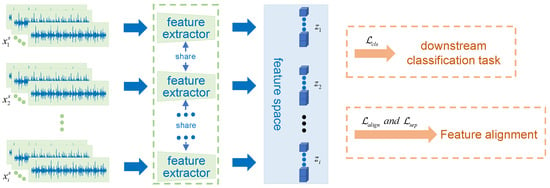
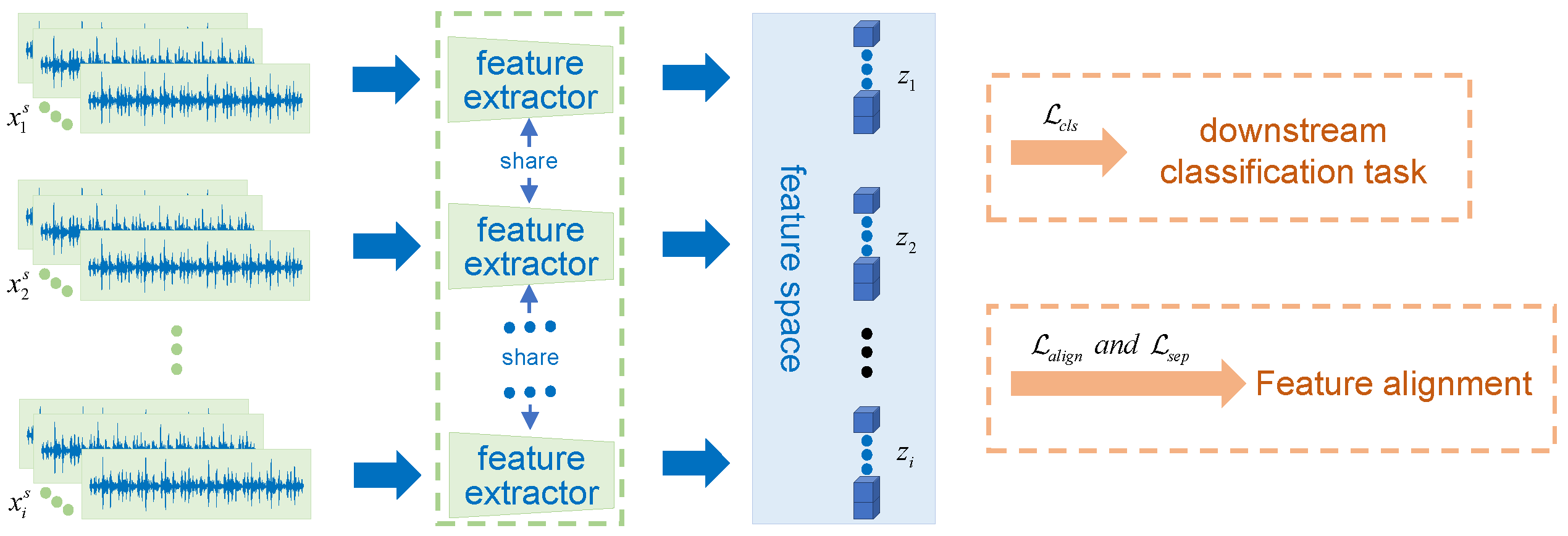
To address the multi-source domain generalization problem in rotating machinery fault diagnosis, we propose a domain-invariant representation learning framework that integrates causal excitation modeling with class-conditional feature alignment. The overall architecture is illustrated in Figure 1.
Figure 1.
Overview of the proposed domain-invariant fault representation learning framework.
The proposed framework consists of four major components:
- A fault-sensitive multi-branch feature extractor , designed to capture modulation-related characteristics from vibration signals;
- An ICM-based class-conditional distribution alignment module, which enforces consistency of same-class feature distributions across source domains;
- A prototype-driven structural regularization mechanism, which preserves inter-class separability in the learned feature space;
- A task classifier , used for downstream rotating machinery fault classification.
As shown in Figure 1, vibration signals collected under different operating conditions are first processed by the shared feature extractor to obtain latent representations in a common feature space (let denote the d-dimensional latent feature representation.). These representations are simultaneously optimized through supervised classification loss and cross-domain alignment losses. The alignment module minimizes discrepancies between class-conditional feature distributions, while the structural regularization mechanism maintains stable inter-class margins during training. Finally, the classifier produces fault category predictions based on the learned invariant representations. The training process of the model is as shown in Algorithm 1.
| Algorithm 1 Training the Proposed Multi-Source DG Framework |
|
4.2. Mechanism-Aware Multi-Branch Feature Extraction Network
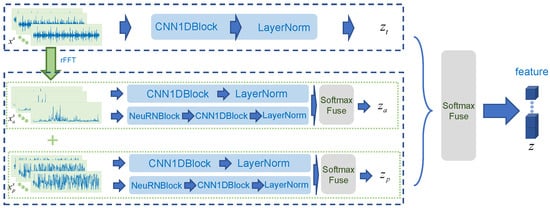
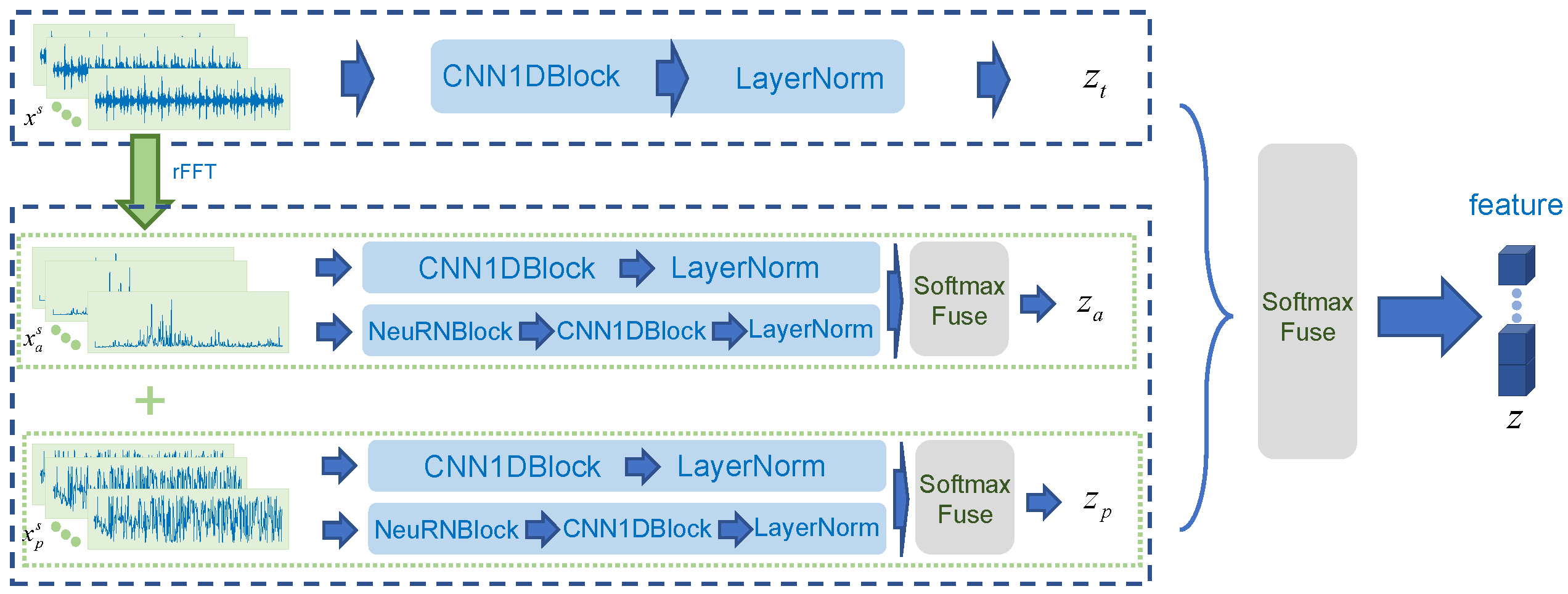
Mechanical faults in rotating machinery typically induce impulsive responses governed by excitation–resonance and modulation mechanisms [15,16]. In the frequency domain, such fault-related behaviors manifest as amplitude and phase modulation patterns. Although the absolute locations and energy levels of characteristic frequencies may shift under varying operating conditions, localized spectral fluctuations and modulation structures remain strongly correlated with fault mechanisms. To effectively exploit these characteristics, prior studies have investigated feature fusion across time, frequency, and time–frequency domains, demonstrating that multi-domain representations can enhance diagnostic robustness [32,33]. Time-domain features are particularly sensitive to operating condition variations and thus provide complementary information for characterizing condition-induced effects. In this work, considering rotating equipment whose rotational frequency is significantly lower than the sensor sampling frequency (e.g., wind turbine drivetrains), we focus on time-domain and frequency-domain representations. The proposed feature extractor consists of three branches, as illustrated in Figure 2:
Figure 2.
Architecture of the proposed mechanism-aware multi-branch feature extraction network.
- Time-domain branch, which captures condition-related temporal trends and supports domain generalization;
- Frequency–amplitude branch, which models energy distribution and impulse-related modulation characteristics;
- Frequency–phase branch, which preserves phase variations associated with modulation effects.
To operationalize the above excitation–modulation principle in a learnable manner, we introduce the NeuRN mechanism [34] into the two frequency-domain branches. NeuRN emphasizes local deviations while maintaining flexibility to adapt to unseen domain variations. We are not aware of prior work applying NeuRN to vibration-based time-series analysis in rotating machinery fault diagnosis. For each vibration sample and each channel, a real-valued Fast Fourier Transform (rFFT) is applied to obtain the frequency-domain representation:
Given that the sensor sampling frequency is typically much higher than the characteristic fault frequencies, we further truncate the spectrum to retain the lower-frequency components:
The frequency-amplitude branch input is defined as:
where is a small constant to ensure numerical stability.
For the phase component, to avoid discontinuity and enable smooth optimization, phase values are encoded using sine and cosine transformations and concatenated along the channel dimension:
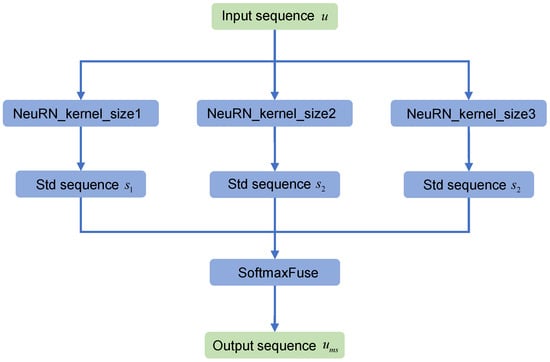
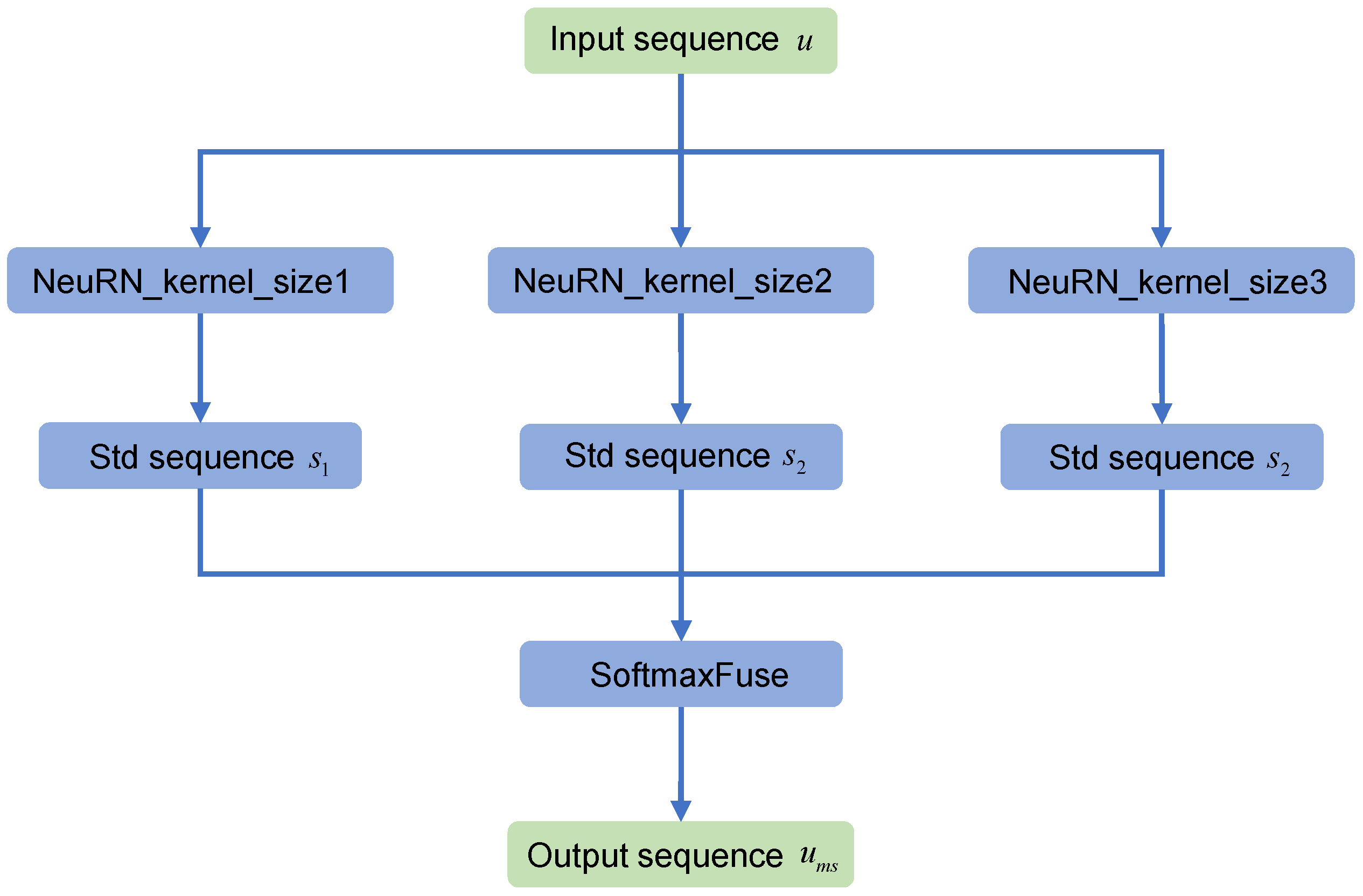
As shown in Figure 2, the time-domain branch employs a 1D CNN to extract global temporal features. For the frequency-amplitude and frequency-phase branches, in addition to a 1D CNN for global information modeling, a multi-scale NeuRN block is introduced to capture localized spectral variations. The internal computation of the NeuRN block is illustrated in Figure 3.
Figure 3.
Computational procedure of the multi-scale NeuRN block in the frequency domain.
For a frequency-domain sequence , the NeuRN layer computes local standard deviation along the frequency axis. For each frequency index i, define a sliding window of size k as , where the kernel size of NeuRN is k. The local mean is computed as:
The corresponding local variance and standard deviation are given by:
Subsequently, channel-wise max normalization is applied:
Mechanical fault signals are physically generated through excitation–resonance and amplitude–phase modulation mechanisms. When a localized defect repeatedly impacts the rotating structure, it excites structural resonance modes, producing impulsive responses that are subsequently modulated by rotational speed. In the frequency domain, such modulation does not only manifest as isolated characteristic frequencies, but, more importantly, as localized spectral energy fluctuations and sideband structures around carrier frequencies.
From a signal processing perspective, these modulation-induced sidebands introduce local increases in spectral variance within a narrow frequency neighborhood, rather than globally shifting the entire spectrum. Therefore, instead of relying solely on convolutional kernels to detect specific frequency peaks, it is more consistent with the underlying fault generation mechanism to measure local spectral dispersion.
The NeuRN layer implements this principle by computing the local standard deviation along the frequency axis (Equation (8)). The local variance quantifies the dispersion of spectral amplitudes within a neighborhood , which directly reflects the intensity of modulation and resonance effects caused by fault excitation. Compared to conventional convolutional kernels that learn fixed linear filters, the local standard deviation operator is inherently sensitive to modulation strength and sideband density, making it particularly suitable for capturing excitation-induced spectral irregularities under varying operating conditions.
To adapt to diverse sideband structures in rotating machinery faults, multiple NeuRN layers with different kernel sizes are employed to capture multi-scale spectral variations . Their outputs are fused via learnable normalized weights:
The same fusion strategy is applied to integrate sub-branches within each domain and to combine the three primary branches shown in Figure 2. The final fused representation is fed into a two-layer MLP classifier for fault prediction.
4.3. Class-Conditional Distribution Alignment with ICM-Inspired Batch Mixing
Aligning only marginal feature distributions across domains may cause inter-class overlap and lead to feature entanglement, thereby degrading discriminative performance under domain shifts [17,18]. To avoid this issue, we perform alignment at the class-conditional level. Specifically, our objective is to enforce consistency of class-conditional feature distributions across domains:
To improve computational efficiency and avoid the quadratic cost induced by pairwise domain alignment, we adopt a mixing strategy inspired by the Independent Causal Mechanism (ICM) principle. Pairwise multi-source alignment enumerates domain pairs, leading to transport evaluations per iteration (up to constants related to the number of valid classes and samples). In contrast, the proposed ICM-style batch mixing constructs only two mixed batches per class, resulting in mixing cost and transport evaluations per class per iteration. For each class c, we first collect samples belonging to class c from each domain in the current mini-batch . After randomly shuffling the samples, we select a random slicing index to partition each domain-specific class set into two subsets. The mixed batches are then constructed by concatenating the corresponding slices across domains:
This construction implicitly simulates domain interpolation and encourages the model to learn invariant structures under cross-domain mixing. To prevent the model from trivially minimizing the alignment loss by collapsing feature variance, we normalize both mixed batches using shared statistics computed over their union. The class-wise mean and standard deviation are computed as:
The normalized features are then obtained as:
To measure the discrepancy between the two normalized mixed batches and , we employ the entropy-regularized optimal transport distance (Sinkhorn OT) [35], which serves as a differentiable approximation of the Wasserstein-1 distance.
Cosine distance is adopted to emphasize angular similarity in the normalized feature space. This choice makes the alignment invariant to feature magnitude and mitigates trivial variance shrinkage during training, while preserving discriminative class geometry across domains.
Let and denote uniform marginal distributions, where and . The entropy-regularized optimal transport distance is defined as:
where denotes the set of admissible couplings with marginals a and b. This objective corresponds to the entropy-regularized optimal transport problem, whose solution provides a smoothed approximation to the Wasserstein-1 distance while enabling stable gradient-based optimization.
The overall ICM-based class-conditional alignment loss is defined as:
where denotes the set of classes appearing in both mixed batches.
This formulation enforces consistency of class-conditional feature distributions across domains while maintaining computational scalability when the number of source domains increases.
4.4. Prototype-Based Structural Regularization
Although class-conditional alignment promotes cross-domain consistency, excessive alignment may inadvertently reduce inter-class separability, particularly when multiple fault categories exhibit overlapping modulation patterns under different operating conditions. To preserve cross-domain discriminability, we introduce a prototype-based structural regularization mechanism. In practice, this is implemented using a memory bank.
For each domain m and class c, we define the domain-specific class prototype as:
Given a mini-batch containing samples of class c from domain m, the empirical prototype estimate is computed as:
where denotes the number of samples of class c in domain m.
To ensure stable prototype estimation across training iterations, the memory bank is updated using exponential moving average (EMA):
where controls the momentum of prototype updates.
To capture cross-domain structural information, we aggregate domain-specific prototypes to form a global class prototype:
where denotes normalized domain weights.
Based on the global prototype representation, we define pull and push regularization terms.
The pull loss encourages each sample to approach its corresponding class prototype:
where is a distance metric (cosine distance in this work).
The push loss enforces inter-class margins by penalizing samples that are too close to non-matching prototypes:
where denotes the set of classes excluding , and is the margin parameter.
The overall prototype-based structural regularization term is defined as:
This formulation ensures that while domain alignment enforces invariance, the geometric structure of class distributions remains stable across domains, thereby mitigating representation collapse and preserving discriminative margins under domain shifts.
4.5. Overall Training Objective
The supervised classification loss on source domains is formulated using the standard cross-entropy loss:
The overall training objective integrates the supervised classification term, the class-conditional alignment loss, and the prototype-based structural regularization:
This joint objective enables the model to simultaneously optimize predictive performance on source domains, enforce class-conditional domain invariance, and preserve inter-class geometric structure in the learned feature space.
5. Experimental Evaluation
5.1. Datasets and Experimental Protocol
5.1.1. Datasets
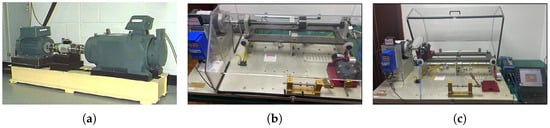
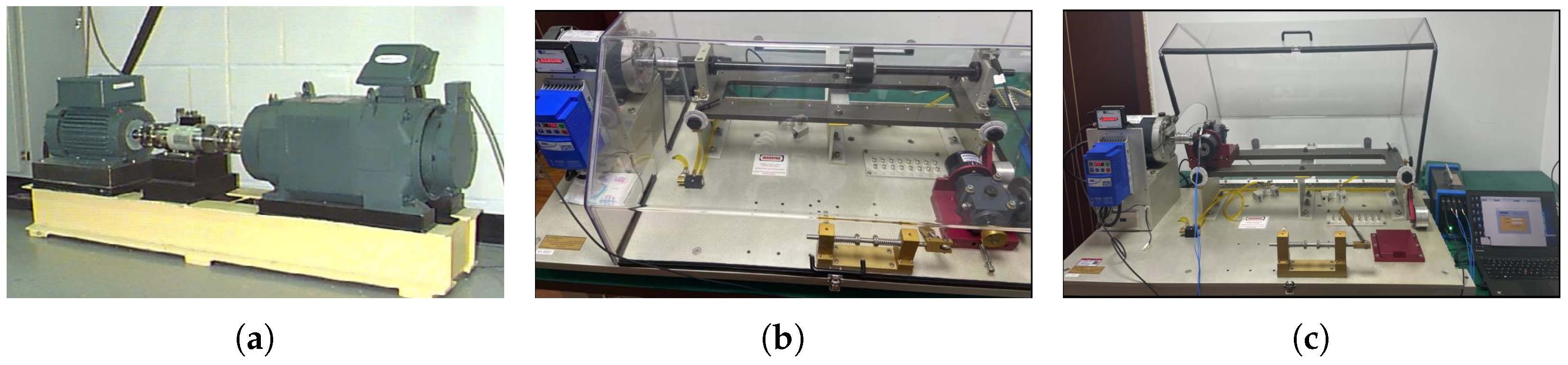
To comprehensively evaluate the proposed framework in multi-source domain generalization (DG) for rotating machinery fault diagnosis, we consider three publicly available benchmark datasets. These datasets contain vibration signals collected under multiple operating conditions, including variations in load, speed, and torque, covering different health states of rotating machinery components. The datasets include the Case Western Reserve University (CWRU) bearing dataset [36] and the Huazhong University of Science and Technology (HUST) bearing and gearbox datasets [12]. The corresponding experimental platforms are illustrated in Figure 4.
Figure 4.
Experimental platforms of the considered datasets: (a) CWRU bearing test rig; (b) HUST bearing test platform; (c) HUST gearbox test platform.
The CWRU dataset was collected using the test rig shown in Figure 4a. Vibration signals were recorded under four different load levels (0 hp, 1 hp, 2 hp, and 3 hp) and four health conditions, including normal condition, inner-race fault, outer-race fault, and rolling element fault. Each fault type includes four severity levels. In this study, the four load levels are treated as distinct domains, and the four health conditions are regarded as fault categories. We consider only the fault severity of 21 μm, and for outer-race faults, only those located at the 12 o’clock position in the load zone are included. This dataset is denoted as CWRU.
The HUST bearing and gearbox datasets were collected using the experimental platforms shown in Figure 4b and Figure 4c, respectively. Vibration signals were recorded under various combinations of rotational speed and load. For the HUST bearing dataset, the health conditions include normal state, inner-race faults, outer-race faults, and rolling element faults, each with two severity levels (mild and severe). In this study, the mild and severe cases are treated as two separate DG tasks, denoted as HB and HBS, respectively. Mixed faults and variable-speed loading conditions are excluded. For the HUST gearbox dataset, the health conditions include broken tooth, missing tooth, and normal state. This dataset is denoted as HG. Similar to the CWRU setting, different speed–load combinations are defined as distinct domains. The HB and HBS datasets each contain 10 domains, while the HG dataset includes 25 domains.
5.1.2. Multi-Source Domain Generalization Protocol
To evaluate the general applicability of the proposed framework, we construct multiple multi-source domain generalization (DG) tasks by selecting one domain from each dataset as the target domain, while treating all remaining domains from the same dataset as source domains for training. The detailed task configurations are summarized in Table 1. Due to space limitations, a representative subset of DG tasks is reported for quantitative comparison. All domains were evaluated during internal experiments, and the reported tasks exhibit consistent trends across the full task set.
Table 1.
Multi-source domain generalization task configuration.
For each task, the model is trained exclusively on labeled data from the selected source domains and evaluated on the unseen target domain, without accessing any target-domain samples during training.
In all DG tasks, the target-domain data are strictly held out during training. They are used solely for final evaluation and are never involved in model selection, early stopping, checkpoint selection, or hyperparameter tuning. Model selection, if required, is performed exclusively using source-domain validation data.
To further demonstrate the effectiveness of the proposed approach, we compare it with several representative multi-source DG methods reported in recent literature, including DSAN [13], CDAN [37], DDC [38], HoMM [39], and RAINCOAT [40].
Although some compared methods were originally proposed for domain adaptation (DA), they can be naturally extended to the multi-source DG setting by removing access to target-domain data and performing alignment only among source domains. In our implementation, no target-domain samples are used for any baseline method [12].
For fairness, each baseline follows the original architectural design reported in its respective paper. Methods such as DDC, DSAN, CDAN, and HoMM adopt standard CNN backbones as in their original implementations, while RAINCOAT retains its time–frequency dual-branch architecture. We do not introduce additional architectural enhancements beyond those described in the original works.
To ensure comparable training conditions, all methods are trained under the same optimizer, batch size, and number of epochs. Hyperparameter tuning is conducted exclusively using source-domain validation data, without accessing target-domain information.
All experiments were conducted on a workstation equipped with an AMD Ryzen 9 3900X 12-Core Processor, an NVIDIA GeForce RTX 2070 SUPER GPU, and 64.0 GB RAM.
5.1.3. Implementation Details
The model was optimized using Adam with learning rate and weight decay . The batch size was set to 32. The FFT truncation parameter was . The EMA momentum for prototype updating was . The loss weights were , , and . A warm-up strategy was applied to gradually activate the structural regularization in early training. The entropy coefficient was set to , the number of Sinkhorn iterations to 50, and the maximum number of sampled points to 512. Computation was performed in the log-domain for numerical stability.
The margin parameter in Equation (23) was determined using an adaptive strategy. Specifically, at training step t, the margin was estimated as
where and denote the mean and standard deviation of inter-class cosine distances between global prototypes. We set , , and , initialized the scheduler after 30 steps, updated it every 30 steps, and applied exponential smoothing with momentum 0.9. The prototype pair buffer size was set to 5000.
All experiments were repeated with multiple random seeds to ensure stability.
5.2. Experimental Results and Analysis
5.2.1. Performance Comparison Under Multi-Source Domain Generalization
To mitigate the influence of class imbalance on evaluation results, we adopt the F1-score as the primary performance metric. The F1-score is computed according to Equation (28). The multi-source domain generalization results are summarized in Table 2. To reduce the impact of randomness, each reported result represents the mean performance over multiple runs with different random seeds, calculated after training convergence across several stable epochs.
Table 2.
Cross-domain generalization performance (F1-score, %) across multi-source DG tasks (best results in bold).
As shown in Table 2, the proposed multi-source DG framework achieves competitive and generally superior generalization performance across the evaluated tasks. In particular, notable improvements are observed in tasks G4, G9, and G14, where the proposed method demonstrates clear advantages over baseline models. Among the compared approaches, only the proposed method and RAINCOAT incorporate prior-guided feature extraction mechanisms, whereas the remaining models rely on conventional convolutional neural networks for representation learning. The comparative results suggest that integrating mechanism-informed feature extraction can contribute to improved cross-condition generalization performance. Furthermore, except for CDAN, which employs an adversarial learning paradigm to enforce domain invariance, the other baseline methods adopt feature alignment strategies. As reflected in Table 2, adversarial-based approaches appear more sensitive to hyperparameter configurations, and mismatched parameter settings may lead to substantial performance degradation in certain tasks.
5.2.2. Training Dynamics and Feature Visualization
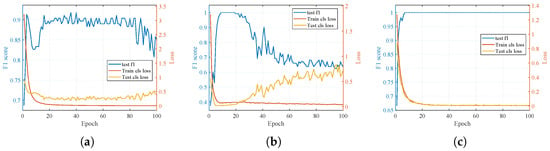
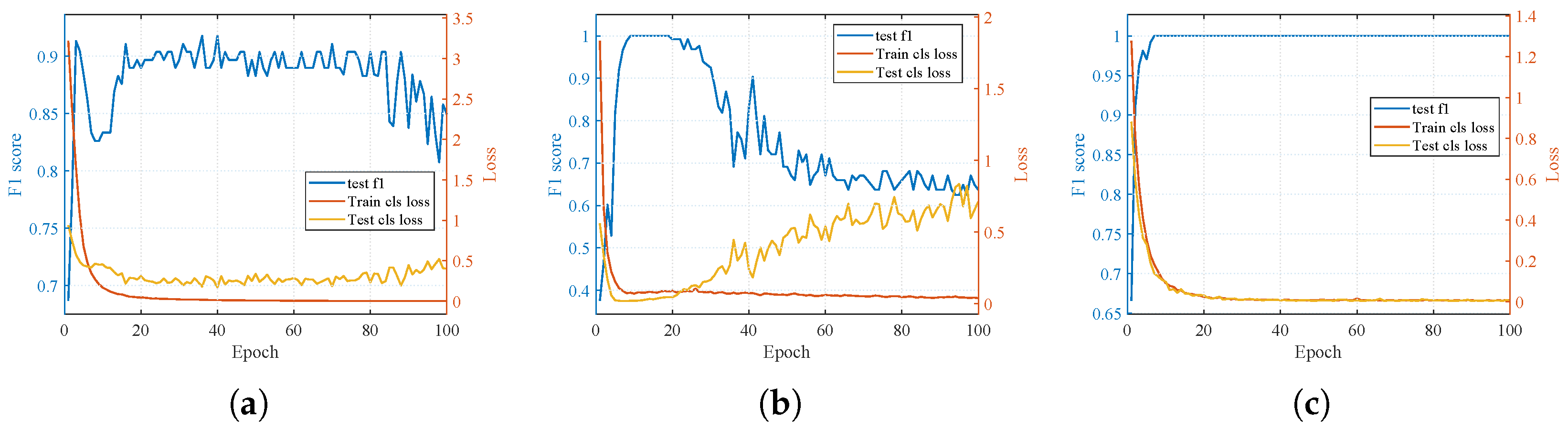
In this subsection, we further analyze the training behavior and learned representations of the models. Figure 5 presents the training curves of representative approaches on task G1, including RAINCOAT (marginal feature alignment with time–frequency feature extraction), DSAN (class-conditional alignment with time-domain feature extraction), and the proposed method (the curves labeled as “test” in Figure 5 correspond to post-epoch evaluation on the held-out target domain for analysis purposes only and do not influence the training process).
Figure 5.
Training dynamics of different models on task G1: (a) RAINCOAT; (b) DSAN; (c) the proposed method.
As illustrated in Figure 5, when domain-invariant feature learning is achieved solely through marginal alignment or unconstrained class-conditional alignment, performance degradation may occur in later training stages, particularly when the number of samples per class is limited. This phenomenon suggests that excessive alignment without structural constraints may weaken discriminative class information, leading to reduced generalization capability. In contrast, the proposed method incorporates structural regularization during class-conditional alignment, resulting in more stable classification performance throughout training. Moreover, comparison between Figure 5a,b indicates that integrating mechanism-informed feature extraction contributes to improved robustness against domain shifts.
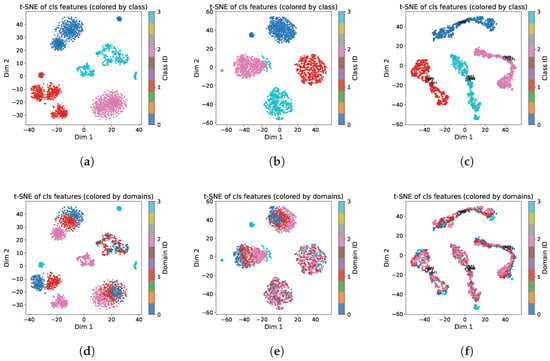
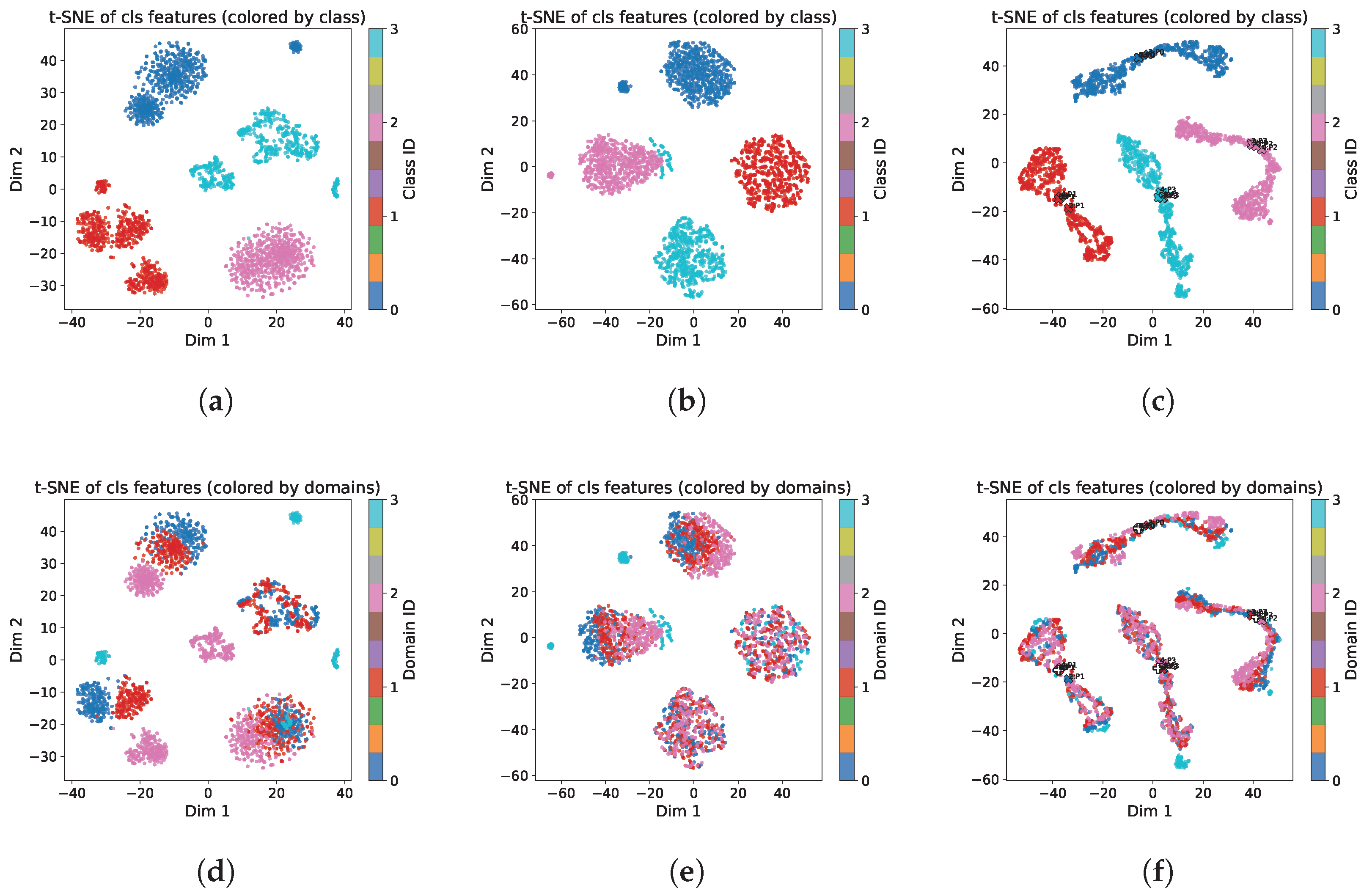
To further investigate these observations, we visualize the learned feature representations at the end of training (epoch = 100) using t-SNE. The results are shown in Figure 6.
Figure 6.
t-SNE visualization of learned feature representations. (a) RAINCOAT (colored by class); (b) DSAN (colored by class); (c) proposed method (colored by class; “×” denotes class prototypes); (d–f) same features colored by domain (white “×” indicates global class prototype).
Comparing Figure 6a–c, it can be observed that class-conditional alignment encourages tighter intra-class clustering while maintaining domain invariance. For RAINCOAT and DSAN, although domain information becomes relatively mixed in later stages of training, noticeable inter-class overlap and feature drift are present, which may explain their degraded cross-domain performance. In contrast, the proposed method, equipped with prototype-based structural regularization, encourages samples to cluster around their corresponding class prototypes while preserving inter-class margins. As a result, feature entanglement and cross-domain class shifting are effectively mitigated, leading to more stable and generalizable representations. When coloring features by domain (Figure 6d–f), the proposed method maintains domain mixing without sacrificing class separation. The global class prototypes (white “×”) remain well positioned within their respective clusters, further illustrating the structural consistency enforced by the prototype-based regularization mechanism.
5.2.3. Branch Weight Analysis of the Proposed Feature Extractor
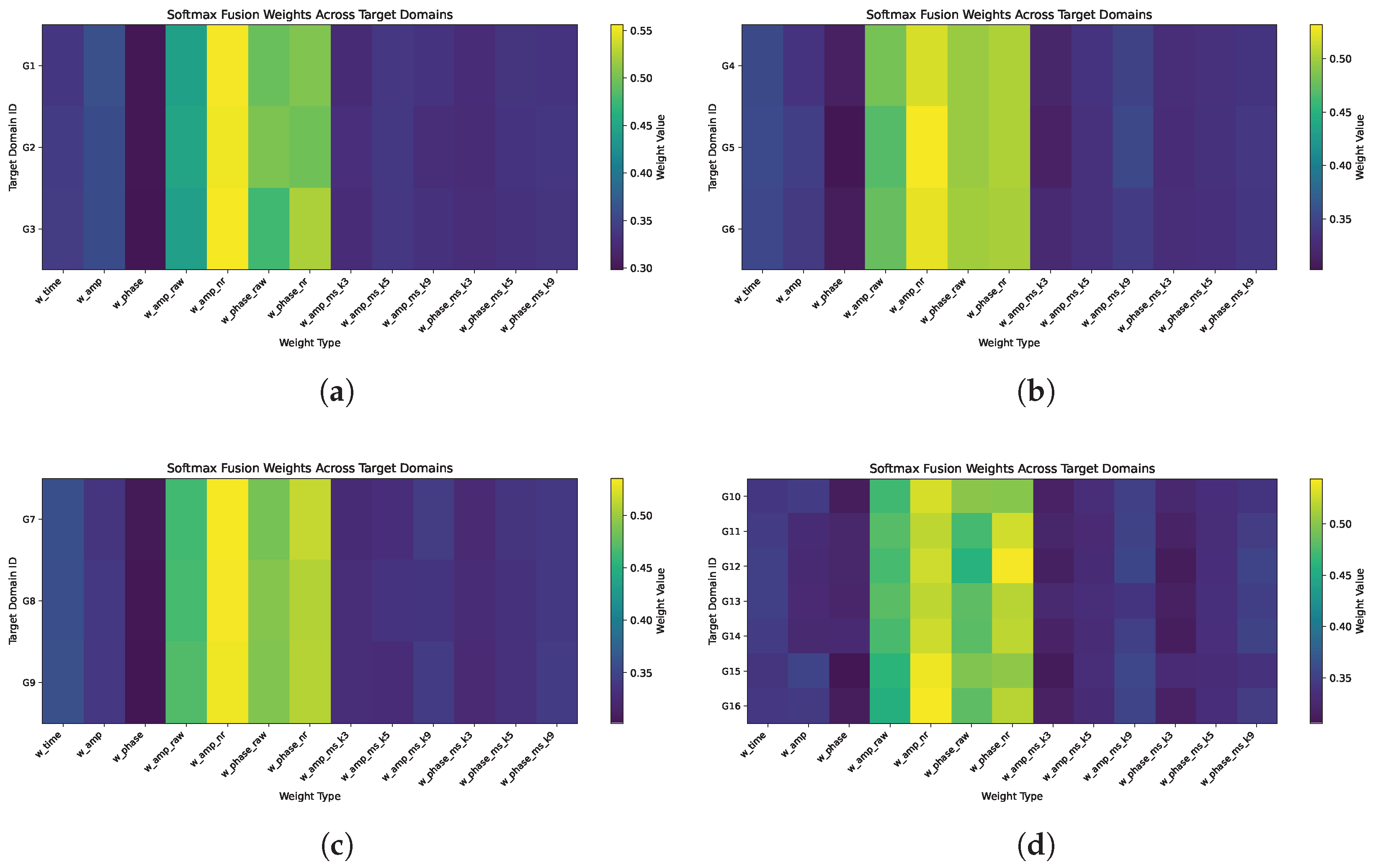
The performance comparison in the previous subsection indicates that an appropriate feature extraction architecture contributes significantly to classification accuracy and robustness in multi-source domain generalization for rotating machinery. To further analyze the behavior of the proposed feature extractor, we visualize the learned SoftmaxFuse weights of each branch across different tasks and datasets in the form of heatmaps, as shown in Figure 7.
Figure 7.
Heatmap of learned SoftmaxFuse weights across different tasks and datasets. (a) CWRU tasks; (b) HB tasks; (c) HBS tasks; (d) HG tasks.
From the heatmaps, it can be observed that the NeuRN-enhanced frequency branches consistently receive relatively higher weights across most tasks. For the bearing datasets, the frequency-amplitude branch with the NeuRN module tends to dominate, indicating that energy modulation patterns play a major role in bearing fault discrimination. In contrast, for the gearbox dataset (HG) and the severe fault bearing dataset (HBS), both the frequency–amplitude and frequency-phase NeuRN branches exhibit higher contributions, suggesting that phase modulation information becomes increasingly important under more complex or severe operating conditions. These observations imply that the NeuRN-based local variation modeling mechanism enhances the network’s ability to capture fault-induced amplitude and phase modulation patterns under domain shifts, thereby improving diagnostic robustness. Moreover, the heatmaps show that, across multiple tasks, the weights assigned to different kernel sizes within the multi-scale NeuRN modules are nearly uniform. This indicates that no single scale overwhelmingly dominates the decision process. Instead, the multi-scale NeuRN design enables the model to adapt to diverse and complex spectral modulation patterns, allowing it to handle variations in fault characteristics across operating conditions. Such balanced multi-scale contributions further support the effectiveness of incorporating localized modulation-aware mechanisms in multi-source domain generalization.
5.2.4. Noise Robustness Under Cross-Domain SNR Shifts
In practical industrial environments, operating-condition variations are often accompanied by different levels of background noise, which may further challenge diagnostic reliability. To evaluate the robustness of the proposed framework under noisy conditions, we conduct additional experiments by injecting additive white Gaussian noise (AWGN) into the vibration segments at different signal-to-noise ratios (SNRs).
Given a vibration sample , where C denotes the number of channels and T the signal length, the noisy observation is defined as
where is zero-mean Gaussian noise. The signal power is computed as
For a target SNR level expressed in decibels (), the noisy signal is generated as
Unless otherwise specified, models are trained on clean source-domain data and evaluated on noisy target-domain data to simulate practical deployment conditions. Table 3 reports the macro-F1 scores under different SNR levels.
Table 3.
Noise robustness results (F1-score, %) under cross-domain SNR shifts (best results in bold).
As shown in Table 3, the proposed method maintains relatively stable performance under moderate noise levels (e.g., 10 dB and 20 dB) across most tasks. Although performance degradation is observed at extremely low SNR (5 dB), the relative ranking across tasks remains largely consistent with the results under the “No Noise” condition. In particular, tasks with strong baseline generalization performance under clean conditions (e.g., G2, G3, G7, G8, G12, and G16) exhibit only limited degradation, indicating that the learned modulation-aware representations retain discriminative structure under noise perturbations.
For tasks that are inherently challenging in the cross-domain setting (e.g., G4, G6, G10, and G14), performance declines more significantly as SNR decreases. This observation suggests that severe domain shifts combined with high noise levels amplify intrinsic task difficulty. Nevertheless, the results demonstrate that the proposed framework preserves meaningful fault-discriminative information under realistic noise conditions, supporting its practical applicability in industrial environments.
5.2.5. Ablation Study
To comprehensively evaluate the contribution of each component in the proposed multi-source domain generalization framework, we design six ablation variants:
- A1: The overall training objective remains unchanged, while the feature extractor uses only the time-domain branch;
- A2: The three-branch architecture is retained, but the NeuRN modules are removed;
- A3: The feature extractor remains unchanged, and only the supervised classification loss is used;
- A4: The feature extractor remains unchanged, and only marginal distribution alignment is applied;
- A5: The feature extractor remains unchanged, and class-conditional alignment is used without structural regularization;
- A6: The feature extractor remains unchanged, and class-conditional alignment with structural regularization is applied without ICM-based mixing.
These variants are evaluated on five representative and relatively challenging tasks (G4, G6, G9, G10, and G14). The results are summarized in Table 4.
Table 4.
Ablation study results (F1-score, %) (best results in bold).
From Table 4, it can be observed that the proposed framework achieves consistently competitive and generally superior generalization performance across most challenging tasks, demonstrating the effectiveness of the overall design. Notably, variant A3 (classification loss only) exhibits severe performance degradation on tasks G10 and G14 across multiple runs. This observation indicates that even with a well-designed feature extractor, the absence of appropriate domain alignment and structural regularization may result in poor generalization under multi-source DG settings. Furthermore, comparing A5 and A6 highlights the importance of the ICM-based mixing mechanism. Incorporating ICM mixing into class-conditional alignment generally yields improved generalization across representative tasks. One plausible explanation is that random class-wise domain mixing implicitly exposes the model to intermediate domain configurations. Such mixed batches can be interpreted as a form of feature-level data augmentation [41], thereby enhancing robustness to unseen operating conditions. As discussed in Section 4.3, the ICM mixing mechanism also improves computational efficiency when the number of source domains increases. To validate this claim, we report the average training time per epoch before and after applying ICM mixing across different datasets, as shown in Table 5. To obtain the per-epoch training time reported in Table 5, we measure wall-clock time on the same workstation (AMD Ryzen 9 3900X, NVIDIA RTX 2070 SUPER, 64 GB RAM) with identical software settings for all methods. For each dataset, we use the same batch size (), the same number of training epochs, and the same precision setting. Timing is conducted after a warm-up of 5 epochs to avoid compilation/caching effects, and the average time per epoch is computed over the subsequent 20 epochs. All measurements are repeated three times with different random seeds, and we report mean ± std. The reported time includes forward/backward passes and loss computation, but excludes offline data preprocessing. The results indicate that when the number of source domains is large, the computational overhead introduced by pairwise domain alignment becomes substantial. In contrast, ICM-based mixing significantly reduces training time without sacrificing generalization performance, demonstrating its scalability advantage in large-scale multi-source DG scenarios.
Table 5.
Average training time per epoch across datasets. # denotes the number of samples.
6. Conclusions
This study addresses the problem of multi-source domain generalization for rotating machinery fault diagnosis under varying operating conditions. To mitigate distribution shifts induced by changes in speed, load, and torque, we propose a domain-invariant fault representation learning framework that integrates mechanism-aware feature modeling with class-conditional structural alignment.
First, a modulation-driven multi-branch feature extraction architecture is constructed to explicitly model fault-sensitive characteristics from time-domain signals as well as spectral amplitude and phase components. By incorporating multi-scale local response mechanisms, the proposed network enhances sensitivity to fault-related variations while suppressing condition-dependent interference, thereby preserving physically meaningful representations.
Second, without requiring access to target-domain data, a class-conditional distribution alignment strategy is introduced. Through mixed-batch construction and Wasserstein-based discrepancy minimization implemented via entropy-regularized optimal transport, the proposed method enforces consistency of same-class feature distributions across operating conditions. Compared with conventional marginal alignment approaches, the proposed strategy maintains structural stability at the class-conditional level, effectively alleviating class imbalance and cross-domain feature entanglement. Furthermore, a prototype-driven structural regularization mechanism is incorporated to preserve inter-class margins and prevent representation collapse during alignment.
Extensive experiments on the CWRU dataset and multi-condition HUST datasets demonstrate that the proposed framework achieves robust generalization performance under unseen operating conditions while maintaining efficient training scalability as the number of source domains increases. Feature visualization and structural analysis further confirm that the learned representations retain clear class discrimination while achieving domain invariance. Overall, this work establishes a unified framework for cross-condition robust fault diagnosis and provides a practical pathway toward deploying intelligent rotating machinery diagnostic systems in complex industrial environments.
Author Contributions
Conceptualization, J.Z. and Q.Z.; methodology, J.Z.; software, J.Z.; validation, J.Z.; formal analysis, J.Z.; investigation, J.Z. and W.Z.; resources, Q.Z.; data curation, J.Z.; writing—original draft preparation, J.Z.; writing—review and editing, J.Z., Q.Z. and W.Z. All authors have read and agreed to the published version of the manuscript.
Funding
This work was supported by the 111 Project (BP0820005) and a technology project of China Huadian Corporation (Grant No. H20250304).
Data Availability Statement
The data supporting the findings of this study are publicly available. The CWRU bearing vibration data were obtained from the Case Western Reserve University Bearing Data Center (https://engineering.case.edu/bearingdatacenter/download-data-file, accessed on 14 September 2025). The HUST gearbox and bearing datasets were collected from an open-source repository released by Zhao et al. [12].
Conflicts of Interest
Author Wenjie Zhou was employed by the company State Grid Hangzhou Xiaoshan Power Supply Company. The remaining authors declare that the research was conducted in the absence of any commercial or financial relationships that could be construed as a potential conflict of interest. The funders had no role in the design of the study; in the collection, analyses, or interpretation of data; in the writing of the manuscript; or in the decision to publish the results.
References
- Habbouche, H.; Amirat, Y.; Benkedjouh, T.; Benbouzid, M. Digital twin-based gearbox fault diagnosis using variational mode decomposition and dynamic vibration modeling. Measurement 2025, 246, 116669. [Google Scholar] [CrossRef] [Scilit]
- Salameh, J.P.; Cauet, S.; Etien, E.; Sakout, A.; Rambault, L. Gearbox condition monitoring in wind turbines: A review. Mech. Syst. Signal Process. 2018, 111, 251–264. [Google Scholar] [CrossRef] [Scilit]
- Zhu, Z.; Lei, Y.; Qi, G.; Chai, Y.; Mazur, N.; An, Y.; Huang, X. A review of the application of deep learning in intelligent fault diagnosis of rotating machinery. Measurement 2023, 206, 112346. [Google Scholar] [CrossRef] [Scilit]
- Zhang, J.; Zhang, M.; Wang, D.; Yang, M.; Liang, C. Multi-scale convolutional sparse attention transformer: A lightweight fault diagnosis model for rotating machinery. Neurocomputing 2025, 650, 130934. [Google Scholar] [CrossRef] [Scilit]
- Qian, Q.; Wen, Q.; Tang, R.; Qin, Y. DG-Softmax: A new domain generalization intelligent fault diagnosis method for planetary gearboxes. Reliab. Eng. Syst. Saf. 2025, 260, 111057. [Google Scholar] [CrossRef] [Scilit]
- Dong, Y.; Li, Y.; Yang, H.; Xu, M.; Wang, R. Invariant Feature Learning and Open Space Feature Synthesis for Open Set Domain Generalization Fault Diagnosis of Rotating Machinery. IEEE Trans. Instrum. Meas. 2025, 74, 3563414. [Google Scholar] [CrossRef] [Scilit]
- Dai, J.; Zeng, H.; Tang, K.; Zhang, F. Investigation on the evolution of wind energy capture capability of wind turbines using historical field data. Renew. Energy 2025, 249, 123177. [Google Scholar] [CrossRef] [Scilit]
- Civera, M.; Surace, C. Non-destructive techniques for the condition and structural health monitoring of wind turbines: A literature review of the last 20 years. Sensors 2022, 22, 1627. [Google Scholar] [CrossRef] [Scilit]
- Hu, K.; Cheng, Y.; Wu, J.; Zhu, H. Cross-domain intelligent diagnostics for rotating machinery using domain adaptive and adversarial networks. J. Ind. Inf. Integr. 2024, 42, 100722. [Google Scholar] [CrossRef] [Scilit]
- Xie, Y.; Wan, F.; Hua, Y.; Yang, M.; Qing, X. Prototype-oriented domain adaptation for rotating machinery fault diagnosis. Measurement 2025, 253, 117544. [Google Scholar] [CrossRef] [Scilit]
- Zhang, Y.; Wang, Z.; Fan, C.; Jiang, Z.; Yu, K.; Ren, Z.; Feng, K. Diffusion model-assisted cross-domain fault diagnosis for rotating machinery under limited data. Reliab. Eng. Syst. Saf. 2025, 264, 111372. [Google Scholar] [CrossRef] [Scilit]
- Zhao, C.; Zio, E.; Shen, W. Domain generalization for cross-domain fault diagnosis: An application-oriented perspective and a benchmark study. Reliab. Eng. Syst. Saf. 2024, 245, 109964. [Google Scholar] [CrossRef] [Scilit]
- Shi, H.; Cao, S.; Zuo, H.; Ma, J.; Lin, C. Deep subdomain adversarial network with self-supervised learning for aero-engine high speed bearing fault diagnosis with unknown working conditions. Measurement 2025, 241, 115668. [Google Scholar] [CrossRef] [Scilit]
- Liu, R.; Ding, X.; Ye, B.; Xu, Y.; Huang, J.; Lv, H. Knowledge-informed multiplication convolution generalization network for interpretable equipment diagnosis under unknown speed domains. Appl. Soft Comput. 2025, 179, 113263. [Google Scholar] [CrossRef] [Scilit]
- Liu, Y.; Yan, C.; Kang, J.; Tian, Y.; Chen, W.; Wu, L. Improved calculation method for fault characteristic frequency of bearing with local defect on rolling element considering kinematic characteristics of raceways. J. Sound Vib. 2025, 597, 118825. [Google Scholar] [CrossRef] [Scilit]
- Wang, T.; Han, Q.; Chu, F.; Feng, Z. Vibration based condition monitoring and fault diagnosis of wind turbine planetary gearbox: A review. Mech. Syst. Signal Process. 2019, 126, 662–685. [Google Scholar] [CrossRef] [Scilit]
- Shi, W.; Zhu, R.; Li, S. Pairwise adversarial training for unsupervised class-imbalanced domain adaptation. In Proceedings of the 28th ACM SIGKDD Conference on Knowledge Discovery and Data Mining; Association for Computing Machinery: New York, NY, USA, 2022; pp. 1598–1606. [Google Scholar]
- Xu, P.; Wang, B.; Ling, C. Class overwhelms: Mutual conditional blended-target domain adaptation. In Proceedings of the AAAI Conference on Artificial Intelligence; Association for the Advancement of Artificial Intelligence: Washington, DC, USA, 2023; Volume 37, pp. 3036–3044. [Google Scholar]
- Zhou, W.; Zhou, Q.; Zhang, J. Speed–Load insensitive fault diagnosis method of wind turbine gearbox based on adversarial training. Electronics 2025, 14, 732. [Google Scholar] [CrossRef] [Scilit]
- Du, Y.; Xu, N.; Zhang, K.; Peng, Y. Cross-Domain Fault Diagnosis Method of Rotating Machinery Based on Classifier Prediction Consistency and Domain Generalization. IEEE Trans. Instrum. Meas. 2026, 45, 154–163. [Google Scholar] [CrossRef] [Scilit]
- Zhao, P.; Zhang, W.; Cao, X.; Li, X. Denoising diffusion probabilistic model-enabled data augmentation method for intelligent machine fault diagnosis. Eng. Appl. Artif. Intell. 2025, 139, 109520. [Google Scholar] [CrossRef] [Scilit]
- Guo, C.; Zhao, Z.; Ren, J.; Wang, S.; Liu, Y.; Chen, X. Causal explaining guided domain generalization for rotating machinery intelligent fault diagnosis. Expert Syst. Appl. 2024, 243, 122806. [Google Scholar] [CrossRef] [Scilit]
- Zhang, G.; Kong, X.; Ma, H.; Wang, Q.; Du, J.; Wang, J. Dual disentanglement domain generalization method for rotating machinery fault diagnosis. Mech. Syst. Signal Process. 2025, 228, 112460. [Google Scholar] [CrossRef] [Scilit]
- Deng, Z.; Ding, F.; Dwork, C.; Hong, R.; Parmigiani, G.; Patil, P.; Sur, P. Representation via representations: Domain generalization via adversarially learned invariant representations. arXiv 2020, arXiv:2006.11478. [Google Scholar] [CrossRef] [Scilit]
- Du, K.; Wu, D.; Bao, K.; Li, M.; Zhu, B. Unconstrained Wasserstein distance and multi-attention fusion convolutional neural network guided adversarial domain adaptation for cross-domain fault diagnosis of machines. Mech. Syst. Signal Process. 2025, 234, 112797. [Google Scholar] [CrossRef] [Scilit]
- Chevalley, M.; Bunne, C.; Krause, A.; Bauer, S. Invariant causal mechanisms through distribution matching. arXiv 2022, arXiv:2206.11646. [Google Scholar] [CrossRef] [Scilit]
- Rui, L.; Ding, X.; Wu, S.; Wu, Q.; Shao, Y. Signal processing collaborated with deep learning: An interpretable FIRNet for industrial intelligent diagnosis. Mech. Syst. Signal Process. 2024, 212, 111314. [Google Scholar] [CrossRef] [Scilit]
- Feng, Y.; Zheng, C.; Chen, J.; Pan, T.; Xie, J.; He, S.; Wang, H. Beyond deep features: Fast random wavelet kernel convolution for weak-fault feature extraction of rotating machinery. Mech. Syst. Signal Process. 2025, 224, 112057. [Google Scholar] [CrossRef] [Scilit]
- Peng, Y.; Shao, H.; Xiao, Y.; Wang, J.; Liu, B. Dual-stage interpretable domain generalization fault diagnosis: Integrating prior knowledge and gradient-weighted class activation mapping. Eng. Appl. Artif. Intell. 2026, 166, 113655. [Google Scholar] [CrossRef] [Scilit]
- Huang, X.; Jin, T.; Liu, Z.; Chen, C.; Hua, C.; Zhang, L. An interpretable multi-superlet kernel fusion convolutional neural network for rotating machinery fault diagnosis. Expert Syst. Appl. 2025, 290, 128484. [Google Scholar] [CrossRef] [Scilit]
- Dang, D.Z.; Su, B.Y.; Wang, Y.W.; Ao, W.K.; Ni, Y.Q. A pencil lead break-triggered, adversarial autoencoder-based approach for rapid and robust rail damage detection. Eng. Appl. Artif. Intell. 2025, 150, 110637. [Google Scholar] [CrossRef] [Scilit]
- Gao, Y.; Zhang, Z.; Chen, B.; Li, J.; Lu, G.; Sun, S.; Zong, L. Time-and frequency-domain fusion for source-free adaptation fault diagnosis. Inf. Fusion 2025, 117, 102875. [Google Scholar] [CrossRef] [Scilit]
- Li, H.; Wang, D. Multilevel feature fusion of multi-domain vibration signals for bearing fault diagnosis. Signal Image Video Process. 2024, 18, 99–108. [Google Scholar] [CrossRef] [Scilit]
- Jalil, H.; Qazi, A.; Iqbal, A. NeuRN: Neuro-inspired Domain Generalization for Image Classification. arXiv 2025, arXiv:2505.06881. [Google Scholar]
- Cuturi, M. Sinkhorn distances: Lightspeed computation of optimal transport. Adv. Neural Inf. Process. Syst. 2013, 26, 2292–2300. [Google Scholar]
- Smith, W.A.; Randall, R.B. Rolling element bearing diagnostics using the Case Western Reserve University data: A benchmark study. Mech. Syst. Signal Process. 2015, 64, 100–131. [Google Scholar] [CrossRef] [Scilit]
- Xia, Y.; Zhang, C.; Ye, Q.; Lu, Y.; Yang, R.; Wu, Y. Collaborative and conditional deep adversarial network for intelligent bearing fault diagnosis. IEEE Trans. Instrum. Meas. 2022, 71, 1–13. [Google Scholar] [CrossRef] [Scilit]
- Yao, Q.; Qin, Y.; Wang, X.; Qian, Q. Multiscale domain adaption models and their application in fault transfer diagnosis of planetary gearboxes. Eng. Appl. Artif. Intell. 2021, 104, 104383. [Google Scholar] [CrossRef] [Scilit]
- Zhang, Y.; Fan, J.; Meng, Z.; Li, J.; Cao, W.; He, H.; Zhang, Z.; Fan, F. Multi-source domain adaptive network based on local kernelized higher-order moment matching for rotating machinery fault diagnosis. ISA Trans. 2024, 150, 311–321. [Google Scholar] [CrossRef] [Scilit] [PubMed]
- He, H.; Queen, O.; Koker, T.; Cuevas, C.; Tsiligkaridis, T.; Zitnik, M. Domain adaptation for time series under feature and label shifts. In Proceedings of the International Conference on Machine Learning; PMLR: Brookline, MA, USA, 2023; pp. 12746–12774. [Google Scholar]
- Albuquerque, I.; Monteiro, J.; Darvishi, M.; Falk, T.H.; Mitliagkas, I. Generalizing to unseen domains via distribution matching. arXiv 2019, arXiv:1911.00804. [Google Scholar]

Disclaimer/Publisher’s Note: The statements, opinions and data contained in all publications are solely those of the individual author(s) and contributor(s) and not of MDPI and/or the editor(s). MDPI and/or the editor(s) disclaim responsibility for any injury to people or property resulting from any ideas, methods, instructions or products referred to in the content. |
© 2026 by the authors. Licensee MDPI, Basel, Switzerland. This article is an open access article distributed under the terms and conditions of the Creative Commons Attribution (CC BY) license.