


Enhancing Network Intrusion Detection Under Class Imbalance Using a Three-Discriminator Generative Adversarial Network



Abstract
1. Introduction
- A novel multi-discriminator GAN framework for network traffic data augmentation under severe class imbalance;
- A parallel discriminator architecture that captures statistical, spatial, and temporal characteristics of network;
- Extensive experimental validation on the imbalance dataset demonstrating superior performance over existing methods.
2. Related Work
2.1. Network Intrusion Detection
2.2. Network Traffic Datasets
2.3. Data Augmentation for Intrusion Detection
2.4. Generative Adversarial Networks
3. Proposed Three-Discriminator GAN Framework
3.1. Generator Architecture
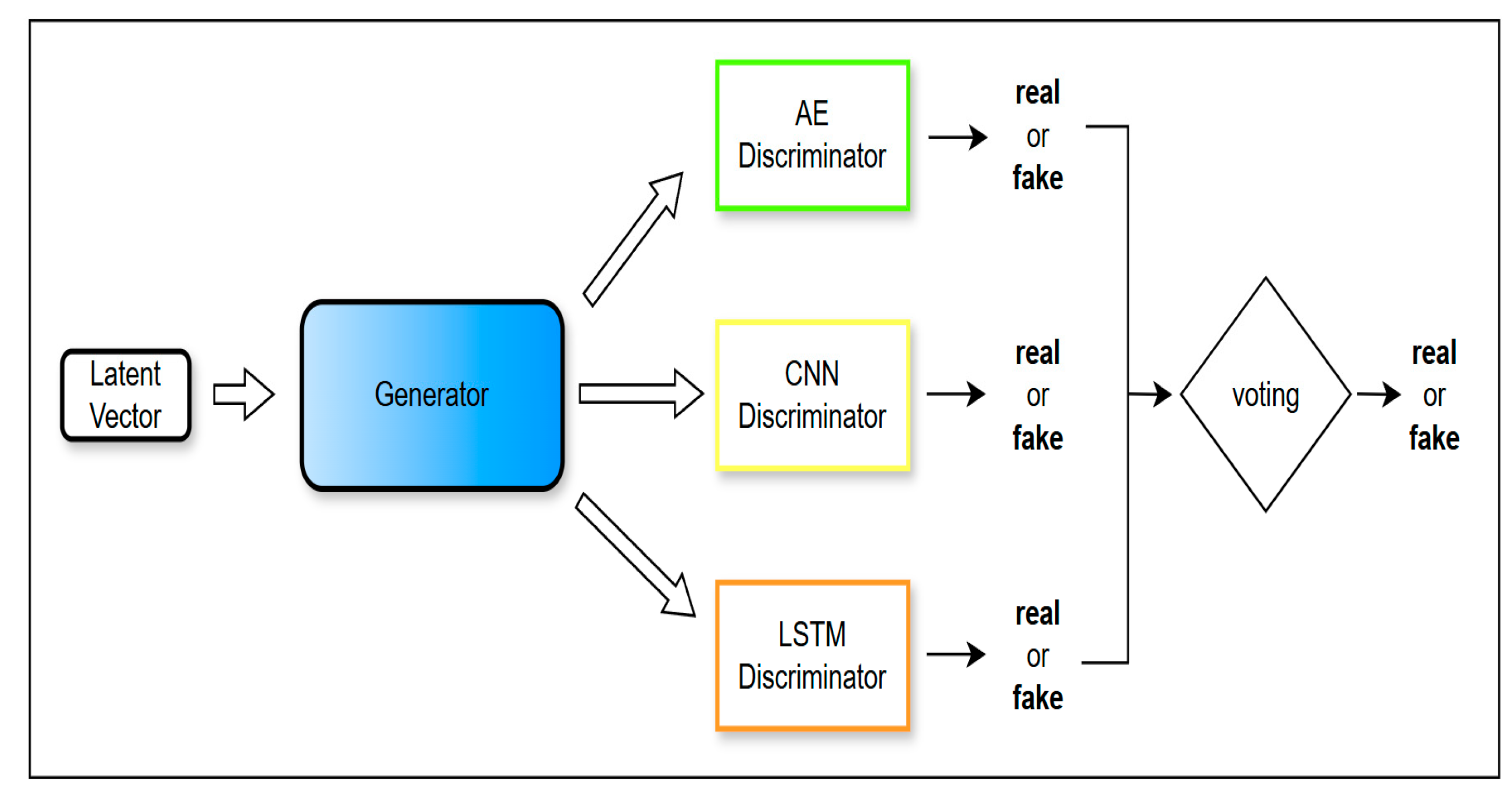
3.2. Multi-Discriminator Architecture
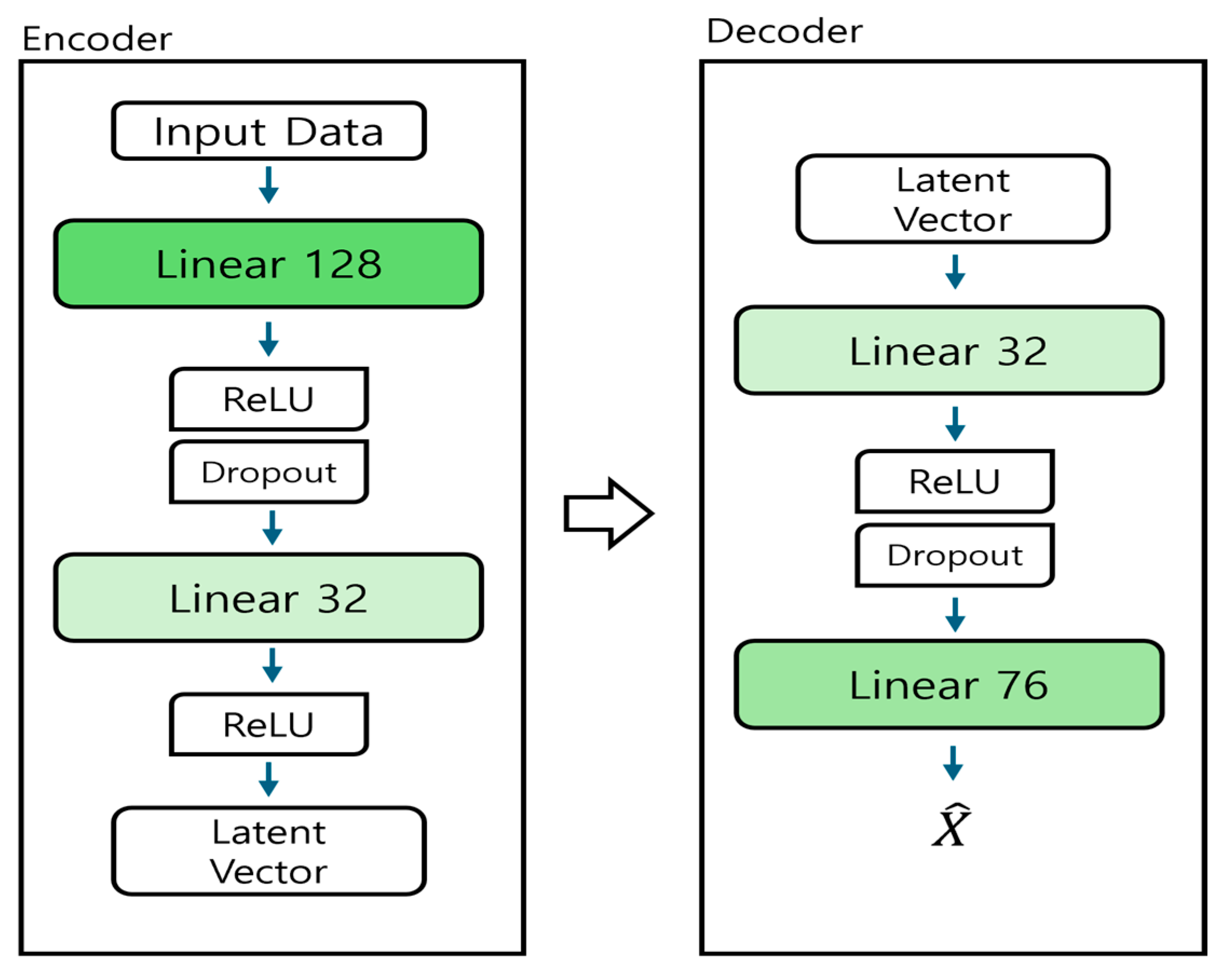
3.2.1. AE-Based Discriminator
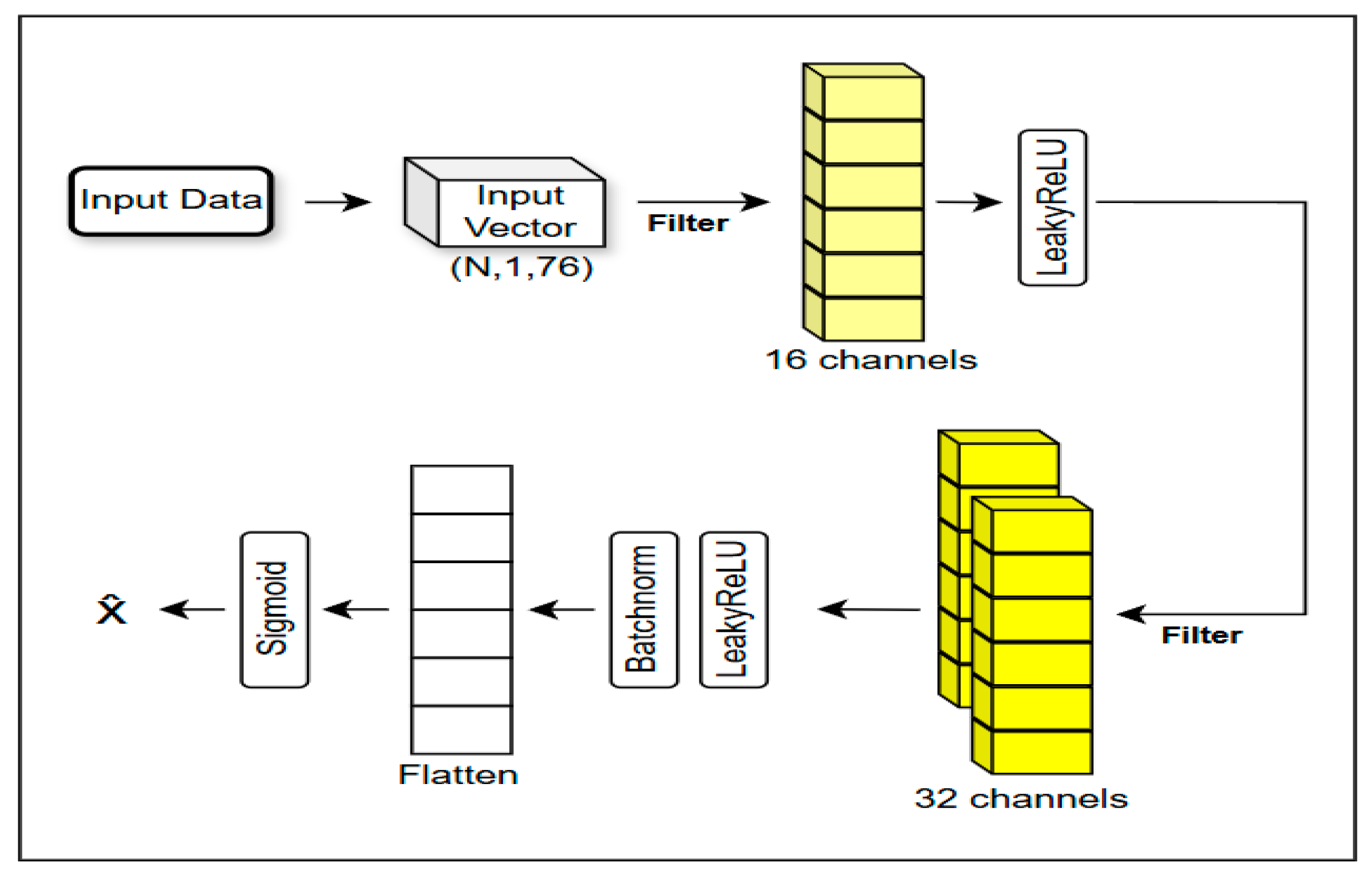
3.2.2. CNN-Based Discriminator
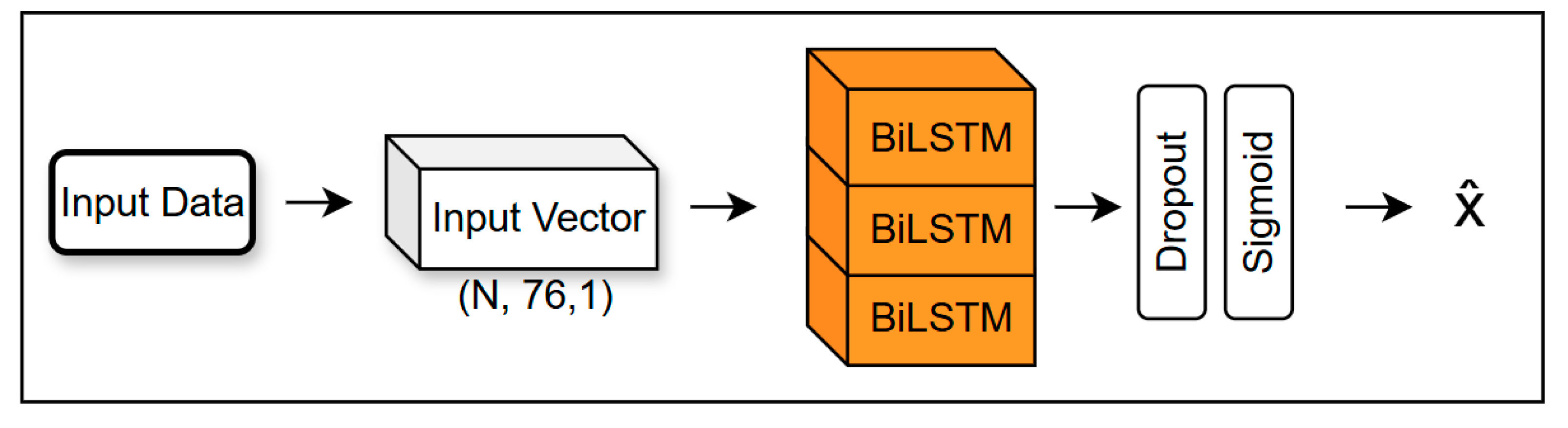
3.2.3. LSTM-Based Discriminator
3.3. Training Strategy
4. Experimental Setup and Results
4.1. Experimental Environment
4.2. Dataset Description and Preprocessing
4.3. Result
5. Conclusions
Author Contributions
Funding
Data Availability Statement
Conflicts of Interest
References
- Rosay, A.; Riou, K.; Carlier, F.; Leroux, P. Multi-layer perceptron for network intrusion detection. Ann. Telecommun. 2022, 77, 371–394. [Google Scholar] [CrossRef]
- Chakraborty, N. Intrusion detection system and intrusion prevention system: A comparative study. Int. J. Comput. Bus. Res. 2013, 4, 1–8. [Google Scholar]
- Garcia-Teodoro, J.; Díaz-Verdejo, J.; Maciá-Fernández, G.; Vázquez, E. Anomaly-based network intrusion detection: Techniques, systems and challenges. Comput. Secur. 2009, 28, 18–28. [Google Scholar] [CrossRef]
- Bhuyan, M.H.; Bhattacharyya, D.K.; Kalita, J.K. Network anomaly detection: Methods, systems and tools. IEEE Commun. Surv. Tutor. 2014, 16, 303–336. [Google Scholar] [CrossRef]
- Benchama, A.; Zebbara, K.; Elasri, S.; Aftatah, M. Optimized CNN-BiGRU intrusion detection model with SMOTE enhancement: Using Optuna for automated hyperparameter tuning. In Artificial Intelligence, Big Data, IoT and Block Chain in Healthcare; Springer: Cham, Switzerland, 2024. [Google Scholar] [CrossRef]
- Bamber, S.S.; Katkuri, A.V.R.; Sharma, S.; Angurala, M. A hybrid CNN-LSTM approach for intelligent cyber intrusion detection system. Comput. Secur. 2025, 148, 104146. [Google Scholar] [CrossRef]
- KDD Cup 1999 Dataset. Available online: http://kdd.ics.uci.edu/databases/kddcup99/kddcup99.html (accessed on 10 January 2026).
- Tavallaee, M.; Bagheri, E.; Lu, W.; Ghorbani, A.A. A detailed analysis of the KDD CUP 99 data set. In Proceedings of the IEEE Symposium on Computational Intelligence for Security and Defense Applications, Ottawa, ON, Canada, 8–10 July 2009. [Google Scholar] [CrossRef]
- Meena, G.; Choudhary, R.R. A review paper on IDS classification using KDD 99 and NSL KDD dataset in WEKA. In Proceedings of the International Conference on Computer, Communications and Electronics (Comptelix), Jaipur, India, 1–2 July 2017; pp. 553–558. [Google Scholar] [CrossRef]
- Chawla, N.V.; Bowyer, K.W.; Hall, L.O.; Kegelmeyer, W.P. SMOTE: Synthetic Minority Over-sampling Technique. J. Artif. Intell. Res. 2002, 16, 321–357. [Google Scholar] [CrossRef]
- Zhao, G.; Liu, P.; Sun, K.; Yang, Y.; Lan, T.; Yang, H. Research on Data Imbalance in Intrusion Detection Using CGAN. PLoS ONE 2023, 18, e0291750. [Google Scholar] [CrossRef] [PubMed]
- Habibi, O.; Chemmakha, M.; Lazaar, M. Imbalanced tabular data modelization using CTGAN and machine learning to improve IoT botnet attacks detection. Eng. Appl. Artif. Intell. 2023, 118, 105669. [Google Scholar] [CrossRef]
- Goodfellow, I.; Pouget-Abadie, J.; Mirza, M.; Xu, B.; Warde-Farley, D.; Ozair, S.; Courville, A.; Bengio, Y. Generative adversarial nets. In Advances in Neural Information Processing Systems (NeurIPS); Curran Associates, Inc.: Red Hook, NY, USA, 2014; Volume 27. [Google Scholar]
- Mirza, M.; Osindero, S. Conditional Generative Adversarial Nets. arXiv 2014, arXiv:1411.1784. [Google Scholar] [CrossRef]
- Tian, W.; Shen, Y.; Guo, N.; Yuan, J.; Yang, Y. VAE-WACGAN: An Improved Data Augmentation Method Based on VAEGAN for Intrusion Detection. Sensors 2024, 24, 6035. [Google Scholar] [CrossRef] [PubMed]
- Li, Z.; Huang, C.; Qiu, W. An Intrusion Detection Method Combining Variational Auto-Encoder and Generative Adversarial Networks. Comput. Netw. 2024, 253, 110724. [Google Scholar] [CrossRef]
- Xu, L.; Skoularidou, M.; Cuesta-Infante, A.; Veeramachaneni, K. Modeling Tabular Data Using Conditional GAN. In Proceedings of the Advances in Neural Information Processing Systems (NeurIPS), Vancouver, BC, Canada, 14 December 2019. [Google Scholar]
- Ioffe, S.; Szegedy, C. Batch normalization: Accelerating deep network training by reducing internal covariate shift. In Proceedings of the International Conference on Machine Learning (ICML); Curran Associates, Inc.: Red Hook, NY, USA, 2015. [Google Scholar]
- Trusov, A.V. Training 4.6-bit convolutional neural networks with a HardTanh activation function. Pattern Recognit. Image Anal. 2025, 35, 44–64. [Google Scholar] [CrossRef]
- LeCun, Y. Connexionist Learning Models. Ph.D. Thesis, Université Pierre et Marie Curie, Paris, France, 1987. [Google Scholar]
- O’Shea, K.; Nash, R. An introduction to convolutional neural networks. arXiv 2015, arXiv:1511.08458. [Google Scholar] [CrossRef]
- Khan, A.; Sohail, A.; Zahoora, U.; Qureshi, A.S. A survey of the recent architectures of deep convolutional neural networks. Artif. Intell. Rev. 2020, 53, 5455–5516. [Google Scholar] [CrossRef]
- Yu, Y.; Si, X.; Hu, C.; Zhang, J. A review of recurrent neural networks: LSTM cells and network architectures. Neural Comput. 2019, 31, 1235–1270. [Google Scholar] [CrossRef] [PubMed]
- Liu, J.; Li, D.; Liu, Z. Research on traffic classification based on BiLSTM and Informer. In Proceedings of CSA 2024 Advances in Computer Science and Ubiquitous Computing, Pattaya, Thailand, 18–20 December 2024; Springer: Singapore, 2025. [Google Scholar] [CrossRef]
- Moustafa, N.; Slay, J. UNSW-NB15: A comprehensive data set for network intrusion detection systems (UNSW-NB15 network data set). In Proceedings of the 2015 Military Communications and Information Systems Conference (MilCIS), Canberra, Australia, 10–12 November 2015; pp. 1–6. [Google Scholar] [CrossRef]

| Component | Specification |
|---|---|
| OS | Windows 11 Pro |
| CPU | AMD Ryzen 7 9700X 8-Core Processor |
| RAM | 64.00 GB |
| CPU | NVIDIA GeForce RTX 3090 |
| Language | Python 3.7.0 |
| Library | Torch, imbalanced-learn, scikit-learn |
| Parameter | Setting |
|---|---|
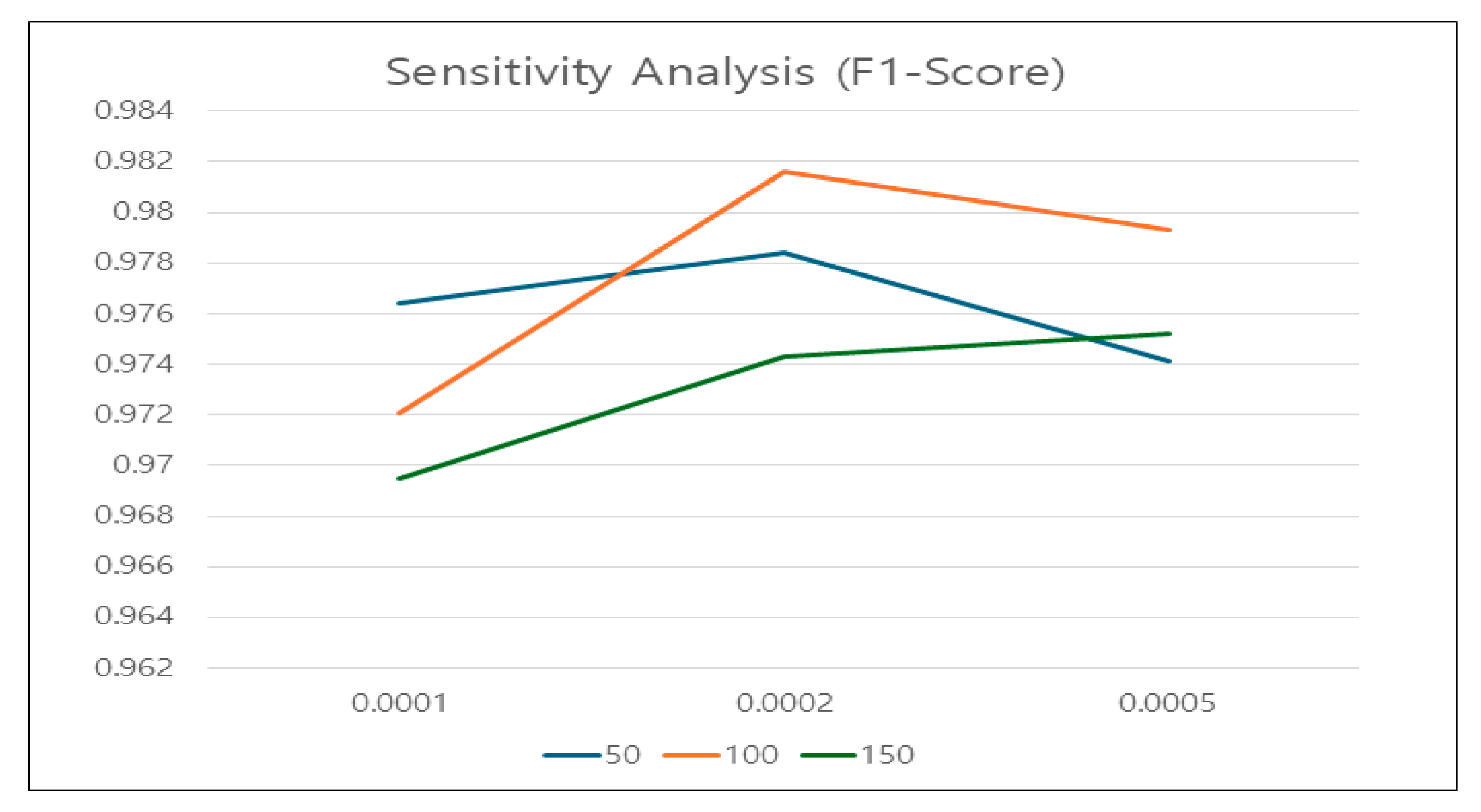
| Epoch | 200 |
| Batch size | 64 |
| Latent Dimension | 100 |
| Optimizer | Adam (Adaptive Moment Estimation) |
| Learning Rate | 0.0002 |
| Label | Sample Size | Label Number |
|---|---|---|
| Benign | 358,332 | 0 |
| Analysis | 385 | 1 |
| Backdoor | 452 | 2 |
| Dos | 4467 | 3 |
| Exploits | 30,951 | 4 |
| Fuzzers | 29,613 | 5 |
| Generic | 4632 | 6 |
| Reconnaissance | 16,735 | 7 |
| Shellcode | 2102 | 8 |
| Worms | 246 | 9 |
| Category | Label | Sample Size | Label Number |
|---|---|---|---|
| Benign | Benign | 358,332 | 0 |
| Information Gathering and Analysis | Analysis, Reconnaissance | 17,120 | 1 |
| System Compromise and Malicious Activities | Backdoor, Exploits, Generic, Shellcode, Worms | 38,383 | 2 |
| Denial of Service | Dos, Fuzzers | 34,080 | 3 |
| Label | Original | Augmentation |
|---|---|---|
| 0 | 358,332 | 358,332 |
| 1 | 17,120 | 100,000 |
| 2 | 38,383 | 100,000 |
| 3 | 34,080 | 100,000 |
| Label | Original | Augmentation |
|---|---|---|
| 0 | 358,332 | 358,332 |
| 1 | 17,120 | 350,000 |
| 2 | 38,383 | 350,000 |
| 3 | 34,080 | 350,000 |
| Accuracy | F1-Score | FNR | FPR | |
|---|---|---|---|---|
| 0.9397 | 0.9397 | 0.0603 | 0.0603 | |
| 0.9424 | 0.9424 | 0.0576 | 0.0576 | |
| 0.9300 | 0.9300 | 0.0700 | 0.0700 | |
| 0.9367 | 0.9367 | 0.0633 | 0.0633 | |
| 0.8913 | 0.8913 | 0.1087 | 0.1087 | |
| 0.8737 | 0.8737 | 0.1263 | 0.1263 | |
| 0.9532 | 0.9532 | 0.0468 | 0.0468 | |
| 0.9564 | 0.9564 | 0.0436 | 0.0436 | |
| 0.9439 | 0.9439 | 0.0561 | 0.0561 | |
| 0.9587 | 0.9587 | 0.0413 | 0.0413 | |
| 0.9602 | 0.9602 | 0.0398 | 0.0398 | |
| 0.9535 | 0.9535 | 0.0465 | 0.0465 |
| Accuracy | F1-Score | FNR | FPR | |
|---|---|---|---|---|
| 0.9397 | 0.9397 | 0.0603 | 0.0603 | |
| 0.9424 | 0.9424 | 0.0576 | 0.0576 | |
| 0.9300 | 0.9300 | 0.0700 | 0.0700 | |
| 0.9589 | 0.9589 | 0.0411 | 0.0411 | |
| 0.8353 | 0.8353 | 0.1647 | 0.1647 | |
| 0.8150 | 0.8150 | 0.1850 | 0.1850 | |
| 0.9746 | 0.9746 | 0.0264 | 0.0264 | |
| 0.9752 | 0.9752 | 0.0258 | 0.0258 | |
| 0.9749 | 0.9749 | 0.0262 | 0.0262 | |
| 0.9812 | 0.9812 | 0.0188 | 0.0188 | |
| 0.9816 | 0.9816 | 0.0184 | 0.0184 | |
| 0.9780 | 0.9780 | 0.0220 | 0.0220 |
| Model | Training Time (Per Epoch) | F1-Score |
|---|---|---|
| Baseline GAN (MLP) | 32 s | 0.9752 |
| GAN + CNN | 31 s | 0.9754 |
| GAN + CNN + AE | 33 s | 0.9780 |
| Proposed 3D-GAN (GAN + CNN + AE + LSTM) | 33 s | 0.9816 |
Disclaimer/Publisher’s Note: The statements, opinions and data contained in all publications are solely those of the individual author(s) and contributor(s) and not of MDPI and/or the editor(s). MDPI and/or the editor(s) disclaim responsibility for any injury to people or property resulting from any ideas, methods, instructions or products referred to in the content. |
© 2026 by the authors. Licensee MDPI, Basel, Switzerland. This article is an open access article distributed under the terms and conditions of the Creative Commons Attribution (CC BY) license.
Share and Cite
Kim, T.; Park, H.; Shin, D.; Shin, D. Enhancing Network Intrusion Detection Under Class Imbalance Using a Three-Discriminator Generative Adversarial Network. Electronics 2026, 15, 1253. https://doi.org/10.3390/electronics15061253
Kim T, Park H, Shin D, Shin D. Enhancing Network Intrusion Detection Under Class Imbalance Using a Three-Discriminator Generative Adversarial Network. Electronics. 2026; 15(6):1253. https://doi.org/10.3390/electronics15061253
Chicago/Turabian StyleKim, Taesu, Hyoseong Park, Dongil Shin, and Dongkyoo Shin. 2026. "Enhancing Network Intrusion Detection Under Class Imbalance Using a Three-Discriminator Generative Adversarial Network" Electronics 15, no. 6: 1253. https://doi.org/10.3390/electronics15061253
APA StyleKim, T., Park, H., Shin, D., & Shin, D. (2026). Enhancing Network Intrusion Detection Under Class Imbalance Using a Three-Discriminator Generative Adversarial Network. Electronics, 15(6), 1253. https://doi.org/10.3390/electronics15061253

