


Highlights
1. What are the main findings of our research?
- Geothermal brine recovery shows the lowest external cost at USD 4.11/kg LCE, compared with USD 9.45/kg LCE for spodumene and USD 11.85/kg LCE for solar brine.
- Smog formation dominates monetized damages, contributing more than 80% across all pathways.
- Monetized results support policy and investment decisions by translating environmental impacts into comparable dollar values.
- Cleaner lithium production should prioritize geothermal brine recovery and smog-emission reduction.
Abstract
The rapid growth of battery energy storage and electric vehicles has increased lithium demand and intensified the attention given to the environmental performance of alternative extraction pathways. Conventional life cycle assessments (LCA) of lithium production typically report midpoint indicators in physical units, which limits cross-category comparison and reduces their usefulness for economic and policy analysis. This study presents a comparative monetized LCA of lithium carbonate equivalent (LCE) production from three pathways: solar brine evaporation, hard-rock spodumene mining, and geothermal brine recovery. Using the TRACI 2.1 midpoint results reported in a prior LCA, six impact categories—global warming, smog formation, acidification, respiratory effects, carcinogenic toxicity, and non-carcinogenic toxicity—are converted into monetary values through a benefit-transfer, damage-cost approach. Total environmental external costs are estimated at USD 11.85/kg LCE for solar brine evaporation, USD 9.45/kg LCE for spodumene mining, and USD 4.11/kg LCE for geothermal brine recovery (all USD amounts are expressed in $2025 unless otherwise mentioned). Smog formation contributes more than 80% of the total monetized damages across all pathways, while toxicity-related impacts account for a smaller share than implied by the normalized midpoint results. Monetization changes the relative ranking of the solar brine and spodumene pathways, while indicating that geothermal brine recovery has the lowest monetized external cost among the impact categories evaluated. These findings show that monetized LCA can complement conventional midpoint assessment and provide more decision-relevant insights for policy and economic evaluation.
1. Introduction
Lithium plays a central role in the transition toward low-carbon energy systems due to its extensive use in lithium-ion batteries for electric vehicles, stationary energy storage, and portable electronics [1,2]. As the deployment of these technologies accelerates, global lithium demand is projected to increase by more than 500% by 2050, relative to 2018 levels [1]. This rapid growth has heightened interest in understanding the environmental performance of alternative lithium extraction pathways and their associated external environmental impacts.
Lithium production remains geographically concentrated, although the producing countries and production shares continue to evolve as new capacity enters the market. Recent data from the U.S. Geological Survey show that, excluding U.S. production, world lithium mine production increased from approximately 222,000 tons in 2024 to approximately 290,000 tons in 2025 [3]. The majority of production was accounted for by a limited number of brine and hard-rock operations in countries such as Australia, Chile, China, Argentina, Zimbabwe, Brazil, Canada, and Mali. This continuing concentration of production raises concerns regarding supply security, price volatility, and the environmental implications of the rapidly expanding lithium extraction.
Two established extraction routes—solar evaporation of lithium-rich brines and hard-rock mining of spodumene—account for most of the current supply. Solar evaporation, widely used in the Andean region, is generally cost-competitive but involves extensive land use, high evaporative water losses, and the generation of residual brine waste streams [4,5]. Spodumene-based production, predominantly practiced in Australia, relies on energy-intensive processes such as crushing, calcination, and chemical conversion, resulting in relatively high energy use and air emissions [6,7]. More recently, lithium recovery from geothermal brines has emerged as an alternative approach, particularly in regions such as California’s Salton Sea, where lithium extraction may be integrated with existing geothermal power operations [8,9,10,11]. Although still in the early stages of commercial deployment, geothermal brine recovery has been identified as a potentially lower-impact extraction option.
LCA is widely used to compare the environmental impacts of lithium extraction technologies. Most lithium LCAs report midpoint indicators—such as global warming potential, smog formation, acidification, and human toxicity—which quantify emissions and resource use in the physical units [12,13]. While these indicators support detailed environmental analysis, they are expressed in different units and therefore cannot be directly compared across impact categories. Normalization methods, such as those available within the TRACI framework, partially address this limitation by scaling midpoint results relative to reference values [14]. However, normalized results can be sensitive to the choice and magnitude of the normalization reference system. Kim et al. (2013) emphasized that normalization references play an important role in interpreting life-cycle assessment results, while Prado et al. (2017) showed that external normalization can influence the conclusions of comparative LCAs [15,16]. This issue is particularly relevant when categories have small or uncertain reference values, because such categories may appear disproportionately important after scaling. Pizzol et al. (2017) also noted that normalization and weighting can support the interpretation but introduce value choices and methodological uncertainty, especially when the results are aggregated or compared across impact categories [17]. These concerns are particularly important for toxicity-related categories, where characterization factors, background inventories, and normalization references are often more uncertain than climate or conventional air pollution indicators. As a result, normalized midpoint results may be useful for screening but may not provide a sufficient basis for economic or policy-oriented comparison across impact categories. In this study, monetary valuation is used as a complementary interpretation step to compare selected midpoint impacts in a common damage-cost unit and to evaluate whether normalized midpoint interpretations are consistent with estimated societal damages.
An alternative approach is to express environmental impacts in monetary terms. Monetary valuation converts the midpoint indicators into a common unit, enabling direct comparison across impact categories and production pathways [18,19,20,21]. Damage-cost-based monetization methods, in particular, estimate the societal costs of emissions by linking pollutant releases to health and environmental damage. Despite their potential to enhance interpretability, monetized LCAs remain limited in the lithium literature. Existing studies of lithium extraction primarily rely on the midpoint or the normalized indicators and do not quantify the external environmental costs on a per-kilogram basis for the lithium carbonate equivalent.
This study addresses this gap by conducting a comparative monetized LCA of lithium carbonate production from three extraction pathways: solar evaporation of brines, hard-rock mining of spodumene, and recovery from the geothermal brines. Using the TRACI 2.1 midpoint results reported in a previously published LCA, six impact categories—global warming, smog formation, acidification, respiratory effects, carcinogenic toxicity, and non-carcinogenic toxicity—are converted into monetary values using a benefit-transfer, damage-cost approach. Climate damages are valued using the social cost of carbon, air-quality impacts are monetized using the U.S. EPA BenMAP-CE benefit-per-ton estimates, and toxicity impacts are expressed in disability-adjusted life years (DALYs). The objectives of this study are to (i) estimate pathway-specific external environmental costs of lithium carbonate production, (ii) examine the differences between the midpoint-based and monetized interpretations of environmental performance, and (iii) provide decision-relevant information for the economic and policy-oriented evaluation of lithium extraction pathways.
2. Literature Review
LCA is widely used to quantify the environmental impacts of lithium extraction and processing, typically reporting midpoint indicators such as global warming potential, smog formation, acidification, and human toxicity. These indicators are expressed in non-monetary units, such as kg CO2-eq, kg O3-eq, and CTUh. While these indicators support detailed scientific comparison across processes and impact categories, they can be difficult to interpret in economic or policy contexts because they do not directly indicate the monetary significance of environmental damages. To address this limitation, a growing body of LCA research has explored monetization methods that convert the environmental burdens into monetary values, enabling more direct comparison across the impact categories and facilitating integration with the cost-based decision-making frameworks.
Several studies have examined lithium resources, supply constraints, and sustainability challenges associated with lithium-ion batteries. Kavanagh et al. (2018) reviewed global lithium sources, industrial uses, and future demands associated with electric vehicles [22]. Peters and Weil (2016) assessed the resource-depletion potential of current and future lithium-ion batteries and showed that the depletion results can vary depending on the selected assessment method [23]. Moreau et al. (2019) examined broader metal-resource constraints associated with supplying a fully renewable energy system, highlighting the importance of critical materials for energy-transition technologies [24]. More recently, Vega-Muratalla et al. (2024) reviewed lithium as a strategic resource for electric-vehicle battery production, including availability, extraction technologies, and future prospects [25]. These studies provide important insights into lithium availability, strategic importance, and resource constraints; however, they do not monetize pathway-specific life-cycle midpoint impacts for lithium carbonate production. The present study addresses this gap by converting selected environmental impacts into monetary damage estimates for solar brine evaporation, spodumene-based production, and geothermal brine recovery pathways.
2.1. Monetization Approaches in LCA
Several approaches have been developed to assign monetary values to environmental impacts. The damage-cost methods estimate the societal damages associated with the emissions or resource use by tracing cause–and–effect pathways from pollutant release to environmental or health outcomes and applying economic valuations at the endpoint. The social cost of carbon (SCC), which estimates the economic damages caused by an additional metric ton of CO2 emissions, is a prominent example of this approach [26,27]. The damage-based methods are conceptually aligned with welfare economics but are subject to uncertainty related to exposure modeling, valuation of non-market impacts, and discounting assumptions.
Willingness-to-pay (WTP) approaches estimate how much individuals are willing to pay to avoid adverse health or environmental outcomes and form the basis of several endpoint-oriented monetization frameworks, including Environmental Priority Strategies (EPS) and Stepwise [28]. Although WTP methods reflect societal preferences, results can vary with income levels, survey design, and cultural context. Abatement-cost approaches, by contrast, value environmental impacts based on the cost of reducing emissions to meet regulatory or policy targets. These methods, such as those implemented in the Environmental Cost Indicator (ECI), reflect compliance costs rather than realized damages and may diverge from actual welfare impacts if policy targets or technologies change over time [29].
More recently, shadow-pricing frameworks have been developed to translate midpoint indicators into monetary terms using standardized valuation coefficients derived from either damage or abatement cost estimates [30,31]. Monetization databases and models—including ReCiPe, IMPACT World+, EcoCost, and LC-IMPACT—provide integrated valuation pathways, but their applicability varies with geographic coverage, modeling assumptions, and the treatment of midpoint versus endpoint indicators. Consequently, the choice of monetization method can substantially influence LCA outcomes and interpretation.
2.2. Applications of Monetized LCA in Energy and Metals
Monetary valuation has been widely applied in LCAs of energy systems, particularly for electricity generation. Studies comparing coal-fired, biomass, and other power technologies consistently find that air-quality-related impacts—especially those associated with particulate matter, sulfur dioxide, and nitrogen oxides—dominate monetized external costs, even when these categories appear less prominent in non-monetized indicator sets [32,33]. Expressing impacts in monetary terms has been shown to simplify technology comparison and enhance relevance for energy planning and policy evaluation.
In metal supply chains, monetized LCA has been used to assess environmental–economic trade-offs for primary metals and critical raw materials. Global LCA syntheses of metal production identify energy use and air emissions as major contributors to environmental burdens across metals [34]. More recent studies combining LCA with external cost or life-cycle costing approaches confirm that health-related air pollution impacts often dominate monetized results, while toxicity indicators that receive emphasis in normalized midpoint analyses contribute less to total damage costs [35]. These findings parallel results from the power sector and underscore the importance of air-quality impacts in monetized environmental assessments.
2.3. LCA of Lithium Extraction and the Remaining Gap
A growing amount of literature has examined the environmental impacts of lithium extraction pathways using conventional LCA methods. Studies of salar-type brine evaporation systems identify water depletion, land occupation, and chemical reagent use as key contributors to environmental impacts at the extraction stage [36]. Regionalized LCAs of lithium carbonate production from brines show substantial variation in the climate, particulate matter, and water scarcity impacts across sites, reflecting differences in brine chemistry, process configuration, and local environmental conditions [37]. LCAs of spodumene-based production generally find higher energy use and greenhouse gas emissions due to high-temperature calcination and chemical conversion processes [38].
Lithium recovery from geothermal brines has been evaluated through combined LCA and techno-economic analyses (TEA), particularly for projects integrated with geothermal power generation. These studies report comparatively lower global warming, land-use, and toxicity impacts per kilogram of lithium carbonate, reflecting reduced surface disturbance and shared infrastructure [14]. Recent assessments of lithium chemical production in the United States further highlight the importance of electricity mix, process emissions, and reagent production as key drivers of life-cycle impacts across brine- and hard-rock-based pathways [39].
Despite this progress, most lithium LCAs report results exclusively in the midpoint or normalized units and do not translate impacts into monetary terms [14,37,38,39]. As a result, existing studies do not provide external environmental cost estimates on a per-kilogram basis for lithium carbonate equivalents, limiting their direct applicability to economic comparisons, procurement decisions, or policy screening. In addition, normalized midpoint results often emphasize toxicity-related categories, while the relative importance of these impacts compared with air-quality and climate damages remains unclear when assessed using monetary valuation.
Table 1 summarizes selected LCA and monetization studies relevant to lithium production, lithium-ion battery supply chains, and damage-cost valuation. The table highlights each study’s methodological approach, main findings, and remaining gap, with the present study included to clarify its specific contribution.
Table 1.
Summary of Selected LCA and Monetization Studies.
2.4. Positioning of This Study
As shown in Table 1, previous LCA studies provide important insights into the environmental impacts of lithium production, lithium-ion battery supply chains, and lithium carbonate production pathways. However, most lithium-focused studies report inventory, midpoint, or normalized impact results without translating these impacts into monetary damage estimates. In response to this limitation, the present study applies a benefit-transfer, damage-cost approach to monetize selected life-cycle midpoint impacts of lithium carbonate production.
Monetary values for climate impacts are based on the social cost of greenhouse gases [40], air-quality damages are estimated using U.S. EPA benefit-per-ton coefficients derived from the BenMAP-CE framework [41], and human-health impacts are valued using disability-adjusted life years (DALYs) from the health economics literature. This approach is consistent with damage-based monetization and differs from methods based on abatement costs or stated-preference surveys.
Using the TRACI 2.1 midpoint impact results reported by Huang et al. [14], this study monetizes six impact categories—global warming, smog formation, acidification, respiratory effects, carcinogenic toxicity, and non-carcinogenic toxicity—for lithium carbonate production from solar brines, spodumene ore, and geothermal brines. By expressing results as external environmental costs in USD per kg lithium carbonate equivalent, the analysis provides a consistent basis for comparing environmental impacts across extraction pathways and examining how conclusions differ between normalized midpoint and monetized LCA interpretations. Expressing impacts in a common monetary unit also helps identify the relative importance of different environmental impact categories, enabling the policymakers and decision makers to prioritize those that impose the greatest societal damage. In doing so, this study addresses a key gap in the lithium LCA literature by providing pathway-level external cost estimates directly relevant to economic comparisons and policy-oriented evaluations of lithium supply options.
3. Methodology
3.1. LCA Framework
This study builds on the LCA and TEA developed by Huang et al. [14] for three lithium carbonate production pathways: solar evaporation of brines, hard-rock mining of spodumene, and lithium recovery from geothermal brines. The data provided by Huang et al. [14] was selected because it provides a consistent, peer-reviewed comparative dataset with TRACI 2.1 midpoint impact results reported on a common functional basis. This consistency allows the present analysis to apply the same monetization framework across the conventional brine, spodumene, and emerging geothermal brine recovery pathways. Since the objective of this study is not to develop a new life-cycle inventory but to translate previously reported midpoint impacts into monetary damage estimates, Huang et al. [14] provide an appropriate and transparent source dataset for the monetized LCA.
The original LCA was implemented in SimaPro version 9.0.0 using the Ecoinvent v3.5 and U.S. Life Cycle Inventory (USLCI) databases, with environmental impacts characterized using the TRACI 2.1 midpoint method developed by the U.S. Environmental Protection Agency [12,13].
The system boundaries differ across extraction pathways according to the underlying LCA design. For geothermal brines, the system includes material and energy inputs associated with lithium recovery and purification, based on laboratory-scale performance data and stoichiometric estimates for a representative 50-MW geothermal facility in California [14]. For solar brine evaporation and spodumene mining, the boundaries encompass lithium chloride production from brines in Chile and spodumene concentration and conversion processes in Australia, respectively [14]. Although these operations are located outside North America, comparable lithium extraction and processing projects are under development in regions such as Clayton Valley, Nevada, and North Carolina [42,43,44], supporting the use of North American characterization and valuation parameters in this analysis.
The functional unit is defined as 1 kg of battery-grade lithium carbonate equivalent at the plant gate. The co-products are not included in the inventories; therefore, the allocation procedures are not required.
One important limitation of the underlying source data is the difference in the process maturity across the three extraction pathways. In Huang et al. [14], the geothermal brine recovery pathway was based on the laboratory-scale process data that were scaled to industrial conditions using the stoichiometric relationships and empirical assumptions, whereas the solar brine evaporation and spodumene pathways represent more established production routes. This difference in maturity may affect the precision of absolute life-cycle impact estimates, particularly for the geothermal pathway. Accordingly, the monetized results presented in this study should be interpreted as a comparative evaluation based on a consistent published LCA dataset, rather than as a definitive representation of the current commercial-scale performance for all lithium extraction systems.
3.2. Geographic Scope, Characterization Level, and Key Assumptions
The LCA used in this study is process-based and does not include site-specific exposure or fate-and-transport modeling. For the monetization step, all emissions are valued using a United States/Canada characterization and damage-cost framework to maintain consistency with the regional scope of TRACI 2.1 midpoint characterization factors and the U.S.-based valuation datasets applied in this analysis [12]. This is a benefit-transfer assumption rather than a claim about the physical location of the emissions. Because the solar brine and spodumene pathways in the source study correspond to the operations in Chile and Australia, respectively, the resulting monetary estimates for those pathways should be interpreted as comparative reference values under a North American valuation framework, not as site-specific local damage estimates.
In the source LCA, environmental impacts were quantified at the midpoint level using TRACI 2.1 indicators, including climate change, smog formation, acidification, and human toxicity. TRACI 2.1 was not applied as a new characterization step in the present study; rather, the analysis adopts the TRACI 2.1 midpoint results reported by Huang et al. [14] because they provide a consistent functional basis for monetizing and comparing the three lithium carbonate production pathways.
Smog formation represents the potential for ground-level ozone formation from emissions of nitrogen oxides (NOx) and volatile organic compounds (VOC). Carcinogenic and non-carcinogenic toxicity represent the potential human health impacts from emissions of hazardous substances and are expressed in comparative toxic units for humans (CTUh). These categories reflect distinct environmental mechanisms and do not overlap at the midpoint level, although they may affect common health endpoints.
Monetary valuation is applied as a post-LCA interpretive step, translating selected midpoint results into estimates of societal and human-health damages using externally derived damage-cost coefficients. This approach does not constitute an endpoint LCA and does not alter the original system boundaries, inventories, or characterization framework. TRACI normalization factors are not applied in the monetized analysis and are referenced only for comparison with normalized midpoint results reported in prior studies [18,45].
Damage-cost coefficients are transferred across regions and treated as static marginal damages, implying linear dose–response relationships without thresholds. The monetized results reported in this study are therefore point estimates derived from deterministic midpoint values and literature-based valuation coefficients. Confidence intervals, standard deviations, and probability distributions are not reported because neither the underlying source LCA nor the adopted damage-cost coefficients provide a complete probabilistic characterization of uncertainty. Nevertheless, uncertainty may arise from several sources, including the transferability of regional damage factors, the choice of social cost of carbon, the valuation of health impacts, and the maturity of the underlying process data, particularly for geothermal brine recovery. Future research could address this limitation through scenario analysis or Monte Carlo simulation once suitable parameter distributions become available.
Figure 1 summarizes the analytical workflow used in this study, beginning with the TRACI 2.1 midpoint impact results reported by Huang et al. [14] and proceeding through category selection, assignment of damage-cost coefficients, conversion to USD/kg LCE, aggregation by pathway and impact category, and comparison of monetized results across the lithium carbonate production pathways.
Figure 1.
Analytical workflow of the monetized life cycle assessment [14].
3.3. Monetizing Life Cycle Impacts
This study applies a benefit-transfer, damage-cost approach to convert selected LCA midpoint results into monetary values. Benefit transfer uses existing economic valuation coefficients, such as damage costs per unit of pollutant emissions, and applies them to emission or impact quantities derived from the LCA [46]. This approach is appropriate for the present study because the objective is to estimate the external environmental costs associated with lithium carbonate production pathways, rather than to provide only relative midpoint or normalized impact scores. Monetized LCA and external-cost approaches have been used in previous energy and industrial assessments. For example, Wang et al. [32] estimated external costs of coal-fired and biomass power generation using a life-cycle approach, while Baumgärtner and Letmathe [33] assessed external costs of electricity generation using country-specific technology mixes and external cost rates. In addition, Arendt et al. [28] reviewed monetization methods in LCA and showed that monetary valuation is a recognized approach for interpreting environmental impacts as costs to society. Therefore, the present study applies a damage-cost framework to translate selected midpoint impacts into USD/kg LCE, allowing comparison across the impact categories and extraction pathways in a policy-relevant monetary unit.
Six midpoint impact categories reported under the TRACI 2.1 framework in Huang et al. [14] are monetized: global warming, smog formation, acidification, respiratory effects, carcinogenic toxicity, and non-carcinogenic toxicity. These categories were selected based on three criteria. First, they are reported by Huang et al. [14] for all three lithium carbonate production pathways, allowing consistent comparison across the solar brine evaporation, spodumene-based production, and geothermal brine recovery. Second, they represent environmental and human-health impact pathways for which damage-cost or health-valuation coefficients are available in the literature. Climate damages are monetized using the social cost of carbon, air-quality-related impacts are monetized using benefit-per-ton estimates, and toxicity-related impacts are monetized using DALY-based health valuation. Third, these categories are directly relevant to the objective of translating selected midpoint impacts into external environmental cost estimates. Other TRACI categories, including eutrophication, ecotoxicity, and fossil fuel depletion, are excluded because the compatible and widely accepted damage-cost coefficients are not available for consistent application across the three pathways [13,14]. As a result, the monetized estimates represent only a portion of the total external costs and are likely conservative.
3.3.1. Global Warming
Climate damages are monetized using the social cost of carbon Dioxide (SCC) developed by the Interagency Working Group on the Social Cost of Greenhouse Gases [40]. The SCC represents the present value of economic damages associated with an additional metric ton of CO2 emissions and it is derived from integrated assessment models such as DICE, FUND, and PAGE [47,48,49]. In this study, a value of 83 USD per metric ton of CO2 is applied, corresponding to a 2.5% discount rate for the 2025 emission year [40].
The SCC was selected because it directly matches the objective of the present study, which is to convert climate-related midpoint impacts into estimates of external societal damage. The global warming results reported in the source LCA are expressed in kg CO2-equivalent per kg LCE; therefore, applying an SCC provides a transparent and widely used method for translating these emissions into monetary damages. This approach is consistent with the damage-cost framework used in the study because the SCC estimates the marginal economic damage associated with an additional metric ton of CO2 emissions, rather than the cost of abating emissions or achieving a specific policy target. Using the SCC also allows climate damages to be expressed in the same monetary unit as the other monetized impact categories, supporting cross-category comparison within the overall USD/kg LCE framework.
The SCC used in policy analysis varies depending on methodological assumptions and policy frameworks. For example, the U.S. Environmental Protection Agency estimated the SCC at approximately $380 per metric ton of CO2 for the 2030 emission year using a 1.5% discount rate [50]. Federal estimates have also changed across administrations. The Biden administration reinstated an interim value of approximately $51 per ton, broadly aligned with the Obama-era estimate of about $50 per ton, whereas the estimate declined to around $1 per ton during the Trump administration, when only the domestic damages were considered [51]. Recent academic research suggests substantially higher SCC values, with estimates around $185 per ton or more, depending on the modeling assumptions [52].
The SCC applied in this study is a standardized federal estimate expressed in real 2025 USD. No separate adjustments were made for the exchange rates, purchasing-power differences, or regional productivity levels at the pathway level. Such factors are reflected only indirectly through the socioeconomic assumptions embedded in the integrated assessment models used to derive the SCC. Because climate damages represent only a small share of the total monetized impacts in this study, variation in the SCC is unlikely to change the overall pathway ranking, although it may affect the precise magnitude of the climate-related damage component. A systematic sensitivity analysis using alternative SCC values and discount-rate assumptions would therefore be a useful extension for future research.
3.3.2. Acidification
Acidification-related impacts are monetized using benefit-per-ton estimates for sulfur dioxide (SO2) and nitrogen oxides (NOx) derived from the U.S. EPA’s BenMAP-CE modeling framework [19]. BenMAP-CE links emissions to changes in ambient pollutant concentrations and quantifies associated health outcomes using established concentration–response functions. Marginal damage values of 40.528 USD per kg for SO2 and 11.445 USD per kg for NOx are applied in this analysis based on the EPA technical documentation [20].
This method was selected because acidification-related emissions are closely associated with conventional air pollutants that cause measurable human health damage through secondary particulate matter formation and related exposure pathways. EPA benefit-per-ton estimates provide a transparent and policy-relevant basis for monetizing these damages because they are derived from air-quality modeling and health-impact assessment, rather than arbitrary weighting factors. Their use is consistent with the objective of this study, which is to translate the midpoint impacts into external damage costs using established valuation coefficients.
3.3.3. Smog Formation
Smog formation is monetized using a weighted combination of benefit-per-ton values for nitrogen oxides (NOx) and volatile organic compounds (VOCs), reflecting their relative contributions to ground-level ozone formation. Following established ozone precursor weighting factors, weights of 87% for NOx and 11% for VOCs are applied, yielding a combined valuation of 57.225 USD per kg of O3-equivalent emissions [20,53].
This method was selected because smog formation in TRACI represents the potential for ground-level ozone formation from precursor emissions, primarily NOx and VOCs. Since ozone-related damages depend on precursor contributions rather than a single emitted pollutant, a weighted precursor-based valuation provides a practical way to translate the midpoint smog indicator into monetary damages. EPA benefit-per-ton values were used because they estimate the health benefits of reducing ozone precursors using established air-quality and epidemiological modeling. This approach is therefore consistent with the damage-cost framework used in the present study and allows smog-related impacts to be expressed in USD/kg LCE.
3.3.4. Respiratory Effects
Respiratory effects associated with fine particulate matter are monetized using a marginal damage value of 76.1 USD per kg of PM2.5, derived from BenMAP-CE estimates for industrial emission sources [20,54]. This value captures health outcomes such as premature mortality, hospital admissions, and respiratory morbidity attributable to the exposure to primary and secondary PM2.5.
This method was selected because respiratory effects are among the most directly health-related midpoint categories included in the analysis. Fine particulate matter exposure has well-established links to premature mortality and respiratory illness, and EPA benefit-per-ton estimates provide a suitable damage-cost coefficient for monetizing these effects. Using BenMAP-CE-based values ensures consistency with the valuation approach applied to other air-quality-related categories in this study and supports the comparison of respiratory damage with climate, smog, acidification, and toxicity damage in a common monetary unit.
3.3.5. Carcinogenic and Non-Carcinogenic Toxicity
Human toxicity impacts are evaluated using USEtox 2.0 characterization factors, which express human health effects in comparative toxic units for humans (CTUh) [45]. CTUh values are converted to disability-adjusted life years (DALYs) using recommended conversion factors of 11.5 DALYs per CTUh for carcinogenic substances and 2.7 DALYs per CTUh for non-carcinogenic substances. DALYs are then monetized using a median valuation of 144,000 USD per DALY, drawn from U.S. health cost-effectiveness literature [21,55].
This method was selected because carcinogenic and non-carcinogenic toxicity impacts are expressed in CTUh, which represents potential human-health disease cases rather than pollutant mass. A DALY-based approach provides a transparent way to convert these potential health effects into a common health-damage metric before monetization. Using DALYs also allows toxicity impacts to be compared with other health-related damages, such as respiratory and ozone-related effects, within the same external-cost framework. Although toxicity valuation is subject to greater uncertainty than air pollution valuation, this approach provides a consistent and literature-supported method for estimating the monetary significance of toxicity-related midpoint results.
4. Results
The monetized cost for impact category k is calculated as:
where = quantity of emission i contributing to category k, and = damage cost per unit emission.
Table 2 provides an example of the calculation for the solar brine evaporation pathway. Because the midpoint results adopted from Huang et al. [14] are reported on a per kg LCE basis, the monetized value for each category is calculated by multiplying the midpoint impact quantity by the corresponding damage-cost coefficient. For example, the global warming impact for solar brine evaporation is 1.80 kg CO2-e per kg LCE. Applying the social cost of carbon coefficient of 0.083 USD/kg CO2-e gives a monetized climate damage of 0.1494 USD/kg LCE. Similarly, the smog formation impact is 0.172 kg O3-eq per kg LCE, which is multiplied by 57.225 USD/kg O3-eq to obtain 9.8427 USD/kg LCE. The total monetized environmental cost for the solar brine pathway is then obtained by summing the monetized values across the six selected impact categories, resulting in 11.8494 USD/kg LCE, reported as 11.85 USD/kg LCE (For details, see Supplementary Materials, Table S1: Monetary Value of Impacts).
Table 2.
Monetized Cost Calculation for Solar Brine Evaporation.
This same procedure is applied to the spodumene-based production and geothermal brine recovery pathways using the corresponding midpoint values reported by Huang et al. [14]. The resulting pathway totals are 9.45 USD/kg LCE for spodumene-based production and 4.11 USD/kg LCE for geothermal brine recovery.
4.1. Total Monetized Environmental Impacts
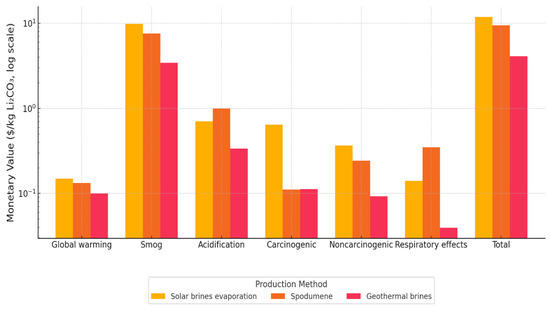
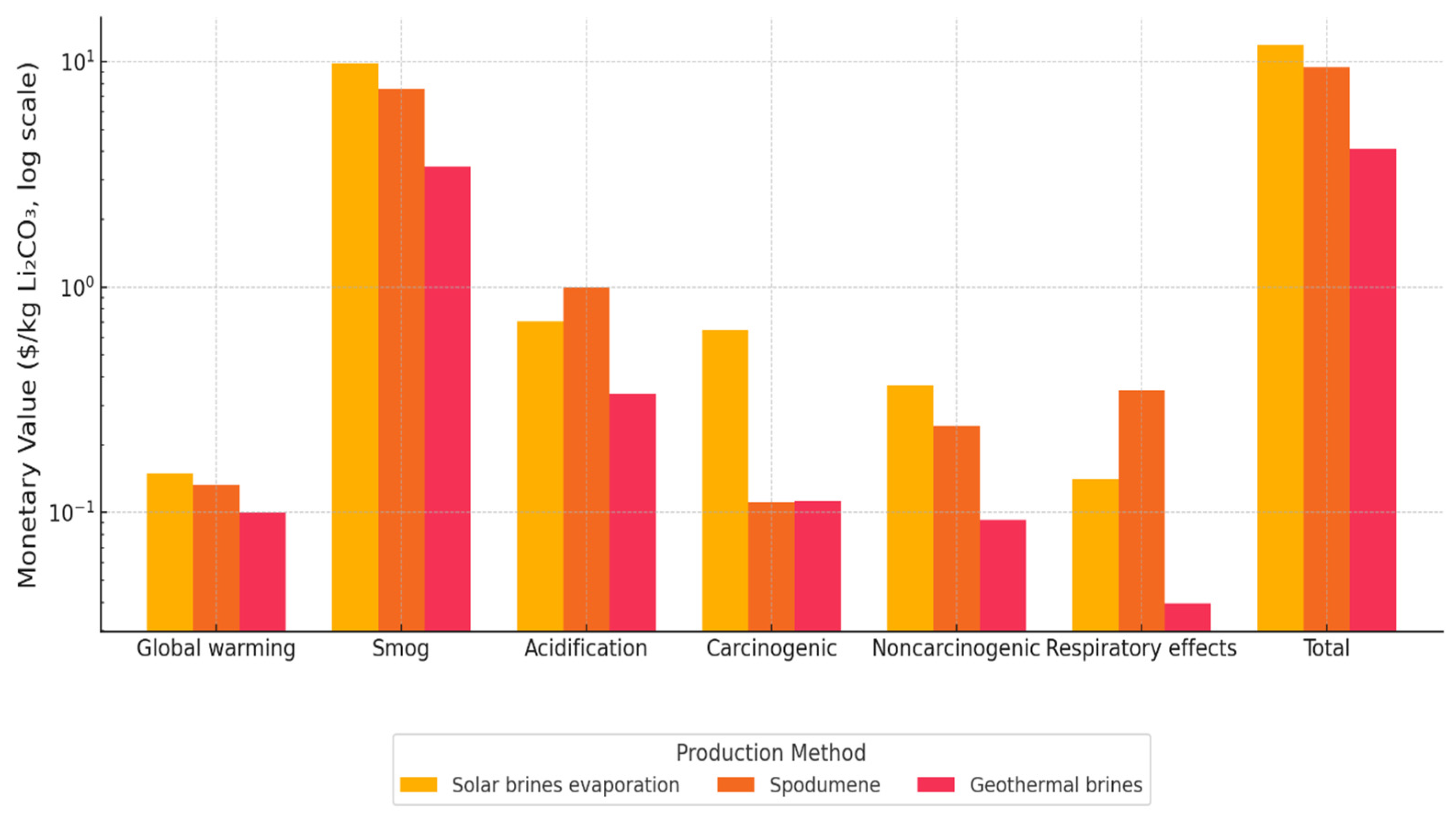
Figure 2 shows clear differences in total monetized environmental damage costs across the three lithium extraction pathways. Solar brine evaporation has the highest total external cost at USD 11.85 per kg LCE, followed by spodumene mining at USD 9.45 per kg LCE, while geothermal brine recovery has the lowest cost at USD 4.11 per kg LCE. These results indicate that, under the assumptions applied, lithium carbonate production from geothermal brines is associated with substantially lower monetized environmental damages than production from conventional brine evaporation or hard-rock mining pathways.
Figure 2.
Total and category-wise monetized life cycle impacts of lithium carbonate production across three extraction techniques, presented on a logarithmic scale. Values are in USD per kg LCE.
4.2. Contribution by Impact Category
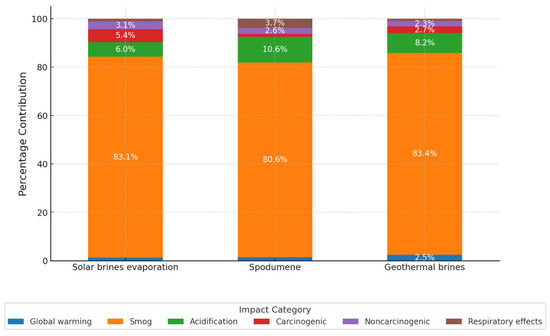
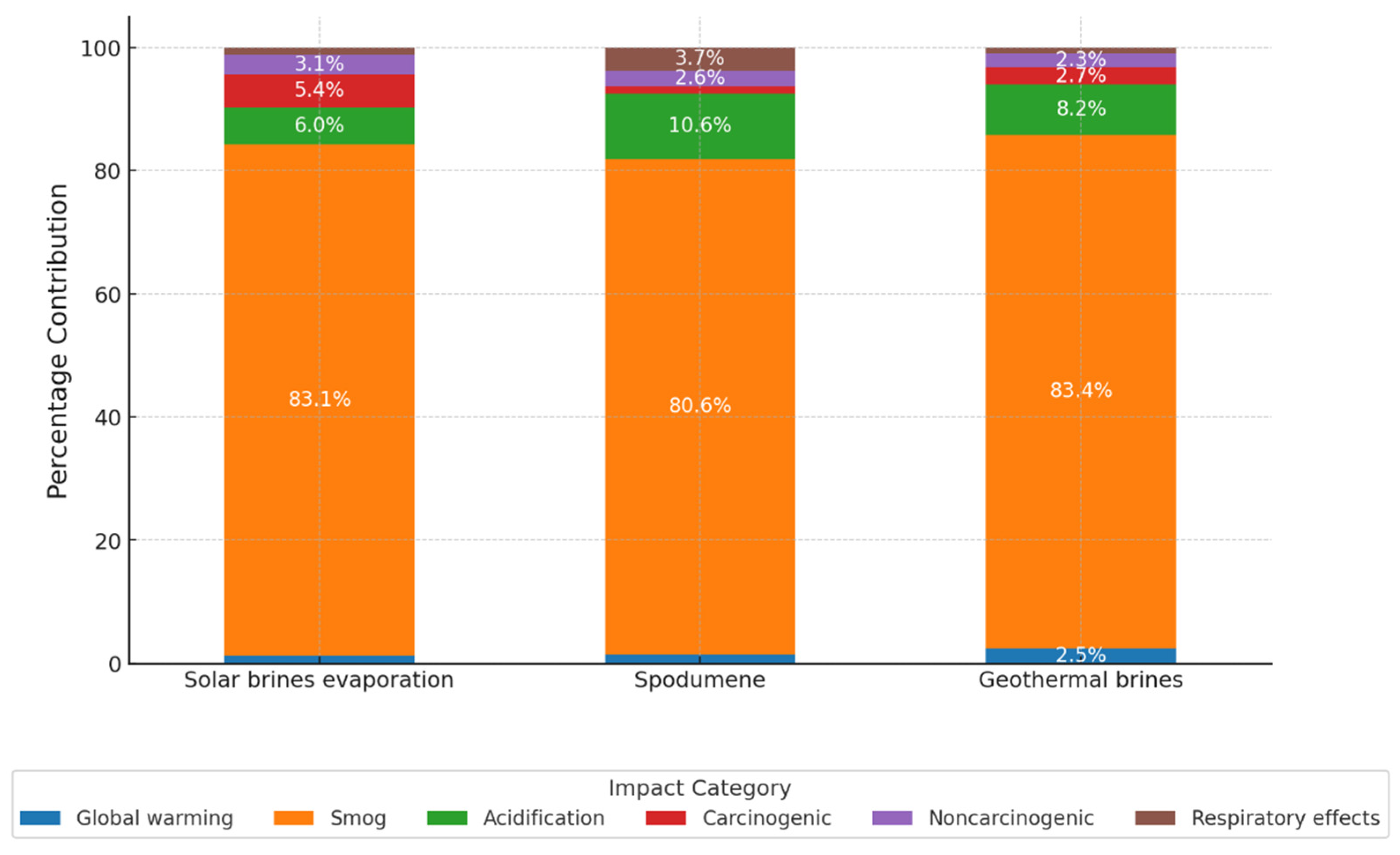
Figure 3 shows the percentage contribution of each monetized impact category to the total external environmental cost for the three lithium extraction pathways.
Figure 3.
Percentage contribution of each environmental impact category to the total monetized environmental external cost for solar brine, spodumene, and geothermal extraction pathways.
Across all pathways, smog formation represents the dominant contributor to total monetized damages. Smog-related impacts account for approximately 83.1% of total external costs for solar brine evaporation, 80.6% for spodumene mining, and 83.4% for geothermal brine recovery. Despite differences in total impact magnitude, the relative importance of smog formation remains consistently high across the extraction routes.
Acidification accounts for a larger share of the total monetized impacts in spodumene mining (10.6%) than in solar brine evaporation (6.0%) or geothermal brine recovery (8.2%). Respiratory effects are most pronounced in spodumene mining, contributing 3.7% of total damages, whereas they remain negligible for the other two pathways.
Toxicity-related categories contribute a smaller share of total monetized impacts across all pathways. For solar brine evaporation, carcinogenic toxicity accounts for 5.4% of total damages, and non-carcinogenic toxicity accounts for 3.1%. Corresponding shares are lower for spodumene mining and geothermal brine recovery, with geothermal pathways exhibiting the smallest relative contribution from toxicity-related impacts.
Global warming accounts for only a small share of the total monetized environmental damage. Even when applying a relatively high social cost of carbon of USD 83 per metric ton of CO2, climate-related damages account for approximately 1% of total external costs for solar brine evaporation and spodumene mining and about 2% for geothermal brine recovery.
Overall, while the absolute magnitude of the monetized damages varies substantially across extraction pathways, the relative contributions of impact categories show consistent dominance of smog formation, with secondary contributions from acidification, respiratory effects, and toxicity, depending on the extraction route.
5. Discussion: Comparison of Midpoint-Based and Monetized Assessments
This section compares the pathway-level and impact-category-level conclusions derived from conventional midpoint-based LCA with those obtained from the monetized LCA presented in this study. The comparison highlights areas of both consistency and divergence and illustrates how valuation frameworks can influence the interpretation of the environmental performance across lithium extraction pathways. To strengthen interpretation, the discussion compares the monetized results primarily with the midpoint-based findings of Huang et al. [14].
5.1. Consistency and Divergence in Overall Pathway Rankings
At the aggregate level, both midpoint-based LCAs and the monetized assessment identify geothermal brine recovery as the lowest-impact pathway for lithium carbonate production. This result reflects the integrated, largely closed-loop nature of geothermal systems, which integrate lithium recovery with existing power infrastructure and avoid energy-intensive thermal processing or open-air evaporation. It is also consistent with Huang et al. [14], who found that geothermal lithium recovery had lower environmental impacts than conventional lithium carbonate production pathways across most midpoint categories. Huang et al. [14] reported impact reductions of 1–95% relative to the conventional LiOH and Li2CO3 production pathways, with geothermal Li2CO3 showing lower global warming impacts than both salar brine and spodumene-based production. The present study extends this midpoint-based comparison by converting selected TRACI 2.1 indicators into monetary external costs, showing that the favorable position of geothermal brine recovery is also reflected under a damage-cost interpretation.
However, because the geothermal pathway in Huang et al. [14] was based on laboratory-scale data, stoichiometric calculations, and scale-up assumptions, the lower monetized external cost estimated for geothermal brine recovery should be interpreted as a comparative indication, rather than as a definitive commercial-scale performance estimate.
In contrast, the relative ranking of solar brine evaporation and spodumene mining differs between midpoint-based and monetized assessments. In midpoint LCAs, solar evaporation often performs more favorably than spodumene mining on indicators such as global warming potential and cumulative energy demand, suggesting that hard-rock mining is the more environmentally intensive option. The monetized results reverse this order, with solar evaporation exhibiting the highest total external cost, followed by spodumene mining.
This divergence reflects the fundamental differences in how midpoint indicators and damage-based valuation weigh environmental burdens. Midpoint indicators emphasize emissions and energy use, whereas monetization accounts for the relative severity of impacts on human health and welfare. As a result, pathways characterized by diffuse or prolonged emissions can appear less impactful under midpoint metrics but incur higher external costs once damages are valued in monetary terms.
5.2. Monetized Impact Contributions Across Extraction Pathways
5.2.1. Solar Evaporation of Brine
Midpoint-based LCAs generally characterize solar evaporation as a low-energy extraction route with moderate impacts across multiple categories. Toxicity-related indicators are present but do not dominate normalized results. In the monetized assessment, however, smog formation emerges as the dominant contributor to external costs, accounting for more than 80% of the total damages, with additional contributions from carcinogenic and non-carcinogenic toxicity.
This shift reflects the high health impacts associated with ozone precursor emissions. Emissions that are relatively modest in quantity can generate substantial monetized damages due to their strong association with premature mortality and morbidity. Consequently, impacts that appear secondary under midpoint normalization become central drivers of external costs once valuation is applied.
5.2.2. Spodumene Mining and Processing
Both midpoint-based and monetized assessments identify spodumene mining as environmentally intensive, but for different dominant reasons. Midpoint results emphasize energy use, greenhouse gas emissions, acidification, and respiratory effects arising from high-temperature calcination and chemical conversion processes. The monetized results reinforce this characterization while revealing a more diverse impact profile than solar evaporation.
Rather than being dominated by a single category, spodumene mining contributes substantially to smog formation, acidification, and respiratory effects. This distribution reflects the role of the combustion-related emissions associated with thermal processing. As a result, spodumene mining incurs significant damages across multiple pathways, even though its total external cost remains lower than that of solar evaporation in the monetized framework.
5.2.3. Geothermal Brine Recovery
Geothermal brine recovery performs best across both midpoint-based and monetized assessments. In midpoint LCAs, this pathway shows lower impacts on climate change, land use, and toxicity than conventional extraction routes. The monetized analysis confirms these advantages and further demonstrates that geothermal systems mitigate both exposure- and combustion-related damage.
Although smog formation remains the dominant category in relative terms, the absolute magnitude of monetized damages is substantially lower than for the other pathways. This outcome reflects the benefits of controlled processing environments, reinjection of spent brines, and reduced reliance on energy-intensive thermal operations. The consistency of geothermal brine recovery’s performance across valuation frameworks highlights the importance of system integration in reducing environmental externalities.
The finding that geothermal brine recovery exhibits the lowest monetized external cost should be interpreted within the scope of the impact categories included in this study. The present monetized framework does not account for water resource consumption, land occupation, or site-specific ecological effects associated with deep-well drilling and reinjection-well construction because compatible damage-cost coefficients for these impacts were unavailable. Accordingly, the analysis does not imply that geothermal brine recovery is universally the lowest-impact option across all environmental dimensions. Rather, it indicates that geothermal brine recovery has the lowest monetized external cost among the six impact categories evaluated here, under the assumptions of the underlying source LCA.
5.3. Interpreting Monetized Environmental Impacts
A comparison between the midpoint indicators reported by Huang et al. [14] and the monetized results reveals important differences in the relative importance of environmental impact categories. In midpoint LCAs, impacts are expressed in physical units, such as kg CO2-equivalent, kg O3-equivalent, kg SO2-equivalent, CTUh, and kg PM2.5-equivalent. These indicators quantify emissions or potential impacts, but they do not directly represent the societal damages associated with those emissions. For example, the midpoint results report a global warming impact of approximately 1.8 kg CO2-equivalent per kg LCE for solar brine evaporation. However, when monetized at a social cost of carbon of USD 83 per ton CO2, climate-related damages account for only about 1–2% of total external environmental costs. In contrast, smog formation, with a midpoint value of approximately 0.17 kg O3-equivalent per kg LCE, accounts for about 80% of total external costs across the pathways. This contrast shows that monetization can substantially change the interpretation of environmental impacts by weighing emissions according to their estimated societal damage costs rather than their physical magnitude alone.
This interpretation differs from the normalized midpoint results reported by Huang et al. [14], where toxicity-related categories, particularly carcinogenic toxicity and ecotoxicity, appeared more prominent. The difference arises because normalization and monetization answer different analytical questions. Normalization scales physical impacts relative to reference values, whereas monetization assigns economic values to estimated damages. Therefore, the present results do not contradict Huang et al. [14]; rather, they show that the relative importance of impact categories can change when the same underlying midpoint results are interpreted through a monetary damage-cost framework. In this study, smog formation becomes the dominant contributor because air-quality-related damages receive relatively high monetary values compared with the selected toxicity categories.
More broadly, this comparison shows that methodological choices can influence both the pathway rankings and perceptions of dominant impact categories. Midpoint indicators emphasize emission quantities and energy use, while monetized assessments place greater weight on impacts that translate into societal damages, particularly those affecting human health and air quality. Consequently, extraction pathways that appear environmentally favorable under energy- or climate-focused metrics may impose higher societal costs when impacts are expressed in monetary terms.
From a decision-making perspective, monetized LCA does not replace conventional midpoint analysis; rather, it complements it by providing additional insight into the societal costs of alternative technologies. By translating environmental burdens into a common monetary metric, monetization enables comparison across impact categories and supports interpretation within an economic decision-making framework.
The economic significance of these results can also be illustrated by comparing the estimated external environmental costs with the market price of lithium carbonate. According to the U.S. Geological Survey, the average contract price of battery-grade lithium carbonate was approximately USD 14 per kg LCE in 2024 [56]. Although lithium prices have exhibited considerable volatility [57], this benchmark provides a useful reference for contextualizing the magnitude of the environmental externalities. Relative to this price level, the estimated external environmental costs—USD 11.85 per kg LCE for solar brine evaporation, USD 9.45 per kg LCE for spodumene mining, and USD 4.11 per kg LCE for geothermal brine recovery—represent a substantial share of the product’s market value.
Incorporating monetary valuation, therefore, enhances the relevance of the LCA results for policy analysis, supply-chain screening, and comparative evaluation of lithium production pathways.
6. Conclusions
This study conducted a comparative monetized LCA of lithium carbonate-equivalent production from three extraction pathways: solar evaporation of brines, hard-rock mining of spodumene, and recovery from geothermal brines. By converting six TRACI 2.1 midpoint impact categories reported in the source LCA into monetary values using a benefit-transfer, damage-cost approach, the analysis provides a consistent basis for comparing the external environmental costs of alternative lithium extraction technologies.
The results show substantial variation in total monetized environmental impacts across pathways. Under the applied assumptions, geothermal brine recovery exhibits the lowest external cost (USD 4.11 per kg LCE), followed by spodumene mining (USD 9.45 per kg LCE) and solar brine evaporation (USD 11.85 per kg LCE). Across all pathways, smog formation accounted for the largest share of monetized damages. In contrast, carcinogenic and non-carcinogenic toxicity contributes a smaller share of the total monetized impacts than that suggested by the normalized midpoint assessments.
Comparison with midpoint-based interpretations demonstrates that monetization can alter both the relative ranking of extraction pathways and the perceived importance of impact categories. While midpoint indicators emphasize energy use and greenhouse gas emissions, the monetized assessment assigns greater weight to air-quality-related health damages. As a result, pathways that perform favorably under energy- or climate-focused metrics may exhibit higher societal costs when impacts are expressed in monetary terms.
Several limitations should be acknowledged. The monetization framework relies on the benefit-transfer coefficients derived primarily from the U.S. damage estimates and assumes linear marginal damages, which may not fully reflect the site-specific exposure conditions or non-linear effects. In addition, the analysis includes only those TRACI midpoint categories for which compatible monetary values are available, implying that the total external costs are likely understated. The system boundary ends at battery-grade lithium carbonate, leaving the plant gate,= and therefore excludes transportation to cathode material production, battery manufacturing, product use, and end-of-life recycling. Accordingly, the findings should be interpreted as comparative estimates of upstream lithium production impacts rather than full life-cycle costs of battery systems. The inclusion of downstream stages could alter the magnitude of total external costs and, in some cases, the relative ranking of pathways, particularly when transport distances, electricity mixes, manufacturing routes, or recycling efficiencies differ substantially. Future research could address these limitations by incorporating region-specific valuation factors, conducting uncertainty analyses, and expanding the analysis to additional life-cycle stages and impact categories as valuation data become available.
These findings show that monetary valuation can add a useful decision-oriented layer to conventional midpoint LCA by translating selected environmental burdens into comparable external cost estimates.
Supplementary Materials
The following supporting information can be downloaded at: https://www.mdpi.com/article/10.3390/resources15050068/s1, Table S1: Monetary value of Impacts.
Author Contributions
A.S.M.I. conducted the formal analysis, investigation, and writing—original draft preparation. S.M. contributed to conceptualization and data curation. R.G.E. provided supervision. All authors have read and agreed to the published version of the manuscript.
Funding
This work was supported by the Critical Materials Innovation Hub, funded by the U.S. Department of Energy, Office of Energy Efficiency and Renewable Energy, Advanced Materials and Manufacturing Technologies Office.
Data Availability Statement
The original contributions presented in this study are included in the article/Supplementary Material. Further inquiries can be directed to the corresponding author.
Conflicts of Interest
The authors declare no conflicts of interest.
Abbreviations
The following abbreviations are used in this manuscript:
| Abbreviation | Full Term |
| ACS | American Chemical Society |
| BenMAP | Benefits Mapping and Analysis Program |
| BenMAP-CE | Environmental Benefits Mapping and Analysis Program—Community Edition |
| CO2 | Carbon dioxide |
| CO2-eq | Carbon dioxide equivalent |
| CTUh | Comparative Toxic Units for humans |
| DALY | Disability-Adjusted Life Year |
| DICE | Dynamic Integrated Climate-Economy model |
| ECI | Environmental Cost Indicator |
| EIA | U.S. Energy Information Administration |
| EPA | U.S. Environmental Protection Agency |
| EPS | Environmental Priority Strategies |
| LCA | Life Cycle Assessment |
| LC-IMPACT | Life Cycle IMPACT |
| LCE | Lithium Carbonate Equivalent |
| MW | Megawatt |
| NOx/NOx | Nitrogen oxides |
| O3 | Ozone |
| O3-eq | Ozone equivalent |
| PAGE | Policy Analysis of the Greenhouse Effect |
| PM | Particulate Matter |
| PM2.5 | Fine particulate matter with diameter ≤ 2.5 µm |
| SCC | Social Cost of Carbon |
| SO2 | Sulfur dioxide |
| TEA | Techno-Economic Analysis |
| TRACI | Tool for the Reduction and Assessment of Chemical and Other Environmental Impacts |
| USLCI | U.S. Life Cycle Inventory database |
| USEtox | UNEP-SETAC toxicity model |
| USD | U.S. dollar |
| VOC | Volatile Organic Compound |
| WTP | Willingness to Pay |
References
- Hund, K.; La Porta, D.; Fabregas, T.P.; Laing, T.; Drexhage, J. Minerals for Climate Action: The Mineral Intensity of a Clean Energy Transition; World Bank: Washington, DC, USA, 2020; Available online: https://energiewende-global.com/wp-content/uploads/2023/05/Minerals_for_Climate_Action_The_Mineral_Intensity_of_a_Clean_Energy_Transition.pdf (accessed on 28 November 2025).
- Veolia Water Technologies. Lithium Processing Capabilities. 2020. Available online: https://www.veoliawatertech.com/sites/g/files/dvc3601/files/document/2020/10/Lithium%20Processing%20Capabilities%20Brochure.pdf (accessed on 28 November 2025).
- Jaskula, B.W. Lithium. In Mineral Commodity Summaries 2026; U.S. Geological Survey: Reston, VA, USA, 2026. Available online: https://pubs.usgs.gov/periodicals/mcs2026/mcs2026-lithium.pdf (accessed on 25 April 2026).
- Habashi, F. Handbook of Extractive Metallurgy; Wiley-VCH: Weinheim, Germany, 1997; Available online: https://ebs.duzce.edu.tr/Uploads/DersMateryal/Handbook-of-extractive-metallurgy.pdf (accessed on 28 November 2025).
- Flexer, V.; Baspineiro, C.F.; Galli, C.I. Lithium recovery from brines: A vital raw material for green energies with a potential environmental impact in its mining and processing. Sci. Total Environ. 2018, 639, 1188–1204. [Google Scholar] [CrossRef] [Scilit]
- U.S. Energy Information Administration (EIA). What Is U.S. Electricity Generation by Energy Source? 2021. Available online: https://www.eia.gov/tools/faqs/faq.php?id=427&t=3 (accessed on 28 November 2025).
- U.S. Energy Information Administration (EIA). Geothermal Resources Used to Produce Renewable Electricity in Western States. 2014. Available online: https://www.eia.gov/todayinenergy/detail.php?id=17871 (accessed on 28 November 2025).
- Luo, Q.; Dong, M.; Li, Q.; Wu, Z.; Liu, Z.; Li, J. Improve the Durability of Lithium Adsorbent Li/Al-LDHs by Fe3+ Substitution and Nanocomposite of FeOOH. Miner. Eng. 2022, 185, 107717. [Google Scholar] [CrossRef] [Scilit]
- Paranthaman, M.P.; Li, L.; Luo, J.; Hoke, T.; Ucar, H.; Moyer, B.A.; Harrison, S. Recovery of lithium from geothermal brine with lithium–aluminum layered double hydroxide chloride sorbents. Environ. Sci. Technol. 2017, 51, 13481–13486. [Google Scholar] [CrossRef] [Scilit] [PubMed]
- Ventura, S.; Bhamidi, S.; Hornbostel, M.; Nagar, A. Selective Recovery of Lithium from Geothermal Brines: Final Project Report; California Energy Commission: Sacramento, CA, USA, 2020. Available online: https://www.energy.ca.gov/sites/default/files/2021-05/CEC-500-2020-020.pdf (accessed on 28 November 2025).
- Neupane, G.; Wendt, D.S. Potential Economic Values of Minerals in Brines of Identified Hydrothermal Systems in the U.S. Idaho National Laboratory. 2017. Available online: https://publications.mygeoenergynow.org/grc/1033849.pdf (accessed on 28 November 2025).
- Bare, J.C. TRACI: The tool for the reduction and assessment of chemical and other environmental impacts. J. Ind. Ecol. 2002, 6, 49–78. [Google Scholar] [CrossRef] [Scilit]
- Bare, J. TRACI 2.0: The tool for the reduction and assessment of chemical and other environmental impacts 2.0. Clean Technol. Environ. Policy 2011, 13, 687–696. [Google Scholar] [CrossRef] [Scilit]
- Huang, T.-Y.; Pérez-Cardona, J.R.; Zhao, F.; Sutherland, J.W.; Paranthaman, M.P. Life cycle assessment and techno-economic assessment of lithium recovery from geothermal brine. ACS Sustain. Chem. Eng. 2021, 9, 6551–6560. [Google Scholar] [CrossRef] [Scilit]
- Kim, J.; Yang, Y.; Bae, J.; Suh, S. The importance of normalization references in interpreting life cycle assessment results. J. Ind. Ecol. 2013, 17, 385–395. [Google Scholar] [CrossRef] [Scilit]
- Prado, V.; Wender, B.A.; Seager, T.P. Interpretation of comparative LCAs: External normalization and a method of mutual differences. Int. J. Life Cycle Assess. 2017, 22, 2018–2029. [Google Scholar] [CrossRef] [Scilit]
- Pizzol, M.; Laurent, A.; Sala, S.; Weidema, B.P.; Verones, F.; Koffler, C. Normalisation and weighting in life cycle assessment: Quo vadis? Int. J. Life Cycle Assess. 2017, 22, 853–866. [Google Scholar] [CrossRef] [Scilit]
- Ryberg, M.; Vieira, M.D.M.; Zgola, M.; Bare, J.; Rosenbaum, R.K. Updated US and Canadian normalization factors for TRACI 2.1. Clean Technol. Environ. Policy 2014, 16, 329–339. [Google Scholar] [CrossRef] [Scilit]
- U.S. Environmental Protection Agency (EPA). Benefits Mapping and Analysis Program (BenMAP), Estimating the Benefit per Ton of Reducing Directly-Emitted PM2.5, PM2.5 Precursors and Ozone Precursors from 21 Sectors. 2023. Available online: https://www.epa.gov/benmap/estimating-benefit-ton-reducing-directly-emitted-pm25-pm25-precursors-and-ozone-precursors (accessed on 28 November 2025).
- U.S. Environmental Protection Agency (EPA). Technical Support Document: Estimating the Benefit per Ton of Reducing Directly-Emitted PM2.5, PM2.5 Precursors and Ozone Precursors from 21 Sectors. 2023. Available online: https://www.epa.gov/system/files/documents/2021-10/source-apportionment-tsd-oct-2021_0.pdf (accessed on 28 November 2025).
- Weaver, M.R.; Joffe, J.; Ciarametaro, M.; Dubois, R.W.; Dunn, A.; Singh, A.; Sparks, G.W.; Stafford, L.; Murray, C.J.L.; Dieleman, J.L. Health care spending effectiveness: Estimates suggest that spending improved US health from 1996 to 2016. Health Aff. 2022, 41, 994–1004. [Google Scholar] [CrossRef] [Scilit] [PubMed]
- Kavanagh, L.; Keohane, J.; Cabellos, G.G.; Lloyd, A.; Cleary, J. Global lithium sources—Industrial use and future in the electric vehicle industry: A review. Resources 2018, 7, 57. [Google Scholar] [CrossRef] [Scilit]
- Peters, J.F.; Weil, M. A critical assessment of the resource depletion potential of current and future lithium-ion batteries. Resources 2016, 5, 46. [Google Scholar] [CrossRef] [Scilit]
- Moreau, V.; Reis, P.C.D.; Vuille, F. Enough metals? Resource constraints to supply a fully renewable energy system. Resources 2019, 8, 29. [Google Scholar] [CrossRef] [Scilit]
- Vega-Muratalla, V.O.; Ramírez-Márquez, C.; Lira-Barragán, L.F.; Ponce-Ortega, J.M. Review of lithium as a strategic resource for electric vehicle battery production: Availability, extraction, and future prospects. Resources 2024, 13, 148. [Google Scholar] [CrossRef] [Scilit]
- Amador, D.R.; Tumini, I. Rules and Recommendations for the Development of a National Database of Construction Materials; Ecómetro Mediciones S.L.: Madrid, Spain, 2021; Available online: https://lifelevels.eu/wp-content/uploads/2021/06/Report-B2_Ecometro-1.pdf (accessed on 28 November 2025).
- Philpott, L.; Partl, H. LCA for Cost Benefit Assessment: A Double-Edged Sword? Available online: https://citeseerx.ist.psu.edu/document?repid=rep1&type=pdf&doi=6ef770f22f1eef89d87ad476a8c30e6ab8ecd4dd (accessed on 28 November 2025).
- Arendt, R.; Bachmann, T.M.; Motoshita, M.; Bach, V.; Finkbeiner, M. Comparison of different monetization methods in LCA: A review. Sustainability 2020, 12, 10493. [Google Scholar] [CrossRef] [Scilit]
- Ecochain. Environmental Cost Indicator: ECI Overview. 2019. Available online: https://ecochain.com/blog/environmental-cost-indicator-eci/ (accessed on 28 November 2025).
- Mandell, S. Carbon emission values in cost benefit analyses. Transp. Policy 2011, 18, 888–892. [Google Scholar] [CrossRef] [Scilit]
- Delft, C.E. Environmental Prices Handbook. 2017. Available online: https://cedelft.eu/wp-content/uploads/sites/2/2021/03/CE_Delft_7N54_Environmental_Prices_Handbook_2017_FINAL.pdf (accessed on 28 November 2025).
- Wang, L.; Watanabe, T.; Xu, Z. Monetization of external costs using lifecycle analysis—A comparative case study of coal-fired and biomass power plants in Northeast China. Energies 2015, 8, 1440–1467. [Google Scholar] [CrossRef] [Scilit]
- Baumgärtner, F.; Letmathe, P. External costs of electricity generation in 27 European countries from 2010–2030: Pathway toward sustainability or business as usual? PLoS ONE 2024, 19, e0294499. [Google Scholar] [CrossRef] [Scilit] [PubMed]
- Nuss, P.; Eckelman, M.J. Life cycle assessment of metals: A scientific synthesis. PLoS ONE 2014, 9, e101298. [Google Scholar] [CrossRef] [Scilit]
- Yokoi, R.; Motoshita, M.; Matsuda, T.; Itsubo, N. Country-specific external costs of abiotic resource use based on user cost model in life cycle impact assessment. Environ. Sci. Technol. 2024, 58, 7849–7859. [Google Scholar] [CrossRef] [Scilit]
- Blair, J.J.A.; Vineyard, N.; Mulvaney, D.; Cantor, A.; Sharbat, A.; Berry, K.; Bartholomew, E.; Ornelas, A.F. Lithium and water: Hydrosocial impacts across the life cycle of energy storage. WIREs Water 2024, 11, e1748. [Google Scholar] [CrossRef] [Scilit]
- Schenker, V.; Pfister, S. Current and future impacts of lithium carbonate from brines: A global regionalized life cycle assessment model. Environ. Sci. Technol. 2025, 59, 6543–6555. [Google Scholar] [CrossRef] [Scilit]
- Istrate, R.; Mas-Fons, A.; Beylot, A.; Northey, S.; Vaidya, K.; Sonnemann, G.; Kleijn, R.; Steubing, B. Decarbonizing lithium-ion battery primary raw materials supply chain. Joule 2024, 8, 2992–3016. [Google Scholar] [CrossRef] [Scilit]
- Iyer, R.K.; Kelly, J.C. Life-cycle analysis of lithium chemical production in the United States. RSC Sustain. 2024, 2, 3929–3945. [Google Scholar] [CrossRef] [Scilit]
- Interagency Working Group on Social Cost of Greenhouse Gases. Technical Support Document: Social Cost of Carbon, Methane, and Nitrous Oxide—Interim Estimates Under Executive Order 13990. 2021. Available online: https://www.energy.gov/sites/default/files/2023-04/57.%20Social%20Cost%20of%20Carbon%202021.pdf (accessed on 28 November 2025).
- U.S. Environmental Protection Agency. BenMAP-CE User’s Manual. 2015. Available online: https://www.epa.gov/sites/default/files/2015-04/documents/benmap-ce_user_manual_march_2015.pdf (accessed on 28 November 2025).
- Tran, T.; Luong, V.T. Lithium production processes. In Lithium Process Chemistry: Resources, Extraction, Batteries and Recycling; Chagnes, A., Światowska, J., Eds.; Elsevier: Amsterdam, The Netherlands, 2015; pp. 81–124. [Google Scholar] [CrossRef] [Scilit]
- Energy, N.S. Piedmont Lithium Project. 2020. Available online: https://www.nsenergybusiness.com/projects/piedmont-lithium-project/ (accessed on 28 November 2025).
- Mining.com. North Carolina County Where Piedmont Plans Lithium Project Temporarily Bans Mining. 2021. Available online: https://www.mining.com/north-carolina-county-where-piedmont-plans-lithium-project-temporarily-bans-mining/ (accessed on 28 November 2025).
- Fantke, P. USEtox® 2.0 Documentation; Version 1.1; USEtox Team: Lyngby, Denmark, 2018; Available online: https://usetox.org/sites/default/files/assets/USEtox_Documentation.pdf (accessed on 28 November 2025).
- Freeman, M.A., III; Herriges, J.A.; Kling, C.L. The Measurement of Environmental and Resource Values: Theory and Methods, 3rd ed.; Taylor & Francis: New York, NY, USA, 2014. [Google Scholar] [CrossRef] [Scilit]
- Nordhaus, W.D. Economic aspects of global warming in a post-Copenhagen environment. Proc. Natl. Acad. Sci. USA 2010, 107, 11721–11726. [Google Scholar] [CrossRef] [Scilit] [PubMed]
- Anthoff, D.; Tol, R.S.J. Erratum to: The uncertainty about the social cost of carbon: A decomposition analysis using FUND. Clim. Change 2013, 121, 413. [Google Scholar] [CrossRef] [Scilit]
- Hope, C. Critical issues for the calculation of the social cost of CO2: Why the estimates from PAGE09 are higher than those from PAGE2002. Clim. Change 2013, 117, 531–543. [Google Scholar] [CrossRef] [Scilit]
- U.S. Environmental Protection Agency (EPA). Report on the Social Cost of Greenhouse Gases: Estimates Incorporating Recent Scientific Advances. 2023. Available online: https://www.epa.gov/system/files/documents/2023-12/epa_scghg_2023_report_final.pdf (accessed on 16 March 2026).
- Chemnick, J.; E&E News. Cost of Carbon Pollution Pegged at $51 a Ton. Scientific American. 2021. Available online: https://www.scientificamerican.com/article/cost-of-carbon-pollution-pegged-at-51-a-ton/ (accessed on 16 March 2026).
- Rennert, K.; Errickson, F.; Prest, B.C.; Rennels, L.; Newell, R.G.; Pizer, W.; Kingdon, C.; Wingenroth, J.; Cooke, R.; Parthum, B.; et al. Comprehensive evidence implies a higher social cost of CO2. Nature 2022, 610, 687–692. [Google Scholar] [CrossRef] [Scilit]
- U.S. Environmental Protection Agency (EPA). Ground-Level Ozone Basics. 2021. Available online: https://www.epa.gov/ground-level-ozone-pollution/ground-level-ozone-basics (accessed on 28 November 2025).
- U.S. Environmental Protection Agency (EPA). Particulate Matter (PM) Basics. 2023. Available online: https://www.epa.gov/pm-pollution/particulate-matter-pm-basics (accessed on 28 November 2025).
- Ashby, F.; Park, H.; Svensson, M.; Heldermon, C.D. Economic burden of Sanfilippo syndrome in the United States. Arch. Public Health 2025, 83, 269. [Google Scholar] [CrossRef] [Scilit] [PubMed]
- Jaskula, B.W. Lithium. In Mineral Commodity Summaries 2025; U.S. Geological Survey: Reston, VA, USA, 2025; pp. 110–111. Available online: https://pubs.usgs.gov/periodicals/mcs2025/mcs2025-lithium.pdf (accessed on 16 March 2026).
- ChemAnalyst. Lithium Carbonate Price Trend and Forecast. 2025. Available online: https://www.chemanalyst.com/Pricing-data/lithium-carbonate-1269 (accessed on 16 March 2026).



Disclaimer/Publisher’s Note: The statements, opinions and data contained in all publications are solely those of the individual author(s) and contributor(s) and not of MDPI and/or the editor(s). MDPI and/or the editor(s) disclaim responsibility for any injury to people or property resulting from any ideas, methods, instructions or products referred to in the content. |
© 2026 by the authors. Licensee MDPI, Basel, Switzerland. This article is an open access article distributed under the terms and conditions of the Creative Commons Attribution (CC BY) license.