


Abstract
Environmental implications of resource dependence remain a central concern for hydrocarbon-based economies undergoing energy transition. Using panel data for GCC countries over 1990–2024 and second-generation econometric techniques that account for cross-sectional dependence and heterogeneity, this study identifies a stable long-run relationship between natural resource rents, renewable energy, and CO2 emissions. The results show that a 1% increase in natural resource rents is linked to a 0.21% rise in CO2 emissions, highlighting the persistence of carbon-intensive economic structures. By contrast, renewable energy is associated with a 0.15% reduction in emissions, although its environmental contribution remains modest. The interaction effect is negative (−0.048) but only partially robust, indicating that renewable energy weakens, but does not fully offset, the environmental pressure associated with resource dependence. These findings suggest that energy transition in GCC economies remains gradual and structurally constrained, requiring not only renewable expansion but also deeper transformation of hydrocarbon-based growth models.
1. Introduction
Natural resource abundance plays a central role in shaping the relationship between economic development and environmental sustainability. In resource-dependent economies, revenues generated from oil, gas, and mineral extraction support economic growth, fiscal stability, and industrial expansion. However, these benefits are often accompanied by significant environmental costs, particularly in economies where production systems remain heavily dependent on fossil fuels and energy-intensive activities. A growing body of empirical literature shows that natural resource rents are frequently associated with higher carbon emissions and environmental degradation [1,2,3]. Although institutional quality, regulatory effectiveness, and technological progress may partially moderate these effects [4,5], resource-dependent economies often remain structurally exposed to carbon-intensive growth patterns.
In response to rising environmental concerns and global decarbonization objectives, renewable energy has emerged as a central component of sustainable development strategies. Renewable energy contributes to environmental improvement by reducing reliance on conventional fossil-fuel-based energy systems and supporting cleaner production processes [6,7]. Existing studies generally report that renewable energy consumption is associated with lower emissions and improved environmental sustainability [8,9]. However, recent evidence suggests that the environmental contribution of renewable energy is conditional rather than uniform. In many resource-dependent economies, renewable energy expansion occurs alongside continued hydrocarbon dominance, limiting the extent to which renewable sources substantially displace fossil-fuel consumption [10,11].
These issues are particularly relevant in the context of Gulf Cooperation Council (GCC) countries, which represent some of the most hydrocarbon-dependent economies in the world. GCC economies are characterized by high natural resource rents, energy-intensive industrial structures, and elevated per capita carbon emissions largely driven by fossil-fuel extraction and consumption [12]. At the same time, GCC countries have increasingly adopted renewable energy and sustainability initiatives as part of broader economic diversification strategies, including Saudi Vision 2030 and related regional transition programs [13]. Recent GCC-focused studies confirm that renewable energy, green financing, and technological progress contribute to environmental improvement, although hydrocarbon dependence continues to exert substantial environmental pressure [10,14,15,16,17]. This coexistence of expanding renewable energy investment and persistent fossil-fuel dependence creates a particularly relevant setting for examining the environmental implications of energy transition in resource-rich economies.
Despite the growing literature on renewable energy transition and environmental sustainability, important gaps remain in the GCC context. Existing studies generally examine either the environmental effects of natural resource rents or the role of renewable energy separately, while limited attention has been devoted to explicitly modeling their interaction within hydrocarbon-dependent economies [10,14,17]. This omission is important because the environmental contribution of renewable energy depends not only on renewable expansion itself, but also on whether it weakens the emissions intensity associated with resource dependence. In addition, several previous studies rely on conventional panel approaches that insufficiently account for cross-sectional dependence and heterogeneous country dynamics despite the strong structural interconnections characterizing GCC economies through oil markets, trade integration, and regional policy coordination [12]. Ignoring these features may generate biased and inconsistent estimates [18,19,20,21].
Against this backdrop, the present study examines the joint and interactive effects of natural resource rents and renewable energy on environmental quality in GCC countries over the period 1990–2024. By explicitly modeling the interaction between resource rents and renewable energy using second-generation panel econometric techniques, the study provides new evidence on the conditional environmental role of renewable energy in hydrocarbon-dependent economies. The analysis contributes to the literature by clarifying whether renewable energy merely coexists with fossil-fuel dependence or whether it effectively moderates the environmental pressure associated with resource rents within the GCC context.
The remainder of the paper is organized as follows. Section 2 reviews the relevant literature and develops the research hypotheses. Section 3 presents the data, variables, and econometric methodology. Section 4 reports the empirical findings, while Section 5 discusses the main results. Section 6 concludes with policy implications, limitations, and directions for future research.
2. Literature Review and Hypotheses Development
2.1. Natural Resource Rents and Environmental Quality
Natural resource rents play a central role in shaping environmental outcomes in resource-dependent economies. In hydrocarbon-based systems, economic activity is often concentrated in extractive and energy-intensive sectors that generate high levels of carbon emissions. This production structure reinforces carbon-intensive growth patterns and limits the transition toward cleaner economic activities. In addition, dependence on resource rents may reduce incentives for economic diversification and technological transformation, particularly when fossil fuels remain dominant within national energy systems.
A large body of empirical literature reports a positive association between natural resource rents and environmental degradation. Ref. [1] finds that higher resource rents increase CO2 emissions in major oil-exporting economies, although institutional quality partially moderates this effect. Similarly, ref. [2] shows that natural resource rents intensify environmental degradation in Sub-Saharan Africa, particularly in highly resource-dependent economies. Focusing on China, ref. [3] reports that resource-driven growth remains environmentally damaging when economic expansion continues to rely on extractive and energy-intensive sectors. In a broader international context, ref. [21] finds that resource-based growth contributes to environmental degradation when cleaner structural transformation remains limited.
Recent evidence further suggests that the environmental consequences of resource rents are conditional on institutional and structural factors. Ref. [4] shows that energy efficiency and institutional conditions influence the environmental effects of natural resource rents in emerging economies, while ref. [5] finds that stronger institutional quality reduces the pollution intensity associated with resource dependence in developing countries. These findings indicate that the environmental implications of resource rents are not uniform across countries and depend partly on regulatory effectiveness, technological development, and economic diversification.
Recent GCC- and Saudi-focused studies reinforce the relevance of these dynamics in hydrocarbon-dependent economies. Ref. [12] highlights the strong interconnection between oil-market dynamics, renewable energy, and CO2 emissions across GCC countries. Similarly, ref. [17] shows that natural resource rents and non-renewable energy consumption contribute significantly to environmental degradation in GCC economies. In the Saudi context, ref. [22] finds that oil and natural gas rents increase carbon intensity, while Mahmood [23] shows that oil rents exert a strong positive effect on CO2 emissions in both the short and long run. These studies confirm that hydrocarbon dependence remains an important structural source of environmental pressure in Gulf economies despite ongoing transition efforts.
Overall, the literature suggests that natural resource rents are more likely to reinforce environmental degradation in economies where fossil-fuel dependence, carbon-intensive production systems, and limited structural diversification persist. This structural configuration remains particularly relevant in GCC countries.
H1.
Natural resource rents are positively associated with environmental degradation in GCC countries.
2.2. Renewable Energy and Environmental Sustainability
Renewable energy plays an important role in improving environmental sustainability by reducing the carbon intensity of economic activity and supporting cleaner production systems. Unlike fossil-fuel-based energy sources, renewable energy contributes primarily through the technique effect, promoting lower-emission technologies, energy efficiency, and long-term decarbonization pathways. However, the environmental contribution of renewable energy depends not only on its expansion, but also on the extent to which it substitutes for conventional fossil-fuel consumption within the energy mix.
A broad empirical literature reports a negative association between renewable energy and environmental degradation. Ref. [6] shows that cleaner energy sources contribute to lower environmental pressure by reducing reliance on carbon-intensive fuels. Similarly, ref. [9] finds that renewable energy supports ecological sustainability in newly industrialized economies, while ref. [7] shows that renewable energy, energy efficiency, and institutional quality jointly contribute to lower CO2 emissions in developed countries. Recent evidence further suggests that the environmental contribution of renewable energy is conditioned by structural and institutional factors. Ref. [11] shows that renewable energy generates stronger environmental gains when the degree of energy transition is sufficiently advanced, while ref. [8] reports that renewable energy improves environmental quality in resource-rich economies, although the magnitude of this effect depends on globalization and energy composition.
Recent GCC-focused studies provide additional evidence on the environmental role of renewable energy transition in hydrocarbon-dependent economies. Ref. [12] shows that renewable energy remains closely interconnected with oil-market dynamics and CO2 emissions across GCC countries, reflecting the continued structural importance of hydrocarbons. More recently, ref. [15] finds that green energy financing contributes to environmental sustainability in GCC economies, although the estimated environmental effect remains relatively modest. In the Saudi context, ref. [16] shows that renewable energy investments and supportive government policies contribute to economic diversification and carbon-emission reduction under Vision 2030 objectives. Similarly, ref. [10] reports that renewable energy and green technology contribute to emission mitigation in GCC countries, although the environmental gains remain constrained by persistent resource dependence.
Despite these advances, the environmental role of renewable energy in GCC economies remains structurally conditioned. Renewable energy expansion continues to coexist with fossil-fuel dominance, energy-intensive production systems, and hydrocarbon-based development models. As a result, renewable energy is expected to improve environmental quality, although its overall contribution may remain moderate unless cleaner energy sources progressively substitute for conventional fossil-fuel consumption.
H2.
Renewable energy consumption is negatively associated with environmental degradation in GCC countries.
2.3. Interaction Between Natural Resource Rents and Renewable Energy
The interaction between natural resource rents and renewable energy reflects the extent to which energy transition contributes to structural transformation in hydrocarbon-dependent economies. Renewable energy can reduce the environmental pressure associated with resource dependence when it substitutes for fossil-fuel-based energy systems. However, when renewable expansion occurs alongside continued hydrocarbon dominance, its environmental contribution may remain limited [8,11]. In GCC economies, this challenge is reinforced by carbon-intensive production structures, subsidized energy systems, and long-standing dependence on oil and gas revenues, all of which slow the transition toward cleaner energy composition.
Recent studies increasingly emphasize the conditional nature of the resource–energy–environment nexus. For example, ref. [20] shows that renewable energy and governance quality jointly contribute to environmental sustainability in resource-rich economies, while ref. [24] finds that renewable energy transition improves environmental quality but remains constrained by structural dependence on conventional energy systems. In the GCC context, ref. [12] shows that oil prices, renewable energy, and CO2 emissions remain strongly interconnected across GCC countries. Similarly, ref. [10] finds that renewable energy and green technology contribute to emission mitigation, although natural resource rents continue to exert environmental pressure. Ref. [14] further confirms the continuing importance of resource dependence during the GCC energy transition process. Using second-generation panel methods, ref. [17] shows that renewable energy reduces emissions, whereas natural resource rents and non-renewable energy consumption increase environmental degradation in GCC countries. More recent evidence also highlights the growing role of green financing and renewable investment. Ref. [15] reports that green energy financing contributes to environmental sustainability in GCC economies, while ref. [16] emphasizes the role of renewable energy investments and government support policies in supporting Saudi Arabia’s diversification and emission-reduction objectives.
Despite these advances, important limitations remain in the existing literature. Several studies examining renewable energy, natural resource rents, and environmental quality mainly focus on the direct effects of these variables separately rather than explicitly modeling their interaction [10,14,15,17]. As a result, limited evidence is available on whether renewable energy weakens the environmental pressure associated with resource dependence in hydrocarbon-dependent GCC economies. In addition, although some recent studies employ advanced panel techniques [17], a large part of the broader literature continues to rely on conventional panel approaches that assume cross-sectional independence and homogeneous slope dynamics [1,2,3,4,5]. Such assumptions may be restrictive in the GCC context due to the strong structural interconnections among GCC countries through oil markets, trade integration, energy-price transmission, and regional policy coordination [12]. Ignoring cross-sectional dependence and heterogeneous country responses may therefore generate biased and inconsistent estimates [18,19,20,25]. By explicitly modeling the interaction between renewable energy and natural resource rents using second-generation panel techniques, the present study provides a more comprehensive assessment of the conditional environmental role of renewable energy in hydrocarbon-dependent economies.
H3.
Renewable energy attenuates the positive association between natural resource rents and environmental degradation in GCC countries.
Building on the preceding theoretical and empirical discussion, the present study examines the joint and interactive effects of natural resource rents and renewable energy on environmental quality in GCC countries using second-generation panel techniques that account for cross-sectional dependence and heterogeneous country dynamics.
The next section presents the data, variable definitions, and econometric methodology used to test the proposed relationships.
3. Data and Methodology
This section outlines the empirical framework used to examine the relationship between natural resource rents, renewable energy, and environmental quality in GCC countries. The analysis proceeds through a sequence of econometric steps designed to ensure robustness and reliability. It begins with preliminary diagnostics, including descriptive statistics and correlation analysis, followed by tests for cross-sectional dependence to account for potential interdependencies across countries. Given the presence of such dependence, second-generation panel unit root tests are employed to determine the stationarity properties of the variables. The existence of a long-run equilibrium relationship is then assessed using panel cointegration techniques. Conditional on cointegration, long-run coefficients are estimated using the Common Correlated Effects Mean Group (CCE-MG) estimator, which accommodates heterogeneity and unobserved common factors. The baseline results are complemented by an interaction model to evaluate the moderating role of renewable energy. Finally, a series of robustness checks, including alternative measures, estimation techniques, lagged specifications, and sensitivity analysis, are conducted to validate the stability of the findings.
3.1. Data and Sample
This study employs an unbalanced panel dataset covering the period 1990–2024 for the Gulf Cooperation Council (GCC) countries, namely Saudi Arabia, United Arab Emirates, Qatar, Kuwait, Oman, and Bahrain. These countries provide an appropriate empirical setting due to their high dependence on hydrocarbon resources and their increasing commitment to energy transition and environmental sustainability.
All variables are obtained from the World Bank World Development Indicators (WDI) database, ensuring consistency, comparability, and reliability across countries and over time. The choice of the sample period is motivated by data availability and the need to capture both the pre-transition and recent phases of renewable energy development in the GCC region.
Environmental quality is proxied by carbon dioxide (CO2) emissions per capita. Natural resource dependence is measured by total natural resource rents as a percentage of gross domestic product. Renewable energy is captured by the share of renewable energy consumption in total final energy use. A set of control variables commonly used in the environmental and resource economics literature is included to account for other determinants of environmental degradation. These include economic development (GDP per capita), energy consumption, trade openness, and urbanization. Table 1 summarizes the variables employed in the empirical analysis and their corresponding operational specifications.

Table 1.
Definition, measurement, and classification of variables.
All variables are transformed into natural logarithms where appropriate to reduce heteroskedasticity, improve comparability across variables measured on different scales, and facilitate elasticity-based interpretation of coefficients. For ratio and proportional variables, such as renewable energy share, trade openness, and urbanization, logarithmic transformation is also useful because it reduces skewness in bounded distributions and allows estimated coefficients to be interpreted as proportional responses rather than absolute changes.
3.2. Data Construction and Sample Composition
All variables are obtained from the World Bank’s World Development Indicators (WDI) and compiled into a country-year panel covering Bahrain, Kuwait, Oman, Qatar, Saudi Arabia, and the United Arab Emirates over the period 1990–2024. The sample period ends in 2024 because complete harmonized observations for the core variables were available only up to that year at the time of data extraction, while 2025 coverage remained incomplete across several indicators. Variables are transformed into natural logarithms to improve comparability and reduce skewness, while the interaction term is constructed from the logged measures of natural resource rents and renewable energy consumption. The relatively small final sample mainly reflects limited early-period availability of renewable energy data across several GCC countries, together with incomplete terminal-year coverage for some indicators. More specifically, missing observations are concentrated primarily in the earlier years of the sample (mainly during the 1990s and early 2000s), particularly for Bahrain, Qatar, and the United Arab Emirates, where renewable energy reporting was initially limited, while some isolated terminal-year gaps remain for selected indicators in 2024 across a few countries. As a result, the final estimation sample consists of 135 country-year observations in an unbalanced panel. For 2024, only officially reported observations available in the World Bank database were retained; no extrapolated, interpolated values were introduced where data were missing. This conservative approach was preferred over interpolation-based methods because the small-country macro-panel structure of the GCC, together with structural shifts in energy transition patterns, makes imputed values potentially distortive for long-run parameter estimation. Missing observations are otherwise handled conservatively, with incomplete country-year observations excluded from the estimation sample. The empirical analysis is implemented using STATA and EVIEWS10 following standard procedures for second-generation panel estimation. Table 2 presents the country-level distribution of observations in the final panel sample.
Table 2.
Country level distribution table.
3.3. Model Specification
To examine the relationship between natural resource rents, renewable energy, and environmental quality, the following baseline panel model is estimated:
where
- •
- denotes carbon emissions per capita for country at time ;
- •
- represents natural resource rents;
- •
- denotes renewable energy consumption;
- •
- is a vector of control variables;
- •
- captures country-specific fixed effects;
- •
- denotes time-specific effects;
- •
- is the error term.
To investigate whether renewable energy mitigates the environmental impact of resource dependence, the model is extended to include an interaction term:
The coefficient on the interaction term captures the moderating effect of renewable energy on the relationship between resource rents and environmental degradation. A negative and statistically significant coefficient would indicate that renewable energy weakens the adverse environmental impact of natural resource dependence.
3.4. Econometric Strategy
Given the panel structure of the data and the potential presence of cross-sectional dependence among GCC countries, the empirical analysis follows a sequence of econometric steps consistent with the recent literature. First, cross-sectional dependence is assessed using diagnostic tests following the approach of [18], which is particularly relevant for macro-panel data where countries may be exposed to common shocks such as oil price fluctuations and global economic conditions. Second, the stationarity properties of the variables are examined using second-generation panel unit root tests that account for cross-sectional dependence, such as the cross-sectionally augmented IPS (CIPS) test proposed by [20]. Third, the existence of a long-run relationship among the variables is tested using panel cointegration techniques, specifically the error-correction-based approach proposed by [25]. Establishing cointegration ensures that the estimated relationships are not spurious and that a stable long-run equilibrium exists between environmental quality, resource rents, and renewable energy.
Finally, the long-run coefficients are estimated using panel estimators that account for cross-sectional dependence and heterogeneity. In particular, the Common Correlated Effects Mean Group (CCE-MG) estimator proposed by [19] is employed. Although the GCC sample comprises only six cross-sectional units, its relatively long time dimension (1990–2024) makes it appropriately characterized as a small-N, long-T macro panel. In such settings, second-generation panel methods remain suitable because they explicitly accommodate heterogeneous country responses, cross-sectional dependence, and unobserved common shocks—features that are theoretically consistent with GCC economies given their shared exposure to hydrocarbon markets, regional policy coordination, and global macroeconomic conditions. To strengthen inference, the baseline CCE-MG estimates are complemented by alternative estimators, lagged specifications, leave-one-out sensitivity analysis, and country-specific heterogeneity analysis.
To ensure robustness, the analysis is complemented by alternative estimators and diagnostic checks. Standard errors are adjusted for heteroskedasticity and serial correlation, and the validity of the model specification is verified through appropriate diagnostic tests. In addition, multicollinearity is assessed using variance inflation factors (VIF) to ensure the stability of the estimated coefficients.
3.5. Causal Interpretation and Endogeneity Considerations
While the econometric framework adopted in this study is designed to estimate robust long-run relationships under cross-sectional dependence and heterogeneous slope coefficients, the estimated coefficients should be interpreted as conditional long-run associations rather than strict causal effects. The observational nature of macro-panel data introduces potential endogeneity concerns, including reverse causality, omitted variable bias, and simultaneity among environmental quality, economic activity, resource dependence, and energy transition dynamics.
Several steps are taken to mitigate these concerns. First, the inclusion of country fixed effects controls for time-invariant unobserved heterogeneity across GCC economies, while time effects capture common shocks affecting all countries simultaneously. Second, the CCE-MG estimator accounts for unobserved common factors that may jointly influence the variables of interest. Third, lagged explanatory specifications are employed as a robustness exercise to reduce concerns related to contemporaneous feedback effects. In addition, the consistency of coefficient signs and magnitudes across alternative estimators and sensitivity analyses provides supplementary evidence that the main associations are not driven by a single estimation strategy.
Nevertheless, these approaches do not fully establish causal identification in the absence of external instruments, quasi-experimental variation, or natural experiments. Consequently, the results should be interpreted as evidence of systematic long-run associations consistent with the proposed theoretical framework, rather than definitive causal relationships. Future research using institutional indicators or causal identification strategies, including instrumental-variable or quasi-experimental designs, would help isolate the transmission channels linking resource dependence, renewable transition, and environmental quality.
4. Empirical Results
4.1. Summary Statistics and Preliminary Insights
Table 3 reports descriptive statistics for the underlying variables in their original units prior to logarithmic transformation, providing preliminary insight into their distribution and structural characteristics across GCC countries.
Table 3.
Descriptive statistics.
The descriptive statistics in Table 3 highlight key structural features of GCC economies. Carbon emissions average 16.2 metric tons per capita, with values reaching 28.4 metric tons, reflecting the carbon-intensive nature of economic activity in the region. Natural resource rents are both substantial and widely dispersed (mean = 32.5%; range = 10.2–65.3%), indicating heterogeneous levels of resource dependence across countries. Renewable energy remains limited, with an average share of 6.4% and a minimum of 1.2%, although its variability suggests a gradual but uneven transition toward cleaner energy sources. GDP per capita shows relatively low dispersion (mean = 10.4), consistent with the generally high income levels observed across GCC economies. By contrast, energy consumption and trade openness exhibit greater variation, with trade ranging from 45.2% to 160.3% of GDP, reflecting differences in economic structure, openness, and external integration across countries. Urbanization remains uniformly high (mean = 84.6%), confirming the predominantly urban character of GCC economies. Taken together, these descriptive statistics indicate that GCC economies are characterized by high emissions, strong but uneven resource dependence, and still limited renewable energy adoption, thereby providing a relevant empirical context for the subsequent analysis.
These descriptive patterns also reinforce the structural interpretation of GCC economies. The coexistence of high carbon emissions and substantial natural resource rents reflects the continued dominance of hydrocarbon-based production systems, while the relatively low share of renewable energy suggests that clean energy remains limited relative to conventional energy use. This imbalance provides an early indication that renewable energy may improve environmental performance, although its aggregate moderating influence is likely to remain constrained unless renewable penetration expands substantially.
4.2. Correlation Analysis
Table 4 presents the pairwise correlation matrix, offering preliminary insights into the relationships among variables and potential multicollinearity issues.
Table 4.
Pairwise correlations.
The correlation matrix in Table 4 is consistent with theoretical expectations. CO2 emissions are positively correlated with natural resource rents (0.62) and energy consumption (0.71), while negatively associated with renewable energy (−0.48). Resource rents are also negatively related to renewable energy (−0.35), suggesting potential constraints on energy transition. GDP per capita shows a positive correlation with emissions (0.55), reflecting the scale effect. While pairwise correlations remain moderate, a formal assessment of multicollinearity is conducted using variance inflation factors (VIF), as reported in the following subsection.
4.3. Multicollinearity Diagnostics
This subsection assesses the presence of multicollinearity among the explanatory variables to ensure the reliability and stability of the estimated coefficients.
Table 5 reports the results of the variance inflation factor (VIF) test used to assess potential multicollinearity among the explanatory variables. The VIF values range between 1.88 and 3.76, which are well below the commonly accepted threshold of 10, indicating that multicollinearity is not a serious concern in the model. The interaction term exhibits a slightly higher VIF, as expected, but remains within acceptable limits. Overall, the results confirm the reliability of the estimated coefficients.
Table 5.
Variance Inflation Factor (VIF) results.
4.4. Cross-Sectional Dependence Assessment
Given the strong economic and structural linkages among GCC countries, particularly through oil markets and regional policy coordination, it is essential to test for cross-sectional dependence before proceeding with panel estimations.
The results of the cross-sectional dependence (CD) test reported in Table 6 strongly reject the null hypothesis of cross-sectional independence for all variables. The CD statistics are large and statistically significant at the 1% level, ranging from 3.95 for TRADE to 7.03 for GDPPC, indicating a high degree of interdependence across GCC countries. This finding reflects the presence of common shocks and shared structural characteristics, particularly related to oil price fluctuations, regional economic integration, and coordinated policy frameworks. The strong cross-sectional dependence observed across all variables justifies the use of second-generation panel econometric techniques, such as the CIPS unit root test and the CCE-MG estimator, which explicitly account for cross-sectional correlations and unobserved common factors.
Table 6.
Cross-sectional dependence (CD) test.
Given the strong evidence of cross-sectional dependence, second-generation panel unit root tests are employed to appropriately assess the stationarity properties of the variables.
4.5. Panel Unit Root Test (CIPS)
To determine the stationarity properties of the variables, the cross-sectionally augmented IPS (CIPS) test is employed. Table 7 reports the results of the CIPS panel unit root test for the study variables.
Table 7.
CIPS unit root test.
The CIPS test results show that all variables are non-stationary in levels but become stationary after first differencing, indicating that they are integrated of order one, I(1), and suitable for panel cointegration analysis. Given that all variables are integrated of order one, the next step is to examine whether a long-run equilibrium relationship exists among them using panel cointegration techniques.
4.6. Panel Cointegration Test
To examine the existence of a long-run equilibrium relationship among the variables, the [25] cointegration test is applied. The corresponding test results are reported in Table 8.
Table 8.
Westerlund cointegration test.
The results of the Westerlund cointegration test strongly reject the null hypothesis of no cointegration across all test statistics. This provides robust evidence of a stable long-run relationship between environmental quality, natural resource rents, renewable energy, and the control variables in GCC countries.
Having established the presence of a long-run equilibrium relationship, the next step is to estimate the long-run coefficients using appropriate panel estimators that account for cross-sectional dependence and heterogeneity.
4.7. Baseline Results
Table 9 reports the baseline regression results estimated using the CCE-MG estimator, providing evidence on the long-run relationships between natural resource rents, renewable energy, and environmental quality in GCC countries.
Table 9.
Baseline regression results (CCE-MG).
The baseline regression results reported in Table 9 provide strong support for the main hypotheses. Natural resource rents (RENT) exhibit a positive and statistically significant coefficient (0.215, p < 0.01), indicating that higher resource dependence is associated with increased CO2 emissions. This finding supports H1, suggesting that hydrocarbon-based economic structures continue to exert upward pressure on environmental degradation in GCC countries. Renewable energy (REN) shows a negative and significant effect (−0.148, p < 0.01), implying that greater reliance on renewable energy is associated with lower emissions. These findings are economically meaningful, indicating that a 10% increase in renewable energy is associated with approximately a 1.5% reduction in CO2 emissions. This result supports H2, although the magnitude indicates a relatively moderate mitigating effect, consistent with the still limited share of renewables in the regional energy mix. Among the control variables, energy consumption (ENERGY) emerges as the most influential factor, with a large positive coefficient (0.472, p < 0.01), confirming the dominant role of fossil fuel-based energy use in driving emissions. GDP per capita (GDPPC) also has a positive and significant effect (0.326, p < 0.01), reflecting the scale effect whereby economic expansion is related to higher environmental pressure. Trade openness (0.058, p < 0.05) and urbanization (0.091, p < 0.05) further contribute positively to emissions, although their effects are more moderate.
In elasticity terms, the estimated coefficients are economically meaningful. A 10% increase in natural resource rents is associated with approximately a 2.2% increase in CO2 emissions, whereas a comparable increase in renewable energy is associated with roughly a 1.5% reduction in emissions. By contrast, a 10% increase in energy consumption is associated with nearly a 4.7% increase in emissions, making conventional energy intensity the dominant environmental correlate in the GCC sample. This relative magnitude highlights that the environmental association of hydrocarbon dependence remains substantially stronger than the mitigating association linked to renewable energy deployment.
The evidence suggests that although renewable energy is negatively associated with emissions, GCC economies remain structurally dependent on carbon-intensive growth patterns.
4.8. Interaction Effects Between Resource Rents and Renewable Energy
Table 10 reports the interaction model results estimated using the CCE-MG approach, enabling an explicit examination of the moderating role of renewable energy in the relationship between natural resource rents and CO2 emissions in GCC countries.
Table 10.
The interaction model results.
The interaction model results reported in Table 10 provide evidence on the moderating role of renewable energy in the relationship between natural resource rents and environmental degradation. The coefficient on the interaction term (RENT × REN) is negative and statistically significant (−0.048, p < 0.05), indicating that greater renewable energy penetration is associated with a weaker positive relationship between natural resource rents and CO2 emissions. This finding is consistent with H3, suggesting that renewable energy partially moderates the environmental pressure associated with resource dependence in GCC countries.
At the same time, the direct effect of natural resource rents remains positive and statistically significant (0.268, p < 0.01), while renewable energy continues to exhibit a negative and significant coefficient (−0.192, p < 0.01), confirming the stability of the baseline results. The interaction coefficient further implies that the positive emissions association of natural resource rents weakens progressively as renewable energy penetration increases. However, because the magnitude of the interaction term (−0.048) remains substantially smaller than the direct positive coefficient on resource rents (0.268), this moderating relationship should be interpreted as partial attenuation rather than full environmental offset. In quantitative terms, renewable energy appears to moderate, but not fundamentally reverse, the environmental pressure associated with hydrocarbon dependence.
Among the control variables, energy consumption remains the strongest positive correlate of emissions (0.458, p < 0.01), reinforcing the central role of fossil-fuel-based energy use in shaping environmental outcomes in the GCC. GDP per capita (0.301, p < 0.01), trade openness (0.051, p < 0.05), and urbanization (0.087, p < 0.05) also maintain positive and statistically significant associations with CO2 emissions, suggesting that economic expansion and structural development continue to operate within a largely carbon-intensive production framework.
These results indicate that higher renewable energy use is associated with a weaker positive relationship between natural resource rents and CO2 emissions in GCC economies. Nevertheless, because the interaction effect becomes only weakly significant in several robustness specifications, its moderating role should be interpreted as moderate in magnitude and only partially robust, rather than as evidence of a strong structural substitution away from fossil-fuel dependence.
4.9. Marginal Effect Analysis of Resource Rents Across Renewable Energy Levels
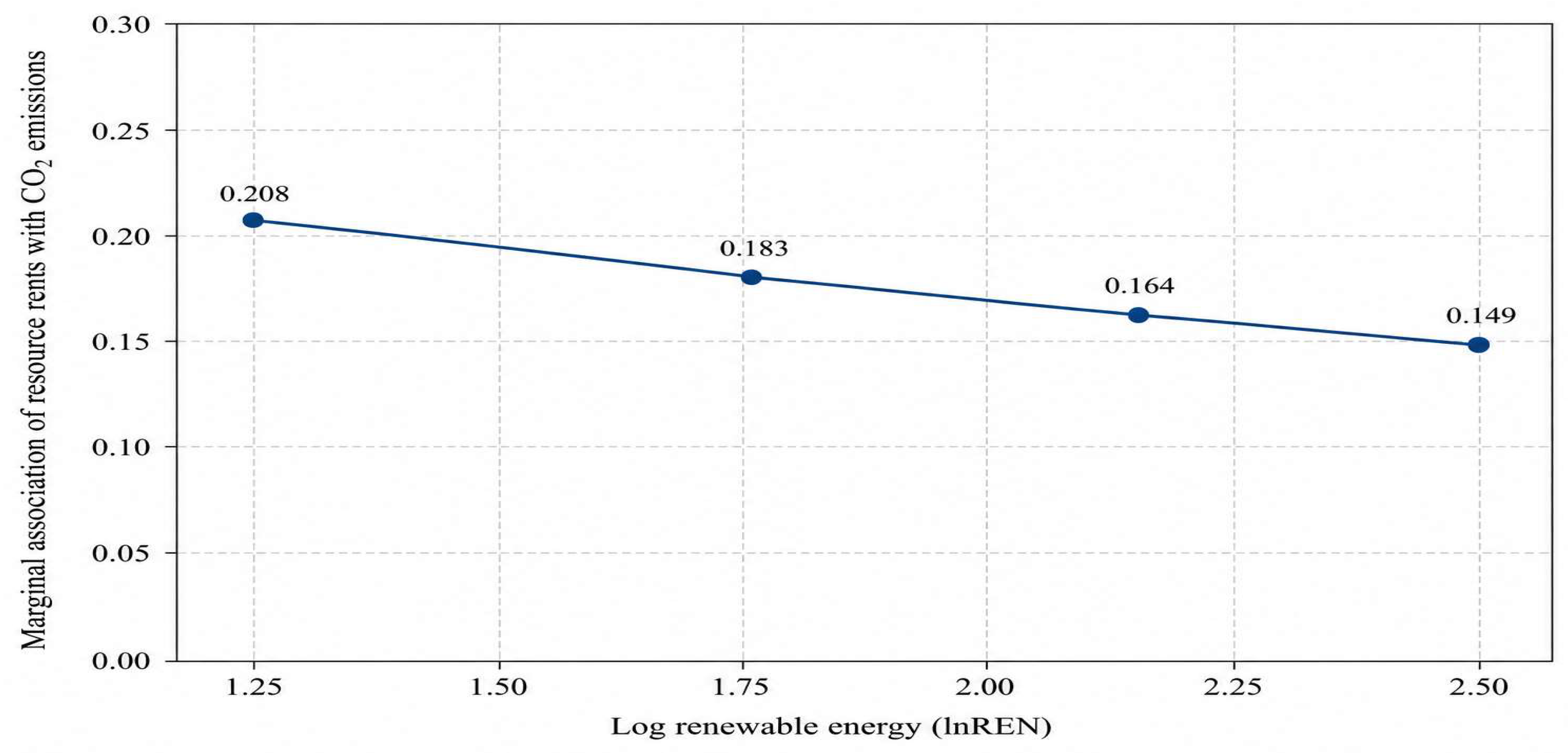
To provide a clearer interpretation of the interaction term, the marginal association between natural resource rents and CO2 emissions is evaluated across different levels of renewable energy consumption. Because the coefficient on the interaction term is negative, the strength of the positive relationship between resource rents and emissions is expected to vary with renewable energy penetration. Estimating these conditional marginal associations allows for a more direct assessment of the economic significance of the moderating relationship identified in the interaction model.
Table 11 presents the estimated marginal association between natural resource rents and CO2 emissions at representative renewable energy levels corresponding to selected percentiles of the observed distribution.
Table 11.
Marginal effect of natural resource rents on CO2 emissions across renewable energy levels (log scale).
Table 11 shows that the positive association between natural resource rents and CO2 emissions declines gradually as renewable energy penetration increases. At low renewable energy levels, the estimated marginal association remains relatively strong (0.208). As renewable energy rises toward higher observed levels, the association weakens progressively, declining to 0.149 at very high renewable penetration. Importantly, the marginal association remains positive throughout the observed range, indicating that renewable energy attenuates, but does not fully offset, the environmental pressure associated with resource dependence. This pattern supports the interpretation of renewable energy as a partial mitigating factor rather than a full structural substitute for hydrocarbon dependence in GCC economies.
Figure 1 illustrates a clear downward-sloping marginal relationship, indicating that higher renewable energy penetration is associated with a progressively weaker positive association between natural resource rents and CO2 emissions. However, the estimated marginal association remains positive across the observed range, indicating attenuation rather than reversal of the environmental pressure associated with resource dependence. This pattern suggests that renewable energy currently acts as a partial mitigating force rather than a full structural substitute for hydrocarbon-based energy systems in GCC economies.
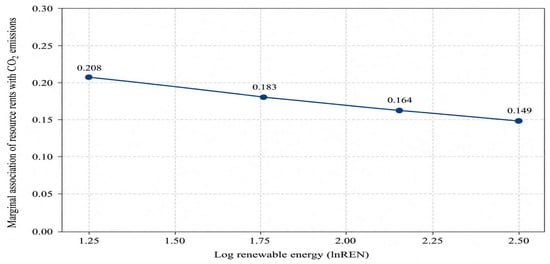
Figure 1.
Marginal association between natural resource rents and CO2 emissions across renewable energy levels.
4.10. Country-Specific Heterogeneity
To explore whether the estimated relationships differ across GCC economies, country-specific long-run coefficients are extracted from the heterogeneous components of the CCE-MG estimator. This analysis provides additional insight into the extent to which the resource–energy–environment nexus varies according to national energy structures and transition progress.
Table 12 reveals meaningful cross-country heterogeneity in the estimated long-run relationships. The positive association between natural resource rents and CO2 emissions is observed across all GCC countries, although its magnitude is stronger in Qatar (0.302) and Saudi Arabia (0.284), reflecting their greater hydrocarbon dependence. Renewable energy is negatively associated with emissions in all countries, with the strongest relationship observed in Oman (−0.176) and the United Arab Emirates (−0.169), where renewable deployment has expanded more rapidly. The interaction term remains negative across countries but is statistically stronger in Oman, the UAE, and Bahrain, suggesting that the moderating role of renewable energy is more pronounced in economies that have advanced further in energy diversification. Overall, these findings reinforce the presence of regional commonalities while highlighting important country-level differences in the strength of the estimated relationships.
Table 12.
Country-specific long-run coefficient estimates.
Cross-country differences are informative. For example, the coefficient on resource rents is nearly 47% larger in Qatar (0.302) than in Bahrain (0.205), indicating materially stronger environmental sensitivity to resource dependence in the most hydrocarbon-intensive economies. Similarly, the interaction effect is statistically stronger in Oman and the United Arab Emirates, suggesting that renewable deployment is associated with relatively greater environmental moderation in countries that have progressed further in energy diversification. These cross-country differences likely reflect variation in hydrocarbon dependence, the pace of renewable deployment, and national diversification strategies across GCC economies, indicating that the environmental role of renewable energy is shaped by country-specific transition pathways rather than a uniform regional pattern.
4.11. Robustness Checks
To assess the stability and reliability of the baseline findings, a series of robustness checks are conducted using alternative variable definitions, estimation techniques, and model specifications. Specifically, the analysis is extended by employing an alternative measure of environmental degradation, applying a different panel estimator, incorporating lagged explanatory variables to address potential endogeneity concerns, and performing a leave-one-out sensitivity analysis. These approaches allow for a comprehensive evaluation of whether the main results are sensitive to modeling choices or sample composition.
4.11.1. Alternative Measure of Environmental Degradation
As a first robustness check, the baseline and interaction models are re-estimated using carbon intensity (CO2 emissions per unit of GDP) as an alternative proxy for environmental degradation. This indicator captures the emissions efficiency of economic activity and provides a complementary perspective to per capita emissions.
The results in Table 13 confirm the robustness of the baseline findings. Natural resource rents remain positively associated with environmental degradation, while renewable energy retains a negative effect, and the interaction term remains negative and significant, supporting H3. Overall, the findings are not sensitive to the alternative environmental indicator.
Table 13.
Robustness 1: carbon intensity (dependent variable).
4.11.2. Alternative Estimation Technique
To verify that the results are not driven by the choice of estimation method, the models are re-estimated using the Augmented Mean Group (AMG) estimator, which, like the CCE-MG estimator, accounts for cross-sectional dependence and heterogeneous slope coefficients across countries. Table 14 reports the results of the AMG estimator.
Table 14.
Robustness 2: AMG estimator.
The AMG results confirm the robustness of the baseline findings. Natural resource rents remain positively associated with emissions (0.231, p < 0.01), while renewable energy retains a negative effect (−0.171, p < 0.01). The interaction term remains negative (−0.051) but only weakly significant (p = 0.091), indicating a less robust moderating effect. Overall, the results are consistent across estimation techniques.
4.11.3. Lagged Explanatory Variables
To address potential concerns related to simultaneity and reverse causality, the model is re-estimated using one-period lagged explanatory variables, including lagged natural resource rents, lagged renewable energy consumption, and their interaction term.The corresponding robustness estimation results are reported in Table 15.
Table 15.
Robustness 3: lagged variables.
The results using lagged explanatory variables confirm the robustness of the baseline findings. Lagged natural resource rents remain positively associated with emissions (0.204, p < 0.01), while lagged renewable energy retains a negative and significant effect (−0.139, p < 0.01). The interaction term remains negative (−0.041) but only weakly significant (p = 0.077), indicating a less robust moderating effect. Overall, the consistency of the coefficients suggests that the results are not driven by short-run simultaneity or reverse causality.
4.11.4. Leave-One-Out Country Analysis
Given the small number of GCC countries included in the sample, a leave-one-out sensitivity analysis is conducted to assess whether the baseline findings are driven by any single country. The model is re-estimated six times, each time excluding one GCC country from the sample. This procedure provides a useful check on coefficient stability and sample sensitivity. The results of the leave-one-out sensitivity analysis are presented in Table 16.
Table 16.
Robustness 4: leave-one-out country analysis.
The leave-one-out results indicate that the main coefficients remain stable across country-exclusion specifications. The coefficient of natural resource rents remains positive, ranging from 0.207 to 0.234, while renewable energy remains negatively associated with CO2 emissions, with coefficients ranging from −0.144 to −0.158. These results suggest that the direct effects of resource rents and renewable energy are not driven by any single GCC country. The interaction term remains negative across all specifications, indicating directional stability. However, its statistical significance weakens under alternative estimators and lagged specifications, suggesting that the moderating role of renewable energy is only partially robust and should therefore be interpreted cautiously.
Taken together, the robustness checks reveal a clear pattern. The direct association of natural resource rents with emissions and the negative association of renewable energy remain stable in sign, magnitude, and significance across all alternative specifications, indicating strong coefficient stability. By contrast, the interaction term remains consistently negative but exhibits weaker statistical precision, suggesting that its directional interpretation is robust, while its magnitude should be treated with greater caution. This distinction is important because it indicates strong evidence for the direct effects, but only moderate evidence for the moderating mechanism.
5. Discussion
The findings highlight the structural nature of the environmental transition challenge in GCC economies. Although renewable energy is associated with lower emissions, hydrocarbon dependence remains strongly linked to carbon-intensive economic activity, indicating that the current transition process remains gradual rather than transformative. The results further show that renewable energy weakens, but does not fully offset, the environmental pressure associated with natural resource rents, reflecting the continued dominance of fossil fuels within GCC energy systems.
The positive association between natural resource rents and CO2 emissions is consistent with a large body of literature showing that resource-dependent economies often remain locked into carbon-intensive development patterns. Ref. [1] reports that higher natural resource rents increase emissions in major oil-exporting economies, while ref. [2] finds similar evidence for highly resource-dependent African economies. Likewise, ref. [3] show that resource-driven growth in China remains environmentally costly when structural diversification and cleaner technological transformation remain limited. The present findings are also consistent with recent Saudi-focused evidence provided by [22,23], who shows that oil and natural gas rents significantly increase carbon intensity and CO2 emissions in Saudi Arabia. Together, these findings reinforce the view that hydrocarbon dependence continues to generate substantial environmental pressure in economies where fossil fuels remain central to production systems, export structures, and fiscal revenues.
At the same time, the GCC evidence reveals important structural specificities. GCC economies combine high hydrocarbon dependence with energy-intensive industrial structures concentrated in petrochemicals, electricity generation, desalination, and transport activities. Historically subsidized domestic energy prices have also encouraged fossil-fuel consumption and slowed the substitution toward cleaner energy systems. These structural conditions help explain why the environmental association of natural resource rents remains particularly strong in the GCC context despite ongoing diversification initiatives and renewable energy investment programs.
The negative association between renewable energy and emissions is consistent with studies emphasizing the environmental benefits of cleaner energy transition. Refs. [6,7, 9] report that renewable energy contributes to lower emissions and improved environmental sustainability. More recent evidence from [8] and [11] further suggests that the environmental contribution of renewable energy depends on structural conditions and the depth of the energy transition process. The present findings are also aligned with recent GCC-related evidence. Ref. [10] show that renewable energy and green technological progress contribute to emission mitigation in GCC countries, while Jaboob [15] reports that green energy financing supports environmental sustainability in GCC economies. Similarly, ref. [16] show that renewable energy investment and government support policies contribute to emission reduction and economic diversification in Saudi Arabia.
However, the estimated environmental effect of renewable energy remains moderate relative to the stronger positive association observed for natural resource rents and energy consumption. This result suggests that renewable energy expansion in GCC countries still coexists with substantial fossil-fuel dependence rather than fully replacing conventional energy systems. Large-scale hydrocarbon production, persistent domestic fossil-fuel consumption, and the relatively limited share of renewables within the regional energy mix continue to constrain the overall environmental impact of renewable deployment. In this sense, the GCC energy transition currently reflects gradual diversification rather than deep structural decarbonization.
The interaction analysis provides additional insight into this transition process. The negative interaction coefficient indicates that renewable energy weakens the positive relationship between natural resource rents and emissions, suggesting that renewable deployment partially mitigates the environmental pressure associated with hydrocarbon dependence. This finding is consistent with [26], who show that renewable energy and governance quality jointly improve environmental sustainability in resource-rich economies. It is also aligned with [10], who report that renewable energy and green technology contribute to GCC emission mitigation despite the persistence of resource-based environmental pressure.
Nevertheless, the moderating effect remains moderate in magnitude and only partially robust across alternative specifications. This finding is important because it suggests that renewable energy currently acts more as a complementary environmental adjustment mechanism than as a full structural substitute for fossil-fuel dependence. In GCC economies, renewable expansion continues to operate within economic systems where hydrocarbon revenues remain central to public finance, exports, industrial production, and domestic energy supply. As a result, renewable energy improves environmental performance without yet fundamentally altering the carbon-intensive structure of regional growth models.
The heterogeneity analysis further reinforces this interpretation. The moderating relationship appears relatively stronger in Oman and the United Arab Emirates, where renewable deployment and diversification policies have progressed more rapidly. By contrast, the positive association between resource rents and emissions remains stronger in the most hydrocarbon-intensive economies, particularly Saudi Arabia and Qatar. These differences suggest that the environmental role of renewable energy is shaped by country-specific transition dynamics, diversification strategies, and the relative pace of renewable penetration across GCC economies.
The control variables also support the broader structural interpretation of the results. Energy consumption remains the strongest positive correlate of emissions, highlighting the continued environmental importance of fossil-fuel-based energy demand in the GCC region. GDP per capita is also positively associated with emissions, indicating that economic expansion in GCC economies continues to operate largely through scale effects rather than cleaner compositional transformation. Similar conclusions are reported by [2,27], all of whom show that economic growth and conventional energy dependence remain important drivers of environmental degradation in resource-dependent economies.
Our findings suggest that renewable energy contributes to environmental improvement in GCC countries, but its effectiveness remains conditioned by the persistence of hydrocarbon-based economic structures. Without stronger substitution away from fossil fuels, deeper energy-market reforms, and broader structural diversification, renewable energy expansion is likely to generate only gradual environmental gains rather than transformative decarbonization outcomes.
6. Conclusions
This study examined the long-run associations between natural resource rents, renewable energy, and environmental quality in GCC countries over the period 1990–2024 using second-generation panel techniques that account for cross-sectional dependence and heterogeneous country responses. The results reveal three central findings. First, natural resource rents are consistently associated with higher CO2 emissions, indicating that hydrocarbon dependence remains closely linked to carbon-intensive economic activity in the region. Second, renewable energy is negatively associated with emissions, suggesting that the expansion of cleaner energy sources is linked to measurable environmental improvement. Third, the interaction analysis indicates that greater renewable energy penetration is associated with a weaker positive relationship between resource rents and emissions. However, this moderating effect remains moderate in magnitude and only partially robust across alternative specifications, and should therefore be interpreted cautiously.
These findings indicate that the environmental challenge facing GCC economies is fundamentally structural. Renewable energy deployment is advancing and is associated with improved environmental performance, yet it has not reached a scale capable of materially reshaping the region’s hydrocarbon-centered energy model. At present, renewable capacity appears to operate largely alongside fossil fuels rather than substantially replacing them. This suggests that the current energy transition in the GCC is best characterized as incremental diversification rather than deep decarbonizing transformation.
The policy implications are therefore highly specific to the GCC development model. Expanding renewable capacity remains necessary, but stronger environmental gains will likely depend on policies that increase the substitution effect of renewables within national energy systems. Priority areas include: (i) gradual reform of domestic fossil-fuel subsidies and energy pricing mechanisms that continue to favor hydrocarbon consumption; (ii) accelerated grid modernization, including regional interconnection, storage capacity, and smart-grid infrastructure to accommodate large-scale solar and wind integration; (iii) stronger regulatory mandates for renewable electricity procurement in energy-intensive sectors such as desalination, petrochemicals, and heavy industry; (iv) targeted expansion of green hydrogen and clean industrial clusters, particularly in Saudi Arabia, the United Arab Emirates, and Oman, where large-scale transition initiatives are already underway; and (v) broader economic diversification strategies that progressively reduce fiscal and productive dependence on hydrocarbon rents. Without such structural adjustments, renewable energy is likely to remain complementary to fossil-fuel use, generating only moderate environmental gains.
Several limitations should be acknowledged. The analysis relies on aggregate renewable energy measures and does not distinguish between renewable technologies, while institutional channels, such as climate policy design, fossil-fuel subsidy reform, and governance quality, are not explicitly modeled, limiting direct assessment of the policy and institutional mechanisms through which resource dependence and renewable transition affect environmental outcomes. In addition, although the econometric framework identifies robust long-run conditional associations, the observational nature of the data does not permit strict causal inference. Future research could extend this analysis by distinguishing between different renewable energy sources, particularly solar and wind energy, whose environmental effects may differ across GCC economies depending on energy structure, climatic conditions, and infrastructure capacity. Future studies could also examine the moderating role of institutional quality, including environmental regulation, governance effectiveness, and fossil-fuel subsidy reforms, in shaping the relationship between natural resource rents, renewable energy, and environmental quality. In addition, stronger causal identification strategies, including instrumental-variable or quasi-experimental approaches, may provide deeper insight into the transmission mechanisms linking resource dependence and energy transition in hydrocarbon-based economies.
The evidence from GCC countries suggests that renewable energy is associated with environmental improvement, but its effectiveness ultimately depends on whether the energy transition evolves from capacity expansion toward structural substitution, where clean energy progressively displaces rather than merely complements fossil-fuel use.
Funding
This work was supported and funded by the Deanship of Scientific Research at Imam Mohammad Ibn Saud Islamic University (IMSIU) (Grant Number: IMSIU-DDRSP2604).
Institutional Review Board Statement
Not applicable.
Informed Consent Statement
Not applicable.
Data Availability Statement
The original contributions presented in this study are included in the article. Further inquiries can be directed to the corresponding author.
Acknowledgments
AI-assisted language tools were used solely for language editing and clarity enhancement. No AI tools were used in data collection, econometric estimation, or interpretation of results. The author assumes full responsibility for the content.
Conflicts of Interest
The author declares no conflicts of interest.
References
- Dabboussi, S. Mitigating emissions in major oil-exporting countries: Accounting for the role of natural resources rents, institutional quality, and business environment. Appl. Econ. 2024, 56, 8422–8436. [Google Scholar] [CrossRef]
- Afolabi, J.A. Natural resource rent and environmental quality nexus in Sub-Saharan Africa: Assessing the role of regulatory quality. Resour. Policy 2023, 82, 103488. [Google Scholar] [CrossRef]
- Arslan, H.M.; Khan, I.; Latif, M.I.; Komal, B.; Chen, S. Understanding the dynamics of natural resources rents, environmental sustainability, and sustainable economic growth: New insights from China. Environ. Sci. Pollut. Res. 2022, 29, 58746–58761. [Google Scholar] [CrossRef] [PubMed]
- Menyah, K.; Wolde-Rufael, Y. CO2 emissions, nuclear energy, renewable energy and economic growth in the US. Energy Policy 2010, 38, 2911–2915. [Google Scholar] [CrossRef]
- Ponce, P.; Khan, S.A.R. A causal link between renewable energy, energy efficiency, property rights, and CO2 emissions in developed countries: A road map for environmental sustainability. Environ. Sci. Pollut. Res. 2021, 28, 37804–37817. [Google Scholar] [CrossRef]
- Faizi, A.; Ak, M.Z.; Alsabhan, T.H.; Shahzad, M.R.; Alshagri, R.; Khan, S. Evaluating the role of renewable energy, natural resources, and globalization in environmental quality in OIC countries. Sci. Rep. 2025, 15, 33496. [Google Scholar] [CrossRef]
- Miao, Y.; Razzaq, A.; Adebayo, T.S.; Awosusi, A.A. Do renewable energy consumption and financial globalisation contribute to ecological sustainability in newly industrialized countries? Renew. Energy 2022, 187, 688–697. [Google Scholar] [CrossRef]
- Sani, A.A.; Sadriwala, K.F.; Pantamee, A.A.; Al Astal, A.Y.M.; Alshaye, E.A. Renewable energy, green technology, and natural resource rents in GCC emission mitigation. Discov. Sustain. 2026, 7, 137. [Google Scholar] [CrossRef]
- Aboulajras, A.S.A.; Khalifa, W.M.S.; Kareem, P.H. Environmental sustainability in emerging economies: The impact of natural resource rents, energy efficiency, and economic growth via quantile regression analysis. Sustainability 2025, 17, 3670. [Google Scholar] [CrossRef]
- Achuo, E.D.; Miamo, C.W.; Kouhomou, C.Z. Resource rents and environmental pollution in developing countries: Does the quality of institutions matter? Rev. Dev. Econ. 2024, 28, 360–387. [Google Scholar] [CrossRef]
- Bulut, U.; Atay-Polat, M.; Bulut, A.S. Environmental deterioration, renewable energy, natural resource rents, and schooling in Türkiye: Does the degree of energy transition matter for environmental quality? J. Environ. Manag. 2024, 365, 121639. [Google Scholar] [CrossRef] [PubMed]
- Alkathery, M.A.; Chaudhuri, K. Co-movement between oil price, CO2 emission, renewable energy and energy equities: Evidence from GCC countries. J. Environ. Manag. 2021, 297, 113350. [Google Scholar] [CrossRef] [PubMed]
- Altalhi, H. Transitioning away from an oil-based economy through Saudi Arabia’s Vision 2030. Humanit. Manag. Sci. J. King Faisal Univ. 2023, 24, 41. [Google Scholar] [CrossRef]
- Alnsour, J.; AlNsour, F.M. The nexus between natural resources, renewable energy and economic growth in the Gulf Cooperation Council countries. Resources 2025, 14, 124. [Google Scholar] [CrossRef]
- Pesaran, M.H. General Diagnostic Tests for Cross Section Dependence in Panels; University of Cambridge: Cambridge, UK, 2004. [Google Scholar] [CrossRef]
- Pesaran, M.H. Estimation and inference in large heterogeneous panels with a multifactor error structure. Econometrica 2006, 74, 967–1012. [Google Scholar] [CrossRef]
- Pesaran, M.H. A simple panel unit root test in the presence of cross-sectional dependence. J. Appl. Econom. 2007, 22, 265–312. [Google Scholar] [CrossRef]
- Westerlund, J. Testing for error correction in panel data. Oxf. Bull. Econ. Stat. 2007, 69, 709–748. [Google Scholar] [CrossRef]
- Aladejare, S. Natural Resource Rents, Globalisation and Environmental Degradation: New Insight from 5 Richest African Economies. Resour. Policy 2022, 78, 102909. [Google Scholar] [CrossRef]
- Shuayb, A.S.S.; Dube, S.; Khalifa, W.; Deka, A.; Kareem, P.H.; Cavusoglu, B. The impact of natural resources rent, renewable energy, and governance on environmental sustainability: Evidence from resource-rich countries. Nat. Resour. Forum 2025, 49, 1842–1858. [Google Scholar] [CrossRef]
- Ben Mbarek, N. Renewable energy transition and environmental quality in OECD economies: Evidence from second-generation dynamic panel estimation. Sustainability 2026, 18, 3805. [Google Scholar] [CrossRef]
- Xiaoman, W.; Majeed, A.; Vasbieva, D.G.; Yameogo, C.E.W.; Hussain, N. Natural resources abundance, economic globalization, and carbon emissions: Advancing sustainable development agenda. Sustain. Dev. 2021, 29, 1037–1048. [Google Scholar] [CrossRef]
- Mahmood, H. Natural Resource Rents and Carbon Intensity Nexus in Saudi Arabia: Disaggregated Analyses. Int. J. Energy Econ. Policy 2026, 16, 1–7. [Google Scholar] [CrossRef]
- Mahmood, H. An Empirical Assessment of Oil, Natural Gas, Mineral, and Forest Rents on CO2 Emissions in Saudi Arabia. Chall. Sustain. 2025, 13, 366–376. [Google Scholar] [CrossRef]
- Jaboob, M. Financing green energy transition for sustainable environment in GCC countries: The pathway for attaining SDGs 7 and 13. Int. J. Energy Sect. Manag. 2026, 20, 691–712. [Google Scholar] [CrossRef]
- Muneer, S.; Leal, C.C.; Oliveira, B. Renewable energy investments and government policies in Saudi Arabia for economic diversification and carbon emission reduction. Discov. Sustain. 2025, 6, 1362. [Google Scholar] [CrossRef]
- Saqib, N.; Duran, I.A.; Hashmi, N.I. Impact of financial deepening, energy consumption and total natural resource rent on CO2 emission in the GCC countries: Evidence from advanced panel data simulation. Int. J. Energy Econ. Policy 2022, 12, 400–409. [Google Scholar] [CrossRef]
Disclaimer/Publisher’s Note: The statements, opinions and data contained in all publications are solely those of the individual author(s) and contributor(s) and not of MDPI and/or the editor(s). MDPI and/or the editor(s) disclaim responsibility for any injury to people or property resulting from any ideas, methods, instructions or products referred to in the content. |
© 2026 by the author. Licensee MDPI, Basel, Switzerland. This article is an open access article distributed under the terms and conditions of the Creative Commons Attribution (CC BY) license.