


Abstract
Asparagus (Asparagus officinalis L.) represents a high-value horticultural crop in Thailand with significant export potential; however, optimizing productivity in tropical environments requires a precise understanding of how cultivation practices and harvest seasons influence marketability. Here, a split-plot experiment arranged in a completely randomized design with three replications was conducted to examine how different crop methods and harvest seasons affect asparagus yield and quality in Lopburi Province, Thailand. The main plots were categorized by harvest season—summer, rainy, and winter—while the subplots included three crop methods: conventional, GAP, and organic. Summer produced the highest yield and asparagus with the greatest levels of total chlorophyll, phenolics, and DPPH radical scavenging activity compared to other seasons. Although the conventional methods yielded the most spears per plant, these spears contained higher levels of contaminants, including cadmium, lead, and nitrate. In contrast, spears from GAP and organic methods had higher phosphorus levels. However, no pesticide residues were found in any spear samples. Economically, the organic method had the shortest payback period, owing to lower production costs; despite a lower annual yield, stable market prices kept it profitable. In addition, organic soils had the highest levels of organic matter, nitrogen, and phosphorus. Overall, while conventional methods enhance the yield and certain qualities, organic farming, particularly when harvested in summer, yields the highest economic returns and the most sustainable system among those tested.
1. Introduction
Asparagus (Asparagus officinalis L.) is a perennial plant in the family Asparagaceae, which is widely cultivated in various regions, including China, Western Europe, North America, and Peru [1,2]. Asparagus is a nutrient-dense vegetable that is high in vitamins, minerals, dietary fiber, and bioactive compounds, including flavonoids and saponins, which have strong antioxidant qualities. Because of these nutritional properties, asparagus is increasingly important in the human diet. It supports overall health and confers benefits, including improvements in gut health due to its prebiotic effects, as well as anti-inflammatory and anticancer properties [3,4].
White and green shoots of asparagus, a highly valued gourmet product with labor-intensive, multi-year production cycles, can be marketed as fresh and as an industrial vegetable for canning and freezing [2,5]. In Thailand, however, green, fresh asparagus is widely used in a variety of dishes, such as stir-fries, salads, and as a side dish [6]. Although in tropical areas, asparagus can be harvested year-round without growth exhibiting dormancy in the winter season, the lifespan of green asparagus cultivation is considered extremely short, with an economic cultivation period lasting only two or three years [7]. Thus, it requires special management during or after the harvesting period, including fertilization, sufficient irrigation, and weed-free conditions, to ensure healthy growth and abundant spear production in subsequent years [8]. Generally, asparagus is well-suited to long-term cultivation in fertile soils with proper irrigation and fertilizer management, allowing for continuous harvests over multiple years [9]. Several studies suggested applying 90–100 kg N:100–225 kg P2O5:200–300 kg K2O ha−1 of chemical fertilizer annually in two separate doses [9,10,11]. Nevertheless, León et al. [12] found that applying an NPK fertilization rate of 327:130.5:286.5 kg ha−1 yielded the best results for asparagus production on the Peruvian arid coast, Peru. In case of organic fertilizer application for organic agriculture, Khucharoenphaisan and Sinma [13] recommended to apply the rice straw compost (rice straw + cow dung at a ratio of 3:1 v/v) at the rate of 37.5 t ha−1 for asparagus production in Lopburi Province, Thailand, which gave a higher yield than the other compost types and rates and resulted in the cumulative number of shoots equivalent to chemical fertilizer application of 187.5 kg ha−1 according to the farmers’ methods. However, the Department of Agricultural Extension of Thailand promoted the use of organic and inorganic fertilizers, applying 37.50 t ha−1 of compost combined with 156.25 kg ha−1 of chemical fertilizer (15-15-15 or 13-13-21) for asparagus production [14]. Moreover, irrigation should reach between 50 and 60% of the soil’s water-holding capacity in the active rooting zone in order to maintain sufficient soil moisture [8].
In Thailand, for continuous harvests over multiple years in the same location, the harvest duration is usually around 2 to 3 months, and allows the plants to completely recover rhizome reservoirs for 1 month, ensuring crop vigor and longevity, with fertilization for moderate soil fertility and adequate moisture to build up reserves in their crowns [8]. However, in Thailand, due to insufficient temperature, winter (mid-October to mid-February) and summer (mid-February to mid-May) yields are lower, whereas the rainy season (mid-May to mid-October), with temperatures of 25–30 °C, yields the highest. This behavior aligned with the findings of Hanagasaki and Nakasone [15]. Additionally, the market price of asparagus varies significantly across seasons, production systems, and quality grades (e.g., spear size). In particular, a lack of asparagus spear yield could result in larger economic profits over the winter. Additionally, some studies have documented that the harvest season affects the nutritional quality of asparagus spears, as environmental factors such as temperature and light intensity significantly influence spears’ nutritional characteristics [16,17]. For instance, Caruso et al. [17] revealed that fresh spears harvested in summer showed higher values of chlorophyll, glucose, fructose, vitamin C, and some mineral nutrients, while spring spears attained lower nitrate and average fiber content. In addition, Shou et al. [16] observed that the highest amount of rutin and total soluble phenol were found in summer spears, compared with those in cooler seasons (spring and autumn).
The use of chemical fertilizers and pesticides has been a foundational practice in conventional agriculture for more than a century, playing a crucial role in enhancing crop nutrition and protecting against pests and diseases [18,19]. However, the excessive use of chemical fertilizers and pesticides has come at a cost of increased energy inputs and adverse environmental effects, including nutrient imbalances, soil degradation, and biodiversity loss [20,21]. The mounting environmental and health concerns surrounding the current agricultural practices have prompted both international and national efforts to promote sustainable crop methods and to ensure food safety for consumers [22]. In parallel, concerns about human exposure to chemical inputs have grown. The increased use of fertilizers and pesticides over recent decades has elevated the risks of chemical exposure among farmers, agricultural workers, and the general population, raising significant public health issues [18]. In recent years, agricultural producers and sellers have faced mounting pressure from consumers, who are becoming more knowledgeable and environmentally conscious to adopt more sustainable farming techniques [23]. Organic farming, a sustainable farming method, can promote environmentally friendly outcomes by employing closed-on-farm nutrient cycling techniques, rather than synthetic fertilizers and pesticides. These methods include crop rotation, biological nitrogen fixation, and the addition of organic matter to enhance soil fertility [24]. Furthermore, organic farming offers significant environmental benefits, as it has a positive impact on water quality, biodiversity, soil fertility, organic matter content, and even some crops’ nutritional value [25]. Despite these benefits, numerous studies confirm that organic farming typically yields lower levels than conventional systems, especially when benchmarked against high-input agricultural practices [26,27]. Conventional farms can produce 16–72% higher yields than organic systems, and in some cases, particularly over the long term, yield gaps may reach up to 50% due to the net depletion of soil nutrients under organic management [28,29]. To maintain productivity, enhance product value by improving food safety, and open export markets to countries such as Japan and the EU, Thai farmers are increasingly adopting Good Agricultural Practices (GAP) in their asparagus production [30]. This transition aims to meet the international demand for safe asparagus by reducing chemical use and ensuring higher product quality through collaboration among farmer groups, contract companies, and government agencies. In response to these growing demands for sustainability, international standards, named GLOBALGAP, have been established to ensure environmental protection and consumer safety. Under this framework, Thailand has the potential for year-round asparagus production, and with the increasing emphasis on GAP, the country is well-positioned to expand its asparagus exports and become a significant player in the global market [23]. Furthermore, the export grades of asparagus will sell for 2.5 to 3.7 USD kg−1 fresh green shoots, whereas domestic markets will pay 0.9 to 1.9 USD kg−1 fresh green shoots for conventionally farmed asparagus [31].
Although substantial research has been conducted over the past ten years comparing the quality of vegetables grown organically and conventionally [32], there is currently a dearth of published research on the impact of cropping systems on the nutritional value of asparagus. In comparison to conventional asparagus, Lorlowhakarn et al. [33] revealed that organic asparagus had a lower protein content, but higher levels of cellulose, total sugar, and iron, while Caruso et al. [17] found no significant differences in the protein, lipid, and vitamin C between asparagus from two cropping systems. Nevertheless, Siomos [34] stated that, more than the cropping system, spear quality can be influenced by genetic, environmental, agronomic, and harvesting factors. To properly understand and manage asparagus spear quality, it is necessary to consider the combined influence of these various factors. This is especially important for assessing heavy metal contamination in asparagus spears and for evaluating economic returns when comparing cropping systems, both of which remain areas requiring further research. Therefore, the objective of this study was to examine how different crop methods and harvest season affect asparagus (Asparagus officinalis L.) yield and quality in Lopburi Province, Thailand. In addition, providing producers with realistic enterprise budgets, such as partial budgeting focusing exclusively on changes in income flows and expenses, to help them identify the most profitable methods of asparagus production was also one of the study’s goals.
2. Materials and Methods
2.1. Study Site and Soil Characteristics
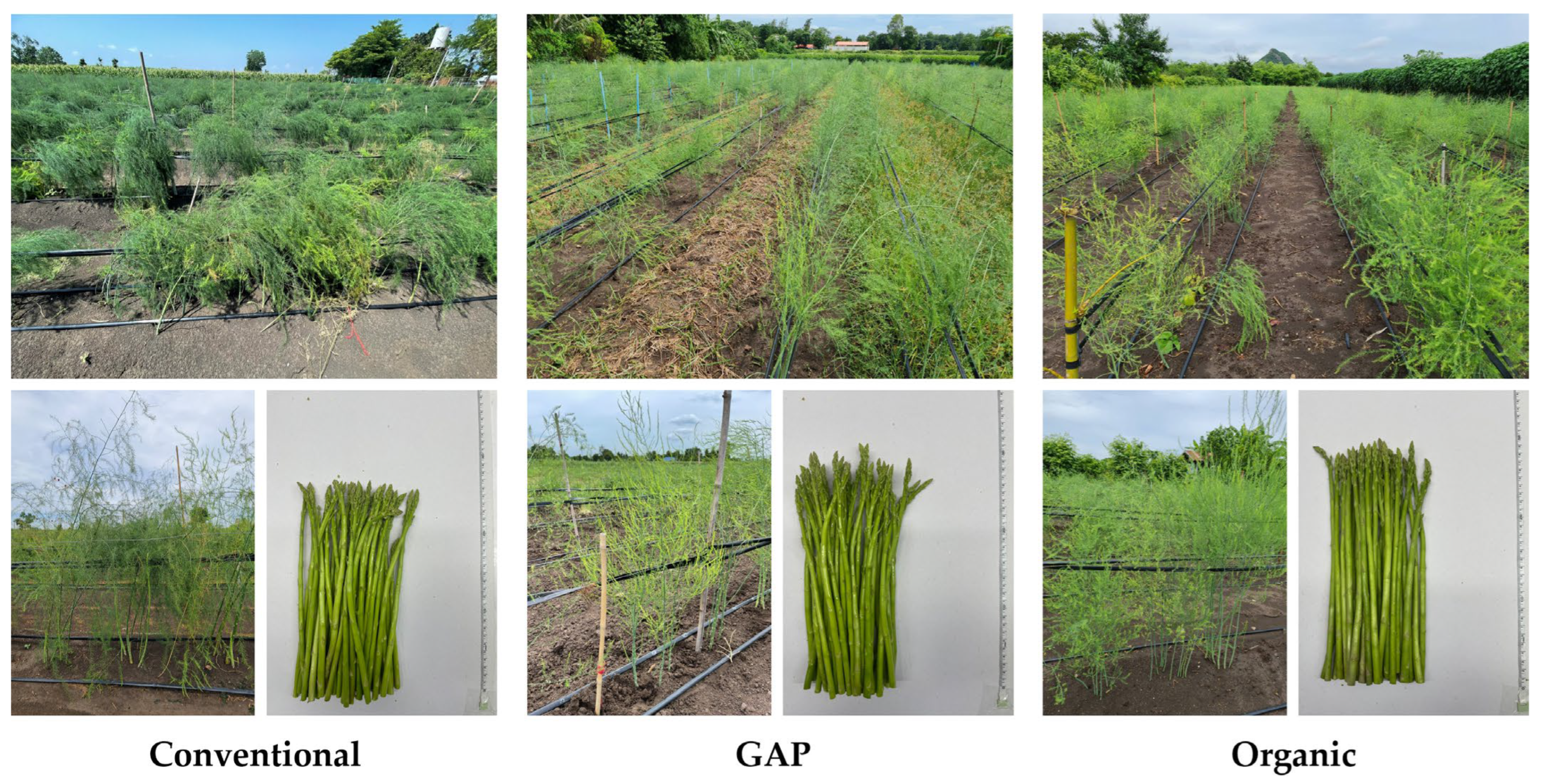
The field study was conducted along asparagus production trails in the Tha Din Dam sub-district, Chai Badan District, Lopburi Province, Thailand (Latitude: 15.17022, Longitude: 101.11525). These trials employed various crop methods, including conventional, good agricultural practices (GAP), and organic, in the same area. Each trial was conducted on a smallholder farm (Figure 1). Three representative trials were randomly selected for each crop method, based on a uniformity criterion requiring that farmers have used at least 80% of the same management practices, including the irrigation system, water source, land preparation prior to planting, transplanting seedlings, harvesting method, and harvesting time. Confounding variance related to on-farm management was reduced, and experimental consistency was guaranteed by this selection. The soil of the experimental area was classified as the Takhli soil series (Loamy-skeletal, carbonatic, isohyperthermic Entic Haplustolls), which is characterized by its calcareous, shallow, and black nature (pH 7.0–8.0), with silty clay loam or clay loam textures throughout the soil profile [35]. The temperatures at the study site ranged from 23.29 °C to 35.19 °C, with seasonal averages of 29.70 °C, 29.19 °C, and 27.09 °C in the summer, rainy, and winter seasons, respectively. Relative humidity during these periods averaged at 68.85%, 77.02%, and 66.59%, within a broader range of 46.53% to 91.35%. Additionally, the mean daylight hours were 12.06 h (summer), 12.07 h (rainy), and 11.15 h (winter) throughout the experimental period.
Figure 1.
Characteristics of the study sites and spear samples of the typical conventional, GAP, and organic farming systems.
2.2. Experimental Design and Crop Method Management
The experiment was arranged as a split-plot in a completely randomized design (CRD) with three replicates. The main plots consisted of three harvest seasons: (1) summer (mid-February to mid-May), (2) rainy (mid-May to mid-October), and (3) winter (mid-October to mid-February). The subplots comprised three crop methods: (1) conventional, (2) good agricultural practices (GAP), and (3) organic methods.
Across all crop method sites, two-year-old crowns of A. officinalis cultivar ‘Brock’s Improved’ were used. This cultivar is recognized for its large shoots, high-quality yield, and resistance to pests, diseases, and environmental stress [36,37]. The irrigation was managed by using water from an artesian well with a drip tape irrigation system, which was activated at 60–80% of the soil’s available water consumption. Asparagus seedlings were grown in plastic bags prior to transplanting and were planted at 1.5 m × 0.5 m. During the harvesting or resting periods, common management practices in asparagus trials included pruning dead stems, using a trellis (made from old irrigation pipe tapes) to support the plants, leaving 4–5 mother plants for fern development, and capping new shoots.
Comparable methods for managing pests and nutrients were employed across each crop method during the conversion and stable phases (Table 1). During the harvesting period, the conventional method received 16-16-16 and 11-0-41 formulae (N-P-K) chemical fertilizers, as well as animal manure (e.g., cow, chicken, and pig manure), whereas the GAP method received 16-20-0 and 11-0-41 formulae (N-P-K) chemical fertilizers along with animal manure. Additionally, in some seasons, such as winter, both farming systems occasionally apply liquid fertilizer containing zinc, calcium, and boron during the dormant phase to feed the plant and prepare it for nutrient buildup, whereas the organic method received only animal manure. Topdressing during the resting period was performed using a 16-16-16 formula (N-P-K) chemical fertilizer and animal manure in the conventional and GAP methods, and only animal manure in the organic method. Pests and diseases were monitored every other week. While commercial biological pesticides (Trichoderma) were employed in the organic method, synthetic pesticides and fungicides were utilized in the conventional and GAP methods, respectively, to control pests and diseases.
Table 1.
Nutrient and pest control management in different crop methods for asparagus production.
2.3. Data Collection and Analysis
2.3.1. Analysis of Soil Chemical Properties
Soil samples were taken from each plot at a depth of 0–20 cm both prior to and following the experimental period. The collected samples were air-dried in the shade to preserve their integrity, then passed through a 2 mm sieve and stored in sealed plastic bags for laboratory analysis. The soil pH and electrical conductivity (EC) were determined using a pH-EC meter (SciberScan PC510, EUTEC, Singapore). Measurements were conducted in distilled water at soil-to-water ratios of 1:1 for pH and 1:5 for EC, respectively. Organic matter (OM) was determined using the Walkley and Black [38] method. The total nitrogen content in the soil was analyzed using the Kjeldahl digestion method. The availability of phosphorus (P) and potassium (K) was assessed based on procedures adapted from the Natural Resources Conservation Service [39], with minor modifications. For available P, the Bray II extraction method was applied, and concentrations were quantified by spectrophotometry (UV-1280, Shimadzu, Kyoto, Japan) at 880 nm. The available K was determined using a 1 M ammonium acetate (NH4OAc) solution at pH 7.0, and measurements were performed using a flame photometer (Model 410, Sherwood Scientific Ltd., Cambridge, UK). The available Mg and Ca quantifications were analyzed using an atomic absorption spectrometer (PinAAcle900F, Perkin-Elmer, Waltham, MA, USA).
To determine heavy metal concentrations in the soil, one g of the soil sample (particle size < 2 mm) was weighed and placed into a 250 mL digestion tube. Subsequently, 10 mL of nitric-perchloric acid (HNO3:HClO4 at a ratio of 2:1 v/v) was added. The mixture was digested in a fume hood, initially at 150 °C, then the temperature was increased to 220 °C. Digestion continued for approximately 1–2 h or until a clear solution was obtained. The digested sample was then diluted to a final volume of 50 mL with distilled water. An appropriate dilution was prepared prior to measuring elemental concentrations by atomic absorption spectroscopy (PinAAcle900F, Perkin-Elmer, Waltham, MA, USA). The concentration of each element was calculated by comparing the absorbance values to a standard calibration curve, using the following equation [40]:
where S = concentration of the element in the solution from the standard curve (mg/L);
Heavy metal concentration (mg/kg) = (S × V × df)/W
V = volume of the extractant solution (mL);
W = weight of the dry spear sample used for the analysis (g);
df = dilution factor of the sample solution.
2.3.2. Plant Growth and Yield
For each experimental plot, three plants were randomly sampled within a 1 m2 area. Vegetative growth parameters, including plant length and plant width, were measured monthly. The plant height was measured from the soil surface to the node of the lowest fully developed leaf, using a measuring tape. The plant width was recorded as the average width measured at the widest point perpendicular to the plant’s axis (90°). During the harvest season, daily yield data were also collected. When the spears were 200–250 mm out of the ground, they were hand-cut at the ground level. This was done between 0600 and 0900 h, when the heads were tight with close bracts before they ferned out. At each picking, the plot product was separated into marketable and waste fractions. Well-formed spears or marketable spears that were green and of at least 20 cm in length were hand-sorted according to their basal stem diameter into grade A (more than 10 mm), grade B (more than 8–10 mm), grade AB (more than 6–8 mm), and grade C (3–6 mm), according to the Thai Agricultural Commodity and Food Standards (TACFS) 1500 [41]. Spears with broken heads or less than 5 mm in thickness were removed. After harvest, the spears were packaged in plastic bags and immediately placed in a Styrofoam box with ice for transport to the laboratory, where nutrient and phytochemical analyses were conducted.
2.3.3. Determination of Chlorophyll Contents
The harvested asparagus spears were chopped into small pieces and ground to a fine powder with liquid nitrogen. Subsequently, 0.5 g of the spear sample was immediately extracted with 10 mL of 80% acetone. The extracted samples were incubated in the dark at 4 °C for 72 h to prevent pigment degradation. The supernatant was collected, and the absorbance was measured at 645, 663, and 470 nm, using a UV-visible spectrophotometer (UV-1280, Shimadzu, Kyoto, Japan). These absorbance values were then applied to standard equations as described by Mackinney [42] and Yu et al. [43] to calculate chlorophyll a, chlorophyll b, and total chlorophyll. The concentrations were expressed as mg g−1 fresh weight (FW).
2.3.4. Determination of Nitrate Accumulation
The harvested asparagus spears were washed, chopped into smaller pieces, and oven-dried at 60 °C using a Thermotec 2000 (Contherm Scientific Ltd., Lower Hutt, New Zealand) until a constant weight was achieved. The dried samples were ground to a fine powder, and 0.1 g of the powdered sample was mixed with 10 mL of distilled water using a vortex mixer. The mixture was left overnight, then centrifuged at 2000× g for 10 min. The supernatant was collected, and the nitrate content was evaluated using the salicylic acid method, modified from Cataldo et al. [44]. To do so, 0.2 mL of the extract was mixed with 0.2 mL of 5% salicylic acid in concentrated H2SO4 and incubated for 20 min. Subsequently, 5 mL of NaOH was added, and the solution was allowed to cool to room temperature to complete the reaction. The absorbance was measured at 410 nm, using a UV spectrophotometer (UV-1280, Shimadzu, Kyoto, Japan). The concentration (mg kg−1 FW) was determined by comparing the results to the nitrate reference calibration curve of a standard KNO3 solution. The results were then reported on a fresh-weight basis, relative to the water content of the plant tissue, using the conversion of dry weight to fresh weight.
2.3.5. Determination of Bioactive Compounds
The total phenolics, flavonoids, and antioxidant activity in dried spear samples were determined using a modified protocol described by Chutimanukul et al. [45]. The total phenolic contents were quantified with the Folin–Ciocalteu reagent, and the results were expressed as mg gallic acid equivalents (GAE) g−1 dry weight. The flavonoid content was analyzed using a colorimetric method, and results were reported as mg rutin equivalents (RE) g−1 dry weight. The antioxidant activity was measured using the 2,2-diphenyl-1-picrylhydrazyl (DPPH) radical scavenging assay, and the results were presented as the percentage of DPPH inhibition using the following formula [45]:
where Ac = control reaction absorbance; As = sample reaction absorbance.
DPPH radical scavenging (%) = [(Ac − As)/Ac] × 100
2.3.6. Determination of Macronutrient Contents
The dried spear samples were ground and sieved through a 2 mm sieve to determine the macronutrient content. The total nitrogen content was determined by using the Kjeldahl method. The concentrations of P, K, Mg, and Ca were determined according to the standard protocol of the Association of Official Analytical Chemists (AOAC), with modifications. In brief, 1.0 g of the dried spear sample was combined with a nitric-perchloric acid solution (HNO3:HClO4 at a ratio of 2:1 v/v) and digested. After digestion, the samples were diluted with deionized water to a final volume of 50 mL and stored at room temperature in plastic tubes. The P concentration in samples was determined using a spectrophotometer (UV-1280, Shimadzu, Kyoto, Japan) at 420 nm. In contrast, the quantification of K, Mg, and Ca was performed using an atomic absorption spectrometer (PinAAcle900F, Perkin-Elmer, Waltham, MA, USA).
2.3.7. Determination of Micronutrient Contents and Heavy Metals Accumulation
Then, 1 g of the dry spear samples (particle size < 2 mm) was weighed. The Fe, Zn, Cu, Cd, and Pb concentrations in the spear samples were measured using the same techniques as those used for soil analysis.
2.3.8. Pesticide Residue Analysis
Pesticide residue analysis was conducted by first chopping the samples into small pieces and grinding them thoroughly using a lab micronizer. A portion of the homogenized sample was then used for residue extraction following ISO/IEC 17025:2005-certified methods, along with specific procedures for certain pesticides. Standard solutions were prepared by diluting a 1000 mg L−1 stock solution into 100 mg L−1 and 0.1 mg L−1 working standards. These were used to construct a calibration curve and spiked into samples for quality control. The analysis was carried out using chromatographic instruments such as gas chromatography (GC) or liquid chromatography (LC), depending on the type of pesticide. The residue concentration was determined by comparing the sample peak retention times and areas with those of the standards using a linear regression equation. The calibration curve had to show a correlation (R2) of at least 0.995 to be valid. The final residue level in each sample was determined using the following formula [46]:
where Csample = concentration of the pesticide in the sample solution (mg/kg).
Csample = (Ccalib × Vsample × F)/Wsample
Ccalib = concentration of the pesticide in the sample solution calculated from the calibration curve in the GC/LC report (mg/kg), where Ccalib = (area of sample × concentration of standard)/area of standard.
Vsample = diluted final volume of the extractant solution (mL).
Wsample = weight of the fresh spear sample used for the analysis (g).
F = correction factor.
2.3.9. Yield Estimation and Economic Benefit Analysis
Following the methodology of Wei et al. [47], a modified partial budgeting analysis was employed to evaluate the economic benefits, specifically examining how the production costs and total income influenced shifts in cash flow. Two categories were used to classify the production costs: (1) fixed costs, and (2) variable costs. Fixed costs included land preparation and irrigation systems, while variable costs were allocated to the seed, fertilizer, trellis, other chemicals used to control fungi and insects, and labor costs. Labor costs for planting, irrigation monitoring, weeding, and harvesting were computed using the Ministry of Labor, Thailand’s minimum daily wage rate of 10.95 USD in the study area (Lopburi province, Thailand).
All harvested asparagus spears across grades were free of physical damage, such as broken spear tips or unfurling heads, referring to marketable yield. The net marketable yield (kg/ha) was calculated assuming a planting density of 50 × 150 cm between plants and rows, namely 13,300 plants per ha. The total sales were calculated from the net annual yield, using conventional and GAP (good agricultural practices) market prices. For the conventional market price, asparagus spear size grades A, B, AB, and C were 2.46, 1.84, 1.23, and 0.62 USD kg−1, respectively. For GAP and organic market prices, the fresh marketable yields of asparagus spear size grades A, B, AB, and C were 3.07, 2.46, 1.84, and 1.23 USD kg−1, respectively. The actual values of the revenue and production cost were converted to USD (USD 1 = THB 32.53), using prevailing exchange rates during the study period.
2.4. Statistical Analysis
The effects of the experimental treatments were evaluated using a randomized split-plot design with three replications. Data were evaluated using analysis of variance (ANOVA) in IBM SPSS Statistics version 26.0 (IBM Corp., Armonk, NY, USA). Mean comparisons were conducted using Duncan’s multiple range test at a significance level of p ≤ 0.05 to identify statistically significant differences among treatments.
3. Results
3.1. Soil Chemical Properties
Different crop methods and harvest seasons affecting the chemical properties of the soil were analyzed (Table 2).
Table 2.
Selected soil properties affected by different crop methods and harvest seasons for asparagus production.
During the harvest season, the lowest pH and EC values were observed in the rainy season’s soil, whereas the lowest organic matter, total N, and available K were observed in the soil of the winter season. However, the lowest available P was observed in the soil during the summer season (Table 2).
Regarding the effect of the different crop methods, almost all the traits of the soil’s chemical properties, including the pH, EC, organic matter, total N, and available P, were significantly higher in organic methods, whereas the highest available K was observed in the soil of conventional systems. Nevertheless, an interaction between the harvest season and crop methods was observed regarding the effect on overall soil chemical properties. According to the results, the winter-season soil managed by GAP and organic methods and the summer-season soil managed by conventional methods had the highest soil pH. The highest EC, organic matter, and total N were observed in the summer-season soil managed by the organic method, and were 0.35 dS m−1, 4.16%, and 0.21%, respectively. In addition, significantly higher levels of available P were observed in all soils harvested during the organic method season. Nevertheless, the highest available K was observed in the summer-season soil managed by the conventional method (Table 2).
Different crop methods and harvest seasons led to significant differences in the availability of most macro- and micronutrient availability (Table 3). During the harvest season, the highest Ca, Fe, and Pb values were observed in the soil of the summer season, where the Ca value was not significantly different from the soil of the rainy season. Although there was no significant difference in soil Mg values across seasons, the highest Zn value was observed in the winter season’s soil. Nevertheless, the soil in the rainy season showed the highest values of Cu and Cd. Soil nutrient analysis revealed that Ca, Mg, Zn, Cd, and Pb reached their highest levels under the conventional system, though Mg levels were comparable to the GAP system. In contrast, Fe and Cu concentrations were significantly higher in both the GAP and organic systems (Table 3).
Table 3.
Soil macro- and micronutrient availability, and heavy metal contamination affected by different crop methods and harvest seasons for asparagus production.
The results showed that winter-season soil managed by the conventional method had the highest Ca and Zn values, and the Ca concentration was not significantly different from that of rainy and summer-season soil managed by the conventional method. Conversely, the lowest Mg value was found in the soil of the organic system in all seasons, whereas the lowest Fe value was found in the summer-season soil managed by the conventional method. For Cu, the winter-season soil managed by the conventional method had the lowest soil Cu value, which was significantly lower than that of the rainy-season soil managed by the conventional and GAP methods. For the heavy metals, the highest Cd value was observed in rainy-season soil managed by conventional and GAP methods, whereas the lowest Pb value was observed in the rainy-season soil managed by the organic methods. This Pb value was not significantly different from that of the winter and rainy-season soils managed by the GAP method (Table 3).
3.2. Growth and Yield Performance
The highest plant length and plant width, as well as the daily marketable yield, were observed in the summer season, while the plant width was not significantly different in the winter season. The highest daily marketable yield was observed in asparagus grown under the conventional method. In addition, a significantly greater plant width was observed in the asparagus grown under the conventional and organic methods, although the different crop methods did not significantly affect the plant length, which ranged from 115.72 to 120.15 cm. Nevertheless, an interaction between harvest seasons and crop methods was observed only for the effect on the daily marketable yield. The results showed that the organic method during the summer season produced asparagus with the highest daily marketable yield, at 86.10 kg ha−1 day−1. This management condition also resulted in a trend toward increased average plant length (128.80 cm) and width (66.56 cm), although these values did not differ significantly from other treatments (Table 4).
Table 4.
Growth and yield of asparagus under different crop methods and harvest seasons.
3.3. Chlorophyll Contents
It was noted that the summer-harvested asparagus exhibited significantly higher levels of chlorophyll a and total chlorophyll, whereas the highest chlorophyll b was observed in the asparagus harvested in the rainy season. However, chlorophyll a, chlorophyll b, and the total chlorophyll contents in the asparagus spears were significantly higher under the conventional method, followed by the GAP method. Conversely, the asparagus grown under the organic method exhibited the lowest chlorophyll a, chlorophyll b, and total chlorophyll contents. Nevertheless, there was an interaction between the harvest season and crop method in terms of all chlorophyll contents in asparagus spears. Plots harvested using the conventional method in the summer season exhibited the highest chlorophyll a, chlorophyll b, and total chlorophyll contents (Table 5).
Table 5.
Chlorophyll pigment in asparagus spears under different crop methods and harvest seasons.
3.4. Nitrate Accumulation
Nitrate accumulation in asparagus spears was influenced by harvest season and crop method (p ≤ 0.05). The summer spears had the highest nitrate accumulation, followed by the winter and rainy seasons. Among the crop methods considered, the conventional method produced the highest nitrate accumulation in the asparagus spears, followed by the GAP method. Nonetheless, the asparagus spears had the lowest nitrate buildup when grown using the organic method (Table 6).
Table 6.
Nitrate accumulation in asparagus spears under different crop methods and harvest seasons.
The combined effects of the harvest season and crop methods on nitrate accumulation were also observed. The summer spears produced using the conventional method exhibited the highest nitrate accumulation, as 297.06 mg 100 g−1 fresh weight. In contrast, the rainy spears produced using the organic method had the lowest nitrate accumulation (247.73 mg 100 g−1 fresh weight) (Table 6).
3.5. Bioactive Compounds
Both the harvest season and crop method significantly influenced the bioactive compounds in asparagus spears. The highest total phenolic content and DPPH radical-scavenging were found in the summer spears, whereas the highest total flavonoid content was recorded in the winter spears. The conventional method resulted in the highest total phenolic and flavonoid contents in asparagus spears. The organic method yielded the highest DPPH radical-scavenging of asparagus spears.
In addition, the interaction between the harvest season and crop methods affects the observed bioactive compounds of asparagus spears. Summer-harvested asparagus grown under the conventional and GAP methods resulted in the highest total phenolic content and DPPH radical scavenging, respectively, whereas the highest total flavonoid content was recorded in winter-harvested asparagus grown under the conventional method. Nonetheless, significantly lower total phenolic content and DPPH radical-scavenging activity were observed in the winter-harvested asparagus grown under the GAP and organic methods, respectively (Table 7).
Table 7.
Bioactive compounds in asparagus spears under different crop methods and harvest seasons.
3.6. Macronutrient Contents
Differences in harvest management influenced plant nutrient accumulation in asparagus spears. The highest total N and Mg contents were recorded in the summer-harvested spears, while the winter-harvested one had significantly higher total P, total K, and Ca contents. When the crop method was considered, the total N, total K, and Ca contents were significantly higher under the conventional method, whereas the total N content did not differ significantly between the conventional and GAP methods. However, the total P and Mg contents in asparagus spears were significantly higher when they were cultivated by the GAP method, and the total P content showed no significant difference from the organic asparagus spears (Table 8).
Table 8.
Macronutrient contents in asparagus spears under different crop methods and harvest seasons.
Likewise, an interaction between the harvest season and crop method was observed in macronutrient contents in asparagus spears. The significantly higher total N content was observed in the summer-harvested spears cultivated by the conventional method, without any significant difference with the winter-harvested spears grown under the conventional and GAP methods, and the summer-harvested spears grown under the organic method. However, the winter-harvested spears produced by the conventional method exhibited significantly higher total P, total K, and Ca contents, with the total P content not being significantly different from the winter-harvested spears grown under the GAP and organic methods. Nevertheless, the highest Mg content was found in summer and rainy asparagus spears grown under the GAP method (Table 8).
3.7. Micronutrients and Heavy Metals Accumulation
The harvest season and crop method significantly affected (p ≤ 0.05) the accumulation of micronutrients and heavy metals in asparagus spears. Regarding the effect of the harvest season, the highest Fe and Pb contents were found in the summer-season spears, whereas the highest Zn, Cu, and Cd concentrations were observed in the rainy-season spears. In terms of different crop methods, it was demonstrated that the conventional asparagus spears obtained the highest Fe, Cu, Cd, and Pb contents, while the highest Zn content was found in the organic one (Table 9). Furthermore, it was shown that the harvest season and cultivation methods significantly affected the accumulation of heavy metals and micronutrients in asparagus spears. The highest Fe content was found in the summer-season spears produced by the conventional method, although the highest Zn content was observed in the rainy-season spears grown under the organic method. Additionally, the rainy-season spears grown under the organic and conventional methods had the highest Cu contents. In terms of heavy metal accumulation, the conventional method harvested in all seasons exhibited the highest Cd content, whereas the significantly higher Pb content was observed in the organic spears harvested in the summer season and the conventional spears harvested in the winter season, respectively (Table 9).
Table 9.
Micronutrient and heavy metal accumulation in asparagus spears under different crop methods and harvest seasons.
3.8. Pesticide Residue in Asparagus Spears
Four groups—carbamate (including Carbaryl, Isoprocarb, Promecarb, Carbofuran, Methiocarb, Methomyl, Aldicarb, Oxamyl, Metolcarb), organochlorine (such as DDT, Chlordane, Endosulfan, Endrin), organophosphate (such as Monocrotophos, Dimethoate, Pirimiphos-methyl, Chiorpyrifos, Parathion-methyl, Pirimiphos, Malathion, Parathion), and pyrethroid (including Deltamethrin, Bifenthrin, Permethrin, lambda-Cyhalothrin, Cypermethrmn, Cyfluthrin, Fenvalerate)—were used to examine the pesticide residue in asparagus spears. The residue levels were compared against the Maximum Residue Limits (MRLs) established by the Thai Ministry of Public Health (Notification No. 420 B.E. 2564 and the Hazardous Substance Act B.E. 2535) and the Codex Alimentarius (FAO/WHO). Although the conventional and GAP methods utilized Carbofuran (Furadan) for leaf miners and Imidacloprid (Neonicotinoid) for thrips and leafhoppers, residues were inconsistently detected across harvest seasons and crop method conditions. Notably, the Carbofuran levels remained within the MRL of 0.03 mg kg−1 (Table S1).
3.9. Economic Benefit
Production input costs were divided into two categories—fixed and variable—for which fertilizer costs account for more than half of the annual expenses. Remarkably, the findings showed that the organic method’s total annual costs were more than 50% lower than those of the conventional and GAP methods in the first and subsequent years (Table 10). However, compared with the GAP and organic methods, the conventional method has a significantly higher average annual yield, resulting in higher average incomes than in the first and subsequent years. Nevertheless, when comparing crop methods and harvest seasons, the summer-harvested asparagus grown using the organic method yielded the highest three-monthly revenue, followed by the summer-harvested asparagus grown using the conventional and GAP methods, respectively. Conversely, the rainy-harvested asparagus farmed utilizing the organic method has comparatively lower monthly revenues (Table 11).
Table 10.
Total costs of asparagus production under different crop methods.
Table 11.
The average incomes calculated from asparagus production in different crop methods and harvest seasons.
The payback period for asparagus production under various crop methods may profit within the first year of planting. It is notable that the organic method has a comparatively quick payback period—0.24 months after the first harvest or 8.24 months after planting. On the other hand, the GAP method yielded a slightly longer payback period due to its relatively low net profit (Table 12).
Table 12.
Calculation of payback period of first-year asparagus production under different crop methods.
4. Discussion
Soil’s chemical properties are affected by different crop methods. It was clear that soil under the organic farming system recorded much higher pH, EC, organic matter, and N and P concentrations than soils under conventional or GAP farming systems (Table 2), which agreed with previous studies [48,49,50]. The accumulation of organic carbon in soil, resulting from the continuous application of organic manure, such as animal manure in this study’s organic farming, has led to enhanced decomposition of these residues by a higher microbial population, potentially increasing the soil’s organic carbon levels. This finding aligns with the report by Bhanuvally et al. [51], which indicates that the regular addition of organic materials, such as farmyard manure and crop residues, elevates the organic carbon status in soils. In contrast, soils with higher soil organic carbon (SOC) consistently showed lower pH, demonstrating the dual role of organic acids in both acidifying the soil and decreasing decomposition, thus maintaining the SOC content in these acidic soils [52,53]. In certain ecosystems, particularly those with a higher base saturation, higher SOC is typically associated with a higher, more alkaline pH. Increased SOC can improve the soil’s structure and cation exchange capacity (CEC), which functions as a buffer and often raises the pH. The calcareous, shallow, and black nature of the Takhli soil series at the experimental site in the current study (pH 7.0–8.0) likely explains the positive link between the SOC and soil pH. Our results are consistent with the findings obtained by Chanlabut and Nahok [54], who reported that the Takhli soil series has a high pH (7.0–8.0) due to its calcareous nature (marl and limestone nodules) and has a high base saturation, which can facilitate organic matter accumulation and stabilization.
Although other studies report that soil under organic farming has significantly higher concentrations of heavy metals and micronutrients than soil under conventional farming, possibly on organic sorption sites [50,51], the present study demonstrates that organic farming exhibited significantly lower concentrations of micronutrients and heavy metals in soil than conventional farming (Table 3). This observation is likely attributable to the use of fertilizers in different farming systems, as higher concentrations of Cd and Pb have been reported, possibly due to the excessive use of inorganic fertilizers [50,55]. Nonetheless, the complexation of these metals by the humified portion of organic matter likely constitutes an additional reason for diminishing their concentration in the soil solution, hence restricting the processes that are responsible for the translocation of these elements to plants [56,57].
Seasonal variations in temperature and precipitation generally have a substantial impact on the chemical characteristics of soil in plantations: mainly on the pH, nutrient availability, nitrogen dynamics, and carbon cycling [58,59]. In this study, the EC, OM, and total N were significantly higher in summer soil and more prevalent in summer soil managed by the organic method than in the other conditions. This observation corroborates the works of Chiriac et al. [60] and Guo et al. [61], who stated that in the presence of organic matter in the form of compost or animal manure, the increase in soil nitrogen is likely due to the decomposition of organic matter from the application of organic fertilizers, and microbial decomposition activity occurs rapidly during the summer. Additionally, humus produced by the decomposition of organic matter enhances nitrogen retention, resulting in higher nitrogen levels in summer under organic farming methods.
The biochemical composition of asparagus spears is significantly altered by both the harvest season and crop methods (Table 7). Numerous studies, including those by Ku et al. [62] and Saleh et al. [63], have indicated that high levels of inorganic (N-rich) fertilizers are associated with reduced levels of secondary metabolites in various plants, including asparagus. However, some studies reported no significant differences in the bioactive compounds, including the total phenolics, total flavonoids, rutin, and chlorophylls, of conventional and organic asparagus spears [64]. Nonetheless, the summer-harvested spears cultivated using conventional agricultural methods had the highest levels of total chlorophyll and phenolic contents in this investigation. The aforementioned suggests that this tendency may result from the cultivation of asparagus in different geographical regions. According to Cheynier et al. [65], a variety of environmental factors, including soil, UV radiation, and biotic and abiotic stresses, affect phenol production in plants. Additionally, it varies with the harvest season; Maeda et al. [66] reported that phenolic compound production in asparagus spears can be accelerated by increased light intensity and day length in summer compared with other seasons. This is because phenolic compounds are synthesized metabolically when plants are exposed to intense light or UV radiation, thereby increasing the phenylalanine ammonia lyase activity. According to Kohmura et al. [67], they are believed to act as UV-absorbing materials, reducing the amount of light reaching the photosynthetic organ and shielding DNA from harm caused by intense light.
It was evident that the organic method resulted in lower nitrate accumulation in asparagus spears than under GAP and conventional methods (Table 6), which was consistent with the results reported by Caruso et al. [17]. In addition, a slightly higher nitrate content was detected in the summer spears than in the winter and rainy spears, respectively. According to Makus [68], nitrate accumulation in asparagus spears is influenced by seasonal factors. Summertime’s significantly higher light intensity typically results in longer growth periods and greater nitrate accumulation, along with a higher crude fiber and lower sugar content than in cooler seasons. Despite the lack of a standardized nitrate content in Thailand, research on nitrate in Thai vegetables often compares it to the legal limit set by EU legislation [69], which is not to exceed 3500 or 3000–4000 NO3-N mg kg−1 FW for fresh spinach or lettuce, respectively. Since asparagus is generally categorized as a vegetable with very low nitrate accumulation, usually less than 200 mg kg−1 FW [70], our experimental results were consistent with those reported, which found that the nitrate accumulation in asparagus spears grown in all different agricultural systems and harvested in all seasons fell between 247.73 and 297.06 mg kg−1 FW and did not exceed the maximum permissible limit (MPL) set by EU legislation. Nonetheless, since asparagus are classified in the root-tuber vegetable category [71], the nitrate accumulation in asparagus spears in this study was still not exceeded by the MPL for the root and tuber vegetables (not exceeding 400 mg kg−1 FW), as established by Order No. 1/2002 in Romania [72].
The pesticide residue groups, including carbamate, organochlorine, organophosphate, and pyrethroid, are recognized as the main classes of synthetic pesticides and are often associated with pesticide residues in Thai domestic crops [73]. Even though the conventional and GAP farming methods for asparagus production in this study were observed to use Furadan (Carbofuran) for aphids and leaf miners and Imidacloprid (Neonicotinoid) for thrips and leafhoppers, it was clear that not all of the pesticide residues were found in all fresh asparagus spears under different harvest seasons and crop method conditions: particularly Carbofuran, which is absorbed by plant roots and distributed throughout the plant’s tissues, allowing it to control sap-feeding and boring insects and is also highly toxic to mammals, bird, invertebrates, and fish [74]. The study indicates that synthetic pesticide application in both conventional and GAP-based asparagus production remains within safe limits for consumer health.
Since the Codex Alimentarius Commission set limit criteria for Cd and Pb in vegetables at 0.05 mg kg−1 and 0.1 mg kg−1, respectively, the Ministry of Public Health in Thailand has set an acceptable limit of 0.01 mg kg−1 for Cd and Pb in root and tuber vegetables (Food Act B.E. 2522). In the current study, the elevated Cd concentrations found in conventionally managed spears throughout all seasons mirror the high Cd levels detected in the soil, suggesting a direct correlation between the soil composition and plant uptake. This tendency aligns with findings by Biddau and Cidu [75], who noted that while asparagus exhibits low to moderate Cd bioaccumulation compared to other vegetables, it still demonstrates a positive correlation between the soil and shoot concentrations. In the current study, however, the levels of Cd and Pb in all spear samples were below the Thai national standard limits and also the Codex Alimentarius Commission’s allowable limit for the investigation of heavy metal buildup. This is a strength of asparagus production in this area that should be promoted for export, thereby creating added value for the farmers.
In the current study, the conventional method produced results that were 33% and 38% higher than those obtained with GAP and organic methods (Table 4). Our results are consistent with those of Caruso et al. [17], who found that, compared with the organic method that used solely organic fertilizer, the conventional method that used inorganic fertilizer yielded the highest production, since it produced more spears per plant. Nevertheless, according to agricultural research on Thailand’s seasonal productivity, three major factors that significantly affect the crop growth, aboveground biomass, and yield are temperature, solar radiation, and seasonal precipitation [76,77]. Although asparagus can be grown and harvested year-round in Thailand, the excessive humidity during the rainy season increases the risk of fungal diseases like anthracnose, mildew, and rust. Based on the meteorological data in the study, the average relative humidity across the summer, rainy, and winter seasons was 68.85%, 77.02%, and 66.59%, respectively. It is probable that the higher relative humidity during the rainy season (nearly 80%) likely increased the risk of phytopathological diseases, thereby reducing the yield compared to the summer and winter periods. This finding is consistent with that of López-Moreno et al. [78], who stated that high relative humidity (with values over 80%), combined with high rainfall, creates favorable conditions for disease outbreaks, such as rust or mildew, which are known to affect asparagus plants, leading to reduced plant longevity and lower-quality spears.
Lower production may also occur throughout the summer due to low humidity and high temperatures, as Hung et al. [79] reported that when soil surface temperature rises above 33 °C, sensitive asparagus stems blossom more easily, decreasing the product’s commercial value. Nevertheless, the winter months often yield more than the summer and rainy seasons, which provide ideal conditions as the ideal growing temperatures of 25 to 30 °C, allowing for high-quality and succulent spears. This timing is also beneficial as it coincides with reduced production in major temperate-climate exporting countries. Contrary to previous findings, the present study observed that the summer yields significantly outperformed those of the winter and rainy seasons by 52% and 54%, respectively. This heightened productivity is likely attributable to the favorable climatic conditions at the experimental site; specifically, the mean summer temperature of 29.70 °C remained within the optimal physiological threshold for asparagus cultivation. Notably, this temperature did not deviate substantially from the averages recorded during the winter (27.09 °C) and rainy (29.19 °C) seasons. Furthermore, the area has sufficient groundwater, ensuring that asparagus production is unaffected by drought, including during the summer or dry season.
Notably, the organic asparagus cultivated throughout the summer season yielded the highest output, predominantly classified as grade A, which commands higher prices, hence generating the highest income compared to other harvest seasons and agricultural systems (Table 11). Our results are consistent with Caruso et al. [17], who observed that the higher yield under the organic method was attributed to an increased spear caliber and mean weight. However, yields during the winter and rainy seasons, particularly under organic farming systems, are lower than those produced using other methods. Both conventional and GAP farming methods occasionally sprayed liquid fertilizer, which contained zinc and boron, during a dormant phase to feed the plant and get it ready for nutrient buildup during specific harvest seasons, such as winter, but organic farming methods are unable to be used. Several studies indicate that zinc (Zn) and boron (B) are essential micronutrients for asparagus, significantly improving growth and winter hardiness. Zinc promotes early juvenile growth, resulting in improved spring emergence, whereas boron is necessary for cell division, preventing hollow stems and shoot-tip dieback [80,81]. Therefore, supplementation with liquid fertilizer may increase winter asparagus yields in both chemical and GAP-based farming systems, compared to organic farming systems. Furthermore, the lowest yields were observed during the rainy season, particularly under the organic method. This was likely driven by increased disease and insect outbreaks—specifically anthracnose caused by Colletotrichum spp., for which biological control methods (e.g., Trichoderma spp.) were ineffective, as well as localized flooding in low-lying areas.
While the conventional method achieved the highest annual yields and gross revenue—producing spears that consistently met safety standards for chemical residues and heavy metals (Cd and Pb)—elevated input costs resulted in the lowest annual net profit and a protracted payback period. Conversely, organic production emerged as the most economically viable and sustainable approach, with the most rapid return on investment. Given its superior economic returns, high product quality, and positive impact on soil chemical properties, organic cultivation is the most recommended method.
5. Conclusions
The experimental results indicate that organic cultivation produces superior spear quality—characterized by the lowest concentrations of nitrates, Cd, and Pb, alongside the highest DPPH radical scavenging activity—and generates the highest annual net income due to significantly lower production costs. However, optimizing organic yields year-round requires refined management, particularly enhanced pest control strategies. Conversely, conventional production remains advantageous for maximizing gross annual yields while maintaining compliance with safety standards. To improve the economic efficiency of conventional systems, more rigorous nutrient cost management is required, as chemical fertilizers represent the primary operational expenditure. Substituting chemical inputs with self-produced organic fertilizers could substantially reduce overhead and enhance the overall profitability.
Supplementary Materials
The following supporting information can be downloaded at: https://www.mdpi.com/article/10.3390/resources15040056/s1, Table S1. Pesticide residue in asparagus spears under different crop methods and harvest seasons.
Author Contributions
Conceptualization, O.T.; methodology, O.T. and N.S.; formal analysis, O.T. and N.S.; investigation, O.T. and N.S.; resources, O.T.; data curation, O.T.; writing—original draft preparation, O.T.; writing—review and editing, O.T. and P.C.; supervision, J.R.; funding acquisition, O.T. All authors have read and agreed to the published version of the manuscript.
Funding
The authors gratefully acknowledge the financial support provided by the Faculty of Science and Technology, Thammasat University, Contract No. SciGR9/2568.
Data Availability Statement
The data are contained within the article.
Acknowledgments
The authors thank the Department of Agricultural Technology, Faculty of Science and Technology, Thammasat University, for providing the experimental and laboratory facilities.
Conflicts of Interest
The authors declare no conflicts of interest. The funders had no role in the study’s design, data collection, analysis, interpretation, manuscript writing, or decision to publish the results.
References
- Chase, M.W.; Christenhusz, M.; Fay, M.; Byng, J.; Judd, W.S.; Soltis, D.; Mabberley, D.; Sennikov, A.; Soltis, P.S.; Stevens, P.F. An update of the angiosperm phylogeny group classification for the orders and families of flowering plants: APG IV. Bot. J. Linn. Soc. 2016, 181, 1–20. [Google Scholar] [CrossRef] [Scilit]
- Pegiou, E.; Mumm, R.; Acharya, P.; de Vos, R.C.H.; Hall, R.D. Green and white asparagus (Asparagus officinalis): A source of developmental, chemical and urinary intrigue. Metabolites 2020, 10, 17. [Google Scholar] [CrossRef] [Scilit]
- Chitrakar, B.; Zhang, M.; Adhikari, B. Asparagus (Asparagus officinalis): Processing effect on nutritional and phytochemical composition of spear and hard-stem byproducts. Trends Food Sci. Technol. 2019, 93, 1–11. [Google Scholar] [CrossRef] [Scilit]
- Redondo-Cuenca, A.; García-Alonso, A.; Rodríguez-Arcos, R.; Castro, I.; Alba, C.; Rodríguez, J.; Goñi, I. Nutritional composition of green asparagus (Asparagus officinalis L.), edible part and by-products, and assessment of their effect on the growth of human gut-associated bacteria. Food Res. Int. 2022, 163, 112284. [Google Scholar] [CrossRef] [Scilit]
- Açıkgöz Altunel, T. Morphological and habitat characteristics of asparagus (Asparagus officinalis L.) and socio-economic structure of producers. Turk. J. Agric.—Food Sci. Technol. 2021, 9, 1092–1099. [Google Scholar] [CrossRef] [Scilit]
- Yamashita, S.; Motoki, S. Comparative analysis of asparagus marketing practices in Europe, North America, and Asia during summer and autumn. Acta Hortic. 2024, 1404, 1447–1454. [Google Scholar] [CrossRef] [Scilit]
- Onggo, T.M. Influence of harvest method and schedule on yield and spear size of green asparagus in Indonesia. Acta Hortic. 2001, 589, 33–40. [Google Scholar] [CrossRef] [Scilit]
- Kabir, J.; Jana, J.C.; Maity, T.K.; Chatterjee, S. Asparagus. In Vegetable Crops, 4th ed.; Bose, T.K., Kabir, J., Maity, T.K., Parthasarathy, V.A., Som, M.G., Eds.; Daya Publishing House: New Delhi, India, 2021; pp. 731–772. [Google Scholar]
- Hussain, A.; Anjum, F.; Rab, A.; Sajid, M. Effect of nitrogen on the growth and yield of asparagus (Asparagus officinalis). J. Agric. Biol. Sci. 2006, 1, 41–47. [Google Scholar]
- Drost, D. High phosphorus applications at planting improve asparagus root growth and yield. Acta Hortic. 2008, 776, 63–68. [Google Scholar] [CrossRef] [Scilit]
- León, D.; Riojas, R.; Casas, A. Asparagus officinalis L. yield under three levels of potassium applied on a saline soil of the Peruvian coast. Acta Hortic. 2012, 950, 59–64. [Google Scholar] [CrossRef] [Scilit]
- León, D.; Gutierrez, P.P.; Riojas, R.; Casas, A. Nitrogen, phosphorus and potassium levels in asparagus production. Acta Hortic. 2018, 1223, 81–87. [Google Scholar] [CrossRef] [Scilit]
- Khucharoenphaisan, K.; Sinma, K. Effectiveness of organic composts on the growth and production yield of organic asparagus. Asian J. Plant Sci. 2023, 22, 368–373. [Google Scholar] [CrossRef] [Scilit]
- National Bureau of Agricultural Commodity and Food Standards (ACFS). Good Agricultural Practices for Asparagus; Ministry of Agriculture and Cooperatives (MOAC): Bangkok, Thailand, 2005. Available online: https://agkb.lib.ku.ac.th/acfs/search_detail/dowload_digital_file/314874/77314 (accessed on 10 August 2025).
- Hanagasaki, T.; Nakasone, H. Maximizing marketable yield of green asparagus (Asparagus officinalis L.) cultivated in Miyako Island, Okinawa, Japan: Strategies for a typhoon-prone subtropical region. Fruits 2024, 78, 1–9. [Google Scholar] [CrossRef] [Scilit]
- Shou, S.; Lu, G.; Huang, X. Seasonal variations in nutritional components of green asparagus using the mother fern cultivation. Sci. Hortic. 2007, 112, 251–257. [Google Scholar] [CrossRef] [Scilit]
- Caruso, G.; Villari, G.; Borrelli, C.; Russo, C. Effects of crop method and harvest seasons on yield and quality of green asparagus under tunnel in southern Italy. Adv. Hortic. Sci. 2013, 26, 51–58. [Google Scholar] [CrossRef] [Scilit]
- Dhankhar, N.; Kumar, J. Impact of increasing pesticides and fertilizers on human health: A review. Mater. Today Proc. 2023. [Google Scholar] [CrossRef] [Scilit]
- Mondal, P.; Biswas, S.; Pal, K.; Ray, D.P. Annona squamosa as a potential botanical insecticide for agricultural domains: A review. Int. J. Bioresour. Sci. 2018, 5, 81–89. [Google Scholar] [CrossRef] [Scilit]
- Tilman, D.; Fargione, J.; Wolff, B.; D‘Antonio, C.; Dobson, A.; Howarth, R.; Schindler, D.; Schlesinger, W.H.; Simberloff, D.; Swackhamer, D. Forecasting agriculturally driven global environmental change. Science 2001, 292, 281–284. [Google Scholar] [CrossRef] [Scilit]
- Chen, J.; Lü, S.; Zhang, Z.; Zhao, X.; Li, X.; Ning, P.; Liu, M. Environmentally friendly fertilizers: A review of materials used and their effects on the environment. Sci. Total Environ. 2018, 613, 829–839. [Google Scholar] [CrossRef] [Scilit]
- Srisopaporn, S.; Jourdain, D.; Perret, S.R.; Shivakoti, G. Adoption and continued participation in a public Good Agricultural Practices program: The case of rice farmers in the Central Plains of Thailand. Technol. Forecast. Soc. Change 2015, 96, 242–253. [Google Scholar] [CrossRef] [Scilit]
- Kılıç, O.; Boz, I.; Eryılmaz, G.A. Comparison of conventional and good agricultural practices farms: A socio-economic and technical perspective. J. Clean. Prod. 2020, 258, 120666. [Google Scholar] [CrossRef] [Scilit]
- Reganold, J.P.; Wachter, J.M. Organic agriculture in the twenty-first century. Nat. Plants 2016, 2, 15221. [Google Scholar] [CrossRef] [Scilit] [PubMed]
- Seufert, V.; Ramankutty, N. Many shades of gray—The context-dependent performance of organic agriculture. Sci. Adv. 2017, 3, e1602638. [Google Scholar] [CrossRef] [Scilit]
- Knapp, S.; van der Heijden, M.G.A. A global meta-analysis of yield stability in organic and conservation agriculture. Nat. Commun. 2018, 9, 3632. [Google Scholar] [CrossRef] [Scilit]
- Seufert, V.; Ramankutty, N.; Foley, J.A. Comparing the yields of organic and conventional agriculture. Nature 2012, 485, 229–232. [Google Scholar] [CrossRef] [Scilit]
- Gosling, P.; Mark, S. Long-term changes in soil fertility in organic arable farming systems in England, with particular reference to phosphorus and potassium. Agric. Ecosyst. Environ. 2005, 105, 425–432. [Google Scholar] [CrossRef] [Scilit]
- Gomiero, T.; Pimentel, D.; Paoletti, M.G. Environmental impact of different agricultural management practices: Conventional vs. organic agriculture. Crit. Rev. Plant Sci. 2011, 30, 95–124. [Google Scholar] [CrossRef] [Scilit]
- Laosutsan, P.; Shivakoti, G.P.; Soni, P. Factors influencing the adoption of good agricultural practices and export decision of thailand’s vegetable farmers. Int. J. Commons. 2019, 13, 867–880. [Google Scholar] [CrossRef] [Scilit]
- Ruecha, N. People Are Starting to Realize Thailand Can Export Asparagus. 2025. Available online: https://www.freshplaza.com/north-america/article/9392832/people-are-starting-to-realize-thailand-can-export-asparagus/ (accessed on 10 August 2025).
- Orsini, F.; Maggio, A.; Rouphael, Y.; De Pascale, S. “Physiological quality” of organically grown vegetables. Sci. Hortic. 2016, 208, 131–139. [Google Scholar] [CrossRef] [Scilit]
- Lorlowhakarn, S.; Piyatiratitivorakul, S.; Cherdshewasart, W. Organic asparagus production as a case study for implementation of the national strategies for organic agriculture in Thailand. Thai J. Agric. Sci. 2008, 41, 63–74. [Google Scholar]
- Siomos, A.S. The quality of asparagus as affected by preharvest factors. Sci. Hortic. 2018, 233, 510–519. [Google Scholar] [CrossRef] [Scilit]
- Office of Soil Survey and Land Use Planning. Miracle of Soil: Soil Series for Economic Plants Cultivation in Thailand; Land Development Department, Ministry of Agriculture and Cooperatives: Bangkok, Thailand, 2005.
- Nath, P.; Papademetriou, M.; Piluek, K.; Herath, E.M. The Vegetable Sector in Thailand: A Review; FAO Regional Office for Asia and the Pacific: Bangkok, Thailand, 1999; pp. 55–56. [Google Scholar]
- Klanrit, P.; Lila, K.; Netsawang, P.; Siangsanor, P.; Thanonkeo, P.; Thanonkeo, S. Effect of organic additives on the micropropagation of Asparagus officinalis. Horticulturae 2023, 9, 1244. [Google Scholar] [CrossRef] [Scilit]
- Walkley, A.; Black, I.A. An examination of Degtjareff method for determining organic carbon in soils: Effect of variationsindigestion conditions and of inorganic soil constituents. Soil Sci. 1934, 63, 251c263. [Google Scholar] [CrossRef] [Scilit]
- Burt, R. Soil Survey Laboratory Methods Manual; Soil Survey Investigations Report, No. 42, Version 4.0; Natural Resources Conservation Service Soils: Washington, DC, USA, 2004.
- Sanjaya, S.; Romulo, A. Study of chemical, physical stabilites, and sensory properties of sorghum-adlay-based milk. IOP Conf. Ser. Earth Environ. Sci. 2023, 1252, 012157. [Google Scholar] [CrossRef] [Scilit]
- Thai Agricultural Commodity and Food Standards (TACFS) 1500. Asparagus; National Bureau of Agricultural Commodity and Food Standards, Ministry of Agriculture and Cooperatives: Bangkok, Thailand, 2004.
- Mackinney, G. Absorption of light by chlorophyll solutions. J. Biol. Chem. 1941, 140, 315–322. [Google Scholar] [CrossRef] [Scilit]
- Yu, X.L.; Hu, Q.L.; Huang, Y. Study on extracting methods and characteristics of chlorophyll in peony. J. Luoyang Norm. Univ. 2005, 5, 113–115. [Google Scholar] [CrossRef]
- Cataldo, D.; Maroon, M.; Schrader, L.E.; Youngs, V.L. Rapid colorimetric determination of nitrate in plant tissue by nitration of salicylic acid. Commun. Soil Sci. Plant Anal. 1975, 6, 853–855. [Google Scholar] [CrossRef] [Scilit]
- Chutimanukul, P.; Jindamol, H.; Thongtip, A.; Korinsak, S.; Romyanon, K.; Toojinda, T.; Darwell, C.T.; Wanichananan, P.; Panya, A.; Kaewsri, W.; et al. Physiological responses and variation in secondary metabolite content among Thai holy basil cultivars (Ocimum tenuiflorum L.) grown under controlled environmental conditions in a plant factory. Front. Plant Sci. 2022, 13, 1008917. [Google Scholar] [CrossRef] [Scilit]
- Steinwandter, H. Universal 5 min on—Line method for extracting and isolating pesticide residues and industrial chemicals. Fresenius. Z. Anal. Chem. 1985, 322, 752–754. [Google Scholar] [CrossRef] [Scilit]
- Wei, X.; Khachatryan, H.; Rihn, A. Production costs and profitability for selected greenhouse grown annual and perennial crops: Partial enterprise budgeting and sensitivity analysis. HortScience 2020, 55, 637–646. [Google Scholar] [CrossRef] [Scilit]
- Mazzan, M.; Cavani, L.; Ciavatta, C.; Campanelli, G.; Burgio, G.; Marzadori, C. Conventional versus organic management: Application of simple and complex indexes to assess soil quality. Agric. Ecosyst. Environ. 2021, 322, 107673. [Google Scholar] [CrossRef] [Scilit]
- Oliveira, E.M.; Wittwer, R.; Hartmann, M.; Keller, T.; Buchmann, N.; van der Heijden, M.G.A. Effects of conventional, organic and conservation agriculture on soil physical properties, root growth and microbial habitats in a long-term field experiment. Geoderma 2024, 447, 116927. [Google Scholar] [CrossRef] [Scilit]
- Zokti, J.A.; Sadiq, D.B.; Dayyabu, A.K.D. The impact of organic and conventional farming methods on soil physicochemical composition and bioaccumulation of heavy metals and arsenic on pearl millet (Pennisetum glaucum) grown in Kaura Namoda, Zamfara State, Nigeria. Direct Res. J. Eng. Inform. Tech. 2025, 13, 35–39. Available online: https://journals.directresearchpublisher.org/index.php/drjeit/article/view/470 (accessed on 10 August 2025).
- Bhanuvally, M.; Sunitha, N.H.; Sharanabasava; Ravi, S.; Mahadevaswamy. Effect of organic farming practices on soil chemical properties. Int. J. Environ. Clim. Change 2024, 14, 470–481. [Google Scholar] [CrossRef] [Scilit]
- Zhang, X.; Guo, J.; Vogt, R.D.; Mulder, J.; Wang, Y.; Qian, C.; Wang, J.; Zhang, X. Soil acidification as an additional driver to organic carbon accumulation in major Chinese croplands. Geoderma 2020, 366, 114234. [Google Scholar] [CrossRef] [Scilit]
- Bajgai, Y.; Adhikari, A.; Lal, R.; Wangdi, T. Organic and conventional management effects on soil organic carbon and macro-nutrients across land uses in the Bhutanese Himalayas. Soil Syst. 2025, 9, 99. [Google Scholar] [CrossRef] [Scilit]
- Chanlabut, U.; Nahok, B. Soil carbon stock and soil properties under different land use types of agriculture. Environ. Nat. Resour. J. 2023, 21, 417–427. [Google Scholar] [CrossRef] [Scilit]
- Zaccone, C.; Di Caterina, R.; Rotunno, T.; Quinto, M. Soil—Farming system—Food—Health: Effect of conventional and organic fertilizers on heavy metal (Cd, Cr, Cu, Ni, Pb, Zn) content in semolina samples. Soil Tillage Res. 2010, 107, 97–105. [Google Scholar] [CrossRef] [Scilit]
- Zhou, S.; Chen, S.; Yuan, Y.; Lu, Q. Influence of humic acid complexation with metal ions on extracellular electron transfer activity. Sci. Rep. 2015, 5, 17067. [Google Scholar] [CrossRef] [Scilit] [PubMed]
- Maffia, A.; Oliva, M.; Marra, F.; Mallamaci, C.; Nardi, S.; Muscolo, A. Humic substances: Bridging ecology and agriculture for a greener future. Agronomy 2025, 15, 410. [Google Scholar] [CrossRef] [Scilit]
- Veeraragavan, S.; Duraisamy, R.; Mani, S. Seasonal variation of soil enzyme activities in relation to nutrient and carbon cycling in Senna alata (L.) Roxb invaded sites of Puducherry region, India. Geol. Ecol. Landsc. 2018, 2, 155–168. [Google Scholar] [CrossRef] [Scilit]
- Xiong, X.; Lyu, M.; Deng, C.; Li, X.; Lu, Y.; Lin, W.; Jiang, Y.; Xie, J. Carbon and nitrogen availability drives seasonal variation in soil microbial communities along an elevation gradient. Forests 2022, 13, 1657. [Google Scholar] [CrossRef] [Scilit]
- Chiriac, O.P.; Pittarello, M.; Moretti, B.; Zavattaro, L. Factors influencing nitrogen derived from soil organic matter mineralisation: Results from a long-term experiment. Agric. Ecosyst. Environ. 2025, 381, 109444. [Google Scholar] [CrossRef] [Scilit]
- Guo, Y.; Zhao, C.; Liu, X.; Dong, Y.; Liu, W.; Chen, Q.; Ding, S.; Zhang, J.; Guo, B.; Gao, X. The Impact of Organic Fertilizer Substitution on Microbial Community Structure, Greenhouse Gas Emissions, and Enzyme Activity in Soils with Different Cultivation Durations. Sustainability 2025, 17, 4541. [Google Scholar] [CrossRef] [Scilit]
- Ku, Y.G.; Kang, D.H.; Lee, C.K.; Lee, S.Y.; Ryu, C.S.; Kim, D.; Polovka, M.; Namieśnik, J.; Gorinstein, S. Influence of different cultivation systems on bioactivity of asparagus. Food Chem. 2018, 244, 349–358. [Google Scholar] [CrossRef] [Scilit]
- Saleh, R.; Gunupuru, L.R.; Lada, R.; Nams, V.; Thomas, R.H.; Abbey, L. Growth and biochemical composition of microgreens grown in different formulated soilless media. Plants 2022, 11, 3546. [Google Scholar] [CrossRef] [Scilit]
- Ku, Y.G.; Bae, J.H.; Namieśnik, J.; Barasch, D.; Nemirovski, A.; Katrich, E.; Gorinstein, S. Detection of bioactive compounds in organically and conventionally grown asparagus spears. Food Anal. Methods 2018, 11, 309–318. [Google Scholar] [CrossRef] [Scilit]
- Cheynier, V.; Comte, G.; Davie, K.M.; Lattanzio, V.; Martens, S. Plant phenolics: Recent advances on their biosynthesis, genetics, and ecophysiology. Plant Physiol. Biochem. 2013, 72, 1–20. [Google Scholar] [CrossRef] [Scilit] [PubMed]
- Maeda, T.; Honda, K.; Sonoda, T.; Motoki, S.; Inoue, K.; Suzuki, T.; Oosawa, K.; Suzuki, M. Light condition influences rutin and polyphenol contents in asparagus spears in the mother-fern culture system during the summer–autumn harvest. J. Jpn. Soc. Hortic. Sci. 2010, 79, 161–167. [Google Scholar] [CrossRef] [Scilit]
- Kohmura, H.; Watanabe, Y.; Muto, N. Polyphenol content, antioxidant activity and surface colour of asparagus spears cultivated under different conditions of sunlight. Acta Hortic. 2008, 776, 255–260. [Google Scholar] [CrossRef] [Scilit]
- Makus, D.J. Response in green and white asparagus to supplemental nitrogen and harvest date. HortScience 1995, 30, 55–58. [Google Scholar] [CrossRef] [Scilit]
- European Commission. Commission Regulation (EU) No 1258/2011 of 2 December 2011 amending Regulation (EC) No 1881/2006 as regards maximum levels for nitrates in foodstuffs. Off. J. Eur. Union 2011, L320, 15–17. Available online: https://eur-lex.europa.eu/eli/reg/2011/1258/oj (accessed on 6 January 2026).
- Santamaria, P. Nitrate in vegetables: Toxicity, content, intake and EC regulation. J. Sci. Food Agric. 2006, 86, 10–17. [Google Scholar] [CrossRef] [Scilit]
- Luo, F.; Yan, X.J.; Hu, X.F.; Yan, L.J.; Cao, M.Y.; Zhang, W.J. Nitrate quantification in fresh vegetables in Shanghai: Its dietary risks and preventive measures. Int. J. Environ. Res. Public Health 2022, 19, 14487. [Google Scholar] [CrossRef] [Scilit] [PubMed]
- Ministry of Agriculture, Food and Forestry. Order No. 1 of 3 January 2002 Regarding the Safety and Quality Conditions for Fresh Vegetables and Fruits Intended for Human Consumption. Part I, No. 173, 13 March 2002, Bucharest; Official Gazette of Romania: Bucharest, Romania, 2002. [Google Scholar]
- Suntudrob, J.; Jongmevasna, W.; Payanan, T.; Srikote, R.; Wittayanan, W. Monitoring of pesticide residues in domestic vegetables in Thailand during 2015. Asia Pac. J. Sci. Technol. 2018, 23, APST-23. [Google Scholar] [CrossRef]
- Gammon, D.W.; Liu, Z.; Becker, J.M. Carbofuran occupational dermal toxicity, exposure and risk assessment. Pest Manag. Sci. 2012, 68, 362–370. [Google Scholar] [CrossRef] [Scilit]
- Biddau, R.; Cidu, R. Metals and metalloids in wild asparagus at uncontaminated and mining-contaminated sites. J. Environ. Qual. 2017, 46, 320–329. [Google Scholar] [CrossRef] [Scilit]
- Sintanaparadee, P.; Dermail, A.; Lübberstedt, T.; Lertrat, K.; Chankaew, S.; Ru-anjaichon, V.; Phakamas, N.; Suriharn, K. Seasonal variation of tropical savanna altered agronomic adaptation of stock-6-derived inducer lines. Plants 2022, 11, 2902. [Google Scholar] [CrossRef] [Scilit]
- Kyaw, Y.; Nguyen, T.P.L.; Winijkul, E.; Xue, W.; Virdis, S.G.P. The effect of climate variability on cultivated crops’ yield and farm income in Chiang Mai Province, Thailand. Climate 2023, 11, 204. [Google Scholar] [CrossRef] [Scilit]
- López-Moreno, F.J.; Navarro-León, E.; Atero-Calvo, S.; de la Lastra, E.; Ruiz, J.M.; Soriano, T. Evaluation of the effects of asparagus decline syndrome on yield and quality parameters over three years in Western Europe. Horticulturae 2025, 11, 159. [Google Scholar] [CrossRef] [Scilit]
- Hung, K.A.; Hsu, Y.W.; Chen, Y.C.; Lin, T.P. Influence of microclimate control on the growth of asparagus under greenhouse in tropical climates. Int. J. Biometeorol. 2023, 67, 1225–1235. [Google Scholar] [CrossRef] [Scilit] [PubMed]
- Douglas, J.A.; Follett, J.M.; Littler, R.A. Boron requirement of asparagus seedlings grown in sand culture. Sci. Hortic. 1989, 38, 33–42. [Google Scholar] [CrossRef] [Scilit]
- Desoukey, S.F.; Taha, Z.K.; El-Shabrawi, H.M.; Sabh, A.Z. Impact of zinc oxide nanoparticles on Asparagus officinalis plant. Plant Arch. 2020, 20, 9323–9338. [Google Scholar]

Disclaimer/Publisher’s Note: The statements, opinions and data contained in all publications are solely those of the individual author(s) and contributor(s) and not of MDPI and/or the editor(s). MDPI and/or the editor(s) disclaim responsibility for any injury to people or property resulting from any ideas, methods, instructions or products referred to in the content. |
© 2026 by the authors. Licensee MDPI, Basel, Switzerland. This article is an open access article distributed under the terms and conditions of the Creative Commons Attribution (CC BY) license.