
Systematic Review

A Theoretical Framework for Requirements Management in Complex Engineering Projects

by
Darli Vieira
1,
Raimundo Kennedy Vieira
2 and
Alencar Bravo
1,*
1
Management Department, Université du Québec à Trois-Rivières, 3351, Boul. des Forges, Trois-Rivières, QC G8Z 4M3, Canada
2
Civil Engineering Department, Federal University of Amazonas, Av. General Rodrigo, Octávio, 6200, Coroado I, Manaus 69077-000, Amazonas, Brazil
*
Author to whom correspondence should be addressed.
Systems 2026, 14(7), 780; https://doi.org/10.3390/systems14070780

Submission received: 26 April 2026 / Revised: 16 June 2026 / Accepted: 2 July 2026 / Published: 4 July 2026
(This article belongs to the Section Systems Engineering)

Abstract

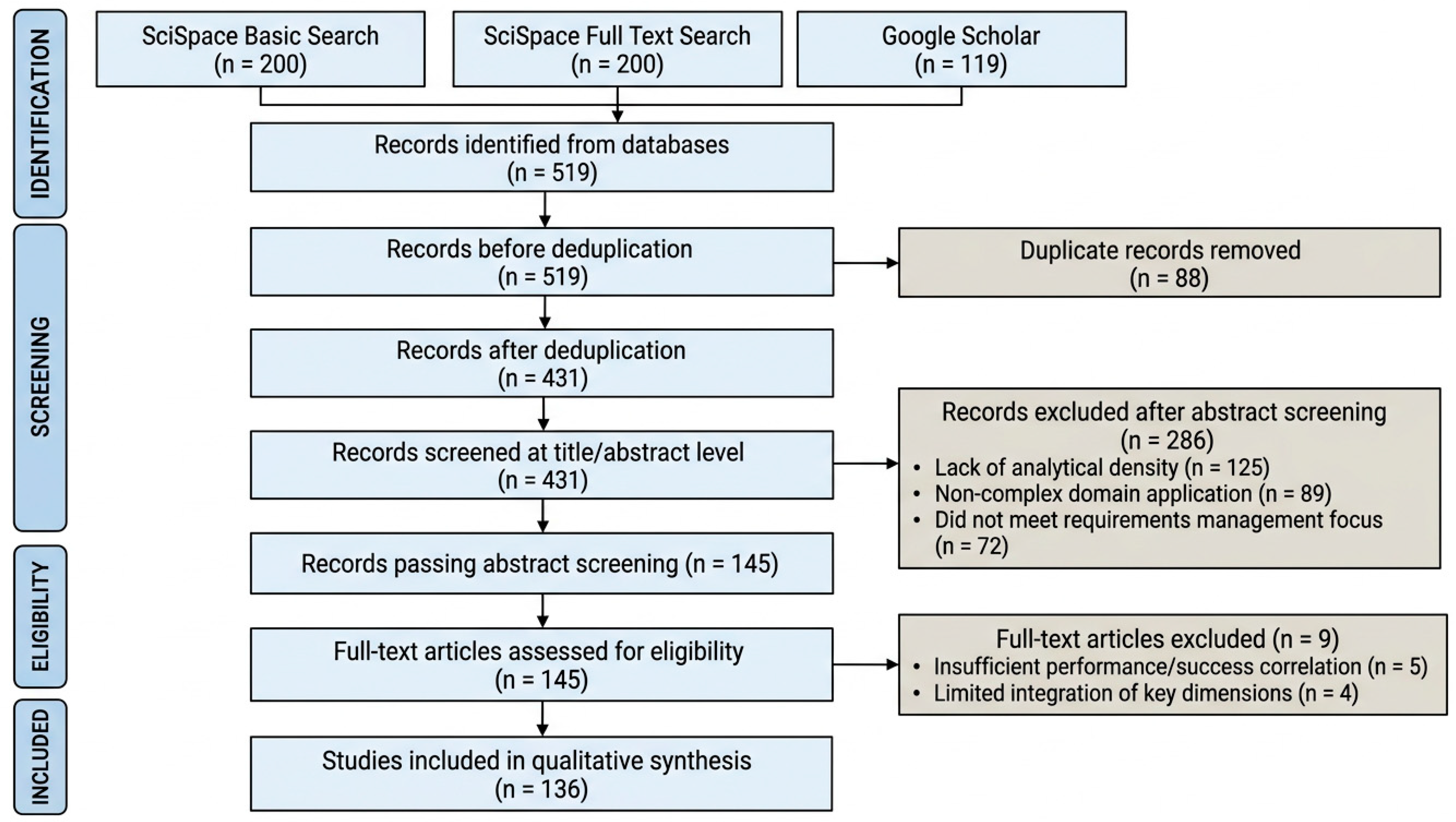
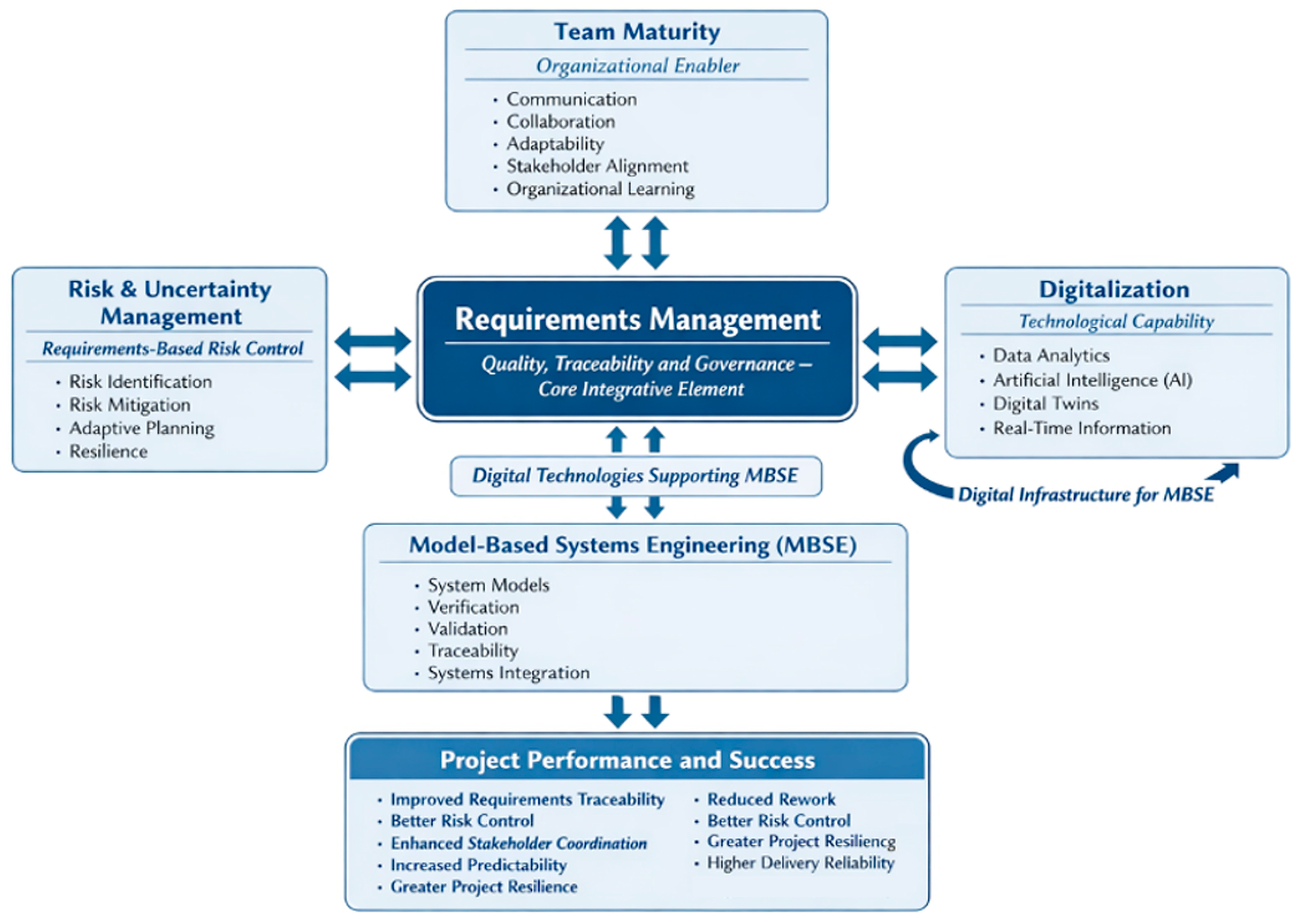
Requirements management is fundamental to complex projects, especially in areas such as engineering, infrastructure, and defense. This article develops an integrative theoretical framework for requirements management in complex projects, grounded in a PRISMA-guided systematic literature review with a qualitative synthesis of the key dimensions of the field. In this review, 136 studies selected from an initial set of 519 records identified across multiple databases were reviewed. Five pillars were found to underpin the proposal: (i) the definition and traceability of requirements, (ii) the mitigation of uncertainties and risks, (iii) team maturity, (iv) digitalization and organizational transformation, and (v) the application of model-based systems engineering (MBSE). A literature review revealed that high-quality requirements reduce errors, improve predictability, and optimize resources, whereas digital approaches and collaborative practices strengthen the adaptive capacity of projects. Thus, in the proposed framework, these dimensions are organized into a hierarchical structure, with an emphasis on the integration of technical, organizational, and digital processes. One limitation is the lack of empirical validation, necessitating future studies on the practical application of the model in real projects, interviews with experts, and the development of operational metrics. This conceptual model is aimed at contributing to the literature and supporting more resilient, automated, and sustainability-oriented practices in complex environments.
Keywords: contracts; complex systems; requirements; risks; team maturity; uncertainty contracts; complex systems; requirements; risks; team maturity; uncertainty