


Abstract
Educational systems increasingly function as complex social environments in which schools, families, and communities interact across institutional boundaries. Within these interconnected systems, teachers frequently operate at the boundary between schools and parents, negotiating expectations regarding trust, authority, and parental participation. Although parental involvement has been widely studied, relatively little attention has been given to how teachers themselves perceive and navigate these relationships within everyday school practice. This study examines novice teachers’ perceptions of parent–teacher relations through a multi-level systemic perspective. Based on a quantitative survey of approximately 200 novice ultra-Orthodox teachers, the research explores teachers’ perceptions of parental trust and active parental involvement across three interconnected levels: micro-level teacher–parent interactions, meso-level school organizational contexts, and macro-level systemic transformations in educational governance. The findings reveal that teachers’ perceptions of parental trust and involvement are shaped by both organizational conditions and broader systemic changes in school–family relations. Conceptualizing teacher–parent relations through a multi-level lens, the study contributes an empirical application of this perspective to the examination of parent–teacher relations. It demonstrates how teachers interpret and navigate these relationships across different levels of the educational system within a distinct socio-cultural context. Focusing on teachers’ perceptions, the study further extends existing conceptualizations of teachers as boundary actors.
1. Introduction
In recent decades, there has been growing recognition that processes of teaching, learning, and socialization in schools do not occur in isolation from the broader social contexts in which educational systems operate [1,2]. Schools are therefore no longer viewed solely as autonomous and closed institutions, but rather as social organizations embedded within complex networks of relationships among schools, families, and communities. Within this broader system, educational responsibility, professional authority, and learning processes are continuously shaped through interactions among educators, students, and parents.
In this context, school–family relations have become a central dimension for understanding the functioning of educational systems. These relations are associated not only with students’ academic achievement and adjustment but also with how teachers perceive and define their professional roles and the boundaries of their responsibility within the school environment [1,3]. Accordingly, teacher–parent relations can be conceptualized as part of complex adaptive systems, characterized by nonlinear dynamics, feedback loops, and emergent patterns that cannot be reduced to the actions of individual actors alone [4,5].
A substantial body of research highlights parental involvement as an important factor in promoting educational processes and supporting students’ success [6,7]. Despite its importance, the concept of parental involvement cannot be treated as a single, uniform phenomenon. Rather, it represents a complex and multidimensional construct encompassing a wide range of practices and forms of participation. One of the most influential frameworks for understanding this complexity is Epstein’s [1] model of school–family–community partnerships. According to this model, families, schools, and communities constitute overlapping spheres of influence that jointly shape children’s education. A complementary perspective is offered by Hoover-Dempsey and Sandler [8], who argue that parents’ decisions to become involved in their children’s education are influenced by several factors, including their perceptions of parental role, their sense of efficacy, and invitations for involvement from teachers, schools, or children themselves. From this perspective, parental involvement is understood as a relational and dynamic process emerging from interactions between parents and the school environment.
The study contributes to the literature in three main ways. First, it examines novice teachers as boundary actors within a distinct cultural–institutional context, focusing on ultra-Orthodox women teachers in Israel. Second, it applies a multi-level (micro–meso–macro) perspective to the study of parent–teacher relations, offering an empirically grounded view of how these relationships are understood across different levels of the educational system. Third, it introduces a retrospective comparison between teachers’ own experiences as students and their current perceptions as professionals, providing insight into how parent–teacher relations are interpreted across time. Taken together, these contributions position the study as an empirical extension of existing frameworks, offering a contextually grounded understanding of how teachers perceive and navigate relationships with parents.
1.1. Literature Review
1.1.1. Micro Level: Everyday Parent–Teacher Interactions
At the micro level, teacher–parent relations are enacted through everyday interactions, including conversations about academic progress, discussions of behavioral or emotional challenges, information sharing, and the negotiation of expectations. Within these interactions, perceptions of trust, authority, collaboration, and distance are continuously constructed and negotiated.
One central dimension at this level is parental trust in teachers. Adams and Christenson [9] conceptualize trust in family–school relationships as a foundational component of effective collaboration between parents and school staff, emphasizing the role of parents’ and teachers’ perceptions in shaping trust. Trust reflects parents’ confidence that teachers act in the child’s best interests, demonstrate professional competence, and communicate openly and fairly. Bryk and Schneider [10] further develop this concept through their notion of relational trust, arguing that trust is grounded in respect, personal regard, competence, and integrity, and functions as a key social resource for school improvement. In such cases, when parental trust is strong, communication tends to be open and cooperative, whereas weakened trust may generate caution, skepticism, or increased monitoring of teachers’ work [9,10].
Recent research further highlights that parent–teacher trust can function as a key relational pathway, shaping not only parent–teacher interactions but also subsequent teacher–child relationships [11,12].
A second central dimension at the micro level is active parental involvement [13]. Parental involvement is commonly described as parents’ participation in activities related to their children’s education, including communication with teachers, monitoring learning processes, attending school meetings, participating in school initiatives, and, at times, engaging in decision-making [13]. Importantly, parental trust and parental involvement should be understood as related but analytically distinct constructs. While high levels of trust may, in some cases, be associated with a reduced perceived need for intensive parental monitoring, increased parental involvement may also emerge from concern, uncertainty, or a desire to supervise school processes. However, recent scholarship has also questioned the assumption that parental involvement is uniformly beneficial, highlighting that school-centered forms of involvement may privilege certain groups over others [14].
While these frameworks highlight the importance of trust and parental involvement, this literature often assumes that involvement is uniformly beneficial, overlooking potential tensions or unequal dynamics. Earlier research often emphasized the benefits of parental involvement; more recent studies highlight its context-dependent and sometimes ambivalent nature [12]. They suggest that teachers may not always interpret parental involvement as a partnership but may experience it as requiring professional management or negotiation. These perspectives underscore the need to examine how parent–teacher relations are experienced and interpreted within specific contexts. This gap underscores the importance of examining how teachers themselves interpret the relationship between trust and involvement in their everyday practice.
1.1.2. Meso Level: Organizational Context of the School
Although teacher–parent relationships are experienced at the interpersonal level, they are shaped by the broader organizational context in which they occur. The meso level refers to school-level factors such as school type, organizational culture, professional climate, leadership style, communication policies, institutional routines, and the distribution of responsibilities within the school. Research in educational leadership emphasizes that schools’ influence on teaching and learning is mediated by organizational conditions that either support or constrain collaboration and trust [4,15]. School leadership plays an important role in shaping these conditions, particularly by influencing staff working conditions, professional interactions, and the broader school climate [16]. Consequently, relationships with parents are not determined solely by individual teachers’ communication styles but are also shaped by the institutional frameworks that structure these interactions.
Schools’ organizational openness toward parents constitutes an important contextual factor. Fisher and Friedman [17] found that parental involvement is associated with parents’ identification with the school’s goals, their trust in the institution, and their perceptions of the school’s openness toward them. These findings highlight that parental involvement is not only a function of family characteristics but also of the institutional conditions that shape how schools signal whether parental participation is welcomed, structured, and legitimate.
From a systems perspective, these organizational conditions are dynamic rather than static. Interactions between teachers and parents are shaped not only by existing institutional structures but also by ongoing reciprocal processes in which teachers’ practices, parental responses, and organizational expectations influence one another over time. In this sense, teacher–parent relations at the meso level can be understood as evolving through ongoing reciprocal processes that connect everyday interactions with broader organizational patterns, thereby linking interpersonal practices with institutional norms and expectations [4,5].
1.1.3. Macro Level: Systemic and Cultural Transformations in School–Family Relations
At the macro level, teacher–parent relations are shaped by broader transformations in educational systems and social expectations. Over recent decades, educational discourse has increasingly shifted from hierarchical models where schools were viewed as the primary authority and parents as supportive outsiders toward models emphasizing partnership, transparency, shared responsibility, and parental participation [18,19]. However, the literature also emphasizes that this shift toward partnership is neither simple nor unproblematic. As parents are increasingly recognized as legitimate stakeholders in education, tensions may emerge concerning authority, influence, and professional boundaries. Critical research has shown that discourses of parental involvement are not socially neutral and may privilege forms of participation associated with dominant social groups [20,21]. In multicultural societies such as Israel, these dynamics become even more complex [22] among teachers from diverse groups. Cultural competence is therefore essential for educators who engage with families from diverse backgrounds. Cultural competence involves not only knowledge about cultural differences but also the ability to interpret communication patterns, expectations, and behaviors within their cultural contexts [23].
This perspective aligns with the literature on boundary crossing, which conceptualizes professional learning as occurring at the intersections between social and institutional worlds. Akkerman and Bakker [24] argue that boundaries should be understood not only as sites of separation but also as spaces of learning and transformation. From this perspective, interactions with parents represent a key arena in which teachers negotiate institutional expectations, cultural differences, and professional identity.
Organizational role structures also shape the nature of teacher–parent interactions. Not all teachers occupy the same position at the boundary between school and family, and different teaching roles entail varying levels of responsibility, communication, and accessibility to parents. Thus, teacher–parent relationships reflect not only interpersonal dynamics but also organizational structures that define authority, responsibility, and proximity to parents within the school.
Moreover, critical perspectives on parental involvement emphasize that these processes are not neutral but embedded within broader structures of power, inequality, and sociocultural stratification. Research has shown that norms of “appropriate” parental involvement often reflect the values and practices of dominant social groups [4,15,22], potentially marginalizing other forms of participation. From this perspective, parent–teacher relations may also involve implicit negotiations over authority, legitimacy, and voice.
These dynamics are particularly relevant in culturally and religiously distinct contexts, where expectations regarding authority, community roles, and school–family relations may differ. Such considerations highlight the importance of examining not only the extent of parental involvement but also how it is interpreted and experienced by teachers within specific sociocultural settings.
While the existing literature provides a strong foundation for understanding parental involvement and trust, it has been argued that these constructs are often treated in an integrative manner, with less attention to tensions, inequalities, and contextual variation. Recent scholarship has begun to emphasize the need to examine how these relationships are experienced and negotiated within specific sociocultural and institutional contexts. Building on this perspective, the present study adopts a more context-sensitive and multi-level approach to understanding parent–teacher relations.
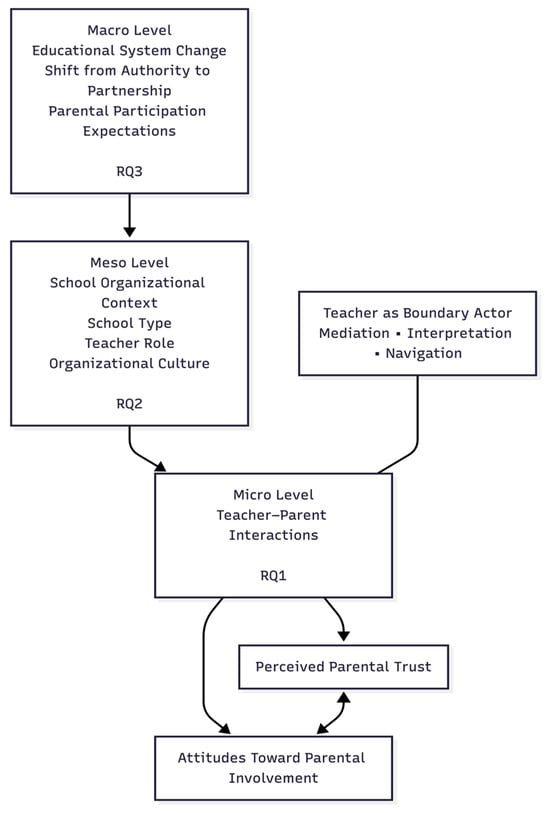
The conceptual framework guiding the study is presented in Figure 1.
Figure 1.
A multi-level systematic model of teacher–parent relations.
The conceptual model situates teachers’ perceptions of parental trust and parental involvement within a multi-level educational system. Teacher–parent interactions occur at the micro level, are shaped by school organizational contexts at the meso level and reflect broader systemic transformations in educational governance at the macro level.
From a systems perspective, educational organizations can be understood as complex adaptive systems in which multiple actors, teachers, students, parents, and administrators interact across institutional and social boundaries [25,26]. Within such systems, relationships between schools and families are not merely interpersonal exchanges but dynamic processes shaped by interactions across multiple levels of the educational environment. Teachers often function as boundary actors who mediate between institutional expectations and family perspectives, translating organizational norms into everyday relational practices with parents. Understanding teacher–parent relations, therefore, requires a multi-level systemic approach that connects micro-level interactions, meso-level organizational contexts, and macro-level changes in educational governance and cultural expectations.
1.2. Research Questions
Building on the conceptual framework presented above, the study examines teachers’ perceptions of parent–teacher relations across multiple levels of the educational system. Specifically, the study addresses the following research questions:
RQ1—Micro level
What are the main dimensions through which novice teachers perceive interactions with parents in their everyday professional practice?
RQ2—Meso level
To what extent are teachers’ perceptions of parental trust and active parental involvement associated with the organizational context of the school, including school type and teachers’ professional role?
RQ3—Macro level
How do teachers’ current perceptions of parent–teacher relations compare with their retrospective experiences as students, and what do these differences suggest about broader systemic changes in school–family relations?
2. Materials and Methods
2.1. Research Design
To examine teachers’ perceptions of parent–teacher relations within educational systems, the present study employed a quantitative survey design. Guided by the multi-level conceptual framework presented in Figure 1, the research explores how teachers interpret parent–teacher relations across three interconnected levels: everyday interactions with parents (micro level), the organizational context of the school (meso level), and broader systemic transformations in educational governance and expectations regarding parental involvement (macro level).
The study focuses on novice ultra-Orthodox women teachers working in different educational settings in Israel. This population provides a particularly informative context for examining parent–teacher relations, as these teachers operate at the intersection of distinct cultural and institutional environments while navigating professional expectations regarding communication, trust, and parental participation.
To address the research questions, a structured questionnaire was administered to teachers in several educational frameworks. The questionnaire included items measuring teachers’ perceptions of parental trust and attitudes toward active parental involvement, as well as questions regarding their professional role and school context. In addition, respondents were asked to reflect retrospectively on their own experiences as students, allowing the study to compare past and present perceptions of parent–teacher relations. The same set of items was used to assess both retrospective (past) and current (present) perceptions.
2.2. Participants
The sample consisted of 206 novice ultra-orthodox teachers from the Israeli public education system, presented in Table 1. Participation was voluntary, and data were collected anonymously.
Table 1.
Demographics of participants.
The sample consisted predominantly of young and early-career teachers, with 87.8% aged 30 or younger and 82% with up to 5 years of teaching experience. Most participants held a bachelor’s degree (81.5%), while a smaller proportion held a senior teaching certificate (17.1%) or a master’s degree (1.5%). In terms of income, the majority reported average income levels (60.2%), followed by below-average (33%) and above-average income (6.8%). Regarding professional roles, 59.2% were homeroom teachers and 40.8% were subject teachers. Most participants worked in elementary schools (55.3%) or special education settings (28.6%), with smaller representation in secondary schools (6.8%) and other school types (9.2%). Participants were drawn from diverse educational streams, primarily Haredi (35.3%) and religious state schools (36.9%), with smaller proportions from state schools (10.7%) and other frameworks (17.2%). Geographically, participants were distributed across Jerusalem (22.8%), the Beit Shemesh area (27.1%), the center (22.3%), the south (16.1%), and the north (11.7%).
2.3. Research Tools
The research instrument used in this study was a quantitative questionnaire designed to examine teachers’ perceptions of their relationships with parents [27]. The questionnaire was adapted from an instrument originally developed to assess kindergarten teachers’ perceptions of parent–teacher relations and was modified to reflect teachers’ perceptions of parental involvement. The second part of the questionnaire included the same set of items, presented from a retrospective perspective, asking teachers to reflect on their own experiences of parental involvement while they were students in the educational system. The questionnaires were distributed online through professional networks and educational groups. Participants received an explanation of the study’s purpose and were assured that responses would remain confidential and used solely for research purposes.
2.4. Data Analysis
Data were analyzed using SPSS (version 29). Descriptive statistics were calculated to examine the distribution, means, and standard deviations of the main study variables. To assess the internal consistency of the scales, Cronbach’s alpha coefficients were computed for each construct. The micro-level constructs were measured using 10 items (6 for parental trust and 4 for active parental involvement). The parental trust scale included items such as “I feel that parents trust me” and “I feel that parents respect my professional authority”. The active parental involvement scale included items such as “I share information with parents about their child’s behavior” and “I feel that parents want to be an active part of school initiatives”. The meso level was operationalized through organizational variables, including school type and teacher role, rather than through a separate scale. The macro-level comparison was based on the same set of items, administered in a retrospective format referring to teachers’ experiences as students, allowing for a within-subject comparison between past and present perceptions.
Pearson correlation analyses were conducted to examine the relationships between perceived parental trust and attitudes toward parental involvement. To examine differences across organizational contexts, independent-samples t-tests and a one-way ANOVA were conducted based on teachers’ roles and school types. To further investigate predictors of teachers’ perceptions, hierarchical linear regression analyses were performed. In each model, background variables (e.g., age, teaching experience), organizational variables (e.g., school type, teacher role), and the complementary construct (trust or involvement) were entered as predictors. Interaction terms were tested to explore potential moderating effects. To examine changes in perceptions between the past and the present, paired-samples t-tests and repeated-measures analyses were conducted.
Although the study is guided by a multi-level (micro–meso–macro) conceptual framework, the statistical analyses employed are based on single-level techniques (e.g., correlations, ANOVA, and linear regression). These methods do not directly model cross-level interactions or systemic interdependencies. Instead, the multi-level framework is used as an interpretive lens to organize data patterns. This approach enables an initial examination across levels but does not fully capture systemic dynamics, which would require more advanced multi-level designs.
2.5. Ethics
The study was conducted in accordance with ethical standards for educational research. Participation was voluntary, and participants could withdraw at any time. Data were collected anonymously and did not include identifying information. Ethical approval was obtained from the Herzog Academic College Ethics Committee (Approval No. 2025/0302).
3. Results
The results are presented in accordance with the multi-level conceptual framework proposed in this study, which views teacher–parent relations as embedded within interconnected layers of the educational system. From this perspective, interactions between teachers and parents constitute a micro-level process shaped by organizational contexts at the school level (meso level) and by broader systemic transformations in school–family relations over time (macro level). Accordingly, the findings are organized in three stages. First, the micro-level structure of teachers’ perceptions of parental involvement is examined through factor analysis and descriptive statistics. Second, the analyses explore how these dimensions vary across organizational contexts, including school type and teacher role. Finally, the study considers the broader temporal dimension by comparing teachers’ current experiences with their retrospective perceptions as students, thereby situating the findings within ongoing systemic changes in school–family relations.
3.1. Micro-Level: Parent–Teacher Interactions
To examine how novice teachers conceptualize parental involvement in their daily professional interactions, an exploratory factor analysis (EFA) was conducted on the ten items measuring teachers’ perceptions of parental involvement in their current work context. The analysis employed principal component extraction with oblimin rotation, given the theoretical expectation that the underlying dimensions of parental involvement may be interrelated.
Prior to conducting the exploratory factor analysis, the suitability of the data for factor analysis was assessed. The Kaiser–Meyer–Olkin (KMO) measure of sampling adequacy indicated an acceptable level (KMO = 0.811), and Bartlett’s test of sphericity was significant (χ2 = 602.114, p < 0.001), supporting the factorability of the correlation matrix.
The analysis revealed a two-factor structure with eigenvalues greater than 1. The first factor, representing parental trust, had an eigenvalue of 3.49 and explained 34.86% of the variance. The second factor, representing active parental involvement, had an eigenvalue of 1.86 and explained an additional 18.63% of the variance. Together, the two factors accounted for 53.5% of the total variance. Inspection of the rotated pattern matrix indicated a clear factor structure. All items showed primary loadings above 0.57 and were therefore retained. Cross-loadings were generally low; one item exhibited a moderate secondary loading, but its primary loading was substantially higher and thus it was retained within its original factor. McDonald’s omega was calculated based on the standardized factor loadings obtained from the exploratory factor analysis. The parental trust scale demonstrated strong internal consistency (ω = 0.87), while the active parental involvement scale showed acceptable reliability (ω = 0.75).
Based on these results, two composite indices were constructed representing parental trust and active parental involvement. Table 2 presents the factor loadings for the items included in the analysis.
Table 2.
Factor loadings for parental involvement items.
Descriptive statistics for the two composite indices are presented in Table 3.
Table 3.
Descriptive statistics and reliability.
The findings indicate relatively high levels of both parental trust (M = 3.85, SD = 0.73) and active parental involvement (M = 3.73, SD = 0.71). The internal consistency of the parental trust scale was good (Cronbach’s α = 0.81), indicating a high level of reliability. All items contributed meaningfully to the scale, supporting its internal coherence. Corrected item–total correlations ranged from 0.42 to 0.65, indicating that all items contributed meaningfully to the scale. But the internal consistency of the active involvement scale was modest (α = 0.62), which is acceptable for exploratory research involving a small number of items. Corrected item–total correlations ranged from 0.36 to 0.46, indicating that all items contributed meaningfully to the scale. Examination of “alpha if item deleted” showed that removing any item would not improve reliability, as all resulting coefficients were lower than the overall alpha. These findings support the scale’s internal coherence, although the relatively low reliability should be interpreted with caution. Future research should aim to refine and expand the measure.
A Pearson correlation analysis revealed a small but statistically significant positive association between parental trust and active parental involvement (r = 0.19, p = 0.006). Importantly, the items included in the involvement scale reflect constructive forms of parental engagement such as collaboration, communication, and participation in school activities rather than intrusive or conflictual involvement. Accordingly, the positive relationship suggests that higher levels of constructive parental participation tend to be accompanied by greater trust in teachers’ professional work. Together, these findings indicate that parental trust and active involvement represent two related yet distinct dimensions of teacher–parent interaction within the school context.
Having established that parental trust and active parental involvement constitute two related dimensions of teacher–parent interaction, the next stage of the analysis examined how these dimensions vary across different organizational contexts. From a systems perspective, teacher–parent relations are not shaped solely by individual perceptions but are also embedded within the institutional structures in which teachers work. Therefore, the following analyses explore whether teachers’ experiences of parental trust and involvement differ according to school characteristics and teachers’ professional roles within the school. In particular, attention is given to the role of homeroom teachers and to differences between school types, as these positions may shape the nature and intensity of teacher–parent interactions at the organizational boundary between school and family.
3.2. Meso-Level: School Organizational Context
To further examine the organizational conditions shaping teacher–parent relations, the next stage of the analysis focuses on the meso level of the educational system. From a systems perspective, interactions between teachers and parents are embedded within the institutional contexts in which teachers work. School structures, professional roles, and organizational arrangements may therefore influence both the level of parental trust and the forms of parental involvement experienced by teachers.
Accordingly, the following analyses examine whether the two dimensions identified earlier, parental trust and active parental involvement vary across different school contexts. Specifically, the analyses explore differences associated with school type and teachers’ professional roles, with particular attention to the position of homeroom teachers, who often serve as the primary point of contact between the school and parents. These analyses allow us to better understand how organizational contexts shape teacher–parent interactions at the boundary between school and family. Table 4 presents trust and active involvement across school type.
Table 4.
Parental trust and involvement across school type.
Because of the relatively small number of participants in two of the school categories, the analysis was restricted to the two largest groups in the sample (elementary school and special education schools). Therefore, the sample was reduced, and the regression models included 172 participants. While this decision enabled more robust statistical comparisons, it may have obscured potential differences across a broader range of educational contexts. Independent-samples t-tests were conducted to examine whether teachers’ perceptions of parental trust and active parental involvement differed between the two school contexts. The results revealed a significant difference in parental trust between the two school types. Teachers in special education schools reported higher levels of parental trust (M = 4.05, SD = 0.57) than teachers in elementary schools (M = 3.65, SD = 0.78), t(151.91) = −3.87, p < 0.001. The effect size was moderate (Cohen’s d = 0.56), indicating a meaningful difference in teachers’ experiences of parental trust across these organizational contexts.
In contrast, no significant difference was found between the two school types in levels of active parental involvement, t (171) = −1.61, p = 0.109. This finding suggests that while the level of parental participation appears relatively similar across school contexts, teachers’ perceptions of parental trust vary between the two educational settings.
To further examine the organizational conditions shaping teacher–parent relations, differences between homeroom teachers and subject teachers were analysed using independent samples t-tests. Homeroom teachers typically serve as the primary point of contact between the school and parents and, therefore, may experience parental involvement differently from subject teachers. Table 5 presents the differences between teacher roles.
Table 5.
Parental trust between teachers’ roles.
To examine whether teachers’ professional role within the school is associated with differences in teacher–parent relations, independent samples t-tests were conducted comparing homeroom teachers and subject teachers. The results indicated no significant difference between the two groups in levels of parental trust, t(202.51) = −1.44, p = 0.152. Homeroom teachers (M = 3.79, SD = 0.80) and subject teachers (M = 3.93, SD = 0.60) reported similar levels of parental trust. In contrast, a significant difference was found in levels of active parental involvement. Homeroom teachers reported higher levels of parental involvement (M = 3.83, SD = 0.70) than subject teachers (M = 3.59, SD = 0.71), t(204) = 2.38, p < 0.018. This finding suggests that teachers who serve as homeroom teachers tend to experience more frequent parental engagement in school-related activities. Table 6 summarizes the differences in teachers’ attitudes of parental trust and active involvement across school context and teacher roles.
Table 6.
Organizational context and teacher–parent relations.
Table 6 summarizes the patterns observed across the organizational variables examined in this study. While teachers’ perceptions of parental trust vary across school types, teachers’ attitudes towards active parental involvement appears to be more strongly associated with teachers’ professional roles within the school.
To further examine the factors associated with teachers’ perceptions of parent–teacher relations, regression analyses were conducted. While the previous analyses examined differences across school contexts and teacher roles separately, the regression models allow us to assess the relative contribution of these variables when considered simultaneously. In particular, the models examine whether teachers’ professional role and school context (elementary vs. special education) was entered as a predictor in the regression model remain associated with teachers’ perceptions of parental trust and their attitudes toward active parental involvement after controlling for teachers’ age, years of teaching experience, and the relationship between the two dimensions of teacher–parent relations.
Table 7 presents the regression models predicting teachers’ perceptions of parental trust in teacher–parent relations. Model 1 includes teachers’ age, years of teaching experience, attitudes toward active parental involvement, teacher role (homeroom vs. subject teacher), and school type. The overall regression model was statistically significant, , explaining approximately 8% of the variance in teachers’ attitudes toward parental trust (). Model 2 adds the interaction between teacher role and school type to examine whether the relationship between teacher role and perceived parental trust varies across school contexts. The overall model remained statistically significant, , explaining approximately 7.6% of the variance in teachers’ attitudes toward parental trust ().
Table 7.
Regression model predicting teachers’ perception towards parental trust.
The results indicate that school type was the only significant predictor of perceived parental trust in Model 1 (β = −0.226, p < 0.01), suggesting that teachers working in elementary schools reported lower levels of perceived parental trust compared with teachers working in special education settings. None of the other predictors reached statistical significance, although attitudes toward active parental involvement showed a marginal association with perceived trust. In Model 2, the interaction between teacher role and school type was added. The interaction term was not statistically significant, indicating that the association between school context and teachers’ perceptions of parental trust does not differ between homeroom and subject teachers.
While the previous analysis examined the factors associated with teachers’ perceptions of parental trust, the second regression model focuses on teachers’ attitudes toward active parental involvement. These two dimensions represent related yet distinct aspects of teacher–parent relations identified in the earlier factor analysis. Accordingly, the following model examines whether teachers’ professional role, school context, and perceived parental trust are associated with teachers’ attitudes toward active parental involvement, while controlling for teachers’ age and years of teaching experience. As in the previous model, an interaction term between teacher role and school type was included to examine whether the relationship between teacher role and attitudes toward parental involvement varies across school contexts.
Table 8 presents the regression models predicting teachers’ attitudes toward active parental involvement. Model 1 included teachers’ age, years of teaching experience, perceived parental trust, teacher role (homeroom vs. subject teacher), and school type as predictors. The overall regression model was statistically significant, , explaining approximately 5% of the variance in teachers’ attitudes toward parental involvement ().
Table 8.
Regression model predicting teachers’ attitudes towards active involvement.
Among the predictors, teacher role emerged as a significant predictor (β = 0.218, p < 0.01), indicating that homeroom teachers reported more positive attitudes toward active parental involvement than subject teachers. Perceived parental trust showed a positive but marginal association with attitudes toward parental involvement (β = 0.151, p ≈ 0.055). None of the other variables reached statistical significance. In Model 2, the interaction between teacher role and school type was added in order to examine whether the association between teacher role and attitudes toward parental involvement varies across school contexts. Although the overall model remained statistically significant, , the interaction term was not significant (β = 0.100, p = 0.540), suggesting that the relationship between teacher role and attitudes toward parental involvement does not differ between elementary and special education schools. The non-significant interaction effects suggest that differences across roles or boundary positions were not statistically detected; however, this should not be interpreted as evidence that organizational conditions affect all teachers similarly.
Taken together, the findings presented above illustrate how teachers’ perceptions of parent–teacher relations are shaped by organizational factors within the current educational system. However, although the regression analyses provide insight into the relationships between the variables, the overall explanatory power of the models is relatively modest (R2 = 5–8%). This suggests that the findings should be interpreted as indicating modest associations rather than strong predictive effects. We assess those unmeasured factors (e.g., teacher self-efficacy, school leadership practices, class size, parental socioeconomic status, cultural norms) likely account for most of the variance.
The relatively low explained variance further indicates that additional factors not included in the present study may play an important role in shaping teachers’ perceptions. School context was associated with teachers’ perceptions of parental trust, while teachers’ professional role within the school was related to their attitudes toward active parental involvement. These results highlight how teacher–parent interactions are embedded in the organizational structures of schools and reflect dynamics operating at the micro and meso levels of the educational system. However, teachers’ perceptions of parent–teacher relations may also be influenced by broader systemic experiences that extend beyond their current professional environment. It is important to note that the teachers participating in this study were themselves educated in a more centralized, authority-oriented educational system, in which parental participation in school processes was relatively limited. This background provides an important context for interpreting teachers’ views of parent–teacher relations, as their current professional experiences may be shaped by contrasts between past and present educational structures.
To explore this broader systemic dimension, the following analysis shifts to the macro level, examining teachers’ retrospective perceptions of parental trust and involvement during their own schooling and comparing them with their current perceptions as teachers. This comparison allows us to consider how changes in educational governance, organizational culture, and expectations regarding parental participation may be reflected in teachers’ attitudes toward parent–teacher relations.
3.3. Macro-Level: System Transformation in School–Family Relations
To examine differences between teachers’ retrospective perceptions of parent–teacher relations during their own schooling and their current experiences as teachers, paired-samples t-tests were conducted for perceived parental trust and attitudes toward active parental involvement. Presents in Table 9.
Table 9.
Differences between past and present in teachers’ attitudes.
The results revealed a significant difference between past and present perceptions of parental trust. Teachers reported lower levels of perceived parental trust in their current professional context than in the schools in which they studied, t(204) = −8.37, p < 0.001. The effect size was moderate (Cohen’s d = 0.58). An opposite pattern was observed for attitudes toward active parental involvement. Teachers reported significantly more positive attitudes toward active parental participation in their current professional context compared with their retrospective perceptions of parent–teacher relations during their own schooling, t(204) = 11.90, p < 0.001. The effect size for this difference was large (Cohen’s d = 0.83). These findings suggest a substantial shift in teachers’ perceptions of parent–teacher relations, reflecting broader systemic changes in expectations regarding parental participation in educational processes. However, it is important to note that the “past” measure is based on retrospective self-reports rather than longitudinal data, and it should be interpreted with caution. First, based on retrospective self-reports and may be subject to recall bias, as memories of schooling can be idealized or selectively reconstructed. Second, the comparison reflects not only temporal differences but also differences in role perspective, as participants evaluate past experiences as students and present experiences as professionals. These distinct positions may shape how relationships with parents are perceived and interpreted. In addition, although the same questionnaire items were used to assess both past and present perceptions, the meaning attributed to these items may differ across contexts. Accordingly, the findings are best understood as reflecting perceived shifts in parent–teacher relations rather than direct evidence of objective or systemic change over time. The results, therefore, capture how teachers reconstruct and interpret changes in parent–teacher relations over time, rather than documenting actual changes in the educational system.
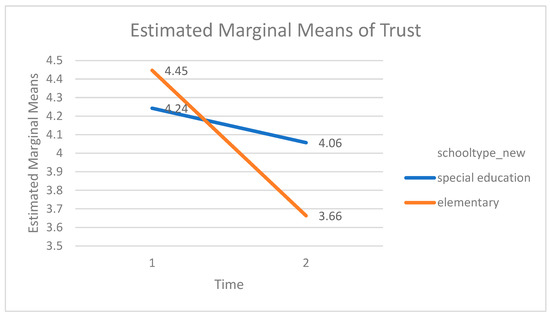
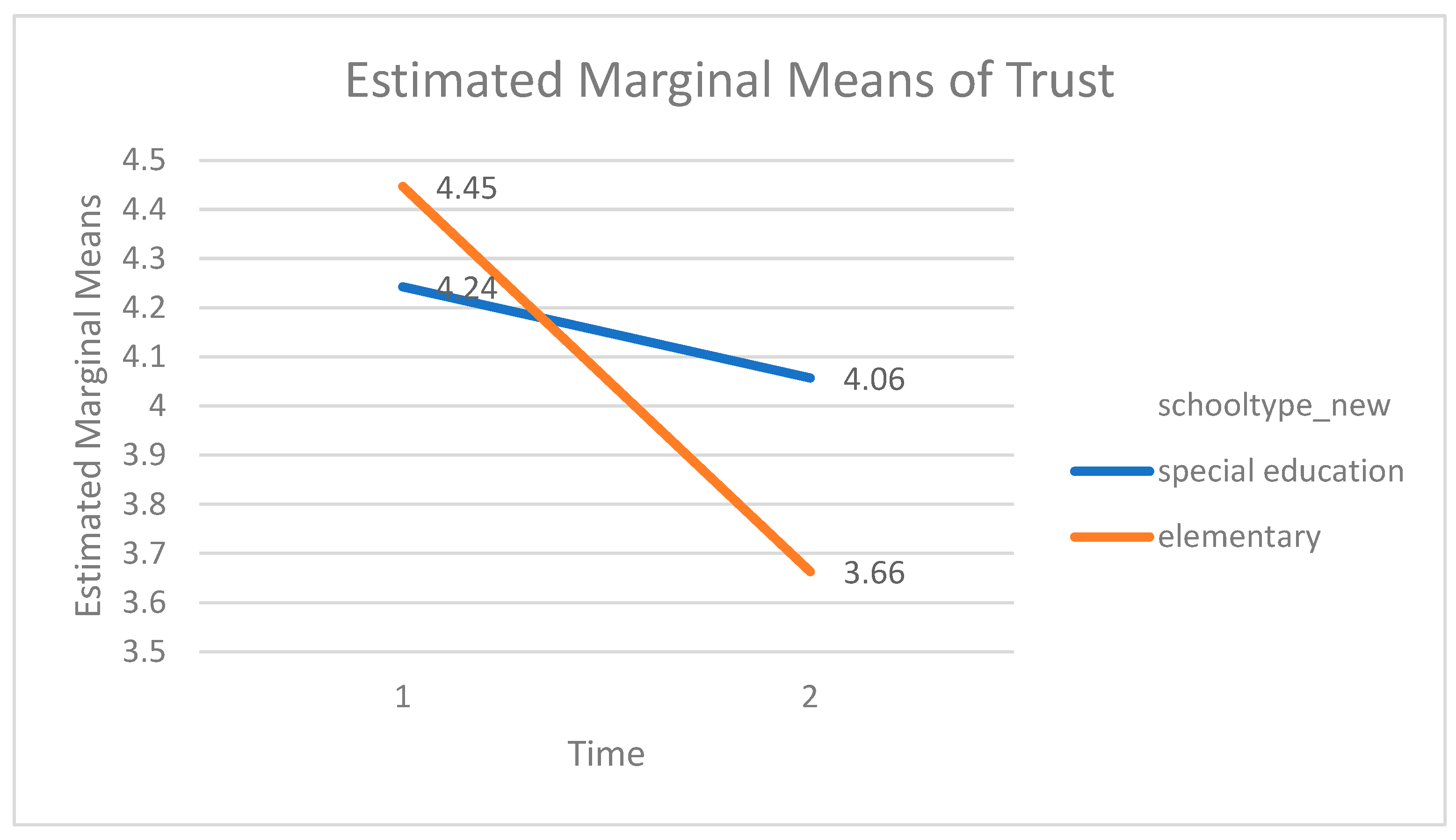
A mixed repeated-measures ANOVA was conducted to examine differences between teachers’ retrospective perceptions of trust in parent–teacher relations during their own schooling and their current perceptions as teachers. The analysis revealed a significant main effect of time, F(1,168) = 46.95, p < 0.001, η2 = 0.218, indicating a substantial difference between past and present perceptions towards trust. Importantly, a significant interaction was found between time and school type, F(1,168) = 17.88, p < 0.001, η2 = 0.096. This finding suggests that the magnitude of the difference between past and present perceptions varies across school contexts. As illustrated in Figure 2, the change was more pronounced among teachers working in elementary schools compared with those working in special education settings. No significant interaction was found between time and teacher role, F (1,168) = 1.54, p = 0.216, indicating that the shift in perceptions between past and present does not differ between homeroom and subject teachers.
Figure 2.
Past and present in teachers’ perceptions towards trust.
A mixed repeated-measures ANOVA examined differences between teachers’ retrospective views of parental involvement during their own schooling and their current views as teachers. A significant main effect of time emerged, F(1,168) = 97.52, p < 0.001, η2 = 0.367, indicating a substantial difference between past and present. No significant interactions were found with school type, F(1,168) = 1.74, p = 0.189, or teacher role, F(1,168) = 3.30, p = 0.071, suggesting that this shift was consistent across contexts and roles.
The results reveal a multi-level pattern in parent–teacher relations. At the micro level, participants reported relatively high parental trust and positive attitudes toward involvement, with a modest but significant positive association between the two. At the meso level, organizational context influenced these patterns: differences emerged across school types in perceived trust, whereas attitudes toward involvement were less context dependent. The teacher’s role showed only a limited effect, mainly on involvement. At the macro level, a shift was observed between retrospective accounts of past relationships and current experiences. Participants recalled higher parental trust in the past, reflecting a more hierarchical system, while attitudes toward involvement indicated broader systemic change across contexts. Overall, the results suggest that parent–teacher relations are shaped by the interplay between individual experiences, organizational contexts, and broader systemic transformations in educational expectations and governance.
4. Discussion
The findings suggest that teachers see themselves as active agents shaping parent–teacher relations, positioning themselves as boundary actors between school and family. These contexts may also be understood as a form of relational or distributed leadership, in which influence is exercised through interaction, coordination, and meaning making rather than through formal authority. However, while the study adopts a systemic perspective, the findings should be interpreted with caution, as the analyses do not directly model multi-level interactions. Accordingly, the results reflect patterns across levels rather than fully capturing systemic dynamics.
The findings further indicate a perceived transformation in parent–teacher relations, characterized by a shift from higher levels of perceived trust and lower parental involvement in the past to increased involvement accompanied by lower perceived trust in the present. This pattern aligns with previous studies describing a shift toward more participatory models of school–family relations [1] but also highlights a less-examined aspect of this transition, namely, that increased parental involvement may be accompanied by challenges to teachers’ professional authority. It also supports existing accounts of a transition from centralized and authority-based systems toward more participatory and decentralized models [1,3]. However, the findings also suggest that this shift is not linear. Increased parental involvement may be accompanied by tensions surrounding professional authority, indicating that expanding participation does not necessarily strengthen relational trust. Rather, parent–teacher relations appear to be shaped through ongoing negotiation between authority and partnership within evolving educational systems.
The pattern whereby increased parental involvement is accompanied by lower perceived trust invites a more critical interpretation. From a professional perspective, this finding may reflect shifting power dynamics in contemporary education, in which teachers experience greater parental presence alongside a perceived erosion of professional authority. In this sense, increased involvement does not necessarily signal partnership; it may also be interpreted as monitoring or heightened scrutiny. From a systems perspective, this pattern can be understood in terms of feedback loops and unintended consequences. Efforts to promote parental involvement often intended to strengthen collaboration may inadvertently intensify parental oversight, which in turn can be experienced by teachers as reduced trust. Such dynamics highlight the complexity of parent–teacher relations as an adaptive system, in which changes at one level may generate counterintuitive effects at another. Importantly, these interpretations reflect teachers’ subjective perceptions and should be understood as indicative of how involvement and trust are experienced, rather than as direct evidence of causal relationships.
At the same time, the findings underscore the importance of organizational context in structuring these relationships. Teachers’ roles within the school, particularly their positioning as primary points of contact with parents, are perceived as shaping the extent and nature of parental involvement. These results reinforce the view that parent–teacher relations are embedded within institutional structures rather than being solely the outcome of interpersonal dynamics [1,16]. Differences across school types further highlight how varying organizational conditions and interaction patterns influence the development of trust and the experience of relational complexity. While prior research has emphasized the role of school context in shaping parental involvement [16] the present findings suggest that these effects may be more nuanced, particularly in relation to how trust is experienced across different school settings.
From a boundary-crossing perspective [24], teachers can be understood as boundary workers who actively mediate between the institutional logic of the school and families’ expectations. In this process, everyday practices such as communication routines, sharing information about students, and coordinating expectations may function as “boundary objects” that enable coordination across contexts. These practices allow teachers to navigate differences while maintaining a workable relationship between school and home, even amid tensions around trust and involvement.
At the level of everyday practice, the distinction between perceived parental trust and parental involvement emerges as particularly significant. While these dimensions are positively related, they are not interchangeable. High levels of parental involvement do not necessarily indicate trust and may, in some cases, reflect monitoring or concern [3]. At the same time, trust has been conceptualized as a relational construct grounded in perceptions of professional competence and mutual expectations [9]. The findings suggest that parent–teacher relations are shaped not only through interaction but through ongoing processes of interpretation as perceived and reported by teachers. However, it is important to note that these findings are based on teachers’ self-reported perceptions rather than direct observations of interactional practices.
Taken together, these findings both support and extend the existing literature by demonstrating that parent–teacher relations are shaped not only by structural and organizational factors but are also actively interpreted by teachers at all levels. The findings suggest that parent–teacher relations may be understood as operating within a multi-level system in which systemic transformations, organizational contexts, and everyday interactions are interconnected. However, these patterns should be interpreted with caution, as they reflect teachers’ subjective perceptions rather than directly observed dynamics. Within this framework, teachers are perceived as playing a central role in mediating between levels and translating broader changes into their daily practice, while shaping their relationships with parents.
Although the study focuses on novice ultra-Orthodox teachers, this context offers a contextually grounded perspective that may contribute to understanding how teachers interpret and navigate relationships at the boundary between schools and families in contemporary educational settings. However, the cultural and religious characteristics of the sample may shape teachers’ perceptions of parent–teacher relations, and therefore the findings should be generalized to other populations and educational contexts with caution.
These findings also have practical implications for educational leadership. School leaders can support teachers in their role as boundary actors by providing clear organizational frameworks that define the scope of parent–teacher communication while preserving teachers’ professional autonomy. In addition, creating structured channels for parental involvement may help balance participation with trust, reducing the potential for perceived monitoring. Finally, leadership development programs and particularly induction and mentoring frameworks for novice teachers may benefit from explicitly preparing teachers to navigate parent–teacher relationships from a systemic perspective. This may be especially relevant in culturally and religiously distinct contexts, where expectations regarding authority, community involvement, and home–school relations may differ and require context-sensitive professional preparation.
Several limitations should be considered when interpreting the findings. First, the study is based on teachers’ self-reported perceptions and does not include direct observations of parent–teacher interactions. As such, the findings reflect how teachers understand and interpret these relationships rather than how they are enacted in practice. Second, while the participants work across diverse educational settings within the Israeli education system, the sample is limited to novice ultra-Orthodox women teachers. This specific socio-cultural and professional positioning may shape how teachers perceive parent–teacher relations and should be considered when interpreting the findings. Finally, the cross-sectional design does not allow for examining changes over time or causal relationships between variables. At the same time, this specific context provides a valuable analytical lens for examining how teachers navigate parent–school relations across cultural and institutional boundaries.
This study set out to examine parent–teacher relations through a multi-level lens, focusing on novice teachers operating within a distinct socio-cultural context. By conceptualizing teachers as boundary actors, the findings offer empirical insight into how teachers perceive their role in navigating relationships between schools and families.
In addition, the retrospective comparison between past and present perceptions provides a nuanced understanding of how these relationships are interpreted across time. While the findings are based on teachers’ subjective perspectives and should be interpreted with caution, they contribute to the literature by illustrating how existing theoretical frameworks can be applied and explored within a specific cultural and institutional setting.
Author Contributions
Conceptualization, V.E. and Y.C.; methodology, Y.C.; software, Y.C.; validation, Y.C., V.E. and S.S.; formal analysis, Y.C.; resources, V.E.; data curation, S.S.; writing—original draft preparation, Y.C., V.E. and S.S.; writing—review and editing, Y.C.; visualization, Y.C.; project administration, V.E.; funding acquisition, S.S. All authors have read and agreed to the published version of the manuscript.
Funding
This research was funded by Lion Family Foundation.
Institutional Review Board Statement
The research discussed in this paper received ethical approval from the Herzog College. Approval number: 25-0302; date of approval: 6 March 2025.
Informed Consent Statement
Informed consent was obtained from all subjects involved in the study.
Data Availability Statement
Data available upon request due to restrictions placed on participant privacy; however, segments of the data can be requested by contacting the corresponding author.
Conflicts of Interest
The authors declare no conflicts of interest.
References
- Epstein, J.L. School, Family, and Community Partnerships: Preparing Educators and Improving Schools, 2nd ed.; Routledge: Abingdon, UK, 2018. [Google Scholar] [CrossRef] [Scilit]
- Lareau, A. Social Class Differences in Family-School Relationships: The Importance of Cultural Capital. Sociol. Educ. 1987, 60, 73–85. [Google Scholar] [CrossRef] [Scilit] [PubMed]
- Goodall, J.; Montgomery, C. Parental involvement to parental engagement: A continuum. Educ. Rev. 2014, 66, 399–410. [Google Scholar] [CrossRef] [Scilit]
- Leithwood, K.; Harris, A.; Hopkins, D. Seven strong claims about successful school leadership revisited. Sch. Leadersh. Manag. 2020, 40, 5–22. [Google Scholar] [CrossRef] [Scilit]
- Mutton, T.; Burn, K.; Thompson, I. Preparation for family–school partnerships within initial teacher education programmes in England. J. Educ. Teach. 2018, 44, 278–295. [Google Scholar] [CrossRef] [Scilit]
- Fan, X.; Chen, M. Parental involvement and students’ academic achievement: A meta-analysis. Educ. Psychol. Rev. 2001, 13, 1–22. [Google Scholar] [CrossRef] [Scilit]
- Hill, N.E.; Tyson, D.F. Parental involvement in middle school: A meta-analytic assessment of the strategies that promote achievement. Dev. Psychol. 2009, 45, 740–763. [Google Scholar] [CrossRef] [Scilit]
- Hoover-Dempsey, K.V.; Sandler, H.M. Final performance report for OERI grant #R305T010673. In The Social Context of Parental Involvement: A Path to Enhanced Achievement; Vanderbilt University: Nashville, TN, USA, 2005. [Google Scholar]
- Adams, K.S.; Christenson, S.L. Trust and the family–school relationship: Examination of parent–teacher differences in elementary and secondary grades. J. Sch. Psychol. 2000, 38, 477–497. [Google Scholar] [CrossRef] [Scilit]
- Bryk, A.S.; Schneider, B. Trust in Schools: A Core Resource for Improvement; Russell Sage Foundation: New York, NY, USA, 2002. [Google Scholar]
- Søe, M.A.; Psouni, E. Parent-teacher trust as a relational pathway to the child: Teachers’ perceptions about child-teacher-parent relationship-building during the child’s transition to preschool. Int. J. Educ. Res. 2025, 132, 102618. [Google Scholar] [CrossRef] [Scilit]
- Avvisati, F.; Besbas, B.; Guyon, N. Parental Involvement in School: A Literature Review. Rev. D’économie Polit. 2010, 120, 759–778. [Google Scholar] [CrossRef] [Scilit]
- Gaspar, C.R.; Sahay, D. Expanding the concept of parent involvement to special education: Considerations for inclusivity. J. Fam. Theory Rev. 2025, 17, 423–445. [Google Scholar] [CrossRef] [Scilit] [PubMed]
- Schejter-Cohen, T.; Fast, I.; Tubin, D. Diagnosing and treating parents: A new perspective on teacher-parent relationships. Teach. Teach. 2026, 32, 92–106. [Google Scholar] [CrossRef] [Scilit]
- Hallinger, P. Leadership for learning: Lessons from 40 years of empirical research. J. Educ. Adm. 2011, 49, 125–142. [Google Scholar] [CrossRef] [Scilit]
- Koivuhovi, S.; Kilpi-Jakonen, E.; Erola, J.; Vainikainen, M.-P. Parental involvement in elementary schools and children’s academic achievement: A longitudinal analysis across educational groups in Finland. Res. Soc. Stratif. Mobil. 2025, 90, 101007. [Google Scholar] [CrossRef] [Scilit]
- Fisher, Y.; Fridman, I. Parents and school: Mutuality and involvement. Dapim 2009, 47, 11–40. (In Hebrew) [Google Scholar]
- Katznelson, E. The relationship between parents and their children’s education system. Psycho Actual. 2014, 40–46. (In Hebrew). Available online: https://www.psychology.org.il/%D7%A7%D7%A9%D7%A8-%D7%91%D7%99%D7%9F-%D7%94%D7%95%D7%A8%D7%99%D7%9D-%D7%95%D7%9E%D7%A2%D7%A8%D7%9B%D7%AA-%D7%94%D7%97%D7%99%D7%A0%D7%95%D7%9A-%D7%A9%D7%9C-%D7%99%D7%9C%D7%93%D7%99%D7%94%D7%9D-/%D7%A2%D7%93%D7%A0%D7%94-%D7%9B%D7%A6%D7%A0%D7%9C%D7%A1%D7%95%D7%9F (accessed on 26 April 2026).
- Oplatka, I. Fundamentals of Educational Administration. Leadership and Management in the Educational Organization.Pardes, Haifa. 2015. (In Hebrew) Available online: https://kotar.cet.ac.il/kotarapp/index/Book.aspx?nBookID=103433397 (accessed on 3 April 2026).
- Auerbach, S. From moral supporters to struggling advocates: Reconceptualizing parent roles in education through the experience of working-class families of color. Urban Educ. 2007, 42, 250–283. [Google Scholar] [CrossRef] [Scilit]
- Baquedano-López, P.; Alexander, R.A.; Hernández, S.J. Equity issues in parental and community involvement in schools: What teacher educators need to know. Rev. Res. Educ. 2013, 37, 149–182. [Google Scholar] [CrossRef] [Scilit]
- Elimelech, V.; Chassida, Y.; Schussheim, S. Intersubjectivity in Parental Involvement: Coping with Female Educators from the Haredi Sector Teaching in the Israeli Education System. Stud. Educ. Adm. 2026, 40, 237–261. (In Hebrew). Available online: https://drive.google.com/file/d/1qXWOC-QqLT97N-bzgnESejtILPTFOxSu/view?pli=1 (accessed on 3 April 2026).
- Shapira, N.; Shonfeld, M.; Friedman, D.; Faraj Falah, J. Educators in Israel define cultural competence. Front. Educ. 2023, 8, 1131352. [Google Scholar] [CrossRef] [Scilit]
- Akkerman, S.F.; Bakker, A. Boundary crossing and boundary objects. Rev. Educ. Res. 2011, 81, 132–169. [Google Scholar] [CrossRef] [Scilit]
- Morin, E. On Complexity; Hampton Press: New York, NY, USA, 2008. [Google Scholar]
- Senge, P.M. The Fifth Discipline: The Art and Practice of the Learning Organization; Doubleday: New York, NY, USA, 2006. [Google Scholar]
- Avitan, H. Perceptions of Kindergarten Teachers Working in a Cluster of Kindergartens with a Principal and Kindergarten Teachers Working in a Single Autonomous Kindergarten, Their Leadership Style and Communication with Parents. Master’s Thesis, Levinsky College of Education, Tel Aviv, Israel, 2017. (In Hebrew) [Google Scholar]

Disclaimer/Publisher’s Note: The statements, opinions and data contained in all publications are solely those of the individual author(s) and contributor(s) and not of MDPI and/or the editor(s). MDPI and/or the editor(s) disclaim responsibility for any injury to people or property resulting from any ideas, methods, instructions or products referred to in the content. |
© 2026 by the authors. Licensee MDPI, Basel, Switzerland. This article is an open access article distributed under the terms and conditions of the Creative Commons Attribution (CC BY) license.