1. Introduction
With the rapid advancement of digital technologies and the continuous deepening of supply chain management concepts, competition among brands has gradually shifted from firm-level competition to inter-supply-chain competition [
1]. The theory of inter-supply-chain competition and intra-supply-chain coordination has attracted significant attention from both academia and industry [
2]. To enhance supply chain competitiveness, firms have increasingly adopted online channel marketing strategies. Depending on the entity that establishes the online channel, the dual-channel operation model can be further categorized into the manufacturer-led dual-channel model (where the manufacturer operates the online channel) and the retailer-led dual-channel model (where the retailer operates the online channel) [
3]. Although the academic literature has extensively and deeply investigated dual-channel issues, most related studies have focused on channel competition [
4]. Meanwhile, the advancement of the Internet and information technology has facilitated the evolution of omni-channel business models. To provide more comprehensive services and enhance customer loyalty, firms leverage the respective advantages of online and offline channels to transform the dual-channel retail model—originally characterized by competition—into an omni-channel retail model characterized by collaboration and integration. The omni-channel business model not only enables offline channels to expand sales through online channel promotion but also allows online channels to improve customer service levels by leveraging the strengths of offline channels, ultimately achieving mutual benefits. In response, numerous industry practices have emerged. For instance, the Internet-based brand Xiaomi has expanded from online to offline; as of April 2021, its offline experience stores, “Xiaomi Home,” exceeded 5000 locations, and the deep integration of online and offline channels has effectively mitigated the disadvantages of poor consumer experience associated with pure online sales. Similarly, the fresh food brand Hema Fresh has capitalized on the rich data resources of its online seafood channel by shifting seafood sales from offline to online, thereby optimizing the consumer shopping experience. Traditional enterprises that have successfully transformed through omni-channel strategies are not uncommon. According to statistics and forecasts from QYResearch (Beijing Hengzhou Bozhi International Information Consulting Co., Ltd., Beijing, China), global sales in the omni-channel warehousing and distribution management system market reached USD 1.306 billion in 2024 and are projected to reach USD 2.009 billion by 2031 [
5]. As omni-channel business strategies are widely adopted within supply chains, competition in sales markets has intensified. Against this practical backdrop, this paper aims to investigate the following research questions: Faced with supply chains engaging in omni-channel collaboration through different channel structure models, which channel structure holds a competitive advantage? How can the optimal equilibrium strategies for inter-supply-chain competition in omni-channel contexts be characterized and analyzed? How can intra-supply-chain coordination mechanisms be designed for different types of omni-channel supply chains to further enhance their inter-supply-chain competitiveness?
A review of the existing literature reveals that this study is primarily related to three streams of research: inter-supply-chain competition, dual-channel supply chains, and omni-channel supply chains. Regarding inter-supply-chain competition, Qi et al. [
2] indicate that when recycling-technology-investment effectiveness is relatively low, or when investment effectiveness is high, and brand differentiation between vehicle producers is significant, firms reap higher economic benefits under the collective recycling system. Yang et al. [
6] analyzed how supply chain competition affects members’ low-carbon operation strategies. Shao et al. [
7] found that supply chain competition significantly influences firms’ outsourcing strategy formulation. Li [
8] explored how inter-supply-chain competition affects supply chain cost improvement strategies under asymmetric information. Liu et al. [
9] investigated the impact of supply chain competition on manufacturing firms’ adoption of clean development mechanisms. However, the above studies are all based on single-channel supply chains, with few considering dual-channel supply chains. Shen et al. [
10] explore the different responses of two competing supply chains to living wage accreditation. Similar to Shen et al. [
10], this study also considers the interaction between supply chain member relationships and inter-supply-chain competition. However, Shen et al. [
10] is also based on a single-channel supply chain. By characterizing the linkage between online and offline channels, this study analyzes the impact of inter-supply-chain competition on channel mode selection strategies in omni-channel supply chains, thereby extending the research scope of inter-supply-chain competition to omni-channel supply chains and enriching the related research findings.
Furthermore, with respect to dual-channel supply chains, most studies have focused on the competitive relationship between online and offline channels. A strategic analysis is conducted by Niu et al. [
11] on dual-sourcing and dual-channel supply chains that rely on unreliable alternative suppliers. In a related study, Gao et al. [
12] examine the role of cost information asymmetry within dual-channel supply chains, concluding that private information possessed by upstream firms can reduce channel conflict and enhance consumer surplus. Regarding cooperation and coordination in dual-channel supply chains, Zheng et al. [
13] reveal that the biform game coordination mechanism significantly enhances the volume of Certified Emission Reductions (CERs) traded and consumer surplus, compared to a non-cooperative scenario. Arisian et al. [
14] propose adjustable minimum order quantity (MOQ) arrangements that promote coopetitive resilience, providing supply chains with the capability to reconcile competitive pressures with collaborative efforts. Sun et al. [
4] demonstrate that their proposed revenue-sharing and cost-allocation contracts can effectively align the vertical cooperation of players within the online container supply chain operating under a decentralized structure. Yang [
15] reports that both inter-supplier competition and inter-supplier cooperation generate inverted U-shaped effects on the innovation performance of manufacturers. Yang et al. [
16] considered one closed-loop supply chain with two channels adopting different recycling models. Similar to the above studies, this study also examines dual-channel supply chain coordination. However, the difference lies in the fact that this study considers the context of inter-supply-chain competition. In addition, this study also considers dual-channel structures under different member leadership, comparing the advantages and disadvantages of manufacturer-led dual-channel and retailer-led dual-channel structures for omni-channel cooperation.
As an extension and development of dual-channel supply chains, omni-channel supply chains render inter-channel relationships more complex, shifting from pure competition to coopetition. Gao and Su [
17] analyzed the impact of physical information, virtual information, and inventory information on omni-channel models from the perspective of cross-channel information sharing. They further investigated operational management issues of channel cooperation models such as buy-online, pick-up-in-store (BOPS) [
18] and showrooming [
19]. Zhang et al. [
20] explored optimal information provision strategies for omni-channel supply chain enterprises under the showrooming model. Hong et al. [
21] uncover that product-focused advertising by a partner leads to a win–win result across all firms in the market, securing economic sustainability, especially when facing intermediate-level market competition. Wang and Zhu [
22] show that carriers often form alliances and compete against the port for leadership. Higher bargaining power is universally preferred; however, the port will not accept the carrier alliance as the leader, nor will the alliance accept the port as the leader. As a result, both sides agree to equal bargaining power as a compromise. The impact of inter-supply-chain competition on omni-channel supply chain operations has not yet received attention, despite being common in practice. This study is closely related to Liu et al. [
3] and Shang et al. [
23]. Liu et al. [
3] compared two structurally different omni-channel supply chain models and provided the applicability conditions for manufacturer-led omni-channel and retailer-led omni-channel structures. However, as noted above, the difference lies in the fact that this study examines supply chain channel structure selection under inter-supply-chain competition. Furthermore, Shang et al. [
23] reveal that cooperation between retailers, as well as cooperation between manufacturers, enables the total profit of the entire supply chain competition system to exceed that observed under fully independent competition. Yet, when both supply chains opt for the manufacturer/retailer cooperation model, the total profit becomes worse than that of the completely independent state. This indicates that centralized supply chain decision-making does not consistently dominate decentralized decision-making. Differently, this study also considers the relationship between online and offline channels.
The main contributions of this paper are as follows: Although existing research has conducted investigations on topics such as inter-supply-chain competition in single-channel supply chains [
1,
2,
6,
7,
8,
9,
10], inter-channel competition and coordination in dual-channel supply chains [
4,
11,
12,
13,
14,
15], and omni-channel supply chain operations [
3,
16,
17,
18,
19,
20,
21], few studies have analyzed omni-channel supply chain operation and management problems in the context of inter-supply-chain competition. Against the practical background of intensifying inter-supply-chain competition, this study considers two competing supply chains, both engaging in omni-channel cooperation, and examines equilibrium decisions and equilibrium states under inter-supply-chain competition, dominant omni-channel structure strategies, and omni-channel supply chain coordination mechanisms, particularly when different supply chains adopt different channel structures. This research thus fills the research gap regarding omni-channel supply chain operation strategies under inter-supply-chain competition, providing theoretical foundations and decision-making references for competing supply chains to rationally implement omni-channel operation decisions.
Table 1 summarizes the differences between our paper and some important related papers.
2. Model Assumptions and Problem Description
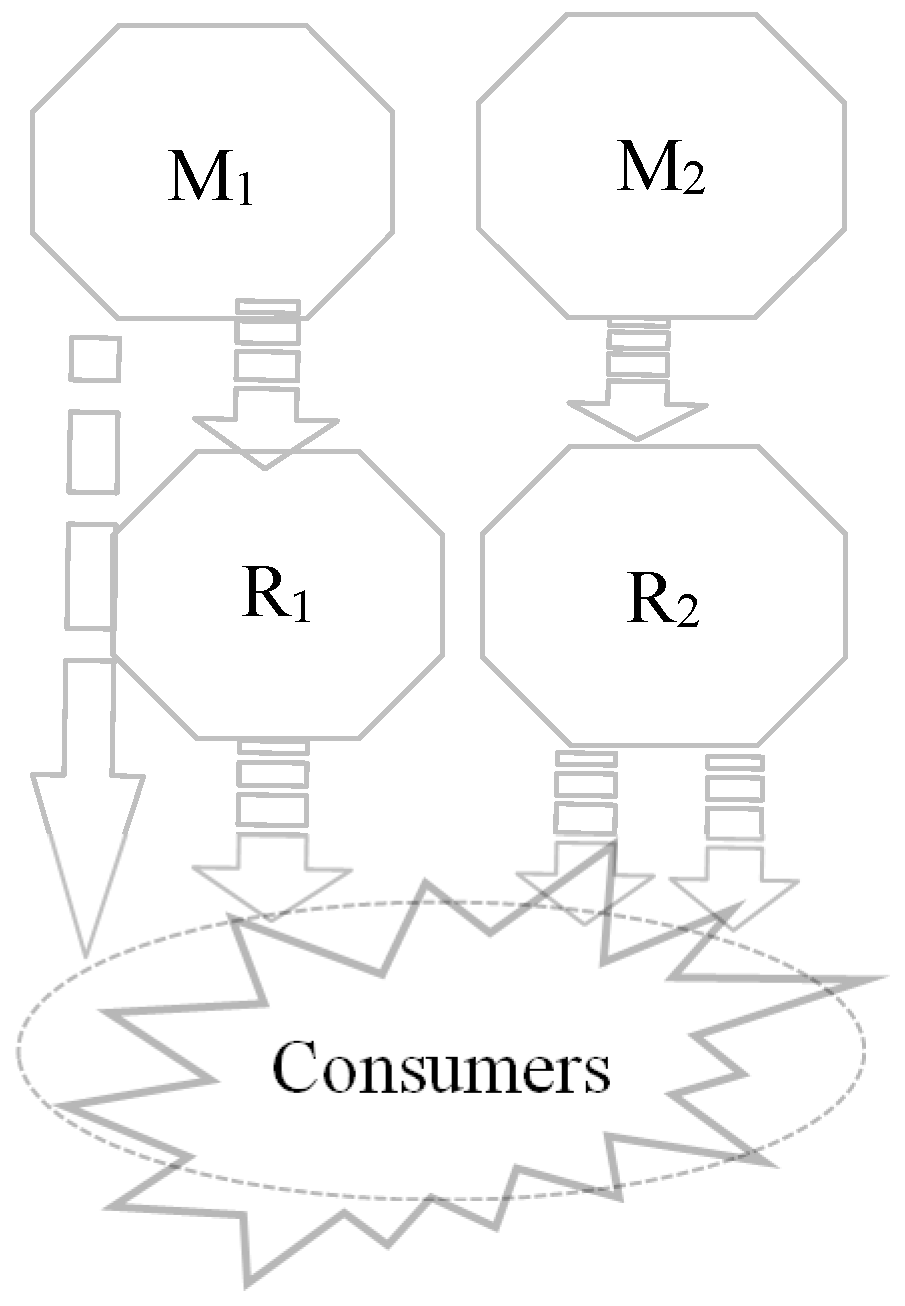
Consider a market with two omni-channel supply chains selling substitutable products. Supply chain i (i = 1, 2) consists of a manufacturer
and a retailer
, and sells products through channel j (j = r, e denotes the offline and online channels, respectively; see
Figure 1).
In supply chain 1 (2), the manufacturer (retailer) is responsible for establishing the online channel, and these two dual-channel models are referred to as Model M and Model R, respectively, which are quite popular in reality. For example, Apple, as a brand manufacturer, opens the online channel Apple.com by itself and also has many retailers offline. At the same time, JD.com, as one retailer of Apple, opens online and offline channels selling Apple’s products across China. Another example can be Kweichow Moutai, a famous brand manufacturer of wine. Kweichow Moutai has its own online channel for selling wine to consumers directly and also has many retailers offline. Freshippo, as one retailer of Kweichow Moutai, opens online and offline channels in the meantime to sell Moutai wine to consumers.
Retailer
places orders
with manufacturer
at a wholesale price
for products with a production cost
, while simultaneously stocking the online channel with a certain quantity
. The channel sells at a retail price
and incurs selling costs
, such as ordering and promotion. Unlike traditional dual-channel supply chains that focus solely on inter-channel competition, this paper considers omni-channel cooperation between the online and offline channels within the supply chain. Specifically, the physical store Ri is responsible for customer services such as product display, experience, and after-sales maintenance for both the online and offline channels. Retailer Ri exerts service effort
and incurs the associated cost
[
3]. Due to the positive externality generated by omni-channel cooperation, the online channel benefits
from the service cooperation provided by the physical store, where the parameter
reflects the degree of service cooperation between channels. Market demand is inversely (directly) proportional to the selling price of the focal (competing) brand and directly (inversely) proportional to the service level of the focal (competing) brand. In addition, each channel
j in supply chain
i faces a certain number of random visitors
, which follows a probability distribution
with a range of
, with density functions
. Based on the above description, the market demand is given by:
In the above demand function,
denotes the base market demand for brand
i,
represents the proportion of consumers who switch to the online channel for purchase,
captures the market expansion effect brought about by the establishment of the online channel,
m(
n) denotes the price (service) sensitivity coefficient, and
represents the price (service) substitution factor, satisfying
. It can be observed that due to the substitution effect between channels, engaging in service cooperation with the online channel also introduces competition for the physical store. At the end of the sales season, the retailer disposes of any remaining products at a salvage value of
, while the unit shortage cost due to stockouts is defined as
. Let
denote the profit functions. Note that
. Based on the above assumptions, the profits of each supply chain participant can be expressed as follows:
In the above profit functions,
,
and
denote the expected shortage, surplus, and sales volume of the product, respectively. Formula (1) represents the manufacturer’s profit in supply chain 1 and consists of the online order profits minus online expected shortage service costs and online expected shortage selling costs, and plus offline order profits. Formula (2) represents the manufacturer’s profit in supply 2 and consists of the online order profits and the offline order profits. Formula (3) represents the retailer’s profit in supply chain 1 and consists of the offline selling profits minus offline expected shortage service costs, offline expected shortage selling costs, and the total costs of service efforts. Formula (4) represents the retailer’s profit in supply chain 2 and consists of the sum of online and offline selling profits minus online and offline expected shortage service costs, online and offline expected shortage selling costs, and the total costs of service efforts.
represents the total profit of supply chain
i, and
represents the total profit of the overall system. We summarize the related parameters in
Table 2.
To analyze the impact of inter-supply-chain competition on omni-channel operations, four equilibrium structural models of inter-supply-chain competition are considered below, based on whether the two omni-channel supply chains adopt centralized or decentralized decision-making. These four models are: competition between two decentralized supply chains (DD model), competition between a decentralized supply chain and a centralized supply chain (DI and ID models), and competition between two centralized supply chains (II model).
3. Equilibrium Strategies of Inter-Supply-Chain Competition in Ordering and Service
3.1. DD Competition Model
When both omni-channel supply chains adopt decentralized decision-making, with each member within the supply chain aiming to maximize its own profit, the competitive equilibrium under the DD model can be formulated as the following EPEC (Equilibrium Program with Equilibrium Constraints) optimization game model [
9]:
Both the upper and lower levels represent Nash competition equilibrium among competing firms. The meaning of each formula in EPEC formulations is that, given any decision from the competitor, solve the equilibrium solutions for the manufacturer/retailer that make its profit optimal. Through analysis, the following proposition holds.
Proposition 1. Under the DD model, the retailer’s expected profit functions and are strictly differentiable concave functions with respect to the joint decisions and , respectively. The equilibrium decisions for retailer ordering and service levels are given by: Proof.
Let
,
, the Hessian matrices of
and
with respect to
and
are:
and
The leading principal minors of each order are as follows:
and
That is, the Hessian matrices are strictly negative definite; therefore, and are strictly differentiable concave functions with respect to and . Solving the system of first-order conditions for the retailer’s decision variables, = , yields the equilibrium decisions for retailer ordering and service levels under the DD model, which satisfies Equation (5). This completes the proof. □
Let , , and , , and performing sensitivity analysis on the parameters leads to the following results:
Corollary 1. , , , , , , and when the sizes of the two chain parameters are the same, there is , .
Proof.
Based on the sensitivity analysis of the parameters, it can be known that:
This completes the proof. □
To further analyze the optimal equilibrium strategy of the manufacturer at the upper level, substituting Equation (5) into the manufacturer’s profit function and solving the system of first-order conditions, , yields the equilibrium decisions of the manufacturer, which satisfies the following conclusion.
Proposition 2. The manufacturer’s optimal ordering and wholesale price decisions satisfy the following equations: From Corollary 1, it can be seen that, given the wholesale price, deeper service cooperation will reduce the offline store’s order quantity while increasing the online channel’s order quantity. Therefore, engaging in service cooperation is detrimental to the offline channel but beneficial to the online channel. Comparing the two types of omni-channel structure models, in Model M, where the online channel is controlled by the manufacturer, the absence of double marginalization results in a higher degree of centralization, endowing this model with greater structural superiority. However, in Model M, the implementation of service cooperation simultaneously dampens the retailer’s incentive for promotion. In contrast, in Model R, deeper service cooperation enhances the retailer’s service level, and given the same wholesale price, the service level in Model R is higher. This, to some extent, reflects the superiority of Model R in the context of omni-channel cooperation. This advantage helps to offset the loss in supply chain structural efficiency caused by the higher degree of double marginalization in Model R compared to Model M. Therefore, when the positive effects of service cooperation outweigh the structural disadvantages of the supply chain, the profit of the omni-channel supply chain under Model R may exceed that under Model M (a finding corroborated by the numerical analysis in this paper). Does omni-channel cooperation necessarily harm the retailer and the supply chain in Model M? The analysis shows that service cooperation in Model M has a positive effect on both the retailer and the supply chain. This is because, to incentivize the retailer to engage in cooperation, the manufacturer adopts a strategy of lowering the wholesale price, which reduces the retailer’s ordering cost, alleviates the double marginalization effect in the omni-channel supply chain, encourages the retailer to increase order quantity and service level, and ultimately improves the overall operational efficiency of the omni-channel supply chain.
3.2. DI, ID, and II Competitive Mode
When omni-channel supply chain i adopts an integrated strategy while supply chain 3 − i remains decentralized, taking the DI model as an example, the competitive game decision model for the two omni-channel supply chains can be formulated as the following MPEC (Mathematical Program with Equilibrium Constraints) optimization model [
11]:
In the game model, the lower level consists of the competitive equilibrium between retailer i and supply chain 3 − i, while the upper level represents the optimization problem of the manufacturer
. The reason for MPEC formulations is that given any decision from
and the competitor, supply chain 2, it solves the equilibrium solutions for
which makes its profit optimal and also makes the profits of
and supply chain 2 optimal. Similar to Proposition 1, the profit function
of the omni-channel supply chain is a strictly differentiable concave function with respect to
. This is accomplished by solving the system of first-order conditions for the profit function of the omni-channel supply chain under the DI model (or ID model) with respect to its decision variables:
The lower-level equilibrium decisions of the game can be obtained, respectively, which satisfy the following proposition.
Proposition 3. Under the DI and ID models, the equilibrium joint decisions of ordering and service levels for members of the omni-channel supply chain satisfy the following equations: Substituting Equation (7) into the profit function of the manufacturer under the DI model (or ID model) and solving of first-order conditions for the upper-level decisions yields the optimal ordering and wholesale price strategies for the manufacturer under the DI model (or ID model), which satisfies the following conclusion.
Proposition 4. Let
, , and the optimal joint decisions of the manufacturer’s ordering and wholesale price satisfy: The above conclusions indicate that
,
, suggesting that when a centralized supply chain competes with a decentralized supply chain, the centralized structure is dominant, and the decentralized supply chain may adopt coordination strategies to cope with competition. The following analysis focuses on the equilibrium strategies under the II model. When both omni-channel supply chains adopt centralized strategies, the core firm aims to maximize supply chain profit. The inter-supply-chain competition under the II model can be formulated as the following Nash competition equilibrium game model:
By simultaneously solving the system of first-order conditions of the supply chain profit expressions with respect to the decision variables, , the equilibrium strategies for inter-supply-chain competition between the two centralized omni-channel supply chains under the II model satisfy the following conclusion.
Proposition 5. Under the II model, the optimal joint decisions for ordering and service levels in the equilibrium of omni-channel supply chain competition satisfy: Let . Without loss of generality, assume that the unit profit of products from the same brand is identical, i.e., (), which implies . Through analysis, the following result holds:
Corollary 2. , , , , , and when , .
According to Corollary 2, under the II model, the implementation of service cooperation by supply chain i always helps to increase the online order quantity of the focal supply chain and the overall service level of the supply chain. Moreover, when consumer service sensitivity is sufficiently high, the offline order quantity also increases with the service level, while both the online and offline order quantities of the competing supply chain (supply chain 3 − i) are adversely affected. The service level of the focal supply chain is not influenced by the degree of cooperation of the competing supply chain. In summary, engaging in service cooperation benefits the focal supply chain while harming the competing supply chain, effectively enhancing inter-supply-chain competitiveness. Therefore, omni-channel cooperation is a dominant strategy in supply chain competition and should be vigorously promoted. Corollary 2 also indicates that intensified inter-supply-chain competition is detrimental to both supply chains.
For a clearer understanding of results in this study and setting the stage for the comparison in
Section 4, we summarize the differences in the assumptions and modeling design among these four scenarios—DD, DI, ID, and II in
Table 3.
4. Design of the Cross-Channel Supply Chain Coordination Mechanism
To further improve the operational efficiency of omni-channel supply chains and facilitate the transition from a decentralized to a centralized structure, the following analysis examines the design of coordination contract mechanisms for omni-channel supply chains. An omni-channel supply chain involves multiple decision variables, making it impossible for a single contract to simultaneously coordinate ordering and service decisions. Consider a class of wholesale price plus subsidy contracts : the manufacturer supplies products to the retailer at a wholesale price and provides subsidies to compensate the retailer for losses due to overstock and stockout, respectively. Additionally, based on the experiential and after-sales services provided by the physical store, the manufacturer offers the retailer a service subsidy .
Proposition 6. (1) When manufacturer offers a wholesale price plus subsidy contract that satisfies the following conditions, the omni-channel supply chain under Model M can achieve the decision-making level of a centralized supply chain: (2) When manufacturer offers a wholesale price plus subsidy contract that satisfies the following conditions, the omni-channel supply chain under Model R can achieve the decision-making level of a centralized supply chain: Proof.
Under the wholesale price plus subsidy contract
, within the interval where the retailer’s optimal decision lies, we have:
After analysis, it is shown that
is a differentiable concave function with respect to
. Solving
, the first-order condition for the decision variable yields
,
. Substituting this into
, it can be found that within the manufacturer’s optimal decision interval is the following:
This expression is a strictly differentiable concave function with respect to . Further solving the first-order condition gives , indicating that the M-model omni-channel supply chain achieves the decision-making level of a centralized supply chain. By the same reasoning, the wholesale price plus subsidy contract can achieve perfect coordination in the R-model omni-channel supply chain. This completes the proof. □
Note: The specific values of the parameters in the theorem are related to the bargaining power of the chain members and must satisfy the incentive compatibility (IC) and individual rationality (IR) constraints: that is, after coordination, the profits of each manufacturer and retailer must be greater than those in the uncoordinated scenario.
Proposition 6 gives the specific form of the subsidy contract. In practice, the manufacturer has data corresponding to each parameter in the subsidy contract, and then can get the specific subsidy values in the contract. Based on these subsidy values, the manufacturer can carry out the contract through various means, e.g., sales volume ratio rebate, factory direct discount, joint promotion subsidy, etc. For example, in order to assist its offline distributors in coping with the intensified market competition and the rising operational pressure, Gree Electric Appliances plans to set aside approximately 5% of its 2025 offline channel sales revenue as funds for building its own offline distribution channels. In addition, for accurately monitoring and subsidizing retailers’ service efforts, the manufacturer can regulate the level of service efforts by signing contracts with retailers that include quantifiable service indicators, and also implement corresponding reward and punishment mechanisms. Not only that, but post-sale data tracking, dynamic monitoring, and inferring the level of service efforts based on outcome indicators are effective ways employed by manufacturers to subsidize service efforts that are difficult to directly observe in reality.
5. Numerical Analysis and Sensitivity Analysis
To further elucidate and complement the findings of this study, a numerical analysis is conducted below. Following field research on enterprises, data collection, and statistical analysis, the model parameters are obtained as follows:
These values are all in the realistic parameter ranges and consistent with the relationship between the parameters based on the existing literature and practical investigation. To conduct a comparative analysis of the payoffs of supply chain members under competition between the two omni-channel models, a sensitivity analysis of the relevant parameters is first performed to examine the impact of service collaboration on the omni-channel supply chain. Subsequently, a comparative analysis of the two omni-channel supply chain structures is carried out to identify the competitive advantages and applicable conditions of each model. Finally, the coordination problem of the omni-channel supply chain is analyzed to explore effective pathways for improving operational efficiency in the omni-channel supply chain.
5.1. Parameter Sensitivity Analysis
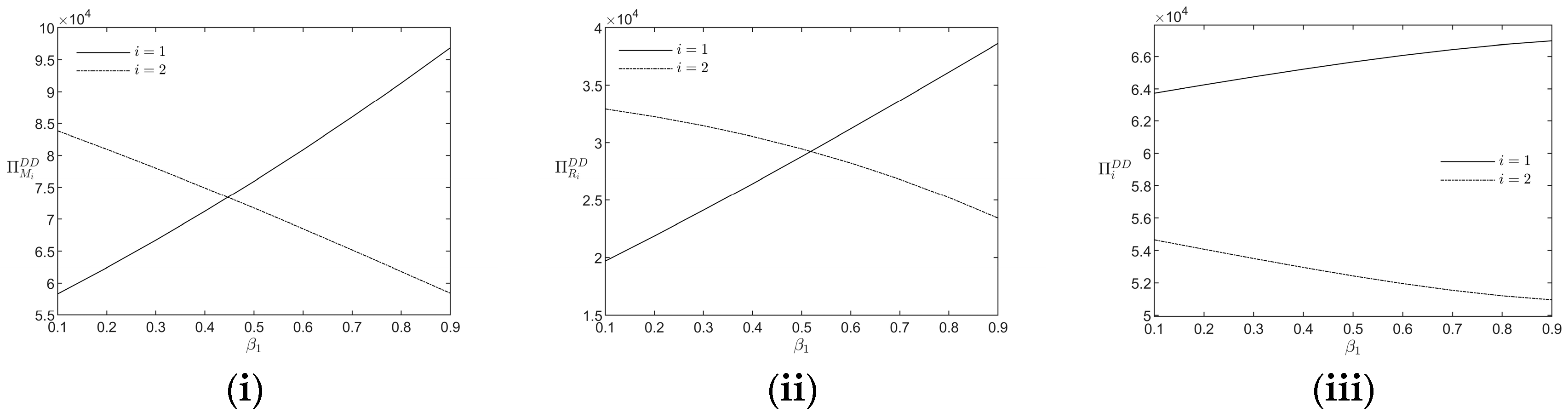
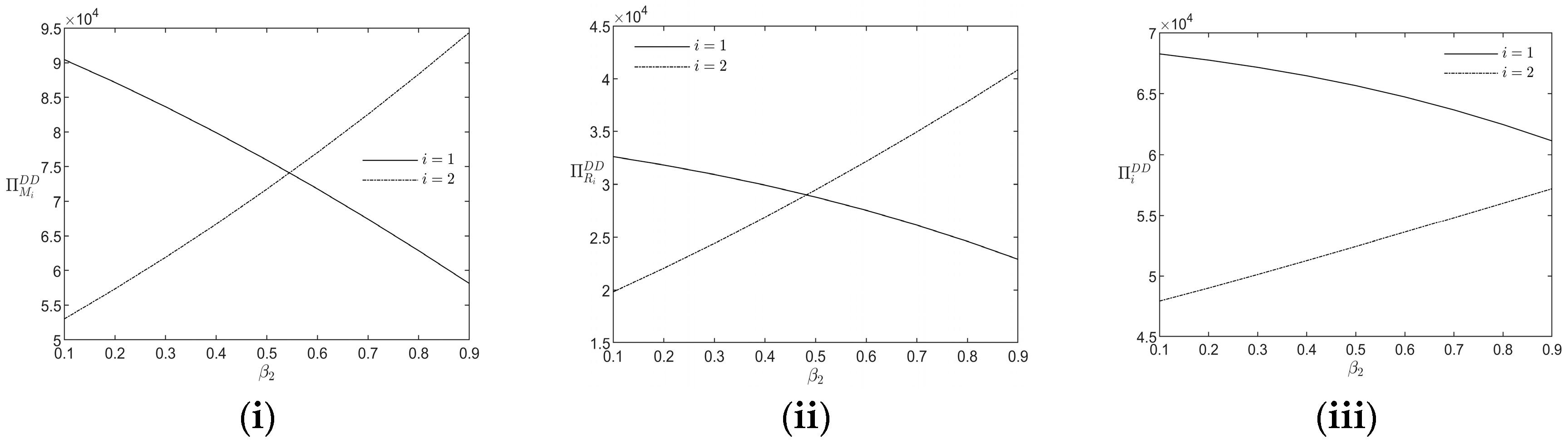
First, holding other parameters constant, a sensitivity analysis is conducted to examine the effects of the degree of service collaboration
and
in the omni-channel supply chain on the profits of the manufacturer, the retailer, and the overall supply chain (see
Figure 2 and
Figure 3). The following conclusions can be drawn.
- (1)
As shown in
Figure 2 and
Figure 3, regardless of whether in the M-model or the R-model, the results are as follows.
increases, and , and increase, whereas , and decrease. This indicates that engaging in omni-channel service collaboration benefits the focal supply chain while adversely affecting the competing supply chain. This is because such collaboration enables the retailer’s service to generate positive within-chain externalities across channels and enhances the inter-chain competitiveness of the supply chain. To sustain this advantage, the supplier reduces the wholesale price to incentivize the retailer to engage in service collaboration. The reduced wholesale price lowers the retailer’s ordering cost while offsetting the disadvantages caused by service spillover effects, prompting the retailer to increase the service level and order quantity. As a result, the profits of the manufacturer, the retailer, and the overall supply chain all increase. Ultimately, service collaboration achieves a win–win outcome for both online and offline channels, retailers and manufacturers, sellers, and consumers, while also enhancing the overall market competitiveness of the supply chain. Therefore, engaging in service collaboration constitutes a dominant strategy in omni-channel supply chain competition.
- (2)
A further analysis is conducted to examine the variation in supply chain profits as
and
increase simultaneously and are equal (
), with the results shown in
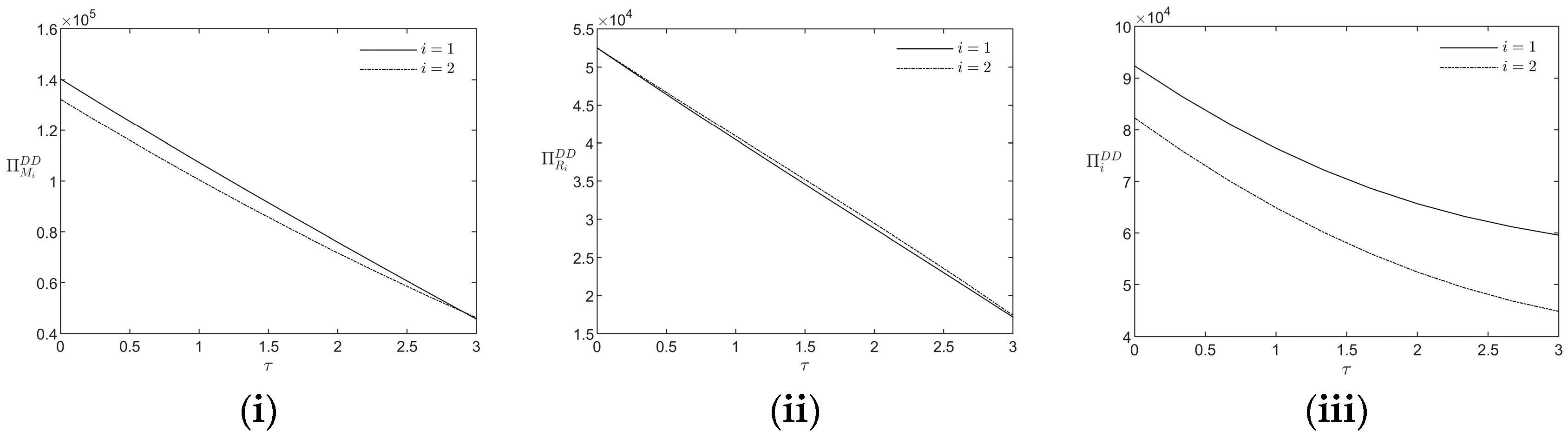
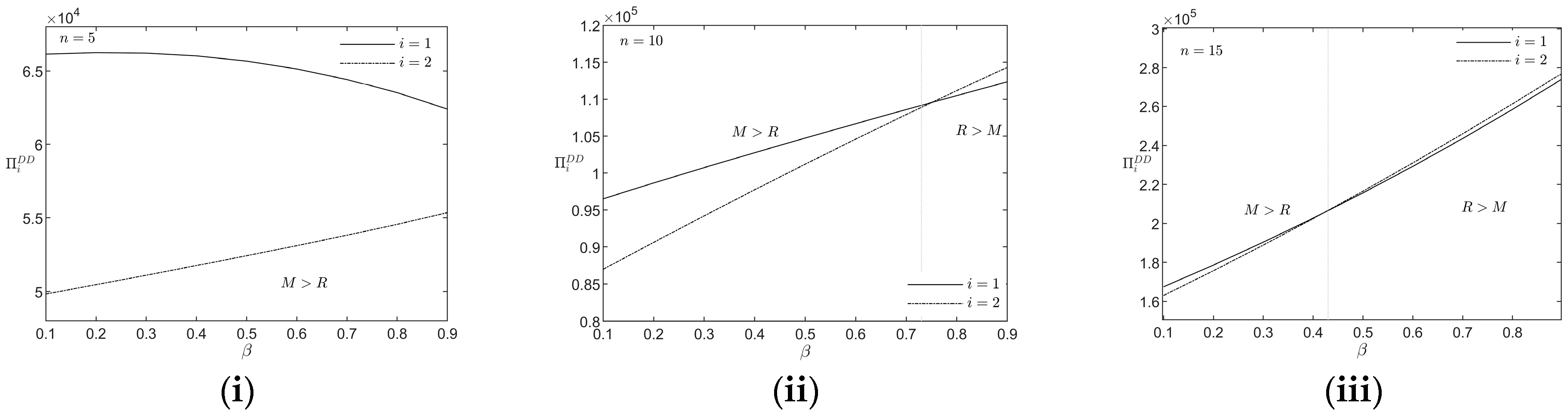
Figure 4. As illustrated in
Figure 4, although service collaboration brings benefits to the omni-channel supply chain, it also intensifies inter-supply-chain competition. When the consumer sensitivity to service is low (n = 5), the benefits of service collaboration under the M-model fail to offset the losses induced by intensified competition, causing supply chain profits to first increase and then decrease as
increases. As consumer sensitivity to service rises (n = 10), profits under the M-model increase with the simultaneous expansion of service collaboration across both chains. When n increases further (n = 15), the rate of profit growth under the M-model accelerates with
. In contrast, regardless of the value of n, the supply chain profit under the R-model consistently increases as
increases. Thus, when both supply chains engage in service collaboration simultaneously, the M-model supply chain benefits from service collaboration only when consumer sensitivity to service is sufficiently high, whereas service collaboration competition always benefits the R-model.
- (3)
The analyses to examine the variations in supply chain profits as
and
increase are conducted with the results shown in
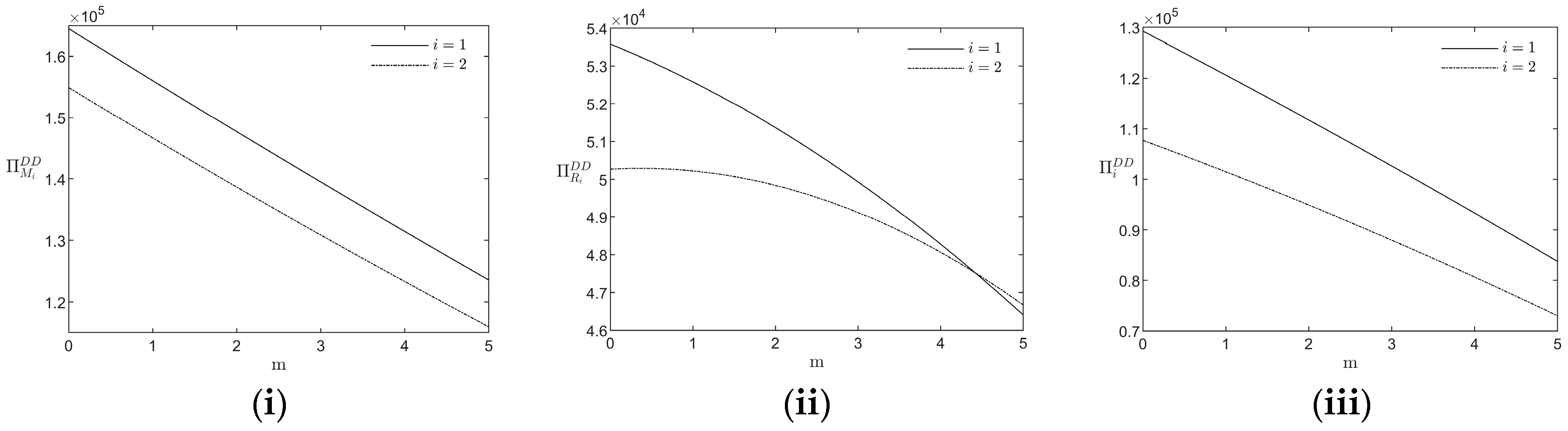
Figure 5 and
Figure 6. As illustrated in
Figure 5, the increase in the service substitution factor
has the same effects on the profits of the manufacturers, retailers, and the whole supply chains, i.e., decreases the profits of all members. Similarly, the price sensitivity coefficient
has the same implications except that the increase of
make the profit of the retailer in supply chain 2 descend more slowly. Overall, all members’ profits in supply chain 2 are always lower than those in supply chain 1, with the increases of
and
, including the supply chains’ profits.
5.2. Comparative Analysis of Omni-Channel Models
Below is a comparative analysis of omni-channel supply chain structures under inter-chain competition with heterogeneous channel structures. By conducting sensitivity analyses on the parameter
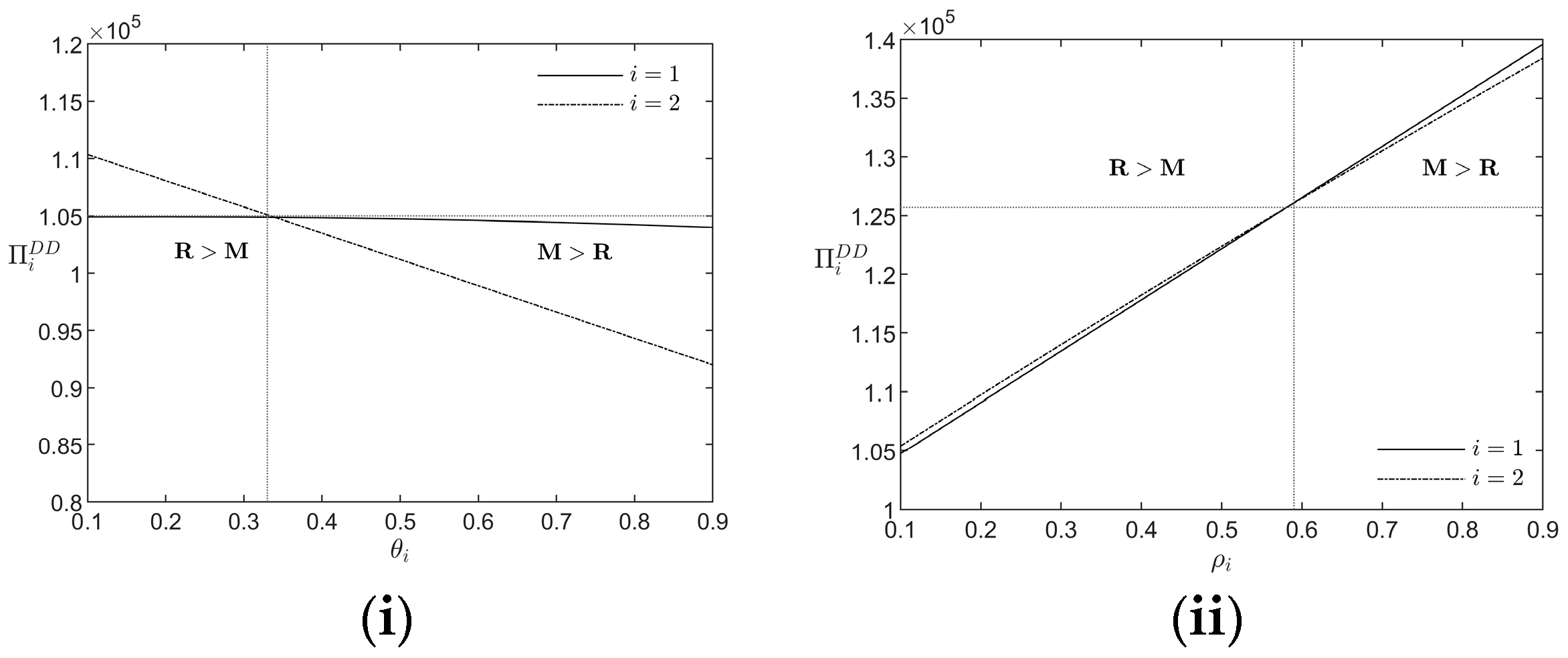
sequentially (see
Figure 4 and
Figure 7) and comparing the profits of the M-model and R-model supply chains, the following research conclusions are obtained:
- (1)
Comparing the equilibrium profits of the M-model and R-model supply chains under competition (
Figure 4) reveals that when n is low (n = 5), the profit of the R-model omni-channel supply chain is consistently lower than that of the M-model supply chain. This is because the R-model exhibits a lower degree of centralization compared to the M-model, which possesses an inherent structural advantage. As n increases, however, the benefits of service collaboration become more pronounced for the R-model, enabling its profit to surpass that of the M-model. Notably, the larger n is, the greater the dominance interval of the R-model, and the more evident the R-model’s advantage in service collaboration competition. In summary, deepening service collaboration across channels constitutes a dominant strategy in inter-chain competition. Such collaboration benefits both supply chains, and in the absence of resource constraints, the equilibrium-dominant omni-channel structure under competition is the R-model, with its advantage becoming more pronounced as consumer sensitivity to service increases. To further compare the two omni-channel structures, the effects of other parameters are analyzed below.
- (2)
Fixing
, sequential sensitivity analyses of parameters such as
(
Figure 7) indicate that there exist corresponding parameter intervals under which either the M-model or the R-model becomes the dominant omni-channel structure. The rationale is as follows: as
increases, the total market size expands, prompting the manufacturer to raise the wholesale price. Since only the offline channel is affected by the wholesale price in the M-model, the impact of such an increase is smaller than in the R-model. Consequently, when
is relatively high, the M-model becomes the dominant strategy in omni-channel supply chain competition. Conversely, an increase in
harms offline channel sales, leading the supplier to lower the wholesale price to compensate for this loss. As consumers in the M-model ultimately shift to the manufacturer’s online channel, the manufacturer offers a greater price reduction in this model, making the M-model dominant when
is sufficiently high. This Figure also suggests that excessive channel migration may be detrimental to the overall supply chain, implying that firms should avoid blind overemphasis on online marketing. As the intensity of supply chain competition
increases, the profits of both supply chains decline. This is because heightened competition exacerbates the double marginalization effect, causing both chains to overconsume resources in response to competition, thereby increasing efficiency losses and reducing profits. Meanwhile, intensified competition leads both supply chains to exert greater promotional efforts, allowing the R-model to gradually gain the upper hand. It can be observed that when
is sufficiently high, the R-model becomes the dominant strategy; inter-supply-chain competition benefits consumers but is detrimental to the supply chain system.
Synthesizing the above analyses, the following conclusion can be drawn: When the parameters satisfy certain conditions, omni-channel supply chain systems can benefit from engaging in service collaboration. There exist parameter intervals for such that the M-model and the R-model respectively serve as the dominant structural strategies in O2O inter-chain competition.
5.3. Analysis of Cross-Channel Supply Chain Coordination
First, the value of the coordination contract for the omni-channel supply chain is analyzed. The data in
Table 4 confirm the effectiveness of the coordination contract. The following explains how the designed contract mechanism can be used to coordinate the DD model into the ID model or the DI model, and further into the II model. As shown in
Table 4, by keeping omni-channel supply chain 2 unchanged and applying the wholesale price plus subsidy contract specified in Proposition 6(1), the DD model can be coordinated into the ID model. Specifically, with parameters
, we have
. After coordination, the decisions and profits of supply chain 1 reach the centralized level, which is higher than that in the uncoordinated scenario:
Similarly, keeping omni-channel supply chain 2 unchanged and selecting the wholesale price plus subsidy contract parameters , , from Proposition 6(1), the DI model can be coordinated into the II model, while simultaneously increasing the profit of supply chain 1.
Keeping omni-channel supply chain 1 unchanged and adopting the wholesale price plus subsidy contract parameters , , from Proposition 6(2), the DD model can be coordinated into the DI model. Likewise, using the wholesale price plus subsidy contract parameters , , from Proposition 6(2), the omni-channel ID model can be coordinated into the II model, while concurrently enhancing the profit of omni-channel supply chain 2.
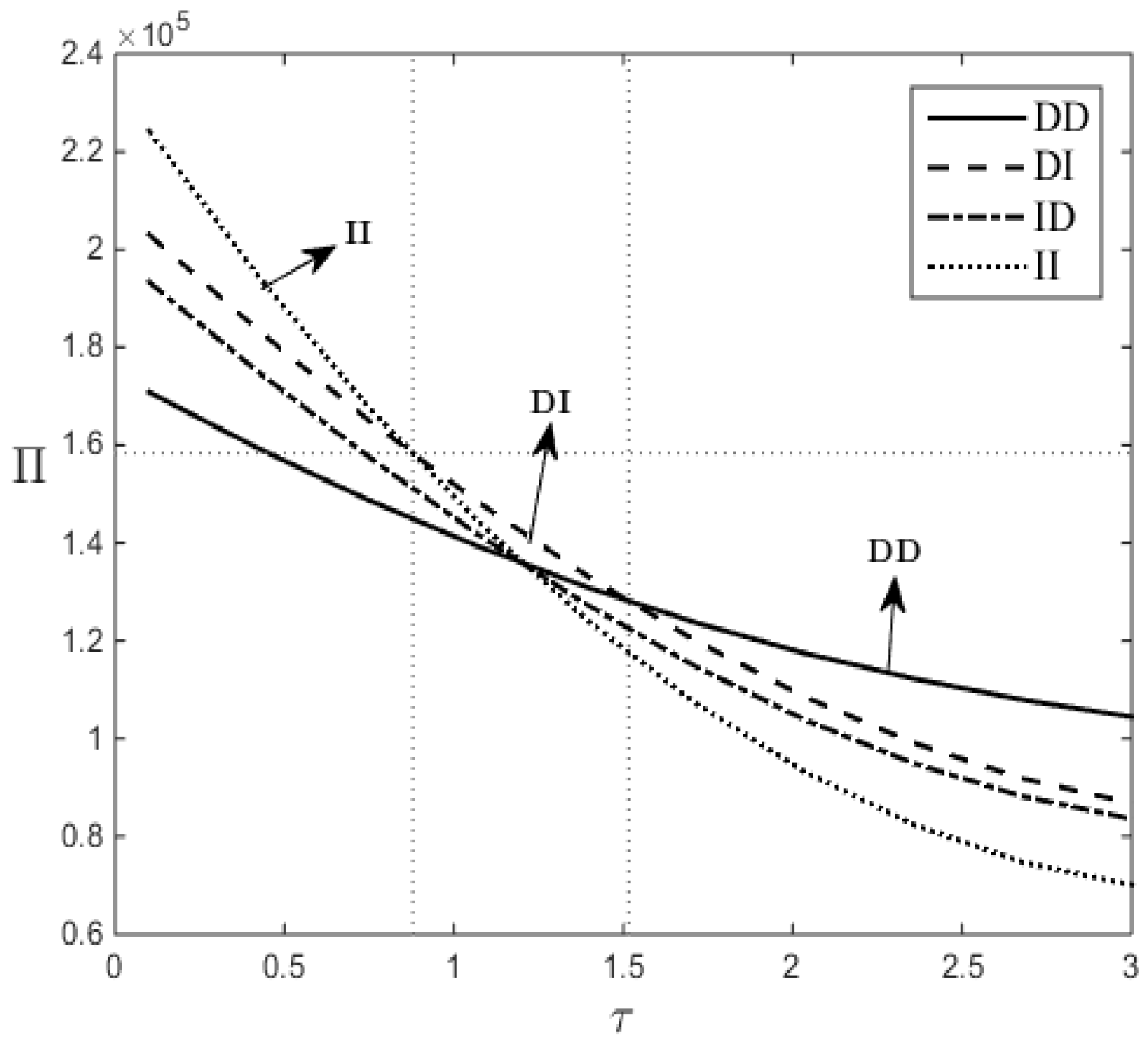
The above analysis indicates that when two omni-channel supply chains compete, managers of both M-model and R-model omni-channel supply chains will invariably choose to engage in internal coordination. After coordination, the profit of the omni-channel supply chain not only exceeds its pre-coordination level but also surpasses that of the competing supply chain. This implies that under the DD model, both omni-channel supply chains will opt for internal coordination, and the equilibrium state of supply chain competition ultimately evolves into the II competition model. In summary, coordination constitutes a dominant strategy for a single omni-channel supply chain. However, from the perspective of the entire supply chain system (i.e., the sum of the profits of the two omni-channel supply chains), does coordination remain a dominant strategy? This study further conducts a comparative analysis of the total profits of the two supply chains under the DD, DI, and II models, with the results shown in
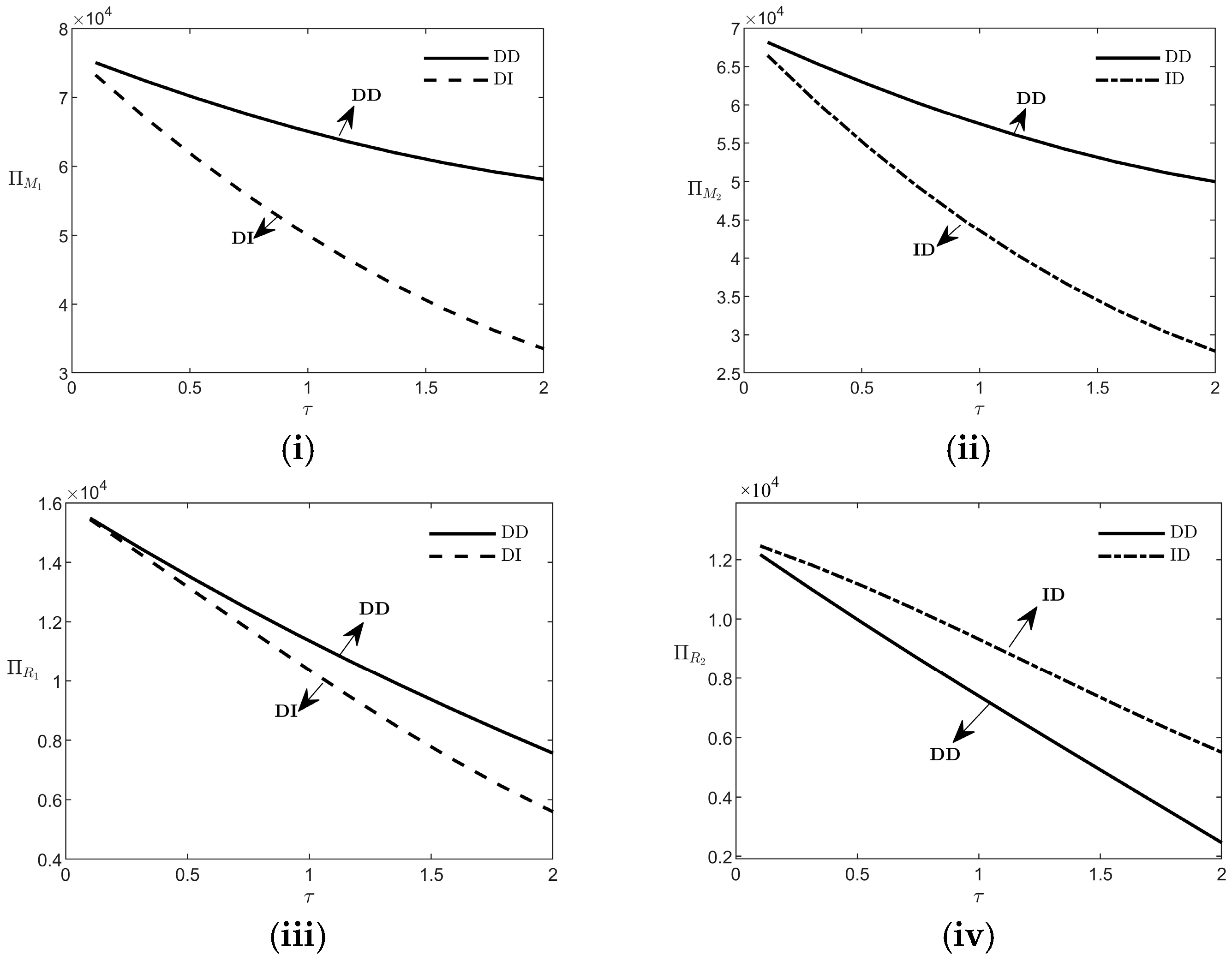
Figure 8. As illustrated in
Figure 8, when the intensity of inter-supply-chain competition is relatively low, the system profit is highest under the II model. As the intensity of inter-chain competition
increases, the structural mode yielding the highest system profit gradually shifts to the DI model. Eventually, when the intensity of market competition increases to a certain level, the DD model becomes the optimal state for supply chain system profit, while the II model yields the lowest profit. The reason behind
Figure 8 can be obtained intuitively from
Figure 9, which shows the scenario comparisons (high vs. low competition) of each supply chain member’s profits. This is because, compared with other models, the II model entails more intense competition between supply chains and a higher degree of double marginalization, leading both chains into a “prisoner’s dilemma”. It can be seen that from the perspective of the overall supply chain system, excessive adoption of coordination strategies by omni-channel supply chains may instead prove detrimental. Managers of supply chain systems should therefore appropriately select the structural state of supply chain competition based on the intensity of market competition. The above analysis offers managerial insights for omni-channel supply chain managers in formulating rational coordination strategies.
6. Conclusions
The advancement of technologies such as mobile internet and online payment has given rise to omni-channel operations as a novel marketing business model, while simultaneously intensifying competition among supply chains. This study considers market competition between two supply chains of substitutable brands, wherein one supply chain establishes an online channel from the manufacturer side (M-model) and the other from the retailer side (R-model). In both cases, the online channel leverages offline physical stores for service marketing collaboration, including product display, trial, and after-sales service. Using optimization and analytical modeling methods such as EPEC, MPEC, and Nash equilibrium, this study investigates decision-making, competitive equilibrium, model selection, and intra-chain coordination under competition between two omni-channel supply chains. The findings are as follows:
- (1)
Regardless of whether the omni-channel supply chain adopts the M-model or the R-model, engaging in service collaboration constitutes a dominant strategy under competition between the two supply chains, enabling the supply chain to secure a greater competitive advantage. Managers of omni-channel supply chains should therefore actively plan and implement this marketing model.
This finding offers several actionable implications for managers of omni-channel supply chains operating in competitive environments. First, the result that service cooperation constitutes a dominant strategy under inter-supply-chain competition—regardless of whether the manufacturer opens an online channel (M-mode) or the retailer opens an online channel (R-mode)—suggests that service cooperation should no longer be viewed as a discretionary operational choice. Instead, it is a strategic necessity for competing supply chains seeking to secure a competitive advantage. Managers in both channel leadership structures are therefore advised to proactively initiate and implement service cooperation mechanisms with their channel partners. Second, the finding that service cooperation enables a supply chain to capture greater competitive advantage implies that hesitation or delay in adopting such cooperation may place a supply chain at a systematic disadvantage relative to rival chains that do cooperate. From a strategic planning perspective, omni-channel supply chain managers should prioritize the design of service collaboration frameworks—such as joint investment in after-sales support, cross-channel service integration, and aligned service-level agreements—that are robust to different channel governance modes. Finally, given that the dominance of service cooperation holds under inter-supply-chain competition, managers should recognize that the decision to cooperate on services not only improves internal channel coordination but also serves as a competitive weapon against rival supply chains. Accordingly, the active deployment of service cooperation in omni-channel marketing strategies is strongly recommended as a means to enhance long-term profitability and market positioning.
- (2)
In terms of channel structure selection, when both the M-model and R-model supply chains choose to engage in service collaboration, the R-model gradually becomes the dominant structural strategy as the degree of collaboration deepens. Further analysis reveals that the R-model should also be selected when the scale effect of the online channel is low, the substitution factor of the online channel is low, or the intensity of market competition is high; otherwise, the M-model is preferable. Thus, managers should appropriately select the omni-channel supply chain structure based on the relevant parameter conditions.
The finding provides nuanced guidance for omni-channel supply chain managers regarding the selection of channel structure modes under inter-supply-chain competition. First, when both competing supply chains—regardless of whether the manufacturer opens an online channel (M-mode) or the retailer opens an online channel (R-mode)—choose to engage in service cooperation, the R-mode gradually becomes the dominant strategy as the degree of cooperation deepens. This implies that managers who anticipate or plan to implement deep service collaboration should consider transitioning toward or adopting the retailer-led online channel structure to maximize competitive advantage. Second, the results identify specific boundary conditions under which the R-mode is preferred: when the economies of scale of the online channel are relatively low, when the online channel substitution factor is low, or when the intensity of market competition is high. Conversely, under opposite conditions (higher online channel economies of scale, higher substitution factor, or lower market competition intensity), the M-mode becomes the preferred choice. This suggests that channel structure decisions should not be made in a one-size-fits-all manner. Instead, managers are advised to carefully assess key contextual parameters—including online channel efficiency, the degree of cannibalization between online and offline channels, and the competitive landscape—before committing to a particular omni-channel structure. A dynamic, contingency-based approach to channel structure selection, rather than a static preference for either mode, will enable supply chains to better align their omni-channel strategies with market conditions. In summary, the strategic choice between M-mode and R-mode in omni-channel supply chains should be informed by empirical evaluation of the relevant parameters, with the retailer-led mode gaining favor under conditions of deep cooperation, limited online scale economies, low substitution, or high competition.
- (3)
Upstream–downstream coordination within an omni-channel supply chain constitutes an equilibrium-dominant strategy under inter-supply-chain competition, with the equilibrium state of supply chain competition being the II model. However, when both omni-channel supply chains implement coordination strategies, the overall supply chain system may fall into a “prisoner’s dilemma” (i.e., the system profit after coordination is lower than before coordination). System managers should implement coordination based on the specific circumstances: for instance, both supply chains should coordinate when the intensity of market competition is low; only the R-model supply chain should coordinate when competition intensity is moderate; and coordination should be avoided when competition intensity is high.
This finding yields important managerial implications for omni-channel supply chain decision-makers operating under inter-supply-chain competition. The result that vertical coordination between upstream and downstream members within an omni-channel supply chain constitutes an equilibrium-dominant strategy under competition suggests that, in principle, managers should prioritize internal channel coordination as a means to enhance competitive positioning. Specifically, the equilibrium state of supply chain competition occurs when both competing supply chains adopt a centralized decision-making structure. This implies that, from a game-theoretic perspective, full coordination across rival chains represents a natural stable outcome. However, the study also uncovers a critical caveat: when both competing omni-channel supply chains simultaneously implement coordination strategies, the system may fall into a “prisoner’s dilemma” trap, wherein the post-coordination system profit is lower than that prior to coordination. This counterintuitive finding carries profound implications for managerial practice. It cautions managers that pursuing coordination unilaterally—or assuming that coordination always yields superior outcomes—may be misguided when rival chains are also coordinating. Instead, managers should adopt a contingent approach to coordination decisions based on the intensity of market competition.
This study provides a theoretical foundation for the standardized implementation and practice of omni-channel supply chain operations by enterprises. Nevertheless, this study has several limitations. Firstly, in our research scope, we only assume service collaboration in omni-channel supply chains. However, in practice, collaboration in omni-channel supply chains extends beyond service cooperation across channels to encompass aspects such as capital, logistics, inventory, and information. Future research may further explore these themes through extended analysis and investigation. Secondly, our paper only discusses the wholesale mode between the manufacturer and retailer. In practice, both wholesale and agency modes are prevalent. Therefore, examining how different distribution modes affect the results of this study’s conclusions would be an interesting research direction. Thirdly, our paper assumes that the retailer’s orders can be completed immediately. But in reality, the phenomenon of order delays occurs from time to time. Therefore, future research could delve into how considering stochastic lead times or risk-averse preferences of the retailers influences competition and coordination of omni-channel supply chains with different channel structures.