


Abstract
With the proliferation of artificial intelligence (AI) products, Algorithmic Management (AM) is becoming an increasingly prevalent option for corporate governance. Meanwhile, the traditional boundaries between human–machine and interpersonal relationships are blurring. While some current studies suggest that AM is alienating interpersonal relationships within organizations, our research proposes and tests an alternative theoretical perspective, arriving at a contrasting conclusion: interpersonal relationship under AM can be closer. Focusing on employees in organizations utilizing AM, this study investigates how and why AM influences interpersonal relationship closeness (IRC). Grounded in Uncertainty Management Theory, we propose that by fostering a fairer working experience, AM enhances IRC at work by reducing employees’ uncertainty perception. The present research, comprising four studies, empirically establishes that the positive effect of AM on interpersonal closeness is transmitted via fairness perceptions and sequentially mediated by uncertainty reduction. Collectively, these findings challenge the prevailing negative narrative, extend Uncertainty Management Theory to the human–AI interaction context, and offer practical insights for organizations adopting AM.
1. Introduction
Interpersonal relationships have long been considered crucial in traditional organizational models [1]. From the perspective of collective intelligence, interpersonal communication is not merely information transfer but a vital link that connects individuals, forming organizations into organic wholes [2]. From an individual perspective, interpersonal connection is widely recognized as a fundamental human need. Classic motivational theories, such as Maslow’s hierarchy of needs, highlight the importance of belongingness and social relationships for psychological well-being [3]. Given that the workplace constitutes a major social environment for adults, the quality of interpersonal relationships among employees can play a crucial role in shaping both individual experiences and organizational outcomes.
However, dynamic factors from humans such as emotions, moods, and health status involve substantial uncertainty, which inevitably profoundly affects interpersonal relationship closeness (IRC) and even organizational management efficiency [4,5]. It can be argued that organizations both rely on interpersonal connections and unavoidably suffer from the negative impacts of uncertainty within these interpersonal relationships. Therefore, maintaining positive IRC in the workplace is both challenging and critical for organizations and employees [6,7]. The quality of social interactions at work directly impacts individuals’ health and well-being, as well as team cohesion. Previous research has shown that poor social interactions at work can negatively affect health [8] and even lead to team disintegration [9]. The issues of how to reduce uncertainty and maintain healthy collaborative relationships have long been central challenges in human resource management [10,11,12,13].
Some organizations have begun transferring part or all of their managerial functions to algorithms, shifting from “human managing human” to “algorithms managing human” in pursuit of cost reduction and efficiency gains [14]. Particularly with the rapid development of AI technology in recent years, the barrier to using AI-driven algorithmic management (AM) has continuously lowered, sparking interest in AM among a growing number of organizations.
However, while AM may reduce inefficient communication pressures in traditional management, simply weakening interpersonal ties is not advisable, as harmonious relationships remain a cornerstone of healthy organizational development. Consequently, concerns have been raised that AM might weaken or even fracture interpersonal relationships within organizations, as algorithms could monopolize information flow, relationship maintenance, and even power of employees [15,16,17].
Prior to the advent of the AI era, algorithmic decision-making was often criticized for its lack of objectivity and fairness, with researchers emphasizing the need to decipher its “black box” of power [18,19]. As research progressed, scholars increasingly examined how algorithms shape social practices and institutional processes. For example, Ziewitz [20] argues that debates surrounding algorithmic transparency and normative standards often reflect broader social concerns that arise when new technological elements are integrated into established systems. Consequently, academic attention has gradually shifted from questioning whether algorithms should be used toward examining when, where, and how algorithms exert their influence in organizational and social contexts.
Research on relationships under AM predominantly focuses on the contexts of the gig economy and the relationships between employees and the organization or AI, paying insufficient attention to inter-employee relationships in general work settings [21]. For instance, Tomprou and Lee [15], from a psychological contract perspective, explored how employees respond to algorithmic versus human agents in situations of contract fulfillment and breach. Their findings suggest that employees may react differently to algorithmic agents, with lower turnover intentions reported when algorithmic agents under-deliver on promises compared to human agents, particularly in scenarios where promised inducements are severely under-delivered. Other studies link AM with Digital Taylorism, viewing it as an expression of organizations’ extreme pursuit of automated management and efficiency [22]. Taking crowdsourcing platforms as an example, this Digital Taylorist approach often manifests as a focus on production targets and a neglect of individual worker needs [23]. These studies primarily focus on the impact of AI on individual employees, such as knowledge management [24], autonomy [25], job burnout [26], and work disengagement [27]. The objectives of these studies have focused more on gig occupations under AM, such as ride-hailing drivers and food delivery couriers [26]. This contextual specificity raises a critical theoretical question: Are the observed negative interpersonal effects an inherent attribute of AM, or are they contingent upon the particular socio-structural features of gig work (e.g., isolated labor, transactional relationships)?
It should be noted that the gig worker community itself hardly requires traditional colleague relationships, and the closeness between individuals serving a unified employer is already very limited. This context creates the impression that algorithms inherently create interpersonal distance. We thus hypothesize that the formation of these relatively independent relationships is more attributable to the nature of gig platforms themselves, and the advent of AM further intensifies the sense of division in human–AI opposition. In other words, the misconception that AM negatively impacts interpersonal relationships might stem solely from the inherent attributes of the gig economy.
Information technology has long played a crucial role in enabling and strengthening human collaboration. From a collective intelligence perspective, digital communication technologies function as key mechanisms that connect individuals and facilitate coordinated action [28]. In organizational contexts, algorithmic systems may similarly reshape how managerial decisions are implemented and perceived by employees. Compared with traditional human management, algorithmic decision-making is often characterized by greater consistency and reduced susceptibility to personal biases. Organizations frequently introduce algorithmic systems with the expectation that such systems provide more objective and standardized decision processes [4]. Empirical studies also show that individuals often associate algorithmic decisions with efficiency and objectivity, which can shape their perceptions of fairness in organizational decision-making contexts [29]. Such characteristics suggest that AM may foster stronger perceptions of organizational fairness among employees, as consistent and standardized decision processes are more likely to be interpreted as impartial and predictable.
Drawing on uncertainty management theory, perceptions of fairness play a crucial role in how individuals interpret and respond to uncertain environments [30]. When organizational processes are perceived as fair, employees are more likely to view the workplace as stable and predictable, which helps alleviate feelings of uncertainty. Reduced uncertainty, in turn, facilitates trust, cooperation, and positive social interactions among organizational members. In workplace settings where employees experience lower uncertainty about decision processes and outcomes, they are more likely to develop supportive and cooperative interpersonal relationships with their colleagues.
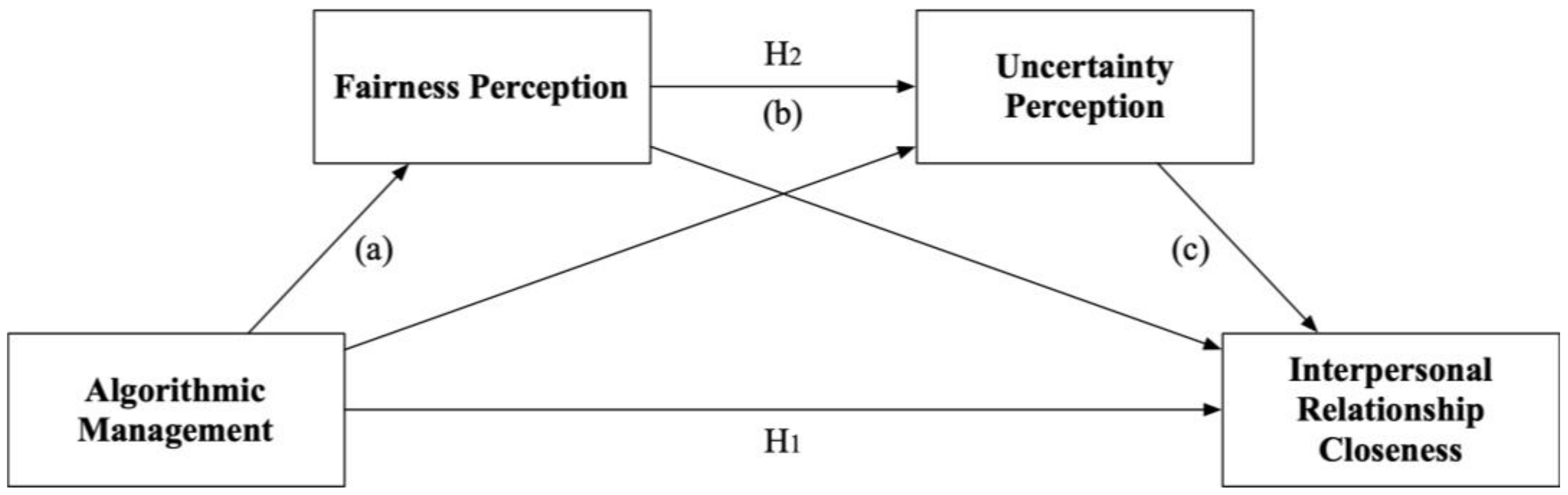
Taken together, these arguments suggest that AM may positively influence IRC by enhancing perceptions of fairness and reducing employees’ uncertainty. Based on these theoretical arguments, we propose the following hypotheses and theoretical model (see Figure 1 “Theoretical model”):
Hypothesis 1.
AM has a positive impact on IRC.
Hypothesis 2.
Fairness perception and uncertainty perception serially mediate the positive relationship between AM and IRC. Specifically, (a) AM is positively related to fairness perception; (b) fairness perception is negatively related to uncertainty perception; (c) uncertainty perception is negatively related to IRC.
Figure 1.
Theoretical model.
2. Overview of Research Design
To rigorously test our core hypothesis that AM enhances IRC through the sequential influence of fairness perception and uncertainty reduction, we adopted a multi-study research design combining correlational surveys and scenario-based approaches. This four-study framework represents a deliberate and progressive empirical strategy designed to address the limitations associated with relying on a single research method. In particular, correlational surveys provide ecological validity by capturing employees’ perceptions in real organizational contexts, whereas scenario-based designs allow for clearer comparisons between management conditions. Combining these complementary approaches enables a more rigorous examination of the proposed theoretical model.
Study 1 employed a cross-sectional online survey with a broad employee sample to establish the baseline relationship between AM and IRC in real organizational settings. Study 2 then used a scenario-based between-subjects design comparing AM with traditional human management to examine whether AM influences employees’ perceptions of fairness and uncertainty. Study 3 further examined the relationships among fairness perception, uncertainty perception, and IRC using an independent survey sample, thereby providing evidence for the proposed psychological mechanism linking these constructs. Finally, Study 4 integrated all key variables within a single survey to provide a comprehensive test of the full sequential mediation model.
Together, these studies provide complementary evidence for the proposed mechanism through which AM shapes interpersonal relationships. By allowing each study to focus on a specific component of the theoretical model while combining different methodological approaches, this multi-study design enhances the robustness and credibility of the empirical findings.
3. Study 1
In the first study, we used an online survey to test the main-effect hypothesis that AM positively influences IRC. While existing research predominantly focuses on the negative impacts of AM on interpersonal relationships within gig platforms, our study sought to examine this relationship within a broader workforce to potentially yield different insights. To distinguish our research from prior studies centered on gig platforms, we did not restrict our sample to a specific work arrangement. That is, participants were recruited regardless of whether their work followed a general employment model or a gig-work model. This approach allowed us to gather data from a more generalized work context, thereby testing the potential positive influence of technology on human relationships. The primary aim of this sub-study was to demonstrate that, in general work settings, the relationship between AM and IRC is not as negative as commonly perceived; instead, IRC can be higher under AM.
3.1. Method
Given that the study was conducted in China, we utilized a domestic online survey platform, wenjuan.com. In October 2024, we recruited participants from seven companies across regions including Beijing, Shandong, and Hebei, spanning multiple industries such as manufacturing and services.
To ensure the reliability of the questionnaire content, we selected measurement scales from internationally renowned, double-blind peer-reviewed journals. Through a literature review of relevant quantitative instruments, we identified two established English-language scales from the management field to measure the two key constructs in Study 1: AM and IRC.
Regarding the specific measures, to assess the application of AM in the workplace, we used the Algorithmic Management Questionnaire (AMQ) developed by Parent-Rocheleau et al. [31]. The scale conceptualizes AM as a multidimensional system encompassing five functional components: algorithmic monitoring, goal setting, scheduling, performance rating, and compensation. Each dimension contains three to five items designed to capture the deployment of AM across different organizational functions. The full scale comprises 20 items, including statements such as “An automated system tracks me carefully to ensure I am completing my tasks.”
Importantly, prior research suggests that AM typically operates as an integrated management system rather than as isolated technological tools. In practice, multiple algorithmic functions are often implemented simultaneously and interact with one another in shaping employees’ work experiences and perceptions [25,32,33]. Consistent with this perspective, the present study conceptualizes AM as a holistic system of interconnected AM practices rather than analyzing each subsystem separately.
To measure the closeness of interpersonal relationships among colleagues, we used the Work Relationship Closeness Scale developed by Chen and Peng [34]. This scale consists of two dimensions—Instrumental Component and Expressive Component—and contains nine items, including “We understand each other” and “We trust each other.”
As the scales were originally in English and the target participants were Chinese speakers, a rigorous translation process was essential. We employed a rigorous double-blind translation and back-translation procedure to develop the Chinese version of the scales [35]. Three researchers with study-abroad experience in English-speaking countries and three researchers with backgrounds in information science participated in this process. All researchers are actively engaged in organizational behavior or human resource management research. All scales used a 7-point Likert scale (1 = “strongly disagree”, 7 = “strongly agree”). Before responding to the adapted questionnaire items, participants were instructed to carefully reflect on their work experiences over the past six months and base their answers on these actual experiences.
3.2. Results
Sample Characteristics and Reliability. After one month of data collection, a total of 243 valid questionnaires were retained. Participants were predominantly between 25 and 41 years old (67.49%), held a bachelor’s degree (65.43%), and were relatively balanced in gender (male 53.09%, female 46.91%). Detailed demographic distribution is presented in Table 1. The measurement instruments demonstrated good internal consistency. Cronbach’s α for the AM scale was 0.969, and for the relationship closeness scale was 0.855, both exceeding the recommended threshold of 0.70.
Table 1.
Descriptive Statistics.
Descriptive Statistics and Correlations. Means, standard deviations, and correlations among all variables are presented in Table 2. Correlation analysis revealed a significant, moderate positive correlation between AM and IRC (r = 0.536, p < 0.001), providing preliminary support for the main-effect hypothesis.
Table 2.
Means, Standard Deviations, and Correlations.
Hypothesis Testing: Main Effect of AM. To test the hypothesis that AM positively predicts IRC, a simple linear regression was conducted. Results (see Model 1 in Table 3) showed that the model was statistically significant, F(1, 241) = 97.23, p < 0.001. AM explained 28.7% of the variance in IRC (R2 = 0.287). Specifically, AM had a significant positive predictive effect on IRC, with an unstandardized coefficient B = 0.337, SE = 0.034, β = 0.536, t = 9.861, p < 0.001, 95% CI [0.269, 0.404]. According to Cohen’s (1992) guidelines, a β > 0.5 represents a large effect size.
Table 3.
Hierarchical Regression Analysis IRC.
Robustness Check. To examine the robustness of the main effect, age, gender, and education level were entered as control variables in the second step of a hierarchical regression (see Model 2 in Table 3). The increase in explained variance was not significant (ΔR2 = 0.016, p = 0.135). Critically, the main effect of AM remained highly significant and stable after controlling for these demographic variables (B = 0.342, β = 0.545, p < 0.001). None of the control variables were significant predictors (ps > 0.05). These results further substantiate that the positive predictive effect of AM on IRC is independent and robust.
4. Study 2
Study 2 was designed as a scenario-based experiment to compare employees’ psychological reactions to AM and traditional interpersonal management. In this study, we focused specifically on two key psychological responses—fairness perception and uncertainty perception—to examine whether AM generates distinct cognitive and emotional reactions compared with human management. Because the main objective of Study 2 was to isolate these immediate psychological responses, IRC was not measured in this study. The link between these psychological perceptions and IRC was examined in subsequent studies.
4.1. Method
Study 2 aimed to experimentally examine the psychological reactions to AM. We recruited 400 participants via an online platform for this scenario-based experiment study. Participants were randomly assigned to one of two experimental conditions: an AM condition or a traditional interpersonal management condition. To manipulate the type of management system, we developed two sets of written scenario materials describing workplace situations in which managerial decisions were made either by an algorithmic system or by a human manager. Before answering the survey questions, participants were required to carefully read the scenario corresponding to their assigned condition.
Specifically, participants in the AM condition were asked to take on the role of an employee named MJ. Drawing on the five components of AM, we depicted MJ’s daily work routine under an algorithmic system. For example, upon arriving at work, MJ receives a list of daily tasks, goals, and schedules generated by an algorithmic system. As MJ proceeds with the workday, all computer-based activities are collected and aggregated by the algorithm, which is then used to assess MJ’s performance and calculate compensation.
In contrast, participants in the interpersonal management condition were asked to assume the role of an employee named WB. To ensure core content consistency between the experimental and control conditions, the interpersonal management scenario was adapted by modifying the five components of AM into their human-managed equivalents. For instance, WB’s daily tasks, goals, and schedules are communicated by colleagues or supervisors. As WB works, job behaviors are observed by managers through monitoring, and these performance observations ultimately inform WB’s performance ratings and compensation calculations.
To ensure that the two conditions differed only in the type of management system, we carefully matched the core contextual elements of the scenarios. Specifically, both versions described the same work tasks, monitoring processes, performance evaluation procedures, and compensation mechanisms, while only varying whether these functions were performed by an algorithmic system or by a human manager. After reading the assigned scenario, participants were asked to answer a series of questions based on their impressions from the materials. Specifically, participants in both groups provided subjective ratings of their perceived uncertainty and fairness within the described work context.
Uncertainty Perception. To measure general uncertainty perception in the work context, this study adopted the General Perceptions of Work Uncertainty scale developed by Colquitt et al. [36]. This scale, which has demonstrated good reliability and validity, is based on Uncertainty Management Theory [30,37] and assesses individuals’ general perceptions of uncertainty in their work or workplace. The scale includes four items, such as “There is a lot of uncertainty in my work right now,” “Many things seem unsettled at work currently,” “If I think about work, I feel a lot of uncertainty,” and “I cannot predict how things will go at work.”
Fairness Perception. To measure the fairness perception within the organization, we used the Organizational Justice Scale developed by Colquitt [38]. This scale examines different facets of organizational justice across four dimensions: procedural, distributive, interpersonal, and informational justice, with items such as “Has (he/she) treated you with dignity?” “Has (he/she) treated you with respect?” and “Has (he/she) refrained from improper remarks or comments?” To mitigate the risk of participants anchoring their responses to a single, specific relationship, we adapted the original scale by replacing the pronouns “he/she” with the phrase “your colleagues.” This modification was intended to contextualize the questions and encourage participants to consider their workplace relationships in a more general and aggregate manner.
4.2. Results
Participants, Design, and Manipulation Check. We employed a single-factor, between-subjects experimental design (Management Type: Algorithmic vs. Interpersonal). A total of 367 participants (54.2% male, Mage = 3.15; see Table 4) were randomly assigned to either the AM condition (n = 178) or the interpersonal management condition (n = 189). Results of the manipulation check (see Table 5) confirmed that the experimental manipulation was highly successful. Participants in the AM condition reported perceiving significantly more AM (d = 5.08) and significantly less interpersonal management (d = −4.16) than those in the interpersonal condition.
Table 4.
Descriptive Statistics.
Table 5.
Results of the Manipulation Check (N = 367).
Results of Hypotheses Testing. Independent samples t-tests were conducted to examine the effects of management type on perceived fairness and uncertainty (see Table 6). As hypothesized, participants in the AM condition reported a significantly higher level of interpersonal justice (M = 4.11) than those in the interpersonal management condition (M = 3.81), t(339.85) = 2.28, p = 0.023, Cohen’s d = 0.24. Also as hypothesized, participants in the AM condition reported a significantly lower level of uncertainty (M = 3.67) than those in the interpersonal management condition (M = 4.12), t(347.34) = −2.48, p = 0.014, Cohen’s d = −0.26.
Table 6.
Effects of Management Type on Fairness and Uncertainty (N = 367).
Conclusion. The results suggest that, compared with traditional interpersonal management, AM is associated with higher perceived fairness and lower perceived uncertainty in the described work context. These findings provide preliminary evidence consistent with the psychological mechanism proposed in Study 2.
5. Study 3
The third study also utilized an online survey methodology to examine the effects of fairness and uncertainty on IRC, as well as the attenuating effect of fairness on uncertainty. Drawing on Uncertainty Management Theory, we posited that the experience of uncertainty may contribute to lower-quality work relationships, while perceptions of fairness can effectively mitigate this uncertainty [39]. Consequently, Study 3 aimed to test the mediating mechanism whereby fairness enhances IRC by reducing feelings of uncertainty.
5.1. Method
Consistent with the distribution method in Study 1, we administered the questionnaire via an online survey platform. For this study, we distributed the survey to companies in the energy, information technology, and manufacturing sectors located in regions such as Beijing, Hubei, and Sichuan. The questionnaire was constructed using well-established scales published in leading international journals.
Fairness Perception. The measurement of fairness perception was identical to that used in Study 1, employing the adapted Organizational Justice Scale [38] to assess perceptions of fairness within the workplace.
Uncertainty Perception. The measurement of uncertainty was identical to that used in Study 1, employing the General Perceptions of Work Uncertainty scale [36] to capture individuals’ general sense of uncertainty at work.
IRC. The measurement of IRC was identical to that used in Study 2, employing the Work Relationship Closeness Scale [34] to evaluate the perceived closeness among colleagues.
5.2. Results
Participants and Measures. A total of 572 valid responses were collected. Participants were predominantly between 31 and 41 years old (49.83%), with a balanced gender distribution (male: 53.32%, female: 46.68%), and most held a bachelor’s degree (45.98%). Detailed demographic information is presented in Table 7. All scales demonstrated good reliability and validity (see Table 8). Cronbach’s α coefficients were 0.975 for Fairness perception, 0.907 for Uncertainty, and 0.887 for IRC. Confirmatory factor analysis (see Table 9) showed that the hypothesized three-factor model (FAIR, UNC, IRC) fit the data excellently (χ2/df = 1.439, CFI = 0.990, TLI = 0.988, RMSEA = 0.028) and fit significantly better than alternative models, supporting the discriminant validity of the three constructs.
Table 7.
Descriptive Statistics.
Table 8.
Reliability and Validity Analysis.
Table 9.
Confirmatory Factor Analysis.
Descriptive Statistics and Correlations. Means, standard deviations, and correlations among all variables are presented in Table 10. Correlation analysis revealed that fairness perception was positively correlated with IRC (r = 0.525, p < 0.001) and negatively correlated with uncertainty (r = −0.576, p < 0.001). Uncertainty was negatively correlated with IRC (r = −0.555, p < 0.001). These results provided preliminary support for the subsequent mediation analysis.
Table 10.
Means, Standard Deviations, and Correlations.
Hypothesis Testing: The Mediating Role of Uncertainty. To test the hypothesis that uncertainty mediates the relationship between fairness perception and IRC, we conducted a mediation analysis using Hayes’s PROCESS v4.1 macro (Model 4) in SPSS 29.0.1 with 5000 bootstrap resamples, controlling for age, gender, and education level. All continuous variables were standardized prior to analysis; thus, the coefficients reported are standardized (β). The regression path results are presented in Table 11. The analysis showed that fairness perception significantly and negatively predicted uncertainty (β = −0.573, p < 0.001). In the model simultaneously including FAIR and UNC, uncertainty significantly and negatively predicted IRC (β = −0.290, p < 0.001), while the direct effect of FAIR on IRC remained significant (β = 0.242, p < 0.001). The decomposition of effects (see Table 12) showed that the total standardized effect of FAIR on IRC was significant (β = 0.409, p < 0.001). The standardized indirect effect of FAIR on IRC via UNC was 0.166, with a 95% bootstrap confidence interval of [0.122, 0.211], which does not include zero, indicating a significant mediation effect.
Table 11.
Hierarchical Regression Analysis IRC.
Table 12.
Total, direct and indirect effects.
Conclusion. The results of Study 3 demonstrate that fairness perception not only directly enhances IRC but also does so indirectly by reducing employees’ experienced uncertainty. Uncertainty plays a partial mediating role between fairness perception and IRC. This finding reveals a key psychological pathway through which fairness perception influences the quality of interpersonal relationships.
6. Study 4
Study 4 aimed to integrate and comprehensively test the full theoretical model proposed across the preceding three studies.
6.1. Method
Participants and Procedure. Consistent with the approach in Studies 1 and 3, data were collected via an online survey. A new, independent sample was recruited to test the integrative model. As with prior studies, participants were informed about the academic purpose of the research, assured of anonymity and confidentiality, and instructed to reflect on their recent work experiences when responding.
Measures. All constructs were measured using the same validated scales employed in the previous studies. Minor wording adaptations were made where necessary to ensure contextual consistency across the integrated survey.
AM. Identical to Study 1, we used the 20-item Algorithmic Management Questionnaire by Parent-Rocheleau et al. [31] to measure the five dimensions of AM in the workplace.
Fairness Perception. Identical to Study 2, we used the adapted Fairness perception Scale by Colquitt [38] to assess participants’ perceptions of fairness within their organization.
Uncertainty Perception. Identical to Study 2, we used the 4-item General Perceptions of Work Uncertainty scale by Colquitt et al. [36].
IRC. Identical to Study 1, we used the 9-item Work Relationship Closeness Scale by Chen and Peng [34].
Control Variables. Consistent with the analytical approach in Studies 1 and 3, we included age, gender, and education level as control variables in the analyses.
6.2. Results
Participants and Measures. Study 4 collected 301 valid responses. Participants were predominantly between 31 and 41 years old (49.50%), with a balanced gender distribution (male: 48.50%, female: 51.50%), and most held a bachelor’s degree (56.81%). Detailed demographic information is presented in Table 13. All scales demonstrated excellent reliability and validity (see Table 14). Cronbach’s α coefficients were 0.969 for AM, 0.988 for Fairness perception, 0.889 for Uncertainty, and 0.855 for IRC. Confirmatory factor analysis (see Table 15) confirmed that the hypothesized four-factor model (AM, FAIR, UNC, IRC) provided the best fit to the data (χ2/df = 1.351, CFI = 0.980, TLI = 0.978, RMSEA = 0.034) and fit significantly better than alternative models with merged factors, supporting the discriminant validity of the four core constructs.
Table 13.
Descriptive Statistics.
Table 14.
Reliability and Validity Analysis.
Table 15.
Confirmatory Factor Analysis.
Descriptive Statistics and Correlations. Means, standard deviations, and correlations among all variables are presented in Table 16. Correlation analysis showed that AM was positively correlated with both fairness perception (r = 0.207, p < 0.001) and IRC (r = 0.369, p < 0.001), and negatively correlated with uncertainty (r = −0.378, p < 0.001). Fairness perception was negatively correlated with uncertainty (r = −0.489, p < 0.001) and positively correlated with IRC (r = 0.483, p < 0.001). Uncertainty was negatively correlated with IRC (r = −0.484, p < 0.001). These systematic intercorrelations provided the necessary foundation for testing the serial mediation model.
Table 16.
Means, Standard Deviations, and Correlations.
Hypothesis Testing: Serial Mediation Analysis. To integrate the preceding studies and test the full theoretical model, we conducted a serial mediation analysis using Hayes’s PROCESS v4.1 macro (Model 6) in SPSS 29.0.1. This analysis examined whether AM influences IRC through the serial mediation of fairness perception and uncertainty, while controlling for gender, age, and education level. All continuous variables were standardized prior to analysis; thus, the coefficients reported are standardized (β). The regression path results are presented in Table 17. The analysis revealed clear pathway relationships. AM significantly and positively predicted fairness perception (β = 0.176, p < 0.001). Controlling for AM, fairness perception significantly and negatively predicted uncertainty (β = −0.517, p < 0.001). In the final model, fairness perception significantly and positively predicted IRC (β = 0.279, p < 0.001), while uncertainty significantly and negatively predicted IRC (β = −0.179, p < 0.001). The direct effect of AM on IRC remained significant (β = 0.159, p < 0.001).
Table 17.
Regression paths of the conceptual model.
Decomposition of Total, Direct, and Indirect Effects. The decomposition of effects (see Table 18) showed that the total standardized effect of AM on IRC was significant (β = 0.278, p < 0.001), and the direct standardized effect was also significant (β = 0.159, p < 0.001). The indirect effect analysis further revealed three significant indirect pathways. The indirect effect of AM on IRC via fairness perception was 0.049, with a 95% bootstrap confidence interval of [0.021, 0.084]. The indirect effect via uncertainty was 0.054, 95% CI [0.026, 0.090]. Additionally, the serial indirect effect of AM on IRC through the pathway of FAIR and then UNC was 0.016, 95% CI [0.006, 0.030]. The bootstrap confidence intervals for all indirect paths excluded zero, indicating significant effects. The total indirect effect was 0.120.
Table 18.
Total, direct and indirect effects.
Conclusion. The results of Study 4 integrate and extend the findings from the previous three studies, providing a complete test of the theoretical model. AM not only directly enhances IRC but also does so indirectly through three distinct psychological mechanisms: by elevating perceptions of fairness perception, by reducing feelings of uncertainty, and through a serial mechanism whereby increased justice leads to reduced uncertainty, ultimately enhancing closeness.
7. Discussion
7.1. Overall Findings
This research aims to explore how AM influences IRC among employees and to uncover the psychological mechanisms underlying this relationship. Through four sequential studies, we systematically examined the proposed relationships using both correlational and experimental approaches.
Study 1 provided initial empirical evidence that the use of AM is positively associated with IRC among employees. Study 2 employed a scenario-based experimental design to compare employees’ reactions to AM and traditional interpersonal management, demonstrating that AM tends to elicit stronger perceptions of fairness and lower feelings of uncertainty. Study 3 further examined the relationships among the key psychological variables and showed that fairness perception is negatively associated with uncertainty perception and positively related to IRC. Finally, Study 4 integrated all key constructs and provided empirical support for the proposed sequential mediation model.
Taken together, the findings consistently indicate that AM can positively influence IRC in the workplace. Specifically, employees working under AM tend to perceive higher levels of organizational fairness, which reduces their feelings of uncertainty and ultimately enhances IRC among colleagues. These findings offer a clearer understanding of how AM shapes employees’ workplace experiences and social relationships.
7.2. Theoretical Contributions
The results support a significant serial mediation path, indicating that AM enhances perceived fairness perception, which in turn reduces uncertainty, ultimately leading to closer interpersonal relationships. Collectively, our research makes three key theoretical contributions. First, it challenges the prevailing dystopian narrative by demonstrating AM’s positive effect on interpersonal closeness in general work settings. Second, it extends Uncertainty Management Theory by introducing fairness perception as a critical mediator that links technological systems (AM) to intra-employee psychological states (uncertainty) and relational outcomes. Third, it validates and closes a theoretical loop within the uncertainty–fairness–relational closeness nexus, which had been previously postulated but not fully tested.
First, and fundamentally, our research challenges the prevailing dystopian narrative by demonstrating that the negative interpersonal outcomes often associated with AM are not inherent to the technology itself. By “de-contextualizing” AM from the gig economy and examining its effects in general work organizations, we provide robust evidence that AM can, in fact, enhance interpersonal closeness. This shifts the scholarly conversation from assuming AM is inherently alienating to investigating under what conditions it might foster or hinder social bonds. Since concerns arose about AI replacing humans, the relationship between humans and AI has become nuanced. Particularly as organizations transition from human-led to algorithm-led management, views of Digital Taylorism have emerged, suggesting that interpersonal relationships within organizations are being impacted by human–AI relationships. This is especially prevalent in gig economy research, where many studies have confirmed the gradual distancing of interpersonal relationships with the advent of AM. However, our findings indicate that, from the perspectives of fairness perception and uncertainty perception, AM does not alienate interpersonal relationships but rather enhances IRC by strengthening perceptions of fairness perception and reducing uncertainty perception. Viewed this way, AI, as information technology, retains its function of enhancing connections between people to some extent.
Second, and central to our theoretical contribution, we extend Uncertainty Management Theory by repositioning fairness perception as a pivotal bridge between a technological system (AM) and intra-employee psychological states. Whereas justice has often been studied as an outcome of managerial actions or a moderator of workplace reactions, we theorize and demonstrate its critical mediating role in translating the structural features of AM into reduced uncertainty and, ultimately, enhanced interpersonal closeness. This constitutes a theoretical refinement, moving beyond merely applying the theory to a new context (human–AI interaction) to refining a core construct’s function within the theory. Previous research on Uncertainty Management Theory and relationships primarily focused on leader–employee relationships, employee–organization relationships, etc. These studies demonstrated how uncertainty and fairness influence employees and organizations. As AI gradually transforms from a technology or tool into a “silicon person,” its potential impact as a “human-like” entity within organizations needs attention. As a tool or technology, AI’s predictability and consistency in specific contexts offer advantages in fairness compared to humans. As an “anthropomorphized” tool, AI, more than other technologies, can evoke emotional and attitudinal connections with humans. From the perspective of Uncertainty Management Theory, we demonstrated that the fairness perception inherent in AM accurately predicts the reduction in employees’ uncertainty perception, thereby enhancing inter-employee relationships. This extends the scope of Uncertainty Management Theory from human–human and human–organization dyads to include human–technology relationships, thereby pushing the theoretical boundaries.
Third, our research provides what is, to our knowledge, the first integrated empirical test that closes a long-postulated but fragmented theoretical loop. We move beyond examining isolated links to demonstrate the complete sequence from an antecedent (AM, via justice), through the core psychological mechanism (uncertainty reduction), to the key relational outcome (interpersonal closeness). This holistic validation strengthens the nomological network of Uncertainty Management Theory in organizational settings. When Uncertainty Management Theory was formally proposed around 2000, it mentioned the negative effect of fairness perception on uncertainty perception but focused more on exploring uncertainty perception itself, without extending to investigate the effect of uncertainty perception on relationships themselves. A year after Bos formally proposed the theory, scholars like Colquitt conceptualized the dimensions of fairness perception, which included fairness concerning interpersonal relationships. Thus, a closed cycle is formed from fairness perception to uncertainty perception, and then to IRC itself. This study empirically demonstrates the proposition within Uncertainty Management Theory that fairness perception leads to reduced uncertainty perception. Furthermore, building on Colquitt’s work, it validates the negative impact of uncertainty perception on the relationships themselves and the positive impact of fair on IRC.
7.3. Practical Implications and Future Research Directions
First, this study empirically demonstrates the positive impact of AM on IRC within organizations, providing theoretical support for the promotion and application of AM in organizations. Although some current research argues that AM alienates interpersonal relationships, equating it with Digital Taylorism, our findings suggest that the relationship between AM and workplace relationships is more nuanced than commonly assumed. Theoretically, compared to human management, AM, due to the relative stability of its rules, procedures, and data, may be less susceptible to interference from human subjective factors like emotions and biases. By providing a relatively fairer atmosphere, AM may enhance interpersonal relationships among employees by reducing their uncertainty perception. Therefore, for organizations often plagued by poor fairness climates and distant employee relationships due to human factors, the application of AM might offer a turnaround. At the same time, it is important to recognize that AM sometime is not a monolithic phenomenon. Different configurations of AM may produce distinct psychological responses among employees. In the present study, AM is conceptualized as an integrated management system composed of multiple interconnected functions, including monitoring, goal setting, scheduling, performance evaluation, and compensation. However, some forms of AM—particularly those characterized by intensive behavioral surveillance—may generate different perceptions among employees, potentially increasing concerns related to privacy, control, or autonomy. Under such conditions, the positive effects identified in this study may be weakened or even reversed. Future research could therefore distinguish between different types of AM systems and examine how varying configurations of algorithmic control shape interpersonal relationships in organizations. Beyond these boundary conditions, future research may also extend the present findings by examining how AM influences different types of workplace relationships. Regarding employee roles, this study did not impose strict limitations, focusing only on general relationships among employees. Future research could refine the study of interpersonal relationships within organizations, further exploring the impact of AM on leader–member relationships, team-member relationships, etc., to determine whether AM affects different relational structures in similar ways.
Second, this study emphasizes the importance of AI Ethics in the process of implementing AM. AI has long been favored by many organizations for its efficiency. Coupled with promotion by markets and government departments, various AI products have rapidly entered organizations. Although many organizations have quickly developed non-legal policy instruments or soft law concerning AI ethics [40], the update frequency of these rules, guidelines, and recommendations is evidently insufficient compared to the multiple annual iterations of AI. Meanwhile, AI development is extremely rapid, potentially limiting the guiding role of these documents on AI Ethics. Existing research shows that some organizations merely use ethical principles as tools for “ethics washing” [41] during the application of technologies like AI, blindly adopting tools like AM without emphasizing ethical considerations such as fairness. Such management approaches may seem to comply with outdated, rigid ethical principles but are ultimately detrimental to the organization. Our research shows that if employees perceive fairness from AM, the introduction of AI can benefit interpersonal relationships within the organization. Ample research has already shown that good employee relationships benefit organizations. In other words, focusing on the fairness of AM is crucial for the digital transformation process of organizations. Future research could further explore other elements of AI ethics, such as algorithmic transparency, diversity, and privacy. Beyond fairness perception, other social-psychological mechanisms may also contribute to the strengthening of interpersonal relationships under AM. When algorithmic rules structure managerial decisions, employees may perceive fewer opportunities or incentives to engage in impression management or to seek favoritism from human supervisors, which may reduce politically driven competition among coworkers and foster more cooperative interactions. In addition, when employees are collectively managed by an impersonal algorithmic system rather than by a human supervisor, they may experience a stronger sense of shared circumstances or “common fate”. Such shared experiences may encourage informal communication, emotional support, and mutual understanding among coworkers, thereby strengthening IRC. Future research could further investigate these alternative relational mechanisms to provide a more comprehensive understanding of how AM shapes workplace social dynamics.
Third, this study validates that in a macro-environment influenced by uncertain factors, fair AM can potentially help organizations reduce employees’ uncertainty perception at work. Currently, due to factors like technological change and geopolitics, global economic and political policy uncertainties have intensified, making facing uncertainty the norm for organizations and individuals. Confronted with the general trend of applying AI, some enterprises undergoing digital and intelligent transformation might still be observing how AI functions within organizations. Traditional human management might generate more uncertainty due to factors like human moods and stances. Our study demonstrates that in the current climate of heightened uncertainty, AM, due to characteristics like consistency, might allow employees to perceive less uncertainty. Therefore, for enterprises, AM could become a valuable tool for organizations to control uncertainty. In the macro-environment of VUCA (Volatility, Uncertainty, Complexity, Ambiguity), providing a more stable environment for employees is crucial. Therefore, future research could further explore the impact of AM on the V, C, and A of VUCA to understand how AI can help organizations and their employees better adapt to the VUCA environment. Another important limitation concerns the cultural context of the present study. All empirical data were collected in China, where cultural characteristics such as relatively higher power distance and collectivist orientations may shape how employees interpret managerial authority and organizational control mechanisms. In such contexts, an impersonal algorithmic system may sometimes be perceived as more predictable or impartial than human supervisors whose decisions might be influenced by personal preferences. However, in cultural environments where individual autonomy and privacy are more strongly emphasized, employees may react more critically to algorithmic monitoring or surveillance. Future research could therefore examine whether the relationship between AM, fairness perception, uncertainty perception, and IRC varies across different cultural contexts.
Furthermore, for enterprises planning to deploy AM in the future, the recruitment process could place more consideration on candidates’ perception of uncertainty. Our research indicates that for employees who already perceive uncertainty, the introduction of AM can help reduce their uncertainty perception. Future research could incorporate employees’ tolerance for uncertainty into the investigation, exploring whether employees less tolerant of uncertainty might prefer AM. In addition, although Study 2 employed a scenario-based experimental design to compare AM with traditional interpersonal management, the scenarios cannot fully control all contextual factors that may influence participants’ perceptions. As with many vignette-based studies, participants’ responses were based on hypothetical work situations rather than real organizational experiences. Future research could adopt more tightly controlled laboratory experiments or field experiments to further examine the causal effects of AM on employees’ psychological perceptions.
Author Contributions
Conceptualization, investigation, C.H. and P.L.; methodology, software, validation, formal analysis, writing—original draft preparation, visualization, C.H. Resources, writing—review and editing, supervision, project administration, funding acquisition, P.L. All authors have read and agreed to the published version of the manuscript.
Funding
This research was funded by The National Social Science Fund of China, grant number 24AGL034.
Institutional Review Board Statement
The study was conducted in accordance with the Declaration of Helsinki, and approved by the Institutional Ethics Committee of Beijing Institute of Technology (2024).
Informed Consent Statement
Informed consent was obtained from all subjects involved in the study.
Data Availability Statement
The data used to support the findings of this study are available from the corresponding author upon request.
Conflicts of Interest
The authors declare no conflicts of interest. The funders had no role in the design of the study; in the collection, analyses, or interpretation of data; in the writing of the manuscript; or in the decision to publish the results.
Abbreviations
The following abbreviations are used in this manuscript:
| AI | Artificial Intelligence |
| AM | Algorithmic Management |
| IRC | Interpersonal Relationship Closeness |
| VUCA | Volatility, Uncertainty, Complexity, Ambiguity |
References
- Tsui, A.S.; Wang, H.; Xin, K.R. Organizational Culture in China: An Analysis of Culture Dimensions and Culture Types. Manag. Organ. Rev. 2006, 2, 345–376. [Google Scholar] [CrossRef] [Scilit]
- McAllister, D.J. Affect- and Cognition-Based Trust as Foundations for Interpersonal Cooperation in Organizations. Acad. Manag. J. 1995, 38, 24–59. [Google Scholar] [CrossRef] [Scilit]
- Maslow, A.H. Motivation and Personality, 3rd ed.; Frager, R., Fadiman, J., McReynolds, C., Cox, R., Eds.; Longman: New York, NY, USA, 1987; ISBN 978-0-06-041987-5. [Google Scholar]
- Leicht-Deobald, U.; Busch, T.; Schank, C.; Weibel, A.; Schafheitle, S.; Wildhaber, I.; Kasper, G. The Challenges of Algorithm-Based HR Decision-Making for Personal Integrity. J. Bus. Ethics 2019, 160, 377–392. [Google Scholar] [CrossRef] [Scilit] [PubMed]
- Weick, K.E.; Sutcliffe, K.M.; Obstfeld, D. Organizing and the Process of Sensemaking. Organ. Sci. 2005, 16, 409–421. [Google Scholar] [CrossRef] [Scilit]
- Chen, X.-P.; Chen, C.C. On the Intricacies of the Chinese Guanxi: A Process Model of Guanxi Development. Asia Pac. J. Manag. 2004, 21, 305–324. [Google Scholar] [CrossRef] [Scilit]
- Rast, D.E., III; van Knippenberg, D.; Hogg, M.A. Intergroup Relational Identity: Development and Validation of a Scale and Construct. Group Process. Intergroup Relat. 2020, 23, 943–966. [Google Scholar] [CrossRef] [Scilit]
- Cyranowski, J.M.; Zill, N.; Bode, R.; Butt, Z.; Kelly, M.A.R.; Pilkonis, P.A.; Salsman, J.M.; Cella, D. Assessing Social Support, Companionship, and Distress: National Institute of Health (NIH) Toolbox Adult Social Relationship Scales. Health Psychol. 2013, 32, 293–301. [Google Scholar] [CrossRef] [Scilit]
- Ilgen, D.R.; Hollenbeck, J.R.; Johnson, M.; Jundt, D. Teams in Organizations: From Input-Process-Output Models to IMOI Models. Annu. Rev. Psychol. 2005, 56, 517–543. [Google Scholar] [CrossRef] [Scilit]
- Elovainio, M.; van den Bos, K.; Linna, A.; Kivimäki, M.; Ala-Mursula, L.; Pentti, J.; Vahtera, J. Combined Effects of Uncertainty and Organizational Justice on Employee Health: Testing the Uncertainty Management Model of Fairness Judgments among Finnish Public Sector Employees. Soc. Sci. Med. 1982, 61, 2501–2512. [Google Scholar] [CrossRef] [Scilit]
- Yan, T.; Dooley, K.J. Communication Intensity, Goal Congruence, and Uncertainty in Buyer–Supplier New Product Development. J. Oper. Manag. 2013, 31, 523–542. [Google Scholar] [CrossRef] [Scilit]
- Mitchell, R.L.; Matusik, J.G.; Johnson, R.E. Backlashes or Boosts? The Role of Warmth and Gender in Relational Uncertainty Reductions. Hum. Resour. Manag. 2023, 62, 851–865. [Google Scholar] [CrossRef] [Scilit]
- Graesser, A.C.; Greiff, S.; Stadler, M.; Shubeck, K.T. Collaboration in the 21st Century: The Theory, Assessment, and Teaching of Collaborative Problem Solving. Comput. Hum. Behav. 2020, 104, 106134. [Google Scholar] [CrossRef] [Scilit]
- Bankins, S.; Ocampo, A.C.; Marrone, M.; Restubog, S.L.D.; Woo, S.E. A Multilevel Review of Artificial Intelligence in Organizations: Implications for Organizational Behavior Research and Practice. J. Organ. Behav. 2024, 45, 159–182. [Google Scholar] [CrossRef] [Scilit]
- Tomprou, M.; Lee, M.K. Employment Relationships in Algorithmic Management: A Psychological Contract Perspective. Comput. Hum. Behav. 2022, 126, 106997. [Google Scholar] [CrossRef] [Scilit]
- Newman, D.T.; Fast, N.J.; Harmon, D.J. When Eliminating Bias Isn’t Fair: Algorithmic Reductionism and Procedural Justice in Human Resource Decisions. Organ. Behav. Hum. Decis. Process. 2020, 160, 149–167. [Google Scholar] [CrossRef] [Scilit]
- Mittelstadt, B.D.; Allo, P.; Taddeo, M.; Wachter, S.; Floridi, L. The Ethics of Algorithms: Mapping the Debate. Big Data Soc. 2016, 3, 205395171667967. [Google Scholar] [CrossRef] [Scilit]
- Porter, T.M. Trust in Numbers: The Pursuit of Objectivity in Science and Public Life; Princeton University Press: Princeton, NJ, USA, 1995; ISBN 978-0-691-02908-5. [Google Scholar]
- Bilić, P. Search Algorithms, Hidden Labour and Information Control. Big Data Soc. 2016, 3, 2053951716652159. [Google Scholar] [CrossRef] [Scilit]
- Ziewitz, M. Governing Algorithms: Myth, Mess, and Methods. Sci. Technol. Hum. Values 2016, 41, 3–16. [Google Scholar] [CrossRef] [Scilit]
- Duggan, J.; Sherman, U.; Carbery, R.; McDonnell, A. Algorithmic Management and App-work in the Gig Economy: A Research Agenda for Employment Relations and HRM. Hum. Resour. Manag. J. 2020, 30, 114–132. [Google Scholar] [CrossRef] [Scilit]
- Altenried, M. The Platform as Factory: Crowdwork and the Hidden Labour behind Artificial Intelligence. Cap. Cl. 2020, 44, 145–158. [Google Scholar] [CrossRef] [Scilit]
- Liu, H.Y. Digital Taylorism in China’s e-Commerce Industry: A Case Study of Internet Professionals. Econ. Ind. Democr. 2023, 44, 262–279. [Google Scholar] [CrossRef] [Scilit]
- Liu, P.; Yuan, L.; Jiang, Z. The Dark Side of Algorithmic Management: Investigating How and When Algorithmic Management Relates to Employee Knowledge Hiding? J. Knowl. Manag. 2024, 29, 342–371. [Google Scholar] [CrossRef] [Scilit]
- Meijerink, J.; Bondarouk, T. The Duality of Algorithmic Management: Toward a Research Agenda on HRM Algorithms, Autonomy and Value Creation. Hum. Resour. Manag. Rev. 2023, 33, 100876. [Google Scholar] [CrossRef] [Scilit]
- Peng, J.; Wei, M.; Loi, T.I.; Li, J. Every Coin Has Two Sides: A Self-Determination Perspective on the Relationship between Algorithmic Management and Gig Workers’ Job Burnout. J. Manag. Psychol. 2024, 40, 243–258. [Google Scholar] [CrossRef] [Scilit]
- Li, Y.; Zhao, L.; Cao, C.; Yang, D. The Double-Edged Sword Effect of Algorithmic Transparency: An Empirical Study of Gig Workers’ Work Disengagement under Algorithmic Management. Inf. Manag. 2025, 62, 104100. [Google Scholar] [CrossRef] [Scilit]
- Rosenberg, L.; Willcox, G. Artificial Swarm Intelligence. In Intelligent Systems and Applications; Bi, Y., Bhatia, R., Kapoor, S., Eds.; Advances in Intelligent Systems and Computing; Springer International Publishing: Cham, Switzerland, 2020; Volume 1037, pp. 1054–1070. ISBN 978-3-030-29515-8. [Google Scholar]
- Lee, M.K. Understanding Perception of Algorithmic Decisions: Fairness, Trust, and Emotion in Response to Algorithmic Management. Big Data Soc. 2018, 5, 2053951718756684. [Google Scholar] [CrossRef] [Scilit]
- Lind, E.; van den Bos, K. When Fairness Works: Toward a General Theory of Uncertainty Management. Res. Organ. Behav. 2002, 24, 181–223. [Google Scholar] [CrossRef] [Scilit]
- Parent-Rocheleau, X.; Parker, S.; Bujold, A.; Gaudet, M.-C. Creation of the Algorithmic Management Questionnaire: A Six-phase Scale Development Process. Hum. Resour. Manag. 2023, 63, 25–44. [Google Scholar] [CrossRef] [Scilit]
- Andersson, C.; Crevani, L.; Hallin, A.; Ivory, C.; Lammi, I.J.; Lindell, E.; Popova, I.; Uhlin, A. Hyper-Taylorism and Third-Order Technologies: Making Sense of the Transformation of Work and Management in a Post-Digital Era. In Management and Information Technology after Digital Transformation; Ekman, P., Dahlin, P., Keller, C., Eds.; Routledge: London, UK, 2021; pp. 63–71. ISBN 978-0-367-61276-4. [Google Scholar]
- Gal, U.; Jensen, T.B.; Stein, M.-K. Breaking the Vicious Cycle of Algorithmic Management: A Virtue Ethics Approach to People Analytics. Inf. Organ. 2020, 30, 100301. [Google Scholar] [CrossRef] [Scilit]
- Chen, X.-P.; Peng, S. Guanxi Dynamics: Shifts in the Closeness of Ties between Chinese Coworkers. Manag. Organ. Rev. 2008, 4, 63–80. [Google Scholar] [CrossRef] [Scilit]
- Brislin, R.W. Back-Translation for Cross-Cultural Research. J. Cross-Cult. Psychol. 1970, 1, 185–216. [Google Scholar] [CrossRef] [Scilit]
- Colquitt, J.A.; Lepine, J.A.; Piccolo, R.F.; Zapata, C.P.; Rich, B.L. Explaining the Justice-Performance Relationship: Trust as Exchange Deepener or Trust as Uncertainty Reducer? J. Appl. Psychol. 2012, 97, 1–15. [Google Scholar] [CrossRef] [Scilit] [PubMed]
- Van Den Bos, K.; Lind, E.A. Uncertainty Management by Means of Fairness Judgments. In Advances in Experimental Social Psychology; Elsevier: Amsterdam, The Netherlands, 2002; Volume 34, pp. 1–60. ISBN 978-0-12-015234-6. [Google Scholar]
- Colquitt, J.A. On the Dimensionality of Organizational Justice: A Construct Validation of a Measure. J. Appl. Psychol. 2001, 86, 386–400. [Google Scholar] [CrossRef] [Scilit]
- Kacmar, K.M.; Witt, L.A.; Zivnuska, S.; Gully, S.M. The Interactive Effect of Leader-Member Exchange and Communication Frequency on Performance Ratings. J. Appl. Psychol. 2003, 88, 764–772. [Google Scholar] [CrossRef] [Scilit]
- Jobin, A.; Ienca, M.; Vayena, E. The Global Landscape of AI Ethics Guidelines. Nat. Mach. Intell. 2019, 1, 389–399. [Google Scholar] [CrossRef] [Scilit]
- Bietti, E. From Ethics Washing to Ethics Bashing: A Moral Philosophy View on Tech Ethics. J. Soc. Comput. 2021, 2, 266–283. [Google Scholar] [CrossRef] [Scilit]

Disclaimer/Publisher’s Note: The statements, opinions and data contained in all publications are solely those of the individual author(s) and contributor(s) and not of MDPI and/or the editor(s). MDPI and/or the editor(s) disclaim responsibility for any injury to people or property resulting from any ideas, methods, instructions or products referred to in the content. |
© 2026 by the authors. Licensee MDPI, Basel, Switzerland. This article is an open access article distributed under the terms and conditions of the Creative Commons Attribution (CC BY) license.