


Abstract
Freight-dominant port collection and distribution road networks exhibit strong spatial congestion, early spillback, and heterogeneous vehicle dynamics that challenge conventional traffic signal control strategies. Although Max-Pressure (MP) signal control provides strong decentralized stability properties, its classical queue-based formulation lacks sensitivity to incipient spatial congestion and performs poorly when heavy-duty vehicles (HDVs) dominate traffic composition. This paper proposes a gain-modulated Max-Pressure (Gain-MP) control framework, in which conventional pressure computation is augmented by an occupancy-dependent feedback gain that dynamically adjusts phase priorities according to real-time spatial congestion states and current right-of-way conditions. Without altering the decentralized structure of MP, the proposed method introduces a nonlinear feedback mechanism that enhances system responsiveness to congestion formation while suppressing excessive phase switching. The approach is evaluated using microscopic simulation on a signalized grid network representing port access corridors under time-varying demand and high HDV penetration. Results demonstrate that the dynamic Gain-MP controller performs better than classical queue-based MP, PCU-weighted MP, and fixed-time control. Moreover, constant-demand experiments indicate that the dynamic Gain-MP controller maintains bounded vehicle accumulation over a wider empirical demand range than the benchmark MP-based methods under the tested settings.
1. Introduction
The rapid expansion of global maritime trade has made the efficiency of port logistics a critical determinant of national and regional trade competitiveness [1]. Port collection and distribution road networks, which serve as the backbone for container movements between seaports and inland freight terminals, are pivotal to sustaining port operations and ensuring reliable hinterland connectivity [2]. During peak freight periods, port access networks are subject to substantial pressure from time-varying container truck flows [3], while increasing truck shares may further reduce network throughput [4]. Under such conditions, especially in freight-dominant corridors with high heavy-duty vehicle (HDV) shares, signalized bottlenecks are more likely to experience queue growth and service deterioration. Effective signal control in port corridors is therefore essential to maintain smooth container flows and ensure reliable connectivity between terminals and hinterland networks [5].
In recent years, the Max-Pressure (MP) control framework has become widely recognized as an effective real-time signal control strategy. MP assigns a weight to each movement based on the difference between upstream and downstream traffic states, usually aggregated across competing downstream movements—and activates the phase with the greatest network-wide impact. Classical MP relies on a point-queue abstraction and computes pressure from queue length [6,7]. Importantly, MP is a generalized framework that admits alternative state variables such as flow, delay, travel time, and related performance indicators [7]. It guarantees network-wide stability under feasible demand, operates in a decentralized manner using only local information, and adapts in real time without prior knowledge of demand or routing, thereby achieving computational simplicity alongside robust responsiveness.
However, the classical MP framework is primarily calibrated for homogeneous urban traffic dominated by passenger cars, raising concerns when applied directly to freight-dominated port corridors. Queue length fails to capture the space consumption and traffic dynamics of HDVs, which dominate port traffic. As a result, two links with identical queue lengths may have very different occupancy levels when one is dominated by HDVs, resulting in biased pressure estimates and inappropriate phase selection. Although passenger car unit (PCU)-based conversions have been proposed to unify heterogeneous vehicle types into a single metric, PCU factors are static and context-sensitive; they vary with kinematic characteristics, lane usage, and geometry [8]. This static scaling may bias phase selection, often reducing the weight of movements with smaller PCU. It can also misrepresent the urgency of competing flows, which may undermine the stability and fairness of PCU-based MP formulations.
Moreover, in high-volume freight corridors, spatial congestion often emerges before visible queues form, manifesting as increasing densities and downstream spillback. When control decisions rely solely on queue length, latent congestion may be underestimated, delaying effective intervention at locations most prone to spillback or blockage.
While many MP variants incorporate alternative state variables such as delay or travel time, their applicability to port traffic remains limited for three main reasons. First, many of these indicators are difficult to obtain in real time without high connected vehicle (CV) penetration. Second, delay and travel time are ex-post indicators, ill-suited to predictive or proactive control. Third, most variants are developed for urban arterials and lack validation under port-specific operating conditions. Consequently, they fail to address the limitations of queue-based MP in freight-dominant settings and generally cannot proactively detect the latent spatial congestion common in port road networks.
To handle these issues, we propose a Gain-modulated Max-Pressure (Gain-MP) framework with two variants, namely a static version with fixed gain parameters and a dynamic version that updates gains online according to real-time occupancy and phase state. This approach enhances the classical pressure computation with a congestion-sensitive gain based on current link occupancy, thereby improving responsiveness to latent spatial congestion. The gain function is defined through coefficients that vary with occupancy level and phase state, with larger coefficient values assigned to higher occupancy levels. These coefficients are combined with the current occupancy to produce the dynamic gain factor, so that links with higher occupancy are more likely to receive stronger priority adjustment.
Without altering the classical MP structure, the proposed method introduces a gain adjustment layer that preserves the decentralized design of MP while improving its adaptability to freight-dominated traffic. This adjustment enables the controller to allocate green time more effectively to movements facing higher congestion, particularly when upstream saturation creates spillback risks.
We evaluate the method through microscopic simulations on a 4 × 4 grid using SUMO (Simulation of Urban Mobility). Comparative experiments vary traffic demand and HDV proportions, benchmarking against fixed-time Webster control, queue-based MP, and PCU-weighted MP. The proposed controller yields consistent improvements under high-demand conditions, significantly reducing average delay and increasing network throughput, demonstrating enhanced operational suitability for complex port environments.
The remainder of the paper is organized as follows. Section 2 reviews MP-based control strategies and their extensions. Section 3 presents the proposed Gain-MP method, including the occupancy-based gain function. Section 4 details the simulation setup and experimental design. Section 5 discusses results and implications. Section 6 concludes and outlines future work.
2. Literature Review
The Max Pressure (MP) signal control method, originally proposed by Varaiya [6], received significant attention owing to its strong theoretical guarantees and real-time responsiveness. In the MP framework, each candidate movement was assigned a pressure value, typically computed as the difference between upstream and downstream traffic states, often represented by queue lengths. Under mild assumptions such as bounded arrival rates and infinite queue capacities, MP was rigorously proven to stabilize any feasible demand within the network capacity region [9]. This property rendered it theoretically optimal in maximizing throughput performance [10,11]. In addition, MP’s decentralized structure allowed independent intersection-level computation based solely on local traffic data, which simplifies its deployment across large-scale urban networks [12,13].
Despite those advantages, the conventional queue-based MP (QMP) formulation demonstrated several limitations when applied in heterogeneous or freight-intensive environments, such as port collection and distribution networks. The main issue was that QMP assumed the queue length always reflected congestion severity, which was not necessarily true. In flows with many HDVs, lanes could already be highly occupied before queues become visible. Such hidden congestion and spillback risks were not well captured by queue length alone, which often resulted in poor green time allocation and inappropriate phase selection [9,14,15,16].
To address the inadequacy of queue-based indicators, researchers explored alternative metrics, such as vehicle delay [17,18,19,20,21,22] and travel time [23,24]. Delay-based MP models integrated accumulated vehicle waiting times into pressure calculations, thereby associating congestion severity with total delay. Similarly, travel time-based formulations attempted to reflect broader congestion dynamics through average or estimated travel durations. However, both delay and travel time may rely on historical or trajectory-level data, which can introduce latency in detecting real-time congestion [25]. This dependence on delayed feedback undermined the inherent strength of MP in responding promptly to dynamic traffic conditions. In rapidly evolving environments such as port road networks, such delays often resulted in reactive rather than anticipatory control, reducing overall effectiveness.
A study introduced heterogeneity-aware adjustments, particularly through PCU transformations [8], in an effort to unify heterogeneous vehicle types into a consistent pressure metric. These approaches convert queues of diverse vehicles into equivalent PCU, enabling direct comparison across movements. Although straightforward in implementation, PCU-based methods typically rely on fixed passenger car equivalent (PCE) factors and thus may fail to capture real-time vehicle interactions or spatial variations. Prior studies have shown that PCE values vary under different traffic conditions, suggesting that the use of a single static equivalence factor may lead to mismatches in freight-dominated environments where vehicle composition changes over time [26,27,28]. Beyond basic modifications, a number of researchers proposed MP extensions tailored to specific operational contexts. For instance, OCC-MP [29] introduced occupancy-based weights to prioritize high-occupancy and public transport vehicles; pedestrian-aware MP [30,31] incorporated pedestrian movements into the control logic; and TSP-MP [32] included mechanisms for transit signal priority. In the realm of heterogeneous or mixed traffic, ref. [8] integrated MP with reinforcement learning (RL), using PCU-based phase selection by MP and optimizing green durations via RL after each phase execution.
Although these adaptations demonstrated the flexibility of the MP framework, they did not address the unique challenges of port access networks, such as high HDV densities and rapid spillback.
Much of the literature highlighted theoretical and practical challenges associated with MP. However, several studies also demonstrated its robustness under realistic deployment constraints. For example, empirical investigations confirmed that MP maintains network stability and control performance even when deployed at a subset of intersections or when queue measurements are noisy or incomplete. An additional study in [25] examined the use of CV data to improve queue estimation. Complementarily, the study in [33] further validated the throughput optimality of MP under imperfect queue measurements and proposed a filtered optimization scheme to mitigate related performance degradation. A study also validated the throughput optimality of MP under partial-node implementation [34]. This finding suggests that MP is feasible under limited information and deployment conditions. However, the core limitation of MP, which lies in the lack of proactive mechanisms for detecting and responding to incipient congestion risks, has not been well addressed yet.
Studies explicitly incorporating occupancy-related information into pressure-based traffic control remain relatively limited. One previous work introduced occupancy into MP formulations to prioritize transit or high-passenger-load movements; however, in this work, “occupancy” refers primarily to passenger occupancy rather than road-space usage [29]. By contrast, another pressure-based study in heterogeneous traffic considered spatial or area occupancy as a state descriptor when queue-based lane representation becomes inadequate [35]. This study is more closely related to the present work because it indicates that occupancy can provide additional control-relevant information under conditions of heterogeneous traffic and constrained storage.
Nevertheless, the present study differs from these two studies in both the traffic context and control design. First, it focuses on lane-based freight-dominant port access networks, where long HDVs create strong spatial congestion effects even before complete queue formation. Second, the proposed method does not simply replace queue length with occupancy; instead, it introduces occupancy-sensitive gain modulation into the MP framework and combines it with phase-dependent regulation. This preserves the decentralized nature of MP control while improving its responsiveness to spatial saturation and its ability to restrain unnecessary switching.
In summary, existing MP-based methods fell short in adequately capturing the complex traffic dynamics of port collection and distribution road network. In particular, they did not accommodate the operational demands arising from high HDV proportions, spatially concentrated demand, and evolving congestion patterns. To address these limitations, this study introduces a Gain-MP strategy that integrates real-time road occupancy into the MP framework through an occupancy-based gain factor. By adjusting pressure sensitivity based on instantaneous spatial conditions, the proposed model enhances the controller’s ability to detect and mitigate latent congestion risks in a timely manner. The improvement allows the Gain-MP method to retain the theoretical strengths of conventional MP while offering superior adaptability in freight-oriented and capacity-constrained port traffic environments.
3. Methodology
We consider a directed network of nodes and links. One link is a road segment between two adjacent intersections. Each intersection connects upstream and downstream links that carry incoming and outgoing flows. Movement denotes traffic from an upstream link to a downstream link . is the set of upstream links to node . is the set of downstream links . Let denote the phase set at intersection . For , is the set of movements served by phase . The turn ratio from to at time is . The saturation flow from movement at time is .
3.1. Classical Queue-Based Max-Pressure (QMP)
We first review the classical queue-based MP (QMP). MP maximizes throughput by selecting the phase with the largest pressure at each step. Movement pressure equals the upstream queue length minus the weighted sum of downstream queues over competing exits.
At each time step , we denote the baseline weight of movement for as
where is the number of queued vehicles for movement at time . The pressure for phase at intersection is
with denoting the set of movements served by phase at intersection . The controller activates the phase with the maximum :
This control logic prioritizes phases that serve the most severely congested movements based on the queue-length differential across intersections. The classical formulation assumes that queue length captures demand and that vehicles contribute equally to congestion.
In port access corridors these assumptions are weak. HDVs increase spatial occupancy without full stops. Queue length may miss rolling queues. First, queue length alone may not reflect the actual spatial occupancy of a lane, particularly when vehicles are not fully stopped (e.g., slowly approaching or rolling). Second, HDV occupy significantly more space and introduce different dynamic effects than passenger cars, which are not captured by simple queue length. Third, MP reacts to observable queue differentials, often missing early signs of congestion formation that appear in rising density or occupancy rather than queue length.
These limitations lead to two main consequences in port traffic environments: (1) Underestimation of pressure in HDV-dominated links, causing delayed response to actual congestion risk; (2) lack of anticipatory control, which can result in inefficient phase sequences, increased delay, and frequent stop-and-go operations.
3.2. PCU-Based Queue-Weighted Max-Pressure Control (PCU-QMP)
PCU-QMP scales movement queue length by PCU to reflect heterogeneity [10]. The PCU-based MP method scales the queue length in each movement by vehicle type, assigning larger weights to HDV to account for their increased space consumption and impact on flow dynamics.
The weight of movement for is defined as
here indexes vehicle classes, is the PCU of class , and is the count of stopped class-i vehicle.
PCU-QMP still depends on queue length and ignores moving vehicles and spatial occupancy. Fixed PCU values do not capture short-term changes. Performance degrades in dynamic, storage-limited corridors.
To address these challenges, we propose a modified Max Pressure method that integrates link spatial occupancy into the pressure calculation, enabling the controller to better perceive evolving congestion and prioritize movements based on their spatial demand severity.
3.3. Gain-Modulated Max-Pressure Control (Gain-MP) Framework
This section presents the theoretical basis and design of the proposed Gain-MP signal control framework, where the dynamic variant is the main implementation evaluated in this study. The method extends the classical MP framework by incorporating an occupancy-based gain factor that dynamically adjusts phase priority according to both the current phase state and spatial congestion level. Before introducing the proposed model, OCC-MP [29] is briefly reviewed for conceptual reference. In that study, the weighting notion is associated with passenger occupancy rather than road-space occupancy.
OCC-MP introduces occupancy as a weighting factor in the MP computation to prioritize transit and high passenger load vehicle movements. This approach demonstrates that adjusting pressure by passenger load-related factors can enhance the responsiveness of MP controllers without changing their decentralized nature. Inspired by this idea, Gain-MP incorporates link occupancy into pressure computation but further develops the concept by making the gain dynamic—that is, sensitive to both (1) whether a movement currently has the right of way and (2) its instantaneous occupancy level.
The design is motivated by two observations. First, non-cyclic MP controllers have shown higher efficiency than cyclic ones [14], yet they often suffer from frequent switching and green time loss. An adaptive gain can mitigate this by strengthening the priority of phases that already hold the right of way, reducing unnecessary changes. Second, due to the back-pressure structure of MP, a heavily congested movement may still receive a small pressure if its downstream link is also congested, which prevents timely relief. To correct this, the gain should increase with occupancy so that movements approaching saturation receive higher priority.
Accordingly, the Gain-MP model adjusts the movement weight by a phase and occupancy-dependent gain, enabling the controller to allocate green time more effectively in port networks with a high share of HDVs.
Gain-MP retains the basic MP framework but modifies the movement weight through a dynamic gain factor that depends on both phase status and occupancy level. This allows the controller to anticipate congestion formation and reduce phase switching without changing the decentralized computation structure.
The modified movement weight is
where operator truncates negatives to avoid minor turns, lowering the pressure of the phase and triggering unproductive phase activations. Prior work reported performance gains from this non-negative truncation [7,29]. The pressure of each phase and its selection follow Equations (6) and (7).
The occupancy of movement at time is defined as the ratio between the total vehicle length within the link and the storage length of the link:
where is the storage length of the link , is the n-vehicle length for movement at time . Occupancy captures spatial congestion and responds earlier than queue length to downstream blockage.
To discretize congestion states, occupancy is mapped into four levels using thresholds :
where is an indicator function. Levels represent uncongested, moderate, heavy, and critical congestion, respectively.
The dynamic gain factor is computed from the coefficient corresponding to the current occupancy level and phase state, together with the current occupancy value, as follows
where denotes the phase state: when the movement currently has the right of way (green), otherwise (red).
The coefficients in the gain table are rule-based design parameters specified according to phase state and occupancy level. Their numerical values are not derived from analytical calibration or exhaustive optimization, but are chosen to satisfy the structural requirements of the proposed gain mechanism. The design follows three principles. First, the coefficient increases monotonically with occupancy level so that near-saturated movements receive stronger priority adjustment through the resulting dynamic gain. Second, the gain remains within a bounded range to avoid excessively aggressive control responses. Third, the gain is phase-specific, with the coefficient under the green state always larger than the corresponding coefficient under the red state, so that ongoing discharge can be preserved while still allowing severely occupied competing movements to gain priority when necessary.
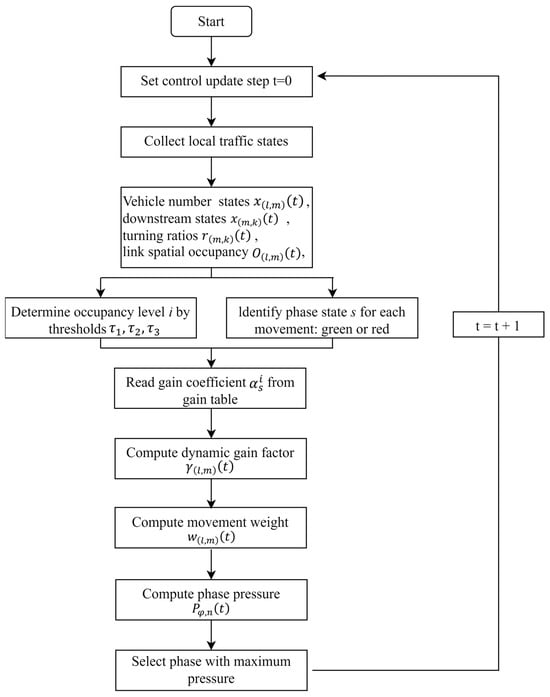
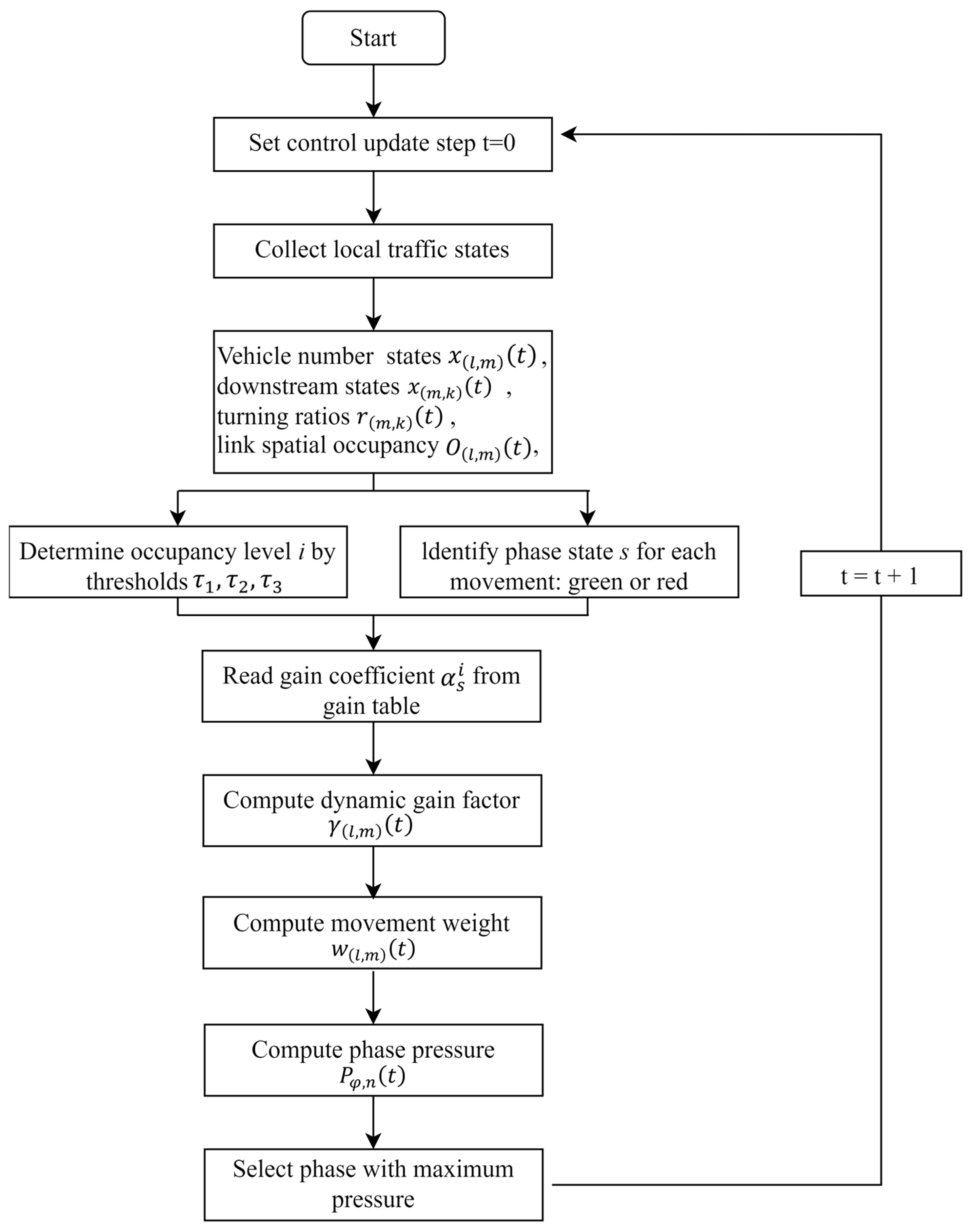
Several alternative parameter configurations satisfying these rules were examined in preliminary simulations. Although the numerical results varied moderately across configurations, the qualitative performance ranking remained unchanged, with the dynamic gain design consistently outperforming the queue-based baselines under the tested freight-dominant scenarios. The parameter set used in this paper was retained because it yielded comparatively better and more stable overall performance. Figure 1 summarizes the online decision process of the proposed dynamic Gain-MP controller. At each control update step, the controller first collects local traffic-state information, including upstream vehicle numbers, downstream conditions, turning ratios, and link spatial occupancy. The occupancy level of each movement is then determined according to predefined thresholds, and the current phase state is identified as either green or red. Based on the combination of occupancy level and phase state, the corresponding gain coefficient is selected from the gain table and used together with the current occupancy to compute the dynamic gain factor. The gain-modulated movement weights are then calculated, aggregated into phase pressures, and compared across candidate phases. Finally, the phase with the maximum pressure is activated for the next control interval.
Figure 1.
Flowchart of the dynamic Gain-MP signal control procedure.
4. Case Study and Simulation
4.1. Simulation Network and Experimental Setup
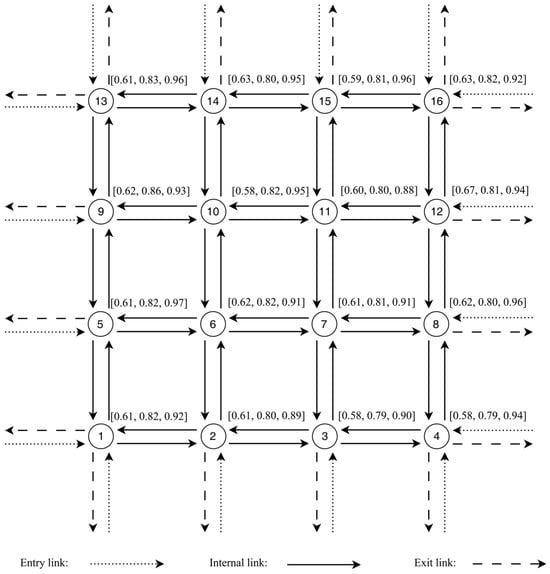
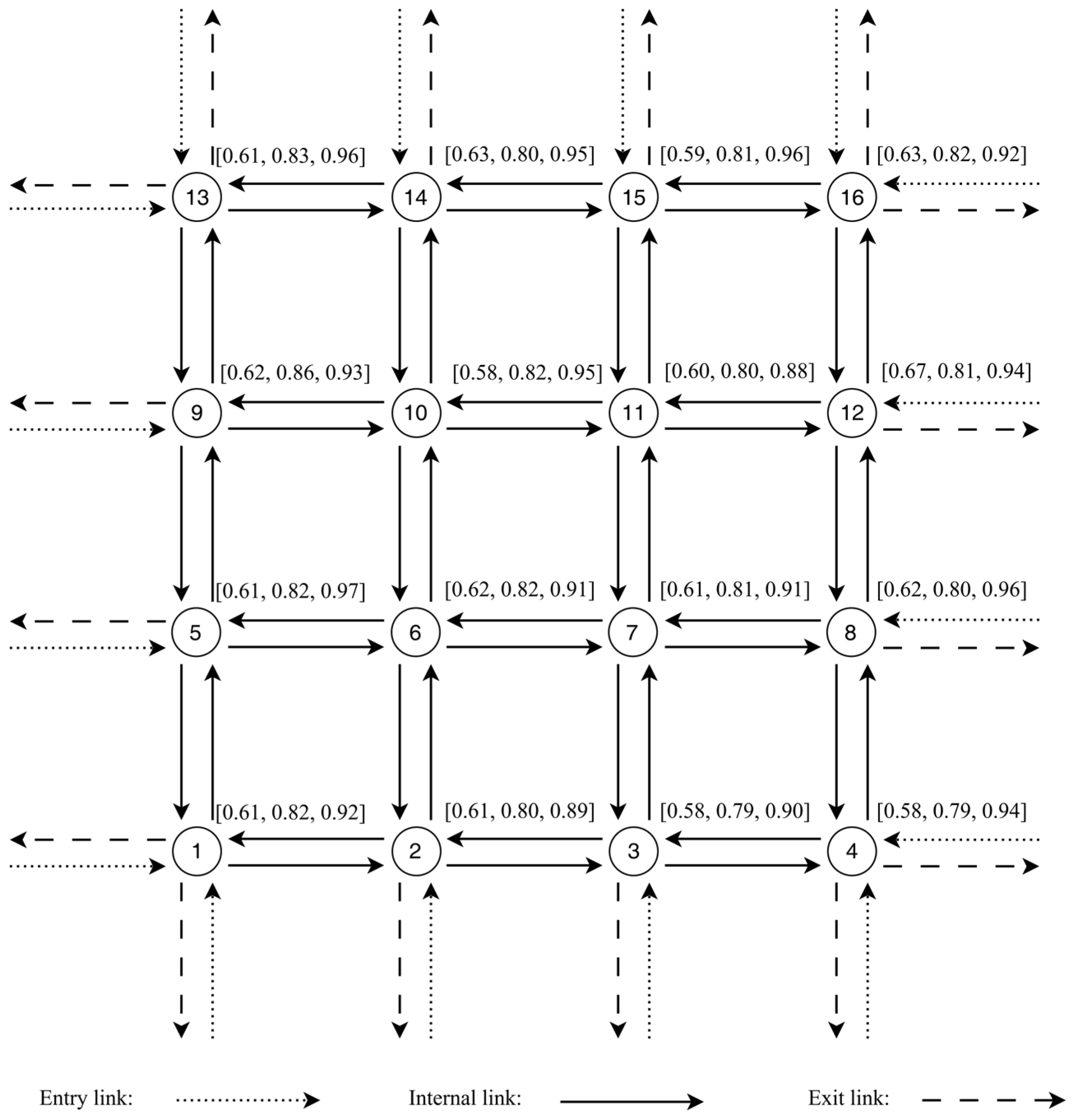
We evaluate the proposed method in the microscopic traffic simulation platform SUMO (Simulation of Urban Mobility) 1.23.1 on a stylized synthetic signalized network designed to capture the main operational characteristics of port collection and distribution corridors. Rather than reproducing a specific real-world port road network, the testbed is constructed as a controlled environment for comparing different control strategies under freight-dominant conditions. As illustrated in Figure 2, the network is configured as a 4 × 4 signalized grid, the numbers in the circles represent the intersection numbers, and each approach link is 300 m long, so that finite storage, queue spillback, and space competition can emerge under high demand.
Figure 2.
Simulation Network.
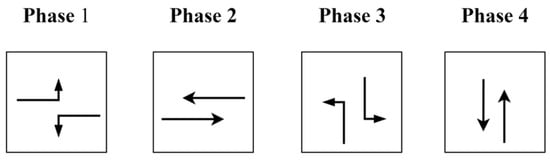
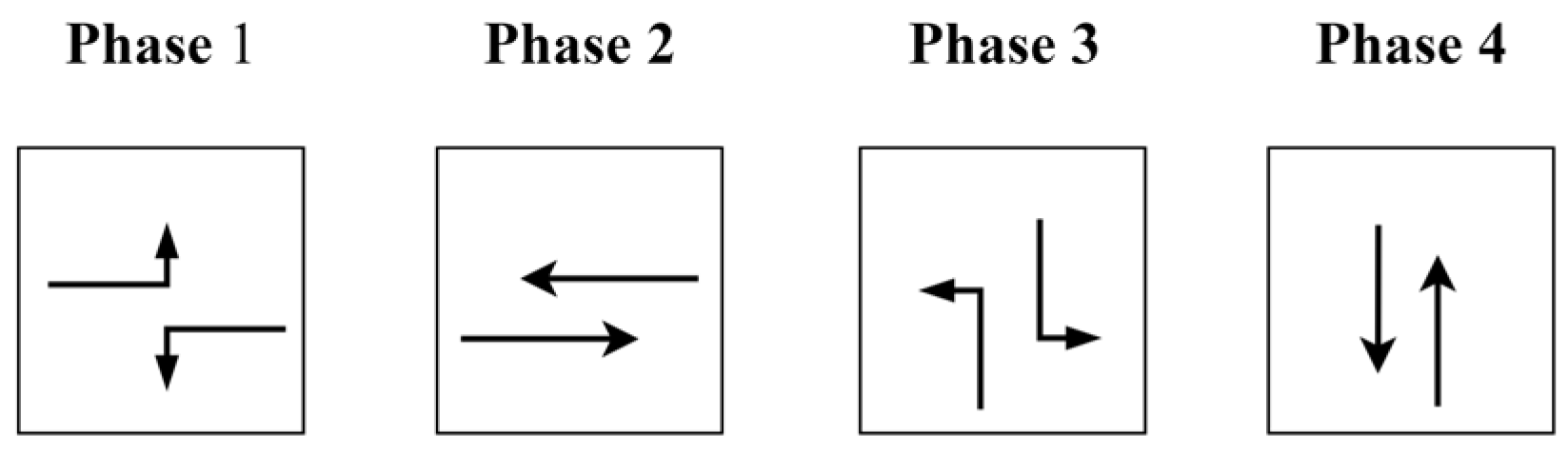
Signals operate with four phases, separating through and protected-left movements. The phase structure at each intersection is identical and follows the configuration shown in Figure 3. Phase 1 serves North-South left-turn movements; phase 2 serves North-South through movements; phase 3 serves East-West left-turn movements; and phase 4 serves through movements. Right-turn movements are not signal-controlled. The minimum green time and the control update interval are both set to 15 s, so that the controller remains responsive while avoiding unrealistically frequent switching. The simulation time step is 1 s, and phase changes are permitted only at multiples of 15 s.
Figure 3.
Phase structure at each intersection.
As a benchmark, a fixed-time Webster signal control strategy is implemented in the simulation. The Webster controller adopts the same four-phase structure, phase sequence, and minimum green time of 15 s as those used by the MP-based controllers, in order to ensure a fair comparison.
For each demand level, phase saturation ratios are obtained offline by operating the network under a fixed-time baseline with equal green splits of 15 s per phase. The value in the upper right corner of each intersection in Figure 2 represents the saturation level. For example, Intersection 1 has a saturation level of 0.61 under low traffic demand. Based on these saturation ratios, the Webster cycle length is computed using the classical Webster formulation and is constrained within a predefined range from 60 s to 180 s. The effective green time within each cycle is then allocated to individual phases in proportion to their saturation ratios, subject to a minimum green time of 15 s and a maximum green time of 60 s.
The Webster cycle length and green splits are updated only when the demand level changes and remain fixed within each demand stage. Since no yellow or all-red intervals are modeled in the simulation, the lost time in the Webster formulation is set to zero.
4.2. Demand Scenarios and Traffic Composition Settings
Two vehicle classes are modeled: passenger cars and container trucks. Passenger cars are assigned a length of 5.0 m, a maximum speed of 20 m/s, an acceleration of 2.6 m/s2, and a deceleration of 4.5 m/s2. Container trucks are assigned a length of 15.0 m, the same maximum speed, an acceleration of 0.6 m/s2, and a deceleration of 2.0 m/s2. These settings are intended to reflect the major operational contrast between cars and freight vehicles in port-oriented traffic, especially in terms of spatial occupancy and discharge dynamics.
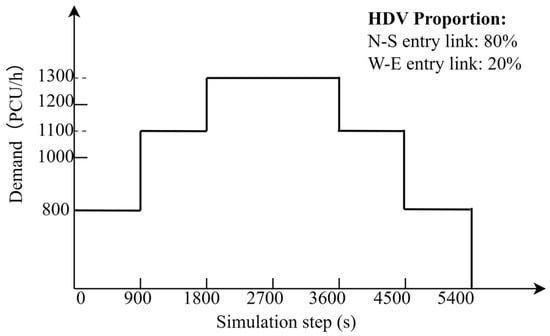
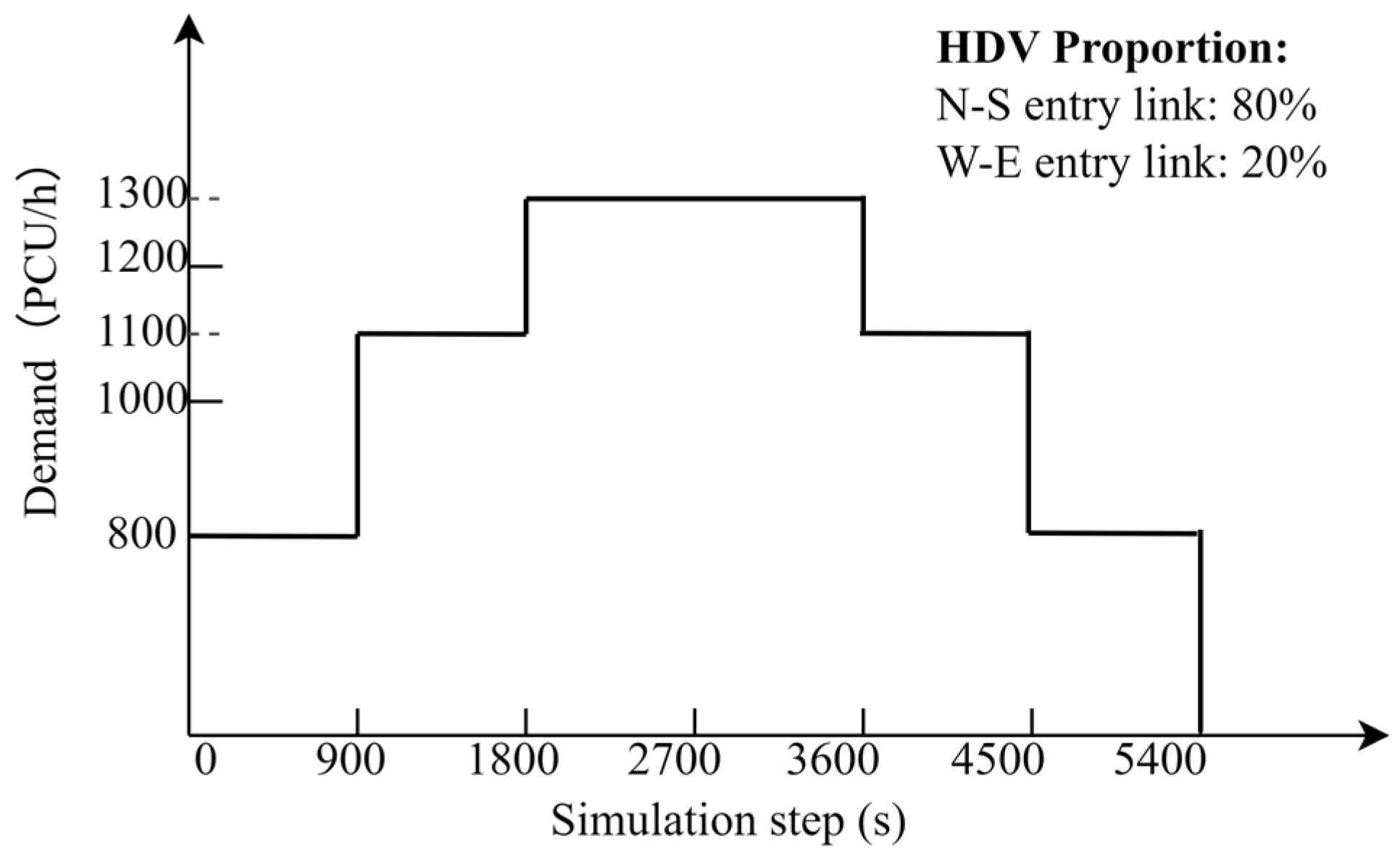
A single time-varying demand scenario was constructed to reproduce the operational fluctuations commonly observed in port collection and distribution corridors. As shown in Figure 4, the total inflow follows a five-stage sequence of 800–1100–1300–1100–800 PCU/h. The vehicle composition reflects the freight-oriented nature of the network: HDVs account for 80% of total inflow on the north–south approaches and 20% on the east–west approaches. Vehicles are generated stochastically at the network boundaries according to these ratios and are assigned fixed turning probabilities of 0.3, 0.2, and 0.5 for left turn, right turn, and through movements, respectively, at each intersection. The corresponding intersection saturation levels under demand levels of 800, 1100, and 1300 PCU/h are shown in the upper-right corner of Figure 2.
Figure 4.
Traffic demand.
To reduce random variation, each simulation scenario was executed using 10 random seeds, and all reported results represent the average across these runs.
The Gain-MP controller adopts the parameter configuration listed in Table 1. Table 1 reports the coefficient values of used to compute the dynamic gain factor , rather than the final values of itself. Following the design logic in Section 3.3, the coefficient increases monotonically with occupancy level, and the coefficient under the green-state gain is always greater than the corresponding red-state gain. The reported coefficients were selected heuristically rather than through exhaustive calibration. Several rule-consistent alternatives were examined in preliminary tests, and the overall qualitative performance trend remained unchanged. The final parameter set was retained because it delivered comparatively better and more stable overall performance in the tested scenarios.
Table 1.
Parameter configuration of the Gain-MP model.
Comparative evaluations included Webster, QMP, and PCU-QMP. QMP and PCU-QMP compute pressure based on the number of queued vehicles on each link, whereas Gain-MP uses the total number of vehicles to capture both stationary and moving congestion. All controllers were tested under identical network geometry, detector layout, and inflow conditions.
Performance evaluation employed indicators describing both intersection-level and network-wide efficiency, including cumulative delay, average queue length, total number of vehicles within the network, and throughput. All indicators were recorded at 1 s intervals throughout the simulation and averaged over intersections and random seeds.
4.3. Simulation Results and Performance Analysis
4.3.1. Temporal Evolution of Network Performance
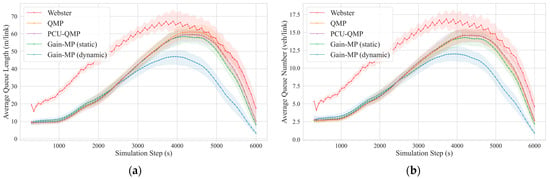
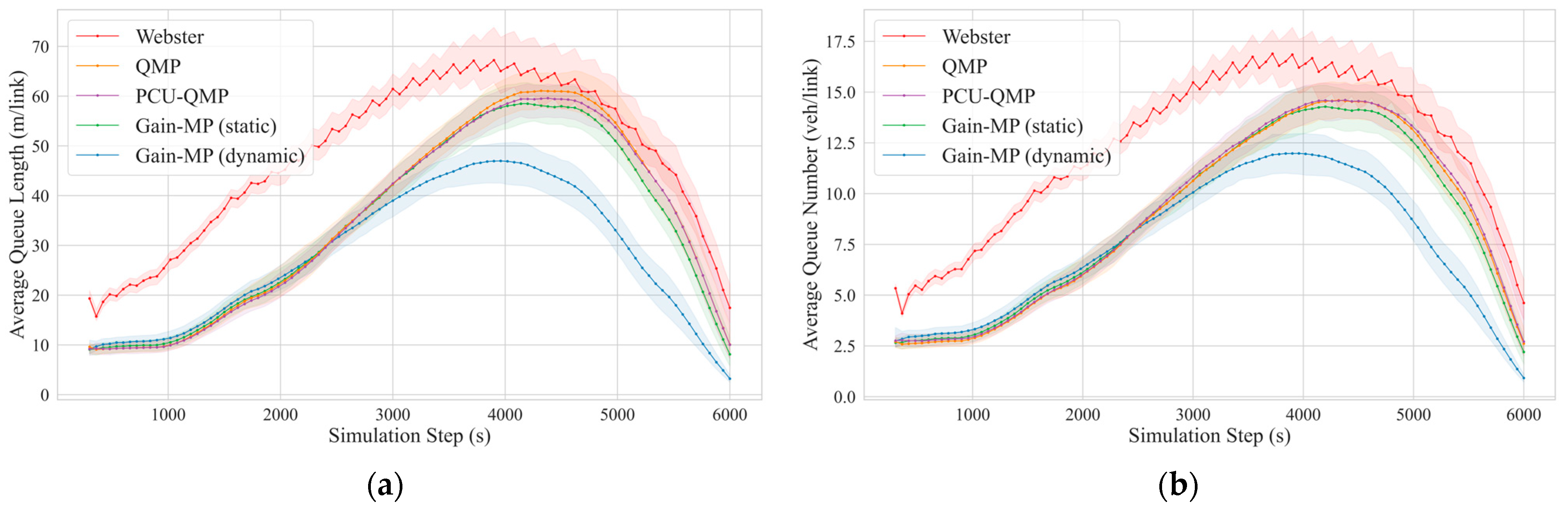
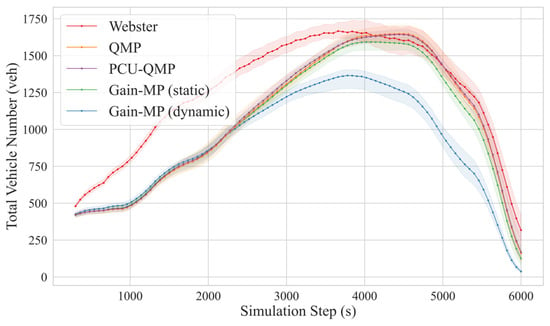
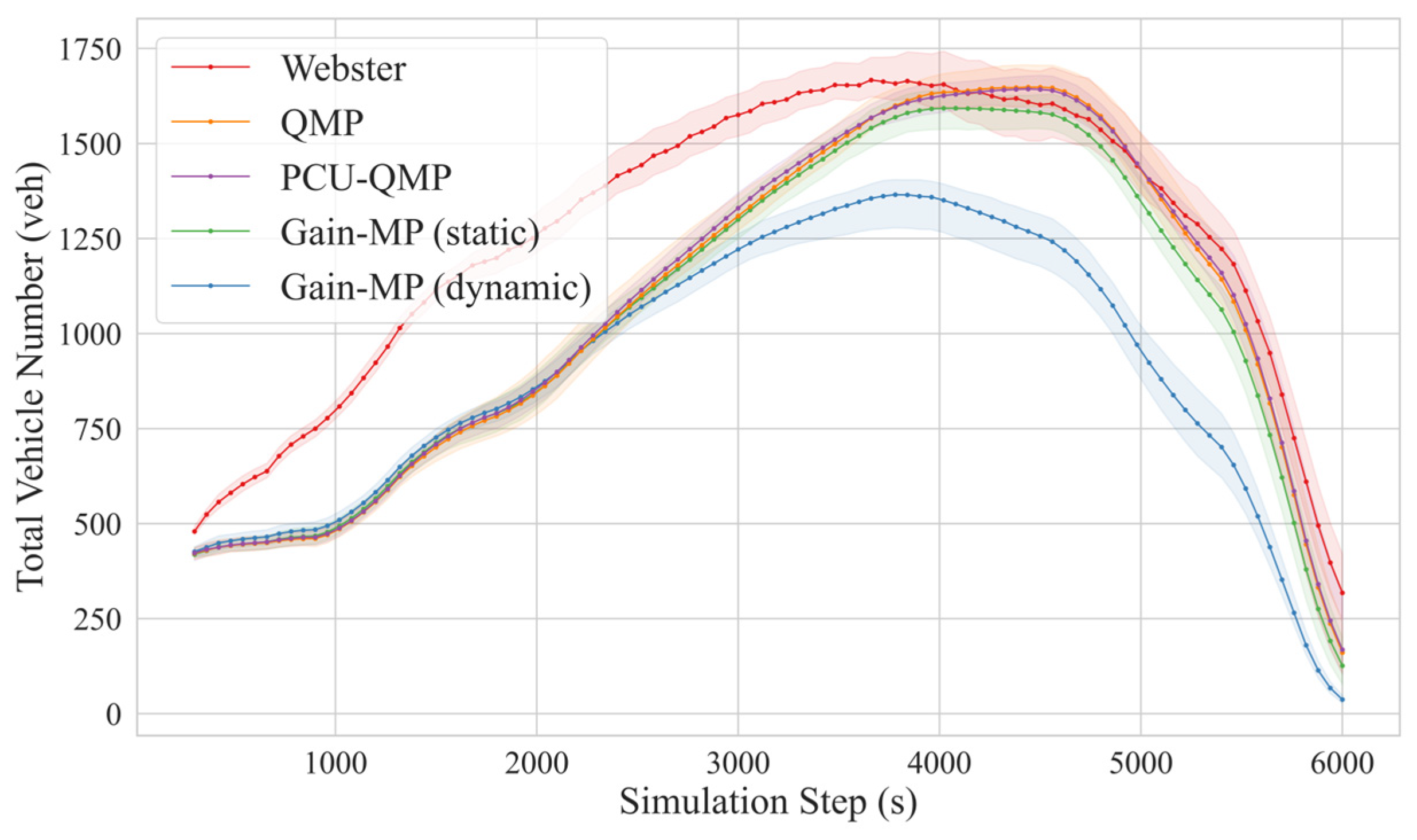
Figure 5, Figure 6, Figure 7, Figure 8 and Figure 9 show that the proposed dynamic Gain-MP controller consistently outperforms Webster, QMP, PCU-QMP, and static Gain-MP across multiple temporal performance indicators. In these figures, the shaded areas represent the variation range between the maximum and minimum values across the 10 simulation runs. This advantage is not limited to one isolated metric but appears simultaneously in queue length, delay, network accumulation, and throughput, indicating that the proposed gain design improves the overall operating state of the network. Figure 5 shows the time evolution of queue-related indicators. The left subplot depicts the average queue length, while the right subplot presents the average number of queued vehicles. During the rising-demand stage, all controllers display similar queue growth as inflow approaches the network capacity. QMP and PCU-QMP produce nearly identical results, indicating that static PCU weighting yields little additional benefit once the heavy-duty-vehicle distribution becomes spatially homogeneous. The static Gain-MP achieves a modest reduction in queue length during the recovery period, whereas the dynamic Gain-MP consistently maintains the shortest queues across the entire simulation. The maximum average queue length under Gain-MP (dynamic) is below 50 m per link, whereas QMP, PCU-QMP, and Gain-MP (static) exceed about 60 m per link at the peak. The Webster baseline produces the largest queue length and remains above the MP-based controllers throughout most of the simulation. A similar pattern appears in the number of queued vehicles, where Gain-MP (dynamic) peaks at around 12 veh per link, compared with around 15 veh per link for QMP and PCU-QMP, and a higher level for Webster.
Figure 5.
Average queue length per link: (a) expressed in meters; (b) expressed in vehicle numbers.
Figure 6.
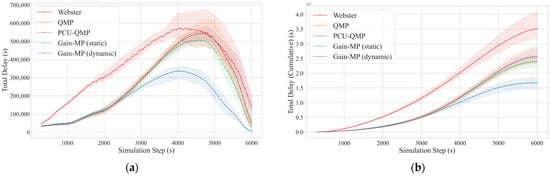
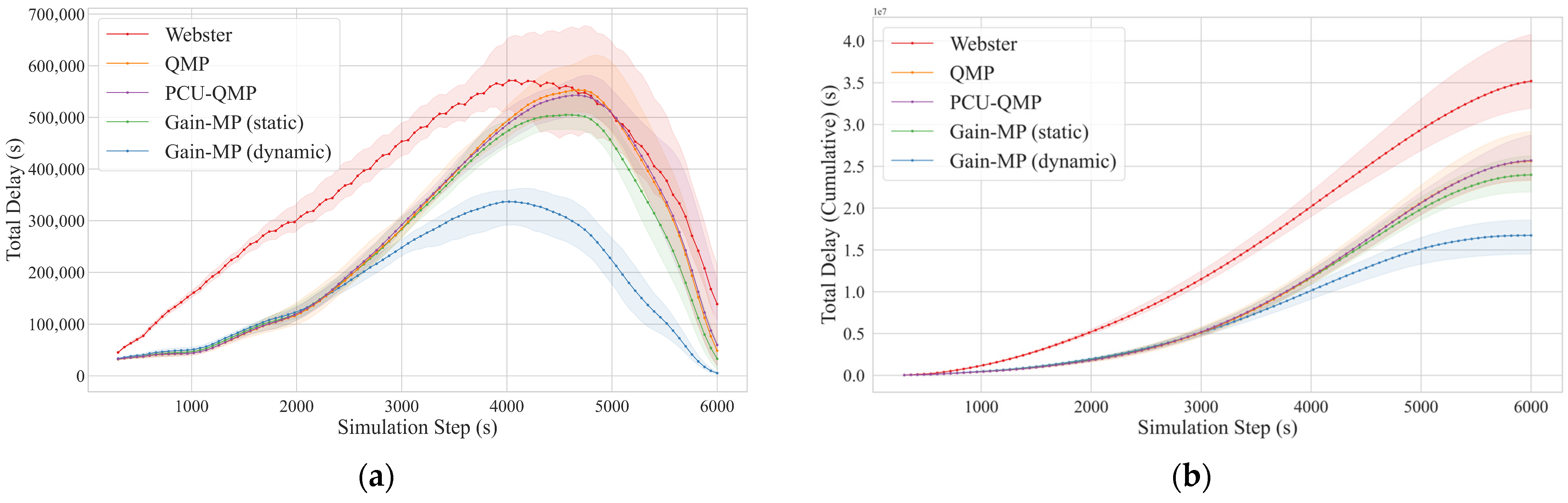
Comparison of internal delay: (a) delay incurred in each step; (b) cumulative delay.
Figure 7.
Number of vehicles in the network.
Figure 8.
Difference in network throughput: (a) entered vehicles; (b) exit vehicles.
Figure 9.
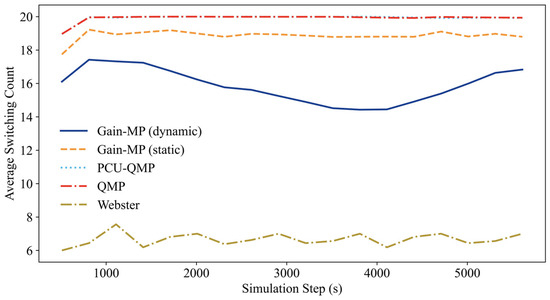
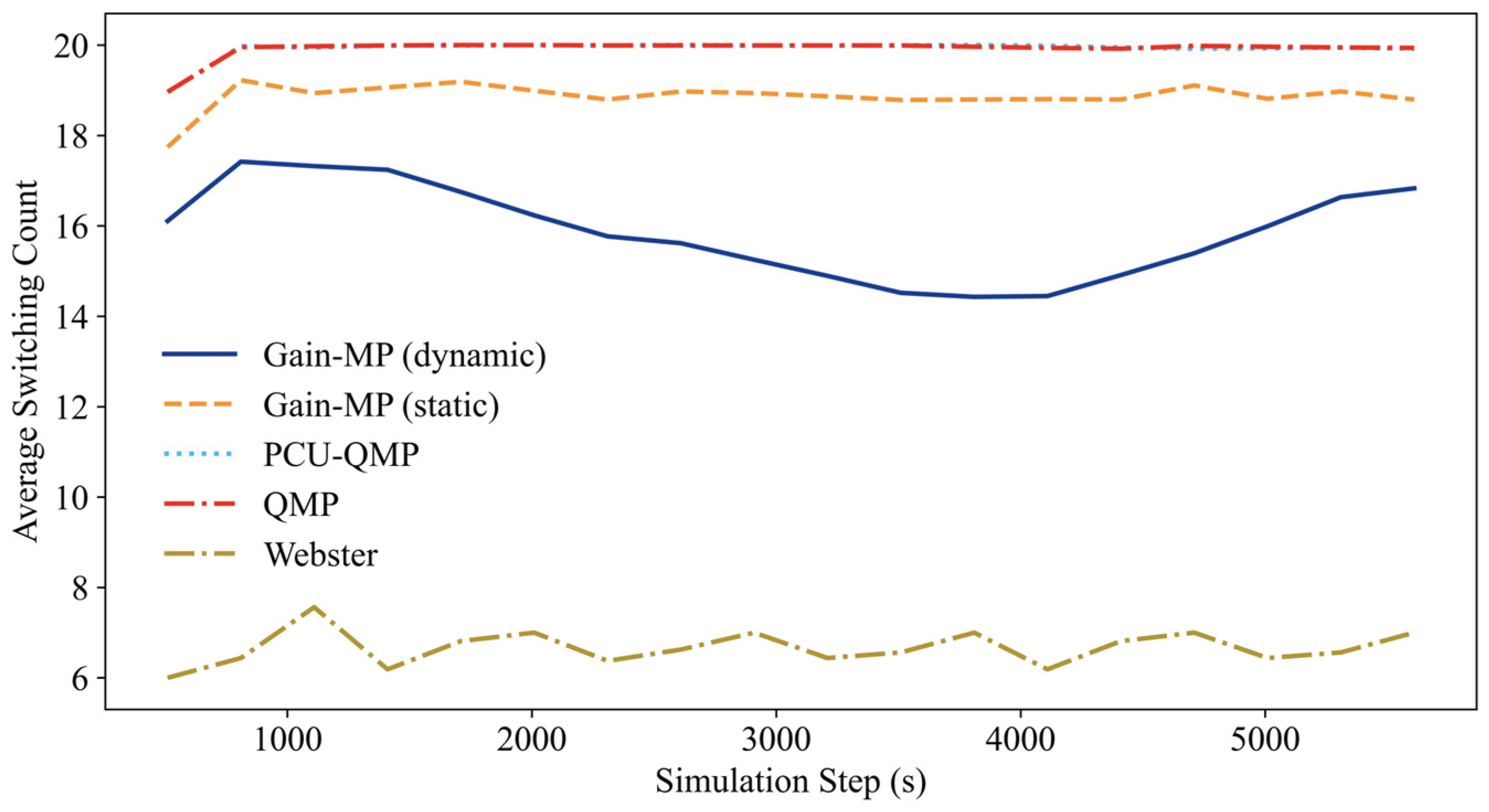
Average phase-switching frequency over time.
Figure 6 presents the delay-related indicators. The left subplot shows the total delay, and the right subplot displays the cumulative delay over time. The total delay of all models follows the five-stage demand profile and reaches its maximum near the demand peak. The dynamic Gain-MP maintains a significantly lower delay throughout the simulation, about 25 percent below the baseline methods during the high-demand interval. The static Gain-MP performs moderately better than Webster, QMP, and PCU-QMP. The cumulative-delay curve confirms these results: the slope for the dynamic model becomes noticeably flatter after the mid-simulation stage, reflecting stabilized queue dynamics and reduced delay growth. By the end of the simulation, its cumulative delay remains the lowest among all controllers.
Figure 7 illustrates the temporal evolution of the total number of vehicles within the network. The curve exhibits a clear surge-and-release pattern consistent with the demand variation. The dynamic Gain-MP maintains the smallest network accumulation and the fastest discharge rate after the peak period, indicating more efficient utilization of network capacity and improved throughput.
The main reason is that the dynamic Gain-MP controller does not rely solely on stopped queues. By incorporating link spatial occupancy, it becomes more sensitive to early congestion formation, especially in freight-dominant conditions where long and slow-moving trucks may occupy substantial road space before complete queue formation is visible. This allows the controller to respond earlier to incipient spatial saturation and to allocate green time more effectively during the rising-demand stage.
A second important feature is that the gain design is phase-dependent. The controller increases responsiveness when severely occupied movements are currently being served, while avoiding excessive activation of newly competing phases when occupancy is still low or moderate. This mechanism helps preserve discharge continuity and reduces fragmentation of effective green service. As a result, under high demand, the dynamic Gain-MP not only lowers queues and delay but also restrains the rapid accumulation of vehicles within the network.
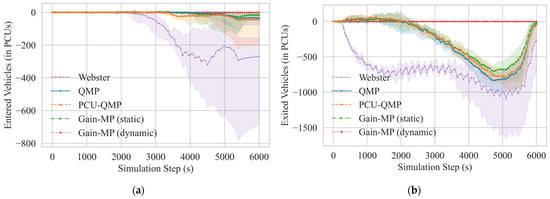
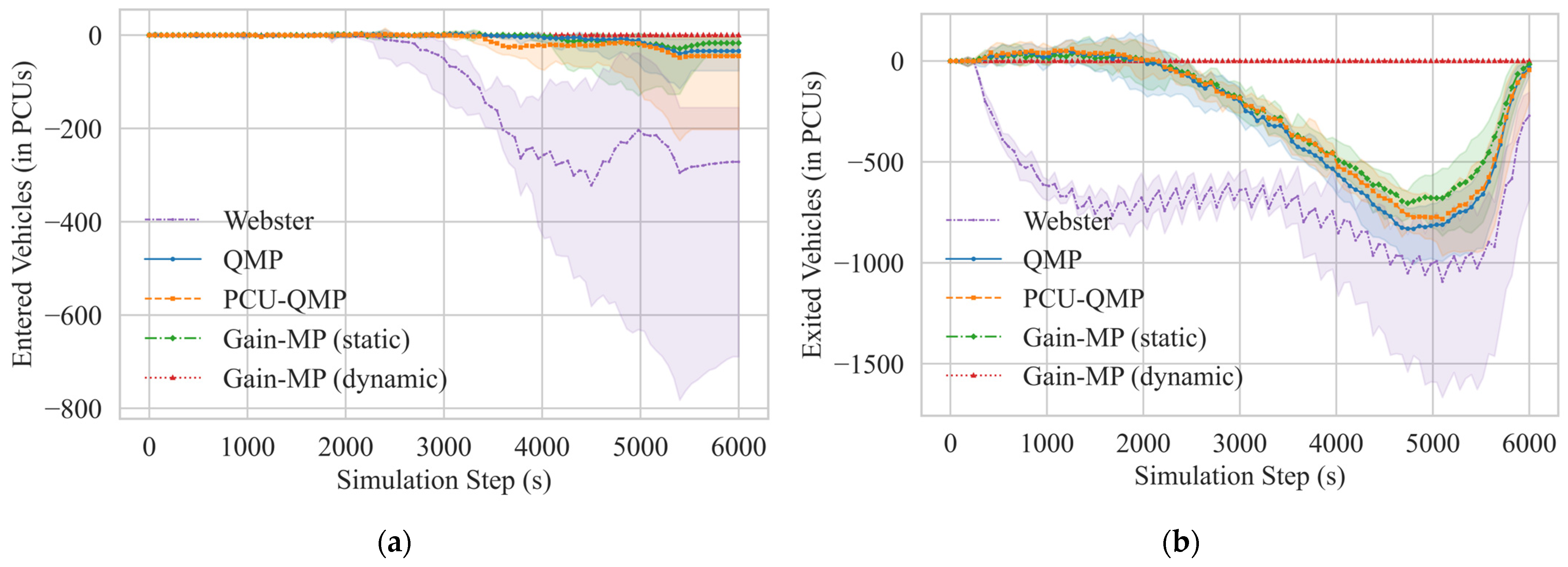
Figure 8 presents the cumulative numbers of entered and exited vehicles, illustrating the temporal evolution of throughput. The left subplot shows the cumulative inflow to the network, while the right subplot depicts the difference in exited vehicles relative to the baseline demand, both expressed in PCUs. During the rising-demand phase, all controllers maintain similar inflow patterns, confirming that upstream vehicle generation is not constrained by the signal control strategy. As congestion builds up, however, clear differences emerge in the discharge process. The dynamic Gain-MP maintains almost no backlog in vehicle exits, whereas QMP and PCU-QMP experience significant reductions in outflow during the peak period, with the cumulative deficit exceeding 800 PCUs around t = 4800 s. Webster exhibits the most pronounced discharge deficit during the peak period, and its exit backlog remains larger than all MP-based controllers. The static Gain-MP performs between these two groups but still shows a noticeable discharge lag.
The throughput results in Figure 8 further clarify this mechanism. Since the entered vehicle curves remain similar across controllers, the differences in performance cannot be attributed to unequal demand loading. Instead, the higher cumulative exit level under dynamic Gain-MP reflects the more efficient internal release of vehicles from the network. This indicates that the proposed method improves the conversion of green time into effective discharge under freight-heavy conditions.
4.3.2. Phase Switching Dynamics and Decision Stability
Frequent phase changes usually indicate oversensitivity to short-term state fluctuations. It should also be emphasized that this study does not seek to identify a universal optimal switching frequency range. Instead, switching behavior is interpreted as part of a control trade-off. Excessive switching can fragment effective green service and increase start-up losses, whereas overly infrequent switching may delay service to newly critical movements [36,37]. In freight-oriented traffic, this problem is especially important because repeated stopping and restarting of heavy vehicles increases lost time, reduces discharge efficiency, and can aggravate queue spillback. For this reason, switching frequency is not interpreted here as an isolated target, but as a behavioral indicator that helps explain the efficiency differences among controllers.
Figure 9 shows that the QMP and PCU-QMP controllers exhibit considerably higher switching frequencies during congested periods, suggesting that queue-based pressure alone is more likely to react to short-term fluctuations without sufficiently preserving service continuity. In the figure, the light blue dashed line representing PCU-QMP overlaps with the red dash-dot line representing QMP over part of the simulation horizon, because both controllers maintain the highest switching counts during those periods. By contrast, the proposed Gain-MP controllers display more restrained switching behavior, and the dynamic Gain-MP performs best in this respect during the peak period.
This finding is important because it shows that introducing occupancy into the control logic does not simply make the controller more aggressive. Instead, when occupancy sensitivity is combined with phase-dependent gain regulation, the controller becomes both more responsive to spatial congestion and more selective in changing phases. In other words, the proposed method improves the balance between adaptability and stability of service rather than merely increasing responsiveness.
At the same time, this study does not attempt to define a universal optimal switching frequency. Excessive switching may waste green time and increase start-up losses, while overly infrequent switching may delay service to newly critical movements. Under the present simulation setting, the dynamic Gain-MP appears to move the control process toward a more effective intermediate regime.
4.3.3. Performance Impacts Across Vehicle Types
Table 2 reports the average delay, waiting time, waiting count, fuel consumption, and CO2 emissions for different vehicle types under each control strategy. All metrics are computed by aggregating vehicle trajectories over the entire simulation horizon from 0 to 6000 s, including all vehicles that enter and exit the network during the simulation. This full-horizon aggregation provides an overall assessment that complements the time-dependent results presented in Section 4.3.1 and Section 4.3.2.
Table 2.
Average delay, waiting time, waiting count, fuel consumption, and CO2 emissions by vehicle type.
Overall, the dynamic Gain-MP controller consistently outperforms the other strategies across all evaluated metrics. When averaged over the entire simulation horizon from 0 to 6000 s, dynamic Gain-MP reduces the average delay of all vehicles by approximately 34% compared with the fixed-time Webster control, with reductions of similar magnitude observed for both passenger cars and HDVs. Correspondingly, the average waiting time is reduced from 248 s/veh under Webster to 133 s/veh under dynamic Gain-MP.
One apparent exception in Table 2 is the waiting count indicator, for which Webster yields fewer stop events on average than the MP-based controllers. This result should be interpreted together with the waiting time and delay indicators rather than in isolation. Waiting count reflects the number of times a vehicle stops, whereas waiting time and delay reflect how long and how severely that interruption affects the vehicle.
As a fixed-time controller, Webster operates with a more rigid phase structure and fewer adaptive adjustments, which can reduce the number of stop episodes experienced by some vehicles. However, once vehicles are stopped under such a timing regime, they often remain delayed for longer because green allocation cannot respond to the evolving traffic state. This explains why Webster has the lowest waiting count while still producing the highest overall delay and waiting times. Therefore, in the present freight-dominant setting, a lower waiting count under Webster should not be interpreted as superior operational performance.
In addition to efficiency improvements, dynamic Gain-MP also exhibits lower fuel consumption and CO2 emissions. Compared with the Webster control, the average fuel consumption of all vehicles decreases from 619 to 495 mL/km/veh, while CO2 emissions are reduced from 1961 to 1568 g/km/veh over the full simulation period. The static Gain-MP controller shows the same performance trend but with smaller improvements across all metrics.
Clear differences between vehicle types are observed across all control strategies. HDVs consistently experience higher delay, fuel consumption, and CO2 emissions than passenger cars. For example, under dynamic Gain-MP control, the average delay of HDVs is 228 s/veh, compared with 211 s/veh for passenger cars, while fuel consumption reaches 889 mL/km/veh for HDVs versus 223 mL/km/veh for passenger cars.
Despite these absolute differences, the relative performance ranking of the controllers remains consistent across vehicle types. Dynamic Gain-MP achieves the lowest delay, waiting time, and emission levels for both passenger cars and HDVs, indicating that the proposed framework improves overall traffic efficiency without disproportionately favoring a specific vehicle class.
The consistency of these improvements across vehicle types and performance metrics demonstrates the robustness of the proposed Gain-MP framework under heterogeneous traffic conditions. Since all indicators in Table 2 are averaged over the full simulation horizon and include all vehicles entering and exiting the network, the observed benefits are not limited to specific demand stages or transient conditions. This robustness is particularly relevant for port-oriented road networks, where high proportions of HDVs impose additional challenges on signal control performance.
4.4. Empirical Network Stability
To further examine the empirical bounded-accumulation performance of different controllers under near-capacity conditions, a series of constant-demand experiments was conducted in the SUMO simulation environment. It should be noted that this part of the study does not provide a formal theoretical proof of stability for the proposed controller. Instead, it uses the simulated evolution of total vehicle accumulation to examine whether congestion remains bounded over time under the tested demand levels [38].
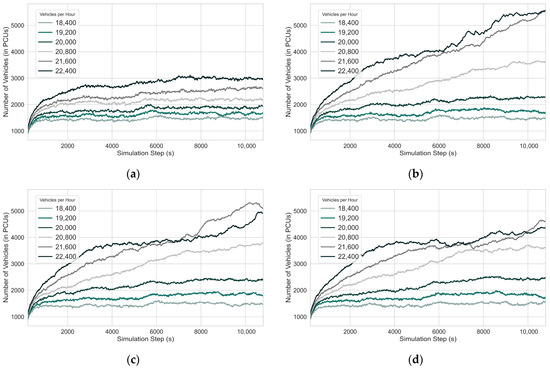
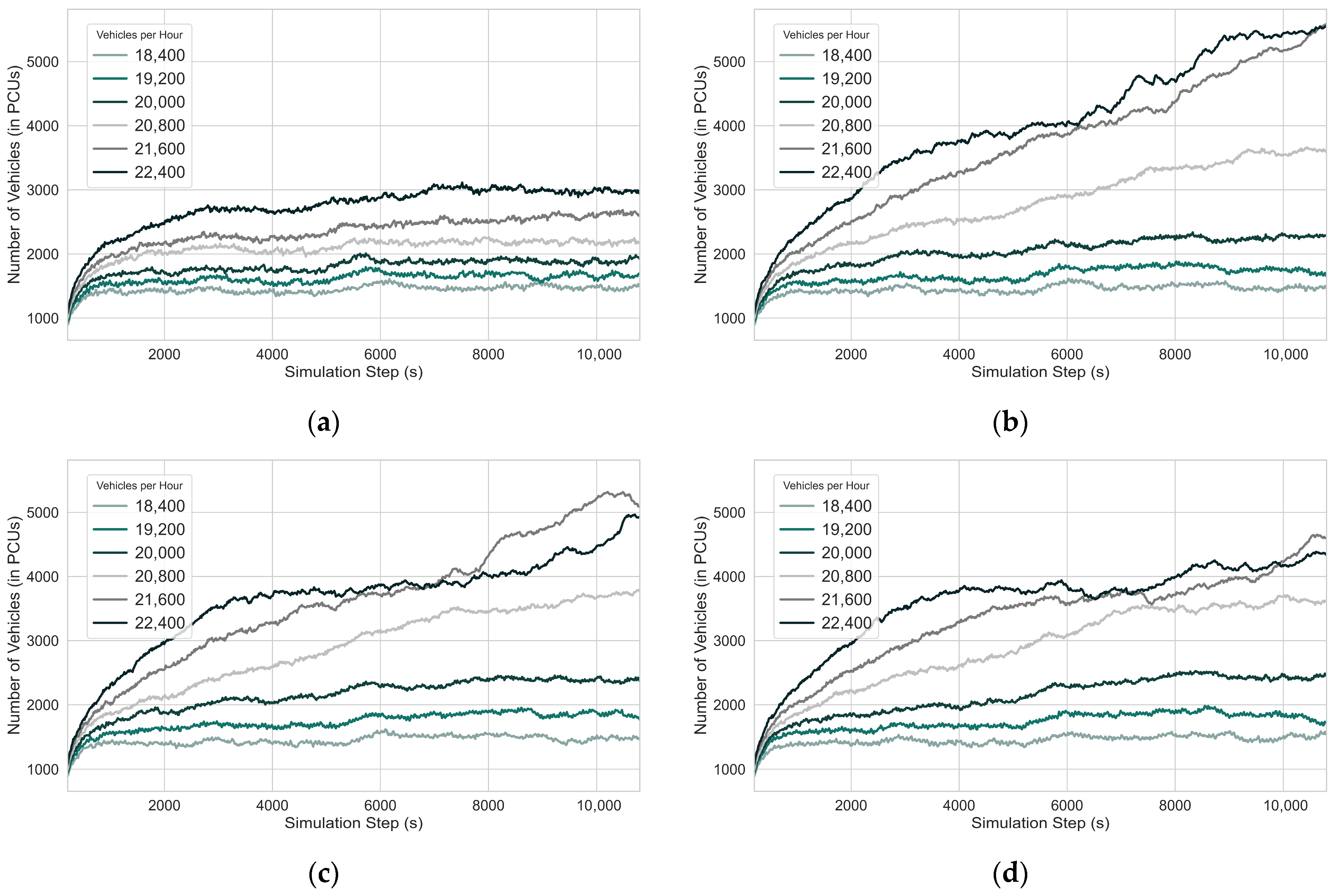
The inflow rates at all network entrances are uniformly scaled from 18,400 to 22,400 PCU/h, as indicated in the legends of Figure 10a–d. Unlike the efficiency-oriented experiments in Section 4.3, which adopt per-entry demand levels, this stability analysis employs network-level total demand in order to characterize the overall system loading and assess the ability of each controller to maintain bounded queues under sustained inflow. It should be noted that the demand setting in this experiment differs from the time-varying scenarios considered earlier. Here, the inflow rates remain constant throughout the simulation, allowing the steady-state accumulation dynamics to be observed directly, rather than transient responses to fluctuating demand.
Figure 10.
Network accumulation under constant demand: (a) Gain-MP (Dynamic); (b) Gain-MP (Static); (c) QMP; (d) PCU-QMP.
Figure 10a–d present the evolution of total vehicle accumulation under different inflow levels for the compared controllers. Each curve corresponds to a specific network-level demand. For the QMP and PCU-QMP controllers, the accumulation curves begin to diverge once the inflow exceeds approximately 20,000 PCU/h, indicating persistent accumulation growth beyond this loading level. The PCU-QMP variant shows only limited improvement over QMP, suggesting that static PCU weighting alone does not substantially expand the empirical bounded-accumulation range of the MP framework under the tested demand levels.
In contrast, both versions of the proposed Gain-MP controller maintain bounded accumulation over a wider range of demand levels. The dynamic Gain-MP shows the widest empirical bounded-accumulation range under the tested settings: accumulation curves remain bounded at 21,600 PCU/h, and the growth rate remains moderate even at 22,400 PCU/h. The static Gain-MP also performs better than the QMP-based baselines in terms of empirical bounded-accumulation performance, but its empirical bounded-accumulation range is narrower than that of the dynamic version. These results suggest that dynamic gain adjustment is more effective than static weighting in restraining accumulation growth under the tested high-load conditions.
5. Discussion
The proposed Gain-MP framework can be interpreted as introducing a nonlinear feedback gain modulation into the classical Max-Pressure control loop. In conventional MP, pressure differences directly determine phase selection, implicitly assuming uniform sensitivity of the controller to all congestion states. By contrast, Gain-MP dynamically amplifies pressure signals based on real-time occupancy levels, effectively increasing the system’s sensitivity as links approach spatial saturation. This mechanism enables earlier corrective action when congestion is forming but queues are not yet fully observable, thereby reducing the likelihood of spillback propagation.
Importantly, this gain modulation operates locally and preserves the decentralized nature of MP. Each intersection adjusts its responsiveness using only conventional detector data, without requiring communication between nodes or global coordination. This property is particularly relevant for large-scale port road networks, where centralized control or high-resolution trajectory data may be impractical.
A notable feature of the proposed framework is the differentiation between gains applied to active (green) and inactive (red) phases. From a systems viewpoint, this introduces a damping effect that mitigates excessive oscillation in control decisions. While classical non-cyclic MP controllers are known to be highly responsive, they may also exhibit frequent phase switching in response to minor state fluctuations. The phase-dependent gain structure in Gain-MP selectively reinforces sustained discharge when occupancy is high, while suppressing unnecessary phase changes under low congestion.
Simulation results confirm that this design yields lower phase switching frequency without explicitly optimizing for switching behavior. This outcome suggests that gain modulation can implicitly balance responsiveness and stability—an important trade-off in decentralized control systems operating under noisy or partially observable conditions.
The constant-demand accumulation analysis in Section 4.4 provides a further comparison of controller behavior under sustained loading. Under the tested demand levels, the dynamic Gain-MP controller maintains bounded accumulation over a wider empirical range than the QMP-based benchmark methods. Since this part of the study is based on SUMO simulation rather than theoretical derivation, the result should be interpreted as simulation-based empirical evidence rather than as a formal analytical proof of stability improvement.
These findings suggest an important system-level implication: improving state sensitivity through gain adjustment can provide substantial benefits in capacity-constrained networks without requiring centralized coordination. At the same time, the present study does not provide a structured calibration or global sensitivity analysis for the gain thresholds and coefficients. Although preliminary rule-based alternatives produced similar qualitative rankings, a more systematic sensitivity assessment would be valuable for improving parameter interpretability and transferability across networks.
6. Conclusions
This study proposes a Gain-MP signal control framework for port-oriented road networks characterized by heterogeneous traffic and heavy freight demand. By introducing occupancy and phase-dependent gain terms into the Max-Pressure formulation, the proposed approach enhances the adaptability of phase selection while preserving the decentralized structure of MP control.
Simulation results demonstrate that the Gain-MP controllers consistently outperform fixed-time Webster, QMP, and PCU-QMP in terms of delay, queue length, and throughput under representative demand conditions. These improvements are observed for both passenger cars and HDVs, confirming the robustness of the proposed framework in heterogeneous traffic environments.
Beyond efficiency metrics, the analysis of phase switching behavior reveals that Gain-MP exhibits more stable decision patterns compared to queue-based MP controllers. Although phase switching frequency is not treated as an optimization objective, the reduced switching activity provides behavioral insight into the improved performance of the proposed method. In addition, the constant-demand accumulation analysis under near-capacity loading shows that dynamic Gain-MP maintains bounded vehicle accumulation over a wider empirical range than the QMP-based benchmark methods under the tested settings. Since this result is based on simulation analysis, it should be interpreted as empirical evidence rather than as a formal theoretical proof of stability improvement. A formal stability analysis of the proposed controller will be an important direction for future work.
The results indicate that the proposed Gain-MP framework improves operational efficiency, decision stability, and network-level robustness simultaneously. These characteristics make it particularly suitable for decentralized signal control in port-oriented road networks with high freight intensity and sustained heavy demand.
Several limitations should be acknowledged. First, the simulation network is a stylized freight-oriented testbed rather than a calibrated real-world port corridor. Second, detector errors, communication delays, intergreen constraints, and other field implementation factors are not explicitly modeled. Third, the gain parameters were selected by rule-based heuristic testing rather than exhaustive sensitivity analysis or formal optimization. These issues should be addressed in future work through site-based calibration, robustness testing, and field-oriented controller implementation studies.
Author Contributions
Conceptualization, Y.M. and P.Z.; methodology, Y.M., P.Z. and M.P.; software, Y.M.; validation, Y.M., H.Y., T.X., N.P. and W.C.; formal analysis, Y.M. and M.G.; investigation, Y.M., H.Y., T.X., N.P. and W.C.; resources, P.Z.; data curation, Y.M., H.Y., T.X., N.P., W.C. and M.G.; writing—original draft preparation, Y.M. and H.Y.; writing—review and editing, H.Y., M.P. and P.Z.; visualization, Y.M.; supervision, M.P. and P.Z.; project administration, P.Z.; funding acquisition, H.Y. and P.Z. All authors have read and agreed to the published version of the manuscript.
Funding
This research was funded by the National Natural Science Foundation of China (Grant No. 52272334, 52502403), the Provincial Key R&D Program of Zhejiang (2024C01180), the Natural Science Foundation of Zhejiang Province (ZCLQ24E0801), the Philosophy and Social Science Planning Project of Zhejiang Province (25JCXK001YB), and the Fundamental Research Funds for the Provincial Universities of Zhejiang (SJLY2025006).
Data Availability Statement
The data are available from the corresponding author on reasonable request.
Conflicts of Interest
The authors declare no conflicts of interest.
References
- Lin, W.; Sun, L.; Wang, T.; Shang, H.; Xu, W. The impact of port investment along the 21st Century Maritime Silk Road on regional port network connectivity and its imbalance. Reg. Stud. Mar. Sci. 2025, 87, 104239. [Google Scholar] [CrossRef] [Scilit]
- Bernacki, D.; Lis, C. Traffic and freight flow predictions and effects of capacity expansion in the urban–port road interface: The case of a port city in Poland. Marit. Policy Manag. 2023, 50, 1005–1026. [Google Scholar] [CrossRef] [Scilit]
- Leng, Z.; Lian, C.; Yuan, K.; Yuan, Q. Moving Beyond the World’s Largest Port: Spatiotemporal Patterns of Port Container Truck Flows Linked to the Ningbo-Zhoushan Port. Systems 2025, 13, 1068. [Google Scholar] [CrossRef] [Scilit]
- Gao, Y.; Levinson, D. The rise of trucks and the fall of throughput. Transp. A Transp. Sci. 2025, 1–28. [Google Scholar] [CrossRef] [Scilit]
- Zhao, Y.; Ioannou, P. A co-simulation, optimization, control approach for traffic light control with truck priority. Annu. Rev. Control 2019, 48, 283–291. [Google Scholar] [CrossRef] [Scilit]
- Varaiya, P. Max pressure control of a network of signalized intersections. Transp. Res. Part C Emerg. Technol. 2013, 36, 177–195. [Google Scholar] [CrossRef] [Scilit]
- Levin, M.W. Max-pressure traffic signal timing: A summary of methodological and experimental results. J. Transp. Eng. Part A Syst. 2023, 149, 03123001. [Google Scholar] [CrossRef] [Scilit]
- Agarwal, A.; Sahu, D.; Mohata, R.; Jeengar, K.; Nautiyal, A.; Saxena, D.K. Dynamic traffic signal control for heterogeneous traffic conditions using max pressure and reinforcement learning. Expert Syst. Appl. 2024, 254, 124416. [Google Scholar] [CrossRef] [Scilit]
- Gregoire, J.; Qian, X.; Frazzoli, E.; De La Fortelle, A.; Wongpiromsarn, T. Capacity-aware backpressure traffic signal control. IEEE Trans. Control Netw. Syst. 2014, 2, 164–173. [Google Scholar] [CrossRef] [Scilit]
- Wongpiromsarn, T.; Uthaicharoenpong, T.; Wang, Y.; Frazzoli, E.; Wang, D. Distributed traffic signal control for maximum network throughput. In Proceedings of the 2012 15th International IEEE Conference on Intelligent Transportation Systems, Anchorage, AK, USA, 16–19 September 2012; pp. 588–595. [Google Scholar]
- Tsitsokas, D.; Kouvelas, A.; Geroliminis, N. Critical node selection method for efficient max-pressure traffic signal control in large-scale congested networks. In Proceedings of the Abstract Book: 10th Symposium of the European Association for Research in Transport (hEART 2022), Leuven, Belgium, 1–3 June 2022. [Google Scholar]
- Le, T.; Kovács, P.; Walton, N.; Vu, H.L.; Andrew, L.L.H.; Hoogendoorn, S.S.P. Decentralized signal control for urban road networks. Transp. Res. Part C Emerg. Technol. 2015, 58, 431–450. [Google Scholar] [CrossRef] [Scilit]
- Tsitsokas, D.; Kouvelas, A.; Geroliminis, N. Two-layer adaptive signal control framework for large-scale dynamically-congested networks: Combining efficient Max Pressure with Perimeter Control. Transp. Res. Part C Emerg. Technol. 2023, 152, 104128. [Google Scholar] [CrossRef] [Scilit]
- Robbennolt, J.; Chen, R.; Levin, M. Microsimulation study evaluating the benefits of cyclic and non-cyclic max-pressure control of signalized intersections. Transp. Res. Rec. 2022, 2676, 303–317. [Google Scholar] [CrossRef] [Scilit]
- Li, L.; Jabari, S.E. Position weighted backpressure intersection control for urban networks. Transp. Res. Part B Methodol. 2019, 128, 435–461. [Google Scholar] [CrossRef] [Scilit]
- Xiao, N.; Frazzoli, E.; Li, Y.; Wang, Y.; Wang, D. Pressure releasing policy in traffic signal control with finite queue capacities. In Proceedings of the 53rd IEEE Conference on Decision and Control, Los Angeles, CA, USA, 15–17 December 2014; pp. 6492–6497. [Google Scholar]
- Liu, H. TD-MP: A max pressure algorithm considering delay equity. In Proceedings of the 102nd Annual Meeting of the Transportation Research Board, Washington, WA, USA, 8–12 January 2023. [Google Scholar]
- Wu, J.; Ghosal, D.; Zhang, M.; Chuah, C.-N. Delay-Based Traffic Signal Control for Throughput Optimality and Fairness at an Isolated Intersection. IEEE Trans. Veh. Technol. 2018, 67, 896–909. [Google Scholar] [CrossRef] [Scilit]
- Zoabi, R.; Haddad, J. Max-Pressure Control utilizing Total Movement Delay. IFAC-PapersOnLine 2024, 58, 206–212. [Google Scholar] [CrossRef] [Scilit]
- Zoabi, R.; Haddad, J. Dynamic Cycle Time in Traffic Signal of Cyclic Max-Pressure Control. In Proceedings of the 4th Symposium on Management of Future Motorway and Urban Traffic Systems 2022, Dresden, Germany, 30 November–2 December 2022. [Google Scholar]
- Liu, H.; Gayah, V.V. A novel Max Pressure algorithm based on traffic delay. Transp. Res. Part C Emerg. Technol. 2022, 143, 103803. [Google Scholar] [CrossRef] [Scilit]
- Dixit, V.; Nair, D.J.; Chand, S.; Levin, M.W. A simple crowdsourced delay-based traffic signal control. PLoS ONE 2020, 15, e0230598. [Google Scholar] [CrossRef] [Scilit]
- Mercader, P.; Uwayid, W.; Haddad, J. Max-pressure traffic controller based on travel times: An experimental analysis. Transp. Res. Part C Emerg. Technol. 2020, 110, 275–290. [Google Scholar] [CrossRef] [Scilit]
- Zoabi, R.; Haddad, J. An advanced Max-Pressure traffic controller based on travel time delays. In Proceedings of the 2022 IEEE 25th International Conference on Intelligent Transportation Systems (ITSC), Macau, China, 8–12 October 2022; pp. 1662–1667. [Google Scholar]
- Cao, J.; Hu, Y.; Diamantis, M.; Zhang, S.; Wang, Y.; Guo, J.; Papamichail, I.; Papageorgiou, M.; Zhang, L.; Hu, J.S. A max pressure approach to urban network signal control with queue estimation using connected vehicle data. In Proceedings of the 2020 IEEE 23rd International Conference on Intelligent Transportation Systems (ITSC), Rhodes, Greece, 20–23 September 2020; pp. 1–8. [Google Scholar]
- Ghanim, M.S.; Abu-Lebdeh, G. Characterization of heavy vehicle headways in oversaturated interrupted conditions: Towards development of passenger car equivalency factors. Int. J. Transp. Sci. Technol. 2022, 11, 589–602. [Google Scholar] [CrossRef] [Scilit]
- Mondal, S.; Chakraborty, S.; Roy, S.K.; Gupta, A. Estimation of passenger car unit for heterogeneous traffic stream of urban arterials: Case study of Kolkata. Transp. Lett. 2023, 15, 1276–1288. [Google Scholar] [CrossRef] [Scilit]
- Sharma, M.; Biswas, S. Estimation of Passenger Car Unit on urban roads: A literature review. Int. J. Transp. Sci. Technol. 2021, 10, 283–298. [Google Scholar] [CrossRef] [Scilit]
- Ahmed, T.; Liu, H.; Gayah, V.V. OCC-MP: A Max-Pressure framework to prioritize transit and high occupancy vehicles. Transp. Res. Part C Emerg. Technol. 2024, 166, 104795. [Google Scholar] [CrossRef] [Scilit]
- Liu, H.; Gayah, V.V.; Levin, M.W. A max pressure algorithm for traffic signals considering pedestrian queues. Transp. Res. Part C Emerg. Technol. 2024, 169, 104865. [Google Scholar] [CrossRef] [Scilit]
- Xu, T.; Bika, Y.; Levin, M.W. Ped-mp: A pedestrian-friendly max-pressure signal control policy for city networks. J. Transp. Eng. Part A Syst. 2024, 150, 04024028. [Google Scholar] [CrossRef] [Scilit]
- Xu, T.; Barman, S.; Levin, M.W.; Chen, R.; Li, T. Integrating public transit signal priority into max-pressure signal control: Methodology and simulation study on a downtown network. Transp. Res. Part C Emerg. Technol. 2022, 138, 103614. [Google Scholar] [CrossRef] [Scilit]
- Charalambous, T.; Liaquat, M.; Kulcsár, B.; Wymeersch, H. Back-Pressure traffic Signal Control in the Presence of Noisy Queue Information. IFAC-PapersOnLine 2023, 56, 10491–10496. [Google Scholar] [CrossRef] [Scilit]
- Barman, S.; Levin, M.W. Throughput properties and optimal locations for limited deployment of Max-pressure controls. Transp. Res. Part C Emerg. Technol. 2023, 150, 104105. [Google Scholar] [CrossRef] [Scilit]
- Kumaravel, S.D.; Ayyagari, R. A decentralized signal control for non-lane-based heterogeneous traffic under V2I communication. IEEE Trans. Intell. Transp. Syst. 2020, 21, 1741–1750. [Google Scholar] [CrossRef]
- Wang, X.; Yin, Y.; Feng, Y.; Liu, H.X. Learning the max pressure control for urban traffic networks considering the phase switching loss. Transp. Res. Part C Emerg. Technol. 2022, 140, 103670. [Google Scholar] [CrossRef] [Scilit]
- Sun, J.; Wang, Y.; Yang, H.; Zhang, Z.; Papageorgiou, M.; Liu, G.; Zheng, P. Max-Pressure Controller for Traffic Networks Considering the Phase Switching Loss. Sustainability 2025, 17, 4492. [Google Scholar] [CrossRef] [Scilit]
- Levin, M.W.; Hu, J.; Odell, M. Max-pressure signal control with cyclical phase structure. Transp. Res. Part C Emerg. Technol. 2020, 120, 102828. [Google Scholar] [CrossRef] [Scilit]

Disclaimer/Publisher’s Note: The statements, opinions and data contained in all publications are solely those of the individual author(s) and contributor(s) and not of MDPI and/or the editor(s). MDPI and/or the editor(s) disclaim responsibility for any injury to people or property resulting from any ideas, methods, instructions or products referred to in the content. |
© 2026 by the authors. Licensee MDPI, Basel, Switzerland. This article is an open access article distributed under the terms and conditions of the Creative Commons Attribution (CC BY) license.