


Abstract
The conceptual foundation of this research is the idea of convergence between such development directions of modern production systems as digital design tools and sustainable development. The problem lies in searching for the most effective tools, sources of knowledge, and solutions that contribute to improving ecological well-being, including through the adoption of nature-like technologies. The research aim is to substantiate the role of digital engineering in ensuring sustainable development and to identify priority directions for the development of production systems in the context of Russian realities. Research methods: systems analysis, formalization, comparison, statistical analysis, mathematical modeling were employed. Results: the influence of digital engineering on the sustainable development of production systems and the role of nature-like technologies are substantiated; the convergence of digitalization processes and the concept of sustainable development in the form of the «digital engineering–nature-like technologies» dyad is revealed; patterns of development of Russian production systems in the «design and engineering–environmental aspects of sustainable development» plane are identified; and alternative models for managing the technological development of production systems with a focus on ecological well-being are developed. Scientific novelty of the research: based on multidimensional nonlinear analysis, the importance of the convergence of digital engineering and nature-like technologies is proven, and priority directions for the development of production systems that contribute to achieving sustainable development goals under the policy of import substitution and technological leadership implemented in Russia are identified. The formulated theoretical and methodological provisions advance the field of knowledge in industrial economics and sustainable development and are applicable within the planning and programming of activities for production systems at various levels.
1. Introduction
The evolution of modern production systems is driven by the demands of high-tech markets and environmental safety requirements, influenced by shifting customer preferences, intense domestic and global competition, and economic efficiency considerations. Addressing the challenge of enhancing enterprise flexibility and adaptability requires identifying effective tools for optimizing both production and business processes. As a rule, innovation-driven organizations demonstrate greater competitiveness through continuous improvement of their systems. In the context of Industry 4.0 and Industry 5.0, priorities are focused on digitalization and robotization of technical systems. The relevant tools enable significant optimization of high-tech manufacturing by enhancing product design quality and testing procedures. A notable outcome is the improvement in resource efficiency, environmental sustainability, and system productivity.
Contemporary research on sustainable development places significant emphasis on digital transformation and innovation. However, despite the extensive literature, a notable research gap persists. Empirical analysis at a systems level, investigating the direct impact of enterprises’ technological activity in digital design and engineering on macroeconomic indicators of environmental efficiency, remains insufficiently developed. This study aims to address this gap. Its objective is to examine the relationship between the development and use of advanced production technologies in design and key parameters of environmental sustainability within the context of the Russian economy.
The main goal of this work is to model and quantitatively assess the influence of digital engineering tools on the sustainable development of production systems. To achieve this, the study addresses three key tasks: analyzing the impact of digital engineering and nature-inspired technologies on the sustainability of production systems, identifying patterns in the development of Russian production systems along the “design/engineering–environmental sustainability” dimension, and developing predictive models for managing the technological advancement of production networks with a focus on environmental outcomes.
The scientific contribution of the research lies in conducting a systems analysis that quantitatively evaluates the differential impact of in-house technology development compared to its implementation on various environmental indicators, such as resource efficiency and pollution levels. The findings form an evidence base for industrial enterprises and government bodies, enabling more informed prioritization of technological investments to achieve sustainable development goals.
A systematic approach to digital transformation of processes, aligned with technological leadership objectives, enables effective implementation of digital engineering. In a narrow sense, it constitutes a comprehensive suite of services aimed at enhancing efficiency across the entire product lifecycle—from design and simulation to testing, manufacturing, operation, and disposal—all leveraging modern information technologies. In the broad sense, digital engineering is a multidisciplinary, knowledge-intensive approach to production organization, fundamentally grounded in integrated digital support throughout the lifecycle of high-tech products [1]. Digital engineering is fundamentally based on computer modeling. Consequently, digital engineering encompasses the entire production system of an enterprise—all organizational units interconnected through the product lifecycle.
Within the framework of sustainable development and technology economics, the suite of digital transformation initiatives for production system delivers the following effects:
- economic—labor productivity growth, enhanced product/service quality, improved resource efficiency, reduced resource/energy waste, cost optimization;
- social—safer working conditions through automation of high-risk operations, workforce upskilling via adoption of new IT systems;
- environmental—lower carbon footprint, reduced waste generation, decreased wastewater discharge.
From a practical standpoint, the most challenging research domain concerns production environmental metrics. This has necessitated a comprehensive literature review encompassing environmental preservation theory and methodology amid intensive anthropogenic pressures.
This study primarily focuses on addressing resource and energy efficiency challenges through the implementation of Best Available Techniques (BAT). Their implementation in industry necessitates developing modernization infrastructure for Russian manufacturing facilities and continuously improving the regulatory framework [2,3].
Substantial knowledge potential has accumulated around the interrelated themes of innovation and sustainable development. Achieving energy and resource conservation demands technological breakthroughs through open innovation [4,5]. The sustainable development agenda prioritizes environmental and “green” innovations that enhance environmental quality, product standards, and production technologies. Mega- and macroeconomic systems exhibit distinct evolutionary patterns. While ecological innovations facilitate transition to low-carbon economies, globalization conversely exacerbates environmental degradation and stimulates pollutant emissions [6,7]. Beyond technological factors, CO2 emission levels correlate with governance efficiency [8,9]. At mesoeconomic levels, high-tech industries gain greatest advantages and measurable environmental benefits through participation in innovation networks [10]. Pilot green innovation implementations catalyze spatial development, triggering eco-modernization in adjacent cities and regions [11]. Microeconomic analysis reveals technological innovations outperform environmental regulations in delivering tangible sustainability impacts [12]. The recommended framework for building resilient business innovation ecosystems combines triple helix models and digital technology integration [13].
A distinct branch of research comprises studies dedicated to innovations based on artificial intelligence (AI) and digital technologies, aimed at achieving sustainable development goals. On one hand, the symbiosis of digital and “green” technologies determines the effectiveness of investments in sustainable development [14]. On the other hand, scholars debate the impact of digital technologies on environmental performance. Most researchers argue that the intensification of digital technology innovations contributes to reduced environmental pollution [15,16,17], while others conclude that the breadth and depth of digital transformation significantly increase corporate carbon intensity [18,19]. This may be attributed to rising electricity consumption by data centers.
Nevertheless, the digitalization and cognitive automation of production deliver a positive environmental effect. This outcome is based on the analysis of big data from product life cycles, streamed in real time from smart devices embedded in production equipment [20]. AI-driven production monitoring systems enable timely detection of deviations in environmental parameters from permissible levels [21]. The use of AI promotes balanced improvement in both ecological conditions and economic growth [22]. However, amid extensive evidence supporting the positive role of innovations and AI in sustainable development, arguments exist regarding a paradoxical contradiction between their benefits and drawbacks. This contradiction lies in the simultaneous creation and erosion of sustainable value, as well as the differing objectives of stakeholders [23].
At the same time, a serious problem is the dehumanization of industry in the context of building intelligent production systems and «smart» factories [24]. The response to this challenge has been the concept of Industry 5.0, which places human-centricity at the forefront and is aimed at ensuring sustainable development [25,26,27]. Consequently, the toolkit of the Fourth Industrial Revolution must be complemented by the principles of Industry 5.0 to achieve genuinely sustainable development of production systems.
Digital engineering as a modern product design and optimization tool remains understudied. However, the role of digital twins in digital engineering has been evaluated: they enable optimization of high-tech product designs, reduction in design and manufacturing errors, and improvement of production flexibility and fault tolerance [28,29]. Digital twins help bridge the gap between product design and manufacturing [30] and facilitate a systemic approach to product design and operation at early design stages [31]. Accordingly, systemic design implies an iterative cycle combining design, simulation, performance evaluation, and redesign stages, resulting in a digital model [32]. Design variability is achieved through generative design—a method employing artificial intelligence to generate multiple alternative models considering specified resource constraints [33,34]. The objects of digital design can include both products [35,36], and production lines [37]. However, digital engineering as a knowledge-intensive production organization approach requires creating a digital platform for process and risk management [38].
Less studied are aspects of product design (including digital design) under tightening environmental regulations and quality requirements. Intelligent data analysis enables the use of digital twins to enhance product sustainability transparency and environmental preservation through early risk identification [39,40]. Digital design reduces time-to-market, optimizes energy consumption, and promotes eco-friendly technologies [41,42]. Integrated design approaches (Lean design, Eco-design, and Industry 4.0 principles) can improve environmental metrics across the product lifecycle [43]. Systems combining design thinking with quality lifecycle assessment models facilitate customer-centric development of sustainable products through iterative design [44], resulting in environmentally conscious sustainable design [45].
Decision-making processes in design, digital transformation, and sustainable development increasingly utilize high-fidelity predictive models. The proliferation of big data has driven widespread adoption of machine learning techniques, including artificial neural networks, with demonstrated applications in: Predictive modeling of fuel efficiency and CO2 emissions in hybrid electric vehicle operations [46], Performance optimization of adsorption desalination systems [47], Air quality monitoring and forecasting [48], Short-term (hourly) electric load forecasting for sustainable energy grid management [49], Waste generation prediction and management [50] and others.
Despite the extensive literature on the subject, a gap in research is evident concerning the relationship between enterprises’ technological activity in the field of design and engineering and the environmental indicators of sustainable development. However, within the context of pursuing technological leadership, the focus shifts from individual enterprise development and their innovative activities to their cooperation. This cooperation ultimately manifests as a synergistic effect at the macro-management level. In this process, the contribution of enterprises can be considered system-forming. Consequently, it is considered appropriate to investigate the connections between technological efforts and results using the example of the Russian economy.
This study is a continuation of the authors’ ongoing research into evaluating the influence of digital transformation and organizational innovation on societal economic and environmental dimensions. The preceding research phase concentrated on mesoeconomic systems [51].
Considering the above, the research objective is defined as studying the influence of digital engineering tools on the sustainable development of production systems and identifying priority areas for development relevant to the Russian context.
Research objectives:
- analyze digital engineering’s impact on sustainable production systems and nature-inspired technologies;
- identify development patterns of Russian production systems in the «design/engineering–environmental aspects of sustainable development» dimension;
- develop models for managing the technological advancement of production networks with a focus on environmental sustainability, suitable for forecasting and planning economic activities.
2. Materials and Methods
The study focuses on the development of production systems in the Russian context, considering the requirements of sustainable development, intensive digital transformation of the economy, and the pursuit of technological sovereignty. The theoretical framework is based on materials related to sustainable development, digitalization, production design, forecasting of sustainability indicators, and other topics published in international journals.
To identify development patterns, empirical analysis incorporates environmental and technological indicators. Data were sourced from the official websites of the Federal State Statistics Service (Rosstat) [52] and the World Bank [53], covering the observation period from 2005 to 2022 (the starting point is determined by the stabilization of the macroeconomic environment in Russia). The set of indicators is classified into two blocks: dependent (Yi) and independent (Xk) variables:
X1—digital activity in the development of advanced production technologies for design and engineering (number of technologies);
X2—digital activity in the application of advanced production technologies for design and engineering (number of technologies);
X3—digital activity in the use of specialized software for design (% of organizations);
X4—digital activity in the use of specialized software for automated production management (% of organizations);
Y1—total electricity consumption (million kWh);
Y2—freshwater usage (billion m3);
Y3—discharge of polluted wastewater (billion m3);
Y4—emissions of air pollutants from stationary and mobile sources (thousand tons);
Y5—generation of hazardous production and consumption waste (Classes I–IV, million tons);
Y6—electricity loss rate (%).
The table with the source data is provided in Appendix A.
When conducting the analysis, it is crucial to note a key limitation of the variables used (X1 and X2). The Rosstat data captures the actual number of types of advanced production technologies related to design and engineering at enterprises, categorized by their development (X1) and use (X2). However, these quantitative indicators do not reflect:
- the quality and technical level of each individual technology;
- the scale (depth) of implementation (e.g., whether the technology is used on a single experimental bench or covers core production);
- the actual degree of integration and the ultimate impact on the productivity, cost, or environmental performance of specific enterprises.
Thus, variables X1 and X2 serve in our study as aggregated proxy indicators of the level of digitalization and technological activity in the industrial sector at the macro level. They allow for identifying statistical relationships and trends, but their interpretation requires caution. The identified dependencies should be considered as significant associations and correlations underlying hypothetical cause-and-effect mechanisms. Direct testing of these mechanisms requires further research at the enterprise level with more granular data.
All listed indicators represent aggregate values for Russia as a whole.
Data processing and analysis were implemented using correlation analysis, regression analysis, and the construction of automated neural networks.
The regression analysis (performed in the Statistica software, version—STATISTICA 10) involved the search for predictive models with high forecasting power. A differentiated approach was employed, utilizing both stepwise inclusion and stepwise exclusion of predictors based on their impact on the dependent variable and the coefficient of determination R2, which indicates the proportion of variance in Y explained by the model.
The modeling approach employs fully connected neural networks (all neurons in one layer are connected to neurons in adjacent layers); single-layer and multi-layer architectures; supervised learning (with known input-output pairs based on statistical indicators) for regression analysis.
Neural network modeling was conducted in Statistica and Deductor Studio software (version—Deductor Academic 5.3). The use of alternative modeling environments allows for selecting the best tool through comparative error analysis. A key advantage of Deductor Studio is its capability to construct deep neural networks with multiple hidden layers. Overall, this toolkit facilitates the discovery of new knowledge and patterns consistent with the theoretical framework of this study.
Neural network quality was assessed using the mean absolute percentage error (MAPE) metric (Equation (1)):
where Yj—actual value; Yj*—predicted value; n—number of observation periods (n = 18); j—time period index.
MAPE is calculated for each dependent variable Yij. The mean MAPE across all outputs is computed for each neural network model.
For interpreting MAPE (Mean Absolute Percentage Error) values, the authors refer to Lewis’s scale [54], which classifies model accuracy as follows: high accuracy for MAPE below 10%; good forecast for MAPE within 11–20%; acceptable forecast for MAPE within 21–50%.
When modeling the impact of technologies on production performance, a time lag is likely to exist between technology implementation and the emergence of expected nonlinear effects. Therefore, it appears methodologically sound to develop both lag-free and time-lagged models. Accordingly, the time series data will be adjusted using the following relationship (Equation (2)):
where Yij—the actual value of the i-th indicator in the j-th period; Δ—the time lag (measured in years).
Yij = f (Xi (j−Δ)),
The study examines alternative models incorporating 1-year, 2-year, and 3-year lag periods. Model variations will be compared using two key metrics: variable sensitivity (importance) measures; MAPE.
In summary, the research methodology integrates: systems analysis, formalization techniques, comparative assessment, statistical analysis (time-series examination) and Mathematical modeling (including: correlation diagnostics, neural network modeling, model error evaluation).
This study focuses on the Russian economy as a representative and informative case for examining the relationship between technological activity and environmental sustainability at the macro level. This choice is driven by several interrelated factors that make the Russian experience a valuable “laboratory” for analyzing more general patterns.
First, contemporary Russian industry is undergoing a “triple transition”: simultaneously addressing the tasks of import substitution and technological sovereignty, digital transformation within the framework of national projects, and integrating the principles of a “green” economy. This concentrated agenda creates a unique environment in which different types of technological activity not only coexist but are in explicit competitive dynamics for resources and political support. Such a context allows for the clear identification and quantitative assessment of the comparative effectiveness of these two strategic pathways for achieving sustainable development goals. Second, the specificity of Russian industry, characterized by a significant share of basic sectors with a high degree of wear and tear on fixed assets, provides analytical clarity. It allows for the isolation and demonstration of a key hypothesis of our study: the impact of digitalization on pollution indicators is largely mediated and constrained by structural factors (the physical condition of equipment, the capacity of treatment infrastructure), while its effect on resource efficiency is more direct and stronger. Thus, the Russian case serves as a vivid example relevant to many economies with outdated production infrastructure. The study of Russia’s trajectory under the pressure of sanctions and an explicit political focus on developing domestic technologies makes an important contribution to the global discourse on the effectiveness of industrial policy. The obtained empirical data allows for an assessment of the effectiveness of measures aimed at stimulating precisely internal R&D and engineering.
Consequently, the analysis of the Russian context extends beyond a specific national case. It provides an analytical framework and empirical evidence valuable for understanding a more universal problem: how to reconcile the goals of technological development, economic sovereignty, and environmental sustainability in the face of structural constraints and global turbulence.
3. Results
The proposed results structure represents a sequential research chain from theoretical justification to practical modeling and validation. Section 3.1. Impact of Digital Engineering on Sustainable Development serves as the theoretical and conceptual foundation. The objective of this subsection is to synthesize existing knowledge and theoretically substantiate the potential cause-and-effect relationships between digital engineering and environmental indicators. Section 3.2. Assessing the Interconnections Between Technological and Sustainable Development in Russia marks the transition to empirical analysis and context specification. Its goal is to move from general theories to the analysis of actual observed relationships based on Russian data. Section 3.3. Modeling the Impact of Technological Solutions on Sustainable Production Development is the core of research, where quantitative tools are applied. The objective is to transform the interconnections identified in Section 3.2 into formal, mathematically verifiable models (regression, neural networks). Section 3.4. Validation of Models for the Dependence of Sustainable Development on the Technological Activity of Russian Organizations involves assessing the practical value and reliability of the results obtained in Section 3.3. The aim is to test the constructed models on new data or using alternative methods to verify their adequacy, accuracy, and suitability for forecasting.
3.1. Impact of Digital Engineering on Sustainable Development
The application of digital engineering technologies has multifaceted implications, as evidenced by the following key aspects:
- Research and Innovation Activity. The adoption of digital innovations enhances organizational innovation capacity and corporate reputation while increasing production investment attractiveness. This creates opportunities for financing environmental initiatives and implementing nature-inspired technologies.
- Process Optimization. Detailed product design minimizes risks of bottlenecks, waste generation, and overproduction. It enables precise resource planning and environmental performance forecasting through predictive analytics technologies.
- Big Data Management. Digital platforms facilitate comprehensive data collection, processing, and analysis, supporting the development of high-precision models (digital twins). Data sources include CAx systems (CAD, CAE, CAM), computer-aided operations (CAO), and related technologies.
- Modeling and Scenario Forecasting. Mathematical and computational models generate new insights about high-tech products under development, informing optimal decisions across design, production, operation, and disposal phases. This includes forecasting probabilities and quantities of pollutant emissions, wastewater discharge, waste generation, noise pollution, and other environmental impacts.
- Automation. Replacing manual labor with mechanized processes reduces human error risks, improves workplace safety, and enhances testing accuracy.
- Industry 5.0 Transition. Digital engineering facilitates the shift toward Industry 5.0 by creating collaborative environments for human–machine interaction.
- Cross-Disciplinary Collaboration. Specialists from diverse fields cooperate to achieve a common objective: developing advanced eco-friendly products that outperform foreign counterparts in technical characteristics.
- Personnel development. The adoption of new design methodologies necessitates continuous upskilling, which enhances employees’ professional competencies, boosts their efficiency and motivation, improves adaptability and competitiveness, and fosters creative potential.
The study particularly focuses on the convergence between digital engineering and nature-inspired technologies. Within the framework of this systems analysis, nature-inspired technologies are understood as digital engineering solutions and systems whose operational principles are borrowed from natural ecosystems to achieve circularity, adaptability, and resource efficiency in economic processes. In the context of the sustainable development of the Russian economy, these include: digital twins of industrial clusters, which model material and energy flows analogously to biogeochemical cycles; bio-inspired optimization algorithms (genetic algorithms, neural networks) applied to reduce the resource intensity of logistics and production chains; and industrial symbiosis platforms and smart energy management systems, which facilitate cooperation between enterprises following the model of symbiotic relationships in nature.
The practical implementation of such technologies is assessed through a set of key environmental indicators, including:
- reduction in the specific resource intensity (of water, energy, materials) per unit of gross output;
- the dynamics of generation, utilization, and recycling rates of industrial waste;
- the intensity of greenhouse gas emissions (in CO2 equivalent) per unit of industrial production et al.
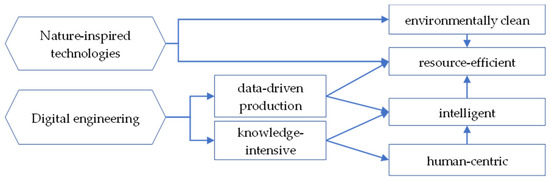
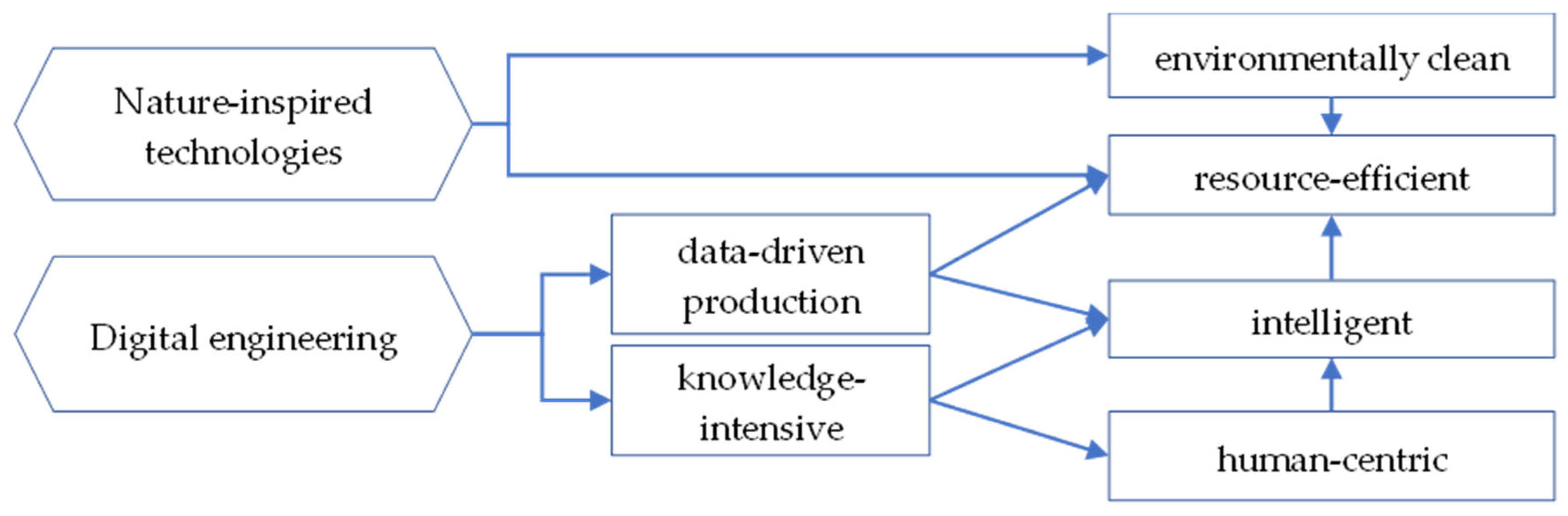
The priority development areas for modern Russian enterprises—including digital transformation, import substitution, science and innovation, sustainable development, low-carbon economy, diversification, and engineering—necessitate technological solutions capable of integrating these multidimensional aspects. A systems approach to addressing environmental, economic, social, and technological challenges can generate synergistic effects while reducing entropy in production networks. Consequently, the «digital engineering–nature-inspired technologies» dyad exemplifies complementary development tools that yield fundamentally innovative solutions across industrial sectors. In practical terms, applying digital engineering in alignment with nature-inspired principles enables the creation of globally competitive production systems capable of surpassing international benchmarks (Figure 1). This means that the presented symbiosis of natural principles and digital engineering tools forms a new ontology of industrial systems. Furthermore, in the context of achieving technological leadership, the source of these tools must be the country’s scientific research and innovation potential.
Figure 1.
The Synergistic Effect of the «Digital Engineering–Nature-Inspired Technologies» dyad.
- Knowledge-intensive production is characterized by intensive R&D activities focused on developing economically viable domestic technological solutions. These solutions integrate principles of sustainable development, lean manufacturing, quality management, and digitalization while surpassing foreign counterparts in functionality, technical parameters, and cost-efficiency.
- Resource-efficient production represents a core objective of modern production networks, aiming to reduce specific consumption of energy, water, and natural resources per unit of output. This includes comprehensive monitoring throughout the product lifecycle.
- Eco-friendly production requires adherence to circular economy principles, green economy practices, responsible production/consumption patterns, and establishing sustainable (responsible) supply chains to minimize environmental risks.
- Human-centric approach—the synergistic combination of human and machine capabilities delivers greater value than full automation alone.
- Data-driven production—leveraging data analytics across all product lifecycle stages and management levels.
- Smart manufacturing—integrated production networks enabling rapid response to: supply chain fluctuations, evolving customer preferences, quality management system requirements, environmental management standards, occupational safety regulations.
Furthermore, by enhancing the production network’s adaptability to destabilizing factors—whether external (geoeconomic conditions, supply chain transformations) or internal (equipment depreciation, workforce turnover)—this combined approach can significantly strengthen the network’s resilience. It provides the system with shock-absorption capacity while maintaining structural stability of the production network.
3.2. Assessing the Interconnections Between Technological and Sustainable Development in Russia
The impact of technological modernization is not always transparent—especially at the macroeconomic level—due to the complexity of technical systems. Hidden patterns and relationships can be uncovered through data analysis techniques. Of particular scientific and practical interest is the effect of technology adoption on environmental performance indicators. On one hand, this relationship should be evident, given investments in low-carbon, circular, energy- and resource-efficient solutions. On the other hand, the correlation heatmap (Table 1) reveals the following characteristics of Russian industrial development:
Table 1.
Correlation color map.
- the development and implementation of production technologies for design and engineering provides a positive effect in terms of reducing environmental pollution and electricity losses (correlation of X1 with resulting indicators Yi is predominantly negative and strong);
- the use of ready-made solutions for design and engineering does not contribute to improving the environmental situation (correlation of X2 with resulting indicators Yi is predominantly positive and noticeable, i.e., demonstrates a direct relationship);
- digitalization of design processes, including the implementation of digital engineering, delivers the expected environmental effect (correlation of X3 with resulting indicators Yi is negative and moderate);
- digitalization of automated production management processes does not yield a definitive response in terms of improving sustainable development indicators (correlation of X4 with resulting indicators Yi shows both positive and negative moderate relationships);
- electricity consumption strongly correlates with the development of production technologies (direct relationship between Y1 and X1) and digitalization of design (direct relationship between Y1 and X3);
- water usage decreases with active development of production technologies in design (inverse relationship between Y2 and X1), but is directly proportional to their application (direct relationship between Y2 and X2);
- environmental pollution decreases with active technological development and digitalization in design (inverse relationships between Y3–Y5 and X1, X3);
- energy losses reduce with increased intensity of production technological modernization (inverse relationships between Y6 and X1, X3).
Thus, during the study period, a weak correlation was generally observed between design technologies and nature-inspired technologies. This finding highlights the “digital engineering–nature-inspired technologies” dyad as a promising tool. Against the backdrop of import substitution policies, in-house technological developments (X1) demonstrate superiority over passive use of ready-made technological solutions (X2) in building sustainable production systems.
Simulation results reveal a substantial difference in the strength of digitalization’s influence across different groups of environmental indicators. The most significant and statistically robust effect is observed concerning the reduction in specific electricity and water consumption. This can be explained by the fact that these parameters are the most directly amenable to optimization through real-time process control digital tools (e.g., digital twins, predictive analytics systems, and intelligent dispatching). Digital engineering enables fine-tuning of loads, equipment operating modes, and heat balances, which directly reduces energy and water consumption per unit of output.
At the same time, the influence on indicators of pollutant emissions, wastewater discharge, and waste generation proved to be less pronounced and statistically weaker. This observation is fully consistent with theoretical premises. These parameters are determined to a much greater extent not only by the level of management digitalization but also by several fundamental production–technological and infrastructural factors, on which digital transformation has only an indirect and long-term impact:
- the qualitative and quantitative composition of the raw materials used, which is often determined by external supplies and cannot be quickly changed;
- the physical wear, baseline efficiency, and environmental performance of the core technological equipment making up the production fleet—digitalization can optimize the operation of existing equipment but cannot always radically reduce its “inherent” emissions without physical replacement;
- the availability, technical level, and capacity of end-of-pipe treatment systems (gas cleaning, water treatment)—implementing digital monitoring and control systems for these complexes (which is partly reflected in the variables of our study) can improve their efficiency but cannot compensate for their complete absence or fundamental inadequacy.
Thus, the obtained results confirm the hypothesis that the effect of digital engineering manifests most quickly and directly in resource efficiency (reducing the “input”). In contrast, the influence on emission and waste indicators (the system’s “output”) is more complex, requires comprehensive production modernization, and depends on numerous additional structural and infrastructural conditions. This underscores the necessity for an integrated approach to greening, where digital transformation serves as a powerful tool but does not replace investments in renovating fixed assets and environmental protection infrastructure.
3.3. Modeling the Impact of Technological Solutions on Sustainable Production Development
3.3.1. Stepwise Regression
A set of models for the dependence of Yi on a set of predictors has been constructed (Table 2). The following parameters were applied to assess the quality of the equations:
Table 2.
Regression equations.
- adjusted R-squared—the R-squared value adjusted for the number of independent variables (provides a more accurate estimate compared to R-squared);
- p-value—the probability of rejecting the hypothesis about the dependence of predictors and the response;
- Durbin–Watson d—a criterion for testing the autocorrelation of residuals.
The Durbin–Watson d statistic takes values within the range of 0 to 4. Values close to 2 indicate the absence of autocorrelation; values less than 2 indicate positive autocorrelation of residuals; values greater than 2 indicate negative autocorrelation.
Based on the values of adjusted R-squared and p-value, the majority of all predictor-response combinations are characterized by good predictive capability, with the exception of dependency (5). Evaluating the Durbin–Watson d statistic and the magnitude of the MAPE, it can be stated that dependencies (1) and (2) possess the highest accuracy. In other words, digital engineering implemented domestically in Russia provides a pronounced effect in terms of electricity and water resource consumption. This is explained by the fact that resource consumption (Y1, Y2) is continuously monitored and is a primary object of management, conservation, and automation. Emissions, wastewater discharge, and waste generation (Y3, Y4, Y5, Y6) are nonlinear consequences, dependent not only on technology but also on the quality and composition of raw materials and the performance of treatment systems. The latter depend primarily on capital investment.
The dependencies can be interpreted as follows:
- (1) Design and engineering processes (X1, X3) are energy-intensive, while automation processes (X4) are energy-saving. Collectively, these processes determine the magnitude of electricity consumption.
- (2) Digital engineering (X1, X3) determines the rational use of water through measurement accuracy and flow optimization, as well as design objectives that preclude losses. Production automation (X4) contributes to increased productivity and production scale, which may be accompanied by an increase in water consumption.
Such models allow for the construction of alternative development scenarios (pessimistic, optimistic, baseline) and can serve to alert regulatory authorities of potential deterioration in environmental indicators against the backdrop of the overall modernization of production systems.
The deterministic nature of regression models enables the determination of a specific value of an environmental parameter upon a change in the level of digital activity.
3.3.2. Automated Neural Network with a Single Hidden Layer
The second set of models was constructed using the Statistica software. The analysis included all dependent (Yi) and independent (Xk) variables. Based on the observation scope, the following parameters were configured:
- task type: regression;
- the sample size demonstrating optimal performance was distributed as follows: training—60%, test—20%, validation—20%;
- subsampling method: random subsamples;
- neural network type: Multilayer Perceptron (MLP);
- number of hidden neurons: 3 to 10;
- activation functions: identity, logistic, hyperbolic tangent (tanh), exponential.
The modeling process retained five neural networks demonstrating high performance across all three sample subsets (training, test, and validation sets) (Table 3). Guided by the principle of selecting the highest training set performance (both across networks and sample subsets), the authors ultimately selected Network No. 5—MLP 4-7-6—which demonstrated the lowest training error. The hidden layer contained 7 neurons. Analysis of weight coefficients revealed stronger connections originating from the input layer, specifically (X1 → hidden neuron 5; X4 → hidden neuron 6).
Table 3.
Preserved neural networks demonstrating high model quality.
The sensitivity analysis highlights the predominant importance of parameter X1 (13.175), confirming our earlier conclusion about the critical role of in-house engineering and design solutions in achieving optimal system performance.
The subsequent parameters exhibited the following sensitivity rankings: X4 (5.8), X3 (5.456), X2 (2.383).
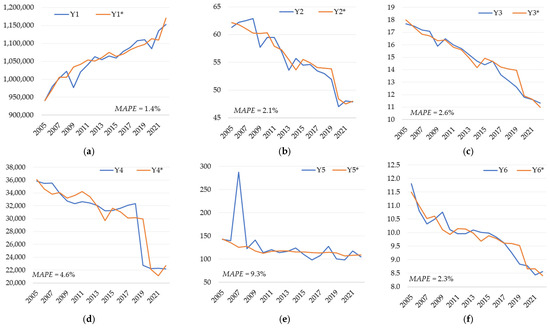
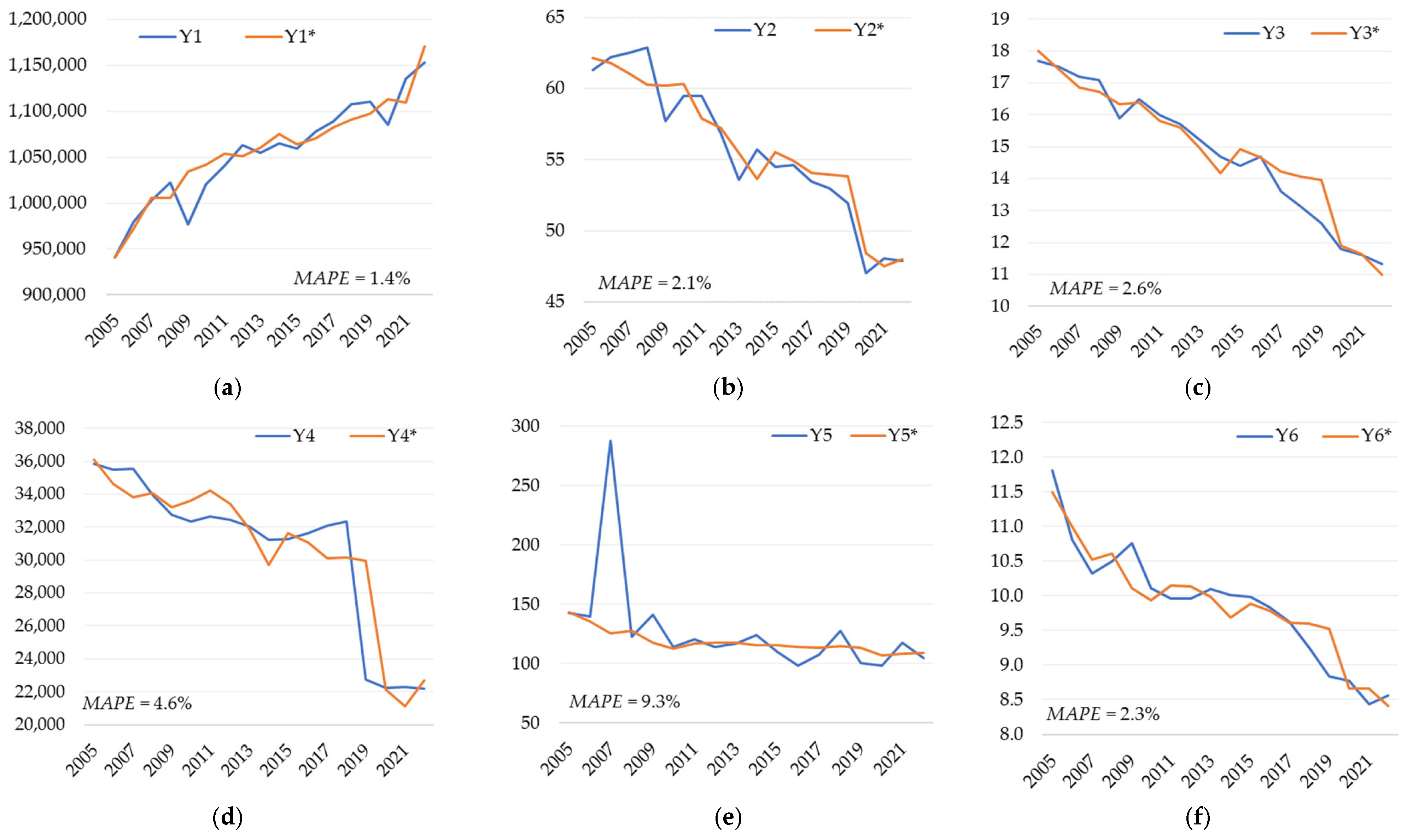
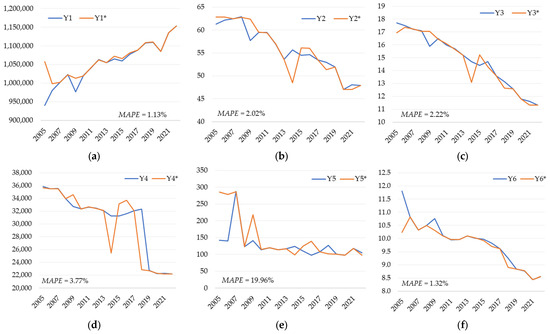
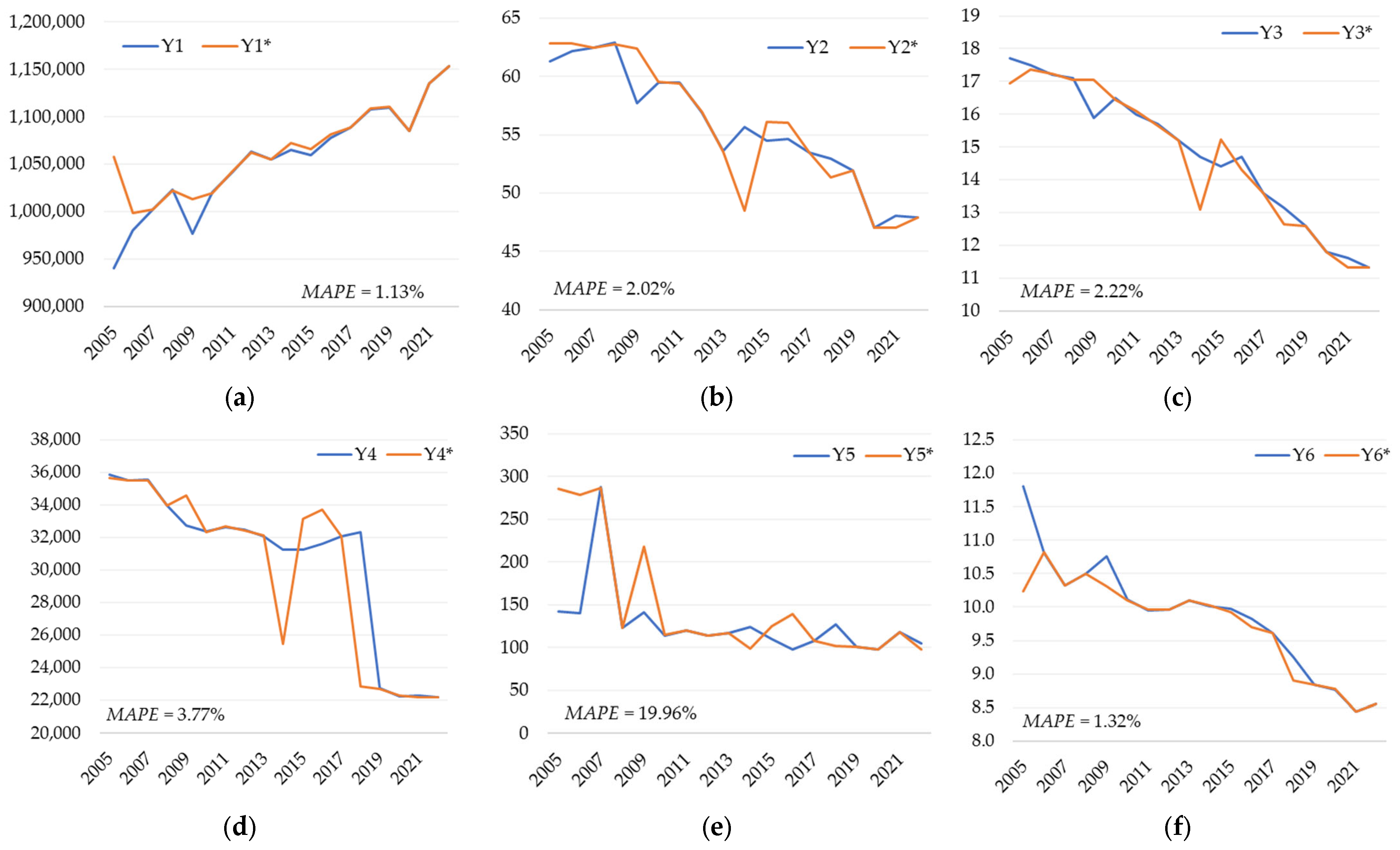
Evaluation of the model quality for assessing the dependence of sustainable development on technological activity of Russian organizations revealed varying MAPE magnitudes (Figure 2). A significant deviation was observed for indicator Y5 due to an anomalously high value in 2007 (Figure 2e). To address this, additional modeling was performed excluding this outlier (using the Irwin criterion), but both the model’s accuracy and the neural network’s performance deteriorated. Consequently, it was decided to retain the 2007 observation despite its substantial deviation. The average MAPE across the six indicators (Y1–Y6) was 3.7%.
Figure 2.
Comparison of actual and predicted values of environmental indicators using the automated MLP 4-7-6 neural network (Statistica): (a) electricity consumption (million kWh); (b) freshwater usage (billion m3); (c) Polluted wastewater discharge (billion m3); (d) air pollutant emissions (thousand tons) from stationary and mobile sources; (e) hazardous waste generation (million tons) of environmental hazard classes I–IV; (f) electricity transmission and distribution losses (%). (Yi*) calculated values Yi.
To verify the accuracy of the judgments, models with time lags of 1 year (model MTL1), 2 years (model MTL2), and 3 years (model MTL3) were constructed. The calculations are based on dependency (2). For model comparison (including the model without time lags, MTL0), feature sensitivity metrics and MAPEs were evaluated (Table 4). In all four cases, the sensitivity of X1 is relatively higher than other features, once again confirming the importance of scientific research and innovation activities of enterprises in the fields of design and digital engineering.
Table 4.
Comparative analysis of models without and with time lag consideration.
Incorporating the time lag factor between technology implementation and the manifestation of pollution reduction effects yielded mixed results: on one hand, based on the highest sensitivity, the MTL2 model is preferred for application, but the magnitude of prediction error increases; on the other hand, when evaluating error levels, the baseline MTL0 model and the time-lagged MTL3 model (j − 3) demonstrate better performance. The final conclusion will be drawn based on the validation results of the constructed models.
3.3.3. Automated Neural Network with Multiple Hidden Layers of Neurons
An alternative modeling tool, Deductor Studio, allows for varying the number of hidden layers and neurons. To enhance variability, three architectures were constructed—with one (Figure 3), two, and three hidden layers of neurons. Considering the specifics of the software product, the following settings were defined:
Figure 3.
Comparison of actual and calculated values of environmental indicators based on an automated neural network [4 × 7 × 6] (Deductor Studio): (a) electricity consumption (million kWh); (b) freshwater usage (billion m3); (c) polluted wastewater discharge (billion m3); (d) air pollutant emissions (thousand tons) from stationary and mobile sources; (e) hazardous waste generation (million tons) of environmental hazard classes I–IV; (f) electricity transmission and distribution losses (%). (Yi*) calculated values Yi.
- data processing method—multilayer neural network;
- raining algorithm—Resilient Propagation (RPROP)—learning with weight correction after presenting all examples of the training set;
- sample size: training—60%, validation—40%;
- an example is considered recognized if the error is below 0.05;
- activation function type—sigmoidal.
Figure 3 presents the calculation results of the neural network model with one hidden layer containing 7 neurons (for comparability with the MLP 4-7-6 model).
A comparative analysis of neural networks with different architectures leads to the conclusion that a neural network with two hidden layers of neurons (2 and 4 neurons in each hidden layer) exhibits higher performance, as the average error value was only 3.05% (Table 5).
Table 5.
Comparative analysis of models with one, two, and three hidden layers.
Thus, verification of the obtained automated neural networks was performed using the data incorporated in the model. At the current stage, it can be stated that the models operate with a low error margin. The Statistica software provides relatively high modeling accuracy when using both the MTL0 approach (without considering the time lag) and the MTL3 model with a time lag (j − 3) are applied. The Deductor Studio software delivers higher computational accuracy when using a two-layer neural network architecture [4 × 2 × 4 × 6].
3.4. Validation of Models for the Dependence of Sustainable Development on the Technological Activity of Russian Organizations
If the model verification was conducted on data from 2005 to 2022, then validation is proposed to be carried out on new data, for which actual feature values for 2023 were used (Table 6). Among the complex models, the lowest mean absolute percentage error (MAPE) was achieved by the single-layer neural networks MTL3 and [4 × 7 × 6], as well as by the two-hidden-layer neural network [4 × 2 × 4 × 6]. This finding corroborates the conclusions presented in the preceding section. Moreover, the MAPE values remained below 10% in most cases, demonstrating the high predictive capability of the developed neural network architectures.
Table 6.
The model validation results for the input values X1 = 409 units, X2 = 40 105 units, X3 = 15.5%, X4 = 13.6%.
The core premise of the constructed models is based on the following principles:
- the intensification of developing industrial and digital design and engineering technologies, while incorporating environmental impact monitoring and minimization, contributes to improved ecological well-being, as evidenced by reductions in electricity consumption, energy losses, water usage, discharge of contaminated wastewater, and waste generation;
- throughout the analyzed period, the potential of digital engineering in the context of sustainable development remained underutilized, representing a promising avenue for producing high-quality, competitive, and knowledge-intensive products;
- innovations in design and engineering demonstrate significantly greater impact on energy conservation, water efficiency, and production decarbonization compared to waste processing optimization;
- the application of off-the-shelf design and engineering technologies proves less effective in driving sustainable development, underscoring the critical need for developing integrated solutions that combine digital engineering approaches with nature-inspired technologies.
4. Discussion
The materials examined in this study indicate a predominance of microeconomic approaches in managing digital production design [39,40,41,42,43,44,45]. Our research focuses on analyzing the macroeconomic impacts of digital design technologies on environmental conditions. This approach provides a comprehensive understanding of the country’s technological development patterns without delving into specific production modernization practices.
The study examining the relationship between digitalization rates and national electricity consumption partially aligns with the conclusions presented in studies [18,19]. The findings point to an ambiguous relationship between digitalization and sustainable development indicators. Our study demonstrated a unidirectional change in (1) organizations’ activity in digital design adoption and (2) electricity consumption volume; a unidirectional change in (1) implemented design and engineering developments and (2) electricity consumption volume, but a multidirectional change in (1) utilized design and engineering technologies and (2) energy consumption. This suggests that the digitalization of design may have a negative impact on environmental performance indicators within the industrial macro-system. However, it should be noted that digital transformation is neither the sole nor the primary factor driving increased energy consumption.
The comprehensive analysis conducted using stepwise regression and neural networks with various architectures not only enabled the construction of predictive models but also revealed stable patterns of fundamental importance for sustainable development policy.
Despite methodological differences, all applied models unanimously indicated the decisive role of two factors:
Development of Advanced Technologies (X1) demonstrated the highest relative importance (greatest weight in neural networks and high sensitivity). This indicates that in-house research and development (R&D) in the field of digital design and engineering is the primary driver for improving environmental efficiency. This factor is directly linked to the creation of adapted, breakthrough solutions.
Automation Level (X4) also showed a significant and stable positive influence, especially on resource efficiency. This confirms the hypothesis that implementing automated control systems is a necessary condition for realizing the potential of digital models.
A crucial contrast: the parameter for using ready-made technologies (X2) showed a statistically weak and unstable relationship with most target environmental indicators (except for waste generation Y5, where the relationship was positive). This is a critically important finding for import substitution and technological development policy: the mass implementation of foreign or standard solutions without their deep adaptation and accompanying R&D does not lead to significant improvement in environmental outcomes.
The modeling clearly differentiated the impact of digital engineering into two groups of indicators:
Strong and Direct Impact on Resource Intensity (“Inputs”): electricity (Y1) and water (Y2) consumption demonstrate the closest and most linear relationship with the level of digitalization. The explanation lies in the fact that these parameters are optimally managed in real-time using digital twins and predictive analytics systems.
Weak and Indirect Impact on Pollution (“Outputs”): volumes of emissions (Y3), wastewater (Y4), and waste (Y5, Y6) depend to a much lesser degree on the analyzed digital factors. This confirms the theoretical premise: these indicators are more strongly determined by structural factors, such as raw material composition, the physical wear of core equipment, and the capacity of end-of-pipe treatment infrastructure. Modernizing these requires separate capital investments and cannot be reduced solely to the digitalization of management.
The obtained results also correlate with the dynamic capabilities theory, as demonstrated in study [18] through the lens of digitalization and green development in production systems. The study reveals a clear dynamic (2005–2022): while the number of developed design technologies increased by 250%, environmental pollution indicators decreased by an average of 30%. In other words, the adaptation of the industrial macro-system to external environmental conditions (economic, industrial, and environmental policies) occurs through the restructuring of internal processes and technologies. This reveals the organizational inertia noted in [18]—specifically, the slow pace of design digitalization (as of 2023, only 15.5% of Russian organizations utilized specialized design software tools). This phenomenon can be explained by several key factors: high implementation costs, a shortage of personnel with required digital competencies, cybersecurity risks (including data breaches, cyberattacks, and digital platform failures), as well as challenges in integrating legacy CAD systems with new digital tools.
The conducted analysis reveals patterns that align with global trends while reflecting the specifics of the national context. The key finding that internal technology development (X1), rather than its passive adoption (X2), is the main driver of resource efficiency (Y1, Y2) is consistent with the technological strategies of leading economies, such as China and the EU, which emphasize domestic innovation. However, the identified weak link between digitalization and pollution emissions (Y3–Y6) underscores the determining role of structural factors. In countries with modern infrastructure (e.g., Germany), digital solutions yield a comprehensive effect, reducing both resource consumption and emissions. In economies with outdated fixed assets and treatment capacities digitalization alone cannot overcome these bottlenecks. Thus, the study contributes to the global discourse by offering an analytical framework for a differentiated assessment of the effects of digital transformation, depending on the level of development of industrial and environmental infrastructure.
An important aspect is the question of nature-like technologies. As could be observed, these technologies are not analyzed in explicit form within this study. However, it is a known fact that the principles of the circular economy are being replicated (an increase in recycled water use, secondary waste processing, and the utilization of captured pollutants in production). Furthermore, against the backdrop of sustained growth in the volumes of mineral extraction and manufacturing industries in Russia, a reduction in the use of fresh water, emissions of pollutants, and generation of production and consumption waste is observed. All of this allows one to infer the active implementation of nature-inspired technology principles within Russia’s industrial system.
Furthermore, it is important to emphasize that the identified cause-and-effect relationships are, above all, indirect and statistical in nature. The influence of technological factors (X1–X4) on the environmental indicators (Y1–Y6) of a production macro-system manifests through a complex set of technological, managerial, and institutional conditions. Contributing factors include: market conditions and the investment climate within the macroeconomic system, regulatory frameworks governing the environmental aspects of production, and the use of other digital tools (beyond digital engineering).
The limitations of the conducted research are its scale, the content of the predictors, and the presence of varying time lags.
- The object of the study was the macroeconomic system. Patterns identified at the macro level are also explained by network interactions and do not imply analogous changes at the level of a specific production system. Consequently, the presented models and conclusions are applicable not so much for an individual enterprise, but rather at the level of state and industrial management.
- The statistical data for X1 and X2 (the number of production technologies) do not specify the quality and type of technologies, nor the scale of their implementation in Russian production.
- Time lags manifest differently in the sphere of digital design and in the achievement of environmental effects.
Summarizing the listed limitations, it should be emphasized that the identified patterns can serve as a tool for detecting trends at the macro level and for adjusting programs and strategies for the country’s scientific and technological development.
5. Conclusions
The global economic landscape is fundamentally shaped by the interconnectedness of key development pathways for production networks: scientific research and innovation, digital transformation, sustainable development goal attainment, and nature-inspired technology adoption. This study incorporates these multidimensional considerations, combining theoretical and methodological approaches to derive actionable insights relevant for contemporary production networks.
First, the research substantiates the influence of digital engineering on the sustainable development of production systems, which manifests in exploring new directions for research and innovation activities; optimizing production processes and operations; managing big data; modeling and scenario forecasting of production systems, networks, and products; automating processes and operations; implementing Industry 5.0 principles; enhancing cooperation; and developing personnel.
Secondly, the study demonstrates the convergence between digitalization processes and sustainable development principles through the “digital engineering–nature-inspired technologies” dyad, whose synergistic effect enables the creation of knowledge-intensive, resource-efficient, environmentally clean, human-centric, data-driven, and intelligent production systems. A systems approach can effectively reduce entropy while enhancing the flexibility and resilience of production systems.
Third, correlation analysis revealed the following patterns in the development of Russian production systems: (1) the development and implementation of custom production technologies for design and engineering improves environmental indicators more significantly than using off-the-shelf solutions; (2) digitalization of design processes (including digital engineering implementation) delivers greater environmental benefits than digitalizing automated production management processes. During the study period, only a weak correlation was observed between design technologies and nature-inspired technologies, highlighting the untapped potential of the «digital engineering–nature-inspired technologies» synergy.
Fourth, models were developed to quantify the relationship between sustainable development outcomes and technological activity in design/engineering within Russian manufacturing systems. Regression analysis made it possible to identify the most significant combinations of predictors that determine environmental indicators. The obtained results allow us to state that the digital engineering being implemented in Russia demonstrates asymmetric effectiveness. Its potential is most fully realized in managing direct and continuously monitored resource flows—electricity and water consumption (Y1, Y2). Regarding emissions, discharges, and waste generation (Y3, Y4, Y5, Y6), the effect is less evident. This is since these indicators are derivative results, dependent on a combination of factors beyond the scope of operational digitalization: the composition of raw materials, the degree of wear of core equipment, and the condition and technological level of capital-intensive purification infrastructure systems.
Through rigorous verification and validation of alternative automated neural networks, the most efficient models were selected for predicting environmental aspects of sustainable development, accounting for modernization of design and engineering approaches across all product lifecycle stages.
The study’s scientific novelty lies in demonstrating—through multidimensional nonlinear analysis—the critical importance of converging digital engineering with nature-inspired technologies, while identifying priority development pathways for production systems that advance sustainable development goals amid Russia’s import substitution policies and technological sovereignty initiatives.
Based on the modeling results, the following recommendations have been formulated for various stakeholders:
For industrial companies:
- priority should be given to investments in in-house development and adaptation of digital engineering solutions (X1), rather than passive borrowing;
- implementing automation systems (X4) is a necessary next step to realize the potential of digital models;
- the greatest and quickest return on digitalization should be expected in the area of reducing operational costs through savings in energy and water.
For government regulatory bodies and policy makers:
- the system of support measures (subsidies, tax incentives) should be differentiated and primarily stimulate the development of domestic advanced production technologies (APT), not merely their presence at an enterprise;
- target environmental indicators must realistically account for varying response rates: requirements for reducing resource intensity can be tightened more quickly than emission standards, for which digitalization is a necessary but insufficient condition for improvement;
- for forecasting the consequences of technological policy, models with a time lag and the neural network architecture with two hidden layers, which demonstrated the best-balanced accuracy in this study, can be recommended.
Thus, the constructed models serve not only as a forecasting tool but also as a basis for identifying cause-and-effect relationships and formulating a targeted strategy for transitioning to sustainable production, in which digital transformation plays a key, but not the sole, role in systemic modernization.
The study’s findings contribute to advancing conceptual frameworks in industrial economics and sustainable development while enriching dynamic capabilities theory and enhancing forecasting methodologies for technological and sustainable development of production systems, with applicable insights for innovation planning and digital transformation programming across macroeconomic, meso-economic, and microeconomic levels.
Future research could explore: (1) patterns in adopting nature-inspired technologies at the meso-level (within spatial development contexts); (2) advanced methodologies for digital lifecycle management of high-tech products; and (3) development of software solutions for monitoring, diagnostics, planning, and forecasting of data-driven manufacturing aligned with sustainable development principles.
Author Contributions
Conceptualization, N.V.B. and F.F.G.; methodology, N.V.B.; software, A.I.S.; validation, F.F.G. and N.V.B.; formal analysis, F.F.G. and A.I.S.; investigation, N.V.B.; resources, F.F.G.; data curation, N.V.B.; writing—original draft preparation, N.V.B.; writing—review and editing, F.F.G.; visualization, F.F.G.; supervision, A.I.S.; project administration, N.V.B.; funding acquisition, A.I.S. All authors have read and agreed to the published version of the manuscript.
Funding
This research received no external funding.
Institutional Review Board Statement
Not applicable.
Informed Consent Statement
Not applicable.
Data Availability Statement
The original contributions presented in this study are included in the article. Further inquiries can be directed to the corresponding author.
Acknowledgments
The work was carried out with the support of a grant provided in 2025 by the Foundation for Science and Technology of the Republic of Tatarstan for conducting fundamental and applied research in scientific and educational institutions, enterprises, and organizations of the real sector of the economy of the Republic of Tatarstan, Agreement No. 21 dated 1 December 2025.
Conflicts of Interest
The authors declare no conflicts of interest.
Abbreviations
The following abbreviations are used in this manuscript:
| AI | Artificial intelligence |
| BAT | Best Available Techniques |
| MAPE | The mean absolute percentage error |
| MLP | Multi-layer perceptron |
| MTL | Model with time lag |
Appendix A. Input Data
Table A1.
A system of indicators of an environmental and technological nature.
References
- Borovkov, A.I.; Leventsov, V.A.; Rozhdestvensky, O.I.; Sachava, D.S.; Shamansky, D.V. Advanced Engineering School «Digital engineering»: Engineering master’s programs implemented jointly with industrial partners. Prof. J. Ser. Tech. Sci. 2024, 1, 35–60. (In Russian) [Google Scholar]
- Skobelev, D.O. Building the infrastructure for transforming Russian industry towards better resource efficiency and environmental performance. Procedia Environ. Sci. Eng. Manag. 2021, 8, 483–493. [Google Scholar]
- Guseva, T.; Shchelchkov, K.; Vartanyan, M.; Tikhonova, I. Setting energy efficiency enhancement objectives for Russian energy intensive industries. Procedia Environ. Sci. Eng. Manag. 2019, 6, 619–628. [Google Scholar]
- Jalal, A.Q.; Essa Allalaq, H.A.; Shinkevich, A.I.; Kudryavtseva, S.S.; Ershova, I.G. Assessment of the efficiency of energy and resource-saving technologies in open innovation and production systems. Int. J. Energy Econ. Policy 2019, 9, 289–296. [Google Scholar] [CrossRef] [Scilit]
- Galindo-Martin, M.-A.; Mendez-Picazo, M.-T.; Perez-Pujol, R.-S. Open innovation and sustainable development: A micro and macroeconomic analysis using a mixed method research with PLS-SEM-NCA and Delphi. Int. J. Inf. Manag. 2025, 82, 102874. [Google Scholar] [CrossRef] [Scilit]
- Sun, Y.; Yesilada, F.; Andlib, Z.; Ajaz, T. The role of eco-innovation and globalization towards carbon neutrality in the USA. J. Environ. Manag. 2021, 299, 113568. [Google Scholar] [CrossRef] [Scilit]
- Pho, T.V.; Phan, D.-K.; Phan, G.Q.; Nguyen, T.T.H. Impact of financial development, technological innovation, green trade and institutional quality on sustainable development: Revelations from global evidence. Sustain. Chem. One World 2025, 6, 100058. [Google Scholar] [CrossRef] [Scilit]
- Wang, X.; Iqbal, S.; Amin, N.; Hussain, M.; Zaman, S.; Khan, S. The role of government effectiveness, technological innovations, natural resource protection on carbon emissions in Gulf Cooperation Council region: A pathway for achieving sustainable development goals by 2030. J. Environ. Manag. 2025, 377, 124506. [Google Scholar] [CrossRef] [Scilit]
- Khan, M.; Khan, I. Achieving environmental sustainability through technological innovation, good governance and financial development: Perspectives from low income countries. Sustain. Futur. 2024, 8, 100392. [Google Scholar] [CrossRef] [Scilit]
- Bawa, S.; Benin, I.W.; Almudaihesh, A.S. Innovation Networks and Knowledge Diffusion Across Industries: An Empirical Study from an Emerging Economy. Sustainability 2024, 16, 11308. [Google Scholar] [CrossRef] [Scilit]
- Deng, S.; Wang, H.; Yao, Z. The role of low-carbon technology innovation incentive programs in achieving sustainable development goals in cities: Empirical evidence from 277 cities in China. Environ. Technol. Innov. 2025, 39, 104296. [Google Scholar] [CrossRef] [Scilit]
- Li, Z.; Tang, D. Pathways of the digital economy’s impact on green total factor productivity in the construction industry. Sustainability 2024, 16, 11283. [Google Scholar] [CrossRef] [Scilit]
- Zhang, S.; Lee, M.-J.; Chen, G.; Jung, J.-S.; Cho, M.H. Your Firm Needs a Sustainable Business Innovation Ecosystem. Sustainability 2024, 16, 11217. [Google Scholar] [CrossRef] [Scilit]
- Platania, F.; Toscano Hernandez, C.; El Ouadghiri, I.; Peillex, J. Bridging AI innovation and sustainable Development: The effect of AI technological progress on SDG investment performance. Technovation 2025, 146, 103279. [Google Scholar] [CrossRef] [Scilit]
- Liu, Y.; Liu, N.; Huo, Y. Impact of digital technology innovation on carbon emission reduction and energy rebound: Evidence from the Chinese firm level. Energy 2025, 320, 135187. [Google Scholar] [CrossRef] [Scilit]
- Yue, Q.; Lv, S. Impact of Digital Transformation on Carbon Performance of Industrial Firms Considering Performance–Expectation Gap as a Moderator. Sustainability 2024, 16, 6097. [Google Scholar] [CrossRef] [Scilit]
- Song, Y.; Xie, Z.; Song, Y. The impact of Digital transformation on carbon emission intensity. Int. Rev. Econ. Financ. 2025, 102, 104302. [Google Scholar] [CrossRef] [Scilit]
- Lin, W.; Wang, Y.; Zhang, Q.; Peron, M.; Lu, J. Emerging opportunities or paradoxes: Assessing the effect of digital technology adoption on corporate carbon performance. J. Environ. Manag. 2025, 391, 126399. [Google Scholar] [CrossRef] [Scilit]
- Tang, L.; Lu, B.; Tian, T. The Effect of Input Digitalization on Carbon Emission Intensity: An Empirical Analysis Based on China’s Manufacturing. Int. J. Environ. Res. Public Health 2023, 20, 3174. [Google Scholar] [CrossRef] [Scilit]
- Zhang, Y.; Ren, S.; Liu, Y.; Si, S. A big data analytics architecture for cleaner manufacturing and maintenance processes of complex products. J. Clean. Prod. 2017, 142, 626–641. [Google Scholar] [CrossRef] [Scilit]
- Shinkevich, A.I.; Psareva, N.Y.; Malysheva, T.V. Choosing Industrial Zones Multi-Criteria Problem Solution for Chemical Industries Development Using the Additive Global Criterion Method. Mathematics 2022, 10, 1434. [Google Scholar] [CrossRef] [Scilit]
- Rojek, I.; Mroziński, A.; Kotlarz, P.; Macko, M.; Mikołajewski, D. AI-Based Computational Model in Sustainable Transformation of Energy Markets. Energies 2023, 16, 8059. [Google Scholar] [CrossRef] [Scilit]
- Mancuso, I.; Messeni Petruzzelli, A.; Panniello, U.; Vaia, G. The bright and dark sides of AI innovation for sustainable development: Understanding the paradoxical tension between value creation and value destruction. Technovation 2025, 143, 103232. [Google Scholar] [CrossRef] [Scilit]
- Saniuk, S.; Grabowska, S.; Straka, M. Identification of Social and Economic Expectations: Contextual Reasons for the Transformation Process of Industry 4.0 into the Industry 5.0 Concept. Sustainability 2022, 14, 1391. [Google Scholar] [CrossRef] [Scilit]
- Alojaiman, B. Technological Modernizations in the Industry 5.0 Era: A Descriptive Analysis and Future Research Directions. Processes 2023, 11, 1318. [Google Scholar] [CrossRef] [Scilit]
- Hozdić, E.; Makovec, I. Evolution of the Human Role in Manufacturing Systems: On the Route from Digitalization and Cybernation to Cognitization. Appl. Syst. Innov. 2023, 6, 49. [Google Scholar] [CrossRef] [Scilit]
- Bernhard, O.; Wegmann, M.; Wagner, S.; Nigg, V.; Cochran, D.; Rauch, E.; Zaeh, M.F. Industry 5.0 implementation barriers for manufacturing companies. Procedia CIRP 2025, 134, 723–728. [Google Scholar] [CrossRef] [Scilit]
- Daareyni, A.; Ylä-Autio, A.; Martikkala, A.; Mokhtarian, H.; Ituarte, I.F. Combining data-driven and model-driven methods to support digital-twin engineering design: A case study for the (Re)design optimization of a quadcopter. Expert Syst. Appl. 2026, 296, 129113. [Google Scholar] [CrossRef] [Scilit]
- Papacharalampopoulos, A.; Michail, C.; Stavropoulos, P. Manufacturing resilience and agility through processes digital twin: Design and testing applied in the LPBF case. Procedia CIRP 2021, 103, 164–169. [Google Scholar] [CrossRef] [Scilit]
- Schleich, B.; Anwer, N.; Mathieu, L.; Wartzack, S. Shaping the digital twin for design and production engineering. CIRP Ann. 2017, 66, 141–144. [Google Scholar] [CrossRef] [Scilit]
- Anwer, N.; Stark, R.; Tao, F.; Erkoyuncu, J.A. Developing and leveraging digital twins in engineering design. CIRP Ann. 2025, 74, 843–868. [Google Scholar] [CrossRef] [Scilit]
- Zhou, T.; Xiong, W.; Obata, Y.; Lange, C.; Ma, Y. Chapter 2: Digital product design and engineering analysis techniques. In Digital Manufacturing; Elsevier: Amsterdam, The Netherlands, 2022; pp. 57–96. [Google Scholar] [CrossRef] [Scilit]
- Krish, S. A practical generative design method. Comput.-Aided Des. 2011, 43, 88–100. [Google Scholar] [CrossRef] [Scilit]
- Yoo, S.; Lee, S.; Kim, S.; Hwang, K.H.; Park, J.H.; Kang, N. Integrating deep learning into CAD/CAE system: Generative design and evaluation of 3D conceptual wheel. Struct. Multidiscip. Optim. 2021, 64, 2725–2747. [Google Scholar] [CrossRef] [Scilit]
- Zheng, P.; Lim, K.Y.H. Product family design and optimization: A digital twin-enhanced approach. Procedia CIRP 2020, 93, 246–250. [Google Scholar] [CrossRef] [Scilit]
- Mourtzis, D.; Angelopoulos, J.; Panopoulos, N. Personalized PSS Design Optimization based on Digital Twin and Extended Reality. Procedia CIRP 2022, 109, 389–394. [Google Scholar] [CrossRef] [Scilit]
- Cimino, A.; Gnoni, M.G.; Longo, F.; La Rosa, A. Digital Twin (DT) based methodology to support effective design of industrial production lines. Procedia Comput. Sci. 2023, 217, 1896–1907. [Google Scholar] [CrossRef] [Scilit]
- Frepoli, C.; Valeri, J.; Martin, R.P. Development of an Enterprise Digital Platform for Risk-Informed Design. In Proceedings of the Probabilistic Safety Assessment and Management Conference (PSAM 16), Honolulu, HI, USA, 26 June–1 July 2022. [Google Scholar]
- Seegrün, A.; Kruschke, T.; Mügge, J.; Hardinghaus, L.; Knauf, T.; Riedelsheimer, T.; Lindow, K. Sustainable product lifecycle management with Digital Twins: A systematic literature review. Procedia CIRP 2023, 119, 776–781. [Google Scholar] [CrossRef] [Scilit]
- Peterson, L.; Gosea, I.V.; Benner, P.; Sundmacher, K. Digital twins in process engineering: An overview on computational and numerical methods. Comput. Chem. Eng. 2025, 193, 108917. [Google Scholar] [CrossRef] [Scilit]
- Bhatti, G.; Mohan, H.; Singh, R.R. Towards the future of smart electric vehicles: Digital twin technology. Renew. Sustain. Energy Rev. 2021, 141, 110801. [Google Scholar] [CrossRef] [Scilit]
- Iranshahi, K.; Brun, J.; Arnold, T.; Sergi, T.; Müller, U.C. Digital twins: Recent advances and future directions in engineering fields. Intell. Syst. Appl. 2025, 26, 200516. [Google Scholar] [CrossRef] [Scilit]
- Dahmani, N.; Benhida, K.; Belhadi, A.; Kamble, S.; Elfezazi, S.; Jauhar, S.K. Smart circular product design strategies towards eco-effective production systems: A lean eco-design industry 4.0 framework. J. Clean. Prod. 2021, 320, 128847. [Google Scholar] [CrossRef] [Scilit]
- Siwiec, D.; Gajdzik, B.; Gawlik, R.; Wolniak, R.; Pacana, A. Open eco-innovations in sustainable product development: Model framework of design thinking in quality life cycle assessment (DT-QLCA). J. Open Innov. Technol. Mark. Complex. 2025, 11, 100480. [Google Scholar] [CrossRef] [Scilit]
- Birkeland, J. Nature positive: Interrogating sustainable design frameworks for their potential to deliver eco-positive outcomes. Urban Sci. 2022, 6, 35. [Google Scholar] [CrossRef] [Scilit]
- Arıkuşu, Y.S.; Bayhan, N.; Tiryaki, H. Determination of Energy Savings via Fuel Consumption Estimation with Machine Learning Methods and Rule-Based Control Methods Developed for Experimental Data of Hybrid Electric Vehicles. Energies 2023, 16, 7970. [Google Scholar] [CrossRef] [Scilit]
- Zarei, T.; Chatavi, M.; Nazari, M.; Amirfakhraei, A.; Salimi, M.; Amidpour, M. Machine Learning-Based Model Prediction of an Adsorption Desalination System and Investigation of the Impact of Parameters on the System’s Outputs. Water 2024, 16, 3700. [Google Scholar] [CrossRef] [Scilit]
- Chauhan, R.; Kaur, H.; Alankar, B. Air Quality Forecast using Convolutional Neural Network for Sustainable Development in Urban Environments. Sustain. Cities Soc. 2021, 75, 103239. [Google Scholar] [CrossRef] [Scilit]
- Waheed, W.; Xu, Q. Data-driven short term load forecasting with deep neural networks: Unlocking insights for sustainable energy management. Electr. Power Syst. Res. 2024, 232, 110376. [Google Scholar] [CrossRef] [Scilit]
- Abdeljaber, A.; Al Smadi, S.; Talib, M.A.; Abdallah, M. Comparative analysis of machine learning and conventional methods for waste generation forecasting. Clean. Eng. Technol. 2025, 27, 100992. [Google Scholar] [CrossRef] [Scilit]
- Barsegyan, N.V.; Galimulina, F.F.; Shinkevich, A.I. Digital transformation and modeling of nature-inspired systems. Systems 2025, 13, 793. [Google Scholar] [CrossRef] [Scilit]
- Federal State Statistics Service. Available online: https://www.rosstat.gov.ru/ (accessed on 26 July 2025).
- Electric Power Transmission and Distribution Losses. Available online: https://data.worldbank.org/indicator/EG.ELC.LOSS.ZS (accessed on 26 July 2025).
- Lewis, C.D. Industrial and Business Forecasting Methods: A Practical Guide to Exponential Smoothing and Curve Fitting; Butterworth Scientific: London, UK; Boston, MA, USA, 1982. [Google Scholar]

Disclaimer/Publisher’s Note: The statements, opinions and data contained in all publications are solely those of the individual author(s) and contributor(s) and not of MDPI and/or the editor(s). MDPI and/or the editor(s) disclaim responsibility for any injury to people or property resulting from any ideas, methods, instructions or products referred to in the content. |
© 2026 by the authors. Licensee MDPI, Basel, Switzerland. This article is an open access article distributed under the terms and conditions of the Creative Commons Attribution (CC BY) license.