


Abstract
In today’s rapidly evolving business environment, digitalization has emerged not only as a technological trend but also as a strategic imperative. This paper develops a conceptual framework that examines how Industry 4.0 (I4.0) technologies and tools drive strategic innovation and enable the transformation of business models. Based on a systematic literature review, the framework identifies a set of organizational and contextual preconditions (strategic vision, organizational culture, digital skills, infrastructure, financial resources, and regulatory conditions) that can act as either enablers or barriers to innovation. The analysis reveals that these preconditions give rise to two contrasting innovation cycles: a virtuous cycle, where favourable conditions amplify the adoption of digital technologies and foster business model transformation, and a vicious cycle, where unfavourable conditions reinforce technological inertia and hinder strategic development. By integrating insights from innovation management, digital transformation, and business model theory, the framework offers a nuanced understanding of how technology and strategy intersect and provides actionable guidance for managers seeking to move beyond operational improvements toward reimagining value creation, delivery, and capture in the digital age.
1. Introduction
In recent years, digitalization has become one of the most pervasive forces reshaping the global economy. Far from being a mere technological trend, it represents a profound transformation in how organizations create, deliver, and capture value. The convergence of technologies such as big data, simulation, and the Internet of Things (IoT) or tools like artificial intelligence (AI) or Blockchain is driving fundamental changes across industries, enabling new forms of connectivity, automation, and data-driven decision-making [1,2,3]. As a result, firms are increasingly compelled to reconfigure their strategies and business models to remain competitive in highly dynamic and uncertain environments [2,4,5,6].
However, technological advances alone do not guarantee sustainable competitive advantage; rather, value creation depends on a firm’s ability to strategically integrate and manage digital technologies to innovate at the organizational level. Consequently, strategic innovation has emerged as a key driver of long-term success in the digital era [4,7,8].
On the organizational perspective, it is relevant to clarify some concepts, that are sometimes still misunderstood [9]: Digitization: concerns the conversion from analogue to digital; Digitalization: adoption of digital technologies to improve business processes and models; Digital transformation: a broader concept that includes the adoption of new technologies (digitalization), but also the organizational and social changes concerning the digital world. Even being apart from the previous ones, it also makes sense to clarify the meaning of business model innovation. According to Foss & Saebi (2017) [10], “business model innovation represents a novel and more holistic form of organizational innovation that warrants theory building, operationalization, and testing”. In this paper, the focus will be on the concept of Digitalization, but to make the concepts clear, we would like to present a brief critical analysis of these concepts. Digitization is the most basic and technical level. It refers solely to the conversion of analogue data into digital form. On its own, digitization generates efficiency gains but does not necessarily alter organizational routines or strategic logic. The concept is operational and technology-centred, offering limited potential for competitive differentiation [11].
Digitalization, in contrast, involves the use of digital technologies to redesign processes, enhance information flows, and support new capabilities. It goes beyond technical conversion and requires some degree of organizational adaptation, such as new workflows, employee skills, or data-driven decision-making. However, digitalization often remains process-oriented. It improves “how things are done” without fundamentally changing “what the firm is” or “how it creates value” [11].
Digital transformation marks a radical shift. It entails a strategic and organizational reorientation, in which digital technologies reshape structures, culture, roles, and value propositions. Digital transformation implies not only technological adoption but also new leadership mindsets, cross-functional integration, and redefined customer interactions. It is neither a project nor a technological upgrade. It is a deep organizational change process that alters a firm’s trajectory [12].
Finally, business model innovation stands at yet another level, focusing specifically on how the firm creates, delivers, and captures value. While digitalization and digital transformation can enable BMI, they are not equivalent to it. Business model innovation involves reconfiguring value logic—such as shifting from products to services, introducing platform models, or redesigning revenue mechanisms. Importantly, a firm may digitalize its processes without transforming its business model, and it may even undertake elements of digital transformation without achieving genuine BMI.
Despite the extensive research on business model innovation as well as on I4.0, the latter, more recent, and even recognizing that technology may foster digital transformation [2,3,10]. This relation remains fragmented and underexplored. Much of the existing literature tends to focus on either the technological enablers of digital transformation or the managerial processes behind innovation but seldom integrates both perspectives within a unified theoretical framework. Based on the queries presented in the sections below, it was verified that a very limited number of studies (32) explicitly address the concepts of “business model (innovation)” and “I4.0” in their titles or abstracts. From those 32, some are papers oriented to particular industries like construction or hospitality, or specific topics like sustainability. These figures confirm the scarcity of integrative approaches. Might be important to notice that some of those papers in specific industries were not included in the analysis performed for this paper’s results. This gap limits our understanding of how I4.0 technologies simultaneously act as catalysts for firms’ development and as enablers or barriers of new, digitally enhanced business models [6,13,14,15,16]. The conceptual contribution of this paper lies in bridging the above-mentioned gap by proposing a unified framework that integrates technological, organizational, and contextual dimensions. Unlike prior models that treat enablers and barriers as static attributes, the proposed framework reconceptualizes them as dynamic moderators that can activate either a virtuous or a vicious cycle of innovation depending on their configuration.
The objective of this paper is therefore to develop a conceptual framework to explain how I4.0 technologies act as enablers of strategic and business model innovation. We also argue that these innovations may trigger the (digital) transformation of business models. By integrating insights from the literature on digitalization, strategic innovation, and business model theory, the proposed framework aims to clarify the pathways through which digitalization influences organizational change and value creation.
This study is significant for both theory and practice. Theoretically, it contributes to bridging disparate research streams by articulating the mediating role of strategic innovation capabilities in the relationship between digitalization and business model transformation. From a managerial perspective, it provides a conceptual foundation for firms seeking to leverage digital technologies not only to enhance operational efficiency but also to strategically reimagine their business architectures, fostering agility, customer centricity, and long-term sustainability.
2. Methodological Approach
To ensure methodological transparency in developing the proposed conceptual framework, this study adopts a protocol-driven, quality-focused approach using a systematic literature review (SLR) methodology as its primary research technique. The systematic methodology comprised four stages: planning, search, screening, and analysis. The SLR method enables a structured and replicable synthesis of existing knowledge, allowing the identification of patterns, relationships, and conceptual gaps across diverse research streams [17,18].
In conceptual and theory-building research, systematic reviews play a critical role in consolidating fragmented insights into a coherent theoretical foundation [18,19]. This structured approach helps avoid selection bias and enables a comprehensive understanding of how digitalization and I4.0 technologies and tools have been conceptualized as drivers of business model innovation.
The planning stage consisted of preparing the review protocol, which included defining the research objective, keywords, publication search criteria, search string, and publication exclusion criteria. The research objective is to develop a conceptual framework to explain how I4.0 technologies act as enablers of strategic and business model innovation. Therefore, the chosen keywords are “business model innovation”, “digitalization”, “I4.0 Technologies”, and “I4.0 Tools”.
The search criteria determined that the searches were performed in SCOPUS regarding title, keywords, and abstract. This database was selected as the primary source for literature retrieval. Scopus is widely recognized as the largest multidisciplinary database of peer-reviewed research in the social sciences, management, and technology fields.
The literature search follows a double-query design, intended to progressively narrow the focus from conceptual foundations to digitalization-related mechanisms. Two search strings were defined and executed in Scopus, applied to titles, abstracts, and keywords:
Query 1—Concept Clarification: (“business model innovation”) in order to identify foundational works that define and conceptualize business model innovation.
Query 2—I4.0 and Business Model Innovation: (“business model innovation” AND (“Industry 4.0” OR “I4.0”) AND Techn* OR Tools)—To explore how I4.0 technologies and tools enable or influence business model innovation.
The adopted approach, restricted to occurrences of the selected keyword titles, abstracts, and keywords, is common in systematic reviews as it increases the likelihood of identifying papers that explicitly address the focal concepts and avoids retrieving articles where the terms appear only peripherally or in non-substantive contexts. However, this decision also introduces certain limitations. By limiting the search to these fields, there is a possibility that relevant studies discussing digitalization or business model innovation in-depth within the full text, but without highlighting these concepts in the title, abstract, or keywords, may not have been captured.
Additionally, using a single database may omit relevant publications indexed exclusively in other repositories, such as Web of Science. Nevertheless, given Scopus’s extensive coverage and the conceptual orientation of this study, the chosen strategy provides a robust and transparent basis for identifying the core literature while maintaining methodological consistency.
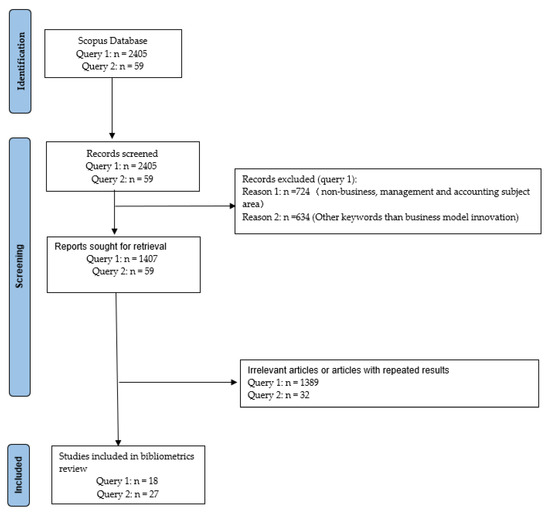
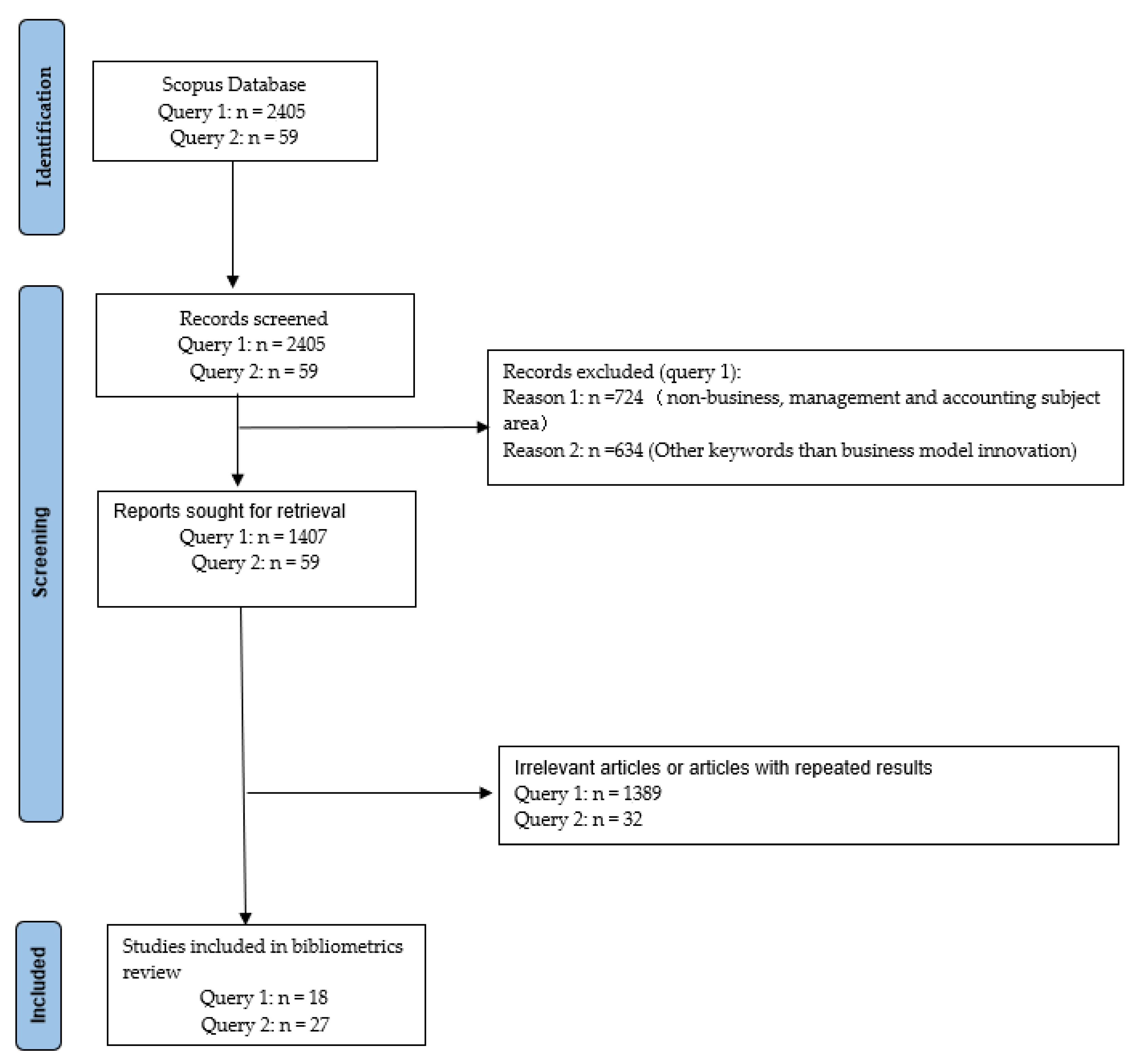
Searches were restricted to peer-reviewed journal articles written in English. Peer-reviewed publications were selected to ensure that the analysis was grounded in research of verified academic quality, methodological rigour, and theoretical relevance. Limiting the review to English-language articles was necessary to maintain consistency in interpretation and to ensure the feasibility of the analysis, as English remains the dominant language of scientific communication in the fields of innovation management and digitalization. Other exclusion/inclusion criteria were adopted by query and might be found in Figure 1. Those criteria will also be developed in the respective subsection (below).
Figure 1.
The PRISMA methodology.
The search results (screening stage) went under a multi-stage screening process following the PRISMA guidelines [20,21]. Titles and abstracts were screened for relevance. Full-text analysis was then performed on the selected papers to identify the most frequently reported enablers and barriers of business model innovation, which are synthesized in Table 1. In a second step, and aligned with the focus of Query 2, the analysis examined how each I4.0 technology and tool functions as an enabler or inhibitor of business model innovation. The resulting set of technology-specific moderators, conditions that either foster or hinder innovation, is summarized in Table 2.
Following this identification process, the most recurrent and influential elements across both analyses were compared and consolidated. This cross-analysis allowed for the detection of common organizational and contextual factors that consistently shape firms’ capacity to innovate. These insights provided the basis for developing the dual-cycle framework, distinguishing the virtuous and vicious cycles through which digitalization can either promote strategic and business model innovation or reinforce technological and organizational inertia.
By revising extant knowledge, this study follows Jaakkola’s approach [22] to complete the conceptualization, including theory synthesis, theory adaptation, typology, and model. Our research design for this conceptual paper is theory synthesis, which seeks to achieve conceptual integration across multiple theories or literature streams.
Generative AI (ChatGPT 5.2) was also used to facilitate analysing the literature for the sake of theme development in this paper, specifically in the exploration of the initial theme organization of the paper. During the paper development, some issues were “discussed” with GenAI. After the analysis of the most relevant papers (mostly cited), the remaining were analysed with the contribution of another AI tool (Chat PDF) that focused on document analysis. Some parts of the paper were edited and improved in terms of written language through ChatGPT. The use of Gen AI followed the guidance of Anderssen et al. (2025) [23] and Zhou & Sheu (2025) [24].
Table 1.
Definition, enablers, barriers, and objectives of business model innovation.
Table 2.
Industry 4.0 technologies and tools, enablers/barriers and moderators.
3. Theoretical Framework
The present section will be organized according to the research topics and the paper’s objective. First, we will present subsections aligned with the previously identified queries and purpose. Combining the findings, a conceptual framework will be presented.
3.1. Business Model Innovation
Query 1—Concept Clarification: (“business model innovation”) in order to identify foundational works that define and conceptualize business model innovation.
Considering that the main goal for this section is the definition of the concept, as well as the identification of the most relevant elements associated with business model innovation, we retrieved 2405 papers. In order to narrow the results, the search was performed focusing on “Business, Management and Accounting” as the area and “business innovation model” as the keyword. This search resulted in 1047 documents. After a first screening, some irrelevant articles were removed, resulting in 1389 articles.
The conclusions drawn from the analysis of these papers according to the defined methodology are presented below.
In summary, the review of the literature revealed a convergence in how business model innovation is defined and conceptualized across the academic community. The analysis of the twenty key references summarized in Table 1 highlights the recurring emphasis on value creation, delivery, and capture as core dimensions of business model innovation, as well as the consistent identification of leadership, organizational resources and capabilities, and technology (adoption) as its main enablers. Similarly, the barriers reported more frequently were the current company structure, in terms of assets, resources, and capabilities; resistance to change; and organizational culture aspects. Although a broader range of publications was initially reviewed, no substantially divergent definitions, enablers, or barriers were identified beyond those represented in Table 1.
Moreover, the findings indicate that innovation in business models is inherently strategic in nature, aiming not only at operational improvement but also at fostering strategic innovation, strengthening competitive advantage, and ultimately creating value for firms and their stakeholders.
This consistency reinforces the maturity of the existing literature and provides a conceptual foundation for the subsequent analysis, which seeks to explore how digital technologies further shape (or not) the transformation of business models.
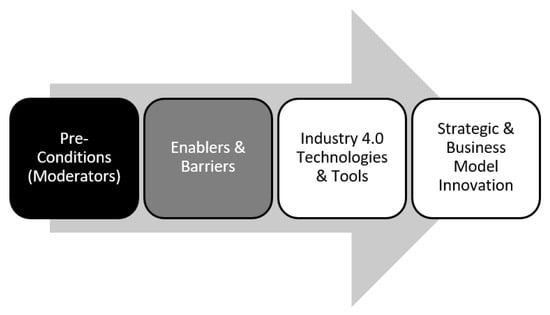
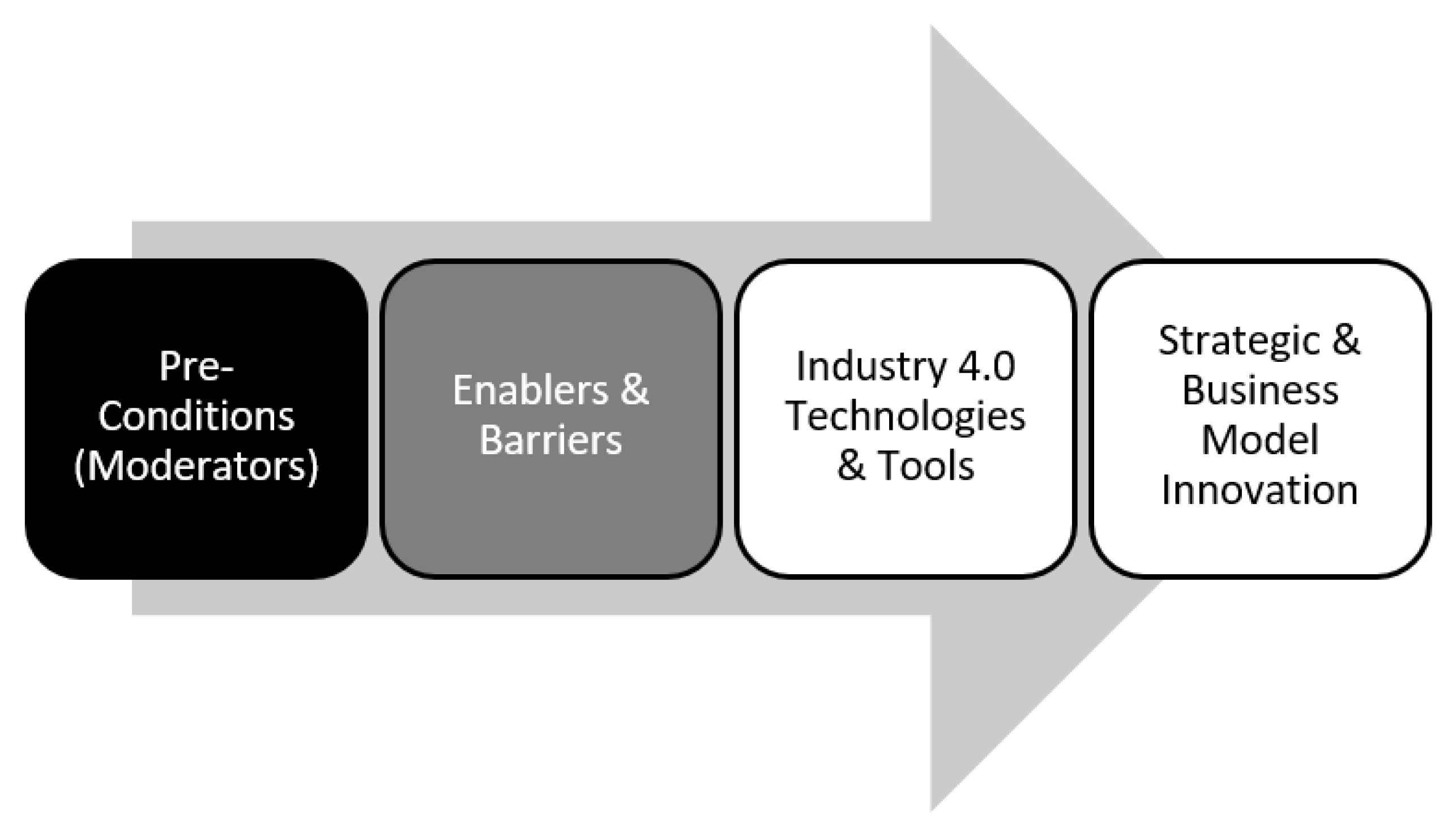
Bearing this relationship in mind, Figure 2 presents the conceptual model to be explored in the following section. The model assumes that firms operate within a set of pre-existing organizational and contextual conditions (moderators or mediators), which can function either as enablers or barriers to the adoption of I4.0 technologies and tools. These preconditions determine the extent to which firms can effectively integrate and leverage advanced technologies. The successful implementation of I4.0 technologies and tools under favourable conditions is expected to trigger business model innovation, leading to new forms of value creation, delivery, and capture, and thereby reinforcing the firm’s strategic innovation trajectory.
Figure 2.
Conceptual framework (Part I).
3.2. Industry 4.0 and Business Model Innovation
Query 2—I4.0 and Business Model Innovation: (“business model innovation” AND (“Industry 4.0” OR “I4.0”) AND Techn* OR Tools)—The aim is to explore how I4.0 technologies and tools enable or influence business model innovation. The specific inclusion criteria for this search were papers published from 2011 to 2025. This period captures the most significant developments in I4.0 research. This search resulted in 59 documents. After an analysis of the relevant/irrelevant papers, 32 were removed, resulting in a final number of 27 analysed papers.
Building upon the conceptual foundations of business model innovation presented in the previous section, this part of the study examines the intersection between I4.0 technologies and tools with business model innovation, emphasizing their role as potential enablers or barriers to strategic innovation. The accelerated diffusion of digital technologies, such as big data analytics, the IoT, blockchain, additive manufacturing, or cloud computing, has transformed the competitive landscape, enabling new ways of creating and capturing value across industries [7,8,30,32]. However, while these technologies offer unprecedented opportunities for organizational renewal and agility, they also introduce new complexities and challenges that can hinder innovation if not properly aligned with strategic objectives [3,26]. Still under review of the literature, this section aims to identify the I4.0 technologies and tools most frequently associated with business model and strategic innovation, as well as to explore the moderating factors that influence their effectiveness as innovation drivers. By synthesizing these insights, the section seeks to clarify the mechanisms through which I4.0 acts both as a catalyst and, at times, a constraint in the pursuit of strategic and business model innovation.
The analysis of the literature, summarized in Table 2, highlights the multifaceted role of Industry 4.0 technologies and digital tools in shaping business model innovation. Across the nine technologies and four tools identified, a clear pattern emerges in which these technologies and tools may act as enablers or barriers of innovation, fostering or hindering business models’ transformation and consequently value creation. Among them, cybersecurity stands out as a transversal technology, influencing and supporting the adoption of all other I4.0 technologies by ensuring data integrity, system reliability, and trust within digital ecosystems.
The analysis also reveals that the impact of these technologies is highly context-dependent, shaped by a set of moderators or preconditions that can act as either enablers or barriers depending on their configuration. Factors such as data quality (accurate vs. poor), organizational culture (digitally oriented vs. resistant to change), financial conditions (availability of investment vs. cost constraints), digital skills (expertise vs. skill shortages), strategic vision (digital orientation vs. lack of vision), networking capabilities (strong vs. weak inter-firm relations), connectivity (adequate vs. limited), and legal or regulatory frameworks (digitally supportive vs. traditional) emerge as decisive variables moderating the success of business model and strategic innovation, as summarized in Table 2.
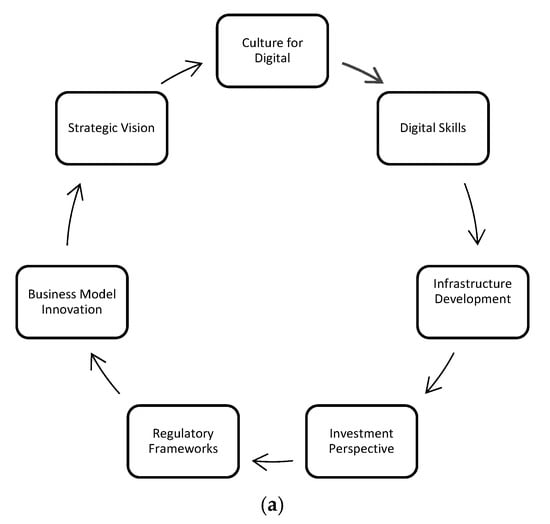
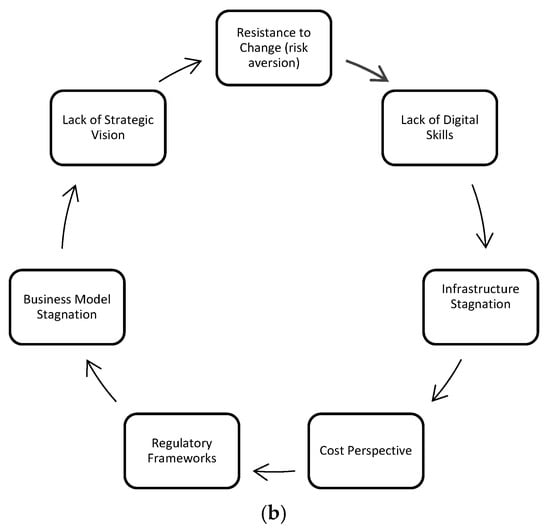
These findings suggest that I4.0 technologies and tools operate within two contrasting innovation cycles: a virtuous cycle, where favourable moderators amplify digital innovation and accelerate business model transformation; and a vicious cycle, where unfavourable conditions reinforce technological inertia and hinder growth (Figure 3). The prevalence of either cycle depends largely on the ecosystem in which firms operate.
Figure 3.
Conceptual framework (Part II): (a) the virtuous cycle; (b) the vicious cycle.
Furthermore, when these results are considered alongside those from Table 1, which summarizes the general definitions, enablers, and barriers of business model innovation, it becomes evident that several factors overlap across both analyses. This convergence reinforces the argument that firms willing to adopt, experiment with, and take strategic risks on I4.0 technologies are, by definition, engaging in processes of business model transformation and innovation. In essence, the decision to implement I4.0 technologies is not merely a technological upgrade; it represents a strategic commitment to continuous renewal, agility, and value creation. These insights provide the empirical and conceptual foundation for the second part of the framework, which proposes a two-cycle conceptual framework explaining how digitalization drives both the enablers and the barriers of strategic and business model innovation.
Figure 3 illustrates the second part of the conceptual framework, which conceptualizes the dual dynamics—the virtuous and the vicious cycles—through which I4.0 technologies and tools, through their moderators, influence business model innovation. Both cycles are shaped by the same set of moderators or preconditions, which may act as either enablers or barriers depending on their configuration. These preconditions include strategic vision, organizational culture, digital skills, infrastructure conditions, financial resources, and regulatory environments, which together determine the firm’s capacity to implement and integrate digital technologies effectively.
In the virtuous cycle, favourable configurations of these preconditions, such as a clear digital strategy, supportive culture, sufficient financial resources/investments, and skilled human capital, enhance a firm’s readiness for digital transformation, thereby facilitating the adoption of I4.0 technologies and promoting business model innovation. In contrast, the vicious cycle represents firms operating under adverse or “trap” conditions, where the same preconditions manifest negatively (e.g., lack of strategic vision, resistance to change, limited financial capacity, inadequate infrastructure, or restrictive regulations), leading to technological inertia and limited innovation capability.
Additionally, several other moderating factors identified in Table 2, such as data quality, connectivity conditions, technological readiness, networking intensity, and the integration of new and existing resources, further influence the strength and direction of these cycles. Together, these factors illustrate how organizational and contextual conditions determine whether digitalization acts as a catalyst for value creation (virtuous cycle) or as a source of constraint and stagnation (vicious cycle).
Connecting the results from the literature review, Table 1 and Table 2 provide the empirical foundation for the dual-cycle conceptual model presented in Figure 3. Table 1 establishes the core enablers and barriers of business model innovation, highlighting that organizational capabilities, leadership, culture, resources, and technology adoption consistently shape firms’ ability to create, deliver, and capture value. Table 2 extends this understanding by showing how specific I4.0 technologies and digital tools interact with a set of moderators, such as data quality, strategic vision, digital skills, infrastructure, financial conditions, and regulatory environments, that determine whether their impact is enabling or inhibiting. When integrated, these results reveal that the same moderating factors identified in both tables operate as dynamic preconditions that can either activate a virtuous cycle of technological adoption and business model transformation or reinforce a vicious cycle of inertia and stagnation. Figure 3 synthesizes these insights by illustrating how favourable configurations of these moderators amplify digital innovation, while unfavourable configurations impede it, thereby explaining the dual pathways through which digitalization shapes business model innovation.
4. Discussion and Conclusions
The findings of this study contribute to the ongoing debate on how I4.0 technologies drive strategic and business model innovation. By integrating insights from the literature, the proposed conceptual framework clarifies the mechanisms through which digital technologies influence business model transformation. Rather than treating digital technologies as deterministic catalysts of innovation, this study demonstrates that their impact is fundamentally shaped by a set of organizational and contextual moderators. By uncovering the mechanisms through which these moderators operate, the paper contributes a more nuanced understanding of how digitalization influences business model transformation. A key contribution lies in the identification of a common foundation of preconditions: strategic vision, organizational culture, digital skills, infrastructure, financial resources, and regulatory frameworks. Those preconditions can assume dual roles depending on how they are configured. This duality moves the debate beyond simplistic lists of “enablers” and “barriers” and instead conceptualizes them as dynamic moderators that shape the pathways of digitalization. In favourable configurations, they trigger a virtuous cycle in which digitalization aligns with strategy, mobilizes organizational capabilities, and enables firms to create, deliver, and capture new forms of value. In unfavourable configurations, they give rise to a vicious cycle in which organizational rigidity, resource constraints, and weak strategic intent reinforce technological stagnation. This theoretical distinction is one of the central contributions of the paper, as it offers an interpretative lens that can explain divergent patterns of digital transformation across firms, industries, and regions.
The framework also highlights the transversal role of cybersecurity, positioning it not merely as another technology but as a foundational condition that underpins trust, data integrity, and system resilience. The integration of cybersecurity as a transversal technology further refines this understanding. Acting as both a safeguard and a trust enabler, cybersecurity underpins the effectiveness of all other I4.0 technologies. Its presence highlights that digital innovation is inseparable from issues of data integrity, reliability, and resilience, factors increasingly central to firms’ competitive advantage. Moreover, by comparing the findings from Table 1 and Table 2, this study shows that many enablers and barriers of adoption of I4.0 are consistent with those already identified for business model innovation, confirming the mutual reinforcement between digitalization and strategic management. Firms that adopt I4.0 technologies are not merely digitizing processes; they are reconfiguring their value and redefining their business models in response to technological opportunities and ecosystem pressures.
The development of the proposed framework is directly grounded in the synthesis of findings presented in Table 1 and Table 2. Table 1 shows a strong convergence in how the literature conceptualizes business model innovation, emphasizing value creation, delivery, and capture, and consistently identifying leadership, organizational resources and capabilities, and technology adoption as primary enablers. The most common barriers (rigid structures, resistance to change, and cultural constraints) were likewise organizational in nature. These findings established that business model innovation is fundamentally a strategic process shaped by internal conditions. Table 2 extends this understanding by demonstrating that the adoption of I4.0 technologies follows the same pattern: technologies do not act as isolated drivers of innovation but are contingent upon a set of preconditions such as strategic vision, organizational culture, digital skills, infrastructure quality, financial resources, and regulatory environment. Importantly, the same factors that enable technology adoption can also hinder it when unfavourably configured, revealing a duality that mirrors the enabler–barrier structure found in the broader BMI literature.
This convergence between the two reviews, showing that both business model innovation outcomes and I4.0 technology adoption depend on the same underlying organizational and contextual moderators, provides the conceptual justification for integrating them into a unified framework. The identification of overlapping preconditions, combined with the observation that these factors can generate either progress or stagnation, directly informed the formulation of the dual-cycle model. The virtuous and vicious cycles emerged as a logical synthesis of the evidence: if the same moderators are present across both bodies of literature, and if they can operate positively or negatively, then digitalization and business model innovation must follow two possible trajectories depending on how these moderators are configured. Furthermore, the transversal role of cybersecurity and the additional moderators identified in Table 2, such as data quality, connectivity, networking, technological readiness, and resource integration, provided the necessary detail to explain heterogeneity in digital transformation outcomes. By integrating these insights, the proposed framework offers a structured explanation of how and why I4.0 technologies lead to business model innovation under certain conditions and fail to do so under others.
Theoretical contributions of this study are threefold. First, it integrates the enabler–barrier duality into a single model, reconceptualizing them as dynamic moderators rather than static attributes. Second, it positions these moderators as the pivotal link between digitalization and business model outcomes, thereby clarifying the causal mechanisms that previous research often leaves implicit. Third, it advances a cyclical explanation of digital transformation, emphasizing that success and failure tend to reinforce themselves over time. To summarize, the main theoretical contribution is the identification of dynamic organizational and contextual moderators that determine whether I4.0 technologies and tools might be easily or hardly adopted. It is expected that adoption will trigger a virtuous cycle of business model innovation or a vicious cycle of technological stagnation if I4.0 is not adopted. Thus, the paper responds to recent calls for a more dynamic and process-oriented understanding of digital transformation and business model innovation. This conceptual manuscript, while serving as a starting point for the theoretical elaboration on I4.0 technologies as drivers of strategic and business model innovation, offers directions for future research. While the study provides a robust conceptual synthesis, it remains primarily theoretical and based on literature analysis. Future research should empirically test the proposed framework through case studies, comparative analyses, or quantitative modelling to validate the virtuous and vicious cycles and examine how specific moderators interact in different industry contexts. Additionally, extending the model to include emerging dimensions of Industry 5.0, such as human–machine collaboration and sustainability orientation, could enrich the understanding of how digitalization continues to reshape strategic and business model innovation. Industry 5.0 was on purpose not considered for the current research, since it is an integrative part of the 4th Industrial Revolution. Furthermore, it is worth looking at the contextual differences and regional differences between emerging countries and developed countries, the firm type of heterogeneity regarding small and medium-sized enterprises, multinational enterprises, and state-owned enterprises. Taken together, this study makes scholarly contributions by illuminating future research directions. We call for future research to look at the research objectives of investigating virtuous and vicious cycles proposed in this theoretical framework in different industry settings. It would be promising to explore the following specific research questions:
- (1)
- Future research questions for empirical investigations and mechanisms:
- Q1 What firm-level mechanisms or managerial practices strengthen or weaken virtuous and vicious cycles?
- Q2 To what extent do organizational culture and leadership moderate the relationship between I4.0 technology adoption and business model innovation?
- Q3 How does the integration of sustainability and social impact into digital transformation strategies alter the dynamics of business model innovation?
- (2)
- Future research questions for exploring industry- and context-specific dynamics
- Q4 How do the impacts of I4.0 technologies on strategic renewal vary across industries with different technological intensities or regulatory environments?
- Q5 What contextual factors explain the differing patterns of digital transformation between emerging and developed economies?
- (3)
- Future research questions from comparative and longitudinal perspectives
- Q6 How do firms’ digital transformation trajectories evolve over time, and what triggers transitions from virtuous to vicious cycles (or vice versa)?
- Q7 How do national/regional innovation systems and institutional frameworks shape the pace and direction of I4.0-enabled business model innovation?
- Q8 How do resource constraints in small and medium-sized enterprises (SMEs) influence their ability to engage in I4.0-driven business model innovation, compared to multinational and state-owned enterprises?
For practitioners, the findings underscore that digitalization is not only a technological upgrade but a strategic process requiring alignment between technological choices and organizational conditions. Managers should assess the configuration of their preconditions before implementing I4.0 initiatives, while policymakers can support virtuous cycles by promoting digital literacy, enabling collaborative networks, and designing regulatory frameworks that foster innovation. Policymakers can also play a crucial role by designing supportive regulatory environments, promoting digital literacy programs, and facilitating networks that enhance collaboration and knowledge exchange across the ecosystem.
In conclusion, this study shows that digitalization holds significant potential to transform business models, but its success hinges on the organizational and contextual configuration in which it is embedded. Firms that cultivate favourable preconditions can activate a self-reinforcing cycle of strategic and business model innovation, whereas those that neglect them risk falling into a pattern of digital stagnation. Understanding and actively managing these cycles is essential for building long-term competitiveness and achieving sustainable value creation in an increasingly digital economy.
Author Contributions
N.D. and R.K.D. contributed equally to this work. All authors have read and agreed to the published version of the manuscript.
Funding
This research received no external funding.
Data Availability Statement
No new data were created.
Conflicts of Interest
The authors declare no conflicts of interest.
Abbreviations
The following abbreviations are used in this manuscript:
| AI | Artificial Intelligence |
| I4.0 | Industry 4.0 |
| IoT | Internet of Things |
References
- Müller, J.M.; Buliga, O.; Voigt, K.I. Fortune favors the prepared: How SMEs approach business model innovations in Industry 4.0. Technol. Forecast. Soc. Change 2018, 132, 2–17. [Google Scholar] [CrossRef] [Scilit]
- Tomičić-Pupek, K.; Furjan, M.T.; Pihir, I.; Vrček, N. Disruptive Business Model Innovation and Digital Transformation. Bus. Syst. Res. 2023, 14, 1–25. [Google Scholar] [CrossRef] [Scilit]
- Ancillai, C.; Sabatini, A.; Gatti, M.; Perna, A. Digital technology and business model innovation: A systematic literature review and future research agenda. Technol. Forecast. Soc. Change 2023, 188, 122307. [Google Scholar] [CrossRef] [Scilit]
- Björkdahl, J. Strategies for Digitalization in Manufacturing Firms. Calif. Manag. Rev. 2020, 62, 17–36. [Google Scholar] [CrossRef] [Scilit]
- Sjödin, D.; Parida, V.; Jovanovic, M.; Visnjic, I. Value Creation and Value Capture Alignment in Business Model Innovation: A Process View on Outcome-Based Business Models. J. Prod. Innov. Manag. 2020, 37, 158–183. [Google Scholar] [CrossRef] [Scilit]
- Teece, D.J. Business models and dynamic capabilities. Long Range Plan. 2018, 51, 40–49. [Google Scholar] [CrossRef] [Scilit]
- Bouwman, H.; Nikou, S.; Molina-Castillo, F.J.; de Reuver, M. The impact of digitalization on business models. Digit. Policy Regul. Gov. 2018, 20, 105–124. [Google Scholar] [CrossRef] [Scilit]
- Bouwman, H.; Nikou, S.; de Reuver, M. Digitalization, business models, and SMEs: How do business model innovation practices improve performance of digitalizing SMEs? Telecomm. Policy 2019, 43, 101828. [Google Scholar] [CrossRef] [Scilit]
- Duarte, N.; Pereira, C.; Carneiro, D. Maturity or readiness How to measure the levels of digitalisation The case of Tâmega e Sousa Region. Int. J. Econ. Bus. Res. 2025, 29, 301–324. [Google Scholar] [CrossRef] [Scilit]
- Foss, N.J.; Saebi, T. Fifteen Years of Research on Business Model Innovation: How Far Have We Come, and Where Should We Go? J. Manag. 2017, 43, 200–227. [Google Scholar] [CrossRef] [Scilit]
- Ritter, T.; Pedersen, C.L. Digitization capability and the digitalization of business models in business-to-business firms: Past, present, and future. Ind. Mark. Manag. 2020, 86, 180–190. [Google Scholar] [CrossRef] [Scilit]
- Vial, G. Understanding digital transformation: A review and a research agenda. J. Strateg. Inf. Syst. 2019, 28, 118–144. [Google Scholar] [CrossRef] [Scilit]
- Ghobakhloo, M. Industry 4.0, digitization, and opportunities for sustainability. J. Clean. Prod. 2020, 252, 119869. [Google Scholar] [CrossRef] [Scilit]
- Frank, A.G.; Dalenogare, L.S.; Ayala, N.F. Industry 4.0 technologies: Implementation patterns in manufacturing companies. Int. J. Prod. Econ. 2019, 210, 15–26. [Google Scholar] [CrossRef] [Scilit]
- Khan, I.S.; Ahmad, M.O.; Majava, J. Industry 4.0 innovations and their implications: An evaluation from sustainable development perspective. J. Clean. Prod. 2023, 405, 137006. [Google Scholar] [CrossRef] [Scilit]
- Ancillai, C.; Pascucci, F. Digital servitization as Business Model Innovation: An explorative study on the role of absorptive capacity. Sinergie Ital. J. Manag. 2023, 41, 71–93. [Google Scholar] [CrossRef] [Scilit]
- Tranfield, D.; Denyer, D.; Smart, P. Towards a Methodology for Developing Evidence-Informed Management Knowledge by Means of Systematic Review. Br. J. Manag. 2003, 14, 207–222. [Google Scholar] [CrossRef] [Scilit]
- Snyder, H. Literature review as a research methodology: An overview and guidelines. J. Bus. Res. 2019, 104, 333–339. [Google Scholar] [CrossRef] [Scilit]
- Paul, J.; Criado, A.R. The art of writing literature review: What do we know and what do we need to know? Int. Bus. Rev. 2020, 29, 101717. [Google Scholar] [CrossRef] [Scilit]
- Page, M.J.; McKenzie, J.E.; Bossuyt, P.M.; Boutron, I.; Hoffmann, T.C.; Mulrow, C.D.; Shamseer, L.; Tetzlaff, J.M.; Akl, E.A.; Brennan, S.E.; et al. The PRISMA 2020 statement: An updated guideline for reporting systematic reviews. BMJ 2021, 372, n71. [Google Scholar] [CrossRef] [Scilit]
- Moher, D.; Liberati, A.; Tetzlaff, J.; Altman, D.G. Preferred reporting items for systematic reviews and meta-analyses: The PRISMA statement. PLoS Med. 2009, 6, e1000097. [Google Scholar] [CrossRef] [Scilit] [PubMed]
- Jaakkola, E. Designing conceptual articles: Four approaches. AMS Rev. 2020, 10, 18–26. [Google Scholar] [CrossRef] [Scilit]
- Andersen, J.P.; Degn, L.; Fishberg, R.; Graversen, E.K.; Horbach, S.P.; Schmidt, E.K.; Schneider, J.W.; Sørensen, M.P. Generative Artificial Intelligence (GenAI) in the research process—A survey of researchers’ practices and perceptions. Technol. Soc. 2025, 81, 102813. [Google Scholar] [CrossRef] [Scilit]
- Zhou, Q.; Sheu, J.B. The use of Generative Artificial Intelligence (GenAI) in operations research: Review and future research agenda. J. Oper. Res. Soc. 2025, 1–21. [Google Scholar] [CrossRef] [Scilit]
- Clausen, T.H.; Molden, L.H. Managerial ties, external resources, and business model innovation: Interplay and mediation analysis. J. Small Bus. Manag. 2024, 62, 3164–3190. [Google Scholar] [CrossRef] [Scilit]
- Foss, N.J.; Saebi, T. Business models and business model innovation: Between wicked and paradigmatic problems. Long Range Plan. 2018, 51, 9–21. [Google Scholar] [CrossRef] [Scilit]
- DaSilva, C.M.; Trkman, P. Business model: What it is and what it is not. Long Range Plan. 2014, 47, 379–389. [Google Scholar] [CrossRef] [Scilit]
- Bock, A.J.; Opsahl, T.; George, G.; Gann, D.M. The Effects of Culture and Structure on Strategic Flexibility during Business Model Innovation. J. Manag. Stud. 2012, 49, 279–305. [Google Scholar] [CrossRef] [Scilit]
- Martinez, F. Organizational change in response to environmental complexity: Insights from the business model innovation literature. Bus. Strat. Environ. 2022, 31, 2299–2314. [Google Scholar] [CrossRef] [Scilit]
- Rachinger, M.; Rauter, R.; Müller, C.; Vorraber, W.; Schirgi, E. Digitalization and its influence on business model innovation. J. Manuf. Technol. Manag. 2019, 30, 1143–1160. [Google Scholar] [CrossRef] [Scilit]
- Li, F. The digital transformation of business models in the creative industries: A holistic framework and emerging trends. Technovation 2020, 92–93, 102012. [Google Scholar] [CrossRef] [Scilit]
- Ciampi, F.; Demi, S.; Magrini, A.; Marzi, G.; Papa, A. Exploring the impact of big data analytics capabilities on business model innovation: The mediating role of entrepreneurial orientation. J. Bus. Res. 2021, 123, 1–13. [Google Scholar] [CrossRef] [Scilit]
- Martins, L.L.; Rindova, V.P.; Greenbaum, B.E. Unlocking the hidden value of concepts: A cognitive approach to business model innovation. Strat. Entrep. J. 2015, 9, 99–117. [Google Scholar] [CrossRef] [Scilit]
- Chesbrough, H. Business model innovation: Opportunities and barriers. Long Range Plan. 2010, 43, 354–363. [Google Scholar] [CrossRef] [Scilit]
- Ji, F.; Zhou, Y.; Zhang, H.; Cheng, G.; Luo, Q. Navigating the Digital Odyssey: AI-Driven Business Models in Industry 4.0. J. Knowl. Econ. 2024, 16, 5714–5757. [Google Scholar] [CrossRef] [Scilit]
- Chirumalla, K.; Leoni, L.; Oghazi, P. Moving from servitization to digital servitization: Identifying the required dynamic capabilities and related microfoundations to facilitate the transition. J. Bus. Res. 2023, 158, 113668. [Google Scholar] [CrossRef] [Scilit]
- Ferrigno, G.; Del Sarto, N.; Piccaluga, A.; Baroncelli, A. Industry 4.0 base technologies and business models: A bibliometric analysis. Eur. J. Innov. Manag. 2023, 26, 502–526. [Google Scholar] [CrossRef] [Scilit]
- Llinas, D.; Abad, J. The role of high-performance people management practices in industry 4.0: The case of medium-sized Spanish firms. Intang. Cap. 2019, 15, 190–207. [Google Scholar] [CrossRef] [Scilit]
- Krishnan, R.; Phan, P.Y.; Krishnan, S.N.; Agarwal, R.; Sohal, A. Industry 4.0-driven business model innovation for supply chain sustainability: An exploratory case study. Bus. Strategy Environ. 2025, 34, 276–295. [Google Scholar] [CrossRef] [Scilit]
- Arifiani, L.; Arifiani, L. The effect of disruption technology, opportunities and challenges of telecommunication industry 4.0 in Indonesia. Int. J. Recent Technol. Eng. 2019, 7, 808–819. [Google Scholar]
- Bawono, M.; Mihardjo, L.W.W. Driving transformation performance through innovation and experience model. Manag. Sci. Lett. 2020, 10, 1259–1264. [Google Scholar] [CrossRef] [Scilit]
- Frank, A.G.; Mendes, G.H.S.; Ayala, N.F.; Ghezzi, A. Servitization and Industry 4.0 convergence in the digital transformation of product firms: A business model innovation perspective. Technol. Forecast. Soc. Change 2019, 141, 341–351. [Google Scholar] [CrossRef] [Scilit]
- Paiola, M.; Grandinetti, R.; Schiavone, F. Business model innovation and ambidexterity in Industry 4.0. Sinergie Ital. J. Manag. 2024, 42, 71–94. [Google Scholar] [CrossRef] [Scilit]
- Malik, Z.; Pasha, U. Role of Industry 4.0 in Pandemic Covid-19 and Shifting Business Models. J. Manag. Pract. Humanit. Soc. Sci. 2022, 6, 1–14. [Google Scholar] [CrossRef] [Scilit]
- Ghobakhloo, M.; Iranmanesh, M.; Foroughi, B.; Tirkolaee, E.B.; Asadi, S.; Amran, A. Industry 5.0 implications for inclusive sustainable manufacturing: An evidence-knowledge-based strategic roadmap. J. Clean. Prod. 2023, 417, 138023. [Google Scholar] [CrossRef] [Scilit]
- Heubeck, T.; Meckl, R. Antecedents to cognitive business model evaluation: A dynamic managerial capabilities perspective. Rev. Manag. Sci. 2022, 16, 2441–2466. [Google Scholar] [CrossRef] [Scilit]
- Oh, K.S.; Cho, M.H.; Park, B.I. The Comparative Impact of Conventional and Digital Innovations on Driving Corporate Sustainability: The Case of Venture Firms in South Korea. Sustainability 2025, 17, 3226. [Google Scholar] [CrossRef] [Scilit]
- Omar, Y.M.; Minoufekr, M.; Plapper, P. Business analytics in manufacturing: Current trends, challenges and pathway to market leadership. Oper. Res. Perspect. 2019, 6, 100127. [Google Scholar] [CrossRef] [Scilit]
- Kafetzopoulos, D. Understanding BMI from Industry 4.0, knowledge management and market uncertainty perspective. Bus. Process. Manag. J. 2023, 29, 1522–1542. [Google Scholar] [CrossRef] [Scilit]
- Dressler, M.; Paunovic, I. Converging and diverging business model innovation in regional intersectoral cooperation–exploring wine industry 4.0. Eur. J. Innov. Manag. 2020, 24, 1625–1652. [Google Scholar] [CrossRef] [Scilit]
- Anwar, M. Digitalization in Family Business: Trajectories and Trends. IEEE Trans. Eng. Manag. 2024, 71, 7782–7796. [Google Scholar] [CrossRef] [Scilit]
- Pacubas, C.Y.; Secretaria, N.M.; Lucero, L.T.; Umpar, N.R.; Armas, K.L. Enabling digital Servitization in Philippine manufacturing: A business model innovation framework for MSMEs in the industry 4.0 ERA. Edelweiss Appl. Sci. Technol. 2025, 9, 457–465. [Google Scholar] [CrossRef] [Scilit]
- Müller, J.M.; Däschle, S. Business model innovation of industry 4.0 solution providers towards customer process innovation. Processes 2018, 6, 260. [Google Scholar] [CrossRef] [Scilit]
- Marcon, É.; Le Dain, M.A.; Frank, A.G. Designing business models for Industry 4.0 technologies provision: Changes in business dimensions through digital transformation. Technol. Forecast. Soc. Change 2022, 185, 122078. [Google Scholar] [CrossRef] [Scilit]
- Stornelli, A.; Ozcan, S.; Simms, C. Advanced manufacturing technology adoption and innovation: A systematic literature review on barriers, enablers, and innovation types. Res. Policy 2021, 50, 104229. [Google Scholar] [CrossRef] [Scilit]
- Bettiol, M.; Capestro, M.; Di Maria, E.; Micelli, S. How SMEs respond to an exogenous shock: Diversification, servitization and digitalization. J. Digit. Econ. 2023, 2, 221–232. [Google Scholar] [CrossRef] [Scilit]
- Savastano, M.; Amendola, C.; Bellini, F.; D’Ascenzo, F. Contextual impacts on industrial processes brought by the digital transformation of manufacturing: A systematic review. Sustainability 2019, 11, 891. [Google Scholar] [CrossRef] [Scilit]
- Martín, M.G.; Álvarez, A.P.; Ordieres-Meré, J.; Villalba-Díez, J.; Morales-Alonso, G. New business models from prescriptive maintenance strategies aligned with sustainable development goals. Sustainability 2021, 13, 216. [Google Scholar] [CrossRef] [Scilit]
Disclaimer/Publisher’s Note: The statements, opinions and data contained in all publications are solely those of the individual author(s) and contributor(s) and not of MDPI and/or the editor(s). MDPI and/or the editor(s) disclaim responsibility for any injury to people or property resulting from any ideas, methods, instructions or products referred to in the content. |
© 2025 by the authors. Licensee MDPI, Basel, Switzerland. This article is an open access article distributed under the terms and conditions of the Creative Commons Attribution (CC BY) license.