


Highlights
What are the main findings?
- •
- The partial replacement of the Ordinary Cement Portland (OPC) by the Natural Hydraulic Lime (NHL) reduces the alkalinity of the matrix and preserves the natural fibers.
- •
- Fibers that have undergone hornification treatment exhibit better performance throughout the aging process than those that have undergone NaOH treatment.
What is the implication of the main finding?
- •
- The inclusion of NHL in matrix binder and the enhanced protection against the ageing achieved for the hornification treatment improved softening behavior in the alkaline hydraulic binder matrix reinforced with natural hemp fibers.
Abstract
The degradation of the natural fibers in the hydraulic binder alkaline matrix is widely known. This study investigates the effect of two fiber treatments, namely immersion in sodium hydroxide (NaOH) solution and hornification, in two types of alkaline environmental ordinary Portland cement (OPC) and a mixture of OPC and natural hydraulic lime (NHL). After curing for 28 days, the specimens were subjected to 25 and 50 dry–wet aging cycles to evaluate their degradation behavior. Subsequently, the specimens underwent flexural and compressive strength tests. This study reveals that the specimens with the mixed binder of ordinary Portland cement (OPC) and natural hydraulic lime (NHL), after 50 aging cycles, reached toughness values in the descending branch compared to the total toughness obtained in the flexural–displacement diagram, of 17% and 27% for the treatment with NaOH and hornification fiber, compared to 3% and 10% obtained for the matrix with an OPC binder. Therefore, the inclusion of NHL as a matrix binder provided better softening behavior than those with only the OPC binder, providing better protection of the fibers against environmental alkalinity due to matrix alkalinity. In addition, the hornification treatment better preserved the fibers throughout the aging process.
1. Introduction
Carbon emissions associated with cement production are responsible for over 8% of global CO2 emissions [1,2,3]. Cement, together with aggregates of various sizes and water, is used in the manufacture of mortars and concrete, which are widely used construction materials worldwide. To reduce the carbon footprint and preserve acceptable mechanical performance, the literature presents numerous studies that have explored the partial replacement of cement with alternative materials, such as geopolymers [4], metakaolin [5], fly ash [6], silica fume [7], slag [8], calcined clay [9], construction waste [10], and bio-composites [11].
Another binder commonly used in mortar production is hydraulic lime. This binder is characterized by its highly workable, flexible, breathable, and self-healing properties [12,13], although it generally exhibits lower mechanical performance than ordinary Portland cement (OPC). In addition, hydraulic lime can absorb CO2 during its setting and hardening processes through carbonation. Consequently, depending on the performance requirements and intended application, mortars can be produced using cement, hydraulic lime, or a combination of both binders.
One of the most interesting renewable raw materials for the manufacture of cement-based composites are vegetable fibers due to their low cost and their contribution to environmental, energy, and resource conservation [14,15,16]. Natural fibers are commonly used to increase the volume stability of mortars, thereby reducing shrinkage cracking phenomena, increasing brittle fracture toughness, and increasing strain hardening behavior. Several researchers corroborate the higher toughness, improved impact capacity, and higher deformation capacity of natural fiber cementitious composites [17,18,19]. Different varieties of natural fibers have been used as reinforcement in cementitious matrices, such as sisal, flax, jute, abaca, curaua, and hemp, among others [15,20,21,22,23,24].
The use of fiber in mortars is linked with flexural and tensile forces and enhances thermal insulation and noise reduction. Natural fibers have appeared as an alternative to steel and plastic fibers. There are different types of fibers, and their use depends on the geographical conditions and their availability. Unfortunately, only a small portion of the world’s fiber production (32.6 million tons in 2024) is reused, so researching new possibilities for the use of these fibers is an essential objective [25]. Natural fibers are derived from different plant species and can be categorized according to the specific plant component from which they are obtained, such as stems, leaves, seeds, fruit, or bark. Thus, in [26], the authors reviewed the use of natural fibers in industry. They noted the growing popularity of these fibers in construction materials, particularly for producing mortars, highlighting the excellent mechanical properties of hemp fibers. Regarding hemp fibers, the authors noted that their advantages included their mechanical properties, the absence of pesticide requirements, their minimal fertilization needs, and their rapid growth compared to other natural fibers. Regarding disadvantages, the authors mentioned the labor required to separate the fibers from the bast, and the fact that its cultivation is restricted in many countries. In [27], the authors present a review of the use of natural fibers in cementitious matrices, ordering them according to the degree of utilization of each fiber. The authors concluded that the most adopted treatments were those aimed at reducing the alkalinity of the cementitious matrix. They also highlighted that information regarding the long-term durability of these fibers remains limited.
Although its origin seems to be Asian, among natural fibers available in the Mediterranean area, hemp (Cannabis sativa) has attracted the attention of researchers not only because of its flexibility and high tensile strength but also because its cultivation requires little water, grows quickly, reduces soil erosion levels, requires hardly any biocides, and captures a significant amount of carbon dioxide [28,29,30,31]. Hemp fiber, like other natural fibers, can be used as reinforcement for cementitious matrix materials. Despite the mechanical improvements that fibers provide to these composite materials, their use can be affected in terms of adhesion and durability. Therefore, the degradation of natural fibers in a cementitious matrix has become one of the main problems that needs to be solved to manufacture durable natural fiber-reinforced cement composites [32,33]. The most important drawbacks were water absorption and fiber fracture. The effect of water absorption causes fiber dimensional variation and subsequent microcracks around the interface between fiber and matrix [34,35], while fiber fracture is associated with mineralization due to the migration of cement hydration to lumens, as well as the matrix’s alkalinity due to calcium hydroxide formation during cement hydration [36,37].
To prevent fiber degradation, there are two main strategies, modification of the matrix’s alkalinity and fiber treatment. Matrix modification aims to reduce environmental alkalinity by reducing the calcium hydroxide content with partial substitution of the cement by pozzolans. Thus, the partial replacement of cement by several materials, such as metakaolin, ground granulate blast furnace slag, crushed waste calcined clay bricks, fly ash, and others, have been studied in the literature [33,38,39,40,41].
To improve durability, as well as the necessary adhesion between the fibers and the matrix, several physical or chemical treatments can be used. Several researchers have summarized different chemical and physical treatments and their advantages, focusing especially on the controlled alkalinity and water absorption of cement with natural fibers [36,42,43,44,45,46].
Among others, Ref. [25] has reported on three types of treatments, with cellulose acetate, hydrophobic starch, and cassava starch. The cellulose acetate treatment reduced the water absorption by an average of 112% over untreated sisal fibers. The treatment created a coating around the fibers, reducing the water absorption, tensile strength, and elastic modulus. Acetate and hydrophobic starch treatments reduced the tensile strength and elastic modulus by 26 and 29%, respectively, while cassava starch reduced these properties by 35 and 39%. Velez et al. [47] proposed a mixing treatment with liquid gum Arabic and silica fume. This treatment consisted of dipping the coconut fiber in liquid gum Arabic for 1 min and then attaching silica fume to it. Other research has proposed water washing and alkaline treatments. Zukowski et al. [48] first proposed three washing cycles in water at 80 °C for 3 h and then immersion in a 1% Ca(OH)2 solution.
Among various chemical treatments, NaOH treatment or mercerization stands out as one of the most widely used due to its cost-effectiveness and favorable results in bond improvement. The literature has proposed the use of sodium hydroxide in a range of 1 to 15%, showing promising results in terms of increased crystallinity, tensile strength, and Young’s modulus compared to untreated fibers [34,49,50,51]. This treatment also aims to reduce water absorption. In [34], the authors proposed treatments at 1, 5, and 10% concentrations of the NaOH solution. Authors stated that for the 1% alkaline solutions, the improvement of water absorption was negligible, but water absorption improved significantly with increasing alkaline solutions. Excess NaOH concentration caused excess delignification of the natural fibers and a decrease in fiber strength [46]; thus, the literature indicated that the optimum NaOH concentration was around 5%.
In [34], the authors proposed a pretreatment consisting of cleaning the fiber by immersing it in hot water for 1 h and air-drying it for 48 h. On the other hand, in [52], the authors proposed a hybrid treatment with NaOH and subsequent impregnation with different options. The results suggested an improvement in fiber tensile strength and durability.
One of the main physical methods that has been used to modify the fiber surface is hornification [47]. The treatment consists of applying several wet–dry cycles that lead to a decrease in lignin and hemicellulose content, increasing the crystallinity of the fibers. This process reduces the water absorption of the fibers and, consequently, there is a reduction in calcium hydroxide incrustations that, in turn, leads to a reduction in cellulose degradation in the cementitious composite [53,54]. In addition, the treatment increases the roughness of the fiber surface, improving adhesion with the matrix. Other relevant benefits associated with this treatment are the low energy consumption and non-use of chemicals. There is no uniformity in the application of the treatment, neither in the time and temperature for each phase of the cycle nor in the number of cycles [53]. In general, to obtain an optimum increase in the mechanical and physical properties of the fibers, a range of five to 10 wet–dry cycles is recommended, although, depending of the fiber’s nature and an increase in the number of cycles, these properties may be further improved [55,56]. In [57], the authors applied the NaOH treatment on hemp fibers. They performed 10 wet/dry cycles. An increase of about 20% in the compressive and flexural strength was observed compared to the reference mortar.
Different aging procedures can be found in the literature. In [58], the authors proposed the comparison between different aging processes, such as room temperature, high temperature, or freeze–thaw cycles. The authors concluded that wet/dry cycles presented a high accelerating effect on aging, and a high temperature and relative humidity accelerated the degradation of natural fibers in the cement matrix. The authors indicated that one of the most widely used is the dry–wet cycle. In [59], the authors proposed two wet/dry cycles procedures to determine durability of natural fiber mortar according to the existing literature. The first consisted of six cycles, initiated with the sample completely saturated with water, at 30 ± 1 °C for 1 day, and subsequent dried for 2 days in a ventilated chamber at 36 ± 1 °C and a wind speed of 0.5 m/s. In the second, the number of cycles was also six, immersing the samples in sealed tap water at 70 °C and then drying them in a circulating air environment of an oven at 70 °C. The duration of each cycle was established as a function of mass variation according to the immersing or drying times. Samples were measured every 10 min for the first 2 h, every 1 h thereafter, and then 3 h for wetting and 4 h for drying. In [57], the authors proposed 10 wet/dry cycles of two days each: in a wet cycle, the samples were immersed in a water bath at a room temperature of 20 °C with all surfaces in contact with water; whereas in a dry cycle, the samples were dried in an oven at 60 °C. In [60], the authors proposed a cycle of 300 h in which the samples were exposed to salt spray (salt fog chamber) using a 5% NaCl solution.
Despite the advantages of natural fiber composites in a cementitious matrix, there is a lack of knowledge about the aging effects and durability of these composites. Therefore, the objectives of this study were to analyze the improvement in the durability of hemp fibers in an alkaline matrix: firstly, through the partial replacement of OPC with NHL in the cement matrix; and secondly, through the effect of two treatments—namely, treatment with NaOH and hornification—on aging.
2. Materials and Methods
2.1. Materials
The specimens were prepared and tested at the Materials Laboratory of the Department of Architecture and Engineering of the Construction of the University of Girona (Spain).
For this research, ordinary Portland cement (OPC) type CEM II/B-L, with a resistance of 32.5 MPa at 28 days according to [61], was used. The hydrated lime used was the natural hydraulic lime (NHL)-3,5, with a compressive strength of 3.5 MPa at 28 days according to [62]. The aggregate used was a washed granitic sand type AF-0/2-T-G-L according to [63], which was supplied with a maximum diameter of 2 mm for application in cementitious materials.
Hemp fibers were supplied by Agofibra S.L. The commercial presentation of hemp was raw, or curled, which means that the fibers were very dirty and full of impurities. Table 1 presents the elemental chemical composition of the fibers obtained from a previous study by the authors of [39]. For this reason, the first step was to separate fibers from the impurities. They were then cut to a uniform length of 2 cm. Finally, the fibers were subjected to chemical and physical treatments.
Table 1.
Elemental chemical composition of fibers in % of weight.
2.2. Fiber Treatment
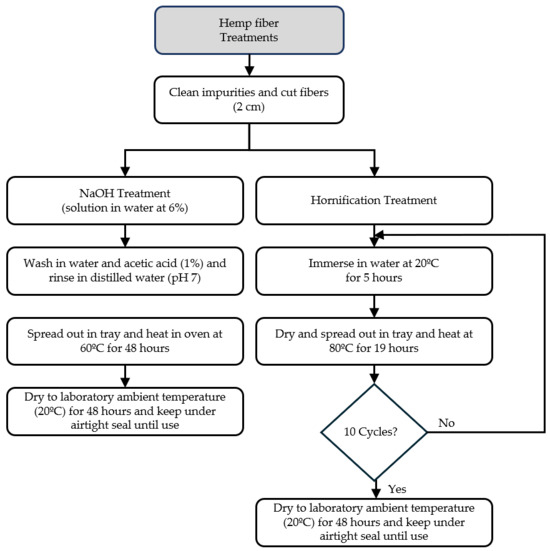
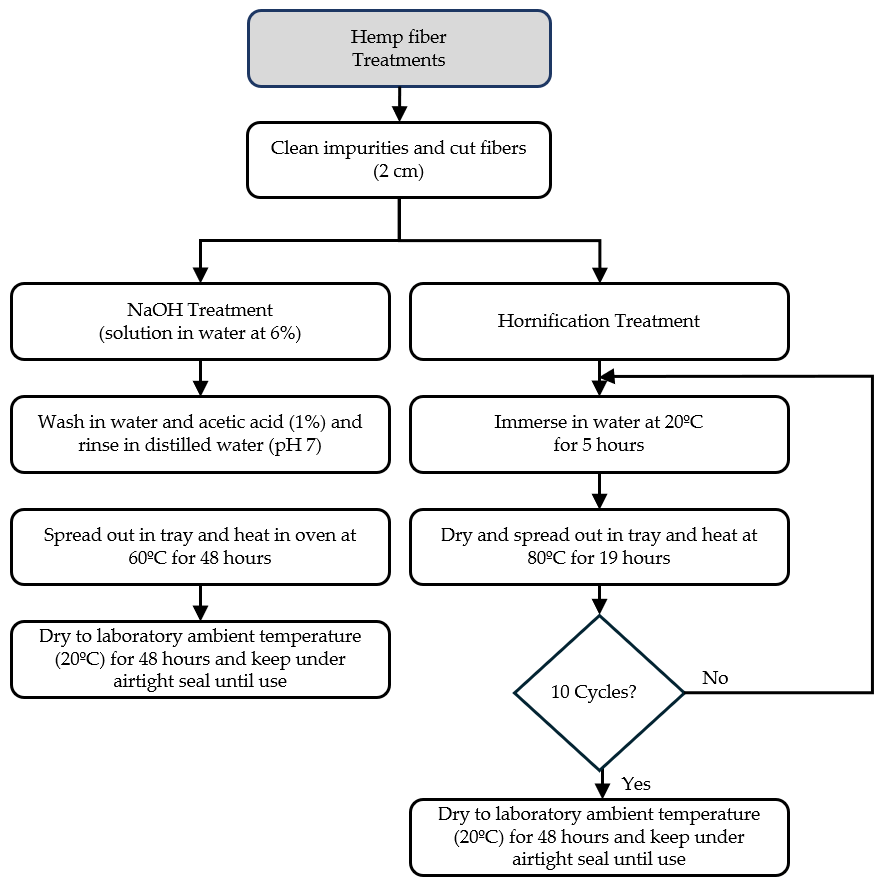
In the NaOH treatment, the fibers were submerged in a vessel with a 6% NaOH solution for a period of 48 h. The treated fibers were then washed several times with distilled water and 1 wt.% acetic acid to neutralize excess NaOH. The fibers were thus neutralized without affecting the hydration of Portland cement. This process was based on research by other authors [60,64], which proved the efficiency of the treatment. Finally, the fibers were dried in an oven at 60 °C for 48 h.
In the hornification treatment, the fibers were subjected to 10 wet/dry cycles. The wetting cycle consisted of immersing the fibers for 5 h in potable water at 20 ± 2 °C. Subsequently, the drying cycle consisted of spreading the fibers on a tray and placing them in an oven for 19 h at 80 °C. Figure 1 shows the procedures followed.
Figure 1.
NaOH and hornification treatments of natural hemp fibers.
2.3. Mortar Mix Design
Two types of mortars were prepared for each treatment, using a mixture of 0.5:0.5:3 (cement:natural hydraulic lime:sand) and 1:3 (cement:sand) in proportion to the mass of the materials. Fibers were added at 1.25% by the mass of the binder. The water-to-cement ratio in all samples was 0.7. The compositions of mortar mixtures is shown in Table 2.
Table 2.
Mix design of the mortar (in weight).
The mixing process was carried out according to [65], with slight modifications to achieve a more uniform distribution and to avoid entanglement of the fibers in the matrix. First, water and cement were added to the mixer bowl and mixed at low speed for 30 s. In the hydraulic lime–cement mortar, hydraulic lime and cement were mixed before adding water to improve distribution.
The mixture was then kneaded for 30 s at high speed. At this point, the mixer was stopped for 90 s; during the first 15 s, the mortar adhering to the mixer walls was scraped back into the mixture with a spatula. The mixer was then kneaded at high speed for another 60 s, followed by holding the mixer at low speed for 60 s to introduce all the hemp fibers. The mixer was then stopped for 30 s to remove any fibers that had become entangled between the mixer blades. Finally, it was kneaded at low speed for another 30 s to distribute the fibers evenly.
To analyze the mortar in its fresh state, the consistency evaluation was carried out according to [66]. For the evaluation of the hardened mortar, prismatic specimens of 40 × 40 × 160 mm3 were molded and subjected to curing for a period of 28 days, according to [67]. During the first 7 days of the curing process, the specimens were kept at a humidity of 95 ± 5%, achieved by placing the samples in a polyethylene bag. After the first 3 days, the specimens were unmolded and continued to be kept in the bag. In the remaining 21 days, the specimens were kept in a humid chamber at 20 °C ± 2 °C and 65% ± 5%.
Three-point flexural tests were carried out according to [67]. The tests were performed on three 40 × 40 × 160 mm prismatic specimens. The load was applied with displacement control, at a speed of 0.017 mm/s, by means of a universal testing machine with a 30 kN load cell. The stress was obtained from Equation (1). The displacement was obtained from the information provided by the universal testing machine.
where f is the flexural strength, F is the force, l is the span between the supports, and b and d are cross-sections of the specimen.
The uniaxial compression test was conducted on the specimen halves after the three-point flexural test. The load was applied to an undisturbed loading area 40 × 40 mm2 in each half. The test was performed under displacement control, with the load applied at a rate of 0.02 mm/s. Stress was obtained by dividing the recorded load by the cross-sectional area. Stress and displacement curves of the flexural and compressive tests were derived from the measured values.
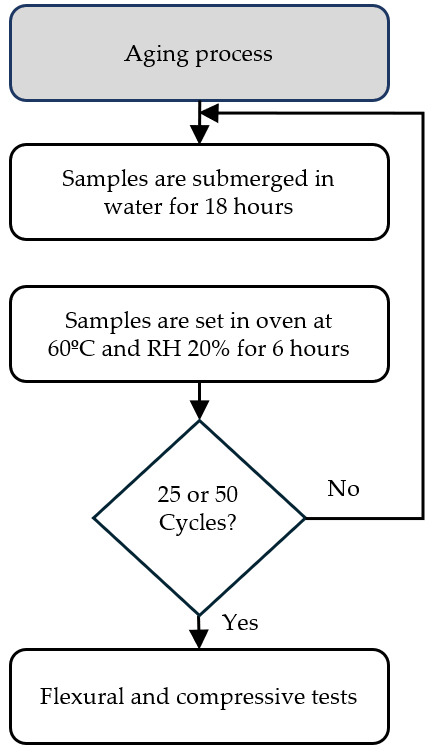
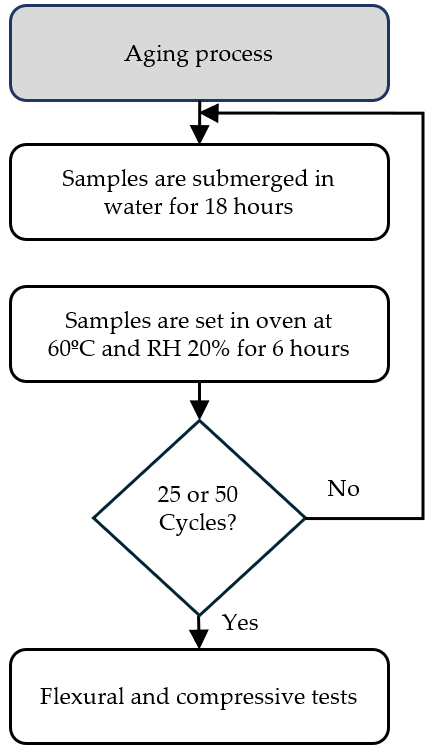
Durability is one of the most important parameters of a material that will be subjected to continuous environmental exposure. The evaluation of wet–dry cycles simulates this condition at a laboratory scale. To analyze the durability of the specimens, they were subjected to the dry–wet test for 25 and 50 cycles. Each cycle consisted of immersing the specimens for 18 h in water at a laboratory ambient temperature of 20 °C ± 5 °C and subsequent drying for 6 h in an air-circulated oven at 60 °C ± 5 °C and a relative humidity below 20%. To analyze degradation due to the aging process at 0, 25, and 50 aging cycles, which correspond to 28, 63, and 90 days of the curing process, three specimens were subjected to the flexural test and six specimens to the uniaxial compressive test, according to the standards of [67]. Figure 2 shows the aging procedure for 25 and 50 cycles.
Figure 2.
Aging process of the specimens.
3. Results and Discussion
3.1. Consistency
Table 3 presents the values obtained for both orthogonal diameters of each sample of the specimens tested. As can be seen, the average diameter of the samples ranged between 140 and 200 mm, and the difference between both diameters was less than 10%; thus, the test was acceptable, and the specimens had a plastic consistency.
Table 3.
Consistency of the specimens.
3.2. Compressive Strength
Table 4 presents the mean experimental compressive strength values and their coefficients of variation (CoVs), obtained at 28 days of curing (0 aging cycles) and after 25 and 50 aging cycles, of the test specimens.
Table 4.
Mean experimental and analytical values of compressive strength for the different aging cycles.
The compressive strength, due to the curing process of mortar, increased over time. Although this increase in strength is related to several factors associated with curing processes, such as temperature or humidity, a rough estimate of this value could be established from the curing age. In line with this, Ref. [68] has proposed Equations (2) and (3).
where βcc(j) is calculated according to Equation (2), fc(j) and fc,28 are the compressive strengths at j and 28 days, and S is the coefficient related to the kind of cement used—in this study, 0.38 and 0.25 for mortar with and without lime, respectively. The increase obtained from Equation (2) for Portland cement specimens at 90 days was 112%, which agreed with the literature [41,69,70]. Table 3 presents the calculated values for 63 and 98 days related to 25 and 50 cycles, respectively.
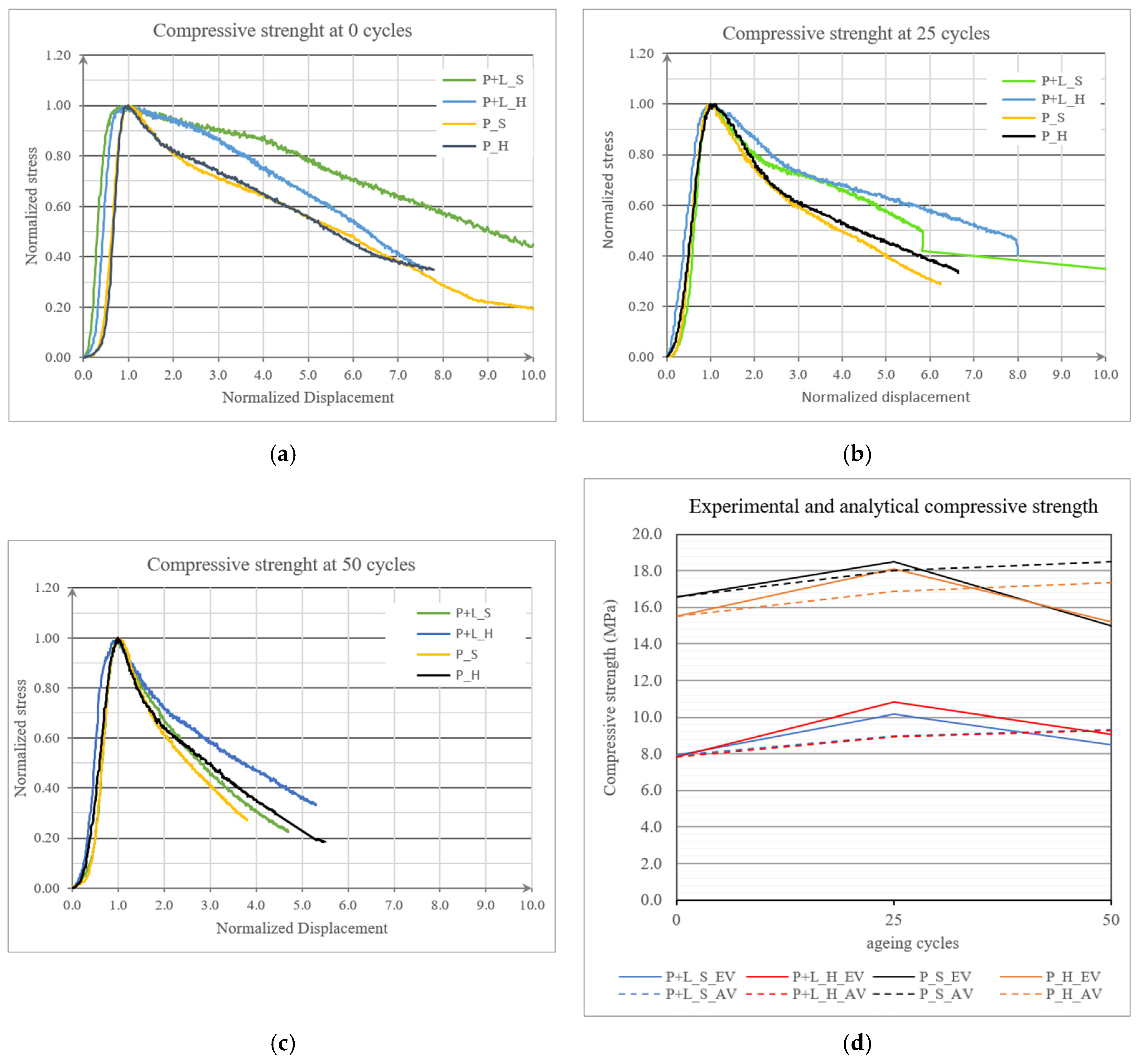
The incremental values of the experimental compressive strength, observed in Table 3 between 0 and 25 cycles, were 133% and 114% for P+L and P mortar, respectively. These values for 0 to 50 cycles were 111% and 94%. In the numerical approach, these values were 114% and 109% in the first case and 118% and 112% for the second. Thus, the increase in experimental values was higher than the analytical ones for 25 cycles but lower for 50 cycles.
The influence of the fiber treatment on compressive strength was negligible for P mortar samples. On the other hand, P+L mortar samples with H treatment at 25 and 50 cycles showed an increase in compressive strength of 6% and 7% over samples with S treatment.
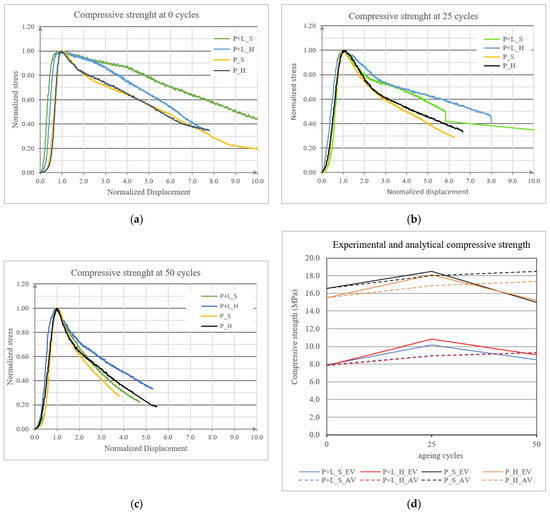
To understand the effect of aging cycles on compressive strength, Figure 3 shows the evolution of experimental and numerical values over time. From the observation of Figure 3 it could be stated that for a P mortar at 25 cycles of aging the experimental compressive strength in all cases was higher than the numerical one. In 50 cycles, the behavior was different between both mortars. In the P+L mortar experimental and numerical compressive strengths were similar; however, for the P mortars experimental compressive strength was lower than numerical.
Figure 3.
Normalized force–displacement diagrams for compressive strength of specimens at (a) 0, (b) 25, and (c) 50 cycles. (d) Experimental (continuous line) and analytical (dash line) compressive strength values at 0, 25, and 50 cycles.
To analyze the behavior of the specimens throughout the aging cycles, Figure 3a–c present stress–displacement diagrams. To facilitate comparison between different specimens, these diagrams were normalized to the maximum stress values. It could be observed that all samples showed the same behavior up to the compressive strength peak, whereas in the softening branch, there was a loss of strength as the aging cycles increased. The displacement at 40% of the peak force in the descending branch clearly decreased with increasing aging, from 6.5–10 times peak displacement to 3–5 times peak displacement. In all cases, specimens with P+L mortar had better behavior than P mortar specimens. On the other hand, the treatment of the fibers showed no significant differences for P mortar specimens. In contrast, for P+L mortar specimens, S treatment performed better at 0 cycles but worse at 50 cycles than with H treatment. Several authors have stated that NaOH treatment had a positive effect on compressive and flexural strength [15].
3.3. Flexural Strength
Table 5 presents the mean experimental flexural strength values, together with their coefficients of variation (CoVs) obtained at 28 days of curing (0 aging cycles), as well as after 25 and 50 aging cycles. In addition, the analytical values for flexural strength, calculated from the experimental data by applying Equations (2) and (3), are also provided.
Table 5.
Mean experimental and analytical values of the flexural strength for the different aging cycles.
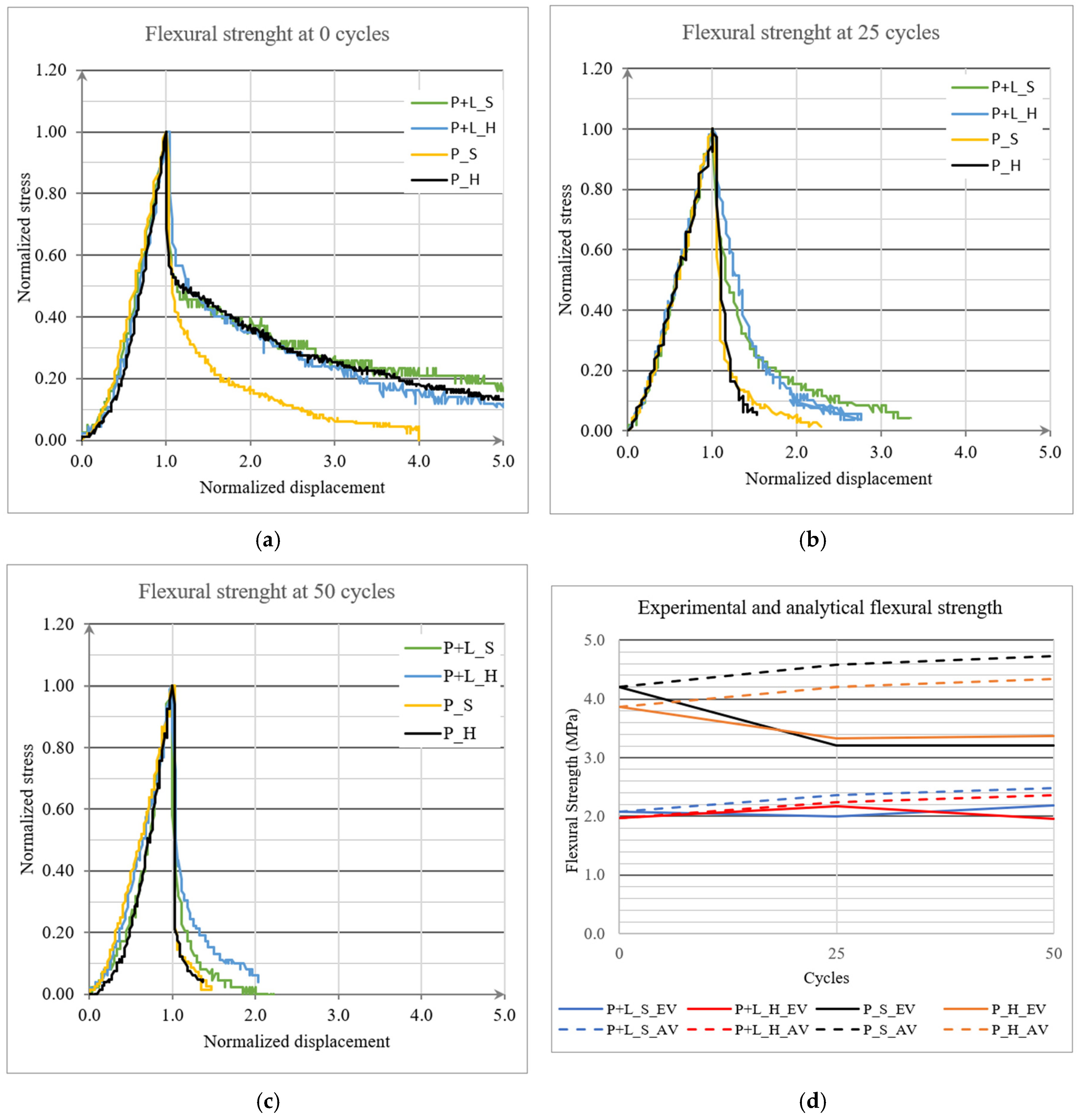
The experimental flexural strength of P+L mortar presented a similar value throughout the different cycles and treatments of the fibers. For P mortar specimens, the ratios between 0 and 25 cycles were 76% and 86% for the S and H treatments, respectively. The values of the specimens after 50 aging cycles were similar to those obtained at 25 cycles. A comparison of the experimental and analytical values revealed that, for the P + L mortar specimens, the analytical values were 91% and 86% lower than the experimental values for 25 and 50 cycles, respectively. These same values for P mortar specimens were 72% and 68%. The values obtained agreed with the literature [59,71].
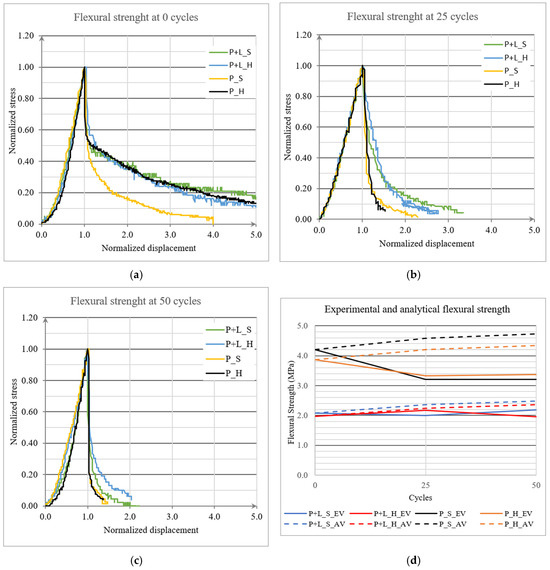
To analyze the behavior of specimens, Figure 4 shows normalized force–displacement diagrams for all samples over the cycles.
Figure 4.
Normalized force–displacement diagrams for flexural strength of specimens at (a) 0, (b) 25, and (c) 50 cycles. (d) Experimental (continuous line) and analytical (dash line) flexural strength values at 28, 63, and 98 days, corresponding to 0, 25, and 50 cycles.
As observed for compressive strength, the specimens lost their softening ability as the aging cycles progressed. At 0 cycles, only the P_S specimens showed a low level of softening. Meanwhile, the P+L specimens showed a greater softening level than P specimens at 25 and 50 cycles. These results agreed with values obtained by other authors [20,56].
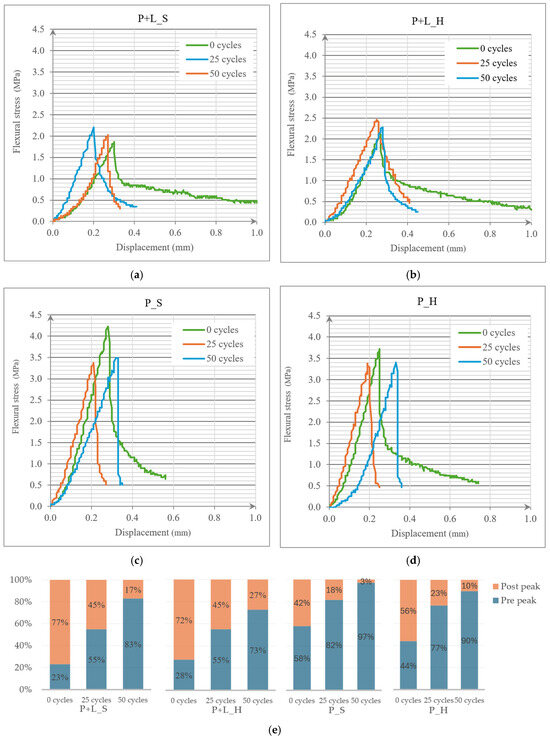
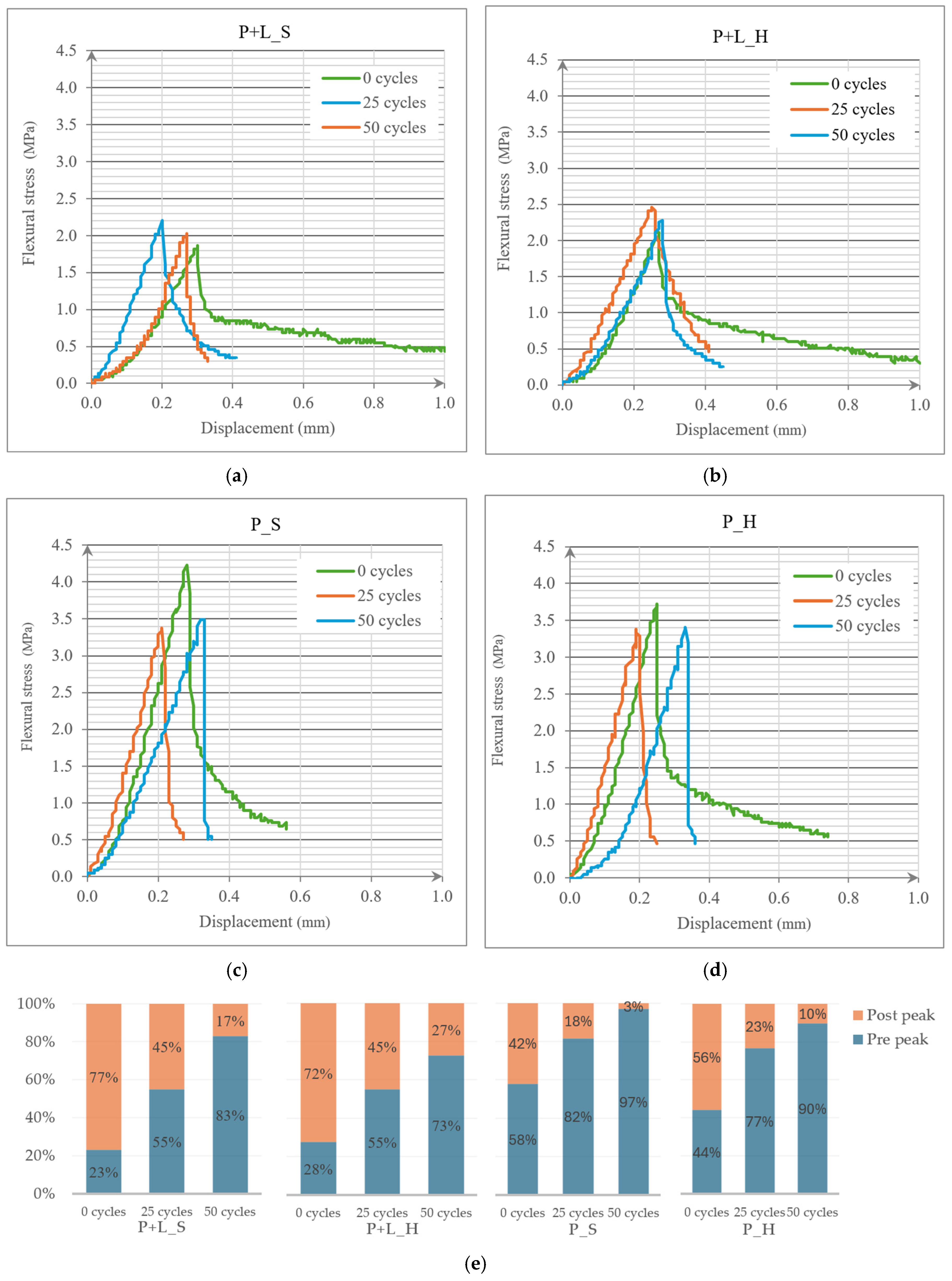
The inclusion of fibers in the cementitious matrix presented an increase in post-peak softening behavior. To analyze this behavior, Figure 5 presents flexural stress–displacement diagrams of each type of specimen at 0, 25, and 50 cycles. To evaluate toughness, a descending branch until the load was 20% of the peak load was considered.
Figure 5.
Tensile–displacement diagrams at 0, 25, and 50 aging cycles of (a) P+L_S, (b) P+L_H, (c) P_S, and (d) P_H; and (e) pre- and post-peak normalized toughness of specimens.
From Figure 5e, it can be observed that the toughness of specimens with a P+L matrix showed higher post-peak softening at all aging stages analyzed than the P matrix specimens. This same effect can be stated for specimens with hornification treatment compared to specimens with NaOH treatment.
Although the partial replacement of ordinary Porland cement by natural hydraulic lime reduced the peak stress, the post-peak behavior of P+L specimens showed greater softening throughout the cycles.
Table 6 presents the values for the loss of compressive and flexural strength following various aging processes under wet and dry conditions for a natural fiber composite with a cement binder, as reported in the literature.
Table 6.
Loss of compressive and flexural strength after several wet and dry aging processes, acording to the literature.
One of the main drawbacks of natural fiber cementitious composites is the alkalinity of the matrix. Based on the results obtained in this study, the benefits associated with the inclusion of NHL could be observed. Hence, from the heating temperature during OPC or NHL production, different hydraulic phases are obtained. OPC produces mainly C3S calcium silicates and aluminate silicates, whereas NHL produces mainly C2S calcium silicates [73]. Calcium silicates react with water to form calcium silicate hydrate gel (C-S-H) and calcium hydroxide Ca(OH)2. Ca(OH)2 is responsible for matrix alkalinity [34,74]. The formation of Ca(OH)2 from the C3S hydration reaction is three times higher than in C2S hydration reaction. Typically, the predominant hydraulic phase in the NHL matrix is C2S [75]. Thus, full or partial replacement of OPC by NHL reduces the alkalinity of the matrix due to a lower calcium hydroxide content. Other benefits of NHL are reductions in pore size and water permeability, which in turn reduce the degradation of the fibers [60,76]. Thus, P+L mortar specimens showed a reduction in the unfavorable effects related to an elevated pH environment on the natural fibers. This means that partial or total substitution of OPC for NHL as a binder reduces chemical degradation of the natural fibers, improving their long-term durability.
As shown in Figure 3 and Figure 4, the H treatment appears to preserve the fibers more effectively than the S treatment. Hornification reduces the water absorption capacity of the fibers by modifying the cellulose structure, whereas NaOH treatment decreases water absorption uptake through the partial removal of non-cellulosic components. Consequently, hornification can be considered a less aggressive treatment and appears to provide slightly better performance as the aging cycles progress, particularly in terms of compressive strength behavior.
The results obtained in this study indicated that the P_S and P_H mortar specimens exhibited variations in compressive strength of −2% and −10%, respectively, after 50 aging cycles, while the corresponding variations in flexural strength were −24% and −13%. These values fall within the ranges reported in Table 6. In contrast, the P+L_S and P+L_H specimens showed variations of 7% and 16%, respectively, in compressive strength, and 6% and −1%, respectively, in flexural strength. These findings suggest that specimens incorporating partial cement replacement with hydraulic lime exhibited superior mechanical performance.
The compressive and flexural strength results reveal a significant increase between the experimental and analytical values after 25 aging cycles, whereas these differences become considerably smaller after 50 cycles. Although the strength of hydraulic composite materials is conventionally assessed after 28 days of curing, hydration reactions continue beyond this period, leading to a progressive increase in strength over time, as reflected in the analytical values obtained in this study. These ongoing reactions also influence the bonding capacity at the fiber–matrix interface.
Furthermore, the alkalinity of the matrix gradually decreases as calcium hydroxide Ca(OH)2 reacts with atmospheric carbon dioxide through carbonation processes. This reaction reduces the matrix pH, thereby creating a less aggressive environment for natural fibers.
Regarding compressive strength, the experimental values obtained after 25 aging cycles show an increase of approximately 30–40% for the P+L specimens and around 17% for the P specimens compared with the corresponding analytical values. After 50 cycles, a reduction in strength relative to the values measured after 25 cycles is observed, ranging between 16% and 19% for both types of specimens.
A similar trend can be identified in the flexural strength results. For the P specimens, reductions of 14% and 24% are observed after 25 cycles, with these values remaining essentially unchanged after 50 cycles. In the case of the P+L specimens reinforced with hornification-treated fibers, an increase in flexural strength of approximately 10% is observed after 25 cycles, followed by a decrease of about 10% relative to the 25-cycle values after 50 cycles. Conversely, specimens reinforced with NaOH-treated fibers exhibit remarkably low strength values after 25 cycles. However, after 50 cycles, their behavior becomes comparable to that of the hornification-treated fibers, with both treatments yielding strength values close to those measured at 28 days.
Based on these findings, the increase in strength observed after 25 cycles may be primarily attributed to the continued development of the matrix’s strength as a result of ongoing hydration reactions. In contrast, the subsequent reduction in strength may be associated with the progressive deterioration of both the fiber and fiber–matrix interface. In particular, the flexural strength results obtained for the P specimens suggest that this degradation process tends to stabilize over time as the matrix becomes less alkaline. Nevertheless, further investigations involving longer exposure periods are required to confirm this hypothesis and to provide a more comprehensive assessment of the long-term durability of the composite materials.
4. Conclusions
This study analyzed the influence of partial replacement of OPC with NHL in the cement matrix, as well as the effect of two treatments, namely treatment with NaOH and calcination throughout the aging process, on the mechanical properties of natural fiber-reinforced mortars. For this purpose, an experimental program was used to compare compressive and flexural strength values for three aging periods (0, 25, and 50 cycles) on four types of specimens, combining two types of matrices (cement mortar and cement and hydraulic lime mortar) and two types of fiber treatment (NaOH and hornification). From the results obtained, the following conclusions can be drawn:
- The presence of natural fibers in cementitious composites, up to 25 cycles, improves compressive strength but reduces flexural strength. Thereafter, both compressive and flexural strength decrease with reference to the analytical values.
- The partial substitution of ordinary Portland cement by natural hydraulic lime provides a less alkaline environment, with less fiber degradation observed in this study. Therefore, a total substitution of ordinary Portland cement by natural hydraulic lime could be a useful strategy to reduce the degradation of natural fibers. However, further studies will be needed to verify this claim.
- Analyzing the post-peak behavior, it can be stated that the hornification treatment presented a greater preservation of the fibers throughout the aging cycles than the NaOH treatment.
Due to the number of specimens analyzed, the conclusions of this study should be interpreted mainly from a qualitative point of view. More experimental data are needed to reach more general or quantitative conclusions.
Author Contributions
Conceptualization, M.Á.C. and J.L.; methodology, I.C. and J.S.; validation, M.Á.C. and J.L.; formal analysis, J.F. and J.S.; investigation, J.F. and J.S.; resources, M.Á.C.; data curation, I.C.; writing—original draft preparation, M.Á.C.; writing—review and editing, J.L.; visualization, M.Á.C.; supervision, M.Á.C. and J.L. All authors have read and agreed to the published version of the manuscript.
Funding
This research received no external funding.
Data Availability Statement
The dataset used in this manuscript is available upon request from the authors.
Conflicts of Interest
The authors declare no conflicts of interest.
References
- Guo, R.; Wang, J.; Bing, L.; Tong, D.; Ciais, P.; Davis, S.J.; Andrew, R.M.; Xi, F.; Liu, Z. Global CO2 uptake by Cement from 1930 to 2019. Earth Syst. Sci. Data 2021, 13, 1791–1805. [Google Scholar] [CrossRef] [Scilit]
- Salas, D.A.; Ramirez, A.D.; Rodríguez, C.R.; Petroche, D.M.; Boero, A.J.; Duque-Rivera, J. Environmental Impacts, Life Cycle Assessment and Potential Improvement Measures for Cement Production: A Literature Review. J. Clean. Prod. 2016, 113, 114–122. [Google Scholar] [CrossRef] [Scilit]
- Rajesh, J.; Kandasamy, S.; Agrawal, A.; Samal, S.P.; Swaminathan, G. Fresh and Strength Properties of High Volume Ultra-Fine Fly Ash Cement Mortar with Calcinated Limestone Powder. Sci. Rep. 2026, 16, 3860. [Google Scholar] [CrossRef] [Scilit] [PubMed]
- Almutairi, A.L.; Tayeh, B.A.; Adesina, A.; Isleem, H.F.; Zeyad, A.M. Potential Applications of Geopolymer Concrete in Construction: A Review. Case Stud. Constr. Mater. 2021, 15, e00733. [Google Scholar] [CrossRef] [Scilit]
- Machner, A.; Zajac, M.; Ben Haha, M.; Kjellsen, K.O.; Geiker, M.R.; De Weerdt, K. Stability of the Hydrate Phase Assemblage in Portland Composite Cements Containing Dolomite and Metakaolin after Leaching, Carbonation, and Chloride Exposure. Cem. Concr. Compos. 2018, 89, 89–106. [Google Scholar] [CrossRef] [Scilit]
- Kurda, R.; de Brito, J.; Silvestre, J.D. A Comparative Study of the Mechanical and Life Cycle Assessment of High-Content Fly Ash and Recycled Aggregates Concrete. J. Build. Eng. 2020, 29, 101173. [Google Scholar] [CrossRef] [Scilit]
- Lou, Y.; Khan, K.; Amin, M.N.; Ahmad, W.; Deifalla, A.F.; Ahmad, A. Performance Characteristics of Cementitious Composites Modified with Silica Fume: A Systematic Review. Case Stud. Constr. Mater. 2023, 18, e01753. [Google Scholar] [CrossRef] [Scilit]
- Awoyera, P.; Adesina, A. A Critical Review on Application of Alkali Activated Slag as a Sustainable Composite Binder. Case Stud. Constr. Mater. 2019, 11, e00268. [Google Scholar] [CrossRef] [Scilit]
- Sharma, M.; Bishnoi, S.; Martirena, F.; Scrivener, K. Limestone Calcined Clay Cement and Concrete: A State-of-the-Art Review. Cem. Concr. Res. 2021, 149, 106564. [Google Scholar] [CrossRef] [Scilit]
- Borges, P.M.; Schiavon, J.Z.; da Silva, S.R.; Rigo, E.; Neves Junior, A.; Possan, E.; Andrade, J.J.D.O. Mortars with Recycled Aggregate of Construction and Demolition Waste: Mechanical Properties and Carbon Uptake. Constr. Build. Mater. 2023, 387, 131600. [Google Scholar] [CrossRef] [Scilit]
- Abdalla, J.A.; Hawileh, R.A.; Bahurudeen, A.; Jyothsna, G.; Sofi, A.; Shanmugam, V.; Thomas, B.S. A Comprehensive Review on the Use of Natural Fibers in Cement/Geopolymer Concrete: A Step towards Sustainability. Case Stud. Constr. Mater. 2023, 19, e02244. [Google Scholar] [CrossRef] [Scilit]
- Klemm, A.J.; Wiggins, D.E. Lime Mortar and Sacrificial Protection of Heritage Stonework. Proc. ICE Eng. Hist. Herit. 2015, 168, 167–176. [Google Scholar] [CrossRef] [Scilit]
- De Nardi, C.; Cecchi, A.; Ferrara, L.; Benedetti, A.; Cristofori, D. Effect of Age and Level of Damage on the Autogenous Healing of Lime Mortars. Compos. Part B Eng. 2017, 124, 144–157. [Google Scholar] [CrossRef] [Scilit]
- Li, M.; Pu, Y.; Thomas, V.M.; Yoo, C.G.; Ozcan, S.; Deng, Y.; Nelson, K.; Ragauskas, A.J. Recent Advancements of Plant-Based Natural Fiber–Reinforced Composites and Their Applications. Compos. Part B Eng. 2020, 200, 108254. [Google Scholar] [CrossRef] [Scilit]
- Lilargem Rocha, D.; Tambara Júnior, L.U.; Marvila, M.T.; Pereira, E.C.; Souza, D.; de Azevedo, A.R. A Review of the Use of Natural Fibers in Cement Composites: Concepts, Applications and Brazilian History. Polymers 2022, 14, 2043. [Google Scholar] [CrossRef] [Scilit] [PubMed]
- Singh, M.K.; Mohanty, A.K.; Misra, M. Upcycling of Waste Polyolefins in Natural Fiber and Sustainable Filler-Based Biocomposites: A Study on Recent Developments and Future Perspectives. Compos. Part B Eng. 2023, 263, 110852. [Google Scholar] [CrossRef] [Scilit]
- Çomak, B.; Bideci, A.; Salli Bideci, Ö. Effects of Hemp Fibers on Characteristics of Cement Based Mortar. Constr. Build. Mater. 2018, 169, 794–799. [Google Scholar] [CrossRef] [Scilit]
- de Lima, T.; de Azevedo, A.; Marvila, M.; Candido, V.; Fediuk, R.; Monteiro, S. Potential of Using Amazon Natural Fibers to Reinforce Cementitious Composites: A Review. Polymers 2022, 14, 647. [Google Scholar] [CrossRef] [Scilit] [PubMed]
- Benaimeche, O.; Carpinteri, A.; Mellas, M.; Ronchei, C.; Scorza, D.; Vantadori, S. The Influence of Date Palm Mesh Fibre Reinforcement on Flexural and Fracture Behaviour of a Cement-Based Mortar. Compos. Part B Eng. 2018, 152, 292–299. [Google Scholar] [CrossRef] [Scilit]
- de Azevedo, A.; Klyuev, S.; Marvila, M.; Vatin, N.; Alfimova, N.; de Lima, T.; Fediuk, R.; Olisov, A. Investigation of the Potential Use of Curaua Fiber for Reinforcing Mortars. Fibers 2020, 8, 69. [Google Scholar] [CrossRef] [Scilit]
- Ferrández, D.; Álvarez Dorado, M.; Zaragoza-Benzal, A.; Leal Matilla, A. Feasibility of Ecofriendly Mortars with Different Hemp Additions for Use in Building Sector. Heritage 2023, 6, 4901–4918. [Google Scholar] [CrossRef] [Scilit]
- Giglio, F.; Savoja, G. Vegetable Fibers for Composite Materials in Constructive Sector. In Proceedings of the International Conference on Materials, Alloys and Experimental Mechanics (ICMAEM-2017), Hyderabad, India, 3–4 July 2017; Volume 225, p. 012259. [Google Scholar] [CrossRef] [Scilit]
- Toledo Filho, R.D.; de Andrade Silva, F.; Fairbairn, E.M.R.; Filho, J.d.A.M. Durability of Compression Molded Sisal Fiber Reinforced Mortar Laminates. Constr. Build. Mater. 2009, 23, 2409–2420. [Google Scholar] [CrossRef] [Scilit]
- Song, H.; Liu, J.; He, K.; Ahmad, W. A Comprehensive Overview of Jute Fiber Reinforced Cementitious Composites. Case Stud. Constr. Mater. 2021, 15, e00724. [Google Scholar] [CrossRef] [Scilit]
- García, G.; Cabrera, R.; Rolón, J.; Pichardo, R.; Thomas, C. Natural Fibers as Reinforcement of Mortar and Concrete: A Systematic Review from Central and South American Regions. J. Build. Eng. 2024, 98, 111267. [Google Scholar] [CrossRef] [Scilit]
- Mundhe, A.; Kandasubramanian, B. Advancements in Natural Fiber Composites: Innovative Chemical Surface Treatments, Characterizaton Techniques, Environmental Sustainability, and Wide-Ranging Applications. Hybrid Adv. 2024, 7, 100282. [Google Scholar] [CrossRef] [Scilit]
- Laverde, V.; Marin, A.; Benjumea, J.M.; Rincón Ortiz, M. Use of Vegetable Fibers as Reinforcements in Cement-Matrix Composite Materials: A Review. Constr. Build. Mater. 2022, 340, 127729. [Google Scholar] [CrossRef] [Scilit]
- Struik, P.C.; Amaducci, S.; Bullard, M.J.; Stutterheim, N.C.; Venturi, G.; Cromack, H.T.H. Agronomy of Fibre Hemp (Cannahis satira L.) in Europe. Ind. Crops Prod. 2000, 11, 107–118. [Google Scholar] [CrossRef] [Scilit]
- Amaducci, S.; Scordia, D.; Liu, F.H.; Zhang, Q.; Guo, H.; Testa, G.; Cosentino, S.L. Key Cultivation Techniques for Hemp in Europe and China. Ind. Crops Prod. 2015, 68, 2–16. [Google Scholar] [CrossRef] [Scilit]
- Maalouf, C.; Ingrao, C.; Scrucca, F.; Moussa, T.; Bourdot, A.; Tricase, C.; Presciutti, A.; Asdrubali, F. An Energy and Carbon Footprint Assessment upon the Usage of Hemp-Lime Concrete and Recycled-PET Façades for Office Facilities in France and Italy. J. Clean. Prod. 2018, 170, 1640–1653. [Google Scholar] [CrossRef] [Scilit]
- Ip, K.; Miller, A. Life Cycle Greenhouse Gas Emissions of Hemp–Lime Wall Constructions in the UK. Resour. Conserv. Recycl. 2012, 69, 1–9. [Google Scholar] [CrossRef] [Scilit]
- Wei, J.; Meyer, C. Degradation Mechanisms of Natural Fiber in the Matrix of Cement Composites. Cem. Concr. Res. 2015, 73, 1–16. [Google Scholar] [CrossRef] [Scilit]
- Fidelis, M.E.A.; Toledo Filho, R.D.; de Andrade Silva, F.; Mechtcherine, V.; Butler, M.; Hempel, S. The Effect of Accelerated Aging on the Interface of Jute Textile Reinforced Concrete. Cem. Concr. Compos. 2016, 74, 7–15. [Google Scholar] [CrossRef] [Scilit]
- de Souza Castoldi, R.; de Souza, L.M.S.; Souto, F.; Liebscher, M.; Mechtcherine, V.; de Andrade Silva, F. Effect of Alkali Treatment on Physical–Chemical Properties of Sisal Fibers and Adhesion towards Cement-Based Matrices. Constr. Build. Mater. 2022, 345, 128363. [Google Scholar] [CrossRef] [Scilit]
- Mwaikambo, L.Y.; Ansell, M.P. Chemical Modification of Hemp, Sisal, Jute, and Kapok Fibers by Alkalization. J. Appl. Polym. Sci. 2002, 84, 2222–2234. [Google Scholar] [CrossRef] [Scilit]
- Ardanuy, M.; Claramunt, J.; Toledo Filho, R.D. Cellulosic Fiber Reinforced Cement-Based Composites: A Review of Recent Research. Constr. Build. Mater. 2015, 79, 115–128. [Google Scholar] [CrossRef] [Scilit]
- Tolêdo Filho, R.D.; Scrivener, K.; England, G.L.; Ghavami, K. Durability of Alkali-Sensitive Sisal and Coconut Fibres in Cement Mortar Composites. Cem. Concr. Compos. 2000, 22, 127–143. [Google Scholar] [CrossRef] [Scilit]
- Greco, P.F.; Pepi, C.; Gioffré, M. A Novel Biocomposite Material for Sustainable Constructions: Metakaolin Lime Mortar and Spanish Broom Fibers. J. Build. Eng. 2024, 83, 108425. [Google Scholar] [CrossRef] [Scilit]
- Llorens, J.; Julián, F.; Gifra, E.; Espinach, F.X.; Soler, J.; Chamorro, M.À. An Approach to Understanding the Hydration of Cement-Based Composites Reinforced with Untreated Natural Fibers. Sustainability 2023, 15, 9388. [Google Scholar] [CrossRef] [Scilit]
- Pane, I.; Hansen, W. Investigation of Blended Cement Hydration by Isothermal Calorimetry and Thermal Analysis. Cem. Concr. Res. 2005, 35, 1155–1164. [Google Scholar] [CrossRef] [Scilit]
- Chindaprasirt, P.; Jaturapitakkul, C.; Sinsiri, T. Effect of Fly Ash Fineness on Compressive Strength and Pore Size of Blended Cement Paste. Cem. Concr. Compos. 2005, 27, 425–428. [Google Scholar] [CrossRef] [Scilit]
- Diquélou, Y.; Gourlay, E.; Arnaud, L.; Kurek, B. Impact of Hemp Shiv on Cement Setting and Hardening: Influence of the Extracted Components from the Aggregates and Study of the Interfaces with the Inorganic Matrix. Cem. Concr. Compos. 2015, 55, 112–121. [Google Scholar] [CrossRef] [Scilit]
- Diquélou, Y.; Gourlay, E.; Arnaud, L.; Kurek, B. Influence of Binder Characteristics on the Setting and Hardening of Hemp Lightweight Concrete. Constr. Build. Mater. 2016, 112, 506–517. [Google Scholar] [CrossRef] [Scilit]
- Sedan, D.; Pagnoux, C.; Chotard, T.; Smith, A.; Lejolly, D.; Gloaguen, V.; Krausz, P. Effect of Calcium Rich and Alkaline Solutions on the Chemical Behaviour of Hemp Fibres. J. Mater. Sci. 2007, 42, 9336–9342. [Google Scholar] [CrossRef] [Scilit]
- Awwad, E.; Mabsout, M.; Hamad, B.; Farran, M.T.; Khatib, H. Studies on Fiber-Reinforced Concrete Using Industrial Hemp Fibers. Constr. Build. Mater. 2012, 35, 710–717. [Google Scholar] [CrossRef] [Scilit]
- Li, X.; Tabil, L.G.; Panigrahi, S. Chemical Treatments of Natural Fiber for Use in Natural Fiber-Reinforced Composites: A Review. J. Polym. Environ. 2007, 15, 25–33. [Google Scholar] [CrossRef] [Scilit]
- Vélez, E.; Rodríguez, R.; Yanchapanta Gómez, N.B.; Mora, E.D.; Hernández, L.; Albuja-Sánchez, J.; Calvo, M.I. Coconut-Fiber Composite Concrete: Assessment of Mechanical Performance and Environmental Benefits. Fibers 2022, 10, 96. [Google Scholar] [CrossRef] [Scilit]
- Zukowski, B.; Mendonca, Y.; Silva, F.; Toledo, R. Effect of Moisture Movement on the Tensile Stress-Strain Behavior of SHCC with Alkali Treated Curaua Fiber. Mater. Struct. 2020, 53, 49. [Google Scholar] [CrossRef] [Scilit]
- Ferreira, S.R.; de Andrade Silva, F.; Lima, P.R.L.; Toledo Filho, R.D. Effect of Fiber Treatments on the Sisal Fiber Properties and Fiber–Matrix Bond in Cement Based Systems. Constr. Build. Mater. 2015, 101, 730–740. [Google Scholar] [CrossRef] [Scilit]
- Jiang, D.; An, P.; Cui, S.; Xu, F.; Tuo, T.; Zhang, J.; Jiang, H. Effect of Leaf Fiber Modification Methods on Mechanical and Heat-Insulating Properties of Leaf Fiber Cement-Based Composite Materials. J. Build. Eng. 2018, 19, 573–583. [Google Scholar] [CrossRef] [Scilit]
- Cai, M.; Takagi, H.; Nakagaito, A.N.; Li, Y.; Waterhouse, G.I.N. Effect of Alkali Treatment on Interfacial Bonding in Abaca Fiber-Reinforced Composites. Compos. Part A Appl. Sci. Manuf. 2016, 90, 589–597. [Google Scholar] [CrossRef] [Scilit]
- Li, Q.; Ibrahim, L.; Zhou, W.; Zhang, M.; Fernando, G.F.; Wang, L.; Yuan, Z. Holistic Solution to Natural Fiber Deterioration in Cement Composite Using Hybrid Treatments. Cellulose 2020, 27, 981–989. [Google Scholar] [CrossRef] [Scilit]
- do Amaral, L.M.; de Souza Rodrigues, C.; Poggiali, F.S.J. Hornification on Vegetable Fibers to Improve Fiber-Cement Composites: A Critical Review. J. Build. Eng. 2022, 48, 103947. [Google Scholar] [CrossRef] [Scilit]
- Claramunt, J.; Ardanuy, M.; García-Hortal, J.A. Effect of Drying and Rewetting Cycles on the Structure and Physicochemical Characteristics of Softwood Fibres for Reinforcement of Cementitious Composites. Carbohydr. Polym. 2010, 79, 200–205. [Google Scholar] [CrossRef] [Scilit]
- Ferreira, S.R.; de Andrade Silva, F.; Lima, P.R.L.; Toledo Filho, R.D. Effect of Hornification on the Structure, Tensile Behavior and Fiber Matrix Bond of Sisal, Jute and Curauá Fiber Cement Based Composite Systems. Constr. Build. Mater. 2017, 139, 551–561. [Google Scholar] [CrossRef] [Scilit]
- Poletanovic, B.; Kopecsko, K.; Merta, I. Fibre Hornification Improves the Long-Term Properties of Hemp Fibre-Reinforced Fly Ash-Based Geopolymer Mortar. Constr. Build. Mater. 2024, 446, 137957. [Google Scholar] [CrossRef] [Scilit]
- Poletanovic, B.; Janotka, I.; Janek, M.; Bacuvcik, M.; Merta, I. Influence of the NaOH-Treated Hemp Fibres on the Properties of Fly-Ash Based Alkali-Activated Mortars Prior and after Wet/Dry Cycles. Constr. Build. Mater. 2021, 309, 125072. [Google Scholar] [CrossRef] [Scilit]
- Wei, J.; Meyer, C. Degradation Rate of Natural Fiber in Cement Composites Exposed to Various Accelerated Aging Environment Conditions. Corros. Sci. 2014, 88, 118–132. [Google Scholar] [CrossRef] [Scilit]
- Alcivar-Bastidas, S.; Petroche, D.M.; Cornejo, M.H.; Martinez-Echevarria, M.J. Effect of Aging Process on Mechanical Performance of Reinforced Mortar with NaOH Abaca Fibers. Case Stud. Constr. Mater. 2024, 20, e03122. [Google Scholar] [CrossRef] [Scilit]
- Azevedo, A.; Marvila, M.; Antunes, M.; Rangel, E.; Fediuk, R. Technological Perspective for Use the Natural Pineapple Fiber in Mortar to Repair Structures. Waste Biomass Valorization 2021, 12, 5131–5145. [Google Scholar] [CrossRef] [Scilit]
- UNE-EN 197-1:2011; Cement—Part 1: Composition, Specifications and Conformity Criteria for Common Cements. European Committee for Standardization: Brussels, Belgium, 2011.
- UNE-EN 459-1:2016; Building Lime—Part 1: Definitions, Specifications and Conformity Criteria. European Committee for Standardization: Brussels, Belgium, 2021.
- UNE-EN 13139:2003; Aggregates for Mortar. European Committee for Standardization: Brussels, Belgium, 2003.
- El Oudiani, A.; Glouia, Y.; Ben Sghaier, R.; Tlija, M.; khalifa, A.; Msahli, S.; Sakli, F. Effect of Alkali Treatment and Fibre Length on Agave/Mortar Composite Properties. Ind. Crops Prod. 2024, 222, 119530. [Google Scholar] [CrossRef] [Scilit]
- UNE-EN 196-1:2018; Methods of Testing Cement—Part 1: Determination of Strength. European Committee for Standardization: Brussels, Belgium, 2018.
- UNE-EN 1015-3:2000/A2:2007; Method of Test for Mortar for Masonry. Part 3. Determination of Consistence of Fresh Mortar (by Flow Table). Asociación Española de Normalización y Certificación (AENOR): Madrid, Spain, 2020.
- UNE-EN 1015-11:2020; Methods of Test for Mortar for Masonry—Part 11: Determination of Flexural and Compressive Strength of Hardened Mortar. European Committee for Standardization: Brussels, Belgium, 2020.
- The Fédération Internationale du Béton—International Federation for Structural Concrete (fib) Thomas Telford Ltd. (London). CEB-FIB Model Code 90; 213/214; 1993; Available online: https://shop.fib-international.org/publications/ceb-bulletins/33-ceb-fip-model-code-90-pdf (accessed on 13 July 2026).
- Chindaprasirt, P.; Homwuttiwong, S.; Sirivivatnanon, V. Influence of Fly Ash Fineness on Strength, Drying Shrinkage and Sulfate Resistance of Blended Cement Mortar. Cem. Concr. Res. 2004, 34, 1087–1092. [Google Scholar] [CrossRef] [Scilit]
- Han, X.; Yang, J.; Feng, J.; Zhou, C.; Wang, X. Research on Hydration Mechanism of Ultrafine Fly Ash and Cement Composite. Constr. Build. Mater. 2019, 227, 116697. [Google Scholar] [CrossRef] [Scilit]
- de Azevedo, A.R.G.; Marvila, M.T.; Tayeh, B.A.; Cecchin, D.; Pereira, A.C.; Monteiro, S.N. Technological Performance of Açaí Natural Fibre Reinforced Cement-Based Mortars. J. Build. Eng. 2021, 33, 101675. [Google Scholar] [CrossRef] [Scilit]
- Ballesteros, J.E.M.; Santos, S.F.; Mármol, G.; Savastano, H.; Fiorelli, J. Evaluation of Cellulosic Pulps Treated by Hornification as Reinforcement of Cementitious Composites. Constr. Build. Mater. 2015, 100, 83–90. [Google Scholar] [CrossRef] [Scilit]
- Lanas, J.; Pérez Bernal, J.L.; Bello, M.A.; Alvarez Galindo, J.I. Mechanical Properties of Natural Hydraulic Lime-Based Mortars. Cem. Concr. Res. 2004, 34, 2191–2201. [Google Scholar] [CrossRef] [Scilit]
- Sumra, Y.; Payam, S.; Zainah, I. The pH of Cement-Based Materials: A Review. J. Wuhan Univ. Technol. Mater. Sci. Ed. 2020, 35, 908–924. [Google Scholar] [CrossRef] [Scilit]
- Arizzi, A.; Parra-Fernández, C. A Comprehensive Review of the Manufacturing Process and Properties of Natural Hydraulic Limes. Mater. Struct. 2025, 58, 152. [Google Scholar] [CrossRef] [Scilit]
- Almeida, A.E.F.S.; Tonoli, G.H.D.; Santos, S.F.; Savastano, H. Improved Durability of Vegetable Fiber Reinforced Cement Composite Subject to Accelerated Carbonation at Early Age. Cem. Concr. Compos. 2013, 42, 49–58. [Google Scholar] [CrossRef] [Scilit]

Disclaimer/Publisher’s Note: The statements, opinions and data contained in all publications are solely those of the individual author(s) and contributor(s) and not of MDPI and/or the editor(s). MDPI and/or the editor(s) disclaim responsibility for any injury to people or property resulting from any ideas, methods, instructions or products referred to in the content. |
© 2026 by the authors. Licensee MDPI, Basel, Switzerland. This article is an open access article distributed under the terms and conditions of the Creative Commons Attribution (CC BY) license.