


Abstract
The paper deals with the concept of how to regulate structure formation in the interfacial transition zone (ITZ) between the Ordinary Portland Cement (OPC) matrix and basalt to ensure the durability of basalt fiber-reinforced concretes. It has been demonstrated that the alkali–silica reaction (ASR) can be transformed from a destructive (negative) process into a constructive one in OPC concrete through activation by sodium water glass combined with the incorporation of an Al2O3-containing additive, namely metakaolin. Alkaline activation increased the compressive strength of OPC basalt fiber-reinforced concrete by 1.6–1.9 times. The formation of stable zeolite-like hydration products within the Na2O-CaO-Al2O3-SiO2-H2O system promoted self-healing of the ITZ. This resulted in a 5.6-fold increase in ITZ microhardness compared to the cement matrix, as well as transforming expansion into shrinkage of concrete with a final value of 0.01 mm/m after 360 days. The structure-forming processes in the ITZ ensured a 1.14-fold increase in the compressive strength of 180-day alkali-activated OPC basalt fiber-reinforced concrete compared to its 30-day strength, in contrast to a 0.92-fold decrease in the strength of the non-modified OPC analog under conditions accelerating the development of ASR.
1. Introduction
It is well known that reinforced concrete is the most widely used material for constructing structures designed to provide protection against blast shockwaves, which is particularly relevant for the construction of protective shelters and fortification structures in the context of natural disasters, military actions, and terrorism [1]. Intensity explosive loads on concrete, as a brittle material, can lead to chipping and cause serious injury to people as well as damage to equipment [2,3]. High-strength fiber-reinforced concretes are characterized by exceptional resistance to dynamic impact loads [4]. The superior protective properties of such concrete are primarily ensured through fiber reinforcement [5]. In addition, the long-term mechanical performance and deformation behavior of cement-based systems remain critical for ensuring structural reliability under service conditions [6] and aggressive environmental exposure [7]. Furthermore, recent studies have demonstrated that the development of advanced reinforcement systems, including hybrid fiber-reinforced polymer–steel solutions, can significantly improve both the mechanical performance and durability of concrete [8].
Fiber reinforcement has become one of the most effective approaches for improving the mechanical performance and durability of concretes [9,10]. Various types of fibers have been investigated, such as steel, glass, carbon, polypropylene, and basalt fibers [11]. Comparative analysis indicates that basalt fiber stands out due to its exceptional mechanical properties, high strength, thermal stability, and compatibility with cement materials [12,13]. This fiber enables the minimization of the cost of reinforced concrete and greenhouse gas emissions throughout its life cycle [14]. The production of basalt fiber has the lowest global warming potential compared to fibers derived from other raw materials [15]. Moreover, basalt rock is widely available and its fiber production does not require additional components [16]. Owing to these characteristics, basalt fiber is regarded as the most economical, environmentally friendly, and promising reinforcing agent. Recent studies have also explored converting basalt-containing waste into secondary raw materials, highlighting their chemical reactivity and potential for modifying the composition and properties of construction materials [17].
Enhancing the efficiency of basalt fiber-reinforced concrete is advisable in connection with addressing the issue of increasing the strength of Portland cements while simultaneously reducing their carbon footprint. Partial replacement of the clinker component with supplementary cement materials (such as fly ash, blast furnace slag, and calcined clay) represents the most effective solution for reducing CO2 emissions in cement production in line with global trends in sustainable development [18,19,20,21]. However, this substitution reduces the strength of Portland cement, particularly in the early stages of hardening.
It has been shown that this problem can be resolved while maximizing the potential of the clinker by involving alkali metal compounds in the hydration process, which provide a high pH value [22]. The advantages of alkali-activated cements over traditional Portland cements, due to their superior performance and economic and environmental benefits, have led to their widespread implementation worldwide [23,24,25]. The effectiveness of alkali-activated cements is explained by the specific features of the phase composition of hydrates—in the absence of free portlandite Ca(OH)2 and ettringite, an increased content of low-basic calcium hydrosilicates, which grow longitudinally in a highly alkaline environment, contribute to self-reinforcement of the microstructure [26]. Due to peculiarities of the microstructure, alkali-activated cements in concrete demonstrate high early strength [27,28], freeze–thaw resistance [29,30,31], resistance to aggressive environments [32,33], reduced heat release [34,35], etc. This indicates the potential use for alkali-activated cements in special-purpose materials.
The corrosion of basalt fiber caused by alkaline hydrolysis remains an important global issue [36]. It is known that in the hydrated environment of Portland cement, saturated with Ca(OH)2, a layer of corrosion products forms on the surface of basalt fibers, represented by C-A-S-H and C-S-H phases [37]. These products can partially perform the function of a protective layer on the fiber surface [38]. However, such calcium hydrate phases are characterized by compositional instability and relatively high solubility [39]. In all, the Portland cement matrix negatively affects the long-term preservation of the properties of basalt fiber.
The high-alkali environment of alkali-activated cements also negatively affects basalt fiber, as OH− ions destroy the –Si–O–Si– bonds in the fiber structure, initiating their corrosion [40,41]. Basalt fiber corrosion is accompanied by the reaction of alkali with reactive SiO2, forming silicic acid gel, which absorbs water, expands, and forms sodium or potassium hydrosilicates (Na2SiO3·nH2O, K2SiO3·nH2O), creating pressure that destroys the interfacial transition zone (ITZ) in the “alkali-activated cement–basalt” system [42]. Alkali-activated systems provide new opportunities for controlling reaction mechanisms through compositional design [43]
Thus, durability-related issues, particularly in alkali–silica reactions (ASRs), remain among the most critical factors limiting the long-term performance of concrete structures. Recent studies have emphasized that ASR is a complex physico-chemical process requiring improved understanding and advanced mitigation strategies [44]. These include restricting the chemical–mineralogical composition of the batch and the minimum allowable fiber diameter or additional recipe–technological modification methods. For example, the introduction of structure-compacting oxides, such as zirconium, aluminum, iron, tin, etc., into the fiber composition is known [45,46]. Thermal treatment of basalt fiber at 500 °C followed by cooling to densify the structure has also been proposed [47]. However, the introduction of such restrictions or additional protective measures increases the cost of fiber production, complicates the technology, and essentially only postpones the problem.
It can be assumed that the use of supplementary cementitious materials (SCMs), such as fly ash, slag, and silica fume, has been widely investigated as an effective approach to reduce ASR-induced expansion [48]. The most effective solution for neutralizing the effect of alkaline corrosion of basalt fiber is the introduction of an Al2O3-containing additive, e.g., metakaolin, into the Portland cement composition [49]. This additive neutralizes the negative effect by binding gel-like sodium hydrosilicates into zeolite-like formations of the Na2O-Al2O3-SiO2-H2O system [50]. These products form a protective layer on the surface of basalt fibers and are regarded as “beneficial,” i.e., structure-forming hydrate phases [26]. Recent studies on the microstructure of ASR products confirm the key role of such gel transformation processes in controlling expansion and durability of cementitious systems [51]. At the same time, partial replacement of the clinker component with aluminosilicate materials is considered the most effective solution for reducing greenhouse gas emissions in cement production in line with sustainable development strategies [52]. However, this replacement leads to a decrease in the strength of Portland cement, especially at early ages. In contrast, the efficiency of alkaline activation even increases with higher aluminosilicate content in cement, as the elevated alkalinity causes the breaking of covalent bonds in low-basic minerals (Si–O–Si, Al–O–Al, and Al–O–Si), which is impossible during water mixing in the case of Ordinary Portland Cement (OPC) with purely ionic bonds (Ca–O–Si) [53]. Such reactions can improve the mechanical performance and durability of fiber-reinforced concretes based on alkali-activated cement.
Unlike conventional approaches focused on mitigating ASRs, this study proposes a concept of its controlled transformation from a destructive process into a constructive one (i.e., leading to ITZ densification and strength enhancement rather than expansion-induced damage), contributing to the self-healing of the ITZ. The novelty of the work lies in the combined use of alkaline activation of OPC and its partial replacement by an Al2O3-containing additive to bind alkali–silicate gel into stable zeolite-like phases, thereby improving the microstructural stability and durability of the material.
Thus, the aim of the study was to perform comparative tests to reveal specific features of the corrosion processes in alkali-susceptible basalt fiber in concretes based on OPC and alkali-activated OPC, and to demonstrate the possibility of preventing destructive processes in concrete with increased alkali content through the introduction of an Al2O3-containing additive—metakaolin.
2. Raw Materials and Testing Technique
2.1. Materials
CEM I 42.5 N (further, OPC) per to EN 197-1 was used as the main component of the cement systems. The specific surface area of OPC was 320–350 m2/kg (by Blaine), and a specific gravity of 3.15 g/cm3.
Metakaolin ARGICAL-M 1200S (Imerys Minerals Refractory, Glomel, France) was used as a supplementary aluminosilicate component. The material had a pozzolanic reactivity of 1250 mg Ca(OH)2/g (Chapelle test), a specific surface area of 800 m2/kg (by Blaine), a specific gravity of 2.4 g/cm3, and an average particle size of 1.5 μm. The purity of metakaolin was 93.8%.
Sodium silicate solution (further, water glass) (TM Klebrig, Kyiv, Ukraine) per CAS 1344-09-8 was used as an alkaline activator. Its silicate modulus was Ms = 2.87, with a density of ρ = 1300 kg/m3.
Among various alkaline activators, soluble silicates and aluminates are considered to be the most effective. Their anions are similar to those present in the primary hydration products formed during the degradation of aluminosilicate frameworks, allowing them to act as an additional source of reactive species [26]. In this study, water glass was used as a chemically active mixing liquid rather than a simple replacement for water, providing both alkaline species and soluble silica for activation of the system.
The trisodium phosphate Na3PO4·12H2O (TM Klebrig, Kyiv, Ukraine, purity = 98%) per CAS 7601-54-9 was used to regulate the setting time. It was previously dissolved in water glass and then brought to a homogeneous state. The content of trisodium phosphate was 10 wt. % of the water glass.
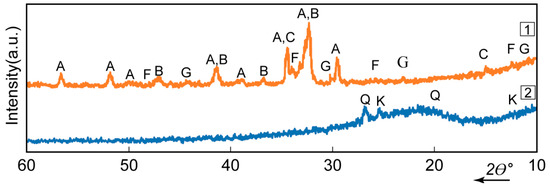
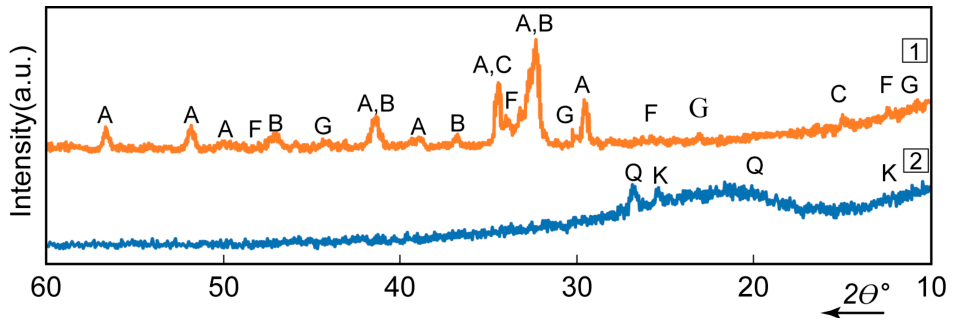
The chemical compositions of the raw materials are presented in Table 1. XRD patterns of OPC and metakaolin are provided in Figure 1.
Table 1.
Chemical composition of raw materials.
Figure 1.
XRD patterns of OPC (1) and metakaolin (2). Abbreviations: A—alite; B—belite; C—tricalcium aluminate; F—four-calcium alumoferrite; G—calcium sulfate hemihydrate (gypsum); Q—quartz; and K—kaolinite.
The XRD patterns of the raw materials confirmed the presence of typical crystalline phases. OPC was characterized by the presence of alite (3CaO∙SiO2), belite (2CaO∙SiO2), tricalcium aluminate (3CaO∙Al2O3), four-calcium alumoferrite (4CaO∙Al2O3∙Fe2O3), and calcium sulfate hemihydrate (CaSO4∙0.5H2O) or gypsum. Metakaolin exhibited crystalline phases, such as quartz (SiO2) and kaolinite (Al2O3∙2SiO2∙2H2O), and a predominantly amorphous structure with a broad halo, indicating its high pozzolanic reactivity.
Natural basalt rock was crushed and sieved to obtain the 1.25–2.5 mm fraction, which was used as the fine aggregate, with a specific gravity of 2.9 g/cm3. This fraction was selected to ensure a uniform particle size distribution and to increase the reactive surface area of the aggregate, facilitating the evaluation of alkali–silica reaction (further, ASR) development. The fine basalt aggregate was used to simulate ASR processes in the hydration environment of the hardened model cement system with different Na2O contents and Al2O3/SiO2 ratios (Table 2).
Table 2.
Compositions and characteristics of cement systems.
The ratio between the above-mentioned cement systems and crushed basalt rock in fine aggregate concrete (further, fine concrete) was 1:2 by weight. The consistency of the fresh concrete mixes (as evaluated by flow) was 106–115 mm per the National Standard of Ukraine, DSTU B V.2.7–181:2009 [54].
Basalt bars with a diameter of 10 mm, produced from melt, were used to investigate the structure formation in the ITZ and its microhardness. Model systems consisting of paste from the cement (Table 2) and basalt bar (“cement matrix–basalt bar”) were prepared.
The mixture compositions of fiber-reinforced concretes, used to study the genesis of its strength, are presented in Table 3.
Table 3.
Compositions of fiber-reinforced concretes.
Silica sand, with grain sizes between 0.16 and 0.63 mm (fr. 0.16/0.63), was used as the fine aggregate in the preparation of fiber-reinforced concretes.
Crushed stone with grain sizes of 5.0–10.0 mm (fr. 5/10) and 10.0–20.0 mm (fr. 10/20) was used as the coarse aggregate in fiber-reinforced concretes.
Basalt fibers with a diameter of 18 μm and a length of 12 mm were used as reinforcing elements.
After casting, the specimens were subjected to steam curing (90 ± 2 °C, RH ≈ 100%) for 8 h, followed by curing under normal conditions (20 ± 2 °C, RH ≥ 90%) and elevated temperature conditions (65 ± 2 °C, RH ≥ 90%) until the testing age.
2.2. Testing Methods
The first block (model) of the study was devoted to the effect of metakaolin on the mitigation of ASR in fine concrete based on alkali-activated cements (further, alkali-activated concretes).
The fine concrete mixtures were prepared using a laboratory concrete mixer.
Prismatic specimens (40 × 40 × 160 mm) of concrete were prepared with the model cement system (Table 2) to fine basalt aggregate at a ratio of 1:2 by weight. After casting, the specimens were subjected to steam curing in a laboratory chamber at t = 90 ± 2 °C and RH ≈ 100% for 8 h. Following steam curing, the specimens were kept in the molds with sealed surfaces under normal curing conditions (t = 20 ± 1 °C, RH ≥ 90%) for 2 days. Then, the specimens were demolded and stored in a climatic chamber at 38 ± 3 °C and RH ≈ 100% until the testing ages of 28, 90, 180, 270, and 360 days.
In addition to standardized procedures such as ASTM C1293, alternative accelerated testing approaches have been proposed to investigate ASR mechanisms under controlled laboratory conditions. For instance, prolonged exposure at elevated temperatures and high relative humidity without alkaline immersion has been reported as a valid approach for studying long-term ASR evolution [55].
The curing regime adopted in the present study (t = 38 ± 3 °C, RH ≈ 100%, up to 360 days) follows this methodological approach and is intended to ensure sustained moisture supply while avoiding additional effects associated with alkaline immersion. Therefore, the applied protocol can be considered a conservative approach for comparative evaluation of ASR development and mitigation efficiency.
It should be noted that longer exposure periods may be required to fully capture ASR progression in highly resistant systems. Therefore, the results are interpreted primarily in terms of comparative performance and underlying mechanisms rather than as a direct prediction of long-term field behavior.
Compressive strength and linear deformations of the specimens were determined at the specified testing ages.
Compressive strengths were determined according to EN 196-1:2016. And to test the linear deformations, the specimen length measured at the age of 2 days was taken as the reference (zero) value.
The second block (model) of the study aimed to investigate the structure formation in the ITZ between the cement pastes (Table 2) and basalt bars, and to evaluate the ITZ microhardness.
After casting, 40 × 40 × 160 mm specimens of the cement pastes with embedded basalt bars were cured under normal conditions for 2 days, demolded, and subsequently stored in a climatic chamber under temperature–humidity conditions (t = 38 ± 3 °C, RH ≈ 100%) for 360 days.
The identification of the hydration products in the ITZ was done through X-ray diffraction (XRD), using a single-crystal X-ray diffractometer equipped with a copper anode (DRON-3M, JSC “Bourevestnik”, St. Petersburg, Russia) and nickel filter at U = 30 kV, I = 10 to 20 mA at a range of registered angles (θ) from 6 to 30 (the rotation speed of the counter was calculated as 2 degrees per minute), using the technique reported in [56].
The ITZ was examined using a scanning electron microscope (SEM) with a microanalyzer (REMMA 102-02, JSC “SELMI”, Sumy, Ukraine). The settings of the scanning electron microscope were as follows: accelerating voltage—up to 30 kV; SEI mode resolution—5 nm; and magnification—from 2500 to 23,000. The settings of the energy dispersive X-ray spectrometer were as follows: analyzed element range—from Na; energy resolution—143 eV at MnKα; energy range—up to 30 kV.
Elemental distributions were obtained using electron microprobe analysis. The results are presented as qualitative profiles along the scanning path and are used for comparative interpretation rather than absolute quantification.
Microstructural analyses (XRD and SEM) were performed on representative specimens after 360 days of curing under accelerated conditions.
The microhardness of the ITZ was determined using a Vickers tester by indentation of a diamond pyramid under a load of 0.196 N with a dwell time of 15 s. At least five indentations were performed in the investigated zone at distances of 5–10 μm. The diagonals of the prints were measured with the help of a microscope. Microhardness values were calculated using the Vickers equation:
where P is the load value, N; and d is the average diagonal length, mm.
Hµ = 1.854·P/d2
Microhardness measurements were performed on at least three specimens, with no fewer than five indentations in each investigated zone.
The third block (practical implementation) of the study was devoted to the genesis of the strength of basalt fiber-reinforced concrete.
The mixtures were prepared in a laboratory concrete mixer.
The compressive strength of basalt fiber-reinforced concrete was determined according to EN 12390-3:2019. Cubic specimens (100 × 100 × 100 mm) were prepared using the mixtures presented in Table 3.
After casting, the specimens were subjected to steam curing in a laboratory steam-curing chamber at t = 90 ± 2 °C and RH ≈ 100% for 8 h. After the steam curing, the specimens were kept in the molds with sealed surfaces under normal curing conditions (t = 20 ± 1 °C, RH ≥ 90%) for 2 days.
After demolding, the specimens were stored in a climatic chamber under two curing regimes:
- Normal conditions (t = 20 ± 2 °C, RH ≥ 90%);
- Elevated temperature conditions (t = 65 ± 2 °C, RH ≥ 90%).
Compressive strength was determined at the ages of 28, 90, and 180 days.
For all experimental series, three specimens were tested at each age, and the mean value was reported. The variability is expressed as standard deviation, and error bars in the figures represent standard deviation (n = 3).
Prismatic specimens (40 × 40 × 160 mm) were used to determine compressive strength and linear deformations (including expansion and shrinkage) of fine concrete, while cubic specimens (100 × 100 × 100 mm) were used for compressive strength testing of basalt fiber-reinforced concrete.
Compressive strength was determined at 28, 90, 180, 270, and 360 days, whereas deformation measurements were performed up to 360 days. Microstructural analyses (XRD and SEM) and microhardness measurements of the ITZ were carried out on selected specimens at representative curing ages.
3. Results
3.1. Influence of Metakaolin on the Mitigation of the Alkali–Silica Reaction Process in Alkali-Activated Fine Concrete
The well-known approach to mitigate ASR in traditional OPC concretes is to incorporate Al2O3-containing admixtures such as calcined clay (notably metakaolin), fly ash, and red mud. The main criteria used to determine the degree of corrosion are the evolution of concrete strength and deformation [42].
Alkali-activated OPC contains almost three times more alkali (by Na2O equivalent) compared to traditional Portland cement. The stability of the properties of alkali-activated OPC basalt fiber-reinforced concretes was examined to determine the mitigation of ASR due to addition of metakaolin.
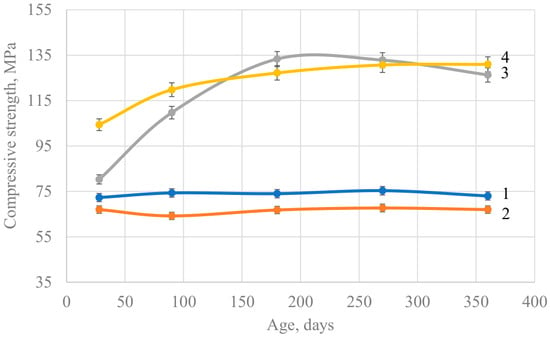
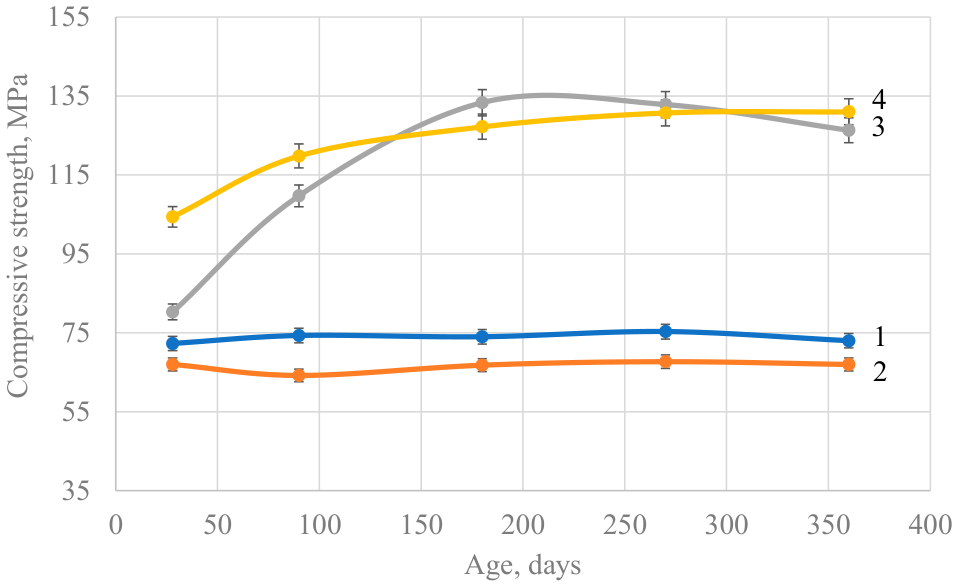
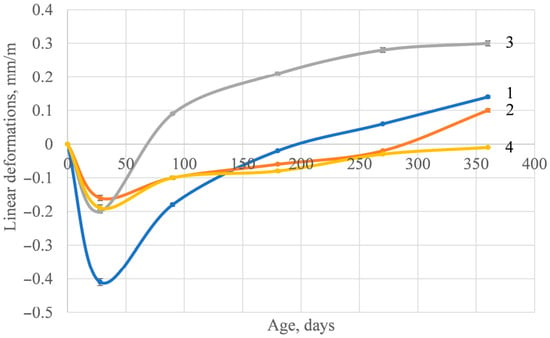
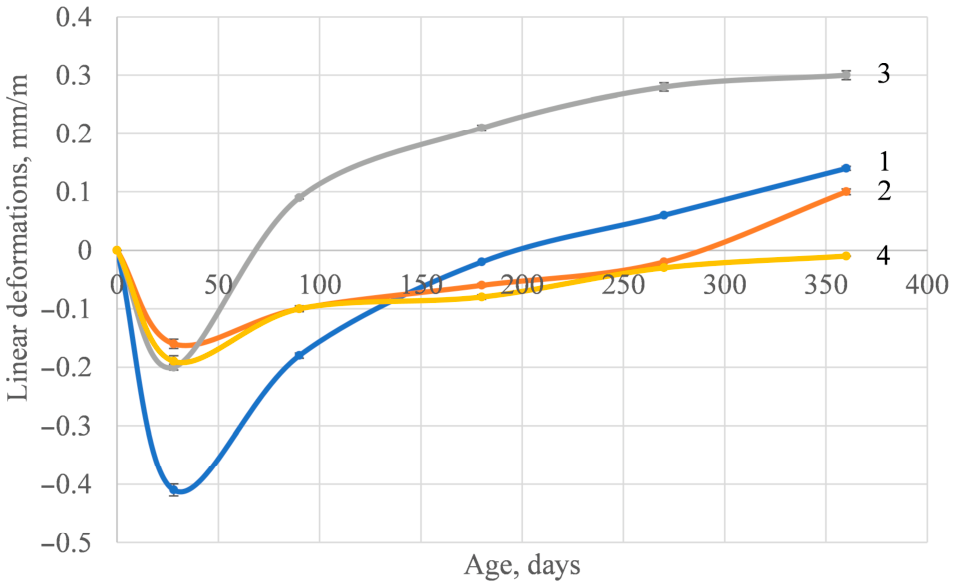
The investigated compositions are consistently denoted as CS1–CS4 (Table 2), and this notation is used throughout the manuscript. The results are shown in Figure 2 and Figure 3.
Figure 2.
Compressive strength of fine concrete based on different cement systems after steam curing (t = 90 ± 2 °C, RH = 100%) and subsequent storage in a climatic chamber (t = 38 ± 3 °C, RH ≈ 100%): 1—CS1; 2—CS2; 3—CS3; and 4—CS4.
Figure 3.
Linear deformations of fine concrete based on different cement systems after steam curing (t = 90 ± 2 °C, RH = 100%) and subsequent storage in a climatic chamber (t = 38 ± 3 °C, RH ≈ 100%): 1—CS1; 2—CS2; 3—CS3; and 4—CS4.
Corrosion of natural basalt rock in the hydration medium of OPC mixed with water (CS1) was observed to initiate after 270 days of curing under accelerated test conditions (Figure 3, curve 1). This was accompanied by an expansion of 0.06 mm/m after 270 days and 0.14 mm/m after 360 days. The incorporation of metakaolin (CS2) delayed the onset of this process to a later period, with an expansion of 0.1 mm/m at 360 days (Figure 3, curve 2).
An increase in Na2O content (CS3) caused accelerated corrosion. This was evidenced by a decrease in concrete strength from 133.3 MPa at 180 days to 126.3 MPa at 360 days (Figure 2, curve 3), as well as by the onset of expansion after 90 days, reaching the value of 0.09 mm/m (Figure 3, curve 3).
However, the incorporation of metakaolin in alkali-activated cement (CS4) resulted in shrinkage, decreasing from 0.19 mm/m at 28 days to 0.01 mm/m at 360 days (Figure 3, curve 4), as well as increasing compressive strength from 104.4 MPa at 28 days to 131.0 MPa at 360 days (Figure 2, curve 4). This indicates that metakaolin bound the corrosion products in the ITZ, thereby neutralizing the negative effect of ASR and transforming it into a positive one.
3.2. Modeling of Structure Formation in the “Cement Matrix–Basalt Bar” System
Studies on modeling the corrosion processes of basalt have confirmed the distinct features of structure formation in the ITZ in the presence of metakaolin compared to cement systems without Al2O3-containing additives.
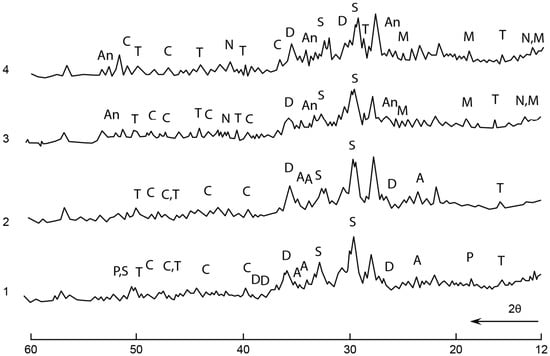
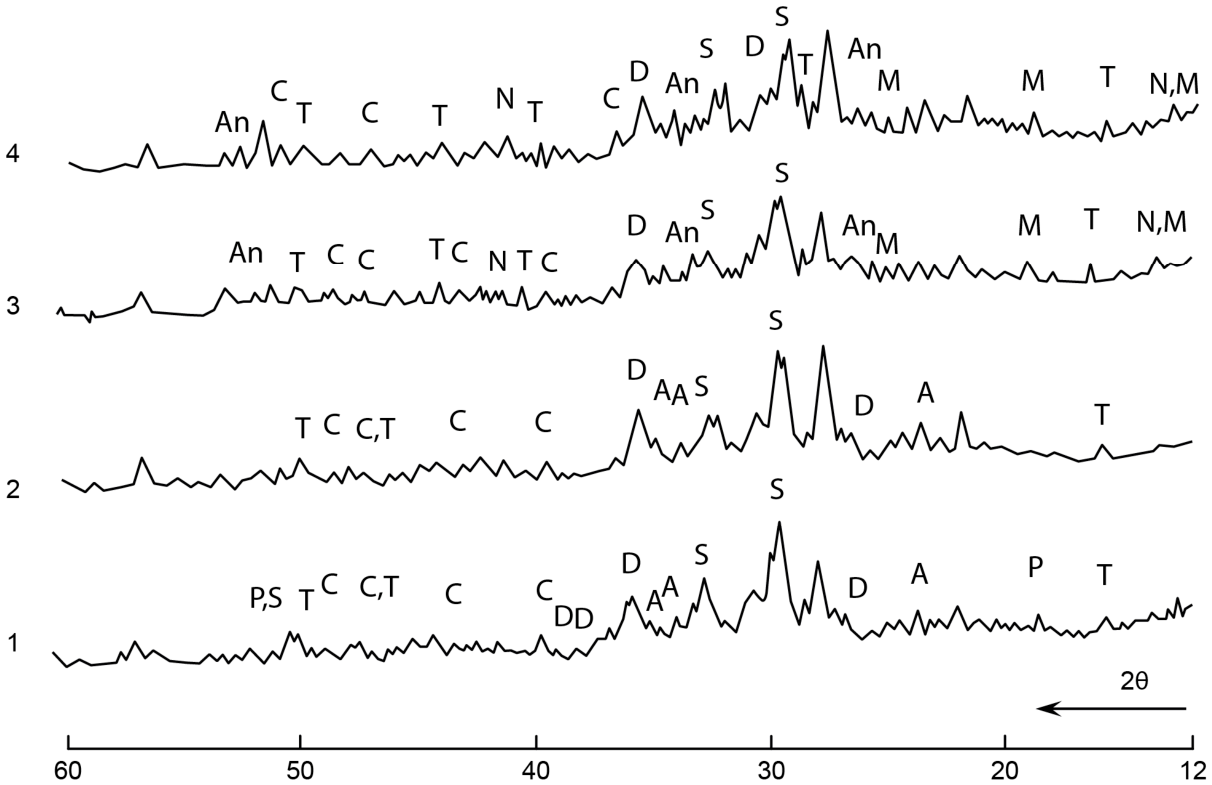
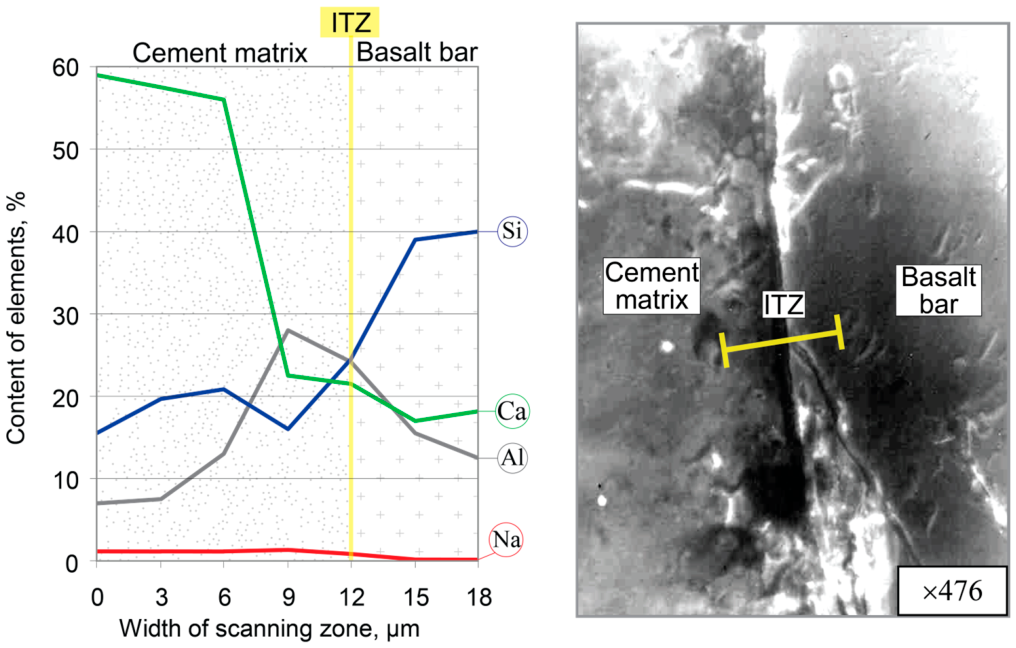
Thus, the hydration products of CS1 are as follow (Figure 4, curve 1): dellaite (6CaO·3SiO·2H2O, PDF card No 29-376), low-calcium hydrosilicates (CSH(I), PDF card No 1-720), tobermorite (5CaO·6SiO·5H2O, PDF card No 45-1480), portlandite (Ca(OH)2, PDF card No 44-1481), calcite (CaCO3, PDF card No 5-586), and hydroaluminates (CaO·Al2O3·10H2O, PDF card No 11-204). These phases are typical for OPC [57,58].
Figure 4.
XRD patterns of the ITZ “cement matrix–basalt bar” after curing at t = 38 ± 3 °C and RH = 100% for 360 days: 1—CS1; 2—CS2; 3—CS3; and 4—CS4. Abbreviations: S—CSH(I); D—dellaite; T—tobermorite; P—portlandite; C—calcite; A—hydroaluminate; An—analcime; N—natrolite; and M—mesolite.
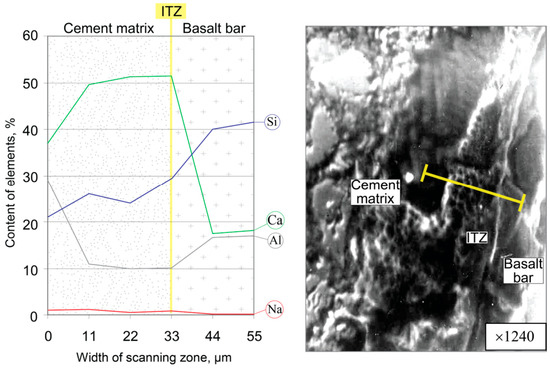
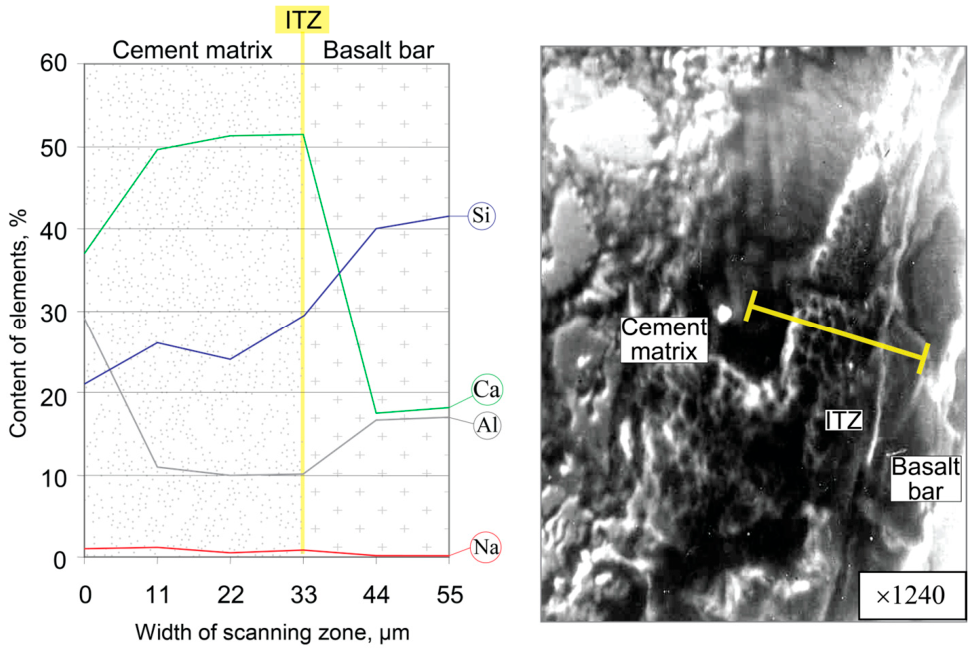
In view of the relatively high expansion of concrete, i.e., up to 0.14 mm/m at 360 days (Figure 3), these hydrates can worsen the performance of the ITZ and the distribution of elements, i.e., increased contents of Ca2+ and Si4+ ions (Figure 5). SEM examination also confirms this assumption by the obscurity of the ITZ.
Figure 5.
SEM micrographs and microprobe element distribution profiles in the ITZ “cement matrix (CS1)—basalt bar” after curing at t = 38 ± 3 °C and RH = 100% for 360 days.
The activation of OPC (CS3) by the water glass resulted in deeper hydration, as confirmed by the reduced intensity of the initial diffraction lines (Figure 4, curve 3). The changes in the hydration process enclosed the formation of low-calcium hydrosilicates (CSH(I), PDF card No 1-720) and tobermorite (5CaO·6SiO·5H2O, PDF card No 45-1480), and portlandite Ca(OH)2 was not detected. As a result, some reduction in self-deformations has been fixed for concrete (Table 2). The contents of Ca2+ and Si4+ ions in the ITZ decreased, while the contents of Al3+ and Na+ ions were maintained (Figure 6). As a result, the formation of zeolite-like hydroaluminosilicates such as analcime (Na2O⋅Al2O3⋅4SiO2⋅2H2O, PDF card No 42-1378) [59] and mesolite (Na2O⋅2CaO⋅3Al2O3⋅9SiO2⋅8H2O, PDF card No 24-1064) [60] can be identified. The ITZ tends to broaden due to formation of these products (Figure 6), and considering the performances of concrete (Figure 2 and Figure 3), it can be concluded that corrosion of the basalt bar was a constructive (positive) process.
Figure 6.
SEM micrographs and microprobe element distribution profiles in the ITZ “cement matrix (CS3)—basalt bar” after curing at t = 38 ± 3 °C and RH = 100% for 360 days: 1—cement matrix; 2—contact zone (ITZ); and 3—basalt bar.
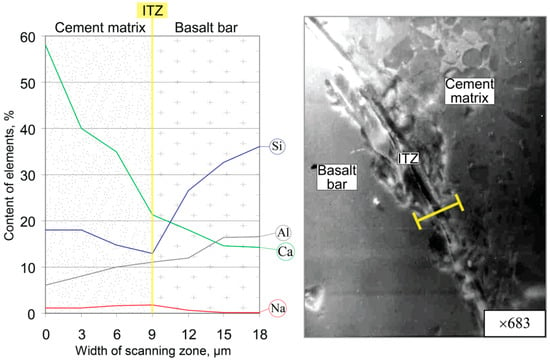
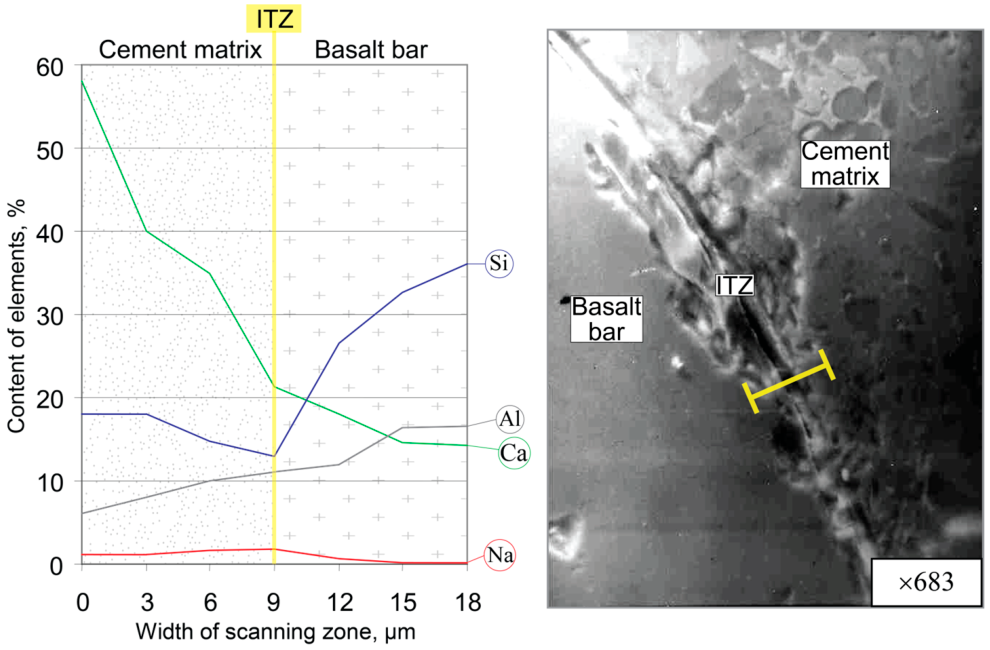
The addition of metakaolin to non-activated OPC (CS2) had a negligible effect on hydration products according to XRD (Figure 4, curve 2). However, the content of Ca2+ ions in this case essentially declined in the ITZ (Figure 7). Hence, the diminution of OH− ions consequently reduced the risk of corrosion in the ITZ. This conclusion was confirmed by the sharpness of the ITZ, and correlated well with the known results about lower concentrations of alkali in hydrated OPC in the presence of the active alumina [61].
Figure 7.
SEM micrographs and microprobe element distribution profiles in the ITZ “cement matrix (CS2)—basalt bar” after curing at t = 38 ± 3 °C and RH = 100% for 360 days.
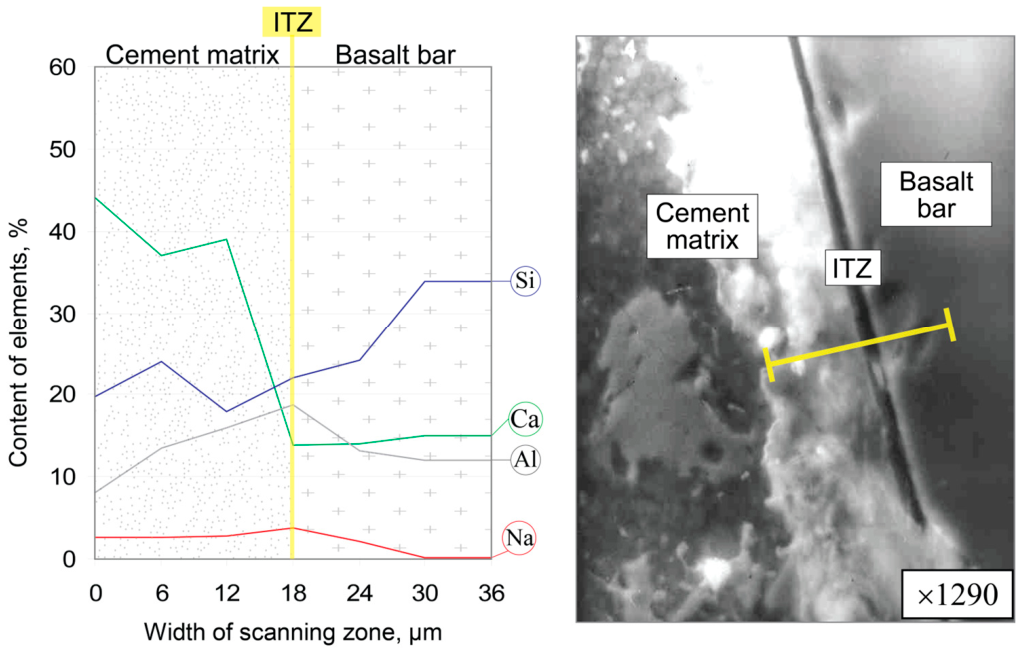
On the contrary, the addition of metakaolin completely prevented the corrosion of the basalt bar in alkali-activated OPC (CS4), and in this case the ITZ had precise boundaries (Figure 8). Due to water glass, the active Al2O3 involved within metakaolin, participated actively in the structure formation in the ITZ of the model system and with the transformation of the negative process of basalt corrosion into a positive one [62]. Zeolite-like hydration products, i.e., analcime (Na2O⋅Al2O3⋅4SiO2⋅2H2O, PDF card No 42-1378), natrolite (Na2O⋅Al2O3⋅3SiO2⋅2H2O, PDF card No 20-759), and mesolite Na2O⋅2CaO⋅3Al2O3⋅9SiO2⋅8H2O, PDF card No 24-1064), have been identified (Figure 4, curve 4). The growth in the contents of Al3+ and Na+ ions, as well as the decrease in Ca2+ ions in the ITZ, are evidence of these structure formation processes (Figure 8). These results confirmed the adaptive transformation of the ITZ due to the formation of stable zeolite-like products in the presence of alkali [63]. The above-mentioned processes caused less deformations of concrete, as some of the expansion was fixed and shrinkage fell down to a minimum value of 0.01 mm/m at 360 days (Figure 3).
Figure 8.
SEM micrographs and microprobe element distribution profiles in the ITZ “cement matrix (CS4)—basalt bar” after curing at t = 38 ± 3 °C and RH = 100% for 360 days.
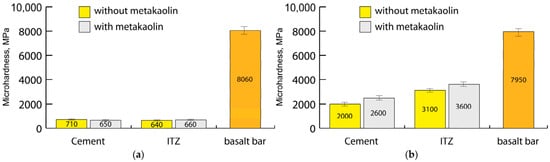
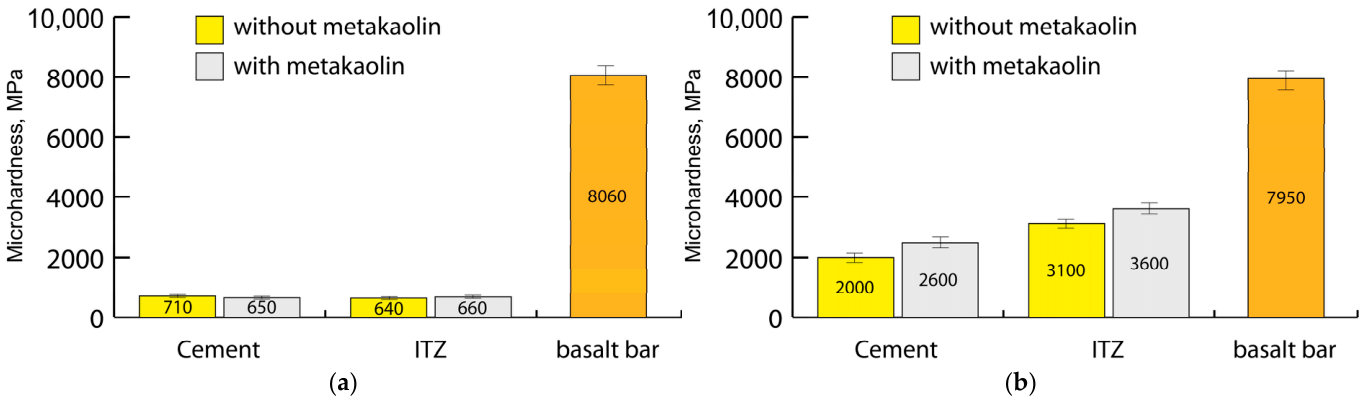
A comparison of the corrosion of basalt bars in the hydration medium of non-activated OPC (CS1, CS2) and alkali-activated OPC (CS3, CS4) allowed the following differences to be stated. In the traditional composition, the structure forming process is characterized by the formation of a film consisting of calcium hydrosilicates and alkali metal gel in the ITZ “cement matrix–basalt bar”, which is capable to swell under this film and create stress/strain in the concrete (the destructive process). On the contrary, in alkali-activated OPC, in the presence of metakaolin (CS4), the alkali metal gel is bound into insoluble zeolite-like hydroaluminosilicates of alkaline and alkaline–alkali earth compositions. The last of which was stable, dense, and hardy and materially enhanced the ITZ, and this constructive process was confirmed by the values of its microhardness (Figure 9).
Figure 9.
The influence of metakaolin on microhardness of the ITZ “cement matrix–basalt bar” after curing at t = 38 ± 3 °C and RH = 100% for 360 days for the cement systems mixed by: (a) water; and (b) water glass.
The highest microhardness of the ITZ was obtained for the alkali-activated cement system containing metakaolin (CS4), reaching approximately 3600 MPa. In contrast, the ITZ microhardness in the reference system “OPC–basalt bar” (CS1) was about 640 MPa, with no significant influence of water glass alone.
Thus, the combined effect of alkaline activation and metakaolin incorporation resulted in approximately a 5.6-fold increase in ITZ microhardness compared to the reference system. This effect is attributed to the densification of the ITZ associated with the formation of zeolite-like hydration products. Within the same system (CS4), the ITZ microhardness is approximately 1.8 times higher than that of the corresponding cement matrix.
3.3. Strength Development of Basalt Fiber-Reinforced Concrete
The conclusions regarding self-healing in the ITZ of the “cement matrix–basalt” system in the presence of an Al2O3-containing additive were supported by long-term observations of basalt fiber-reinforced steam-cured concrete.
For clarity, the concrete mixtures (Mix 1–Mix 4) correspond to the cement systems CS1–CS4, respectively, as defined in Table 2 and Table 3.
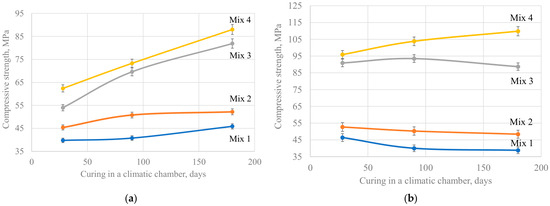
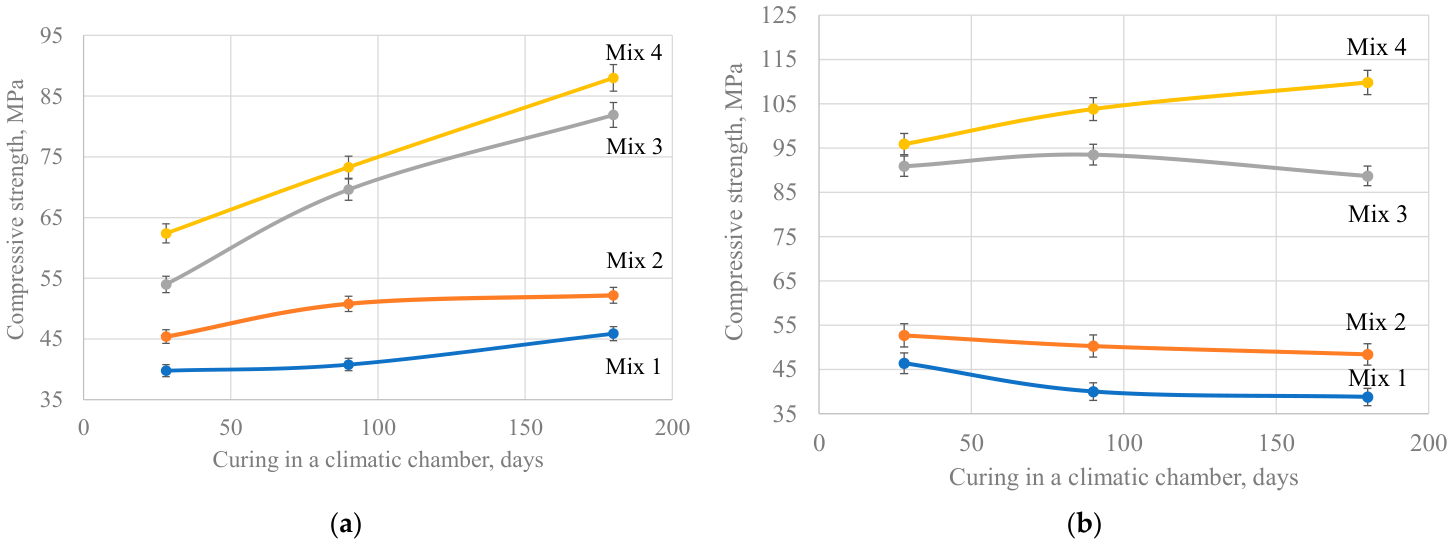
Under normal curing conditions (t = 20 ± 2 °C, RH ≥ 90%), CS1-based basalt fiber-reinforced concrete (Mix 1) exhibited a slight increase in compressive strength from 39.8 MPa to 45.9 MPa over the period from 28 days to 180 days (Figure 10a). A comparable increase in compressive strength was observed for CS2-based basalt fiber-reinforced concrete (Mix 2), increasing from 45.4 MPa to 52.2 MPa over the same period. Further storage resulted in a higher compressive strength of Mix 2 to Mix 1, which can be attributed to densification of the cement matrix due to additional low-calcium aluminosilicate hydrates (C-A-S-H phases). The reduction in Ca(OH)2 content and the formation of additional C-A-S-H gel densified the ITZ, creating more favorable conditions for preserving the properties of basalt fibers compared to a cement system without metakaolin.
Figure 10.
Strength gain of basalt fiber-reinforced concrete based on various cement systems (mixes from Table 3) after steam curing (t = 90 ± 2 °C, RH = 100%) and storing in a climatic chamber: (a) under normal curing conditions (t = 20 ± 2 °C, RH ≥ 90%); and (b) under elevated temperature conditions (t = 65 ± 2 °C, RH ≥ 90%).
CS3-based basalt fiber-reinforced concrete (Mix 3) exhibited a consistent increase in compressive strength compared to Mix 1 from 39.8 MPa to 54.0 MPa, from 40.8 MPa to 69.6 MPa, and from 45.9 MPa to 81.9 MPa at 28, 90, and 180 days of curing, respectively (Figure 10a). However, the addition of metakaolin to the alkali-activated OPC (Mix 4) resulted in a significant increase in compressive strength, reaching 62.4 MPa, 73.3 MPa, and 88.0 MPa at 28, 90, and 180 days.
Under elevated temperature conditions, the patterns of changes in the compressive strength at 28 days of curing (Figure 10b) were identical to those observed under normal conditions (Figure 10a). However, storage under conditions that accelerate the ASR was accompanied by a decrease in the compressive strength of Mix 1—from 46.4 MPa at 28 days to 38.8 MPa at 180 days (Figure 10b). The addition of metakaolin to OPC also caused a reduction in strength (Mix 2)—from 52.7 MPa at 28 days to 48.4 MPa at 180 days. Similarly, the strength of concrete based on alkali-activated OPC (Mix 3) decreased from 90.9 MPa at 28 days to 88.7 MPa at 180 days. These presented data correlate with the results of the ASR process simulation (see Section 3.1).
However, the incorporation of metakaolin into OPC under alkaline activation ensured an increase in the compressive strength of basalt fiber-reinforced concrete (Mix 4) from 95.9 MPa at 28 days to 109.8 MPa at 180 days. This was attributed to the binding of corrosion products in the ITZ with the formation of zeolite-like hydration products (see Section 3.2), which converts the negative effect of ASR into a positive one.
Thus, the introduction of an additional amount of Na2O into the cement system ensured the self-healing process in the ITZ in the presence of an Al2O3-containing additive. Compared to the non-activated analog (Mix 1), this approach allowed for an increase in concrete compressive strength by factors of 2.1, 2.6, and 2.8 at 28, 90, and 180 days of curing, respectively, under external conditions that maximally accelerated ASR.
4. Discussion
The results demonstrated that alkaline activation of OPC, combined with metakaolin incorporation, modifies the mechanism of ASR in basalt fiber-reinforced concrete. Alkaline activation not only increased the compressive strength of OPC but also intensified the corrosion of basalt fibers. This negative effect was mitigated by the incorporation of metakaolin, which bound sodium hydrosilicates formed during alkaline corrosion and promoted the formation of stable zeolite-like hydration products within the Na2O–CaO–Al2O3–SiO2–H2O system. Thus, the corrosion process was effectively transformed from a destructive to a constructive one, contributing to the self-healing of the ITZ. This transformation was reflected in the densification of the ITZ, evidenced by a 5.5–5.6-fold increase in microhardness relative to the OPC matrix, and in the shifting from expansion (0.14 mm/m) to negligible shrinkage (0.01 mm/m after 360 days). At the same time, the compressive strength of basalt fiber-reinforced concrete compared with that of the OPC analog increased by 18%, 46%, and 82% after steam curing followed by storage for 28, 90, and 180 days under conditions that accelerated ASR (t = 65 ± 2 °C, RH ≥ 90%).
It should be noted that the curing conditions applied in this study (t = 65 ± 2 °C, RH ≥ 90% as well as t = 38 ± 3 °C, RH ≥ 90% for models) are intentionally accelerated and are commonly used to intensify alkali–silica reaction processes within a shortened experimental time, in accordance with established testing approaches (e.g., ASTM C1260 and ASTM C1293).
Although such conditions do not directly represent typical service environments, they are widely accepted for evaluating the effectiveness of mitigation strategies and for identifying governing mechanisms of ASR development. According to Arrhenius-type considerations, an increase in temperature accelerates reaction kinetics, allowing long-term processes to be simulated within laboratory time scales.
Therefore, the results obtained in this study should be interpreted in terms of comparative performance and mechanistic understanding rather than direct prediction of service life. Under moderate environmental conditions, the same mechanisms—namely, the transformation of alkali–silicate gel into stable aluminosilicate phases—are expected to occur, albeit at a slower rate, suggesting that the self-healing effect would be less pronounced in kinetics but similar in nature.
In the present study, the term “constructive” ASR is used to describe a condition in which ASR-related processes do not result in expansion-induced damage, but instead lead to densification and strengthening of the interfacial transition zone (ITZ). This is quantitatively reflected by the absence of expansion (or its transformation into shrinkage) combined with an increase in mechanical properties.
The proposed approach, implemented in the model system “OPC–metakaolin–water glass”, is based on the transformation of alkali–silicate gel into stable aluminosilicate phases. The results suggest the feasibility of using Al2O3-containing industrial by-products, e.g., fly ash and red mud, in future research. The identified mechanism of ITZ stabilization provides a basis for the development of OPC basalt fiber-reinforced high-strength concretes with improved resistance to impact and blast loading.
Other well-known methods for the mitigation of ASR in OPC concretes include the use of aluminum and lithium compounds. For instance, replacing 30% of OPC with an Al(OH)3 additive resulted in a reduction in concrete expansion below the threshold level of 0.04% [64]. The effectiveness of lithium compounds such as LiNO2, LiNO3, LiCl, LiOH, and Li2CO3 has also been demonstrated. These compounds reduced concrete expansion to an acceptable level [65]. All concrete specimens were stored at t = 38 °C and RH > 95% for 1 year, as specified in ASTM C1293/C1293M-23a [66].
The effectiveness of supplementary cement materials to reduce the ASR in OPC concrete has been demonstrated [67]. Replacing 30% of OPC with metakaolin, glass powder, a blend of metakaolin and glass powder, or a blend of fly ash and blast furnace slag reduced expansion below the threshold level of 0.1%, as determined by the accelerated mortar bar test according to ASTM C1260-23 [68]—following curing in water at t = 80 °C for 24 h, the specimens were then fully immersed in a sodium hydroxide (NaOH) solution at t = 80 °C for 14 days.
The data reported in [69] correlate with the results presented in [70] regarding the positive effect of supplementary cement materials in mitigation of ASR. The incorporation of a blend consisting of 10–15% ground granulated blast-furnace slag and 10–15% glass powder, or a blend of 10% silica fume and 10% glass powder, ensured a reduction in mortar expansion below the threshold level of 0.1% as per ASTM C1260-23.
A positive effect from the combined use of supplementary cement materials and lithium compounds has been demonstrated [70]. Replacing 30% of OPC with a blend of metakaolin and LiNO3, a blend of glass powder and LiNO3, or a blend of ground granulated blast-furnace slag, fly ash, and LiNO3 ensured a reduction in expansion below the threshold level of 0.1% according to ASTM C1260-23.
The results from other studies are generally consistent with the present findings in terms of reducing ASR-induced expansion, confirming the effectiveness of mitigation strategies such as supplementary cementitious materials and lithium-based admixtures. However, comparison of mechanical performance is less straightforward, as most available studies primarily focus on expansion control, while strength gain under accelerated ASR conditions is not systematically reported.
In the present study, the proposed approach not only controls ASR but also results in a significant increase in compressive strength of alkali-activated cement concrete (by 18%, 46%, and 82% at 28, 90, and 180 days, respectively), even under conditions accelerating ASR. In contrast, the incorporation of supplementary cementitious materials in OPC systems is often associated with a reduction or only marginal improvement in early-age strength. For example, replacing 30% of OPC with metakaolin, glass powder, their combined blend, or fly ash–slag mixtures led to compressive strength reductions of 4%, 31%, 16%, and 36% [70]. When such materials were combined with lithium compounds, only moderate strength gains were observed (approximately 5–7%).
These differences suggest that the proposed approach may provide a combined effect of expansion control and strength enhancement, rather than the trade-off between durability and mechanical performance observed in conventional systems.
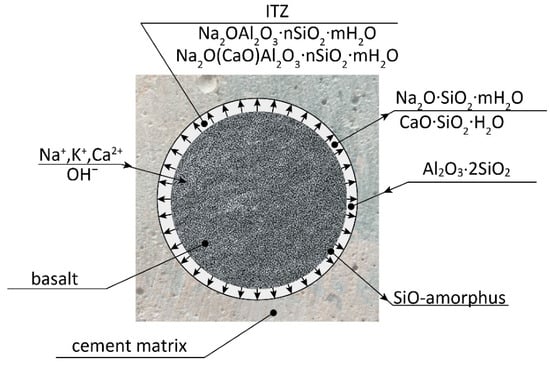
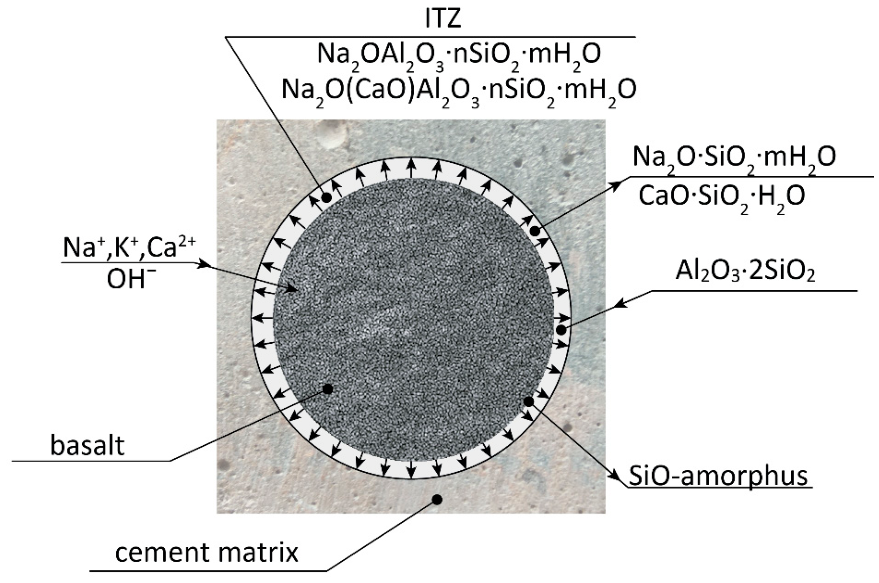
To interpret these results, it is necessary to consider the fundamental chemical processes governing ASR. The distinctive features of the proposed method can be directly correlated with the transformation of alkali–silicate gel into stable aluminosilicate phases in the ITZ, which contributes to its self-healing. The essence of ASR is that it proceeds when alkali susceptible aggregates are used in concrete and under the influence of high humidity during its service life [62]. The diagrammatic view of ASR, the measures on its prevention were further observed and schematically represented in Figure 11.
Figure 11.
The self-healing processes of ITZ “alkali-activated OPC–basalt” in presence of metakaolin.
Firstly, it must be noted that ASR can proceed only when alkali exceed a limit that causes the deterioration of concrete. The process of internal alkali appearing during hydration of cement can be as follow [70]:
Na2SO4 + Ca(OH)2 + 2H2O → CaSO4·2H2O + 2NaOH(Na+,OH−).
Alkali can also be brought in from outside (for example, by alkaline activation) [71]:
Na2O·nSiO2·mH2O + Ca(OH)2 → CaO·nSiO2·mH2O + 2NaOH.
Secondly, the alkali-susceptible silicon dioxide (SiO2) reacts with an alkali metal hydroxide and forms a silica gel, which, due to adsorbing water and calcium, results in expanding pressure and, accordingly, in degradation of the formed structure [72]:
2NaOH + nSiO2 + mH2O → Na2O·nSiO2·mH2O.
An alkali metal silicate gel can form C-S-H phases in the presence of Ca(OH)2, and this process is followed by the permanent formation of alkali metal hydroxide:
Na2O·nSiO2·mH2O + Ca(OH)2 + mH2O → CaO·SiO2·mH2O + 2NaOH.
Thirdly, some quantities of alkali can be bound by the C-S-H phases, and a lower Ca/Si ratio causes the higher ability of these phases to bind alkali [73]. But the above-mentioned processes undergo radical changes due to the addition of metakaolin because of its ability to bind the gel-like phase of Na2O·nSiO2·mH2O and alkali (NaOH), creating alkaline aluminosilicate hydrates [74]:
Al2O3·2SiO2 + 2NaOH + mH2O → Na2O·Al2O3·2SiO2·mH2O;
Al2O3·2SiO2 + Na2O·nSiO2·mH2O → Na2O Al2O3·(n + 2)SiO2·mH2O.
With the addition of metakaolin, there is also a factor of C-A-S-H phases buildup, which in turn is able to bind greater quantities of alkali compared to C-S-H with the formation of stable in the volume of zeolite-like C-N-A-S-H phases:
CaO·nSiO2·mH2O + Al2O3·2SiO2 + 2NaOH + kSiO2→ CaO·Na2O·Al2O3·(n + 2 + k)SiO2 (m + 1)H2O
Thus, by using the Al2O3/SiO2 ratio, the prediction of ASR can be realized. And metakaolin, similar to silica fume, allows portlandite to be bind into low-basic C-S-H phases. Metakaolin also provides volume stability of the alkali-activated OPC basalt-reinforced concretes due to the binding of corrosion products into stable hydrated phases.
The results indicate that the proposed approach enables the transformation of ASR from a detrimental process into a constructive one, characterized by suppressed expansion and enhanced ITZ performance while simultaneously promoting strength development of OPC through alkali activation and the presence of metakaolin. This combined effect of durability improvement and strength enhancement distinguishes the proposed method from conventional ASR mitigation strategies and highlights its potential for high-performance basalt fiber-reinforced concrete applications.
5. Conclusions
- Alkaline activation of OPC combined with metakaolin incorporation enables the transformation of the alkali–silica reaction (ASR) from a destructive process into a constructive one, which relies on the formation of stable hydration products within the Na2O-CaO-Al2O3-SiO2-H2O system in the interfacial transition zone between alkali-activated OPC and basalt fiber.
- The compositional buildup of alkali-activated OPC requires an approximately three-fold increase in Na2O content, which enhances compressive strength by a factor of 1.6–1.9; however, it intensifies concrete degradation due to ASR. The addition of metakaolin effectively mitigates this effect, converting expansion at 360 days (up to 0.14 mm/m) into negligible shrinkage (0.01 mm/m).
- The improved performance of metakaolin-containing alkali-activated OPC concrete is associated with the formation of stable zeolite-like hydration products in the ITZ (e.g., analcime, natrolite, and mesolite), resulting in its densification and a 5.6-fold increase in microhardness compared to the OPC matrix.
- The proposed investigations ensure long-term strength development of basalt fiber-reinforced concrete, i.e., its durability. The compressive strength increases by 1.14 times in 180 days, whereas the non-modified analog shows a decrease to 0.92 of its initial value, even under conditions that accelerate ASR.
Author Contributions
P.K.: Conceptualization, Methodology, Validation, Formal analysis, Writing—review and editing, Supervision, Project administration, Funding acquisition. I.R.: Methodology, Validation, Formal analysis, Investigation, Data curation, Writing—review and editing. O.G.: Validation, Investigation, Resources, Writing—original draft preparation. O.K.: Methodology, Software, Validation, Formal analysis, Investigation, Resources, Data curation, Writing—original draft preparation, Visualization. All authors have read and agreed to the published version of the manuscript.
Funding
The authors express their gratitude to the Ministry of Education and Science of Ukraine for the financial support of this research, which was carried out within the budgetary financing of topics with registration No 0126U000965, 0126U001154, and an implementation period 2026–2028.
Institutional Review Board Statement
Not applicable.
Informed Consent Statement
Not applicable.
Data Availability Statement
The data are not publicly available, as this work was carried out within the framework of the mentioned projects, and its results can be made available on request after registering a report in the State Scientific Institution of the Ukrainian Institute of Scientific and Technical Expertise and Information (http://www.uintei.kiev.ua/en, accessed on 20 April 2026) at https://nddkr.ukrintei.ua/ (accessed on 20 April 2026).
Conflicts of Interest
The authors declare no conflicts of interest.
References
- Fediuk, R.; Amran, M.; Klyuev, S.; Klyuev, A. Increasing the Performance of a Fiber-Reinforced Concrete for Protective Facilities. Fibers 2021, 9, 64. [Google Scholar] [CrossRef] [Scilit]
- Shadan, P.; Sharafi, P.; Saeed, N. Blast response and protection level of concrete composite wall panels made with recycled tyre fibers in a cement matrix. Constr. Build. Mater. 2024, 451, 138866. [Google Scholar] [CrossRef] [Scilit]
- Zhao, C.; Chen, J.; Wang, Y.; Lu, S. Damage mechanism and response of reinforced concrete containment structure under internal blast loading. Theor. Appl. Fract. Mech. 2012, 61, 12–20. [Google Scholar] [CrossRef] [Scilit]
- Guo, W.; Fan, W.; Shao, X.; Shen, D.; Chen, B. Constitutive model of ultra-high-performance fiber-reinforced concrete for low-velocity impact simulations. Compos. Struct. 2018, 185, 307–326. [Google Scholar] [CrossRef] [Scilit]
- Pham, T.M. Fiber-reinforced concrete: State-of-the-art-review on bridging mechanism, mechanical properties, durability, and eco-economic analysis. Case Stud. Constr. Mater. 2025, 22, e04574. [Google Scholar] [CrossRef] [Scilit]
- Wang, Y.; Khan, M.; Uy, B.; Katwal, U.; Tao, Z.; Thai, H.; Ngo, T. Long-term performance of steel-concrete composite wall panels under axial compression. Structures 2024, 64, 106606. [Google Scholar] [CrossRef] [Scilit]
- Liu, Q.; Wang, Y.; Wang, T.; Duan, K.; Zhang, F.; Chen, L.; Su, K.R. Probabilistic distribution and temporal variation of non-uniform corrosion in reinforced concrete under chlorine environment. J. Build. Eng. 2026, 118, 115018. [Google Scholar] [CrossRef] [Scilit]
- Han, S.; Xiao, G.; Wang, P.; Xu, C.; Zhou, A.; Yu, J.; Ou, J. Axial-bending behavior of hybrid fiber-reinforced polymer-steel reinforced concrete columns with novel closed ties: Confinement mechanism and equivalent design. Eng. Struct. 2026, 353, 122236. [Google Scholar] [CrossRef] [Scilit]
- Deng, Z.; Liu, X.; Liang, N.; de la Fuente, A.; Peng, H. Flexural Performance of a New Hybrid Basalt-Polypropylene Fiber-Reinforced Concrete Oriented to Concrete Pipelines. Fibers 2021, 9, 43. [Google Scholar] [CrossRef] [Scilit]
- Zaid, O.; Al-Ezzi, M.J.; Al-Dala’ien, R.N.; Ahmed, M.; Anas, S.M. State of the art review on ultra-high-performance fiber-reinforced concrete properties standardization and structural applications. Discov. Sustain. 2026, 7, 83. [Google Scholar] [CrossRef] [Scilit]
- Dziomdziora, P.; Smarzewski, P. Effect of Hybrid Fiber Compositions on mechanical properties and durability of ultra-high-performance concrete: A comprehensive review. Materials 2025, 18, 2426. [Google Scholar] [CrossRef] [Scilit] [PubMed]
- Zhao, C.; Jiang, G.; Guo, J.; Zhang, X.; Ma, Z.; Zhuang, C.; Zhang, W.; Yu, S. Experimental Investigation on the Frost Resistance and Service Life Prediction of Basalt Fiber-Reinforced Concrete. Fibers 2025, 13, 143. [Google Scholar] [CrossRef] [Scilit]
- Zhang, P.; Zheng, Q.; Gao, Z.; Wang, F.; Lai, C. Research progress on impact resistance of fiber-reinforced concrete—A review. J. Build. Eng. 2025, 112, 113982. [Google Scholar] [CrossRef] [Scilit]
- Zhang, D.; Yu, J.; Wu, H.; Jaworska, B.; Ellis, B.R.; Li, V.C. Discontinuous micro-fibers as intrinsic reinforcement for ductile. Engineered Cementitious Composites (ECC). Compos. Part B Eng. 2020, 184, 107741. [Google Scholar] [CrossRef] [Scilit]
- Akbar, A.; Liew, K.M. Multicriteria performance evaluation of fiber-reinforced cement composites: An environmental perspective. Compos. Part B Eng. 2021, 218, 108937. [Google Scholar] [CrossRef] [Scilit]
- Sohail, M.G.; Alnahhal, W.; Taha, A.; Abdelaal, K. Sustainable alternative aggregates: Characterization and influence on mechanical behavior of basalt fiber-reinforced concrete. Constr. Build. Mater. 2020, 255, 119365. [Google Scholar] [CrossRef] [Scilit]
- Dyussembinov, D.; Shakhmov, Z.; Lukpanov, R.; Jexembayeva, A.; Zhumagulova, A. Technology of mineral insulation waste utilization. Fibers 2026, 14, 17. [Google Scholar] [CrossRef] [Scilit]
- Vaičiukynienė, D.; Nizevičienė, D.; Kantautas, A.; Tamošaitis, G.; Fornés, I.V.; Krivenko, P.; Boiko, O. Effect of large amounts of supplementary cementitious material on the hydration of blended cement. J. Mater. Civ. Eng. 2025, 37, 04025091. [Google Scholar] [CrossRef] [Scilit]
- Scrivener, K.L.; John, V.M.; Gartner, E.M. Eco-efficient cements: Potential economically viable solutions for a low-CO2 cement-based materials industry. Cem. Concr. Res. 2018, 114, 2–26. [Google Scholar] [CrossRef] [Scilit]
- Zhang, Y.; Zhang, J.; Luo, W.; Wang, J.; Shi, J.; Zhuang, H.; Wang, Y. Effect of compressive strength and chloride diffusion on life cycle CO2 assessment of concrete containing supplementary cementitious materials. J. Clean. Prod. 2019, 218, 450–458. [Google Scholar] [CrossRef] [Scilit]
- Zunino, F.; Martirena, F.; Scrivener, K. Limestone Calcined Clay Cements (LC3). ACI Mater. J. 2021, 118, 49–60. [Google Scholar] [CrossRef] [Scilit]
- Kumar, A.; Sant, G.; Patapy, C.; Gianocca, C.; Scrivener, K.L. The influence of sodium and potassium hydroxide on alite hydration: Experiments and simulations. Cem. Concr. Res. 2012, 42, 1513–1523. [Google Scholar] [CrossRef] [Scilit]
- Kriven, W.M.; Leonelli, C.; Provis, J.L.; Boccaccini, A.R.; Attwell, C.; Ducman, V.S.; Ferone, C.; Rossignol, S.; Luukkonen, T.; van Deventer, J.S.J.; et al. Why geopolymers and alkali-activated materials are key components of a sustainable world: A perspective contribution. J. Am. Ceram. Soc. 2024, 107, 5159–5177. [Google Scholar] [CrossRef] [Scilit]
- Ducman, V.; Provis, J.L.; Kryvenko, P.; van Deventer, J.; Keulen, A.; Matthys, S.; Winnefeld, F.; Kanavaris, F.; Shi, C.; Dehn, F.; et al. Standardization and Legislation. In Mechanical Properties of Alkali-Activated Materials; Ye, G., Dehn, F., Eds.; RILEM State-of-the-Art Reports; Springer Nature: London, UK, 2026; Volume 46, pp. 527–549. [Google Scholar] [CrossRef] [Scilit]
- Qin, Y.; Qu, C.; Ma, C.; Zhou, L. One-part alkali-activated materials: State of the art and perspectives. Polymers 2022, 14, 5046. [Google Scholar] [CrossRef] [Scilit]
- Kryvenko, P.; Rudenko, I.; Sikora, P.; Sanytsky, M.; Konstantynovskyi, O.; Kropyvnytska, T. Alkali-activated cements as sustainable materials for repairing building construction: A review. J. Build. Eng. 2024, 90, 109399. [Google Scholar] [CrossRef] [Scilit]
- Kryvenko, P.; Rudenko, I.; Kovalchuk, O.; Gelevera, O.; Konstantynovskyi, O. Influence of dosage and modulus on soluble sodium silicate for early strength development of alkali-activated slag cements. Minerals 2023, 13, 1164. [Google Scholar] [CrossRef] [Scilit]
- Kryvenko, P.; Sanytsky, M.; Kropyvnytska, T. The effect of nanosilica on the early strength of alkali-activated portland composite cements. Solid State Phenom. 2019, 296, 21–26. [Google Scholar] [CrossRef] [Scilit]
- Chen, B.; Wang, J. Experimental study on the durability of alkali-activated slag concrete after freeze-thaw cycle. Adv. Mater. Sci. Eng. 2021, 2021, 9915639. [Google Scholar] [CrossRef] [Scilit]
- Krivenko, P.; Rudenko, I.; Konstantynovskyi, O.; Razsamakin, A. Sustainable performance of alkali-activated blast furnace cement concrete with high freeze-thaw resistance. IOP Conf. Ser. Earth Environ. Sci. 2023, 1254, 012003. [Google Scholar] [CrossRef] [Scilit]
- Krivenko, P.; Rudenko, I.; Konstantynovskyi, O. Effect of technological factors on freeze-thaw resistance of alkali-activated slag cement concrete in NaCl solution. AIP Conf. Proc. 2023, 2684, 040011. [Google Scholar] [CrossRef] [Scilit]
- Nassar, A.K.; Sivanandam, S.; Saran, D.; Sundar, S.B.S.; Kathirvel, P.; Murali, G.; Dixit, S. Durability assessment of sustainable one-part alkali activated concrete produced from agricultural and industrial waste activators under aggressive environmental conditions. Constr. Build. Mater. 2025, 486, 141823. [Google Scholar] [CrossRef] [Scilit]
- Krivenko, P.; Rudenko, I.; Konstantynovskyi, O.; Vaičiukynienė, D. Mitigation of Corrosion Initiated by Cl− and SO42−-ions in Blast Furnace Cement Concrete Mixed with Sea Water. Materials 2022, 15, 3003. [Google Scholar] [CrossRef] [Scilit] [PubMed]
- Krivenko, P.; Rudenko, I.; Konstantynovskyi, O. Comparison of influence of surfactants on thermokinetic characteristics of alkali-activated slag cement. East.-Eur. J. Enterp. Technol. 2021, 6, 39–48. [Google Scholar] [CrossRef] [Scilit]
- Hu, Z.; Wyrzykowski, M.; Lura, P. Estimation of reaction kinetics of geopolymers at early ages. Cem. Concr. Res. 2020, 129, 105971. [Google Scholar] [CrossRef] [Scilit]
- Xiao, T.; Pan, Q.; Cheng, J.; Zhao, S. Corrosion behaviour and mechanism of basalt fibers in acidic and alkaline environments. Corros. Sci. 2016, 110, 15–22. [Google Scholar] [CrossRef] [Scilit]
- Kočí, V.; Keppert, M.; Černý, R. Deterioration of basalt-based reinforcement in corrosive environments: Experimental monitoring and mathematical models. J. Phys. Conf. Ser. 2023, 2628, 012012. [Google Scholar] [CrossRef] [Scilit]
- Rybin, V.A.; Utkin, A.V.; Baklanova, N.I. Corrosion of uncoated and oxide-coated basalt fiber in different alkaline media. Corros. Sci. 2016, 102, 503–509. [Google Scholar] [CrossRef] [Scilit]
- Wang, Q.; Ding, Y.; Randl, N. Investigation on the alkali resistance of basalt fiber and its textile in different alkaline environments. Constr. Build. Mater. 2020, 272, 121670. [Google Scholar] [CrossRef] [Scilit]
- Liu, M.; Guo, Z.; Qian, Y.; Chen, L.; Mao, X.; Zhao, J.; Yang, D. Investigation into the long-term alkali resistance of basalt fibers. J. Build. Eng. 2024, 98, 111105. [Google Scholar] [CrossRef] [Scilit]
- Tang, C.; Jiang, H.; Zhang, X.; Li, G.; Cui, J. Corrosion behavior and mechanism of basalt fibers in sodium hydroxide solution. Materials 2018, 11, 1381. [Google Scholar] [CrossRef] [Scilit]
- Stark, J.; Wicht, B. Dauerhaftigkeit von Beton; Birkhäuser-Verlag: Basel, Switzerland; Boston, MA, USA; Berlin, Germany, 2001. [Google Scholar]
- Jin, H.; Ghazizadeh, S.; Provis, J.L. Investigation of alkali-silica reaction in alkali activated cements by thermodynamic modelling. Mater. Struct. 2025, 58, 265. [Google Scholar] [CrossRef] [Scilit]
- Omar, O.; Al Hatailah, H.; Nanni, A. Advances and Perspectives in Alkali–Silica Reaction (ASR) Testing: A Critical Review of Reactivity and Mitigation Assessments. Designs 2025, 9, 71. [Google Scholar] [CrossRef] [Scilit]
- Garbacz, A.; Włodarczyk, M.; Banasiak, G. Influence of composition modification of basalt fiber-reinforced polymer bars on alkali resistance. Polymers 2026, 18, 637. [Google Scholar] [CrossRef] [Scilit] [PubMed]
- Theerapapvisetpong, A.; Kwanpanngam, P.; Tamrongwongwi, T. Improvement of alkali resistance of glass fiber from basalt and lignite bottom ash mixture by addition of ZrO2 content. J. Met. Mater. Miner. 2021, 31, 147–153. [Google Scholar] [CrossRef] [Scilit]
- Doroshenko, O. Use of modified basalt fiber in transport construction. Transp. Syst. Technol. 2023, 42, 58–68. [Google Scholar] [CrossRef] [Scilit]
- Eu, H.; Kim, G.; Son, M.; Sasui, S.; Lee, Y.; Choi, H.; Kang, S.; Nam, J. Alkali-silica reaction and residual mechanical properties of high-strength mortar containing waste glass fine aggregate and supplementary cementitious materials. Int. J. Concr. Struct. Mater. 2024, 18, 69. [Google Scholar] [CrossRef] [Scilit]
- Luo, D.; Sinha, A.; Adhikari, M.; Wei, J. Mitigating alkali-silica reaction through metakaolin-based internal conditioning: New insights into property evolution and mitigation mechanism. Cem. Concr. Res. 2022, 159, 106888. [Google Scholar] [CrossRef] [Scilit]
- Kryvenko, P. (Ed.) Compressive Strength of Concrete; IntechOpen: London, UK, 2020. [Google Scholar] [CrossRef] [Scilit]
- Jóźwiak-Niedźwiedzka, D.; Jaskulski, R.; Dziedzic, K.; Brachaczek, A.; Jarząbek, D.M. Initial characteristics of alkali-silica reaction products in mortar containing low-purity calcined clay. Materials 2024, 17, 2207. [Google Scholar] [CrossRef] [Scilit]
- Rahla, K.M.; Mateus, R.; Bragança, L. Comparative sustainability assessment of binary blended concretes using Supplementary Cementitious Materials (SCMs) and Ordinary Portland Cement (OPC). J. Clean. Prod. 2019, 220, 445–459. [Google Scholar] [CrossRef] [Scilit]
- Amer, I.; Kohail, M.; El-Feky, M.S.; Rashad, A.; Khalaf, M.A. A review on alkali-activated slag concrete. Ain Shams Eng. J. 2021, 12, 1475–1499. [Google Scholar] [CrossRef] [Scilit]
- DSTU B V.2.7-181; Alkaline Cements. Specifications. Amendment 1. National Standard of Ukraine: Kyiv, Ukraine, 2009.
- Stark, J. Alkali-Kieselsäure-Reaktion; Schriftenreihe des F.A. Finger-Instituts für Baustoffkunde, Bauhaus-Universität Weimar: Weimar, Germany, 2008. [Google Scholar]
- Ali, A.; Chiang, Y.W.; Santos, R.M. X-Ray diffraction techniques for mineral characterization: A review for engineers of the fundamentals, applications, and research directions. Minerals 2022, 12, 205. [Google Scholar] [CrossRef] [Scilit]
- Scrivener, K.L.; Juilland, P.; Monteiro, P.J.M. Advances in understanding hydration of Portland cement. Cem. Concr. Res. 2015, 78, 38–56. [Google Scholar] [CrossRef] [Scilit]
- Fanna, D.J.; George, L.; Moran, K.; Wuhrer, R. Investigation of Ordinary Portland Cement Hydration Mechanisms Utilising X-ray Mapping, In Situ X-ray Diffraction and In Situ Micro-CT. Microsc. Microanal. 2024, 30, 479–484. [Google Scholar] [CrossRef] [Scilit]
- Wang, J.; Wu, X.; Wang, J.; Liu, C.; Lai, Y.; Hong, Z.; Zheng, J. Hydrothermal synthesis and characterization of alkali-activated slag–fly ash–metakaolin cementitious materials. Micropor. Mesopor. Mat. 2012, 155, 186–191. [Google Scholar] [CrossRef] [Scilit]
- Ke, X.; Bernal, S.A.; Provis, J.L.; Lothenbach, B. Thermodynamic modelling of phase evolution in alkali-activated slag cements exposed to carbon dioxide. Cem. Concr. Res. 2020, 136, 106158. [Google Scholar] [CrossRef] [Scilit]
- Ramlochan, T.; Thomas, M.; Gruber, K. The effect of metakaolin on alkali-silica reaction in concrete. Cem. Concr. Res. 2000, 30, 339–344. [Google Scholar] [CrossRef] [Scilit]
- Krivenko, P.; Drochytka, R.; Gelevera, A.; Kavalerova, E. Mechanism of preventing the alkali–aggregate reaction in alkali activated cement concretes. Cem. Concr. Compos. 2014, 45, 157–165. [Google Scholar] [CrossRef] [Scilit]
- Shi, Z.; Shi, C.; Zhao, R.; Wan, S. Comparison of alkali–silica reactions in alkali-activated slag and Portland cement mortars. Mater. Struct. 2015, 48, 743–751. [Google Scholar] [CrossRef] [Scilit]
- Szeles, T.; Wright, J.; Rajabipour, F.; Stoffels, S. Mitigation of Alkali-Silica Reaction by Hydrated Alumina. Transp. Res. Rec. 2017, 2629, 15–23. [Google Scholar] [CrossRef] [Scilit]
- Shi, Z.; Lothenbach, B. Role of aluminum and lithium in mitigating alkali-silica reaction—A Review. Front. Mater. 2022, 8, 796396. [Google Scholar] [CrossRef] [Scilit]
- ASTM C1293/C1293M-23a; Standard Test Method for Determination of Length Change of Concrete Due to Alkali-Silica Reaction. ASTM International: West Conshohocken, PA, USA, 2023. [CrossRef] [Scilit]
- Almakrab, A.; Elshazli, M.T.; Ibrahim, A.; Khalifa, Y.A. Assessment of Various Mitigation Strategies of Alkali-Silica Reactions in Concrete Using Accelerated Mortar Test. Materials 2024, 17, 5124. [Google Scholar] [CrossRef] [Scilit]
- ASTM C1260-23; Standard Test Method for Potential Alkali Reactivity of Aggregates (Mortar-Bar Method). ASTM International: West Conshohocken, PA, USA, 2023. [CrossRef] [Scilit]
- Fanijo, A. Evaluation and Mitigation of Alkali Silica Reaction (ASR) in Cementitious Materials. Master’s Thesis, University of Idaho, Moscow, ID, USA, 2019. [Google Scholar]
- Zhang, F.; Hu, Z.; Dai, L.; Wen, X.; Wang, R.; Zhang, D.; Song, X. Study on corrosion mechanism of different concentrations of Na2SO4 solution on early-age cast-in-situ concrete. Materials 2021, 14, 2018. [Google Scholar] [CrossRef] [Scilit]
- Santana-Carrillo, J.L.; Ortega-Zavala, D.E.; Burciaga-Díaz, O.; Escalante-Garcia, J.I. Modified blended limestone-Portland cement binders: Evaluation of 4 different sodium silicates. Cem. Concr. Compos. 2021, 118, 103935. [Google Scholar] [CrossRef] [Scilit]
- Gong, F.; Sun, X.; Takahashi, Y.; Maekawa, K.; Jin, W. Computational modeling of combined frost damage and alkali-silica reaction on the durability and fatigue life of RC bridge decks. J. Intell. Constr. 2023, 1, 1–14. [Google Scholar] [CrossRef] [Scilit]
- Yan, Y.; Yang, S.-Y.; Miron, G.D.; Collings, I.E.; L’Hôpital, E.; Skibsted, J.; Winnefeld, F.; Scrivener, K.; Lothenbach, B. Effect of alkali hydroxide on calcium silicate hydrate (C-S-H). Cem. Concr. Res. 2022, 151, 106636. [Google Scholar] [CrossRef] [Scilit]
- Shi, Z.; Shi, C.; Zhang, J.; Wan, S.; Zhang, Z.; Ou, Z. Alkali-silica reaction in waterglass-activated slag mortars incorporating fly ash and metakaolin. Cem. Concr. Res. 2018, 108, 10–19. [Google Scholar] [CrossRef] [Scilit]

Disclaimer/Publisher’s Note: The statements, opinions and data contained in all publications are solely those of the individual author(s) and contributor(s) and not of MDPI and/or the editor(s). MDPI and/or the editor(s) disclaim responsibility for any injury to people or property resulting from any ideas, methods, instructions or products referred to in the content. |
© 2026 by the authors. Licensee MDPI, Basel, Switzerland. This article is an open access article distributed under the terms and conditions of the Creative Commons Attribution (CC BY) license.