


Highlights
- LbL coatings based on a dual-modified pullulan polyelectrolyte pair and β-CD/NO.
- Multilayer design enhances TS up to 4 times and WVPR up to 1.8 times.
- Water-triggered self-healing via dynamic non-covalent bonds.
- Potent antifungal activity due to the incorporation of an active β-CD/neem oil complex.
- LbL active coatings reduce C. albicans on fruit by over 70% during storage.
Abstract
To reduce the high post-harvest losses of perishable fruits due to fungal spoilage, a novel, self-healing, active multilayer coating based on green polymer chemistry was developed. The system was constructed by the layer-by-layer technique from a dual-modified pullulan polyelectrolyte pair—pullulan maleate and enzymatically derived pullulan betaine with incorporation of β-cyclodextrin/neem oil inclusion complex (β-CD/NO). SEM and DSC analyses confirmed the successful formation of the complex and the structural transition to a rough topography. Due to strong interlayer electrostatic interactions and β-CD as a rigid filler, the multilayer films with the active complex achieved the highest tensile strength of 1.30 ± 0.61 MPa (up to 4× increased in comparison to the monolayer films), with a decrease in elasticity to 10.84%. Additionally, water vapor permeability values were reduced by 22%–28% compared to related biomatrices, while rapid, water-activated self-healing successfully repaired physical film damage. In vitro testing against Candida albicans showed a pronounced synergistic effect with a zone of inhibition of 16.5 ± 1.1 mm for the active formulation. During seven-day in vivo testing on fresh figs, the active coating effectively suppressed yeast proliferation at room temperature (maintaining levels at 2.1 log CFU/g versus 7.1 in untreated figs) and under refrigerated conditions. This innovative system represents a highly promising and sustainable platform for active food packaging.
1. Introduction
Food spoilage is driven by microbial activity, enzymatic breakdown, oxidation, and physical damage, with environmental factors such as temperature, light, and humidity accelerating decay. Post-harvest fruits and vegetables are particularly vulnerable to bacterial, yeast, and mold growth due to their high moisture content, nutrient-rich nature, and delicate skin. Beyond posing serious foodborne health risks, microbial activity causes massive global economic losses; spoilage rates range from 10% to 20% in developed nations with advanced cold-chain technology, but surge to 40% to 50% in developing countries that lack proper refrigeration, sanitation, and storage infrastructure [1].
Sustainable, edible coatings made from natural biopolymers and lipids enhance food preservation by forming a protective barrier that limits moisture loss, inhibits microbial growth, and prevents oxidation [2]. Incorporating natural antimicrobials provides a safe alternative to synthetic agents without promoting resistance, provided all polymers, plasticizers, and active compounds are strictly food-safe and preserve sensory appeal. While engineering multilayer coatings with interfacial hydrogen and ionic bonding improves tensile strength and water vapor barriers [3], physical handling, storage, and transport can still cause micro-cracks that compromise this protection. To overcome this vulnerability, current research centers on self-healing active coatings—materials that autonomously repair minor surface damage and scratches to maintain continuous structural integrity, safety, and functionality throughout the supply chain. Given the nature of the macromolecules used to prepare edible coatings, the self-healing mechanism relies on dynamic non-covalent bonds (hydrogen, hydrophobic, electrostatic, Schiff base, and host-guest interactions) that can be repaired under ambient conditions with little or no external energy. Du et al. fabricated a multilayer coating made of chitosan (CS) and sodium alginate (SA) using a layer-by-layer assembly technique. The coating exhibited self-healing properties when exposed to water. While the recovered mechanical and barrier properties were reduced compared to the original coating, the coating still maintained its ability to cover the strawberry fruit and provide preservation [4]. Deng et al. created a composite film using sodium alginate (SA) and whey protein. They incorporated gluconolactone into the film, which slowly hydrolyzed to gluconic acid. This acid helps maintain the electrostatic interaction between the SA and whey protein by protonating the amino groups in the whey protein. The resulting coating, applied to bananas using a hand-held spray gun, exhibited self-healing properties, likely due to the electrostatic forces between the macromolecules in the film [5]. Sultan et al. created a self-healing coating by layering two opposite-charged biopolymers—carboxymethyl cellulose (CMC) and chitosan—using an LbL self-assembly technique. They applied it for the preservation of lemons [6]. However, preparation of these coatings remains resource-intensive. Specifically, achieving rapid healing and robust mechanical barrier performance requires at least three layering cycles, resulting in significant time, material, and energy consumption. Also, these coatings have been investigated without the addition of active compounds, demonstrating the synergy between the self-healing and antimicrobial effects, as well as the influence of these components on the coatings’ mechanical and barrier properties. CS, in combination with beeswax and pollen grains, has been employed to prepare self-healing composite films investigated for the preservation of pears. The self-healing ability of these films likely stems from the dynamic interplay of electrostatic interactions and hydrogen bonding within their supramolecular structure, with calcium ions diffusing to cut points and facilitating the reformation of these bonds, effectively reconnecting the material [7]. Yang et al. have explored the potential of active multilayer coating based on SA and l-menthol-β-cyclodextrin-graft-CS to prolong the shelf-life of fruits and vegetables using apples as a model food. Edible coatings were applied on the apple surface by immersing the apple first in the SA solution, and then in the solution of l-menthol-β-cyclodextrin-graft-CS. The self-healing ability of the prepared coating is based on a dual mechanism: electrostatic interactions between SA and CS and guest-host interactions (l-menthol-β-CD), with l-menthol serving as an antimicrobial agent [8]. Therefore, self-healing coatings with antimicrobial properties represent a groundbreaking, sustainable, and effective preservation strategy crucial for extending the shelf life of perishable food products while maintaining their safety and quality. The careful selection of antimicrobial compounds and the design of a biopolymer matrix are crucial for obtaining effective packaging for certain food products. Pullulan—a GRAS-certified, non-toxic, and fully biodegradable polysaccharide synthesized by Aureobasidium pullulans—is selected as the primary matrix for advanced self-healing coatings due to its unique balance of chemical versatility, aesthetic quality, and safety. Its maltotriose backbone, linked by α-1,6-glycosidic bonds, provides a flexible, water-soluble structure rich in reactive hydroxyl groups; this allows precise functionalization with anionic and cationic moieties (such as maleate and betaine) to establish the responsive polyelectrolyte networks essential for electrostatic self-healing. Furthermore, pullulan exhibits exceptional film-forming capabilities, producing transparent, high-gloss coatings that adhere strongly to complex surfaces like fruit wax, making it an ideal, safe biopolymer for sustainable food preservation. Among the various natural compounds explored for their antimicrobial potential, neem oil (derived from Azadirachta indica) has gained attention due to its broad-spectrum antifungal and antibacterial activities. Its mild odor is advantageous for food preservation, especially in encapsulated form, which can be tailored to match the polarity of the food matrix for optimal integration. Different researchers have applied various methods for neem oil encapsulation that include biodegradable polymers, such as the formation of poly(D, L-lactic-co-glycolic)/polyvinyl alcohol (PLGA/PVA) microparticles for miticide [9], poly(3-hydroxybutyrate-co-3-hydroxyvalerate) (PHBV) nanoparticles using the Supercritical Fluid Emulsion Solvent Extraction (SFESE) process, and formation of CS/sodium tripolyphosphate (STPP) nanoparticles by ultrasound-assisted ionic gelation [10]. However, these approaches suffer from critical limitations. The formulation typically relies on multi-step emulsion techniques requiring organic solvents—particularly for preparation of non-edible matrices based on PLGA, PVA, and PHBV—which demand high energy input, substantial surfactant consumption, and specialized equipment. Furthermore, the inclusion of labor-intensive washing and lyophilization steps increases overall operational complexity and cost, requiring highly trained personnel. In addition, the implementation of these nanoparticle encapsulation routes in active sustainable packaging remains understudied. Owing to their specific surface properties and solubility behaviors, unfunctionalized micro- and nanoparticles are inherently incompatible with dissimilar polymer matrices unless additional compatibilizing agents are introduced. Encapsulating hydrophobic compounds with β-cyclodextrin (β-CD) has emerged as a straightforward, scalable strategy to resolve key issues surrounding bioactive compatibility, stability, and controlled release from hydrophilic matrices. Performed under mild conditions, this one-pot approach relies on food-grade β-CD, offering an eco-friendly alternative to energy-intensive emulsification methods while ensuring successful integration of hydrophobic compounds into hydrocolloid-based active packaging systems [11].
Although progress has been made in developing LbL polyelectrolyte systems and encapsulating bioactive compounds, a critical gap remains: there is still a lack of fully bio-based, active, sustainable coatings that combine rapid self-healing, strong antifungal activity, and effortless washability, prepared via a simple process without harmful organic solvents. Currently available solutions inevitably compromise on one or more of these requirements—either through reduced stability due to the absence of active components, the use of bioactives with overpowering odors, the incorporation of synthetic or hard-to-wash ingredients that limit consumer acceptance, or reliance on complex, energy-demanding synthesis procedures. Therefore, an ecologically accessible concept is needed to successfully link bioactive host–guest complexes with dynamically cross-linked polysaccharide matrices.
To address these overarching challenges, this study presents a novel, fully polysaccharide-based, self-healing LbL coating that synergizes biopolymer engineering with molecular bioactive encapsulation. Pullulan was selected as the foundational matrix due to its GRAS status, exceptional film-forming transparency, and high water solubility, enabling effortless removal by routine washing before consumption. To form a responsive polyelectrolyte network capable of rapid electrostatic self-healing, pullulan was dually functionalized: a cationic derivative (pullulan betaine) was produced via mild enzymatic modification with betaine chloride, while an anionic counterpart (pullulan maleate) was synthesized by carboxylating hydroxyl groups with maleic anhydride. The carboxylate groups of the maleate moiety provide the strong negative charge density necessary for robust ionic cross-linking with pullulan betaine; furthermore, rigorous post-synthesis purification ensures the complete removal of unreacted maleic anhydride, maintaining non-toxicity and food-contact safety. To overcome the volatility and sensory limitations of natural bioactives, neem oil was encapsulated within β-CD inclusion complexes to ensure stability and controlled release of its antimicrobial constituents. These complexes were strategically integrated into an LbL architecture composed of oppositely charged pullulan derivatives, yielding a dynamic coating capable of autonomous structural recovery via electrostatic interactions. The applicability of the developed system was demonstrated on fresh figs as a model carbohydrate-rich substrate highly susceptible to fungal spoilage, particularly by Candida albicans. The obtained results highlight the synergistic effect of dual pullulan functionalization and encapsulated bioactives, leading to enhanced antifungal performance, structural integrity, and sustainability. To the best of our knowledge, this study represents the first report of a fully polysaccharide-based, self-healing LbL coating constructed from enzymatically cationized and chemically esterified pullulan paired with cyclodextrin-encapsulated neem oil, thereby advancing the design of active, resilient food packaging systems.
2. Materials and Methods
2.1. Materials
Maleic anhydride (AMA) and betaine (N,N,N-trimethylglycine) were supplied from Sigma-Aldrich (St. Louis, MO, USA). Pullulan (Pull) was supplied from Avena Lab (Vršac, Serbia). Lipase enzyme (Rhizopus sp.), lyophilized, Mr 43,000, 60 U/mg, was provided by SERVA FEINBIOCHEMICA GmbH & Co. KG (Heidelberg, Germany), while β-cyclodextrin (β-CD), N,N-dimethylformamide (DMF), 2-pyrrolidone, methanol, p-toluenesulfonic acid (p-TSA), and dimethyl sulfoxide (DMSO) were procured from Thermo Fisher Scientific (Kandel, Germany). Refined ethanol (96%) was procured from Centrohem (Stara Pazova, Serbia). Neem oil (NO) was generously provided as a gift from the HIM Ayurvedic Medicine Processors Association, Chintpurni, Himachal Pradesh, India, and was used without further purification. Sabouraud Dextrose Agar (SDA) was supplied by Sigma-Aldrich (St. Louis, MO, USA) and used as the growth medium for Candida albicans.
2.2. Modification of Biopolymers
Pullulan betaine (Pull-bet) was prepared by dissolving 30 g of pullulan and 21 g of betaine in a solvent mixture of 400 mL of distilled water and 100 mL of DMF. To this solution, 0.12 g of lipase enzyme, pre-activated in 120 mL of phosphate buffer, was added. The reaction was conducted in a three-necked flask immersed in a temperature-controlled water bath under continuous slow stirring (200 rpm) for 24 h. After the reaction period, the solvent was removed by evaporation, and the precipitate was collected by adding methanol. The resulting precipitate was isolated by filtration and subsequently dried.
Pullulan maleate (Pull-AMA) was synthesized by dissolving 30 g of Pull and 16.37 g of maleic anhydride in 300 mL of 2-pyrrolidone. The reaction was performed in a three-necked flask at 70 °C for 4 h under slow stirring (200 rpm), using 0.15 g of p-TSA as a catalyst. Following the reaction, the solvent was removed by evaporation, and the addition of methanol precipitated the resulting Pull-AMA. The precipitate was then isolated via filtration and subsequently dried to a constant weight.
To guarantee safety for food-contact applications and eliminate potential chemical hazards, both synthesized derivatives (Pull-bet and Pull-AMA) underwent rigorous purification. The collected precipitates were subjected to repeated washing cycles with excess methanol to thoroughly extract unreacted starting materials, catalyst residues (p-TSA), and high-boiling reaction solvents (DMF and 2-pyrrolidone). The washed biopolymer cakes were initially dried at room temperature and subsequently subjected to extended freeze-drying (lyophilization) to constant mass. This final lyophilization step ensured complete sublimation of trace volatile washing agents, water, and residual organic species, yielding pure, non-toxic, food-grade polyelectrolyte powders.
The degree of esterification was estimated following the procedure described in Supplementary Section S1 [12,13]. Although betaine modification is typically analyzed by measuring nitrogen content [14], the same method was used in both cases to evaluate the level of esterification, given that esters were formed. The degree of esterification for Pull-AMA is estimated at 61.2%, while for Pull-bet, it is 45.8%.
2.3. Formation of Neem Oil-β-CD Inclusion Complex
A β-cyclodextrin/neem oil inclusion complex (β-CD/NO) was synthesized following a modified co-precipitation method, adapted from Erceg et al. (2023) [11]. Specifically, 1 g of β-cyclodextrin (β-CD) was dissolved in 50 mL of distilled water at 45 °C to ensure complete dissolution. Subsequently, NO, in a mass ratio of β-CD to NO of 2:1, was introduced into the aqueous β-CD solution. This ratio was selected as a compromise between achieving a sufficient antimicrobial dose of neem oil and the inherent loading capacity of β-cyclodextrin for bulky triglyceride-rich oils, thereby ensuring effective inclusion while minimizing uncomplexed oil. The resulting mixture was continuously homogenized at 37 °C for 3 h to facilitate the formation of inclusion complexes. Following cooling to ambient temperature, the mixture was refrigerated at 4 °C for 12 h to induce precipitation of the complex. The β-CD/neem oil inclusion complex was vacuum-filtered, rinsed with refined ethanol during filtration in 3 cycles, and dried at 50 °C until constant weight. The encapsulation efficiency was estimated at 56.3% ± 1.2%, according to the protocol described by Bae and Lee, 2008 [15] (Supplementary Section S2).
2.4. Preparation of Self–Healing Edible Coating Samples
Pullulan betaine (Pull-bet) and pullulan maleate (Pull-AMA) film-forming solutions were prepared by dissolving 1.8 g of biopolymer in 20 mL of distilled water (pH 6.4 and 6.0, respectively), adding 0.54 g of glycerol, and homogenizing at 60 °C until complete dissolution. For solutions incorporating a β-CD/NO inclusion complex, 0.09 g of the complex, pre-dispersed in 3 mL of distilled water, was added to each homogenized biopolymer solution, and the resulting mixture was homogenized for 1 h. The amount of the β-CD/NO inclusion complex was determined as a compromise between ensuring adequate dispersibility of the complex in the biopolymer solution and achieving sufficient concentration to exert an antimicrobial effect that prolongs food shelf life. After being poured into Petri dishes, samples were dried at 50 °C for 5 h.
Self-healing multilayer coatings, both with and without the inclusion complex, were fabricated via a layer-by-layer (LbL) assembly technique. First, a base layer of Pull-AMA was cast in a Petri dish and dried at 50 °C for 5 h. Subsequently, a second layer consisting of Pull-bet (with or without the inclusion complex) was deposited onto the dried base layer under identical drying conditions. Finally, a third layer of Pull-AMA was applied, and the resulting three-layer system was dried at 50 °C for 5 h to yield the final LbL architecture.
2.5. Differential Scanning Calorimetry (DSC) Analysis of Modified Pullulan and β-CD/NO Inclusion Complex
The phase transitions of modified pullulan samples and the β-CD/NO inclusion complex were investigated using differential scanning calorimetry (DSC) on a TA Instruments Q20 DSC system (New Castle, DE, USA) under a nitrogen atmosphere with a flow rate of 50 cm3/min. The temperature scale and cell constant of the instrument were calibrated using indium reference standards. The Pull-MA and Pull-bet samples were initially cooled from room temperature to −90 °C and subsequently heated to 250 °C at a cooling and heating rate of 10 °C/min. In contrast, the β-cyclodextrin-based samples were analyzed by heating from room temperature to 250 °C. The glass transition temperatures (Tg) were determined as the midpoint of the heat capacity change (ΔCp), with a standard uncertainty of u(T) = 0.5 °C.
2.6. Fourier Transform Infrared (FTIR) Analysis of Films
To determine the composition of the monolayer and multilayer samples, Attenuated Total Reflectance Fourier Transform Infrared (ATR-FTIR) spectroscopy was utilized. A Shimadzu IRaffinity-1s spectrometer (Shimadzu, Kyoto, Japan), equipped with a MIRacle 10 ATR accessory (Dia/ZnSe), was used to collect spectra in the 4000 to 400 cm−1 region. Each spectrum represented an accumulation of 40 scans, acquired at a spectral resolution of 4 cm−1. Samples were tested after being cast in Petri dishes and dried at 50 °C for 5 h.
2.7. Scanning Electron Microscopy (SEM) Analysis of Films
The surface morphology of the monolayer and layer-by-layer (LbL) films, as well as neat β-CD and the β-CD/NO inclusion complex, was evaluated using field-emission scanning electron microscopy (FE-SEM). Before characterization, all samples were pre-dried in a desiccator over activated silica gel for 24 h to eliminate residual moisture and prevent outgassing under high vacuum. The specimens were then mounted on aluminum stubs and sputter-coated with a thin gold/platinum alloy layer (15/85 ratio) using a Polaron SC502 Sputter Coater (Fisons, VG Microtech, East Sussex, UK) to prevent surface charging. Microstructural analysis was performed using a TESCAN MIRA 3 XMU FE-SEM (TESCAN, Cranberry Township, PA, USA) operating at an accelerating voltage of 20 kV. Surface features of the monolayer and LbL films were recorded at a magnification of 200×, whereas the neat β-CD and β-CD/NO inclusion complexes were evaluated at magnifications of 200×, 500×, and 1000× to capture both overall particle distribution and localized surface topography.
2.8. Determination of Film Thickness
The thickness of the films was measured with a Digico 1 μm micrometer (Tesa, Renens, Switzerland) with a precision of 0.001 mm. For each sample, nine measurements were recorded at different positions on two separate films, and the average of these values was used to represent the film thickness.
2.9. Moisture Content (MC), Total Soluble Matter (TSM), and Swelling Test Analysis of Films
For the determination of moisture content (MC) and total soluble matter (TSM), coating samples were cut into 20 mm × 20 mm squares, weighed, and dried at 105 ± 2 °C until a constant mass was achieved. MC was calculated as the percentage of mass loss relative to the initial sample weight. All measurements were performed in quadruplicate, and results are reported as mean values.
TSM was evaluated by immersing the dried samples in 50 mL of distilled water for 24 h at room temperature under periodic stirring. After immersion, the samples were removed, redried at 105 ± 2 °C to constant weight (m″), and the TSM was calculated as the percentage of solubilized dry matter according to Equation (1):
where m′ represents the initial dry weight of the film specimens (g), and m″ represents the final dry weight of the redried film residues (g). All experimental tests were conducted in triplicate, and the corresponding mean values and standard deviations were reported.
The swelling degree (SD) was determined by immersing pre-weighed film samples (10 mm × 10 mm) in 25 mL of distilled water at room temperature for 30 min. After immersion, the swollen films were carefully removed, excess surface moisture was gently blotted off, and the samples were reweighed. The procedure was adapted from Apriliyani et al. (2020) [16]. All measurements were conducted in triplicate, and SD was calculated according to the corresponding Equation (2):
where m2 represents the mass of the swollen sample after 30 min, and m1 corresponds to the mass of the dry sample.
2.10. Analysis of Water Barrier Properties of Films
The water vapor transmission rate (WVTR) of the films was measured in accordance with ISO 2528:1995 [17] using an effective test area of 50 cm2. Experiments were performed at 25 ± 1 °C and 90% ± 2% relative humidity. Each film was tested in triplicate, and the mean of the obtained values was reported as the WVTR.
2.11. Analysis of the Mechanical Properties of Films
Tensile properties of the neat films and their blends were evaluated using a universal testing machine (Shimadzu EZ-LX, Shimadzu, Kyoto, Japan) equipped with a 100 N load cell. Measurements were carried out in accordance with ASTM D882–18 [18] under controlled laboratory conditions (24 ± 2 °C and 45% ± 5% relative humidity). Rectangular specimens (80 mm × 15 mm) were tested at a crosshead speed of 50 mm/min, with an initial gauge length of 50 mm. Tensile strength (TS) and elongation at break (EB) were determined as the average of five independent tests.
2.12. Observation of the Self-Healing Process of LbL Film
To observe the self-healing properties, a Delta Optic Smart 5.0 MP digital optical microscope (Delta Optical, Novi Osinač, Poland) was utilized. Microscopic images were subsequently captured using HiView software (HIRISE, v2.3). Images were recorded before breaking, after breaking, and after adding a drop of water.
2.13. Antimicrobial Assessment
The test organism was Candida albicans ATCC 10231, cultured on Sabouraud dextrose agar (SDA: composition per liter: 40.0 g D-glucose, 5.0 g peptone from casein, 5.0 g meat peptone, 15 g agar, final pH 5.6 ± 0.2 at 25 °C). A standardized inoculum equivalent to 0.5 McFarland (approximately 6 log CFU/mL) was used for all assays. In vitro testing used the agar diffusion method to evaluate all formulations as freshly prepared solutions. The inoculated SDA plates were treated with test solutions and incubated at 37 °C for 48 h. The inhibition zones were measured in millimeters. All assays were conducted in triplicate, and results were expressed as mean ± standard deviation (SD). The positive control was nystatin (100 U/mL), and the negative controls were sterile distilled water and a DMSO solution. In vivo testing was conducted on fresh figs (Ficus carica) as a fruit susceptible to yeast spoilage. Figs were surface-sterilized and inoculated with C. albicans (50 µL of yeast suspension was applied to the top of the fig). After 30 min at ambient temperature (23 °C), samples with active or control coatings were used. A third group without coating served as a negative control. Samples were stored at ambient (23 °C) and refrigerated (4 °C) conditions. Sampling occurred on days 0, 1, 3, 5, and 7. Coatings were applied using a manual spray applicator in three layers to sterile glass slides and fresh fig fruits. The active coating was structured as follows: first layer—Pull-AMA β-CD, second layer—Pull-bet β-CD, and third layer—Pull-AMA β-CD. The control coating differed only in the first layer, where neat Pull-AMA was used. Microbiological analysis involved homogenization of the fig in sterile saline (10 g of sample in 90 mL of solution), followed by serial dilution and CHROMagar™ Candida (CHROMagar™, Paris, France). Colony counts were expressed as log CFU/g.
3. Results and Discussion
3.1. Results of DSC Analysis
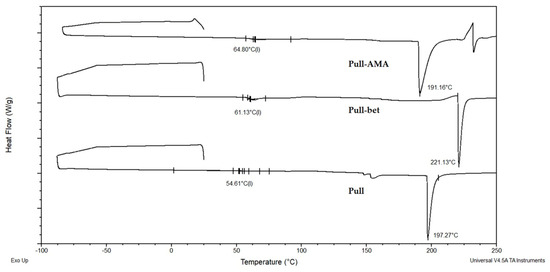
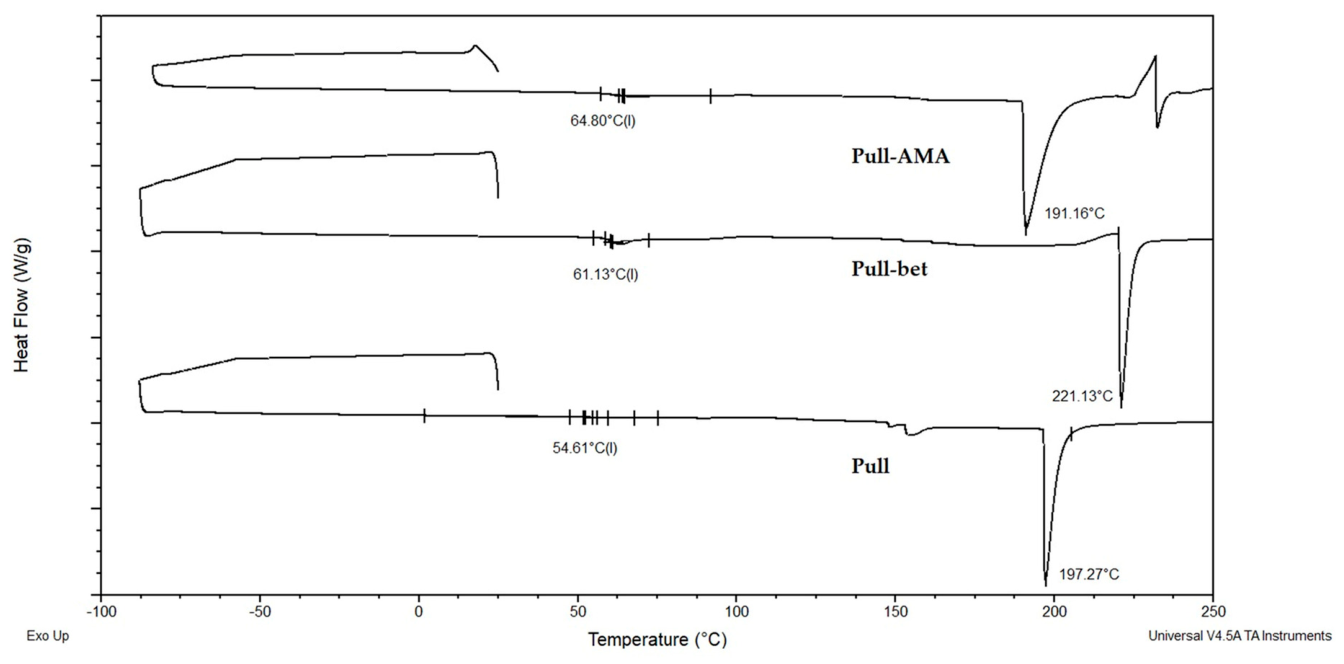
The DSC thermograms of Pullulan and its derivatives. Incorporation of betaine and maleate in the pullulan structure has increased the glass transition temperature (Tg) (Figure 1). For the neat pullulan, Tg has a value of 54 °C, while for Pull-bet and Pull-AMA, 61 and 64 °C, respectively. Functionalization of pullulan leads to the formation of hydrogen bonds due to the ionic groups attached to the pullulan backbone. While the esterification of polymers with long alkyl chains typically lowers Tg by increasing the free volume within the polymer matrix and enhancing segmental chain mobility [19], that plasticizing effect is absent here. In this case, the attached chains are both charged and structurally short, and the low degree of esterification is insufficient to disrupt the network, ultimately restricting chain movement and elevating the thermal stability. Degradation has a peak between 191 and 221 °C.
Figure 1.
DSC thermograms of Pull, Pull-bet, and Pull-MA.
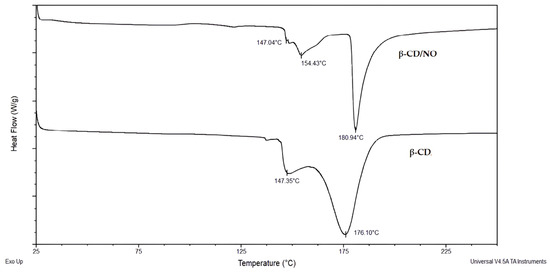
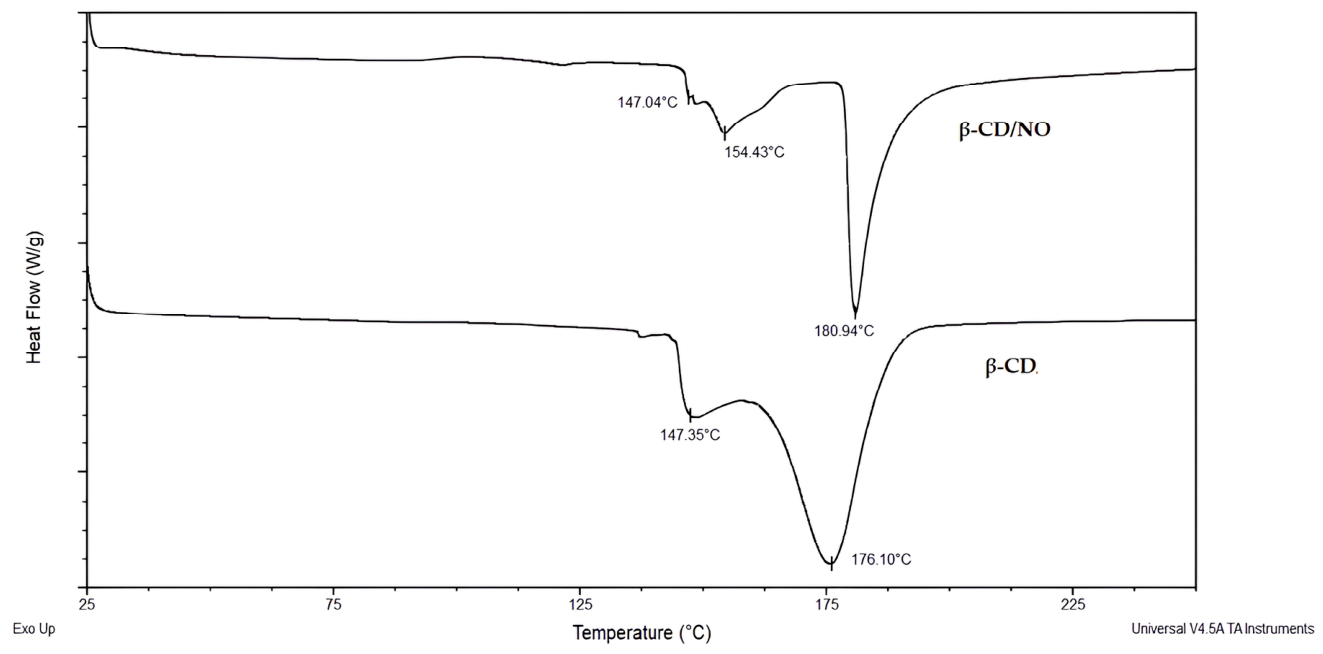
Figure 2 shows the thermograms of β-CD and the β-CD/NO inclusion complex. The DSC thermograms of neat β-CD and the β-CD/NO inclusion complex reveal critical insights into the host-guest interactions and thermal stability shifts. Neat β-CD exhibits two primary endothermic events. The first is a minor endothermic peak centered at 147.35 °C, which is attributed to a dehydration-driven phase transition. This initial thermal event corresponds to the evaporation of water molecules from the hydrophobic cavity of the cyclodextrin, subsequently inducing a localized rearrangement or collapse of its crystal lattice. Following this dehydration, a broad, prominent endothermic peak is observed at 176.10 °C, signifying either a crystalline phase transition or the liberation of strongly bound intramolecular water molecules [20]. Upon successful formation of the inclusion complex, distinct alterations in the thermal profile emerge. The thermogram of the β-CD/NO complex features a new, well-defined endothermic peak at 154.43 °C. This peak serves as a characteristic thermal signature of the encapsulated guest, representing the thermally induced transition or volatilization of the protected neem oil constituents. Furthermore, the major host matrix peak significantly shifts to a higher temperature (180.94 °C) and displays a narrower, sharper profile compared to the neat macrocycle [21]. This change in thermal stability strongly corroborates the successful inclusion complexation; the neem oil components effectively occupy the hydrophobic cavity of β-CD, displacing the residual water molecules, modifying the crystal lattice packing, and thermodynamically stabilizing the host framework.
Figure 2.
DSC thermograms of β-CD and β-CD/NO inclusion complex.
3.2. Results of FTIR Analysis
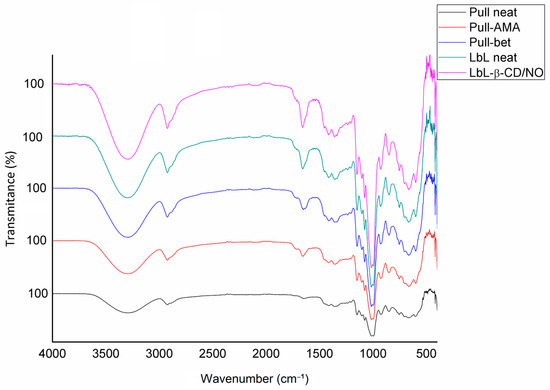
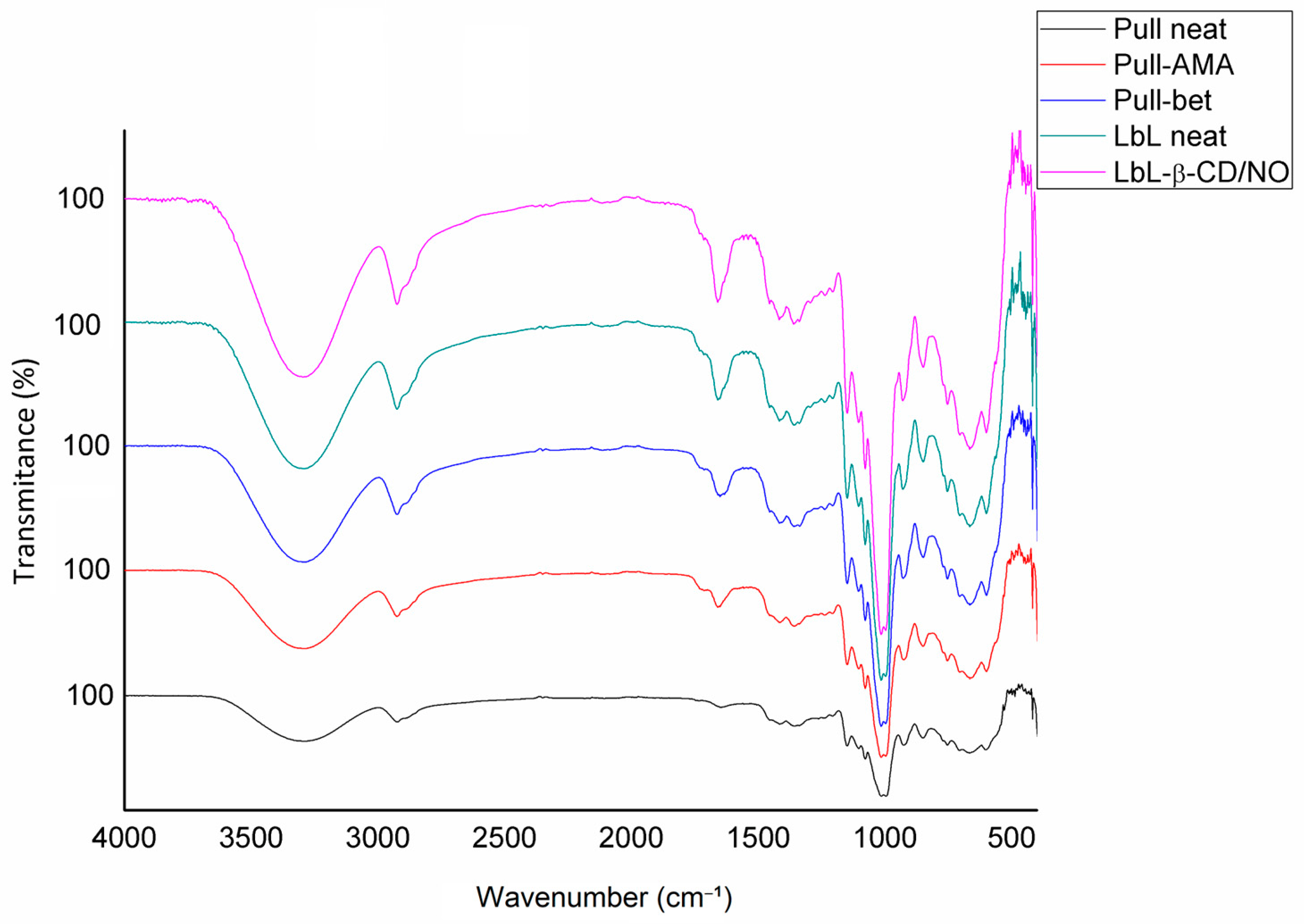
The FTIR spectra (Figure 3) revealed characteristic absorption bands corresponding to both the pullulan skeleton and the modifications. A broad absorption band peaking at 3287 cm−1 in neat pullulan and shifting to 3296 cm−1 in Pull-AMA and Pull-bet spectra is attributed to the stretching vibrations of the O–H groups present in pullulan and glycerol. Peaks observed between 2900 and 2800 cm−1 correspond to C–H stretching vibrations from both pullulan and glycerol. Crucially, the successful modification of pullulan by maleic anhydride and betaine is confirmed by the appearance of distinct peaks at 1719 cm−1 (Pull-AMA) and 1741 cm−1 (Pull-bet), respectively, which are assigned to the C=O stretching of the newly formed ester groups. An intense peak at 1660 cm−1 in the Pull-AMA and 1628 cm−1 in the Pull-bet spectra, attributed to O–C–O stretching, is significantly more pronounced than the barely visible peak at 1645 cm−1 in neat pullulan. Furthermore, peaks at 1416 and 1355 cm−1 in neat pullulan, 1414 and 1359 cm−1 in Pull-AMA, and 1406 and 1336 cm−1 in Pull-bet are assigned to CH2 and CH3 bending vibrations. The absorption band at 1154–1151 cm−1 is characteristic of the C–O–C stretching of the glycosidic bonds, while bands in the 1108–1015 cm−1 range, present in all spectra, are indicative of C–C–O stretching and C–O–H bending. The band at 926–931 cm−1 is attributed to the α-(1→4) glycosidic bond vibration, and small shifts indicate changes in the local environment due to esterification. The band at ~850 cm−1 in all spectra is assigned to α-glycosidic linkage vibration (C–H deformation). Bands at 770, 754, and 712 cm−1 present in all spectra are attributed to ring skeletal vibration, C–H deformation (ring), and C–C–O/ring bending, respectively. The same bands are present in the FTIR spectra of LbL and LbL with β-CD/NO, but the peaks of esterification are not pronounced. The FTIR spectra of β-cyclodextrin, β-cyclodextrin/neem oil (NO) inclusion complex, and neem oil are presented in the Supporting Material (Figure S1). The overall spectra of β-CD and the β-CD/NO complex are very similar, as expected, because the FTIR measurement primarily probes the surface of the β-CD molecules, and the encapsulated neem oil resides inside the β-CD cavity, where it does not significantly contribute to the spectrum. However, the spectrum of the β-CD/NO inclusion complex exhibits a distinct additional band at 942 cm−1, which can be attributed to subtle structural perturbations of the β-CD ring upon guest encapsulation. This band is absent in pure β-CD and provides indirect evidence of successful inclusion of neem oil, despite the lack of direct FTIR signals from the encapsulated guest molecules.
Figure 3.
FTIR spectra of prepared films.
3.3. Results of SEM Analysis
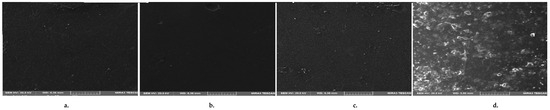
Figure 4 shows the surface morphology of monolayer Pull-AMA and Pull-bet films (Figure 4a,b), as well as of the LbL films (neat and with incorporated β-CD/NO inclusion complex, Figure 4c,d). The micrographs of the monolayer films reveal exceptionally smooth, continuous, and homogeneous surface structures completely free of defects such as microcracks or pores, signifying robust cohesive forces and molecular-level compatibility within the modified pullulan polymer matrix [21]. Upon the sequential electrostatic deposition of polyelectrolyte layers, the neat LbL film (Figure 4c) exhibits a distinct transition toward a subtly textured, micro-rough topography with fine surface fluctuations, providing direct visual evidence of successful LbL assembly and interfacial polymer chain rearrangement. In contrast, incorporating the β-CD/NO inclusion complex into the LbL assembly (Figure 4d) dramatically alters the surface architecture, yielding a highly textured, rough morphology.
Figure 4.
SEM images of: (a) Pull-bet film; (b) Pull-AMA film; (c) LbL neat film; (d) LbL-β-CD/NO film.
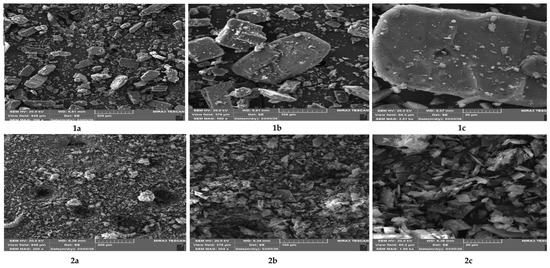
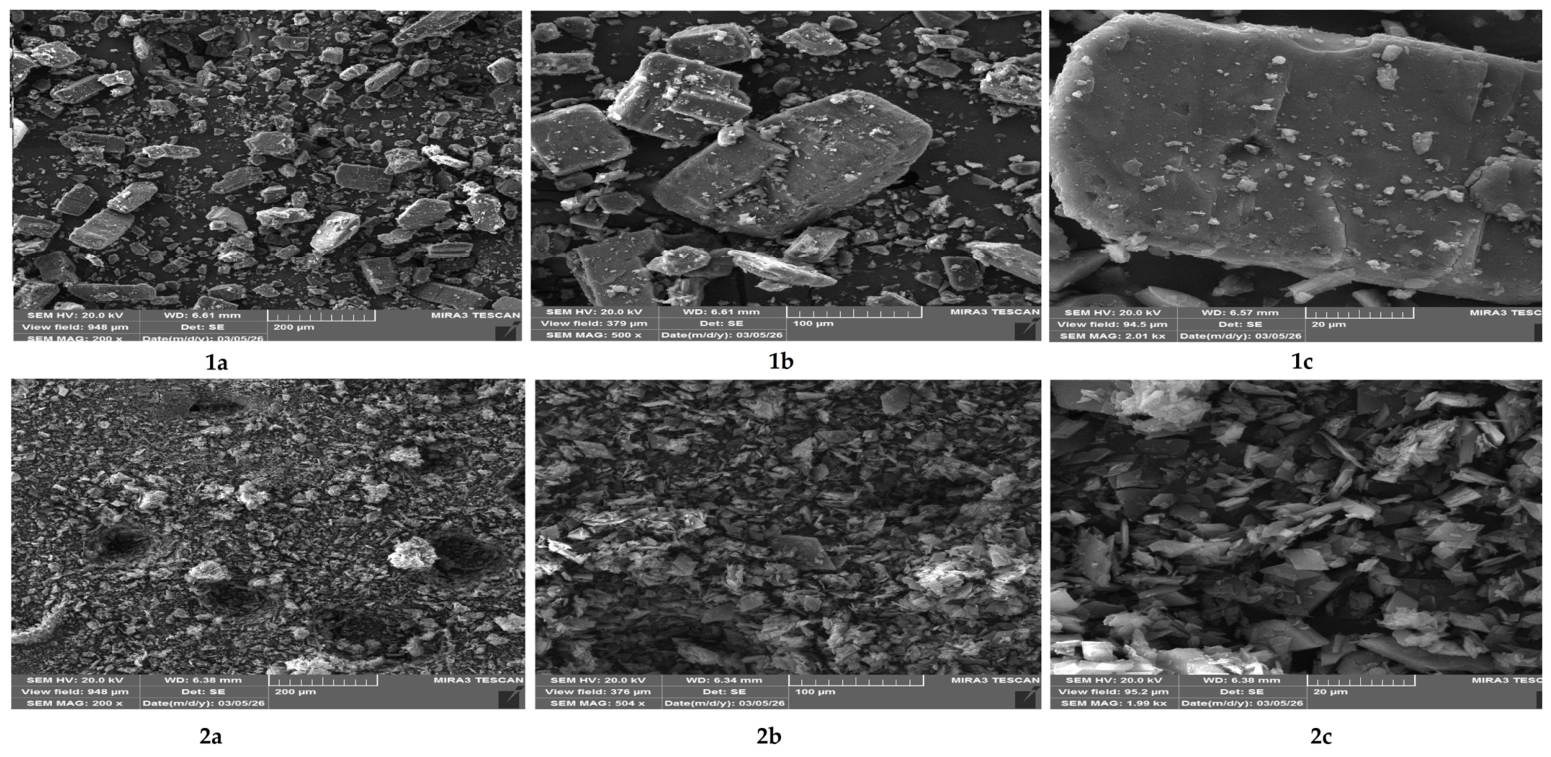
To further elucidate this behavior, the microstructural morphologies of neat β-CD and the β-CD/NO inclusion complex were evaluated at multiple magnifications (200×, 500×, and approximately 2000×) (Figure 5). Neat β-CD (Figure 5(1a–1c)) displays characteristic, well-defined crystalline structures consisting of block-like rectangular particles with sharp edges and relatively smooth surfaces. Conversely, the β-CD/NO inclusion complex (Figure 5(2a–2c)) reveals a complete disruption of this original crystalline habit. The large particles are replaced by much smaller, irregularly shaped, flaky micro-particles that aggregate into clustered networks. This dramatic morphological transformation is primarily attributed to the dehydration of the cyclodextrin cavity and a subsequent loss of intermolecular cohesive forces within the host crystal lattice, directly induced by the physical accommodation of the hydrophobic neem oil guest molecules within the cavity, consistent with the results of DSC analysis.
Figure 5.
SEM images of β-CD (1a–1c), and β-CD/NO inclusion complex (2a–2c).
3.4. Results of Moisture Content (MC), Total Soluble Matter (TSM), Swelling Test Analysis, and Water Vapour Transmission Rate (WVTR)
The moisture content (MC), total soluble matter (TSM), swelling degree (SD), and water vapour transmission rate (WVTR) values are given in Table 1. While all samples exhibited relatively similar MC values, the TSM values were higher for the monolayer films (Pull-bet and Pull-AMA). This difference is attributed to the electrostatic interactions within the oppositely charged multilayer (LbL) films, as well as the incorporation of the β-CD/NO inclusion complex, both of which restrict water solubility. Furthermore, the monolayer samples completely dissolved within the first 30 min (hence the lack of SD data), whereas the multilayer films exhibited controlled swelling, with SD values of 92.2% for LbL neat and 82.2% for LbL β-CD/NO. Neat pullulan, as well as Pull-bet and Pull-AMA, are very hydrophilic and present a low barrier to water vapour. Compared to the monolayer films, the neat layer-by-layer (LbL) assembly exhibits greater resistance to water vapour. This is attributed to the electrostatic interactions between the anionic groups of Pull-AMA and the cationic groups of Pull-bet, as well as to the thickness of the film (2–3 times greater than for the monolayer films). Furthermore, the incorporation of a smaller amount of the inclusion complex within the layers leads to a distinct improvement in the water vapor barrier properties. This enhancement is likely driven by the formation of secondary interactions between β-CD and the modified pullulan matrices, alongside the structural presence of neem oil encapsulated within the β-CD cavities. Remarkably, the obtained WVTR values are 22%–28% lower than those reported for chitosan/gelatin blends incorporated with β-CD/lemongrass oil inclusion complexes [11]. This demonstrates that the incorporation of β-CD at this specific concentration level does not deteriorate the barrier properties but rather significantly improves them.
Table 1.
Moisture content (MC), total soluble matter (TSM), swelling degree (SD), and water vapour transmission rate (WVTR) values with standard deviation values of prepared samples.
Statistical analysis using Tukey’s HSD test (described in Supplementary Section S3 Statistical Analysis) revealed significant differences (p < 0.05) for all evaluated parameters, including thickness, moisture content (MC), total soluble matter (TSM), swelling degree (SD), and water vapor barrier properties (WVTR).
3.5. Analysis of Mechanical Properties
The results of tensile strength (TS) and elongation at break (EB) are given in Table 2.
Table 2.
Tensile strength (TS) and elongation at break (EB) of prepared pullulan films and corresponding multilayer assemblies, with values reported as mean ± standard deviation (SD).
The mechanical performance of the developed packaging materials was evaluated in terms of tensile strength (TS) and elongation at break (EB), revealing a profound dependence on chemical modification, multilayer assembly, and active complex incorporation. In comparison to the monolayer film, the multilayer (LbL) films exhibit a remarkable mechanical transition, showcasing over a threefold increase in TS. This pronounced reinforcement is primarily driven by strong electrostatic (ionic) and hydrogen bonding interactions established at the interfaces between the alternating layers, specifically involving the positively charged trimethylammonium groups of the betaine-modified Pull and the negatively charged carboxylate groups of the Pull-AMA. The chemical modification of the pullulan backbone successfully increases the density of these functional moieties, dramatically expanding the population of secondary bonds within the self-assembled multilayer network. A substantially different mechanical behavior was observed following the incorporation of the β-CD/NO inclusion complex within the multilayer assembly, as the loaded film (LbL-β-CD/NO) exhibited the highest overall tensile strength (TS) of 1.30 ± 0.61 MPa alongside a significant reduction in elongation at break (EB) to 10.84%, contrasting sharply with the highly extensible monolayer films and the ductile neat LbL matrix. This transition from a flexible network to a highly rigid, coherent supramolecular structure is driven by several synergistic reinforcing mechanisms. First, the high density of primary and secondary hydroxyl groups exposed on the hydrophilic outer surface of the β-CD cavity facilitates extensive intermolecular hydrogen bonding with the host pullulan hydroxyls and the functional groups introduced via maleate and betaine modifications, maximizing interfacial adhesion and restricting cooperative polymer chain mobility. Second, while free oils typically exert a plasticizing effect by increasing free volume, encapsulating neem oil within the β-CD cavity sequesters the hydrophobic active components from the continuous phase, preventing matrix softening and allowing the complex to behave as a rigid, non-plasticizing filler. Finally, these immobilized host–guest complexes act as nanostructured steric hindrance centers and physical crosslinking nodes that restrict chain relaxation and prevent deformation under load. These findings align with established cyclodextrin-hydrocolloid literature where the integration of β-CD promotes dense hydrogen-bonding networks [22,23] and restricts segmental relaxation [23], demonstrating that the combined strategy of targeted chemical modification, electrostatic LbL self-assembly, and cyclodextrin-mediated encapsulation offers a highly controllable platform for tailoring active packaging materials from highly extensible networks to mechanically robust barrier structures. However, the mechanical baseline of the LbL system remains distinct. Specifically, the tensile strength (TS) of the investigated LbL-β-CD/NO film is 12.8-fold lower than that of chitosan/gelatin composite films incorporating a β-CD/lemongrass oil inclusion complex [11], and 22-fold lower than that of gelatin-based edible films loaded with a trans-anethole β-CD complex [21]. Although incorporating β-CD in conventional biopolymer matrices generally yields a slight increase in TS up to an optimal threshold [11,22,23,24,25], introducing the β-CD inclusion complex into LbL architectures markedly improves mechanical strength relative to neat LbL films, and even more significantly when compared to monolayer pullulan-based films.
Statistical analysis using Tukey’s HSD test (described in Supplementary Section S4) revealed significant differences (p < 0.05) for TS and EB.
3.6. Analysis of Self-Healing Ability
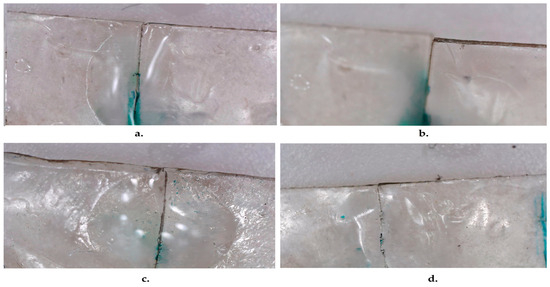
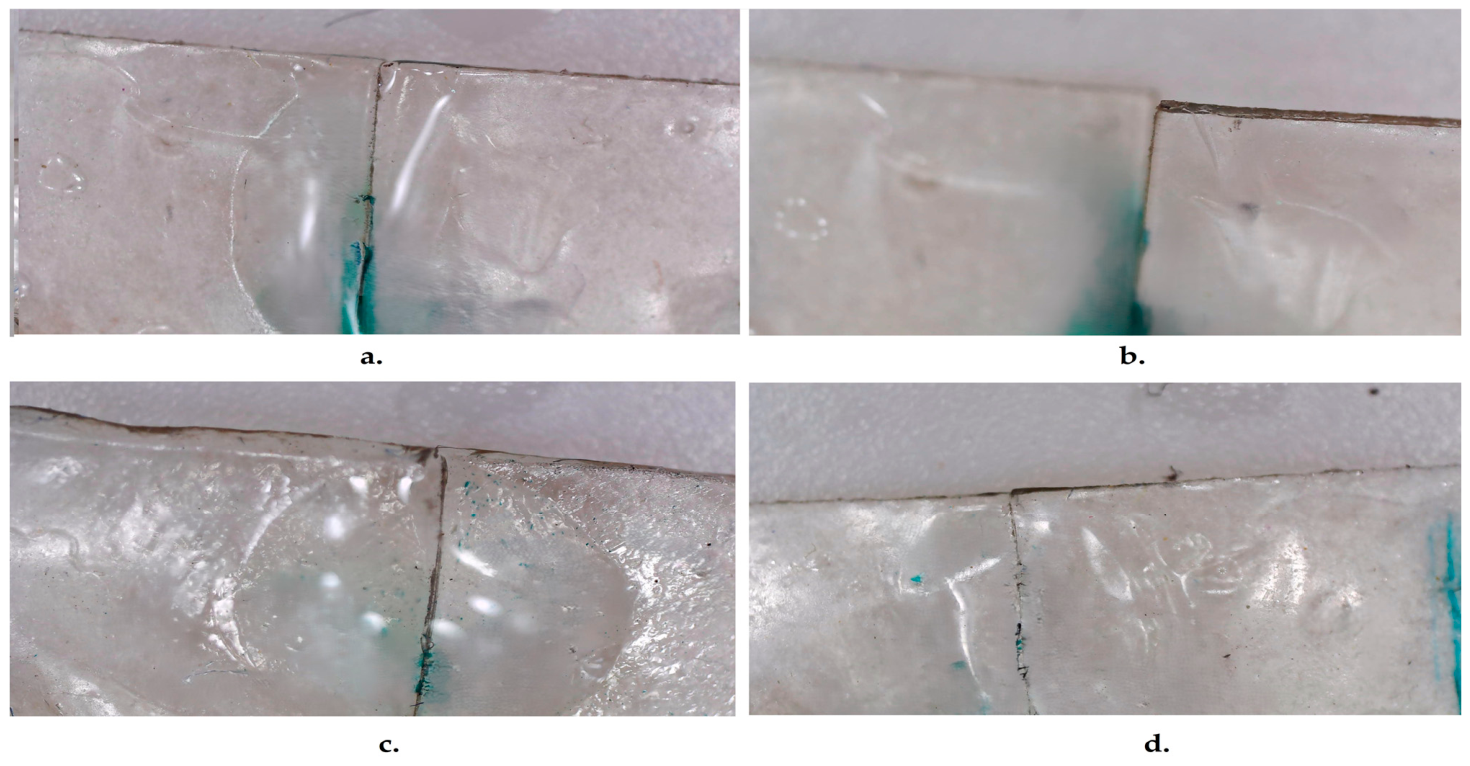
The water-triggered self-healing capability of the developed LbL-β-CD/NO film was visually monitored and is illustrated in Figure 6a–d. Initial mechanical damage was introduced by cleanly cutting the film using scissors, resulting in a distinct, physical separation of the film into two detached segments with sharp, well-defined boundaries (Figure 6a,b). Upon the application of a single droplet of distilled water directly over the damaged interface (Figure 6c), localized swelling and hydration of the highly hydrophilic polysaccharide-based matrix were immediately observed. The introduced water molecules act as an efficient plasticizer, temporarily disrupting the localized electrostatic pairs and hydrogen bonds while significantly increasing the segmental mobility of the modified pullulan chains. This high chain mobility enables the polyelectrolyte chains (bearing cationic trimethylammonium and anionic carboxylate groups) to diffuse across the cut boundary, initiating interdiffusion and physical entanglement at the interface. Following a subsequent drying period of 20 min at ambient conditions (Figure 6d), the evaporation of water drives the thermodynamic reorganization and reformation of the dynamic ionic crosslinks and hydrogen-bonding networks across the former gap. The physical fissure completely disappears, leaving only a faint, superficial scar line and restoring the structural continuity of the film [4]. This rapid, water-activated structural recovery indicates the extremely dynamic nature of the LbL assembly, positioning these films as highly promising candidates for applications in smart, self-healing active packaging. Since it is an intrinsic, water-activated healing mechanism, it can significantly extend the preservation of the quality of the packaged product; adding a small amount of water after the occurrence of mechanical damage leads to a rapid reconstruction of the film, which effectively prevents the penetration of pathogens and external contaminants to the product itself.
Figure 6.
Self-healing process of LbL film: mechanical damage (a,b), addition of a drop of water (c), drying of the film (d).
To confirm that the observed optical recovery represents true self-healing rather than mere water-induced film restructuring, comparative control experiments were performed using monolayer films of comparable thickness (composed of Pull-bet and Pull-AMA). While adding a water droplet to these single-layer films resulted in immediate dissolution due to the lack of stabilized interchain complexation—leading to a severe reduction in film thickness (70.4% for Pull-bet and 69.8% for Pull-AMA for 20 min) and a catastrophic drop of 95.6% in tensile strength (TS) and 92.3% in elongation at break (EB)—applying water to the multilayer LbL system successfully triggered structural recovery. Rather than dissolving the material, water acts as a temporary plasticizer that enhances local chain mobility within the dense matrix. As visually demonstrated in the time-lapse optical images, this controlled plasticization allows the robust network of ionic and hydrogen bonds to drive the targeted fusion, reconnection, and closure of the damaged regions, highlighting the unique structural stability and healing efficacy afforded by the multilayer architecture. This robust recovery was further confirmed by analyzing the mechanical properties of the healed films. Following the procedure described in Section 2.11, measurements across five samples subjected to a single damage-and-healing cycle revealed retention of 93.2% of their original tensile strength and 96.3% of their initial elongation at break.
3.7. Results of Microbiological Testing
The agar diffusion test revealed clear differences in how the tested samples affected the growth of Candida albicans. Among the samples (Table 3), the most effective was Pull-AMA-β-CD/NO, which produced a strong inhibition zone of 16.5 ± 1.1 mm. Pull-bet β-CD/NO also performed well (14.8 ± 0.9 mm), though slightly less so. These results suggest that incorporating neem oil into a cyclodextrin complex and embedding it within functionalized pullulan films significantly enhances anti-yeast activity. The Pull-AMA variant may offer better performance due to its modified chemical structure, which likely improves how the active components are dispersed and released at the target site. Neem oil on its own showed moderate anti-yeast activity, forming a 13.2 ± 1.0 mm inhibition zone. This is consistent with earlier studies that highlight its strong natural anti-yeast properties [26]. On the other hand, β-cyclodextrin by itself had only a mild effect (4.5 ± 0.4 mm), reinforcing the idea that while cyclodextrins do not act directly against yeast, they play an important supporting role by stabilizing and delivering hydrophobic compounds like essential oils. The formulations without neem oil showed limited inhibition, with zones of 3.5 ± 0.3 mm and 5.1 ± 0.5 mm, respectively. These results indicate that the base biopolymers alone, even when chemically functionalized, do not provide meaningful anti-yeast action. The results support the concept that a combination of β-cyclodextrin/neem oil inclusion complex within a pullulan-based matrix provides a synergistic anti-yeast effect. This combination appears to create a stable, slow-release barrier that not only physically protects but also biochemically suppresses yeast growth. The results are in line with earlier research on neem oil’s bioactivity [26], the inclusion capacity of cyclodextrins [27], and the film-forming and carrier capabilities of pullulan.
Table 3.
In vitro testing of individual compounds and coating formulation against C. albicans.
In the in vivo fig model, the active coating significantly reduced yeast growth. To simulate real-world conditions for perishable produce, Candida albicans growth was monitored on pre-contaminated fresh figs stored at both ambient (23 °C) and refrigerated (4 °C) conditions over 7 days (Table 4). The goal was to assess the anti-yeast performance of multilayer bioactive coatings compared to control coatings and uncoated fruit.
Table 4.
In vivo fig model for anti-yeast effect evaluation.
Under ambient temperature, targeted yeast proliferation was notably suppressed on figs treated with the active coating. Starting from a contamination baseline of <1 log CFU/g, the yeast load on actively coated figs peaked modestly at 2.9 ± 0.1 log CFU/g on day 5, before decreasing slightly to 2.1 ± 0.2 by day 7. This trend suggests that the active components delayed yeast growth and may have contributed to a mild reduction in viable cells toward the end of the storage period. In contrast, control-coated figs, which lacked neem oil in the first layer, showed a sharp and steady increase in yeast load, reaching 5.1 ± 0.2 log CFU/g by day 7. The uncoated figs exhibited the fastest and highest growth, with C. albicans counts escalating to 7.1 ± 0.2 log CFU/g. The difference between active and control coatings became particularly evident after day 1, with a nearly 3-log reduction observed in favor of the active treatment by day 7.
At 4 °C, yeast growth was significantly slower across all samples, as expected. However, the actively coated figs once again performed best, showing minimal increase over time, from 2.3 ± 0.1 to 2.7 ± 0.2 log CFU/g over 7 days. This confirms that the bioactive coating maintains its antiyeast functionality even under cold storage. The control-coated figs reached 4.5 ± 0.3 log CFU/g by day 7, while uncoated figs exhibited a more pronounced increase to 6.2 ± 0.3, mirroring the general trend seen under ambient conditions. These results highlight the importance of neem oil’s presence, which appears to act both as a contact antiyeast agent and as a reservoir of sustained activity over time, particularly when encapsulated in β-cyclodextrin complexes.
Across both storage conditions, the active multilayer coating consistently outperformed both the control and the uncoated group. The incorporation of neem oil, known for its broad-spectrum antiyeast properties [26], and β-cyclodextrin, which enhances the solubility and controlled release of hydrophobic compounds [27], appears to create a synergistic system. This system not only slows yeast colonization but may also reduce metabolic viability over time. The control coating, although offering some physical barrier effects, was clearly insufficient without the active botanical component. The uncoated figs served as an effective reference for natural spoilage progression, showing consistent exponential growth of the yeast across all time points and temperatures.
Crucially, while raw neem oil has a distinct odor (though far milder than essential oils), encapsulation within β-cyclodextrin masks it, keeping the coating sensorially neutral and preserving the fruit’s organoleptic quality. By contrast, the active-free control coating provided only a modest barrier that failed to prevent decay, whereas uncoated figs suffered uninterrupted exponential yeast growth, serving as the baseline for natural spoilage. To transition these findings to industry, this composite formulation can be seamlessly integrated into automated spraying or dipping systems to guarantee uniform coverage and boost commercial viability. Moreover, because all formulation components are food-contact safe and inherently water-soluble, the primary design intent is for the coating to protect the produce throughout storage and transport and then be completely washed off before consumption. Water-uptake and swelling degree measurements confirm that this removal process occurs readily upon rinsing; furthermore, tuning (decreasing) the initial layer thickness can be utilized to further accelerate the dissolution and speed up the washing step for end-consumers.
4. Conclusions
In this work, a multifunctional and self-healing active sustainable coating based on a pullulan matrix was successfully developed, offering an effective solution for protecting perishable fruits from fungal spoilage. The system was constructed using a layer-by-layer (LbL) technique from synthesized anionic pullulan-maleate and a sustainable, enzymatically obtained cationic pullulan-betaine, with the successful incorporation of β-cyclodextrin/neem oil inclusion complex. DSC and FTIR analyses have confirmed the success of pullulan modification, as well as the formation of an inclusion complex, while SEM analysis revealed a transition from a smooth monolayer surface to a textured and micro-rough topography of the multilayer films. In addition, the integration of the β-CD/NO complex into the LbL structure led to the formation of a dense hydrogen and electrostatic network, which resulted in remarkable mechanical superiority in the form of a threefold increase in tensile strength to a maximum of 1.30 ± 0.61 MPa with a concomitant decrease in elongation to 10.84%. At the same time, significantly improved barrier properties were observed, where the multilayer coatings with the active complex reduced water vapor permeability (WVTR) by 22%–28% compared to related biomatrices, while ensuring controlled film swelling. A particularly important functional aspect is autonomous self-healing, with the films showing rapid, water-activated regeneration under ambient conditions, where dynamic electrostatic and hydrogen bonds enabled complete closure of physical cracks. Finally, a strong antifungal effect was achieved; in vitro tests against the destructive yeast Candida albicans confirmed an excellent synergistic effect of the active formulations with a zone of inhibition of up to 16.5 ± 1.1 mm, while in an in vivo model of fresh figs, the active coating significantly slowed down yeast proliferation during 7 days of storage in the refrigerator and at room temperature, where a concentration of only 2.1 log CFU/g was achieved in comparison to 7.1 log CFU/g for untreated fruit.
Despite these promising findings, several limitations of the current study warrant consideration. First, in vivo efficacy was evaluated exclusively using fresh figs (Ficus carica) as a model perishable host. Second, the manual, laboratory-scale LbL deposition process requires further technical adaptation for continuous, high-throughput industrial lines. To address these challenges, future research will focus on optimizing the encapsulation parameters to maximize neem oil loading capacity without compromising matrix stability. Furthermore, work will center on scaling up application techniques—specifically automated spraying, which offers superior, uniform coverage regardless of substrate geometry or coating viscosity—and extending validation to other highly perishable soft fruits, particularly berries.
Supplementary Materials
The following supporting information can be downloaded at: https://www.mdpi.com/article/10.3390/coatings16091063/s1, Section S1. Determining the Degree of Esterification (EV) by Potentiometric Titration; Section S2. Determination of Encapsulation Efficiency of Neem Oil in β-CD; Section S3. Statistical Analysis; Section S4. FTIR Analysis of Neem Oil, β/CD, and β/CD/NO Inclusion Complex; Figure S1. FTIR spectra of β-CD and β-CD/NO inclusion complex, and neat NO. Reference [15] are cited in the supplementary materials.
Author Contributions
Conceptualization, T.E.; methodology, T.E., S.R., A.J., O.Š., S.L., S.P. and A.M.; software, T.E., S.R. and S.L.; validation, T.E., S.R. and A.M.; formal analysis, T.E., S.R., O.Š., S.L., A.J. and S.P.; investigation, T.E., S.R. and A.M.; resources, T.E., S.R., O.Š., A.J. and A.M.; data curation, T.E.; writing—original draft preparation, T.E., S.R., A.J. and O.Š.; writing—review and editing, T.E.; visualization, T.E.; supervision, T.E.; project administration, T.E.; funding acquisition, T.E. All authors have read and agreed to the published version of the manuscript.
Funding
This research study was funded by the Provincial Secretariat for Higher Education and Scientific Research of Autonomous Province Vojvodina (Serbia) within the project “New generation nanoemulsion bioinsecticides: synergy of plant oils and extracts for environmentally friendly control of stink bugs—ECObiopest” (grant No. 003871936 2025 09418 003 000 000 001 04 003) and by the Ministry of Education, Science, and Technological Development of the Republic of Serbia (grant No. 451-03-33/2026-03/200134, 451-03-33/2026-03/200019, 451-03-34/2026-03/200135).
Institutional Review Board Statement
Not applicable.
Informed Consent Statement
Not applicable.
Data Availability Statement
The raw data supporting the conclusions of this article will be made available by the authors on request.
Acknowledgments
During the preparation of this manuscript, the authors used Gemini (https://gemini.google.com) and BioRender (https://www.biorender.com). The authors have reviewed and edited the output and take full responsibility for the content of this publication.
Conflicts of Interest
The authors declare no conflicts of interest.
Abbreviations
The following abbreviations are used in this manuscript:
| CS | Chitosan |
| SA | Sodium alginate |
| CMC | Carboxymethyl cellulose |
| NO | Neem oil |
| LbL | Layer-by-layer |
| DSC | Differential Scanning Calorimetry |
| FTIR | Fourier Transform Infrared spectroscopy |
| DSMO | Dimethyl sulfoxide |
| MC | Moisture content |
| TSM | Total soluble matter |
| SD | Swelling degree |
References
- Mafe, A.N.; Edo, G.I.; Makia, R.S.; Joshua, O.A.; Akpoghelie, P.O.; Gaaz, T.S.; Jikah, A.N.; Yousif, E.; Isoje, E.F.; Igbuku, U.A.; et al. A review on food spoilage mechanisms, food borne diseases and commercial aspects of food preservation and processing. Food Chem. Adv. 2024, 5, 100852. [Google Scholar] [CrossRef] [Scilit]
- Tasnim, M.; Islam, N. Active edible coatings for smart food preservation and sustainability: A review. Carbohydr. Polym. Technol. Appl. 2025, 13, 101061. [Google Scholar] [CrossRef] [Scilit]
- Treviño-Garza, M.Z.; García, S.; Heredia, N.; Alanís-Guzmán, M.G.; Arévalo-Niño, K. Layer-by-layer edible coatings based on mucilages, pullulan and chitosan and its effect on quality and preservation of fresh-cut pineapple (Ananas comosus). Postharvest Biol. Technol. 2017, 128, 63–75. [Google Scholar] [CrossRef] [Scilit]
- Du, Y.; Yang, F.; Yu, H.; Cheng, Y.; Guo, Y.; Yao, W.; Xie, Y. Fabrication of novel self-healing edible coating for fruits preservation and its performance maintenance mechanism. Food Chem. 2021, 351, 129284. [Google Scholar] [CrossRef] [Scilit] [PubMed]
- Deng, P.; Zhang, Y.; Deng, Q.; Sun, Y.; Li, Y.; Wang, Z.; Jiang, F. Multifunctional sodium alginate-based self-healing edible cross-linked coating for banana preservation. Food Hydrocoll. 2024, 151, 109753. [Google Scholar] [CrossRef] [Scilit]
- Sultan, M.; Hafez, O.M.; Saleh, M.A. Quality assessment of lemon (Citrus aurantifolia, swingle) coated with self-healed multilayer films based on chitosan/carboxymethyl cellulose under cold storage conditions. Int. J. Biol. Macromol. 2022, 200, 12–24. [Google Scholar] [CrossRef] [Scilit] [PubMed]
- Sultan, M.; Hafez, O.M.; Saleh, M.A.; Youssef, A.M. Smart edible coating films based on chitosan and beeswax–pollen grains for the postharvest preservation of Le Conte pear. RSC Adv. 2021, 11, 9572–9585. [Google Scholar] [CrossRef] [Scilit] [PubMed]
- Yang, Y.; Ren, J.; Luo, C.; Yuan, R.; Ge, L. Fabrication of l-menthol contained edible self-healing coating based on guest-host interaction. Colloids Surf. A Physicochem. Eng. Asp. 2020, 597. [Google Scholar] [CrossRef] [Scilit]
- Moeini, A.; Pedram, P.; Goudoulas, T.; Mehlhorn-Diehl, T.; Gestmann, F.; Fattahi, E.; Becker, T.; Germann, N. Encapsulation of Neem oil from Azadirachta indica into Poly(lactic-co-glycolic acid) as a novel sprayable miticide system with long-term storage stability and controlled release kinetic. Ind. Crop. Prod. 2023, 201. [Google Scholar] [CrossRef] [Scilit]
- Pham, M.P.T.; Tran, L.Q.; Le, C.Y.V.; Tran, V.T.; Do, N.H.N.; Le, P.K. Ultrasound-assisted ionic gelation of neem oil-encapsulated chitosan nanoparticles as a promising biopesticide. Chem. Pap. 2023, 78, 1825–1832. [Google Scholar] [CrossRef] [Scilit]
- Erceg, T.; Šovljanski, O.; Stupar, A.; Ugarković, J.; Aćimović, M.; Pezo, L.; Tomić, A.; Todosijević, M. A comprehensive approach to chitosan-gelatine edible coating with β-cyclodextrin/lemongrass essential oil inclusion complex—Characterization and food application. Int. J. Biol. Macromol. 2022, 228, 400–410. [Google Scholar] [CrossRef] [Scilit] [PubMed]
- ASTM D3644-15R22; Standard Test Method for Acid Number of Styrene–Maleic Anhydride Resins. ASTM International: West Conshohocken, PA, USA, 2022.
- ISO 3657:2023; Animal and Vegetable Fats and Oils—Determination of Saponification Value, 6th ed. International Organization for Standardization: Geneva, Switzerland, 2023.
- Jurko, L.; Makuc, D.; Štern, A.; Plavec, J.; Žegura, B.; Bošković, P.; Kargl, R. Cytotoxicity and Antibacterial Efficacy of Betaine- and Choline-Substituted Polymers. ACS Appl. Polym. Mater. 2023, 5, 5270–5279. [Google Scholar] [CrossRef] [Scilit] [PubMed]
- Bae, E.K.; Lee, S.J. Microencapsulation of avocado oil by spray drying using whey protein and maltodextrin. J. Microencapsul. 2008, 25, 549–560. [Google Scholar] [CrossRef] [Scilit] [PubMed]
- Purwadi, P.; Manab, A.; Apriliyanti, M.W.; Ikhwan, A.D. Purwadi Characteristics of Moisture Content, Swelling, Opacity and Transparency with Addition Chitosan as Edible Films/Coating Base on Casein. Adv. J. Food Sci. Technol. 2020, 18, 9–14. [Google Scholar] [CrossRef] [Scilit]
- ISO 2528:1995; Sheet Materials—Determination of Water Vapour Transmission Rate—Gravimetric (Dish) Method. International Organization for Standardization: Geneva, Switzerland, 1995.
- ASTM D882-18; Standard Test Method for Tensile Properties of Thin Plastic Sheeting. ASTM International: West Conshohocken, PA, USA, 2018.
- Karkad, A.A.; Marinković, A.; Jovanović, A.; Simić, K.; Ivanović, S.; Milošević, M.; Erceg, T. Design and Optimization of Pullulan-Isononanoate Films with Bioactive-Loaded Liposomes for Potential Biomedical Use. Polymers 2026, 18, 305. [Google Scholar] [CrossRef] [Scilit] [PubMed]
- Silva, I.; Feitosa, E.; Santos, M.; Silva, R.; Rocha, M.; da Silva, F.; Lima, F.; Costa, A.M.; Alves, P.; de Sousa, S.; et al. Theoretical and Experimental Investigations on Inclusion Complex β-Cyclodextrin and Sulcatone: A Cardiovascular Activity Evaluation. J. Braz. Chem. Soc. 2020, 31, 1064–1077. [Google Scholar] [CrossRef] [Scilit]
- Erceg, T.; Aćimović, M.; Šovljanski, O.; Lončar, B.; Tomić, A.; Pavlović, M.; Vukić, V.; Hadnađev, M. Preparation and characterization of carboxymethylated pullulan/butyric acid-modified chitosan active sustainable bi-layer coatings intended for packaging of cheese slices. Int. J. Biol. Macromol. 2024, 277, 134053. [Google Scholar] [CrossRef] [Scilit] [PubMed]
- Ye, Y.; Zhu, M.; Miao, K.; Li, X.; Li, D.; Mu, C. Development of Antimicrobial Gelatin-Based Edible Films by Incorporation of Trans-Anethole/β-Cyclodextrin Inclusion Complex. Food Bioprocess Technol. 2017, 10, 1844–1853. [Google Scholar] [CrossRef] [Scilit]
- Sha, H.; Yuan, C.; Cui, B.; Zhao, M.; Wang, J. Pre-gelatinized cassava starch orally disintegrating films: Influence of β-Cyclodextrin. Food Hydrocoll. 2022, 123. [Google Scholar] [CrossRef] [Scilit]
- Adrover, A.; di Muzio, L.; Trilli, J.; Brandelli, C.; Paolicelli, P.; Petralito, S.; Casadei, M.A. Enhanced Loading Efficiency and Mucoadhesion Properties of Gellan Gum Thin Films by Complexation with Hydroxypropyl-β-Cyclodextrin. Pharmaceutics 2020, 12, 819. [Google Scholar] [CrossRef] [Scilit] [PubMed]
- Li, H.; Yang, M.; Liu, G.; Gao, Z. Composite Sustained-Release Antibacterial Films Formed by Hydrogen-Bonding Cross-Linking of Sulfobutylether-β-cyclodextrin@curcumin Inclusion Complexes with Gelatin for Grape Preservation. J. Agric. Food Chem. 2025, 73, 14592–14607. [Google Scholar] [CrossRef] [Scilit] [PubMed]
- Gburi, A.A.; Al-Shahwany, A.; Hadi, S. Evaluation of the biological efficacy of neem oil against some pathogens. Bioact. Compd. Health Dis. 2026, 9, 65–72. [Google Scholar] [CrossRef] [Scilit]
- Loftsson, T.; Duchene, D. Cyclodextrins and their pharmaceutical applications. Int. J. Pharm. 2007, 329, 1–11. [Google Scholar] [CrossRef] [Scilit] [PubMed]


Disclaimer/Publisher’s Note: The statements, opinions and data contained in all publications are solely those of the individual author(s) and contributor(s) and not of MDPI and/or the editor(s). MDPI and/or the editor(s) disclaim responsibility for any injury to people or property resulting from any ideas, methods, instructions or products referred to in the content. |
© 2026 by the authors. Licensee MDPI, Basel, Switzerland. This article is an open access article distributed under the terms and conditions of the Creative Commons Attribution (CC BY) license.