Application and Development of Polyurethane-Modified Asphalt for Pavement Engineering: A Review
 ,
,
Abstract
1. Introduction
2. Modification Mechanism and Synthesis Principles of Polyurethane-Modified Asphalt
2.1. Modification Mechanism of Polyurethane-Modified Asphalt
2.2. Synthesis Principles of Polyurethane-Modified Asphalt
3. Polyurethane-Modified Asphalt Applications
3.1. Polyurethane-Modified Emulsified Asphalt
3.2. Polyurethane Composite-Modified Asphalt
3.2.1. Polyurethane and Epoxy Resin Composite-Modified Bitumen
3.2.2. Polyurethane and SBS Composite-Modified Asphalt
3.2.3. Polyurethane and Reactive Elastomeric Terpolymer (RET) Composite-Modified Asphalt
3.3. Polyurethane-Modified Asphalt Mixtures
3.3.1. Permeable Pavements
3.3.2. Bridge and Tunnel Paving
3.3.3. Maintenance of Cracks and Potholes
4. Economic Applicability Analysis
5. Discussion and Prospects
- (1)
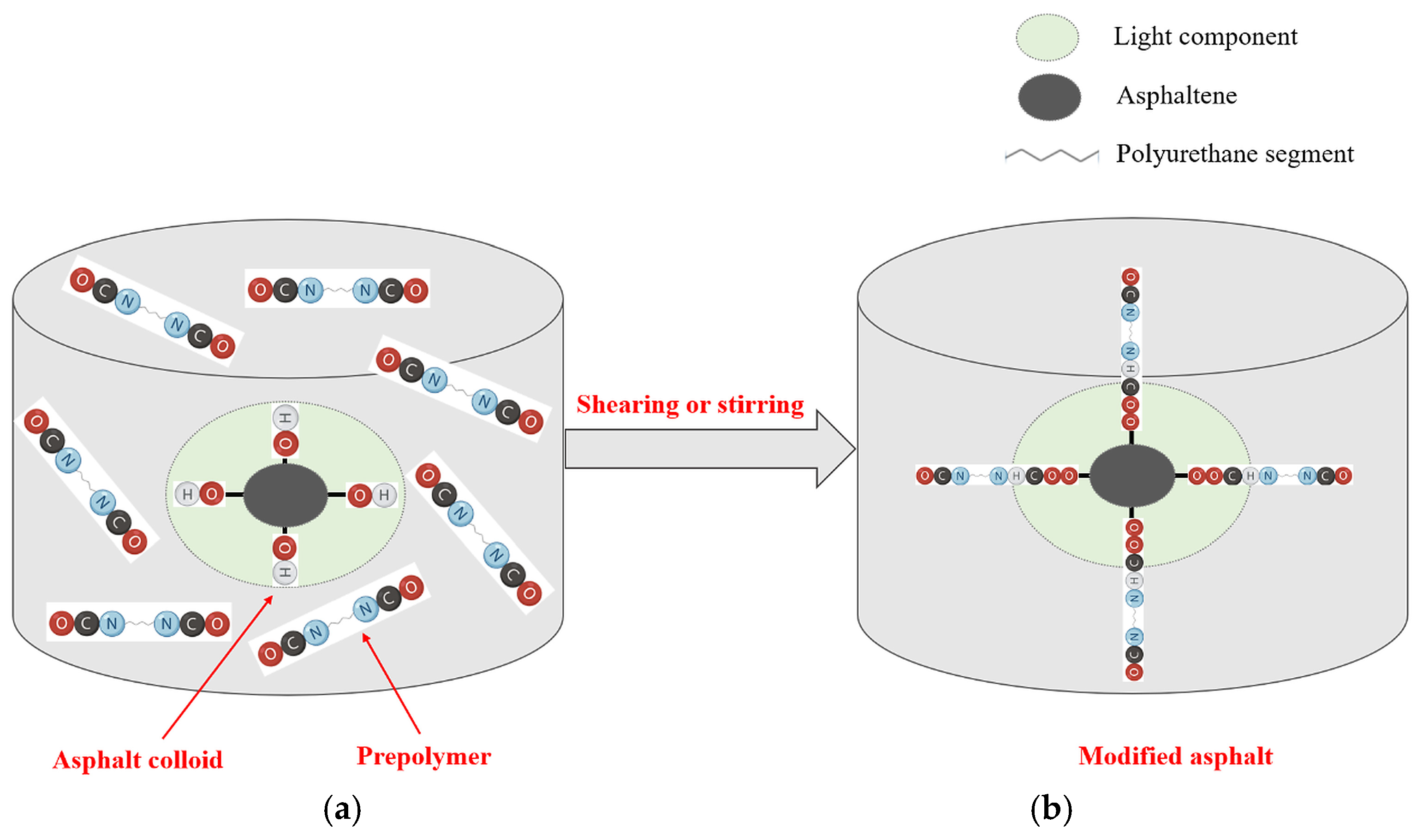
- As discussed in Section 2.1, current experiments and molecular simulations support the simultaneous occurrence of covalent reactions, hydrogen bonding, adsorption, and physical entanglement in PU–asphalt systems, but their relative contributions remain insufficiently quantified [26,28]. The central research need is therefore not simply to identify additional interactions, but to determine how changes in isocyanate/polyol chemistry, NCO/OH ratio, asphalt polarity, curing history, and interface structure redistribute these interactions and, in turn, alter adhesion, phase stability, rheology, and mixture performance. Comparable multiscale protocols are required before molecular descriptors can be used as transferable material design parameters.
- (2)
- Thermosetting and thermoplastic PU systems require different workability and performance criteria. For thermosetting PU-modified asphalt, viscosity develops continuously during reaction; useful field-oriented indices therefore include rotational viscosity at the intended construction temperature as a function of time, viscosity-growth rate, and a construction tolerance (workable/pot) time defined by a validated mixing or compaction limit. NCO conversion from Fourier transform infrared spectroscopy can be used as a complementary curing-state indicator. Luo et al. [34] reported workable times of approximately 72 min and 46 min at 130 °C for high-content systems containing 30% and 50% isocyanate prepolymer, respectively. Thermoplastic PU, by contrast, does not rely on irreversible network curing and is more reprocessable; however, its performance is governed by melt dispersion, hard/soft-segment structure, compatibility, and hot-storage stability. A direct comparison of thermosetting- and thermoplastic-PU asphalt mixtures showed that both could outperform SBS-modified mixtures in several strength, high-temperature, and fatigue indicators, while the thermoplastic system showed favorable low-temperature cracking resistance; however, water stability remained insufficient for the investigated PU mixtures [30]. These differences confirm that a single PU workability or acceptance criterion is not scientifically justified.
- (3)
- Existing standards can provide measurement frameworks, but they do not constitute PU-specific acceptance criteria. ASTM D4402/D4402M-23 [72] describes rotational-viscometer measurement of asphalt viscosity at elevated temperature; EN 13302:2018 [73] specifies rotating-spindle dynamic-viscosity testing for bituminous binders; and the Chinese JTG 3410-2025 (T 0625-2011) [74] method provides Brookfield rotational-viscosity testing. Conventional polymer-modified-asphalt specifications, including JTG F40-2004 [75], can provide reference values for constructability, but their fixed viscosity limits were not developed for reactive PU systems. For thermosetting PU, any acceptance window must also account for elapsed reaction time, curing degree, moisture sensitivity, shear history, and mixture compactability. These documents are identified by their standard designations as normative technical frameworks and are not counted within the 71-journal-article evidence set used for the literature synthesis.
- (4)
- Environmental impacts and comprehensive life-cycle economic analyses remain insufficiently characterized. The use of bio-based raw materials, waste polyurethane, and RAP can improve resource efficiency, but recyclability, emissions, durability, and cost should be evaluated within the same system boundary [61,65,67].
- (1)
- (2)
- Establish PU-specific workability and construction specifications that combine standardized rotational-viscosity measurement with time-to-threshold, pot life, curing degree, moisture sensitivity, interfacial adhesion, and mixture compactability. Laboratory viscosity-time criteria should be validated against successful mixing, transport, paving, and compaction, rather than by directly adopting a fixed limit developed for conventional polymer-modified asphalt [34].
- (3)
- (4)
- Conduct long-term monitoring of existing polyurethane-modified asphalt pavements, including stress and strain responses, crack development, interlayer bonding, hydraulic performance, and maintenance history.
- (5)
- Develop reuse and recycling methods for waste polyurethane-modified asphalt, and investigate the compatibility of polyurethane prepolymers with aged binders and RAP [65].
- (6)
- Develop a sustainability assessment framework that covers resource consumption, carbon emissions, construction energy, maintenance, traffic delays, service life, and life-cycle cost. Such quantitative evidence is necessary for future technical standards and large-scale engineering applications [67].
6. Conclusions
- (1)
- PU modifies asphalt through a combination of covalent reactions and physical associations, but the individual contributions of these mechanisms have not yet been sufficiently quantified for transferable formulation design. Thermosetting, thermoplastic, waterborne, and composite systems should therefore be treated as distinct material classes whose performance depends on isocyanate/polyol chemistry, NCO/OH ratio, asphalt composition, and curing/processing history [21,26,28].
- (2)
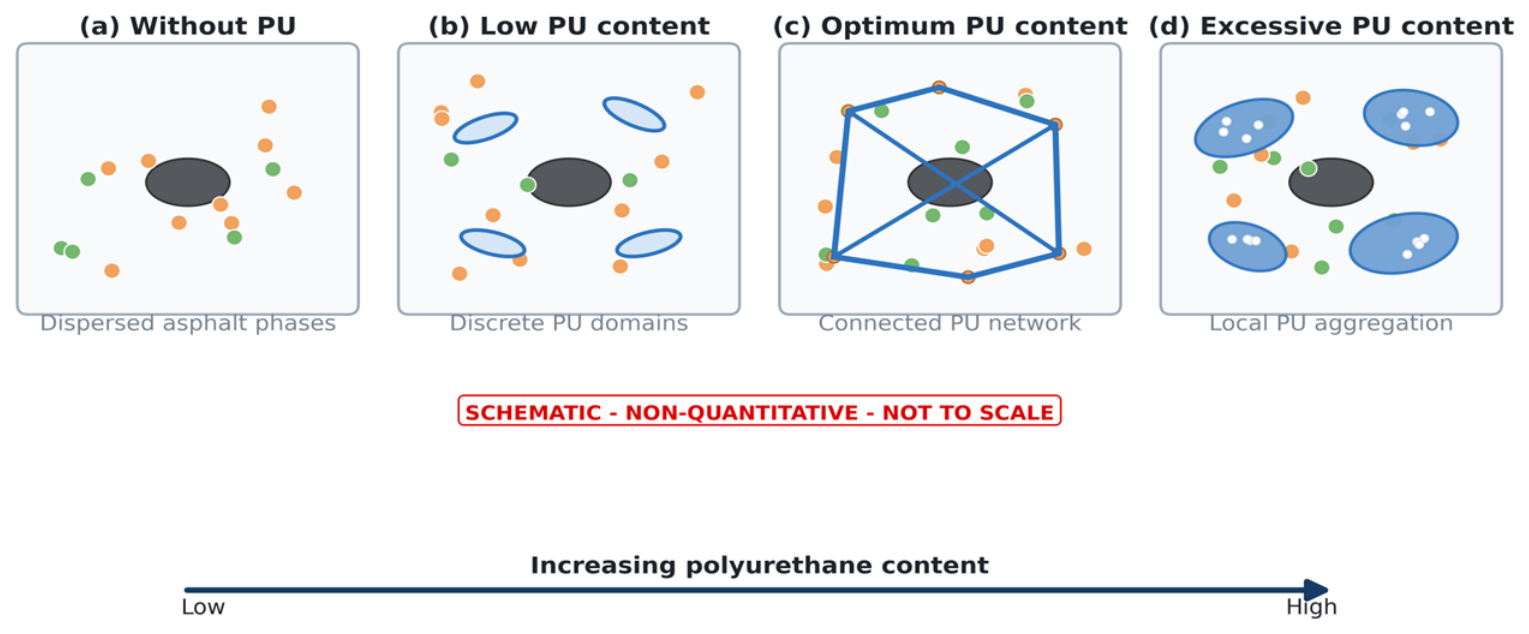
- The literature does not support a universal optimum PU dosage. Representative optimized formulations are highly system-specific: 8 wt.% PU + 32 wt.% epoxy resin were selected for one epoxy/PU binder [50]; approximately 4% SBS + 5% PUP were recommended for one high-viscosity/high-elasticity SBS/PUP binder [54]; and 1.5% RET + 8%–10% PUP were recommended for one RET/PUP system [57]. These values should be regarded as design examples rather than transferable specifications.
- (3)
- Constructability remains a key limitation of reactive PU. At 130 °C, a high-content study reported workable times of approximately 72 min for 30% isocyanate prepolymer and 46 min for 50%. After 14 d of curing, the 50% system showed a 142.1% increase in the high-temperature rutting factor [34]. This result illustrates the principal trade-off in thermosetting systems: stronger curing-dependent reinforcement may be accompanied by a narrower construction window. Thermoplastic PU avoids irreversible curing but requires separate control of compatibility and storage stability [30].
- (4)
- PU is unlikely to replace SBS or other conventional modifiers in every pavement application. Its strongest application potential lies in cases where adhesion, durability, special functionality, or reduced-temperature/rapid construction can offset higher material and process costs. In the 2026 porous-pavement LCA/LCCA study, PU-prepolymer porous asphalt became both economically and environmentally favorable only when its service life exceeded that of the SBS alternative by approximately 35% [67]. Long-term field validation, standardized workability criteria, recycling routes, and consistent life-cycle boundaries are therefore prerequisites for large-scale implementation.
Author Contributions
Funding
Institutional Review Board Statement
Informed Consent Statement
Data Availability Statement
Acknowledgments
Conflicts of Interest
References
- Porto, M.; Caputo, P.; Loise, V.; Eskandarsefat, S.; Teltayev, B.; Oliviero Rossi, C. Bitumen and Bitumen Modification: A Review on Latest Advances. Appl. Sci. 2019, 9, 742. [Google Scholar] [CrossRef] [Scilit]
- Lesueur, D. The colloidal structure of bitumen: Consequences on the rheology and on the mechanisms of bitumen modification. Adv. Colloid Interface Sci. 2009, 145, 42–82. [Google Scholar] [CrossRef] [Scilit] [PubMed]
- Polacco, G.; Filippi, S.; Merusi, F.; Stastna, G. A review of the fundamentals of polymer-modified asphalts: Asphalt/polymer interactions and principles of compatibility. Adv. Colloid Interface Sci. 2015, 224, 72–112. [Google Scholar] [CrossRef] [Scilit] [PubMed]
- Redelius, P. Asphaltenes in Bitumen, What They Are and What They Are Not. Road Mater. Pavement Des. 2009, 10, 25–43. [Google Scholar] [CrossRef] [Scilit]
- Hou, X.; Xiao, F.; Wang, J.; Amirkhanian, S. Identification of asphalt aging characterization by spectrophotometry technique. Fuel 2018, 226, 230–239. [Google Scholar] [CrossRef] [Scilit]
- Behnood, A.; Gharehveran, M.M. Morphology, rheology, and physical properties of polymer-modified asphalt binders. Eur. Polym. J. 2019, 112, 766–791. [Google Scholar] [CrossRef] [Scilit]
- Lo Presti, D. Recycled Tyre Rubber Modified Bitumens for road asphalt mixtures: A literature review. Constr. Build. Mater. 2013, 49, 863–881. [Google Scholar] [CrossRef] [Scilit]
- Zhu, J.; Birgisson, B.R.; Kringos, N. Polymer modification of bitumen: Advances and challenges. Eur. Polym. J. 2014, 54, 18–38. [Google Scholar] [CrossRef] [Scilit]
- Xie, H.; Li, C.; Wang, Q. A critical review on performance and phase separation of thermosetting epoxy asphalt binders and bond coats. Constr. Build. Mater. 2022, 326, 126792. [Google Scholar] [CrossRef] [Scilit]
- Demchuk, Y.; Gunka, V.; Sidun, I.; Korchak, B.; Donchenko, M.; Drapak, I.; Poliuzhyn, I.; Pyshyev, S. Study of Road Bitumen Operational Properties Modified with Phenol–Cresol–Formaldehyde Resin. Resources 2025, 14, 91. [Google Scholar] [CrossRef] [Scilit]
- Li, T.; Guo, Z.; Liang, D.; Luo, S.; Zhang, Y.; Hong, B.; Lu, G.; Wang, D.; Oeser, M. Chemical and physical effects of polyurethane-precursor-based reactive modifier on the low-temperature performance of bitumen. Constr. Build. Mater. 2022, 328, 127055. [Google Scholar] [CrossRef] [Scilit]
- Li, T.; Guo, Z.; Lu, G.; Liang, D.; Luo, S.; Hong, B.; Wang, D.; Oeser, M. Experimental investigations and quantum chemical calculations of methylene diphenyl diisocyanate (MDI)-based chemically modified bitumen and its crosslinking behaviours. Fuel 2022, 321, 124084. [Google Scholar] [CrossRef] [Scilit]
- Akindoyo, J.O.; Beg, M.D.H.; Ghazali, S.; Islam, M.R.; Jeyaratnam, N.; Yuvaraj, A.R. Polyurethane types, synthesis and applications—A review. RSC Adv. 2016, 6, 114453–114482. [Google Scholar] [CrossRef] [Scilit]
- Li, X.; Li, J.; Wang, J.; Yuan, J.; Jiang, F.; Yu, X.; Xiao, F. Recent applications and developments of polyurethane materials in pavement engineering. Constr. Build. Mater. 2021, 304, 124639. [Google Scholar] [CrossRef] [Scilit]
- Cong, L.; Yang, F.; Guo, G.; Ren, M.; Shi, J.; Tan, L. The use of polyurethane for asphalt pavement engineering applications: A state-of-the-art review. Constr. Build. Mater. 2019, 225, 1012–1025. [Google Scholar] [CrossRef] [Scilit]
- Huang, G.; Yang, T.; He, Z.; Yu, L.; Xiao, H. Polyurethane as a modifier for road asphalt: A literature review. Constr. Build. Mater. 2022, 356, 129058. [Google Scholar] [CrossRef] [Scilit]
- Izquierdo, M.A.; García-Morales, M.; Martínez-Boza, F.J.; Navarro, F.J. Thermo-mechanical properties and microstructural considerations of MDI isocyanate-based bituminous foams. Mater. Chem. Phys. 2014, 146, 261–268. [Google Scholar] [CrossRef] [Scilit]
- Navarro, F.J.; Partal, P.; Martínez-Boza, F.; Gallegos, C.; Bordado, J.C.M.; Diogo, A.C. Rheology and microstructure of MDI–PEG reactive prepolymer-modified bitumen. Mech. Time-Depend. Mater. 2006, 10, 347–359. [Google Scholar] [CrossRef] [Scilit]
- Cuadri, A.A.; Partal, P.; Ahmad, N.; Grenfell, J.; Airey, G. Chemically modified bitumens with enhanced rheology and adhesion properties to siliceous aggregates. Constr. Build. Mater. 2015, 93, 766–774. [Google Scholar] [CrossRef] [Scilit]
- Xia, L.; Cao, D.; Zhang, H.; Guo, Y. Study on the classical and rheological properties of castor oil-polyurethane pre polymer (C-PU) modified asphalt. Constr. Build. Mater. 2016, 112, 949–955. [Google Scholar] [CrossRef] [Scilit]
- Zhang, M.; Xiong, K.; Zhang, J.; Li, Y.; He, Y.; Pei, J. Evaluation of the rheological properties and aging resistance of asphalt modified by MDI/TDI polyurethane. Constr. Build. Mater. 2024, 411, 134350. [Google Scholar] [CrossRef] [Scilit]
- Sun, M.; Zheng, M.; Qu, G.; Yuan, K.; Bi, Y.; Wang, J. Performance of polyurethane modified asphalt and its mixtures. Constr. Build. Mater. 2018, 191, 386–397. [Google Scholar] [CrossRef] [Scilit]
- Lu, J.; Xu, S.; Li, C.; Fu, C.; Gao, M.; Wang, Z.; Yang, F.; Zhou, G.; Li, R.; Ling, T. The latest research progress of polyurethane modified asphalt binder: Synthesis, characterization, and applications. Int. J. Adhes. Adhes. 2025, 140, 104035. [Google Scholar] [CrossRef] [Scilit]
- Sheng, H.; Ma, R.; Li, Y.; Cheng, P.; Cheng, A. Advances in Polyurethane-Modified Asphalt via the Prepolymer Method: Molecular Design, Modification Mechanisms, Structural Evolution, and Performance Optimisation. Polymers 2026, 18, 1803. [Google Scholar] [CrossRef] [Scilit] [PubMed]
- Jin, X.; Sun, S.; Guo, N.; Huang, S.; You, Z.; Tan, Y. Influence on Polyurethane Synthesis Parameters Upon the Performance of Base Asphalt. Front. Mater. 2021, 8, 656261. [Google Scholar] [CrossRef] [Scilit]
- Gong, X.; Liu, Q.; Chen, P.; Wang, H.; Liu, X.; Chen, S.; Wu, S. Modification mechanism of green polyurethane modified asphalt prepared by in-situ polymerization. Constr. Build. Mater. 2024, 448, 138243. [Google Scholar] [CrossRef] [Scilit]
- Zhang, Z.; Sun, J.; Jia, M.; Ban, X.; Wang, L.; Chen, L.; Huang, T.; Liu, H. Effects of polyurethane thermoplastic elastomer on properties of asphalt binder and asphalt mixture. J. Mater. Civ. Eng. 2021, 33, 04020477. [Google Scholar] [CrossRef] [Scilit]
- Shi, W.; Wei, K.; Guo, X.; Ni, T.; Tian, J. Study on the interfacial adhesion performance of polyurethane-modified asphalt based on molecular dynamics simulation. Appl. Surf. Sci. 2025, 685, 162041. [Google Scholar] [CrossRef] [Scilit]
- Gallu, R.; Méchin, F.; Dalmas, F.; Gérard, J.-F.; Loup, F. Rheology-morphology relationships of new polymer-modified bitumen based on thermoplastic polyurethanes (TPU). Constr. Build. Mater. 2020, 259, 120404. [Google Scholar] [CrossRef] [Scilit]
- Jia, M.; Zhang, Z.; Yang, N.; Qi, B.; Wang, W.; Huang, Z.; Sun, J.; Luo, F.; Huang, T. Performance Evaluation of Thermosetting and Thermoplastic Polyurethane Asphalt Mixtures. J. Mater. Civ. Eng. 2022, 34, 04022097. [Google Scholar] [CrossRef] [Scilit]
- Yu, R.; Zhu, X.; Zhang, M.; Fang, C. Investigation on the Short-Term Aging-Resistance of Thermoplastic Polyurethane-Modified Asphalt Binders. Polymers 2018, 10, 1189. [Google Scholar] [CrossRef] [Scilit] [PubMed]
- Jin, X.; Guo, N.; You, Z.; Wang, L.; Wen, Y.; Tan, Y. Rheological properties and micro-characteristics of polyurethane composite modified asphalt. Constr. Build. Mater. 2020, 234, 117395. [Google Scholar] [CrossRef] [Scilit]
- Fang, J.; Tu, J. Effect of ultraviolet (UV) aging on rheology properties and microstructure of polyurethane (PU) modified asphalt. Mater. Res. Express 2019, 6, 125318. [Google Scholar] [CrossRef] [Scilit]
- Luo, Z.; Duan, J.; Cao, Z.; Yi, J.; Xu, S.; Wang, R. Environmentally friendly high-content polyurethane modified asphalt: Workability evaluation and early performance evolution. Constr. Build. Mater. 2024, 453, 139093. [Google Scholar] [CrossRef] [Scilit]
- Xiong, Z.; Xu, Z.; Hong, J.; Gong, M.; Cheng, J.; Zhang, L. Performance and Modification Mechanism of Polyurethane Semi-prepolymer Modified Asphalt. J. Wuhan Univ. Technol.-Mater. Sci. Ed. 2026, 41, 903–915. [Google Scholar] [CrossRef] [Scilit]
- Xu, S.; Liu, S.; Li, Z.; Zhang, Z.; Meng, H.; Wang, Y.; Ling, M. Preparation Process and Performance Evaluation of Polyurethane-Modified Asphalt and Its Mixtures. J. Mater. Civ. Eng. 2026, 38, 04026059. [Google Scholar] [CrossRef] [Scilit]
- Wang, H.; Tang, N.; Zhang, R. Preparation and property controllability of dynamically crosslinked polyurethane modified bitumen. Constr. Build. Mater. 2025, 491, 142700. [Google Scholar] [CrossRef] [Scilit]
- Sheng, X.; Wang, M.; Xu, T.; Chen, J. Preparation, properties and modification mechanism of polyurethane modified emulsified asphalt. Constr. Build. Mater. 2018, 189, 375–383. [Google Scholar] [CrossRef] [Scilit]
- Carrera, V.; Cuadri, A.A.; García-Morales, M.; Partal, P. The development of polyurethane modified bitumen emulsions for cold mix applications. Mater. Struct. 2015, 48, 3407–3414. [Google Scholar] [CrossRef] [Scilit]
- Xu, L.; Li, X.; Zong, Q.; Xiao, F. Chemical, morphological and rheological investigations of SBR/SBS modified asphalt emulsions with waterborne acrylate and polyurethane. Constr. Build. Mater. 2021, 272, 121972. [Google Scholar] [CrossRef] [Scilit]
- Xu, L.; Zhao, Z.; Li, X.; Yuan, J.; Zhou, Q.; Xiao, F. Cracking investigation on fog seal technology with waterborne acrylate and polyurethane as a clean modification approach. J. Clean. Prod. 2021, 329, 129751. [Google Scholar] [CrossRef] [Scilit]
- Zhao, Y.; Gong, X.; Liu, Q. Research on rheological properties and modification mechanism of waterborne polyurethane modified bitumen. Constr. Build. Mater. 2023, 371, 130775. [Google Scholar] [CrossRef] [Scilit]
- Chen, R.; Xu, W.; Chen, Y. Preparation and Properties of Waterborne Polyurethane and SBS Composite-Modified Emulsified Asphalt. Appl. Sci. 2024, 14, 7288. [Google Scholar] [CrossRef] [Scilit]
- Tan, J.; Hou, S.; Jin, R.; Zhong, X.; Zou, X. Influence Mechanism of Waterborne Polyurethane on the Properties of Emulsified Asphalt. Materials 2025, 18, 3280. [Google Scholar] [CrossRef] [Scilit] [PubMed]
- Liu, Y.; Cao, Z.; Mu, M.; Wang, Z.; Wang, J.; Zhang, Y.; Wang, K.; Liu, Y.; Li, X. Enhancing the Comprehensive Performance and Interfacial Adhesion of Emulsified Asphalt Using an Epoxy-Functionalized Waterborne Polyurethane. Polymers 2026, 18, 719. [Google Scholar] [CrossRef] [Scilit] [PubMed]
- Bo, S.; Hou, Y.; Ren, M. Study on the Properties of Waterborne Epoxy Resin/Polyurethane Composite Modified Emulsified Asphalt. Materials 2026, 19, 2394. [Google Scholar] [CrossRef] [Scilit] [PubMed]
- Yuan, L.; Yang, Q.; Jing, H.; Wang, X.; Wang, Z.; Xu, X.; Zhou, X.; Feng, H.; Guo, H. Multi-scale characterizations for adhesion performance of waterborne polyurethane modified emulsified asphalt with different aggregates. Constr. Build. Mater. 2026, 519, 145912. [Google Scholar] [CrossRef] [Scilit]
- Zhang, Z.; Sun, J.; Jia, M.; Qi, B.; Zhang, H.; Lv, W.; Mao, Z.; Chang, P.; Peng, J.; Liu, Y. Study on a thermosetting polyurethane modified asphalt suitable for bridge deck pavements: Formula and properties. Constr. Build. Mater. 2020, 241, 118122. [Google Scholar] [CrossRef] [Scilit]
- Awazhar, N.A.; Khairuddin, F.H.; Rahmad, S.; Mohd Fadzil, S.M.; Omar, H.A.; Md Yusoff, N.I.; Haji Badri, K.H. Engineering and leaching properties of asphalt binders modified with polyurethane and Cecabase additives for warm-mix asphalt application. Constr. Build. Mater. 2020, 238, 117699. [Google Scholar] [CrossRef] [Scilit]
- Zhang, Z.; Sun, J.; Huang, Z.; Wang, F.; Jia, M.; Lv, W.; Ye, J. A laboratory study of epoxy/polyurethane modified asphalt binders and mixtures suitable for flexible bridge deck pavement. Constr. Build. Mater. 2021, 274, 122084. [Google Scholar] [CrossRef] [Scilit]
- He, Q.; Zhang, H.; Li, J.; Duan, H. Performance evaluation of polyurethane/epoxy resin modified asphalt as adhesive layer material for steel-UHPC composite bridge deck pavements. Constr. Build. Mater. 2021, 291, 123364. [Google Scholar] [CrossRef] [Scilit]
- Yang, G.; Wang, C.; Fu, H.; Yan, Z.; Yin, W. Waterborne Epoxy Resin–Polyurethane–Emulsified Asphalt: Preparation and Properties. J. Mater. Civ. Eng. 2019, 31, 04019265. [Google Scholar] [CrossRef] [Scilit]
- Zhou, X.; Wang, Z.; Guo, H.; Wang, X.; Chen, W.; Liu, J.; Zhang, H.; Wan, C. Property improvement of epoxy emulsified asphalt modified by waterborne polyurethane in consideration of environmental benefits. Case Stud. Constr. Mater. 2024, 21, e03559. [Google Scholar] [CrossRef] [Scilit]
- Tian, Z.; Zhang, Z.; Zhang, K.; Huang, S.; Luo, Y. Preparation and properties of high viscosity and elasticity asphalt by styrene–butadiene–styrene/polyurethane prepolymer composite modification. J. Appl. Polym. Sci. 2020, 137, 49123. [Google Scholar] [CrossRef] [Scilit]
- Chen, B.; Dong, F.; Yu, X.; Zheng, C. Evaluation of Properties and Micro-Characteristics of Waste Polyurethane/Styrene-Butadiene-Styrene Composite Modified Asphalt. Polymers 2021, 13, 2249. [Google Scholar] [CrossRef] [Scilit] [PubMed]
- Wu, H.; Yang, M.; Song, W.; Wu, Z.; Chen, D.; Chen, X. Mechanical and rheological properties of polyurethane-polyurea (PU-PUa) modified asphalt binder. Constr. Build. Mater. 2024, 411, 134798. [Google Scholar] [CrossRef] [Scilit]
- Xu, C.; Zhang, Z.; Zhao, F.; Liu, F.; Wang, J. Improving the performance of RET modified asphalt with the addition of polyurethane prepolymer (PUP). Constr. Build. Mater. 2019, 206, 560–575. [Google Scholar] [CrossRef] [Scilit]
- Jia, M.; Zhang, Z.; Liu, H.; Peng, B.; Zhang, H.; Lv, W.; Zhang, Q.; Mao, Z. The synergistic effect of organic montmorillonite and thermoplastic polyurethane on properties of asphalt binder. Constr. Build. Mater. 2019, 229, 116867. [Google Scholar] [CrossRef] [Scilit]
- Zhang, H.; Su, C.; Bu, X.; Zhang, Y.; Gao, Y.; Huang, M. Laboratory investigation on the properties of polyurethane/unsaturated polyester resin modified bituminous mixture. Constr. Build. Mater. 2020, 260, 119865. [Google Scholar] [CrossRef] [Scilit]
- Xie, J.; Lin, J.; Wu, S.; Liu, Q.; Li, C.; Zhang, S.; Wang, H.; Wang, F.; Wan, Z. Design, Performance and Mechanisms of Asphalt Modified with Polyurethane and Hydroxylated Crumb Rubber. Materials 2026, 19, 1654. [Google Scholar] [CrossRef] [Scilit] [PubMed]
- Cao, Z.; Hao, Q.; Xu, S.; Han, X.; Yi, J.; Sun, G. Preparation and performance evaluation of bio-based polyurethane modified asphalt binders: Towards greener and more sustainable asphalt modifier. Constr. Build. Mater. 2025, 476, 141209. [Google Scholar] [CrossRef] [Scilit]
- Chen, J.; Yin, X.; Wang, H.; Ding, Y. Evaluation of Durability and Functional Performance of Porous Polyurethane Mixture in Porous Pavement. J. Clean. Prod. 2018, 188, 12–19. [Google Scholar] [CrossRef] [Scilit]
- Cong, L.; Wang, T.; Tan, L.; Yuan, J.; Shi, J. Laboratory evaluation on performance of porous polyurethane mixtures and OGFC. Constr. Build. Mater. 2018, 169, 436–442. [Google Scholar] [CrossRef] [Scilit]
- Lu, G.; Renken, L.; Li, T.; Wang, D.; Li, H.; Oeser, M. Experimental study on the polyurethane-bound pervious mixtures in the application of permeable pavements. Constr. Build. Mater. 2019, 202, 838–850. [Google Scholar] [CrossRef] [Scilit]
- Li, R.; Ma, X.; Chen, J.; Tang, N.; Zhu, H.; Leng, Z.; Tan, Z. Performance enhancement of recycled asphalt mixtures using polyurethane prepolymer. Constr. Build. Mater. 2026, 526, 146402. [Google Scholar] [CrossRef] [Scilit]
- Xu, S.; Lu, G.; Hong, B.; Jiang, X.; Peng, G.; Wang, D.; Oeser, M. Experimental investigation on the development of pore clogging in novel porous pavement based on polyurethane. Constr. Build. Mater. 2020, 258, 120378. [Google Scholar] [CrossRef] [Scilit]
- Li, G.; Wang, J.; Yao, L.; Yang, B.; Lu, G.; Han, M.; Zou, F.; Leng, Z. Environmental and economic assessments of novel polyurethane prepolymer modified porous asphalt: A case study in Hong Kong. J. Clean. Prod. 2026, 571, 148806. [Google Scholar] [CrossRef] [Scilit]
- Hong, B.; Lu, G.; Gao, J.; Wang, D. Evaluation of polyurethane dense graded concrete prepared using the vacuum assisted resin transfer molding technology. Constr. Build. Mater. 2021, 269, 121340. [Google Scholar] [CrossRef] [Scilit]
- Hong, B.; Lu, G.; Gao, J.; Dong, S.; Wang, D. Green tunnel pavement: Polyurethane ultra-thin friction course and its performance characterization. J. Clean. Prod. 2021, 289, 125131. [Google Scholar] [CrossRef] [Scilit]
- Xiong, K.; Zhang, J.; He, Y.; Li, J.; Zhang, M.; Li, R.; Pei, J.; Li, Y.; Lyu, L. Introducing the mineral powder to strengthen polyurethane grouting materials for crack repair of asphalt pavements. Constr. Build. Mater. 2024, 453, 139023. [Google Scholar] [CrossRef] [Scilit]
- Zhang, H.; Zhang, D.; Liu, F.; Wei, T. Investigation of a novel blocked waterborne polyurethane emulsified asphalt mixture for pothole repair: Material development, road performance and construction parameters. Road Mater. Pavement Des. 2025, 26, 3161–3195. [Google Scholar] [CrossRef] [Scilit]
- ASTM D4402/D4402M-23; Standard Test Method for Viscosity Determination of Asphalt at Elevated Temperatures Using a Rotational Viscometer. ASTM International: West Conshohocken, PA, USA, 2023.
- EN 13302:2018; Bitumen and Bituminous Binders—Determination of Dynamic Viscosity of Bituminous Binder Using a Rotating Spindle Apparatus. European Committee for Standardization (CEN): Brussels, Belgium, 2018.
- JTG 3410-2025; Standard Test Methods of Asphalt and Asphalt Mixture for Highway Engineering. China Communications Press: Beijing, China, 2025.
- JTG F40-2004; Technical Specifications for Construction of Highway Asphalt Pavements. China Communications Press: Beijing, China, 2004.




| Representative Quantitative Evidence | Cost/Application | Processability | Fatigue/Adhesion | Low-Temperature Cracking | High-Temperature Resistance | Modifier/System |
|---|---|---|---|---|---|---|
| No single transferable dosage is assigned here because polymer architecture, base-asphalt chemistry, and compatibility strongly affect the usable formulation [3,8]. | Mature supply chain and specifications | High-temperature shear; hot-storage phase separation can occur | Good fatigue response; adhesion depends on binder–polymer compatibility | Generally improved flexibility versus base asphalt | Strong and mature benchmark; polymer network improves rutting resistance | SBS-modified asphalt [3,8] |
| For one EPU system, 8 wt.% PU + 32 wt.% epoxy resin was selected as the optimum formulation; low-temperature cracking resistance improved versus epoxy asphalt [50]. | High initial cost; mainly special/bridge applications | Thermoset curing and limited construction window | High adhesion and good fatigue resistance | Epoxy can be brittle; PU improves flexibility | Very high strength and rutting resistance after cure | Epoxy asphalt/EPU [9,50] |
| 1.5% RET + 8%–10% PUP; ~5000 rpm shear and at least 1 h were recommended for the investigated system [57]. | Added formulation complexity | Requires adequate reaction/shearing control | Moisture resistance and composite performance improved | PUP mainly compensates low-temperature weakness | RET primarily reinforces high-temperature response | RET + PUP [57] |
| Representative formulation: 4% SBS + 5% PUP + 0.5% chain extender + 1‰ sulfur crosslinker [54]. | Suitable for porous/high-demand sections | Formulation- and viscosity-sensitive | Improved cohesion and network stability | Balanced by combined physical/reactive networks | High viscosity and high elastic recovery | SBS + PUP [54] |
| At 130 °C, 30% and 50% isocyanate-prepolymer systems had workable times of ~72 and 46 min; the 50% system showed a 142.1% increase in rutting factor after 14 d curing [34]. | Higher initial material cost; special applications | Time-dependent viscosity; short pot/workable time | Strong cohesive and interfacial response | Relaxation capacity may decrease when crosslink density is excessive | Strong, curing-dependent rutting resistance and stiffness | Thermosetting/high-content PU [34] |
| A direct TS-PU/TP-PU mixture comparison showed strong high-temperature and fatigue performance for both PU systems; TP-PU outperformed SBS in low-temperature cracking resistance, while water stability remained a limitation [30]. | Potentially easier processing than thermosetting systems | Reprocessable; no irreversible thermoset curing window, although compatibility and storage stability remain important | Reported fatigue and strength advantages over SBS in a direct mixture comparison | Good flexibility; may outperform SBS at low temperatures in reported mixtures | High-temperature performance improved relative to base asphalt; performance versus SBS is system-dependent | Thermoplastic PU [30] |
Disclaimer/Publisher’s Note: The statements, opinions and data contained in all publications are solely those of the individual author(s) and contributor(s) and not of MDPI and/or the editor(s). MDPI and/or the editor(s) disclaim responsibility for any injury to people or property resulting from any ideas, methods, instructions or products referred to in the content. |
© 2026 by the authors. Licensee MDPI, Basel, Switzerland. This article is an open access article distributed under the terms and conditions of the Creative Commons Attribution (CC BY) license.
Share and Cite
Wang, W.; Wei, J.; Zhang, Z.; Chen, W.; Liu, H.; Wang, F.; Ye, F. Application and Development of Polyurethane-Modified Asphalt for Pavement Engineering: A Review. Coatings 2026, 16, 1064. https://doi.org/10.3390/coatings16091064
Wang W, Wei J, Zhang Z, Chen W, Liu H, Wang F, Ye F. Application and Development of Polyurethane-Modified Asphalt for Pavement Engineering: A Review. Coatings. 2026; 16(9):1064. https://doi.org/10.3390/coatings16091064
Chicago/Turabian StyleWang, Wenjian, Jincheng Wei, Zhengchao Zhang, Wei Chen, Haojie Liu, Fangchuan Wang, and Fan Ye. 2026. "Application and Development of Polyurethane-Modified Asphalt for Pavement Engineering: A Review" Coatings 16, no. 9: 1064. https://doi.org/10.3390/coatings16091064
APA StyleWang, W., Wei, J., Zhang, Z., Chen, W., Liu, H., Wang, F., & Ye, F. (2026). Application and Development of Polyurethane-Modified Asphalt for Pavement Engineering: A Review. Coatings, 16(9), 1064. https://doi.org/10.3390/coatings16091064