Industrial Scaling and Commercialization of Biopolymer-Based Food Packaging: Processing, Performance, Regulatory and Sustainability Challenges




Highlights
- Production route determines the scale-up bottlenecks in biopolymer packaging.
- Cost, regulation, and end-of-life systems remain interdependent barriers.
- Sustainability depends on feedstock, material performance, and disposal route.
- Early integration of TEA and LCA can reduce commercialization risks.
- Existing infrastructure and biorefineries offer strong near-term scale-up potential.
- Packaging must be designed for verified safety and realistic end-of-life routes.
Abstract
1. Introduction
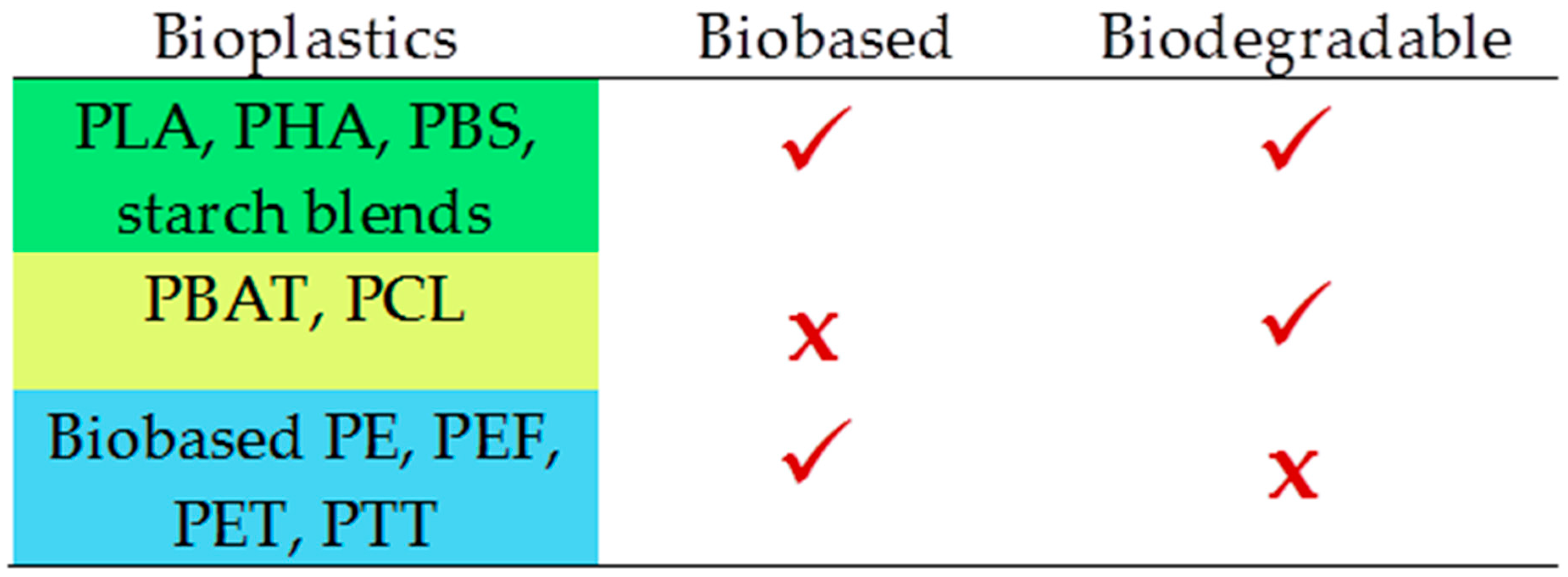
2. Terminology
3. Classification of Biopolymers According to Renewable Carbon Source
3.1. Renewable Feedstock Categories

| Raw Material Source (Feedstock Origin) | Examples of Feedstocks | Representative Polymers | Production Pathway | Typical Processing/Conversion Methods | Main Limitations | Packaging Relevance | Reference |
|---|---|---|---|---|---|---|---|
| Agricultural crops and plant-derived polysaccharides | Corn, potato, cassava, wheat, rice, sugar beet, wood, cotton, agricultural residues, lignocellulosic biomass | Starch, cellulose, cellulose derivatives, cellulose nanofibers (CNF), cellulose nanocrystals (CNC), hemicellulose derivatives | Direct extraction of natural polymers; modification of natural polymers and derivatives | Extraction, plasticization, esterification, etherification, melt extrusion, solution casting, coating, electrospinning, nanocomposite preparation | Moisture sensitivity; poor water vapor barrier; brittleness; limited thermal stability; dependence on modification degree; recycling challenges for some derivatives | Films, coatings, paper and board coatings, barrier layers, nanocomposite packaging, multilayer structures | [33,34,35,36,37,38,39,40] |
| Marine biomass and animal-derived renewable resources | Crustacean shells, algae, seaweed, animal skin and bones | Chitosan, alginate, agar, carrageenan, gelatin, collagen | Direct extraction of natural polymers | Solution casting, coating, freeze drying, electrospinning, blending with other biopolymers | Poor mechanical properties in pure form; moisture sensitivity; variability of biological sources; limited thermal resistance | Antimicrobial films and coatings, active packaging, oxygen-barrier layers, fresh produce packaging | [33,41,42] |
| Microbial and fermentation-derived feedstocks | Glucose, sucrose, glycerol, vegetable oils, molasses, whey, lignocellulosic hydrolysates, agricultural and food waste streams | PHA, PHB, PHBV, PHBH, bacterial cellulose, pullulan, curdlan, xanthan gum | Microbial biosynthesis of polymers | Fermentation, downstream recovery, solvent casting, extrusion, injection molding, compression molding, electrospinning, 3D printing | High production and purification cost; low productivity vs. petrochemical polymers; brittleness; scale-up challenges | Compostable films, rigid food containers, trays, antimicrobial packaging, coatings, high-value sustainable packaging applications | [43,44,45,46,47,48] |
3.2. Conversion of Biomass-Derived Carbon into Polymer Precursors
4. Classification of Biopolymers According to Processing Pathways—From Polymer Production to Packaging Manufacture
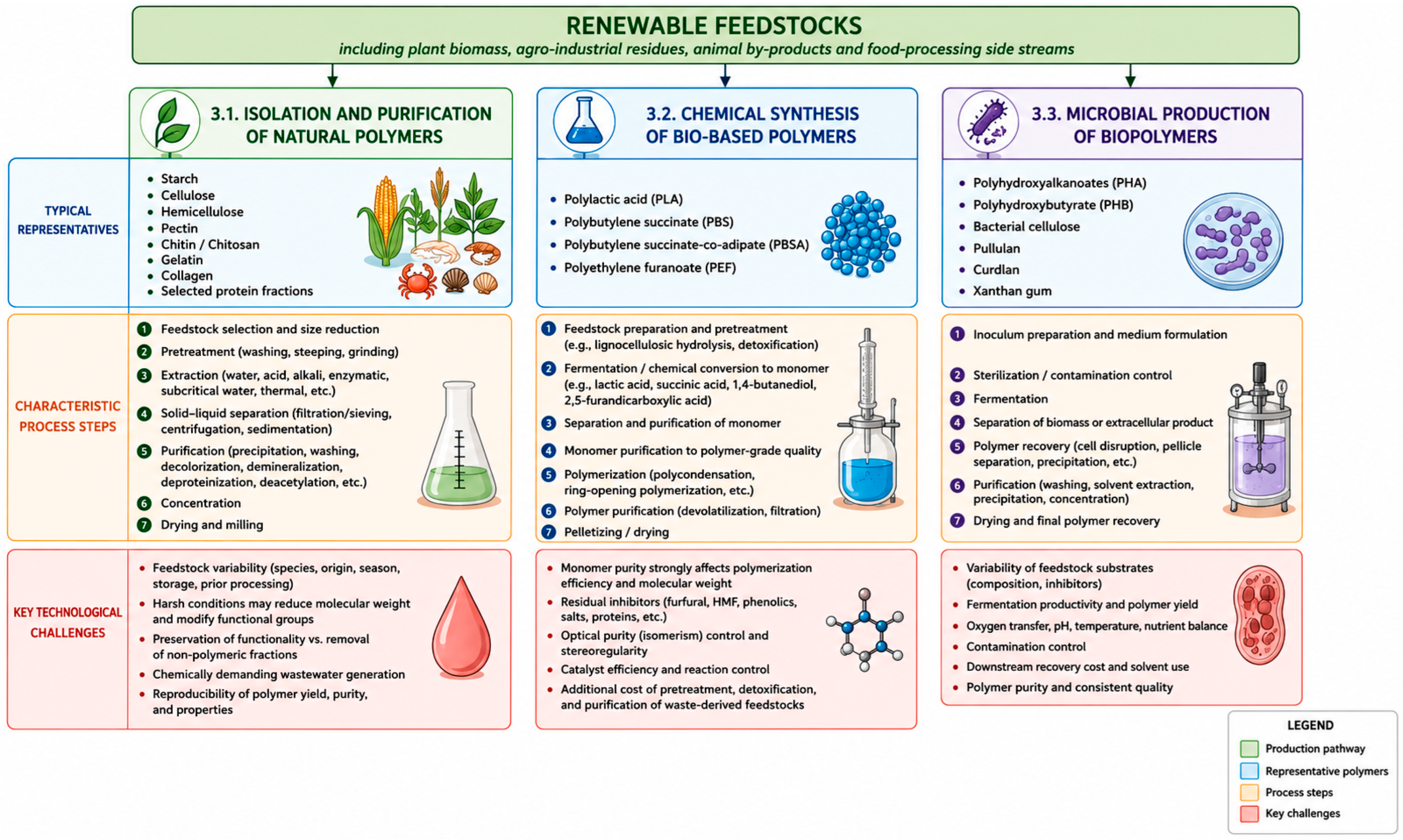
4.1. Isolation and Purification of Natural Polymers
4.2. Chemical Synthesis of Bio-Based Polymers
4.3. Microbial Production of Biopolymers
5. Conversion into Packaging Products
5.1. Extrusion
5.2. Injection Molding
5.3. Thermoforming
5.4. Blow Molding
6. Key Barriers to Industrial Implementation and Market Adoption
6.1. Economic Challenges
6.2. Functional and Market Limitations
6.3. Regulatory and Safety Issues
6.3.1. Regulatory and Safety Landscape Worldwide and in Europe
| Continent | Regulation/Strategy | Year | Application | Relevance for Biopolymers |
|---|---|---|---|---|
| Europe | Directive 94/62/EC | 1994 | Packaging and packaging waste | The first regulatory framework for sustainable packaging |
| REACH Regulation (EC) 1907/2006 | 2006 | Chemicals and polymers | Registration of monomers and additives | |
| Waste Framework Directive 2008/98/EC | 2008 | Waste management | Circular economy | |
| Single Use Plastics Directive 2019/904 | 2019 | Single-use plastic | Regulates bioplastics | |
| PPWR (EU) 2025/40 | 2025 | Packaging | The most important current regulation | |
| Asia | Green Product Certification (China) | 2016 | Sustainable products | Bioplastics certification |
| Plastic Waste Management Rules (India) | 2016, 2022 | Plastic management | Defines compostable plastic | |
| China Plastic Pollution Control Action Plan | 2020 | Single-use plastic | Stimulates biopolymers | |
| Plastic Resource Circulation Act (Japan) | 2022 | Plastics and recycling | It encourages bio-based and recyclable materials | |
| North America | U.S. National BioPreferred Program | 2002 | Bio-based products | Labeling of bio-based content |
| ASTM D6400 [166] | 2004 | Compostable plastic | Basic industry standard | |
| ASTM D6868 [167] | 2005 | Biodegradable packaging | Certification of compostability | |
| Canadian Zero Plastic Waste Agenda | 2018 | Plastic | Promotes sustainable polymers | |
| California SB54 | 2022 | Packaging | Mandatory recyclability of packaging | |
| South America | National Solid Waste Policy (Brazil) | 2010 | Waste management | The basis for bioplastics |
| Brazilian Packaging Waste Framework | 2010–2020 | Packaging | Recycling and EPR systems | |
| Argentina Plastic Waste Reduction Policies | 2019 | Plastic | Limitation of single-use plastics | |
| Chile Single-Use Plastics Law | 2021 | Packaging | Support for alternative materials | |
| Australia | Australian Packaging Covenant (APCO) | 1999–now | Packaging | Recyclability goals |
| Australian Bioplastics Association Certification Scheme | 2007 | Bioplastic | Certification according to EN and ASTM standards | |
| National Waste Policy Action Plan | 2019 | Waste | Encourages compostable materials | |
| National Plastics Plan | 2021 | Plastic | Transition to sustainable packaging | |
| Africa | South Africa National Environmental Management: Waste Act | 2008 | Waste management | Basic regulatory framework |
| Rwanda Plastic Ban Regulations | 2008 | Plastic | It encourages alternative materials | |
| Kenya Plastic Bag Ban | 2017 | Plastic | The strictest plastic ban | |
| African Circular Economy Alliance | 2017 | Sustainability | Regional strategy for sustainable materials | |
| South African Plastics Pact | 2020 | Plastic | Circular economy |
6.3.2. Overview of Standards for Biopolymer Materials (ISO/ASTM/EN)
7. Life Cycle Assessment of Biopolymers and Polymers—Key Differences and Comparative Overview
8. Future Trends and Emerging Technologies for Scalable Biopolymer Packaging
8.1. Artificial Intelligence, Machine Learning and Data-Driven Material Optimization
8.2. Smart, Active and Intelligent Packaging
8.3. 3D Printing and Additive Manufacturing
8.4. The Development of Industrial Biorefineries
8.5. Composite Design, Blending and Compatibilization
8.6. The Integration of LCA, TEA and Policy-Oriented Research at Early Stages of Material Development
9. Conclusions
Author Contributions
Funding
Institutional Review Board Statement
Informed Consent Statement
Data Availability Statement
Conflicts of Interest
Abbreviations
| Bio-PE | Bio-based polyethylene |
| Bio-PET | Bio-based polyethylene terephthalate |
| PBAT | Poly(butylene adipate-co-terephthalate) |
| PBSA | Poly(butylene succinate-co-adipate) |
| PBS | Poly(butylene succinate) |
| PCL | Polycaprolactone |
| PE | Polyethylene |
| PEF | Poly(ethylene furanoate) |
| PET | Poly(ethylene terephthalate) |
| PHA | Polyhydroxyalkanoates |
| PHB | Poly(3-hydroxybutyrate) |
| PHBH | Poly(3-hydroxybutyrate-co-3-hydroxyhexanoate) |
| PHBV | Poly(3-hydroxybutyrate-co-3-hydroxyvalerate) |
| PLA | Polylactic acid (poly(lactic acid)) |
| PMMA | Poly(methyl methacrylate) |
| PP | Polypropylene |
| PS | Polystyrene |
| PTT | Poly(trimethylene terephthalate) |
| PVC | Poly(vinyl chloride) |
| TPS | Thermoplastic starch |
References
- Yin, Y.; Woo, M.V. Transitioning of petroleum-based plastic food packaging to sustainable bio-based alternatives. Sustain. Food Technol. 2024, 2, 548–566. [Google Scholar] [CrossRef] [Scilit]
- Dhanraj, N.D.; Hatha, A.A.M.; Jisha, M.S. Biodegradation of petroleum based and bio-based plastics: Approaches to increase the rate of biodegradation. Arch. Microbiol. 2022, 204, 258. [Google Scholar] [CrossRef] [Scilit] [PubMed]
- Stoica, M.; Bichescu, C.I.; Crețu, C.-M.; Dragomir, M.; Ivan, A.S.; Podaru, G.M.; Stoica, D.; Stuparu-Crețu, M. Review of Bio-Based Biodegradable Polymers: Smart Solutions for Sustainable Food Packaging. Foods 2024, 13, 3027. [Google Scholar] [CrossRef] [Scilit] [PubMed]
- Nilsen-Nygaard, J.; Fernández, E.N.; Radusin, T.; Rotabakk, B.T.; Sarfraz, J.; Sharmin, N.; Sivertsvik, M.; Sone, I.; Pettersenet, M.K. Current status of biobased and biodegradable food packaging materials: Impact on food quality and effect of innovative processing technologies. Compr. Rev. Food Sci. Food Saf. 2021, 20, 1333–1380. [Google Scholar] [CrossRef] [Scilit] [PubMed]
- Shah, M.Z.; Quraishi, M.; Sreejith, A.; Pandit, S.; Roy, A.; Khandaker, M.U. Sustainable degradation of synthetic plastics: A solution to rising environmental concerns. Chemosphere 2024, 352, 141451. [Google Scholar] [CrossRef] [Scilit] [PubMed]
- Fiandra, E.F.; Shaw, L.; Starck, M.; McGurk, C.J.; Mahon, C.S. Designing biodegradable alternatives to com-modity polymers. Chem. Soc. Rev. 2023, 52, 8085–8105. [Google Scholar] [CrossRef] [Scilit] [PubMed]
- Jha, S.; Akula, B.; Enyioma, H.; Novak, M.; Amin, V.; Liang, H. Biodegradable Biobased Polymers: A Review of the State of the Art, Challenges, and Future Directions. Polymers 2024, 16, 2262. [Google Scholar] [CrossRef] [Scilit] [PubMed]
- Abdullah; Cai, J.; Hafeez, M.A.; Wang, Q.; Farooq, S.; Huang, Q.; Tian, W.; Xiao, J. Biopolymer-based functional films for packaging applications: A review. Front. Nutr. 2022, 9, 1000116. [Google Scholar] [CrossRef] [Scilit] [PubMed]
- Westlake, J.R.; Tran, M.W.; Jiang, Y.; Zhang, X.; Burrows, A.D.; Xie, M. Biodegradable biopolymers for active packaging: Demand, development and directions. Sustain. Food Technol. 2023, 1, 50–72. [Google Scholar] [CrossRef] [Scilit]
- Periyasamy, T.; Asrafali, S.P.; Lee, J. Recent Advances in Functional Biopolymer Films with Antimicrobial and Antioxidant Properties for Enhanced Food Packaging. Polymers 2025, 17, 1257. [Google Scholar] [CrossRef] [Scilit] [PubMed]
- Priyadarshi, R.; Roy, S.; Ghosh, T.; Biswas, D.; Rhim, J.-W. Antimicrobial nanofillers reinforced biopolymer composite films for active food packaging applications—A review. Sustain. Mater. Technol. 2022, 32, e00353. [Google Scholar] [CrossRef] [Scilit]
- Rosenboom, J.G.; Langer, R.; Traverso, G. Bioplastics for a circular economy. Nat. Rev. Mater. 2022, 7, 117–137. [Google Scholar] [CrossRef] [Scilit] [PubMed]
- Ali, S.S.; Abdelkarim, E.A.; Elsamahy, T.; Al-Tohamy, R.; Li, F.; Kornaros, M.; Zuorro, A.; Zhu, D.; Sun, J. Bio-plastic Production in Terms of Life Cycle Assessment: A State-of-the-Art Review. Environ. Sci. Ecotechnol. 2023, 15, 100254. [Google Scholar] [CrossRef] [Scilit] [PubMed]
- Sokač Cvetnić, T.; Debeaufort, F.; Benbettaieb, N.; Pavlinić Prokurica, I.; Kurek, M. Composting of Biode-gradable Packaging Materials: A Review of Available Technology for Biopolymer Degradation. Processes 2026, 14, 850. [Google Scholar] [CrossRef] [Scilit]
- Carvalho, A.C.F.; Ghosh, S.; Hoffmann, T.G.; Prudêncio, E.S.; Krebs de Souza, C.; Roy, S. Valuing Agro-Industrial Waste in the Development of Sustainable Food Packaging Based on the System of a Circular Bioeconomy: A Review. Clean. Waste Syst. 2025, 11, 100275. [Google Scholar] [CrossRef] [Scilit]
- Zhang, L.; Zhang, J.; Cui, M.; Qi, W.; Huang, R.; Su, R.; Zhang, K. Multifunctional Bio-Based Packaging for Perishable Foods: Structural Design, Scalable Fabrication, and Versatile Applications. Adv. Mater. 2026, 38, e21880. [Google Scholar] [CrossRef] [Scilit] [PubMed]
- Perera, K.Y.; Jaiswal, A.K.; Jaiswal, S. Biopolymer-Based Sustainable Food Packaging Materials: Challenges, Solutions, and Applications. Foods 2023, 12, 2422. [Google Scholar] [CrossRef] [Scilit] [PubMed]
- Lambert, S.; Wagner, M. Environmental performance of bio-based and biodegradable plastics: The road ahead. Chem. Soc. Rev. 2017, 46, 6855–6871. [Google Scholar] [CrossRef] [Scilit] [PubMed]
- Vert, M.; Doi, Y.; Hellwich, K.-H.; Hess, M.; Hodge, P.; Kubisa, P.; Rinaudo, M.; Schué, F. Terminology for Biorelated Polymers and Applications (IUPAC Recommendations 2012). Pure Appl. Chem. 2012, 84, 377–410. [Google Scholar] [CrossRef] [Scilit]
- Trucillo, P.; Rizzo, M.; Errico, D.; Di Maio, E. Social, Economic, and Environmental Impacts of Bio-Based Versus Fossil-Derived Polyethylene Production. Adv. Sustain. Syst. 2025, 9, 2400392. [Google Scholar] [CrossRef] [Scilit]
- Folino, A.; Karageorgiou, A.; Calabrò, P.S.; Komilis, D. Biodegradation of Wasted Bioplastics in Natural and Industrial Environments: A Review. Sustainability 2020, 12, 6030. [Google Scholar] [CrossRef] [Scilit]
- Mecking, S. Nature or petrochemistry?—Biologically degradable materials. Angew. Chem. Int. Ed. 2004, 43, 1078–1085. [Google Scholar] [CrossRef] [Scilit]
- Kapoor, D.D.; Madaan, P.; Kumar, J.; Tiwari, S.K.; Gupta, K.K.; Gupta, R.K. Transition towards renewable and biodegradable polymers: A comprehensive review. J. Polym. Res. 2025, 32, 345. [Google Scholar] [CrossRef] [Scilit]
- Garrison, T.F.; Murawski, A.; Quirino, R.L. Bio-Based Polymers with Potential for biodegradability. Polymers 2016, 8, 262. [Google Scholar] [CrossRef] [Scilit] [PubMed]
- Di Bartolo, A.; Infurna, G.; Dintcheva, N.T. A Review of Bioplastics and Their Adoption in the Circular Economy. Polymers 2021, 13, 1229. [Google Scholar] [CrossRef] [Scilit] [PubMed]
- Dutta, D.; Sit, N. A comprehensive review on types and properties of biopolymers as sustainable bio-based alternatives for packaging. Food Biomacromol. 2024, 1, 58–87. [Google Scholar] [CrossRef] [Scilit]
- Isikgor, F.H.; Becer, C.R. Lignocellulosic biomass: A sustainable platform for the production of bio-based chemicals and polymers. Polym. Chem. 2015, 6, 4497–4559. [Google Scholar] [CrossRef] [Scilit]
- Bradhan, S.K.; Gupta, S.; Gorman, M.E.; Ali Haider, M. Biorenewable chemicals: Feedstocks, technologies and the conflict with food production. Renew. Sustain. Energy Rev. 2015, 51, 506–520. [Google Scholar] [CrossRef] [Scilit]
- Pandey, A.; Verma, N.; Jain, S.; Kumar Bose, S.; Yadava, P. Valorisation of lignocellulosic biomass: A new generation in biorefinery and biomaterials. Biotechnol. Sustain Mater. 2025, 2, 20. [Google Scholar] [CrossRef] [Scilit]
- Amulya, K.; Morris, S.; Lens, P.N.L. Aquatic Biomass as Sustainable Feedstock for Biorefineries. Biofuels Bioprod. Bioref. 2023, 17, 1012–1029. [Google Scholar] [CrossRef] [Scilit]
- Tsegaye, B.; Jaiswal, S.; Jaiswal, A.K. Food Waste Biorefinery: Pathway towards Circular Bioeconomy. Foods 2021, 10, 1174. [Google Scholar] [CrossRef] [Scilit] [PubMed]
- Yaashikaa, P.R.; Senthil Kumar, P.; Varjani, S. Valorization of agro-industrial wastes for biorefinery process and circular bioeconomy: A critical review. Bioresour. Technol. 2022, 343, 126126. [Google Scholar] [CrossRef] [Scilit] [PubMed]
- Kumari, S.V.G.; Pakshirajan, K.; Pugazhenthi, G. Recent advances and future prospects of cellulose, starch, chitosan, polylactic acid and polyhydroxyalkanoates for sustainable food packaging applications. Int. J. Biol. Macromol. 2022, 221, 163–182. [Google Scholar] [CrossRef] [Scilit] [PubMed]
- Teixeira-Costa, B.E.; Andrade, C.T. Natural Polymers Used in Edible Food Packaging—History, Function and Application Trends as a Sustainable Alternative to Synthetic Plastic. Polysaccharides 2022, 3, 32–58. [Google Scholar] [CrossRef] [Scilit]
- Thuppahige, V.T.W.; Karim, M.A. A comprehensive review on the properties and functionalities of biodegradable and semibiodegradable food packaging materials. Compr. Rev. Food Sci. Food Saf. 2022, 21, 689–718. [Google Scholar] [CrossRef] [Scilit] [PubMed]
- Jiang, Z.; Ngai, T. Recent Advances in Chemically Modified Cellulose and Its Derivatives for Food Packaging Applications: A Review. Polymers 2022, 14, 1533. [Google Scholar] [CrossRef] [Scilit] [PubMed]
- Liu, Y.; Ahmed, S.; Sameen, D.E.; Wang, Y.; Lu, R.; Dai, J.; Li, S.; Qin, W. A review of cellulose and its derivatives in biopolymer-based for food packaging application. Trends Food Sci. Technol. 2021, 112, 532–546. [Google Scholar] [CrossRef] [Scilit]
- Diyana, Z.N.; Jumaidin, R.; Selamat, M.Z.; Ghazali, I.; Julmohammad, N.; Huda, N.; Ilyas, R.A. Physical Properties of Thermoplastic Starch Derived from Natural Resources and Its Blends: A Review. Polymers 2021, 13, 1396. [Google Scholar] [CrossRef] [Scilit] [PubMed]
- Amaraweera, S.M.; Gunathilake, C.; Gunawardene, O.H.P.; Fernando, N.M.L.; Wanninayaka, D.B.; Dassa-nayake, R.S.; Rajapaksha, S.M.; Manamperi, A.; Fernando, C.A.N.; Kulatunga, A.K.; et al. Development of Starch-Based Materials Using Current Modification Techniques and Their Applications: A Review. Molecules 2021, 26, 6880. [Google Scholar] [CrossRef] [Scilit] [PubMed]
- Nath, P.C.; Sharma, R.; Mahapatra, U.; Mohanta, Y.K.; Rustagi, S.; Sharma, M.; Mahajan, S.; Nayak, P.K.; Sridhar, K. Sustainable production of cellulosic biopolymers for enhanced smart food packaging: An up-to-date review. Int. J. Biol. Macromol. 2024, 273, 133090. [Google Scholar] [CrossRef] [Scilit] [PubMed]
- As’ad Mahpuz, A.S.; Muhamad Sanusi, N.A.S.; Jusoh, A.N.C.; Amin, N.J.M.; Musa, N.F.; Sarabo, Z.; Othman, N.Z. Manifesting sustainable food packaging from biodegradable materials: A review. Environ. Qual. Manag. 2022, 32, 379–396. [Google Scholar] [CrossRef] [Scilit]
- Kumar, A.V.; Hasan, M.; Mangaraj, S.; Pravitha, M.; Verma, D.K.; Srivastav, P.P. Trends in Edible Packaging Films and its Prospective Future in Food: A Review. Appl. Food Res. 2022, 2, 100118. [Google Scholar] [CrossRef] [Scilit]
- Stublić, K.; Ranilović, J.; Ocelić Bulatović, V.; Kučić Grgić, D. Advancing Sustainability: Utilizing Bacterial Polyhydroxyalkanoate for Food Packaging. Processes 2024, 12, 1886. [Google Scholar] [CrossRef] [Scilit]
- Guerrero, B.G.; Santos, K.d.L.; Kamimura, E.S.; de Oliveira, C.A.F. Application of microbial exopolysaccha-rides in packaging films for the food industry: A review. Int. J. Food Sci. Technol. 2024, 59, 17–29. [Google Scholar] [CrossRef] [Scilit]
- Cazón, P.; Vázquez, M. Bacterial cellulose as a biodegradable food packaging material: A review. Food Hydrocoll. 2021, 113, 106530. [Google Scholar] [CrossRef] [Scilit]
- Shahaban, O.P.S.; Khasherao, B.Y.; Shams, R.; Dar, A.H.; Dash, K.K. Recent advancements in development and application of microbial cellulose in food and non-food systems. Food Sci. Biotechnol. 2024, 33, 1529–1540. [Google Scholar] [CrossRef] [Scilit] [PubMed]
- Hong, S.J.; Ahn, K.; Kim, J.T.; Kim, Y.-T. Polyhydroxyalkanoates for sustainable food packaging: A compre-hensive review on production, applications, and end-of-life scenarios for food packaging. Trends Food Sci. Technol. 2025, 165, 105294. [Google Scholar] [CrossRef] [Scilit]
- Mahato, R.P.; Kumar, S.; Singh, P. Production of polyhydroxyalkanoates from renewable resources: A review on prospects, challenges and applications. Arch. Microbiol. 2023, 205, 172. [Google Scholar] [CrossRef] [Scilit] [PubMed]
- Banerjee, P.; Ray, S.S. Sustainability and Life Cycle Assessment of Thermoplastic Polymers for Packaging: A Review on Funda-mental Principles and Applications. Macromol. Mater. Eng. 2022, 307, 2100794. [Google Scholar] [CrossRef] [Scilit]
- Wang, X.; Chen, Q.; Lü, X. Pectin Extracted from Apple Pomace and Citrus Peel by Subcritical Water. Food Hydrocoll. 2014, 38, 129–137. [Google Scholar] [CrossRef] [Scilit]
- Tan, Y.N.; Lee, P.P.; Chen, W.N. Microbial Extraction of Chitin from Seafood Waste Using Sugars Derived from Fruit Waste-Stream. AMB Express 2020, 10, 17. [Google Scholar] [CrossRef] [Scilit] [PubMed]
- Cruz, R.M.S.; Krauter, V.; Krauter, S.; Agriopoulou, S.; Weinrich, R.; Herbes, C.; Scholten, P.B.V.; Uysal-Unalan, I.; Sogut, E.; Kopacic, S.; et al. Bioplastics for Food Packaging: Environmental Impact, Trends and Regulatory Aspects. Foods 2022, 11, 3087. [Google Scholar] [CrossRef] [Scilit] [PubMed]
- Barletta, M.; Genovesi, A.; Desole, M.P.; Gisario, A. Melt processing of biodegradable poly(butylene suc-cinate) (PBS)—A critical review. Clean Technol. Environ. Policy 2025, 27, 683–725. [Google Scholar] [CrossRef] [Scilit]
- Yan, J.; Oyedeji, O.; Leal, J.H.; Donohoe, B.S.; Semelsberger, T.A.; Li, C.; Hoover, A.N.; Webb, E.; Bose, E.A.; Zeng, Y.; et al. Characterizing Variability in Lignocellulosic Biomass: A Review. ACS Sustain. Chem. Eng. 2020, 8, 8059–8085. [Google Scholar] [CrossRef] [Scilit]
- Ponnusamy, P.G.; Mani, S. Material and Environmental Properties of Natural Polymers and Their Composites for Packaging Applications—A Review. Polymers 2022, 14, 4033. [Google Scholar] [CrossRef] [Scilit] [PubMed]
- González-López, M.E.; Calva-Estrada, S.J.; Gradilla-Hernández, M.S.; Barajas-Álvarez, P. Current trends in biopolymers for food packaging: A review. Front. Sustain. Food Syst. 2023, 7, 1225371. [Google Scholar] [CrossRef] [Scilit]
- Shekhar, N.; Mondal, A. Synthesis, Properties, Environmental Degradation, Processing, and Applications of Polylactic Acid (PLA): An Overview. Polym. Bull. 2024, 81, 11421–11457. [Google Scholar] [CrossRef] [Scilit]
- Nath, D.; Misra, M.; Al-Daoud, F.; Mohanty, A.K. Studies on Poly(Butylene Succinate) and Poly(Butylene Succinate-co-Adipate)-Based Biodegradable Plastics for Sustainable Flexible Packaging and Agricultural Applications: A Comprehensive Review. RSC Sustain. 2025, 3, 1267–1302. [Google Scholar] [CrossRef] [Scilit]
- Stanley, J.; Terzopoulou, Z.; Klonos, P.A.; Zamboulis, A.; Xanthopoulou, E.; Koltsakidis, S.; Tzetzis, D.; Fras Zemljič, L.; Lambropoulou, D.A.; Kyritsis, A.; et al. Effect of Monomer Type on the Synthesis and Properties of Poly(Ethylene Furanoate). Polymers 2023, 15, 2707. [Google Scholar] [CrossRef] [Scilit] [PubMed]
- Olivas-Alonso, C.; Flores, Y.; Martínez de Ilarduya, A.; Chiralt, A.; Torres-Giner, S. Synthesis and Characterization of Fully Bio-Based Butylene Succinate Oligomers with Varying Molecular Weights for Sustainable Food Packaging Applications. Polymers 2025, 17, 1276. [Google Scholar] [CrossRef] [Scilit] [PubMed]
- Jiang, T.; Qiao, H.; Zheng, Z.; Chu, Q.; Li, X.; Yong, Q.; Ouyang, J. Lactic Acid Production from Pretreated Hydrolysates of Corn Stover by a Newly Developed Bacillus coagulans Strain. PLoS ONE 2016, 11, e0149101. [Google Scholar] [CrossRef] [Scilit] [PubMed]
- Koller, M. Advances in Polyhydroxyalkanoate (PHA) Production. Bioengineering 2017, 4, 88. [Google Scholar] [CrossRef] [Scilit] [PubMed]
- Hussain, Z.; Sajjad, W.; Khan, T.; Wahid, F. Production of Bacterial Cellulose from Industrial Wastes: A Review. Cellulose 2019, 26, 2895–2911. [Google Scholar] [CrossRef] [Scilit]
- Choi, S.Y.; Cho, I.J.; Lee, Y.; Kim, Y.-J.; Kim, K.-J.; Lee, S.Y. Microbial Polyhydroxyalkanoates and Nonnatural Polyesters. Adv. Mater. 2020, 32, 1907138. [Google Scholar] [CrossRef] [Scilit] [PubMed]
- Loan, T.T.; Trang, D.T.Q.; Huy, P.Q.; Ninh, P.X.; Thuoc, D.V. A Fermentation Process for the Production of Poly(3-Hydroxybutyrate) Using Waste Cooking Oil or Waste Fish Oil as Inexpensive Carbon Substrate. Biotechnol. Rep. 2022, 33, e00700. [Google Scholar] [CrossRef] [Scilit] [PubMed]
- de Souza Reis, G.A.; Michels, M.H.A.; Fajardo, G.L.; Lamot, I.; de Best, J.H. Optimization of Green Extraction and Purification of PHA Produced by Mixed Microbial Cultures from Sludge. Water 2020, 12, 1185. [Google Scholar] [CrossRef] [Scilit]
- Pagliano, G.; Ventorino, V.; Panico, A.; Pepe, O. Integrated systems for biopolymers and bioenergy production from organic waste and by-products: A review of microbial processes. Biotechnol. Biofuels 2017, 10, 113. [Google Scholar] [CrossRef] [Scilit] [PubMed]
- Zytner, P.; Kumar, D.; Elsayed, A.; Mohanty, A.; Ramarao, B.V.; Misra, M. A Review on Polyhydroxyalkanoate (PHA) Production through the Use of Lignocellulosic Biomass. RSC Sustain. 2023, 1, 2120–2134. [Google Scholar] [CrossRef] [Scilit]
- de Melo, R.N.; Hassemer, G.S.; Steffens, J.; Junges, A.; Valduga, E. Recent Updates to Microbial Production and Recovery of Polyhydroxyalkanoates. 3Biotech 2023, 13, 204. [Google Scholar] [CrossRef] [Scilit] [PubMed]
- Polychronopoulos, N.D.; Vlachopoulos, J. Polymer Processing and Rheology. In Functional Polymers; Mazumder, M.A.J., Sheardown, H., Al-Ahmed, A., Eds.; Springer: Cham, Switzerland, 2019; pp. 133–180. [Google Scholar] [CrossRef] [Scilit]
- Giannakas, A.E. Extrusion of Biopolymers for Food Applications. In Advances in Biopolymers for Food Science and Technology; Pal, K., Sarkar, P., Cerqueira, M.Á., Eds.; Elsevier: Amsterdam, The Netherlands, 2024; pp. 137–169. [Google Scholar] [CrossRef] [Scilit]
- Fabijański, M. Study of the Single-Screw Extrusion Process Using Polylactide. Polymers 2023, 15, 3878. [Google Scholar] [CrossRef] [Scilit] [PubMed]
- Augé, M.-O.; Roncucci, D.; Bourbigot, S.; Bonnet, F.; Gaan, S.; Fontaine, G. Recent advances on reactive extrusion of Poly(lactic acid). Eur. Polym. J. 2023, 184, 111727. [Google Scholar] [CrossRef] [Scilit]
- Aversa, C.; Barletta, M.; Gisario, A.; Pizzi, E.; Prati, R.; Vesco, S. Corotating twin-screw extrusion of poly(lactic acid) PLA/poly(butylene succinate) PBS/ micro-lamellar talc blends for extrusion blow molding of biobased bottles for alcoholic beverages. J. Appl. Polym. Sci. 2021, 138, e51294. [Google Scholar] [CrossRef] [Scilit]
- Bugnicourt, E.; Cinelli, P.; Lazzeri, A.; Alvarez, V. Polyhydroxyalkanoate (PHA): Review of Synthesis, Char-acteristics, Processing and Potential Applications in Packaging. eXPRESS Polym. Lett. 2014, 8, 791–808. [Google Scholar] [CrossRef] [Scilit]
- Monika; Pal, A.K.; Bhasney, S.M.; Bhagabati, P.; Katiyar, V. Effect of Dicumyl Peroxide on a Poly(lactic acid) (PLA)/Poly(butylene succinate) (PBS)/Functionalized Chitosan-Based Nanobiocomposite for Packaging: A Reac-tive Extrusion Study. ACS Omega 2018, 3, 13298–13312. [Google Scholar] [CrossRef] [Scilit] [PubMed]
- Gisario, A.; Barletta, M.; Genovesi, A. Ternary Blends of Thermoplastic Starch (TPS) with Poly(lactic acid) (PLA) and Poly(butylene succinate-co-adipate) (PBSA): Design and Processing. J. Reinf. Plast. Compos. 2025, 41, 448–482. [Google Scholar] [CrossRef] [Scilit]
- Hietala, M.; Mathew, A.P.; Oksman, K. Bionanocomposites of thermoplastic starch and cellulose nanofibers manufactured using twin-screw extrusion. Eur. Polym. J. 2013, 49, 950–956. [Google Scholar] [CrossRef] [Scilit]
- Frone, A.N.; Batalu, D.; Chiulan, I.; Oprea, M.; Gabor, A.R.; Nicolae, C.-A.; Raditoiu, V.; Trusca, R.; Panaitescu, D.M. Morpho-Structural, Thermal and Mechanical Properties of PLA/PHB/Cellulose Biodegradable Nanocomposites Obtained by Compression Molding, Extrusion, and 3D Printing. Nanomaterials 2020, 10, 51. [Google Scholar] [CrossRef] [Scilit] [PubMed]
- Kun, D.; Pukánszky, B. Polymer/lignin blends: Interactions, properties, applications. Eur. Polym. J. 2017, 93, 618–641. [Google Scholar] [CrossRef] [Scilit]
- Mendes, J.F.; Paschoalin, R.T.; Carmona, V.B.; Sena Neto, A.R.; Marques, A.C.P.; Marconcini, J.M.; Mattoso, L.H.C.; Medeiros, E.S.; Oliveira, J.E. Biodegradable polymer blends based on corn starch and thermoplastic chi-tosan processed by extrusion. Carbohydr. Polym. 2015, 137, 452–458. [Google Scholar] [CrossRef] [Scilit] [PubMed]
- Krishna, M.; Nindo, C.I.; Min, S.C. Development of fish gelatin edible films using extrusion and compression molding. J. Food Eng. 2012, 108, 337–344. [Google Scholar] [CrossRef] [Scilit]
- Choton, S.; Gupta, N.; Bandral, J.D.; Anjum, N.; Choudary, A. Extrusion technology and its application in food processing: A review. Pharma Innov. J. 2020, 9, 162–168. [Google Scholar] [CrossRef] [Scilit]
- Salehiyan, R.; Soleymani Eil Bakhtiari, S. A review on rheological approaches as a perfect tool to monitor thermal degradation of biodegradable polymers. Korea-Aust. Rheol. J. 2024, 36, 295–317. [Google Scholar] [CrossRef] [Scilit]
- Ceretti, D.V.A.; Edeleva, M.; Cardon, L.; D’hooge, D.R. Molecular Pathways for Polymer Degradation during Conventional Processing, Additive Manufacturing, and Mechanical Recycling. Molecules 2023, 28, 2344. [Google Scholar] [CrossRef] [Scilit] [PubMed]
- Kosmalska, D.; Janczak, K.; Raszkowska-Kaczor, A.; Stasiek, A.; Ligor, T. Polylactide as a Substitute for Conventional Polymers—Biopolymer Processing under Varying Extrusion Conditions. Environments 2022, 9, 57. [Google Scholar] [CrossRef] [Scilit]
- Fu, H.; Xu, H.; Liu, Y.; Yang, Z.; Kormakov, S.; Wu, D.; Sun, J. Overview of Injection Molding Technology for Processing Polymers and Their Composites. ES Mater. Manuf. 2020, 8, 3–23. [Google Scholar] [CrossRef] [Scilit]
- Naser, A.Z.; Deiab, I.; Defersha, F.; Yang, S. Expanding Poly(lactic acid) (PLA) and Polyhydroxyalkanoates (PHAs) Applications: A Review on Modifications and Effects. Polymers 2021, 13, 4271. [Google Scholar] [CrossRef] [Scilit] [PubMed]
- McAdam, B.; Brennan Fournet, M.; McDonald, P.; Mojicevic, M. Production of Polyhydroxybutyrate (PHB) and Factors Impacting Its Chemical and Mechanical Characteristics. Polymers 2020, 12, 2908. [Google Scholar] [CrossRef] [Scilit] [PubMed]
- Gigante, V.; Cinelli, P.; Seggiani, M.; Alavarez, V.A.; Lazzeri, A. Processing and Thermomechanical Properties of PHA. In The Handbook of Polyhydroxyalkanoates; Koller, M., Ed.; CRC Press: Boca Raton, FL, USA, 2020; pp. 91–118. [Google Scholar] [CrossRef] [Scilit]
- Shojaeiarani, J.; Bajwa, D.S.; Ryan, C.; Kane, S. Enhancing UV-shielding and mechanical properties of polylactic acid nanocomposites by adding lignin coated cellulose nanocrystals. Ind. Crops Prod. 2022, 183, 114904. [Google Scholar] [CrossRef] [Scilit]
- Ilyas, R.A.; Aisyah, H.A.; Nordin, A.H.; Ngadi, N.; Zuhri, M.Y.M.; Asyraf, M.R.M.; Sapuan, S.M.; Zainudin, E.S.; Sharma, S.; Abral, H.; et al. Natural-Fiber-Reinforced Chitosan, Chitosan Blends and Their Nanocomposites for Various Advanced Applications. Polymers 2022, 14, 874. [Google Scholar] [CrossRef] [Scilit] [PubMed]
- Forsgren, L.; Berglund, J.; Thunberg, J.; Rigdahl, M.; Boldizar, A. Injection Molding and Appearance of Cellulose-Reinforced Composites. Polym. Eng. Sci. 2020, 60, 5–12. [Google Scholar] [CrossRef] [Scilit]
- Morcillo-Martín, R.; Rabasco-Vílchez, L.; Jiménez-Jiménez, F.; Espinosa, E.; Tarres, Q.; Rodriguez, A. Thermoformed Fiber-Polyethylene Biocomposites: A Circular Food Packaging on Cherry Tomatoes. Food Bioprocess Technol. 2025, 18, 2447–2461. [Google Scholar] [CrossRef] [Scilit]
- Subramanian, M.N. Thermoforming: Processing and Technology; John Wiley & Sons: Hoboken, NJ, USA, 2024. [Google Scholar]
- Pelgrims, I.; Verberckmoes, A.; Efimov, I.; Van Steenberge, P.H.M.; D’hooge, D.R.; Edeleva, M. Structural Defects and Processing Limitations for Polymer Film Blowing Applications: A Comprehensive Review of Conventional and Emerging Sustainable Technologies. Polymers 2025, 17, 3314. [Google Scholar] [CrossRef] [Scilit] [PubMed]
- Lynch, M.D. The bioprocess TEA calculator: An online technoeconomic analysis tool to evaluate the commercial competitiveness of potential bioprocesses. Metab. Eng. 2021, 65, 42–51. [Google Scholar] [CrossRef] [Scilit] [PubMed]
- Mousavi-Avval, S.H.; Sahoo, K.; Nepal, P.; Runge, T.; Bergman, R. Environmental impacts and techno-economic assessments of biobased products: A review. Renew. Sustain. Energy Rev. 2023, 180, 113302. [Google Scholar] [CrossRef] [Scilit]
- Schick, S.; Heindel, J.; Groten, R.; Seide, G.H. Overcoming Challenges in the Commercialization of Biopolymers: From Research to Applications—A Review. Polymers 2024, 16, 3498. [Google Scholar] [CrossRef] [Scilit] [PubMed]
- Börner, T.; Zinn, M. Key challenges in the advancement and industrialization of biobased and biodegradable plastics: A value chain overarching perspective. Front. Bioeng. Biotechnol. 2024, 12, 1406278. [Google Scholar] [CrossRef] [Scilit] [PubMed]
- European Bioplastics. Bioplastics Market Development Update 2024. Published 10 December 2024. Available online: https://www.european-bioplastics.org/bioplastics-market-development-update-2024/ (accessed on 1 June 2026).
- Amponsah, L.; Jones, E.; Davies, J.; Shokri, S.; Parsons, S.; Chuck, C.J. Life cycle assessment and techno-economic analysis of a macroalgal-derived biopolymer film coupled with carbon capture. Sustain. Sci. Technol. 2026, 3, 024001. [Google Scholar] [CrossRef] [Scilit]
- Bressanin, J.M.; Sampaio, I.L.M.; Geraldo, V.C.; Klein, B.C.; Chagas, M.F.; Bonomi, A.; Maciel Filho, R.; Cavalett, O. Techno-economic and environmental assessment of polylactic acid production integrated with the sugarcane value chain. Sustain. Prod. Consum. 2022, 34, 244–262. [Google Scholar] [CrossRef] [Scilit]
- Manandhar, A.; Shah, A. Techno-Economic Analysis of the Production of Lactic Acid from Lignocellulosic Biomass. Fermentation 2023, 9, 641. [Google Scholar] [CrossRef] [Scilit]
- Chalermthai, B.; Charoensuppanimit, P.; Nootong, K.; Olsen, B.D.; Assabumrungrat, S. Techno-economic assessment of co-production of edible bioplastic and food supplements from Spirulina. Sci. Rep. 2023, 13, 10190. [Google Scholar] [CrossRef] [Scilit] [PubMed]
- Okoro, O.V.; Nie, L.; Gunduz, O.; Ulag, S.; Hamidi, M.; Shavandi, A. Technoeconomic Assessment of Biopolymer Production from Crustacean Waste with the UK as a Case Study. Sustainability 2023, 15, 2280. [Google Scholar] [CrossRef] [Scilit]
- Mhaddolkar, N.; Astrup, T.F.; Tischberger-Aldrian, A.; Pomberger, R.; Vollprecht, D. Challenges and opportunities in managing biodegradable plastic waste: A review. Waste Manag. Res. 2025, 43, 911–934. [Google Scholar] [CrossRef] [Scilit] [PubMed]
- Manikandan, N.A.; Pakshirajan, K.; Pugazhenthi, G. Techno-economic assessment of a sustainable and cost-effective bioprocess for large scale production of polyhydroxybutyrate. Chemosphere 2021, 284, 131371. [Google Scholar] [CrossRef] [Scilit] [PubMed]
- García, A.; Aguirre, C.; Pérez, A.; Bahamonde, S.S.; Urtuvia, V.; Díaz-Barrera, A.; Peña, C. Recent Trends in the Production and Recovery of Bioplastics Using Polyhydroxyalkanoates Copolymers. Microorganisms 2024, 12, 2135. [Google Scholar] [CrossRef] [Scilit] [PubMed]
- Ghasemlou, M.; Barrow, C.J.; Adhikari, B. The future of bioplastics in food packaging: An industrial perspective. Food Packag. Shelf Life 2024, 42, 101279. [Google Scholar] [CrossRef] [Scilit]
- Sachdev, D.; Gupta, S.; Bhullar, N.K.; Verma, G. Recent Progress on the Correlation Between Hydrophobicity and the Water Absorption of Different Materials. J. Inorg. Organomet. Polym. Mater. 2025, 35, 5261–5286. [Google Scholar] [CrossRef] [Scilit]
- Antunes e Sousa, G.J.; Silva, S.P.; Fernandes, F.A.O.; Alves de Sousa, R.J. Cork-Based Composite Materials for Multifunctional Engineering Applications: Processing, Performance and Research Challenges. Appl. Compos. Mater. 2026, 33, 86. [Google Scholar] [CrossRef] [Scilit]
- Daou, L.; Sayegh, E.; Atallah, E.; Jabbour Al Maalouf, N.; Sarkis, N. Greenwashing as a Barrier to Sustainable Marketing: Expectation Disconfirmation, Confusion, and Brand–Consumer Relationships. Sustainability 2025, 17, 9979. [Google Scholar] [CrossRef] [Scilit]
- Raźniewska, M. Compostable Packaging Waste Management—Main Barriers, Reasons, and the Potential Directions for Development. Sustainability 2022, 14, 3748. [Google Scholar] [CrossRef] [Scilit]
- Reichert, C.L.; Bugnicourt, E.; Coltelli, M.-B.; Cinelli, P.; Lazzeri, A.; Canesi, I.; Braca, F.; Martínez, B.M.; Alonso, R.; Agostinis, L.; et al. Bio-Based Packaging: Materials, Modifications, Industrial Applications and Sus-tainability. Polymers 2020, 12, 1558. [Google Scholar] [CrossRef] [Scilit] [PubMed]
- Jicsinszky, L.; Bucciol, F.; Chaji, S.; Cravotto, G. Mechanochemical Degradation of Biopoly-mers. Molecules 2023, 28, 8031. [Google Scholar] [CrossRef] [Scilit] [PubMed]
- Negrete-Bolagay, D.; Guerrero, V.H. Opportunities and Challenges in the Application of Bioplastics: Per-spectives from Formulation, Processing, and Performance. Polymers 2024, 16, 2561. [Google Scholar] [CrossRef] [Scilit] [PubMed]
- Nagaraja, S.; Bindiganavile Anand, P.; Mahadeva Naik, R.N.; Gunashekaran, S. Effect of aging on the bi-opolymer composites: Mechanisms, modes and characterization. Polym. Compos. 2022, 43, 4115. [Google Scholar] [CrossRef] [Scilit]
- Buffum, K.; Pacheco, H.; Shivkumar, S. Environmental Effects on the Properties of Biopolymer Ser-vice-ware Products. Polym.-Plast. Technol. Eng. 2015, 54, 506–514. [Google Scholar] [CrossRef] [Scilit]
- Taneepanichskul, N.; Purkiss, D.; Miodownik, M. A Review of Sorting and Separating Technologies Suitable for Compostable and Biodegradable Plastic Packaging. Front. Sustain. 2022, 3, 901885. [Google Scholar] [CrossRef] [Scilit]
- Dzreke, S.S. Beyond the eco-label: Consumer psychology, greenwashing traps, and supply chain transparency in sustainable material communication. Contemp. Perspect. 2025, 2, 1–20. [Google Scholar] [CrossRef] [Scilit]
- Ketelsen, M.; Janssen, M.; Hamm, U. Consumers’ response to environmentally-friendly food packaging—A systematic review. J. Clean. Prod. 2020, 254, 120123. [Google Scholar] [CrossRef] [Scilit]
- Nazareth, M.C.; Marques, M.R.C.; Pinheiro, L.M.; Castro, I.B. Key issues for bio-based, biodegradable and compostable plastics governance. J. Environ. Manag. 2022, 322, 116074. [Google Scholar] [CrossRef] [Scilit] [PubMed]
- Fletcher, C.A.; Niemenoja, K.; Hunt, R.; Adams, J.; Dempsey, A.; Banks, C.E. Addressing Stakeholder Concerns Regarding the Effective Use of Bio-Based and Biodegradable Plastics. Resources 2021, 10, 95. [Google Scholar] [CrossRef] [Scilit]
- Mathew, S.S.; Jaiswal, A.K.; Jaiswal, S. A comprehensive review on hydrophobic modification of biopolymer composites for food packaging applications. Food Packag. Shelf Life 2025, 48, 101464. [Google Scholar] [CrossRef] [Scilit]
- Paul, V.; Rai, S.; Vikranta, U.; Nandan, A.; Agarwal, A.; Tripathi, A.D. Starch-PHA Blend-Based Biopolymers with Potential Food Applications. Starch 2024, 76, 2300131. [Google Scholar] [CrossRef] [Scilit]
- Makarova, A.O.; Bogdanova, L.R.; Zueva, O.S. Use of Natural Biopolymers to Create Nanocomposite Materials. Solid State Phenom. 2020, 299, 299–304. [Google Scholar] [CrossRef] [Scilit]
- Gheorghita Puscaselu, R.; Lobiuc, A.; Sirbu, I.O.; Covasa, M. The Use of Biopolymers as a Natural Matrix for Incorporation of Essential Oils of Medicinal Plants. Gels 2022, 8, 756. [Google Scholar] [CrossRef] [Scilit] [PubMed]
- Zhang, Y.; Zhang, W. Application of Natural Wax in Biopolymer Food Packaging Film. In Biomaterials for Sustainable Food Packaging. Environmental Footprints and Eco-Design of Products and Processes; Roy, S., Shahid, M., Eds.; Springer: Cham, Switzerland, 2026. [Google Scholar] [CrossRef] [Scilit] [PubMed]
- Amrutha, S.R.; Rejimon, P.K.; Suja, N.R.; Mart, A. Thermal Properties of Biopolymers. In Handbook of Biopolymers; Thomas, S., Ajitha, A.R., Chirayil, C.J., Thomas, B., Eds.; Springer: Singapore, 2023. [Google Scholar] [CrossRef] [Scilit]
- Shojaeiarani, J.; Bajwa, D.S.; Rehovsky, C.; Bajwa, S.G.; Vahidi, G. Deterioration in the Physico-Mechanical and Thermal Properties of Biopolymers Due to Reprocessing. Polymers 2019, 11, 58. [Google Scholar] [CrossRef] [Scilit] [PubMed]
- Mohammed, A.A.B.A.; Hasan, Z.; Omran, A.A.B.; Elfaghi, A.M.; Khattak, M.A.; Ilyas, R.A.; Sapuan, S.M. Effect of Various Plasticizers in Different Concentrations on Physical, Thermal, Mechanical, and Structural Properties of Wheat Starch-Based Films. Polymers 2023, 15, 63. [Google Scholar] [CrossRef] [Scilit] [PubMed]
- Velghe, I.; Buffel, B.; Vandeginste, V.; Thielemans, W.; Desplentere, F. Review on the Degradation of Poly(lactic acid) during Melt Processing. Polymers 2023, 15, 2047. [Google Scholar] [CrossRef] [Scilit] [PubMed]
- Montano-Herrera, L.; Pratt, S.; Arcos-Hernandez, M.V.; Halley, P.J.; Lant, P.A.; Werker, A.; Laycock, B. In-line monitoring of thermal degradation of PHA during melt-processing by Near-Infrared spectroscopy. New Biotechnol. 2014, 31, 357–363. [Google Scholar] [CrossRef] [Scilit] [PubMed]
- Nofar, M.; Salehiyan, R.; Sinha Ray, S. Rheology of poly (lactic acid)-based systems. Polym. Rev. 2019, 59, 465–509. [Google Scholar] [CrossRef] [Scilit]
- Cui, L.; Imre, B.; Tátraaljai, D.; Pukánszky, B. Physical ageing of Poly(Lactic acid): Factors and consequences for practice. Polymers 2020, 186, 122014. [Google Scholar] [CrossRef] [Scilit]
- Hussain, M.; Khan, S.M.; Shafiq, M.; Abbas, N. A review on PLA-based biodegradable materials for biomedical applications. Giant 2024, 18, 100261. [Google Scholar] [CrossRef] [Scilit]
- Golubović, Z.; Bojović, B.; Kirin, S.; Milovanović, A.; Petrov, L.; Anđelković, B.; Sofrenić, I. Effect of Aging on Tensile and Chemical Properties of Polylactic Acid and Polylactic Acid-Like Polymer Materials for Additive Manufacturing. Polymers 2024, 16, 1035. [Google Scholar] [CrossRef] [Scilit] [PubMed]
- Staplevan, M.J.; Ansari, A.J.; Ahmed, A.; Hai, F.I. Impact of bioplastic contamination on the mechanical recycling of conventional plastics. Waste Manag. 2024, 185, 1–9. [Google Scholar] [CrossRef] [Scilit] [PubMed]
- Mhaddolkar, N.; Tischberger-Aldrian, A.; Astrup, T.F.; Vollprecht, D. Consumers confused “Where to dispose biodegradable plastics?” A study of three waste streams. Waste Manag. Res. 2024, 42, 776–787. [Google Scholar] [CrossRef] [Scilit] [PubMed]
- United Nations Environment Programme (UNEP). Turning off the Tap: How the World Can End Plastic Pollution and Create a Circular Economy; UNEP: Nairobi, Kenya, 2023; Available online: https://www.unep.org/resources/turning-off-tap-end-plastic-pollution-create-circular-economy (accessed on 27 May 2026).
- Margariti, K.; Hatzithomas, L.; Boutsouki, C. Elucidating the Gap between Green Attitudes, Intentions, and Behavior through the Prism of Greenwashing Concerns. Sustainability 2024, 16, 5108. [Google Scholar] [CrossRef] [Scilit]
- Veziroglu-Bicer, P.; Chrysochou, P.; Uysal-Unalan, I. Bioplastics in food packaging: A systematic review of consumer perceptions, systemic and communication challenges, and future research directions. Food Res. Int. 2026, 233, 118911. [Google Scholar] [CrossRef] [Scilit] [PubMed]
- Lin, J.; Jaiswal, A.K.; Jaiswal, S. A Critical Review of Consumer Perception and Environmental Impacts of Bioplastics in Sustainable Food Packaging. Sustainability 2025, 17, 1358. [Google Scholar] [CrossRef] [Scilit]
- Gazeau, B.; Zaman, A.; Pacini, H.; Khan, M.A. Clarifying the Taxonomy of Plastics and Bioplastics: Toward a ‘Zero-Trace Plastic’ (ZTP) Material Framework. Sustainability 2025, 17, 6763. [Google Scholar] [CrossRef] [Scilit]
- Barbosa, B.; Oliveira, Z.; Coelho, A.M.R. Perceived greenwashing and its impact on eco-friendly product purchase. Tour. Manag. Stud. 2024, 20, 1–12. [Google Scholar] [CrossRef] [Scilit]
- Siracusa, V.; Blanco, I. Bio-Polyethylene (Bio-PE), Bio-Polypropylene (Bio-PP) and Bio-Poly(ethylene terephthalate) (Bio-PET): Recent Developments in Bio-Based Polymers Analogous to Petroleum-Derived Ones for Packaging and Engineering Applications. Polymers 2020, 12, 1641. [Google Scholar] [CrossRef] [Scilit] [PubMed]
- Maraveas, C.; Angeli, G.K.; Vatsanidou, A.; Kotzabasaki, M.I. Biopolymer-Based Nanopesticides for Pesticide Degradations. In Biopolymeric Nanoparticles for Agricultural Applications. Nanotechnology in the Life Sciences; Abd-Elsalam, K.A., Hashim, A.F., Ahmed, F.K., Thomas, S., Eds.; Springer: Cham, Switzerland, 2024. [Google Scholar] [CrossRef] [Scilit]
- Lestido-Cardama, A.; Barbosa-Pereira, L.; Sendón, R.; Bustos, J.; Losada, P.P.; de Quirós, A.R.B. Chemical safety and risk assessment of bio-based and/or biodegradable polymers for food contact: A review. Food Res. Int. 2025, 202, 115737. [Google Scholar] [CrossRef] [Scilit] [PubMed]
- Zhang, Z.; Ma, Z.; Song, L.; Farag, M.A. Maximizing Crustaceans (Shrimp, Crab, and Lobster) By-Products Value for Optimum Valorization Practices: A Comparative Review of Their Active Ingredients, Extraction, Bio-processes and Applications. J. Adv. Res. 2024, 57, 59–76. [Google Scholar] [CrossRef] [Scilit] [PubMed]
- Nogueira, G.F.; Oliveira, R.A.d.; Velasco, J.I.; Fakhouri, F.M. Methods of Incorporating Plant-Derived Bioactive Compounds into Films Made with Agro-Based Polymers for Application as Food Packaging: A Brief Review. Polymers 2020, 12, 2518. [Google Scholar] [CrossRef] [Scilit] [PubMed]
- Hamed, I.; Jakobsen, A.N.; Lerfall, J. Sustainable edible packaging systems based on active com-pounds from food processing byproducts: A review. Compr. Rev. Food Sci. Food Saf. 2022, 21, 198–226. [Google Scholar] [CrossRef] [Scilit] [PubMed]
- Kato, L.S.; Conte-Junior, C.A. Safety of Plastic Food Packaging: The Challenges about Non-Intentionally Added Substances (NIAS) Discovery, Identification and Risk Assessment. Polymers 2021, 13, 2077. [Google Scholar] [CrossRef] [Scilit] [PubMed]
- Jokar, M.; Pedersen, G.A.; Loeschner, K. Six open questions about the migration of engineered nano-objects from polymer-based food-contact materials: A review. Food Addit. Contam. Part A 2017, 34, 434–450. [Google Scholar] [CrossRef] [Scilit] [PubMed]
- Bayeroju, O.F.; Aransi, A.N.; Nwokediegwu, Z.Q.S. Bio-Based Materials for Construction: A Global Review of Sustainable Infrastructure Practices. Iconic Res. Eng. J. 2019, 2, 376–393. [Google Scholar]
- European Commission. The European Green Deal. Communication From the Commission to the European Parliament, the European Council, the Council, the European Economic and Social Committee and the Committee of the Regions. COM/2019/640 Final; Publications Office of the European Union: Luxembourg, 2019; Available online: https://eur-lex.europa.eu/resource.html?uri=cellar:b828d165-1c22-11ea-8c1f-01aa75ed71a1.0002.02/DOC_1&format=PDF (accessed on 2 June 2026).
- European Commission. A New Circular Economy Action Plan for a Cleaner and More Competitive Europe. Communication From the Commission to the European Parliament, the Council, the European Economic and Social Committee and the Committee of the Regions. COM/2020/98 Final; European Commission: Brussels, Belgium, 2020; Available online: https://eur-lex.europa.eu/resource.html?uri=cellar:9903b325-6388-11ea-b735-01aa75ed71a1.0017.02/DOC_1&format=PDF (accessed on 5 June 2026).
- Dragomir, V.D.; Dumitru, M. The state of the research on circular economy in the European Union: A bibliometric review. Clean. Waste Syst. 2024, 7, 100127. [Google Scholar] [CrossRef] [Scilit]
- Pacheco Torgal, F. Bio-Based Construction Materials in the Context of the EU Bioeconomy: Overcoming Systemic Barriers to Mainstream Adoption. Resources 2026, 15, 72. [Google Scholar] [CrossRef] [Scilit]
- Tun, T.Z.; Nurlatifah; Htwe, A.T.; Than, N.N.; Khine, M.M.; Chavanich, S.; Viyakarn, V.; Isobe, A.; Nakata, H. Polymer types and additive concentrations in single-use plastic products collected from Indonesia, Japan, Myanmar, and Thailand. Sci. Total Environ. 2023, 889, 163983. [Google Scholar] [CrossRef] [Scilit] [PubMed]
- Jakrawatana, N.; Ngammuangtueng, P.; Vorayos, N.; Gheewala, S.H. Replacing single-use plastics with biomaterial packaging in Thailand and impacts on the water-energy-climate Nexus. Sustain. Prod. Consum. 2023, 39, 506–520. [Google Scholar] [CrossRef] [Scilit]
- National Development and Reform Commission; Ministry of Ecology and Environment. Opinions on Further Strengthening Plastic Pollution Control; The State Council of the People’s Republic of China: Beijing, China, 2020. Available online: https://cwrrr.org/regulation/opinions-on-further-enhancing-the-pollution-control-of-plastics/ (accessed on 29 May 2026).
- Lewis, K. A New Industrial Revolution for Plastics. 2021. Available online: https://www.usda.gov/media/blog/2018/09/19/new-industrial-revolution-plastics (accessed on 10 June 2026).
- USDA. Voluntary Labeling Program for Biobased Products. Federal Register. 2011. Available online: https://www.federalregister.gov/documents/2011/01/20/ (accessed on 25 May 2026).
- Department of Agriculture. Voluntary labeling program for biobased products. In Federal Register; USDA: Washington, DC, USA, 2011; Volume 76, pp. 3790–3813. Available online: https://www.federalregister.gov/documents/2011/01/20/2011-968/voluntary-labeling-program-for-biobased-products (accessed on 1 June 2026).
- ASTM D6400-26; Standard Specification for Labeling of Plastics Designed to Be Aerobically Composted in Municipal or Industrial Facilities. ASTM International: West Conshohocken, PA, USA, 2026.
- ASTM D6868-21; Standard Specification for Labeling of End Items that Incorporate Plastics and Polymers as Coatings or Additives with Paper and Other Substrates Designed to be Aerobically Composted in Municipal or Industrial Facilities. ASTM International: West Conshohocken, PA, USA, 2021.
- European Parliament; Council of the European Union. Regulation (EC) No 1935/2004 of the European Parliament and of the Council of 27 October 2004 on Materials and Articles Intended to Come into Contact with Food and Repealing Directives 80/590/EEC and 89/109/EEC; Official Journal of the European Union: Brussels, Belgium, 2004. [Google Scholar]
- European Commission. Commission Regulation (EU) No 10/2011 of 14 January 2011 on Plastic Materials and Articles Intended to Come into Contact with Food; Official Journal of the European Union: Brussels, Belgium, 2011. [Google Scholar]
- Folino, A.; Pangallo, D.; Calabrò, P.S. Assessing bioplastics biodegradability by standard and research methods: Current trends and open issues. J. Environ. Chem. Eng. 2023, 11, 109424. [Google Scholar] [CrossRef] [Scilit]
- Leal Filho, W.; Barbir, J.; Venkatesan, M.; Lange Salvia, A.; Dobri, A.; Bošković, N.; Eustachio, J.H.P.P.; Ingram, I.; Dinis, M.A.P. Policy Gaps and Opportunities in Bio-Based Plastics: Implications for Sustainable Food Packaging. Foods 2025, 14, 1955. [Google Scholar] [CrossRef] [Scilit] [PubMed]
- Zhang, W.; Heaven, S.; Banks, C.J. Degradation of some EN13432 compliant plastics in simulated mesophilic anaerobic digestion of food waste. Polym. Degrad. Stab. 2018, 147, 76–88. [Google Scholar] [CrossRef] [Scilit]
- EN 13432:2000; Packaging—Requirements for Packaging Recoverable Through Composting and Biodegradation—Test Scheme and Evaluation Criteria for the Final Acceptance of Packaging. European Committee for Standardization (CEN): Brussels, Belgium, 2000.
- EN 14995:2006; Plastics—Evaluation of Compostability—Test Scheme and Specifications. European Committee for Standardization (CEN): Brussels, Belgium, 2006.
- EN 16640:2017; Bio-Based Products—Bio-Based Carbon Content—Determination of the Bio-Based Carbon Content Using the Radiocarbon Method. European Committee for Standardization (CEN): Brussels, Belgium, 2017.
- EN 16785-1:2015; Bio-Based Products—Bio-Based Content—Part 1: Determination of the Bio-Based Content Using the Radiocarbon Analysis and Elemental Analysis. European Committee for Standardization (CEN): Brussels, Belgium, 2015.
- ISO 17088:2021; Plastics—Organic Recycling—Specifications for Compostable Plastics. International Organization for Standardization (ISO): Geneva, Switzerland, 2021.
- ISO 14855:2012; Determination of the Ultimate Aerobic Biodegradability of Plastic Materials Under Controlled Composting Conditions—Method by Analysis of Evolved Carbon Dioxide—Part 1: General Method. International Organization for Standardization (ISO): Geneva, Switzerland, 2012.
- Ramesh, P.; Vinodh, S. State of art review on Life Cycle Assessment of polymers. Int. J. Sustain. Eng. 2020, 13, 411–422. [Google Scholar] [CrossRef] [Scilit]
- Tamburini, E.; Costa, S.; Summa, D.; Battistella, L.; Fano, E.A.; Castaldelli, G. Plastic (PET) vs bioplastic (PLA) or refillable aluminium bottles—What is the most sustainable choice for drinking water? A life-cycle (LCA) analysis. Environ. Res. 2021, 196, 110974. [Google Scholar] [CrossRef] [Scilit] [PubMed]
- Velasquez, S.T.R.; Hu, Q.; Kramm, J.; Santin, V.C.; Völker, C.; Wurm, F.R. Plastics of the Future? An Interdisciplinary Review on Biobased and Biodegradable Polymers: Progress in Chemistry, Societal Views, and Environmental Implications. Angew. Chem. Int. Ed. 2025, 64, e202423406. [Google Scholar] [CrossRef] [Scilit] [PubMed]
- Šuput, D.; Popović, S.; Ugarković, J.; Hromiš, N. Application of Life Cycle Assessment in the Packaging Sector for the Environmental Assessment of Polymer and Biopolymer Based Materials: A Review. J. Process. Energy Agric. 2022, 26, 75–78. [Google Scholar] [CrossRef] [Scilit]
- Paul-Pont, I.; Ghiglione, J.-F.; Gastaldi, E.; Ter Halle, A.; Huvet, A.; Bruzaud, S.; Lagarde, F.; Galgani, F.; Duflos, G.; George, M.; et al. Discussion about suitable applications for biodegradable plastics regarding their sources, uses and end of life. Waste Manag. 2023, 157, 242–248. [Google Scholar] [CrossRef] [Scilit] [PubMed]
- Shanmugam, V.; Kaynak, E.; Das, O.; Padhye, L.P. Environmental performance of bioplastics: Degradation pathways, chemical leaching, and life-cycle implications. npj Mater. Sustain. 2026, 4, 9. [Google Scholar] [CrossRef] [Scilit]
- Fonseca, A.; Ramalho, E.; Gouveia, A.; Figueiredo, F.; Nunes, J. Life Cycle Assessment of PLA Products: A Systematic Literature Review. Sustainability 2023, 15, 12470. [Google Scholar] [CrossRef] [Scilit]
- Borda, F.; Conte, R.; Ambrogio, G.; Gagliardi, F. Environmental performance of PET and biopolymers: A comparative LCA of end-of-life scenarios. Int. J. Adv. Manuf. Technol. 2026, 142, 2599–2613. [Google Scholar] [CrossRef] [Scilit]
- Wojnarowska, M.; Rychwalski, M.; Witko, T. Environmental Life Cycle Assessment of Poly(3-hydroxybutyrate) (PHB): A Comparative Study with Petrochemical and Bio-Based Polymers. Resources 2025, 14, 162. [Google Scholar] [CrossRef] [Scilit]
- Yates, M.R.; Barlow, C.Y. Life cycle assessments of biodegradable, commercial biopolymers—A critical review. Resour. Conserv. Recycl. 2013, 78, 54–66. [Google Scholar] [CrossRef] [Scilit]
- Schwarz, A.; Ferjan, Š.; Kunst, J. Life cycle assessment of advanced grade PLA product with novel end-of-life treatment through depolymerization. Sci. Total Environ. 2023, 905, 167020. [Google Scholar] [CrossRef] [Scilit] [PubMed]
- Garcia-Velasquez, C.; van der Meer, Y. Can we improve the environmental benefits of biobased PET production through local biomass value chains?—A life cycle assessment perspective. J. Clean. Prod. 2021, 380, 135039. [Google Scholar] [CrossRef] [Scilit]
- Rezvani Ghomi, E.; Khosravi, F.; Saedi Ardahaei, A.; Dai, Y.; Neisiany, R.E.; Foroughi, F.; Wu, M.; Das, O.; Ramakrishna, S. The Life Cycle Assessment for Polylactic Acid (PLA) to Make It a Low-Carbon Material. Polymers 2021, 13, 1854. [Google Scholar] [CrossRef] [Scilit] [PubMed]
- Yanat, M.; Voortman, E.; Buijsse, C.; Schroën, K. Life cycle assessment (LCA) of chitin nanocrystal reinforced polylactic acid (ChNC/PLA) and polyethylene terephthalate (PET) packaging material. Carbohydr. Polym. 2025, 348, 122927. [Google Scholar] [CrossRef] [Scilit] [PubMed]
- Moretti, C.; Hamelin, L.; Jakobsen, L.G.; Junginger, M.H.; Steingrimsdottir, M.M.; Høibye, L.; Shen, L. Cradle-to-grave life cycle assessment of single-use cups made from PLA, PP and PET. Resour. Conserv. Recycl. 2021, 169, 105508. [Google Scholar] [CrossRef] [Scilit]
- Priya, A.K.; Alagumalai, A.; Balaji, D.; Song, H. Bio-based agricultural products: A sustainable alternative to agrochemicals for promoting a circular economy. RSC Sustain. 2023, 1, 746–762. [Google Scholar] [CrossRef] [Scilit]
- Abdulsalam, L.; Abubakar, S.; Permatasari, I.; Lawal, A.A.; Uddin, S.; Ullah, S.; Ahmad, I. Advanced Biocompatible and Biodegradable Polymers: A Review of Functionalization, Smart Systems, and Sustainable Applications. Polymers 2025, 17, 2901. [Google Scholar] [CrossRef] [Scilit] [PubMed]
- Maranghi, S.; Tosti, L.; Domiński, A.; Rydz, J. Life cycle assessment of (bio)degradable polymers as a tool to achieve the goals of the circular economy. Packag. Rev. 2023, 1, 13–21. [Google Scholar] [CrossRef] [Scilit] [PubMed]
- Walker, S.; Rothman, R. Life cycle assessment of bio-based and fossil-based plastic: A review. J. Clean. Prod. 2020, 261, 121158. [Google Scholar] [CrossRef] [Scilit]
- Morão, A.; De Bie, F. Life cycle impact assessment of polylactic acid (PLA) produced from sugarcane in Thailand. J. Polym. Environ. 2019, 27, 2523–2539. [Google Scholar] [CrossRef] [Scilit]
- Weichert, D.; Link, P.; Stoll, A.; Rüping, S.; Ihlenfeldt, S.; Wrobel, S. A review of machine learning for the optimization of production processes. Int. J. Adv. Manuf. Technol. 2019, 104, 1889–1902. [Google Scholar] [CrossRef] [Scilit]
- Malashin, I.; Martysyuk, D.; Tynchenko, V.; Gantimurov, A.; Semikolenov, A.; Nelyub, V.; Borodulin, A. Machine Learning-Based Process Optimization in Biopolymer Manufacturing: A Review. Polymers 2024, 16, 3368. [Google Scholar] [CrossRef] [Scilit] [PubMed]
- Dahl, J.F.; Schlangen, M.; van der Goot, A.J.; Corredig, M. Predicting rheological parameters of food biopolymer mixtures using machine learning. Food Hydrocoll. 2025, 160, 110786. [Google Scholar] [CrossRef] [Scilit]
- Bin Abu Sofian, A.D.A.; Sun, X.; Kumar Gupta, V.; Berenjian, A.; Xia, A.; Ma, Z.; Show, P.L. Advances, Synergy, and Perspectives of Machine Learning and Biobased Polymers for Energy, Fuels, and Biochemicals for a Sustainable Future. Energy Fuels 2024, 38, 1593–1617. [Google Scholar] [CrossRef] [Scilit]
- Tian, B.; Liu, J.; Yang, W.; Wan, J.-B. Biopolymer Food Packaging Films Incorporated with Essential Oils. J. Agric. Food Chem. 2023, 71, 1325–1347. [Google Scholar] [CrossRef] [Scilit] [PubMed]
- Ejaz, U.; Rashid, R.; Ahmed, S.; Narejo, K.K.; Qasim, A.; Sohail, M.; Ali, S.T.; Althakafy, J.T.; Alanazi, A.K.; Abo-Dief, H.M.; et al. Synthesis of methylcellulose-polyvinyl alcohol composite, biopolymer film and thermostable enzymes from sugarcane bagasse. Int. J. Biol. Macromol. 2023, 235, 123903. [Google Scholar] [CrossRef] [Scilit] [PubMed]
- Wang, D.; Zhang, M.; Jiang, Q.; Mujumdar, A.S. Intelligent System/Equipment for Quality Deterioration Detection of Fresh Food: Recent Advances and Application. Foods 2024, 13, 1662. [Google Scholar] [CrossRef] [Scilit] [PubMed]
- Mohammadian, E.; Alizadeh-Sani, M.; Jafari, S.M. Smart monitoring of gas/temperature changes within food packaging based on natural colorants. Compr. Rev. Food Sci. Food Saf. 2020, 19, 2885–2931. [Google Scholar] [CrossRef] [Scilit] [PubMed]
- Radusin, T.; Torres-Giner, S.; Stupar, A.; Ristic, I.; Miletic, A.; Novakovic, A.; Lagaron, J.M. Preparation, characterization and antimicrobial properties of electrospun polylactide films containing Allium ursinum L. extract. Food Packag. Shelf Life 2019, 21, 100357. [Google Scholar] [CrossRef] [Scilit]
- Erceg, T.; Vukić, N.; Šovljanski, O.; Stupar, A.; Šergelj, V.; Aćimović, M.; Baloš, S.; Ugarković, J.; Šuput, D.; Popović, S.; et al. Characterization of Films Based on Cellulose Acetate/Poly(caprolactone diol) Intended for Active Packaging Prepared by Green Chemistry Principles. ACS Sustain. Chem. Eng. 2022, 10, 9141–9154. [Google Scholar] [CrossRef] [Scilit]
- Erceg, T.; Šovljanski, O.; Stupar, A.; Ugarković, J.; Aćimović, M.; Pezo, L.; Tomić, A.; Todosijević, M. A Comprehensive Approach to Chitosan-Gelatine Edible Coating with β-Cyclodextrin/Lemongrass Essential Oil Inclusion Complex—Characterization and Food Application. Int. J. Biol. Macromol. 2023, 228, 400–410. [Google Scholar] [CrossRef] [Scilit] [PubMed]
- Erceg, T.; Šovljanski, O.; Tomić, A.; Aćimović, M.; Stupar, A.; Baloš, S. Comparison of the Properties of Pullulan-Based Active Edible Coatings Implemented for Improving Sliced Cheese Shelf Life. Polymers 2024, 16, 178. [Google Scholar] [CrossRef] [Scilit] [PubMed]
- Kumar, A.; Kumar, A.; Wei, S.; Chopra, S.; Rudra, S.G.; Rabbani, A. Biodegradable and smart packaging films for food quality and safety: A review. Appl. Food Res. 2025, 5, 101491. [Google Scholar] [CrossRef] [Scilit]
- Keung, K.L.; Lee, C.K.M.; Tsang, T.T.; Liu, C.; Misbah, I. The impact of customisation experience and co-design value on the 3D printed specimen. J. Eng. Des. 2024, 35, 1153–1184. [Google Scholar] [CrossRef] [Scilit]
- Singh, S.; Kumari, R.; Kamble, Z. Sustainable bio-based smart and intelligent composites: A review. J. Reinf. Plast. Compos. 2025. [CrossRef] [Scilit]
- Siddiqui, M.A.S.; Rabbi, M.S.; Ahmed, R.U.; Billah, M.M. Biodegradable natural polymers and fibers for 3D printing: A holistic perspective on processing, characterization, and advanced applications. Clean. Mater. 2024, 14, 100275. [Google Scholar] [CrossRef] [Scilit]
- Agrawal, K.; Bhat, A.R. Advances in 3D printing with eco-friendly materials: A sustainable approach to manufacturing. RSC Sustain. 2025, 3, 4992–5026. [Google Scholar] [CrossRef] [Scilit]
- Jiang, Z.; Diggle, B.; Tan, M.L.; Viktorova, J.; Bennett, C.W.; Connal, L.A. Extrusion 3D Printing of Polymeric Materials with Advanced Properties. Sci. Adv. 2020, 7, 2001379. [Google Scholar] [CrossRef] [Scilit] [PubMed]
- de Mello, A.F.M.; Machado, C.M.B.; Neyra, L.C.R.; Ocán-Torres, D.Y.; Barros, R.N.; Medeiros, M.C.; Soccol, C.R.; Vandenberghe, L.P.S. Biorefinery-based production of biodegradable bioplastics: Advances an challenges in circular bioeconomy. npj Mater. Sustain. 2025, 3, 42. [Google Scholar] [CrossRef] [Scilit]
- Akinsemolu, A.A.; Idowu, A.M.; Onyeaka, H.N. Recycling Technologies for Biopolymers: Current Challenges and Future Directions. Polymers 2024, 16, 2770. [Google Scholar] [CrossRef] [Scilit] [PubMed]
- Cooreman, E.; Vangeel, T.; Van Aelst, K.; Van Aelst, J.; Lauwaert, J.; Thybaut, J.W.; Van den Bosch, S.; Sels, B.F. Perspective on Overcoming Scale-Up Hurdles for the Reductive Catalytic Fractionation of Lignocellulose Biomass. Ind. Eng. Chem. Res. 2020, 59, 17035–17045. [Google Scholar] [CrossRef] [Scilit]
- Asghar, A.; Sairash, S.; Hussain, N.; Baqar, Z.; Sumrin, A.; Bilal, M. Current challenges of biomass refinery and prospects of emerging technologies for sustainable bioproducts and bioeconomy. Biofuels Bioprod. Biorefining 2022, 16, 1478–1494. [Google Scholar] [CrossRef] [Scilit]
- Venkatraman, S.; Rajendran, D.S.; Vaidyanathan, V.K. Development and Scale-Up of the Bioreactor System in Biorefinery: A Significant Step Toward a Green and Bio-Based Economy. In Biotechnological Advances in Biorefinery. Interdisciplinary Biotechnological Advances; Agrawal, K., Verma, P., Eds.; Springer: Singapore, 2024. [Google Scholar] [CrossRef] [Scilit]
- Strassburg, S.; Mayer, K.; Scheibel, T. Functionalization of biopolymer fibers with magnetic nanoparticles. Phys. Sci. Rev. 2022, 7, 1091–1117. [Google Scholar] [CrossRef] [Scilit]
- Silvestre, A.J.D.; Freire, C.S.R.; Vilela, C. Advanced Biopolymer-Based Nanocomposites and Hybrid Materials. Materials 2021, 14, 493. [Google Scholar] [CrossRef] [Scilit] [PubMed]
- Joye, I.J.; McClements, D.J. Biopolymer-Based Delivery Systems: Challenges and Opportunities. Curr. Top. Med. Chem. 2016, 16, 1026–1039. [Google Scholar] [CrossRef] [Scilit] [PubMed]
- Alzahrania, A.S.; Alamry, K.A.; Hussein, M.A. Advanced biopolymer nanocomposites for real-time biosurveillance and defense against antimicrobial resistance and viral threats. RSC Adv. 2025, 15, 32431–32463. [Google Scholar] [CrossRef] [Scilit] [PubMed]
- Ciobanu, M.-M.; Flocea, E.-I.; Boișteanu, P.-C. The Impact of Artificial and Natural Additives in Meat Products on Neurocognitive Food Perception: A Narrative Review. Foods 2024, 13, 3908. [Google Scholar] [CrossRef] [Scilit] [PubMed]


| Barrier | Impact on TEA | Example | Implication for the Market | Dominant Biopolymer | Reference |
|---|---|---|---|---|---|
| High Capital Expenditure (CAPEX) | Increased initial investment; the investment return period extended | Processing plants for macroalgae, pyrolysis and carbon capture increases investment costs | Difficult entry of new manufacturers and slower commercialization | Macroalgae-derived biopolymer | [102] |
| High Operating Expenses (OPEX) | Reduced profitability; the product price increased | Biomass cultivation, harvesting, and processing costs significantly affect economic viability | Final product may be more expensive than conventional alternatives | ||
| High production costs of PLA compared to conventional plastics | Increased minimum selling price and reduced competitiveness | The high cost of PLA is one of the main reasons for its limited market application; competitiveness remains a challenge | Slower adoption of PLA as a substitute for PET, PP and PS | Sugarcane juice/molasses-derived sugars –> PLA | [103] |
| Need for integration with existing biorefinery systems | Higher energy and infrastructure costs when production is not integrated | Economic viability improved by integration with an ethanol distillery and the use of bagasse and straw for energy | Locations with energy and co-products have the greatest potential | ||
| High costs of pretreatment and hydrolysis of lignocellulose biomass | Increased CAPEX, OPEX, and minimum selling price | Sulfuric acid pretreatment and enzymatic hydrolysis represent a significant part of total cost; for lactic acid, purification can account for 25%–32% of production costs | More difficult to compete with lactic acid produced from starch and sugar | Lignocellulosic biomass -> chemical platform for PLA production | [104] |
| High cost of acid hydrolysis equipment | Increased capital investments | The hydrolysis reactor cost was the most influential parameter in the sensitivity analysis | Higher investment risk for new plants | ||
| High capital costs for large-scale production | Extended payback period | The total CAPEX is estimated at about 55.7 million USD for a large industrial plant | Significant initial investment and interested investors required | Protein/polysaccharide-based bioplastic from Spirulina fractions | [105] |
| Unprofitability of one product production | Reduced project profitability | Microalgae production for only one product is not economically viable | Limited commercialization of standalone processes | ||
| High process energy requirements | Production costs increase; profitability reduced | The chemical process requires intensive heating, cooling and processing of materials | Greater dependence on energy prices and greater production risk | Crustacean processing waste -> chitosan-based biopolymer | [106] |
| Large amounts of post-production waste streams | They increase the costs of waste management and compliance with regulations | The use of strong acids and bases generates significant amounts of liquid waste | Additional environmental costs and regulatory challenges | ||
| End-of-life costs | Certification, collection and processing costs | Biodegradable waste management depends on legislation, infrastructure and clear separation | Without infrastructure and clear labeling, consumers and recyclers remain confused | - | [107] |
| Limitation | Scientific Basis | Market Consequence | Reference |
|---|---|---|---|
| Hydrophilicity and moisture sensitivity | Some biopolymer films contain polar groups that increase water uptake and permeability | Lower suitability for humid foods and long shelf-life packaging | [8,115] |
| Sensitivity to processing conditions | Many biopolymers susceptible to thermal degradation, moisture and shear stresses | Lower processing efficacy during extrusion, injection molding, film blowing and thermoforming | [116,117] |
| Aging and long-term stability | Biopolymers can lose mechanical performance after exposure to humidity or temperature | Difficult qualification for durable or reusable products | [118,119] |
| Waste-management and infrastructure constraints | Biodegradable plastics require specific disposal routes and are not automatically recyclable or home-compostable | Contamination of recycling streams; lower acceptance by waste operators | [107,120] |
| Greenwashing risk and communication challenges | Vague “green”, “bio” or “eco” claims can mislead consumers and reduce trust | Consumer skepticism; regulatory risk | [121,122] |
| Consumer perception gap and market limitations | Consumers may not understand disposal requirements, performance limits, or differences between bio-based, biodegradable, and compostable materials | Low willingness to pay; incorrect use and disposal | [123,124] |
| Study | Material | Main Conclusions |
|---|---|---|
| [185] | PLA vs. PET, PP, PS | PLA has lower greenhouse gas emissions than most conventional plastics; PLA shows greater negative impacts in the categories of eutrophication and human toxicity due to agricultural biomass production; The sustainability of PLA material strongly depends on the way of production and waste management. |
| [186] | PET vs. PLA vs. PHA | PET has the greatest negative impact on the environment among the analyzed materials; PLA and PHA show significantly better results in most LCA categories, especially when there is an effective recycling system; PHA showed the best biodegradability and the greatest potential for reducing the microplastic problem. |
| [187] | PHB vs. PLA vs. PP vs. PS | PHB currently has a higher energy requirement and carbon footprint than PLA, PP and PS during production; The biggest problem with PHB is the energy-intensive phases of extraction and purification; PHB has a great advantage due to its biodegradability and the renewable origin of the raw materials; PLA showed the best results during production, while PHB has better long-term environmental performance due to biodegradation. |
| [188] | PLA, PHA and starch biopolymers | Biopolymers often have lower fossil fuel consumption and lower global warming potential than conventional plastics; In other impact categories (eutrophication, acidification, water and soil consumption), biopolymers may perform worse than petrochemical polymers; The results of LCA analyses are highly dependent on the methodology, regional conditions and assumptions used in the studies. |
| [189] | Advanced PLA systems | Chemical recycling and depolymerization significantly improve the LCA results of PLA materials; Biopolymers have the greatest potential when used in long-lasting products within the circular economy, not just as a one-time replacement for fossil-based plastics. |
| [190] | 30% bio-based PET vs. 100% bio-based PE | Bio-PET can have significantly better environmental performance than fossil PET, but sustainability depends on the origin of the biomass. |
| [191] | PET, PE, PP, PS vs. PLA | PLA produces less CO2 emissions; less dependent on fossil fuels; uses renewable raw materials (corn, sugar cane, biomass); Conversion stage (fermentation, polymerization, processing) is the most energy-intensive phase of the PLA life cycle. |
| [192] | Chitin nanocrystal reinforced PLA vs. PET | PLA and ChNC/PLA have an advantage if they go to composting or controlled disposal; PET is better if it goes into good recycling. |
| [193] | PLA vs. PP, PET | The biggest environmental hotspot for PLA cups was identified as the process energy used in the conversion from biomass to PLA polymer, followed by the electricity consumption of thermoforming the cups; PLA cups outperform PET cups in terms of climate change mitigation (22% lower impact) and fossil resource depletion (52% lower) when compared to both PET and PP cups (41% lower); PLA cups have much greater consequences on photochemical ozone production, acidification, and terrestrial eutrophication than PET and PP cups; PP cups have better performance than PET cups. |
Disclaimer/Publisher’s Note: The statements, opinions and data contained in all publications are solely those of the individual author(s) and contributor(s) and not of MDPI and/or the editor(s). MDPI and/or the editor(s) disclaim responsibility for any injury to people or property resulting from any ideas, methods, instructions or products referred to in the content. |
© 2026 by the authors. Licensee MDPI, Basel, Switzerland. This article is an open access article distributed under the terms and conditions of the Creative Commons Attribution (CC BY) license.
Share and Cite
Šuput, D.; Kurek, M.; Stupar, A. Industrial Scaling and Commercialization of Biopolymer-Based Food Packaging: Processing, Performance, Regulatory and Sustainability Challenges. Coatings 2026, 16, 894. https://doi.org/10.3390/coatings16080894
Šuput D, Kurek M, Stupar A. Industrial Scaling and Commercialization of Biopolymer-Based Food Packaging: Processing, Performance, Regulatory and Sustainability Challenges. Coatings. 2026; 16(8):894. https://doi.org/10.3390/coatings16080894
Chicago/Turabian StyleŠuput, Danijela, Mia Kurek, and Alena Stupar. 2026. "Industrial Scaling and Commercialization of Biopolymer-Based Food Packaging: Processing, Performance, Regulatory and Sustainability Challenges" Coatings 16, no. 8: 894. https://doi.org/10.3390/coatings16080894
APA StyleŠuput, D., Kurek, M., & Stupar, A. (2026). Industrial Scaling and Commercialization of Biopolymer-Based Food Packaging: Processing, Performance, Regulatory and Sustainability Challenges. Coatings, 16(8), 894. https://doi.org/10.3390/coatings16080894