1. Introduction
The shield tunnel for water conveyance, with its outstanding features such as high bearing capacity, high water conveyance efficiency, and minimal impact on the surface ecological environment, has gradually become a key structure in the water diversion engineering system [
1,
2]. Since the diameter of the shield machine’s casing is larger than that of the segments, after the advancement is completed, a circular gap will be formed at the shield tail, causing the underlying strata to temporarily become void. To control the deformation and ensure the stability of the structure, it is necessary to carry out behind-wall grouting promptly [
3,
4,
5]. At present, there is extensive research on the materials used for backfill grouting for shield tunnels. Under different geological conditions, groundwater environments, and construction stages, the grouting materials need to meet differentiated performance requirements. However, the single-liquid grouting materials commonly used in traditional shield construction have several limitations, such as low early strength, poor stability, prone to segregation and stratification, weak water resistance dispersion ability, and poor long-term durability [
6,
7]. Furthermore, its poor durability also causes the grouting body to experience premature degradation in terms of waterproofing and load-bearing properties under the long-term action of erosive groundwater [
8]. The traditional cement–gypsum dual-liquid grouting material has been applied in shield tunneling projects in water-rich strata due to its short gelation time and high early strength. However, this material has a large fluctuation in setting time and is difficult to control. During construction, problems such as pipe blockage and insufficient filling often occur, which affect the project outcome [
9,
10,
11]. With the continuous expansion of the scale of shield tunnel projects and the increasingly complex geological environment they are in, developing a kind of behind-wall grouting material with excellent injectability, controllable setting time, high consolidation strength, good anti-seepage performance, long-term durability stability, and in line with low-carbon and environmental protection requirements has become the current research focus and direction in the field of engineering materials [
12].
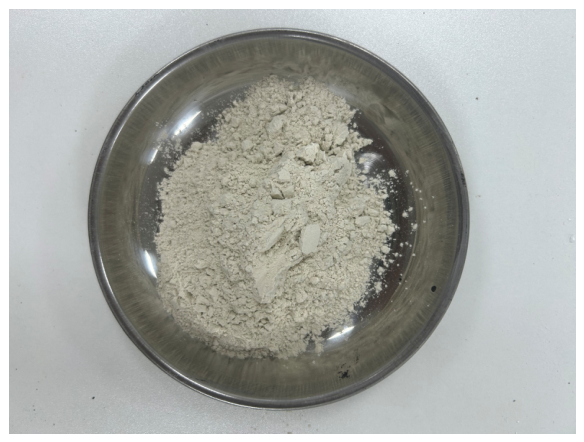
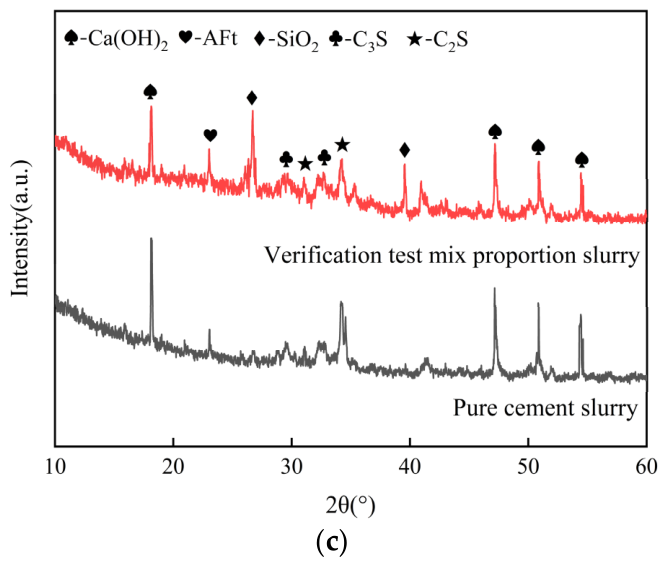
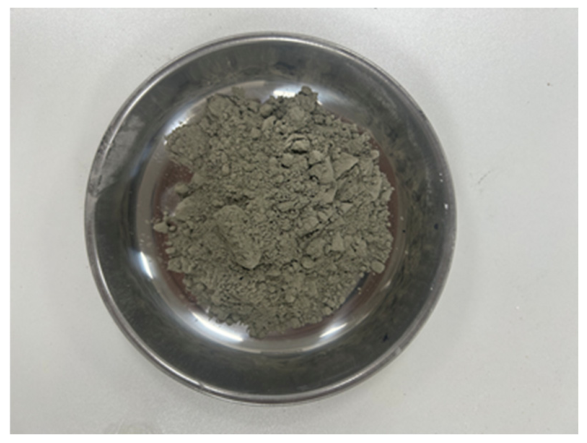
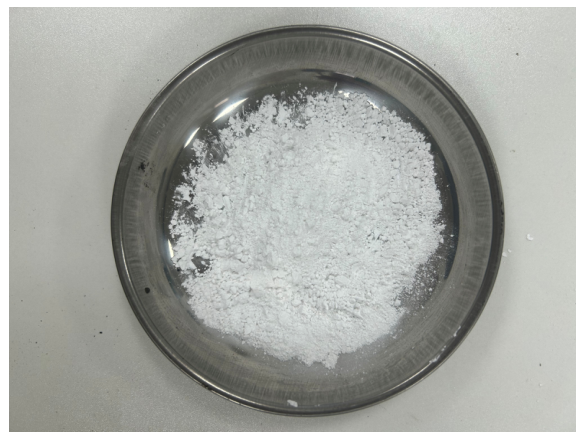
Based on the above background, this paper uses nano-silica, fly ash and bentonite to conduct composite modification on cement-based grouting materials, aiming to enhance their early strength while effectively improving the water separation and sedimentation characteristics, fluidity of the grout, and improving the impermeability and drying shrinkage performance, thereby enhancing the overall performance of cement-based grouting materials. Through macroscopic and microscopic tests to systematically evaluate the engineering performance of the composite modified grouting slurry, the feasibility of the composite modified grouting slurry technology and the superiority of the slurry performance are demonstrated.
This research is on the application of nano-silica, fly ash and bentonite in cement-based grouting materials. Many studies have also been conducted by scholars both at home and abroad. As a high-performance admixture for cement-based materials, nano-silica has attracted much attention for its favorable comprehensive performance when combined with other active mineral admixtures and for its performance regulation mechanism as a single cement replacement material. Zhang et al. [
13] conducted research indicating that the incorporation of nano-silica and silica fume in cement mortar can significantly enhance its resistance to chloride ion penetration. Through MIP analysis, it was found that the pozzolanic effect of nano-silica can optimize the pore structure and effectively reduce the number of harmful pores. Microscopic tests such as SEM and XRD further revealed that both can accelerate the hydration process of the slurry, and their pozzolanic reactions can generate more C-S-H gels. At the same time, due to their small particle size characteristics, they can also exert a grading filling effect, thereby significantly improving the compressive strength. Among them, the combined effect of 4% silica fume and 2% nano-silica was particularly significant, and the addition of nano-silica also helped to reduce the drying shrinkage of the slurry. Bahadori et al. [
14] investigated the impact of replacing part of cement with nano-silica on the performance of concrete. The results showed that concrete with 2% nano-silica replacing 20% cement exhibited superior comprehensive performance, with extremely low strength loss, a denser microstructure, and a significantly reduced water absorption rate. This mix ratio not only saved the amount of cement but also effectively enhanced the impermeability and drying shrinkage performance of the concrete. The study also found that as the amount of nano-silica added increased, the density of the concrete showed a downward trend.
Fly ash, as a widely available and highly performing mineral admixture, also exhibits remarkable effects in improving the workability and microstructure of cement-based materials. Related research has gradually delved from macroscopic performance to the microscopic mechanism level. Sharma et al. [
15] found that fly ash mainly has three functions: morphological effect, active effect, and micro-aggregate effect. Fly ash can consume Ca(OH)
2 in the interface transition zone, thereby promoting the development of the cement hydration process. Jiang Peng et al. [
16] confirmed through scanning electron microscopy that the hydration products of fly ash microbeads could crystallize and nucleate in the voids of cement particles, gradually forming fibrous crystals and effectively filling the pores, thereby enhancing the overall strength of the mixture. Wang Qin et al. [
17] compared and analyzed the volume fractions of tobermorite crystals and C-S-H gels in ordinary concrete and fly-ash-modified concrete based on BSE images, and found that the addition of fly ash microbeads could significantly increase the content of C-S-H gels. The SEM observation results further indicated that the introduction of fly ash microbeads led to a reduction in the size of tobermorite crystals in the concrete and a more uniform pore distribution. Akmalaiuly et al. [
18] systematically investigated the influence of fly ash fineness on the workability of fresh concrete, and pointed out that the morphology, particle size and physical properties of fly ash particles are the key factors for regulating the workability and water requirement of concrete. Maeijer et al. [
19] further analyzed the action laws of fly ash microsphere fineness on the rheological behavior of cement-based materials. The results showed that fly ash microspheres could significantly improve the fluidity of paste, mortar and concrete, and delivered favorable workability optimization when used together with high-efficiency water reducers.
Bentonite, as a natural layered silicate mineral, has been experimentally verified for its enhancing effects on the mechanical properties, impermeability and microstructure of cement mortar. Its main component is montmorillonite. Depending on the types of cations adsorbed in the interlayer domain of montmorillonite, it can be classified into various types such as sodium-based, calcium-based, magnesium-based and aluminum-based [
20,
21]. Hu et al. [
22] investigated the influence of bentonite on the pore structure and permeability of cement mortar. The results showed that when the bentonite content was 8%, the compressive strength, flexural strength, and water permeability of the mortar increased by 61.48%, 42.09%, and 76.47%, respectively. Sun et al. [
23] studied the effect of basalt fiber (BF) on the rheological properties and mechanical performance of bentonite cement slurry. The results indicated that when the fiber content was 0.6% and the length was 9 mm, the compressive strength and tensile strength of the slurry increased by 19.17% and 28.21%, respectively. BF forms a three-dimensional network structure in the slurry and effectively enhances the mechanical properties of the material through the bridging effect of the fibers. Liu et al. [
24] systematically investigated the effects of adding different proportions of sodium-based, calcium-based and magnesium-based bentonite to cement mortar on the workability, mechanical properties and impermeability of the mortar. They also analyzed the mechanism of action by combining microscopic and pore structure analysis. The study found that all three types of bentonite could significantly enhance the compressive strength, flexural strength and impermeability of the mortar. The improvement in performance became more pronounced as the amount of bentonite added increased. Among them, the magnesium-based bentonite had the best impermeability effect.
In conclusion, nano-silica, fly ash and bentonite have significant advantages in enhancing the stability and long-term impermeability and drying shrinkage performance of the slurry. However, most existing studies focus on the application of a single component in conventional mortars. Therefore, this paper, based on engineering practice, investigates the regulatory mechanism of the combined modification of nano-silica, fly ash and bentonite on the performance of grouting materials, aiming to improve the comprehensive performance of the grouting materials behind the wall and providing a basis for the optimized design of grouting materials behind the wall.
4. Test Results and Analysis of Impermeability and Drying Shrinkage Performance
To investigate how nano-silica, fly ash and bentonite affect the impermeability and drying shrinkage performance of cement-based grouting materials as composite modifiers, a systematic comparative test scheme was designed. A total of five groups of tests were set up, namely: pure cement slurry group (A), verification test mix proportion slurry group (B), only nano-silica addition group (C), only fly ash addition group (D), and only bentonite addition group (E). At the same time, in order to eliminate the influence of working performance differences on the impermeability and drying shrinkage performance of the materials, the dosage of the water reducer in each group of tests was adjusted to ensure that the fluidity of each slurry was the same. The test ratio is shown in
Table 22. The dosages of each component are listed in
Table 23. The test results of slurry fluidity are shown in
Table 24.
4.1. Impermeability Test
This experiment measures the impermeability performance of the slurry by using the impermeability pressure value. The test results showing the influence of each group of slurry on its impermeability performance are presented in
Table 25.
The results of the water resistance test show that, compared with the pure cement slurry, the water resistance performance of all the other groups has improved except for the group with only fly ash addition. The water resistance pressure of the group with only nano-silica addition (C) is 0.86 MPa, which is 17.81% higher than the benchmark group. This is attributed to its micro-filling effect and the formation of C-S-H gel by the reaction with volcanic ash, which fills the micropores. The water resistance pressure of the group with only fly ash addition (D) is 0.52 MPa, which is 28.77% lower than the benchmark group. This is due to the reduction in effective cementitious materials and insufficient early pozzolanic reaction. The water resistance pressure of the group with only bentonite addition (E) is 0.91 MPa, which is 24.66% higher than the benchmark group. This is because of the expansion filling effect of bentonite and the film-forming water-blocking effect. The verification test mix proportion slurry group (B) has the highest water resistance pressure of 1.05 MPa, which is 43.84% higher than the benchmark group. It significantly outperforms each of the single addition groups, indicating that the combination of nano-silica, fly ash, and bentonite has a significant synergistic water resistance effect.
4.2. Drying Shrinkage Performance Test
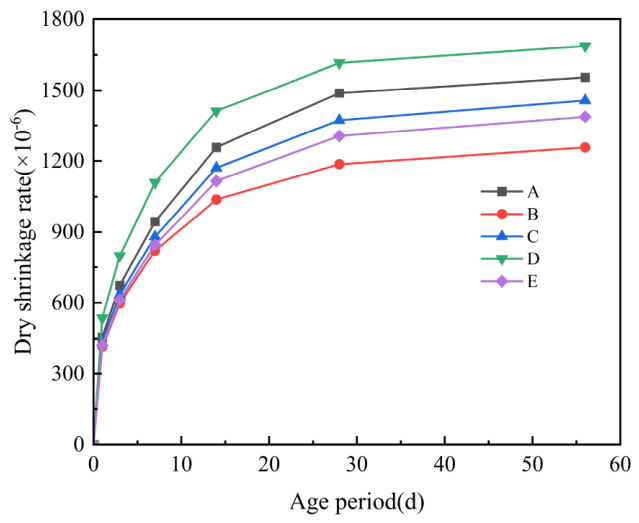
For the drying shrinkage test, three parallel specimens were prepared for each group, with a total of 15 specimens. The test results and corresponding standard deviations are presented in
Table 26. As shown in
Figure 14, the drying shrinkage values of each group increased with the extension of age, growing rapidly in the early stage and then slowing down in the later stage. The verification test mix proportion slurry group (B) had a drying shrinkage rate of 1257 × 10
−6 at 56 days, which was 19.16% lower than that of the pure cement group (A), and was significantly lower than that of each single-component addition group (C, D, E). Its excellent anti-shrinkage property is attributed to the comprehensive modification performance of the three components: nano-silica continuously undergoes pozzolanic reaction to generate low calcium-silica ratio C-S-H gel, filling the capillary pores and refining the pore structure; bentonite, with its layered structure, absorbs water and expands directly to compensate for chemical shrinkage and drying shrinkage; fly ash, with its spherical particles, exerts a micro-aggregate effect and optimizes the particle grading. Due to the single-functionality of each single-component addition group (the pure cement group has a loose structure, the nano-silica group lacks volume compensation, the fly ash group has slow early hydration, and the bentonite group has secondary shrinkage in the later stage), the dry shrinkage values of these groups are all higher than that of the verification test mix proportion compound addition group.
4.3. Limitations of This Study
In this experiment, the dosage of superplasticizer was adjusted differentially for Groups A to E to unify the fluidity of all slurries. The fluctuation of superplasticizer dosage ranging from 0.70% to 1.00% can alter the pore structure of slurry, thereby exerting additional influences on the drying shrinkage and impermeability of hardened specimens. Therefore, the performance differences among all groups arise from the combined effects of fly ash, nano-silica, bentonite and superplasticizer. The interference induced by superplasticizer cannot be completely eliminated, so the performance variations cannot be solely attributed to mineral-modified components. Meanwhile, the existing macroscopic performance test data fail to quantitatively separate the independent effect of a single component. In this manuscript, we only infer a synergistic improvement trend of the composite system based on the variation of macroscopic properties, and the experimental conditions to directly verify the component synergistic effect are not available at present.