


Abstract
This study deals with the influence of the pressure steaming process on color changes and acidity development in the heartwood and sapwood zones of pine wood (Pinus sylvestris L.). The hydrothermal treatment was carried out in a pressure autoclave under two different technological modes: Mode I (105 °C) and Mode II (120 °C) with exposure times of 6 and 18 h. The results showed that steaming causes a demonstrable decrease in wood moisture immediately after treatment, which is a consequence of self-evaporation during autoclave decompression. Colorimetric analysis in the color space CIE L*a*b* revealed a progressive darkening (decrease in L*) and a shift towards warmer, red-yellow shades (increase in a* and b*) in both anatomical zones. Optimal visual homogenization, in which the color contrast between sapwood and heartwood practically disappears, was mathematically achieved in Mode I after 18 h of exposure. In parallel, deep acidification occurred, when pH values decreased from initial native levels (4.7 for heartwood and 5.1 for sapwood) to a minimum of 4.0 and 4.1, respectively. Two-factor analysis of variance confirmed that steaming temperature and exposure time are statistically highly significant factors (p < 0.001 and p < 0.01, respectively) influencing the pH decrease, which is primarily caused by the thermal autohydrolysis of hemicelluloses and the subsequent release of free acetic acid. These findings provide key optimization parameters for industrial wood staining and subsequent surface treatment processes.
1. Introduction
Pine wood (Pinus sylvestris L.) is a key raw material for the European woodworking industry. Its wide use is conditioned not only by its high rate of expansion in our climate zone but also by its specific microstructure and chemical properties [1]. These characteristics make it a suitable basis for advanced technological processes and the application of surface treatments. In the paint sector, pine represents an important model for studying the interactions between the natural texture of wood and the requirements for precisely defined industrial parameters. The macroscopic structure of pine wood is defined by a significant anatomical differentiation between the sapwood zone and the heartwood [1,2]. While the sapwood shows a high degree of permeability and is optimal for deep impregnation, the heartwood is characterized by the presence of secondary metabolites [3,4]. The high concentration of resins and hydrophobic extractives in the core creates a natural diffusion barrier, which significantly modifies the sorption properties and can limit the adhesion of paint systems [5,6].
The density and characteristic texture of pine mesh determine not only the esthetic quality of the surface but also its optical stability. Reflectivity and color fastness are directly dependent on the photochemical resistance of the lignin–saccharide complex. Preservation of the visual integrity of the surface is thus conditioned by the chemical stability of the macromolecular components of wood, especially the resistance of lignin to degradation caused by UV radiation and oxidative processes [7,8].
Wood steaming is a controlled process of exposing the material to saturated water steam in pressure devices (autoclaves). The primary aim of this technology is to optimize rheological properties, eliminate internal stresses, and achieve the color homogeneity of wood. When exposed to temperatures in the range of 100–140 °C, the partial hydrolysis of cell wall biopolymers occurs. The process is initiated by the degradation of hemicelluloses associated with the release of water-soluble extractive substances. The kinetics of these transformations is determined by the thermal mode and exposure, leading to the progressive decomposition of polysaccharides. The autocatalytic effect of the released acetic and formic acids induces the oxidation of carbohydrates and pectins; the subsequent dehydration of pentoses produces 2-furaldehyde [1,9,10,11,12,13].
In parallel, structural transformations of lignin occur, characterized by the generation of free radicals and an increase in the concentration of phenolic hydroxyl groups. The synthesis of new chromophoric systems is manifested by a significant change (darkening) in the wood, which directly correlates with the modification of its visual, physical, and mechanical attributes [1,9,14,15].
The concentration of hydrogen ions in the wood mass, expressed as the pH value, is a critical indicator of the chemical reactivity of wood. The acidity of wood is directly proportional to the content of free and bound organic acids, which significantly affect not only the curing kinetics of coating systems and adhesives but also the natural resistance of the material to biotic agents. In its natural state, Pinus sylvestris L. exhibits a slightly acidic reaction, with the pH values of aqueous extracts typically ranging from 4.0 to 5.0. Compared to deciduous trees, pine is naturally more acidic, which is due to the specific composition of its extractive substances and resin acids (e.g., abietic acid). Steaming wood with saturated water steam induces deep chemical transformations that lead to progressive acidification of the tissues. This decrease in pH is primarily a consequence of deacetylation processes, in which free organic acids are released from hemicelluloses. This phenomenon is particularly significant in sapwood and heartwood, where the variable concentration of acids and extractives directly affects processing parameters and limits the possibilities of subsequent applications of surface treatments or adhesives [1,16,17,18,19,20,21,22].
The color characteristic of wood is among the dominant physical–esthetic parameters that directly determine its application in interior design and furniture making. The resulting visual perception is conditioned by the presence of chromophores in lignin, tannins, and specific extractives distributed in the cell matrix [23,24].
In the process of steaming wood, deep chemical transformations of these components occur, which induces a targeted change in the color of the wood. In pine wood, this process is specific due to the significant differentiation between sapwood and heartwood. The sapwood zone, due to the hydrolysis and oxidation of carbohydrates, acquires richer, honey-yellow-to-brownish shades, thus eliminating the original pale contrast. Heartwood, due to its high concentration of resins and pinosylvins, undergoes thermal stabilization and oxidation, which leads to uniform darkening and color unification with the sapwood. The resulting intensity and saturation of the pine color shade are directly dependent on the intensity of wood steaming, primarily on the temperature and length of exposure in the autoclave [25,26,27,28,29,30].
This study investigates the dynamics of moisture content, color shifts, and acidity (pH) in pine sapwood and heartwood during steaming with saturated steam at temperatures between 105 °C and 120 °C for up to 18 h. Furthermore, it analyzes the correlation between the total color difference ΔE* in the CIE L*a*b* space and wood pH while assessing the efficacy of the steaming process in harmonizing color differences between sapwood and heartwood.
2. Materials and Methods
2.1. Material Characteristics and Hydrothermal Treatment Methodology
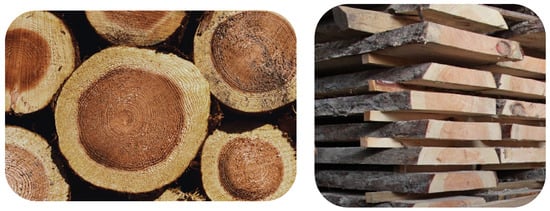
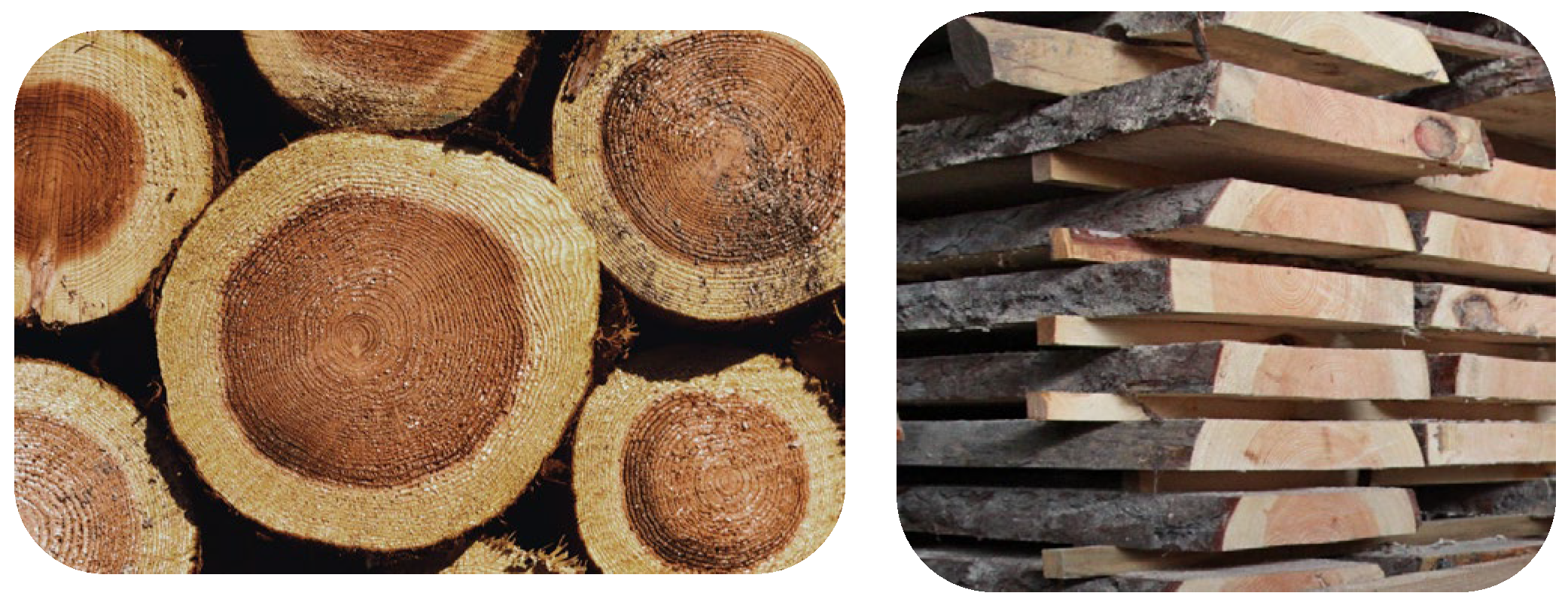
For the research, 25 pine trunks with a length of 6.3 m with a clearly visible sapwood and heartwood zone (Figure 1) were selected from the Štiavnické vrchy locality (GPS. 48.4161247 N, 18.8593111 E, Central Slovakia region).
Figure 1.
View of the front cut of pine wood before sawing (left); view of the sawn lumber before entering the autoclave (right).
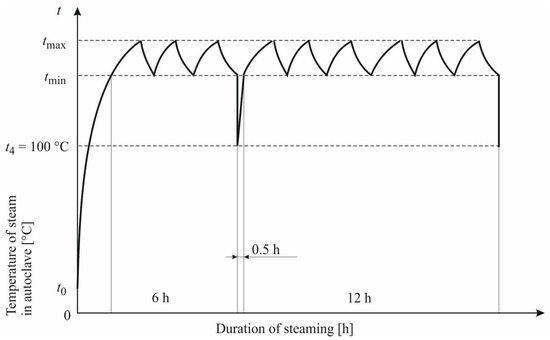
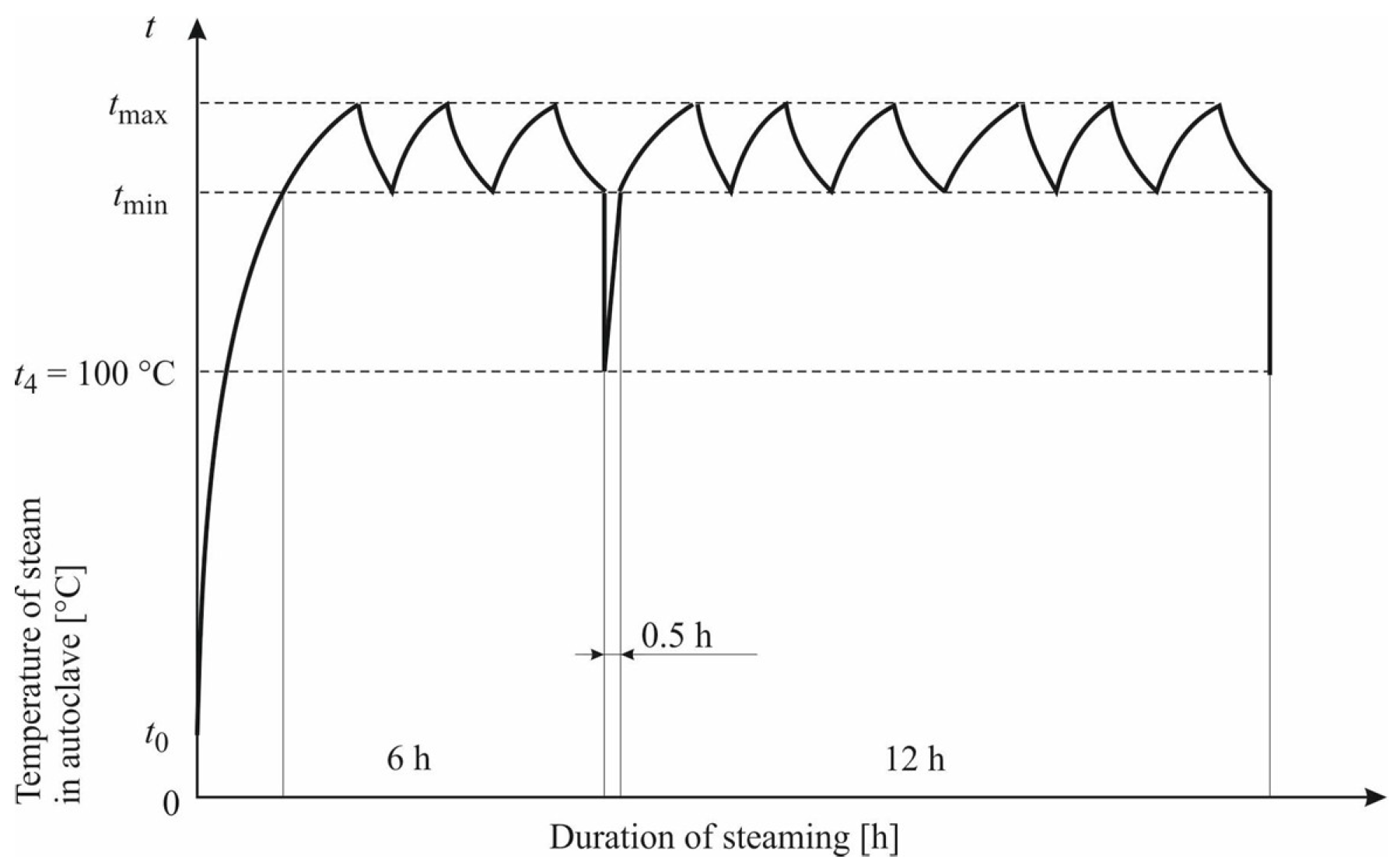
Center lumber measuring 300–400 mm in width and 50 mm in thickness was produced by edge trimming, followed by longitudinal sawing into two asymmetric sections. These sections were subsequently cross-cut to obtain 2 m long lumber specimens, which were randomly assigned into 5 groups of 15 pieces each. The first group served as the unsteamed control group. The remaining four groups were hydrothermally treated in a pressure autoclave (APDZ 240, Himmasch AD, Haskovo, Bulgaria) at Sundermann s.r.o. in Banská Štiavnica, Slovakia. The steaming was conducted under two distinct modes: Mode I at () and mode II at (). Individual groups were removed from the autoclave after treatment durations of and . The conditions for steaming pine core wood in a saturated water vapor environment, including the time intervals for sampling individual groups of steamed semi-finished products, are shown in the diagram in Figure 2.
Figure 2.
Diagram of the process of steaming pine wood.
The process of steaming pine wood was carried out in a pressure autoclave APDZ 240 (Himmasch AD, Haskovo, Bulgaria) at a saturated water steam pressure exceeding atmospheric pressure. Specific temperature modes intended for the modification of color properties are defined in Table 1. The operating temperature range, necessary to ensure the stability of the technological process, is defined by the boundary values tmax and tmin. The value t4 represents the temperature of saturated water steam in the autoclave after reduction to the atmospheric pressure level. This decrease allows for safe manipulation of the device and subsequent sampling of wood at specified time intervals after 6 and 18 h of steaming.
Table 1.
Technological parameters applied during the saturated steam treatment of pine wood specimens in an APDZ 240 pressure autoclave.
2.2. Determination of Wood Moisture and Technological Process of Drying Pine Lumber
The moisture content of pine wood was monitored before the wood steaming process using a random sampling method at 60 measuring points in the sapwood zone and 60 points in the heartwood. Similarly, the moisture content was measured after the steaming process in individual modes, namely at 30 points for sapwood and 30 points for the heartwood after cooling the material to ambient temperature. A resistance moisture meter of type FMD6 (Brookhuis Micro-Electronic, Almelo, The Netherlands) with penetration probes was used for the measurement.
After the drying process was completed, the moisture content of all processed blanks was verified by the gravimetric method in accordance with standards [31] on test specimens cut from individual groups (steamed sapwood and steamed heartwood). The drying technology of native and treated pine blanks was designed as low-temperature, with the priority goal of stabilizing and preserving the color shade acquired during steaming. Drying was carried out in a conventional hot-air dryer KAD 1x6 (KATRES s.r.o., Jihlava, Czech Republic) according to a two-stage regime: phase I.: At drying medium temperatures t = 35–40 °C and relative humidity φ = 70%–60%, free water evaporates. In this phase, there are no thermal changes in the lignin–saccharide complex of pine, which eliminates the risk of the degradation of chromophoric structures and ensures the color stability of the wood. Phase II.: Evaporation of bound water below the fiber saturation point took place at elevated temperatures t = 70–80 °C [32]. Surface treatment of all dried blanks was carried out by milling on a JET JPT-410HH machine (STROJE Slovensko, Banská Bystrica, Slovak Republic).
2.3. Wood Color Measurement in the Pine Wood Steaming Process
Surface color parameters of the control and steamed pine specimens were measured in the CIE L*a*b* color space using a Konica Minolta CR-10 Color Reader (Konica Minolta, Chiyoda, Japan). Color coordinates were recorded on the radial surfaces under a standard D65 illuminant through an 8 mm measuring aperture. Lightness (L*), red–green chromaticity (a*), and yellow–blue chromaticity (b*) values were determined at 60 randomized measuring points for sapwood and 60 points for heartwood in the unsteamed state. Following each steaming mode and duration, color measurements were repeated at the same sample volume (60 points per wood zone per treatment) to accurately quantify treatment-induced chromatic changes. The total color difference was calculated using the following equation:
where L*1, a*1, and b*1 are the color space coordinates measured on the surface of the dried and milled native wood specimens.
L*2, a*2, and b*2 are the color space coordinates of the dried and machined surface of the steamed wood specimens [33].
2.4. Measuring Wood Acidity in the Pine Wood Steaming Process
The acidity measurement of native and steamed pine wood samples (sapwood and heartwood) was carried out on a planed surface using a pH meter pH7110 using a special surface electrode SenTix Sur (XYLEM, Weilheim, Germany).
The pH determination methodology consisted of applying a surface contact electrode directly to the wood surface. Due to the low humidity of dry wood, a drop of distilled water was first applied to the measured area, which ensured the necessary electrolytic contact between the electrode and the sample surface. The stabilization of the measured value on the device display occurred after 180 to 240 s, after which the resulting acidity reading was read. This procedure was identical for all monitored groups of pine blanks. The acidity of pine wood was monitored before the steaming process at 60 measuring points in the sapwood zone and 60 points in the heartwood. Similarly, this process was repeated after steaming at each mode and time at 60 points for sapwood and 60 points for heartwood.
2.5. Statistical Processing of Measured Data
Mathematical modeling and graphical representations of the color and acidity (pH) parameters across the distinct pine wood zones were generated using TIBCO Statistica 14.0 (TIBCO Software Inc., Palo Alto, CA, USA). Differences between experimental groups were statistically evaluated using Student’s t-test and analysis of variance (ANOVA). Statistical significance was assessed based on the calculated p-values, establishing the confidence level for differences among the datasets investigated.
3. Results and Discussion
3.1. Moisture Content of Native and Steamed Pine Wood
The moisture values of pine sapwood and heartwood, measured before the steaming process, after the steaming process in a pressure autoclave, and after drying in a hot-air dryer, are shown in Table 2.
Table 2.
Changes in the average wood moisture content during the steaming and drying cycles (mean ± SD).
From the measured data, it is clear that the initial moisture content of native sapwood was higher (63.9 ± 3.9%) compared to heartwood (59.7 ± 3.7%). Hydrothermal treatment (steaming) caused a demonstrable decrease in moisture content before drying in both anatomical zones, while the intensity of this decrease was determined by the selected mode:
- -
- In Mode II, a more significant decrease in moisture content was recorded after steaming than in Mode I. In sapwood, moisture content decreased by 10.9% (to 56.9%) and in heartwood by up to 11.7% (to 52.7%).
- -
- After the final hot-air drying process, almost complete homogenization of moisture content occurred across all samples. The final moisture values ranged stably within a narrow range from 11.9% to 12.2%, which represents a total relative decrease in moisture after drying of 76.8% to 81.2% compared to the initial state.
The recorded decrease in wood moisture immediately after the steaming process (before self-drying in the kiln) is an expected phenomenon from the point of view of wood thermodynamics. This partial loss of water (by 7.7% to 11.7%) is caused by a form of self-evaporation. After the cycle in the pressure autoclave is completed and the pressure drops to atmospheric level, there is intensive evaporation of free water from the surface and lumens of the cells, using the accumulated heat that the wood mass absorbed during steaming with saturated water vapor. The fact that Mode II caused a steeper decrease in moisture in all cases indicates that this mode worked with a higher energy level (higher temperature and steam pressure). A higher temperature gradient in the wood leads to more intensive heat accumulation, which subsequently intensifies the kinetics of water evaporation during autoclave decompression. From the point of view of wood anatomy, it is interesting to compare the moisture loss after steaming between sapwood and heartwood. In Mode II, the heartwood showed a higher moisture loss (11.7%) than the sapwood (10.9%). This condition can be attributed to the different permeability and chemical composition of pine heartwood, which is rich in extractive substances. The hydrothermal environment of the autoclave can cause partial modification or redistribution of these accompanying substances in the capillary system of the core, thereby opening paths for an easier escape of water steam. Final drying confirmed that the previous steaming did not have a negative effect on the dryability of the material. On the contrary, the homogenization of the final moisture around the value ≈ 12% proves that the hydrothermal pretreatment contributes to the release of internal stresses in the wood and ensures a uniform diffusion of bound water during the subsequent hot-air drying [34,35,36].
3.2. Native and Steamed Pine Wood Color
The color of dry native pine sapwood in the color space CIE L*a*b* is characterized by a very light, white-yellowish hue, which was identified by the following coordinate values: L* = 84.8 ±1.5; a* = 7.9 ± 1.0; and b* = 21.9 ± 0.9 (Table 3). The natural color of pine heartwood shows a slightly darker and more pronounced red-yellow tone, which is described in the color space coordinates by the values: L* = 82.9 ± 1.5; a* = 9.3 ± 1.1; and b* = 23.8 ± 1.1 (Table 4). These initial values are in accordance with the optical characteristics reported for coniferous wood with heartwood formation [28,29,30,31,32,33,34,35,36,37].
Table 3.
Average values of chromaticity parameters (L*, a*, b*) of pine sapwood (mean ± standard deviation).
Table 4.
Average values of chromaticity parameters (L*, a*, b*) of pine heartwood (mean ± standard deviation).
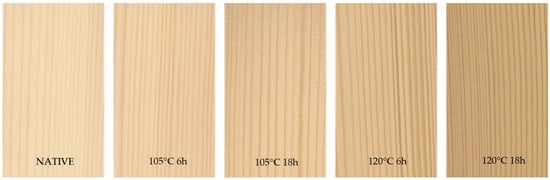
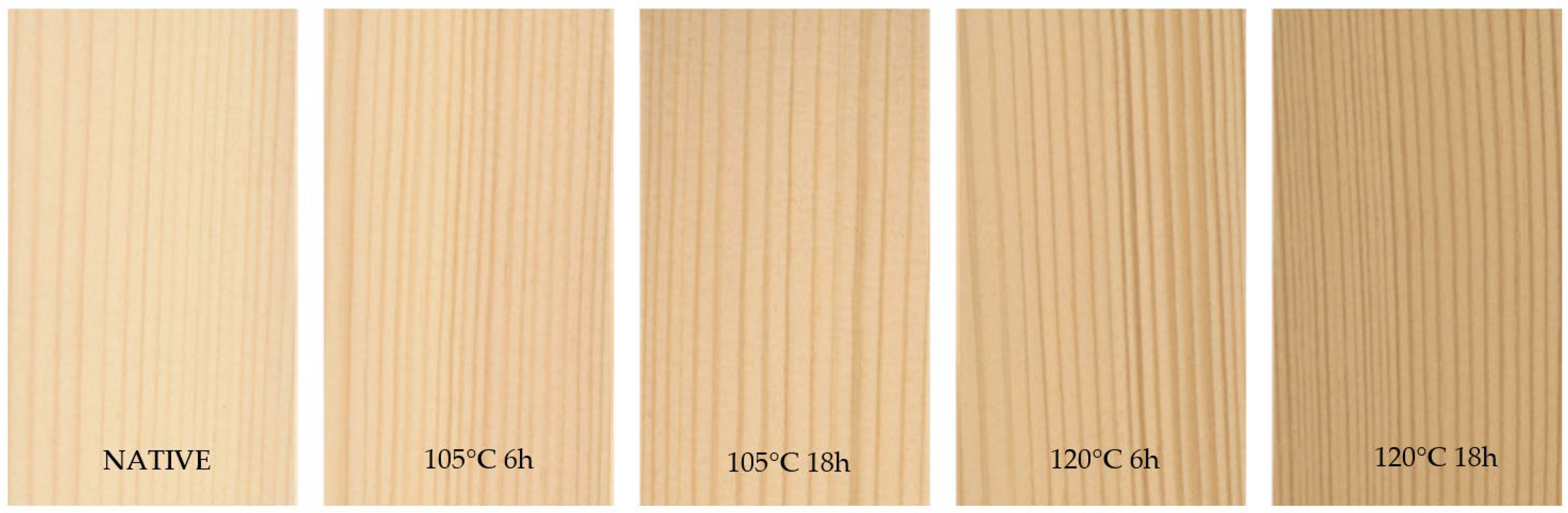
During the steaming process of pine wood, significant changes occur in its physical and chemical properties, with the kinetics and intensity of the coloration of steamed wood fundamentally depending on the steaming temperature, the duration of the process, and the specific anatomical zone, as shown in Figure 3.
Figure 3.
The color of pine wood in the steaming process.
Detailed information on the development of pine wood color coordinates during steaming focusing on the lightness coordinate L*, red chromaticity a*, and yellow chromaticity b* is comprehensively summarized in Table 3 for pine sapwood and Table 4 for pine heartwood.
Experimental values of the color of native and hydrothermally treated pine wood in the color space CIE L*a*b* summarized in Table 3 and Table 4 indicate a significant influence of temperature and steaming time on the resulting visual character of the material. The initial lightness of untreated wood was differentiated depending on the anatomical zone; sapwood showed a higher initial lightness L* = 84.8 ± 1.5 compared to heartwood L* = 82.9 ± 1.5, which represents a natural difference of 2.24%.
In Mode I (105 °C) after 6 h of steaming, the lightness of sapwood decreased by 2.71% (to 82.5) and that of heartwood by 3.02% (to 80.4). Extending the time to 18 h caused a total decrease in sapwood lightness by 16.27% (to 71.0) and heartwood lightness by 10.86% (to 73.9).
In Mode II (120 °C), the increase in temperature significantly accelerated the darkening process. After only 6 h, sapwood lightness decreased by 14.15% (to 72.8) and heartwood lightness by 10.98% (to 73.8). After 18 h, the decrease in sapwood reached 27.95% (to 61.1 ± 0.9) and in heartwood 18.34% (to 67.7 ± 1.6).
The red spectrum coordinate a* showed a linearly increasing trend in both zones, which visually documents the transition to warm brown shades. Native heartwood had an initial red color fraction higher by 17.72% (a* = 9.3) than sapwood (a* = 7.9). In Mode II at 18 h, the a* value increased by 82.28% in sapwood (from 7.9 to 14.4 ± 0.7) and by 46.24% in heartwood (from 9.3 to 13.6 ± 0.7).
The yellow shade showed a consistent increase across both modes. In sapwood, the b* value increased by 22.37% (from 21.9 to 26.8 ± 0.8) after 18 h in Mode II. For heartwood, an overall increase of 15.13% (from 23.8 to 27.4 ± 1.0) was recorded.
Analysis of variance (ANOVA) confirmed that the factors “steaming temperature” and “exposure time” have a statistically highly significant effect (p < 0.001) on the change in all three color coordinates (L*, a*, b*).
Lightness (L*): Testing showed that the change in lightness of sapwood between 6 h (L* = 82.5) and 18 h (L* = 71.0) in Mode I is statistically significant (p < 0.05). An even more dramatic statistical shift was recorded in Mode II (120 °C).
Chromaticity (a* and b*): For the red color coordinate a* in heartwood, the test showed an interesting fact: the difference between 6 h (a* = 11.4) and 18 h (a* = 11.9) in Mode I is not statistically significant (p > 0.05). This means that the extension of steaming at a temperature of 105 °C no longer significantly increases the proportion of red shades in the heartwood. On the contrary, in Mode II at 120 °C, there is a statistically significant increase up to a value of 13.6 ± 0.7, which confirms the existence of a higher temperature at which deeper thermal changes in the heartwood chromaticity are activated.
While in the native state, the statistical difference in the mean lightness values between sapwood and heartwood was demonstrable (t-test; p < 0.05) after the application of Mode I (at 18 h) their statistical intersection occurred. The lightness values of sapwood (71.0 ± 0.9) and heartwood (73.9 ± 1.5) show an overlap of confidence intervals, which from the point of view of mathematical statistics defines this point as the point of optimal visual homogenization, when the human eye ceases to perceive the boundary between the sapwood and heartwood of pine [28,37,38].
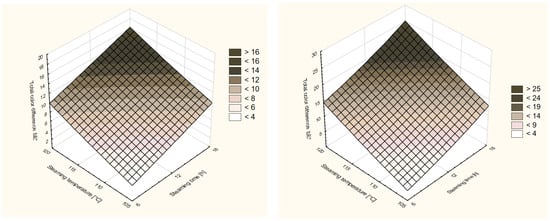
The dependence of the total color difference in heartwood and sapwood (ΔE*) on the independent variables—steaming time (x) and steaming temperature (y)—is graphically interpreted using 3D graphs (Figure 4.). Based on the measured values, mathematical Equations (1) and (2) were determined by a statistical program.
where x = steaming time and y = steaming temperature.
Figure 4.
3D graphs of total color difference in heartwood (left) and sapwood (right).
It is clear from both graphs that the steaming temperature is a more dominant factor than the time itself. While increasing the time at a low temperature (105 °C) only increases ΔE* gradually, increasing the temperature to 120 °C causes a sharp increase in the color change even at shorter exposure times.
This phenomenon is in accordance with the Arrhenius law of chemical kinetics, where a higher temperature provides the necessary activation energy to accelerate hydrolytic and oxidative reactions. During steaming, hemicelluloses are degraded, acetic acid is released (which further acts as a catalyst for auto-hydrolysis), and lignin structures are decomposed or condensed. The result of these processes is the formation of new conjugated systems (chromophores) that absorb light in the visible spectrum, which is macroscopically manifested by darkening and changing the color shade of the wood.
The differences in the achieved maximum ΔE* between both graphs clearly indicate that in the industrial control of the steaming process, it is necessary to approach individually and it is not possible to steam several types of wood at the same time.
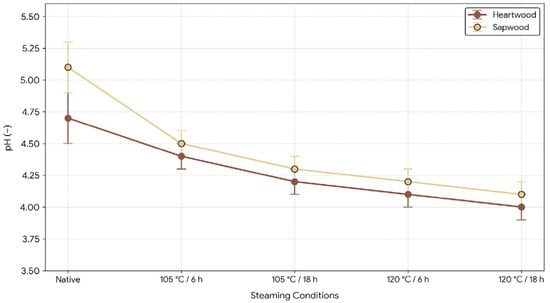
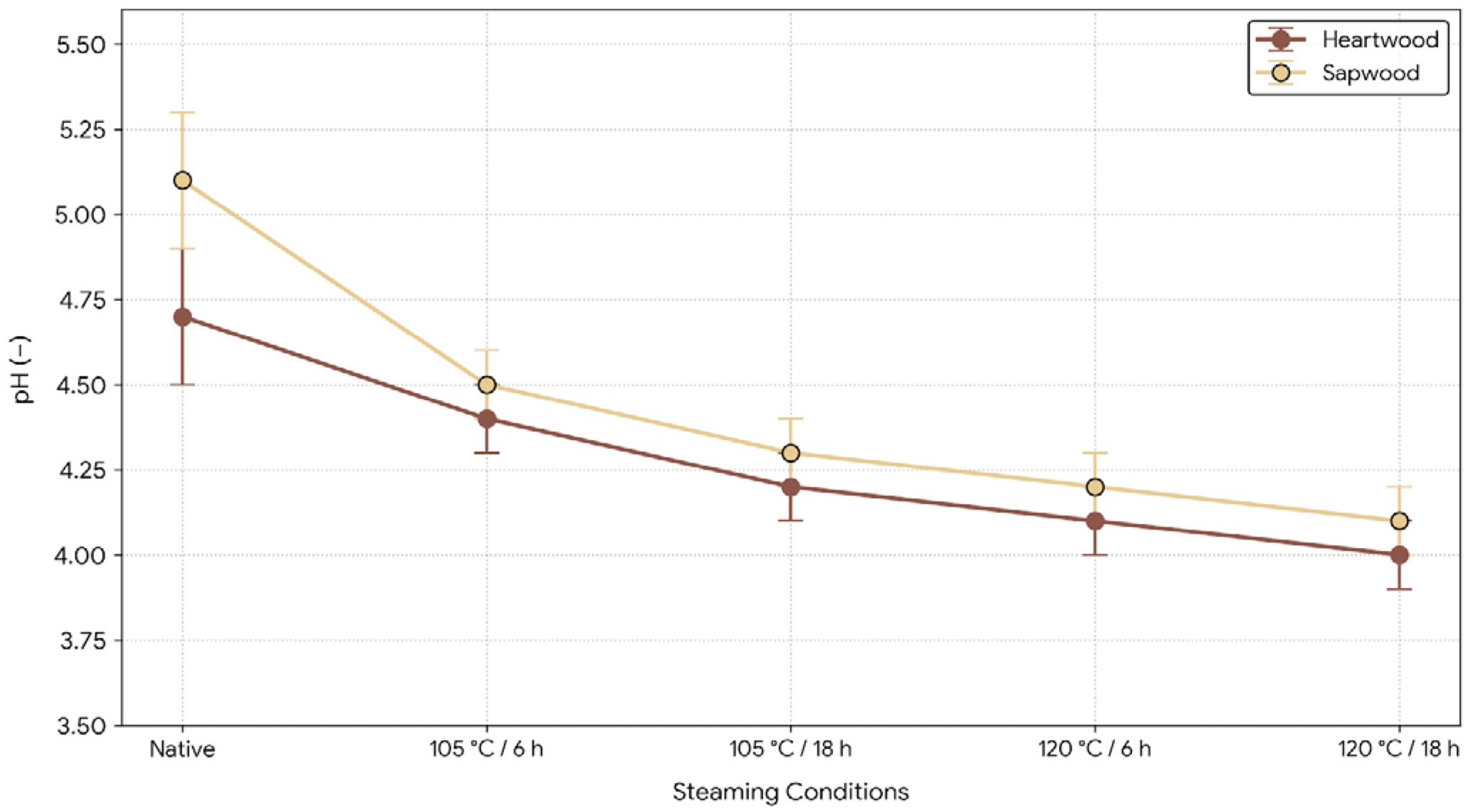
The acidity values of pine wood measured before the steaming process with saturated water vapor and during the technological process measured in both modes and in time intervals of 6 and 18 h after are shown in Figure 5.
Figure 5.
Influence of steaming conditions on pine wood pH.
Figure 5 shows a consistent trend of decreasing pH (increasing acidity) with increasing temperature and increasing steaming time for both anatomical zones of the trunk.
The initial (native) wood showed different levels of acidity between the heartwood and sapwood. Heartwood had an average pH of 4.7, while sapwood was less acidic with a value of 5.1. The higher acidity of the native heartwood is a natural accompanying phenomenon of the steaming process, during which parenchyma cells die and extractive substances accumulate, mainly resin acids and phenolic compounds, which lower the pH. A slightly higher variability of the data was recorded for both types of samples, which reflects the natural heterogeneity of the wood mass before modification.
After steaming, there was an immediate decrease in pH even under the mildest conditions (105 °C/6 h) to a value of 4.4 for the heartwood and 4.5 for the sapwood. With the extension of time to 18 h and the increase in temperature to 120 °C, the decrease in pH continued until the final minimum, which was reached with the combination of 120 °C/18 h (pH = 4.0 for the heartwood and pH = 4.1 for the sapwood). An interesting finding is that although sapwood maintained a slightly higher pH than the heartwood in all phases, the overall decrease in pH was more pronounced in the sapwood (ΔpH = 1.0) compared to the heartwood (ΔpH = 0.7). This suggests that the saccharide components of the sapwood (richer in free hemicelluloses) undergo hydrolysis more intensively in the first phase than the heartwood saturated with extractives. The standard deviation stabilized at 0.1 after steaming, which confirms that the hydrothermal process acts on the wood mass evenly and homogenizes its chemical properties.
The decrease in pH during steaming is primarily a consequence of the thermal autohydrolysis of hemicelluloses. During the exposure of wood to increased temperature and humidity, the deacetylation of polyoses occurs (primarily galactoglucomannans, which are the dominant non-cellulosic saccharide of coniferous wood). Free acetic acid is released from the acetyl groups, which passes into the solution and dramatically increases the concentration of oxonium ions H3O+, which is macroscopically manifested by a decrease in pH. This process has an autocatalytic character—the released acid further accelerates the hydrolytic cleavage of other polysaccharide chains and the degradation of the lignin–saccharide complex [39,40,41,42].
This increase in acidity is closely correlated with color changes ΔE*, as the acidic environment stimulates the dehydration of pentoses and hexoses to furfural and 5-hydroxymethylfurfural, which subsequently condense with lignin and other components to form dark chromophoric structures.
To assess the degree of influence of technological parameters (steaming temperature, steaming time) and their mutual interaction on the resulting acidity (pH) of both zones of pine wood, a two-factor analysis of variance (ANOVA) was applied. The results confirmed that the mechanism of changes is highly dependent on both monitored variables:
- -
- Effect of temperature: For both heartwood and sapwood, the steaming temperature is the most significant factor (p < 0.001). Increasing the temperature from 105 °C to 120 °C induces a sharp increase in the concentration of acidic components, which confirms that the activation energy required for the deacetylation of hemicelluloses is primarily dependent on the thermal degree of exposure.
- -
- Effect of time: Steaming time was also evaluated as a statistically highly significant factor (p < 0.01). Extending the exposure time allows for the continuous generation of acetic acid, which leads to a gradual deepening of acidity in both anatomical parts of the stem.
- -
- Interaction of factors (temperature and time): The mutual interaction of both factors turned out to be statistically insignificant (p > 0.05). This result is scientifically important, as it indicates that the effect of time on the decrease in pH has the same (parallel) course regardless of whether steaming takes place at 105 °C or 120 °C. The action of both factors is therefore additive, not synergistic.
4. Conclusions
In this study, the effects of pressure steaming parameters (temperature and time) on moisture dynamics, color coordinates, and pH changes in pine sapwood and heartwood (Pinus sylvestris L.) were comprehensively evaluated. Based on experimental results and statistical analyses, the following main conclusions can be formulated:
- -
- The steaming process induces an immediate decrease in wood moisture content (by 7.7% to 11.7%) immediately after the pressure release in the autoclave due to thermodynamic self-evaporation using accumulated heat.
- -
- Increasing the steaming temperature from 105 °C to 120 °C and extending the time to 18 h significantly accelerated the wood darkening process. While in the native state, there is a demonstrable optical difference between sapwood and heartwood; Mode I (105 °C) at 18 h exposure represents the optimal technological point for visual homogenization. At this point, the lightness confidence intervals (L*) overlap, making the human eye unable to perceive the boundary between the sapwood and heartwood zones.
- -
- Hydrothermal treatment causes progressive acidification of the wood tissue. Native heartwood is naturally more acidic than sapwood due to the concentration of resin acids and accompanying substances. After steaming, the pH value in both zones decreased to final minima of 4.0 (heartwood) and 4.1 (sapwood). This decrease is chemically caused by thermal autohydrolysis and the deacetylation of hemicelluloses (especially galactoglucomannans), which releases free acetic acid, increasing the concentration of hydrogen ions, namely H3O+.
- -
- Two-factor analysis of variance (ANOVA) confirmed that both steaming temperature (p < 0.001) and exposure time (p < 0.01) are highly significant factors determining the increase in acidity, with their effect being additive, without synergistic interaction (p > 0.05). Since heartwood and sapwood show different chemical sensitivities and different maxima of the total color difference (ΔE*), it is essential to approach both zones individually in industrial management to ensure optimal adhesion of subsequent coating systems and surface quality.
Author Contributions
Conceptualization, M.D. and A.B.; methodology, M.D.; software, A.B.; validation, M.D., A.B. and L.N.; formal analysis, M.D.; investigation, M.D.; resources, M.D. and L.N.; data curation, M.D. and L.N.; writing—original draft preparation, M.D.; writing—review and editing, M.D., A.B. and L.N.; visualization, M.D., A.B. and L.N.; supervision, M.D.; project administration, A.B.; funding acquisition, A.B. All authors have read and agreed to the published version of the manuscript.
Funding
This paper was prepared within the grant project: VEGA 1/0423/25 as the result of the work of the authors and the considerable assistance of the agencies.
Institutional Review Board Statement
Not applicable.
Data Availability Statement
The data presented in this study are available upon request from the corresponding author.
Conflicts of Interest
The authors declare no conflicts of interest.
References
- Fengel, D.; Wegener, G. Wood: Chemistry, Ultrastructure, Reactions; Walter de Gruyter: Berlin, Germany, 2003; pp. 25–60. [Google Scholar]
- Rowell, R.M. Handbook of Wood Chemistry and Wood Composites, 2nd ed.; CRC Press: Boca Raton, FL, USA, 2012; pp. 55–92. [Google Scholar]
- Hill, C.A.S. Wood Modification: Chemical, Thermal and Other Processes; John Wiley & Sons: Chichester, UK, 2006; pp. 15–43. [Google Scholar]
- Ekeberg, D.; Flæte, P.-O.; Eikenes, M.; Fongen, M.; Naess-Andresen, C.F. Qualitative and quantitative determination of extractives in heartwood of Scots pine (Pinus sylvestris L.) by gas chromatography. J. Chromatogr. A 2006, 1109, 267–272. [Google Scholar] [CrossRef] [Scilit] [PubMed]
- Budakçı, M.; Saygin, E.; Şenol, S. ffect of resin cleaning process on adhesion strength of water-based varnishes. BioResources 2019, 14, 1317–1332. [Google Scholar] [CrossRef] [Scilit]
- Bergström, B. Chemical and structural changes during heartwood formation in Pinus sylvestris. Forestry 2003, 76, 45–53. [Google Scholar] [CrossRef] [Scilit]
- George, B.; Suttie, E.; Merlin, A.; Deglise, X. Photodegradation and photostabilisation of wood—The state of the art. Polym. Degrad. Stab. 2005, 88, 268–274. [Google Scholar] [CrossRef] [Scilit]
- Tolvaj, L.; Mitsui, K. Light source dependence of the photo-induced discoloration of wood. J. Wood Sci. 2005, 51, 468–473. [Google Scholar] [CrossRef] [Scilit]
- Sundqvist, B.; Karlsson, O.; Westremark, U. Determination of formic-acid and acid concentrations formed during hydrothermal treatment of birch wood and its relation to color, strength and hardness. Wood Sci. Technol. 2006, 40, 549–561. [Google Scholar] [CrossRef] [Scilit]
- Willems, W.; Altgen, M.; Militz, H. Comparison of EMC and durability of heat treated wood from high versus low water vapour pressure reactor systems. Int. Wood Prod. J. 2015, 6, 12–18. [Google Scholar] [CrossRef] [Scilit]
- Dzurenda, L. Colouring of Beech Wood During Thermal Treatment Using Saturated Water Steams. Acta Fac. Xylologiae Zvolen 2014, 56, 13–22. [Google Scholar]
- Dzurenda, L.; Dudiak, M. Homogenization of the Color of Beech Sapwood and False Heartwood by the Steaming Process. Forests 2024, 15, 1009. [Google Scholar] [CrossRef] [Scilit]
- Vilkovský, P.; Vilkovská, T.; Klement, I.; Čunderlík, I. The Analysis Effect of Selected Factors on the Shear Strength of Woodbark at Different Wood Species. Forests 2022, 13, 637. [Google Scholar] [CrossRef] [Scilit]
- Hon, N.S.D.; Shiraishi, N. Wood and Cellulosic Chemistry; CRC Press: Boca Raton, FL, USA, 2001; p. 928. [Google Scholar]
- Výbohová, E.; Geffertová, J.; Geffert, A. Impact of steaming on the chemical composition of maple wood. BioResources 2018, 13, 5862–5874. [Google Scholar] [CrossRef] [Scilit]
- Rowell, R.M. Handbook of Wood Chemistry and Wood Composites, 2nd ed.; CRC Press: Boca Raton, FL, USA, 2012; 703p. [Google Scholar]
- Geffert, A.; Geffertová, J.; Dudiak, M. Direct method of measuring the pH value of wood. Forests 2019, 10, 852. [Google Scholar] [CrossRef] [Scilit]
- Trübswetter, P. Wood Modification by Steaming. Holztechnologie 2006, 47, 16–21. [Google Scholar]
- Kosíková, B.; Čunderlík, I.; Kúdela, J.; Kačík, F. Chemical Changes in Wood During Steaming. Wood Res. 1999, 44, 35–42. [Google Scholar]
- Irle, M. pH and Why You Need to Know it. Available online: http://www.wbpionline.com/features/ph-and-why-you-need-to-know-it/ (accessed on 20 August 2012).
- Wang, W.; Cao, J.; Cui, F.; Wang, X. Effect of pH on Chemical Components and Mechanical Properties of Thermally ModifiedWood. Wood Fiber Sci. 2012, 44, 46–53. [Google Scholar]
- Faix, O.; Labbe, H. Characterization of wood chemical changes in steaming and their effects on color and other properties. Holzforschung 2002, 56, 651–657. [Google Scholar]
- Tolvaj, L.; Molnár, S.; Varga, D. Range of Color Changes of Beech Wood in the Steaming Process. BioResources 2009, 4, 1335–1345. [Google Scholar]
- Molnar, S.; Tolvaj, L. Colour homogenisation of different wood species by steaming. In Interaction of Wood with Various Forms of Energy; Technical University: Zvolen, Slovakia, 2002; pp. 119–122. [Google Scholar]
- Lichtenegger, H.; Müller, U. Wood and Wood Products: A Guide for Architects and Builders; Springer: Berlin/Heidelberg, Germany, 2010. [Google Scholar]
- Tiemann, L.K.; Müller, U.; Schneider, P. The influence of steaming on color change in beech wood. Eur. J. Wood Wood Prod. 2013, 71, 597–603. [Google Scholar]
- Tolvaj, L. Applications of Colour Measurement in Wood Research. In Optical Properties of Wood; Smart Sensors, Measurement and Instrumentation; Springer: Cham, Switzerland, 2004; Volume 45. [Google Scholar]
- Meints, T.; Teischinger, A.; Stingl, R.; Hassmann, C. Wood colour of central European wood species: CIELAB characterisation and colour intensification. Eur. J. Wood Prod. 2017, 75, 499–509. [Google Scholar]
- Dudiak, M. Cross-correlation of color and acidity of wet beech wood in the process of thermal treatment with saturated steam. Wood Res. 2021, 66, 105–116. [Google Scholar] [CrossRef] [Scilit]
- Dudiak, M.; Výbohová, E.; Dzurenda, L. Color Stability and Photo-Degradation of Steamed Beech Wood (Fagus sylvatica L.) with False Heartwood Under UV Exposure. Polymers 2026, 18, 984. [Google Scholar] [CrossRef] [Scilit] [PubMed]
- STN EN 13183-1; Moisture Content of a Piece of Sawn Timber–Part1: Determination by Oven Dry Method. Slovenian Institute for Standardization: Ljubljana, Slovenia, 2003.
- Dzurenda, L. Mode for hot air drying of steamed beech blanks while keeping the colors ac-quired in the steaming process. Acta Fac. Xylologiae Zvolen 2022, 64, 81–88. [Google Scholar]
- ISO/CIE 11664-4:2019; Colorimetry—Part 4: CIE 1976 L*a*b* Colour Space. International Organization for Standardization: Geneva, Switzerland, 2019.
- Oner, U.; Nadir, A. The effect of steaming on equilibrium moisture content in beech wood (Fagus orientalis Lipsky). For. Prod. J. 2014, 54, 90–93. [Google Scholar]
- Klement, I.; Vilkovský, P.; Vilkovská, T. The Influence of Wood Moisture Content on the Processes of Freezing and Heating. Appl. Sci. 2021, 11, 6099. [Google Scholar] [CrossRef] [Scilit]
- Barański, J. Moisture Content During and After High and Normal Temperature Drying Processes of Wood. Dry. Technol. 2017, 36, 751–761. [Google Scholar] [CrossRef] [Scilit]
- Suchta, A.; Barański, J.; Vilkovská, T.; Klement, I.; Vilkovský, P. The impact of drying conditions on the surface color changes of pine wood. BioResources 2024, 19, 656–669. [Google Scholar]
- Klement, I.; Vilkovská, T.; Baranski, J.; Konopka, A. The impact of drying and steaming processes on surface color changes of tension and normal beech wood. Dry. Technol. 2018, 36, 1490–1497. [Google Scholar] [CrossRef] [Scilit]
- Timar, M.C.; Varodi, A.; Hacibektsoglu, M.; Campean, M. Color and FTIR analysis of chemical changes in beech wood (Fagus silvatica L.) after light steaming and heattreatment in two different environments. BioResources 2016, 11, 8325–8343. [Google Scholar] [CrossRef] [Scilit]
- Tjeerdsma, B.; Militz, H. Chemical changes in hydrothermal treated wood: FTIR analysis of combined hydrothermal and dry heat-treated wood. Eur. J. Wood Wood Prod. 2005, 63, 102–111. [Google Scholar] [CrossRef] [Scilit]
- Bonifazi, G.; Calienno, L.; Capobianco, G.; Monaco, A.L.; Pelosi, C.; Picchio, R.; Serranti, S. Modeling color and chemical changes on normal and red heart beech wood by reflectance spectrophotometry, Fourier Transform Infrared spectroscopy and hyperspectral imaging. Polym. Degrad. Stab. 2015, 113, 10–21. [Google Scholar] [CrossRef] [Scilit]
- Hofmann, T.; Tolvaj, L.; Visi-Rajczi, E.; Varga, D. Chemical changes of steamed timber during short-term photodegradation monitored by FTIR spectroscopy. Eur. J. Wood Prod. 2022, 80, 841–849. [Google Scholar] [CrossRef] [Scilit]

Disclaimer/Publisher’s Note: The statements, opinions and data contained in all publications are solely those of the individual author(s) and contributor(s) and not of MDPI and/or the editor(s). MDPI and/or the editor(s) disclaim responsibility for any injury to people or property resulting from any ideas, methods, instructions or products referred to in the content. |
© 2026 by the authors. Licensee MDPI, Basel, Switzerland. This article is an open access article distributed under the terms and conditions of the Creative Commons Attribution (CC BY) license.