


Abstract
The long-term exposure of asphalt pavement to ultraviolet radiation causes significant performance degradation and reduces its service life. To enhance the UV resistance of asphalt, nanocomposite modifiers have been incorporated through mechanical blending. However, their effectiveness has been largely limited by poor component uniformity. To address this issue, UV-resistant antioxidant nano-TiO2 was employed to modify the UV-shielding of layered porous carbon (PC), resulting in the synthesis of nano-TiO2 intercalated PC (TiO2/PC). The PC nanosheet was modified by TiO2 nanoparticles via in situ growth, significantly improving the dispersion homogeneity of TiO2. Comprehensive characterization (SEM/EDS/FT-IR/XPS) confirmed the successful synthesis of TiO2/PC with well-defined interfacial bonding. Compared to control samples (PC, TiO2, and TiO2 + PC), the asphalt modified by TiO2/PC-2 composite demonstrated superior UV aging resistance, lower physical aging indices and reduced rheological aging parameters. Moreover, TiO2/PC modifier prominently suppressed the formation of oxidative groups (C=O/S=O), improved the colloidal stability, and delayed the sol–gel transition of the modified asphalt. The synergistic UV shielding mechanism was attributed to the enhanced UV absorption of TiO2, multi-reflection and scattering within the PC matrix, and the radical scavenging capabilities of both components. These results provide new design insights for developing anti-UV aging modifiers for asphalt pavements.
1. Introduction
The rapid advancement of transportation infrastructure has led to an increasing demand for durable, safe, and sustainable pavement systems. Extending the service life of asphalt pavements has therefore become a critical objective in modern road engineering [1]. Asphalt aging is widely recognized as one of the primary factors limiting pavement durability, as it results in increased stiffness and brittleness, reduced stress relaxation capacity at low temperatures, and weakened adhesion between asphalt and aggregates [2,3]. These changes ultimately lead to severe pavement distresses such as cracking, raveling, delamination, and potholing, thereby compromising road safety and increasing maintenance costs and environmental burdens. Consequently, improving the aging resistance of asphalt materials is essential for achieving long-life and low-carbon pavement systems [4,5].
Asphalt aging is governed by two dominant mechanisms: thermal-oxidative aging and photo-oxidative aging induced by ultraviolet (UV) radiation [6]. While extensive studies have focused on thermal aging under high-temperature conditions, UV-induced aging has received comparatively less attention despite its critical role in regions with strong solar radiation and high UV exposure. UV radiation accelerates the formation of oxygen-containing functional groups (e.g., carbonyl (C=O) and sulfoxide (S=O)), leading to irreversible chemical hardening and deterioration of rheological properties. To mitigate these effects, various modifiers have been incorporated into asphalt systems, among which nanomaterials have demonstrated significant advantages due to their high specific surface area, tunable electronic structures, and multifunctional properties [7,8,9].
In particular, nanomaterials can enhance asphalt performance through multiple mechanisms, including (i) inhibiting oxygen diffusion via barrier effects, (ii) improving thermal stability through phonon scattering, and (iii) absorbing and attenuating UV radiation through bandgap-related electronic transitions [10,11]. Transition metal oxide nanoparticles such as ZnO, Fe2O3, and TiO2 exhibit strong UV absorption capabilities and have been widely explored for improving UV-aging resistance of asphalt binders [12]. However, conventional incorporation methods based on direct physical blending often lead to nanoparticle agglomeration due to high surface energy, resulting in poor dispersion and limited effectiveness in practical applications.
Carbon-based nanomaterials have recently attracted attention as promising asphalt modifiers owing to their unique structural and physicochemical properties. Coal tar pitch (CTP), a carbon-rich by-product accounting for more than 55% of coal tar, can be converted into functional carbon materials through controlled thermal transformation processes [13,14]. Among these, porous carbon (PC) nanosheets exhibit large specific surface area, high structural stability, and excellent adsorption capability. When incorporated into asphalt, PC nanosheets can form a lamellar barrier structure that effectively prolongs the diffusion path of oxygen molecules and reduces the volatilization of light components, thereby slowing down thermal-oxidative aging [15,16]. Nevertheless, the intrinsic UV-shielding capability of PC alone is relatively limited, which restricts its effectiveness in mitigating photo-oxidative degradation.
To overcome the limitations of single-component modifiers, recent studies have explored composite systems to achieve synergistic performance enhancement [17]. However, most existing approaches still rely on simple physical mixing of different modifiers, which cannot fundamentally resolve the issue of interfacial incompatibility and nanoparticle aggregation. Therefore, developing structurally integrated nanocomposites with enhanced dispersion and multifunctional properties remains a key challenge.
In this study, a novel TiO2-intercalated porous carbon nanocomposite (TiO2/PC) was designed and synthesized to improve the UV-aging resistance of asphalt. First, two-dimensional PC nanosheets with controlled microstructure were prepared from coal tar pitch via a molten salt-assisted method using NaCl as the reaction medium. Subsequently, nano-TiO2 particles were grown in situ on the surface of PC nanosheets through a one-step hydrothermal process using tetrabutyl titanate as the precursor, forming a uniformly distributed TiO2/PC composite with strong interfacial bonding. The morphology, elemental distribution, and surface functional groups of the composite were systematically characterized using SEM, BET, Raman spectral, FT-IR, and XPS techniques.
To evaluate the effectiveness of the proposed modifier, asphalt binders modified with PC, TiO2, their physical blend (TiO2 + PC), and TiO2/PC composites were comparatively investigated. The aging resistance was quantitatively assessed using multiple performance indicators, including physical aging indices (e.g., penetration and softening point changes), rheological aging indices derived from dynamic shear rheometer (DSR) measurements, chemical functional group indices (C=O and S=O) obtained from FT-IR analysis, and molecular weight distribution characteristics. In addition, the evolution of colloidal stability and sol–gel transition behavior of asphalt was analyzed to reveal the underlying aging mechanisms.
The results demonstrate that the TiO2/PC composite, particularly at an optimized composition (TiO2/PC-2), significantly outperforms both single-component modifiers and their physical mixtures. Specifically, the composite-modified asphalt exhibits lower aging indices, reduced formation of oxidative functional groups, improved colloidal stability, and delayed structural transformation during UV aging. These improvements are attributed to the synergistic effects of (i) efficient UV absorption by TiO2 nanoparticles, (ii) multiple reflection and scattering of UV light within the layered PC structure, (iii) enhanced oxygen diffusion resistance provided by the lamellar carbon matrix, and (iv) interfacial interactions such as hydrogen bonding between the modifier and polar components of asphalt [18,19]. Overall, this study provides a comprehensive experimental framework and mechanistic understanding for designing multifunctional nanocomposite modifiers, offering new insights into enhancing the UV-aging resistance and long-term durability of asphalt pavements.
2. Materials and Methods
2.1. Materials
N-methyl pyrrolidone (NMP, ≥99.0%, M = 99.13 g·mol−1), anhydrous ethanol (≥99.7%, M = 46.07 g·mol−1), sodium chloride (NaCl, ≥99.5%, M = 58.44 g·mol−1), tetrabutyl titanate (TBOT, ≥98%, M = 340.32 g·mol−1), hydrochloric acid (HCl, 36–38 wt.%), and sodium hydroxide (NaOH, ≥96%, M = 40.00 g·mol−1) were purchased from Sinopharm Chemical Reagent Co., Ltd. (Shanghai, China). Coal pitch was supplied by Hebei Fengtaiyuan Energy Technology Co., Ltd. (Handan, China). All reagents were of analytical grade and used without further purification. SK-70# road petroleum asphalt was produced by Korea Petrochemical Co., Ltd. (Seoul, Republic of Korea), and its basic properties are listed in Table 1.
Table 1.
Basic properties of SK-70# base asphalt.
2.2. Preparation of Coal Pitch-Based PC
Prior to the synthesis of PC, a NaCl template with a size range of 5–10 μm was prepared following a modified recrystallization method [20]. Briefly, a saturated NaCl aqueous solution (~6.1 mol·L−1 at room temperature) was first prepared by dissolving excess NaCl in deionized water at 25 °C, followed by filtration to remove undissolved solids. Subsequently, 100 mL of the saturated NaCl solution was added dropwise into 500 mL of anhydrous ethanol under continuous magnetic stirring (600 rpm) at room temperature. The addition rate was controlled at approximately 2 mL·min−1 to ensure uniform nucleation and precipitation. After complete addition, the suspension was further stirred for 1 h to allow full recrystallization. The resulting precipitate was then collected by vacuum filtration and washed three times with anhydrous ethanol to remove residual water. The obtained NaCl crystals were dried in a vacuum oven at 80 °C for 12 h and gently ground to obtain a micro-sized NaCl template for subsequent PC synthesis.
The PC was synthesized via a template-assisted method. Initially, 1 g of CTP was dissolved in 30 mL of N-methyl pyrrolidone under stirring to form a homogeneous solution. Subsequently, 10 g of micron-sized NaCl template was added to the solution, followed by stirring for 2 h. The mixture was oven-dried at 180 °C to remove the solvent, and the resulting solid was ground for 1 h. The obtained powder was then placed in a covered quartz boat and subjected to a thermal treatment process: (1) heating to 250 °C at 1 °C·min−1 for 2 h and (2) carbonization at 750 °C under N2 for 2 h (5 °C·min−1 heating rate). After cooling to room temperature, the composite was repeatedly washed with deionized water to eliminate the NaCl template, followed by vacuum drying at 80 °C for 12 h to obtain PC.
2.3. Synthesis of TiO2-Loaded PC (TiO2/PC) Composite Modifier
The as-prepared PC (0.5 g) was dispersed in 30 mL of 6 mol/L HCl solution. Subsequently, 400 μL or 600 μL of tetrabutyl titanate was added dropwise to the mixture. The solution was then subjected to hydrothermal treatment at 180 °C for 6 h. After cooling to room temperature, the product was repeatedly washed with deionized water and dried at 50 °C. The obtained sample was further calcined in a muffle furnace at 500 °C for 3 h to yield TiO2/PC. The final products were designated as TiO2/PC-1 and TiO2/PC-2, corresponding to the tetrabutyl titanate volumes of 400 μL and 600 μL, respectively.
2.4. Preparation of TiO2/PC-Modified Asphalt
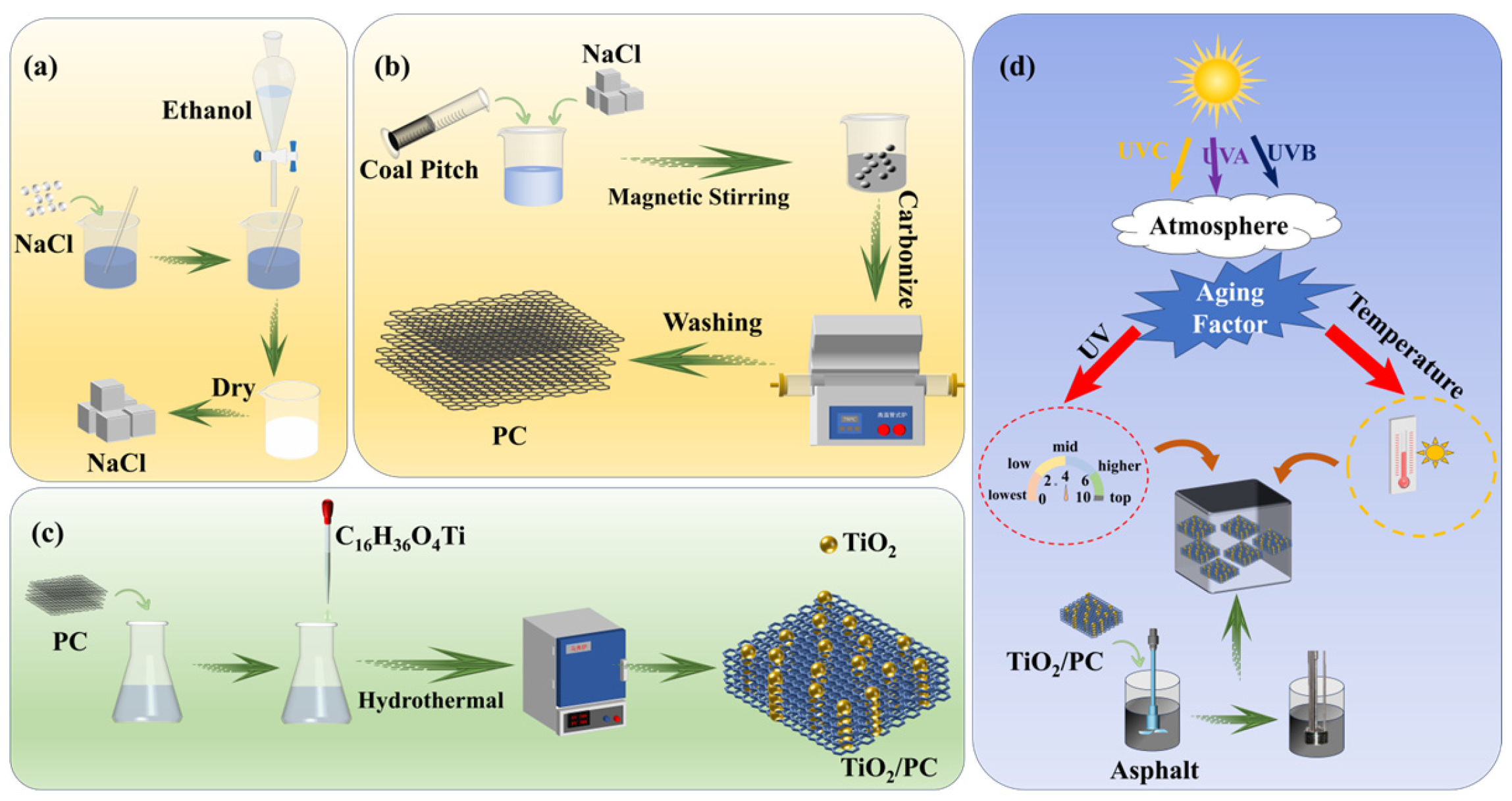
The base asphalt SK-70 was first heated to 150 ± 5 °C in a mixing container. Then, a fixed dosage of 3 wt.% of either TiO2/PC-1 or TiO2/PC-2 was added to the molten asphalt and dispersed using a high-speed shear mixer at 6000 rpm for 60 min. To further improve blending uniformity, the mixture was subsequently processed using a mechanical stirrer at 2000 rpm for 60 min while maintaining the same temperature. For comparative analysis, control binders were prepared under identical conditions using PC, TiO2, or a physical mixture of PC and TiO2 (denoted as TiO2 + PC). In this study, the modifier dosage was fixed at 3 wt.% for all samples to ensure a direct comparison of the effects of different modifier types and composite structures. The selected mixing temperature, shear rate, and modifier dosage were determined based on widely reported preparation conditions for nanomaterial-modified asphalt systems [9,12,13,18,19]. The preparation procedures for PC, TiO2/PC, and modified asphalt are schematically illustrated in Figure 1.
Figure 1.
Schematic illustration of the preparation process and application of TiO2/PC-modified asphalt: (a) preparation of NaCl template; (b) synthesis of porous carbon (PC); (c) preparation of TiO2/PC composite; (d) preparation and UV-aging evaluation of modified asphalt.
2.5. UV Aging Test
The UV aging test was conducted using an intelligent UV accelerated aging chamber (Model ST101F-2AB, Bell Testing Equipment Co., Ltd., Dongguan, China). The chamber was equipped with a 500 W high-pressure mercury UV lamp (Philips HPL-N 500 W, Philips Lighting, Eindhoven, The Netherlands) and a controlled air-cooled temperature regulation system. The distance between the UV lamp and the sample surface was maintained at approximately 30 cm to ensure uniform irradiation. The UV aging of asphalt pavement is predominantly induced by UVA radiation [21]. Accordingly, the selected UV wavelength range was 320–400 nm, with an average intensity of about 20.0 mW·cm−2, measured at the sample surface using a calibrated radiometer. The aging process was conducted at a controlled temperature of 50 ± 0.5 °C for a duration of 7 days. During the test, samples were placed horizontally on a rotating sample holder to ensure uniform exposure.
2.6. Material Characterization
2.6.1. Scanning Electron Microscope (SEM) Test
The microstructure of PC and the loading effect of nano-TiO2 were observed using a field emission SEM (FE-SEM, Gemini SEM 500, Zeiss, Oberkochen, Germany). Prior to observation, the samples were mounted on a sample holder using conductive adhesive and sputter-coated with a 20 nm gold layer to enhance conductivity. The surface morphology was then examined at appropriate magnifications.
2.6.2. Fourier Infrared Spectroscopy (FT-IR) Test
The functional groups of samples were characterized by a VERTEX 80V spectrometer (Bruker, Ettlingen, Germany). For sample preparation, the powdered specimen was thoroughly mixed with KBr at a mass ratio of 1:100 and ground with an agate mortar. The mixture was then dried with an infrared lamp and compressed into pellets using a hydraulic press under 0.8 MPa pressure. The modified asphalt was analyzed using the attenuated total reflectance (ATR) technique. Before measurement, the samples were heated to achieve homogeneity, after which a representative portion was evenly spread into the sample mold with a coating blade. It was essential to ensure complete removal of moisture, as water exhibits strong absorption bands that could mask the distinctive spectral signals of other functional groups. FTIR spectra were recorded with a resolution of 4 cm−1 through 32 scans over the wavenumber range of 4000–400 cm−1.
2.6.3. Brunauer–Emmett–Teller (BET) Test
The surface area and the pore size distribution were determined using a Micromeritics ASAP 2020 surface area analyzer. Prior to testing, the samples were dried at 100 °C in a vacuum oven for 2 h to remove moisture. The pore size distribution was determined by the Barrett-Joyner-Halenda (BJH) method, which provides information on micropores, mesopores, and macropores, as well as their distribution in materials.
2.6.4. X-Ray Photoelectron Spectroscopy (XPS) Test
The chemical composition, surface valence states and defect states of PC and TiO2/PC were characterized by XPS (Thermo ESCALAB 250, Waltham, MA, USA) using monochromatic Al Kα X-ray sources. All binding energies were referenced to the carbon peak at 284.6 eV for correction.
2.6.5. X-Ray Diffraction (XRD) Test
The crystal structure of the samples was measured by XRD (Bruker D8 Advance, Karlsruhe, Germany) in the 2θ range from 5° to 90°. The XRD measurements were performed using a Cu Kα radiation source (λ = 1.5406 Å) in continuous scanning mode, with a step size of 0.02°, a dwell time of 0.5 s per step, and divergence and receiving slit sizes of 1° and 0.2 mm, respectively. Phase identification was carried out using the ICDD PDF-4+ database, and peak indexing was performed using High Score Plus software (v 5.3a Version).
2.6.6. Raman Spectral Analysis
The molecular structure of the samples was characterized by Raman spectroscopy using an Invia Reflex spectrometer (Renishaw, Gloucestershire, UK). The spectra were recorded with a 532 nm excitation laser at a power of 10 mW, and the scanning range was 200–2000 cm−1.
2.6.7. UV-Vis Test
The UV-vis absorption spectra of PC and TiO2/PC composites were recorded using a UV-2600 spectrophotometer (Shimadzu, Kyoto, Japan) over the wavelength range of 200–800 nm with a resolution of 2 nm. The UV-Vis spectrophotometer was equipped with an integrating sphere in diffuse reflectance (DRS) mode. Powder samples were measured directly without further treatment, and BaSO4 was used as the reflectance standard.
2.6.8. Aging Indices
The aging process of asphalt induces significant changes in its colloidal structure and chemical composition due to the formation of aging products, thereby modifying its physical and rheological characteristics. This study employs comprehensive aging evaluation indices to quantitatively assess aging resistance, including physical aging indices, such as residual penetration ratio (RPR), softening point increment (SPI), ductility retention rate (DRR), and viscosity aging index (VAI), as well as rheological aging indices, such as rutting factor aging index (RFAI). For RPR, SPI, DRR, and VAI, each test was conducted on three parallel samples, and the results are reported as mean ± standard deviation. These indices can be calculated by Formulas (1)–(5).
RPR = aged penetration/unaged penetration
SPI = aged softening point-unaged softening point
DRR = aged ductility/unaged ductility
VAI = (aged viscosity − unaged viscosity)/unaged viscosity
RFAI = aged rutting factor/unaged rutting factor
2.6.9. Chemical Functional Aging Indices
The aging extent of asphalt was further quantified by monitoring characteristic chemical functional groups. The distinct FTIR characteristic absorption peaks at 1700 cm−1 (carbonyl, C=O) and 1030 cm−1 (sulfoxide, S=O) were identified as key indicators of oxidative aging. The aging progression was subsequently characterized by carbonyl aging index (CAI) and sulfoxide aging index (SAI), as defined in Formulas (6) and (7).
2.6.10. Asphalt Chemical Component Testing
The chemical composition of asphalt before and after aging was determined using an IATROSCAN MK-6s TLC-FID analyzer (Beijing Bolangde Technology Co., Ltd., Beijing, China). Prior to analysis, asphalt samples were dissolved in n-heptane to obtain a solution with a concentration of approximately 2 wt%. A small volume (1–2 μL) of the solution was spotted onto Chromarod S-III silica-coated quartz rods and allowed to dry at room temperature.
The separation of asphalt into four fractions (SARA: Saturates, Aromatics, Resins, and Asphaltenes) was carried out using a three-stage development process in chromatographic chambers with different solvent systems. First, n-heptane was used to develop the rods to a distance of 10 cm to separate saturates. Second, a mixture of toluene/n-heptane (80/20, v/v) was used to elute aromatics to the same distance. Third, a mixture of toluene/ethanol (95/5, v/v) was applied to develop resins. The asphaltenes remained at the origin due to their high polarity. After each development step, the rods were dried in air.
Following chromatographic separation, the rods were analyzed using a flame ionization detector (FID). The hydrogen flow rate was set to 160 mL/min, air flow rate to 2000 mL/min, and scanning speed to 30 s per rod. The relative content of each fraction was quantified based on the integrated peak areas.
This procedure was conducted in accordance with established methods reported in ASTM D4124, ensuring reliability and reproducibility of the SARA fractionation results [22].
3. Results and Discussion
3.1. Characterization Analyses of PC and TiO2/PC
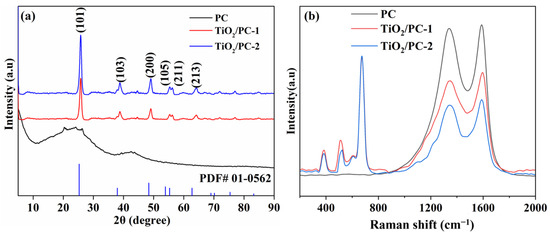
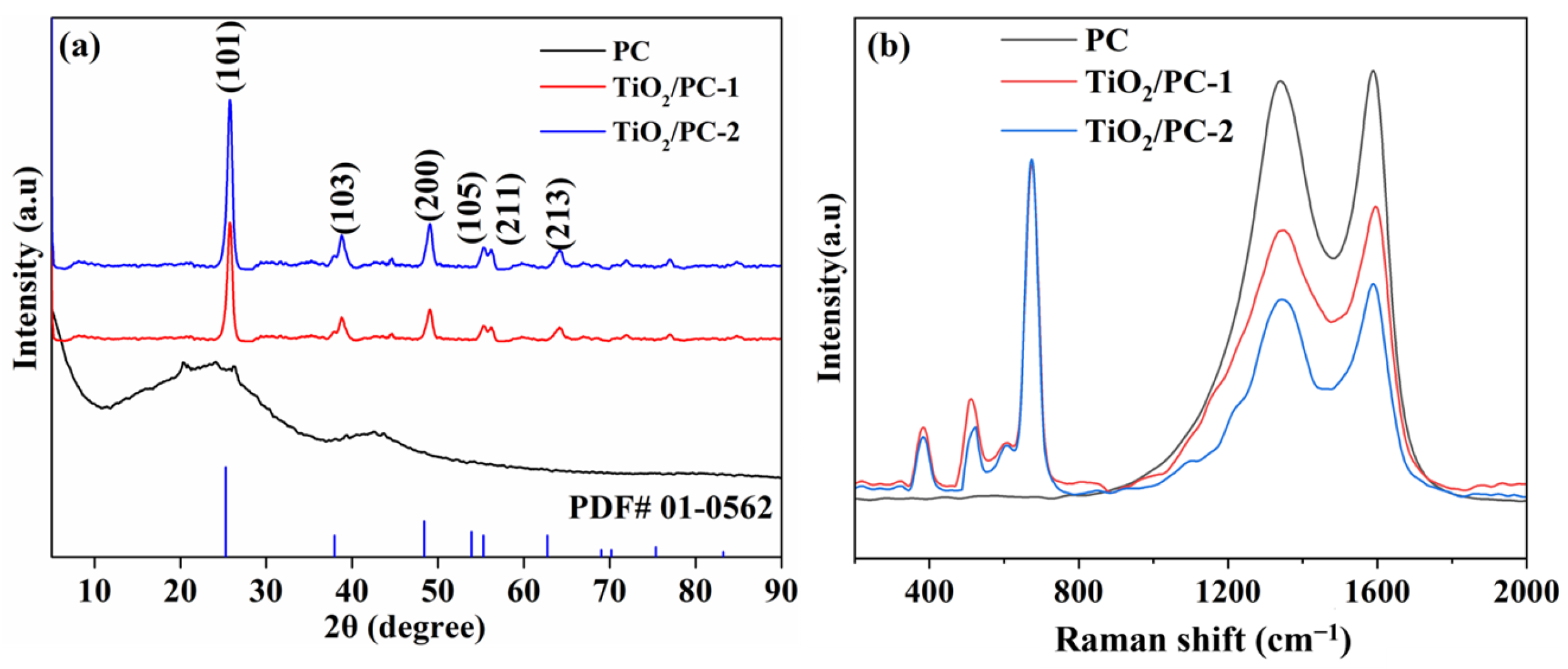
Figure 2a shows the XRD patterns of PC and TiO2/PC. PC exhibits weak and broad diffraction humps, indicating its amorphous nature and poor crystallinity. These broad peaks appear at approximately 25.5°and 43.5°, corresponding to the (002) and (100) planes of graphitic carbon, with interplanar spacings of about 3.49 Å and 2.08 Å, respectively. These features are characteristic of graphitic lattice structures and disordered stacking configurations [23]. After the introduction of TiO2, the XRD pattern changes markedly, with several distinct diffraction peaks appearing in the TiO2/PC composites. The main diffraction peaks can be indexed to anatase TiO2, including the reflections at approximately 25.3° (101, d = 3.52 Å), 37.8° (103, d = 2.38 Å), 48.0° (200, d = 1.89 Å), 53.9° (105, d = 1.70 Å), 55.1 (211, d = 1.67 Å), and 62.7° (213, d = 1.48 Å). These results confirm the high crystallinity of anatase TiO2 in the TiO2/PC composites (JCPDS No. 21-1272) [24]. The increased peak intensity and peak area of TiO2/PC-2 are attributed to its higher TiO2 content. Furthermore, Scherrer equation analysis based on the (101) peak indicates that TiO2/PC-1 has a larger crystallite size than TiO2/PC-2. Furthermore, Scherrer equation analysis based on the (101) peak reveals larger crystallite sizes for TiO2/PC-1 (247 nm) compared to TiO2/PC-2 (203 nm).
Figure 2.
XRD patterns (a) and Raman spectra (b) of TiO2/PC and PC.
Raman spectroscopy was employed to further investigate the structural characteristics and disorder of CTP-derived PC. As shown in Figure 2b, all samples exhibit two prominent bands at approximately 1350 cm−1 (D-band) and 1592 cm−1 (G-band), corresponding to disordered carbon structures and the in-plane vibration E2g of sp2-bonded carbon atoms in graphitic domains, respectively. The D-band intensity is associated with sp3-type defects and amorphous carbon, while the G-band reflects the degree of graphitic ordering [25]. The intensity ratio (ID/IG) is commonly used to evaluate the degree of structural disorder. The calculated ID/IG values for PC, TiO2/PC-1, and TiO2/PC-2 are 0.96, 1.08, and 1.16, respectively. The increase in ID/IG indicates an increased density of structural defects and disordered carbon, likely resulting from the incorporation of TiO2 and the associated interfacial interactions. This suggests partial disruption of sp2 domains and the formation of additional defect sites [26,27]. Notably, the G-band position (~1592 cm−1) shows an upshift compared to the typical value for ideal graphite (~1580 cm−1), which can be attributed to factors such as structural disorder, lattice distortion, and possible charge transfer interactions between TiO2 and the carbon matrix. For quantitative analysis, Raman spectra were deconvoluted using a Lorentzian fitting function. The full width at half maximum (FWHM) of both D and G bands was extracted and used to ensure the reliability of the peak fitting and TiO2 determination. The relatively broadened peaks further confirm the presence of disordered and amorphous carbon structures. In addition, three characteristic peaks at approximately 399 cm−1 (B1g), 515 cm−1 (A1g), and 639 cm−1 (B2g) are observed, confirming the presence of anatase TiO2 in the composites [28], which is consistent with the XRD results.
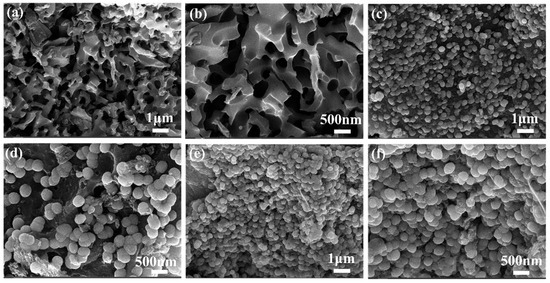
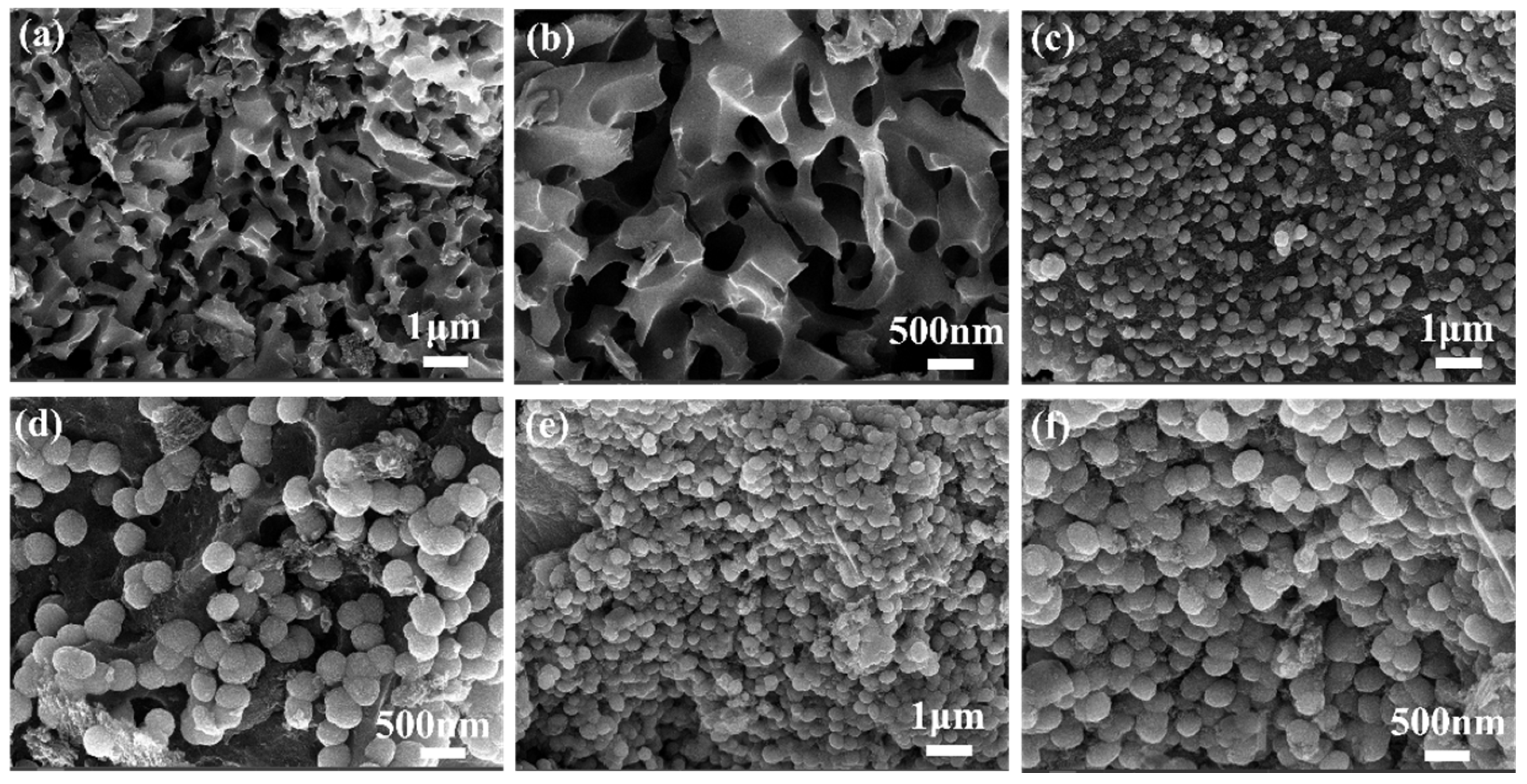
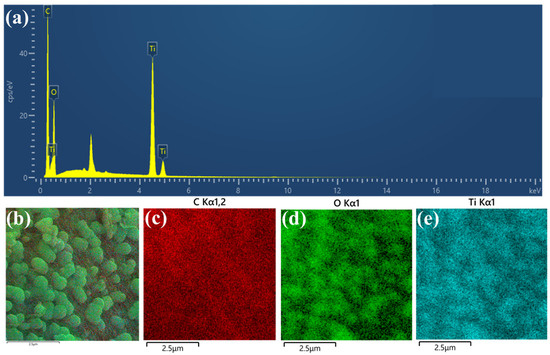
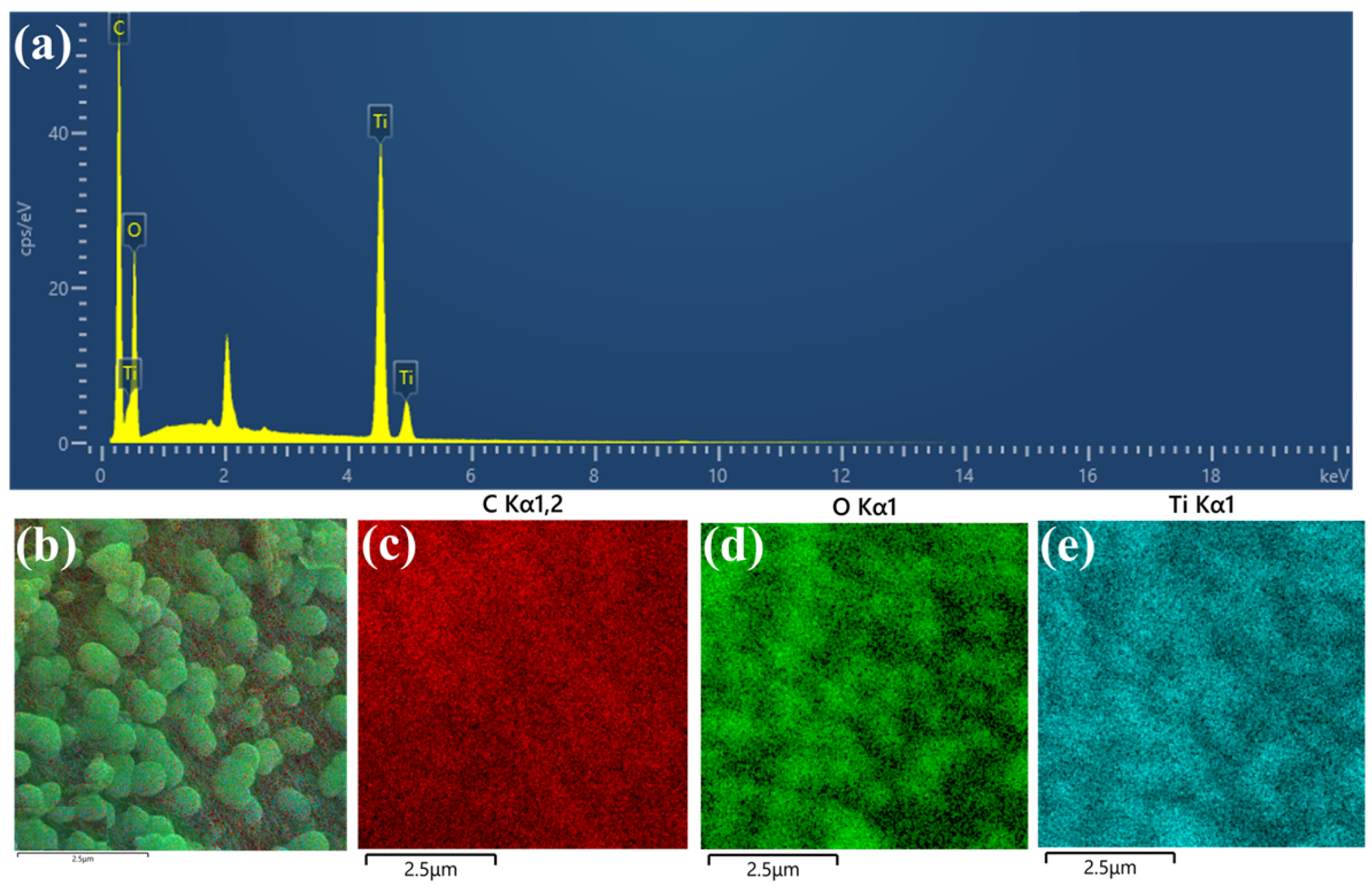
Figure 3 presents the SEM images of the as-prepared samples. As shown in Figure 3 a,b, PC exhibits a rough, honeycomb-like morphology with an interconnected porous carbon framework. Irregular cavities and thin carbon walls can be observed, indicating that the carbon material possesses a highly developed porous texture [29]. However, the specific pore-size categories cannot be determined reliably from SEM images alone. As shown in Figure 3c–f, after TiO2 loading, numerous particulate features are observed on the surface of the porous carbon matrix, resulting in a rougher morphology compared with that of PC. These particles can be attributed to deposited TiO2, indicating successful incorporation of TiO2 onto the carbon substrate. With increasing tetrabutyl titanate content, the amounts of surface-deposited particles appear to increase. At the same time, some degree of local aggregation can also be observed in the composites. Overall, the SEM results suggest that the porous framework of PC is retained after TiO2 incorporation, while TiO2 particles are attached to the carbon surface. A more detailed evaluation of pore structure, particle size distribution, and dispersion uniformity would require additional quantitative characterization. In addition, the EDX spectrum and elemental mapping (Figure 4) show the distribution of C, O and Ti elements, further verifying the successful incorporation of TiO2 into PC.
Figure 3.
SEM images of PC (a,b), TiO2/PC-1 (c,d) and TiO2/PC-2 (e,f).
Figure 4.
EDX spectra (a) and EDX elemental mapping: layered image (b), C (c), O (d), and Ti (e) of TiO2/PC-2.
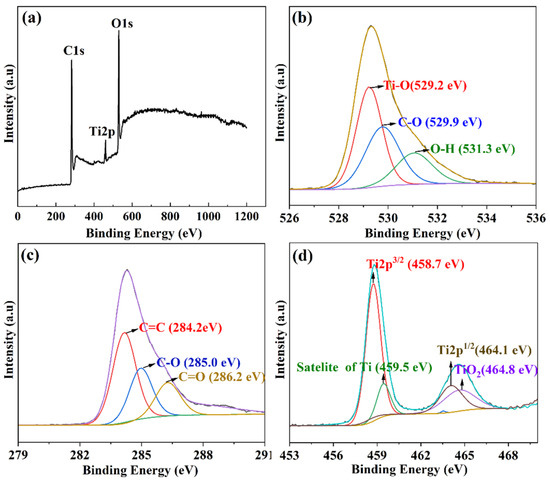
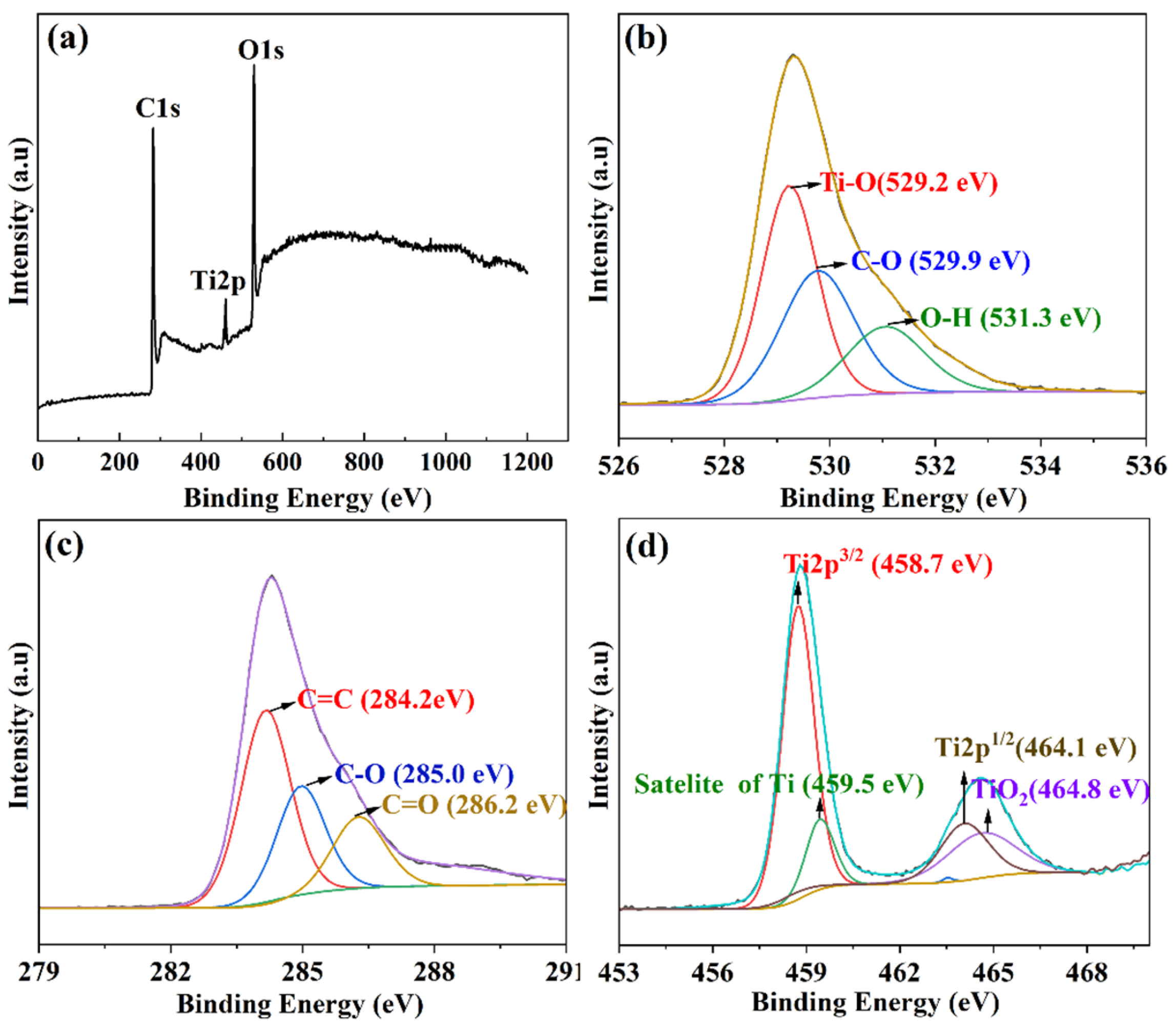
The surface elemental composition and chemical states of TiO2/PC were analyzed by XPS (Figure 5). A Gaussian fit was applied to determine the oxidation states of each element. The XPS survey spectrum of the TiO2/PC-2 composite shows the C 1s, O 1s, and Ti 2p peaks at 290.8, 536.4, and 465.2 eV, respectively, indicating the successful incorporation of TiO2 into the carbon matrix. The high-resolution O 1s spectrum (Figure 5b) can be deconvoluted into two main components: a dominant peak at ~529.2 eV, corresponding to lattice oxygen (Ti–O–Ti) in TiO2, and a higher binding energy peak at ~531.5–532.5 eV, which can be attributed to surface hydroxyl groups and oxygen-containing functional groups (e.g., C–O/C=O). The C 1s spectrum (Figure 5c) shows three main peaks located at approximately 284.2, 285.0, and 286.5 eV, corresponding to C–C/C=C, C–O, and C=O functional groups, respectively [30,31], indicating the presence of oxygen-containing functionalities on the carbon surface. The high-resolution Ti 2p spectrum (Figure 5d) displays peaks at 458.7, 459.5, 464.1, and 464.8 eV, corresponding to the Ti 2p3/2, a satellite Ti state, Ti 2p1/2 and TiO2 (Ti4+), respectively [32,33]. Notably, combining the Ti 2p, O 1s, and C 1s spectra suggests the formation of Ti–O–C bonds due to the interfacial interactions between PC and TiO2 [33]. Overall, the XPS results confirm the presence of TiO2 and oxygen-containing functional groups on the carbon surface. Furthermore, XPS analysis reveals the coexistence of Ti3+ and Ti4+ states in the composite, which facilitates electron transfer and generates active sites, improving the UV absorption efficiency of TiO2 [34].
Figure 5.
XPS spectra of TiO2/PC-2. (a) Full XPS survey spectrum and high-resolution spectra at (b) O 1s, (c) C 1s, and (d) Ti 2p core levels.
3.2. BET-BJH Analysis
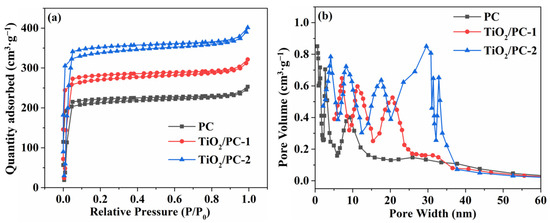
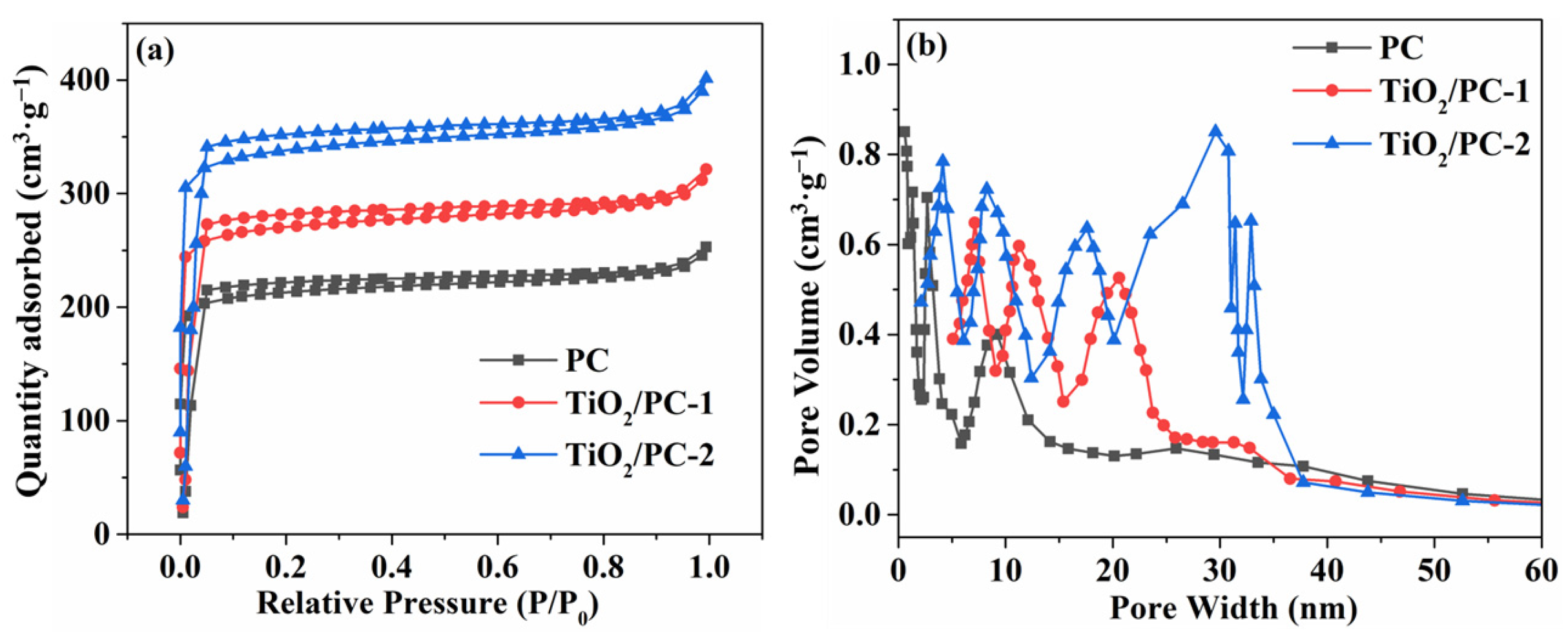
The nitrogen adsorption–desorption isotherms and pore size distribution curves of PC, TiO2/PC-1, and TiO2/PC-2 are shown in Figure 6. All samples exhibit a pronounced adsorption uptake at low relative pressure ((P/P0 < 0.1)), indicating significant micropore filling. In addition, a distinct hysteresis loop is observed at intermediate and high relative pressures, suggesting the presence of mesoporous structures. Therefore, the isotherms are dominated by Type I characteristics in the low-pressure region, together with Type IV features and hysteresis at higher relative pressure, indicating the coexistence of micropores and mesopores [35,36]. It should be noted that the adsorption increases in the high P/P0 region should be regarded as associated with capillary condensation and textural/interparticle effects, rather than being taken as direct evidence for macropores. Therefore, the pore structure discussion in this work is focused mainly on microporous and mesoporous characteristics derived from the N2 adsorption results.
Figure 6.
Nitrogen adsorption–desorption isotherms (a) and pore width distribution (b) of PC, TiO2/PC-1, and TiO2/PC-2.
As shown in Figure 6b and Table 2, the pore structure parameters vary systematically after TiO2 incorporation. In Table 2, Sbet represents the total specific surface area calculated using the BET method, which includes contributions from micropores, mesopores, and external surface area. In contrast, Smicro refers to the micropore surface area obtained from micropore analysis, reflecting only the contribution of pores smaller than 2 nm. Therefore, the difference between Sbet and Smicro corresponds to the surface area contribution from mesopores and external surfaces. The BET specific surface areas of PC, TiO2/PC-1, and TiO2/PC-2 are 1356, 1237, and 1183 m2⸱g−1, respectively. Compared with PC, the specific surface area decreases by 8.8% for TiO2/PC-1 and 12.8% for TiO2/PC-2, indicating that the differences are significant rather than comparable. Similarly, the micropore surface area decreases from 1126 to 926 and 802 m2⸱g−1, corresponding to reductions of 17.8% and 28.8%, respectively. The total pore volume also decreases from 0.61 to 0.48 and 0.45 cm3⸱g−1, while the micropore volume decreases from 0.47 to 0.33 and 0.29 cm3⸱g−1. Although TiO2/PC-2 shows a higher adsorbed quantity over a broad relative pressure range in the isotherm plot, this does not directly imply a higher BET surface area. The BET surface area is determined mainly from adsorption behavior in the low-pressure region and is particularly sensitive to the contribution of micropores. Therefore, the higher adsorption at elevated relative pressure for TiO2/PC-2 is consistent with a greater contribution from larger pores or textural porosity, while the decrease in SBET and Smicro indicates a reduction in accessible microporous surface area after TiO2 loading. The hierarchical porous structure offers distinct functional advantages: macropores facilitate rapid ion diffusion, while mesopores provide increased reaction interfaces. This synergistic effect enhances UV absorption and degradation capacity [37,38].
Table 2.
Pore characteristics of PC and TiO2/PC composites.
In this work, the BET method was used to determine the specific surface area, the BJH method was used to analyze the pore size distribution in the mesopore range, and the micropore parameters were obtained from the micropore analysis summarized in Table 2. These results indicate that TiO2 incorporation alters the pore structure of PC, leading to a decrease in microporous surface area and micropore volume, while retaining a hierarchical porous texture containing both microporous and mesoporous features.
3.3. UV-Vis Analysis
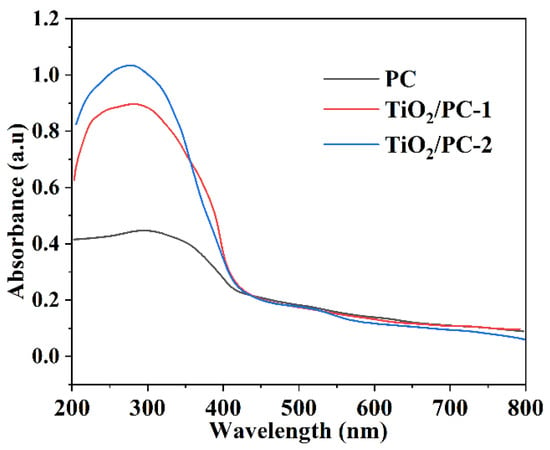
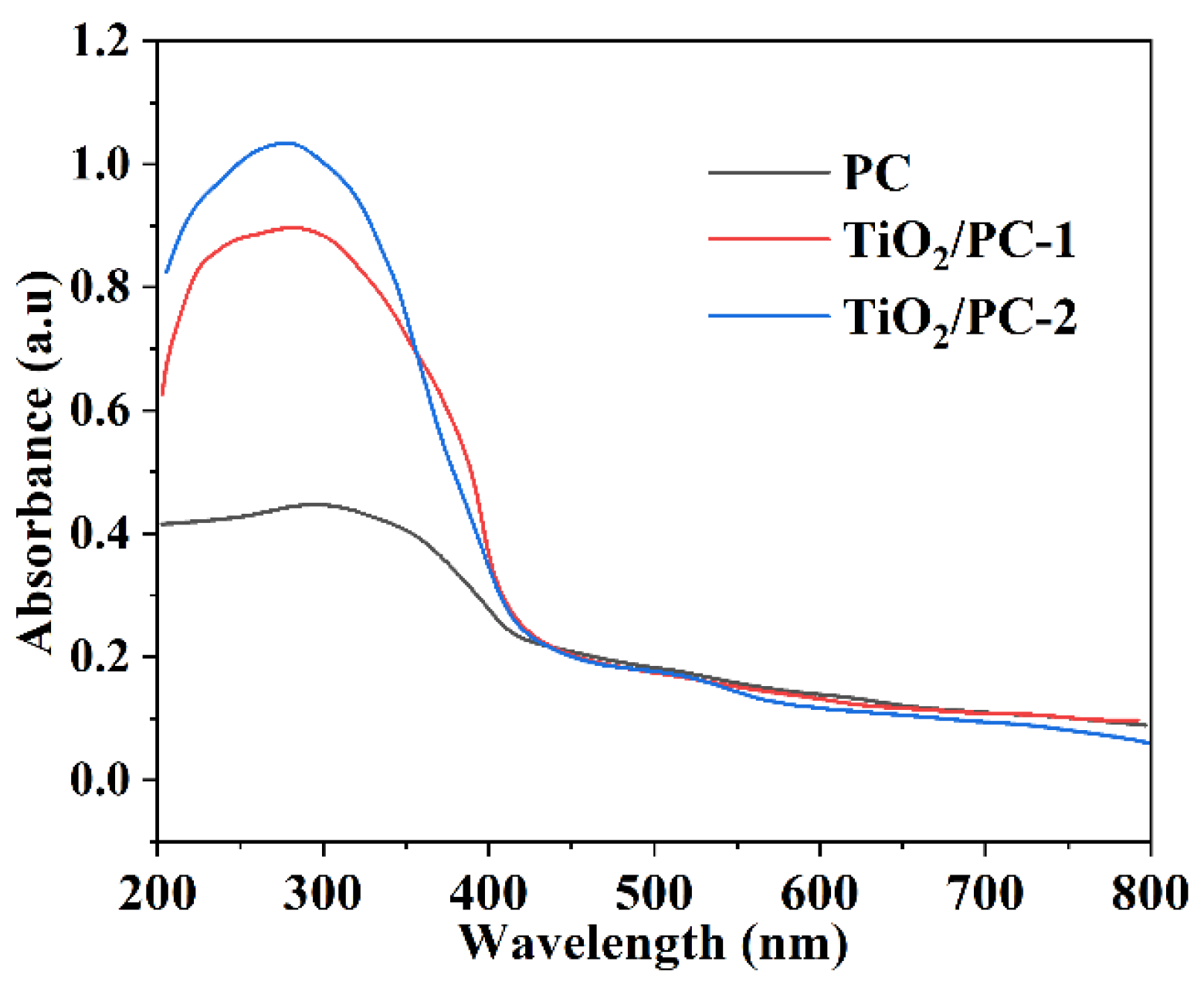
The absorbance of various samples was tested in the wavelength range of 200–800 nm. As shown in Figure 7, both TiO2/PC-1 and TiO2/PC-2 exhibit strong absorption below 400 nm, corresponding to the intrinsic UV absorption of TiO2. In addition, these composites show moderate absorption in the visible region, indicating that the incorporation of TiO2 and carbonaceous components broadens the light-response range [39]. Compared with PC, TiO2/PC-1 and TiO2/PC-2 display significantly enhanced UV absorption, demonstrating their improved UV shielding capability and suggesting better resistance to UV-induced aging.
Figure 7.
UV-vis absorption spectra of synthesized samples.
As a wide-bandgap semiconductor, TiO2 primarily absorbs UV photons with energies exceeding its bandgap (~3.2 eV). Upon irradiation, valence-band electrons are excited to the conduction band, generating electron-hole pairs. Most electron-hole pairs recombine instantaneously, while some migrate to the surface and participate in redox reactions [40]. In this process, the PC matrix contributes in two key ways: first, its high surface area provides abundant active sites, enhancing the TiO2-UV interaction; moreover, the TiO2/PC heterojunction facilitates the charge separation and reduces the bandgap, further promoting the UV absorption [41]. Consequently, TiO2/PC is expected to show stronger UV aging resistance than PC. The anti-aging performance of the TiO2/PC composites is closely related to their structural and optical characteristics. XRD confirms the successful incorporation of anatase TiO2, while SEM indicates that TiO2 particles are deposited on the porous carbon framework. UV-vis analysis shows that TiO2/PC composites exhibit substantially enhanced absorption in the UV region compared with PC, indicating improved UV shielding capability. These structural and optical features help reduce UV penetration and suppress UV-induced oxidation in the asphalt system.
3.4. Physical Aging Indices of the Modified Asphalt
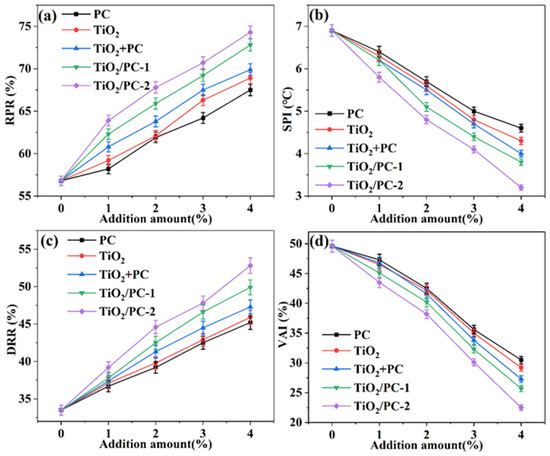
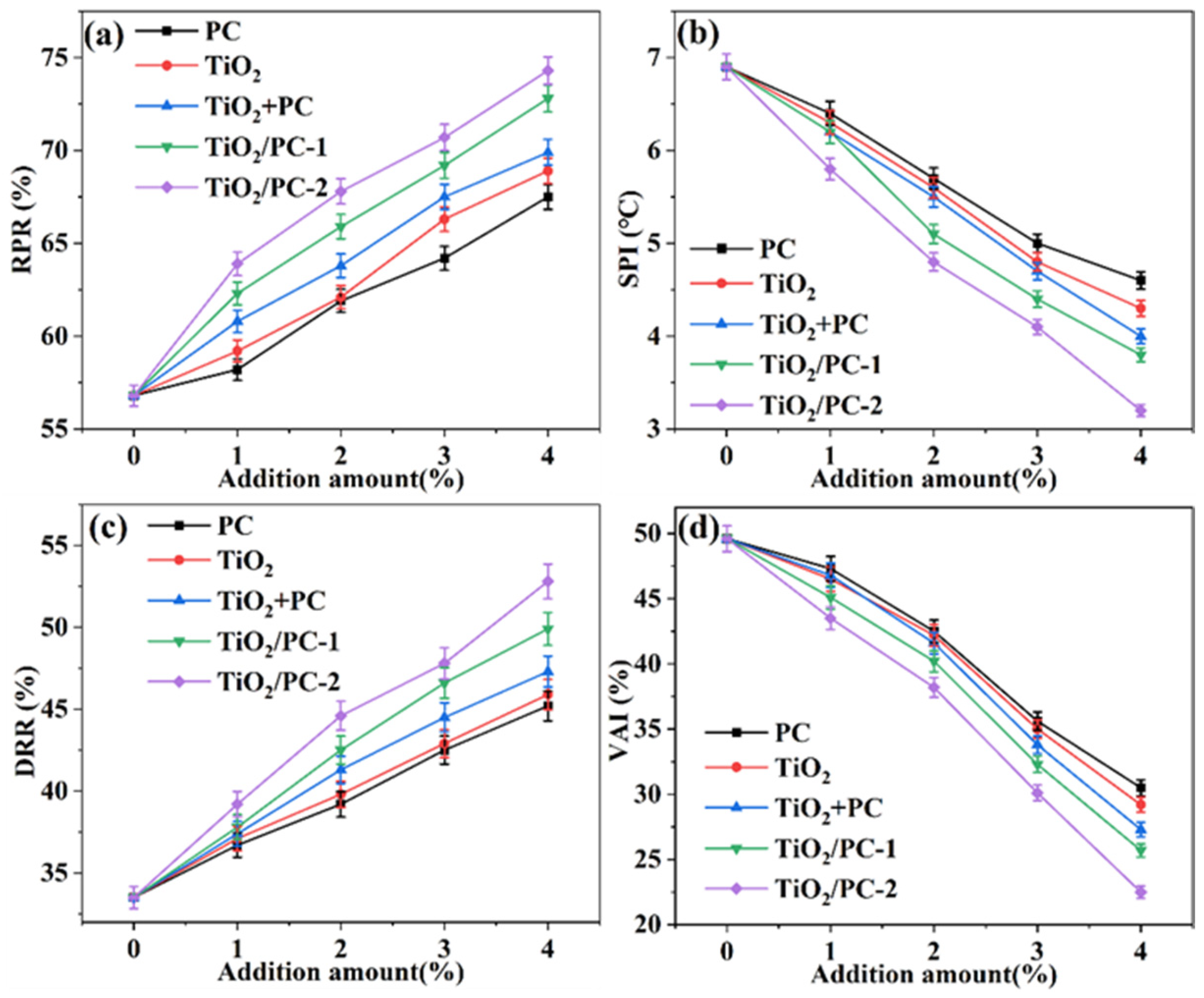
The anti-aging properties of modified asphalts were evaluated by characterizing RPR, SPI, DRR and VAI after UV aging. As shown in Figure 8, RPR and DRR increase with the dosage of the modifier, while SPI and VAI decrease significantly. These trends indicate that the modifiers can effectively improve the physical properties of asphalt after UV aging, with more improvement at higher concentrations. At a fixed dosage of 3%, as shown in Figure 8b,d, the incorporation of TiO2 alone reduced SPI and VAI by 0.3 °C and 4.3%, respectively, compared to PC-modified asphalt. The TiO2 + PC modifier prepared by mechanical mixing achieved reductions of 0.6 °C and 10.5%, respectively. In contrast, the introduction of TiO2/PC-1 and TiO2/PC-2 resulted in lower SPI and VAI, with reductions of 0.8 °C and 15.7% for TiO2/PC-1 and 1.4 °C and 26.2% for TiO2/PC-2, demonstrating their superior capabilities to enhance the anti-aging performance in asphalts.
Figure 8.
RPR (a), SPI (b), DRR (c) and VAI (d) of modified asphalt samples.
As presented in Figure 8a,c, the combinations of TiO2 and PC can increase the RPR and DRR of modified asphalt after UV aging. Furthermore, among the five types of composites, the one containing TiO2/PC-2 exhibits the best improvement in RPR and DRR after UV aging. When TiO2/PC-2 is added, the RPR and DRR are substantially increased from 56.8% to 74.3% and from 33.57% to 52.8%, respectively.
The above results demonstrate that although the addition of TiO2 and PC can generally enhance the physical properties of asphalt after UV aging, the degree of improvement strongly depends on the modification method. When TiO2 nanoparticles are combined with PC via in situ growth, TiO2/PC presents a better improvement in aging resistance than PC alone or mechanically mixed TiO2 + PC.
PC, as an effective shielding agent, can efficiently block and reflect UV light due to its inherent porous and lamellar structure [42]. TiO2/PC composite, with enhanced dispersion of TiO2 particles on the PC surface, attenuated UV radiation through energy dissipation, where the absorbed photons were easily converted into thermal energy to prevent UV-induced damage.
3.5. Rheological Properties of Asphalt After UV Aging
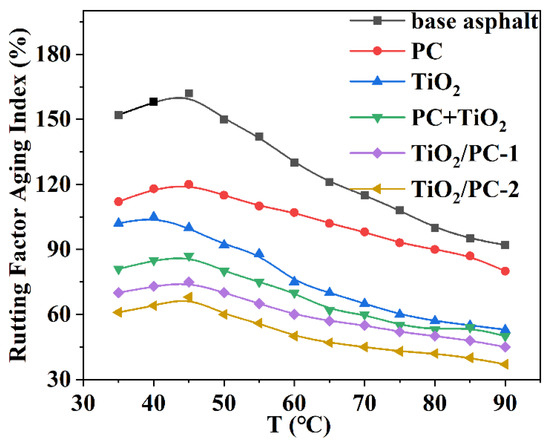
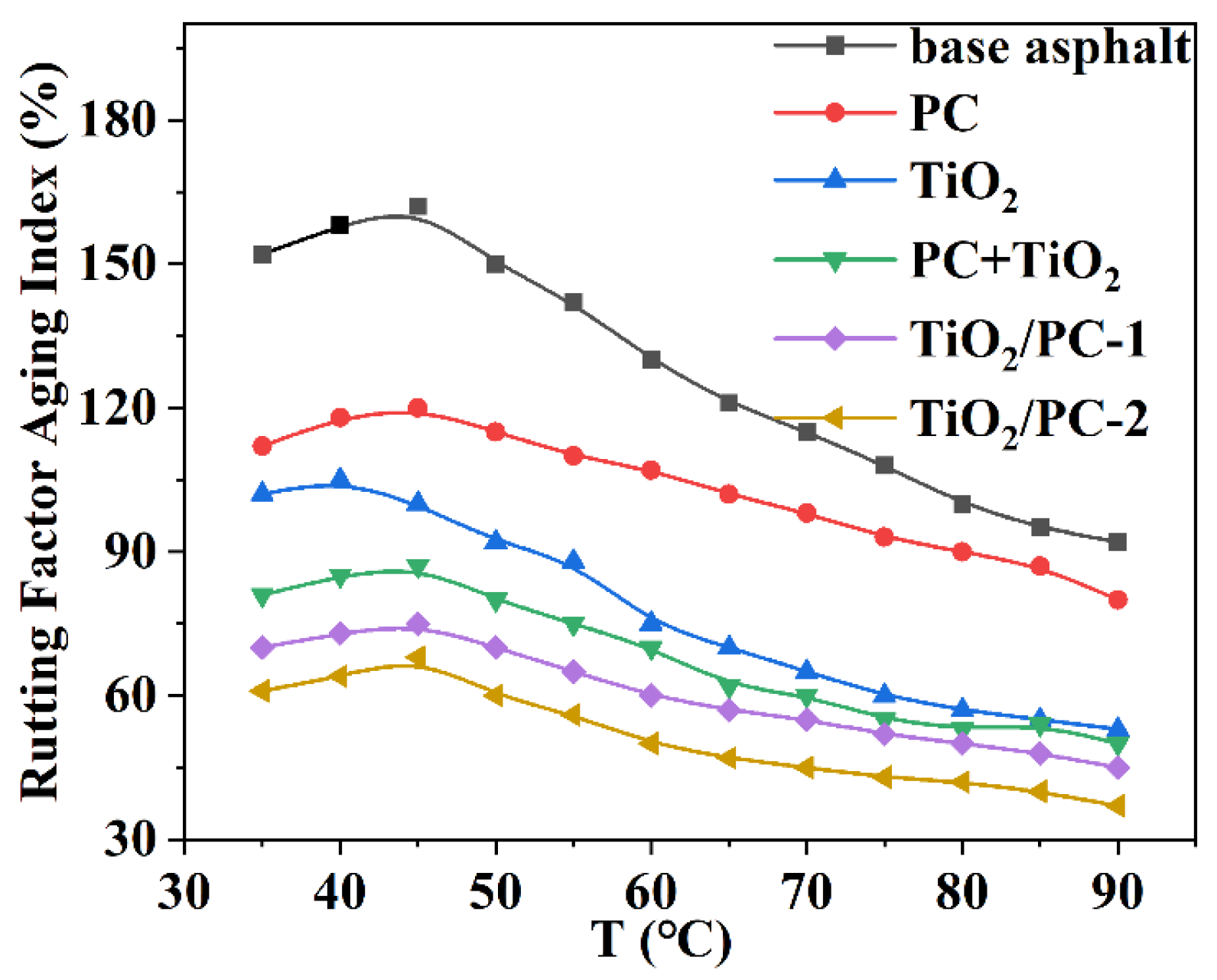
Figure 9 presents the RFAI of various asphalt samples after UV aging. The base asphalt exhibits the highest RFAI values across all test temperatures, reflecting its significant aging effects, while the incorporation of different modifiers reduces the RFAI. Compared to the RFAI of base asphalt (130.2%) at 60 °C, adding TiO2/PC-2 achieves the lowest RFAI (50.1%), followed by adding TiO2/PC-1 (60.5%), TiO2 + PC (70.4%), TiO2 (75.2%), and PC (107.3%). For TiO2 + PC-modified asphalt, the direct mechanical blending method fails to alter the agglomerated state of TiO2 particles, thereby limiting their effectiveness in enhancing UV aging resistance. Moreover, TiO2 demonstrates superior anti-UV aging performance over PC at an equal content, aligning with the trends observed in physical property aging indices.
Figure 9.
RFAI values of modified asphalt under UV aging at various temperatures.
As shown in Figure 9, the RFAI curves of the UV-aged and original asphalts exhibit a consistent trend, initially increasing and then decreasing. At lower temperatures (25–40 °C), the UV shielding effect of TiO2 is limited, resulting in inefficient radical scavenging. UV aging triggers the oxidative degradation of light asphalt fractions (saturates and aromatics), generating polar oxygen-containing groups (e.g., carbonyl and sulfoxide). These polar molecules enhance the intermolecular interactions (hydrogen bonding and dipole effects), forming a more rigid network structure. This, in turn, enhances the elastic response of asphalt and leads to an increase in RFAI.
Near the glass transition region (40–60 °C), the oxidized crosslinked network is partially disrupted by the intensified thermal motion of molecular chains. The competition between elastic recovery and viscous flow in aged asphalt reaches a dynamic equilibrium, causing the value of RFAI to peak. As shown in Figure 9, the synergistic effect of PC lamellae (physical shielding) and TiO2 (chemical radical scavenging) may stabilize the RAFI values [43].
At elevated temperatures (>60 °C), the accelerated disentanglement of long-chain asphalt molecules and shear-induced fracture of the brittle crosslinked network enhance the viscous flow behavior, potentially reducing the RFAI. Additionally, the interfacial debonding at high temperatures further weakens the deformation resistance, also contributing to the RFAI decrease.
Thus, this nonlinear trend reveals a dual failure mechanism in UV-aged asphalt involving low-temperature oxidative embrittlement and high-temperature thermo-mechanical degradation of the crosslinked network. As shown in Figure 9, the uniform dispersion and chemical stability of TiO2/PC modifiers extend the stable RFAI temperature range, enhancing the durability of the modified asphalt.
3.6. Aging Indices of Chemical Functional Groups After UV Aging
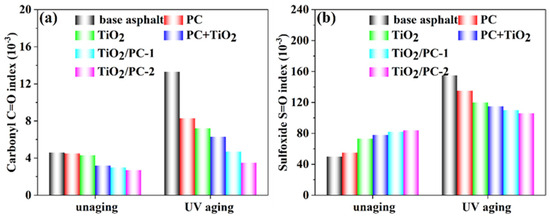
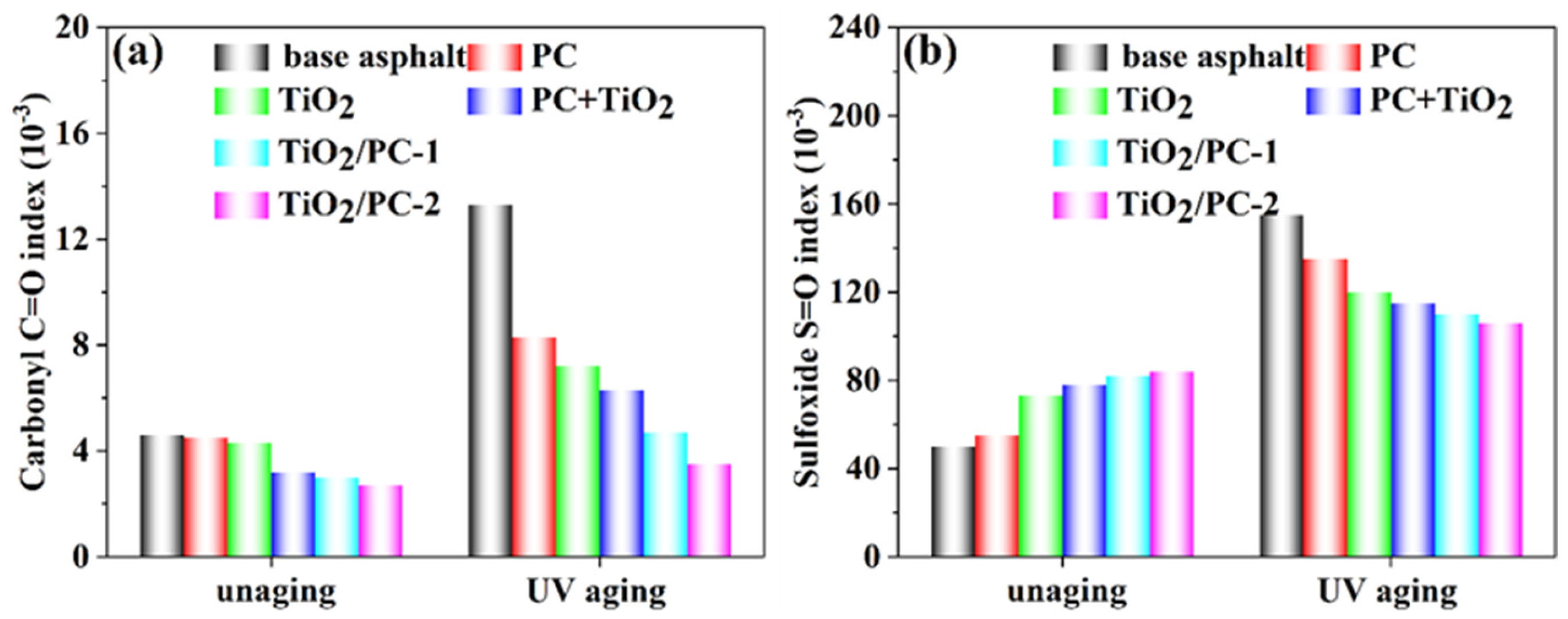
Figure 10 presents the aging indices of asphalt after UV exposure. The CAI and SAI of base asphalt increased significantly after UV aging, with increments of 189.2% and 210.0%, respectively. In contrast, the TiO2/PC-2-modified composite exhibited the lowest increases in CAI and SAI (29.6% and 26.2%, respectively), followed by TiO2/PC-1- (56.7% and 34.1%) and TiO2 + PC-modified asphalt (96.8% and 47.4%). These results indicate that the incorporation of TiO2/PC composites effectively retards the oxidation of asphalt molecules during aging, reducing the formation of carbonyl and sulfoxide aging products. Consistent with the physical and rheological aging indices, the increase in chemical functional group indices of TiO2-modified asphalt was significantly lower than that of PC-modified asphalt after UV aging, originating from the semiconductor characteristics of TiO2. These inorganic particles effectively attenuate UV radiation through absorption and reflection mechanisms. Notably, nano-TiO2 exhibits strong UV absorption with a peak absorbance of 1.2 in the UV range, which contributes significantly to the superior UV resistance of the TiO2/PC composites [44].
Figure 10.
Change in aging-related chemical groups after UV aging: carbonyl index (CAI) (a) and sulfoxide index (SAI) (b).
For the TiO2 + PC-modified asphalt, the direct blending approach failed to improve the dispersion state of TiO2 particles, limiting their UV resistance enhancement. In contrast, particle agglomeration was mitigated in the TiO2/PC composites, leading to more uniform TiO2 dispersion and a more pronounced synergistic effect [45]. Consequently, the TiO2/PC-2-modified asphalt demonstrated the lowest increases in CAI and SAI after UV aging, highlighting its superior anti-aging performance, which is consistent with its higher TiO2 content and stronger UV absorption. This suggests that TiO2/PC-2 provides more effective shielding against incident UV irradiation. In addition, the porous carbon support contributes to maintaining the composite structure and supporting TiO2 loading, which is beneficial for the overall anti-aging effect.
3.7. Chemical Components Analysis of Asphalt After UV Aging
Aging progressively changes the chemical composition of asphalt, primarily characterized by the conversion of aromatics to resins and the subsequent transformation of unstable resins into asphaltenes. Thus, evaluating the colloidal state based on the initial composition of asphalt may not provide a comprehensive understanding.
This study utilizes colloidal stability index (CI, Equation (8)) to characterize the asphalt colloidal system. Asphalt colloidal structures are categorized into sol, sol–gel, and gel types. A higher CI indicates a more sol-like structure, and a lower CI reflects a more gel-like behavior. While both sol and gel structures can impair pavement performance, the intermediate sol–gel structure is considered optimal for asphalt mixtures. To quantify the aging degree of asphalt, the gelation index (GI, Equation (9)) is introduced to evaluate its anti-aging capability. A lower GI value signifies superior resistance to aging.
Compared to the base asphalt, the four fractions’ contents in various asphalt samples showed negligible changes prior to aging (Table 3). Meanwhile, the CI values of the asphalt were similar. These results indicate that the different modifiers were only physically dispersed within the matrix, with no substantial influence on the chemical composition or colloidal state of asphalt. Figure 11 and Table 4 present the contents of saturates, aromatics, resin, and asphaltene in the modified asphalts after UV aging, characterized by decreased saturate and aromatic contents alongside increased resin and asphaltene contents. The UV irradiation promotes photoexcitation of saturates and aromatics, producing reactive free radicals that subsequently undergo oxidation to form additional resins [46]. This aging process is accompanied by a significant reduction in CI, reflecting accelerated asphalt hardening and diminished colloidal stability.
Comparative analysis of GI shows that PC- and TiO2-modified asphalts exhibit lower GI (27.6% and 24.6%, respectively) compared to base asphalt (GI = 31.5%), confirming their enhanced resistance to gelation and UV aging. The TiO2/PC-1 and TiO2/PC-2 composites demonstrate particularly effective anti-aging effects, as evidenced by their lower GI value and superior ability to suppress the formation of oxygen-containing functional groups and heavy fractions during aging [47]. These results correlate well with the physical, rheological, and chemical groups aging indices, collectively demonstrating that the TiO2/PC composite significantly improves the durability of the asphalt by retarding the oxidative aging process.
CI = (Aromatics + Resin)/(Saturates + Asphaltene)
GI = (CI Unaged − CI Aged)/CI Unaged
Table 3.
Four components’ contents in modified asphalt before UV treatment.
Figure 11.
Effect of UV aging on the four components of modified asphalts.
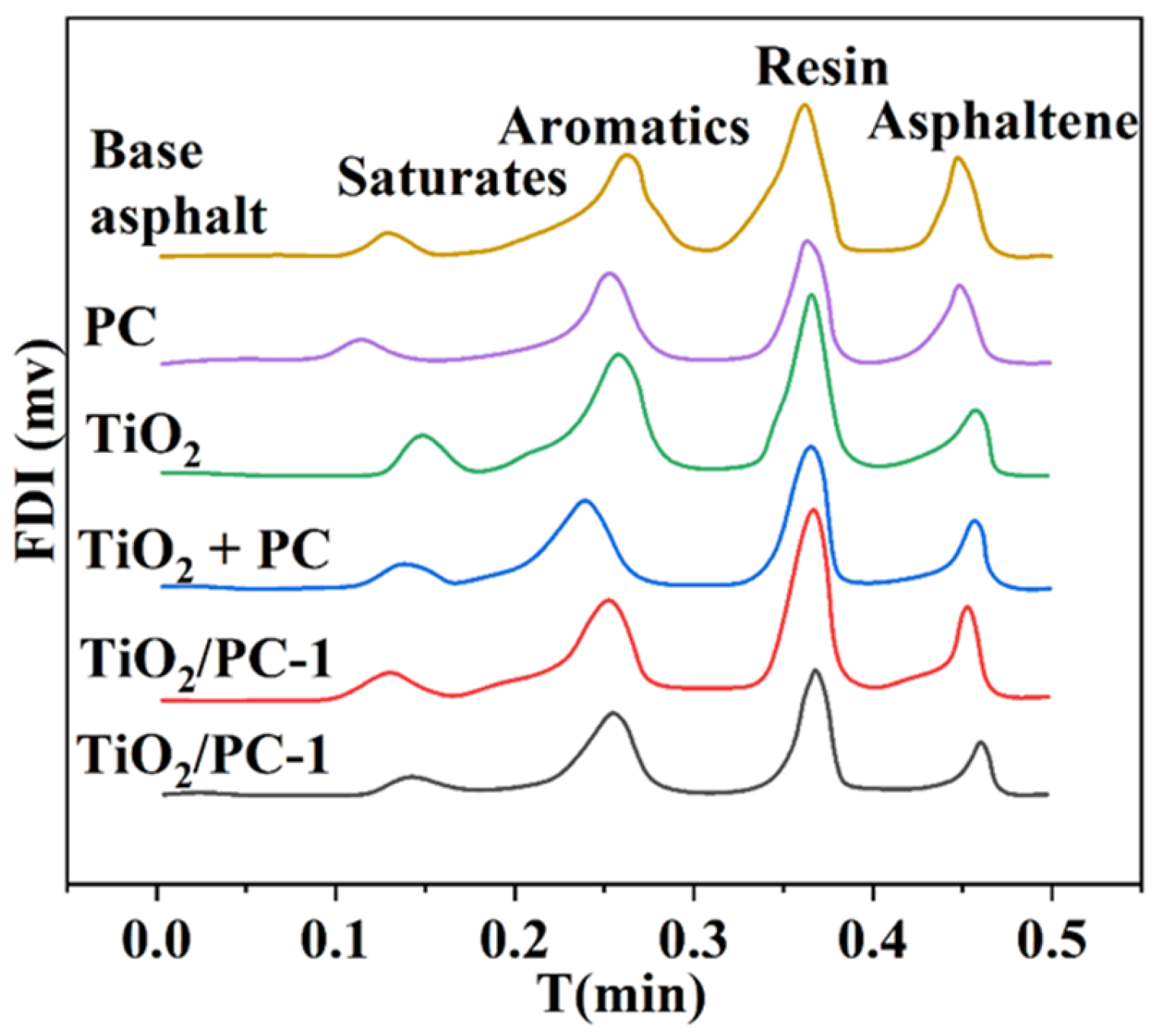
Table 4.
Four components’ contents in modified asphalt after UV treatment.
3.8. Anti-Aging Mechanism Analysis
The improved UV resistance of TiO2/PC nanocomposites encompasses both physical and chemical processes [48,49]. Physical aging is characterized by the volatilization of light components, while chemical aging involves the conversion of light components into heavy fractions. These chemical transformations are driven by asphalt oxidation, which proceeds via a free radical mechanism [50,51].
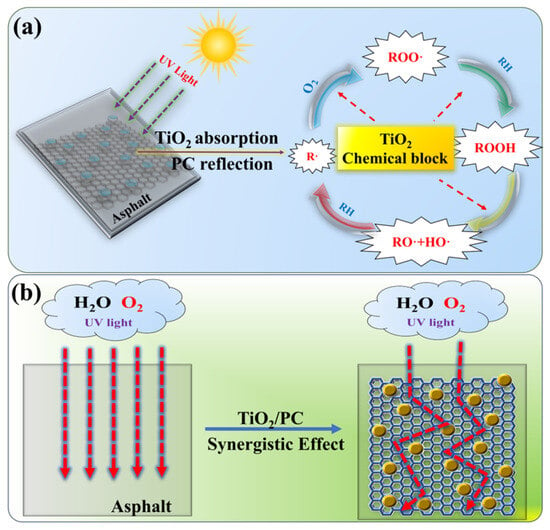
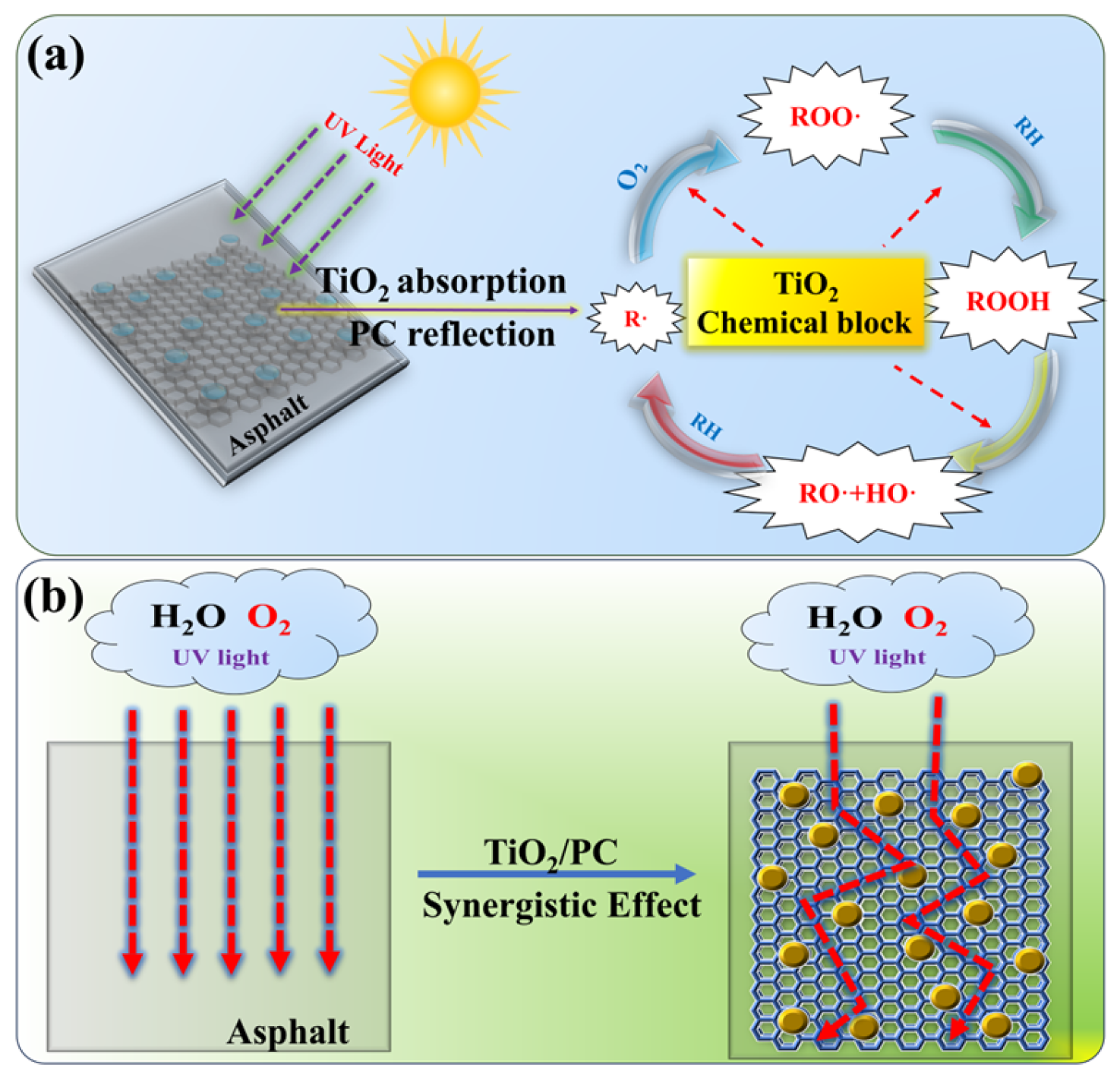
As illustrated in Figure 12a, under UV irradiation, asphalt molecules undergo bond cleavage to generate free radicals (R⋅). Subsequently, these radicals react with oxygen to form peroxyl radicals (ROO⋅). In the third stage, ROO⋅ reacts with asphalt molecules (RH) to yield hydroperoxides (ROOH) and new R⋅ radicals. ROOH further decomposes into hydroxyl radicals (⋅OH) and alkoxy radicals (RO⋅, e.g., carbonyl or aldehyde groups). Finally, RO⋅ reacts with RH to produce ROH and additional R⋅ radicals, perpetuating the oxidative cycle [52]. This reaction cascade encompasses chain initiation, propagation, branching, and termination, all of which are accelerated by UV exposure [53]. The incorporation of TiO2/PC nanocomposites significantly enhances UV resistance through synergistic mechanisms, as illustrated in Figure 12a,b. In the initial stage, TiO2 and PC effectively suppress R⋅ generation by absorbing, reflecting, and scattering UV radiation. The unique microstructure formed between TiO2 and asphalt impedes oxygen diffusion, thereby delaying the conversion of R⋅ to peroxyl radicals (ROO⋅). TiO2 exhibits strong UV absorption, where valence band electrons are excited to the conduction band, generating electron-hole pairs. These photogenerated carriers recombine rapidly, releasing energy as heat. Concurrently, the layered structure of PC acts as an efficient UV reflector/scatterer, while its nanosheet morphology extends the diffusion path of aging agents (H2O, O2 and UV light). Also, the delocalized π-electron system in the graphite-like structure at the edges of PC can serve as an electron donor, directly reducing free radicals [54]. Furthermore, TiO2 retards the decomposition of hydroperoxides (ROOH) in later stages.
Figure 12.
Anti-UV aging process (a) and synergistic blocking effect of TiO2/PC (b).
The synergistic interactions between TiO2 and PC arise from their complementary roles in mitigating UV-induced degradation at different stages. This dual retardation mechanism enables the TiO2/PC composite to function as a multifunctional protective barrier, combining high shielding efficiency and radical scavenging ability and leading to superior UV resistance. Thus, the designed TiO2/PC nanocomposite serves as an effective smart shield, integrating physical blocking, chemical stabilization, and UV attenuation in a single system.
Moreover, the SEM observations indicate that TiO2 particles are distributed on the porous carbon surface, providing accessible sites for interaction with incident UV radiation. Meanwhile, UV-Vis analysis shows that TiO2/PC composites exhibit significantly enhanced absorption in the UV region compared with PC, confirming their improved UV shielding capability. This enhanced UV absorption reduces the penetration of UV radiation and suppresses photo-oxidative reactions within the material. Consequently, samples with higher UV absorption exhibit improved retention of properties after aging. These results demonstrate a clear correlation between microstructure, optical properties, and aging resistance, highlighting the synergistic effect of TiO2 and porous carbon in improving UV durability.
Based on the above analysis, an increase in aging index reflects the formation of oxygen-containing functional groups (such as carbonyl and sulfoxide species), an increase in molecular polarity, and the transformation of lighter maltene components into more polar resin and asphaltene fractions [55,56]. These changes lead to hardening and embrittlement of the asphalt. Conversely, a lower increase in aging index after UV exposure indicates that the modifier suppresses oxidation and slows the aging process. This interpretation is consistent with widely accepted aging mechanisms in asphalt materials [57,58].
Previous studies on TiO2-modified asphalt have demonstrated that nano-TiO2 can effectively mitigate UV-induced aging by reducing oxidative reactions and limiting the formation of oxygenated functional groups, thereby improving durability. In addition, UV aging of asphalt is known to be a surface-dominated process that progressively induces chemical and structural changes, and effective mitigation strategies typically involve UV shielding, absorption, and stabilization of reactive species. The improved performance observed in the TiO2/PC system is consistent with these mechanisms [59].
Furthermore, studies on nanoparticle modifiers have shown that nanomaterials can significantly influence the microstructure and aging resistance of asphalt binders, although their effectiveness depends on dispersion, particle size, and loading level [60,61]. Similarly, carbon-based modifiers (such as graphene, carbon nanomaterials, and porous carbon materials) have been reported to enhance aging resistance by providing barrier effects against oxygen diffusion, improving structural stability, and promoting interfacial interactions within the binder matrix [62,63]. In this work, the porous carbon (PC) serves as a supporting matrix for TiO2 and contributes to the overall aging resistance, while TiO2 provides UV-shielding functionality. Therefore, the improved anti-aging performance of the TiO2/PC composites can be understood as a combined effect of inorganic UV protection and carbon-based structural stabilization, which is consistent with the trends reported in the literature.
4. Conclusions
This study successfully synthesized a TiO2/PC nanocomposite via in situ growth of TiO2 on a layered PC substrate. The anti-aging performance of TiO2/PC-modified asphalt was systematically evaluated and compared with that of pure TiO2, PC, and their hybrid blend. Macro- and micro-scale characterization techniques were integrated to elucidate the UV aging resistance mechanism, with emphasis on the evolution of physical properties, rheological behavior, functional groups, and chemical composition. The main conclusions are as follows:
- (1)
- Hierarchically porous carbon nanosheets were synthesized via a facile one-step carbonization of CTP, utilizing NaCl as a removable template. The NaCl template not only guided the growth of graphitic carbon layer along specific crystallographic planes but also promoted the development of an interconnected porous network. The unique porous nanosheet structure enables multiple reflections and scattering of UV light within the voids.
- (2)
- A TiO2/PC nanocomposite was synthesized via a hydrothermal method, in which TiO2 nanoparticles were in situ deposited onto the three-dimensionally interconnected PC nanosheets. UV-Vis spectra demonstrated that the TiO2/PC nanocomposite possessed synergistic UV-shielding properties with broadband UV absorption (200–400 nm).
- (3)
- Compared with PC, TiO2 and PC + TiO2, TiO2/PC-2 exhibits superior anti-UV aging properties and induces the smallest changes in physical, rheological and functional group aging indices upon UV exposure, as evidenced by the lowest SPI, VAI and RFAI, along with the minimal increases in CAI and SAI.
- (4)
- The TiO2/PC composite demonstrated remarkable synergistic effects in enhancing the UV aging resistance. PC provides physical shielding, UV attenuation and radical reduction, while TiO2 effectively inhibits the chemical chain reactions associated with asphalt aging. Notably, the composite modifier preserved the colloidal stability, as reflected by higher CI and lower GI values, and delayed the sol–gel transition.
It should be noted that the present study focused mainly on the UV-aging resistance of TiO2/PC-modified asphalt under controlled ultraviolet irradiation conditions. Standard short-term and long-term aging procedures, such as the Rolling Thin Film Oven Test (RTFOT) and Pressure Aging Vessel (PAV) test, were not included in this work. Although the UV-aging protocol adopted here is effective for evaluating photo-oxidative aging behavior, it cannot fully represent the thermal-oxidative aging conditions encountered during asphalt mixing, construction, and long-term service. Therefore, future studies should incorporate RTFOT and PAV tests to comprehensively evaluate the aging performance of TiO2/PC-modified asphalt under standard thermal-oxidative and long-term aging conditions.
Author Contributions
Writing—review and editing, software H.Y. and R.T.; Data curation, Formal analysis, Writing—original draft, C.W. Resources, Data curation, Writing—original draft, R.T.; Resources, Data curation, Writing—original draft, C.Y.; Project administration, Investigation and Data curation, J.S.; Methodology, Writing—review and editing, Funding acquisition, H.S.; Resources, Data curation, Q.D.; Writing—original draft, Writing—review and editing, Supervision, Project administration, Y.D. and H.S.; Methodology, Investigation, H.Z. All authors have read and agreed to the published version of the manuscript.
Funding
This research was funded by Shandong Provincial Transportation Science and Technology Program (Grants No.2025BAI14-02, 2022B101 and 2023B89) and Shandong Province Science and Technology-based Small and Medium-sized Enterprises Innovation Capacity Enhancement Project (Grant No. 2022TSGC2056).
Institutional Review Board Statement
Not applicable.
Informed Consent Statement
Not applicable.
Data Availability Statement
The original contributions presented in this study are included in the article. Further inquiries can be directed to the corresponding authors.
Acknowledgments
Sincere appreciation is extended to all supporting institutions and funding agencies.
Conflicts of Interest
The authors declare no conflicts of interest.
Abbreviations
The following abbreviations are used in this manuscript:
| PC | Layered porous carbon |
| TiO2/PC | Nano-TiO2 intercalated PC |
| CTP | Coal tar pitch |
| RPR | Residual penetration ratio |
| SPI | Softening point increment |
| DRR | Ductility retention rate |
| VAI | Viscosity aging index |
| RFAI | Rutting factor aging index |
References
- Zhu, X.; Qian, G.; Yu, H.; Yao, D.; Shi, C.; Zhang, C. Evaluation of coarse aggregate movement and contact unbalanced force during asphalt mixture compaction process based on discrete element method. Constr. Build. Mater. 2022, 328, 127004. [Google Scholar] [CrossRef] [Scilit]
- Guo, M.; Yin, X.; Du, X.; Tan, Y. Effect of aging, testing temperature and relative humidity on adhesion between asphalt binder and mineral aggregate. Constr. Build. Mater. 2023, 363, 129775. [Google Scholar] [CrossRef] [Scilit]
- Zhang, G.; Qiu, J.; Zhao, J.; Wei, D.; Wang, H. Development of interfacial adhesive property by novel anti-stripping composite between acidic aggregate and asphalt. Polymers 2020, 12, 473. [Google Scholar] [CrossRef] [Scilit] [PubMed]
- Zhang, H.; Mao, Q.; Zhu, Z.; Zhang, Z.; Pan, Y.; Wan, J.; Zhou, C.; Qian, J. Experimental study on service performance of epoxy asphalt steel deck pavement of cable stayed bridge. Case Stud. Constr. Mater. 2020, 13, e00392. [Google Scholar] [CrossRef] [Scilit]
- Tang, D.; Zhao, Y.; Xu, G.; Yang, T.; Han, D. Research on the adsorption capacity between asphaltene and resin in asphalt with different aging degree: Experimental study and quantum-mechanical calculation. J. Clean. Prod. 2023, 415, 137651. [Google Scholar] [CrossRef] [Scilit]
- Chen, Z.; Zhang, H.; Duan, H.; Wu, C.; Zhang, S. Long-term photo oxidation aging investigation of temperature-regulating bitumen based on thermochromic principle. Fuel 2021, 286, 119403. [Google Scholar] [CrossRef] [Scilit]
- Chen, S.; Zhang, B.; He, X.; Su, Y.; Liu, Q.; Xu, H. Research on mechanical-activated nanoscale bentonite and surface aging behavior of its modified asphalt. Constr. Build. Mater. 2022, 321, 126356. [Google Scholar] [CrossRef] [Scilit]
- Amini, N.; Hayati, P. Effects of CuO nanoparticles as phase change material on chemical, thermal and mechanical properties of asphalt binder and mixture. Constr. Build. Mater. 2020, 251, 118996. [Google Scholar] [CrossRef] [Scilit]
- Wang, R.; Yue, M.; Xiong, Y.; Yue, J. Experimental study on mechanism, aging, rheology and fatigue performance of carbon nanomaterial/SBS-modified asphalt binders. Constr. Build. Mater. 2021, 268, 121189. [Google Scholar] [CrossRef] [Scilit]
- Zhang, H.L.; Duan, H.H.; Zhu, C.Z.; Chen, Z.H.; Luo, H. Mini-review on the application of nanomaterials in improving anti-aging properties of asphalt. Energy Fuels 2021, 35, 11017–11036. [Google Scholar] [CrossRef] [Scilit]
- Li, S.Q.; Zhang, X.M.; Shi, Y.; Yan, C.Q.; Zhou, S.X. Synergistic effect and mechanism of nanomaterial compounded with sustainable lignin for aging resistance of asphalt. ACS Sustain. Chem. Eng. 2023, 11, 12304–12316. [Google Scholar] [CrossRef] [Scilit]
- Chen, Z.H.; Zhang, D.M.; Zhang, Y.C.; Zhang, H.L.; Zhang, S. Influence of multi-dimensional nanomaterials composite form on thermal and ultraviolet oxidation aging resistances of SBS modified asphalt. Constr. Build. Mater. 2021, 273, 122054. [Google Scholar] [CrossRef] [Scilit]
- Wang, J.; Zhang, H.; Zhu, C. Effect of multi-scale nanocomposites on performance of asphalt binder and mixture. Constr. Build. Mater. 2020, 243, 118307. [Google Scholar] [CrossRef] [Scilit]
- Yang, Y.K.; Li, Z.G.; Zhao, J.S.; Qu, S.J. Structural engineering of pitch-based porous carbon and its application in supercapacitors: A review. J. Energy Storage 2023, 74, 109334. [Google Scholar] [CrossRef] [Scilit]
- Chen, W.; Fan, S.F.; He, X.Y.; Su, Y.; Yang, C.; Liu, Q.; Oh, S.K.; Zhou, H.; Tang, D.K. Achieving superior anti-aging properties of SBS modified asphalt through incorporating 3-methylacryloxy propyl trimethoxysilane surface functionalized MXene. Constr. Build. Mater. 2025, 464, 140156. [Google Scholar] [CrossRef] [Scilit]
- Mahmoud, L.A.M.; Rowlandson, J.L.; Fermin, D.J.; Ting, V.P.; Nayak, S. Porous carbons: A class of nanomaterials for efficient adsorption-based hydrogen storage. RSC Appl. Interfaces 2025, 2, 25–55. [Google Scholar] [CrossRef] [Scilit]
- Zhang, H.; Ke, N.; Zhu, C. Long-term aging properties of bitumen with expanded vermiculite and different inorganic nanoparticles. Pet. Sci. Technol. 2015, 33, 1557–1562. [Google Scholar] [CrossRef] [Scilit]
- Nazari, H.; Naderi, K.; Nejad, F.M. Improving aging resistance and fatigue performance of asphalt binders using inorganic nanoparticles. Constr. Build. Mater. 2018, 170, 591–602. [Google Scholar] [CrossRef] [Scilit]
- Fini, E.H.; Hajikarimi, P.; Rahi, M.; Nejad, F.M. Physiochemical, rheological, and oxidative aging characteristics of asphalt binder in the presence of mesoporous silica nanoparticles. J. Mater. Civ. Eng. 2016, 28, 04015133. [Google Scholar] [CrossRef] [Scilit]
- Ma, X.Q.; Xiao, N.; Xiao, J.; Song, X.D.; Guo, H.D.; Wang, Y.T.; Zhao, S.J.; Zhong, Y.P.; Qiu, J.S. Nitrogen and phosphorus dual-doped porous carbons for high-rate potassium ion batteries. Carbon 2021, 179, 33–41. [Google Scholar] [CrossRef] [Scilit]
- Yang, B.; Li, H.; Sun, Y.; Zhang, H.; Liu, J.; Yang, J.; Zhang, X. Chemo-rheological, mechanical, morphology evolution and environmental impact of aged asphalt binder coupling thermal oxidation, ultraviolet radiation and water. J. Clean. Prod. 2023, 388, 135866. [Google Scholar] [CrossRef] [Scilit]
- ASTM D4124-09 (2018); Standard Test Method for Separation of Asphalt into Four Fractions. ASTM International: West Conshohocken, PA, USA, 2018.
- Yu, T.; Wang, F.; Zhang, X.; Lv, G.; Lv, H.; Wang, J.; Zhai, Y.; Li, M. Typha orientalis leaves derived P-doped hierarchical porous carbon electrode and carbon/MnO2 composite electrode for high-performance asymmetric supercapacitor. Diam. Relat. Mater. 2021, 116, 108450. [Google Scholar] [CrossRef] [Scilit]
- Heng, I.; Low, F.W.; Lai, C.W. High performance supercapattery with rGO/TiO2 nanocomposites anode and activated carbon cathode. J. Alloy Compd. 2019, 796, 13–24. [Google Scholar] [CrossRef] [Scilit]
- Chu, P.K.; Li, L. Characterization of amorphous and nanocrystalline carbon films. Mater. Chem. Phys. 2006, 96, 253–277. [Google Scholar] [CrossRef] [Scilit]
- Shao, C.; Qiu, S.; Wu, G.; Cui, B.; Chu, H.; Zou, Y.; Xiang, C.; Xu, F.; Sun, L. Rambutan-like hierarchically porous carbon microsphere as electrode material for high performance supercapacitors. Carbon Energy 2021, 3, 361–374. [Google Scholar] [CrossRef] [Scilit]
- Wang, Y.; Shao, C.; Qiu, S.; Zhu, Y.; Qin, M.; Meng, Y.; Wang, Y.; Chu, H.; Zou, Y.; Xiang, C.; et al. Nitrogen-doped porous carbon derived from ginkgo leaves with remarkable supercapacitance performance. Diam. Relat. Mater. 2019, 98, 107475. [Google Scholar] [CrossRef] [Scilit]
- Fernández-Álvarez, M.; Moure, A.; Delgado, L.A.; Reinosa, J.J.; Fernández, J.F. Raman spectroscopy study of the role of dispersion and interfaces in the improvement of the mechanical properties of epoxy-TiO2 composites. J. Mater. Res. Technol. 2025, 34, 1744–1758. [Google Scholar] [CrossRef] [Scilit]
- Hao, M.; Xiao, N.; Wang, Y.; Li, H.; Zhou, Y.; Liu, C.; Qiu, J. Pitch-derived N-doped porous carbon nanosheets with expanded interlayer distance as high performance sodium-ion battery anodes. Fuel Process Technol. 2018, 177, 328–335. [Google Scholar] [CrossRef] [Scilit]
- Chen, J.; Wei, J.S.; Zhang, P.; Niu, X.-Q.; Zhao, W.; Zhu, Z.-Y.; Ding, H.; Xiong, H.-M. Red-emissive carbon dots for fingerprints detection by spray method: Coffee ring effect and unquenched fluorescence in drying process. ACS Appl. Mater. Interfaces 2017, 9, 7b03917. [Google Scholar] [CrossRef] [Scilit]
- Yang, C.; Hao, S.J.; Dai, S.L.; Zhang, X.Y. Nanocomposites of poly (vinylidene fluoride)-controllable hydroxylated/carboxylated graphene with enhanced dielectric performance for large energy density capacitor. Carbon 2017, 117, 301–312. [Google Scholar] [CrossRef] [Scilit]
- Shahzad, A.; Rasool, K.; Nawaz, M.; Miran, W.; Jang, J.; Moztahida, M.; Mahmoud, K.A.; Lee, D.S. Heterostructural TiO2/Ti3C2Tx (MXene) for photocatalytic degradation of antiepileptic drug carbamazepine. Chem. Eng. J. 2018, 349, 748–755. [Google Scholar] [CrossRef] [Scilit]
- Irie, H.; Watanabe, Y.; Hashimoto, K. Carbon-doped anatase TiO2 powders as a visible-light sensitive photocatalyst. Chem. Lett. 2003, 32, 772–773. [Google Scholar] [CrossRef] [Scilit]
- Lu, X.; Wang, G.; Zhai, T.; Yu, M.; Gan, J.; Tong, Y.; Li, Y. Hydrogenated TiO2 nanotube arrays for supercapacitors. Nano Lett. 2012, 12, 1690–1696. [Google Scholar] [CrossRef] [Scilit]
- Qi, W.; Shapter, J.G.; Wu, Q.; Yin, T.; Gao, G.; Cui, D.X. Nanostructured anode materials for lithium-ion batteries: Principle, recent progress and future perspectives. J. Mater. Chem. A 2017, 5, 19521–19540. [Google Scholar] [CrossRef] [Scilit]
- Li, T.T.; Yang, G.W.; Wang, J.; Zhou, Y.Y.; Han, H.Y. Excellent electrochemical performance of nitrogen-enriched hierarchical porous carbon electrodes prepared using nano-CaCO3 as template. J. Solid State Electrochem. 2013, 17, 2651–2660. [Google Scholar] [CrossRef] [Scilit]
- Rao, M.S.; Tiwari, A.; Sethi, D.; Dash, T.; Sankaran, K.J.; Sakthivel, R. Effect of various carbon supports for TiO2 and N-doped TiO2 photocatalysts for inactivation of Escherichia coli in water under UV-visible light. J. Photochem. Photobiol. B Biol. 2025, 268, 113180. [Google Scholar] [CrossRef] [Scilit]
- Qiao, H.L.; Wu, M.Q.; Poon, M.T.; Hu, J.Q.; Jiang, Z.Y.; Yu, H.; Xin, J.H.; Wang, L.H. The impact of TiO2 particle and porous structure on UV resistance application for wet-spinning PVDF fiber. Mater. Today Commun. 2025, 46, 112784. [Google Scholar] [CrossRef] [Scilit]
- Sullivan, J.A.; Neville, E.M.; Herron, R.; Thampi, K.R.; MacElroy, J.D. Routes to visible light active C-doped TiO2 photocatalysts using carbon atoms from the Ti precursors. J. Photochem. Photobiol. A Chem. 2014, 289, 60–65. [Google Scholar] [CrossRef] [Scilit]
- Fajrina, N.; Tahir, M. Modification strategies of TiO2-based photocatalysts for enhanced photocatalytic hydrogen production in aqueous medium. J. Environ. Chem. Eng. 2023, 11, 111374. [Google Scholar]
- Wang, C.; Wang, S.; Qian, G.; Chen, C. Carbon-fiber cloth decorated with 3d flowerlike GO/WO3 quantum dots/TiO2 microsphere with high photocatalytic activity under natural sunlight. Part. Part. Syst. Charact. 2021, 38, 2100177. [Google Scholar] [CrossRef] [Scilit]
- Yuan, B.N.; Guo, M.H.; Huang, Z.H.; Naik, N.; Hu, Q.; Guo, Z.H. A UV-shielding and hydrophobic graphitic carbon nitride nanosheets/cellulose nanofibril (gCNNS/CNF) transparent coating on wood surface for weathering resistance. Prog. Org. Coat. 2021, 159, 106440. [Google Scholar] [CrossRef] [Scilit]
- Yang, J.; Jiang, Y.L.; Li, L.J.; Muhire, E.; Gao, M.Z. High-performance photodetectors and enhanced photocatalysts of two-dimensional TiO2 nanosheets under UV light excitation. Nanoscale 2016, 8, 8170–8177. [Google Scholar] [CrossRef] [Scilit] [PubMed]
- Zhang, H.; Zhang, D. Effect of different inorganic nanoparticles on physical and ultraviolet aging properties of bitumen. J. Mater. Civ. Eng. 2015, 27, 0001321. [Google Scholar] [CrossRef] [Scilit]
- Du, P.; Long, J.; Duan, H.; Luo, H.; Zhang, H. Laboratory performance and aging resistance evaluation of zinc oxide/expanded vermiculite composite modified asphalt binder and mixture. Constr. Build. Mater. 2022, 358, 129385. [Google Scholar] [CrossRef] [Scilit]
- Tauste, R.; Moreno-Navarro, F.; Sol-Sánchez, M.; Rubio-Gamez, M.C. Understanding the bitumen ageing phenomenon: A review. Constr. Build. Mater. 2018, 192, 593–609. [Google Scholar] [CrossRef] [Scilit]
- Zhang, H.; Zhu, C.; Yu, J.; Tan, B.; Shi, C. Effect of nano-zinc oxide on ultraviolet aging properties of bitumen with 60/80 penetration grade. Mater. Struct. 2015, 48, 3249–3257. [Google Scholar] [CrossRef] [Scilit]
- Ahmad, M.; Khedmati, M.; Mensching, D.; Hofko, B.; Haghshenas, H.F. Aging characterization of asphalt binders through multi-aspect analyses: A critical review. Fuel 2024, 376, 132679. [Google Scholar] [CrossRef] [Scilit]
- Wu, M.; Yin, L.; Li, M.; You, Z.; Jin, D.; Xin, K. A state-of-the-art review of asphalt aging behavior at macro, micro, and molecular scales. Constr. Build. Mater. 2025, 460, 139738. [Google Scholar] [CrossRef] [Scilit]
- Zhou, S.X.; Yan, J.Q.; Shi, B.H.; Li, S.Q.; Ai, C.F.; Yan, C.Q. Green synthesis of a broad spectrum UV-blocking bitumen modifier: Investigation of anti-aging performance and mechanism in bitumen. J. Clean. Prod. 2023, 425, 139064. [Google Scholar] [CrossRef] [Scilit]
- Liu, S.; Shan, L.Y.; Li, G.N.; Underwood, B.S.; Qi, C. Molecular-based asphalt oxidation reaction mechanism and aging resistance optimization strategies based on quantum chemistry. Mater. Des. 2022, 223, 111225. [Google Scholar] [CrossRef] [Scilit]
- Polo-Mendoza, R.; Martinez-Arguelles, G.; Walubita, L.F.; Moreno-Navarro, F.; Giustozzi, F.; Fuentes, L.; Navarro-Donado, T. Ultraviolet ageing of bituminous materials: A comprehensive literature review from 2011 to 2022. Constr. Build. Mater. 2022, 350, 128889. [Google Scholar] [CrossRef] [Scilit]
- Xu, S.; Jia, X.J.; Huang, R.Y.; Fang, L.; Ma, Z.R.; Zhang, C.L.; Que, Y. Preparation and performance evaluation of different bitumens modified by antioxidant/PABA-LDHs composites. Constr. Build. Mater. 2023, 367, 130286. [Google Scholar] [CrossRef] [Scilit]
- Sugandha; Kushwah, M.; Kumar, V.; Kumar, A.; Choudhary, M.; Gaur, M.S.; Arora, K. Enhancing radical scavenging using reduced graphene oxide based metal organic frameworks: A comparative study. J. Mol. Struct. 2024, 1318, 139076. [Google Scholar] [CrossRef] [Scilit]
- Zheng, Q.; He, P.; Zhang, D.; Weng, Y.; Lu, J.; Wang, T. A holistic view of asphalt binder aging under ultraviolet conditions: Chemical, structural, and rheological characterization. Buildings 2024, 14, 3276. [Google Scholar] [CrossRef] [Scilit]
- Zhen, T.; Kang, X.; Liu, J.; Zhang, B.; Si, W.; Ling, T. Multiscale evaluation of asphalt aging behaviour: A review. Sustainability 2023, 15, 2953. [Google Scholar] [CrossRef] [Scilit]
- Hu, D.; Zhang, H.; Wang, Z.; Wang, X.; Gu, X.; Zhang, J.; Pei, J. From asphalt molecular evolution to performance degradation: Understanding aging mechanisms, inhibition strategies, and rejuvenation techniques. Fuel 2025, 404, 136293. [Google Scholar] [CrossRef] [Scilit]
- Liu, H.; Tian, Z.; Fang, Y.; Zhang, Z.; Zhao, Y.; Hu, P.; Wang, K. Research on gradient aging behaviors of asphalt and decay characteristics of its properties under complex UV radiation conditions based on component diffusion and aging kinetics theory. PLoS ONE 2025, 20, e0329496. [Google Scholar] [CrossRef] [Scilit] [PubMed]
- Ayar, P.; Ruhi, A.; Baibordy, A.; Asadi Azadgoleh, M.; Mohammadi, M.M.; Abdipour, S.V. Toward sustainable roads: A critical review on nano-TiO2 application in asphalt pavement. Innov. Infrastruct. Solut. 2024, 9, 148. [Google Scholar] [CrossRef] [Scilit]
- He, Z.; Ge, D.; Xian, J.; Liu, Q.; Hu, X.; Ju, Z.; Lv, S. Performance comparison of different types of anti-UV aging agents in modified asphalt. Buildings 2025, 15, 360. [Google Scholar] [CrossRef] [Scilit]
- Liu, Z.; Sun, X.; Xu, H.; Lu, Y.; Su, Z.; Ye, Y.; Huang, G. Anti-aging performance and action mechanism of asphalt modified by composite modification. Appl. Sci. 2024, 14, 10250. [Google Scholar] [CrossRef] [Scilit]
- Liu, Y.R.; Tang, X.; Zeng, Q.; Lai, J.P. Impacts of ultraviolet absorption by zinc oxide nanoparticle modifiers on asphalt aging. Sci. Rep. 2024, 14, 19918. [Google Scholar] [CrossRef] [Scilit]
- Ran, W.; Fu, J.; Ran, J.; Ai, X.; Zeng, L.; Zheng, Y.; Li, B. Effects of graphene materials on asphalt and asphalt mixture. Iran. J. Sci. Technol. Trans. Civ. Eng. 2025, 49, 21–38. [Google Scholar] [CrossRef] [Scilit]

Disclaimer/Publisher’s Note: The statements, opinions and data contained in all publications are solely those of the individual author(s) and contributor(s) and not of MDPI and/or the editor(s). MDPI and/or the editor(s) disclaim responsibility for any injury to people or property resulting from any ideas, methods, instructions or products referred to in the content. |
© 2026 by the authors. Licensee MDPI, Basel, Switzerland. This article is an open access article distributed under the terms and conditions of the Creative Commons Attribution (CC BY) license.