


Abstract
In this review, the application of microbially induced calcium carbonate precipitation (MICP) for repairing coal mining-induced cracks in loess soils was summarized, and its objectives, main findings, and key challenges were highlighted. First, the formation characteristics and engineering demands of mining-induced loess cracks were analyzed, and the limitations of existing repair methods in terms of durability, adaptability, and environmental impact were emphasized. The advantages of MICP for soil stabilization, crack sealing, and ground improvement were presented, demonstrating its potential for use in the remediation of cracks in loess. Key challenges in practical implementation, including uneven injection, clogging, environmental constraints on microbial activity, ammonia byproduct risks, and insufficient long-term stability assessment, were discussed. Overall, MICP offers a sustainable and effective strategy for loess crack repair, providing a promising approach for ecological restoration and geotechnical reinforcement in mining-affected regions.
1. Introduction
1.1. Research Background
The coal development region in northern Shanxi Province, China, is located along the middle reaches of the Yellow River and possesses abundant coal resources, ranking among the world’s eight largest coal mining areas and serving as a major national energy and chemical base [1]. However, this region lies on the renowned Loess Plateau, which contains some of the thickest loess deposits worldwide [2] and is characterized by aridity and water scarcity, making it an ecologically fragile zone. After mining, voids and deformation cracks in the overlying strata propagate to the surface, inducing ground subsidence and the formation of cracks [3]. Since the principal aquifers lie above the coal seams, these cracks not only directly damage civil and geotechnical infrastructure (e.g., buildings and transport routes) but also cause mechanical injury to plant roots, reduce vegetation cover, accelerate soil degradation, and enhance soil moisture loss—all of which exacerbate environmental degradation [4,5]. The development of cracks in loess disrupts soil structure, increases evaporation, and reduces water retention, thereby hindering vegetation growth in this semi-arid, environmentally vulnerable region [6]. Surface cracks also result in significant losses of soil moisture and groundwater flow [7,8]. The quantity of loess moisture lost in collapse-crack zones is nearly 50% greater than that in uncracked areas [9]. Therefore, repairing cracks in loess, enhancing resistance to soil erosion, conserving soil moisture, and promoting cultivation [10] are crucial for ecological restoration and protection. Therefore, an innovative, environmentally sustainable, and economically viable soil stabilization and repair technique is urgently needed.
1.2. Research Significance
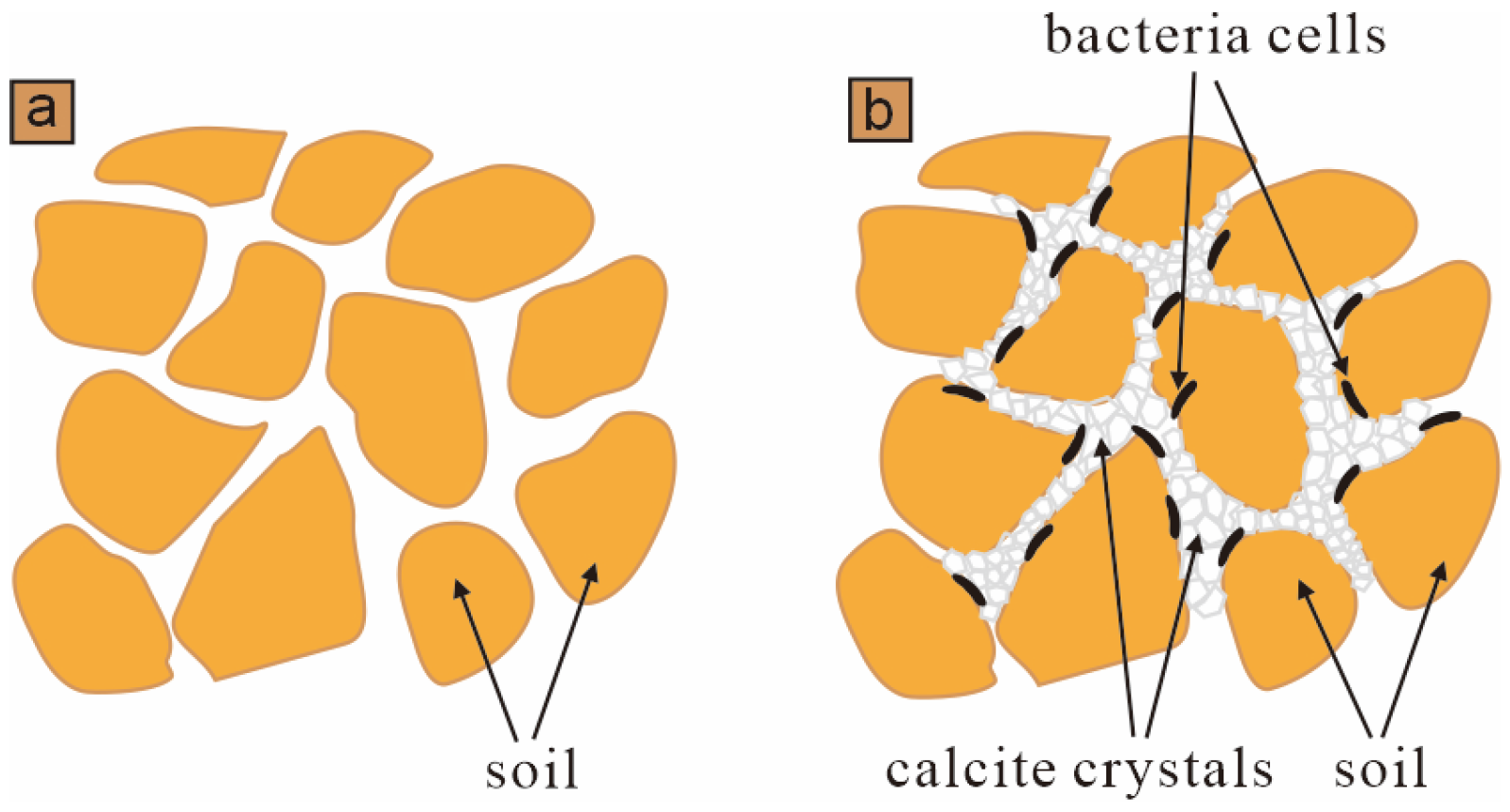
In recent years, microbially induced calcium carbonate precipitation (MICP), an environmentally friendly and sustainable soil stabilization technique, has attracted increasing attention. Drew isolated the first microorganism capable of mediating MICP in a natural environment [11] and named it Bacterium calcis. Such a denitrifying bacterium can induce calcium carbonate precipitation in liquid culture and is recognized as a significant contributor to marine calcium carbonate deposition. Subsequently, Kellerman & Smith [12] observed microbial calcium carbonate precipitation in Atlantic seawater and oolitic sand samples and redesigned the organism as Pseudomonas calcis. Over time, research interest in MICP has increased. In 1973, Boquet et al. [13] demonstrated that soil bacteria commonly induced the formation of calcite crystals, indicating the extension of MICP-mediated bacteria from marine isolates in liquid media to terrestrial soil bacteria cultured on solid media. Kantzas et al. [14] reported that bacterium-induced calcium carbonate precipitation could bind loose sand grains, significantly reducing their porosity and permeability. This discovery enabled the first application of MICP technology in geotechnical engineering. When applied to soil, MICP relies on the metabolic activity of the abundant indigenous microbial community in natural soils to produce calcium carbonate precipitation, thereby enhancing the connections between soil particles [15] (Figure 1). Compared with traditional grouting materials and biopolymers, the bacteria and cementation solutions used in MICP exhibit lower viscosity and superior penetrability [16], enabling treatment of greater crack depths. As the microbial population proliferates, biocementation continues, resulting in progressively thicker and more extensive cementation [17].
MICP technology can increase soil strength and stiffness while reducing soil porosity and permeability, thereby enhancing water retention capacity [18,19]. When applied at the soil surface, this technique also mitigates dust emissions and soil erosion [20,21,22]. As a green solidification method, MICP contributes to environmentally sustainable ground improvement [23]. The mechanical and hydraulic properties exhibited by MICP-treated soils align with contemporary engineering requirements [24,25,26], and this technology offers specific advantages in enhancing the moisture-induced collapse resistance and durability of loess soils [27]. Given increasing interest in MICP technology for environmental remediation and geotechnical engineering [17], its application for coal-mine crack repair presents significant innovation and substantial potential value for addressing ground instability and environmental degradation associated with mining activities.
Figure 1.
A conceptual diagram showing changes to soil grains during biocementation treatment. (a) Soil particles with pore space during cementation treatment; (b) soil particles with complete binding due to CaCO3 precipitation (adapted with modification from Ezzat [28]).
2. Basic Principles and Research Status of MICP
2.1. Principle of MICP Technology
Various bacteria in the natural environment, including heterotrophic and autotrophic microorganisms, can precipitate calcium carbonate crystals under suitable conditions [29]. In the absence of microbial mediation, calcium carbonate precipitation occurs extremely slowly, typically requiring long geological timescales [30]. However, current MICP techniques accelerate this process by controlling key factors that influence bacterial activity and mineralization: bacterial species, urease production, mineralization methods, pH, and the availability of nucleation sites [31,32,33]. By optimizing these parameters, a substantial amount of carbonate minerals can be generated in a short period [34]. Changes in any one or a combination of these controlling factors can affect the course and efficiency of the mineralization process during microbially induced precipitation [35].
2.1.1. Strain Types
Many bacterial species can produce urease and are used in biologically mediated soil improvement. Various bacteria isolated from soil and moisture-restoration contexts produce calcium carbonate crystals under cultivation conditions, including Salmonella, Bacillus subtilis, nitrogen-fixing bacteria, Bacillus megaterium, Bacillus cereus, Bacillus circulans, and Pseudomonas aeruginosa (Table 1). After 1–20 days of incubation, crystals formed on the culture media, indicating that the ability to induce calcium carbonate precipitation is widespread among many bacteria [13,18,35,36,37,38,39].
Table 1.
Representative bacterial strains capable of producing MICP curing effects (2014–2025).
2.1.2. Urease
Urease, an important metalloenzyme in microorganisms, drives calcium carbonate precipitation in MICP by catalyzing the hydrolysis of urea into ammonia and carbonic species [73,74]. This reaction increases the local pH and supplies carbonate ions that combine with calcium to precipitate solid CaCO3. Studies have confirmed that various types of ureases, including those derived from bacteria, algae, soil microbiota, and plants, can facilitate carbonate formation [75]. Urease (also known as urea amidohydrolase) has absolute catalytic specificity for urea and belongs to the amidohydrolase enzyme class [74]. Under suitable conditions, the enzyme can hydrolyze hundreds to thousands of urea molecules per minute; consequently, with other conditions held constant, urease activity determines calcium carbonate precipitation yield in the MICP process [17,35].
2.1.3. MICP Mineralization Principle
Soil bacteria can induce calcite precipitation under alkaline conditions, with microbial cells serving as nucleation sites for mineral formation [76]. The cell surface, including the cell wall and extracellular polymeric substances (EPS), contains negatively charged functional groups such as carboxyl (COO−) and phosphate (PO42−) that attract positively charged Ca2+, promoting local supersaturation and offering heterogeneous nucleation sites for calcium carbonate [77,78] (Figure 2). Calcium carbonate nucleation thus occurs at the cell surface, followed by extracellular crystal growth to form calcite. During this stage, bacterial colonization extends onto newly formed crystal faces, increasing crystal coverage beyond the original substrate contact points [79].
Figure 2.
Schematic Diagram of Microbial Mineralization (adapted with modification from Zhang [80]).
Previous research has shown that microbial mineralization primarily occurs via several pathways, including urea hydrolysis, denitrification, and sulfate reduction [78,81,82].
Urea Decomposition MICP
Urea hydrolysis is the most direct and readily controlled biochemical pathway in MICP. Urease-producing microorganisms are widespread and rapidly catalyze the hydrolysis of urea (NH2CONH2) to generate ammonia (NH3) and carbon dioxide, which subsequently form bicarbonate and carbonate ions that combine with Ca2+ to precipitate as CaCO3 [82]. This pathway has simple kinetics and efficiently produces calcium carbonate particles under suitable alkaline conditions that favor carbonate formation, making it amenable to process control and engineering scale-up [83]. However, the main byproduct, ammonia, is volatile and poses potential environmental pollution risks, requiring measures to treat or reduce ammonia emissions in practical applications.
Urea hydrolysis-based MICP, while offering advantages such as fast mineralization rates and substantial alkalinity generation, produces a large amount of ammonia–nitrogen as a byproduct. This significantly weakens the environmental friendliness of the technology, especially in open systems or large-scale engineering applications, where the migration and accumulation of ammonia may lead to secondary pollution issues.
Denitrification-Induced MICP
Denitrifying bacteria by using nitrate (NO3−) as a terminal electron acceptor under anaerobic conditions, reduces it stepwise to nitrite (NO2−), nitric oxide (NO), nitrous oxide (N2O), and finally nitrogen gas (N2). This series of reactions consumes protons and generates alkalinity, thereby increasing the local pH and promoting carbonate formation [53]. Organic substrates oxidized during microbial metabolism provide the energy required for denitrification [84]. The nitrogen gas and carbon dioxide released during denitrification, together with increased alkalinity, drive CaCO3 precipitation in the presence of Ca2+. This pathway represents an alternative MICP mechanism in which denitrification-generated alkalinity facilitates CaCO3 formation under anoxic conditions.
Denitrification can proceed in distinct pathways: under complete and uninterrupted conditions, the end products are N2 and CO2, which are harmless to the environment. However, if any of the four key enzymes involved in the denitrification pathway is inhibited, toxic intermediates such as nitrite (NO2−) and nitrous oxide (N2O) may accumulate, potentially causing environmental risks [84,85]. While offering potential to reduce ammonia–nitrogen emissions, denitrifying MICP has a more complex reaction pathway and requires strict control of anoxic conditions and the carbon-to-nitrogen ratio. Additionally, nitrite accumulation or N2O release may occur under incomplete denitrification conditions, which compromises its engineering stability and environmental sustainability.
Sulfate-Reducing Bacteria Produce MICP
Sulfate-reducing bacteria (SRB) can use sulfate (SO42−) as a terminal electron acceptor under low-oxygen or anaerobic conditions, reducing it first to sulfite and then to hydrogen sulfide (H2S) [86]. In parallel, the bicarbonate ions produced during the metabolic process can combine with metal ions such as calcium to form carbonate precipitates [31,44,87]. Moreover, SRB metabolism increases the local pH during sulfate reduction, thereby enhancing carbonate saturation and further inducing carbonate precipitation [88]. Even inactive SRB cells can facilitate carbonate precipitation under suitable conditions, as their cell surfaces provide heterogeneous nucleation sites [89].
The sulfate reduction process does not eliminate the risks of byproducts but rather shifts the environmental burden to issues such as hydrogen sulfide release, equipment corrosion, and the accumulation of reduced sulfur. Moreover, this mechanism is highly dependent on anoxic conditions and the availability of organic substrates, complicating process control. Mineralization efficiency and engineering reproducibility are also limited.
Iron-Reducing Bacteria-Induced MICP
Iron-reducing bacteria (IRB) are strictly anaerobic dissimilatory metal-reducing microorganisms that use Fe3+ as a terminal electron acceptor, reducing it to soluble Fe2+ during microbial metabolism [90]. The resulting Fe2+ is unstable and readily oxidized to form ferric oxides or iron salt compounds. These secondary iron minerals, together with extracellular polymeric substances produced by the bacteria, create a viscous material that can fill soil pores and improve interparticle bonding [17,91,92]. However, the yield of materials biologically treated by iron-reducing bacteria is uncertain, and the resulting iron hydroxides or ferrous hydroxides typically exhibit low strength, which may negatively affect engineering performance in field applications [90].
MICP involving iron-reducing bacteria can promote carbonate precipitation, but the process is inherently controlled by iron cycling, redox conditions, and organic substrate availability. The mechanism is complex and poorly controllable, and it may be accompanied by issues such as iron oxide dissolution, pollutant release, and insufficient mineral stability. Consequently, this approach is currently more suitable to consider a conditional mineralization process for specific environments rather than a mature, universal engineering MICP pathway.
Acetic Acid-Induced
Acetogenic bacteria constitute a group of strictly anaerobic microorganisms that are widespread in nature [93]. They may be heterotrophic or autotrophic [94] and can produce acetate from H2 + CO2, CO, or H2 + CO2 + CO mixed gas [95]. The consumption of acetate leads to the formation of bicarbonate ions, which can promote calcium carbonate precipitation [96]. At present, the use of acetogenic bacteria to induce MICP has been explored mainly for CO2 sequestration, but the underlying mechanism and bacterial yields remain unclear [97].
Overall, MICP pathways involving denitrifying, sulfate-reducing, iron-reducing, and acetogenic bacteria can prevent ammonia production. These pathways, driven by (facultative) anaerobes, induce MICP indirectly and at lower rates and require stricter conditions to maintain activity [98,99]. In contrast, the urease-driven urea hydrolysis pathway is simpler, easier to control, environmentally favorable, and efficient at generating carbonate ions in the short term; thus, it is more widely used in MICP applications.
2.2. Application Areas of MICP Technology
2.2.1. MICP Applied in Engineering Fields
Over the past two decades, researchers have investigated diverse engineering applications of MICP, including subsea ground improvement (e.g., sea-bed solidification [34]), concrete crack remediation, loose sand stabilization [100], heritage masonry crack repair [101], desertification control [102], and heavy metal-contaminated soil purification with enhanced soil mechanical and hydrological properties. MICP studies to date predominantly address mortar, concrete, and heritage crack mitigation (Table 2), with few studies on surface soil cracks induced by coal mining or loess cracking and collapse related to mining subsidence. Even fewer investigations have investigated changes in the geotechnical properties of loess after MICP treatment, such as Atterberg limits, shear strength, permeability, or collapsibility behavior. The mechanisms governing MICP modification of loess remain unclear and warrant further research.
Table 2.
MICP technology for crack or pore repair.
Despite the rapid growth of studies on microbially induced calcium carbonate precipitation (MICP) in engineering applications—such as soil consolidation, crack sealing in concrete, heavy metal immobilization, and erosion control—the integration of MICP specifically for the repair of mining-induced loess cracks remains underdeveloped. Most existing MICP research focuses on homogeneous fine-grained soils or concrete systems, where parameters such as urease activity, bacterial dosage, and cementation solution composition are optimized for strength enhancement or permeability reduction. In contrast, loess soils exhibit unique structural anisotropy, high porosity, and open micro-crack networks induced by excavation, which present distinct challenges for effective biocementation.
2.2.2. MICP for Geotechnical Engineering
Currently, MICP research in geotechnical engineering focuses mainly on loose sandy soil stabilization, with extensive investigations into improvements in mechanical and hydraulic properties centered on sand solidification. MICP is applied to enhance soil engineering properties, including strength and stiffness increase, permeability reduction and groundwater seepage control, liquefaction resistance and vibration mitigation, erosion suppression and slope stabilization, foundation bearing capacity improvement with settlement reduction, and environmental applications such as polluted soil remediation and heavy metal fixation (Table 3). MICP also has potential for future applications in CO2 sequestration, desert greening, marine land reclamation, and ecological restoration (Figure 3).
Table 3.
MICP applied to sandy soil consolidation.
Figure 3.
Prospects for Future Applications of MICP (adapted with modification from Zhang [114]).
2.3. Advantages and Limitations of MICP Technology
2.3.1. Advantages
Environmentally Friendly
Compared with those in conventional grouting, the microbial strains in MICP are derived from the surrounding soil and pose no additional environmental risk, conferring superior environmental compatibility. The biomineralization process relies on microbial metabolism to generate calcium carbonate rather than energy-intensive chemical materials, markedly reducing the dependence on high-carbon stabilizers such as cement and lime and lowering overall resource consumption and environmental impact [1]. Furthermore, MICP reduces calcium source consumption and mitigates environmental pollution risk [115]. These attributes align with the requirements of low-carbon and sustainable engineering [114].
Environmental Adaptability
MICP relies on active ureolytic microorganisms to catalyze calcium carbonate formation within soils/materials, resulting in broad environmental tolerance [116]. Strains and process parameters maintain viability and mineralization efficiency across a relatively wide temperature range (e.g., 20–40 °C), pH range, and moist conditions [116]. Although microbial activity and urease-driven precipitation are influenced by environmental factors such as temperature and pH, which govern growth and enzyme performance (e.g., urease activity declines at low temperatures and outside optimal pH), these constraints do not preclude function within operational limits. MICP demonstrates resistance to variations in ion strength and other soil conditions, enabling stable biomineralization in diverse natural and engineered contexts [117]. This adaptability can be further extended by employing indigenous acid- or climate-tolerant strains, facilitating effective stabilization or remediation in acidic, tropical, or contaminated soils [118].
Increased Shear Strength
MICP results in the formation of calcium carbonate bridges between soil particles via microbial metabolism, significantly increasing soil shear strength and structural integrity [119]. Precipitated CaCO3 fills pores and reduces the void ratio while increasing the interparticle friction angle and cohesion, thereby increasing shear resistance and lowering the risk of shear deformation [120]. In direct shear and triaxial tests, MICP treatment markedly increases the cohesion and internal friction angle, resulting in higher peak shear strength and greater ductility under shear loading [121]. MICP improves sands, silts, and expansive soils, representing an eco-friendly ground improvement method with both environmental and mechanical benefits [122].
Reduced Permeability
MICP generates CaCO3 that bridges soil particles, fills pores, and disrupts pore connectivity, leading to a marked reduction in soil permeability [123]. Precipitated CaCO3 occludes original water flow pathways and blocks seepage channels, significantly slowing water movement through the soil matrix [124]. This effect is critical for resisting water erosion, controlling groundwater seepage, and mitigating soil loss. Experimental data indicate that MICP treatment can reduce the permeability coefficient by several orders of magnitude, resulting in a denser soil structure with enhanced impermeability and erosion resistance, which is beneficial for ecological engineering and foundation stabilization design [120].
Improving Water Stability
In loess engineering, MICP induces the formation of extensive amounts of CaCO3 precipitates that fill and seal original pores, thereby significantly reducing soil permeability and enhancing water stability [125]. Pore sealing inhibits rapid infiltration of rainwater and groundwater, thereby reducing hydraulic shear and erosion of the loess structure [126]. This reduction in infiltration limits water-induced softening, slaking, and collapse, improving overall soil stability under wet conditions [127]. Recent experimental evidence has shown that MICP treatment enhanced water stability and erosion resistance under various wetting and immersion conditions, demonstrating clear engineering potential for sensitive soils such as loess [128].
2.3.2. Disadvantages
Soil Compatibility
While MICP demonstrates high efficacy in coarse-grained soils, its application in fine-grained, silty, or clay soils remains limited [118]. The relatively large cell size of microorganisms restricts their mobility and distribution within fine pores, leading to heterogeneous reactions and incomplete calcium carbonate precipitation throughout the target depth. This markedly reduces treatment effectiveness in soils with high fine-particle contents [129]. Furthermore, bacterial cultivation, transport, and retention are strongly influenced by pore geometry, indigenous microbiota, and the geochemical milieu, leading to persistent instability in heterogeneous soil matrices. To address these limitations, some studies have substituted intact cells with urease enzymes to catalyze urea hydrolysis and drive enzyme-mediated calcite precipitation, thereby enhancing distribution uniformity and extending applicability to fine-grained soils [20,123].
Treatment Uniformity
MICP soil improvement often results in pronounced nonuniformity in bacterial solution transport: the bacterial and reagent distributions within pores are influenced by the pore architecture, injection rate, and number of injection cycles, leading to rapid reactions and blockage near inlets and high-permeability channels. This localized CaCO3 precipitation yields strongly cemented zones but poor overall uniformity [130]. Such spatial heterogeneity reduces the effective improvement depth and width, compromising the consistency of reinforced strength.
Ammonia Byproduct from Urease Hydrolysis Poses Environmental Pressure
Urease-driven urea hydrolysis in MICP continuously generates ammonia (NH4+/NH3). At controlled levels, ammonium can serve as a nitrogen source that may benefit soil and plant growth. However, as pH increases, ammonium shifts toward volatile NH3, which can be released into the environment or accumulate in the system [131,132]. Excess ammonia may cause nitrogen pollution, toxic stress, pH disturbance, and additional treatment requirements, thereby compromising precipitate stability and the environmental sustainability of ureolysis-based MICP. Therefore, ammonia generation should be considered a major limitation for the large-scale application of this technology.
3. Characteristics and Rehabilitation Requirements of Cracks in Coal Mining Areas Within Loess Regions
3.1. Geological Characteristics of Loess
Loess on the Chinese Loess Plateau is characterized by high porosity (>40%) and low natural density (1.3–1.6 g/cm3), with a weakly cemented and loose porous fabric that exhibits high sensitivity to water [133]. It is predominantly composed of silt-sized grains (0.005–0.05 mm) arranged in a loose packing with strong pore connectivity, creating open pore structures that promote high porosity and permeability. Chemically, soil contains abundant calcium carbonate, soluble salts, and minor iron–manganese oxides, which contribute to instability upon wetting by softening and disintegration [134]. Mechanically, loess shows low shear strength and a marked susceptibility to deformation, with pronounced collapsibility and structural breakdown under loading [135]. The optimal moisture content of loess is 14.05%, with a maximum dry density of 1.72 g/cm3. The mineral composition is primarily quartz (45.2%), followed by calcite (11.5%) and feldspar (17.9%) [136].
3.2. Formation Mechanism of Cracks in Coal Mining Areas
3.2.1. Formation of Mining-Induced Ground Cracks
Coal mining subsidence disturbs the stratigraphic structure and, when coupled with a semiarid climate (annual rainfall < 500 mm with high evaporation), promotes desiccation shrinkage and wet–dry cyclic swelling in shallow loess, encouraging the initiation of microcracks [135]. Mining-induced cracks propagate upward with loss of overburden support and increased shear failure in loess, preferentially extending along weak interfaces such as weathered layers and calcrete horizons to form throughgoing tensile cracks [137]. After coal extraction, loss of support in the overburden leads to bending, fracturing, and subsidence of the strata, resulting in surface crack development [138]. These processes align with the observed patterns of mining-induced ground cracks, which arise from discontinuous deformation and overburden failure above the mined panels and are influenced by the strata lithology, mining depth, and structural characteristics of the overlying sequence.
G.-Y. Wang et al. [139] emphasized the influence of hydrogeological conditions and reported that groundwater level decline intensifies surface crack propagation. Cracks frequently occur at the boundaries of persistent subsidence-induced hydrological “funnel zones”, accompanied by significant surface settlement and changes in soil stress.
In the loess region, longwall caving mining is more commonly used than room-and-pillar mining. Compared with room-and-pillar methods, longwall caving tends to induce more extensive surface cracking, resulting in wider cracks, a greater number of cracks, and a larger affected area with more pronounced stress concentration [140]. Furthermore, C. Li et al. [141] examined the dynamic evolution of surface cracks in loess regions, reporting that crack development follows distinct stages: initial cracks typically manifest as small Y-shaped microcracks that, with stress accumulation and changes in crack inclination, progressively extend and link to form larger, more complex crack networks. As these networks grow, they evolve into observable surface crack groups.
In the loess region of Northwest China, coal mining is highly mechanized, and overburden deformation and surface damage are severe, resulting in extensive cracks and surface cracks in the overlying rock [142].
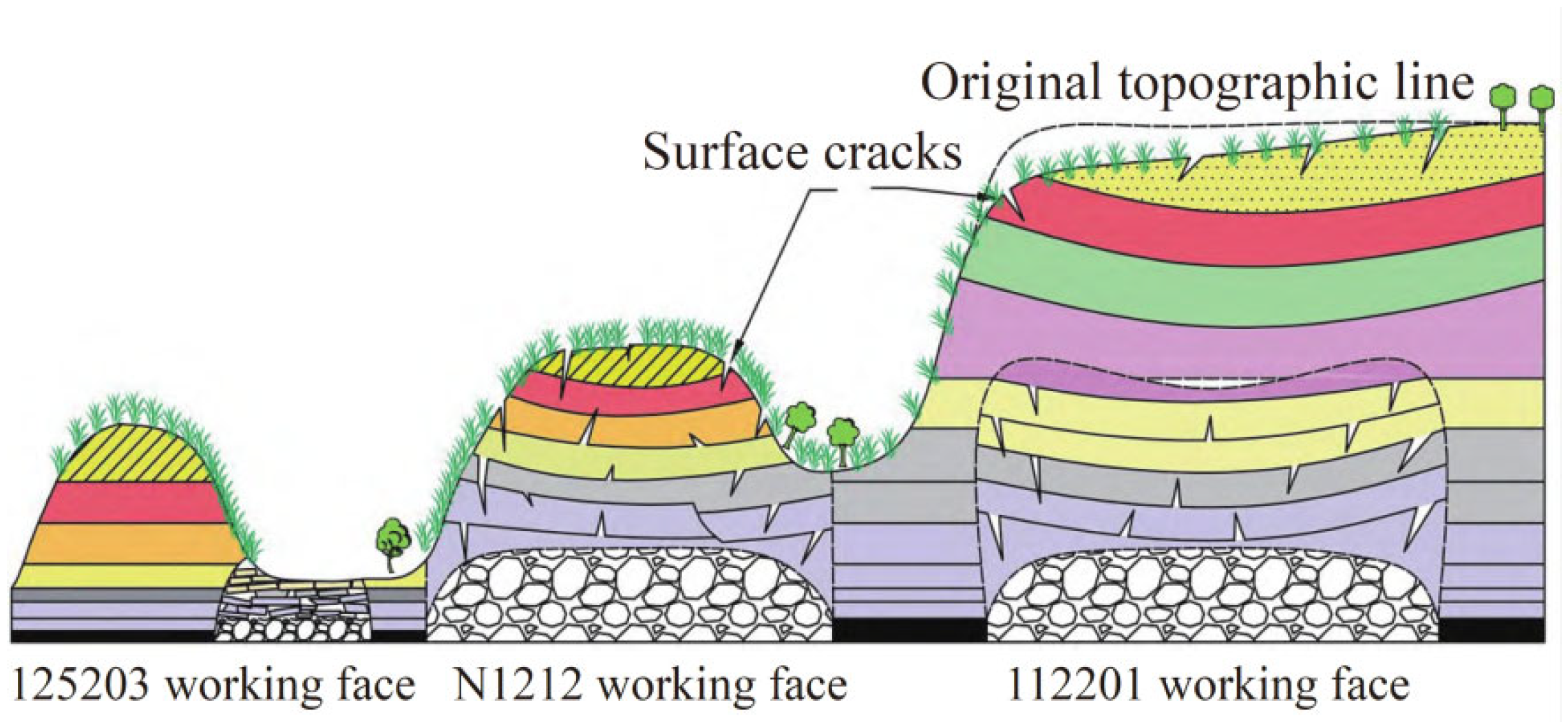
Figure 4.
Model diagram of the formation mechanism of surface cracks [143].
3.2.2. Development Characteristics of Surface Cracks in Coal Mining Areas
Surface cracks above mined regions in the Northwest Chinese loess area exhibit distinct morphological characteristics [144,145,146]: they are narrow at depth and broader near the surface, displaying a vertical “V-shaped” profile. Newly formed cracks exhibit sharp, near-right-angle edges, while older cracks present rounded, weathered margins (Figure 4). Depths are typically < 10 m, although the maximum observed depths can reach ~200 m. In plain view, individual cracks exhibit variable widths and often terminate at their tips, with widths ranging from 0.01 to 2.21 m and lengths ranging from 1 to 350 m (Table 4).
Table 4.
Development of Surface Cracks in Coal Mining Areas in China’s Northwestern Loess Region.
Geological and engineering monitoring indicates that mining-induced surface cracks can attain widths of several centimeters and depths exceeding 10 m (Table 4), exhibit predominantly linear planform geometries, and significantly influence soil erosion, water loss, ecological recovery, and geological hazard risk in mining areas. The cracks are mainly linearly distributed, with both width and depth increasing with increasing mining scale and topographical changes. Small cracks predominate, with the majority of widths concentrated at <50 mm, whereas large cracks are less frequent, following an exponential or right-skewed distribution. Topographic slope significantly influences crack depth distribution: shallow cracks are more prevalent upslope (72% of cracks < 50 mm), whereas downslope cracks exhibit greater widths and depths (reaching 500–1000 mm). Cracks near working faces are most active, and stress release decreases with increasing distance, leading to the gradual convergence of cracks. The superposition effect of cracks is significant, with multiple mining activities causing cracks to widen or new deep cracks to form. Given these characteristics, small cracks are suitable for MICP repair. Future research should further explore different repair strategies based on crack development characteristics (such as morphology, depth, and width).
Crack groups tend to form arc-shaped or elliptical distributions on the surface above mined-out panels (Figure 5). Mining intensity significantly influences crack development: in high-intensity zones (mined area/total area > 30%), cracks are dense and wide, exhibiting elliptical patterns; in moderate-intensity zones (10–30%), cracks are fewer and smaller; and in low-intensity zones (<10%), only minor tensile cracks are observed.
Figure 5.
Morphological Characteristics of the Surface Cracks in Abandoned Mine Areas (adapted with modification from Li [153]).
Spatial distribution characteristics: Surface cracks are distributed over the projected area above the mined-out region and typically extend beyond the panel footprint. According to their positional relationship with the working face, cracks can be categorized into two types: boundary cracks and in-panel cracks. Boundary cracks form around the working face boundaries (gates, entries, and mined stop lines) and exhibit an “O-shaped” ring distribution encircling the extraction perimeter [22]. In-panel, cracks occur parallel to and adjacent to each other on the surface above the mined-out region, forming a series of roughly parallel crack sets. Adjacent cracks are spaced apart, and their intervals are influenced by mining conditions such as the panel width and advance rate (Figure 5 and Figure 6).
Figure 6.
Types of surface cracks: (a) step crack; (b) extrusion swell; (c) sliding crack I; (d) sliding crack II; (e) tensile crack; (f) cluster development; (g) collapse trough; (h) parallel cracks [143].
3.3. Ecological Harm from Cracks in Coal Mining Grounds in the Region
3.3.1. Impact on Water Resources
Mining-induced deformation, fracturing, and displacement of the overlying strata give rise to characteristic “three zones” of subsidence, crack, and bending subsidence. The water content of working faces in aeolian sand areas is strongly affected by surface subsidence, with soil moisture in mined areas substantially lower than that in adjacent unmined terrain [8]. Existing studies indicated that along the boundary of the extraction zone, postmining surface soil water content declines markedly, from 0.099 cm3/cm3 to 0.083 cm3/cm3 [2]. During coal mining subsidence, the groundwater table progressively declines, and crack development in both the overburden and the surface is a principal driver of hydrological change [22,154]. Mining-induced surface cracks facilitate enhanced soil moisture percolation and establish preferential flow paths, resulting in substantial soil water and groundwater loss [7,8].
3.3.2. Effects on Soil
Mining-induced surface cracks accelerate surface water infiltration and rainwater percolation, driving soil nutrient loss and altering soil composition and structure [22,154]. The development of surface cracks reduces the proportion of cohesive particles and increases the sand fraction in shallow slope soils, with the clay content decreasing by 4.50–30.30% and the coarse material content increasing by 6.83–23.67% across the slope profile [135]. Deformation of soil and rock masses induced by coal mining alters soil pore structure and texture, leading to changes in soil hydraulic properties [155], substantially disturbing moisture in the deep vadose zone and increasing the spatial variability of soil organic matter in surface soils [8].
3.3.3. Impact on Vegetation
Ground surface cracks stretch and sever plant root systems, disrupting soil-root contact. Surface cracks cause a significant reduction in shallow groundwater and topsoil moisture, breaching the ecological water threshold required for vegetation growth and potentially leading to plant wilting or mortality [22,156]. Studies have indicated that near cracks induced by ground subsidence, vegetation indices decline significantly within a few meters of the crack, reflecting impaired plant health and coverage.
Coal mining-induced ground cracks increase the area affected by soil and water loss and hinder ecological restoration, increasing geological hazard risk and creating demand for remediation.
3.4. Shortcomings of Existing Repair Techniques
3.4.1. Conventional Soil Solidification Methods
In prior engineering practice, soil solidification has been achieved by both physical and chemical approaches. Physical stabilization typically involves compaction to expel voids and densify the soil, or the incorporation of reinforcements such as rebar, fibers, strips, meshes, and plates to increase strength and reduce settlement [20].
Chemical Soil Solidification
Chemical stabilization employs cementitious binders that react with soil to form a hardened matrix. Common agents include Portland cement, asphalt, fly ash, lime, slag, and biopolymers such as xanthan gum [22]. Portland cement is widely used in ground improvement and soil cementation because of its high strength, durability, workability, and low cost [157]. Its hydration products bind soil particles and improve mechanical properties and stiffness [158].
Nevertheless, cement production contributes substantially to global CO2 emissions, accounting for an estimated 5–8% of industrial CO2 output and exacerbating climate change concerns [159]. Cement hydration in soil generates OH−, rapidly increasing soil pH [160]. Elevated pH can adversely affect indigenous soil microbial communities and ecological processes [161].
Polyacrylamide (PAM) has been applied as a dry granular additive in agricultural soils to form chemical colloidal bonds between soil particles, reducing erosion by increasing aggregate stability [161,162]. However, the primary monomer acrylamide has adverse effects on reproduction and development, which presents environmental and health concerns for its use in soil applications.
Furthermore, chemical approaches often use cements bound with toxic constituents such as polyurethane, silicate, acrylamide, phenolic and epoxy resins, and lignosulfonates. These substances can leach harmful compounds into groundwater and potentially impede subsurface flow, causing environmental degradation [82].
3.4.2. Biopolymer
Xanthan gum and guar gum both improve soil strength, moisture retention, and resistance to deformation when mixed with soil, but their workability and cost-effectiveness require evaluation [163]. Fatehi et al. [164] investigated the use of protein-based biopolymers (casein and sodium caseinate) to stabilize dune sand collected from a highway construction site. They reported that biopolymer soil treatment increased unconfined compressive strength and improved mechanical behavior when casein bound with sand particles. Compared with the untreated controls, casein and sodium caseinate enhanced shear strength and particle bonding in treated sand, demonstrating the potential for biopolymer-induced soil reinforcement in sandy soils.
Chang et al. [165] extracted casein from milk to serve as a soil binder. They reported that soil containing approximately 5% casein by mass achieved a significant increase in unconfined compressive strength (4.34 MPa), which was approximately double that of soil treated with 10% cement (2.65 MPa). However, the strength was sensitive to water content: substantial moisture uptake led to marked strength reduction, indicating limitations for direct field deployment without further enhancement of water resistance.
Biopolymer-based soil treatment significantly improved soil strength, hydraulic conductivity, soil–water characteristics, and erosion control when environmental criteria were met. However, before widespread engineering adoption, the applicability, long-term durability, and economic feasibility of BPST require further validation [166].
Compared with chemical and physical methods commonly used in geotechnical engineering, more environmentally appropriate and economically feasible soil stabilization materials and techniques that offer sustainable performance with reduced ecological impact are needed.
3.4.3. Repair Technology of Coal Mining Crack Soil
Direct research on repairing surface cracks caused by coal mining remains limited; most studies focus on mining techniques to control subsidence and crack evolution, such as backfilling mining to mitigate overburden collapse [167], strip mining to manage surface deformation [168], and grouting reinforcement of the roof to reduce settlement [169]. Consequently, soil restoration for surface cracks can be categorized into three main approaches: natural recovery, mechanical repair, and solidification-based remediation.
Natural Restoration
Research comprises two aspects. First, multidisciplinary studies suggest that as the coal face advances, some mining-induced ground cracks may close under additional mining stress [22]. After closure, the span of these cracks decreases, and the influence on the surrounding soil moisture content is limited at this stage, resulting in a self-sealing water retention effect. Second, studies by Huang [170] and Ju et al. [171] report that when the surface consists of loess (or red loess) rich in expansive clay minerals, water absorption leads to swelling that can repair mining-induced cracks. Similarly, for mining cracks in clay-covered areas, increasing moisture content can promote self-healing of cracks in cohesive soils [172].
Mechanical Repair
This research includes three aspects. First, in regions with undulating terrain, slope micro-topography restoration is carried out according to landform characteristics; Qiang et al. [173] achieved outstanding outcomes in this domain [174]. Second, in relatively gentle terrain, large-scale mechanized uniform restoration is suitable: during topsoil reclamation, Zhen-q [144] incorporated humus, river mud, and other materials beneficial for ecological revegetation, enabling combined vegetation restoration. Third, in valley landforms, EK. Hou et al. [149] proposed a mechanical filling method for ground cracks comprising a “cushion layer + impermeable layer + top seal layer”, using mixtures of in situ loess and sand to fill mined voids and thus reduce crack development (closure, connectivity reduction, and influx control) [7].
Fixation and Repair
Research comprises two aspects. First, some researchers have developed ultra-high-water chemical solidification materials, which are favored by engineers because of their strong operability. Traditional grouting methods have also been used to repair mining-induced ground cracks [142,169,171]. X. Li et al. [142] divided cracks above goaf areas in the Northwest China loess mining districts into zones outside the goaf, inside the goaf, and the re-compacted central zone, behind the longwall face, and ahead of the longwall face. An assessment method for surface damage was established, and a three-step control strategy of “rapid longwall face advance, local grouting reinforcement of the overburden, and zoned treatment of ground cracks” was proposed, with cracks managed and repaired in distinct zones (Figure 7).
Figure 7.
Ground crack repair effect. (a) Before ground crack repair. (b) After ground crack repair [142].
Researchers have also begun exploring biological techniques for repairing surface cracks in loess. Bi Yinli’s team [175] applied microbial reclamation to enhance vegetation recovery in coal mining subsidence areas, mitigating the effects of ground cracks. Studies have shown that MICP can significantly increase soil density, strength, and moisture retention in loess and other soils [127]. Ji Chuning [176] investigated the structural restoration of soils disrupted by mining in loess–aeolian sand regions and reported that fungal communities within Ascomycota can promote the recovery of the original soil fabric. Guo et al. [177] reported that MICP treatment markedly increased dry density, permeability resistance, and water-holding capacity in treated aeolian sands. Lange-Enyedi [61] compared several technologies for repairing micro-cracks and pores, including microcement, superfine cement, gel, epoxy resin, nanomaterials, and MICP. Among these, MICP demonstrated superior performance in repairing small voids, with a relatively low initial viscosity (1–3 cP). MICP also shows promise for repairing smaller cracks because of improved bacterial transport, and this technique can effectively inhibit wind erosion and retain soil moisture, supporting ecological restoration.
4. Feasibility Analysis of Microparticle Impact Cracking Technology in Coal Mining Ground Crack Repair
4.1. Mechanism of Crack Filling and Loess Strength Enhancement by MICP
MICP precipitates accumulate within soil pores and cracks. In loess crack repair, bacterial suspension and cementation solution are delivered into cracks by permeation or pressure grouting. Ureolytic bacteria such as Sporosarcina pasteurii hydrolyze urea to produce ammonia and carbonate ions, which combine with calcium ions to form CaCO3 precipitates [178]. CaCO3 preferentially precipitates on crack walls and at particle contacts, where it fills voids, cements particles, and bridges the soil structure [179]. This biocementation markedly increases shear strength and structural stability in the vicinity of cracks [180].
4.2. Suitability of MICP Technology in the Loess Environment
MICP has been shown to be suitable for soil stabilization and is promising for treating problematic soils such as bentonite and expansive soils [114]. However, the applicability of MICP in loess environments requires further validation. Loess features a distinctive pore network and high permeability characteristics [133,134]. Its slightly alkaline nature (pH 7.5–8.5), low organic matter content, and favorable conditions for urea hydrolysis promote calcite precipitation [181]. Although the high porosity (30–50%) and well-developed vertical joints of loess pose challenges for implementation [135], targeted optimization can still achieve effective reinforcement.
4.2.1. MICP Improves Soil Structure
CaCO3 precipitates nucleate on particle contacts and within pores, filling voids and altering particle arrangement and pore-size distribution [18,182]. This pore infiltration and particle bonding modify the soil microstructure and contribute to solidification [57]. The high porosity and characteristic aggregate fabric of loess provide macroscopic space for microbial transport and CaCO3 deposition [181]. Loess is generally slightly alkaline and rich in soluble Ca2+, conditions that facilitate ureolytic reactions and precipitate formation [183]. The mineral constituents of loess also offer abundant nucleation sites for CaCO3 crystals [18]. Under high cementation solution concentrations, bacterial mineralization occurs more rapidly than at lower concentrations, with CaCO3 crystals continually attaching to the surfaces of loess particles (Figure 8); bacteria attached to particle surfaces act as nucleation centers, around which CaCO3 accumulates and coats particles [18].
Figure 8.
Schematic of MICP-treated cemented soil particles. Bacterial cells (black) attach to soil grains (khaki) and induce the formation of calcite crystals (white). (Adapted with modification from Terzis [184]).
Chen et al. [18] reported that soil grain size is directly related to soil matrix pore-throat dimensions and that pore-throat size controls whether bacteria can move freely and distribute uniformly. The mode of contact between CaCO3 and soil particles shifts from point contact to surface contact, enhancing the integrity of the loess samples. Veronica [185] experimentally demonstrated that soils with particle sizes ranging from 10 to 1000 μm achieve the most effective cementation and form denser material structures.
4.2.2. MICP Increases Soil Strength
MICP induces the precipitation of CaCO3, which functions as a cementing agent, enhancing soil cohesion and strength by filling pore space and binding particles [186,187]. CaCO3 bridging reduces the void ratio and increases inter-particle contact, which improves mechanical resistance and reduces permeability in treated soils (e.g., higher cohesion and shear strength after carbonate precipitation) (Figure 9). The cementation effect also decreases soil compressibility, mitigating settlement and further contributing to strength gains [19,112]. MICP treatment can increase the unconfined compressive strength (UCS) of loess to 2–5 times that of the original strength, with a concomitant significant increase in the elastic modulus [188].
Figure 9.
Stress–strain curves of loess samples with different bacterial concentrations (adapted with modification from Zhang [187]).
4.2.3. Shear Strength
MICP precipitates CaCO3 at particle contacts, forming cementation bridges that markedly increase loess cohesion, whereas the internal friction angle shows a relatively minor change, thereby enhancing overall shear strength (Figure 10) and structural stability [18]. MICP treatment significantly increases the shear strength of loess, with the increase primarily due to substantial cohesion gains, whereas the internal friction angle φ increases only slightly. In direct shear tests, the cohesion of the MICP-treated loess increased from 18–22 kPa to 55–78 kPa, representing a 2.5–4.0-fold increase, whereas φ increased modestly from 26° to 28–30°. The peak values of cohesion and φ were observed at a cementation solution concentration of approximately 1.0 M, with cohesion values of 17.5, 43.0, 55.5, 32.5, and 23.0 kPa substantially higher than the untreated value of 12.5 kPa. Compared with natural loess, φ increased by approximately 35% and cohesion by approximately 340% [24]. Liu et al. reported that when the CaCO3 content reached 3–5%, the peak shear strength increased by approximately 120–180%, more than 70% of which was attributed to the cohesion contribution [187].
Figure 10.
Shear strength of loess before and after MICP modification under diverse confining pressures [189].
4.2.4. Porosity and Permeability
MICP causes CaCO3 to precipitate within pore spaces and pore throats, partially filling voids and forming cementation bridges at particle contacts, which reduces total porosity and particularly decreases the proportion of large pores while enhancing interparticle bonding, thereby significantly lowering loess porosity and permeability [179]. Different amounts of CaCO3 and added materials influence pore-structure regulation and flow pathways. After MICP solidification, the total pore area and the number of micro-to-small pores decrease markedly; microstructural analysis reveals that the total pore count is reduced by approximately 13.2% [190]. The permeability coefficient of loess decreases with increasing cementation solution concentration and additives; for example, when σ3 = 100 kPa, increasing the cementation agent from 0 to 0.5 M decreases the permeability by approximately 40.7%, and with biochar (MBC), the permeability further decreases by approximately 49.2–76.4%. MICP preferentially results in the formation of calcium bridges and fills in large pores (>10 µm) and medium pores (1–10 µm), reducing the number of continuous flow channels and decreasing the throat diameter, thus decreasing hydraulic conductivity [191].
4.2.5. Enhancing Soil Durability and Erosion Resistance
CaCO3 cementation increases soil durability by binding loess particles and producing a denser fabric that resists erosion and weathering. Precipitated CaCO3 bridges particles and reduces their susceptibility to structural breakdown under water impact, thereby enhancing their resistance to disintegration [18]. Y.-J. Cheng et al. [192] reported that MICP treatment substantially improved loess erosion resistance in simulated rainfall tests, with increased CaCO3 precipitation and thicker crust layers correlated with reduced soil loss. At the same cementation solution concentration, more treatment cycles resulted in a greater quantity of CaCO3, a thicker crust, greater structural strength, and lower cumulative erosion.
Xiaohao Sun et al. [27] reported that loess with a post-MICP density of 1.5 g/cm3 exhibited improved aggregate stability and freeze–thaw durability, with uniform solidification and enhanced long-term resistance. MICP also reduced hydraulic conductivity and significantly increased liquefaction resistance in treated loess; extended treatment durations further improved anti-liquefaction performance by increasing CaCO3 bonding and pore filling.
Currently, research on the intrinsic mechanisms linking MICP (Microbially Induced Calcite Precipitation) with loess cracks induced by coal mining remains relatively scarce. Existing literature primarily focuses on experimental validations of MICP’s effectiveness in crack filling or soil consolidation, while the coupling analysis of its mechanisms in actual complex geological-engineering scenarios—such as how MICP influences crack development, mineralization product distribution, and mechanical responses—has not been systematically addressed. On one hand, MICP has been shown in laboratory conditions to significantly reduce crack permeability and enhance the strength of consolidated media. However, the spatial distribution of mineralization products is heavily influenced by factors such as crack geometry, soil pore structure, fluid flow pathways, and environmental variables (e.g., pH, temperature, ion strength). Under complex field conditions, this can lead to uneven mineralization and localized reinforcement effects. These factors are closely related to the crack network characteristics induced by coal mining disturbances but are often not sufficiently discussed in existing reviews.
5. Challenges and Problems of MICP Technology in Coal Mining Ground Crack Repair
5.1. Technical Challenges
5.1.1. Uniformity Issues in Bacterial Solution Injection
Loess exhibits pronounced stratification, collapsibility, and heterogeneous pore structure [133], which affect fluid migration and retention. The variable crack width, connectivity, and orientation under mining influence cause marked differences in bacterial and cementation solution transport, flow, and residence times within cracks and the surrounding soil, leading to local over-precipitation or untreated zones [182]. Experimental and numerical studies have indicated that solute transport rates, diffusion, and the presence of turbulent and stagnant zones within cracks significantly influence the spatial distribution of precipitates [193].
5.1.2. Injection Procedure and Blockage (Early Surface Precipitation) Issues
High-concentration cementation solutions or high-rate injections tend to produce substantial CaCO3 precipitation near the entry or in narrow pathways at an early stage, leading to channel clogging that blocks subsequent solution transport. This phenomenon is especially pronounced under multi-crack or crack network conditions, thereby reducing treatment efficiency and cementation uniformity [130].
5.1.3. Microbial Activity Limited by Environmental Factors (Temperature, pH, Moisture, and Salinity)
Ureolytic bacterial enzyme activity, survival, and adsorption are strongly influenced by temperature and soil hydrological conditions. In loess with large diurnal temperature fluctuations, low winter temperatures, or frequent wet–dry cycles, precipitation rates and crystal forms vary significantly [194]. Freeze–thaw cycles and wet–dry cycles exacerbate pore and crack evolution, altering water and heat transport, structural stability, and precipitation kinetics, which reduces the reproducibility and predictability of treatment performance [195]. Previous work has quantitatively shown that temperature affects both urease activity and precipitation characteristics, with optimal ureolysis typically occurring within moderate temperature ranges and activity diminishing outside these bounds [196].
5.1.4. Strain Selection and Environmental Risk
Non-pathogenic, environmentally compatible strains must be employed in compliance with biorelease and environmental protection regulations [197]. Survival, competitive dynamics, and ecological impacts at the deployment site require rigorous assessment [198]. Studies recommend the use of enzymatic pathways or locally isolated tolerant strains to mitigate ecological risk [198].
5.1.5. Ammonia/Nitrogen Byproducts and Environmental Risk
The ureolytic pathway (the most common MICP route) releases NH4+/NH3 as a byproduct. If uncontrolled or without appropriate post-treatment, this can lead to soil salinization and nitrogen contamination of surface water and groundwater with associated ecological risks [199]. High ammonium and ammonia levels are known to exceed water quality thresholds and can stimulate algal blooms and oxygen depletion in aquatic systems, threatening biota and water quality. These impacts are particularly acute in ecologically fragile loess regions, and ammonia management or alternative approaches such as EICP, enzyme-based methods, or low-urea formulations should be integrated into process design to mitigate environmental risk [123].
5.1.6. Long-Term Durability and Environmental Cycling Effects (Wet–Dry, Freeze–Thaw, Acid Rain)
Laboratory short-term tests often reveal mechanical enhancement. However, under repeated wet–dry cycling [134], freeze–thaw cycling [200], and conditions that promote CaCO3 dissolution and reprecipitation, the phase evolution of CaCO3 and the temporal evolution of mechanical properties remain uncertain [182], necessitating long-term in situ monitoring data to support engineering service life assessments. The resistance to crack reopening or secondary surface subsidence also requires validation [201].
5.1.7. Deep and Large-Scale Injection Implementation Challenges and Cost
Coal mining-induced cracks often extend irregularly in space, and deep injection requires dedicated drilling, packers, and pumping systems to reach target zones [202]. The logistics and material costs associated with cultivating and transporting large volumes of bacterial suspensions and nutrients become a bottleneck when scaling up to field-scale applications [203]. Field trials indicate that although low-viscosity fluids increase penetration, the costs of engineering equipment and operation remain significant and cannot be overlooked [204].
5.1.8. In Situ Monitoring Challenges and Data Representativeness
Engineering implementation requires reliable in situ monitoring of CaCO3 distribution, permeability, mechanical gain, and ammonia release to verify treatment efficacy and environmental compliance. However, the complexity and heterogeneity of crack networks make representative sampling and continuous data acquisition extremely difficult, undermining standardized performance evaluation and acceptance criteria [205]. Machine learning and remote sensing have been proposed as supplementary decision-support tools to integrate multi-modal data and improve system characterization, particularly when conventional point measurements are sparse or impractical.
The future research should focus on a multi-scale coupling approach from the perspective of crack porosity-width-connectivity, utilizing field observations, numerical simulations, and quantitative characterization of mineralization products. This approach aims to reveal the intrinsic connections between the MICP reaction process, calcium carbonate deposition patterns, and crack network evolution, providing a theoretical basis and engineering guidance for optimizing MICP technology under actual engineering conditions.
5.2. Environmental and Engineering Constraints
5.2.1. Constraints at Engineering Sites
Crack aperture and the scale of pore throats/flow channels determine whether microbial cells can enter and distribute, where CaCO3 precipitates within cracks (e.g., end walls, cracks, or pore throats), and whether infillings create continuous interparticle cementation that contributes to load bearing or merely the formation of thin surface films [206]. Crack aperture and pore throat/flow channel dimensions significantly influence bacterial distribution and mineral deposition, thereby controlling bacterial ingress, residence time, and spatial pattern and sealing efficiency of CaCO3 precipitation [207]. The heterogeneity of cracks (e.g., loess layering, aeolian deposits, and clastic fill) leads to uneven transport of bacterial suspensions and irregular CaCO3 reactions and filling in high- and low-velocity zones, resulting in suboptimal cementation characterized by surface coatings rather than interparticle bridges [124,208,209].
Crack depth and seepage/injection accessibility (e.g., injection pressure, injection volume, and construction cost) limit the practical effectiveness of MICP in deep cracks or deep voids [206]. In fine-grained zones or where crack networks are complex, the permeability and distribution of bacterial and cementation fluids are restricted, leading to uneven CaCO3 precipitation and making uniform consolidation difficult in deep cracks or low-porosity loess [182]. Construction constraints, including the number of injections, solution concentration, residence time, and number of cycles required for blockage/solidification, also influence performance [209,210], and field-scale demonstrations still face cost-efficiency trade-offs [204].
5.2.2. Effects of Temperature, Groundwater Chemistry, and Long-Term Stability
Low ambient temperatures (e.g., annual mean 8–10 °C) significantly suppress microbial enzymatic activity, growth rates, and associated biogeochemical reaction kinetics, reducing urease-driven precipitation rates and overall yield. The magnitude of temperature sensitivity varies with strain and process conditions [211].
Groundwater quality and environmental impacts, including residual NH4+, pH shifts, and potential perturbations to native microbial ecology, are of heightened concern in coal-mining subsidence settings; the simultaneous design of ammonia–nitrogen mitigation [212] and systematic monitoring protocols is necessary to manage these risks [210].
Long-term stability and durability remain uncertain: although short-duration mechanical tests and freeze–thaw cycling experiments exist, the persistence of CaCO3, its phase evolution and mechanical degradation under complex climatic cycling (repeated wet–dry, freeze–thaw, and acid deposition) require further long-term field observations to validate performance retention [18].
5.3. Future Research Directions and Prospects
5.3.1. Selection of Cold-Tolerant High-Efficiency Harmless Strains
Isolate or adapt cold-tolerant strains suited to low temperatures in loess regions; adjust process parameters (e.g., heating, extended reaction time, and increased cycle number) to improve performance [181,213]. Prioritize indigenous, high-activity, non-pathogenic ureolytic bacteria; if exogenous reference strains are used, ensure that they are non-pathogenic, environmentally compatible, and compliant with biorelease/environmental protection regulations [197,214]. Field viability, competitive fitness, and ecological impacts must be evaluated [198]. Some studies propose the use of enzymatic methods or locally isolated tolerant strains to reduce risks [197]. Sporosarcina pasteurii is widely employed as a standard model for MICP because of its high urease activity and ease of cultivation. However, it is not the sole option, and alternatives better matched to field conditions and safety may be preferable [215].
5.3.2. Mitigation of Ammonia–Nitrogen Environmental Risks
Ammonia–nitrogen control must be integrated into design via ammonia-release control and post-treatment strategies or by adopting EICP/non-urea pathways as alternatives to conventional ureolytic processes [20]. Options include adsorption media (e.g., zeolites) for NH4+ removal during biocementation or process modifications that reduce ammonia formation and release. Effluent from MICP processes may require pre-treatment before discharge, and ammonia could be recovered and recycled as fertilizer to surrounding vegetation; this feedback utilization warrants further investigation [23]. Large-scale construction generates substantial wastewater and operational discharge that poses environmental risks; these effluent streams must be quantified and managed within engineering design to mitigate the effects on soil and water systems [198].
5.3.3. Grouting Process Optimization
With respect to the application limits of grouting in coal-mining-induced cracks, existing studies [25,216] focus primarily on small rock and soil crack repair. Observations indicate that for narrow apertures (<3 mm), slurry penetration and sealing are achievable without extensive consolidation [217], whereas wide or networked cracks require mechanical fillers (e.g., sand-biocement composites) or staged grouting to increase fill efficiency. The development and validation of staged injection or low-flow, pressure-controlled infiltration techniques remain necessary [218].
Injection Rate Effects
Excessive injection velocity reduces the residence time available for particle settling, thereby lowering deposition efficiency. High flow rates also accelerate sedimentation and increase the risk of blockage in voids, as shown in cementitious and geotechnical grouting studies [104,204]. The influence of the slurry flow rate on grouting efficacy in loess remains to be further experimentally investigated, since flow velocity critically affects the penetration and deposition processes documented in porous media grouting research.
Injection Cycle
Bacterial injection frequency and treatment period significantly affect the distribution of MICP calcium carbonate precipitation and the reinforcement outcome [209]. Multiple injection rounds increase total precipitation and improve uniformity, whereas longer intervals allow more complete reactions and stronger cementation [204]. The optimal cycle count and timing for loess soils require further investigation.
Grouting Pressure
Elevated grouting pressure (confining pressure) improves MICP-induced CaCO3 distribution and inter-particle contact in treated loess, enhancing shear strength and homogeneity [191]. However, excessive injection pressure increases pore water pressure and reduces effective stress, potentially initiating internal soil erosion due to high hydraulic gradients and degrading soil structure, ultimate strength, and impermeability, thus decreasing overall solidification performance [83,180].
5.3.4. Optimized Process Parameters and Procedures
To improve the uniformity and effectiveness of MICP reinforcement, process parameters, injection methods, and flow control strategies must be optimized for different soil materials. Adjustments such as injection rate modulation and the use of single-phase, multiphase, or staged injection schemes have been shown to influence bacterial transport and precipitation distribution, thereby enhancing the spatial consistency of cementation [204]. Studies also emphasize the necessity of a refined design of injection volume and rate to achieve consistent treatment outcomes in both field and laboratory settings [193].
5.3.5. Transport Stability and Dosage Control
Formulation of encapsulated or dry, shelf-stable powder (e.g., microcapsules, dry blends) enhances transport stability and reduces site diffusion, facilitating controlled delivery and accurate dosing during MICP deployment. Monitoring and contingency protocols should be established to manage field variability [219].
5.3.6. Long-Term Field Monitoring, Quality Control, and Evaluation Challenges
Engineering implementation demands reliable in situ monitoring of CaCO3 spatial distribution, hydraulic conductivity, mechanical gain, and ammonia release. Continuous observation under complex field conditions, including wet–dry cycles, acidic intrusion, and microbial community competition for more than 6~12 months or longer, imposes significant data collection challenges, complicating the acceptance criteria and standardization [205]. Machine learning and remote sensing have been proposed as potential auxiliary decision-support tools to address these monitoring burdens [114].
Moreover, although MICP has shown promising performance in healing cracks in engineered materials and stabilizing sandy soils, its application to mining-induced loess cracks remains insufficiently understood. In particular, few studies have systematically quantified the effects of MICP on field-scale loess crack characteristics, such as crack width, depth, and orientation, or evaluated the corresponding improvements in mechanical properties under mining conditions. In addition, comprehensive models integrating the spatial variability of natural loess cracks with MICP reaction kinetics and transport behavior in complex subsurface environments are still lacking. Therefore, further research is needed to bridge the crack between laboratory-scale mechanisms and practical loess crack remediation, with emphasis on multiscale experiments, advanced monitoring methods, and mechanistic modeling to optimize microbial, chemical, and hydraulic treatments for mining-induced loess cracks.
5.4. Economic Viability and Sustainability
Costs include bacterial preparation and cultivation (or enzyme reagents), chemical inputs (such as urea and calcium sources), injection and construction equipment and labor, site preparation, posttreatment (e.g., NH4+ removal), and long-term monitoring. Although MICP demonstrates environmental friendliness and low material costs at small scales, substantial uncertainties remain for large-scale engineering deployment [220,221] (Figure 11). Large-volume solution and biomass injections, repeated cycles, and difficulties in achieving uniform reaction distribution all contribute to increased operational expenditure, energy use, and time investment, which may render cost effectiveness inferior to traditional reinforcement methods [210,222,223]. To reduce operational and maintenance costs, more efficient delivery technologies (such as encapsulation, solid-phase formulations, enzyme-based alternatives, or in situ stimulation of indigenous microbes) must be developed for cracked surface networks [191,209].
Figure 11.
Total economic and environmental costs of using MICP-treated bricks and conventional concrete bricks in pavers for a 1 km road [203].
For cracks induced by coal mining, if the crack network is dense and extensive, relying solely on conventional injection-based MICP often proves economically unviable [202]. A more practical approach is to combine MICP with other techniques, such as physical filling, mechanical plugging or composite material infill, to balance cost effectiveness and sustainability [224]. When MICP is employed as a supplementary method for “local reinforcement or ecological remediation” (e.g., replacing part of the cement or targeting nonstructural zones that are unsuitable for mechanical repair), it can offer cost advantages in specific applications [225].
6. Conclusions
In summary, MICP technology achieves soil cementation, pore filling, and structural reinforcement through microbially induced calcium carbonate precipitation, demonstrating considerable potential for crack repair and soil improvement. Existing studies have demonstrated that this technology can enhance soil strength, improve shear resistance and erosion resistance, and regulate pore structure and permeability properties, providing a new approach for repairing mining-induced land cracks.
Considering the formation characteristics and ecological hazards of mining-induced cracks in the loess region, traditional repair methods still have shortcomings in terms of adaptability, durability, and ecological compatibility. In contrast, MICP technology has strong theoretical applicability for enhancing the cementation of loess particles and improving the stability of cracked areas, aligning well with the repair needs in loess regions.
However, it should also be noted that the engineering application of MICP still faces several key limitations, including insufficient injection uniformity, potential clogging, microbial activity constrained by environmental conditions, environmental risks due to ammonia production by microbial strains, and insufficient long-term stability evaluation. Therefore, the current application of MICP in mining-induced crack repair requires more field validation and mechanistic studies.
Future research should account for site-specific characteristics of the loess region to optimize microbial strain selection, injection processes, and reaction parameters, and to systematically evaluate long-term durability, ecological safety, and engineering applicability. Overall, MICP technology has good research prospects and application value for repairing mining-induced cracks, though its large-scale promotion still depends on further fundamental research and engineering validation.
Author Contributions
Y.G.: Writing—original draft. M.A.b.M.I.: Supervision, Writing—review and editing. T.L.: Writing—review and editing. Z.H.: Funding acquisition, Investigation. L.G.: Data curation. All authors have read and agreed to the published version of the manuscript.
Funding
This study was funded by Guizhou Provincial Science and Technology Project QKHZC [2024]YB140, QKHJC[2025]MS100, QKHPTKXJZ(2025)020. Funded by Guizhou Provincial Education Department Project, QJJ [2024]345, QJJ [2025]001.
Data Availability Statement
The data that support the findings of this study are available from the corresponding author upon reasonable request.
Conflicts of Interest
Author Zhaolai Hua was employed by and was employed by Shaanxi Coal Caojiatan Mining Co., Ltd. The remaining authors declare that the research was conducted in the absence of any commercial or financial relationships that could be construed as a potential conflict of interest; Author Liangliang Guo was employed by and was employed by Shaanxi Province 185 Coalfield Geology Co., Ltd. The remaining authors declare that the research was conducted in the absence of any commercial or financial relationships that could be construed as a potential conflict of interest.
References
- Naeimi, M.; Haddad, A. Environmental impacts of chemical and microbial grouting. Environ. Sci. Pollut. Res. 2020, 27, 2264–2272. [Google Scholar] [CrossRef] [Scilit]
- Ma, T.; Tang, F.; Zhang, F. Multi-scale soil moisture dynamics in arid mined Loess Plateau arise from crack evolution and microstructure collapse. Sci. Rep. 2025, 15, 44524. [Google Scholar] [CrossRef] [Scilit]
- Lian, X.; Zhang, Y.; Yuan, H.; Wang, C.; Guo, J.; Liu, J. Law of movement of discontinuous deformation of strata and ground with a thick loess layer and thin bedrock in longwall mining. Appl. Sci. 2020, 10, 2874. [Google Scholar] [CrossRef] [Scilit]
- Kong, J.L.; Xian, T.; Yang, J.; Chen, L.; Yang, X.T. Monitoring soil moisture in a coal mining area with multi-phase Landsat images. ISPRS Int. Arch. Photogramm. Remote Sens. Spat. Inf. Sci. 2016, XLI-B7, 537–542. [Google Scholar] [CrossRef] [Scilit]
- Zhang, F.; Hu, Z.; Liang, Y.; Li, Q. Evaluation of surface crack development and soil damage based on UAV images of coal mining areas. Land 2023, 12, 774. [Google Scholar] [CrossRef] [Scilit]
- Song, S.; Zheng, B.; Sun, T.; Du, L.; Wei, J. Influence of different mining damage types on soil erodibility in coal mining areas of Northern Shaanxi, China. Sustainability 2023, 15, 5434. [Google Scholar] [CrossRef] [Scilit]
- Zhang, K.; Yang, K.; Wu, X.; Bai, L.; Zhao, J.; Zheng, X. Effects of underground coal mining on soil spatial water content distribution and plant growth type in northwest China. ACS Omega 2022, 7, 18688–18698. [Google Scholar] [CrossRef] [Scilit] [PubMed]
- Bai, L.; Wang, Y.; Zhang, K.; Yang, Y.; Bao, K.; Zhao, J.; Li, X. Spatial variability of soil moisture in a mining subsidence area of northwest China. Int. J. Coal Sci. Technol. 2022, 9, 64. [Google Scholar] [CrossRef] [Scilit]
- Song, Y.-X. Soil Water Migration and Environmental Effects in Shenfu-Dongsheng Subsidence Area. Ph.D. Thesis, Chinese Academy of Geological Sciences, Beijing, China, 2007. [Google Scholar]
- Ma, T.; Tang, F.; Tang, J.; Wang, F.; Li, P.; Yang, Q.; Wang, S.; Jia, X. Effect of coal mining on soil moisture in semi-arid areas based on an improved remote sensing estimation approach. Environ. Earth Sci. 2023, 82, 545. [Google Scholar] [CrossRef] [Scilit]
- Drew, G.H. The action of some denitrifying bacteria in tropical and temperate seas, and the bacterial precipitation of calcium carbonate in the sea. J. Mar. Biol. Assoc. 1911, 9, 142–155. [Google Scholar] [CrossRef] [Scilit]
- Kellerman, K.F.; Smith, N.R. Bacterial precipitation of calcium carbonate. Proc. Wash. Acad. Sci. 1914, 4, 400–402. [Google Scholar]
- Boquet, E.; Boronat, A.; Ramos-Cormenzana, A. Production of calcite (calcium carbonate) crystals by soil bacteria is a general phenomenon. Nature 1973, 246, 527–529. [Google Scholar] [CrossRef] [Scilit]
- Kantzas, A.; Stehmeier, L.; Marentette, D.F.; Ferris, F.G.; Jha, K.N.; Maurits, F.M. A novel method of sand consolidation through bacteriogenic mineral plugging. In Annual Technical Meeting of the Petroleum Society; Petroleum Society of Canada: Calgary, AB, Canada, 1992. [Google Scholar] [CrossRef] [Scilit]
- Kucharski, E.S.; Cord-Ruwisch, R.; Whiffin, V.; Al-Thawadi, S.M.J. Microbial Biocementation. World Patent 066326, 29 June 2006. [Google Scholar]
- Chu, J.; Stabnikov, V.; Ivanov, V. Microbially induced calcium carbonate precipitation on surface or in the bulk of soil. Geomicrobiol. J. 2012, 29, 544–549. [Google Scholar] [CrossRef] [Scilit]
- Ivanov, V.; Chu, J. Applications of microorganisms to geotechnical engineering for bioclogging and biocementation of soil in situ. Rev. Environ. Sci. Biotechnol. 2008, 7, 139–153. [Google Scholar] [CrossRef] [Scilit]
- Chen, Y.; Tan, L.; Xiao, N.; Liu, K.; Jia, P.; Zhang, W. The hydro-mechanical characteristics and micro-structure of loess enhanced by microbially induced carbonate precipitation. Geomech. Energy Environ. 2023, 35, 100469. [Google Scholar] [CrossRef] [Scilit]
- Kulanthaivel, P.; Soundara, B.; Das, A. Performance study on stabilization of fine-grained clay soils using calcium source producing microbes. KSCE J. Civ. Eng. 2020, 24, 2631–2642. [Google Scholar] [CrossRef] [Scilit]
- Almajed, A.; Lateef, M.A.; Moghal, A.A.B.; Lemboye, K. State-of-the-art review of the applicability and challenges of microbial-induced calcite precipitation (MICP) and enzyme-induced calcite precipitation (EICP) techniques for geotechnical and geoenvironmental applications. Crystals 2021, 11, 370. [Google Scholar] [CrossRef] [Scilit]
- DeJong, J.T.; Mortensen, B.M.; Martinez, B.C.; Nelson, D.C. Bio-mediated soil improvement. Ecol. Eng. 2010, 36, 197–210. [Google Scholar] [CrossRef] [Scilit]
- Fu, T.; Saracho, A.C.; Haigh, S.K. Microbially induced carbonate precipitation (MICP) for soil strengthening: A comprehensive review. Biogeotechnics 2023, 1, 100002. [Google Scholar] [CrossRef] [Scilit]
- Mujah, D.; Shahin, M.A.; Cheng, L. State-of-the-art review of biocementation by microbially induced calcite precipitation for soil stabilization. Geomicrobiol. J. 2017, 34, 524–537. [Google Scholar] [CrossRef] [Scilit]
- Chen, Y.; Zhao, L.; Zi, J.; Han, J.; Zhang, C. Investigation on the shear behavior and mechanism of MICP-treated loess soil. Geofluids 2024, 2024, 8001743. [Google Scholar] [CrossRef] [Scilit]
- Deng, J.; Deng, H.; Zhang, Y.; Luo, Y. Experimental study on microbial-induced calcium carbonate precipitation repairing fractured rock under different temperatures. Sustainability 2022, 14, 11770. [Google Scholar] [CrossRef] [Scilit]
- Sun, X.; Miao, L.; Chen, R.; Wang, H.; Wu, L. A revised porous media model of microbially induced carbonate precipitation for loess solidification. J. Geotech. Geoenviron. Eng. 2023, 149, 04023031. [Google Scholar] [CrossRef] [Scilit]
- Sun, X.; Miao, L.; Wang, H.; Chen, R.; Guo, X. Improvement of characteristics and freeze–thaw durability of solidified loess based on microbially induced carbonate precipitation. Bull. Eng. Geol. Environ. 2021, 80, 4957–4966. [Google Scholar] [CrossRef] [Scilit]
- Ezzat, S.M. A critical review of microbially induced carbonate precipitation for soil stabilization: The global experiences and future prospective. Pedosphere 2023, 33, 717–730. [Google Scholar] [CrossRef] [Scilit]
- Sarayu, K.; Iyer, N.R.; Murthy, A.R. Exploration on the biotechnological aspect of ureolytic bacteria for the production of cementitious materials: A review. Appl. Biochem. Biotechnol. 2014, 172, 2308–2323. [Google Scholar] [CrossRef] [Scilit]
- Roberts, N.M.W.; Holdsworth, R.E. Timescales of faulting through calcite geochronology: A review. J. Struct. Geol. 2022, 158, 104578. [Google Scholar] [CrossRef] [Scilit]
- Barton, L.L.; Fauque, G.D. Sulfate-reducing prokaryotes: Changing paradigms. In Sulfate-Reducing Bacteria and Archaea; Barton, L.L., Fauque, G.D., Eds.; Springer: Cham, Switzerland, 2022; pp. 1–55. [Google Scholar] [CrossRef] [Scilit]
- Goodwin, A.L.; Michel, F.M.; Phillips, B.L.; Keen, D.A.; Dove, M.T.; Reeder, R.J. Nanoporous structure and medium-range order in synthetic amorphous calcium carbonate. Chem. Mater. 2010, 22, 3197–3205. [Google Scholar] [CrossRef] [Scilit]
- Hammes, F.; Verstraete, W. Key roles of pH and calcium metabolism in microbial carbonate precipitation. Rev. Environ. Sci. Biotechnol. 2002, 1, 3–7. [Google Scholar] [CrossRef] [Scilit]
- Jiang, N.J.; Yoshioka, H.; Yamamoto, K.; Soga, K. Ureolytic activities of a urease-producing bacterium and purified urease enzyme in anoxic conditions: Implications for subseafloor sand production control by microbially induced carbonate precipitation. Ecol. Eng. 2016, 90, 96–104. [Google Scholar] [CrossRef] [Scilit]
- Qian, C.; Ren, X.; Rui, Y.; Wang, K. Characteristics of bio-CaCO3 from microbial biomineralization with different bacteria species. Biochem. Eng. J. 2021, 176, 108180. [Google Scholar] [CrossRef] [Scilit]
- Gowthaman, S.; Mitsuyama, S.; Nakashima, K.; Komatsu, M.; Kawasaki, S. Biogeotechnical approach for slope soil stabilization using locally isolated bacteria and inexpensive low-grade chemicals: A feasibility study on Hokkaido expressway soil, Japan. Soils Found. 2019, 59, 484–499. [Google Scholar] [CrossRef] [Scilit]
- Harnpicharnchai, P.; Mayteeworakoon, S.; Kitikhun, S.; Chunhametha, S.; Likhitrattanapisal, S.; Eurwilaichitr, L.; Ingsriswang, S. High level of calcium carbonate precipitation achieved by mixed culture containing ureolytic and non-ureolytic bacterial strains. Lett. Appl. Microbiol. 2022, 75, 888–898. [Google Scholar] [CrossRef] [Scilit] [PubMed]
- He, N.; Hu, L.; He, Z.; Li, M.; Huang, Y. Mineralization of lead by Phanerochaete chrysosporium microcapsules loaded with hydroxyapatite. J. Hazard. Mater. 2022, 422, 126902. [Google Scholar] [CrossRef] [Scilit]
- Liu, Y.; Ali, A.; Su, J.-F.; Li, K.; Hu, R.-Z.; Wang, Z. Microbial-induced calcium carbonate precipitation: Influencing factors, nucleation pathways, and application in wastewater remediation. Sci. Total Environ. 2023, 860, 160439. [Google Scholar] [CrossRef] [Scilit]
- Su, J.; Bai, Y.; Huang, T.; Gao, Y.; Wei, L.; Lu, J. Performance and microbial community of simultaneous denitrification and biomineralization in bioreactors. Chem. Eng. Technol. 2019, 42, 637–644. [Google Scholar] [CrossRef] [Scilit]
- Su, J.F.; Gao, Y.C.; Huang, T.L.; Bai, X.C.; Lu, J.S.; He, L. Simultaneous removal of Cd2+, nitrate, and hardness by the bacterium Acinetobacter sp. CN86 in aerobic conditions. Bioprocess Biosyst. Eng. 2019, 42, 1333–1342. [Google Scholar] [CrossRef] [Scilit]
- Oualha, M.; Bibi, S.; Sulaiman, M.; Zouari, N. Microbially induced calcite precipitation in calcareous soils by endogenous Bacillus cereus at high pH and harsh weather. J. Environ. Manag. 2020, 257, 109965. [Google Scholar] [CrossRef] [Scilit]
- Zhuang, D.; Yan, H.; Tucker, M.E.; Zhao, H.; Han, Z.; Zhao, Y.; Sun, B.; Li, D.; Pan, J.; Zhao, Y.; et al. Calcite precipitation induced by Bacillus cereus MRR2 cultured at different Ca2+ concentrations: Further insights into biotic and abiotic calcite. Chem. Geol. 2018, 500, 64–87. [Google Scholar] [CrossRef] [Scilit]
- Zhao, Y.; Yan, H.; Zhou, J.; Tucker, M.E.; Han, M.; Zhao, H.; Mao, G.; Zhao, Y.; Han, Z. Bio-precipitation of calcium and magnesium ions through extracellular and intracellular processes induced by Bacillus licheniformis SRB2. Minerals 2019, 9, 526. [Google Scholar] [CrossRef] [Scilit]
- Su, Y.; Zheng, T.; Qian, C. Application potential of Bacillus megaterium encapsulated by low alkaline sulphoaluminate cement in self-healing concrete. Constr. Build. Mater. 2021, 273, 121740. [Google Scholar] [CrossRef] [Scilit]
- Soon, N.W.; Lee, L.M.; Khun, T.C.; Ling, H.S. Factors affecting improvement in engineering properties of residual soil through microbial-induced calcite precipitation. J. Geotech. Geoenviron. Eng. 2014, 140, 04014006. [Google Scholar] [CrossRef] [Scilit]
- Eberemu, A. Unconfined compressive strength of compacted tropical soil bio-treated with Bacillus megaterium. In Finding Solutions of the 21st Century Transportation Problems Through Research and Innovations; Hossain, Z., Zaman, M., Zhang, J., Eds.; Springer: Cham, Switzerland, 2021; pp. 34–51. [Google Scholar] [CrossRef] [Scilit]
- Elmi, F.; Etemadifar, Z.; Emtiazi, G. Biosynthesis of calcite nanocrystal by a novel polyextremophile Bhargavaea cecembensis-related strain isolated from sandy soil. Microb. Ecol. 2023, 85, 698–707. [Google Scholar] [CrossRef] [Scilit] [PubMed]
- Li, T.; Hu, Y.; Zhang, B. Biomineralization induced by Colletotrichum acutatum: A potential strategy for cultural relic bioprotection. Front. Microbiol. 2018, 9, 1884. [Google Scholar] [CrossRef] [Scilit]
- Erşan, Y.Ç.; De Belie, N.; Boon, N. Microbially induced CaCO3 precipitation through denitrification: An optimization study in minimal nutrient environment. Biochem. Eng. J. 2015, 101, 108–118. [Google Scholar] [CrossRef] [Scilit]
- Zhao, Y.; Han, Z.; Yan, H.; Zhao, H.; Tucker, M.E.; Gao, X.; Guo, N.; Meng, R.; Owusu, D.C. Selective adsorption of amino acids in crystals of monohydrocalcite induced by the facultative anaerobic Enterobacter ludwigii SYB1. Front. Microbiol. 2021, 12, 696557. [Google Scholar] [CrossRef] [Scilit]
- Kumari, D.; Pan, X.; Lee, D.-J.; Achal, V. Immobilization of cadmium in soil by microbially induced carbonate precipitation with Exiguobacterium undae at low temperature. Int. Biodeterior. Biodegrad. 2014, 94, 98–102. [Google Scholar] [CrossRef] [Scilit]
- Zhu, T.; Dittrich, M. Carbonate precipitation through microbial activities in natural environments, and their potential in biotechnology: A review. Front. Bioeng. Biotechnol. 2016, 4, 4. [Google Scholar] [CrossRef] [Scilit]
- Zhao, Y.; Han, Z.; Yan, H.; Zhao, H.; Tucker, M.E.; Han, M.; Mao, G.; Yin, J. Intracellular and extracellular biomineralization induced by Klebsiella pneumoniae LH1 isolated from dolomites. Geomicrobiol. J. 2020, 37, 262–278. [Google Scholar] [CrossRef] [Scilit]
- Ahmed, T.A.; Ganjo, D.A. Bioremediation of oil contaminated drill-cuttings using different strains of native soil bacteria and fungi from the Kurdistan region of Iraq. Malays. J. Sustain. Agric. 2024, 8, 20–27. [Google Scholar] [CrossRef] [Scilit]
- Rahmaninezhad, S.A.; Houshmand, M.; Sadighi, A.; Ahmari, K.; Kamireddi, D.; Street, R.M.; Farnam, Y.; Schauer, C.L.; Najafi, A.R.; Sales, C.M. Overcoming the inhibitory effects of urea to improve the kinetics of microbial-induced calcium carbonate precipitation by Lysinibacillus sphaericus. J. Biosci. Bioeng. 2024, 138, 63–72. [Google Scholar] [CrossRef] [Scilit]
- Liu, J.; Li, G.; Li, X. Geotechnical engineering properties of soils solidified by microbially induced CaCO3 precipitation (MICP). Adv. Civ. Eng. 2021, 2021, 6683930. [Google Scholar] [CrossRef] [Scilit]
- Li, M.; Ali, A.; Li, Y.; Su, J.; Zhang, S. Performance and mechanism of simultaneous removal of calcium and heavy metals by Ochrobactrum sp. GMC12 with chia seed gum as a synergist. Chemosphere 2022, 297, 134061. [Google Scholar] [CrossRef] [Scilit] [PubMed]
- Sun, Y.; Li, Z.; Zhang, X. New discovery in geotechnics: Calcium carbonate induced by plateau freshwater algae. Chin. J. Geotech. Eng. 2025, 47, 2663–2669. [Google Scholar] [CrossRef]
- Lange-Enyedi, N.T.; Németh, P.; Borsodi, A.K.; Halmy, R.; Czuppon, G.; Kovács, I.; Leél-Őssy, S.; Demény, A.; Makk, J. Calcium carbonate precipitating cultivable bacteria from different speleothems of karst caves. Geomicrobiol. J. 2022, 39, 107–122. [Google Scholar] [CrossRef] [Scilit]
- Wang, Y.; Bai, Y.; Su, J.; Wang, Z.; Li, Y.; Gao, Z.; Cao, M.; Ren, M. Kinetic analysis and mechanism of nitrate, calcium, and cadmium removal using the newly isolated Pseudomonas sp. LYF26. Chemosphere 2024, 350, 141156. [Google Scholar] [CrossRef] [Scilit]
- Wang, Z.; Su, J.; Ali, A.; Zhang, R.; Yang, W.; Xu, L.; Zhao, T. Microbially induced calcium precipitation based simultaneous removal of fluoride, nitrate, and calcium by Pseudomonas sp. WZ39: Mechanisms and nucleation pathways. J. Hazard. Mater. 2021, 416, 125914. [Google Scholar] [CrossRef] [Scilit]
- Yang, W.; Xu, L.; Wang, Z.; Li, K.; Hu, R.-Z.; Su, J.; Zhang, L. Synchronous removal of ammonia nitrogen, phosphate, and calcium by heterotrophic nitrifying strain Pseudomonas sp. Y1 based on microbial induced calcium precipitation. Bioresour. Technol. 2022, 363, 127996. [Google Scholar] [CrossRef] [Scilit]
- Liu, X.; Zarfel, G.; Van der Weijden, R.; Loiskandl, W.; Bitschnau, B.; Dinkla, I.J.T.; Fuchs, E.C.; Paulitsch-Fuchs, A.H. Density-dependent microbial calcium carbonate precipitation by drinking water bacteria via amino acid metabolism and biosorption. Water Res. 2021, 202, 117444. [Google Scholar] [CrossRef] [Scilit]
- Liu, P.; Zhang, Y.; Tang, Q.; Shi, S. Bioremediation of metal-contaminated soils by microbially induced carbonate precipitation and its effects on ecotoxicity and long-term stability. Biochem. Eng. J. 2021, 166, 107856. [Google Scholar] [CrossRef] [Scilit]
- Sun, X.; Miao, L.; Tong, T.; Wang, C. Study of the effect of temperature on microbially induced carbonate precipitation. Acta Geotech. 2019, 14, 627–638. [Google Scholar] [CrossRef] [Scilit]
- Lapierre, F.M.; Huber, R. Feeding strategies for Sporosarcina pasteurii cultivation unlock more efficient production of ureolytic biomass for MICP. Biotechnol. J. 2024, 19, 2300466. [Google Scholar] [CrossRef] [Scilit] [PubMed]
- Jiang, N.J.; Liu, R.; Du, Y.J.; Bi, Y.Z. Microbial induced carbonate precipitation for immobilizing Pb contaminants: Toxic effects on bacterial activity and immobilization efficiency. Sci. Total Environ. 2019, 672, 722–731. [Google Scholar] [CrossRef] [Scilit] [PubMed]
- Chen, L.; Song, Y.; Fang, H.; Feng, Q.; Lai, C.; Song, X. Systematic optimization of a novel, cost-effective fermentation medium of Sporosarcina pasteurii for microbially induced calcite precipitation (MICP). Constr. Build. Mater. 2022, 348, 128632. [Google Scholar] [CrossRef] [Scilit]
- Elmi, F.; Etemadifar, Z.; Emtiazi, G. Calcite nanocrystal production using locally isolated ureolytic bacteria and assessing their resistance to extreme conditions. Iran. J. Sci. Technol. Trans. A Sci. 2022, 46, 1523–1530. [Google Scholar] [CrossRef] [Scilit]
- Dong, Y.; Gao, Z.; Wang, D.; Di, J.; Guo, X.; Yang, Z.; Li, Y.; Wang, Y.; Wang, Y. Optimization of growth conditions and biological cementation effect of Sporosarcina pasteurii. Constr. Build. Mater. 2023, 395, 132288. [Google Scholar] [CrossRef] [Scilit]
- Zhu, T.; Lin, Y.; Lu, X.; Dittrich, M. Assessment of cyanobacterial species for carbonate precipitation on mortar surface under different conditions. Ecol. Eng. 2018, 120, 154–163. [Google Scholar] [CrossRef] [Scilit]
- Frankel, R.B.; Bazylinski, D.A. Biologically induced mineralization by bacteria. In Biomineralization and Biological Metal Accumulation; Springer: Dordrecht, The Netherlands, 2003; pp. 95–114. [Google Scholar]
- Holm, L.; Sander, C. An evolutionary treasure: Unification of a broad set of amidohydrolases related to urease. Proteins 1997, 28, 72–82. [Google Scholar] [CrossRef]
- Dilrukshi, R.A.N.; Kawasaki, S. Effect of plant-derived urease-induced carbonate formation on the strength enhancement of sandy soil. In Ecological Wisdom Inspired Restoration Engineering; Achal, V., Mukherjee, A., Eds.; Springer: Singapore, 2019; pp. 93–108. [Google Scholar] [CrossRef] [Scilit]
- Song, N.; Li, Q.; Zhou, Y.; Sun, G.; Pan, L.; Zhao, X.; Dong, P.; Zhao, Y.; Yang, L.; Huang, Y. Carbonate biomineralization induced by two psychrophilic Pseudomonas psychrophila strains isolated from an alpine travertine landform. RSC Adv. 2021, 11, 12885–12892. [Google Scholar] [CrossRef] [Scilit]
- Achal, V.; Pan, X.; Özyurt, N. Improved strength and durability of fly ash-amended concrete by microbial calcite precipitation. Ecol. Eng. 2011, 37, 554–559. [Google Scholar] [CrossRef] [Scilit]
- Rodriguez-Navarro, C.; Jroundi, F.; Schiro, M.; Ruiz-Agudo, E.; González-Muñoz, M.T. Influence of substrate mineralogy on bacterial mineralization of calcium carbonate: Implications for stone conservation. Appl. Environ. Microbiol. 2012, 78, 4017–4029. [Google Scholar] [CrossRef] [Scilit]
- Görgen, S.; Benzerara, K.; Skouri-Panet, F.; Gugger, M.; Chauvat, F.; Cassier-Chauvat, C. The diversity of molecular mechanisms of carbonate biomineralization by bacteria. Discov. Mater. 2020, 1, 2. [Google Scholar] [CrossRef] [Scilit]
- Zhang, Y.S.; Liu, Y.; Sun, X.D.; Zeng, W.; Xing, H.P.; Lin, J.Z.; Kang, S.B.; Yu, L. Application of microbially induced calcium carbonate precipitation (MICP) technique in concrete crack repair: A review. Constr. Build. Mater. 2024, 411, 134313. [Google Scholar] [CrossRef] [Scilit]
- Feng, C.; Cui, B.; Ge, H.; Huang, Y.; Zhang, W.; Zhu, J. Reinforcement of recycled aggregate by microbial-induced mineralization and deposition of calcium carbonate: Influencing factors, mechanism and effect of reinforcement. Crystals 2021, 11, 887. [Google Scholar] [CrossRef] [Scilit]
- Naveed, M.; Duan, J.; Uddin, S.; Suleman, M.; Hui, Y.; Li, H. Application of microbially induced calcium carbonate precipitation with urea hydrolysis to improve the mechanical properties of soil. Ecol. Eng. 2020, 153, 105885. [Google Scholar] [CrossRef] [Scilit]
- Zhang, C.; Huang, F.; Shi, Y.; Sun, X.; Wang, G. Research on the infiltration effect of waterborne polyurethane cementitious composite slurry penetration grouting under vacuum effect. Polymers 2025, 17, 23205. [Google Scholar] [CrossRef] [Scilit]
- Martin, D.; Dodds, K.; Butler, I.B.; Ngwenya, B.T. Carbonate precipitation under pressure for bioengineering in the anaerobic subsurface via denitrification. Environ. Sci. Technol. 2013, 47, 8692–8699. [Google Scholar] [CrossRef] [Scilit]
- Van Paassen, L.A.; Daza, C.M.; Staal, M.; Sorokin, D.Y.; Van Der Zon, W.; Van Loosdrecht, M.C.M. Potential soil reinforcement by biological denitrification. Ecol. Eng. 2010, 36, 168–175. [Google Scholar] [CrossRef] [Scilit]
- Han, L.; Li, J.; Xue, Q.; Chen, Z.; Zhou, Y.; Poon, C.S. Bacterial-induced mineralization (BIM) for soil solidification and heavy metal stabilization: A critical review. Sci. Total Environ. 2020, 746, 140967. [Google Scholar] [CrossRef] [Scilit]
- Abo Elsoud, M.M.; Abo-Alkasem, M.I. Environmental Sulfate-Reducing Microorganisms. In Application of Microbes in Environmental and Microbial Biotechnology; Inamuddin, M.I.A., Ahamed, R., Prasad, R., Eds.; Springer Nature: Singapore, 2022; pp. 625–654. [Google Scholar] [CrossRef] [Scilit]
- Baumgartner, L.K.; Reid, R.P.; Dupraz, C.; Decho, A.W.; Buckley, D.H.; Spear, J.R.; Przekop, K.M.; Visscher, P.T. Sulfate reducing bacteria in microbial mats: Changing paradigms, new discoveries. Sediment. Geol. 2006, 185, 131–145. [Google Scholar] [CrossRef] [Scilit]
- Bosak, T.; Newman, D.K. Microbial nucleation of calcium carbonate in the Precambrian. Geology 2003, 31, 577–580. [Google Scholar] [CrossRef] [Scilit]
- Naeimi, M.; Zandifar, S. Reduction of hydraulic conductivity of sand using combination of microbially produced and chemical source of ferrous cations. Int. J. Geotech. Eng. 2021, 15, 1135–1144. [Google Scholar] [CrossRef] [Scilit]
- Ivanov, V.; Stabnikov, V.; Zhuang, W.Q.; Tay, J.H.; Tay, S.T.L. Phosphate removal from the returned liquor of municipal wastewater treatment plant using iron-reducing bacteria. J. Appl. Microbiol. 2005, 98, 1152–1161. [Google Scholar] [CrossRef] [Scilit] [PubMed]
- Naeimi, M.; Chu, J.; Haddad, A. Comparison of chemical source and microbially produced ferrous cations for iron-based biocementation of sand. Iran. J. Sci. Technol. Trans. Civ. Eng. 2016, 40, 149–157. [Google Scholar] [CrossRef] [Scilit]
- Müller, V.; Frerichs, J. Acetogenic bacteria. In Encyclopedia of Life Sciences; Wiley: Chichester, UK, 2013. [Google Scholar] [CrossRef] [Scilit]
- Ragsdale, S.W. Enzymology of the Wood–Ljungdahl pathway of acetogenesis. Ann. N. Y. Acad. Sci. 2008, 1125, 129–136. [Google Scholar] [CrossRef] [Scilit]
- Schuchmann, K.; Müller, V. Energetics and application of heterotrophy in acetogenic bacteria. Appl. Environ. Microbiol. 2016, 82, 4056–4069. [Google Scholar] [CrossRef] [Scilit]
- Hemayati, M.; Nikooee, E.; Habibagahi, G.; Niazi, A.; Afzali, S.F. New non-ureolytic heterotrophic microbial induced carbonate precipitation for suppression of sand dune wind erosion. Sci. Rep. 2023, 13, 5845. [Google Scholar] [CrossRef] [Scilit]
- Lee, H.; Bae, J.; Jin, S.; Kang, S.; Cho, B.-K. Engineering acetogenic bacteria for efficient one-carbon utilization. Front. Microbiol. 2022, 13, 865168. [Google Scholar] [CrossRef] [Scilit]
- Fan, Q.; Fan, L.; Quach, W.M.; Zhang, R.; Duan, J.; Sand, W. Application of microbial mineralization technology for marine concrete crack repair: A review. J. Build. Eng. 2023, 69, 106299. [Google Scholar] [CrossRef] [Scilit]
- Wilcox, S.M.; Mulligan, C.N.; Neculita, C.M. Microbially induced calcium carbonate precipitation as a bioremediation technique for mining waste. Toxics 2024, 12, 107. [Google Scholar] [CrossRef] [Scilit]
- Song, C.; Wang, C.; Elsworth, D.; Zhi, S. Compressive strength of MICP-treated silica sand with different particle morphologies and gradings. Geomicrobiol. J. 2022, 39, 148–154. [Google Scholar] [CrossRef] [Scilit]
- Liu, S.; Yu, J.; Peng, X.; Cai, Y.; Tu, B. Preliminary study on repairing tabia cracks by using microbially induced carbonate precipitation. Constr. Build. Mater. 2020, 248, 118611. [Google Scholar] [CrossRef] [Scilit]
- Qu, J.; Li, G.; Ma, B.; Liu, J.; Zhang, J.; Liu, X.; Zhang, Y. Experimental study on the wind erosion resistance of aeolian sand solidified by microbially induced calcite precipitation. Materials 2024, 17, 1270. [Google Scholar] [CrossRef] [Scilit] [PubMed]
- Choi, S.G.; Wang, K.; Wen, Z.; Chu, J. Mortar crack repair using microbial induced calcite precipitation method. Cem. Concr. Compos. 2017, 83, 209–221. [Google Scholar] [CrossRef] [Scilit]
- Tobler, D.J.; Minto, J.M.; El Mountassir, G.; Lunn, R.J.; Phoenix, V.R. Microscale analysis of fractured rock sealed with microbially induced CaCO3 precipitation: Influence on hydraulic and mechanical performance. Water Resour. Res. 2018, 54, 8295–8308. [Google Scholar] [CrossRef] [Scilit]
- Wu, C.; Chu, J.; Wu, S.; Hong, Y. 3D characterization of microbially induced carbonate precipitation in rock fracture and the resulted permeability reduction. Eng. Geol. 2019, 249, 23–30. [Google Scholar] [CrossRef] [Scilit]
- Jiang, L.; Jia, G.; Wang, Y.; Li, Z. Optimization of Sporosarcina pasteurii sporulation and germination conditions for concrete crack-healing and evaluation of their repair capacity. ACS Appl. Mater. Interfaces 2020, 12, 10938–10948. [Google Scholar] [CrossRef] [Scilit]
- Du, X.; Si, Z.; Qi, D.; Li, Y.; Huang, L.; Zhang, Y.; Gao, Y. Optimization of spore production and activation conditions of concrete crack healing bacteria and research on crack repair effect. Constr. Build. Mater. 2023, 394, 132140. [Google Scholar] [CrossRef] [Scilit]
- Intarasoontron, J.; Pungrasmi, W.; Nuaklong, P.; Jongvivatsakul, P.; Likitlersuang, S. Comparing performances of MICP bacterial vegetative cell and microencapsulated bacterial spore methods on concrete crack healing. Constr. Build. Mater. 2021, 302, 124227. [Google Scholar] [CrossRef] [Scilit]
- Sun, X.; Miao, L. Application of bioremediation with Bacillus megaterium for crack repair at low temperature. J. Adv. Concr. Technol. 2020, 18, 307–319. [Google Scholar] [CrossRef] [Scilit]
- Meng, H.; Gao, Y.; He, J.; Qi, Y.; Hang, L. Microbially induced carbonate precipitation for wind erosion control of desert soil: Field-scale tests. Geoderma 2021, 383, 114723. [Google Scholar] [CrossRef] [Scilit]
- Lu, W.; Qian, C.; Wang, R. Study on soil solidification based on microbiological precipitation of CaCO3. Sci. China Technol. Sci. 2010, 53, 2372–2377. [Google Scholar] [CrossRef] [Scilit]
- Sharma, A.; Ramakrishnan, R. Study on effect of microbial induced calcite precipitates on strength of fine-grained soils. Perspect. Sci. 2016, 8, 198–202. [Google Scholar] [CrossRef] [Scilit]
- Lian, B.; Hu, Q.; Chen, J.; Ji, J.; Teng, H.H. Carbonate biomineralization induced by soil bacterium Bacillus megaterium. Geochim. Cosmochim. Acta 2006, 70, 5522–5535. [Google Scholar] [CrossRef] [Scilit]
- Zhang, K.; Tang, C.-S.; Jiang, N.-J.; Pan, X.-H.; Liu, B.; Wang, Y.-J.; Shi, B. Microbial-induced carbonate precipitation (MICP) technology: A review on the fundamentals and engineering applications. Environ. Earth Sci. 2023, 82, 229. [Google Scholar] [CrossRef] [Scilit]
- Yin, J.; Wu, J.-X.; Zhang, K.; Shahin, M.A.; Cheng, L. Comparison between MICP-based bio-cementation versus traditional Portland cementation for oil-contaminated soil stabilization. Sustainability 2022, 15, 434. [Google Scholar] [CrossRef] [Scilit]
- Wang, R.; Peng, C.; Zhao, H.; Liu, H.; Wei, T.; Wang, L.; Li, H. Strengthening mechanisms of indigenous bacteria in granite residual soil improvement via microbial induced calcite precipitation. Sci. Rep. 2025, 16, 2782. [Google Scholar] [CrossRef] [Scilit]
- Xie, M.; Zhang, J.; Guan, W.; Shi, G.; Ji, F.; Zhao, X.; Zhang, X.; Xia, X. Exploring sustainable mineralization pathways: Multi-factor impacts on microbial-induced carbonate precipitation and crystals characteristics. Processes 2025, 13, 711. [Google Scholar] [CrossRef] [Scilit]
- Comadran-Casas, C.; Salter, P.J.; Ogundero, A.; Cholet, F.; Giadom, V.B.; Sloan, W.T.; Smith, C.J.; Bass, A.M.; MacDonald, J.; Unluer, C.; et al. Feasibility of microbial-induced calcite precipitation in soils polluted by hydrocarbons. Environ. Sci. Process. Impacts 2026, 28, 112–125. [Google Scholar] [CrossRef] [Scilit]
- Kim, Y.; Roh, Y. Microbial precipitation of calcium carbonate for crack healing and stabilization of sandy soils. Appl. Sci. 2024, 14, 1568. [Google Scholar] [CrossRef] [Scilit]
- Chen, Y.; Zhang, R.; Zi, J.; Han, J.; Liu, K. Evaluation of the treatment variables on the shear strength of loess treated by microbial induced carbonate precipitation. J. Mt. Sci. 2025, 22, 1075–1086. [Google Scholar] [CrossRef] [Scilit]
- Zhao, X.; Ma, J.; Du, J.; Jiang, L. Microbially induced calcite precipitation for soil solidification and erosion mitigation: A review. Bull. Eng. Geol. Environ. 2026, 85, 90. [Google Scholar] [CrossRef] [Scilit]
- Li, G.; Zhu, Q.; Liu, J.; Wang, P.; Liu, X. Shear strength characteristics of aeolian sand solidified by microbially induced calcite precipitation (MICP). Soil Mech. Found. Eng. 2025, 62, 363–370. [Google Scholar] [CrossRef] [Scilit]
- Deylaghian, S.; Nikooee, E.; Seyedi, A.; Niazi, A.; Nagel, T. Non-ureolytic EICP as a novel enzymatic pathway for sustainable soil stabilization. Sci. Rep. 2025, 15, 28150. [Google Scholar] [CrossRef] [Scilit]
- Xia, S.; Song, W. Controls on microbially-induced carbonate precipitation in geologic porous media. Sci. Total Environ. 2024, 957, 177647. [Google Scholar] [CrossRef] [Scilit]
- Sun, X.; Miao, L.; Chen, R. The application of bio-cementation for improvement in collapsibility of loess. Int. J. Environ. Sci. Technol. 2021, 18, 2607–2618. [Google Scholar] [CrossRef] [Scilit]
- Sun, X.; Miao, L.; Wang, H.; Chen, R.; Wu, L. Bio-cementation for mitigation of surface erosion in loess slopes based on simulation experiment. J. Soils Sediments 2022, 22, 1804–1818. [Google Scholar] [CrossRef] [Scilit]
- Atashgahi, S.; Tabarsa, A.; Shahryari, A.; Hosseini, S.S. Effect of carbonate precipitating bacteria on strength and hydraulic characteristics of loess soil. Bull. Eng. Geol. Environ. 2020, 79, 4749–4763. [Google Scholar] [CrossRef] [Scilit]
- Wang, X.; Sun, H. Synergistic effect of microbial-induced carbonate precipitation modified with hydroxypropyl methylcellulose on improving loess disintegration and seepage resistance. Polymers 2025, 17, 548. [Google Scholar] [CrossRef] [Scilit]
- Maston, O.; Ouahbi, T.; Taibi, S.; Hajjar, A.E.; Sapin, L.; Esnault-Filet, A.; Duchemin, B.; Fleureau, J.-M. Effect of MICP treatment on the mechanical properties of clay soils. Transp. Geotech. 2025, 50, 101483. [Google Scholar] [CrossRef] [Scilit]
- Su, F.; Wang, Y.; Liu, Y.; Zhang, J.; Liu, X.; Zhang, S. Factors affecting soil treatment with the microbially induced carbonate precipitation technique and its optimization. J. Microbiol. Methods 2023, 211, 106771. [Google Scholar] [CrossRef] [Scilit] [PubMed]
- Van Linden, N.; Bandinu, G.L.; Vermaas, D.A.; Spanjers, H.; Van Lier, J.B. Bipolar membrane electrodialysis for energetically competitive ammonium removal and dissolved ammonia production. J. Clean. Prod. 2020, 259, 120788. [Google Scholar] [CrossRef] [Scilit]
- Gao, J.; Liu, L.; Ma, N.; Yang, J.; Dong, Z.; Zhang, J.; Zhang, J.; Cai, M. Effect of ammonia stress on carbon metabolism in tolerant aquatic plant Myriophyllum aquaticum. Environ. Pollut. 2020, 263, 114412. [Google Scholar] [CrossRef] [Scilit] [PubMed]
- Zhang, L.; Hu, Z.; Li, H.; She, H.; Wang, X.; Yang, X.; Han, X. Water sensitivity and structural properties of loess. Adv. Civ. Eng. 2024, 2024, 1951668. [Google Scholar] [CrossRef] [Scilit]
- Zhang, C.; Lin, D.; Zhao, G.; Qi, Z.; Suo, K.; Liu, H.; Jiang, C. Experimental study on the evolution law of loess cracks under dry–wet cycle conditions. Water 2025, 17, 796. [Google Scholar] [CrossRef] [Scilit]
- Mi, J.; Yang, Y.; Hou, H.; Zhang, S.; Ding, Z.; Hua, Y. Impacts of ground fissures on soil properties in an underground mining area on the Loess Plateau, China. Land 2022, 11, 162. [Google Scholar] [CrossRef] [Scilit]
- Nie, Y.; Ni, W.; Lü, X.; Tuo, W.; Yuan, K. Macroscopic mechanical behavior and microstructural evolution of compacted loess in the Chinese Loess Plateau. Soil Tillage Res. 2023, 232, 105767. [Google Scholar] [CrossRef] [Scilit]
- Song, S.; Niu, R.; Yang, S.; Cheng, X.; Ruan, H.; Chen, B.; Li, Y.; Tang, L. Effects of coal mining subsidence on loess slope morphology and soil erosion in the middle reaches of the Yellow River. Appl. Sci. 2025, 15, 5684. [Google Scholar] [CrossRef] [Scilit]
- Xie, X.; Hou, E.; Zhao, B.; Feng, D.; Hou, P. Investigating the evolution law and fracture mechanism of overlying coal-bearing strata caused by shallow multi-seam mining in a gully area. Appl. Sci. 2025, 15, 2649. [Google Scholar] [CrossRef] [Scilit]
- Wang, G.-Y.; Zhu, J.-Q.; You, G.G.; Zhang, D.; Yu, J.; Gou, F.-G.; Wu, J.-Q. Earth fissures during groundwater depletion and recovery: A case study at Shitangwan, Wuxi, Jiangsu, China. Hydrology 2025, 12, 62. [Google Scholar] [CrossRef] [Scilit]
- Wang, P.; Zhu, Z.; Guo, L.; Wang, H.; Qu, Y.; Zhang, Y.; Wang, L.; Wang, H. Investigation of ground subsidence response to an unconventional longwall panel layout. Int. J. Coal Sci. Technol. 2024, 11, 68. [Google Scholar] [CrossRef] [Scilit]
- Li, C.; Lu, Q.; Wang, F.; Luo, W.; Xu, Q. Crack mechanism of ground fissures in loess layer of Fenwei Basin, China. J. Mt. Sci. 2024, 21, 1683–1696. [Google Scholar] [CrossRef] [Scilit]
- Li, X.; Ji, D.; Han, P.; Li, Q.; Zhao, H.; He, F. Study of water-conducting fractured zone development law and assessment method in longwall mining of shallow coal seam. Sci. Rep. 2022, 12, 7994. [Google Scholar] [CrossRef] [Scilit] [PubMed]
- Xie, X.; Hou, E.; Feng, D.; Cong, T.; Hou, P.; Chen, Q.; Wang, J.; Li, M.; Xie, Y. Development law and characteristics of surface cracks caused by coal mining in Yushenfu mining area. Chin. J. Eng. 2023, 45, 44–53. [Google Scholar] [CrossRef]
- Hu, Z.-Q. Distribution characteristic and development rules of ground fissures due to coal mining in windy and sandy region. J. China Coal Soc. 2014, 36, 7–15. [Google Scholar] [CrossRef]
- Feng, D.; Hou, E.; Xie, X.; Wei, J.; Hou, P. Differences in the dynamic evolution of surface crack widths at different locations in the trench slope area and the mechanisms: A case study. Environ. Geochem. Health 2023, 45, 7161–7182. [Google Scholar] [CrossRef] [Scilit]
- Fan, L.; Zhang, X.; Xiang, M.; Zhang, H.Q.; Shen, T.; Lin, P.X. Characteristics of ground fissure development in high-intensity mining area of shallow seam in Yushenfu coal field. J. China Coal Soc. 2015, 40, 1442–1447. [Google Scholar] [CrossRef]
- He, X.; Zhao, Y.; Yang, K.; Zhang, C.; Han, P. Development and formation of ground fissures induced by an ultra-large mining height longwall panel in Shendong mining area. Bull. Eng. Geol. Environ. 2021, 80, 7879–7898. [Google Scholar] [CrossRef] [Scilit]
- Yang, X.; Wen, G.; Dai, L.; Sun, H.; Li, X. Ground subsidence and surface cracks evolution from shallow-buried close-distance multi-seam mining: A case study in Bulianta coal mine. Rock Mech. Rock Eng. 2019, 52, 2835–2852. [Google Scholar] [CrossRef] [Scilit]
- Hou, E.; Xie, X.; Feng, D.; Chen, Q.; Che, X.; Hou, P. Laws and prevention methods of ground cracks in shallow coal seam mining. Coal Geol. Explor. 2022, 50, 30–40. [Google Scholar] [CrossRef]
- Li, L.; Wu, K.; Hu, Z.; Xu, Y.; Zhou, D. Analysis of developmental features and causes of ground cracks induced by oversized working face mining in an aeolian sand area. Environ. Earth Sci. 2017, 76, 135. [Google Scholar] [CrossRef] [Scilit]
- Huang, Q.; Du, J.; Hou, E.; Yang, F. Research on overburden and ground surface cracks distribution and formation mechanism in shallow coal seams group mining. J. Min. Saf. Eng. 2019, 36, 7–15. [Google Scholar] [CrossRef]
- Lian, X.; Zhang, Y.; Liu, J.; Deng, W.; Guo, J.; Cai, Y. Rules of overburden crack development in coal mining with different ratios of rock–soil strata conditions. Arab. J. Geosci. 2022, 15, 511. [Google Scholar] [CrossRef] [Scilit]
- Li, T.; Gao, Y.; Yan, J.; Zhang, J.; Kou, G.; Ma, T.; Mei, A. MICP restoration law of coal mining induced ground fissures and its influencingfactors. Coal Geol. Explor. 2023, 51, 99−108. [Google Scholar] [CrossRef]
- Wu, Z.; Cui, F.; Nie, J. Surface soil water content before and after coal mining and its influencing factors—A case study of the Daliuta Coal Mine in Shaanxi Province, China. Mine Water Environ. 2022, 41, 790–801. [Google Scholar] [CrossRef] [Scilit]
- Li, J.; Wu, L.; Huang, Y.; Hu, B.; Wu, X.; Cao, G. Characteristics of soil moisture transport in the aeration zone of subsidence areas under the disturbance of coal seam mining. Geomech. Geophys. Geo-Energy Geo-Resour. 2024, 10, 151. [Google Scholar] [CrossRef] [Scilit]
- Wu, Z.; Cui, F.; Nie, J. Relationship between soil water content and vegetation distribution in a small area before and after coal seam mining: A case study of coal mining subsidence area in Northwest China. Environ. Earth Sci. 2023, 82, 105. [Google Scholar] [CrossRef] [Scilit]
- Moein, M.M.; Moein, A.M.; Saradar, A.; Rigby, S.E.; Tazari, H.; Karakouzian, M. Mechanical properties of Portland cement concrete mixed with different doses of recycled brick powder and steel fiber. Heliyon 2025, 11, e41900. [Google Scholar] [CrossRef] [Scilit]
- Yu, Y.; Yang, M.; Wan, C.; Lin, L. Mechanical, workability, economic and environmental properties of concrete with limestone calcined clay cement and recycled aggregates. Sci. Rep. 2025, 15, 14122. [Google Scholar] [CrossRef] [Scilit]
- Niu, L.; Wu, S.; Andrew, R.M.; Shao, Z.; Wang, J.; Xi, F. Global and national CO2 uptake by cement carbonation from 1928 to 2024. Earth Syst. Sci. Data 2025, 17, 2231–2247. [Google Scholar] [CrossRef] [Scilit]
- Barman, D.; Dash, S.K. Stabilization of expansive soils using chemical additives: A review. J. Rock Mech. Geotech. Eng. 2022, 14, 1319–1342. [Google Scholar] [CrossRef] [Scilit]
- Bekturganova, N.Y.; Mirzaeian, M. The effect of humic acid in composition with polyacrylamide copolymers on wind and water soil erosion. Sci. Rep. 2025, 16, 139. [Google Scholar] [CrossRef] [Scilit] [PubMed]
- Xu, J.; Chen, X.; Zhang, G.; Yu, W.; Cai, C.; Wei, Y. Polyacrylamide-induced trade-offs in soil stability and ecological function: A multifunctional assessment in granite-derived sandy material. Agronomy 2025, 15, 2087. [Google Scholar] [CrossRef] [Scilit]
- Bozyigit, I.; Javadi, A.; Altun, S. Strength properties of xanthan gum and guar gum treated kaolin at different water contents. J. Rock Mech. Geotech. Eng. 2021, 13, 1160–1172. [Google Scholar] [CrossRef] [Scilit]
- Fatehi, H.; Abtahi, S.M.; Hashemolhosseini, H.; Hejazi, S.M. A novel study on using protein-based biopolymers in soil strengthening. Constr. Build. Mater. 2018, 167, 813–821. [Google Scholar] [CrossRef] [Scilit]
- Chang, I.; Im, J.; Chung, M.-K.; Cho, G.-C. Bovine casein as a new soil strengthening binder from dairy wastes. Constr. Build. Mater. 2018, 160, 1–9. [Google Scholar] [CrossRef] [Scilit]
- Chang, I.; Lee, M.; Tran, A.T.P.; Lee, S.; Kwon, Y.-M.; Im, J.; Cho, G.-C. Review on biopolymer-based soil treatment (BPST) technology in geotechnical engineering practices. Transp. Geotech. 2020, 24, 100385. [Google Scholar] [CrossRef] [Scilit]
- Bian, Z.; Miao, X.; Lei, S.; Chen, S.; Wang, W.; Struthers, S. The challenges of reusing mining and mineral-processing wastes. Science 2012, 337, 702–703. [Google Scholar] [CrossRef] [Scilit]
- Zhu, X.; Guo, G.; Liu, H.; Yang, X. Surface subsidence prediction method of backfill-strip mining in coal mining. Bull. Eng. Geol. Environ. 2019, 78, 6235–6248. [Google Scholar] [CrossRef] [Scilit]
- Zhang, D.; Fan, G.; Ma, L.; Wang, X. Aquifer protection during longwall mining of shallow coal seams: A case study in the Shendong Coalfield of China. Int. J. Coal Geol. 2011, 86, 190–196. [Google Scholar] [CrossRef] [Scilit]
- Huang, Q.X. Research on cracks zone of clay aquiclude in overburden. Appl. Mech. Mater. 2014, 548–549, 1744–1747. [Google Scholar] [CrossRef] [Scilit]
- Ju, J.; Xu, J.; Yang, J. Experimental study on the flow behavior of grout used in horizontal directional drilling borehole grouting to seal mining-induced overburden fractures. Geofluids 2021, 2021, 8823902. [Google Scholar] [CrossRef] [Scilit]
- Cai, Y.; Li, H.; Yan, J.; Huang, H.; Feng, Y.; Huang, H. Experimental study on prevention and control of ground fissures in coal mining subsidence in Huaibei Plain of China. Sustainability 2022, 14, 12932. [Google Scholar] [CrossRef] [Scilit]
- Qiang, W.; Liu, H.; Nao, N.; Zhang, Y.; Wen, A.; Zhang, D.; Yang, S.; Han, G. Development and utilization models for positive environmental impacts in mines. J. China Coal Soc. 2023, 47, 1405–1415. [Google Scholar]
- Zhang, J.; Sun, Q.; Zhou, N.; Haiqiang, J.; Germain, D.; Abro, S. Research and application of roadway backfill coal mining technology in western coal mining area. Arab. J. Geosci. 2016, 9, 558. [Google Scholar] [CrossRef] [Scilit]
- Bi, Y.; Zhang, J.; Song, Z.; Wang, Z.; Qiu, L.; Hu, J.; Gong, Y. Arbuscular mycorrhizal fungi alleviate root damage stress induced by simulated coal mining subsidence ground fissures. Sci. Total Environ. 2019, 652, 398–405. [Google Scholar] [CrossRef] [Scilit]
- Ji, C.; Huang, J.; Yu, H.; Tian, Y.; Rao, X.; Zhang, X. Do the reclaimed fungal communities succeed toward the original structure in eco-fragile regions of coal mining disturbances? A case study in North China Loess–Aeolian Sand Area. Front. Microbiol. 2022, 13, 770715. [Google Scholar] [CrossRef] [Scilit]
- Guo, L.; Wang, B.; Guo, J.; Guo, H.; Jiang, Y.; Zhang, M.; Dai, Q. Experimental study on improving hydraulic characteristics of sand via microbially induced calcium carbonate precipitation. Geomech. Energy Environ. 2024, 37, 100519. [Google Scholar] [CrossRef] [Scilit]
- Xu, X.; Guo, H.; Li, M.; Deng, X. Bio-cementation improvement via CaCO3 cementation pattern and crystal polymorph: A review. Constr. Build. Mater. 2021, 297, 123478. [Google Scholar] [CrossRef] [Scilit]
- Huang, C.; Du, Q.; Qu, L.; Xue, J. Effect of MICP treatment on hydraulic characteristics of undisturbed sandy loess. Bull. Eng. Geol. Environ. 2025, 84, 402. [Google Scholar] [CrossRef] [Scilit]
- Tang, C.; Pan, X.; Cheng, Y.; Ji, X. Improving hydro-mechanical behavior of loess by a bio-strategy. Biogeotechnics 2023, 1, 100024. [Google Scholar] [CrossRef] [Scilit]
- Liu, Z.P.; Shao, M.A.; Wang, Y.Q. Large-scale spatial interpolation of soil pH across the Loess Plateau, China. Environ. Earth Sci. 2013, 69, 2731–2741. [Google Scholar] [CrossRef] [Scilit]
- Zhang, H.; Jia, C.; Wang, G.; Su, F.; Sun, Y.; Fan, C. Physical-mechanical properties of microbially induced calcite precipitation-treated loess and treatment mechanism. J. Mt. Sci. 2022, 19, 2952–2967. [Google Scholar] [CrossRef] [Scilit]
- Pan, Z.; Cai, X.; Bo, Y.; Guan, C.; Cai, L.; Haider, F.U.; Li, X.; Yu, H. Response of soil organic carbon and soil aggregate stability to land-use changes on the Loess Plateau. Sci. Rep. 2024, 14, 31775. [Google Scholar] [CrossRef] [Scilit]
- Terzis, D. Kinetics, Mechanics and Micro-Structure of Bio-Cemented Soils. Ph.D. Thesis, École Polytechnique Fédérale de Lausanne (EPFL), Lausanne, Switzerland, 2017. [Google Scholar] [CrossRef]
- Veronica, R.-L. Microbial Activity in Sediments: Effects on Soil Behavior. Ph.D. Thesis, Georgia Institute of Technology, Atlanta, GA, USA, 2007. Available online: https://www.proquest.com/openview/72f8df28afe29703b3fe32a3277388b0/1?pq-origsite=gscholar&cbl=18750 (accessed on 25 July 2025).
- Van Paassen, L.A.; Ghose, R.; Van Der Linden, T.J.M.; Van Der Star, W.R.L.; Van Loosdrecht, M.C.M. Quantifying biomediated ground improvement byureolysis: Large-scale biogrout experiment. J. Geotech. Geoenviron. Eng. 2010, 136, 1721–1728. [Google Scholar] [CrossRef] [Scilit]
- Liu, X.; Fan, J.; Yu, J.; Gao, X. Solidification of loess using microbial induced carbonate precipitation. J. Mt. Sci. 2021, 18, 265–274. [Google Scholar] [CrossRef] [Scilit]
- Gao, J.; Hu, W.; He, P.; Luo, L.; Zhang, S.; Hui, Z.; Zhang, C.; Wang, K.; Fan, R. Positively and negatively charged additives modulate microbial-induced carbonate precipitation (MICP) for lead-contaminated loess remediation. RSC Adv. 2025, 16, 967–980. [Google Scholar] [CrossRef] [Scilit]
- Liu, J.; Zhu, Z.; He, J.; Luo, F.; Yang, Y.; Gu, H.; Wang, Z. Experimental study on shear strength and creep properties of loess modified by microbially induced calcium carbonate precipitation under freeze–thaw cycles. Case Stud. Constr. Mater. 2025, 22, e04119. [Google Scholar] [CrossRef] [Scilit]
- Liu, X.; Pan, C.; Yu, J.; Fan, J. Study on micro-characteristics of microbe-induced calcium carbonate solidified loess. Crystals 2021, 11, 1492. [Google Scholar] [CrossRef] [Scilit]
- Yan, Q.; Kong, L.; Fang, S. Synergistic effects of microbial-induced carbonate precipitation and modified biochar on the engineering properties of loess. Crystals 2025, 15, 504. [Google Scholar] [CrossRef] [Scilit]
- Cheng, Y.J.; Tang, C.S.; Pan, X.H.; Liu, B.; Xie, Y.H.; Cheng, Q.; Shi, B. Application of microbial induced carbonate precipitation for loess surface erosion control. Eng. Geol. 2021, 294, 106387. [Google Scholar] [CrossRef] [Scilit]
- Liu, X.; Pan, C.; Feng, L. Study on migration and diffusion law of MICP solution in fractured loess. Biogeotechnics 2025, 3, 100122. [Google Scholar] [CrossRef] [Scilit]
- Cheng, L.; Zhang, Z.; Liu, C.; Zhang, Y.; Lv, Q.; Zhang, Y.; Chen, K.; Shi, G.; Huang, J. Effects of freeze–thaw and dry–wet cycles on the collapsibility of the Ili loess with variable initial moisture contents. Land 2024, 13, 1931. [Google Scholar] [CrossRef] [Scilit]
- Gao, C.; Wu, Z.; Chen, R.; Ma, Y. Impact of freeze–thaw cycles on loess microstructure: A comparison of fine-grained and coarse-grained soils. Cold Reg. Sci. Technol. 2026, 241, 104701. [Google Scholar] [CrossRef] [Scilit]
- Peng, J.; Liu, Z. Influence of temperature on microbially induced calcium carbonate precipitation for soil treatment. PLoS ONE 2019, 14, e0218396. [Google Scholar] [CrossRef] [Scilit]
- Bhadiyadra, K.; Jong, S.C.; Ong, D.E.L.; Doh, J.-H. Trends and opportunities for greener and more efficient microbially induced calcite precipitation pathways: A strategic review. Geotech. Res. 2024, 11, 161–185. [Google Scholar] [CrossRef] [Scilit]
- Šovljanski, O.; Pezo, L.; Grahovac, J.; Tomić, A.; Ranitović, A.; Cvetković, D.; Markov, S. Best-performing Bacillus strains for microbiologically induced CaCO3 precipitation: Screening of operational and environmental factors. J. Biotechnol. 2022, 350, 31–41. [Google Scholar] [CrossRef] [Scilit]
- Lee, M.; Gomez, M.G.; San Pablo, A.C.M.; Kolbus, C.M.; Graddy, C.M.R.; DeJong, J.T.; Nelson, D.C. Investigating ammonium by-product removal for ureolytic bio-cementation using meter-scale experiments. Sci. Rep. 2019, 9, 18313. [Google Scholar] [CrossRef] [Scilit]
- Zhang, Y.; Zhang, Z.; Hu, W.; Zhang, Y. Evolution and influencing mechanisms of the Yili Loess mechanical properties under combined wetting-drying and freeze-thaw cycling. Materials 2023, 16, 4727. [Google Scholar] [CrossRef] [Scilit]
- Cuthbert, M.O.; McMillan, L.A.; Handley-Sidhu, S.; Riley, M.S.; Tobler, D.J.; Phoenix, V.R. A field and modeling study of fractured rock permeability reduction using microbially induced calcite precipitation. Environ. Sci. Technol. 2013, 47, 13637–13643. [Google Scholar] [CrossRef] [Scilit]
- Gao, Y.; Mohamad Ismail, M.A.; Li, T.; Yan, J.; Sun, Q. Investigation of fracture properties and microbially induced calcite precipitation restoration in coal mining areas within the diverse terrain of Northern Shaanxi, China. Int. J. Coal Sci. Technol. 2025, 12, 2. [Google Scholar] [CrossRef] [Scilit]
- Rahman, M.M.; Hora, R.N.; Ahenkorah, I.; Beecham, S.; Karim, M.R.; Iqbal, A. State-of-the-art review of microbial-induced calcite precipitation and its sustainability in engineering applications. Sustainability 2020, 12, 6281. [Google Scholar] [CrossRef] [Scilit]
- Wang, L.; Shao, H.; Yi, C.; Huang, Y.; Feng, D. Optimization of injection methods in the microbially induced calcite precipitation process by using a field-scale numerical model. Water 2023, 16, 82. [Google Scholar] [CrossRef] [Scilit]
- Wang, W.; Du, W.; Song, X.; Chen, S.; Zhou, H.; Zhang, H.; Zou, Y.; Zhu, J.; Cheng, C. DRA-UNet for coal mining ground surface crack delineation with UAV high-resolution images. Sensors 2024, 24, 5760. [Google Scholar] [CrossRef] [Scilit] [PubMed]
- Song, Z.; Wu, C.; Li, Z.; Shen, D. Fracture sealing based on microbially induced carbonate precipitation and its engineering applications: A review. Biogeotechnics 2024, 2, 100100. [Google Scholar] [CrossRef] [Scilit]
- Cui, Z.; He, X.; Dai, F.; Liu, Y.; Yang, S. Influence of bacterial concentration and fissure aperture on improving dynamic mechanical properties of MICP repaired fissured sandstone. J. Rock Mech. Geotech. Eng. 2026, 18, 1213–1232. [Google Scholar] [CrossRef] [Scilit]
- Nguyen, T.T.T.; Shoukry, A.E.; Saraji, S. Investigating reactive transport and precipitation patterns of calcium carbonate in fractured porous media. J. Colloid Interface Sci. 2025, 679, 467–480. [Google Scholar] [CrossRef] [Scilit]
- Sang, G.; Lunn, R.J.; Minto, J.M.; El Mountassir, G. Microbially induced carbonate precipitation for soil improvement: Insights from a meter-scale radial grouting trial. Biogeotechnics 2026, 4, 100157. [Google Scholar] [CrossRef] [Scilit]
- Raymond, A.J.; DeJong, J.T.; Gomez, M.G.; Kendall, A.; San Pablo, A.C.M.; Lee, M.; Graddy, C.M.R.; Nelson, D.C. Life cycle sustainability assessment of microbial-induced calcium carbonate precipitation soil improvement techniques. Appl. Sci. 2025, 15, 1059. [Google Scholar] [CrossRef] [Scilit]
- Yang, J.; Wang, Y. Efficiency and characteristics of MICP in environments with elevated salinity, diminished oxygen, and lowered temperature: A microfluidics investigation. J. Geotech. Geoenviron. Eng. 2024, 151, 04024123. [Google Scholar] [CrossRef] [Scilit]
- Li, L.; Sun, H.; Ren, C.; Zhao, Z.; Song, Y.; Wang, M.; Chen, S.; Zhou, G. Synchronous removal of heavy metals and ammonia-nitrogen by magnesium ammonium phosphate-enhanced microbial induced calcite precipitation (MICP). J. Hazard. Mater. 2025, 498, 139994. [Google Scholar] [CrossRef] [Scilit] [PubMed]
- Payan, M.; Sangdeh, M.K.; Salimi, M.; Ranjbar, P.Z.; Arabani, M.; Hosseinpour, I. A comprehensive review on the application of microbially induced calcite precipitation (MICP) technique in soil erosion mitigation as a sustainable and environmentally friendly approach. Results Eng. 2024, 24, 103235. [Google Scholar] [CrossRef] [Scilit]
- Maureira, A.; Zapata, M.; Olave, J.; Jeison, D.; Wong, L.-S.; Panico, A.; Hernández, P.; Cisternas, L.A.; Rivas, M. MICP mediated by indigenous bacteria isolated from tailings for biocementation and reduction of wind erosion. Front. Bioeng. Biotechnol. 2024, 12, 1393334. [Google Scholar] [CrossRef] [Scilit] [PubMed]
- Shen, X.; Hashiba, K.; Yakata, T.; Yoshida, K.; Kobayashi, H. Characterization of indigenous bacteria for microbially induced carbonate precipitation in a limestone mine. Microorganisms 2025, 13, 1985. [Google Scholar] [CrossRef] [Scilit]
- Sun, X.; Wai, O.W.H.; Xie, J.; Li, X. Biomineralization to prevent microbially induced corrosion on concrete for sustainable marine infrastructure. Environ. Sci. Technol. 2024, 58, 522–533. [Google Scholar] [CrossRef] [Scilit]
- Wan, S.; Shu, Z.; Kang, S.; Zhong, W.; Zhang, X.; Wu, H.; Liu, R. Microbial-induced calcium carbonate precipitation and basalt fiber cloth reinforcement used for sustainable repair of tunnel lining cracks. Buildings 2024, 14, 3609. [Google Scholar] [CrossRef] [Scilit]
- Hou, C.; Wang, C.; Zheng, L.; Peng, J.; Yuan, T.; Huang, H.; Lu, X. Interfacial crack self-healing by Sporosarcina pasteurii: From medium optimization to spore encapsulation. Biointerphases 2024, 19, 061006. [Google Scholar] [CrossRef] [Scilit]
- Tuttle, M.J.; Bradow, B.M.; Martineau, R.L.; Carter, M.S.; Mancini, J.A.; Holley, K.A.; Diltz, R.A.; Hung, C.-S.; Gupta, M.K. Shelf-stable Sporosarcina pasteurii formulation for scalable laboratory and field-based production of biocement. ACS Appl. Mater. Interfaces 2025, 17, 7251–7261. [Google Scholar] [CrossRef] [Scilit]
- Konstantinou, C.; Wang, Y. Unlocking the potential of microbially induced calcium carbonate precipitation (MICP) for hydrological applications: Opportunities, challenges, and environmental considerations. Hydrology 2023, 10, 178. [Google Scholar] [CrossRef] [Scilit]
- Faruqi, A.; Hall, C.A.; Kendall, A. Sustainability of bio-mediated and bio-inspired ground improvement techniques for geologic hazard mitigation: A systematic literature review. Front. Earth Sci. 2023, 11, 1211574. [Google Scholar] [CrossRef] [Scilit]
- Xiao, R.; Jiang, G.; Chai, W.; Jin, Z.; Du, R.; Khan, M.; Liu, Z.; Yin, H.; Xu, L. Microbially induced calcium carbonate precipitation (MICP): Bibliometric analysis, research hotspot evolution, and mechanistic insights (2005–2024). Water 2025, 17, 3332. [Google Scholar] [CrossRef] [Scilit]
- Seidel, M.; Hamley-Bennett, C.; Reeksting, B.J.; Bagga, M.; Hellmann, L.; Hoffmann, T.D.; Kraemer, C.; Ofiţeru, I.D.; Paine, K.; Gebhard, S. Metabolic insights into microbially induced calcite formation by Bacillaceae for application in bio-based construction materials. Environ. Microbiol. 2025, 27, e70093. [Google Scholar] [CrossRef] [Scilit]
- Zuoyong, L.I.; Cheng, W. Advance in microbial mineralization for fractured rock mass reinforcement and its application. J. Zhejiang Univ. Eng. Sci. 2025, 59, 2336–2351. [Google Scholar] [CrossRef]
- Liu, Z.; Beng, J.; Wu, Y.; Nie, K.; Dang, Y.; Yao, Y.; Li, J.; Fang, M. Microbial induced calcite precipitation for improving low-cohesive soil: Mechanisms, methods and macroscopic properties. Low-Carbon Mater. Green Constr. 2024, 2, 30. [Google Scholar] [CrossRef] [Scilit]
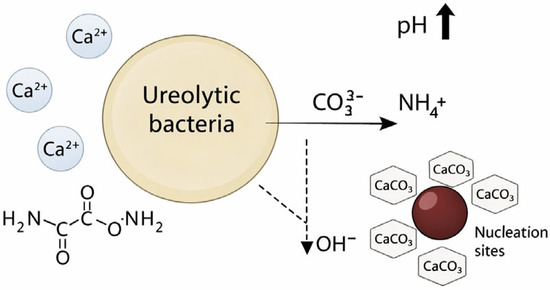
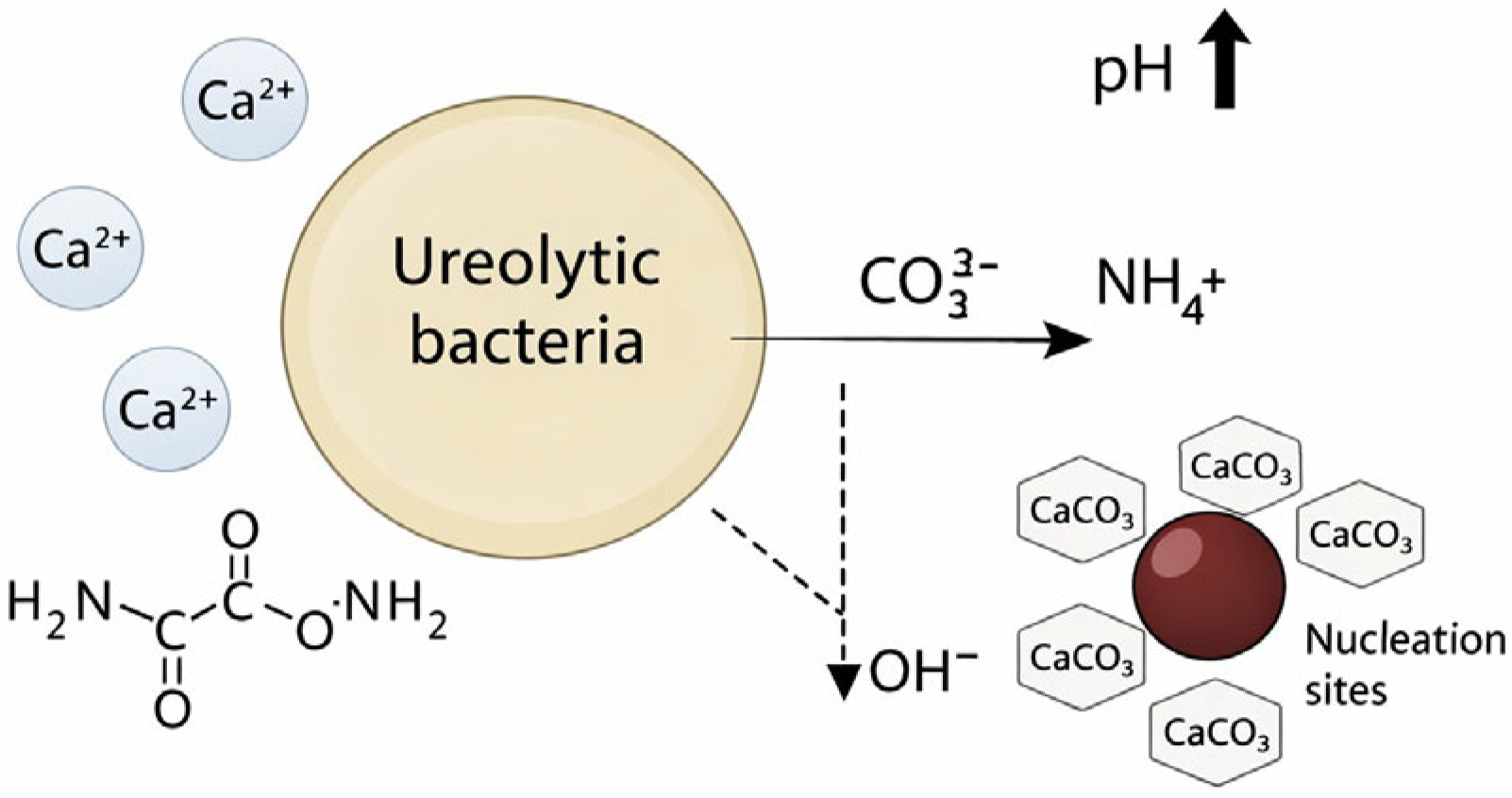
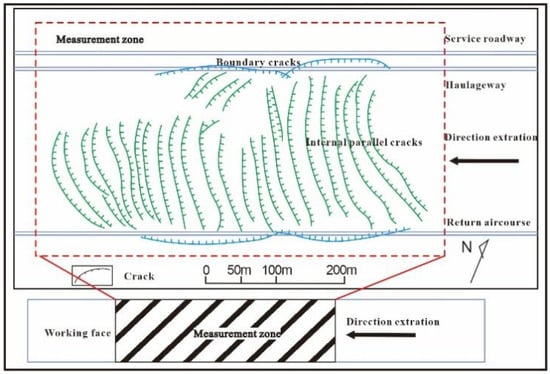
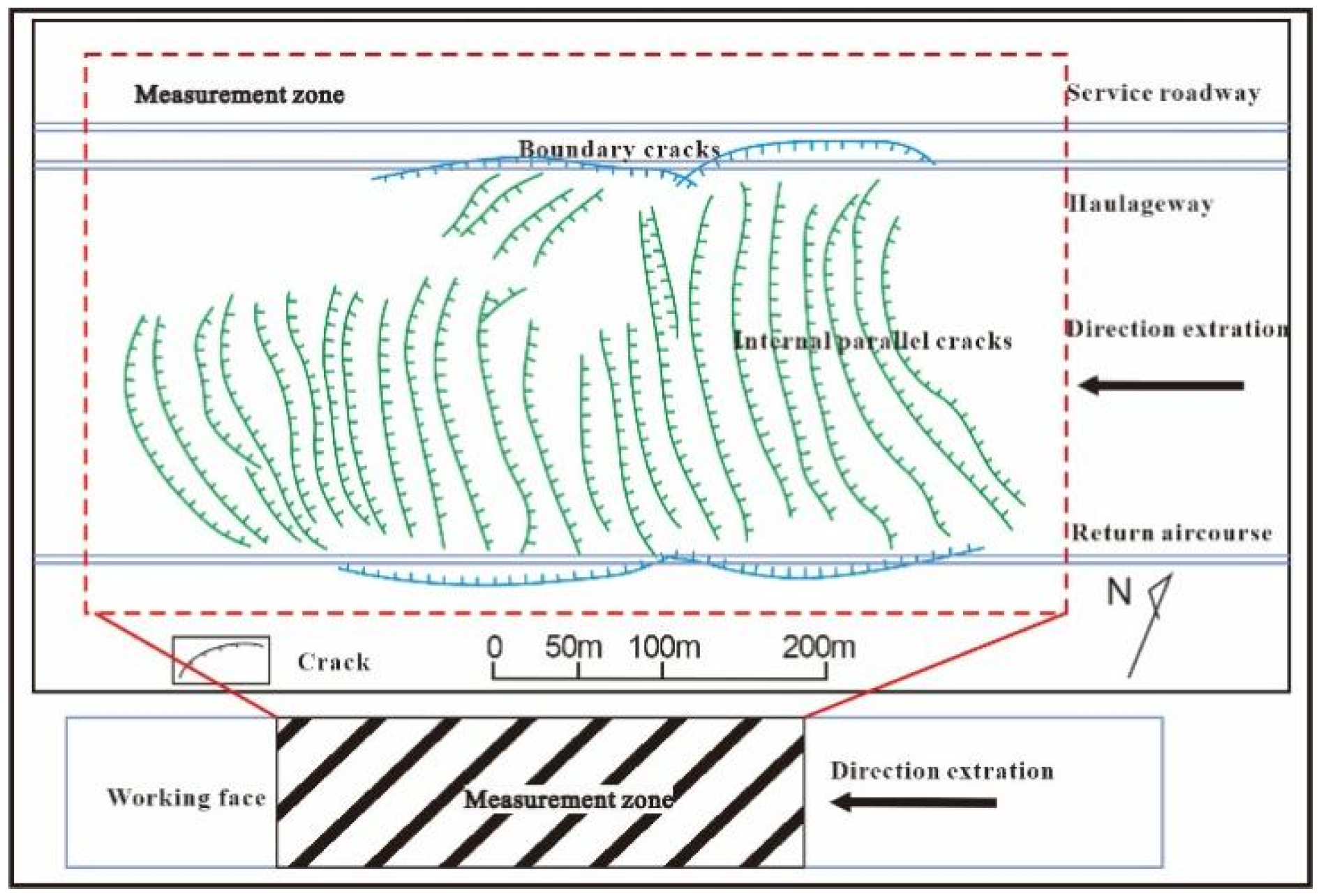
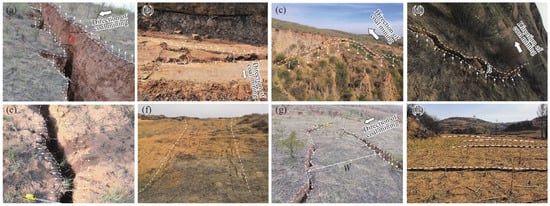
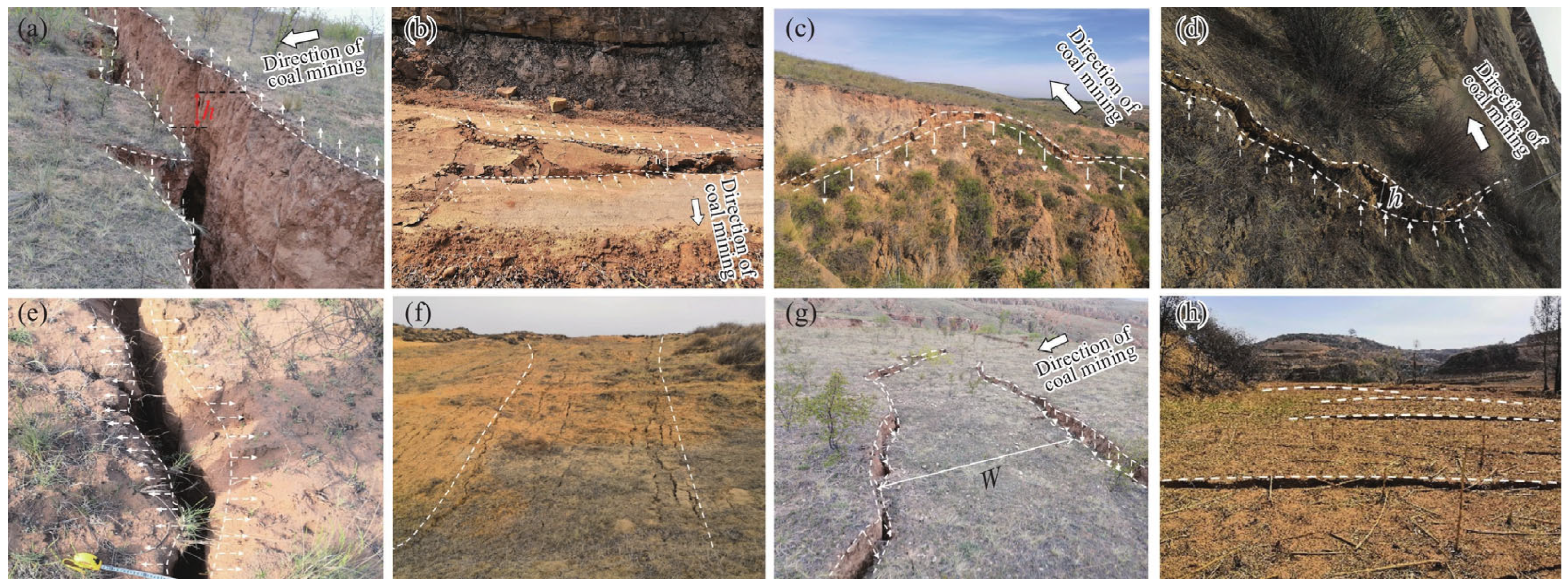
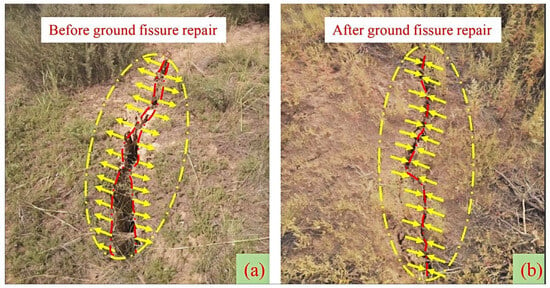
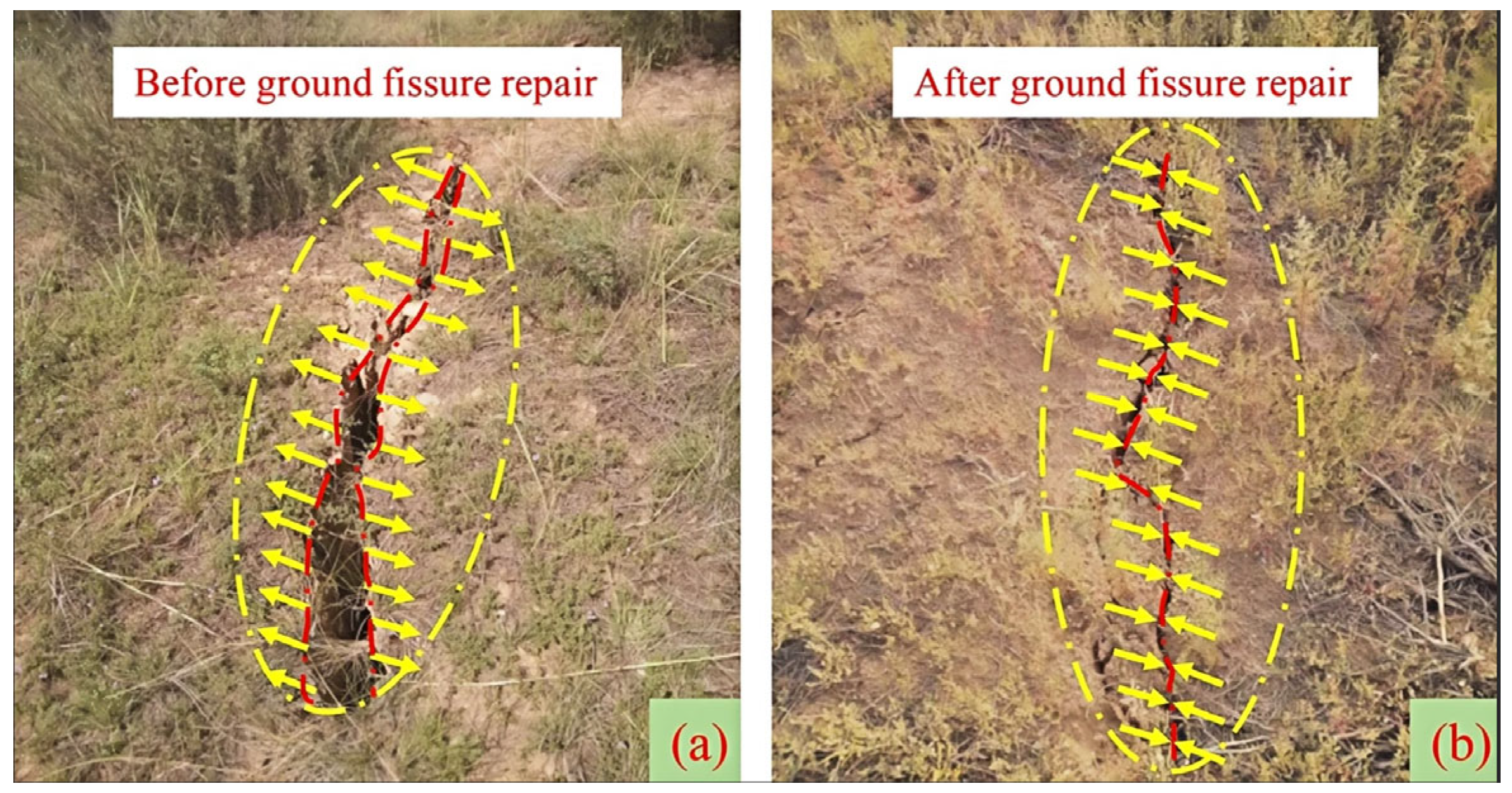
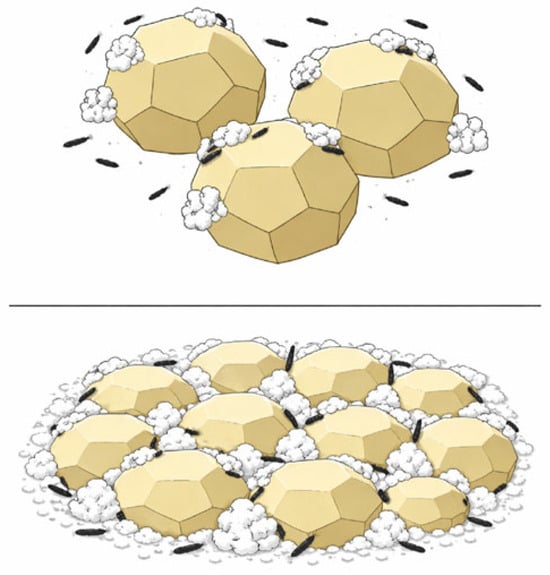
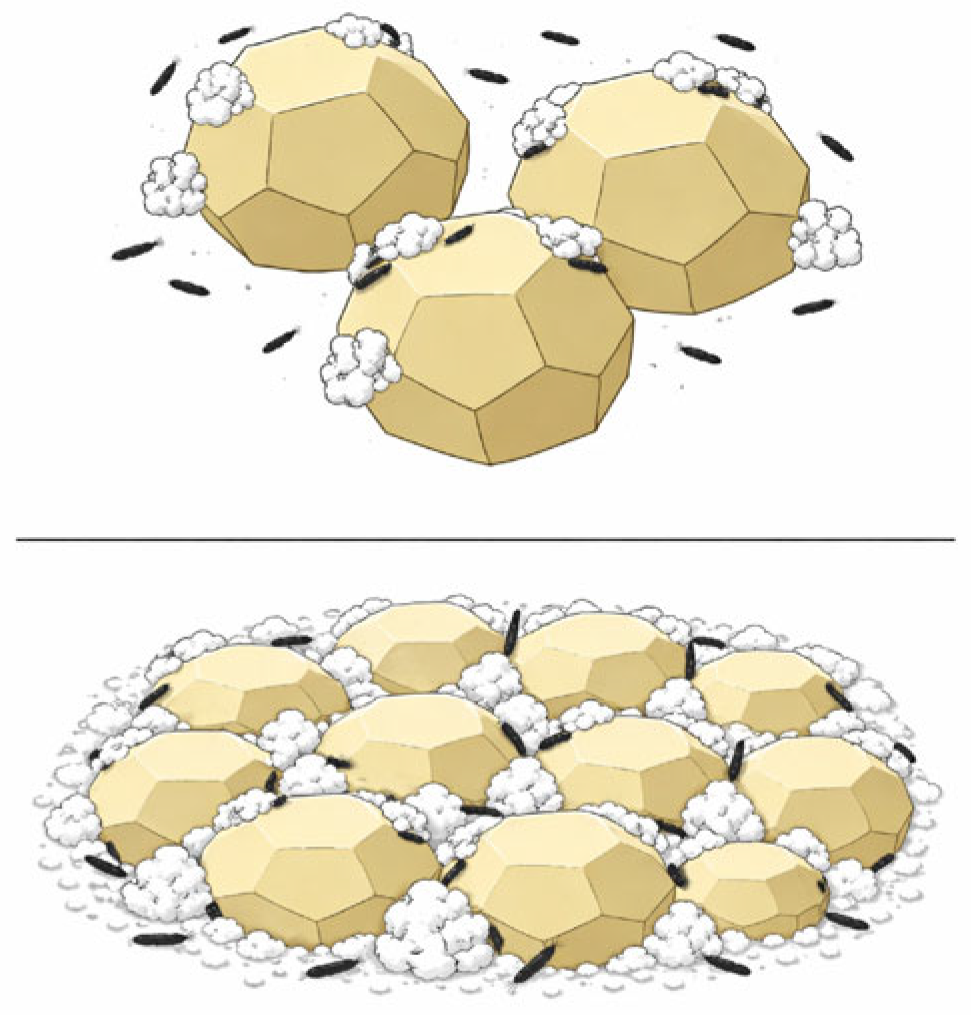
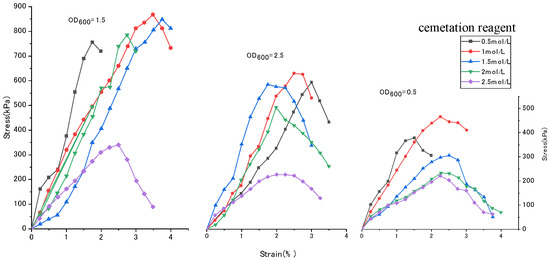
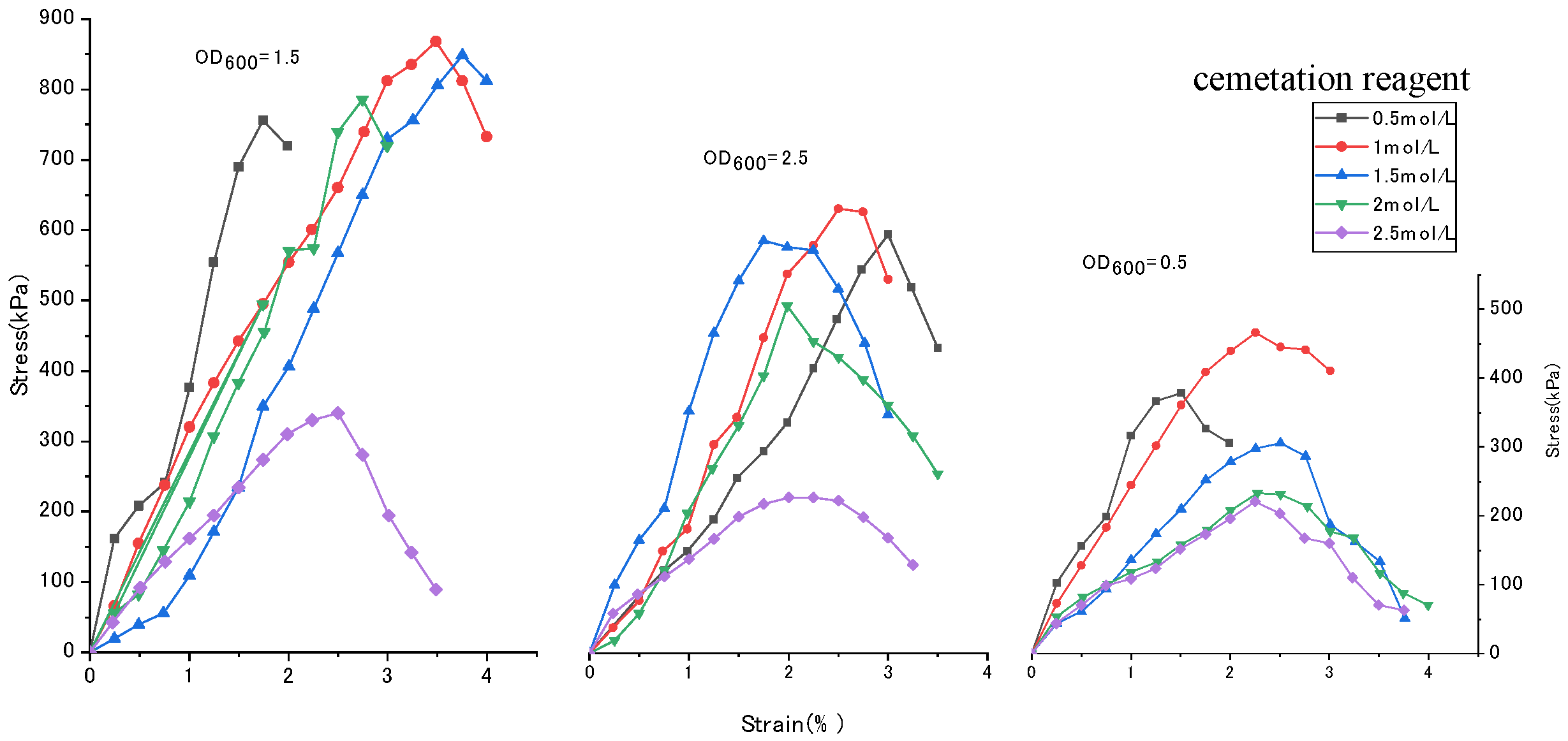
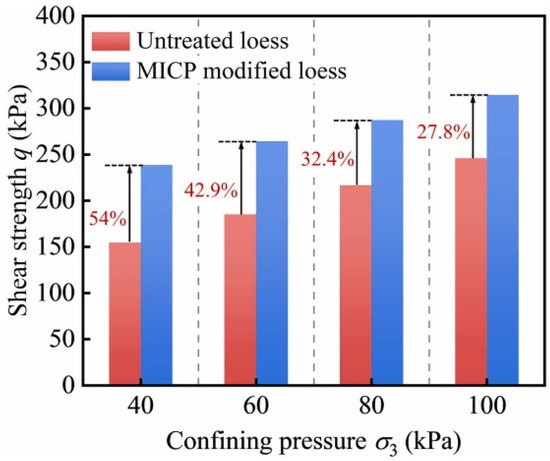
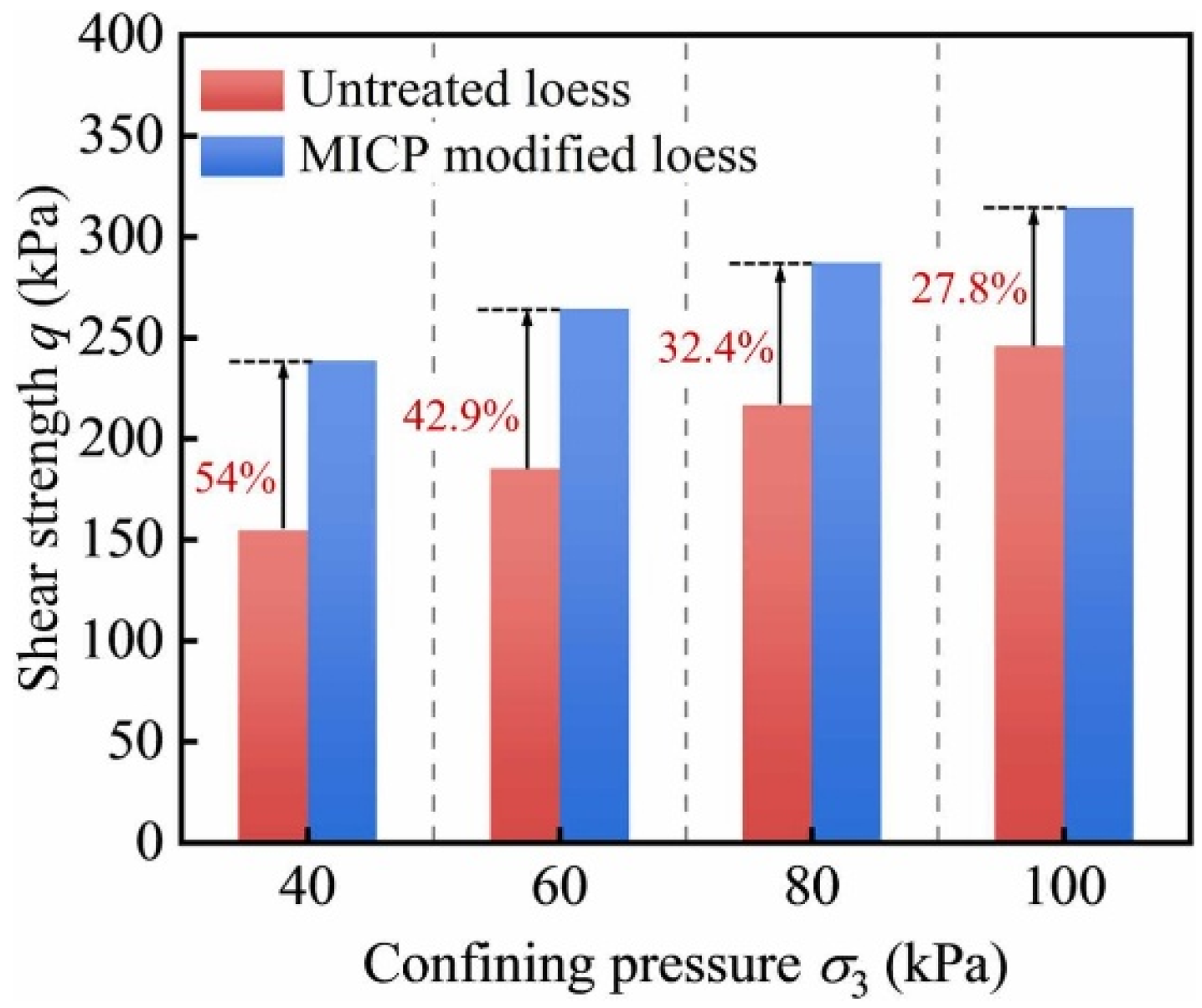
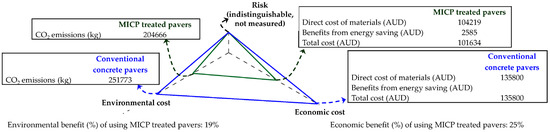
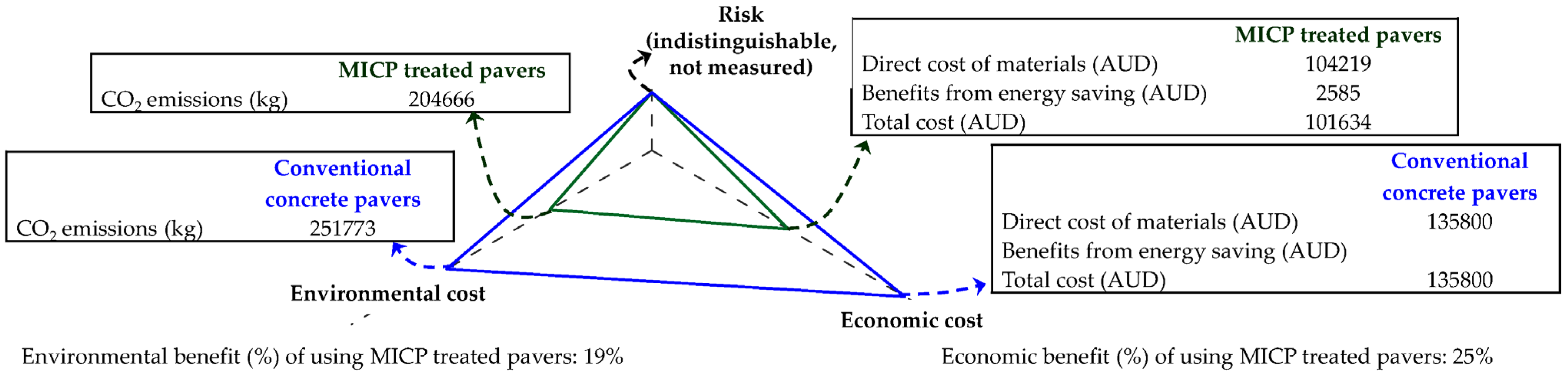

Disclaimer/Publisher’s Note: The statements, opinions and data contained in all publications are solely those of the individual author(s) and contributor(s) and not of MDPI and/or the editor(s). MDPI and/or the editor(s) disclaim responsibility for any injury to people or property resulting from any ideas, methods, instructions or products referred to in the content. |
© 2026 by the authors. Licensee MDPI, Basel, Switzerland. This article is an open access article distributed under the terms and conditions of the Creative Commons Attribution (CC BY) license.