


Highlights
What are the main findings?
- W co-deposition suppresses Volmer–Weber growth of Ni films, yielding smoother, more uniform morphology.
- W co-deposition refines grains of Ni films. Above ~15 at% W, a nanocrystal-to-amorphous transition occurs.
- Nanoindentation shows dual strengthening: dislocation pinning dominates at low W content, while amorphous structure formation becomes the main hardening mechanism at high W content.
What are the implications of the main findings?
- This mechanism of W-modulated Ni-W film morphology offers design principles for controlling adatom diffusion, growth modes, and surface morphology in multicomponent coatings.
- The identified composition–structure properties relationship could guide the synthesis of coatings with tailored structure or mechanical properties.
- This work effectively mitigates reliance on empirical trial-and-error methodologies during the optimization of Ni-W and analogous alloy coatings.
Abstract
Molecular dynamics (MD) simulations were performed to investigate the dynamic deposition behavior, growth mechanism, and mechanical properties of nickel–tungsten (Ni-W) alloy films on single-crystal Al(001) substrates. The results demonstrate that the incorporation of W atoms lowers the Ehrlich–Schwoebel (ES) barrier for Ni adatoms, facilitating downhill diffusion and effectively suppressing Volmer–Weber (VW) mode, thereby improving surface morphology and reducing film roughness. Additionally, W atoms exhibit a tendency to segregate at grain boundaries, inducing lattice distortion and structural disorder. With increasing W content (≥15 at%), the films undergo a transition from a nanocrystalline to an amorphous structure. Nanoindentation simulations reveal that film hardness increases with W content, with the strengthening mechanism being composition-dependent: dislocation pinning dominates at low W concentrations (≤5 at%), while the formation of an amorphous structure emerges as the primary strengthening mechanism at higher W contents (≥15 at%). This work elucidates the growth regulation and strengthening mechanisms of Ni-W films from an atomic-scale perspective, providing a theoretical foundation and simulation-driven guidance for the design and optimization of high-performance, environmentally benign Ni-W coatings.
1. Introduction
Ni-W alloy coatings have attracted significant attention in recent years as a promising alternative to conventional hard chromium (Cr) coatings, driven by growing environmental concerns and increasingly stringent regulations on Cr6+ [1,2,3]. Unlike Cr coatings, which pose serious health and ecological risks during both deposition and service, Ni-W coatings can be electrodeposited from environmentally friendly electrolyte baths while delivering comparable or even superior performance. These coatings exhibit a unique combination of high hardness, excellent wear and corrosion resistance, good thermal stability, and catalytic activity, making them suitable for a broad spectrum of advanced applications, including catalysis [4], micro-electro-mechanical systems (MEMS) [5], relays [6], and diffusion barrier layers within solder joint structures [7].
Given the application-driven demand for tailored properties, extensive experimental efforts have been devoted to understanding and optimizing the microstructure and performance of Ni-W coatings through process control and compositional design. Studies have demonstrated that electrodeposition parameters such as current density, electrodeposition types, and bath composition significantly influence morphology, composition, microstructure, and properties of the resulting coatings [2,8,9]. For instance, pulse electrodeposition has been shown to produce finer-grained and smoother Ni-W coatings with enhanced hardness and corrosion resistance compared to direct current deposition [8]. The W content in the Ni-W coating can be adjusted by modifying the electrolyte composition, current density, and chelating agent ratio and the fabricated Ni76W24 coating, characterized by a uniform honeycomb-like amorphous structure, demonstrates excellent hydrogen evolution reaction (HER) performance [9]. Hardness increased as the W content increased, but micro-cracks occurred on the surface [10]. Therefore, advanced microstructural architectures, such as compositionally modulated multilayers, have been explored by alternating the deposition parameters to reduce internal stress and enhance hardness, solid particle erosion and wear resistance [3,10,11,12]. In addition, the performance of alloy coatings fabricated through electrodeposition can be further improved by incorporating second-phase particles (such as ceramic particles, carbon particles, etc.). Recently, several reports have been published showing improved properties on Ni-W/X composites (where X is TiB2 [13], diamond [14], ZrO2 [15], hBN [16], carbon nanotubes [17] or graphene [18], etc.).
While these experimental investigations have provided valuable empirical knowledge, they are inherently limited in their ability to directly observe and elucidate the atomic-scale dynamic processes that govern film formation. Phenomena such as the initial nucleation of adatoms, the coalescence of atomic clusters, and the early-stage development of surface roughness—all of which critically determine the final microstructure—remain inaccessible to in situ experimental techniques. This limitation hinders a fundamental understanding of how alloying elements, such as tungsten, influence growth behavior and structural evolution.
MD simulation offers a powerful approach to provide real-time, atomistic resolution of the deposition process. Previous MD studies have investigated the thin-film growth of various metallic systems, revealing the significant roles of incident energy, incident angle, substrate temperature, and crystallographic orientation [19,20,21,22]. For example, Wu et al. [19] simulated the deposition of Ni-Al films on a Ni substrate and found that interfacial mixing is primarily governed by incident energy and substrate temperature. Rong et al. [20] demonstrated a transition from Stranski-Krastanov to Frank-van der Merwe growth mode for Ni films on Fe(001) with increasing incident energy, accompanied by reduced surface roughness. Ichou et al. [21] reported that decreasing the incident angle weakens the self-shadowing effect, while higher incident energy enhances atomic mobility, both contributing to smoother film surfaces in Ni-Ti systems. Lee et al. [22] attributed the VW growth mode observed at low incident energy (0.1 eV) to the steering effect on Ni(111), whereas higher energy (6 eV) enabled adatoms to funnel into lower layers, promoting layer-by-layer growth. These studies have advanced our understanding of process-structure relationships in binary alloy films.
However, despite the extensive work on MD simulations of film deposition, an atomic-scale investigation into the role of W in Ni-W film growth remains absent. Therefore, this study employs MD simulations to investigate the deposition of Ni-W alloy films on a single-crystal Al(001) substrate. By varying the W content, this study aims to elucidate the influence of W on the diffusion behavior of Ni adatoms and to reveal the microstructural evolution, including surface morphology, grain refinement, and the nanocrystalline-to-amorphous transition. Furthermore, the composition-dependent mechanical properties and the strengthening mechanisms are examined through nanoindentation simulations. The insights gained from this study are expected to provide a fundamental understanding of the growth and strengthening mechanisms in Ni-W coatings, thereby offering theoretical guidance for the design of high-performance, environmentally friendly protective coatings.
2. Model Methods
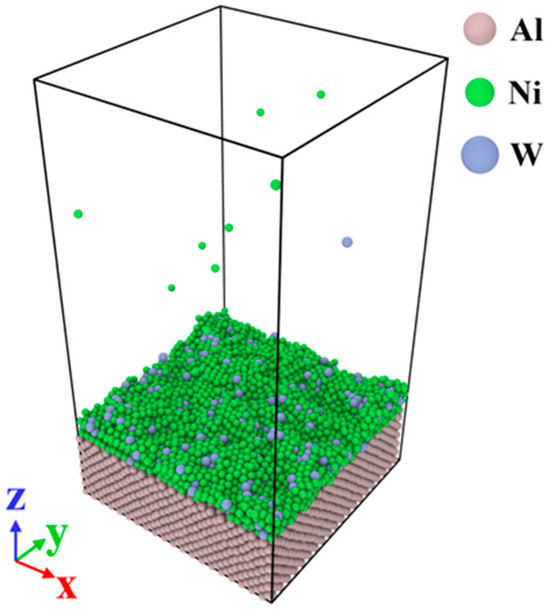
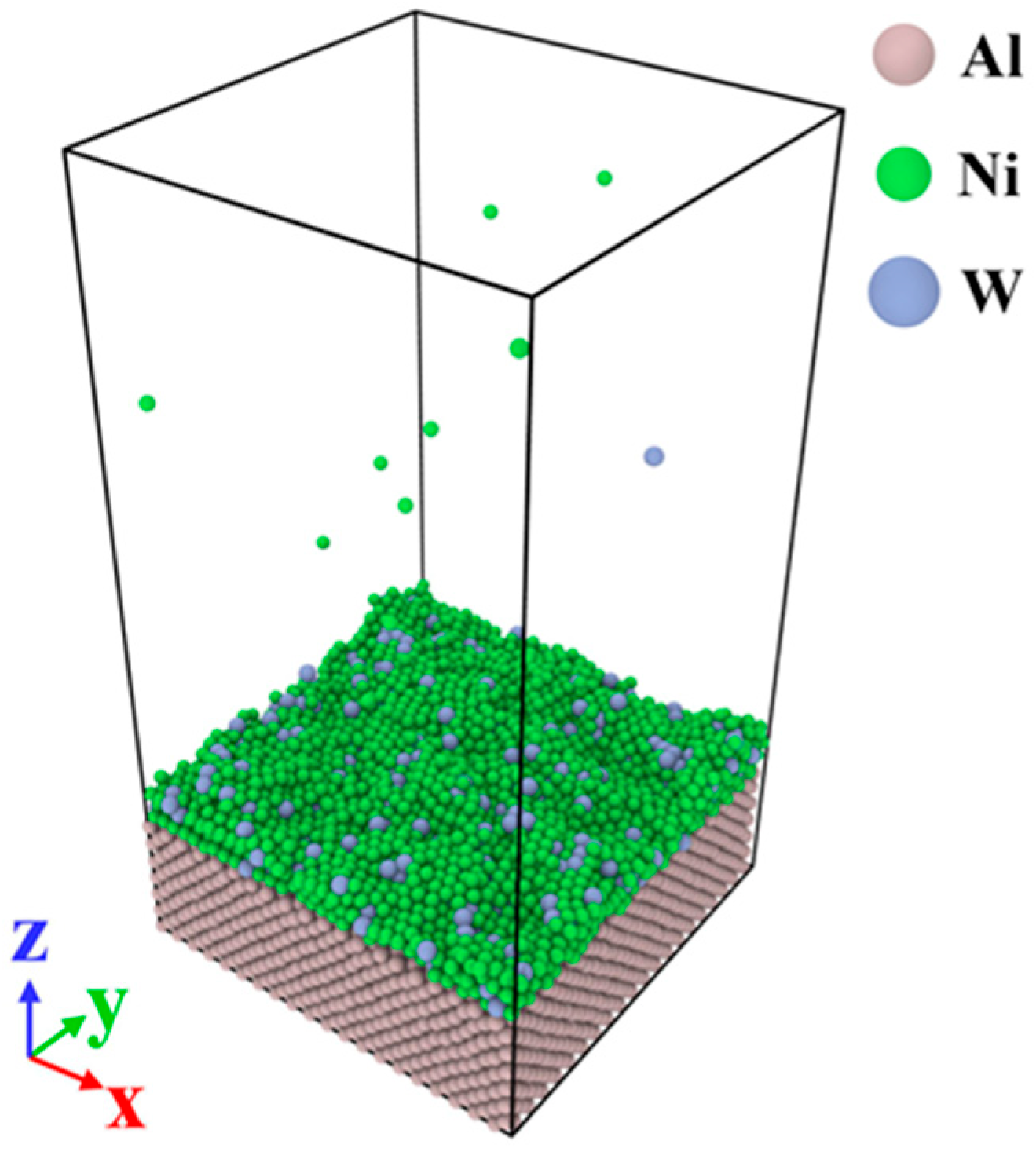
The deposition process of Ni-W films on the single-crystal Al(001) substrate was investigated using classical MD simulations implemented in the large-scale atomic/molecular massively parallel simulator (LAMMPS, version 2Aug2023). As illustrated in Figure 1, the simulation box had dimensions of 80 Å × 80 Å × 150 Å, containing 10,400 Al atoms as the substrate and a vacuum region for atom deposition. The x, y, and z axes were aligned with the [100], [010], and [001] crystal directions of the face-centered cubic (FCC) Al substrate, respectively.
Figure 1.
The deposition model of Ni-W films.
Periodic boundary conditions were applied in the x and y directions to eliminate edge effects, while a fixed boundary condition was applied in the z direction. The substrate was partitioned into three regions along the z-axis: the bottom three layers were fixed to prevent the displacement induced by momentum transfer from incident atoms; the middle five layers were thermostated using the Langevin method to simulate the approximately isothermal conditions in the experiment; and the top five layers were free to interact dynamically with the incoming Ni and W atoms.
Prior to deposition, the substrate was relaxed within the NVT ensemble for 50 picosecond (ps) to reach the temperature of 343 K. All deposition simulations were performed in the NVE ensemble with a time step of 1 femtosecond (fs), employing the velocity Verlet algorithm to integrate Newton’s equations of motion [19,23]. A total of 20,000 atoms were deposited over 10 nanosecond (ns) with an incident energy of 1 eV and a normal incidence angle (0° relative to the substrate normal). The initial positions of incident atoms are randomly distributed on the x-y plane, and their initial z-coordinates are constant at 148 Å to avoid the effect of the substrate surface before the injection. To investigate the compositional dependence of film growth, the W content was varied at 0, 5, 10, 15, and 20 at%, with the corresponding samples designated as W0, W5, W10, W15, and W20, respectively. The deposition rate was maintained constant across all simulations by adjusting the insertion intervals of Ni and W atoms according to Table 1, ensuring that an equal amount of energy is input into the system over the same time. After each deposition, the system was further relaxed for 50 ps [21].
Table 1.
The insertion intervals of Ni and W atoms in the different simulations.
The simulated deposition rate and incident energy in this work are significantly higher than those in real electrodeposition, which may cause discrepancies between the results of simulation and experiment. Nevertheless, deposition rate and incident energy at similar orders of magnitude are widely adopted in atomistic simulations to capture film growth, structural evolution and morphology development within feasible computational timescales [19,20,21,22,23]. This study does not aim to reproduce the detailed electrochemical environment or quantitatively match experimental results but focuses on revealing the influences of composition on the Ni-W films at the atomic level.
The Al-Al interactions were modeled with the embedded atom method (EAM) potential developed by Jacobsen et al. [24], while the Ni-W interactions were represented using the modified embedded atom method (MEAM) potential parameterized by Shim et al. [25]. For Al-Ni and Al-W, the Lennard-Jones (L-J) potential was employed with a cutoff distance of 10 Å. The L-J parameters were taken from the established literature: σ = 0.1067 eV and ε = 3.2042 Å for Al-Ni, and σ = 0.1529 eV and ε = 3.3951 Å for Al-W [26,27,28]. All simulations were visualized and analyzed using the Open Visualization Tool (OVITO, version 3.15.2).
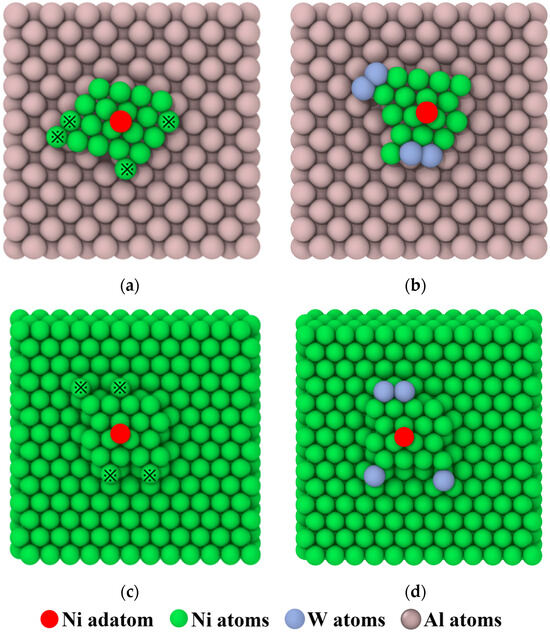
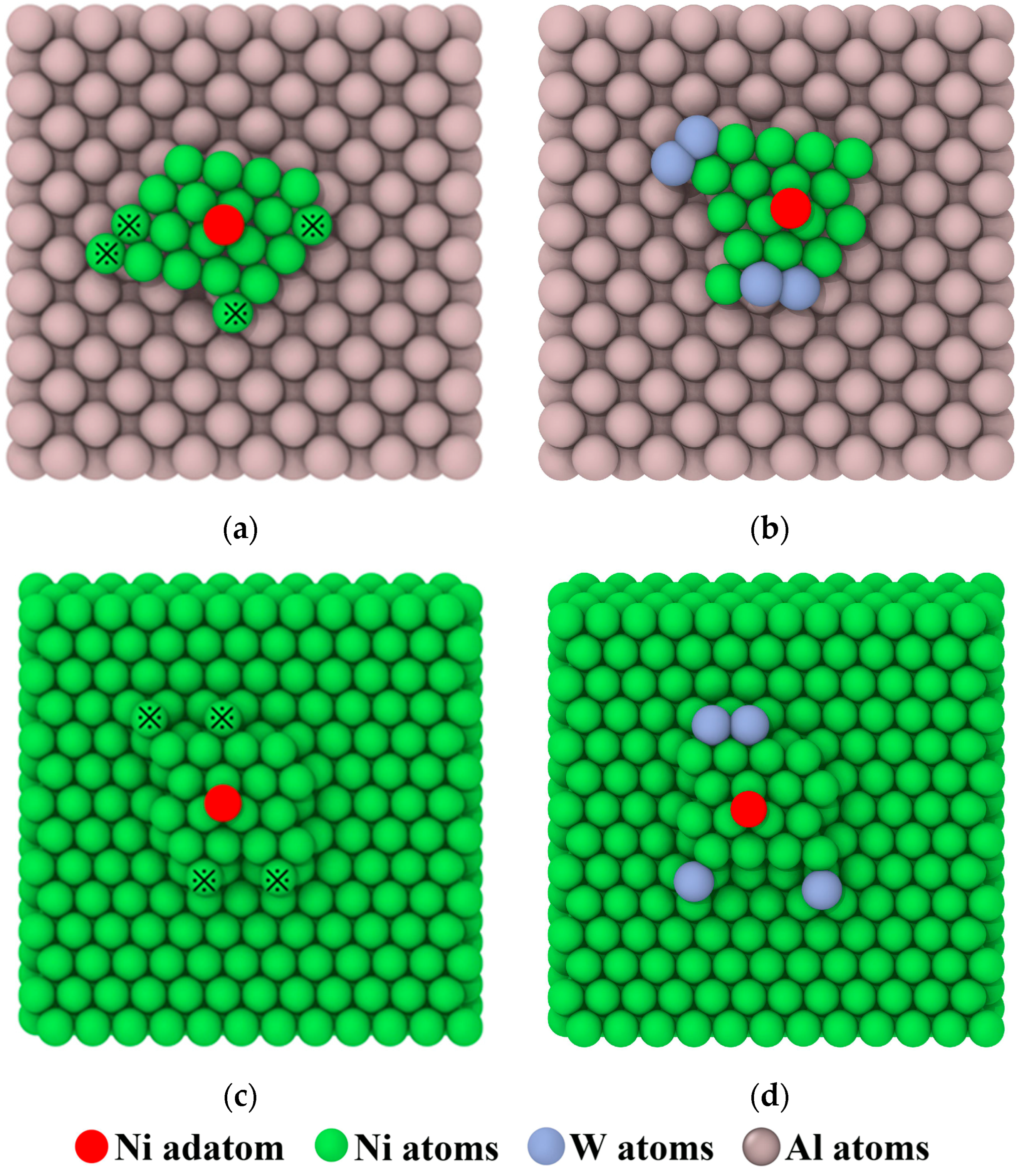
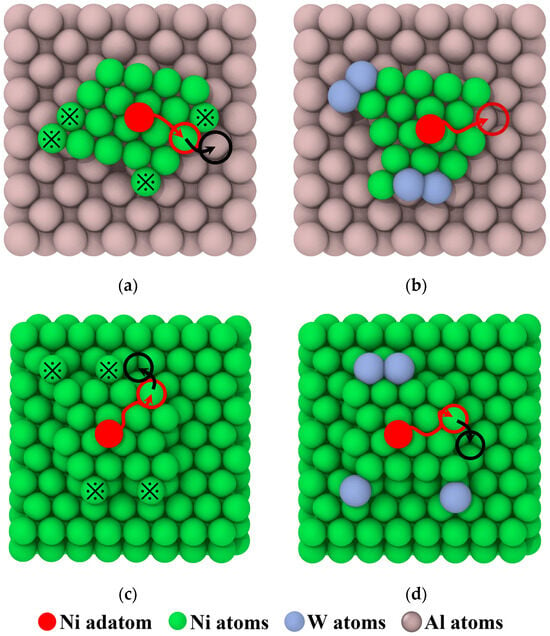
To assess the influence of W on the diffusion behavior of Ni adatoms, a series of models were constructed, as shown in Figure 2. A Ni adatom was placed on the surface of a monolayer cluster supported by either an Al(001) or a Ni(111) substrate, with the cluster composition varied to represent W0 and W20. The entire system was gradually heated under the NVT ensemble, and the adatom trajectory was monitored throughout the simulation. The minimum energy pathways for adatom diffusion were subsequently determined using the nudged elastic band (NEB) method, a well-established technique for identifying transition states and energy barriers. A total of 48 intermediate images were linearly interpolated between the initial and final configurations and were simultaneously optimized while keeping the endpoints fixed. This approach enabled accurate calculation of the diffusion barriers, including the ES barrier at step edges.
Figure 2.
A series of models constructed to study the diffusion behavior of Ni adatoms on the different atomic configurations: (a) Ni cluster and Al(001) substrate; (b) Ni-W cluster and Al(001) substrate; (c) Ni cluster and Ni(111) substrate; (d) Ni-W cluster and Ni(111) substrate. The labeled Ni and W atoms are deposited under the conditions denoted as W0 and W20 in Table 1, respectively, and the remaining parts are the ideal configuration.
Mechanical properties of Ni-W films were evaluated via simulated nanoindentation using a rigid spherical indenter with a radius of 50 Å, modeled as diamond. The interactions between the indenter (C) and Al, Ni, W atoms were described by the L-J potential with parameters taken from the literature: σ = 3.01 eV and ε = 0.0344 Å for C-Al [29], σ = 2.759 eV and ε = 0.0399 Å for C-Ni [30], and σ = 2.951 eV and ε = 0.0507 Å for C-W [27]. The indentation process comprised three stages: a loading phase during which the force was linearly increased from 0 to 800 nanonewton (nN) over 200 ps, a holding phase at maximum load for 200 ps, and an unloading phase where the force was linearly reduced back to zero over the final 200 ps. The load-displacement data were recorded throughout the simulation. Hardness (H) was calculated using the Oliver-Pharr method [23]:
where Pmax is the maximum load; hmax is the maximum penetration depth, Smax is the slope of the unloading curve at maximum load, and R is the indenter radius. To account for the complex structure and rough surface, three hardness data points were averaged for each sample, with the indenter positioned at (40 Å, 40 Å), (60 Å, 60 Å), and (80 Å, 80 Å) in the x-y plane.
3. Results and Discussion
3.1. Surface Morphology and Roughness
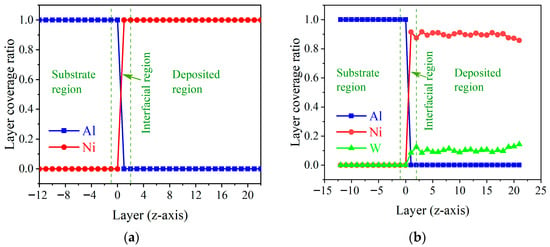
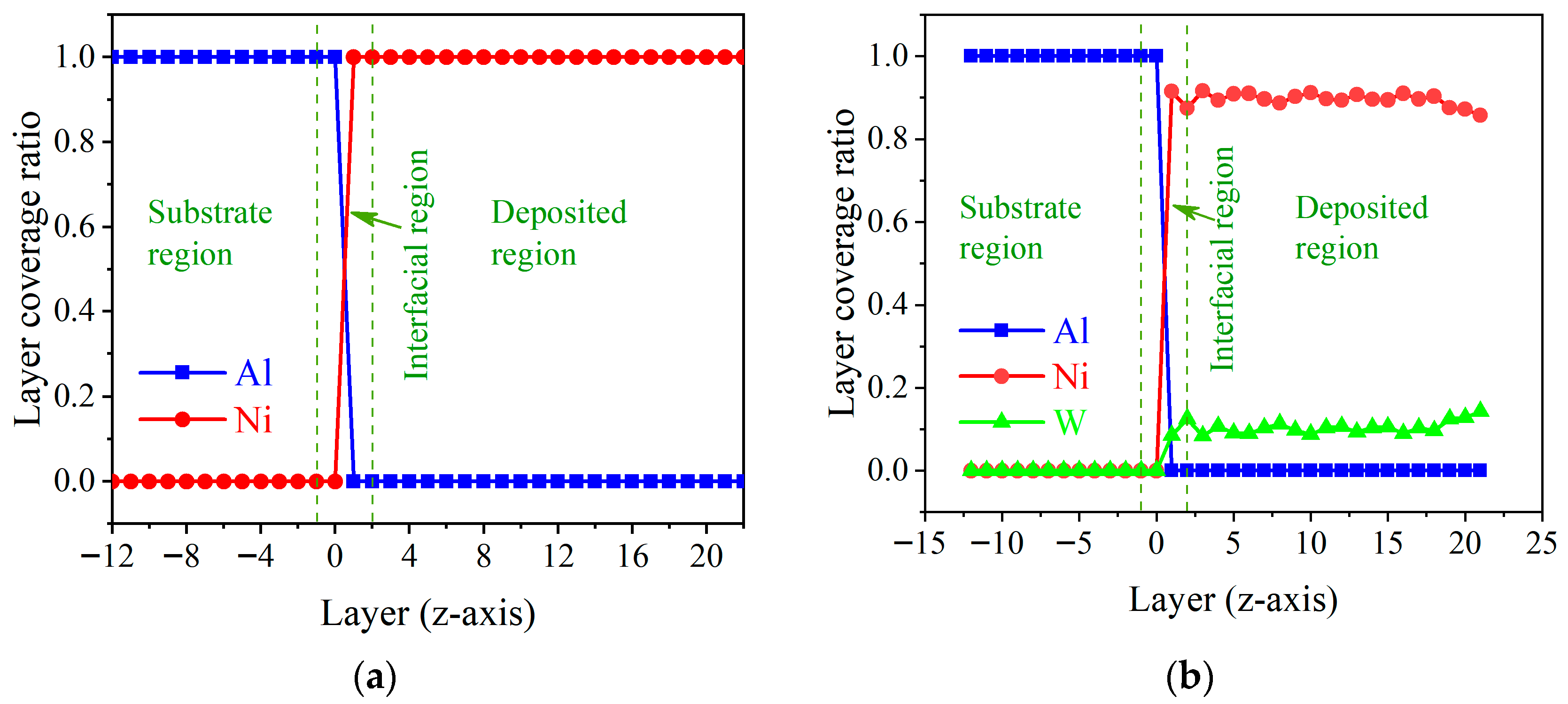
The morphology of the films was characterized to elucidate the influence of W incorporation on Ni-W films. Figure 3 presents the layer coverage ratio for representative samples W0 and W10, providing quantitative insight into the compositional distribution across the film-substrate interface. The zero layer corresponds to the initial Al substrate surface. Analysis of the layer coverage ratio reveals that no elemental intermixing or exchange occurs between the deposited film and the Al substrate during the deposition.
Figure 3.
Layer coverage ratio of Ni-W films: (a) W0; (b) W10.
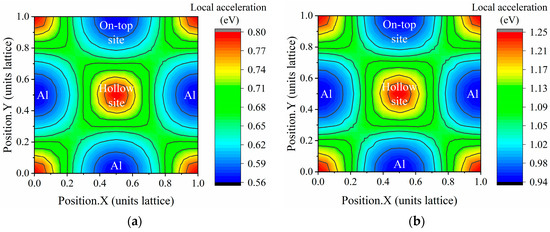
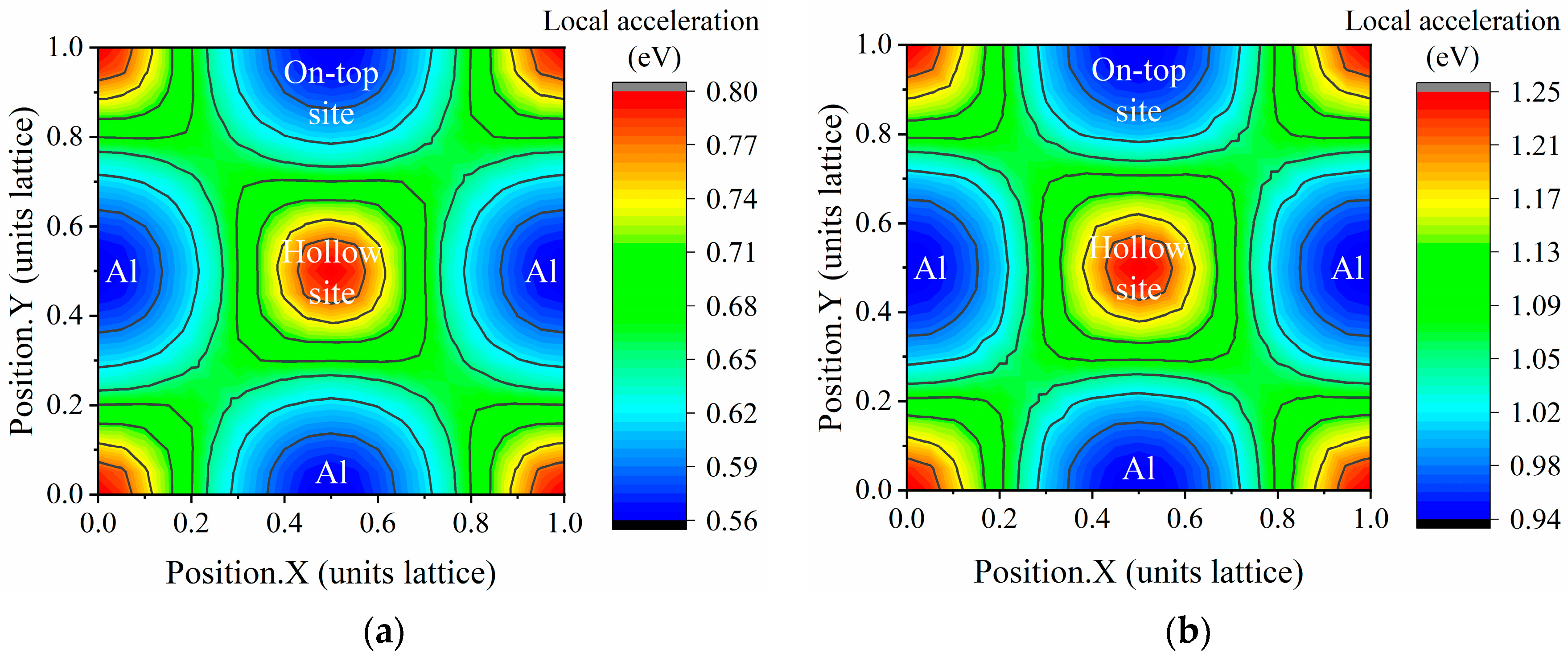
This interfacial integrity can be explained by examining the local acceleration energy of incident atoms as they approach the substrate surface [22]. As illustrated in Figure 4, the local acceleration energy—arising from the attractive potential between incident atoms and substrate atoms—varies across the Al(001) surface. For Ni atoms, this energy ranges from 0.56 eV to 0.80 eV, while for W atoms, it ranges from 0.94 eV to 1.25 eV, with the hollow sites exhibiting the highest values in both cases. Importantly, the sum of the highest local acceleration energies and the initial kinetic energy (1 eV) remain lower than the binding energy of Al (3.39 eV), consistent with the absence of atomic exchange or substrate disruption observed under the deposition conditions of W0 and W10.
Figure 4.
Local acceleration contour of the incident atoms near the Al(001) substrate: (a) Ni; (b) W.
Surface roughness, a critical parameter characterizing the performance of films, was evaluated using the root-mean-square (RMS) method. RMS roughness is defined as [20]:
where n is the total number of surface atoms, is the z-coordinate of surface atom i and is the average z-coordinate of the surface atoms.
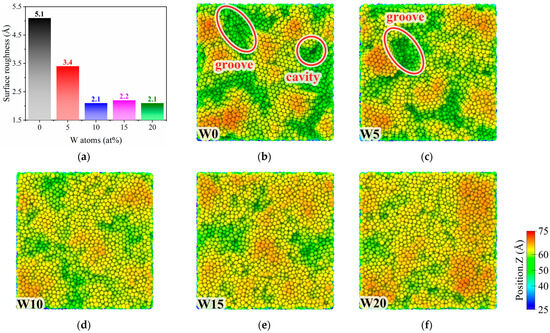
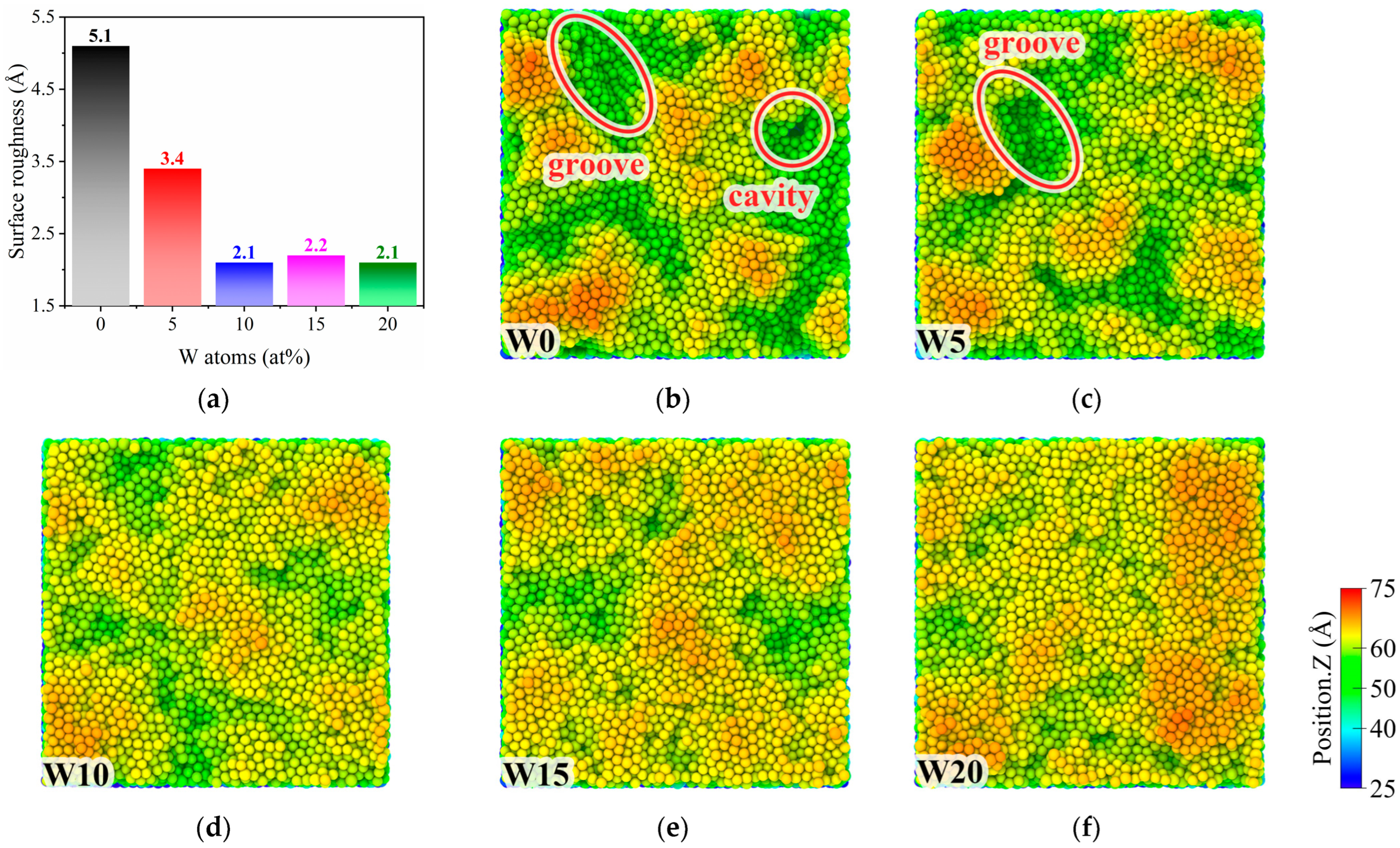
Figure 5a displays the evolution of RMS roughness as a function of W content, while Figure 5b–f present the corresponding surface morphologies. W0 exhibits surface irregularities characterized by protrusions, grooves, and cavities, indicative of a rough, island-dominated growth mode. With increasing W incorporation, an improvement in surface smoothness is observed. W5 and W10 show progressively reduced protrusion heights, shallower trench depths, and diminished cavity dimensions. Beyond 10 at% W, further increases in W content yield no significant additional refinement in the surface morphology, as evidenced by the plateau in RMS roughness values for W15 and W20. These observations demonstrate that the incorporation of W atoms promotes a smoother and more uniform film morphology, which is consistent with relevant experimental reports [31]. The underlying mechanism will be explored in detail in subsequent sections.
Figure 5.
Surface characteristics of Ni-W films: (a) RMS roughness; (b–f) morphology.
3.2. Deposition Process
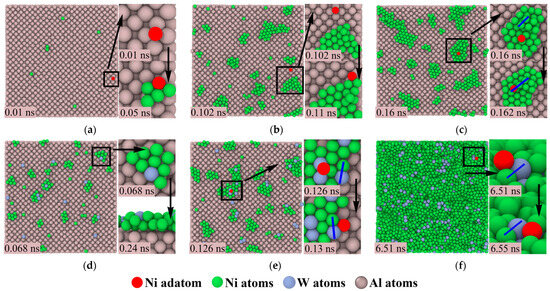
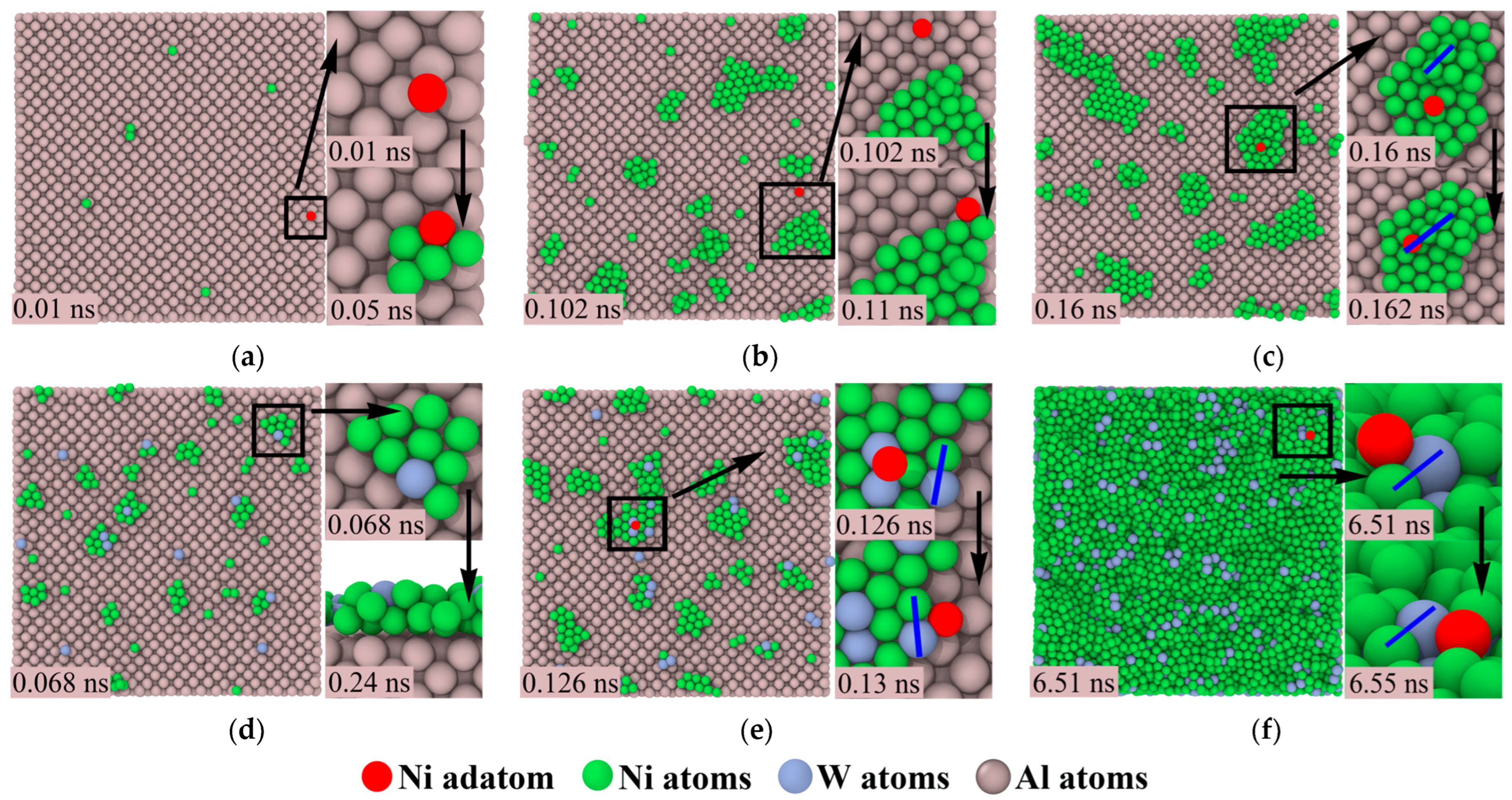
To elucidate the mechanisms by which W atoms modify the surface morphology documented in Section 3.1, the dynamic deposition process was monitored and analyzed at the atomic scale. Figure 6 presents a series of snapshots captured during the deposition of W0 and W10 films, revealing the different growth behaviors.
Figure 6.
The diffusion behavior of Ni adatoms during deposition process: (a–c) W0; (d–f) W10. The arrows indicate the magnified view of the boxed region, and the blue lines denote the steps.
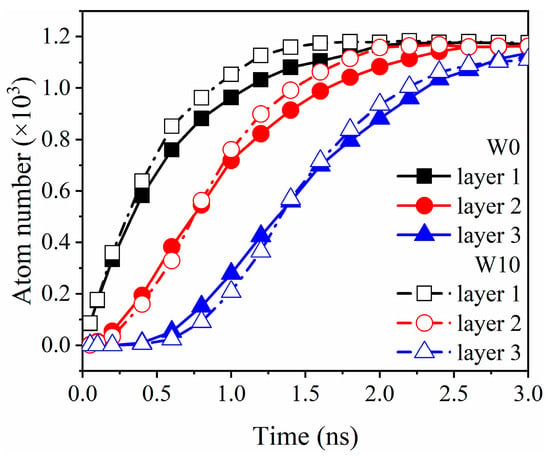
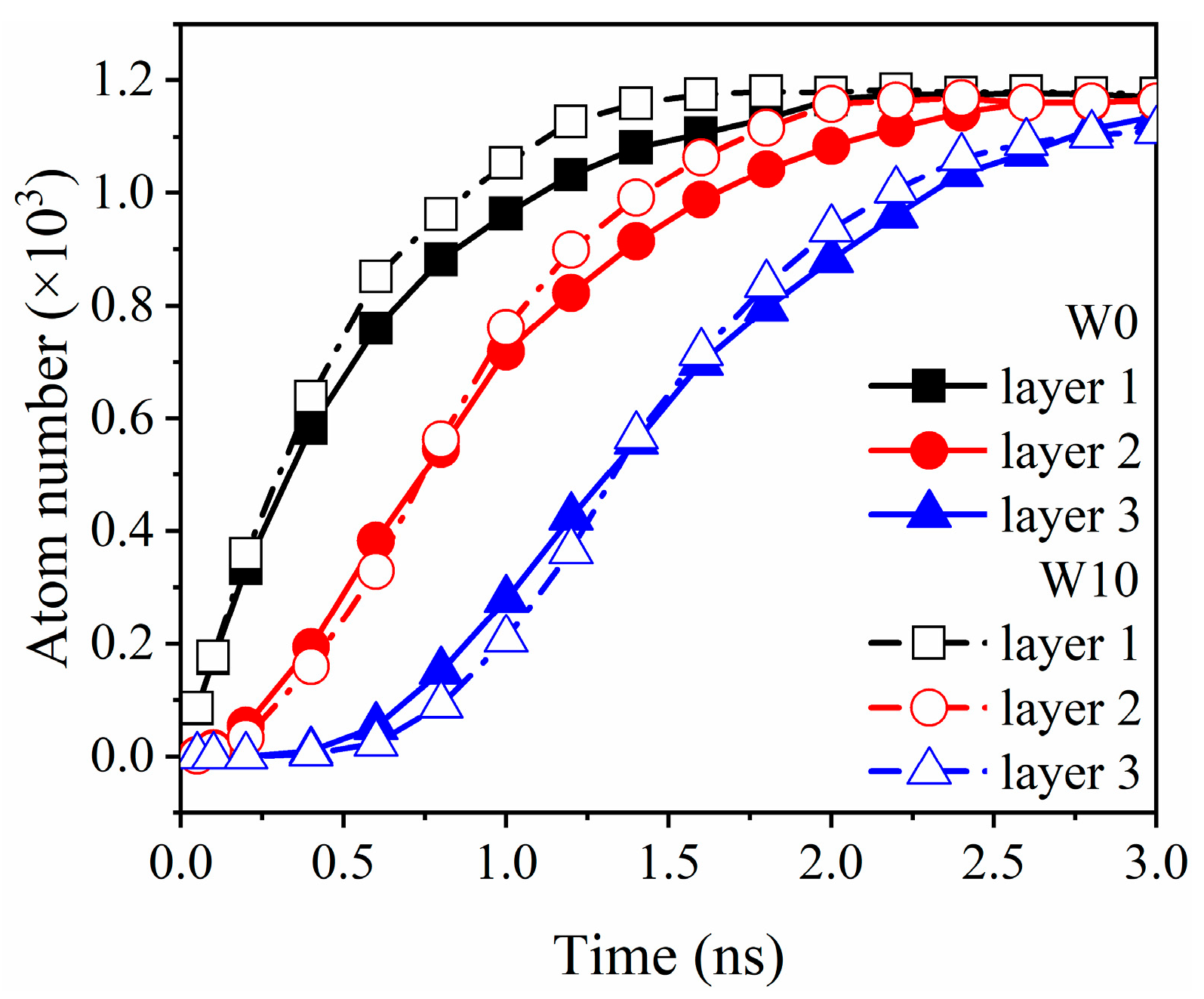
For W0, the deposition proceeds through a characteristic VW mode. During the initial stage shown in Figure 6a, incident Ni atoms adsorb onto the Al(001) surface and undergo thermal vibration at the hollow sites under the influence of localized acceleration energy. As deposition continues, adjacent Ni adatoms diffuse across the surface and coalesce to form atomic clusters. These clusters serve as preferential nucleation sites, attracting surrounding adatoms toward their step edges (Figure 6b). Notably, Ni adatoms that land on top of existing clusters exhibit limited downward mobility; rather than descending to lower layers, they remain on the cluster surface and undergo lateral diffusion until they become incorporated into the growing Ni lattice (Figure 6c). This behavior promotes the vertical growth of atomic islands and leads to the development of a rough surface morphology. The consequence of this growth mode is reflected in Figure 7, which tracks the evolution in the number of layer atoms during deposition. The rapid increase in the number of atoms occupying higher layers indicates that adatoms preferentially attach to existing islands rather than initiating new layers, resulting in VK growth and the rough surface observed for W0.
Figure 7.
The number of atoms within each layer during deposition process.
The incorporation of W atoms alters this growth process. In W10, W atoms are observed to occupy the lattice sites within the close-packed planes of the Ni matrix (Figure 6d). This observation is consistent with experimental reports identifying Ni-W films as substitutional solid solutions in which Ni serves as the solvent and W as the solute [18]. Due to the difference in atomic radius between W (0.141 nm) and Ni (0.124 nm), W atoms induce local lattice expansion and concomitant structural disorder within the Ni matrix. A critical consequence of W incorporation is its effect on the diffusion behavior of Ni adatoms near step edges. As illustrated in Figure 6e, when a Ni incident atom approaches a Ni-W cluster, it does not adsorb onto the cluster surface as observed in the W0 case. Instead, it undergoes downward migration and becomes incorporated directly into the underlying steps. With the progress of deposition, this interlayer atomic migration continues to persist even though the substrate surface undergoes a transition from Al(001) to the Ni-W layer (Figure 6f). These behaviors suppress the vertical growth of atomic islands, as depicted in Figure 7, thus improving the surface morphology and reducing RMS roughness of Ni-W films, as presented in Section 3.1.
3.3. Diffusion Behavior
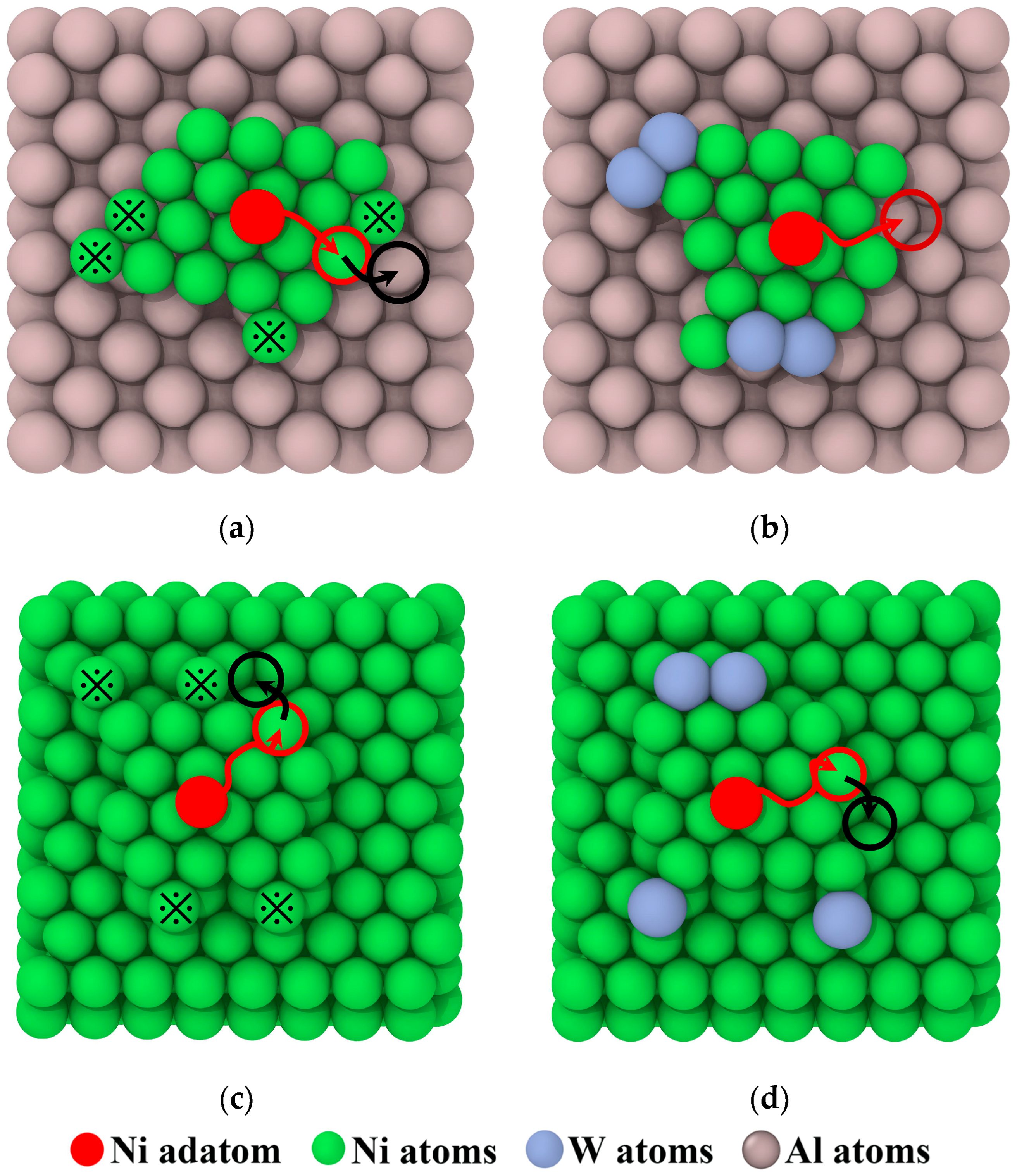
Figure 8 presents the diffusion pathways for Ni adatoms traversing from the top of a monolayer cluster to the substrate. In metal-on-metal diffusion, two primary mechanisms are typically operative: the jump mechanism, wherein an adatom migrates directly across an energy barrier from one equilibrium site to an adjacent site; and the exchange mechanism, wherein an adatom approaching a step edge displaces a surface atom at the edge, occupying the vacated lattice position while the displaced atom becomes a new adatom that continues diffusing along the step.
Figure 8.
Diffusion path of Ni adatoms on the different atomic configurations: (a) Ni cluster and Al(001) substrate; (b) Ni-W cluster and Al(001) substrate; (c) Ni cluster and Ni(111) substrate; (d) Ni-W cluster and Ni(111) substrate. The red and black arrows represent the diffusion paths of Ni adatoms and displaced atoms, respectively. The labeled Ni and W atoms are deposited under the conditions denoted as W0 and W20 in Table 1, respectively.
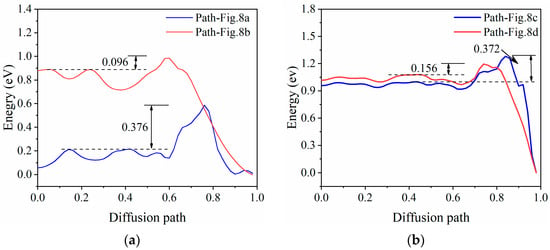
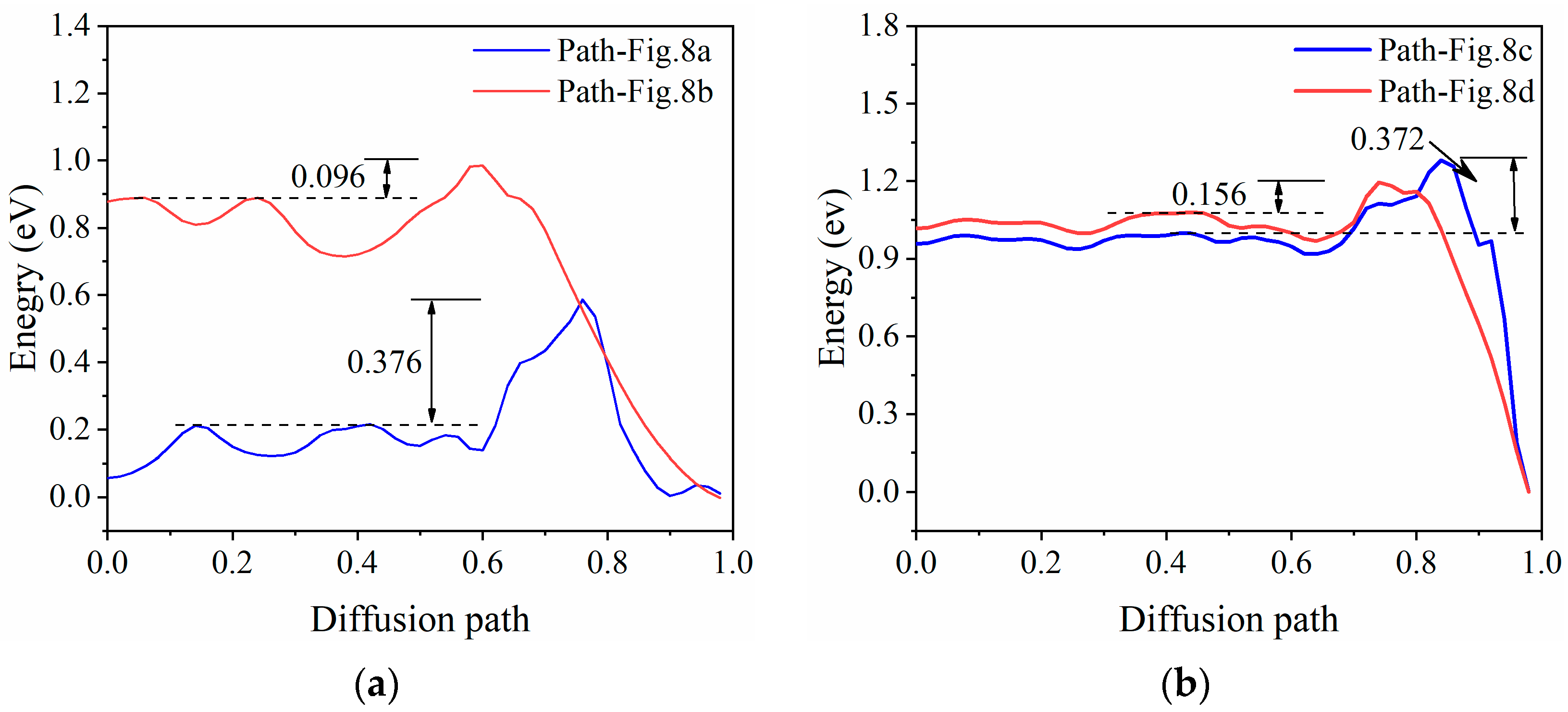
On the pure Ni cluster supported by the Al(001) substrate (Figure 8a), the Ni adatom initially undergoes lateral diffusion within the cluster layer toward the step edge, followed by interlayer descent onto the Al(001) surface via an exchange mechanism. In contrast, when the cluster contains W atoms (Figure 8b), the Ni adatom descends to the lower layer via the jump mechanism. When the substrate is Ni(111), on both pure Ni and Ni-W clusters (Figure 8c,d), the Ni adatom migrates from one (111) surface to another via the exchange mechanism. The substrate exerts an influence on the interlayer diffusion mechanism of Ni adatoms. Figure 9 presents the evolution of system energy along the four diffusion pathways shown in Figure 8, with the horizontal coordinate normalized such that 0.0 and 1.0 represent the initial and final positions of the diffusing Ni adatom, respectively. The system energy along each pathway is referenced to its minimum value, which is set to zero for clarity. In all cases, an additional energy barrier emerges at the step edge—the ES barrier—which must be overcome for the adatom to achieve interlayer transfer.
Figure 9.
The evolution of system energy along the four diffusion pathways on the different substrates: (a) Al(001); (b) Ni(111).
For the Al(001) substrate (Figure 9a), the presence of W atoms in the cluster reduces the ES barrier for Ni adatom descent from 0.376 eV to 0.096 eV (about 74.5%). For the Ni(111) substrate (Figure 9b), the ES barrier decreases from 0.372 eV on the pure Ni cluster to 0.156 eV on the Ni-W cluster (about 58.1%). The ES barrier decreases with increasing tensile strain at the steps [32]. This phenomenon may be ascribed to the local lattice expansion caused by the incorporation of W atoms, which increases the interatomic spacing in adjacent regions; consequently, Ni adatoms can cross steps in a more relaxed spatial environment, reducing the potential energy of the transition state and leading to a lower ES barrier. By reducing the ES barrier, W incorporation facilitates interlayer atom transport, suppresses the vertical growth of atomic islands, and promotes a smoother, more uniform film morphology.
3.4. Microstructure and Mechanical Properties
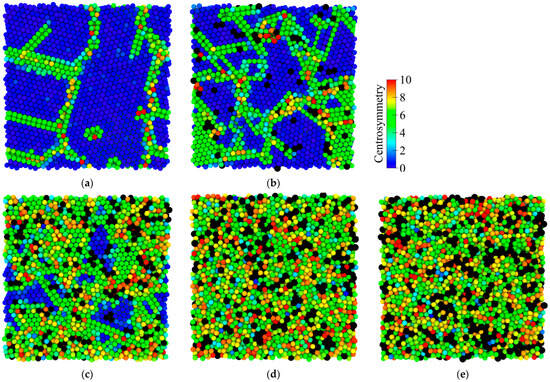
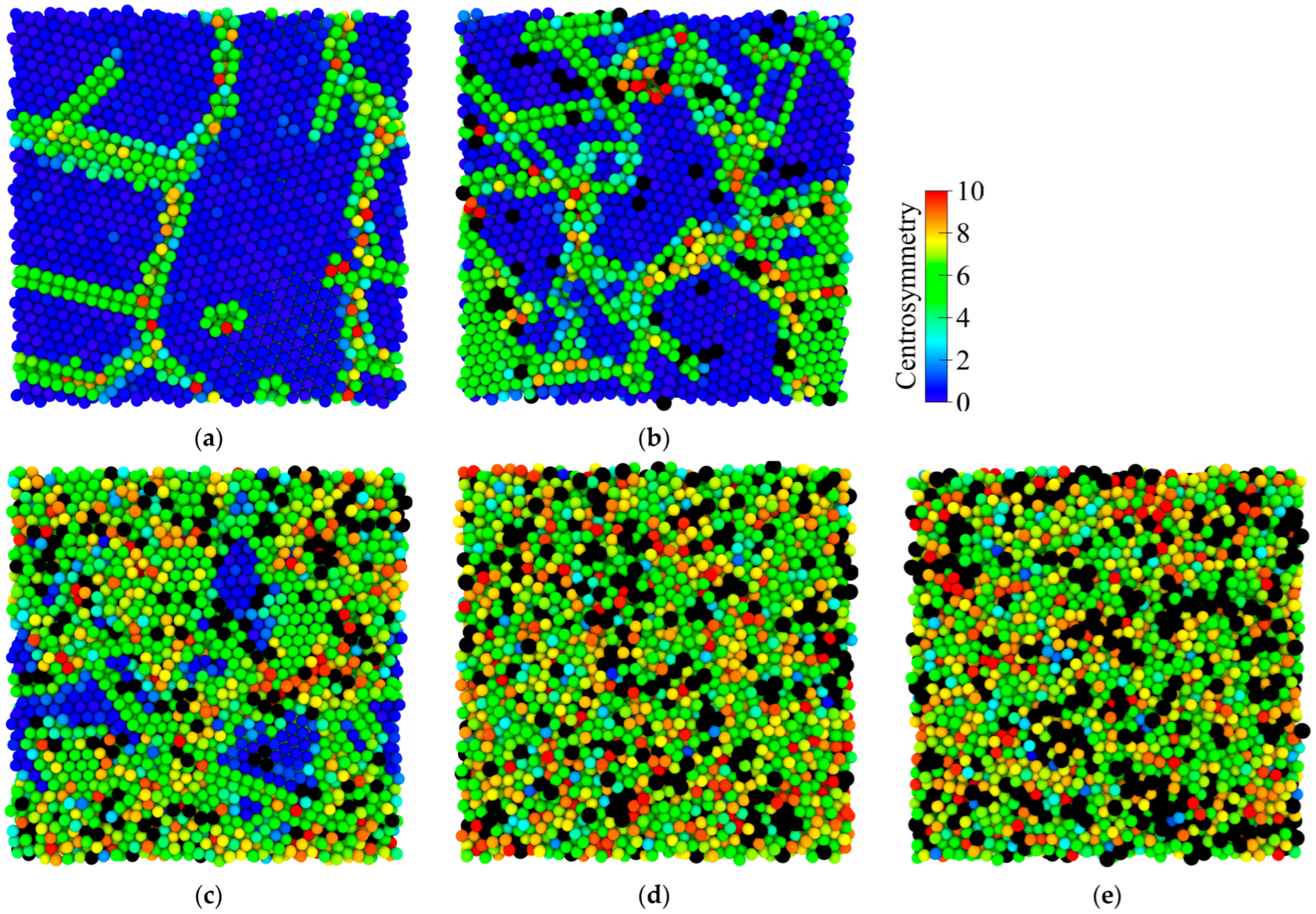
To understand how W incorporation influences the structure and mechanical properties of Ni-W films, a microstructural analysis was performed complemented by nanoindentation simulations. The Central Symmetry Parameter (CSP) quantifies the local symmetry of individual atoms, serving to determine whether an atom belongs to a perfect crystal lattice, contains local defects (such as dislocations or stacking faults), or resides at crystal surfaces [33]. Figure 10 depicts the CSP distribution on the cross-section of films with the z-coordinate of 45 Å.
Figure 10.
CSP distribution of Ni-W films: (a) W0; (b) W5; (c) W10; (d) W15; (e) W20. Blue spheres represent atoms residing in an FCC lattice environment. Black spheres denote W atoms, while other colored spheres indicate atoms with higher CSP values—characteristic of grain boundaries, dislocations, or other lattice defects.
For W0 (Figure 10a), the microstructure consists of well-defined grains separated by relatively narrow grain boundaries, with most atoms exhibiting low CSP values indicative of an ordered crystalline lattice. For W5 (Figure 10b), grain refinement is clear, with the reduced average grain size compared to W0. W atoms incorporate into the Ni lattice, leading to lattice expansion and structural disorder. With increasing W content, the disordered regions expand and interconnect with each other, resulting in the formation of new grain boundaries and the expansion of the original ones. For W10 (Figure 10c), the grain boundary regions have widened considerably, and most atoms exhibit higher CSP values. For W15 and W20 (Figure 10d,e), the grain structure characteristic of nanocrystalline materials gives way to a highly disordered configuration in which distinct grain boundaries are no longer identifiable. The films achieve an amorphous structure with uniform atomic disorder. While there are few MD studies focused on the relationship between grain size and a wide range of W content in Ni-W films until this work, the results of the present work align with trends reported in the experimental reports [31,34,35,36,37,38,39].
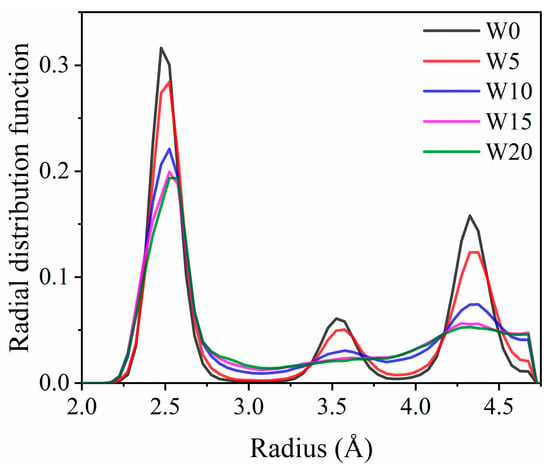
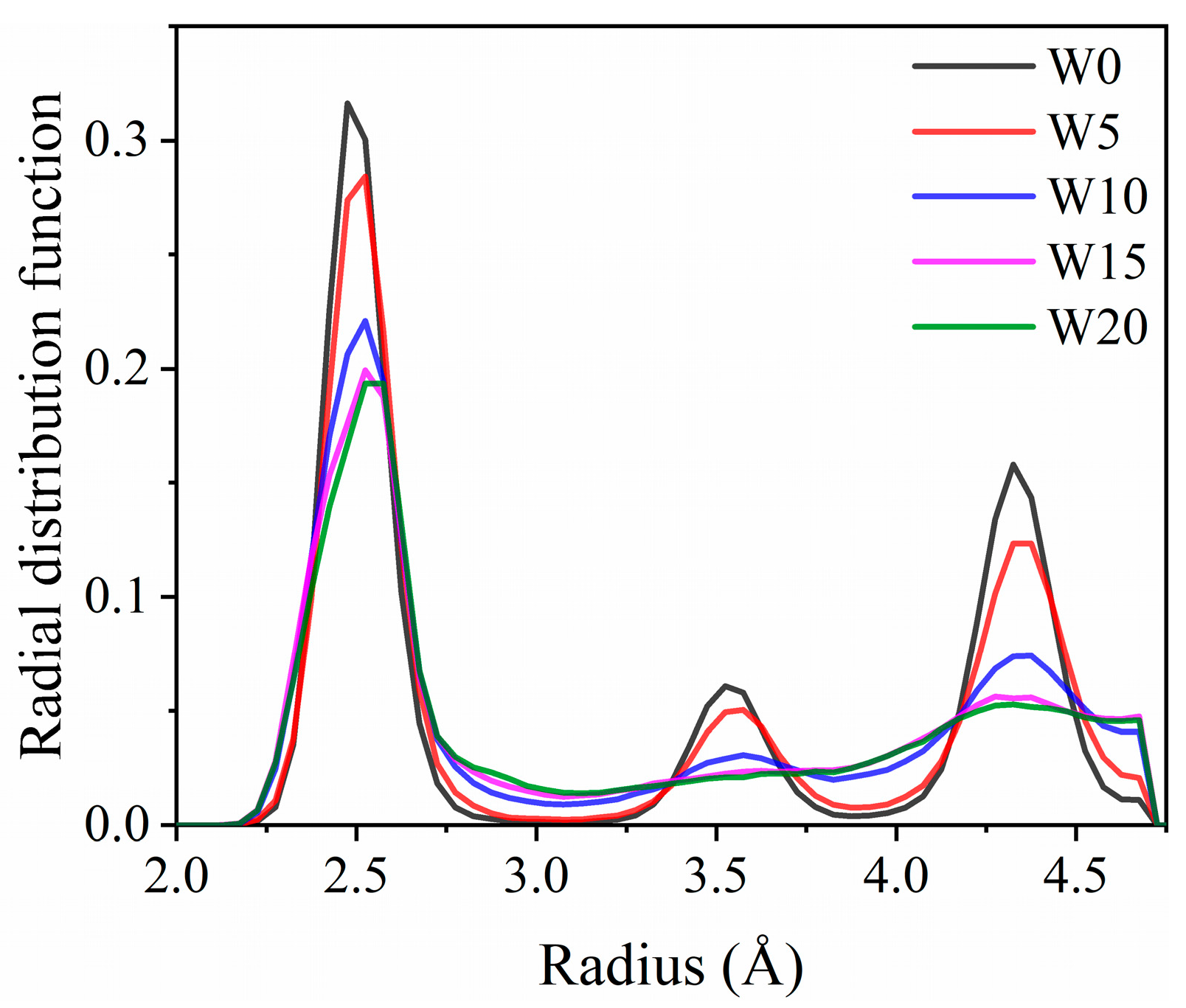
Nevertheless, the single sectional view may not capture the full effect of the W incorporation on the microstructure of Ni-W films. Therefore, the radial distribution function (RDF) analysis is operated on the deposited models [40]. The RDF is defined as with the total number of atoms N, volume of the system V and number n(r) of atoms located in a spherical shell with radius r [41]. For W0 and W5, the RDF presented in Figure 11 exhibits sharp, well-defined peaks at positions corresponding to the characteristic interatomic distances of the FCC Ni lattice: the first nearest neighbor peak at approximately 2.47 Å, the second peak at approximately 3.53 Å, and the third peak at approximately 4.32 Å. For W10, a noticeable broadening of the peaks occurs, accompanied by a reduction in peak intensity—particularly for the second and third peaks. This attenuation indicates progressive degradation of long-range order while short-range order is partially retained, consistent with the mixed crystalline-amorphous structure observed in the CSP analysis for W10. For W15, the peak broadening becomes more pronounced, and the second and third peaks are substantially suppressed, signaling the near-complete loss of long-range correlation. For W20, the RDF exhibits the characteristic features of amorphous material. The critical W concentration for amorphization (about 15 at%) aligns well with the experimentally reported threshold of approximately 13–22.5 at% [36,39,42,43].
Figure 11.
RDF curves of Ni-W films with different W content.
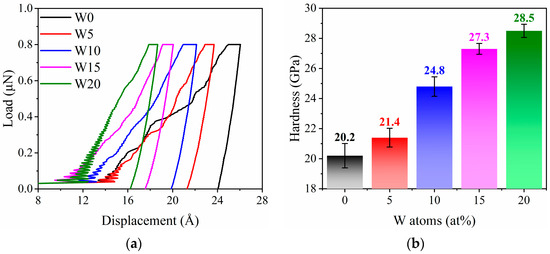
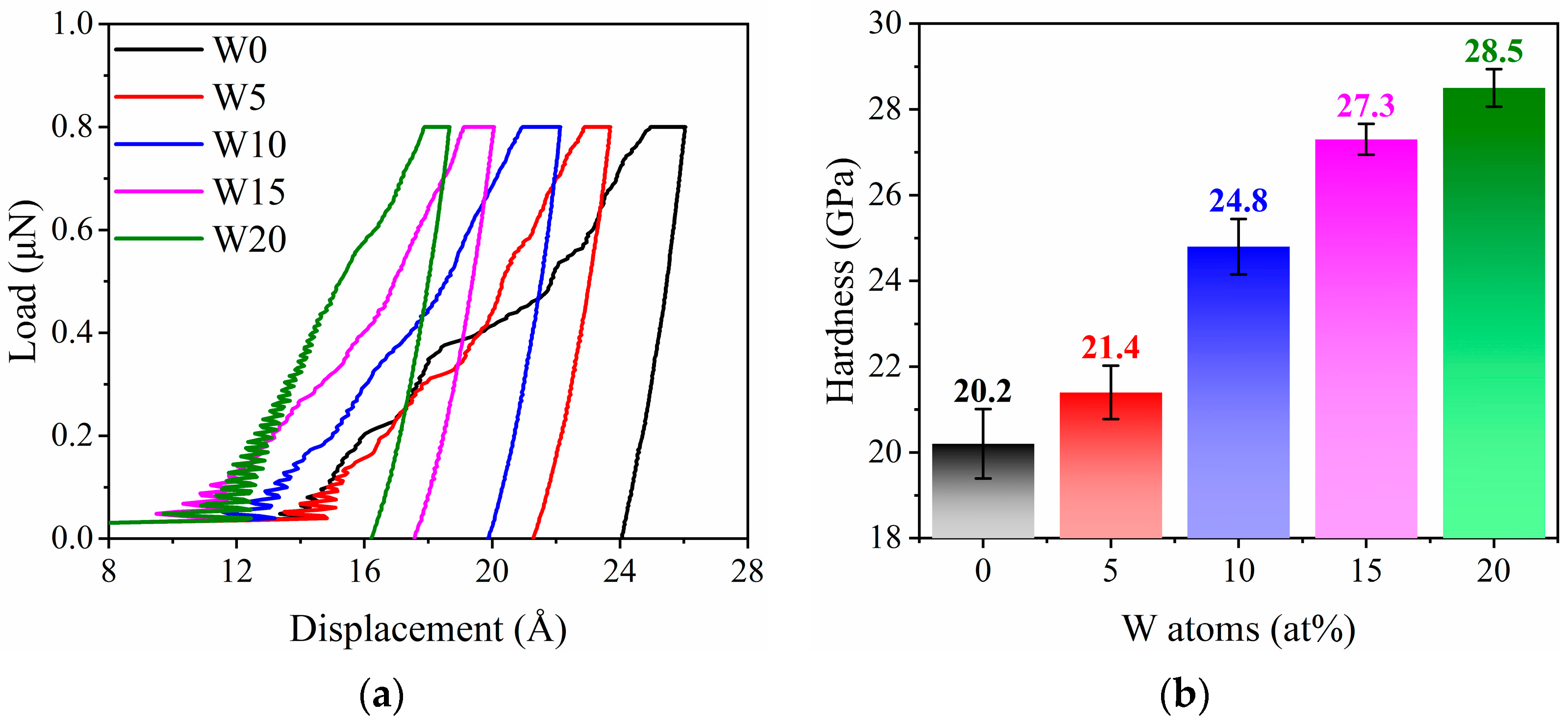
Figure 12a presents the load-displacement curves obtained at (40 Å, 40 Å) of the x-y plane, while Figure 12b summarizes the average hardness values for all five compositions through the nanoindentation simulations at (40 Å, 40 Å), (60 Å, 60 Å) and (80 Å, 80 Å) of the x-y plane. The results reveal an increase in hardness with increasing W content. Due to the inherent spatial and temporal limitations of MD simulations, the hardness values of Ni-W films differ somewhat from experimental reports. However, the trend of hardness variation with W content is consistent with the literature data, confirming the rationality and reliability of MD results [31,34,35,36,37,38]. The surface hardness of W20 reaches the highest level, showing an increase of nearly 41.1% compared to that of W0. It is noteworthy that the grain sizes of W0, W5 and W10 are smaller than 10 nm (Figure 10). At these scales, the classical Hall-Petch relationship is known to break down or even invert. The fine-grained strengthening mechanism is no longer applicable to explaining the enhancement of surface hardness.
Figure 12.
The results of nanoindentation simulations: (a) load-displacement curves; (b) hardness.
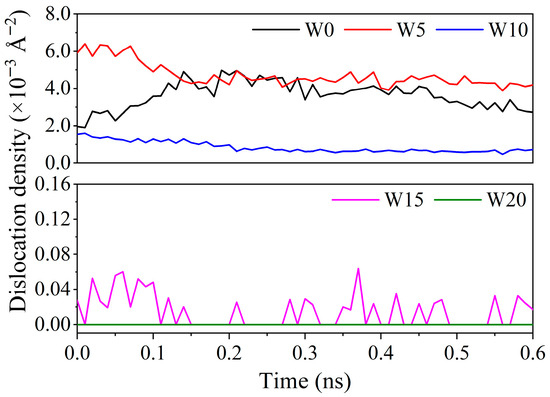
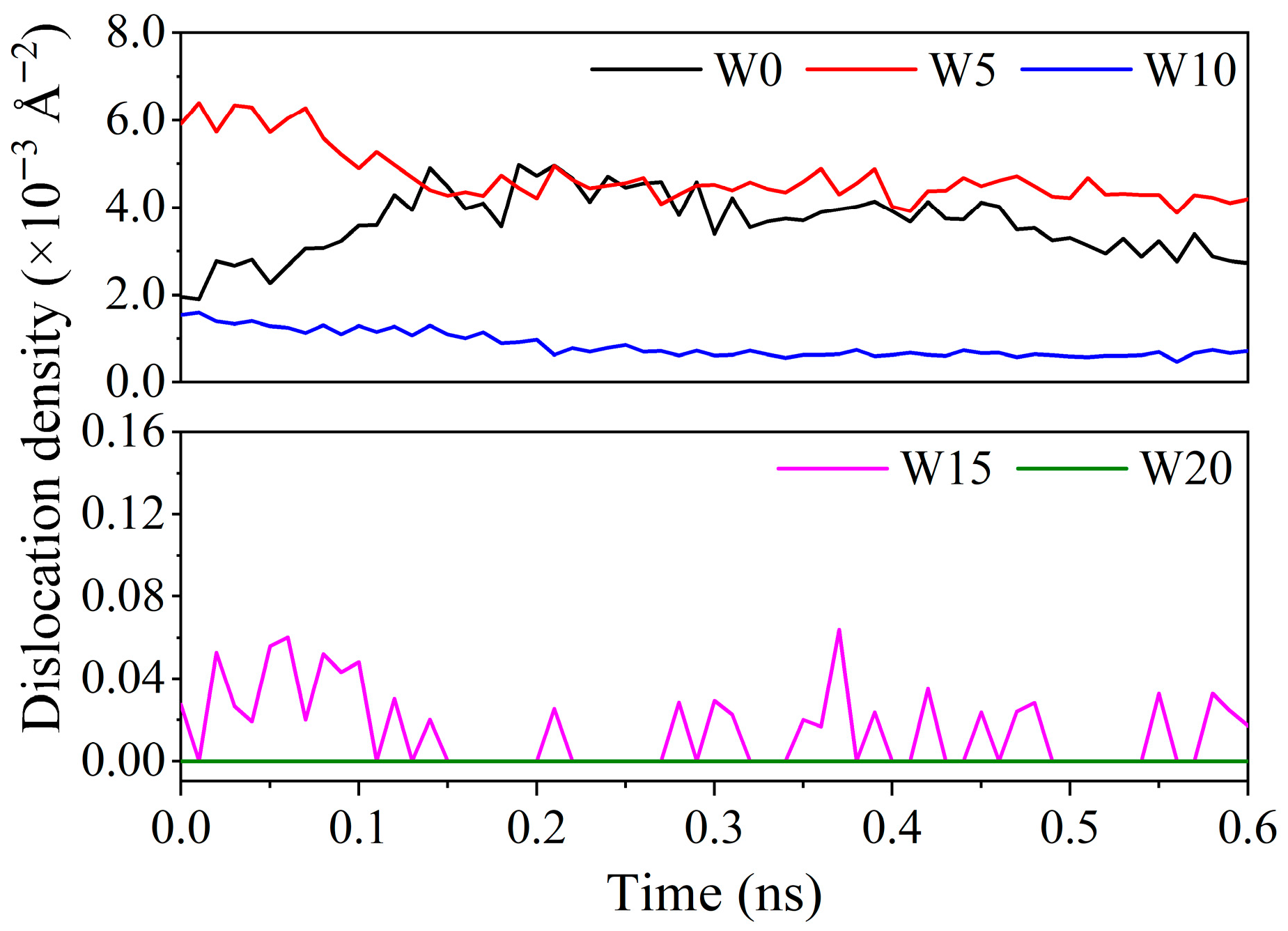
To elucidate the mechanism of hardness strengthening, the dislocation density during nanoindentation was analyzed, as shown in Figure 13. For W0, indentation induces a rapid increase in dislocation density, which peaks at approximately 4.73 × 10⁻³ Å−2 before gradually decreasing as deformation proceeds. For W5, the average dislocation density is higher than that of W0, and the subsequent decline is more gradual. This elevated dislocation activity suggests that at low W concentrations, strengthening is primarily achieved through dislocation pinning. For W15 and W20, the dislocation density during indentation approaches zero. The amorphous structure itself becomes the dominant strengthening mechanism at high W concentrations. Amorphous alloys have a long-range disordered but short-range ordered structure without mobile dislocations, slip systems, or grain boundaries [44]. Its plastic deformation depends on the activation of shear transformation zones (STZs), which requires overcoming a high activation energy for local atomic rearrangement [45]. Thus, amorphous Ni-W coatings exhibit superior resistance to plastic yielding under indentation, giving them greater hardness than crystalline alloys. Although there was no dislocation activity in W15 and W20, the decrease in structural defects can still enhance the mechanical strength and hardness. Among all films, W20 exhibits the highest hardness value. Therefore, in comparison with the dislocation pinning effect, the amorphous structure exerts a more pronounced enhancing influence on the surface hardness of Ni-W films.
Figure 13.
The dislocation density of Ni-W films during the nanoindentation simulations.
4. Conclusions
MD simulations were employed to investigate the atomic-scale deposition process, microstructure, and mechanical properties of Ni-W films on a single-crystal Al(001) substrate. The results reveal that W atoms reduce the ES barrier for Ni adatoms, promoting downhill diffusion and suppressing island growth, thereby improving the surface morphology and reducing roughness. Co-deposition of W atoms promotes the formation and expansion of grain boundaries, thereby driving the grain refinement of Ni-W films. When the W content exceeds 15 at%, a nanocrystalline-to-amorphous phase transformation also occurs. Nanoindentation simulations demonstrate an increase in hardness with W content. This enhancement originates from a composition-dependent transition in the strengthening mechanism: dislocation pinning dominates at low W concentrations, while amorphous structure-strengthening governs at high concentrations. These atomic-scale insights establish a link between composition, deposition process, microstructure, and mechanical properties, providing a basis for the rational design of high-performance Ni-W coatings.
Author Contributions
Conceptualization, D.C.; methodology, D.C., S.M. and Y.Z. (Yongchao Zhu); software, D.C.; validation, S.M. and Y.Z. (Yongchao Zhu); formal analysis, M.L. and Y.Z. (Yajun Zhou); resources, S.M.; data curation, D.C.; writing—original draft, D.C.; writing—review and editing, M.L. and Y.Z. (Yajun Zhou); visualization, D.C.; funding acquisition, S.M., Y.Z. (Yongchao Zhu) and Y.Z. (Yajun Zhou). All authors have read and agreed to the published version of the manuscript.
Funding
This research was supported by the Postgraduate Education Reform and Quality Improvement Project of Henan Province (YJS2025GZZ63), Henan Province Science and Technology Research Projects (252102231019), Natural Science Foundation of Henan (242300420059), Zhengzhou Basic Research and Applied Basic Research Special Fund Project (ZZSZX202105).
Institutional Review Board Statement
Not applicable.
Informed Consent Statement
Not applicable.
Data Availability Statement
The original contributions presented in this study are included in the article. Further inquiries can be directed to the corresponding author.
Conflicts of Interest
The authors declare no conflicts of interest.
References
- Wang, W.; Fang, X.; Fu, Q.; Huang, C.; Fang, L.; Zhang, J.; Feng, X.; Tan, W.; Liu, F.; Li, J.; et al. Iron(II/III) Alters the Relative Roles of the Microbial Byproduct and Humic Acid during Chromium(VI) Reduction and Fixation by Soil-Dissolved Organic Matter. Environ. Sci. Technol. 2025, 59, 2778–2790. [Google Scholar] [CrossRef] [Scilit]
- Allahyarzadeh, M.H.; Aliofkhazraei, M.; Rezvanian, A.R.; Torabinejad, V.; Rouhaghdam, A.R.S. Ni-W electrodeposited coatings: Characterization, properties and applications. Surf. Coat. Technol. 2016, 307, 978–1010. [Google Scholar] [CrossRef] [Scilit]
- Lavakumar, B.; Padmaganesan, H.T.; Prasad, M.J.N.V.; Wasekar, N.P. Enhanced solid particle erosion resistance of nanocrystalline Ni-W coatings through multilayer approach. Surf. Coat. Technol. 2024, 483, 130770. [Google Scholar] [CrossRef] [Scilit]
- Wang, Y.; Yang, Y.; Gao, F.; Zhang, X.; Zhu, L.; Yan, H.; Yang, P.; Gao, M. Unraveling Stoichiometry Effect in Nickel-Tungsten Alloys for Efficient Hydrogen Oxidation Catalysis in Alkaline Electrolytes. Angew. Chem. Int. Ed. Engl. 2024, 63, e202407613. [Google Scholar] [CrossRef] [Scilit]
- Wang, Z.-X.; Liang, F.; Zhang, G.-P.; Zhang, B. Enhancing high-temperature tensile properties of Ni/Ni-W laminated composites for MEMS devices. J. Mater. Sci. Technol. 2023, 138, 129–137. [Google Scholar] [CrossRef] [Scilit]
- Gololobov, G.P.; Suvorov, D.V.; Tyschenko, M.S.; Slivkin, E.V.; Tolstoguzov, A. Switching Properties of the Contact Coatings Based on Refractory Metals Alloys. Coatings 2023, 13, 241. [Google Scholar] [CrossRef] [Scilit]
- Yao, J.; Li, C.; Shang, M.; Chen, X.; Wang, Y.; Ma, H.; Ma, H.; Liu, X. Diffusion Barrier Performance of Ni-W Layer at Sn/Cu Interfacial Reaction. Materials 2024, 17, 3682. [Google Scholar] [CrossRef] [Scilit]
- Chen, Y.-H.; Huang, S.-J.; Booncam, J.; Liang, J.-T.; Lin, H.-E. Influence of pulse parameters on microstructure and corrosion characteristics of electrodeposited Ni-W alloy coating. Mater. Today Commun. 2024, 38, 108486. [Google Scholar] [CrossRef] [Scilit]
- An, Y.-A.; Wu, W.; Wang, T.; Jiao, Y.; Mohammed, Y.M.; Wang, Q. Electrodeposition, characterization and properties of Ni-W alloys as an efficient electrocatalyst for the hydrogen evolution reaction in alkaline solution. Int. J. Hydrogen Energy 2025, 142, 376–389. [Google Scholar] [CrossRef] [Scilit]
- Park, S.; Han, H.; Seo, J.; Park, J.; Yoon, S.; Yoo, B. Electrodeposition of Nickel-Tungsten Alloy with Functional Concentration Periodically Graded Material Structure for Low Stress and High Hardness. J. Electrochem. Soc. 2024, 171, 022502. [Google Scholar] [CrossRef] [Scilit]
- Padmaganesan, H.T.; Lavakumar, B.; Choshi, A.; Takata, N.; Wasekar, N.P.; Prasad, M.J.N.V. Achieving exceptional strain-hardening ability in nanocrystalline Ni-W coatings through compositionally modulated multilayer approach. Mater. Sci. Eng. A 2024, 912, 146971. [Google Scholar] [CrossRef] [Scilit]
- Bathini, L.; Prasad, M.; Wasekar, N.P. Compositionally modulated Ni-W multilayer coatings: A facile approach to enhance the tribological performance. Tribol. Int. 2023, 179, 108145. [Google Scholar] [CrossRef] [Scilit]
- Gyawali, G.; Tripathi, K.; Joshi, B.; Lee, S.W. Mechanical and tribological properties of Ni-W-TiB2 composite coatings. J. Alloys Compd. 2017, 721, 757–763. [Google Scholar] [CrossRef] [Scilit]
- Das, M.K.; Li, R.X.; Qin, J.Q.; Zhang, X.Y.; Das, K.; Thueploy, A.; Limpanart, S.; Boonyongmaneerat, Y.; Ma, M.Z.; Liu, R.P. Effect of electrodeposition conditions on structure and mechanical properties of Ni-W/diamond composite coatings. Surf. Coat. Technol. 2017, 309, 337–343. [Google Scholar] [CrossRef] [Scilit]
- Zhang, W.W.; Ji, C.C.; Li, B.S. Synthesis and properties of Ni-W/ZrO2 nanocomposite coating fabricated by pulse electrodeposition. Results Phys. 2019, 13, 102242. [Google Scholar] [CrossRef] [Scilit]
- Keskin, A.; Hukumdar, O.; Kumlu, U.; Akar, M.A.; Tosun, E.; Keyinci, S. Characterization of Ni-W/hBN nanocomposite electrodeposits. Ceram. Int. 2025, 51, 44857–44871. [Google Scholar] [CrossRef] [Scilit]
- Elias, L.; Hegde, A.C. Electrolytic Synthesis of Ni-W-MWCNT Composite Coating for Alkaline Hydrogen Evolution Reaction. J. Mater. Eng. Perform. 2018, 27, 1033–1039. [Google Scholar] [CrossRef] [Scilit]
- Cheng, D.; Zhang, L.; Zhan, Z.; Xia, H.; Ma, K.; Ma, H.; Gao, Y. Preparation and Properties of Ni-W Composite Coatings Reinforced by Graphene Nanoplatelets. Adv. Eng. Mater. 2021, 23, 2001309. [Google Scholar] [CrossRef] [Scilit]
- Wu, B.; Zhou, J.; Xue, C.; Liu, H. Molecular dynamics simulation of the deposition and annealing of NiAl film on Ni substrate. Appl. Surf. Sci. 2015, 355, 1145–1152. [Google Scholar] [CrossRef] [Scilit]
- Rong, Y.; Zhang, L.; He, H. Molecular dynamics study on the deposition of Ni/graphene composite film. Thin Solid Film. 2021, 732, 138778. [Google Scholar] [CrossRef] [Scilit]
- Ichou, M.A.; Mes-adi, H.; Saadouni, K.; Mazroui, M.H. Deposition of TiNi thin films on Ni(001) substrate using molecular dynamics simulation. Phys. B Condens. Matter 2023, 671, 415365. [Google Scholar] [CrossRef] [Scilit]
- Lee, S.-G.; Chung, Y.-C. Atomic-level investigation of Al and Ni thin film growth on Ni(111) surface: Molecular dynamics simulation. Appl. Surf. Sci. 2007, 253, 8896–8900. [Google Scholar] [CrossRef] [Scilit]
- Zhang, L.; Zhu, Y.; Li, N.; Rong, Y.; Xia, H.; Ma, H. Atomistic simulation of Al-graphene thin film growth on polycrystalline Al substrate. Appl. Surf. Sci. 2018, 433, 540–545. [Google Scholar] [CrossRef] [Scilit]
- Jacobsen, K.W.; Norskov, J.K.; Puska, M.J. Interatomic interactions in the effective-medium theory. Phys. Rev. B 1987, 35, 7423–7442. [Google Scholar] [CrossRef] [Scilit]
- Shim, J.H.; Park, S.I.; Cho, Y.W.; Lee, B.J. Modified embedded-atom method calculation for the Ni-W system. J. Mater. Res. 2003, 18, 1863–1867. [Google Scholar] [CrossRef] [Scilit]
- Adams, D.J.; Adams, E.M.; Hills, G.J. The computer simulation of polar liquids. Mol. Phys. 1979, 38, 387–400. [Google Scholar] [CrossRef] [Scilit]
- Halicioǧlu, T.; Pound, G.M. Calculation of potential energy parameters form crystalline state properties. Phys. Status Solidi A 1975, 30, 619–623. [Google Scholar] [CrossRef] [Scilit]
- Rappe, A.K.; Casewit, C.J.; Colwell, K.S.; Goddard, W.A., III; Skiff, W.M. Uff, a full periodic-table force-field for molecular mechanics and molecular-dynamics simulations. J. Am. Chem. Soc. 1992, 114, 10024–10035. [Google Scholar] [CrossRef] [Scilit]
- Choi, B.K.; Yoon, G.H.; Lee, S. Molecular dynamics studies of CNT-reinforced aluminum composites under uniaxial tensile loading. Compos. Part B Eng. 2016, 91, 119–125. [Google Scholar] [CrossRef] [Scilit]
- Filippova, V.P.; Kunavin, S.A.; Pugachev, M.S. Calculation of the parameters of the Lennard-Jones potential for pairs of identical atoms based on the properties of solid substances. Inorg. Mater. Appl. Res. 2015, 6, 1–4. [Google Scholar] [CrossRef] [Scilit]
- Vamsi, M.; Wasekar, N.P.; Sundararajan, G. Influence of heat treatment on microstructure and mechanical properties of pulse electrodeposited Ni-W alloy coatings. Surf. Coat. Technol. 2017, 319, 403–414. [Google Scholar] [CrossRef] [Scilit]
- Hong, K.-H.; Cha, P.-R.; Nam, H.-S.; Yoon, J.-K. The effect of lattice strain on step edge diffusion. Met. Mater. Int. 2003, 9, 129–134. [Google Scholar] [CrossRef] [Scilit]
- Plimpton, S. Fast parallel algorithms for short-range molecular-dynamics. J. Comput. Phys. 1995, 117, 1–19. [Google Scholar] [CrossRef] [Scilit]
- Sriraman, K.; Raman, S.G.S.; Seshadri, S. Synthesis and evaluation of hardness and sliding wear resistance of electrodeposited nanocrystalline Ni–W alloys. Mater. Sci. Eng. A 2006, 418, 303–311. [Google Scholar] [CrossRef] [Scilit]
- Wu, Y.; Chang, D.; Kim, D.; Kwon, S.-C. Influence of boric acid on the electrodepositing process and structures of Ni–W alloy coating. Surf. Coat. Technol. 2003, 173, 259–264. [Google Scholar] [CrossRef] [Scilit]
- Huang, P.-C.; Chou, C.-C.; Hsu, L.-S. Preparation and tribological research of the electrodeposited NiW alloy coatings for piston ring application. Surf. Coat. Technol. 2021, 411, 126980. [Google Scholar] [CrossRef] [Scilit]
- Slavcheva, E.; Mokwa, W.; Schnakenberg, U. Electrodeposition and properties of NiW films for MEMS application. Electrochim. Acta 2005, 50, 5573–5580. [Google Scholar] [CrossRef] [Scilit]
- Hu, Y.; Yu, Y.; Ge, H.; Wei, G.; Jiang, L. Study on mechanical and anticorrosion performance of NiW alloy coatings prepared by induced codeposition. Int. J. Electrochem. Sci. 2019, 14, 1649–1657. [Google Scholar] [CrossRef] [Scilit]
- Yamasaki, T. High-strength nanocrystalline Ni-W alloys produced by electrodeposition and their embrittlement behaviors during grain growth. Scr. Mater. 2001, 44, 1497–1502. [Google Scholar] [CrossRef] [Scilit]
- Jing, X.-B.; Liu, Z.-L.; Yao, K.-L. Molecular dynamics investigation of deposition and annealing behaviors of Cu atoms onto Cu(001) substrate. Appl. Surf. Sci. 2012, 258, 2771–2777. [Google Scholar] [CrossRef] [Scilit]
- Tsai, P.C.; Jeng, Y.R. Coalescence and epitaxial self-assembly of Cu nanoparticles on graphene surface: A molecular dynamics study. Comput. Mater. Sci. 2019, 156, 104–110. [Google Scholar] [CrossRef] [Scilit]
- Vamsi, M.V.N.; Wasekar, N.P.; Sundararajan, G. Sliding wear of as-deposited and heat-treated nanocrystalline nickel-tungsten alloy coatings. Wear 2018, 412, 136–143. [Google Scholar] [CrossRef] [Scilit]
- Yu, Z.; Shi, S.; Zhang, X.; You, Z.; Zhao, Y. Inverse Hall-Petch and nanocrystal-amorphous transition of broad-spectrum W content NiW alloys. Mater. Sci. Eng. A 2025, 943, 148774. [Google Scholar] [CrossRef] [Scilit]
- Telford, M. The case for bulk metallic glass. Mater. Today 2004, 7, 36–43. [Google Scholar] [CrossRef] [Scilit]
- Schuh, C.A.; Hufnagel, T.C.; Ramamurty, U. Mechanical behavior of amorphous alloys. Acta Mater. 2007, 55, 4067–4109. [Google Scholar] [CrossRef] [Scilit]

Disclaimer/Publisher’s Note: The statements, opinions and data contained in all publications are solely those of the individual author(s) and contributor(s) and not of MDPI and/or the editor(s). MDPI and/or the editor(s) disclaim responsibility for any injury to people or property resulting from any ideas, methods, instructions or products referred to in the content. |
© 2026 by the authors. Licensee MDPI, Basel, Switzerland. This article is an open access article distributed under the terms and conditions of the Creative Commons Attribution (CC BY) license.