


Abstract
To address the shortage of natural aggregates and freshwater, and promote the recycling of construction and demolition waste and localized construction materials for marine engineering, this study explores the electrochemical corrosion characteristics and deterioration mechanism of steel bars in recycled concrete aggregate (RCA)–seawater sea-sand concrete (SSC) concrete. Using RCA replacement rates (0%, 50%, 100%) as the core variable, specimens were prepared. Vacuum water saturation, open-circuit potential (OCP) monitoring, Tafel polarization scanning and electrochemical impedance spectroscopy (EIS) were adopted to study steel corrosion evolution within 180 days. The results show that RCA incorporation accelerates OCP negative drift and reduces passivation film stability, with more severe corrosion at higher replacement rates: the RCA100 group showed obvious corrosion after 60 days, while the RCA50 and RCA0 groups initiated corrosion at 90 days (RCA50 corroded faster). The surface mortar and internal microcracks of RCA enhance the water absorption and ion permeability of concrete, which, coupled with chloride ions, accelerates steel corrosion. This study clarifies the correlation between RCA replacement rate and corrosion parameters, providing data support for mix ratio optimization and marine engineering applications.
1. Introduction
With the acceleration of urbanization and the expansion of infrastructure construction scale, the consumption of natural aggregates and freshwater river sand has increased year by year, making the problems of resource exhaustion and ecological damage increasingly prominent [1,2,3,4]. Meanwhile, the rapid development of marine engineering in China, such as cross-sea bridges, offshore platforms, and island buildings, has led to a surge in demand for concrete raw materials. Relying on inland transportation of freshwater river sand and natural aggregates will significantly increase engineering costs and carbon emissions [5,6]. Driven by both resource constraints and engineering demands, the development of sustainable alternative raw materials for concrete has become a core issue in breaking through the bottleneck in the field of civil engineering [7].
Recycled concrete aggregate (RCA) has emerged as a research hotspot in the field of resource recycling due to its ability to efficiently consume construction and demolition waste (CDW) and reduce the consumption of natural aggregates [8,9]. A relatively systematic body of research has been formed on its mechanical properties and basic application characteristics [10,11]. Yuwadee Zaetang et al. [12] studied the application of RCA in pervious concrete and found that except for the 100% high replacement rate, RCA can improve the compressive strength of concrete; full replacement can also enhance surface wear resistance, the mechanism of which is attributed to the enhanced paste bonding force induced by its surface porosity and roughness. Zhu et al. [13] further studied the multiple recycling of RCA and showed that second-generation recycled aggregate concrete (2nd-RCA) can still meet the 40 MPa compressive strength requirement and has better frost resistance than the first generation, providing mechanical support for the cyclic utilization of RCA. As abundant natural resources in the marine environment, seawater and sea sand can be directly used in concrete preparation to achieve “local material utilization”, which significantly reduces transportation costs and energy consumption, and exhibits prominent economic and environmental benefits [14,15,16]. Therefore, the synergistic application of RCA with seawater and sea sand is regarded as an important technical path to resolve the contradictions between resource shortage, ecological damage, and engineering costs.
However, the inherent physicochemical properties of these two materials pose severe challenges to the long-term durability of concrete structures, especially the corrosion protection of steel bars. RCA generates a large number of microcracks during the crushing process, and the porous old mortar layer attached to its surface results in a much higher water absorption rate than natural aggregates [4,7] and forms a weaker transition zone at the interface between the aggregate and new mortar [17]. These defects increase the porosity and permeability of concrete, provide convenient channels for the intrusion of external harmful ions, and thereby reduce the compactness and durability of concrete. On the other hand, seawater and sea sand contain a large amount of chloride ions (Cl−), which are the most dangerous aggressive medium inducing steel bar corrosion [18,19,20]. When the chloride ion concentration on the steel bar surface accumulates to the critical value, it will destroy the passivation film on its surface, trigger electrochemical corrosion, and ultimately lead to cracking and spalling of the concrete protective layer and a decrease in structural bearing capacity, and endanger engineering safety [21]. More critically, when RCA and seawater/sea sand act synergistically in concrete, their adverse factors produce a significant “1 + 1 > 2” coupled deterioration effect.
At present, research on the combination of RCA with seawater and sea sand is still in the preliminary stage, and the research focus is obviously biased towards mechanical properties. Carolina Caracol et al. [22] found that the combined use of seawater and RCA can improve the mechanical properties of concrete, with the 28-day compressive strength reaching 39 MPa at a 50% RCA replacement rate. Xiao et al. [23] demonstrated through experiments that the incorporation of RCA into seawater sea-sand concrete (SSC) significantly improves early strength, and the 7-day compressive strength of SSC with natural coarse aggregates is 36%–76% higher than that of conventional concrete. In contrast, research on corrosion characteristics is relatively lagging and fragmented. Zhang et al. [24] found through electrochemical tests that an increase in RCA replacement rate accelerates steel bar corrosion under chloride ion attack. Bo Da et al. [25] used electrochemical impedance spectroscopy (EIS) to clarify the influencing factors of steel bar corrosion in coral aggregate concrete in a seawater environment. However, there is still an obvious gap in systematic research on steel bar corrosion in the RCA-SSC; specifically, the quantitative influence law of RCA replacement rate on corrosion initiation, development, and passivation film stability remains unclear.
In view of this, based on the seawater and sea-sand service environment, this study selects RCA replacement rates (0%, 50%, 100%) as the core variable to construct a series of RCA-SSC steel bar specimens. Through water absorption testing, open-circuit potential (OCP) monitoring, Tafel polarization scanning, and EIS, the changes in steel bars on days 7, 14, 28, 60, 90, and 180 were studied. The corrosion initiation time, development rate, interface evolution, and passivation resistance of steel bars under different RCA contents were systematically explored, and the correlation law between RCA content and key corrosion parameters was quantified. This study provides data support and a technical reference for the mix ratio optimization, corrosion inhibition, and engineering application of RCA-SSC.
2. Materials and Methods
2.1. Materials
The cement used was P.O. 42.5 ordinary Portland cement produced by Shanghai Conch Cement Co., Ltd.(Shanghai, China), with a 3-day compressive strength of 29.3 MPa, a 28-day compressive strength of 47.6 MPa, a fineness of 1.2, and a loss on ignition of 1.76%. Its chemical composition (wt.%) was as follows: SiO2 21.5%, CaO 65.2%, Al2O3 5.8%, Fe2O3 3.6%, SO3 2.9%, and others 1.0%. Silica fume was a product of Shanghai Elken International Trading Co., Ltd. (Shanghai, China), with a SiO2 content ≥ 92.5%, a specific surface area of 22,000 m2·kg−1, a loss on ignition ≤ 3.0%, a moisture content ≤ 1.5%, and an average particle size of 0.15 μm. Two types of coarse aggregates were employed—natural coarse aggregate and recycled coarse aggregate—both with a continuous gradation of 5–20 mm. The natural coarse aggregate (NCA), purchased from Shanghai Jinshan Stone Co., Ltd. (Shanghai, China), was granite crushed stone; the recycled coarse aggregate (RCA) was obtained from waste concrete members of a local factory in Baoshan District, Shanghai, which were processed by crushing, sieving, and impurity removal. The key performance indices of the two coarse aggregates are presented in Table 1. The fine aggregate was natural sea sand from Hangzhou Bay, used after sieving and impurity removal. It had a fineness modulus of 2.5, an apparent density of 2615 kg·m−3, a mud content of 0.6 wt.%, a chloride ion content of 0.32 wt.%, and a shell content ≤ 1.2 wt.%, thus falling into the category of medium sand. The mixing water was artificial seawater prepared in the laboratory, formulated according to the composition of natural seawater. The concentrations of each component were precisely controlled as follows: 24.53 g·L−1 of NaCl, 5.20 g·L−1 of MgCl2, 4.09 g·L−1 of Na2SO4, 1.16 g·L−1 of CaCl2, 0.695 g·L−1 of KCl, and 0.355 g·L−1 of other constituents. The test steel bar was an HRB400-grade deformed steel bar produced by Shanghai Baosteel Group Co., Ltd. (Shanghai, China), with a diameter of 12 mm, a yield strength of 400 MPa, and a tensile strength of 540 MPa. Its chemical composition is listed in Table 2. In addition, a polycarboxylate-based superplasticizer with a solid content of 40% and a water reduction rate ≥ 25% was used to improve the workability of concrete.
Table 1.
Performance parameters of coarse aggregates.
Table 2.
Chemical composition of HRB400.
2.2. Electrode Preparation and Electrochemical Test Methods
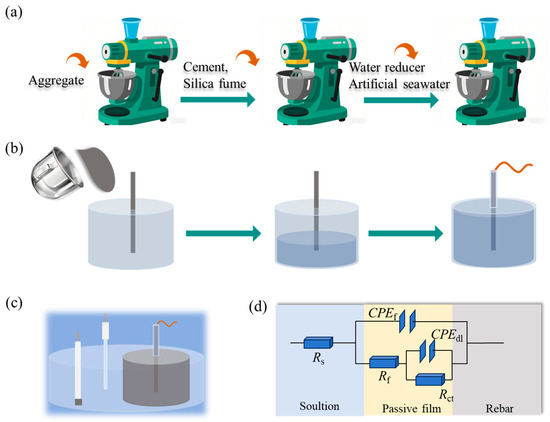
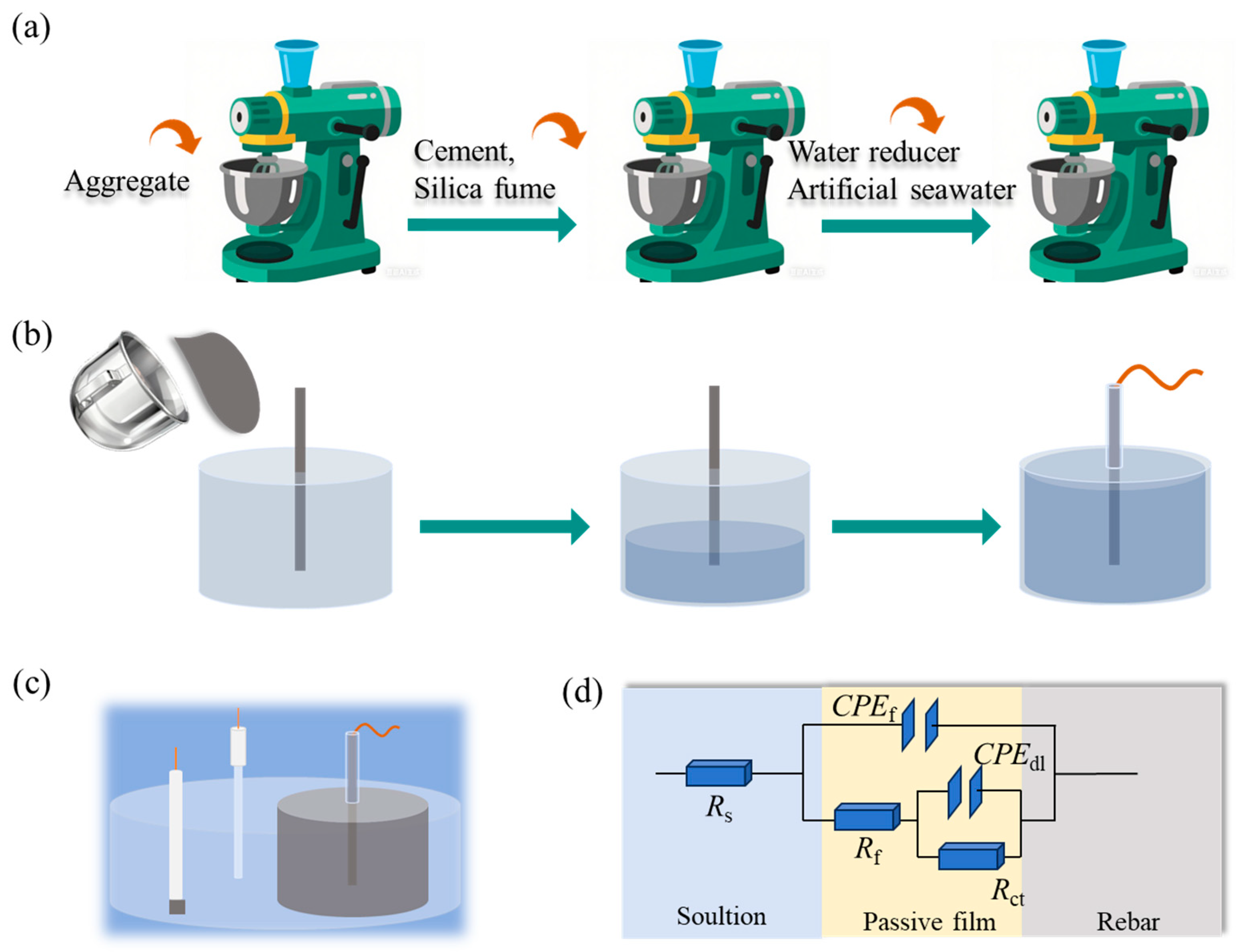
According to the concrete mix proportions with RCA replacement ratios of 0%, 50%, and 100% listed in Table 3, the concrete mixtures were prepared using a forced-action mechanical mixer, with the flow chart shown in Figure 1a. Coarse and fine aggregates were first dry-mixed for 2–3 min, followed by the addition of cement and silica fume for a further 2–3 min of dry mixing. Artificial seawater containing dissolved polycarboxylate-based superplasticizer was then introduced, and the mixture was stirred at low speed for 1 min and high speed for 2 min until uniform and workable. Cylindrical specimens with dimensions of Φ100 mm × 80 mm were cast in PVC molds. HRB400-grade steel bars (16 mm in diameter, 100 mm in length), which had been sanded to remove rust and cleaned with anhydrous ethanol, were vertically fixed at the center of each mold, with an effective working length of 60 mm (Figure 1b). The concrete mixture was placed in two layers and vibrated for 20–30 s per layer to ensure compaction. The top surface was leveled and covered with plastic film for moisture retention. Copper wires were welded to the exposed ends of the steel bars, which were then sealed with epoxy resin. All specimens were cured under standard conditions for 28 days after molding.
Table 3.
Concrete mix ratio.
Figure 1.
Concrete preparation and electrochemical test system: (a) Concrete preparation flow; (b) electrode preparation flow; (c) electrochemical test setup; (d) equivalent circuit for EIS fitting.
After curing, the reinforced concrete specimens were immersed in a simulated seawater environment for 7, 14, 28, 60, 90, and 180 days, followed by electrochemical testing. A CHI660E electrochemical workstation was employed to establish a three-electrode system, with the embedded steel bar as the working electrode, a platinum sheet as the counter electrode, and a Ag/AgCl electrode as the reference electrode, as illustrated in Figure 1c. Before the electrochemical measurements, the electrochemical workstation was preheated for 30 min, and the specimen was simultaneously immersed in the test electrolyte (artificial seawater). After the above pretreatment, the open-circuit potential had already become sufficiently stable. Then, the OCP measurement was formally conducted, and the duration of the OCP test was 120 s to ensure the stability and reliability of the recorded potential. The corrosion potential in this study refers to the stable open-circuit potential (OCP) measured in the corrosive environment. Tafel polarization is one of the most commonly used non-destructive electrochemical methods for monitoring the corrosion state of metal surfaces. According to corrosion electrochemistry theory, a polarization potential perturbation ΔE (within ±300 to ±400 mV vs. OCP) was applied around the corrosion potential Ecorr of the steel. The polarization resistance (Rp) of the specimen was obtained by fitting the linear polarization curve, and the theoretical corrosion current density (icorr) was calculated using the Stern–Geary equation (Equation (1)).
In the equation, icorr denotes the corrosion current density (μA·cm−2); B is the Stern–Geary constant; ΔE = E − Ecorr, where E represents the specimen potential; ba and bc are the anodic and cathodic Tafel constants, respectively, whose values are related to the electrode reaction mechanism; and Rp is the polarization resistance (kΩ·cm2). For steel bars in concrete, B = 26 mV when the steel is in a corroded state, and B = 52 mV when it is in a passivated state.
The depth of corrosion is shown in Equation (2) [26,27].
In the equation, M is the relative atomic mass of iron (55.85 g·mol−1), ρ the density of iron (7.87 g·cm−3), icorr the corrosion current density (μA·cm−2), t the corrosion time (s), n the number of electrons transferred (n = 2), and F the Faraday constant (96,500 C·mol−1). The steel corrosion rate vcorr was calculated from mass loss and corrosion time, with a conversion factor of 1 mA·cm−2 = 0.0116 mm/a.
Electrochemical impedance spectroscopy (EIS) tests were performed over a frequency range of 10−2–105 Hz with an AC signal amplitude of 10 mV. The EIS measurements were performed at the stable open-circuit potential (OCP). All potential values in this study were measured with respect to the Ag/AgCl reference electrode. EIS data were fitted using Zview software (v2.9b), and the equivalent circuit illustrated in Figure 1d was adopted. Here, Rs stands for the concrete solution resistance, Rct is the charge transfer resistance, Rf represents the passive film resistance of the steel bar, CPEdl denotes the constant phase element corresponding to the double-layer capacitance at the steel–concrete interface, and CPEf is the constant phase element associated with the passive film capacitance of the steel bar.
2.3. Mechanism Analysis
To reveal the intrinsic mechanism of steel bar corrosion in RCA-SSC, three methods—vacuum water saturation (for concrete water absorption testing), scanning electron microscopy (SEM) (for internal concrete microstructure observation), and high-resolution photography (for macroscopic steel corrosion morphology)—were employed. This multi-scale approach systematically analyzed the effects of the RCA replacement ratio on concrete deterioration and steel corrosion from three perspectives: macroscopic pore characteristics, microstructural interface properties, and macroscopic corrosion manifestations.
Concrete water absorption was measured using the vacuum water saturation method. Cubic specimens with dimensions of 100 mm × 100 mm × 100 mm were prepared, with three parallel specimens per group. Specimens cured to the target age were dried in a 105 °C oven to constant mass (m1). After cooling to room temperature, they were placed in a vacuum desiccator for 2 h of vacuuming; distilled water was then added to submerge the specimens, and vacuuming continued for 1 h before standing for 24 h. The specimens were removed, surface moisture was wiped dry, and the saturated mass (m2) was recorded. Water absorption (W) was calculated using Equation (3), with the average value of 3 specimens taken as the final result:
For microstructure observation, 180-day-old concrete specimens were selected, and small samples (10 mm × 10 mm × 5 mm) were cut perpendicular to the casting direction. These samples were treated with hydration termination, drying, and gold sputtering; then, the internal morphology of concrete was observed using a Sigma HV scanner. The microscopic morphology was observed by SEM with an accelerating voltage of 3 kV. Prior to the observation, the specimens were cooled in a desiccator for about 1 h to reach room temperature. Meanwhile, the reinforcement was extracted, cleaned to retain the corrosion layer, and photographed to record its macro-corrosion morphology.
3. Results
3.1. Electrochemical Measurements
3.1.1. Open-Circuit Potential (OCP)
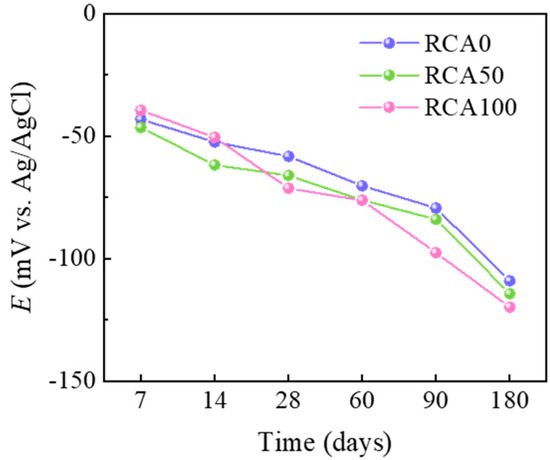
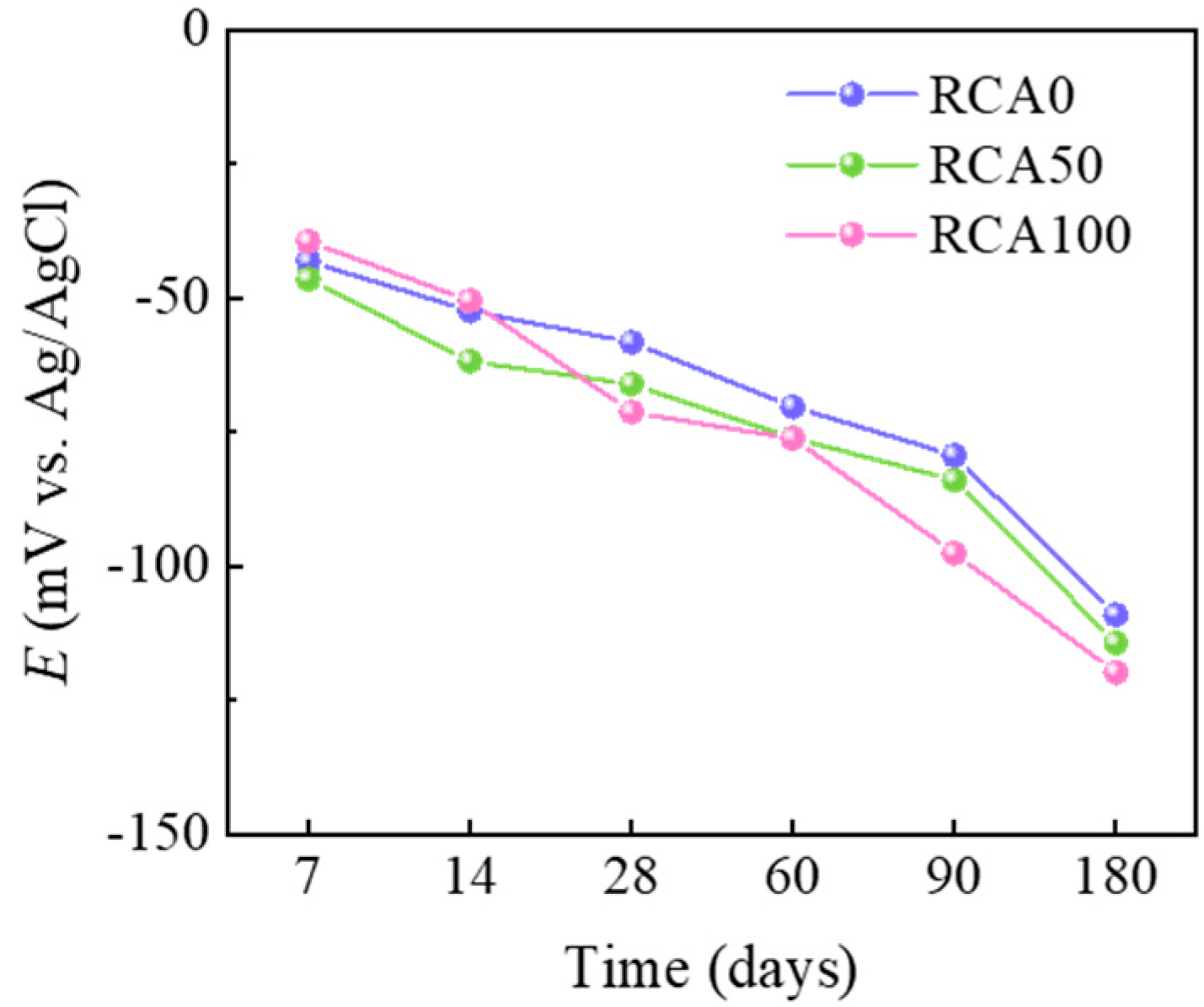
As illustrated in Figure 2, the OCP of steel bars in concrete with three different RCA replacement ratios (RCA0, RCA50, RCA100) exhibited a continuous negative drift trend over the 180-day monitoring period. In this study, the symbol “d” is used to denote “day”, indicating the measurement time. At the initial stage (7 d), the potentials of all groups were relatively close. With increasing age, the rate of potential negative drift was relatively moderate in the early period (7–60 d) but accelerated significantly in the later period (60–180 d). Among the groups, the RCA100 group showed the largest negative drift amplitude, decreasing to approximately −119.8 mV at 180 d. The potential of the RCA50 group was slightly higher than that of the RCA100 group, eventually stabilizing at around −114.3 mV. The RCA0 group (natural aggregate control) maintained the highest potential throughout the test, reaching approximately −109.1 mV at 180 d.
Figure 2.
OCP of steel bars in RCA–SSC with different RCA replacement ratios.
This phenomenon indicates that the incorporation of recycled coarse aggregate accelerates the negative drift in the steel bar’s OCP, with more pronounced negative shifts at higher replacement ratios. This indirectly reflects that the corrosion risk of steel bars in recycled aggregate concrete increases with the elevation of the RCA replacement ratio.
3.1.2. Tafel Polarization Curves
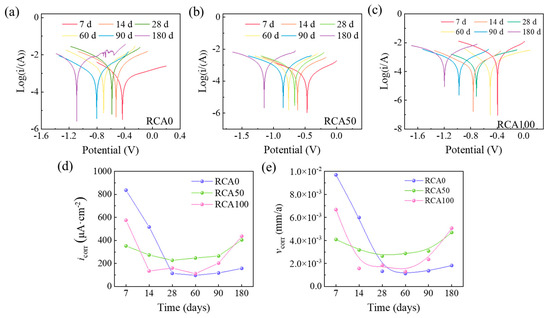
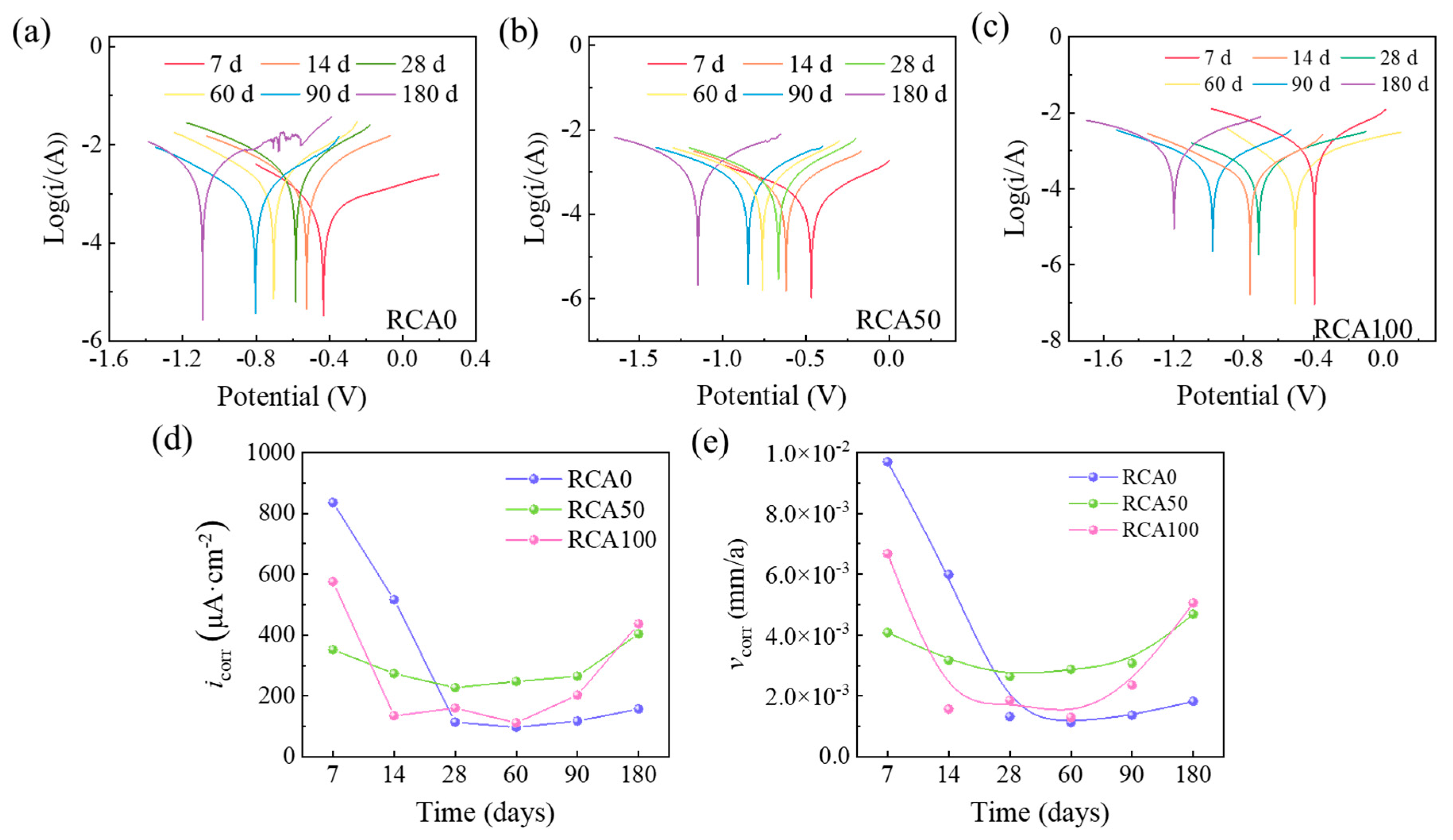
Figure 3a–c present the Tafel polarization curves of steel bars in concrete with different recycled coarse aggregate (RCA) replacement ratios (RCA0, RCA50, RCA100) at ages from 7 to 180 days. All specimens exhibit typical activation–passivation behavior: the cathodic current increases monotonically with negative potential shift; in the anodic region, the current remains at a low level within the passive range, and rises sharply once the potential exceeds the breakdown potential. By comparing different groups at the same age, it can be observed that a higher RCA replacement ratio corresponds to a larger overall current density on the polarization curve, revealing that the incorporation of recycled aggregate accelerates the electrochemical process of steel corrosion.
Figure 3.
Tafel polarization test results: (a) RCA0; (b) RCA50; (c) RCA100; (d) evolution of icorr with corrosion age; (e) evolution of vcorr with corrosion age.
Figure 3d,e further illustrate the evolution of icorr and vcorr with age (7–180 d) for steel bars in concrete with different RCA replacement ratios (RCA0, RCA50, RCA100). Within 7–28 d, icorr decreases for all groups, and vcorr exhibits the same trend, indicating that the passivation effect of concrete hydration products on steel bars is gradually enhanced with age. Although icorr of the RCA0 group begins to rebound at 60 d, it remains relatively stable overall, and vcorr is maintained at 1.12 × 10⁻³–1.82 × 10⁻³ mm/a from 28 d to 60 d, demonstrating that the passive film of steel bars in natural aggregate concrete possesses good long-term stability. The RCA50 group stabilizes after 28 d, and icorr and vcorr increase significantly from 90 d onward. In contrast, the RCA100 group enters a stable stage at 14 d and shows an obvious rebound at 60 d. This indicates that a higher RCA replacement ratio leads to faster formation and stabilization of the steel passive film, but poorer stability of the passive film, with an earlier and more pronounced rebound in icorr, advanced corrosion initiation time, and a significant increase in corrosion risk with an increasing replacement ratio. At 180 d, icorr of the RCA100 group finally rises to 436.6 μA·cm−2 and that of the RCA50 group reaches 404.4 μA·cm−2, while the RCA0 group only rebounds to 157.1 μA·cm−2. Although these values are substantially higher than those in conventional concrete, they are consistent with the extreme corrosivity of the seawater sea-sand matrix coupled with high-porosity RCA. The synergy between the massive chloride reservoir and enhanced oxygen/moisture diffusion pathways through RCA microcracks facilitates rapid anodic dissolution. Similar magnitudes of icorr have been documented in the existing literature for concrete specimens exposed to simulated marine splash zones or similar high-chloride environments [28,29,30]. Meanwhile, the corrosion rate of the RCA100 group is 5.06 × 10⁻³ mm/a, whereas that of the RCA0 group is merely 1.82 × 10⁻³ mm/a. These results confirm that the passive film of steel bars in recycled aggregate concrete has poorer stability and is more prone to accelerated corrosion under long-term service, and the corrosion risk increases with the RCA replacement ratio.
3.1.3. Test Results of EIS
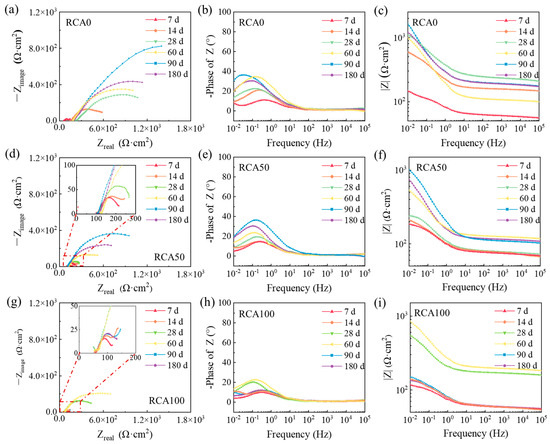
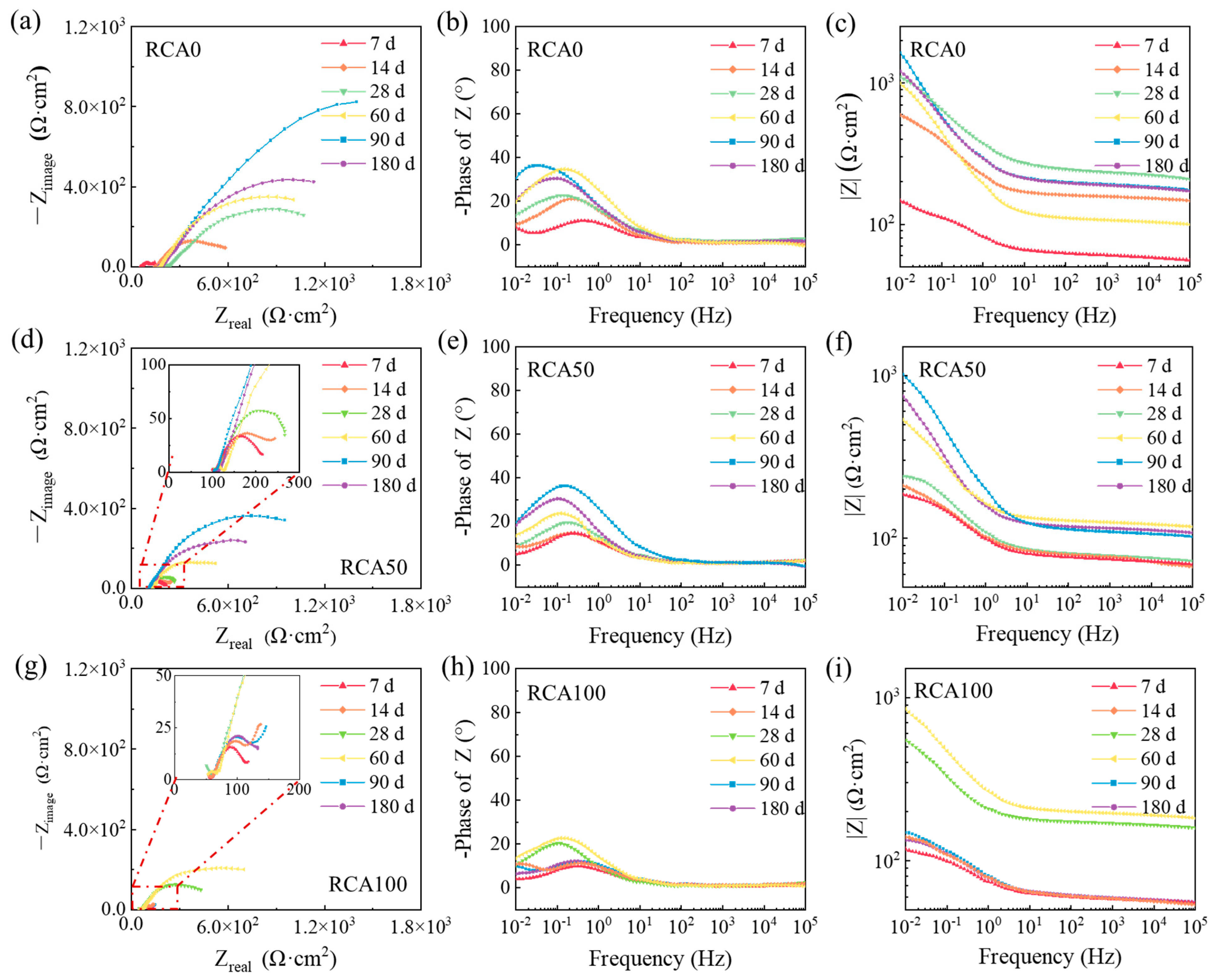
EIS is a frequency-domain technique that indirectly reflects the electrochemical interactions at the concrete–steel interface, serving as a vital tool for investigating electrode reaction kinetics and material corrosion mechanisms. EIS consists of Nyquist plots and Bode plots [31]. The EIS spectra of all groups at different immersion times are presented in Figure 4, and the corresponding fitting results are listed in Table 4.
Figure 4.
EIS curves of (a–c) RCA0, (d–f) RCA50, and (g–i) RCA100: (a,d,g) Nyquist plots; (b,c,e,f,h,i) Bode plots.
Table 4.
Fitting results of EIS for steel bars in RCA0, RCA50, and RCA100 service environments.
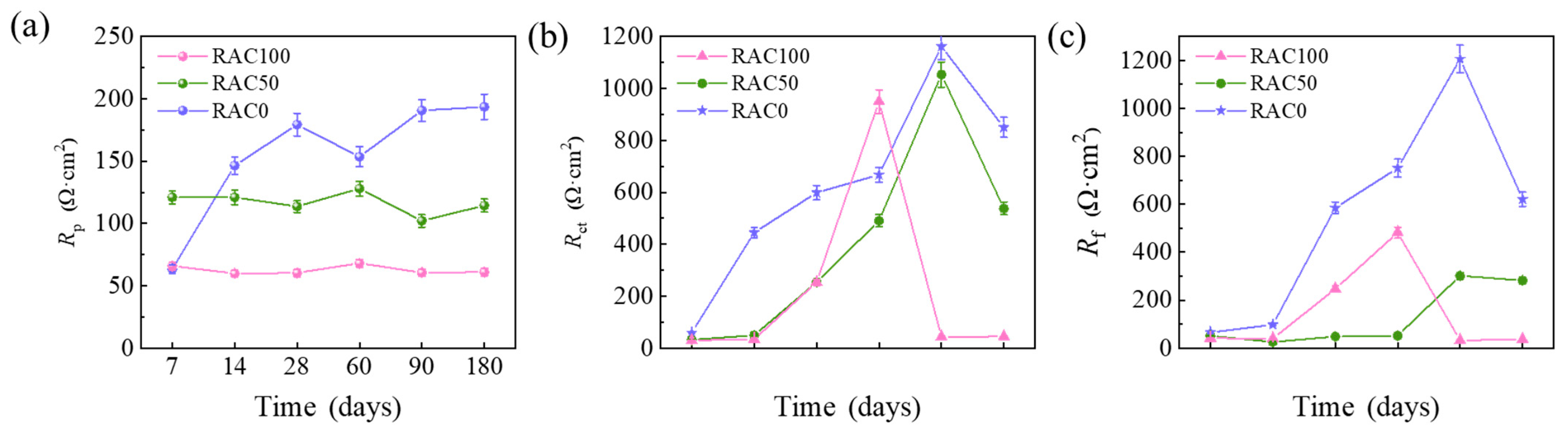
For the RCA0 (natural aggregate) and RCA50 (50% recycled coarse aggregate) concrete groups, their Nyquist plots (Figure 4a,d) show that the capacitive arc radius increased continuously from 0 to 90 d and reached a maximum at 90 d, indicating enhanced passivation at the steel–concrete interface with age. After 90 d, the arc radius began to shrink. Combined with the decreased phase peak height and high-frequency shift in the peak position in the Bode phase plots (Figure 4b,e), as well as the declining trend of the impedance modulus in the Bode modulus plots (Figure 4c,f), these results demonstrate that steel bars in both groups entered the corrosion development stage after 90 d. For the RCA0 group, the EIS equivalent circuit fitting results (Figure 5a) show that the solution resistance Rs exhibited an overall upward trend from 63.4 Ω·cm2 to 193.5 Ω·cm2 over 7–180 d. Both the charge transfer resistance Rct and the film resistance Rf increased continuously from 0 to 90 d, reaching 1161.0 Ω·cm2 and 1206.0 Ω·cm2 at 90 d, respectively, and then decreased significantly to 849.6 Ω·cm2 and 621.2 Ω·cm2 at 180 d. The Y0 values of the double-layer constant phase element CPEdl and the film constant phase element CPEf fluctuated slightly after 90 d, with n-values ranging from 0.44 to 0.91, reflecting changes in the interfacial capacitance characteristics and further confirming 90 d as the corrosion initiation time (Table 4).
Figure 5.
Evolution of EIS-fitted resistances of steel bars in concrete with different RCA replacement ratios over age: (a) Rs; (b) Rct; (c) Rf.
For the RCA50 group, the EIS fitting results indicate that Rs fluctuated slightly within 102.0–127.9 Ω·cm2 over 7–180 d (Figure 5). Rct and Rf increased continuously up to 90 d, reaching 1053.0 Ω·cm2 and 301.6 Ω·cm2 at 90 d, respectively, and then decreased to 537.6 Ω·cm2 and 282.1 Ω·cm2 at 180 d. The Y0 value of CPEdl rebounded after 90 d, while that of CPEf decreased continuously, with n-values between 0.48 and 0.91 (Table 4). This suggests that after 90 d, the interfacial charge transfer resistance decreased, the passive film stability deteriorated, and the corrosion process initiated.
For the RCA100 group, the Nyquist plot (Figure 4g) shows that the capacitive arc radius increased slowly before 60 d and contracted markedly after 60 d. In the Bode phase plot (Figure 4h), the phase peak height increased gradually and the peak position shifted to lower frequencies from 0 to 60 d, whereas after 60 d, the peak height decreased and the peak position shifted back to higher frequencies. The Bode modulus plot (Figure 4i) also shows a decline in the impedance modulus after 60 d. These observations indicate that steel bars in the RCA100 group started to corrode after 60 d, with a faster corrosion development rate, and exhibited the poorest interfacial corrosion resistance among the three groups. According to ASTM C876, OCP values between −110 and −120 mV (vs. Ag/AgCl) are categorized as an “uncertain corrosion probability”. However, when integrated with other electrochemical indicators—specifically icorr > 0.1 μA·cm−2 and the observed drastic drop in EIS resistance—these synergistic data provide strong evidence for the onset of significant corrosion activity.
To investigate the evolution of the solution resistance (Rs), charge transfer resistance (Rct), and film resistance (Rf) of steel in concrete with different recycled coarse aggregate replacement rates (RCA0, RCA50, RCA100) in a seawater and sea-sand environment over the ages of 7 to 180 days, the results are presented in Figure 5a–c.
Regarding the solution resistance Rs (Figure 5a), the RCA0 group exhibited a continuously increasing trend with age, increasing from 63.4 Ω·cm2 at 7 d to 193.5 Ω·cm2 at 180 d, indicating that the pore structure of natural aggregate concrete was progressively refined with hydration, leading to an increase in ionic migration resistance. In contrast, the Rs of the RCA50 group remained relatively stable within the range of 100–130 Ω·cm2, with minor fluctuations. Meanwhile, the Rs of the RCA100 group was consistently the lowest (50–70 Ω·cm2). This suggests that recycled aggregate concrete with a high replacement ratio possesses greater pore connectivity and higher pore fluid conductivity, providing convenient pathways for ionic migration.
Charge transfer resistance Rct serves as a key indicator characterizing the kinetic resistance of the corrosion reaction; a higher Rct corresponds to a lower corrosion rate [32]. As depicted in Figure 5b, Rct of the RCA0 group rose continuously in the early stage and reached a peak of 1161.0 Ω·cm2 at 90 d, reflecting enhanced interfacial passivation. Subsequently, Rct began to decline, falling to 849.6 Ω·cm2 at 180 d, indicating that the steel in this group entered the corrosion development stage after 90 d. The RCA50 group exhibited a similar trend to RCA0 but with a lower peak value (1053.0 Ω·cm2) and a further drop to approximately 537.6 Ω·cm2 at 180 d, demonstrating that the incorporation of recycled aggregate weakened the interfacial corrosion resistance. For the RCA100 group, Rct peaked at about 949.2 Ω·cm2 at 60 d and then plummeted to 43.4 Ω·cm2 by 90 d, revealing that significant corrosion occurred in the steel of this group after 60 d, accompanied by a sharp reduction in charge transfer resistance. The Rct of the RCA100 group exhibited the sharpest decline, reaching its lowest value at 180 days, which indicates the most severe corrosion activity among all groups.
The film resistance Rf reflects the integrity and stability of the passive film on the steel surface [33]. As shown in Figure 5c, Rf of the RCA0 group increased continuously to 1206.0 Ω·cm2 within 0–90 d and then decreased to 621.2 Ω·cm2 at 180 d, confirming the process of passive film densification followed by breakdown. The Rf of the RCA50 group remained at a relatively low level (200–300 Ω·cm2) overall, indicating weaker passive film stability compared with the RCA0 group. The Rf of the RCA100 group was the lowest throughout the test and dropped rapidly after 60 d, with a peak value of only 481.6 Ω·cm2, further verifying the poorest passive film stability and premature corrosion initiation of steel in this group. The evolution of the three resistances demonstrates that the incorporation of recycled coarse aggregate not only reduces the solution resistance of concrete but also weakens the charge transfer resistance and film resistance at the steel/concrete interface, with the deterioration becoming more pronounced at higher replacement rates. A significant resistance drop occurred in the RCA100 group after 60 d, whereas the resistance drop started at 90 d for both the RCA0 and RCA50 groups. These results are consistent with those from EIS spectra, Tafel polarization curves, and open-circuit potential measurements, revealing that an increase in recycled coarse aggregate replacement rate significantly accelerates the corrosion process of steel and reduces the long-term durability.
3.2. Mechanism Investigation
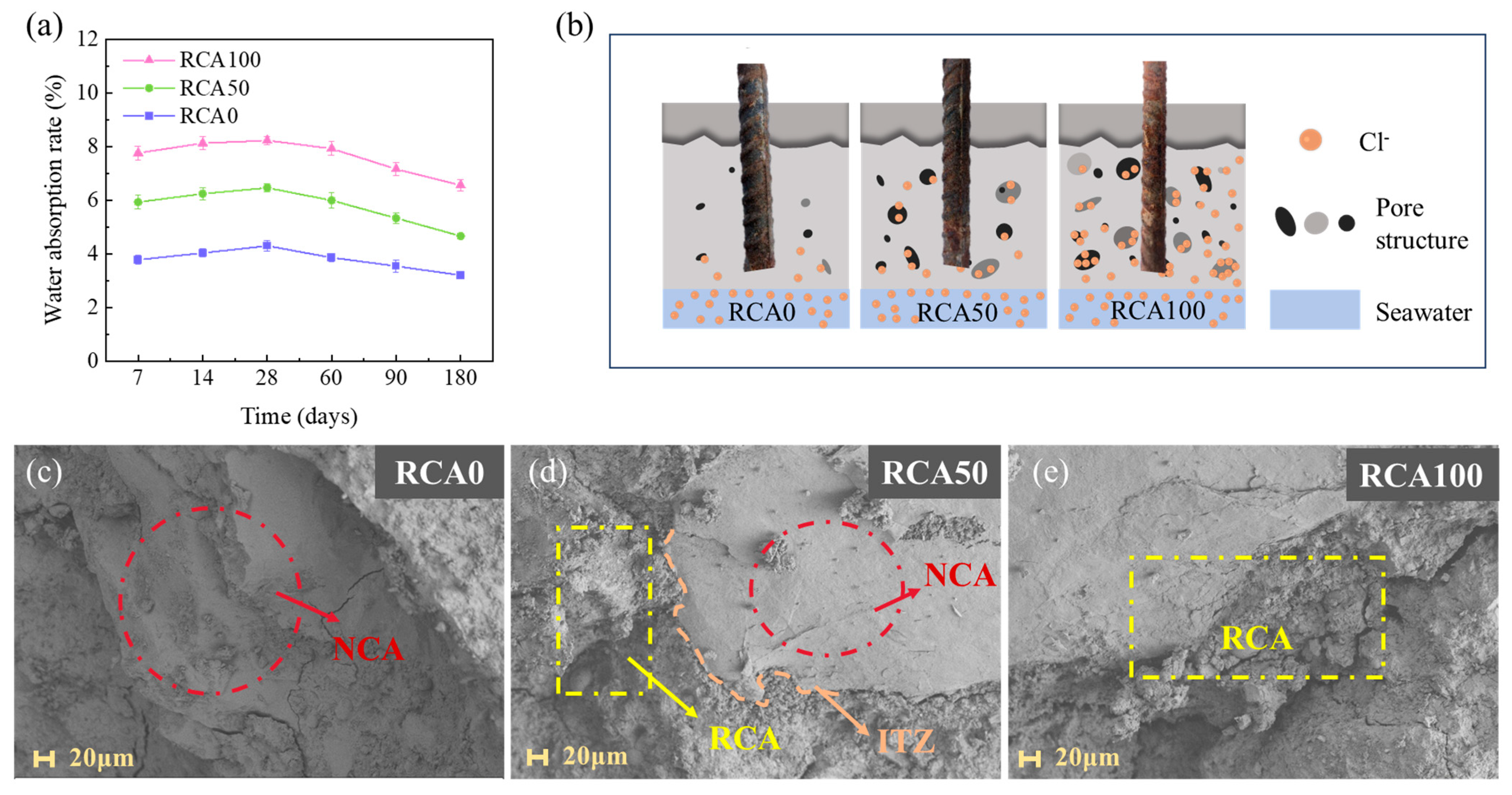
Figure 6a illustrates the variation in water absorption of concrete with different RCA replacement ratios over an age range of 7–180 d. The water absorption of all specimens shows a trend of a slight initial increase followed by a gradual decrease. Among them, the RCA100 group maintains the highest water absorption throughout the test period, reaching approximately 7.8% at 7 d, peaking at 8.2% between 14 and 28 d, and decreasing to 6.6% at 180 d. The water absorption of the RCA50 group falls between that of RCA0 and RCA100, with a value of 5.9% at 7 d, a peak of 6.5% at 28 d, and a reduction to about 4.6% at 180 d. The RCA0 group exhibits the lowest water absorption consistently, registering 3.8% at 7 d, peaking at 4.3% at 28 d, and declining to 3.2% at 180 d. The gradual decrease in water absorption after 28 days is likely due to the continuous hydration of cementitious materials, which refines the capillary pore network.
Figure 6.
Water absorption, steel corrosion characteristics, and micro-morphology of SSC with different RCA replacement ratios: (a) evolution of concrete water absorption with age; (b) schematic diagram of the corrosion of steel bars at 180 d. Internal SEM micro-morphology of concrete: (c) RCA0 group; (d) RCA50 group; (e) RCA100 group.
These results indicate that the incorporation of recycled coarse aggregate significantly increases the water absorption of concrete, with a greater enhancement at higher replacement ratios. This reflects a more porous pore structure and weaker impermeability in concrete with a high RCA replacement ratio [34]. These findings are consistent with the earlier onset of corrosion observed in high-replacement specimens in the aforementioned electrochemical tests, revealing that increased water absorption accelerates the transport of corrosive ions, thereby elevating the long-term corrosion risk of steel bars.
Figure 6b presents a schematic diagram illustrating the interrelationship between internal microstructures, chloride ion (Cl−) transport, and steel corrosion morphologies of concrete specimens with varying recycled coarse aggregate (RCA) replacement ratios after 180 days of exposure to seawater. In the RCA0 group, the internal pore structure was sparse and discrete, with chloride ions only present in small amounts near the bottom interface with seawater. The steel surface exhibited only scattered, isolated rust spots without a continuous rust layer, indicating excellent physical barrier protection provided by the concrete to the steel reinforcement. For the RCA50 group, the number of internal pores increased with enhanced connectivity, enabling chloride ions to penetrate into the upper-middle portion of the concrete. The rust spot area on the steel surface expanded significantly, with localized continuous corrosion observed, yet no distinct corrosion pits or cross-sectional damage was detected. In the RCA100 group, the internal pore structure was the most developed and highly interconnected, leading to massive chloride ion intrusion and extensive distribution throughout the concrete. The steel surface was entirely covered by a dense, continuous rust layer, accompanied by localized expansion cracks, representing the most severe corrosion state among the three groups. Overall, an increase in the RCA replacement ratio exacerbates concrete porosity and accelerates chloride ion transport, thereby progressively impairing the protective capacity of concrete on steel reinforcement, which is fully consistent with the observed evolution of macroscopic corrosion morphologies.
The internal SEM micrographs further elucidate the microstructural basis for the macroscopic performance differences in concrete with varying RCA replacement levels. As shown in Figure 6c, the RCA0 group exhibits a dense internal structure with uniformly distributed hydration products, a tightly bonded interfacial transition zone (ITZ) between natural coarse aggregate (NCA) and cement paste, and low porosity, which effectively impedes the ingress of external harmful substances. In the RCA50 group (Figure 6d), a small number of micropores and microcracks emerge in the ITZ, and weak bonding zones exist at the interface between residual old mortar on RCA surfaces and the new cement paste, creating preferential pathways for ion migration. In the RCA100 group (Figure 6e), the number of pores and cracks increases dramatically, and the ITZ becomes notably loose and discontinuous; the superposition of initial defects inherent in RCA and the weak bonding between old mortar and the new matrix lead to a substantial reduction in concrete compactness and impermeability [35], thereby accelerating the degradation of the concrete matrix and the corrosion of embedded steel.
The above macroscopic and microscopic test results mutually confirm that an increase in the recycled coarse aggregate replacement ratio significantly deteriorates the concrete microstructure, weakens its protective effect on steel bars, and thereby exacerbates the degree of steel corrosion.
4. Conclusions and Future Work
4.1. Conclusions
This study was conducted to address the shortage of natural aggregates and freshwater, promote the recycling of construction solid waste, and investigate the electrochemical corrosion characteristics and deterioration mechanism of steel bars in recycled RCA-SSC. Tests were performed with RCA replacement ratios of 0%, 50%, and 100% over a 180-day period, employing open-circuit potential (OCP) monitoring, Tafel polarization, electrochemical impedance spectroscopy (EIS), water absorption measurement, and scanning electron microscopy (SEM).
The results demonstrate that the incorporation of RCA accelerates the negative shift in steel OCP and impairs the stability of the passive film, with the deterioration effect becoming more pronounced at higher replacement ratios. The RCA100 group exhibited an earlier onset of corrosion, while the RCA50 group, despite initiating corrosion at the same time as the RCA0 (natural aggregate) group, displayed a faster corrosion development rate. EIS analysis reveals that RCA reduces the solution resistance, charge transfer resistance, and passive film resistance, with the RCA100 group showing the most significant reductions.
Mechanistically, the old mortar layer and inherent microcracks in RCA increase the water absorption and permeability of concrete. Combined with chloride ions from seawater and sea sand, these defects generate a synergistic effect that accelerates steel corrosion. SEM observations confirm that a higher RCA replacement ratio leads to a more porous microstructure and weaker interfacial transition zones, thereby diminishing the protective performance of concrete. These findings clarify the relationship between the RCA replacement ratio and steel corrosion behavior, providing essential data support for the optimization of RCA-SSC mix proportions and the development of corrosion inhibition strategies in marine engineering applications.
The present study primarily characterizes the comparative severity of corrosion in RCA-SSC with varying RCA replacement ratios. The absolute extent of performance degradation requires further validation through subsequent experiments using conventional concrete as a control group.
4.2. Research Limitations and Future Work
This study adopted a single SSC matrix, which failed to completely separate the independent effects of RCA and chloride ions; future studies are recommended to conduct 2 × 2 full-factor experiments (RCA vs. non-RCA; SSC vs. normal concrete) to further quantify the coupling effect between RCA and chloride ions on steel corrosion.
Although the 180-day exposure period revealed significant accelerated corrosion trends in RCA-modified concrete, this duration primarily reflects the initiation phase. Further validation through long-term field exposure (1–3 years) or advanced accelerated aging tests is required to fully characterize the structural service life and long-term durability performance in harsh marine environments.
While continuous immersion was employed to isolate the impact of RCA content on corrosion dynamics, this method may underestimate the chloride concentration effects observed in field wet–dry cycles. Future studies should incorporate cyclic exposure to better simulate the complex ion transport mechanisms in site-specific marine environments.
While the synergistic changes in electrochemical parameters, namely the Rf drop and icorr surge, strongly indicate passive film deterioration, future studies utilizing XPS or Raman spectroscopy are warranted to further verify the specific chemical phase transitions within the corrosion layer.
Author Contributions
S.M., K.S. and X.C. (Xiang Chen) contributed to the design of the experimental scheme, specimen preparation, and electrochemical test data collection; J.X. participated in the analysis of concrete microstructure and corrosion mechanism discussion; X.C. (Xinxin Cao) (corresponding author) proposed the research topic, guided the overall research process, and revised the manuscript. All authors have read and agreed to the published version of the manuscript.
Funding
This research received no external funding.
Institutional Review Board Statement
Not applicable.
Informed Consent Statement
Not applicable.
Data Availability Statement
The data that support the findings of this study are available from the corresponding author, Xinxin Cao, upon reasonable request.
Acknowledgments
The authors would like to express their gratitude to Shanghai Communications Construction Contracting Co., Ltd. for providing experimental sites and partial raw materials (e.g., ordinary Portland cement and natural coarse aggregate); Chamtopper Carbon Minus Co., Ltd. for technical support in microstructure observation; and the Department of Road and Urban Railway Engineering, Beijing University of Technology, for providing the CHI660E electrochemical workstation and other testing equipment. Special thanks are also extended to the reviewers for their valuable comments and suggestions on the manuscript.
Conflicts of Interest
Author Shuyi Miao, Kehua Sun and Xiang Chen were employed by Shanghai Communications Construction Contracting Co., Ltd. Author Jiren Xu was employed by Chamtopper Carbon Minus Co., Ltd. The remaining authors declare that the research was conducted in the absence of any commercial or financial relationships that could be construed as a potential conflict of interest.
References
- Younis, A.; Ebead, U.; Suraneni, P.; Nanni, A. Fresh and hardened properties of seawater-mixed concrete. Constr. Build. Mater. 2018, 190, 276–286. [Google Scholar] [CrossRef] [Scilit]
- Omary, S.; Ghorbel, E.; Wardeh, G. Relationships between recycled concrete aggregates characteristics and recycled aggregates concretes properties. Constr. Build. Mater. 2016, 108, 163–174. [Google Scholar] [CrossRef] [Scilit]
- Zhang, Q.; Xiao, J.; Zhang, P.; Zhang, K. Mechanical behaviour of seawater sea-sand recycled coarse aggregate concrete columns under axial compressive loading. Constr. Build. Mater. 2019, 229, 117050. [Google Scholar] [CrossRef] [Scilit]
- Ramalingam, M.; Sivamani, J.; Narayanan, K. Performance studies on recycled aggregate concrete with treated recycled aggregates. Waste Dispos. Sustain. Energy 2023, 5, 451–459. [Google Scholar] [CrossRef] [Scilit]
- Zhang, Z.; Zhang, P.; Niu, G.; Ding, C.; Wu, H. Enhanced passivation of Cr-modified rebar in simulated seawater sea-sand concrete chloride environment. J. Mater. Res. Technol. 2025, 35, 7051–7064. [Google Scholar] [CrossRef] [Scilit]
- Dhondy, T.; Remennikov, A.; Sheikh, M.N. Properties and Application of Sea Sand in Sea Sand–Seawater Concrete. J. Mater. Civ. Eng. 2020, 32, 04020392. [Google Scholar] [CrossRef] [Scilit]
- Elsheikh, A.; Al-Zayadi, S.K.; Albo-Hassan, A.S. Experimental investigation of concrete incorporating recycled concrete aggregates. Innov. Infrastruct. Solut. 2024, 9, 194. [Google Scholar] [CrossRef] [Scilit]
- Nedeljković, M.; Visser, J.; Šavija, B.; Valcke, S.; Schlangen, E. Use of fine recycled concrete aggregates in concrete: A critical review. J. Build. Eng. 2021, 38, 102196. [Google Scholar] [CrossRef] [Scilit]
- Rodríguez, C.; Miñano, I.; Aguilar, M.Á.; Ortega, J.M.; Parra, C.; Sánchez, I. Properties of concrete paving blocks and hollow tiles with recycled aggregate from construction and demolition wastes. Materials 2017, 10, 1374. [Google Scholar] [CrossRef] [Scilit]
- McGinnis, M.J.; Davis, M.; de la Rosa, A.; Weldon, B.D.; Kurama, Y.C. Strength and stiffness of concrete with recycled concrete aggregates. Constr. Build. Mater. 2017, 154, 258–269. [Google Scholar] [CrossRef] [Scilit]
- Bai, G.; Zhu, C.; Liu, C.; Liu, B. An evaluation of the recycled aggregate characteristics and the recycled aggregate concrete mechanical properties. Constr. Build. Mater. 2020, 240, 117978. [Google Scholar] [CrossRef] [Scilit]
- Zaetang, Y.; Sata, V.; Wongsa, A.; Chindaprasirt, P. Properties of pervious concrete containing recycled concrete block aggregate and recycled concrete aggregate. Constr. Build. Mater. 2016, 111, 15–21. [Google Scholar] [CrossRef] [Scilit]
- Zhu, P.; Chen, X.; Liu, H.; Wang, Z.; Chen, C.; Li, H. Recycling of waste recycled aggregate concrete in freeze-thaw environment and emergy analysis of concrete recycling system. J. Build. Eng. 2024, 96, 110377. [Google Scholar] [CrossRef] [Scilit]
- Zhao, Y.; Li, H.; Hu, X.; Shi, C. Evaluation on steel corrosion risk of seawater sea sand concrete with low water-to-binder ratio by electrochemical measurement. Constr. Build. Mater. 2024, 417, 135326. [Google Scholar] [CrossRef] [Scilit]
- Ge, L.; Feng, Z.; Sayed, U.; Li, H. Research on the performance of seawater sea-sand concrete: A review. Constr. Build. Mater. 2023, 409, 133921. [Google Scholar] [CrossRef] [Scilit]
- Zhao, Y.; Hu, X.; Shi, C.; Zhang, Z.; Zhu, D. A review on seawater sea-sand concrete: Mixture proportion, hydration, microstructure and properties. Constr. Build. Mater. 2021, 295, 123602. [Google Scholar] [CrossRef] [Scilit]
- Głuchowski, A.; Sas, W.; Dzięcioł, J.; Soból, E.; Szymański, A. Permeability and Leaching Properties of Recycled Concrete Aggregate as an Emerging Material in Civil Engineering. Appl. Sci. 2019, 9, 81. [Google Scholar] [CrossRef] [Scilit]
- Guo, F.; Al-Saadi, S.; Singh Raman, R.K.; Zhao, X.L. Durability of fiber reinforced polymer (FRP) in simulated seawater sea sand concrete (SWSSC) environment. Corros. Sci. 2018, 141, 1–13. [Google Scholar] [CrossRef] [Scilit]
- Wang, D.; Gong, Q.; Luo, S.; Yang, Z. Effects of desalinated sea sand on the alkali–silica reaction of seawater and sea sand concrete. Mag. Concr. Res. 2024, 76, 366–374. [Google Scholar] [CrossRef] [Scilit]
- Pan, D.; Yaseen, S.A.; Chen, K.; Niu, D.; Ying Leung, C.K.; Li, Z. Study of the influence of seawater and sea sand on the mechanical and microstructural properties of concrete. J. Build. Eng. 2021, 42, 103006. [Google Scholar] [CrossRef] [Scilit]
- Yu, X.; Al-Saadi, S.; Zhao, X.-L.; Raman, R.K.S. Electrochemical Investigations of Steels in Seawater Sea Sand Concrete Environments. Materials 2021, 14, 5713. [Google Scholar] [CrossRef] [Scilit] [PubMed]
- Caracol, C.; Kravchanka, L.; Bravo, M.; de Brito, J.; Agrela, F.; Rosales, J. Recycled aggregate concrete using seawater: Optimizing concrete’s sustainability. J. Build. Eng. 2024, 97, 110841. [Google Scholar] [CrossRef] [Scilit]
- Xiao, J.; Zhang, Q.; Zhang, P.; Shen, L.; Qiang, C. Mechanical behavior of concrete using seawater and sea-sand with recycled coarse aggregates. Struct. Concr. 2019, 20, 1631–1643. [Google Scholar] [CrossRef] [Scilit]
- Zhang, H.; Tang, H.; Yang, Z.; Gong, F. Chloride-induced reinforcement corrosion and rust filling in recycled aggregate concrete. Constr. Build. Mater. 2025, 486, 141997. [Google Scholar] [CrossRef] [Scilit]
- Da, B.; Yu, H.; Ma, H.; Wu, Z. Reinforcement Corrosion Research Based on Electrochemical Impedance Spectroscopy for Coral Aggregate Seawater Concrete in a Seawater Immersion Environment. J. Test. Eval. 2019, 48, 1537–1553. [Google Scholar] [CrossRef] [Scilit]
- Andrade, C.; Alonso, C. Corrosion rate monitoring in the laboratory and on-site. Constr. Build. Mater. 1996, 10, 315–328. [Google Scholar] [CrossRef] [Scilit]
- Tsau, C.-H.; Chen, Y.-H.; Tsai, M.-C. The effects of niobium and molybdenum on the microstructures and corrosion properties of CrFeCoNiNbxMoy alloys. Materials 2022, 15, 2262. [Google Scholar] [CrossRef] [Scilit]
- Francois, R. A discussion on the order of magnitude of corrosion current density in reinforcements of concrete structures and its link with cross-section loss of reinforcement. RILEM Tech. Lett. 2022, 6, 158–168. [Google Scholar] [CrossRef] [Scilit]
- Loukil, O.; Adelaide, L.; Bouteiller, V.; Quiertant, M.; Ragueneau, F.; Chaussadent, T. Investigation of Corrosion Product Distribution and Induced Cracking Patterns in Reinforced Concrete Using Accelerated Corrosion Testing. Appl. Sci. 2024, 14, 11453. [Google Scholar] [CrossRef] [Scilit]
- Korec, E.; Jirásek, M.; Wong, H.S.; Martínez-Pañeda, E. A phase-field chemo-mechanical model for corrosion-induced cracking in reinforced concrete. Constr. Build. Mater. 2023, 393, 131964. [Google Scholar] [CrossRef] [Scilit]
- Ma, H.; Li, Z.; Chen, E.; Yu, H.; Tan, Y.; Wu, C.; Han, X. Research on the corrosion behavior of rebar in basic magnesium sulfate cement concrete based on the electrochemical impedance spectroscopy method. Constr. Build. Mater. 2025, 466, 140326. [Google Scholar] [CrossRef] [Scilit]
- Alexander, C.L. Electrochemical impedance spectroscopy for corrosion diagnosis of reinforced concrete. Curr. Opin. Electrochem. 2026, 55, 101790. [Google Scholar] [CrossRef] [Scilit]
- Yu, Z.; Chen, Z.; Qu, D.; Qu, S.; Wang, H.; Zhao, F.; Zhang, C.; Feng, A.; Chen, D. Microstructure and Electrochemical Behavior of a 3D-Printed Ti-6Al-4V Alloy. Materials 2022, 15, 4473. [Google Scholar] [CrossRef] [Scilit]
- Singh, R.; Nayak, D.; Pandey, A.; Kumar, R.; Kumar, V. Effects of recycled fine aggregates on properties of concrete containing natural or recycled coarse aggregates: A comparative study. J. Build. Eng. 2022, 45, 103442. [Google Scholar] [CrossRef] [Scilit]
- Wang, P.; Chen, B.; Hashmi, A.; Yao, X.; Dong, J. Two-Stage Deterioration Mechanisms in Recycled Aggregate Concrete: From Pore Interface Degradation to Aggregate Interface Defect Control. Buildings 2025, 15, 4480. [Google Scholar] [CrossRef] [Scilit]

Disclaimer/Publisher’s Note: The statements, opinions and data contained in all publications are solely those of the individual author(s) and contributor(s) and not of MDPI and/or the editor(s). MDPI and/or the editor(s) disclaim responsibility for any injury to people or property resulting from any ideas, methods, instructions or products referred to in the content. |
© 2026 by the authors. Licensee MDPI, Basel, Switzerland. This article is an open access article distributed under the terms and conditions of the Creative Commons Attribution (CC BY) license.