


Abstract
This study investigates the causes and mechanisms of a corrosion-induced perforation failure in P110 tubing from a nitrogen injection well in the Tahe Oilfield. A comprehensive analysis was performed using macroscopic examination, mechanical and chemical property testing, characterization of corrosion product morphology and composition, and electrochemical measurements. The results show that the tubing material met all relevant standard requirements, ruling out intrinsic material defects as a contributing factor. The primary cause of failure was the breakdown of the internal coating. Poor coating adhesion in the older tubing from the shallow section, combined with the tensile stress from the tubing’s suspended weight and the acidic service environment, led to coating blistering and disbondment, thereby exposing the underlying steel. In the presence of H2S, CO2, and O2, severe electrochemical corrosion developed on the exposed metal surface. The process was further accelerated by a high concentration of Cl−, which promoted rapid localized corrosion and ultimately resulted in perforation. Based on these findings, several targeted mitigation strategies are proposed. These include optimizing the coating process to improve adhesion and modifying the corrosive environment. The recommendations provide practical guidance for corrosion control in similar oil and gas well applications.
1. Introduction
The Ordovician fracture-cavity reservoir in the Tahe Oilfield is a typical high-temperature, high-pressure, high-salinity, and sour (H2S/CO2) reservoir [1,2]. This extremely harsh downhole environment imposes stringent requirements for corrosion resistance and reliability on the critical tubular materials used in hydrocarbon extraction [3,4,5]. As the primary conduit for transporting hydrocarbons from the formation to the surface, tubing strings are continuously subjected to a complex combination of corrosive media, mechanical loads, and fluctuating temperatures and pressures [6,7,8,9,10]. This makes them highly susceptible to corrosion-related failures. Such degradation can lead to wall thinning and reduced strength, potentially causing leaks and decreased production. In severe cases, it may result in tubing string parting or sticking, significantly increasing workover costs and operational risks, thereby hindering efficient reservoir development [11,12,13,14,15].
A nitrogen injection well in the Tahe Oilfield serves as a key producer in this block. It was drilled to a total depth of 5702 m and primarily targets the Ordovician fracture-cavity reservoir. The injected nitrogen is industrial grade, containing 0.1% to 1.5% oxygen, which introduces a significant oxygen content into the wellbore. Formation fluids are characterized by high salinity. Historical production data indicate that the water phase is of the calcium chloride type, with a total salinity ranging from 216,804.56 to 230,484.76 mg/L, and a chloride ion (Cl−) concentration as high as 132,850.65 to 140,803.15 mg/L. The pH is approximately 6.0. The wellhead temperature is around 60 °C, with a pressure of approximately 17 MPa. The produced gas contains 6.32% CO2 and 3.86% H2S. The combined presence of introduced oxygen, acidic media, and a high concentration of Cl− significantly increases the corrosion risk for the tubing string [16,17].
The tubing string in this well consisted of a combination of 3 1/2-inch and 2 7/8-inch tubing. Specifically, 3 1/2-inch P110 tubing was run from the surface to a depth of 3003.93 m. At that depth, a 3 1/2-inch to 2 7/8-inch crossover was installed, with the remaining section of the string comprising 2 7/8-inch P110 tubing. To mitigate internal corrosion, extend service life, and reduce operational costs, the well was treated in 2021 with a nano-composite internal coating. The intent was to leverage the coating’s physical barrier properties to isolate the metal substrate from corrosive agents [18,19]. The tubing used in the section above 2000 m had been in service for more than three years in this well (old tubing), whereas the lower section consisted of new tubing. Both the old and new tubing had been internally coated. According to the coating application report, an internal nano-graphene coating was applied in accordance with the standard SY/T 6717 [20] (Technical Specifications for Internal Coating of Tubing and Casing). The application process consisted of the following steps: oil removal from the tube surface, abrasive blasting for rust removal, compressed air blowing, individual tube internal coating application, secondary heating and curing, finished tube inspection, application of thread protector oil and installation of thread protectors, and final acceptance and release from the facility. In practice, the process began with the removal of oil residues from the inner wall using medium-frequency induction heating, which fully carbonized any remaining contaminants. This was followed by surface preparation of the inner wall using pressure-based dry abrasive blasting. The blasting media consisted of GP50 bearing steel grit combined with clean, dry sand. After blasting, the inner wall achieved a Sa2.5 grade surface finish, characterized by a gray-white, uniformly roughened metal surface. Following rust removal, the inner wall was blown clean with dry, oil-free compressed air to remove any residual dust and abrasive particles. Coating application was completed within 24 h of this cleaning step. The coating was applied using an internal pipe spraying machine. During application, the inner wall temperature was maintained at 150–160 °C via medium-frequency induction heating. The spray head traversed from one end of the tube to the other, applying a single layer of coating with a target dry film thickness of 150–250 μm. Immediately after spraying, each tube was transferred to a holding room and subjected to a secondary heating and curing cycle at approximately 150 °C for 30 min. Finished product inspection indicated that acceptable coatings exhibited a uniform, smooth surface with consistent color, free from visible defects such as porosity, wrinkling, sagging, incomplete coverage, or peeling. Examination with a 5× magnifying lens revealed no pinholes or bubbles. Coating thickness was measured using a magnetic thickness gauge, confirming that the dry film thickness was no less than 150 μm. However, during subsequent service, corrosion anomalies were observed in the shallow section of the tubing. Field inspection revealed a distinct corrosion perforation at a depth of 10 m, originating from the inner wall and propagating outward. Numerous corrosion pits were also present on the internal surface, significantly disrupting normal well production.
Internal coating is a widely used method for corrosion protection in oil and gas tubulars. Its effectiveness is critically dependent on the coating’s integrity, density, and adhesion strength to the substrate [21,22]. Ideally, a coating forms a continuous, impermeable barrier that prevents corrosive media from reaching the steel. However, if the coating has inherent defects, exhibits poor adhesion, or experiences blistering and disbondment due to mechanical stress or temperature fluctuations during service, its protective function is compromised. Furthermore, the gaps created between the coating and the substrate can trap corrosive agents, leading to aggressive under-film corrosion [11,23]. The blistering and disbondment observed in this well provided pathways for corrosive media to reach the steel surface [24].
While previous studies have advanced the understanding of coated tubing failures in sour (H2S/CO2), high-salinity environments, systematic investigations into coating-deterioration-induced perforation under the specific conditions of this well remain limited. Key aspects, such as the detailed sequence of coating failure and its contributing factors, the synergistic mechanisms of the various corrosive agents, and the specific accelerating effect of chloride ions, have not yet been fully elucidated. Therefore, a comprehensive failure analysis of the corroded and perforated P110 tubing from this well is essential. This study aims to determine the root causes and mechanisms of failure, thereby informing targeted mitigation strategies for this specific well. More broadly, the findings will provide a theoretical basis and technical guidance for the application, and maintenance of internally coated tubing in analogous complex environments, offering significant practical and academic value. This paper presents a detailed investigation of the failed P110 tubing using macroscopic examination, mechanical and chemical property testing, corrosion product analysis, and electrochemical measurements. Based on the identified failure mechanisms, specific protective measures are proposed to enhance the operational safety and integrity of similar wells.
2. Experimental Methods
2.1. Visual Examination
A comprehensive visual inspection was first conducted on tubing sections retrieved from various depths in the well. The examination focused on the condition of the internal coating, noting any blistering, disbondment, or loss of integrity. The location, morphology, and characteristics of corrosion perforations were documented to establish correlations among corrosion damage, well depth, and coating condition. To prevent oxidation after removal, the retrieved tubing was immediately cleaned of any residual fluids and wrapped in industrial plastic film. Test specimens were then cut from the failed tubing string at locations corresponding to the specific requirements of each subsequent analysis. All specimens were kept wrapped in plastic film from the time of preparation until the start of testing to prevent surface oxidation. Nevertheless, the oil pipe will inevitably come into contact with oxygen in the atmosphere after it is removed.
2.2. Physical and Chemical Properties Test
Samples were collected from areas of the tubing exhibiting no significant corrosion for chemical composition analysis. The concentrations of key elements, including C, P, S, Cr, and Ni, were determined using a SPECTRO MAXx07-F spark optical emission spectrometer (SPECTRO Analytical Instruments GmbH, Kleve, Germany) to verify compliance with relevant material standards. A metallographic specimen, measuring 10 mm × 15 mm × wall thickness, was sectioned from the failed tubing. The sample was sequentially ground using 360, 600, 800, 1000, and 1200 grit silicon carbide papers (KOVAX Co., Ltd., Seoul, Republic of Korea), then polished with a diamond polishing compound. Etching was performed with a 4% nital solution. After etching, the specimen was rinsed with tap water, dehydrated with alcohol, and dried with compressed air. The microstructure of the metal was examined using an SDPTOP RX50M optical microscope (Ningbo Sunny Instruments Co., Ltd., Yuyao, China) at five different locations on each of the two samples. The tubing’s cross-sectional microstructure, non-metallic inclusion content, and average grain size were evaluated according to the relevant standards: GB/T 13298-2015, GB/T 10561-2005, and GB/T 6394-2017, respectively [25,26,27]. An annular specimen was cut from the failed tubing section for hardness testing in accordance with ISO 11960-2020 [28]. The end faces of the ring were ground and polished. Hardness measurements were taken circumferentially on the cross-section using an HRS-150 Rockwell hardness tester (Laizhou Huayin Testing Instruments Co., Ltd., Laizhou, China). Measurements were performed at positions representing the inner, middle, and outer wall across four quadrants. Standard flat tensile specimens were machined from the tubing material following ASTM A370 [29]. Three replicate specimens were tested at room temperature using an MTS materials testing machine at a constant crosshead speed of 3 mm/min to determine the tensile properties. Charpy V-notch impact specimens, with dimensions of 55 mm × 10 mm × 10 mm, were machined from the tubing in accordance with ASTM A370. Three longitudinal specimens were tested at −20 °C using a Zwick pendulum impact tester (ZwickRoell GmbH & Co. KG, Ulm, Germany) to evaluate the impact toughness. Coating adhesion tests were performed in accordance with the GB/T 5210-2006 standard [30] using the pull-off method. Tests were conducted on tubing that had been in service for three years (old tubing) and on new, unused tubing. Each test condition was repeated three times. The coatings tested were prepared using the same method described in the introduction, with a thickness of 200 ± 10 μm, and all coated samples passed the final product inspection.
2.3. Corrosion Morphology and Composition Test
Based on the corrosion characteristics of the tubing, samples were collected from corrosion pits located adjacent to the perforation for further analysis. The surface morphology and elemental composition of the corrosion products from the perforated tubing were examined using a JSM-7500F field-emission scanning electron microscope (SEM) (JEOL Ltd., Tokyo, Japan) equipped with an Oxford X-Max energy-dispersive X-ray spectroscopy (EDS) detector (Oxford Instruments plc, Abingdon, Oxfordshire, UK). Cross-sectional specimens of the corroded tubing were also prepared and mounted in epoxy resin. These were examined using SEM to observe the corrosion morphology beneath the surface, and EDS was used for elemental analysis of the corrosion products in this region. Further compositional analysis of the corrosion products was conducted using a Thermo Scientific K-Alpha X-ray photoelectron spectrometer (XPS) (Thermo Fisher Scientific Inc., East Grinstead, West Sussex, UK). The phase composition of the corrosion products was characterized by X-ray diffraction (XRD) using an X’Pert PRO MPD diffractometer (Malvern Panalytical B.V., Almelo, The Netherlands).
2.4. Electrochemical Test
Electrochemical measurements were performed using a Corrtest CS350 electrochemical workstation with a conventional three-electrode cell (Wuhan Corrtest Instruments Corp., Ltd., Wuhan, China). The working electrode was fabricated from uncorroded P110 tubing, machined into a 10 mm × 10 mm × 3 mm coupon with an exposed area of 1 cm2. A silver/silver chloride (Ag/AgCl) electrode served as the reference, and a square platinum electrode was used as the counter electrode. The test solution consisted of a simulated produced water of the calcium chloride type, with ionic concentrations detailed in Table 1. All experiments were conducted at 60 °C, and the test was conducted under normal pressure. Specific experimental parameters are summarized in Table 2. Three test groups were established: Group 1 served as the blank control; Group 2 was designed to evaluate the effect of deaeration; and Group 3 was used to assess the performance of a corrosion inhibitor under the simulated service conditions. Each test was repeated three times to ensure result reliability. The solutions were first prepared according to the composition in Table 1. Nitrogen was bubbled through the solution for 2 h to remove residual dissolved oxygen, followed by CO2 sparging until saturation. The pH was then adjusted to 6.0 using NaOH and HCl. For Groups 1 and 3, oxygen was introduced to provide a trace amount of oxygen, and the dissolved oxygen content in the solution was measured to be 0.0008 wt.% using a dissolved oxygen meter. An imidazoline-based corrosion inhibitor was added to Group 3 at a concentration of 100 ppm. Finally, solid Na2S was added to all test solutions to simulate the presence of H2S in the service environment [31]. The pressure used in the electrochemical tests differed from the actual downhole pressure. Since pressure influences gas solubility, the corrosion rates obtained may differ slightly from field conditions and are not representative of actual in-service corrosion rates. Therefore, the electrochemical tests were used solely to assess the feasibility of deaeration and inhibitor addition as corrosion mitigation strategies for P110 tubing within this specific corrosion system. Prior to each test, the working electrode was immersed in the corrosive medium for 30 min to stabilize the open circuit potential (OCP). Following OCP measurement, potentiodynamic polarization curves were recorded by scanning the potential from −0.5 V to +1.5 V relative to the OCP at a scan rate of 0.2 mV/s. The electrochemical method evaluates the corrosion rate based on the corrosion current density (A/cm2) generated during the electrochemical corrosion process of the metal. Corrosion inhibition efficiency is defined as:
where η is the inhibition efficiency (%), icorr is the corrosion current density of P110 steel in the blank solution (A/cm2), and i’corr is the corrosion current density of P110 steel in the test solution (A/cm2).
Table 1.
Simulated produced water composition (mg/L).
Table 2.
Parameters of the electrochemical test.
3. Results and Discussion
3.1. Macroscopic Morphology Analysis
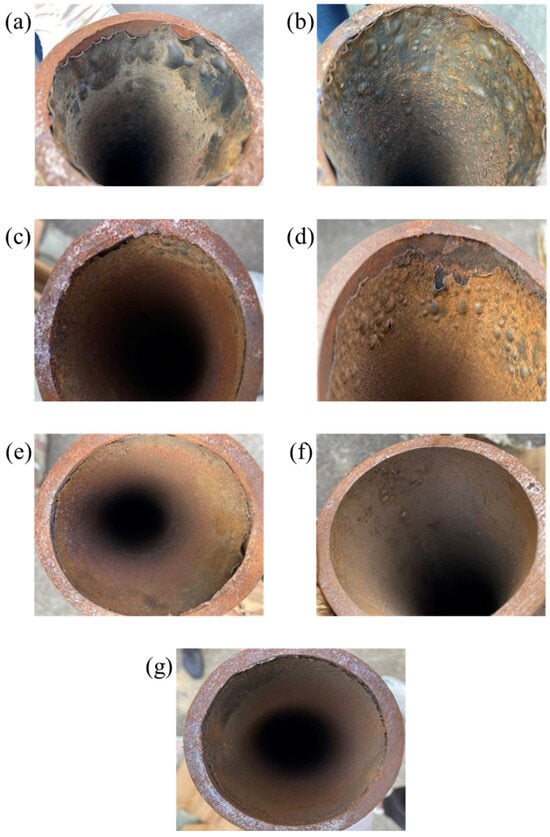
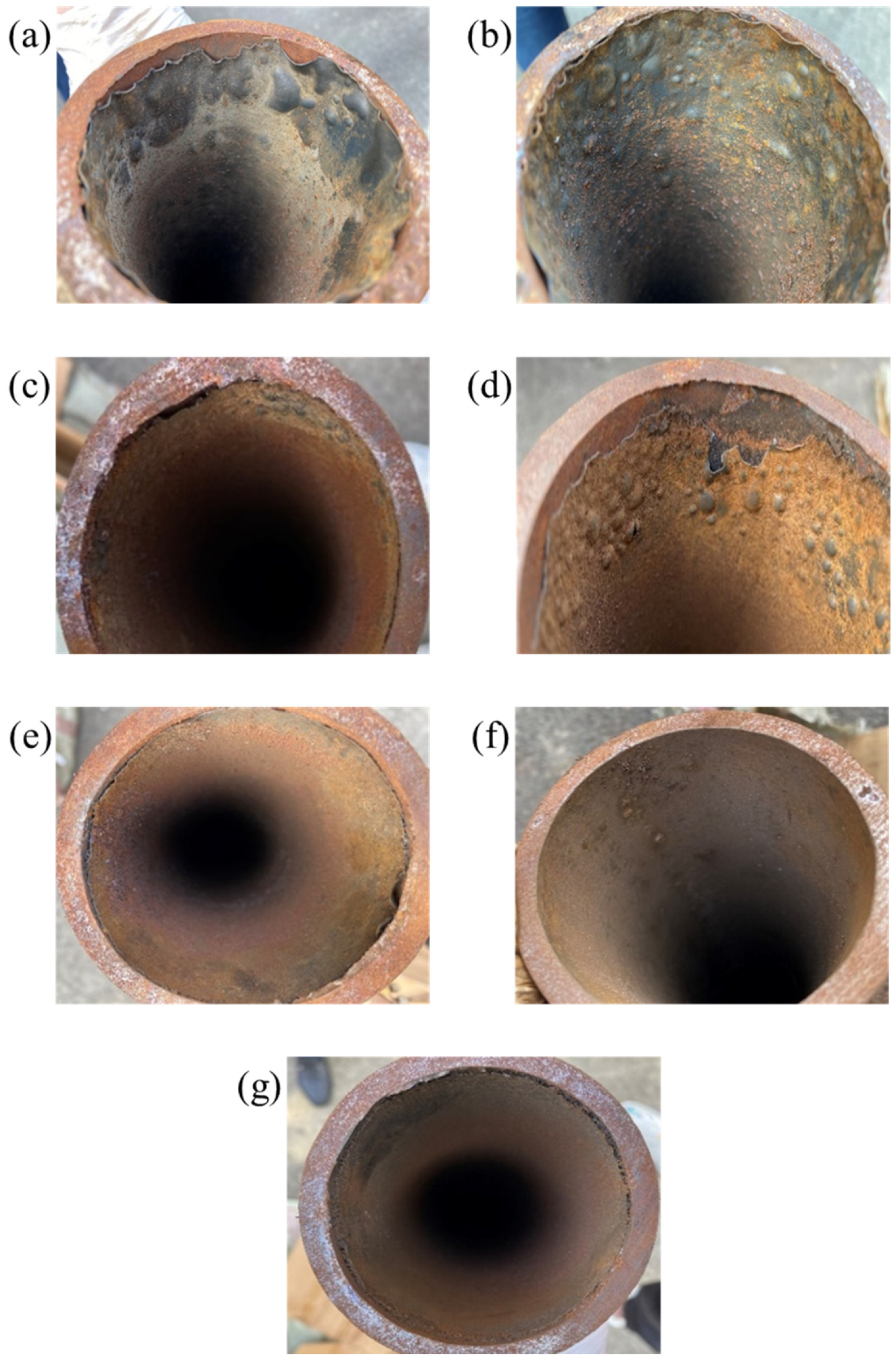
Field inspection revealed a strong correlation between the condition of the internal coating and the severity of corrosion at different well depths. Corrosion damage was predominantly concentrated in the shallow section of the well. Notably, a distinct perforation originating from the inner wall, surrounded by numerous corrosion pits, was observed at a depth of 10 m. While no other perforations were found at other depths, coating disbondment and associated corrosion were commonly observed at the threaded connections throughout the tubing string. The degradation of the internal coating was closely linked to well depth. Figure 1 illustrates the condition of the internal coating at various well depths. In the shallow section (at depths of 5 m and 10 m), the coating exhibited severe blistering. The largest blisters were found at 5 m, while the highest density of blisters occurred at 10 m. These blisters were prone to rupture and disbondment, with the exposed steel underneath showing significant corrosion. Coating disbondment was also noted at a depth of 2000 m. However, the extent of blistering diminished progressively with increasing depth. At depths exceeding 2000 m, the coating remained largely intact with no visible blistering, and the tubing surface was free from significant corrosion.
Figure 1.
P110 tubing inner coating failure: (a) 5 m; (b) 10 m; (c) 1000 m; (d) 2000 m; (e) 4000 m; (f) 5000 m; (g) 5400 m.
Based on the coating application information provided earlier, the tubing in the upper 2000 m section consisted of old tubing that had been in service for over three years prior to coating, while the lower section was coated using new tubing. The observed coating disbondment correlates with the prior service history of the tubing, as coatings applied to new tubing remained largely intact. This is likely attributable to surface imperfections on the old tubing, such as residual corrosion products, oil residues, or scratches that were not completely removed during surface preparation. Such defects compromise the adhesion strength between the coating and the steel substrate. Under the combined influence of the tubing string’s suspended weight and the corrosive downhole environment, the coating becomes susceptible to blistering and disbondment, thereby losing its ability to protect the underlying metal.
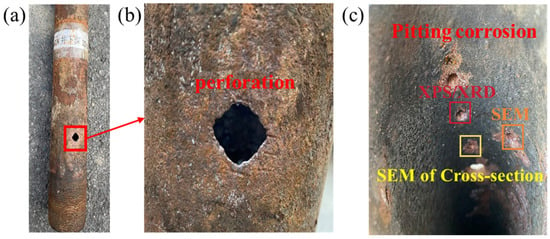
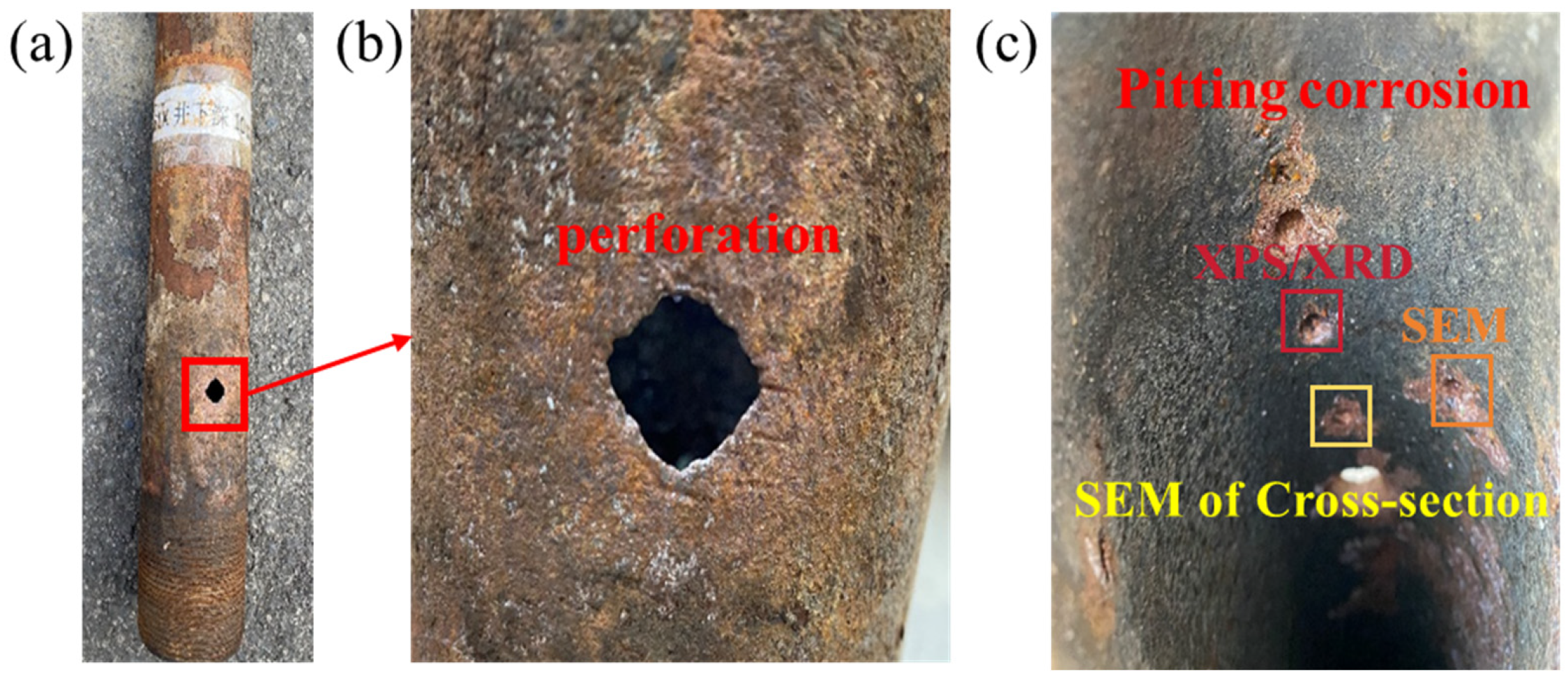
The macroscopic corrosion morphology of the failed tubing recovered from a depth of 10 m is presented in Figure 2. Figure 2a shows a distinct perforation in the tubing body, indicating severe localized corrosion damage. A magnified view (Figure 2b) reveals this perforation to be an irregular through-hole with rough, uneven edges. Further examination of the inner tubing wall (Figure 2c) revealed multiple corrosion pits containing reddish-brown corrosion products. The coexistence of perforation and pitting indicates that severe corrosion occurred due to the synergistic action of corrosive agents in the downhole environment. The specimens used for corrosion product analysis (SEM/XPS/XRD) in this study were all taken from representative pits adjacent to the perforation. These pits, characterized by coating disbondment and severe corrosion, best reflect the mechanism of corrosion-induced perforation failure during tubing service. Each test point is marked in the box shown in Figure 2c, and each test was performed once.
Figure 2.
Macroscopic corrosion morphology of the investigated P110 tubing: (a) the outer wall of the tubing; (b) local magnification; (c) the inner wall of the tubing.
3.2. Physical and Chemical Properties Analysis
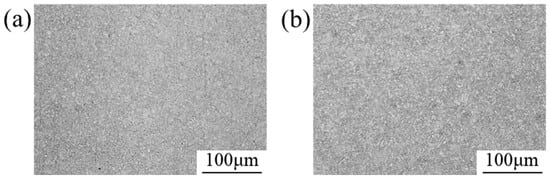
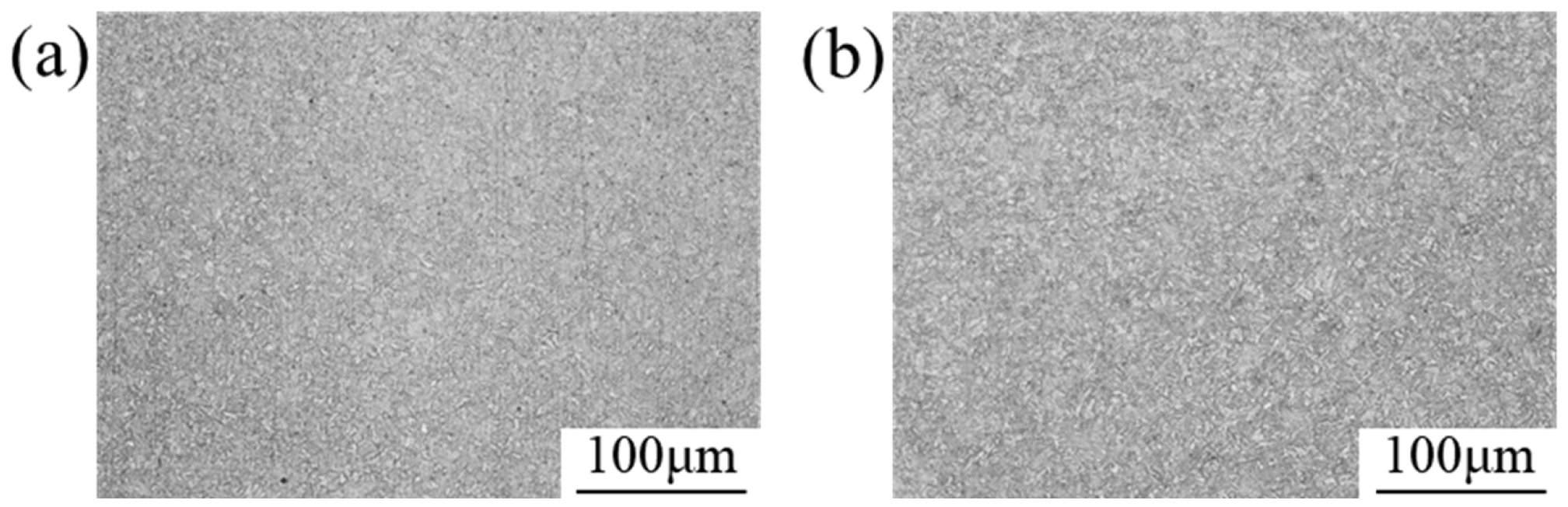
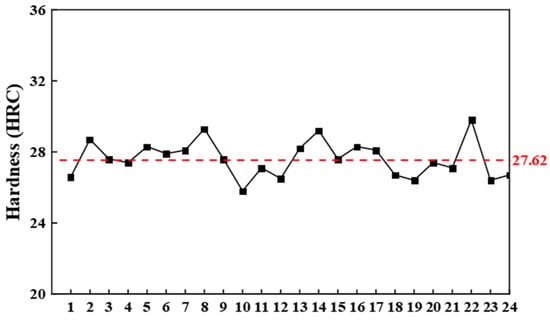
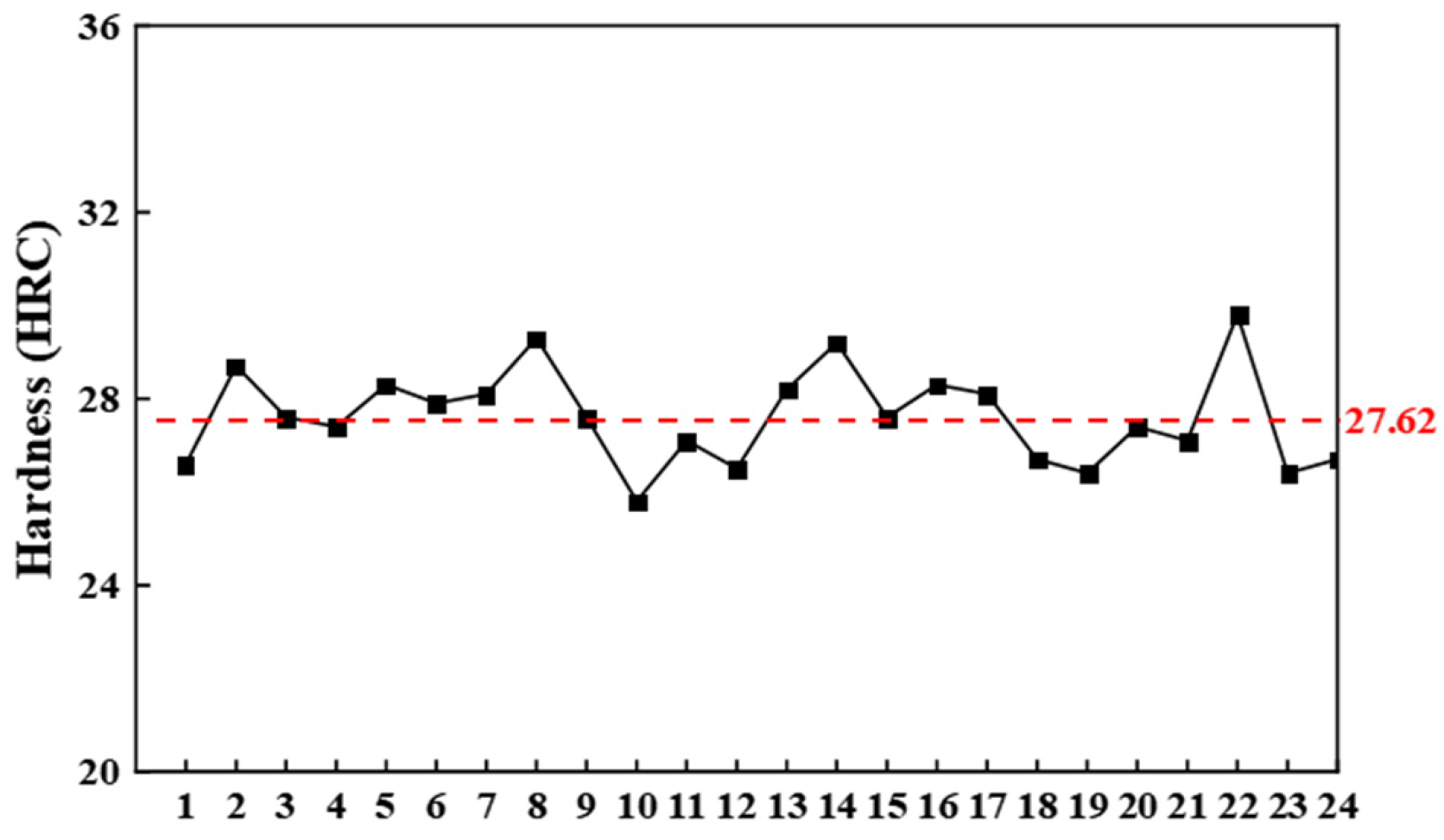
The physicochemical test results were compared against the requirements of ISO 11960-2020. The chemical composition of the P110 tubing is presented in Table 3, with particular attention given to the concentrations of the deleterious elements sulfur and phosphorus. The measured phosphorus and sulfur contents were 0.005% and 0.003%, respectively, both of which are below the maximum allowable limits of 0.030% specified by the standard. The metallographic microstructure of the failed P110 tubing is shown in Figure 3. Both longitudinal and transverse sections exhibit a fine and uniform tempered sorbitic structure with a grain size rating of 9.5. No abnormal microstructural constituents are observed. The non-metallic inclusions were rated as C1.0 and D1.0. The hardness test results for the tubing are presented in Figure 4. The hardness values ranged from 25.8 to 29.8 HRC, with an average of 27.62 HRC and a range of 4 HRC. This satisfies the requirement of ISO 11960-2020, which stipulates a maximum allowable hardness range of ≤4 HRC for P110 tubing. The tensile and impact properties of the P110 tubing are summarized in Table 4 and Table 5, respectively. The tubing exhibits an average yield strength of 895 MPa, an average tensile strength of 942 MPa, a yield-to-tensile ratio of 0.95, and an elongation after fracture of 13.95%. In the Charpy V-notch impact tests, the tubing demonstrates an average impact energy of 77.97 J, significantly exceeding the ≥22.55 J requirement of the standard. The average crack propagation energy is 58.91 J. All these parameters meet the requirements of ISO 11960-2020. The coating adhesion test results are presented in Table 6. The average adhesion strength of the coating applied to the old tubing was 19.68 MPa, whereas that of the coating applied to the new tubing was 22.92 MPa. This indicates that the use of old tubing led to a reduction in coating adhesion.
Table 3.
Chemical composition of the investigated P110 tubing (wt.%).
Figure 3.
Metallographic structure of the investigated P110 tubing: (a) transverse specimen; (b) longitudinal specimen.
Figure 4.
Hardness of the investigated P110 tubing.
Table 4.
Tensile performance of the investigated P110 tubing.
Table 5.
Impact performance of the investigated P110 tubing.
Table 6.
Result of the coating adhesion test.
3.3. Corrosion Morphology and Composition Analysis
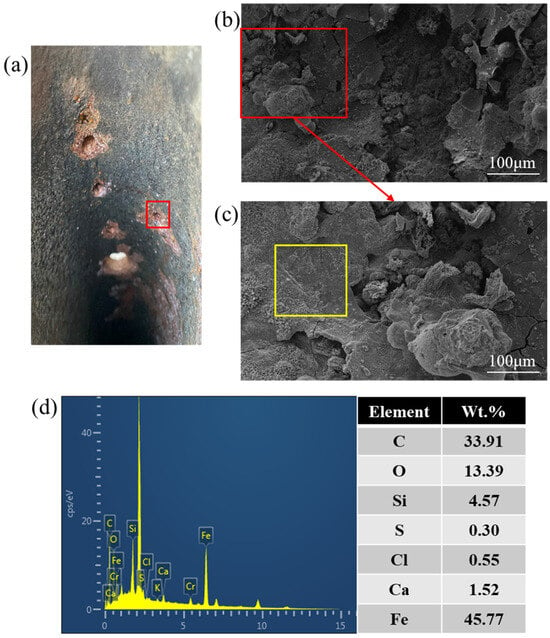
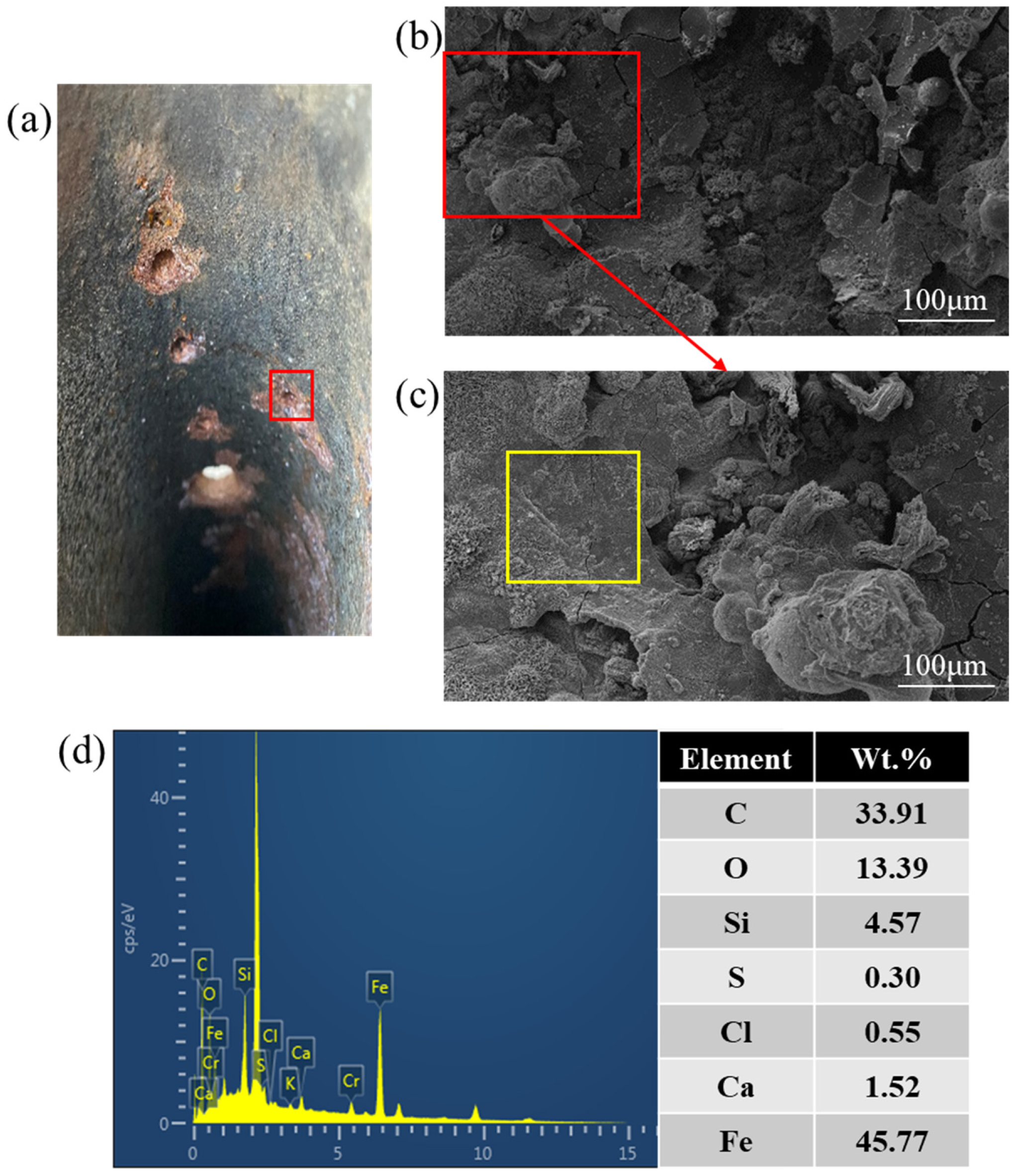
Figure 5 presents the SEM images and corresponding EDS results of the corrosion products inside the corrosion pit on the inner wall of the failed P110 tubing. As shown in Figure 5b, a thick layer of corrosion products accumulates within the pit. The product layer exhibits a loose, porous surface with severe cracking, and some areas show spalling, revealing a fragmented, flaky morphology. These cracks serve as pathways for corrosive media to penetrate, accelerating further attack on the underlying steel substrate. EDS analysis was performed on the area marked by the yellow square in Figure 5c, with the corresponding spectrum shown in Figure 5d. The results indicate that the corrosion products consist primarily of Fe, O, and C, along with minor amounts of Cl, S, Ca, and other elements. The presence of C, S, and Cl confirms that CO2, H2S, and a high concentration of Cl− in the corrosive medium were key factors initiating and promoting corrosion. Due to its small ionic radius and high penetrating ability, Cl− readily permeates through micropores and defects in the corrosion product layer, reaching the interface between the layer and the metal substrate, where it promotes pitting corrosion [32].
Figure 5.
Microstructure and elemental composition of the corrosion pit: (a) test points; (b) micromorphology; (c) local magnification; (d) EDS in the yellow box.
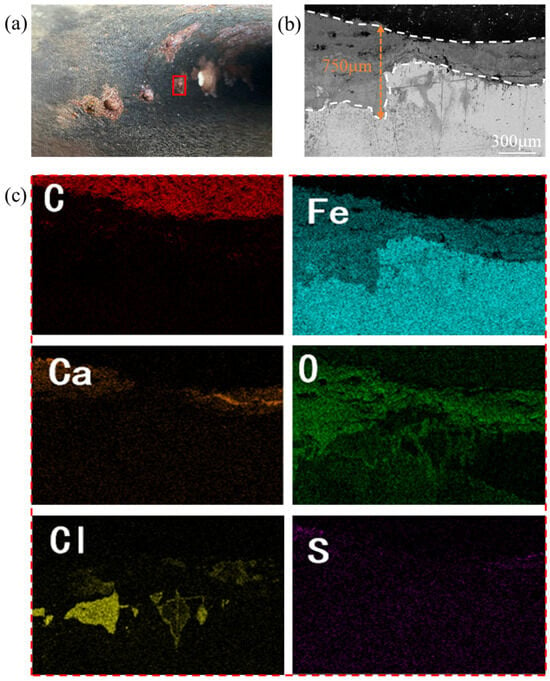
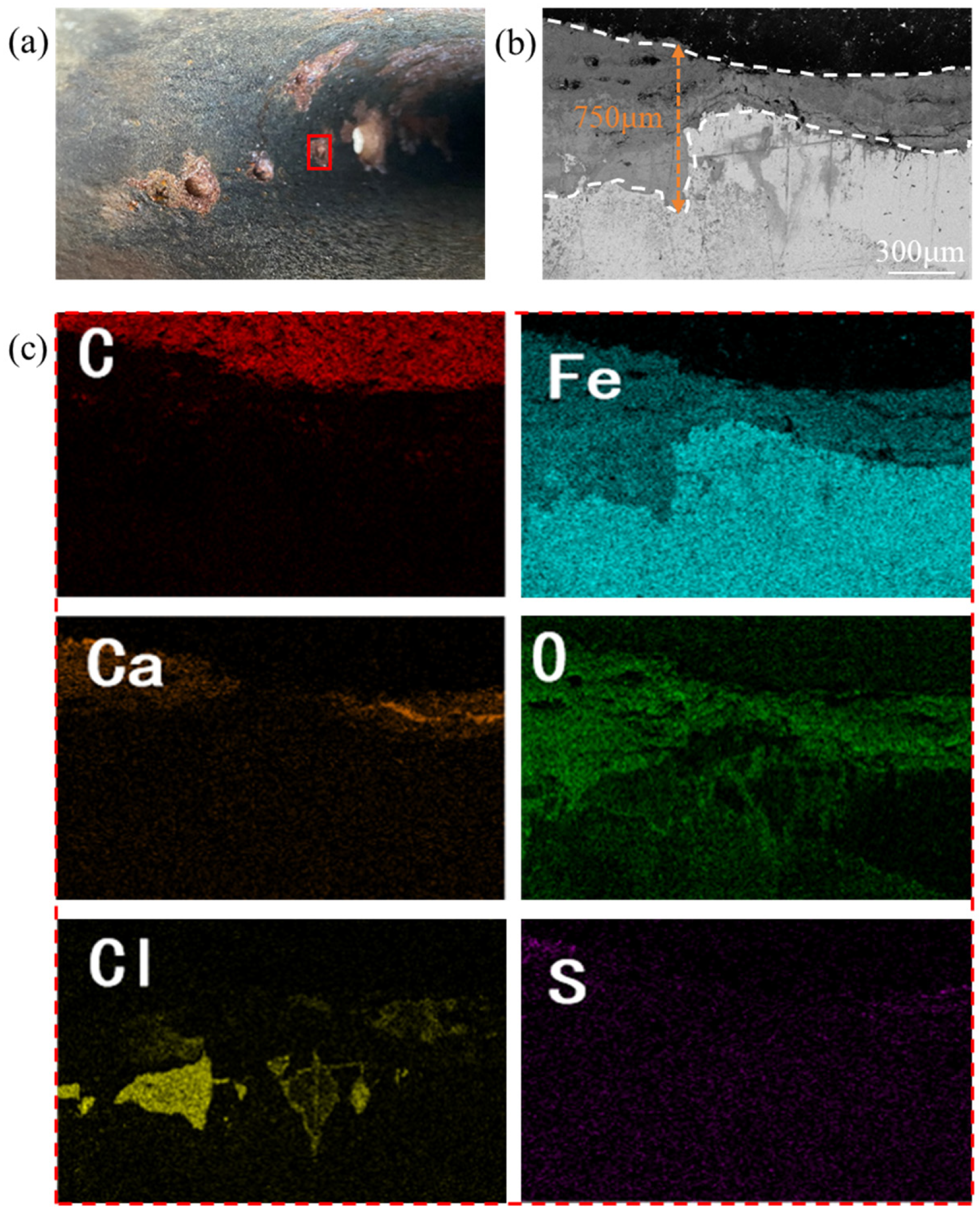
The cross-sectional morphology of the corrosion product layer within the pit was examined using SEM, and the elemental distribution was characterized by EDS. The results are presented in Figure 6, with the location of the cross-sectional specimen indicated in Figure 6a. The region enclosed by the white dashed line represents the corrosion product layer, with the epoxy resin above it and the underlying metal substrate below. As shown in Figure 6b, the corrosion product layer exhibits non-uniform thickness, reaching a maximum of 750 μm, and localized corrosion shows a tendency to propagate further inward. The layer exhibits extensive cracking and is generally loose and fragmented. This morphology confirms that following coating failure, the corrosive medium gained direct access to the metal substrate, initiating severe corrosion. EDS mapping of the cross-section reveals significant O enrichment throughout the corrosion product layer, accompanied by Fe depletion relative to the substrate, confirming that Fe has undergone oxidation [33]. S is primarily concentrated in the outer region of the product layer. In contrast, Cl exhibits pronounced enrichment and has penetrated through the corrosion product layer into the underlying metal substrate. The Cl-enriched zones within the substrate notably coincide with areas of O enrichment. This confirms that Cl− actively accelerates localized corrosion and promotes pitting. These overlapping regions represent active corrosion sites where Cl− attacks the metal matrix, continuously driving the corrosion front deeper into the material. The penetration and localized enrichment of Cl− are critical factors in accelerating localized corrosion [34]. By disrupting the integrity of the surface corrosion product layer, Cl− facilitates the progressive deepening and widening of corrosion pits.
Figure 6.
Cross-section morphology and elemental composition of the corrosion pit. (a) test point; (b) micromorphology; (c) elemental distribution.
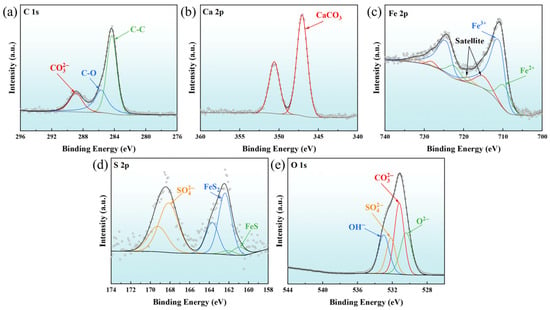
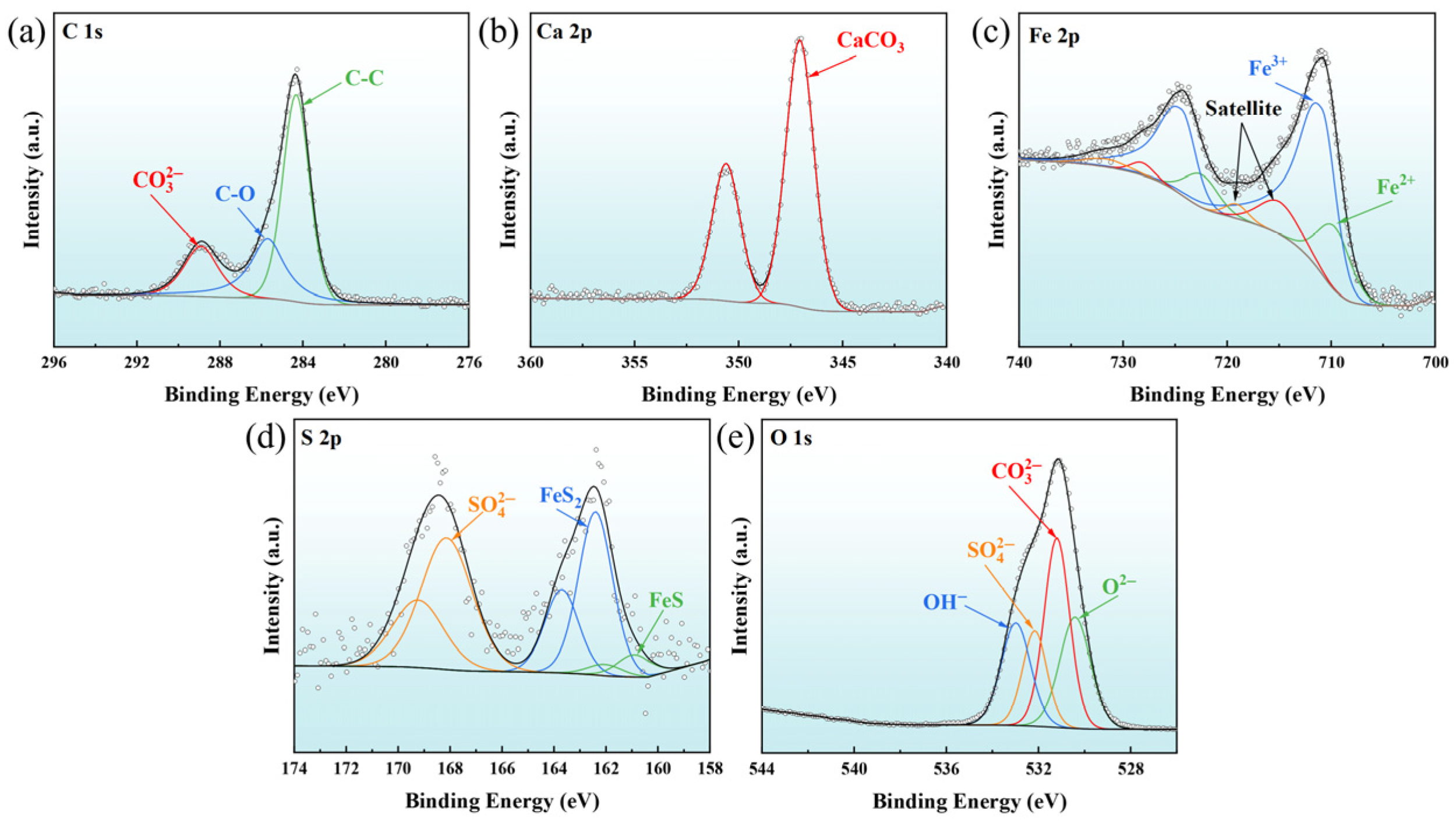
Figure 7 presents the high-resolution XPS spectra of C 1s, Ca 2p, Fe 2p, S 2p, and O 1s acquired from the corrosion products inside the pit. In each spectrum, the experimentally measured data are represented by black circles, while the fitted curves are shown as solid black lines. All spectra were charge-corrected prior to analysis. Figure 7a shows the C 1s XPS spectrum of the corrosion products, which exhibits three characteristic peaks. The peak at 289.3 eV is attributed to CO32−. Figure 7b displays the Ca 2p XPS spectrum, which features a single peak at 347.0 eV corresponding to CaCO3. The presence of CaCO3 indicates that under-deposit corrosion occurred on the tubing. Figure 7c presents the Fe 2p XPS spectrum. The Fe 2p3/2 binding energy peaks at 711.5 eV and 710.2 eV correspond to Fe3+ and Fe2+, respectively [35,36]. Figure 7d shows the S 2p XPS spectrum. The doublet at 160.9 eV and 162.08 eV is assigned to the S 2p3/2 and S 2p1/2 peaks of FeS, while the doublet at 162.4 eV and 163.58 eV corresponds to those of FeS2. In addition, a pronounced doublet observed at 168.2 eV and 169.38 eV is attributed to SO42−. Figure 7e presents the O 1s XPS spectrum, which exhibits four characteristic peaks at 532.9, 532.1 eV, 531.2 eV, and 530.2 eV, corresponding to OH−, SO42−, CO32−, and O2−, respectively. The abundant CO32− suggests that CO2 corrosion occurred, while the presence of OH− and O2− indicates that the corrosion products likely include iron oxides and hydroxides.
Figure 7.
XPS fitting results of corrosion product: (a) C 1s; (b) Ca 2p; (c) Fe 2p; (d) S 2p, (e) O 1s.
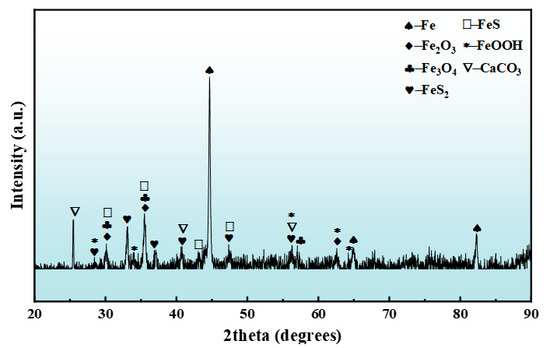
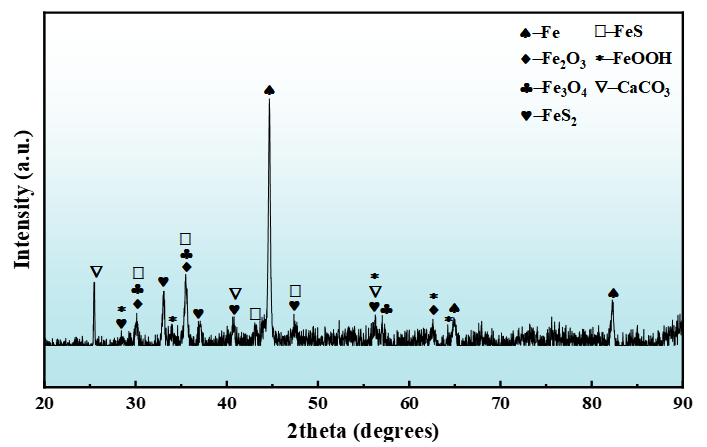
Figure 8 shows the XRD pattern of the corrosion products from inside the pit. Background subtraction was performed during the analysis. Characteristic diffraction peaks corresponding to FeOOH, Fe3O4, Fe2O3, FeS, FeS2, FeCO3, and FeSO4 are clearly identified, consistent with the XPS analysis. The formation of FeCO3 indicates the involvement of CO2 corrosion, while the presence of FeS and FeS2 confirms the occurrence of H2S corrosion. The iron oxides and oxyhydroxides (FeOOH, Fe3O4, Fe2O3) are oxidation products of iron. Integrating these findings with the EDS analysis of both the corrosion products and their cross-sections, it is confirmed that the tubing failure resulted from the synergistic corrosion effect of H2S, CO2, and O2. It is worth noting that although metallic iron was detected by XRD, it was not observed in the XPS spectra. This discrepancy arises because the probing depth of XPS is limited, preventing it from penetrating the dense corrosion product layer to reach the underlying metal substrate.
Figure 8.
XRD pattern of corrosion product.
3.4. Potentiodynamic Polarization Analysis
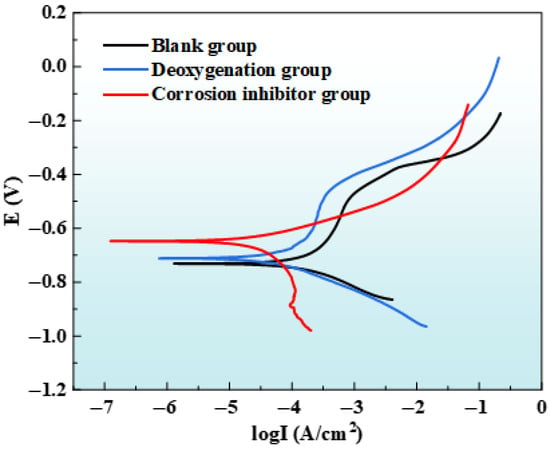
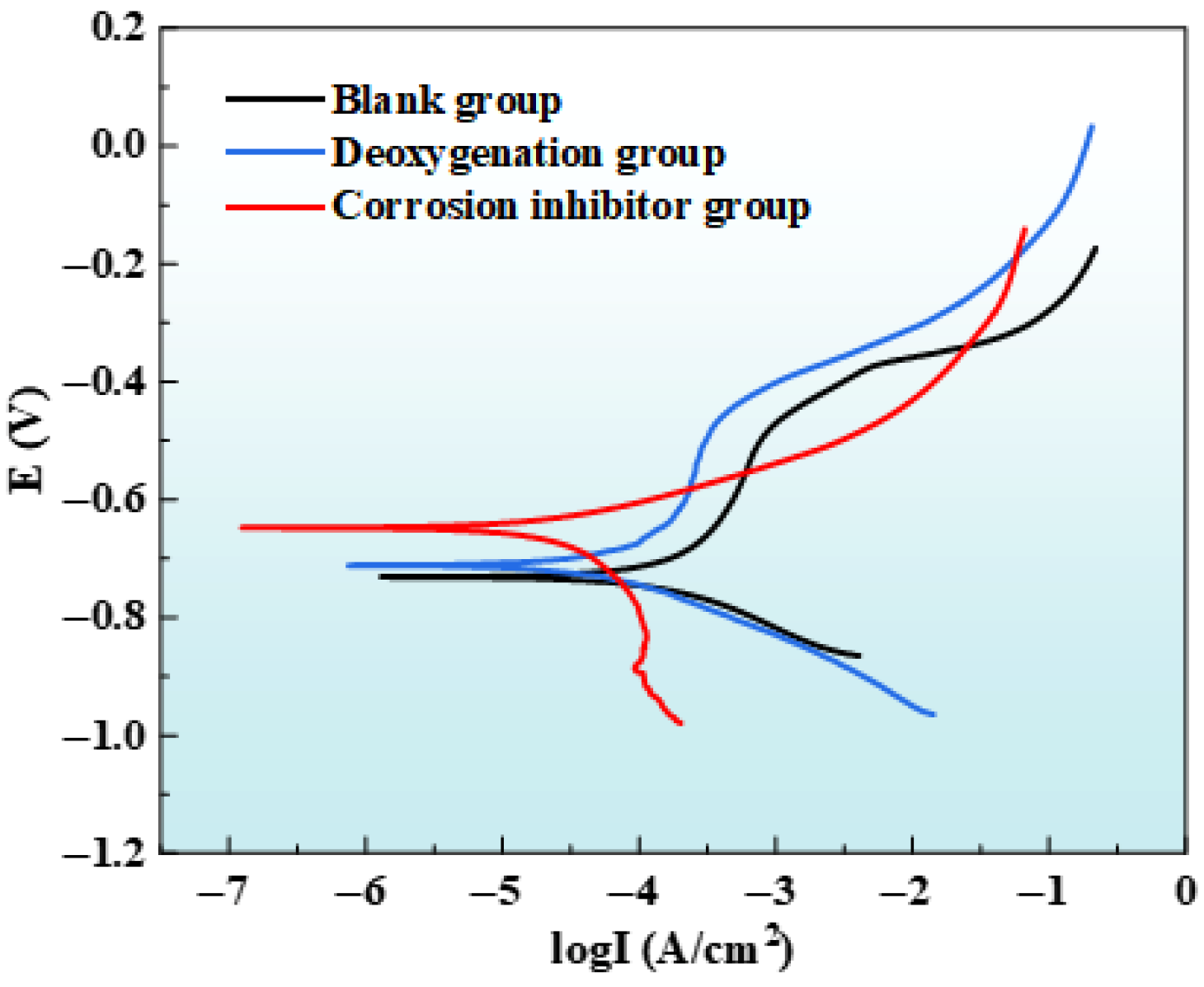
The potentiodynamic polarization curves of P110 steel in simulated produced water under different test conditions are presented in Figure 9. The corrosion current and corrosion potential were obtained by linear fitting of the Tafel curves using the extrapolation method within the CS Studio5 software. The fitted polarization curve parameters are presented in Table 7. The fitting residuals were consistently below 10−8, indicating a good fit. Each test condition was repeated three times, and one representative curve from each group is shown in Figure 9. As presented in Table 7, the standard deviation of Ecorr for each group was less than 15 mV, and the relative standard deviation of Icorr was below 4%, confirming that the experiments were reproducible and the data were stable. As indicated by the experimental groups in Table 2, Group 1 served as the blank control, with neither deoxygenation nor corrosion inhibitor applied. Group 2 was subjected to deoxygenation, while Group 3 received the corrosion inhibitor. As shown in Figure 9 and Table 7, the blank control group exhibited the lowest corrosion potential and the highest corrosion current density. This indicates that under the synergistic effect of H2S, CO2, O2, and high Cl− concentration, P110 steel demonstrates high electrochemical corrosion activity and a rapid corrosion rate. After deoxygenation, the corrosion potential shifts positively and the corrosion current density decreases, confirming that dissolved oxygen further accelerates the corrosion of P110 steel. Upon the addition of the corrosion inhibitor, the corrosion potential increased markedly, and the corrosion current density decreased from 1.53 × 10⁻⁴ A/cm2 to 2.67 × 10⁻⁵ A/cm2. This indicates that the inhibitor can effectively mitigate the corrosion of P110 steel and reduce the corrosion rate. The electrochemical test results show that both reducing the oxygen content in the injected nitrogen and adding a corrosion inhibitor are effective measures to mitigate severe electrochemical corrosion of P110 steel in this aggressive acidic environment. The inhibition efficiency data further demonstrate that the addition of the corrosion inhibitor more effectively reduces the corrosion rate of P110 steel under these operating conditions.
Figure 9.
Polarization curves.
Table 7.
Polarization curve parameters.
4. Failure Mechanism Analysis
Based on the comprehensive experimental results, the corrosion perforation failure of the P110 tubing in this well is not attributable to inherent physicochemical defects in the material itself. Instead, it is the result of the synergistic interaction between coating failure and the aggressive downhole corrosive environment. The failure process began with the degradation of the coating. In this well, coating disbondment was observed exclusively in the shallow section, where the tubing had been in prior service. Adhesion test results showed that the bond strength of the coating applied to the old tubing was lower than that applied to the new tubing. This is likely attributable to surface imperfections on the old tubing, such as adherent mill scale, oil residues, and scratches that were difficult to remove completely, resulting in inherently poor adhesion between the coating and the metal substrate. Simultaneously, the tubing near the wellhead bears the weight of the entire lower tubing string, experiencing the greatest axial tensile stress. This may also affect the adhesion between the coating and the substrate [37].
The second stage is synergistic corrosion involving H2S, CO2, and O2. Following coating failure, the P110 steel substrate was directly exposed to the acidic corrosive environment containing H2S, CO2, and O2, leading to severe synergistic corrosion. As discussed in Section 3.3, the corrosion products on the tubing were found to contain FeS, FeS2, FeCO3, and various iron oxides. This provides strong evidence that H2S, CO2, and O2 collectively contributed to the corrosion process. Based on these findings, the following failure mechanism is proposed.
As a highly aggressive corrosive agent, H2S dissolves in water to generate S2−, HS−, and H+. These species react with Fe2+ to form FeS:
FeS can further react with excess H2S to form FeS2:
Because the injected nitrogen contains oxygen, the initially formed FeS can undergo further oxidation to generate FeSO42. CO2 dissolves in water to form H2CO3, rendering the medium acidic. H2CO3 subsequently ionizes and dissociates into H+, HCO3−, and CO32− ions. The CO32− then react with Fe2+ to precipitate FeCO3:
Oxygen is typically present in nitrogen injection service environments. As a strongly oxidizing corrosive agent, oxygen participates in the cathodic reduction reaction with water:
The subsequent formation of various iron oxides and hydroxides:
The hydrolysis product, Fe(OH)2, is unstable. It is partially oxidized to form Fe3O4:
In an oxygen-rich area, Fe(OH)2 or Fe3O4 undergoes further oxidation to form yellow ferric oxyhydroxide (FeOOH):
FeOOH dehydrates to form Fe2O3:
It is certain that the corrosion products related to H2S and CO2 were generated during the tubing’s service life. However, upon retrieval, the tubing may have been exposed to oxygen, leading to secondary oxidation and the formation of additional oxidation products. Therefore, to enhance the credibility of the mechanistic analysis, the corrosion products identified in this study are compared with those reported in the literature for similar corrosive environments. These findings are consistent with those reported by Liao et al. [38], who investigated the corrosion behavior of pipeline steel in an environment containing H2S, CO2, and O2, and identified corrosion products predominantly consisting of FeCO3, FeS2, FeS, FeOOH, Fe(OH)3, Fe3O4, and Fe2O3. Similarly, Zeng et al. [24] analyzed tubing corrosion failures in heavy oil fire-flooding wells and concluded that, in addition to CO2/H2S corrosion, the synergistic effect of residual O2 and Cl− exacerbates localized corrosion, leading to wall thinning and perforation. The corrosion products they identified were primarily sulfides, carbonates, and iron oxides and hydroxides-a composition that aligns well with the corrosion products detected in this study.
Concurrently, Cl−, as highly aggressive anions, further accelerate the corrosion process. Due to their small ionic radius and strong penetrability, Cl− can permeate through the corrosion product layer and reach the metal substrate surface. Once there, they adsorb onto the surface and substitute O2− or OH− within the passive film, compromising its integrity. The formation of soluble iron chloride complexes leads to the localized breakdown of the passive film [39]. Under the combined effect of synergistic H2S/CO2/O2 corrosion and Cl−-accelerated attack, the corrosion pits on the metal substrate progressively deepen and widen. This results in a gradual thinning of the tubing wall. Once the wall thickness is reduced to a level insufficient to withstand the downhole pressure, an inward-outward corrosion perforation ultimately occurs. Leng et al. [40] similarly reported that in a CO2/O2/Cl− environment, O2 and Cl− exhibit a synergistic effect that promotes the development of localized corrosion on steel. The catalytic action of Cl− further accelerates the growth of corrosion pits.
In contrast, new tubing was used in the deeper well section. The strong adhesion between the coating and the substrate, with no visible blistering or spalling, allowed the coating to maintain its physical barrier function, effectively preventing contact between corrosive media and the metal surface. Consequently, no significant corrosion occurred in this section, demonstrating that an intact internal coating provides excellent corrosion protection for the tubing.
5. Preventive Measures
Based on the corrosion failure mechanism of the P110 tubing in this well and considering the field service conditions, the following targeted protective measures are proposed from the aspects of coating preparation, field application, and corrosion inhibition:
- (1)
- Optimize coating preparation processes to enhance coating quality. For oil wells with similar operating conditions, new tubing should be used for coating processing whenever possible. Strictly control the cleanliness and roughness of the tubing surface prior to coating application [41,42,43].
- (2)
- Inject high-performance corrosion inhibitors downhole. Select imidazoline-type corrosion inhibitors that effectively mitigate the synergistic corrosion of H2S, CO2, and O2 [44].
- (3)
- Control the oxygen content in the injected nitrogen. Employ physical deoxygenation methods or chemical oxygen scavengers to reduce the dissolved oxygen concentration in the water, thereby minimizing the impact of oxygen corrosion.
- (4)
- Establish a full life-cycle monitoring system for coated tubing. Conduct regular inspections of internally coated tubing after deployment to monitor coating integrity and changes in wall thickness, enabling timely detection of coating failure and early-stage corrosion. Implement targeted repair or replacement measures to prevent corrosion perforation accidents.
6. Conclusions
Comprehensive physicochemical property tests on the failed P110 tubing confirm that its performance complies with the requirements of ISO 11960-2020. Corrosion perforation failure is not directly related to the material itself. The main conclusions are as follows:
- (1)
- Coating failure is the core cause of tubing corrosion. In the shallow well section, the coating on the old tubing was prone to blistering and localized disbondment, thereby losing its ability to protect the underlying metal substrate. It is recommended to conduct adhesion tests on the coating before it leaves the factory.
- (2)
- Following coating failure, the P110 tubing was directly exposed to an aggressive acidic environment containing H2S, CO2, O2, and a high concentration of Cl−. This led to severe synergistic corrosion. Cl− further exacerbated localized corrosion by disrupting the passive film and accelerating electrochemical reactions, causing corrosion pits to progressively deepen and widen. This process ultimately resulted in inward-outward corrosion perforation.
- (3)
- Electrochemical test results confirm that both reducing the oxygen content in the injected nitrogen and adding imidazoline-type corrosion inhibitors are effective measures to mitigate severe corrosion of P110 steel in this acidic corrosive environment. These findings provide valuable references for corrosion prevention and control of tubing in analogous oil and gas reservoirs.
- (4)
- The electrochemical study was limited to atmospheric pressure conditions. Future work should combine high-temperature, high-pressure weight-loss corrosion experiments to validate the corrosion rates under actual service conditions.
Author Contributions
Conceptualization, H.Z. and D.Z.; Methodology, J.Z.; Software, L.H.; Validation, W.Z.; Formal analysis, H.Z. and K.Z.; Investigation, W.Z., H.H., Y.G. and J.Z.; Resources, Y.G.; Data curation, H.Z., H.H. and L.H.; Writing—original draft, H.Z.; Writing—review & editing, W.Z. and K.Z.; Visualization, H.Z.; Supervision, D.Z. All authors have read and agreed to the published version of the manuscript.
Funding
This research received no external funding.
Institutional Review Board Statement
Not applicable.
Informed Consent Statement
Not applicable.
Data Availability Statement
Data are contained within the article.
Conflicts of Interest
Authors Wenguang Zeng, Yujie Guo and Jiangjiang Zhang were employed by the Sinopec Northwest Oilfield Company. The remaining authors declare that the research was conducted in the absence of any commercial or financial relationships that could be construed as a potential conflict of interest.
References
- Li, P.; Zhao, Y.; Liu, B.; Zeng, G.; Zhang, T.; Xu, D.; Gu, H.; Gu, T.; Wang, F. Experimental testing and numerical simulation to analyze the corrosion failures of single well pipelines in Tahe oilfield. Eng. Fail. Anal. 2017, 80, 112–122. [Google Scholar] [CrossRef] [Scilit]
- Liu, C.; Lin, C.; Wang, Y.; Wu, M. Burial Dissolution of Ordovician Granule Limestone in the Tahe Oilfield of the Tarim Basin, NW China, and Its Geological Significance. Acta Geol. Sin. 2008, 82, 520–529. [Google Scholar]
- Li, C.; Xiang, Z.; Chen, Z.; Zhang, R. The effect of precipitates on corrosion resistance of N08028 alloy tubing in sour environment. Corrosion 2014, 71, 641–645. [Google Scholar] [CrossRef] [Scilit] [PubMed]
- Liu, S.; Liu, Y.; Zhong, H.; Zou, H.; Yang, D. Experimental study on corrosion resistance of coiled tubing welds in high temperature and pressure environment. PLoS ONE 2021, 16, e0244237. [Google Scholar] [CrossRef] [Scilit]
- Dong, B.; Zeng, D.; Yu, Z.; Cai, L.; Shi, S.; Yu, H.; Zhao, H.; Tian, G. Corrosion Mechanism and Applicability Assessment of N80 and 9Cr Steels in CO2 Auxiliary Steam Drive. J. Mater. Eng. Perform. 2019, 28, 1030–1039. [Google Scholar] [CrossRef] [Scilit]
- Dou, Y.; Li, Z.; Cheng, J.; Zhang, Y. Experimental Study on Corrosion Performance of Oil Tubing Steel in HPHT Flowing Media Containing O2 and CO2. Materials 2020, 13, 5214. [Google Scholar] [CrossRef] [Scilit]
- Dong, L.; Liu, J.; Zhu, X. Study on sealing behavior of corroded tubing in a high pressure environment. Int. J. Press. Vessel. Pip. 2022, 200, 104826. [Google Scholar] [CrossRef] [Scilit]
- Yang, Z.; Zhao, G.; Liu, R. Electrochemical corrosion behavior of P110 tubing steel in CO2-saturated brine containing NO2. Int. J. Electrochem. Sci. 2026, 21, 101292. [Google Scholar] [CrossRef] [Scilit]
- Xue, H.; Li, X.; Li, L.; Huang, X.; Zhang, T.; Sun, J.; Du, J. Study on microbial corrosion behavior of copper alloyed coiled tubing (CACT). Colloids Surf. A Physicochem. Eng. Asp. 2026, 734, 139445. [Google Scholar] [CrossRef] [Scilit]
- Yang, G.; Cui, H.; Huang, T.; Liang, B.; Zhang, J.; Wang, L.; Liu, Z.; Du, C.; Li, X. Stress corrosion cracking behavior and mechanism of stainless steel coiled tubing served for CO2 flooding injection well in CCUS-EOR environments. Eng. Fail. Anal. 2025, 180, 109847. [Google Scholar] [CrossRef] [Scilit]
- Han, Y.; Ren, H.; Zhang, W.; Fu, A.; Ma, Q. Failure Analysis of Corrosion and Fracture of P110 Tubing in a Development Well. J. Phys. Conf. Ser. 2023, 2639, 012061. [Google Scholar] [CrossRef] [Scilit]
- Li, Q.; Wang, D.; Zhang, H.; Li, J.; Lian, W.; Yang, H.; Jiang, B. Study on the stress-corrosion failure of tubing in CO2-EOR wellbores. Eng. Fail. Anal. 2026, 185, 110369. [Google Scholar] [CrossRef] [Scilit]
- Mubarak, G.; Elkhodbia, M.; Gadala, I.; AlFantazi, A.; Barsoum, I. Failure analysis, corrosion rate prediction, and integrity assessment of J55 downhole tubing in ultra-deep gas and condensate well. Eng. Fail. Anal. 2023, 151, 107381. [Google Scholar] [CrossRef] [Scilit]
- Pan, L.; Han, X.; Fang, J.; Yuan, H.; Cheng, Z.; Zhou, M.; Shi, X.; Zeng, D. Study on electrochemical corrosion of P110 tubing during air injection oil flooding. Pet. Res. 2025, 10, 543–551. [Google Scholar] [CrossRef] [Scilit]
- Liu, W.; Shi, T.; Lu, Q.; Zhang, Z.; Ming, C.; Gong, J.; Ren, J. Failure analysis on fracture of S13Cr-110 tubing. Eng. Fail. Anal. 2018, 90, 215–230. [Google Scholar] [CrossRef] [Scilit]
- Wang, Q.; Wu, W.; Li, Q.; Zhang, D.; Yu, Y.; Cao, B.; Liu, Z. Under-deposit corrosion of tubing served for injection and production wells of CO2 flooding. Eng. Fail. Anal. 2021, 127, 105540. [Google Scholar] [CrossRef] [Scilit]
- Liu, Y.; Zhang, B.; Zhang, Y.; Ma, L.; Yang, P. Electrochemical polarization study on crude oil pipeline corrosion by the produced water with high salinity. Eng. Fail. Anal. 2016, 60, 307–315. [Google Scholar] [CrossRef] [Scilit]
- Zhu, S.D.; Li, Y.P.; Wang, H.W.; Li, J.L.; Fu, A.Q.; Chen, G.; Ma, D.; Li, X.P.; Cheng, F. Corrosion Resistance Mechanism of Mica-Graphene/Epoxy Composite Coating in CO2-Cl− System. Materials 2022, 15, 1194. [Google Scholar] [CrossRef] [Scilit] [PubMed]
- Zhu, L.; Feng, C.; Cao, Y. Corrosion behavior of epoxy composite coatings reinforced with reduced graphene oxide nanosheets in the high salinity environments. Appl. Surf. Sci. 2019, 493, 889–896. [Google Scholar] [CrossRef] [Scilit]
- SY/T 6717; Specification of Internal Coating for Tubing and Casing. Petroleum Industry Press: Beijing, China, 2016.
- Liu, L.; Wu, Z.; Cui, S.; An, X.; Ma, Z.; Shao, T.; Fu, R.K.Y.; Wang, R.; Lin, H.; Pan, F.; et al. Abrasion and erosion behavior of DLC-coated oil-well tubings in a heavy oil/sand environment. Surf. Coat. Technol. 2019, 357, 379–383. [Google Scholar] [CrossRef] [Scilit]
- Ma, K.; Zhang, L.; Ma, H.; Wan, J.; Huang, Y.; Liu, X. Innovative strategy for corrosion protection and drag reduction in coiled tubing: Design, fabrication, and performance evaluation. Chem. Eng. J. 2024, 499, 156536. [Google Scholar] [CrossRef] [Scilit]
- Wu, G.; Zhang, Q.; Zhang, N. The failure reason of epoxy-phenolic coating on the internal surface of BG90S steel tubing under sour gas environment. Pigment Resin Technol. 2020, 49, 181–187. [Google Scholar] [CrossRef] [Scilit]
- Zeng, D.; Han, X.; Yu, C.; Zheng, C.; Su, R.; Sun, J.; Li, Y.; Chen, J. Analysis of typical cases of corrosion failure of tubing in heavy oil fire-flooding production wells. Eng. Fail. Anal. 2025, 172, 109391. [Google Scholar] [CrossRef] [Scilit]
- GB/T 13298-2015; Inspection Methods of Microstructure for Metals. Standards Press of China: Beijing, China, 2015.
- GB/T 10561-2005; Steel-Determination of Content of Nonmetallic Inclusions-Micrographic Method Using Standards Diagrams. Standards Press of China: Beijing, China, 2005.
- GB/T 6394-2017; Determination of Estimating the Average Grain Size of Metal. Standards Press of China: Beijing, China, 2017.
- ISO 11960-2020; Petroleum and Natural Gas Industries—Steel Pipes for Use as Casing or Tubing for Wells. ISO: Geneva, Switzerland, 2020.
- ASTM A370; Standard Test Method and Definitions for Mechanical Testing of Steel. ASTM International: West Conshohocken, PA, USA, 2024.
- GB/T 5210-2006; Paints and Varnishes—Pull-off Test for Adhesion. Standards Press of China: Beijing, China, 2006.
- Zhao, X.; Qi, J.; Liu, J.; Li, H.; Du, Q.; Han, Y.; Fu, A. Stress Corrosion Sensitivity of Martensitic Stainless Steel in H2S Environment. Corros. Prot. 2022, 43, 31–37. [Google Scholar]
- Peng, H.; Lyu, W.; Wu, C.; Wang, J.; Su, X.; Zhao, Y.; Xu, S.; Li, Z. Study on the corrosion failure mechanism of X80 pipeline steel by chloride ion at different concentrations. Eng. Fail. Anal. 2025, 179, 109784. [Google Scholar] [CrossRef] [Scilit]
- Zeng, D.; Yu, C.; Luo, J.; Hu, H.; Shi, S.; Zeng, W.; Zhang, J.; Ma, J.; Li, F. Corrosion failure analysis of T2 copper tubes of a heat exchanger in the oilfield nitrogen production system. Int. J. Press. Vessel. Pip. 2025, 216, 105521. [Google Scholar] [CrossRef] [Scilit]
- Shen, F.; Liu, G.; Liu, C.; Zhang, Y. Atomistic insights into iron corrosion in chloride environments: Effects of chloride concentration, pH and crystal orientation. Appl. Surf. Sci. 2026, 719, 165020. [Google Scholar] [CrossRef] [Scilit]
- Yamashita, T.; Hayes, P. Analysis of XPS spectra of Fe2+ and Fe3+ ions in oxide materials. Appl. Surf. Sci. 2008, 254, 2441–2449. [Google Scholar] [CrossRef] [Scilit]
- Bagus, P.S.; Nelin, C.J.; Brundle, C.R.; Crist, B.V.; Lahiri, N.; Rosso, K.M. Combined multiplet theory and experiment for the Fe 2p and 3p XPS of FeO and Fe2O3. J. Chem. Phys. 2021, 154, 094709. [Google Scholar] [CrossRef] [Scilit]
- Yang, C.; Xie, J.; Du, J.; Jin, W. The Influence of Tensile Stress on Oil Tubing Antiseptic Coating. Total Corros. Control 2017, 31, 65–68. [Google Scholar] [CrossRef]
- Liao, K.; Leng, J.; Cheng, Y.F.; Zou, Q.; He, T.; Chen, L.; Qin, M.; Liu, X.; Zhao, S. Investigation into main controlling factors and prediction model of L245NS steel corrosion rate in CO2-O2-SO2-H2S-H2O environment. Mater. Chem. Phys. 2023, 309, 128414. [Google Scholar] [CrossRef] [Scilit]
- Wang, Y.; Cheng, G.; Wu, W.; Qiao, Q.; Li, Y.; Li, X. Effect of pH and chloride on the micro-mechanism of pitting corrosion for high strength pipeline steel in aerated NaCl solutions. Appl. Surf. Sci. 2015, 349, 746–756. [Google Scholar] [CrossRef] [Scilit]
- Leng, J.; Cheng, Y.F.; Liao, K.; Huang, Y.; Zhou, F.; Zhao, S.; Liu, X.; Zou, Q. Synergistic effect of O2-Cl− on localized corrosion failure of L245N pipeline in CO2-O2-Cl− environment. Eng. Fail. Anal. 2022, 138, 106332. [Google Scholar] [CrossRef] [Scilit]
- Sachdeva, G.; Wang, G.; Batista, E.R.; Freibert, F.J.; Pandey, R.; Yang, P. Impact of Surface Defects on the Binding Strength of Anticorrosion 2D Nanomaterial Surface Coatings for UO2. ACS Appl. Nano Mater. 2024, 7, 8862–8868. [Google Scholar] [CrossRef] [Scilit]
- Wang, J.; Zhang, C.; Shen, X.; He, J. A study on surface integrity of laser cladding coatings post-treated by ultrasonic burnishing coupled with heat treatment. Mater. Lett. 2022, 308, 131136. [Google Scholar] [CrossRef] [Scilit]
- Teles, V.C.; de Mello, J.D.B.; da Silva, W.M. Abrasive wear of multilayered/gradient CrAlSiN PVD coatings: Effect of interface roughness and of superficial flaws. Wear 2017, 376–377, 1691–1701. [Google Scholar] [CrossRef] [Scilit]
- Mubarak, G.; Verma, C.; Barsoum, I.; Alfantazi, A.; Rhee, K.Y. Internal corrosion in oil and gas wells during casings and tubing: Challenges and opportunities of corrosion inhibitors. J. Taiwan Inst. Chem. Eng. 2023, 150, 105027. [Google Scholar] [CrossRef] [Scilit]

Disclaimer/Publisher’s Note: The statements, opinions and data contained in all publications are solely those of the individual author(s) and contributor(s) and not of MDPI and/or the editor(s). MDPI and/or the editor(s) disclaim responsibility for any injury to people or property resulting from any ideas, methods, instructions or products referred to in the content. |
© 2026 by the authors. Licensee MDPI, Basel, Switzerland. This article is an open access article distributed under the terms and conditions of the Creative Commons Attribution (CC BY) license.