Article

Metal-Based Slippery Surfaces with Micro-Channel Network Structures for Enhanced Anti-Icing and Antifouling Performance

School of Mechanical Engineering, Guangxi University, Nanning 530004, China
*
Author to whom correspondence should be addressed.
Coatings 2026, 16(4), 458; https://doi.org/10.3390/coatings16040458
Submission received: 24 March 2026 / Revised: 8 April 2026 / Accepted: 9 April 2026 / Published: 11 April 2026

Abstract

In response to the significant challenges posed by ice accumulation and contamination from various fluids in complex operating conditions for metallic materials, this study utilises picosecond laser precision machining to develop a ‘slippery surface’ featuring a micro-channel network structure. The core innovation of this study lies in the use of laser-machined micrometre-scale array textures to overcome the limitations of traditional isolated pores. These globally interconnected micro-channels serve as highly efficient reservoirs and dynamic transport channels for lubricants, significantly enhancing the interfacial capillary locking force of the lubricant. Experimental results demonstrate that this unique network geometry endows the surface with exceptional fluid replenishment and self-healing properties, enabling it to exhibit outstanding broad-spectrum hydrophobicity towards various fluids—including water, crude oil and ethanol (surface tension range: 17.9–72.0 mN m−1)—with sliding angles consistently below 12°, whilst effectively slowing the dehydration and solidification processes of biological fluids. At a low temperature of −15 °C, the surface achieved an ice formation delay of up to 286 s, with an ice adhesion strength of only 33.9 kPa, ensuring that accumulated ice could be spontaneously detached under minimal external force. Furthermore, the micro-channel network structure serves as a key protective mechanism against mechanical wear, maintaining robust slippery properties even after three hours of high-pressure water jet scouring (Weber number of 300). This reliable interface, achieved through structural management, provides an efficient and scalable platform for addressing the all-weather anti-icing and antifouling requirements of outdoor infrastructure.

1. Introduction

Thanks to their high strength, excellent thermal conductivity and machinability, metallic materials play an irreplaceable role in fields such as aerospace [1,2,3], power transmission [4,5,6] and marine engineering [7,8]. However, complex operational environments pose significant challenges for metal surfaces. Firstly, ice accumulation in extreme weather conditions can significantly increase structural loads, leading to power line failures, wind turbine shutdowns or a deterioration in the aerodynamic performance of aircraft [9,10,11,12,13,14]. Furthermore, the adhesion of organic pollutants, crude oil and biological fluids (such as blood) in the environment not only impairs surface functionality but also readily induces severe chemical corrosion and biofouling [15,16]. Therefore, the development of a long-lasting, multifunctional surface modification technology that combines highly effective anti-icing with broad-spectrum antifouling properties holds significant academic research value and engineering application significance.
Superhydrophobic surfaces (SHSs), inspired by the ‘lotus effect’, have been regarded as an ideal solution to the aforementioned problems [17,18,19]. By constructing micro- and nano-structures on the substrate and combining them with low-surface-energy modifications, SHSs can induce droplets to carry away contaminants via rolling [20,21]. However, conventional superhydrophobic surfaces (SHSs) still face significant limitations in practical applications. Firstly, when exposed to organic oils or viscous fluids with low surface tension, SHSs are highly susceptible to a wetting transition, leading to failure [22,23,24]. Secondly, in high-humidity or extremely low-temperature environments, water vapour readily condenses in situ within micro- and nano-pores, causing a severe ‘pinning’ effect that leads to a dramatic surge in ice adhesion strength (typically far exceeding the anti-icing threshold of 100 kPa) [25,26,27]. Furthermore, their fragile micro- and nano-structures struggle to maintain long-term performance when subjected to mechanical wear or cavitation [28]. In addition, to compensate for the deficiencies of SHSs in humid and cold environments, hydrogel surfaces based on hydrophilic polymer networks have emerged as a promising strategy. By anchoring a substantial amount of water within its three-dimensional cross-linked network, the hydrogel forms a quasi-liquid layer on the surface, which provides exceptionally low ice adhesion and superior anti-biofouling performance. However, challenges such as dehydration in extreme environments and inherently weak mechanical strength have limited its large-scale engineering applications in harsh industrial conditions [29].
To overcome these limitations, liquid-infused porous lubricious surfaces (SLIPSs), inspired by the pitcher plant’s trap, have shown promise for practical applications [30]. Such surfaces involve injecting a low-surface-energy lubricant into a porous scaffold, utilising capillary forces to lock in place and form a continuous, smooth, and physically stable liquid–liquid interface. Compared with the solid–gas–liquid interface in conventional SHSs or the liquid-like layer in hydrogels, which is prone to water loss, the molecularly smooth interface provided by SLIPSs allows both polar water droplets and low-surface-energy organic liquids to slide off at a minimal contact angle. Simultaneously, the continuous lubricating film acts as an effective physical barrier, preventing the coagulation and adhesion of biological fluids by blocking water loss, whilst significantly reducing the adhesion force of ice deposits by eliminating surface defects. Recent studies have extensively explored SLIPSs for their excellent anti-icing and antifouling properties; however, most conventional SLIPSs rely on disordered porous structures or isolated pits to plateau lubricants. For instance, Zhang et al. demonstrated that lubricant-infused nano-structured surfaces can significantly reduce ice adhesion, yet a critical bottleneck in these traditional structures remains the ‘Lubricant Depletion’ issue [31]. Once the lubricant in isolated pores is exhausted by external shear forces or evaporation, the surface inevitably loses its slippery functionality.
Addressing these limitations of traditional isolated porous structures and their susceptibility to lubricant depletion, this study proposes a lubricating surface featuring a micro-channel network structure, prepared by combining picosecond laser precision machining with surface functional group modification techniques. First, a micrometre-scale grid texture is etched onto the substrate surface using a picosecond laser, and surface activation is employed to induce the generation of high-density hydroxyl groups. The primary novelty of this study lies in the global interconnectivity of these laser-machined micro-channels, which serve as a continuous reservoir and facilitate the dynamic transport of lubricants through enhanced interfacial capillary locking forces. Unlike traditional isolated or disordered geometries, this networked geometric feature endows the surface with exceptional fluid replenishment and self-healing properties, enabling it to effectively counteract lubricant depletion in complex service environments. This paper systematically examines the surface’s performance in repelling a broad spectrum of liquids and resisting blood coagulation, whilst providing an in-depth analysis of the long-term protective mechanism of the micro-channel network structure against icing under extreme low-temperature and high-pressure water-scouring conditions, thereby offering a highly stable and scalable solution for multifunctional protection of metal surfaces.

2. Materials and Methods

2.1. Materials

Carboxylated perfluoropolyether (PFPE–COOH, 98%), hydrophobic silica (H-SiO2, particle size: 20 nm), n-hexane (97%), silicone oil, 1,2-dichloroethane and anhydrous ethanol (99.7%) were purchased from McLean Biochemical Technology Co., Ltd. (Shanghai, China). Sterile anticoagulated bovine blood was purchased from Pingrui Biotechnology Co., Ltd. (Zhengzhou, China). Peanut oil was purchased from a local market. Glycerol was purchased from Sinopharm Chemical Reagents Co., Ltd. (Shanghai, China). Dimethyl sulphoxide was purchased from Shanghai Aladdin Reagent Co., Ltd. (Shanghai, China). Hydrogen peroxide (H2O2, 30%), Acetone and sulphuric acid (H2SO4, 98%) were purchased from Chengdu Kelong Chemicals Co., Ltd. (Chengdu, China). Crude oil was provided by the Second Station of the Bohai Bay, China. Deionised water was supplied by the Aquapro ultrapure water system (model AJF-0501-M, Aikopu Yiyang Enterprise Development Co., Ltd., Chongqing, China). All chemical reagents were used directly without further purification.

2.2. Preparation of Slippery Surface

Firstly, a picosecond laser processing system (PINE-1064-40, Huari Precision Laser, Wuhan, China) was used to texture the surface of the raw aluminium sheet (Al). With the laser power set to 20 W and a scanning speed of 50 mm/s, a grid pattern with a pitch of 50 μm was created on the sample surface through 10 repeated scans. Then, the patterned aluminium sheet was immersed in a mixture of H2O2 and H2SO4 (with a volume ratio of 1:3) at room temperature for 10 min for surface activation, inducing the formation of a high density of surface hydroxyl (–OH) groups. Subsequently, 2 g of perfluoropolyether carboxylic acid (PFPE–COOH) was uniformly dripped onto the surface, and the sample was transferred to a vacuum oven and heated at 90 °C for 4 h. During this vacuum heat treatment stage, the carboxyl groups (–COOH) of PFPE–COOH further cross-linked with the hydroxyl groups (–OH) on the surface via an esterification reaction, ultimately yielding a Slippery surface.

2.3. Preparation of SHS

Add 1 g of H-SIO2 to 20 mL of ethanol; after ultrasonic dispersion, spray the solution onto a laser-treated surface to impart superhydrophobicity, thereby producing a SHS.

2.4. Wetting Measurements

To obtain contact angle data, a syringe mounted above a rotatable square platform was used to dispense 5 μL droplets of different types of oil onto the slippery surface. Under ambient conditions of 25 °C and 55% relative humidity (RH), images of the liquid–gas interface were analysed using the contact angle measurement system (OCA 20, Dataphysics, Stuttgart, Germany). Each measurement was repeated at least three times in different areas. For slip angle data, a 5 μL oil droplet was placed on the slippery surface, and the surface was then rotated until the droplet began to slip; the angle of inclination at this point was defined as the slip angle.

2.5. Self-Healing Tests

The self-healing performance of the slippery surface was evaluated through a scratch experiment, and in situ observation of the healing process was conducted by using a high-depth-of-field digital microscope (VHX-7000, Keyence Co., Ltd., Shanghai, China). The micro-morphological evolution within the scratched area was real-time recorded, enabling quantitative analysis of healing time corresponding to damage area ratios of 5%, 10%, 15%, 20, 25 and 35%.

2.6. Anti-Icing Tests

All anti-icing tests were conducted on an icing platform maintained at a temperature of −15 °C and a humidity of 30%. The sample was placed horizontally on the icing platform, after which 10 μL of ultrapure water was dropped onto its surface. The freezer was set to −15 °C. The freezer was started and a high-speed camera was activated to record the icing process, enabling the icing time to be quantified.
A digital force sensor (Aipli SF-100, Airuipu Instrument Co., Ltd., Zhejiang, China) was used to measure the de-icing force. Once the water droplet has completely frozen, the force sensor probe pushes the ice droplet at a speed of 1 mm s−1. The adhesion strength is obtained by calculating the ratio of the peak force to the contact area between the ice droplet and the slippery surface. The ice adhesion strength was calculated using the following formula:
τ I c e = F S
Here, τ I c e represents the ice adhesion strength (Pa), F is the measured peak force (N), and S is the contact area between the ice droplet and the sample (m2).

2.7. Characterization

The surface microstructure was characterised using a scanning electron microscope (SEM, Merlin, Zeiss, Shanghai, China). Three-dimensional features of the slippery surface were measured using a deep-field digital microscope (VHX-7000, Keyence Co., Ltd., Shanghai, China). During the preparation of the slippery surface, chemical characterisation was performed using Fourier transform infrared spectroscopy (FTIR, iCAN9, Nuosipu Technology Co., Ltd., Tianjin, China).

3. Results and Discussion

3.1. Preparation and Characterisation of the Slippery Surface

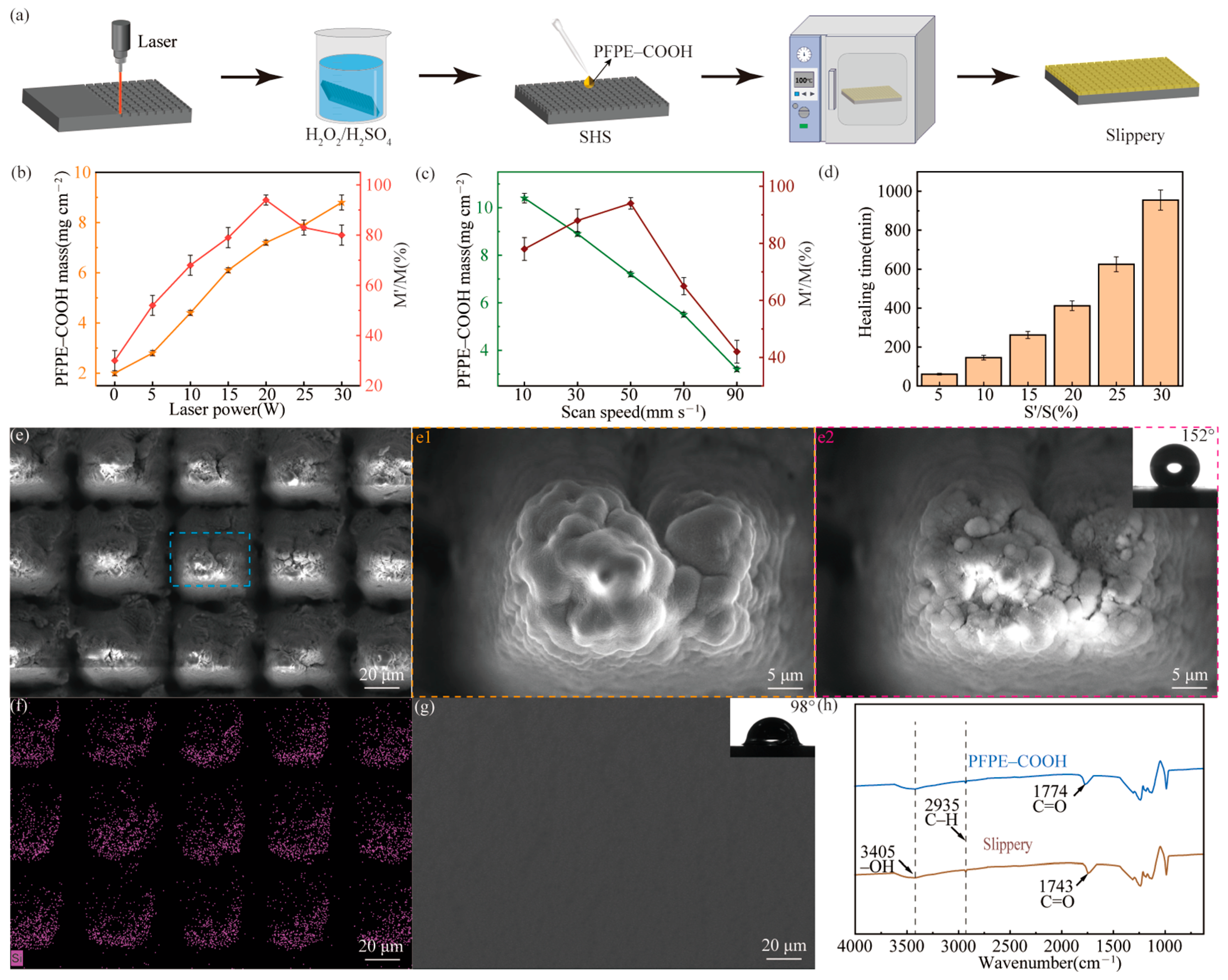
The process for preparing the slippery surface is shown in Figure 1a. First, a network of micro-channels is etched onto the raw aluminium substrate using a picosecond laser. Subsequently, the resulting patterned sample is immersed in a mixture of H2O2 and H2SO4 for surface activation, with the aim of inducing the formation of a high density of hydroxyl (–OH) groups. Finally, PFPE–COOH is drop-coated onto the patterned surface and treated in a vacuum high-temperature oven; this step not only effectively removes residual air from the structure but also promotes chemical bonding between PFPE–COOH and the substrate surface, ultimately yielding a slippery surface. Through systematic optimisation of laser processing parameters (Figure 1b,c), this study identifies 20 W and 50 mm s−1 as the optimal combination for fabricating the slippery surface with peak performance. The synergistic effect of laser power and scanning speed determines the geometric morphology of the micro-channel network structures; specifically, increasing power or decreasing speed enhances the etching depth, providing a larger physical reservoir for the lubricant. Notably, the lubricant retention rate (M’/M) exhibits a parabolic trend, reaching a maximum of 94% at the optimal parameters. This phenomenon stems from the intrinsic balance between the micro-channel geometry and the lubricant stabilisation mechanism. At low power or high scanning speeds, the resulting channels are shallow and poorly defined, failing to form effective capillary traps to counteract the physical stripping of the water jet. Specifically, at a laser power of 0 W (a flat surface with chemical grafting but no micro-structures), the retention rate is only approximately 32%. This indicates that while the robust Al–O–C(O)– covalent bonds between PFPE–COOH and the substrate ensure molecular-level chemical adhesion, a flat surface lacking geometric constraints cannot resist high shear forces. As the parameters are optimised to 20 W and 50 mm/s, the micro-channels achieve an ideal aspect ratio, generating the maximum capillary force to firmly anchor the lubricant within the network. However, with a further increase in power or a decrease in speed, excessive ablation leads to overly wide channel openings and the accumulation of thermal debris. As calculated via the OWRK model [32], the total surface free energy (SFE) of the laser-treated aluminium substrate dropped significantly from 68.5 mJ m−2 to 15.2 mJ m−2 after this PFPE–COOH functionalization. This drastic reduction in SFE, particularly the suppression of the polar component, provides the thermodynamic driving force for the stable infusion and tight anchoring of the lubricant within the micro-channel network.
Quantitative self-healing evaluations (Figure 1d) further confirm that as the damage area (S’/S) expands from 5% to 30%, the surface successfully achieves total recovery of its slippery properties within 60 s to 960 s. This replenishment process is driven by the robust Laplace pressure gradient within the interconnected channels. In conclusion, while chemical modification provides the foundation for lubricant spreading, the laser-induced micro-channel network serves as the essential physical prerequisite for long-term lubricant “anchoring” and “dynamic compensation,” ensuring superior surface resilience. As shown in Figure 1e, the surface microstructure at each stage of the preparation process was characterised in this study. The surface of the original aluminium plate was flat and smooth; following picosecond laser processing, distinct micro- and nano-structures were formed on the surface (Figure 1(e1)). Subsequently, after the sample was modified by spraying with an H-SiO2 solution (Figure 1(e2)), the surface was covered with a dense layer of nanoparticles, indicating the presence of H-SiO2; at this stage, the water contact angle (WCA) of the surface reached 152°. Energy-dispersive X-ray spectroscopy (EDS) analysis (Figure 1f) revealed a highly uniform distribution of Si on the surface, further confirming the presence of the modified layer. As shown in Figure 1g, the modified ‘slippery’ surface exhibited a smooth morphology, with the water contact angle reduced to 98°. The observed reduction in WCA from the SHS state to the slippery state is attributed to the transition of the wetting mechanism. In the SHS state, the micro-channels trapped air to support the droplet in a Cassie-Baxter state with a high WCA. Upon infusion of the lubricant, the air pockets were replaced by a stable, chemically tethered lubricant layer, which effectively ‘masked’ the underlying micro-scale roughness to create a molecularly smooth liquid–liquid interface. Within this multi-phase system, the apparent contact angle is no longer dominated by solid–liquid interactions; instead, it is governed by the thermodynamic equilibrium of the interfacial tensions among the water, lubricant, and the surrounding phase. While the WCA decreased, the elimination of physical surface defects and the significant reduction in contact angle hysteresis enhanced the dynamic mobility of droplets, which is fundamental to the superior anti-icing and antifouling performance of the micro-channel network structures. To facilitate a reliable comparison between different samples, all FTIR spectra were normalised using the C-H stretching vibration peak at 2935 cm−1 as an internal reference. Figure 1h elucidates the evolution of chemical groups during the preparation process. The sharp absorption peak at 1774 cm−1 is attributed to the C=O stretching vibration of the carboxyl group in PFPE–COOH; as the esterification reaction proceeds, the intensity of this peak significantly weakens, and a characteristic ester carbonyl peak appears at 1743 cm−1, confirming that PFPE–COOH has been chemically anchored to the surface.

3.2. Antifouling Properties

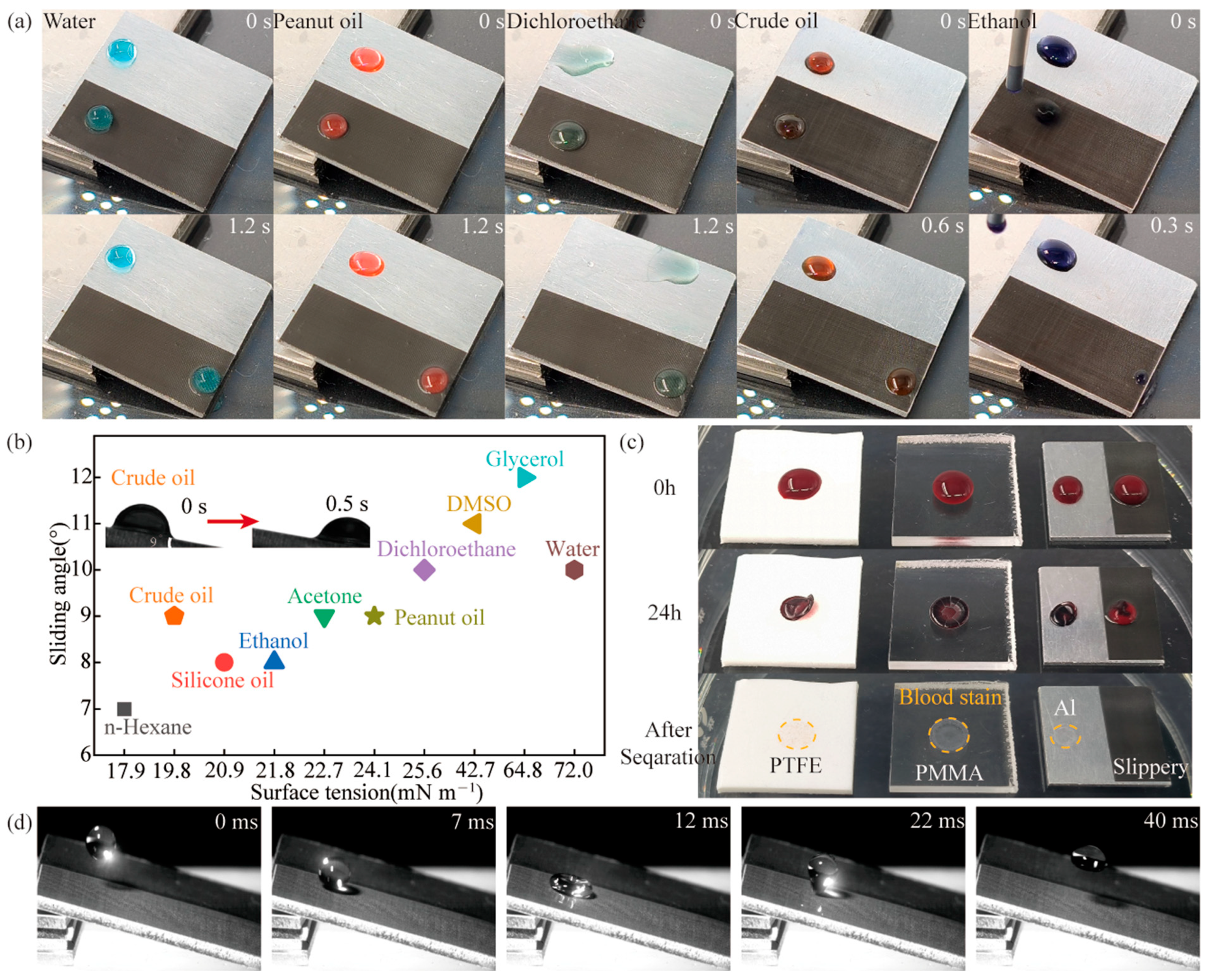
Figure 2a demonstrates the excellent liquid-repellent properties of the slippery surface. Experiments show that water, peanut oil, dichloroethane, crude oil and ethanol (5 μL) all slide off the surface effortlessly, whereas the bare aluminium plate was severely contaminated by these liquids. Figure 2b further demonstrates the surface’s broad applicability; for a variety of liquids with surface tensions ranging from 17.9 to 72.0 mN m−1, the sliding angle (SA) remains below 12°. In blood coagulation resistance tests (Figure 2c), sterile anticoagulated bovine blood was placed on polytetrafluoroethylene (PTFE), acrylic (PMMA), bare aluminium (Al) and the slippery surface for 24 h. The results showed that the blood on the first three surfaces coagulated completely due to water evaporation, whereas only a small amount of the top layer of blood on the slippery surface coagulated. This is attributed to the liquid–liquid interface formed by the oil film, which effectively acts as a barrier to water loss, significantly slowing down the dehydration process of the blood. Furthermore, droplet impact experiments (Figure 2d) show that a 10 μL water droplet striking the surface at a speed of 1.0 m/s rapidly retracts and bounces off intact, with a liquid–liquid contact time of only approximately 15 ms. This extremely short contact time not only reduces the mechanical disturbance of the droplet on the oil film and enhances the surface’s resilience, but also lays the physical foundation for subsequent excellent anti-icing performance by reducing heat exchange between the supercooled droplet and the substrate.

3.3. Anti-Icing Performance and Mechanical Durability

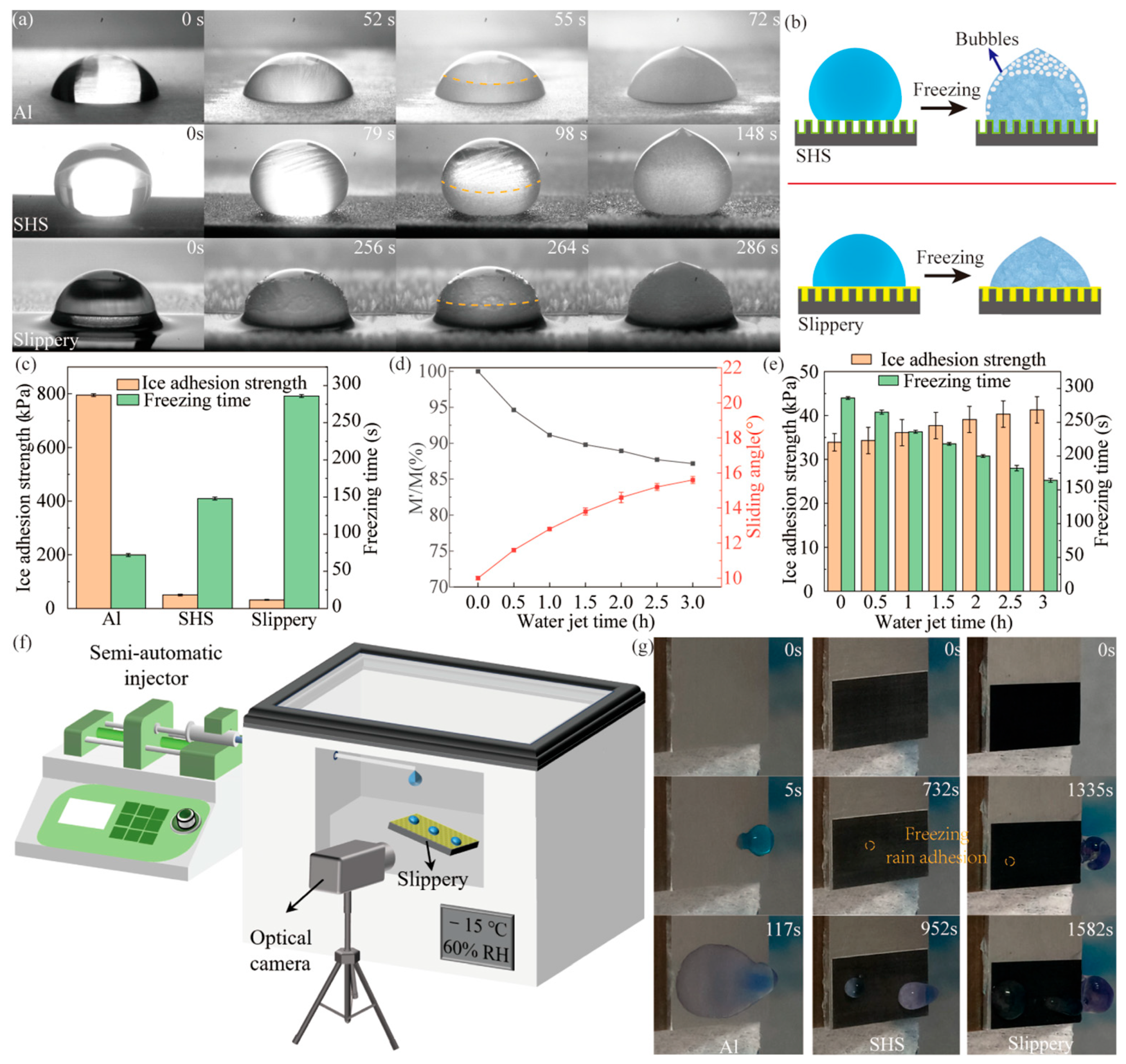
As shown in Figure 3a, this study evaluated the anti-icing performance of the various samples in a low-temperature environment (−15 °C). Experimental records indicate that water droplets on the Al and SHSs froze completely within 72 s and 148 s, respectively. In contrast, the slippery surface exhibited a significant ice formation delay, with the freezing time extended to 286 s, approximately 1.9 times that of the SHS. We further analysed the freezing mechanisms of the slippery surface and SHS (Figure 3b). During the freezing process on the slippery surface, the leading edge of the ice peak at the interface expands outwards and displaces the lubricant, causing the ice droplet to become partially embedded within the lubricant layer. In contrast, for the SHS, the solid–liquid contact area gradually increases due to supercooling and enhanced surface condensation, causing the solid–liquid–gas contact line to migrate into the gaps of the micro-nano-structures. Consequently, it can be inferred that, due to the extrusion of the ‘air cushion’, the wettability of the entire interface transitions from the Cassie state to the Wenzel state. Once the freezing state is reached, the volumetric expansion of the ice crystals fills the interconnected channels of the SHS, significantly increasing the ice-solid contact area and forming mechanical interlocking. Ice adhesion strength tests (Figure 3c) show that the de-icing strength on the bare Al surface reaches as high as 795 kPa. Although the SHS reduces the adhesion force to 50.2 kPa due to the presence of micro-nano-structures—which meets the general standard for anti-icing materials (<100 kPa) [33]—the slippery surface further reduces this strength to 33.9 kPa. This ultra-low adhesion is attributed to the extremely low coefficient of friction of the lubricating layer, meaning that ice deposits can be easily dislodged under minimal external force. The loss of lubricant under harsh environmental conditions is a key challenge limiting its engineering applications [34]. To address this, this study evaluated the mechanical durability of the slippery surface using a simulated rainwater scouring test system. Thanks to its unique micro-channel network design, the surface exhibits exceptional self-healing properties: when the lubricant is depleted in localised areas due to frictional wear, the surrounding fluid rapidly replenishes the area via the interconnected network until a liquid-level equilibrium is restored. As shown in Figure 3d, after 3 h of continuous scouring by a water jet at a Weber number (We) of 300, the surface slip angle remained below 16°, and the mass loss rate (M’/M) was only 16%, indicating that its lubricity was effectively retained. Furthermore, the ice adhesion strength after scouring increased only slightly to 41.3 kPa (Figure 3e), remaining well below the anti-icing threshold. To simulate the freezing rain environment in extremely cold regions, an experimental platform was constructed (Figure 3f). Under conditions of −15 °C and 60% RH, continuous freezing rain impact tests were conducted on the three surfaces (We = 86.2). The results (Figure 3g) show that ice adhesion began to form on the Al, SHS and slippery surface after 5 s, 732 s and 1335 s, respectively. These findings strongly confirm that the slippery surface retains stable and reliable anti-icing performance even after undergoing severe mechanical wear.
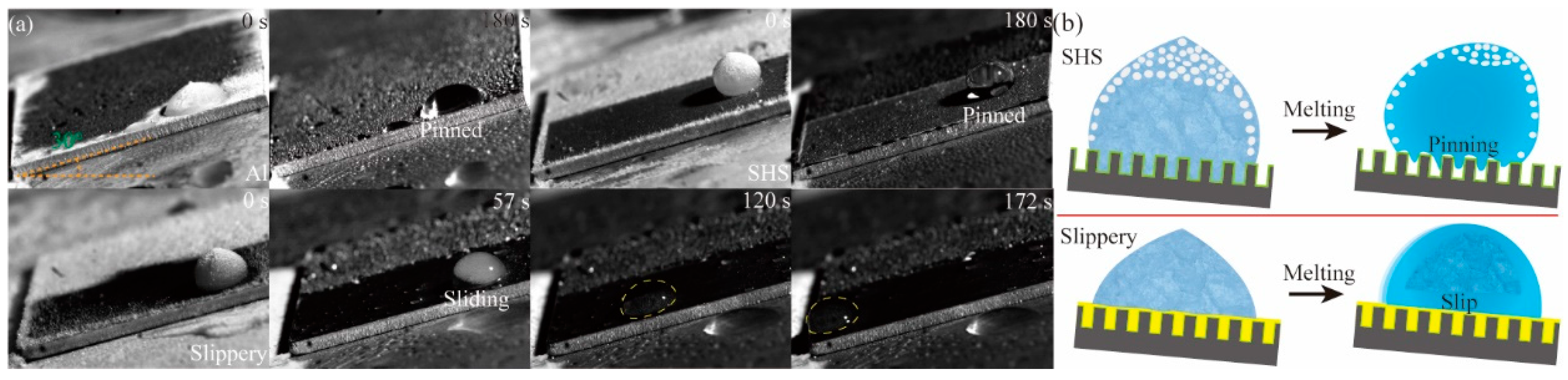
However, for practical engineering applications, it is equally crucial to evaluate a material’s self-dewetting capability during the ice melting phase, as residual moisture is highly prone to inducing secondary freezing when temperatures fluctuate. Figure 4a shows that only the ‘slippery’ surface exhibits self-dewetting, with melted ice droplets sliding off the 30°-inclined surface. In contrast, melted ice droplets on the SHS-ISSS surface remain fixed in place, exhibiting Wenzel wetting. We further analysed the spontaneous dehumidification mechanisms of the slippery surface and SHS (Figure 4b). During ice melting, the lubricant’s fluidity in the slippery surface compensates for the volume expansion of the ice, thereby preventing mechanical jamming. In contrast, for the SHS, although the driving forces during melting are identical to those of slippery surface, the three-phase contact line of the ice–water mixture is firmly anchored by residual ice nuclei or structural defects. This prevents the driving force of the droplets from overcoming this anchoring force, causing them to adhere to the surface. Consequently, only the slippery surface achieves spontaneous de-wetting.

4. Conclusions

This paper addresses the issues of ice accumulation and the adhesion of various contaminants on metallic materials in complex environments by developing a lubricating surface with an interconnected channel structure, thereby providing a long-term solution for all-weather protection of metal substrates. The core value of this research lies in the utilisation of a micrometre-scale grid texture constructed via precision processing with a picosecond laser. This overcomes the limitations of the isolated porous structures found in traditional super-slip surfaces by employing the micro-channel network as both an efficient reservoir and a transport channel for lubricants, thereby significantly enhancing the interfacial capillary locking force of the lubricant. Experimental results demonstrate that these unique geometric features endow the surface with exceptional dynamic fluid replenishment and self-repair capabilities, resulting in outstanding broad-spectrum fluid repellency. The contact angles for various fluids—including water, crude oil and ethanol—are all below 12°, whilst the surface effectively prevents moisture loss to slow down the dehydration and solidification process of biological fluids. In terms of anti-icing performance, the surface achieved an icing delay of up to 286 s at −15 °C, with an ice adhesion strength of only 33.9 kPa, ensuring that accumulated ice can peel off spontaneously under minimal external force. It is worth noting that the interconnected channel structure plays a crucial protective and restorative role during severe mechanical wear, maintaining robust lubricating properties even after three hours of high-pressure water jet scouring (Weber number of 300). In summary, this long-lasting lubricating interface, achieved through structural innovation, holds broad application prospects and expansion potential in the field of anti-icing and antifouling for outdoor infrastructure.

Author Contributions

Conceptualization, L.L.; methodology, L.L.; investigation, W.P. and L.L.; data curation, W.P.; writing—original draft preparation, W.P.; writing—review and editing, W.P. and L.L.; supervision, L.L. All authors have read and agreed to the published version of the manuscript.

Funding

The work is supported by the Specific Research Project of Guangxi for Research Bases and Talents (AE30100196), Youth Science Foundation of Guangxi Zhuang Autonomous Region (KY01030030124030), Guangxi Science and Technology Program [No. GuikeAD25069080].

Institutional Review Board Statement

Not applicable.

Informed Consent Statement

Not applicable.

Data Availability Statement

Data are contained within the article.

Conflicts of Interest

The authors declare no conflicts of interest.

References

  1. Gisario, A.; Kazarian, M.; Martina, F.; Mehrpouya, M. Metal Additive Manufacturing in the Commercial Aviation Industry: A Review. J. Manuf. Syst. 2019, 53, 124–149. [Google Scholar] [CrossRef]
  2. Vercillo, V.; Tonnicchia, S.; Romano, J.; Garcia-Giron, A.; Aguilar-Morales, A.I.; Alamri, S.; Dimov, S.S.; Kunze, T.; Lasagni, A.F.; Bonaccurso, E. Design Rules for Laser-Treated Icephobic Metallic Surfaces for Aeronautic Applications. Adv. Funct. Mater. 2020, 30, 12. [Google Scholar] [CrossRef]
  3. Wang, Q.; Yao, G.; Hou, M. Fatigue Life Prediction and Uncertainty Quantification of Aerospace Metals: A Bayesian Physics-Informed Neural Network Model. Reliab. Eng. Syst. Saf. 2026, 266, 19. [Google Scholar] [CrossRef]
  4. Grant, P.M. Superconducting Lines for the Transmission of Large Amounts of Electrical Power Over Great Distances: Garwin-Matisoo Revisited Forty Years Later. IEEE Trans. Appl. Supercond. 2007, 17, 1641–1647. [Google Scholar] [CrossRef]
  5. Zhu, Q.; Zhang, Y.; Liao, C.; Guo, Y.; Wang, L.; Li, F. Experimental Study on Asymmetric Wireless Power Transfer System for Electric Vehicle Considering Ferrous Chassis. IEEE Trans. Transp. Electrif. 2017, 3, 427–433. [Google Scholar] [CrossRef]
  6. Graham, D.J.; Neasham, J.A.; Sharif, B.S. Investigation of Methods for Data Communication and Power Delivery through Metals. IEEE Trans. Ind. Electron. 2011, 58, 4972–4980. [Google Scholar] [CrossRef]
  7. Tovar-Sanchez, A.; Gonzalez-Ortegon, E.; Duarte, C.M. Trace Metal Partitioning in the Top Meter of the Ocean. Sci. Total Environ. 2019, 652, 907–914. [Google Scholar] [CrossRef]
  8. Johnson, J.E. Metals for Microbes in the Ancient Sea. Nat. Geosci. 2023, 16, 1078–1079. [Google Scholar] [CrossRef]
  9. Jiang, X.; Zhu, M.; Dong, L.; Hu, Q.; Zhang, Z.; Hu, J. Site Experimental Study on Suspension-Tension Arrangement for Preventing Transmission Lines from Icing Tripping. Int. J. Electr. Power Energy Syst. 2020, 119, 7. [Google Scholar] [CrossRef]
  10. Li, Y.; Ma, W.; Kwon, Y.S.; Li, W.; Yao, S.; Huang, B. Solar Deicing Nanocoatings Adaptive to Overhead Power Lines. Adv. Funct. Mater. 2022, 32, 9. [Google Scholar] [CrossRef]
  11. Shen, H.; Li, Y.; Guo, W.; Zhang, F.; Feng, F.; Mu, Z. An Experimental Study of Ice Adhesion on Wind Turbine Blades: Effects of Materials, Airfoils and Attack Angles. Appl. Therm. Eng. 2025, 273, 15. [Google Scholar] [CrossRef]
  12. Wen, Q.; Shi, Y.; Li, Y.; Yang, G.; Liu, Z.; Fu, Y.; Zhang, Z.; Zhang, L.; Wang, X.; Jiang, X. Negative Effects of Sdbd Plasma Anti -/ De-Icing Method for Wind Turbine Blades. Appl. Surf. Sci. 2025, 688, 9. [Google Scholar] [CrossRef]
  13. Baumgardner, D.; Avallone, L.; Bansemer, A.; Borrmann, S.; Brown, P.; Bundke, U.; Chuang, P.Y.; Cziczo, D.; Field, P.; Gallagher, M. In Situ, Airborne Instrumentation Addressing and Solving Measurement Problems in Ice Clouds. Bull. Amer. Meteorol. Soc. 2012, 93, E529–E534. [Google Scholar] [CrossRef]
  14. Gohardani, O. Impact of Erosion Testing Aspects on Current and Future Flight Conditions. Prog. Aeosp. Sci. 2011, 47, 280–303. [Google Scholar] [CrossRef]
  15. Yu, Z.; Li, X.; Li, X.; Zheng, B.; Li, D.; Xu, D.; Wang, F. Nacre-Inspired Metal-Organic Framework Coatings Reinforced by Multiscale Hierarchical Cross-Linking for Integrated Antifouling and Anti-Microbial Corrosion. Adv. Funct. Mater. 2023, 33, 14. [Google Scholar] [CrossRef]
  16. Yang, H.; Liu, Y.; Chen, H.; Li, H. Controlled Release of Newly Synthesized Nh 2 -Zif-8@Bitep from Epoxy Resin-Based Coating for Enhanced Antifouling and Anti-Corrosion Performance. Prog. Org. Coat. 2025, 208, 9. [Google Scholar]
  17. Fihri, A.; Bovero, E.; Al-Shahrani, A.; Al-Ghamdi, A.; Alabedi, G. Recent Progress in Superhydrophobic Coatings Used for Steel Protection: A Review. Colloids Surf. A-Physicochem. Eng. Asp. 2017, 520, 378–390. [Google Scholar] [CrossRef]
  18. Zang, D.; Zhu, R.; Zhang, W.; Yu, X.; Lin, L.; Guo, X.; Liu, M.; Jiang, L. Corrosion-Resistant Superhydrophobic Coatings on Mg Alloy Surfaces Inspired by Lotus Seedpod. Adv. Funct. Mater. 2017, 27, 7. [Google Scholar] [CrossRef]
  19. Wang, D.; Huang, J.; Guo, Z. Tomato-Lotus Inspired Edible Superhydrophobic Artificial Lotus Leaf. Chem. Eng. J. 2020, 400, 11. [Google Scholar] [CrossRef]
  20. Che, C.; Greenfield, D.T.; Wang, M.; Zhang, B. Superamphiphobic Coating Fabricated on 5083 Aluminum Alloy with Integrated Anti-Corrosion and Anti-Icing Functions. Prog. Org. Coat. 2026, 213, 10. [Google Scholar] [CrossRef]
  21. Liao, G.; Yao, W.; She, A.; Bian, X. An Eco-Friendly Building Coating with High Self-Cleaning Capacity: Synergetic Effect of Super-Hydrophobicity and Photocatalytic Degradation. Constr. Build. Mater. 2023, 406, 14. [Google Scholar] [CrossRef]
  22. Li, S.; Zhao, F.; Bai, Y.; Ye, Z.; Feng, Z.; Liu, X.; Gao, S.; Pang, X.; Sun, M.; Zhang, J. Slippery Liquid-Infused Microphase Separation Surface Enables Highly Robust Anti-Fouling, Anti-Corrosion, Anti-Icing and Anti-Scaling Coating on Diverse Substrates. Chem. Eng. J. 2022, 431, 14. [Google Scholar] [CrossRef]
  23. Yang, Z.; He, X.; Chang, J.; Bai, X.; Cao, P.; Yuan, C. Fabrication of Biomimetic Slippery Liquid-Infused Porous Surface on 5086 Aluminum Alloy with Excellent Antifouling Performance. Surf. Interface Anal. 2021, 53, 147–155. [Google Scholar] [CrossRef]
  24. Li, D.; Liu, J.; Liu, Q.; Yu, J.; Zhu, J.; Chen, R.; Lin, Z.; Wang, J. Comparison of Anti-Icing, Antifouling, and Anticorrosion Performances of the Superhydrophobic and Lubricant-Infused Coatings Based on a Hollow-Structured Kapok Fiber. Langmuir 2024, 40, 5420–5432. [Google Scholar] [CrossRef] [PubMed]
  25. Latthe, S.S.; Sutar, R.S.; Bhosale, A.K.; Nagappan, S.; Ha, C.; Sadasivuni, K.K.; Liu, S.; Xing, R. Recent Developments in Air-Trapped Superhydrophobic and Liquid-Infused Slippery Surfaces for Anti-Icing Application. Prog. Org. Coat. 2019, 137, 17. [Google Scholar] [CrossRef]
  26. Barthwal, S.; Lee, B.; Lim, S. Fabrication of Robust and Durable Slippery Anti-Icing Coating on Textured Superhydrophobic Aluminum Surfaces with Infused Silicone Oil. Appl. Surf. Sci. 2019, 496, 9. [Google Scholar] [CrossRef]
  27. Zhang, P.; Guo, Z. Robust Anti-Icing Slippery Liquid-Infused Porous Surfaces Inspired by Nature: A Review. Mater. Today Phys. 2024, 46, 28. [Google Scholar] [CrossRef]
  28. Gao, X.; Guo, Z. Mechanical Stability, Corrosion Resistance of Superhydrophobic Steel and Repairable Durability of its Slippery Surface. J. Colloid Interface Sci. 2018, 512, 239–248. [Google Scholar] [CrossRef]
  29. Hou, W.; Chen, X.; Wang, D.; Cao, Y.; Du, H.; Li, G.; Gan, Z.; Yan, Y.; Gao, C.; Hu, F. Chromatic Forecasting Hydrogels for Anti-Icing Applications. Nat. Commun. 2025, 16, 9. [Google Scholar] [CrossRef]
  30. Wang, Z.; Jiang, L.; Heng, L. Liquid Adhesion Regulation on Bioinspired Slippery Surfaces: From Theory to Application. Acs Nano 2025, 19, 13549–13566. [Google Scholar] [CrossRef]
  31. Zhang, P.; He, S.; Zhang, L.; Wu, J.; Guo, Z. Durable Bionic Honeycomb Slippery Liquid-Infused Porous Surfaces with Anti-Icing and Water-Collecting Properties. Chem. Eng. J. 2024, 490, 11. [Google Scholar] [CrossRef]
  32. Salamanca, C.H.; Yarce, C.J.; Moreno, R.A.; Prieto, V.; Recalde, J. Natural Gum-Type Biopolymers as Potential Modified Nonpolar Drug Release Systems. Carbohydr. Polym. 2018, 189, 31–38. [Google Scholar] [CrossRef]
  33. Golovin, K.; Kobaku, S.P.R.; Lee, D.H.; DiLoreto, E.T.; Mabry, J.M.; Tuteja, A. Designing Durable Icephobic Surfaces. Sci. Adv. 2016, 2, e1501496. [Google Scholar] [CrossRef]
  34. Yuan, Q.; Shi, C.; He, T. Design and Performance Optimization of Self-Cleaning Coating on Decorative Uhpc Surface. Constr. Build. Mater. 2023, 394, 10. [Google Scholar] [CrossRef]
Figure 1. (a) Flowchart of the slippery surface preparation process; (b) effect of laser power on PFPE–COOH storage mass and lubricant retention rate (fixed scanning speed at 50 mm s−1, water jet: 0.5 h, We = 300); (c) effect of scanning speed on PFPE–COOH storage mass and lubricant retention rate (fixed laser power at 20 W, water jet: 0.5 h, We = 300); (d) relationship between surface damage area ratio (S’/S) and self-healing time for the slippery surface prepared with optimal parameters (20 W, 50 mm s−1); (e) SEM image of the surface after laser processing, with (e1) a high-magnification view and (e2) an SEM image of the SHS surface; the inset shows the contact angle on the SHS; (f) energy-dispersive spectroscopy (EDS) image of the Si element on the SHS; (g) SEM image of the slippery surface; the inset shows the contact angle on the slippery surface; (h) Fourier-transform infrared spectroscopy (FTIR) of carboxylated perfluoropolyether (PFPE–COOH) and slippery surface.
Coatings 16 00458 g001
Figure 2. (a) Schematic illustrations of the motion of water, peanut oil, dichloroethane, crude oil and ethanol on the slippery surface and on a bare aluminium plate; (b) sliding angles of liquids with different surface tensions on the slippery surface; the inset shows the sliding behaviour of crude oil; (c) comparative anti-coagulation experiments involving PTFE, PMMA, aluminium and the slippery surface; (d) high-speed snapshot of a water droplet (5 μL) impacting the slippery surface at a velocity of 0.7 m s−1.
Coatings 16 00458 g002
Figure 3. Anti-icing performance and mechanical durability of slippery surface. (a) Time-lapse side views of water droplets freezing on Al, SHS and slippery surfaces; (b) schematic diagrams of ice formation on SHS and slippery surface; (c) comparison of ice adhesion strength versus freezing time on Al, SHS and slippery surface; (d) variation of M’/M and slip angle on the slippery surface as a function of water jet erosion time; (e) ice adhesion strength and freezing time on the slippery surface at different water jet erosion times; (f) schematic diagram of simulated freezing rain impact tests and (g) comparative simulated freezing rain tests on Al, SHS and slippery surface.
Coatings 16 00458 g003
Figure 4. (a) Characterisation of the spontaneous dehumidification properties of Al, SHS and slippery surface; (b) schematic diagram of the dehumidification models for SHS and slippery surface.
Coatings 16 00458 g004
Disclaimer/Publisher’s Note: The statements, opinions and data contained in all publications are solely those of the individual author(s) and contributor(s) and not of MDPI and/or the editor(s). MDPI and/or the editor(s) disclaim responsibility for any injury to people or property resulting from any ideas, methods, instructions or products referred to in the content.