


Abstract
To enhance the electrochemical performance of NiMn layered double hydroxides (LDH), this study explores the Ce-doped NiMn-LDH (CeNiMn-LDH) as a cathode material for supercapacitors. In the CeNiMn-LDH structure, partial substitution of Ni/Mn ions by Ce increases the number of active sites, facilitates electron transfer, and improves current density, leading to a significant enhancement in the electrochemical properties compared with NiMn-LDH. Experimental results show that the 0.3CeNiMn-LDH electrode delivers excellent electrochemical performance, achieving a specific capacitance of 1928.16 F/g at a current density of 1 A/g. Furthermore, an assembled CeNiMn-LDH//AC asymmetric supercapacitor exhibits an energy density of 36.36 Wh/kg and a power density of 850 W/kg at 1 A/g. Therefore, the strategy of employing CeNiMn-LDH offers an effective technical approach for improving the electrochemical performance of supercapacitor cathode materials, demonstrating considerable potential for practical applications.
1. Introduction
The relentless pursuit of global socioeconomic progress has triggered an unprecedented surge in energy demand, leading to the rapid depletion of conventional fossil fuel resources and escalating environmental concerns, such as greenhouse gas emissions and climate instability [1,2,3,4,5]. To mitigate these dual crises, the transition toward a sustainable energy landscape anchored by renewable sources like solar, wind, and tidal power is imperative. However, the inherent intermittency of these renewable sources necessitates the development of advanced electrochemical energy storage (EES) systems with high efficiency, cost-effectiveness, and long-term reliability [6,7]. Among various EES candidates, supercapacitors (SCs), also known as electrochemical capacitors, have garnered profound interest in both academia and industry [8]. They bridge the performance gap between conventional capacitors and batteries, offering exceptional power density, rapid charge–discharge kinetics, and superior cycling stability [9].
According to the underlying charge storage mechanisms, SCs are primarily categorized into electric double-layer capacitors (EDLCs), pseudocapacitors, and hybrid supercapacitors (HSCs) [10]. EDLCs store energy via the physical adsorption and desorption of ions at the electrode and electrolyte interface, typically employing carbon-based materials with high surface areas [11]. While EDLCs exhibit remarkable stability and power output, their energy density is intrinsically limited by the surface-restricted storage capability. Conversely, pseudocapacitors leverage fast and reversible faradaic redox reactions at or near the electrode surface, offering significantly higher specific capacitance and energy density [12,13].
Currently, the development of HSCs has emerged as a state-of-the-art research frontier [14]. By integrating an EDLC-type electrode with a battery-type or pseudocapacitive electrode, HSCs can harness the synergistic advantages of both mechanisms, thereby achieving elevated energy density without sacrificing power density or lifespan. The critical challenge remains the design of advanced electrode materials that possess both high theoretical capacity and robust rate performance [15].
Two-dimensional (2D) layered double hydroxides (LDHs), characterized by a brucite-like structure with a unique cationic arrangement, have been identified as highly promising candidates for HSC electrodes [16]. Their unique merits include structural anisotropy, tunable cationic compositions, and a high theoretical capacity derived from the multi-electron redox reactions of transition metal ions [17,18]. In particular, NiMn-LDHs have demonstrated exceptional electrochemical potential, as the synergistic interaction between nickel and manganese redox couples provides a richer palette of active sites compared to mono-metallic LDHs [19,20,21]. Despite these advantages, the practical implementation of NiMn-LDHs is severely hampered by their intrinsic semiconductor nature, which results in low electronic conductivity and sluggish ion diffusion kinetics [19,22,23].
Furthermore, the strong electrostatic attraction between the positively charged hydroxide layers and interlayer anions often leads to severe self-restacking. This phenomenon significantly reduces the accessible surface area and encapsulates active sites within dense interlayer galleries, causing a drastic decline in rate capability and specific capacity, especially under high mass-loading conditions [24,25].
To circumvent these bottlenecks, various structural engineering strategies such as nanostructure miniaturization, the construction of core–shell frameworks, and hybridization with conductive carbon matrices have been explored. However, these methods often involve multi-step, complex synthesis processes or result in limited overall energy output due to the low weight percentage of the active material [26,27]. Recently, modification with rare-earth (RE) elements has emerged as a potent alternative for modulating the electronic and crystalline structures of LDHs [28]. Cerium (Ce), a quintessential RE element, is particularly distinguished by its unique 4f electronic configuration and the reversible switching between Ce3+ and Ce4+ oxidation states. Among various rare-earth elements, Cerium stands out due to its unique Ce3+/Ce4+ redox chemistry and its superior ability to induce oxygen vacancies, which are crucial for enhancing both the conductivity and active sites of LDH-based electrodes [28]. Additionally, cerium compounds exhibit low toxicity and high chemical stability, enabling safe handling and synthesis under conventional laboratory conditions without strict inert gas protection. The incorporation of Ce can offer dual benefits: first, the formation of CeO2 nanocrystals, which possess high oxygen storage capacity and abundant oxygen vacancies, facilitating interfacial charge transfer; second, the intercalation of Ce3+ ions into the LDH host [29].
Due to the significantly larger ionic radius of Ce3+ compared to Ni2+ or Mn3+, its intercalation can induce controlled lattice distortion and expand (003) interlayer spacing, thereby lowering the energy barrier for ion transport. Nevertheless, the fundamental mechanism regarding how Ce-induced lattice expansion and the resulting heterojunction charge redistribution synergistically enhance the performance of NiMn-LDHs remains to be fully elucidated. In this work, we report the successful synthesis of nanoflower-like CeNiMn-LDH composites via a facile, cost-effective, one-step hydrothermal method. We investigate a synergistic crystallization mechanism where CeO2 precipitates initially, acting as nucleation centers for the subsequent growth of expanded NiMn-LDH platelets [30].
Comprehensive characterizations through XRD and HRTEM confirm that the strategic incorporation of Ce expands (003) interlayer spacing from 6.84 Å to 7.3 Å, effectively constructing high-flux ion highways for accelerated OH- diffusion. XPS results reveal intense electronic coupling and spontaneous charge redistribution at the CeO2/NiMn-LDH heterojunction interface, which significantly optimizes the intrinsic conductivity. Electrochemical evaluations in a three-electrode configuration demonstrate that the optimized 0.3CeNiMn-LDH electrode achieves an outstanding specific capacity of 1928.16 F/g at 1 A/g and maintains a superior rate retention of 1448.8 F/g even at 10 A/g. Kinetic analysis further underscores its performance, with a dominant capacitive contribution of 96 percent at 20 mV/s. To evaluate its practical feasibility, a hybrid asymmetric supercapacitor (ASC) was fabricated on a current collector (0.3CeNiMn-LDH//AC). The device delivers a high energy density of 36.6 Wh/kg at a power density of 850 W/kg while exhibiting excellent long-term cycling stability. This research provides a robust strategy for engineering advanced electrodes and offers new insights into the structure–kinetic relationship of rare-earth-modified nanomaterials for high-performance energy storage applications.
2. Materials and Methods
2.1. Preparation
All chemical reagents used in this study were of analytical grade and used as received without further purification. The specific types, specifications, and suppliers are as follows: nickel nitrate hexahydrate (Ni(NO3)2·6H2O), manganese nitrate tetrahydrate (Mn(NO3)2·4H2O), and ammonium fluoride (NH4F) were purchased from Aladdin Reagent Co., Ltd. (Shanghai, China). Cerium nitrate hexahydrate (Ce(NO3)3·6H2O) was acquired from Macklin Biochemical Co., Ltd. (Shanghai, China). Urea (CO(NH2)2) was obtained from Sinopharm Chemical Reagent Co., Ltd. (Shanghai, China). Anhydrous ethanol (C2H5OH) was a standard analytical-grade reagent. Deionized water used throughout the experiments was produced in the laboratory and met all experimental requirements.
Experimental Instruments: The following instruments were utilized in this research: Structural and morphological analyses were performed using X-ray diffraction (XRD, Rigaku Smartlab 3 kw, Toshojima, Japan) with Cu K-alpha radiation (lambda = 0.15406 nm) across a 2-theta range of 5 to 80 degrees at a scanning rate of 5 degrees/min; field emission scanning electron microscopy (SEM, ZEISS GeminiSEM 300, Oberkochen, Germany) at an acceleration voltage of 10 kV; and transmission electron microscopy (TEM, FEI Talos F200X, Waltham, MA, USA) at an acceleration voltage of 200 kV. Elemental composition and chemical states were analyzed via X-ray photoelectron spectroscopy (XPS, Thermo Scientific K-Alpha, Waltham, MA, USA) using Al K-alpha radiation. Specific surface area and pore size distribution were measured using a nitrogen adsorption–desorption analyzer (BET, ASAP 2460, Micromeritics, Norcross, GA, USA) after degassing samples at 105 °C for 12 h. Electrochemical measurements were conducted on an electrochemical workstation (CHI660E, Shanghai Chenhua Instrument Co., Ltd., Shanghai, China) using a three-electrode system.
Preparation of CeNiMn-LDH: A one-step hydrothermal method was employed to synthesize CeNiMn-LDH composites with varying Ce doping concentrations and hydrothermal reaction times to systematically investigate their effects on the material structure and performance. To prepare pure NiMn-LDH, Ni(NO3)2·6H2O and Mn(NO3)2·4H2O were weighed in a molar ratio of 3:1 [16]. The reaction temperature was set at 120 °C, and the hydrothermal duration was controlled at 2 h, 6 h, and 10 h. The resulting products were named NiMn-LDH-2 h, NiMn-LDH-6 h, and NiMn-LDH-10 h, respectively.
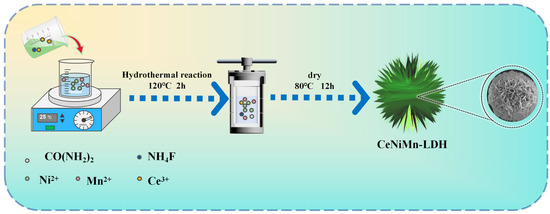
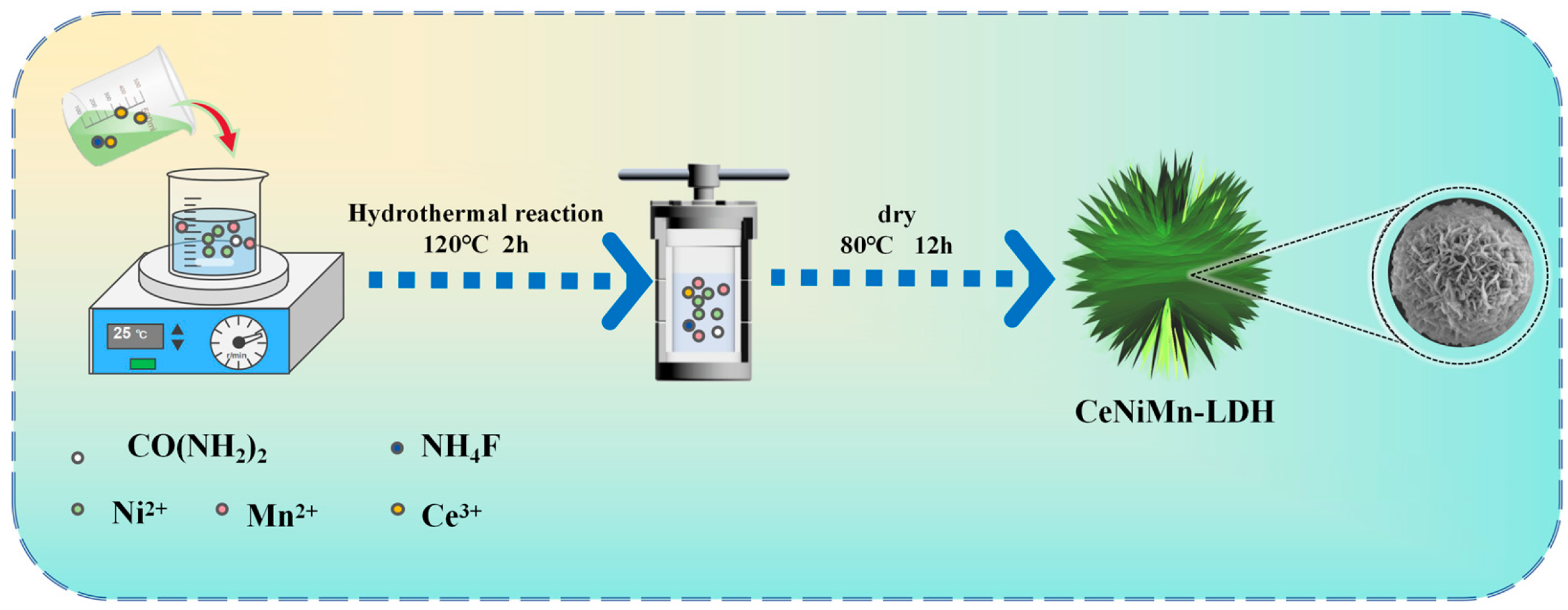
For the Ce-doped samples, as illustrated in the synthesis workflow in Figure 1, the procedure was similar to pure LDH synthesis. The key difference was the addition of Ce(NO3)3·6H2O during the precursor solution preparation stage. The molar ratio of Ce to (Ni + Mn) was controlled at 0.2, 0.3, and 0.4. Ammonium fluoride was added as a structure-directing agent while other preparation parameters remained constant. The hydrothermal conditions were fixed at 120 °C for 2 h. The final products were labeled 0.2CeNiMn-LDH, 0.3CeNiMn-LDH, and 0.4CeNiMn-LDH.
Figure 1.
Schematic diagram showing preparation of CeNiMn-LDH.
Preparation of Electrode Sheets: Working electrodes were prepared using a coating method. The active material, conductive agent (acetylene black), and binder (polyvinylidene fluoride, PVDF) were mixed in a mass ratio of 8:1:1. The mixture was ground in an agate mortar with an appropriate amount of N-methylpyrrolidone (NMP) to form a homogeneous slurry. The slurry was then uniformly coated onto nickel foam current collectors to obtain the working electrodes. The active material mass loading was maintained at approximately 2.0–3.0 mg/cm2, with the electrode thickness optimized synchronously for real conditions. This loading range and matched electrode thickness were optimized to balance high-capacity delivery and efficient ion diffusion kinetics, while ensuring the structural stability and integrity of the electrode to meet the requirements of practical device applications.
2.2. Electrochemical Measurements
Electrochemical performance was evaluated using a three-electrode system on a CHI660E workstation at room temperature (25 °C) in 6 mol/L KOH aqueous electrolyte. The synthesized material served as the working electrode, with a platinum plate as the counter electrode and a Hg/HgO electrode as the reference electrode. Test protocols included cyclic voltammetry (CV), galvanostatic charge–discharge (GCD), electrochemical impedance spectroscopy (EIS), and cycling stability tests. Based on the GCD curves, the specific capacity (C) was calculated using the following formula [4]:
In the formula, C, I, V, V1, V2 and t represent specific capacitance (unit: F/g), applied current density (unit: A/g), working voltage window (unit: V), initial voltage (unit: V), cut-off voltage (unit: V) and discharge time (unit: s), respectively.
The calculation formula for the loading mass of the positive and negative electrodes of an asymmetric supercapacitor (ASC) is as follows:
In the formula, m+ and m− are the loading masses of the positive and negative electrodes of the ASC (unit: g), respectively; C+ and C− are the specific capacitances of the positive and negative electrode materials (unit: F/g), respectively; ΔV+ and ΔV− are the positive and negative voltage windows (unit: V), respectively.
The energy density and power density of the supercapacitor battery are calculated using Equations (3) and (4), respectively:
In the formula, C represents the specific capacitance of the battery (unit: F/g), V represents the size of the voltage window (unit: V), and t represents the discharge time (unit: H).
To gain deeper insights into the charge storage mechanism, the contribution of capacitive-controlled and diffusion-controlled behaviors was quantitatively decoupled using the following equation:
In the formula, i(V) is the total response current at a specific potential (unit: A); k1v represents the peak current component contributed by the surface capacitive-controlled process (unit: A); k2v1/2 represents the peak current component contributed by the diffusion-controlled process (unit: A); and v is the scan rate (unit: V/s).
Furthermore, the power–law relationship was applied:
In the formula, i is the peak current (unit: A); v is the scan rate (unit: V/s); and a and b are adjustable parameters, where the b-value is determined by the slope of the linear plot of log(i) versus log(v).
2.3. Characterization
XRD was used to determine the crystal structure and assess the influence of Ce doping on the layered structure of NiMn-LDH. SEM was utilized to observe the microscopic morphology and the dispersion of the layered structure. TEM provided more detailed structural information, including layer thickness, lattice fringes, and the distribution of Ce elements. XPS was employed to analyze elemental composition, chemical valences, and surface electronic states to investigate the interactions between Ce, Ni, and Mn. Specific surface area and pore size distribution were analyzed via BET to determine the effect of Ce doping on porosity. Raman spectroscopy was used to characterize crystal defects, interlayer vibration modes, and interactions between Ce and the NiMn-LDH framework, providing supplementary evidence for structural changes and oxygen vacancy content.
3. Results and Discussion
3.1. Structure and Morphology of Materials
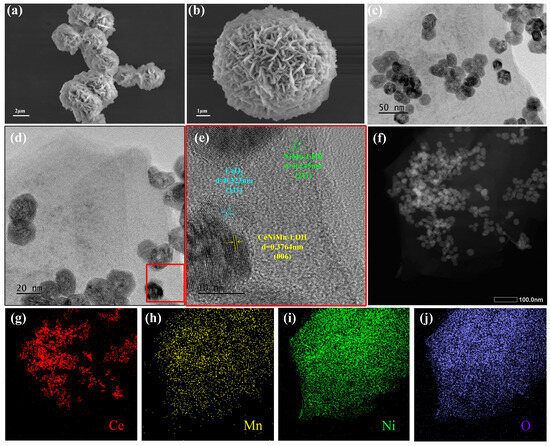
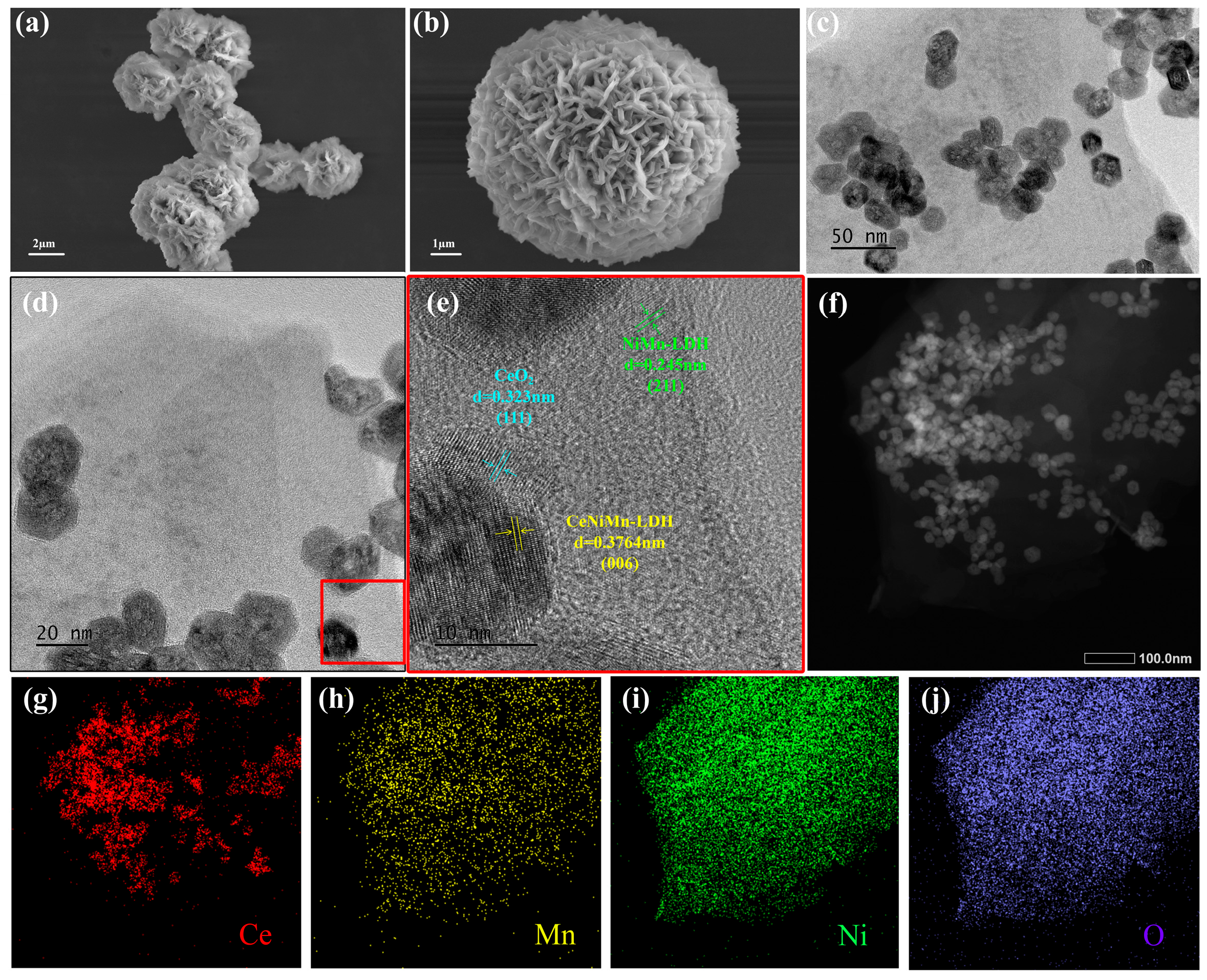
To further reveal the micro-crystal structure, lattice features, and heterojunction interface characteristics of the 0.3CeNiMn-LDH composite at the atomic scale, scanning electron microscopy (SEM) and high-resolution transmission electron microscopy (HRTEM) were employed. As shown in Figure 2a,b, the SEM images display a well-defined nanoflower-like morphology. The successful incorporation of Ce and the formation of CeO2 nanoparticles are further confirmed by HRTEM analysis and EDS mapping, which provide higher resolution and elemental distribution data. HRTEM characterization directly presents the nanoflower structure, lattice fringe details, and phase composition. As illustrated in Figure 2d, multiple sets of regular lattice fringes are observed within the same crystal domain, demonstrating excellent crystalline order. In Figure 2e, a set of lattice fringes with a spacing of 3.764 Å is assigned to the (006) plane of the NiMn-LDH phase. This measured spacing is significantly larger than the theoretical value of 3.42 Å [22] of the original NiMn-LDH, confirming the lattice expansion effect caused by the intercalation of large-radius Ce3+ ions into the interlayer regions. This expansion suppresses layer stacking and provides wider channels for rapid electrolyte ion transport, thereby shortening diffusion paths and providing a structural foundation for enhanced electrochemical performance.
Figure 2.
(a,b) SEM images of 0.3CeNiMn-LDH; (c–f) TEM image of 0.3CeNiMn-LDH; (g–j) EDS spectra of different element distributions in 0.3CeNiMn-LDH.
Additionally, another set of lattice fringes with a spacing of 3.23 Å is identified in Figure 2e, corresponding to the (111) plane of cubic CeO2 (PDF#34-0394). This result is in good agreement with the characteristic CeO2 diffraction peak at 2-theta = 27.8 degrees in the XRD pattern, confirming that at high Ce doping levels, some Ce ions crystallize into independent CeO2 nanocrystals rather than being fully incorporated into the LDH lattice. Meanwhile, lattice fringes with a spacing of 2.45 Å are assigned to the (012) plane of NiMn-LDH, indicating that the original layered framework remains intact despite high Ce doping. Energy-dispersive X-ray spectroscopy (EDX) mapping (Figure 2g–i) further reveals the uniform distribution of Ni, Mn, and Ce elements, suggesting that some Ce ions are doped into the LDH lattice, while others form CeO2 to create a heterojunction [31,32]. The formation of the CeO2/NiMn-LDH heterojunction plays a pivotal role in enhancing the electrochemical performance. The electronic coupling at the heterojunction interface induces a built-in electric field, which significantly lowers the energy barrier for charge transfer and promotes faster redox kinetics. Furthermore, the hybrid structure effectively suppresses the restacking of NiMn-LDH nanosheets, ensuring a high density of accessible active sites. The synergistic effect between the CeO2 nanoparticles and the NiMn-LDH matrix not only improves the specific capacity but also enhances the structural stability during repetitive charging and discharging processes [28].
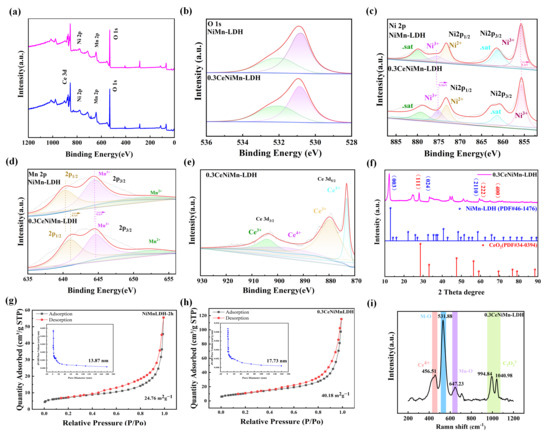
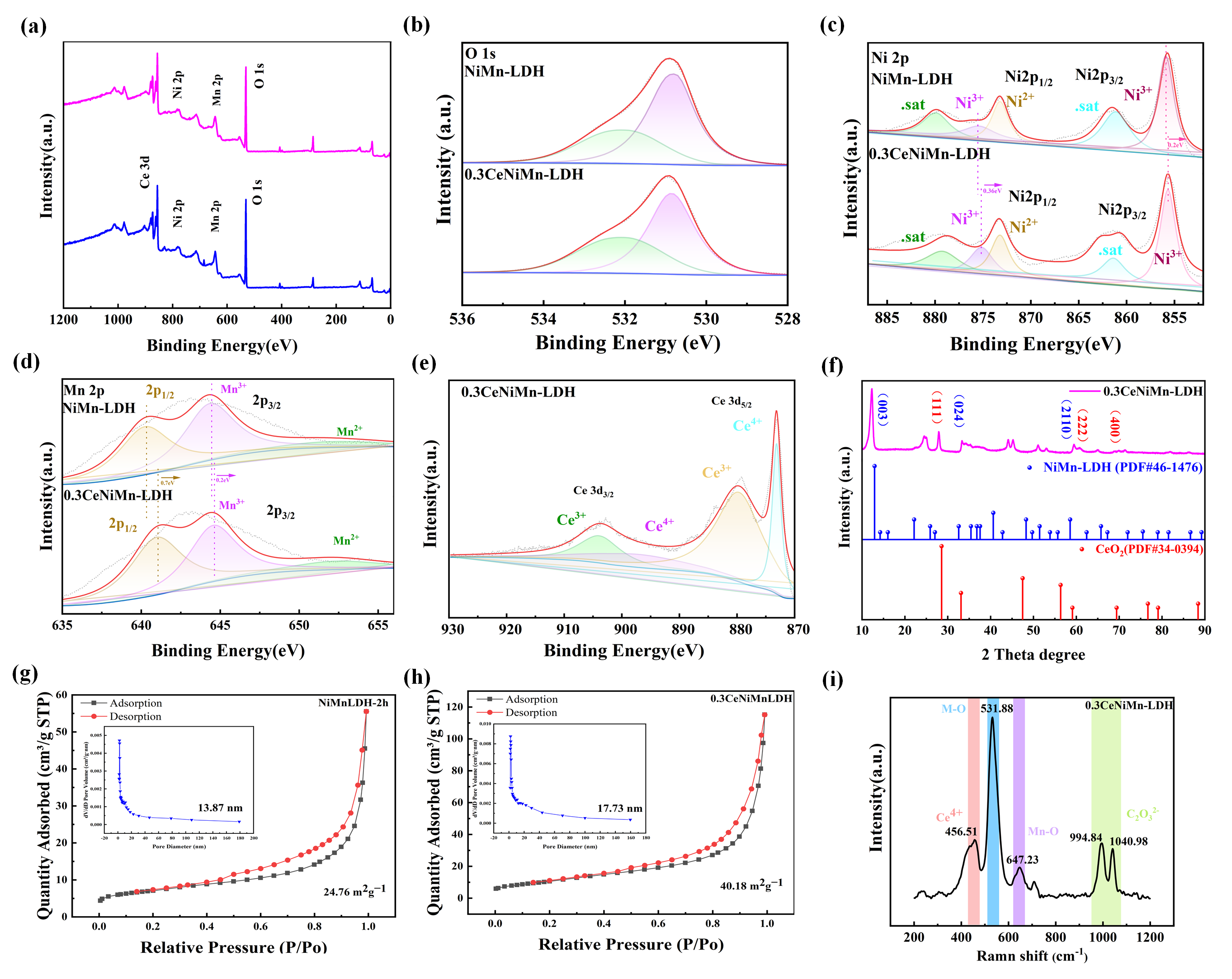
To further investigate the impact of Ce doping on the elemental composition and chemical valence states, XPS characterization was performed on the optimized 0.3CeNiMn-LDH in Figure 3a–c. The survey spectrum (Figure 3a) clearly exhibits characteristic peaks of Ni 2p, Mn 2p, Ce 3d, and O 1s, confirming the uniform distribution of these elements and the successful integration of Ce into the NiMn-LDH framework. The high-resolution O 1s spectrum (Figure 3b) is deconvoluted into two peaks at 530.8 eV and 532.0 eV, corresponding to lattice oxygen (OL) in Ni-O/Mn-O/Ce-O bonds and adsorbed oxygen/surface hydroxyl groups, respectively. The latter promotes the adsorption and interlayer diffusion of electrolyte ions (OH−), kinetically enhancing the specific capacitance [14].
Figure 3.
0.3CeNiMn-LDH (a) XPS full spectrum; (b) O1s; (c) Ni 2p; (d) Mn 2p; (e) Ce 3d; (f) XRD patterns; (g) BET of NiMn-LDH-2 h; (h) BET of 0.3CeNiMn-LDH; (i) Raman spectrum of 0.3CeNiMn-LDH.
In the Ni 2p spectrum (Figure 3c), the Ni 2p3/2 and Ni 2p1/2 main peaks are located at 855.87 eV and 876.2 eV, accompanied by satellite peaks at 861.2 eV and 880 eV. Notably, compared to pristine NiMn-LDH, the Ni 2p peaks of 0.3CeNiMn-LDH show a significant positive shift (0.2–0.36 eV). Given that the electronegativity of Ce (1.12) is lower than that of Ni (1.91), electrons transfer from Ce to Ni orbitals, leading to a redistribution of electron cloud density and a weakened shielding effect. This electron transfer activates Ni sites and induces the partial conversion of Ni2+ to Ni3+, increasing the number of active sites [23]. The Mn 2p spectrum (Figure 3d) further corroborates this strong electronic coupling, showing a coexistence of Mn2+, Mn3+, and Mn4+ states. The Mn 2p1/2 and Mn3+ peaks exhibit positive binding energy shifts (0.7 eV and 0.2 eV, respectively), validating the interfacial electron flow regulation that enhances redox reversibility [33]. The Ce 3d spectrum (Figure 3e) reveals a mixed-valence state of Ce3+ and Ce4+. The Ce3+/Ce4+ redox couple provides additional pathways for electron transfer, improving intrinsic conductivity and promoting oxygen vacancy formation to reduce charge transfer resistance [28,34]. The XRD patterns (Figure 3f) illustrate the structural modulation by Ce doping. Upon 0.3 molar Ce introduction, the (003) peak significantly shifts toward lower angles, indicating an interlayer spacing (003) expansion from 6.84 Å to 7.3 Å. This change caused by large-radius Ce3+ ions widens the transport channels for rapid ion insertion/extraction. The expansion of the interlayer spacing from 6.84 Å to 7.3 Å facilitates ion transport through two primary mechanisms. First, the enlarged gallery provides more spacious channels that significantly reduce the steric hindrance and spatial confinement for the diffusion of hydrated electrolyte ions. Second, the wider spacing weakens the electrostatic interaction between the host layers and the guest ions, thereby lowering the energy barrier for rapid ion intercalation/de-intercalation. These structural optimizations collectively lead to the observed enhancement in rate capability and high active material utilization [32].
Nitrogen adsorption–desorption isotherms (Figure 3g,h) show type IV curves with H3-type hysteresis loops for both samples. Ce doping significantly increases the adsorption capacity and broadens the hysteresis loop, suggesting that Ce prevents nanosheet aggregation and optimizes pore accessibility. The corresponding pore structure parameters are summarized in Table 1.
Table 1.
Comparison of BET of NiMn-LDH and 0.3CeNiMn-LDH.
Raman spectroscopy was used (Figure 3i). Raman spectra further verify the heterojunction formation. The 0.3Ce-modified sample exhibits a unique peak at 456.51 cm−1, assigned to the F2g stretching vibration of fluorite-structured CeO2. The coexistence of CeO2 and NiMn-LDH characteristic vibrations provides strong evidence for the successfully constructed CeO2/LDH heterojunction, which is crucial for accelerating charge transfer and enhancing electrochemical performance [35].
3.2. Electrochemical Performance
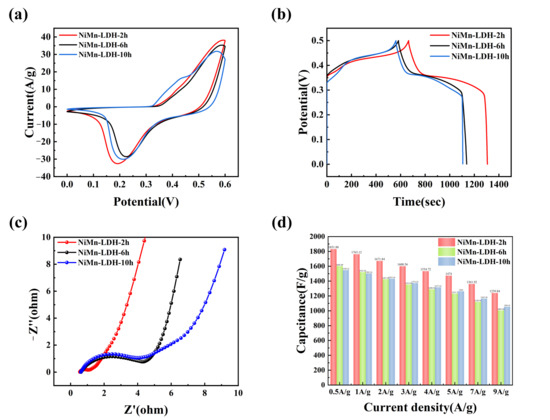
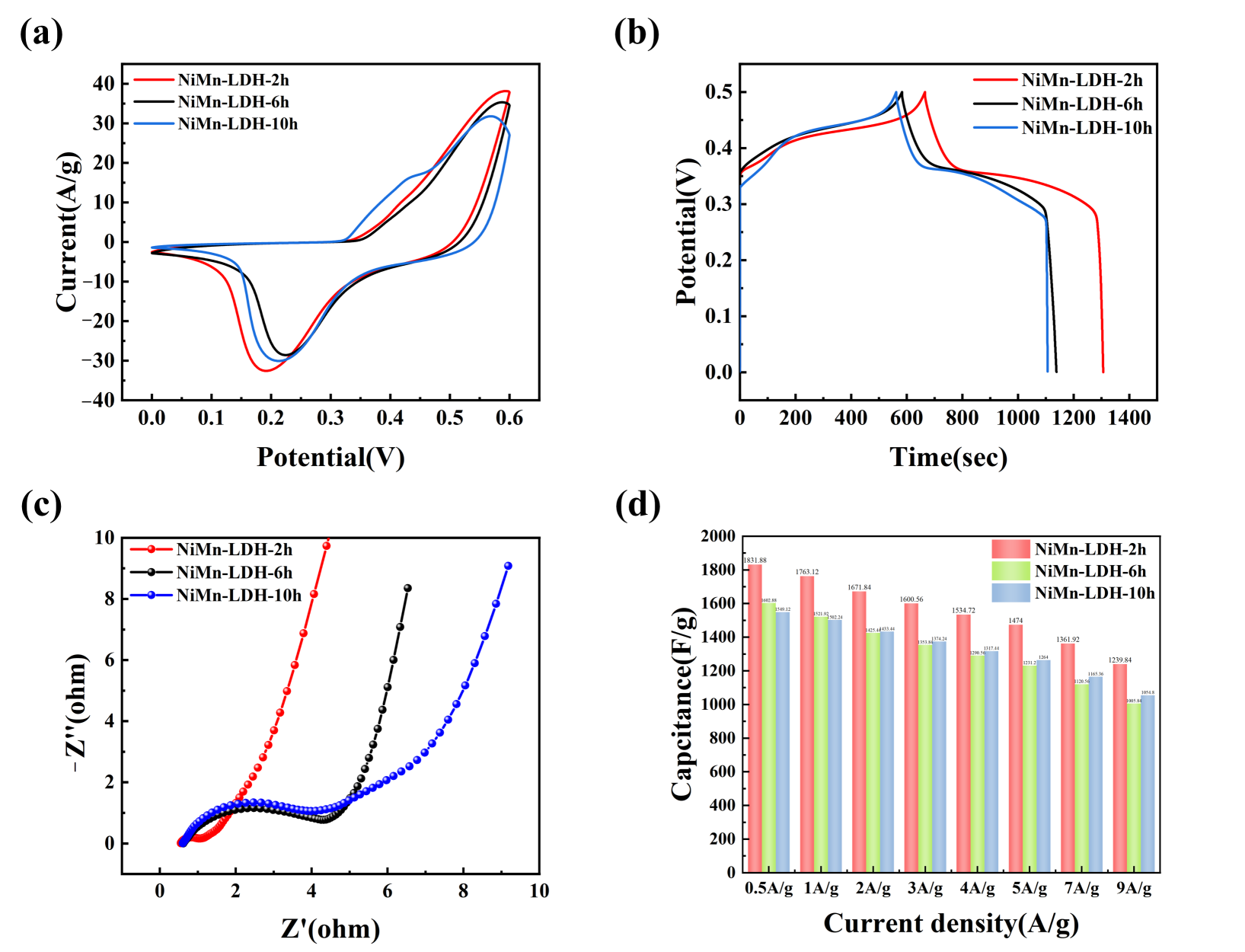
To determine the effect of hydrothermal reaction time on the electrochemical performance of undoped NiMn-LDH and identify the optimal synthesis parameters, samples prepared at different durations (NiMn-LDH-2 h, 6 h, and 10 h) were systematically evaluated via cyclic voltammetry (CV), galvanostatic charge–discharge (GCD), electrochemical impedance spectroscopy (EIS), and rate capability tests (Figure 4a–d). As shown in Figure 4a, the CV curves of all samples at the same scan rate exhibit distinct redox peaks corresponding to the reversible Ni2+/Ni3+ and Mn3+/Mn4+ transitions in alkaline electrolyte [33]. This demonstrates typical battery-like energy storage characteristics, consistent with the pseudocapacitive mechanism of NiMn-LDH. Notably, the NiMn-LDH-2 h sample possesses the largest integral area, suggesting a higher charge storage capacity and more abundant electrochemical active sites, which are closely related to its microstructure and porosity. The GCD curves (Figure 4b) reveal that NiMn-LDH-2 h exhibits the longest discharge time at the same current density, leading to a significant advantage in specific capacitance. As the hydrothermal time extends from 6 h to 10 h, the discharge time and specific capacitance progressively decrease. This is likely due to the excessive stacking of nanosheets or grain growth during prolonged hydrothermal treatment, which reduces the effective electrochemical surface area and hinders the exposure of active sites. EIS results (Figure 4c) further elucidate the charge transfer kinetics. NiMn-LDH-2 h displays the smallest semicircle diameter in the high-frequency region, indicating the lowest interfacial charge transfer resistance (Rct). Furthermore, its steeper slope in the low-frequency region signifies higher electrolyte ion diffusion efficiency, confirming that a 2 h hydrothermal duration facilitates the construction of efficient electron/ion transport channels. The rate capability curves (Figure 4d) show that at a low current density of 1 A/g, NiMn-LDH-2 h delivers a maximum specific capacitance of 1763.12 F/g, significantly outperforming NiMn-LDH-6 h (1521.92 F/g) and NiMn-LDH-10 h (1502.24 F/g). When the current density increases to 9 A/g, NiMn-LDH-2 h maintains a capacity retention of approximately 67.7%, demonstrating superior rate performance. Consequently, 2 h was determined as the optimal hydrothermal time for undoped NiMn-LDH as it yields a loosely stacked nanosheet morphology that synergistically enhances specific capacitance and kinetics. Therefore, the synthesis duration for all subsequent Ce-doped samples was fixed at 2 h to accurately investigate the modification effects of Cerium.
Figure 4.
Comparison of electrochemical testing performance of NiMn-LDH under different hydrothermal times: (a) comparison charts of CV (10 mV/s); (b) comparison charts of GCD (1 A/g); (c) comparison charts of Nyquist; (d) comparison charts of specific capacity.
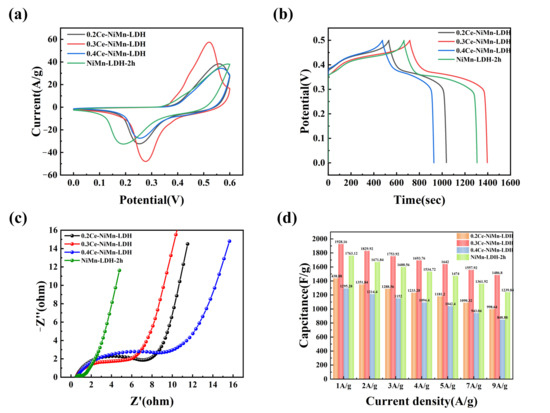
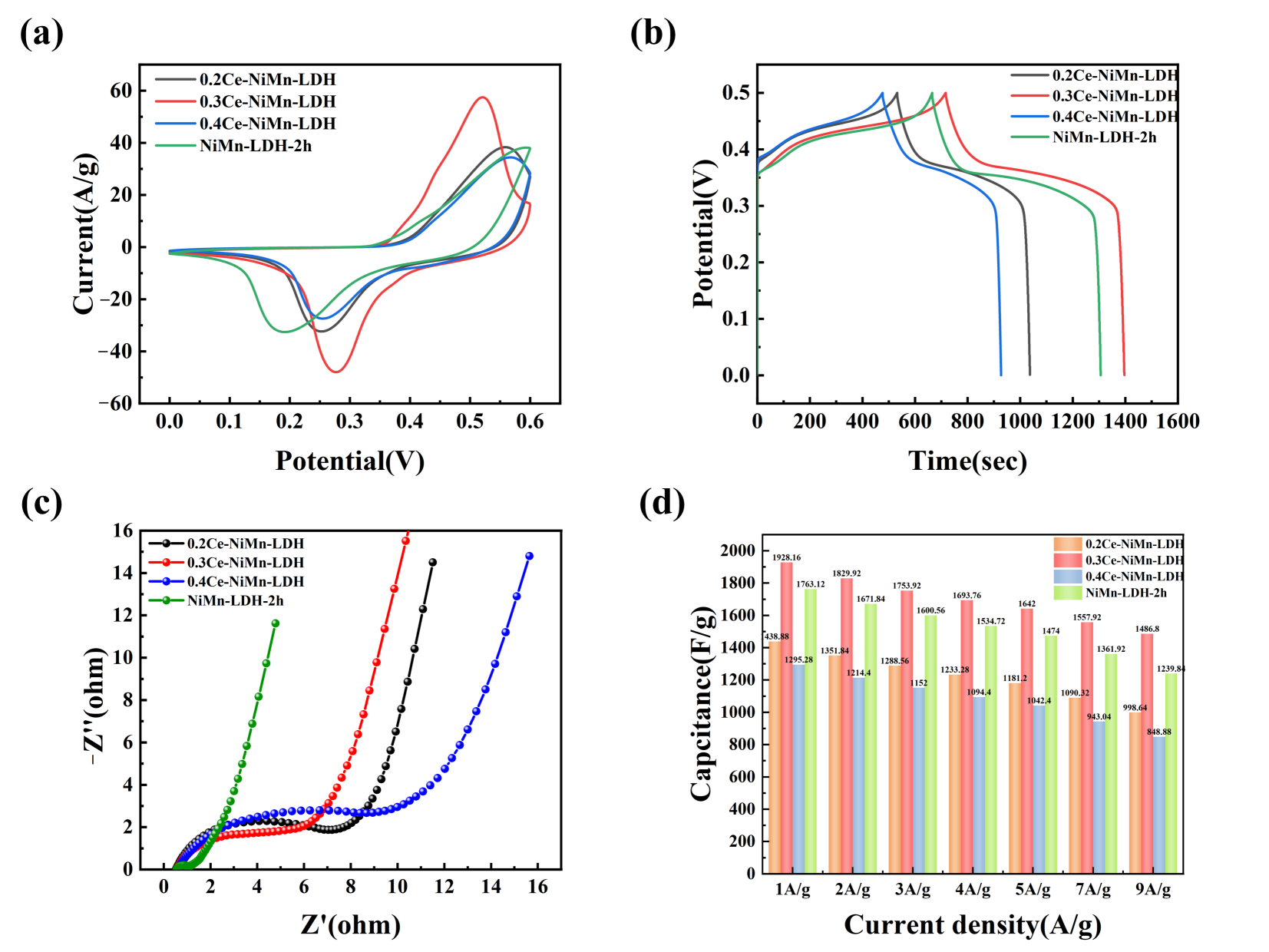
Based on the optimized hydrothermal duration of 2 h, the reaction conditions were fixed (120 °C, 2 h) to investigate the effects of different Ce doping concentrations (0.2, 0.3, and 0.4 molar ratios) on the electrochemical performance of NiMn-LDH. The structure–performance relationships were systematically analyzed via CV, GCD, EIS, and rate capability tests (Figure 5a–d), with 0.3CeNiMn-LDH identified as the optimal composition.
Figure 5.
Comparison of electrochemical testing performance of CeNiMn-LDH with different Ce-doped samples: (a) comparison charts of CV (10 mV/s); (b) comparison charts of GCD (1 A/g); (c) comparison charts of Nyquist; (d) comparison charts of specific capacity.
Figure 5a displays the CV curves of samples with various Ce doping levels at the same scan rate. All samples exhibit prominent redox peaks, indicating that the capacitance predominantly originates from pseudocapacitive mechanisms associated with the reversible Ni2+/Ni3+ and Mn2+/Mn3+/Mn4+ transitions in the alkaline electrolyte [33]. Notably, the 0.3CeNiMn-LDH sample shows a smaller potential difference between the oxidation and reduction peaks compared to the 0.2Ce and 0.4Ce samples. This reduced peak separation signifies lower electrode polarization and minimized energy loss during redox processes, thereby enhancing electrochemical reversibility [24].
The GCD curves at 1 A/g (Figure 5b) further confirm the pseudocapacitive nature, exhibiting typical triangular symmetry and distinct voltage plateaus that align well with the CV results. The 0.3CeNiMn-LDH sample shows a significantly extended discharge time, which is attributed to a synergistic modification effect: (i) the intercalation of Ce3+ ions expands the interlayer spacing from 6.84 Å to 7.3 Å, suppressing agglomeration and widening ion transport channels; (ii) Ce doping modulates the electronic structure to facilitate the conversion of low-valence metal ions to higher-valence states, creating more active sites for charge storage [36].
The Nyquist plots (Figure 5c) reveal distinct impedance characteristics. The 0.3CeNiMn-LDH sample possesses the smallest high-frequency semicircle diameter, indicating the lowest charge transfer resistance (Rct) and highest electron transfer efficiency at the electrode/electrolyte interface. In the low-frequency region, its nearly vertical slope confirms superior ion diffusion kinetics, consistent with the earlier BET results showing the largest surface area and optimal pore size distribution for this sample [37].
As shown in Figure 5d, 0.3CeNiMn-LDH demonstrates the best rate capability across a current density range of 1–9 A/g. At 1 A/g, it delivers a high specific capacitance of 1928.16 F/g. Even at a high current density of 9 A/g, the sample retains a capacitance of 1486.8 F/g (77.1% retention), significantly outperforming the pristine NiMn-LDH and other Ce-doped samples. This exceptional performance results from the synergy of expanded interlayer spacing, developed hierarchical porosity, and the stable CeO2/NiMn-LDH heterojunction, which collectively facilitate rapid ion/electron transport even under high-rate conditions [32]. The improved conductivity stems from the synergy between oxygen vacancy induction and interfacial electronic coupling. Ce3+-induced oxygen vacancies act as electron donors, while the CeO2/NiMn-LDH heterostructure accelerates charge transfer kinetics, markedly reducing charge transfer resistance [38].
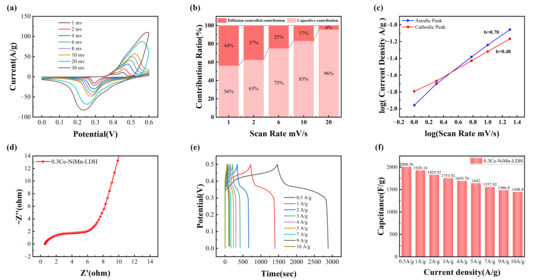
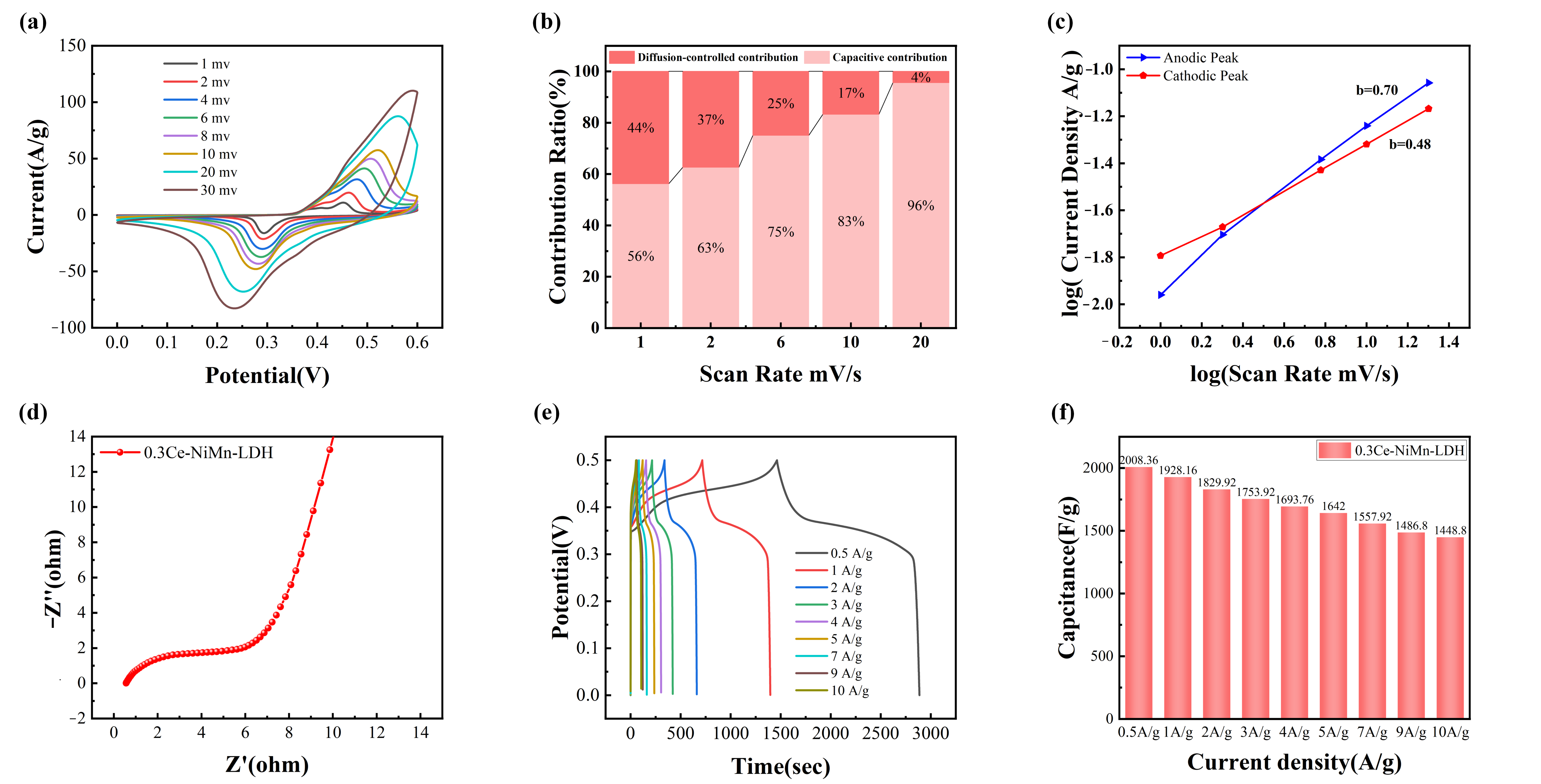
To gain deeper insights into the intrinsic mechanisms underlying the enhanced electrochemical performance of Ce-doped NiMn-LDH, a systematic kinetic analysis was conducted on the optimized 0.3CeNiMn-LDH sample. Figure 6a displays the CV curves at scan rates ranging from 1 to 30 mV/s. Even at a high scan rate of 30 mV/s, the redox peaks remain well-defined and symmetrical without significant distortion, demonstrating excellent electrochemical reversibility and structural stability across a broad scan rate range.
Figure 6.
Electrochemical performance charts of 0.3CeNiMn-LDH: (a) CV diagram; (b) capacitive contribution diagram; (c) b-values; (d) EIS diagram; (e) specific capacity diagram; (f) GCD diagram.
To quantitatively decouple the contributions of diffusion-controlled and capacitive-controlled processes to the total energy storage, the peak current deconvolution Formula (5) was employed. As shown in Figure 6b, the capacitive contribution is 56% at a low scan rate of 1 mV/s and significantly increases to 96% as the scan rate rises to 20 mV/s. This high proportion of capacitive contribution is the primary reason for the superior rate capability of 0.3CeNiMn-LDH. The Ce doping modification manifests in two aspects: (i) expanding the interlayer spacing to accelerate ion diffusion (optimizing diffusion kinetics) and (ii) modulating the surface structure and increasing active sites to enhance rapid pseudocapacitive response (strengthening capacitive contribution) [39].
The energy storage mechanism was further quantified using the power–law relationship Formula (6) (Figure 6c). The fitting results yield b-values of 0.70 for the anodic peak and 0.48 for the cathodic peak. These values indicate a mixed energy storage mechanism involving both diffusion-controlled battery-like behavior and surface-induced capacitive contribution, which complement each other to maximize overall performance [40].
Electrochemical impedance spectroscopy (EIS) was employed to further investigate the charge transfer and ion diffusion kinetics (Figure 6d). The equivalent series resistance Rs is calculated to be only 0.59 Ω, indicating excellent intrinsic conductivity and minimal contact resistance. The charge transfer resistance Rct, represented by the semicircle diameter in the high-frequency region, is as low as 25.74 Ω. This low Rct is attributed to the optimized electronic structure and the generation of oxygen vacancies induced by Ce doping, which collectively reduce the activation energy for redox reactions.
The GCD results in Figure 6e,f further validate the practical storage capacity of 0.3CeNiMn-LDH. At a low current density of 1 A/g, the sample delivers an exceptional specific capacitance of 1928.16 F/g. Even when the current density is increased by 10-fold to 10 A/g, the capacitance remains at 1448.8 F/g, representing a high rate retention of 75.1%. This robustness at high current densities is highly consistent with the kinetic analysis findings of dominant capacitive-controlled processes, directly confirming the effectiveness of the mixed storage mechanism. The electrochemical performance exhibits a volcano-like trend. The 0.2Ce sample lacks sufficient dopants, while for the 0.4Ce sample, excessive CeO2 nanoparticles may lead to the partial blockage of ion diffusion pathways. The 0.3Ce level achieves an optimal balance between maximum lattice expansion and efficient charge transfer. To evaluate the electrochemical superiority, the performance was compared with reported NiMn-LDH materials. As summarized in Table 2, the specific capacitance of 1928.16 F/g exceeds many binary composites, consistent with the structural benefits of Ce doping.
Table 2.
Other reported NiMn-LDH materials.
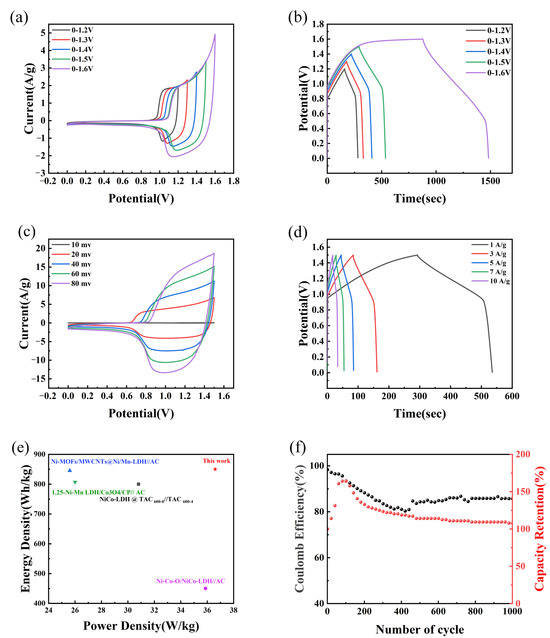
To further evaluate the practical energy storage potential of the optimized 0.3CeNiMn-LDH electrode, an asymmetric hybrid supercapacitor (AHSC) was assembled using 0.3CeNiMn-LDH as the positive electrode and activated carbon (AC) as the negative electrode. As shown in Figure 7a,b, the operating voltage window of the AHSC was explored through CV (10 mV/s) and GCD (1 A/g) tests at various potential ranges. The results indicate that the device can stably operate at a wide voltage window of up to 1.5 V without significant electrolyte decomposition or polarization, which is chosen as the optimal operating range for subsequent evaluations. The CV curves of the 0.3CeNiMn-LDH//AC AHSC at 0–1.5 V (Figure 7c) exhibit a combination of electric double-layer capacitance (EDLC) from the AC and prominent Faradaic redox peaks from the LDH, confirming the hybrid energy storage mechanism. The corresponding GCD curves (Figure 7d) maintain distinct discharge plateaus and excellent temporal symmetry, suggesting high coulombic efficiency and reversible electrochemical kinetics.
Figure 7.
Electrochemical performance of 0.3CeNiMn-LDH//AC supercapacitors: (a) CV plots at different voltage windows of 10 mV/s; (b) GCD plots at different voltage windows of 1 A/g; (c) CV plot at 0–1.5 V; (d) GCD plot at 0–1.5 V; (e) Ragone plot (energy densities vs. power density); (f) cycle life diagram of supercapacitors (current density of 1 A/g).
The energy density and power density of the device were calculated and presented in the Ragone plot (Figure 7e). The AHSC delivers a maximum energy density of 36.36 Wh/kg at a power density of 850 W/kg, which is superior to the previously reported supercapacitors Ni-MOFs/MWCNTs@Ni/Mn-LDH//AC (845.3 W/Kg, 25.6 Wh/Kg) [19], 1.25-Ni-MnLDH/Co3O4/CP//AC (807 W/Kg,26 Wh/Kg) [44], NiCo-LDH@TAC600-0//TAC600-4 (800 W/Kg, 30.8 Wh/Kg) [41], and Ni-Co-O/NiCo-LDH//AC (449.99 W/Kg, 35.87 Wh/Kg) [18]. Furthermore, the long-term cycling stability was evaluated at a current density of 1 A/g (Figure 7f). The initial increase in capacitance is attributed to the electrochemical activation process, where the electrolyte gradually infiltrates the hierarchical nanoflowers and expanded interlayer galleries, effectively increasing the electrochemically active surface area. Once the active sites are fully accessible, the capacitance reaches its peak and then follows a standard gradual degradation trend. The device maintains a stable Coulombic efficiency of 85% after 1000 cycles, highlighting its robust structural stability and potential for durable energy storage applications. Regarding the Coulombic efficiency, the 0.3Ce-NiMn-LDH electrode maintains a value of approximately 85% after 1000 cycles. The Coulombic efficiency of approximately 85% after 1000 cycles is within the expected range for LDH-based materials tested in alkaline media. This value represents a standard and acceptable level of reversibility for pseudocapacitive electrodes, balancing high specific capacitance with stable cycling performance, which confirms the practical potential of the 0.3Ce-NiMn-LDH material.
4. Conclusions
In conclusion, the nanoflower-like 0.3CeNiMn-LDH composite synthesized via a facile one-step hydrothermal method demonstrates exceptional electrochemical performance. As a slurry-cast electrode, it delivers a remarkable specific capacitance of 1928.16 F/g at 1 A/g and maintains a high rate retention of 75.1% at 10 A/g, significantly outperforming the pristine NiMn-LDH. The fundamental reasons for this performance enhancement lie in the synergistic effects of rare-earth element modulation and heterostructure engineering. Characterization results and kinetic analysis reveal that the intercalation of large-radius Ce3+ ions successfully expanded the (003) interlayer spacing from 6.84 Å to 7.3 Å. This expansion, coupled with the formation of a CeO2/NiMn-LDH heterojunction, constructs high-flux pathways for rapid ion diffusion and optimizes the electronic structure for accelerated charge transfer. Consequently, the electrode exhibits a dominant capacitive-controlled contribution of 96% at 20 mV/s, effectively mitigating nanosheet aggregation and enhancing redox activity. Furthermore, the assembled 0.3CeNiMn-LDH//AC asymmetric hybrid supercapacitor (AHSC) demonstrates excellent practical potential, achieving a competitive energy density of 36.36 Wh/kg at a power density of 850 W/kg. This energy performance surpasses many previously reported LDH-based systems. The device also exhibits robust cyclic durability, characterized by a unique electrochemical activation process that leads to capacity retention exceeding 100%. These findings confirm that rare-earth element modulation is a highly effective strategy for engineering advanced LDH electrodes, offering significant insights for next-generation high-performance energy storage systems. While this study demonstrates the potential of CeO2/NiMn-LDH composites, limitations persist. The core challenges lie in insufficient intrinsic electronic conductivity and compromised cycling stability from layered stacking and interfacial attenuation. Future work will focus on composite engineering with 2D conductive materials (e.g., graphene, MXene) to synergistically enhance conductivity and cycling performance for practical device applications.
Author Contributions
Writing and data curation, Y.S.; validation, R.Z. and Y.Z.; review and editing, X.M.; supervision, M.L. All authors have read and agreed to the published version of the manuscript.
Funding
This work was supported by the National Natural Science Foundation of China (NSFC) (Grant No. 62004178) and the Fundamental Research Program of Shanxi Province (Grant No. 202203021212149).
Institutional Review Board Statement
Not applicable.
Informed Consent Statement
Not applicable.
Data Availability Statement
Data are available upon request.
Conflicts of Interest
The authors declare no conflicts of interest.
References
- Mao, X.; He, X.; Yang, W.; Liu, H.; Zhou, Y.; Xu, J.; Yang, Y. Hierarchical holey Co9S8@S-rGO hybrid electrodes for high-performance asymmetric supercapacitors. Electrochim. Acta 2019, 328, 135078. [Google Scholar] [CrossRef] [Scilit]
- Muniraj, V.K.A.; Srinivasa, M.K.; Yoo, H.D. Flexible supercapacitors toward wearable energy storage devices. Bull. Korean Chem. Soc. 2023, 44, 125–136. [Google Scholar] [CrossRef] [Scilit]
- Zhao, W.W.; Jiang, M.Y.; Wang, W.K.; Liu, S.J.; Huang, W.; Zhao, Q. Flexible Transparent Supercapacitors: Materials and Devices. Adv. Funct. Mater. 2021, 31, 2009136. [Google Scholar] [CrossRef] [Scilit]
- Mao, X.; Liu, H.; Niu, T.; Yan, X.; Li, M. TEA Guiding Bimetallic MOF with Oriented Nanosheet Arrays for High-Performance Asymmetric Supercapacitors. Polymers 2024, 16, 3198. [Google Scholar] [CrossRef] [Scilit]
- Lu, W.; Deng, W.; Zheng, X.; Lin, K.; Liu, M.; Zhu, G.; Lin, J.; Wei, Y.; Wang, F.; Liu, J. The Enhanced Electrochemical Properties of Lithium-Rich Manganese-Based Cathode Materials via Mg-Al Co-Doping. Coatings 2024, 15, 3. [Google Scholar] [CrossRef] [Scilit]
- Zhang, A.; Zhang, Q.; Huang, J.; Fu, H.; Zong, H.; Guo, H. NiMnCo-LDH in-situ derived from ZIF-67@ZnO as self-supporting electrode for asymmetric supercapacitor device. Chem. Eng. J. 2024, 487, 150587. [Google Scholar] [CrossRef] [Scilit]
- Zhang, Y.; Mei, H.X.; Cao, Y.; Yan, X.H.; Yan, J.; Gao, H.L.; Luo, H.W.; Wang, S.W.; Jia, X.D.; Kachalova, L.; et al. Recent advances and challenges of electrode materials for flexible supercapacitors. Coord. Chem. Rev. 2021, 438, 213910. [Google Scholar] [CrossRef] [Scilit]
- Yan, Y.N.; Zhou, Y.; Li, Y.F.; Liu, Y.Z. The new focus of energy storage: Flexible wearable supercapacitors. Carbon Lett. 2023, 33, 1461–1483. [Google Scholar] [CrossRef] [Scilit]
- Conway, B.E. Transition from supercapacitor to battery behavior in electrochemical energy storage. J. Electrochem. Soc. 1991, 138, 1539–1548. [Google Scholar] [CrossRef] [Scilit]
- Du, Y.Q.; Xiao, P.; Yuan, J.; Chen, J.W. Research Progress of Graphene-Based Materials on Flexible Supercapacitors. Coatings 2020, 10, 892. [Google Scholar] [CrossRef] [Scilit]
- Duan, M.H.; Ren, Y.; Sun, X.Y.; Zhu, X.Y.; Wang, X.L.; Sheng, L.; Liu, J. EGaln Fiber Enabled Highly Flexible Supercapacitors. ACS Omega 2021, 6, 24444–24449. [Google Scholar] [CrossRef] [Scilit]
- Hu, M.; Zhang, H.; Hu, T.; Fan, B.; Wang, X.; Li, Z. Emerging 2D MXenes for supercapacitors: Status, challenges and prospects. Chem. Soc. Rev. 2020, 49, 6666–6693. [Google Scholar] [CrossRef] [Scilit]
- Jang, S.; Kang, J.; Kwak, S.; Seol, M.L.; Meyyappan, M.; Nam, I. Methodologies for Fabricating Flexible Supercapacitors. Micromachines 2021, 12, 163. [Google Scholar] [CrossRef] [Scilit] [PubMed]
- Wang, J.; Liu, Y.; Yang, G.; Jiao, Y.; Dong, Y.; Tian, C.; Yan, H.; Fu, H. MXene-Assisted NiFe sulfides for high-performance anion exchange membrane seawater electrolysis. Nat. Commun. 2025, 16, 1319. [Google Scholar] [CrossRef] [Scilit] [PubMed]
- Li, M.; Li, Z.Q.; Qu, L.J.; Chen, F.X.; Tian, M.W. Recent Progress of the Active Materials with Various Micro-structures for Flexible Textile-Based Supercapacitors. Adv. Fiber Mater. 2022, 4, 1005–1026. [Google Scholar] [CrossRef] [Scilit]
- Tang, Y.Q.; Shen, H.M.; Cheng, J.Q.; Liang, Z.B.; Qu, C.; Tabassum, H.; Zou, R.Q. Fabrication of Oxygen-Vacancy Abundant NiMn-Layered Double Hydroxides for Ultrahigh Capacity Supercapacitors. Adv. Funct. Mater. 2020, 30, 8223. [Google Scholar] [CrossRef] [Scilit]
- Owusu, K.A.; Wang, Z.; Saad, A.; Boakye, F.O.; Mushtaq, M.A.; Tahir, M.; Yasin, G.; Liu, D.; Peng, Z.; Cai, X. Room Temperature Synthesis of Vertically Aligned Amorphous Ultrathin NiCo-LDH Nanosheets Bifunctional Flexible Supercapacitor Electrodes. Energy Environ. Mater. 2023, 7, 12545. [Google Scholar] [CrossRef] [Scilit]
- Ouyang, L.; Hsiao, C.-H.; Chen, Y.-C.; Lee, C.-Y.; Tai, N.-H. Fabrication of Ni-Mn LDH/Co3O4 on carbon paper for the application in supercapacitors. Surf. Interfaces 2022, 28, 101574. [Google Scholar] [CrossRef] [Scilit]
- Meng, T.-L.; Wang, J.-W.; Ma, Y.-X.; Chen, X.-Q.; Lei, L.; Li, J.; Ran, F. Fabrication of a novel nanohybrid via the introduction of Ni/Mn-LDH into Ni-MOFs/MWCNTs for high-performance electrochemical supercapacitor. Diam. Relat. Mater. 2024, 143, 110901. [Google Scholar] [CrossRef] [Scilit]
- Jiang, J.; Luo, Y.; Wang, X.; Liu, Z.; Cui, S.; Cheng, L.; Li, Z.; Jiao, Z. Synergistic engineering of structure and interface in NiMn-LDH on hollow graphene spheres for high-performance flexible supercapacitors. J. Alloys Compd. 2025, 1048, 185146. [Google Scholar] [CrossRef] [Scilit]
- Li, R.Q.; Liu, Y.Q.; Li, H.B.; Zhang, M.; Lu, Y.R.; Zhang, L.; Xiao, J.P.; Boehm, F.; Yan, K. One-Step Synthesis of NiMn-Layered Double Hydroxide Nanosheets Efficient for Water Oxidation. Small Methods 2019, 3, 1800344. [Google Scholar] [CrossRef] [Scilit]
- Sivaraman, N.; Kumaravel, N.; Thangamuthu, R. Hierarchical NiMnLDH decorated porous carbon nanotubes with N-doped graphitic carbon for electrochemical sensing of 4-nitrophenol. Mikrochim. Acta 2025, 192, 142. [Google Scholar] [CrossRef] [Scilit] [PubMed]
- Wang, J.; Li, S.; Guo, Y.; Ding, J.; Lu, Z. Preparation of S-Doped Ni-Mn-Fe Layered Hydroxide for High-Performance of Oxygen Evolution Reaction. Coatings 2025, 15, 825. [Google Scholar] [CrossRef] [Scilit]
- Xiao, L.; Bai, X.; Wang, Z.; Guan, J. Synergistic spin effects in medium-entropy Ni–Fe–Mn–Ce oxyhydroxides for seawater oxidation. Chem. Sci. 2025, 16, 22010–22020. [Google Scholar] [CrossRef] [Scilit]
- Zhou, L.L.; Xie, R.G.; Wang, L.J. Application of Layered Double Hydroxides in Electrocatalysis. Prog. Chem. 2019, 31, 275–282. [Google Scholar] [CrossRef]
- Sui, Z.; Xu, Q.; Cheng, J.; Zhang, C.; Chen, Y.; Liu, K.; Lei, S.; Zhang, L.; Guo, F. Coupling interface constructions of clustered Mn-CoFeSe2 derived from CoFe-LDH for efficient overall water splitting. Fuel 2026, 410, 138000. [Google Scholar] [CrossRef] [Scilit]
- Sui, Z.; Xu, Q.; Cheng, J.; Zhang, C.; Liu, K.; Lei, S.; Zhang, L.; Guo, F. Interfacial electronic structure regulation of MoSe2–NiSe2–FeSe2 ternary heterojunction for pH-universal hydrogen evolution reaction. Int. J. Hydrogen Energy 2026, 207, 153520. [Google Scholar] [CrossRef] [Scilit]
- Zhang, Y.; Hai, G.; Huang, Z.; Liu, Z.; Huang, X.; Wang, G. Ce-Doping Rather Than CeO2 Modification and Their Synergistic Effect: Promotion from Ce Species in the Electrocatalytic Oxidation of 5-Hydroxymethylfurfural Over NiFe–LDH. Adv. Energy Mater. 2024, 14, 2401449. [Google Scholar] [CrossRef] [Scilit]
- Hu, R.; Fan, C.; Wang, K.; Liu, P.; Wang, Y.-Q. Synergistic effect of Ce doping and heterointerface engineering of NiCoP/Ce-NiCo LDH for durable and corrosion-resistant electrocatalysis in alkaline freshwater and seawater oxidation. J. Colloid Interface Sci. 2025, 700, 138590. [Google Scholar] [CrossRef] [Scilit]
- Liu, Q.; Tan, G.; Long, Y.; Wei, J.; Tian, H.; Xie, S.; Tang, Y. In situ formation of CeO2 coupled with hollow NiCo-LDH nanosheets for efficient photocatalytic hydrogen evolution. Inorg. Chem. Front. 2024, 11, 5080–5090. [Google Scholar] [CrossRef] [Scilit]
- Wang, X.; Yan, H.; Zhang, J.; Hong, X.; Yang, S.; Wang, C.; Li, Z. Stamen-petal-like CeO2/NiMn layered double hydroxides composite for high-rate-performance supercapacitor. J. Alloys Compd. 2019, 810, 151911. [Google Scholar] [CrossRef] [Scilit]
- Xu, Q.; Jiu, H.; Zhang, L.; Guo, F.; Sui, Z.; Chai, X.; Chen, K.; Zhang, Y.; Wang, Y. Defect-rich CeO2 and V doping synergistically modulate the d orbitals of CoFeV-LDH@CeO2 for efficient overall water splitting. Fuel 2026, 416, 138486. [Google Scholar] [CrossRef] [Scilit]
- Yan, A.L.; Wang, X.C.; Cheng, J.P. Research Progress of NiMn Layered Double Hydroxides for Supercapacitors: A Review. Nanomaterials 2018, 8, 747. [Google Scholar] [CrossRef] [Scilit] [PubMed]
- Lu, Y.; Wu, T.; Ma, Z.M.; Mi, Y.J.; Zhao, Z.Q.; Liu, F.; Cao, X.; Wang, N. Integration of Flexible Supercapacitors with Triboelectric Nanogenerators: A Review. Batteries 2023, 9, 281. [Google Scholar] [CrossRef] [Scilit]
- Yang, M.; Ge, W.; Liu, Z.; Yue, Q.; Zhang, J.; Lv, Y.; Wu, H. Synthesis of defective Ni-Mn layered double hydroxides nanosheets via alkali-assisted Mo doping for urea electro-oxidation. Fuel 2024, 356, 129626. [Google Scholar] [CrossRef] [Scilit]
- Shan, L.; Xiong, L. High-Energy Supercapacitor Constructed by Cerium-Doped Iron Tungstate Cathode Materials with Oxygen Vacancies and Hydrophilic Carbon Nanotube Anode. Coatings 2025, 15, 1330. [Google Scholar] [CrossRef] [Scilit]
- Guo, X.; Sun, X.; Wang, L.; Qiao, Y.; Dong, S. Investigation of the Structure and Electrochemical Performance of Perovskite Oxide La1−xCaxCrO3 Utilized as Electrode Materials for Supercapacitors. Coatings 2025, 15, 837. [Google Scholar] [CrossRef] [Scilit]
- Zhang, L.; Liang, J.; Zhang, Y.; Lei, T.; Yang, G.; Li, Y. Hierarchical Ce-doped NiMn-LDH nanoflowers: Tailoring active sites via electrodeposition towards superior overall water splitting. New J. Chem. 2025, 49, 20490–20499. [Google Scholar] [CrossRef] [Scilit]
- Wang, J.; Li, J.; Wang, F.; Zhang, X.; Wu, X.; Zhang, J.; Niu, S.; Chen, L. Introducing Ce into the interface of NiCo LDH@PBAs to build multi core–shell electrode with superior stability of supercapacitor. Chem. Eng. J. 2024, 488, 150932. [Google Scholar] [CrossRef] [Scilit]
- Yin, Q.; Gao, B.; Fu, H.; Hu, L. NiCo Prussian-Blue-Derived Cobalt–Nickel-Layered Double Hydroxide with High Electrochemical Performance for Supercapacitor Electrodes. Coatings 2023, 13, 554. [Google Scholar] [CrossRef] [Scilit]
- Zhao, W.; Deng, J.; Li, M.; Du, G.; Fan, M.; Gao, H.; Yuan, Z. Rational synthesis of sea urchin-like NiCo-LDH/tannin carbon microsphere composites using microwave hydrothermal technique for high-performance asymmetric supercapacitor. Adv. Compos. Hybrid Mater. 2025, 8, 215. [Google Scholar] [CrossRef] [Scilit]
- Hou, Z.R.; Zhang, H.Y.; Zhou, X.S.; Yu, J. Electrical and structural engineering of nanoflower-like NiMn-layered double hydroxide by V modulation for high-performance hybrid supercapacitors. Electrochim. Acta 2024, 483, 144028. [Google Scholar] [CrossRef] [Scilit]
- Hou, Z.R.; Yu, J.; Zhou, X.S.; Chen, Z.B.; Xu, J.W.; Zhao, B.Y.; Gen, W.B.; Zhang, H.Y. Enhanced performance of hybrid supercapacitors by the synergistic effect of Co(OH)2 nanosheets and NiMn layered hydroxides. J. Colloid Interface Sci. 2023, 646, 753–762. [Google Scholar] [CrossRef] [Scilit] [PubMed]
- Luo, Y.; Feng, X.; Wei, D.; Zhang, L.; Wang, Q.; Yang, F.; Qiu, S.; Xu, F.; Zou, Y.; Sun, L.; et al. Structure-Engineered Core–Shell Ni–Co–O/NiCo-LDH Nanospheres as High-Performance Supercapacitor Electrodes. Coatings 2023, 13, 353. [Google Scholar] [CrossRef] [Scilit]

Disclaimer/Publisher’s Note: The statements, opinions and data contained in all publications are solely those of the individual author(s) and contributor(s) and not of MDPI and/or the editor(s). MDPI and/or the editor(s) disclaim responsibility for any injury to people or property resulting from any ideas, methods, instructions or products referred to in the content. |
© 2026 by the authors. Licensee MDPI, Basel, Switzerland. This article is an open access article distributed under the terms and conditions of the Creative Commons Attribution (CC BY) license.