1. Introduction
Edible films are food preservation technologies that act as semipermeable barriers, reducing the dehydration rate in fresh or fresh-cut horticultural products. They are usually thin and pre-formed matrices that act as a protective barrier by reducing the migration of moisture, oxygen, carbon dioxide and aromas. They also reduce metabolic processes such as respiration and senescence and delay microbial growth, providing products with an acceptable color, aroma, taste and texture [
1]. Therefore, edible films preserve the quality of fruits and vegetables, extend their shelf life, and facilitate their distribution and marketing [
2].
Edible films can be formulated with specific compounds such as bioactive compounds, antimicrobial agents, nutrients, colors and ingredients that improve certain characteristics such as texture, flavor and appearance [
3], as well as nutritional and antioxidant value. One product of great interest is casein, as it is a natural biopolymer and an animal-derived protein that constitutes approximately 80% of the total milk protein [
4]. It is recognized as a good source of nutrients, essential amino acids, calcium and phosphorus. Additionally, it possesses emulsifying, foaming, gelling, and stabilizing properties, as well as heat stability, making it eligible for a wide range of industrial applications [
5]. For instance, casein has been utilized in foods, edible films and packaging for adding techno-functional and nutritional properties, obtaining products targeted at specific consumers and markets [
6]. In fact, it has been reported that combining protein-based polymers and biopolymers rendered edible films with enhanced mechanical and functional properties [
7]. Edible biocomposite films with sodium caseinate-gum tragacanth and Carum carvi seed essential oil were applied to prolong the shelf life of black mulberries [
8]. Edible films were prepared with four different galactomannans and cross-linked with casein to evaluate their impact on the preservation effectiveness of Mongolian cheese [
9]. A comparison between edible films based on plant and animal proteins (wheat gluten, cow hide gelatin and cow milk casein) was analyzed regarding mechanical and physicochemical features [
10]. The structural, physicochemical, release, and antioxidant properties of glycerol-plasticized sodium casein and gelatin films with different sea buckthorn oil concentrations (0, 1, 2, 4%) were evaluated [
11].
Despite its wide range of industrial applications within the food materials, functional foods, packaging, cosmetics and pharmaceuticals, casein remains undervalued [
12]. As previously stated, casein has shown potential as a film-forming material; its use can reduce the reliance on secondary packaging and waste generation. However, casein-based edible films have low mechanical strength and high moisture sensitivity [
13]. Fortunately, there are strategies to improve the physicochemical and mechanical properties of edible films, such as the incorporation of specific ingredient types (i.e., karaya gum and pectin) into edible films. In this context, karaya gum gives the film texture, adhesion, and viscosity; while pectin acts as a thickening and stabilizing agent, facilitating dispersion in water and obtaining high consistency [
14]. The incorporation of these ingredients into casein-based edible films will be evaluated in this research to ensure their feasibility as ingredients that improve the features of this film type.
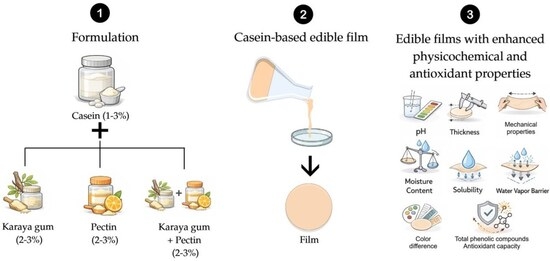
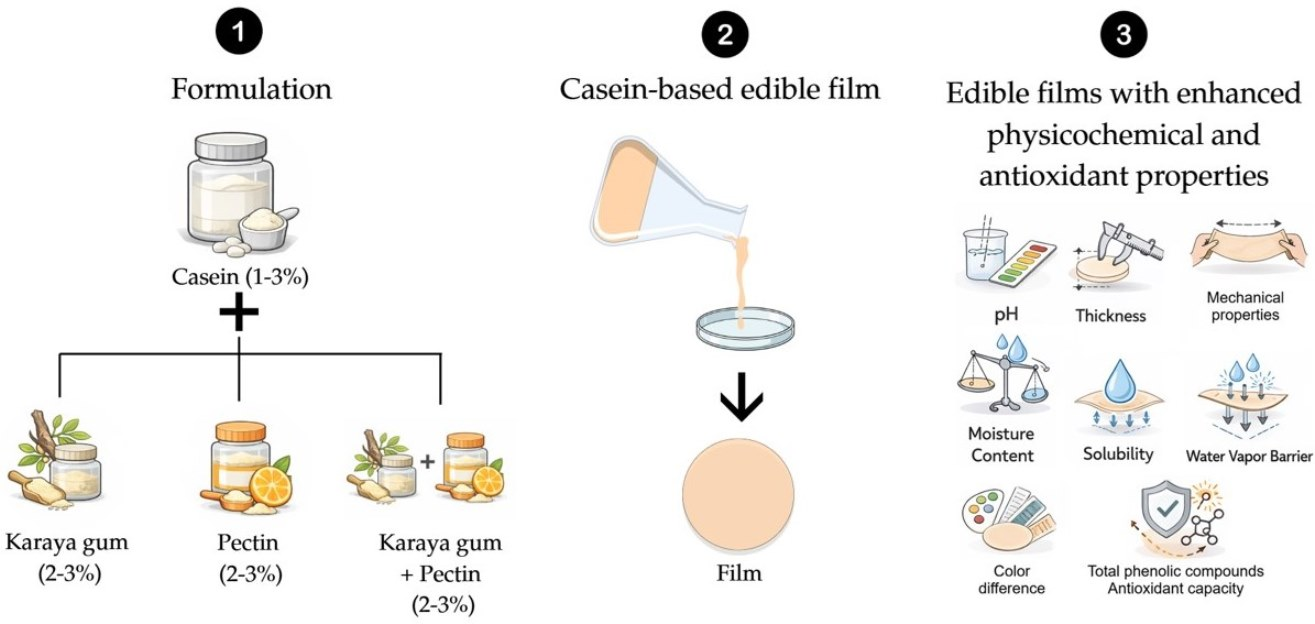
On the other hand, a feasible formulation of protein-based edible films is still pursued as their properties over time depend on the characteristics of the product to be coated, the storage, marketing and transportation conditions. For this reason, studies like the ones presented in this research must be carried out to elucidate the pivotal role of the formulation, the type and concentration of ingredients used in the formulation, and whether these ingredients are able to improve the physicochemical and antioxidant properties of casein-based edible films. The combination of casein with karaya gum, pectin, or karaya gum–pectin could improve these features of edible films, and this hypothesis must be clarified. Additionally, to our knowledge, there is no available information in the literature addressing this important issue; thus, this research could provide new scientific knowledge regarding the behavior of these ingredients when combined with casein-based edible films. That is why this research aimed to evaluate the influence of the formulations on the physicochemical (pH of the film-forming solution, thickness, tensile strength, elongation at break, moisture content, water solubility, swelling ratio, water vapor transmission rate, color difference) and antioxidant characteristics (total phenolic compounds and antioxidant capacity) of edible films based on casein (1, 2 or 3%) and karaya gum, pectin, or karaya gum–pectin (2 or 3%).
2. Materials and Methods
2.1. Materials and Reagents
Fresh cow’s milk was used for the extraction of caseins (C), which was provided by the Faculty of Animal Science and Ecology at the Autonomous University of Chihuahua. The karaya gum (G), pectin (P), glycerol, 2,2-diphenyl-1-picrylhydrazyl (DPPH), the Folin–Ciocalteu reagent, the hydrochloric acid, the sodium hydroxide, the calcium chloride and the methanol were purchased from Merck (Sigma Aldrich, St. Louis, MO, USA).
2.2. Casein Extraction
Fresh cow’s milk was refrigerated at 5 °C for 24 h. Then, the lipids from the surface layer were removed. For casein extraction, the acidification method was used until reaching its isoelectric point to form a precipitate, which was then filtered, concentrated, and dried. A portion of 100 mL of fresh skimmed milk was placed in an incubator and gently shaken. The pH was adjusted to 4.6 with 20% HCl. The suspension was centrifuged at 3500 rpm for 10 min. The supernatant was discarded, and 20 mL of distilled water was added to the precipitate and stirred until it reached a homogeneous suspension. This procedure was repeated twice with distilled water, once with ethanol, once with acetone, and once with ethyl ether. Finally, the precipitate was filtered with Whatman filter paper and dried at room temperature overnight.
2.3. Edible Films Formulation, Preparation and pH of the Film-Forming Solution
Edible films were formulated according to
Table 1 using 1, 2 or 3% of casein (C); 2 or 3% of karaya gum (G), pectin (P), and a combination of both (GP).
The corresponding proportion of casein was dissolved in distilled water (
Table 1). The pH was adjusted to 8 with NaOH 0.1 N using a potentiometer (Hanna instruments HI-2211, Woonsocket, RI, USA). It was constantly stirred for 30 min. In another beaker, the karaya gum, the pectin or the combination of both were dissolved in hot water (70 °C), then the glycerol was added and stirred constantly for 30 min. Once the mixture was made, the pH was assessed. A portion of 10 mL of each solution was cast on polystyrene plates (120 × 120 mm) and incubated at 40 °C for 48 h until drying. The dried films were carefully removed from the plates, conditioned at room temperature and 50% relative humidity until analysis [
6].
2.4. Mechanical Properties of Edible Films
2.4.1. Thickness
The thickness was evaluated using a Film/Thickness GAUGE equipment (BENETECH, GM210, Shenzhen, China). It was previously calibrated at 49, 102, 255, 491, 992 and 1999 μm ± 1%. Results were averaged from three random points in each sample and reported in millimeters (mm).
2.4.2. Tensile Strength and Elongation at Break (Tensile Test)
For this assay, the ASTM method D882-10 [
15] was performed using a TA.HD Plus Texture Analyzer (Stable Micro Systems Ltd., Godalming, UK). Strips of 7.5 cm × 2.5 cm were cut and conditioned at 23 °C for 48 h and 50% relative humidity (RH). Then, they were placed between grips at an initial grip separation and the crosshead speed was set at 40 and 50 mm/min, respectively. Tensile strength (MPa) and elongation at break (%) were obtained through the load-deformation curves.
2.5. Hydrodynamic Properties of Edible Films
2.5.1. Moisture Content
Three disks of 19 mm diameter were cut from each film, then they were weighed and dried until the weight was constant (105 °C for 24 h and 1% RH). The moisture content was the change in the weight of the film before and after drying and was reported as a percentage [
16].
2.5.2. Water Solubility
Three disks of 19 mm diameter were cut and dried at 60 °C for 12 h and 5% RH. Then, they were weighed and dipped in 50 mL of distilled water at 25 °C for 24 h. Then, they were filtered and the residue was dried at 105 °C for 24 h and 1% RH. The percentage of solubility was calculated as the difference between the initial weight of the film and the weight of the insoluble dried residue, divided by the initial weight and multiplied by 100 [
6].
2.5.3. Swelling Ratio
Three disks of 19 mm in diameter were cut, weighed and placed into 50 mL of distilled water. After 1 h at 23 °C and 50% relative humidity (RH), the supernatant was removed and the film was weighed again. The percentage of swelling was calculated as the difference between the final weight of the film and that obtained before the submersion.
2.5.4. Water Vapor Transmission Rate (WPTR)
For this assay, a gravimetric method was used [
16] where 9 g of dry CaCl
2 was placed inside a container to reach 0% RH, then it was sealed with a film of around 8.9 cm
2. Afterwards, they were put in a desiccator with NaCl and 33% RH. The absorption of water was recorded daily for 4 days.
2.6. Optical Properties of Edible Films
Color Difference
The color of the edible films was measured on three different disks of each film using a colorimeter (Minolta CR-300, Osaka, Japan) calibrated with a white dish to obtain the L*, a*, and b* values. With these values, the color difference (ΔE) was calculated [
6].
2.7. Antioxidant Characterization
2.7.1. Total Phenolic Compounds
For these assays, a portion of 40 mg of film was dissolved in 10 mL of 70% ethanol and stirred for 10 min. A portion of 0.7 mL of the film extract was mixed with 0.5 mL of Folin–Ciocalteu and 4.3 mL of distilled water. The solution was then vortexed for 2 min, and then 2 mL of 10% sodium carbonate was added. After 1h in the dark, the absorbance was measured at 760 nm (spectrophotometer PerkinElmer Lambda-25 UV/VIS, Shelton, CT, USA), using distilled water as a blank. The total phenol content was expressed in mg of gallic acid/100 g of samples.
2.7.2. Antioxidant Capacity
For this assay, the 1,1-diphenyl-2-picrylhydrazyl (DPPH) method was used, as described by Brand-Williams et al. (1995) [
17] with some modifications [
18]. A portion of 40 mg of film was dissolved in 10 mL of a DPPH-methanolic solution (0.025 g/L). The absorbance was measured in a spectrophotometer at 515 nm (PerkinElmer Lambda-25 uv/vis, Shelton, CT, USA) after 30 min in darkness. The results were expressed as % DPPH inhibition with methanolic DPPH absorbance as a reference.
2.8. Statistical Analysis
An analysis of variance (ANOVA) of the results, following the least significant difference (LSD) test, was performed to determine the significant differences (p < 0.05) using Statgraphics Plus 5.1 software (Statistical Graphics Corporation, Inc., Rockville, MD, USA). The results were reported as the mean ± standard deviation.
3. Results and Discussion
3.1. pH of Film-Forming Solutions
The pH of the solutions made with casein 1C, 2C and 3C was in the range of 3.51 to 3.82 (
Table 2). These solutions showed the lowest pH compared to the solutions made with casein plus karaya gum, pectin or the combination karaya gum–pectin. However, it was observed that the highest casein content was associated with the highest pH. These results could be linked to the extraction procedure of casein, where an acidification method with 20% HCl was used until reaching a pH of 4.6.
In edible films made with casein and karaya gum, pectin or the combination karaya gum–pectin, the pH values increased in the range of 17% (3C-3GP) to 65% (3C-2P) in the film-forming solutions, except for 1C-3GP, which remained similar to those containing only casein. This fact indicates that the addition of these types of ingredients significantly increases the pH of film-forming solutions. The pH is an important parameter that must be considered when designing and formulating edible films. Adjusting this parameter in the film-forming solution toward alkaline conditions could enhance the physicochemical features of the resulting film [
19] but at the same time, it has been reported that casein microparticles swell above pH 7 and decompose above pH 11 [
20].
When analyzing how the ingredient concentration (mainly casein) influenced the pH of the film-forming solution, it was observed that 2% casein, together with 2 or 3% of karaya gum (2C-2G or 2C-3G) or 3% casein plus 2% karaya gum (3C-2G), significantly increased the pH. Regarding the film-forming solutions containing casein plus pectin, the best combination was 3% casein and 2% pectin (3C-2P) or 1% casein plus 3% pectin (1C-3P), but the latter reached a lower pH value compared to the former. On the other hand, the combination of 1 or 2% casein with 2% karaya gum–pectin (1C-2GP and 2C-2GP) or 2 or 3% casein with 3% karaya gum–pectin (2C-3GP and 3C-3GP) offered the best combination when analyzing film-forming solutions with casein and karaya gum–pectin. The worst combination in terms of pH of the film-forming solution was the one obtained when combining 1% casein plus 3% karaya gum–pectin, which remained unchanged compared to the control 1C.
The pH could also influence the compatibility and molecular interactions between the components of the film matrix, improving its mechanical and morphological properties and determining its functionality [
19]. For all these, evaluating the pH of film-forming solutions is essential to evaluate the physicochemical behavior of casein in aqueous medium and the interaction between the ingredients. The comparative analysis of these values could elucidate the influence of casein concentration on the film-forming solution to design and optimize the formulation of edible films based on the desired properties. Thus, formulating edible films with suitable pH levels could increase their successful application in the preservation of fresh or minimally processed fruits and vegetables.
3.2. Thickness
Table 3 showed the results of edible films’ thickness, being in the range of 0.14 to 0.24 mm. Overall, no statistical differences were observed between the controls (1C, 2C or 3C) and their respective group of films made with different concentrations of karaya gum, pectin or the combination karaya gum–pectin, except for 1C-3G, 1C-3GP, 2C-3P, 2C-2GP, 2C-3GP and 3C-3GP.
Films made with 3% of the karaya gum plus pectin were always thicker than their respective controls, independently of the % of casein added. However, when comparing films with 3% karaya gum (1C-3G) or 3% karaya gum–pectin (1C-3GP) in formulations containing 1% casein, the thickness increased by 7% compared to the control 1C. Films containing 2% casein and 3% karaya gum–pectin (2C-3GP) were 22% thicker than those made with 2% karaya gum–pectin (2C-2GP).
Similarly, films made with 3% casein and 3% of karaya gum–pectin (3C-3GP) were 26% thicker than 3C-2GP. Likewise, films made with 3% casein were thicker than films made with 1 or 2% casein, except for 2C-3P, which remained statistically similar to 3C-3P.
It has been stated that the optimal thickness of edible films is between 0.05 and 0.3 mm, providing a balance in the mechanical strength and the moisture barrier properties, without creating a tough and unpalatable texture [
21]. According to this, all the formulations analyzed in this research had an optimal range of thickness that could maintain the quality of horticultural products once applied.
These results suggest that the type of ingredient used for formulating edible films has a significant effect on their physical characteristics, such as thickness. A higher density in the film-forming solution was observed as the % of casein and % of karaya gum–pectin increased, which could be attributed to large molecules of casein in the surrounding film matrix [
22]. In fact, in a previous investigation, it was reported that a 0.19 mm thickness in films made with 5% of casein and 5% glycerol [
6] was similar to that of films made with 3% casein in this research.
On the other hand, Mohammad et al. (2015) [
23] produced edible films based on basil seed gum with sorbitol and glycerol as plasticizers. The authors reported that an increase in film thickness was attributed to the inclusion of plasticized molecules between the macromolecular chains, expanding the film structure by increasing the molecular volume of the network.
3.3. Tensile Strength and Elongation at Break
These are important properties of greatest interest for evaluating the strength and durability of edible films. Both depend on the ingredients and their interactions within the food matrix [
24].
As shown in
Table 4, the highest tensile strength values were found as the concentrations of casein, karaya gum, pectin and karaya gum–pectin increased. In contrast, the lowest was obtained in films made with casein as the unique ingredient, followed by those containing karaya gum. With respect to edible films with 1% casein, the combination with karaya gum–pectin rendered up to 800% more tensile strength than films with only casein (0.51 vs. 4.49 MPa). Similarly, formulations with 2% casein showed up to 658% higher tensile strength than those containing only casein. In the case of films with 3% casein, 3C-3P obtained the highest tensile strength being 749% higher than 3C.
Tensile strength is an important parameter for evaluating the maximum stress that a film can endure before breaking [
7]. These results indicate that the combination of casein with karaya gum, pectin and karaya gum–pectin can be useful when high tensile strength is required in edible films, as it indicates a high resistance to breaking when stretched, typically resulting from a dense, well-ordered polymer matrix. Mechanical properties are important when producing edible films, as they provide information on the durability and mechanical integrity of fruits and vegetables. Furthermore, tensile strength is associated with the nature and chemical structure of the materials used to form edible films. For example, when increasing the amount of cassava starch (5, 10, 15, 20 and 25%), the tensile strength decreases, showing a significant relationship between the % of cassava starch and the tensile strength [
25].
Table 4 shows the results obtained in this research of elongation at the break of edible films, being in the range of 18.97% to 49.70%. The elongation at break represents the capacity of edible film to resist shape changes without breaking. A high percentage of elongation at break is related to the capability of edible film to envelop and wrap food [
26]. In this context, edible films made with casein (1, 2 or 3%) plus pectin (2 or 3%), as well as the combination of casein (1 and 2%) plus karaya gum–pectin (1 and 2%), showed the highest elongation at break. On the other hand, edible films made with casein plus karaya gum presented the lowest elongation as compared to pectin and the combination karaya gum–pectin films. The controls 2C and 3C displayed the lowest elongation at break in comparison to edible films with karaya gum, pectin or karaya gum–pectin, showing that the addition of these ingredients improves their capacity to withstand shape changes. In fact, similar results were reported in milk-protein-based edible films with Nigella sativa essential oil, where the elongation at break increased as the proportion of essential oil increased [
27].
3.4. Moisture Content
The results regarding the moisture content are presented in
Table 5. It was observed that formulations containing pectin were the wettest edible films, independently of the % of casein. On the contrary, the lowest moisture content was mainly obtained in films with the combination of 3% karaya gum and pectin with 1, 2 or 3% casein, as well as in 3% casein and 2% karaya gum and pectin (3C-2GP). The lower casein content (1%) was associated with the highest moisture content, except for 3C-2GP and 3C-3GP. On the other hand, no significant differences in the moisture content between edible films containing 2 or 3% casein plus karaya gum or pectin were observed: 2C-2G and 3C-2G were statistically similar, as well as 2C-3G and 3C-3G, 2C-2P and 3C-2P, and 2C-3P and 3C-3P. Films containing 1% casein plus 2% of the combination of karaya gum and pectin (1C-2GP) and 3% casein plus 2% of the combination of karaya gum and pectin (3C-3GP) showed higher moisture content than those made with 2% casein. Finally, films with 3% casein plus 3% of karaya gum and pectin were wetter than those made with 1 or 2% casein (1C-3GP and 2C-3GP).
Water is one of the main food constituents and is an index of the stability and quality of these products during storage. Particularly, the moisture content is related to the volume occupied by water molecules in the structural network of edible films. The combination of polysaccharides led to hydrogen bonding interactions, reducing the mobility of macromolecules, decreasing the free volume within the film, and reducing the moisture content of edible films [
28]. In edible films, the literature indicates that the moisture content ranges between 10 and 45% and is related to flexibility, stability and WPTR. The high value of this parameter indicates an increase in the water mobility, low tensile strength and increased elasticity. The moisture content has a significant effect on yuba films, being that the one with 25% moisture and stored at 39% RH has the most potential [
29].
The ingredients play a key role in forming wet edible films, influencing the resistance of these products [
30]. For instance, it has been reported that glycerol-based films containing basil seed gum showed a high moisture content between 27 and 49% [
23]. On the other hand, edible films containing 5% of casein revealed a moisture content of 40.21% [
6], similar to those obtained in this research containing 1, 2 or 3% casein plus pectin (1C-3P, 1C-2P, 1C-3P, 3C-2P and 3C-3P).
3.5. Water Solubility
The results obtained regarding water solubility are presented in
Table 6. The highest water solubility value was obtained in formulations made with pectin, independently of the amount of casein. On the other hand, the lowest water solubility was obtained in edible films made with 1% casein plus karaya gum and the combination of karaya gum and pectin. In the case of edible films with 2% casein, 1C-2G and 1C-3GP showed the lowest percentage of water solubility. Edible films containing 3% casein plus a combination of karaya gum and pectin (2 or 3%) rendered the lowest water solubility.
Overall, it was observed that the higher the concentration of casein, the lower the water solubility. However, no statistical differences were found between edible films containing casein (1, 2 or 3%) plus 3% of pectin, meaning that 1C-3P, 2C-3P, and 3C-3P were similar in the percentage of water solubility, with an average of 95.29%.
Solubility is the ability of edible films to be dissolved in a solvent (i.e., water). Therefore, water solubility is related to moisture content, chemical structure and composition. In the case of edible films assessed in this research, it was obtained that the highest values of moisture content and water solubility were obtained in edible films containing casein (1, 2 or 3%) plus pectin (2 or 3%). Similarly, it was reported that water solubility is influenced by ingredients such as glycerol and pectin, modifying the properties of edible films, such as solubility and gelation [
23]. Other authors argued that interactions between hydrophilic molecules in biopolymers increase water solubility due to their nature; furthermore, this parameter is affected by temperature, formulation type, and the plasticizer due to the reduction of hydrogen bonds [
31].
At this point, among the formulations evaluated in this research, 3C-2P showed excellent mechanical properties (4.96 MPa of tensile strength and 47.53% of elongation at break), but failed in its hydrodynamic features (38.02% of moisture content and 81.51% of water solubility). These results indicate that this formulation could be ideal for encapsulating dry, oxygen-sensitive powders where film dissolution is a desired release mechanism. However, it would be unsuitable for coating fresh fruits and vegetables as they contain high-moisture content.
3.6. Swelling Ratio
The swelling ratio of edible films ranged from 35.27 to 92.17% (
Table 7). Overall, the controls (1C, 2C and 3C) showed the lowest value (35.27 to 41.61%), mainly films made with 3% casein. Regarding the influence of the casein concentration in the swelling ratio of edible films, no significant differences were observed when combining casein plus 3% karaya gum (1C-3G, 2C-3G and 3C-3G), as well as in those films made with pectin at any % of pectin (2 or 3%) and casein (1, 2 and 3%).
Films containing karaya gum obtained the highest swelling ratio (from 92.17 to 81.35%), followed by those containing pectin (68.57 to 78.41%) and finally those with karaya gum–pectin (58.96 to 67.22%). These results indicate that the addition of karaya gum, pectin or the combination of karaya gum–pectin increases the water absorption of edible films, demonstrating the importance of incorporating the proper ingredients in the design of edible films. Swelling ratio is the change in volume of biopolymers when immersed in water and is influenced by polymer concentration, porosity, crosslinking and charge density [
32]. The addition of whey protein isolate to edible films increased the swelling ratio between 1.32 and 2.74 times more in comparison to films made with casein [
6]. Similarly, an increase in this parameter was observed in edible films made with whey protein concentrate, which showed up to 4.27-times higher swelling ratio than those with whey protein isolate [
16].
3.7. Water Vapor Transmission Rate (WVTR)
WVTR represents how much water vapor can penetrate a specific area of film, and it is important because it evaluates the performance of biopolymers as a barrier to moisture.
Table 8 shows the results obtained in edible films based on casein plus karaya gum, pectin and karaya gum–pectin.
Overall, the controls 1C, 2C and 3C had the lowest WVTR, with 3% casein being the one with the lowest percentage (3C). These results could be attributed to the hydrophobicity of caseins, which had a low level of transport of water vapor and could explain why the lowest WVTR was found in films containing only casein as an ingredient. On the other hand, the highest value of WVTR was found in those films made with 3% karaya gum (1C-3G, 2C-3G and 3C-3G). Karaya gum is slightly soluble in water but has a strong ability to swell that could influence the trend observed in karaya gum-based films. The addition of karaya gum, pectin or karaya gum–pectin increased the WPTR of casein-based edible films as compared to their respective controls, indicating that these ingredients reduced the resistance to the transport of water vapor offered by casein.
Regarding the influence of the casein percentage in the WPTR, it was observed that edible films with 3% casein plus 2 or 3% karaya gum were statistically lower than those made with 1 or 2% casein-based edible films. Edible films with casein plus 2 or 3% pectin were significantly influenced by the % of casein contained in the formulation of edible film, as the % of casein increased as the WPTR decreased. In edible films with casein plus 2% karaya gum–pectin, the highest value of WPTR was found in edible films containing 2% casein, while the lowest was in those with 3% casein. Finally, edible films with 3% casein plus 3% karaya gum–pectin displayed lower WPTR than those with 1 or 2% casein.
This parameter (WPTR) is linked to the water vapor barrier offered by a film and is important for maintaining the food quality [
33]. As this parameter increases, the resistance to the transport of water vapor decreases. Within this context, 3C-2P edible film showed the lowest WPTR, indicating that this film can offer a good barrier to water vapor and oxygen, thus it should be able to avoid the oxidation of food and maintain food quality.
3.8. Color Difference (ΔE)
As can be seen in
Table 9, the overall trend was that as the % of casein rises, the color difference increases. Thus, edible films with 1% casein showed the lowest color difference, while 3% casein edible films showed the highest. On the contrary, as the % of karaya gum increases, the color difference decreases. Regarding films made with 2 or 3% casein plus 2 or 3% pectin, no significant differences were observed between them (2C-2P and 2C-3P; 3C-2P and 3C-3P; 2C-2P and 3C-2P; 2C-3P and 3C-3P). The combination of 2 or 3% casein with karaya gum–pectin rendered the highest color differences among all the formulations analyzed, being in the range of 5.13 to 10.48.
It has been reported that variations in the film color are influenced by the intrinsic properties of the film matrix and the drying conditions for the film formation [
34]. Overall, it is preferable that films are colorless so that the coated product resembles the fresh product [
35]. However, if edible films were made for preserving light-sensitive food constituents, they would be opaque.
Moreover, the color of edible films is closely related to the appearance of food, influencing consumer acceptance and the sensory perception of the product, which is why this parameter is important. For example, the addition of chitosan and thyme oil coatings produced slight visual alterations, yet these were significant enough to influence the panelists’ perception [
34], showing the importance of the compatibility of polymers and the other ingredients contained in the formulation of edible films.
3.9. Total Phenolic Content (TPC)
As can be seen in
Table 10, the total phenolic content was in the range of 70.09 to 287.48 mg of gallic acid/100 g of edible films. For edible films made with 1% casein, the highest total phenolic content was found when 2% pectin (1C-2P) was added, while the addition of 3% karaya gum (1C-3G) decreased the content of these compounds. In contrast, treatments 1C, 1C-3P, and 1C-3GP were statistically similar, as were 1C-2G and 1C-2GP. It was observed that an increase in the content of karaya gum, pectin or the combination of karaya gum–pectin considerably decreased the TPC. On the other hand, the % of casein did not affect the total phenolic content in edible films made with 3% of karaya gum (1C-3G, 2C-3G and 3C-3G).
When evaluating edible films containing 2% casein, the highest total phenol content was found in 2C-2P, and the lowest in 2C-3G. In this group, the formulations that did not show significant differences were 2C and 2C-2G, as well as 2C-3P and 2C-3GP. The addition of 3% karaya gum, pectin, or a combination of karaya gum–pectin significantly reduced the total phenol content in edible films made with 2% casein, a similar trend to that observed in formulations with 1% casein. For example, formulation 2C-3G reduced the total phenolic content by 20.07% compared to 2C-2G. When 3% pectin was added to 2C-3P, the total phenol content decreased by 65.65% compared to 2C-2P. The 2C-3GP formulation obtained 45.66% less total phenols than 2C-2GP.
Regarding formulations with 3% casein, the highest total phenolic content was found in 3C-2GP; conversely, the lowest value was in 3C-3GP. On the other hand, treatments 3C, 3C-2P, and 3C-3P were statistically similar, as well as 3C-3G and 3C-3GP. The addition of 3% karaya gum (3C-3G) reduced the total phenol content by 20.07% compared to 3C-2GP. Similarly, when 3% karaya gum–pectin (3C-3GP) was added, the total phenol content decreased by 49.31% compared to 3C-2GP. On the other hand, the addition of 3% pectin (3C-3P) did not significantly change the total phenol content compared to 3C-2P. Increasing the content of karaya gum or of the karaya gum–pectin combination significantly reduced the total phenolic content in the edible films, except for formulations with pectin that remained unchanged.
Pectin is a natural plant polysaccharide that acts as a functional matrix that often associates with phenolic compounds, improving their stability and antioxidant capacity. Phenolic compounds are found in plant products and can be co-extracted with pectin [
36]. Phenolic compounds are antioxidants that are contained in natural products: fruits, vegetables and herbs; in processed food: chocolate, oil, spices, tea, and wine; but also in agricultural and industrial waste and by-products. For this, their utilization in the formulation of edible films can improve the antioxidant, antimicrobial, physicochemical and sensory properties of covered food, making it an innovative approach in this field [
37]. Chitosan and cellulose-based films have been developed by using tannins as active compounds and they presented antioxidant and antimicrobial properties [
38,
39]. Ellagic acid has also been used for developing bioactive chitosan films that provide UV-light protection and antimicrobial activity against
Staphulococcus aureus and
Pseudomonas aeruginosa [
40].
3.10. Antioxidant Capacity
The results of the antioxidant capacities of edible films with casein plus karaya gum, pectin or the combination of karaya gum–pectin are presented in
Table 11. The edible film with the highest antioxidant capacity when using 1% casein was 1C-3GP, while 1C had the lowest. In contrast, 1C-2G and 1C-2GP, as well as 1C-3G and 1C-2GP, were statistically similar. In this set of formulations, it was observed that when adding 3% karaya gum (1C-3G), the antioxidant capacity increased by 15.82% compared to 1C-2G. Similarly, when 3% pectin (1C-3P) was added, the antioxidant capacity percentage increased by 58.12% compared to 1C-2P. When karaya gum and pectin were combined in a ratio of 3% (1C-3GP), there was a 42.72% increase in the antioxidant capacity of the edible films compared to 1C-2GP. These results indicate that adding 3% karaya gum, pectin, or a combination of both could be used to increase the antioxidant capacity of edible films based on 1% casein.
The highest antioxidant capacity was found in formulations 2C-3G and 2C-3GP when using 2% casein in edible films. Conversely, the formulation with the lowest antioxidant capacity value was 2C and 2C-2P within formulations containing 2% casein. On the other hand, 2C-2G, 2C-3P, and 2C-2GP showed no statistically significant differences. The results showed that by adding 3% karaya gum (2C-3G), the antioxidant capacity increased by 25.02% compared to 2C-2G. Similarly, by adding 3% pectin (2C-3P), the antioxidant capacity also increased by 40.46% compared to 2C-2P. When combining 3% karaya gum and pectin (2C-3GP), an increase of 32.75% was also obtained compared to 2C-2GP. These results indicate that the addition of 3% of any of the assessed ingredients (karaya gum, pectin, and the combination of both) increased the antioxidant capacity percentage of edible films made with 2% casein.
In formulations with 3% casein, the highest antioxidant capacity was obtained by 3C-2G; while the lowest were 3C, 3C-3P, and 3C-3GP. The formulations 3C-3G, 3C-2P, and 3C-2GP were statistically similar. As can be seen, adding 3% karaya gum (3C-3G) reduced antioxidant capacity by 14.10% compared to 3C-2G. Similarly, adding 3% pectin (3C-3P) reduced antioxidant capacity by 18.71% compared to 3C-2P. On the other hand, when 3% karaya gum–pectin (3C-3GP) was added, the antioxidant capacity decreased by 17.93% compared to 3C-2GP. These results showed that adding 3% of either karaya gum, pectin, or the combination of both reduces the antioxidant capacity of edible films.
When comparing the results obtained from the TPC of edible films in relation to their antioxidant capacity, an inverse trend was observed. This means that in edible films with low TPC (1C-3G, 2C-3G, 3C-3G and 3C-3GP of each group of edible films), a high antioxidant capacity was found. Generally, TPCs are linked to the antioxidant capacity of food products. In this case, an explanation of these results could be attributed to the compounds contained in milk, such as sulfur-containing amino acids, vitamins (A and E), carotenoids and enzyme systems (superoxide dismutase, catalase, glutathione peroxidase, among others) [
41]. Particularly, the antioxidant capacity of caseins is related to their primary structure that acts as a scavenger [
42]. Casein also inhibits lipoxygenase-catalyzed lipid autoxidation; for this reason, casein-based films are used to prevent oxidation induced browning in horticultural products [
41]. The phosphopeptides contained in caseins can scavenge iron in both lipid and aqueous food systems [
43].
The importance of adding antioxidants in edible films is that they delay the oxidative chain reactions in food, avoiding loss of color and flavor, off-flavors, lipid rancidity, and loss of nutritional quality [
44]. Thus, the antioxidants contained in caseins could prevent all these alterations, enhance the quality and shelf life of food [
37], as well as improve the functional properties of plant-based edible films [
45]. Therefore, formulating edible films with increased antioxidant capacity is crucial for obtaining materials that improve the shelf-life and maintain the functional, nutritional, and organoleptic properties of food.
4. Conclusions
Formulation is an important process that significantly influences the interactions among ingredients and the physicochemical and antioxidant characteristics of edible films. The mechanical properties of casein-based edible films were improved by the addition of karaya gum, pectin and karaya gum–pectin. The solubility of casein-based edible films was augmented by the addition of karaya gum, pectin and karaya gum–pectin. In this context, the formulation with 1, 2 or 3% casein and 2 or 3% of karaya gum, pectin or karaya gum–pectin changes the edible film properties. Overall, the addition of these ingredients increases the pH of the film-forming solution. High percentages of karaya gum, pectin, and the combination of both increased the thickness of the edible films, except for 2C-2P and 2C-3P and for 3C-2G and 3C-3G. The highest tensile strength value was obtained in the formulations of 3% casein with 3% karaya gum (3C-3G) or 2% pectin (3C-2P). The edible films that showed the least color difference compared to their respective controls were those made with 1% casein, regardless of the ingredient used (karaya gum, pectin, and the karaya gum–pectin combination). The moisture content of the edible films was lower in formulations containing karaya gum–pectin, regardless of the casein content. The highest percentage of water solubility was obtained by edible coatings containing pectin, regardless of the % of casein used. In general, the highest concentration of total phenols was obtained in films containing 2% of karaya gum, pectin, or the combination of karaya gum–pectin, since the addition of 3% of these ingredients reduced their concentration. The addition of karaya gum, pectin, and karaya gum–pectin increased the antioxidant capacity of the edible films made from casein, regardless of the casein concentration.
Among the evaluated edible films, the most suitable formulation in terms of mechanical properties was 3C-2P, with 4.96 MPa of tensile strength, 47.53% elongation at break and 28.01 g/m2 day of WPTR; however, it has a high moisture content (38.02%) and water solubility (81.51%). This indicates that this type of edible film is unsuitable for coating horticultural products, as it would dissolve, but could be applied for encapsulating compounds where film dissolution is desired. In terms of the antioxidant features, 3C-2P films had an average concentration of TPC (106.41 mg of gallic acid/100 g of edible films) and antioxidant capacity (8.28% of DPPH inhibition).
Formulating edible films with appropriate physicochemical and antioxidant properties is important as the ingredients can interact and produce synergistic or antagonistic effects, directly influencing the quality and preservation of fresh and perishable products. Future studies are required to assess the molecular structure of these edible films, as well as their application in horticultural products over time.



 ,
,