1. Introduction
Paints are widely used to decorate and protect the exterior of buildings [
1]. In addition to protecting buildings, paints also serve functions such as lighting control and thermal comfort [
2]. Among paint types, Multicolor paints (or Multicolor coatings, multipattern paintings) are appreciated for their unique, randomly distributed particle patterns, which create a beautiful aesthetic [
3]. In the United States, Zolatone, the originator of Multicolor paint, has been used on the interior and exterior of buildings since its development in the 1970s [
4]. In Korea, apartments are classified as multi-family housing units with more than five floors, and various technical regulations are applied [
5]. In most apartment buildings, the walls and ceilings of common indoor spaces, such as elevator halls, corridors, and stairwells, are painted with Multicolor paint [
6]. Multicolor paints are considered more resistant to carbonation than conventional water-based interior paints or three-layer water-based exterior paints [
7]. As shown in
Figure 1, a Multicolor painting uses water-based paint applied to an adhesive surface, such as concrete or cement mortar, with a roller or a spray. Then, the Multicolor paint is applied with a dedicated sprayer.
Additionally, a coating material is sometimes applied as a surface protectant [
8]. After the invention of Zolatone, Japanese paint companies also developed and released numerous related products. However, neither the American nor Japanese Multicolor paintings require the additional surface protectant [
4,
9,
10]. This coating can help prevent the particles of Multicolor paint applied over water-based paint from peeling off or becoming contaminated. In any case, because this coating is thin, it gradually deteriorates over time due to exposure to direct sunlight and interaction with carbon dioxide in the atmosphere. Therefore, regular maintenance, including checking the coated surface and recoating, is essential.
Meanwhile, housing quality disputes are increasing worldwide, and multifaceted efforts to improve it are crucial [
11,
12,
13,
14]. Among these disputes are those concerning Multicolor paintings. While there is no dispute about the water-based paint on the adhesive surface or the Multicolor paint itself, the coating material is the main point of contention. The key point of the dispute is that the coating material was not applied, and there are fierce arguments over the process and methods used to verify whether it was applied.
The coating materials used in Multicolor painting work are transparent and glossy, reflecting light. Therefore, methods that involve visually inspecting the gloss level or the degree of light reflection can be used [
15]. Alternatively, since the coating material of the Multicolor painting is water-resistant, the coating application status can be determined by observing whether sprayed water runs off or is absorbed by the coating [
16]. Construction engineers claim that Multicolor painting has anti-graffiti properties. To assess the application of coatings on Multicolor surfaces, one may use a method that creates lines or markings on the surface with implements such as pencils, water-based pens, and specialized computer pens. Subsequent evaluation of the marks can be conducted by spraying water onto them to assess the coating’s effectiveness in erasing the applied marks [
17,
18,
19]. This method is used to determine whether Multicolor paint coating is performed empirically.
However, while some Multicolor paintings have a strong gloss, others have a weak or no gloss [
20,
21]. Therefore, it is difficult to conclude that evaluating gloss level alone is an appropriate empirical method for determining whether a Multicolor paint coating was applied. Furthermore, while the water-spraying method can be used to verify the application of oil-based paints due to their strong water resistance, it may not be reliable for water-based paints, as their water resistance varies with their material properties [
22]. Meanwhile, testing of markings with writing tools erased is considered a valid method for evaluating anti-graffiti coatings [
23]. However, there is no scientific evidence that this method is also suitable for determining the application status of Multicolor paint coating. This empirical method is not specified in either Japanese Industrial Standards or Korean Industrial Standards [
24,
25].
Despite these inconsistencies, Korean courts, which mediate housing quality disputes, do not judge the application of Multicolor painting based on scientific evidence but instead accept unverified empirical methods without question, leading to judgments that cause immense damage to paint manufacturers and painting contractors amid a surge of complaints [
26].
This study examined various empirical methods for verifying the application of multi-colored paint coatings. By analyzing test results from houses with Multicolor painting, the validity of current empirical methods for determining coating status was compared. Through this analysis, inconsistencies in the empirical methods were identified, and the necessary subsequent research to address them was discussed.
2. Literature Study
2.1. Multicolor Painting Work
Painting work for construction is typically conducted in the following sequence: primer, intermediate coat (painting), and top coating [
27]. The primer is a material that acts as an adhesive, helping the adhesive surface, paint, and waterproofing materials adhere well to each other. However, in Multicolor painting, applying a regular water-based paint is defined as the priming step. Subsequently, applying the multi-color paint sparingly over the water-based paint using a dedicated spray gun serves as the intermediate coat. Finally, applying a transparent coating material is defined as the top coating [
28]. This paper focuses specifically on the top layer, which will be referred to as ‘top coating of Multicolor painting work.’
However, since there is no prior research on the top coating of Multicolor paint materials, this study focused on relevant technical standards and construction guidelines. In particular, whether there are any regulations regarding the anti-graffiti function of the top coating on Multicolor painting work, a key issue in housing quality disputes, is examined. According to JIS K 5667 [
24], during Multicolor painting, the primer must be applied indoors and allowed to dry for at least 6 h before top coating. Test specimens should be dried for 7 days. However, there are no other regulations regarding the application of the top coat for Multicolor painting or its anti-graffiti function, as discussed later.
KS M 6090 specifies requirements for the intermediate and top coating of Multicolor paints, but it does not specify requirements for the primer [
25]. The top coating can be oil-based or water-based, and the quality standards for these paints include requirements for container condition, application properties, viscosity (KU), non-volatile ingredient (%), and drying time. For the entire Multicolor paint film, including the primer, intermediate coat, and top coat, the standard specifies film appearance, lightfastness, alkali resistance, and washability. Among these, the item related to the anti-graffiti properties of the Multicolor painting material is washability resistance. Washability resistance is evaluated according to KS M 5000 3351 (test method for the washability of paint), which is a test standard for enamel combination paints and emulsion paints [
29]. However, this test standard only specifies evaluating the gloss level. Whether the Multicolor paint intermediate coat peels off indicates that it is not a method to assess the top coating material alone.
Meanwhile, in Korea, there are standard specifications for construction work and specialized specifications for housing construction, which are widely used as standards for construction technology. These are recognized as design documents in public sector construction projects and public housing construction. The Architectural Institute of Korea prepares the standard specifications for construction work, and the specialized specifications for housing construction are prepared by the Korea Land and Housing Corporation, both of which are under the control of the Ministry of Land, Infrastructure and Transport, a South Korean government agency. Section 18105 of the standard specifications for construction work specifies acrylic transparent paint as a Multicolor coating material and allows the use of water-soluble high-gloss materials [
30]. Section 45510 of the Korea Housing Corporation’s standard specifications only states that a transparent coating material is used for Multicolor painting [
31]. However, these specifications neither specify that the multi-color painting has anti-graffiti properties nor that any similar tests should be conducted.
In summary, Multicolor painting involves three main components: primer, an intermediate coat, and a top coat, with the term “top coat” referring to the final coating. Numerous quality standards for each stage of the Multicolor painting process, as well as for the overall Multicolor paint, have been established by organizations such as JIS and KS. However, while these technical standards primarily address performance indicators from a material perspective, they do not require that the Multicolor painting material possess anti-graffiti properties, nor do they mandate testing for these properties.
2.2. Issue of Multicolor Painting Work in Defect Lawsuit
This paper examines the issues related to the top coating of Multicolor painting in residential construction quality disputes. We briefly review the procedures and characteristics of defect litigation for handling residential construction quality disputes in Korea [
32].
When issues arise with a house’s quality, homeowners typically request repairs from the builder, but these requests are often delayed or denied for several reasons. Consequently, a substantial number of homeowners in Korea file lawsuits against home builders. Since the courts are not experts in construction technology, they commission investigations to relevant experts for dispute resolution; these experts are called appraisers. Appraisers are specialists in design and construction, and they investigate the house’s quality issues on behalf of the court, submitting a report detailing the problems, the extent of the damage, repair methods, and costs.
An analysis of 32 cases of housing quality disputes that went to Korean courts revealed that the total amount of damages awarded for the omission of the top coating of Multicolor painting was KRW 2.76 billion, approximately USD 1.97 million at an exchange rate of KRW 1400 per US dollar.
However, while various issues are disputed in lawsuits over whether the top coating of Multicolor painting work was omitted, the most critical issue is how to determine whether it was applied. As discussed in
Section 2.1, various technical standards and criteria for Multicolor painting do not specify a method for determining whether the top coating has been applied. The techniques used by appraisers in lawsuits to determine whether the top coating of Multicolor painting work was done varied widely, and representative examples are as follows:
Seoul central district court case no. 2014-Gahap-61369: In this case, the appraiser described the method used to confirm the top coating of Multicolor painting work as follows: “In the case of a glossy finish, the sheen is noticeable even without shining a light on it” [
15].
Seoul central district court case no. 2013-Gahap-512884: In this case, the appraiser stated in the report, “The water repellency of the Multicolor paint surface can be checked by spraying water onto it (to see if water droplets form and run off, or if the water is absorbed)” [
16].
Suwon-Anyang district court case no. 2016-Gahap-104362: In this case, the appraiser stated, “The method of verification involves drawing lines and writing letters on the Multicolor painting surface with a pencil, and then checking whether the marks can be erased with an eraser” during site inspection [
17].
Seoul central district court case no. 2022-Gahap-567947: In this case, the appraiser determined the authenticity of the top coating application by stating, “It can be verified by drawing lines and writing letters on the Multicolor painting surface with a water-based pen, and then checking whether the markings disappear when water is sprayed and wiped with a tissue or cloth” [
18].
Seoul central district court case no. 2022-Gahap-555609: In this case, the appraisers used the method described above, but instead of a water-based pen, they used a computer pen [
19].
Based on the 20 litigation cases reviewed, including the examples above and as shown in
Table 1, it was found that various empirical methods were used to determine whether a top coating of Multicolor painting work was applied. These methods included visual inspection to determine the gloss level and checking whether water droplets formed or were repelled when water was sprayed on the painting surface. Methods for determining the anti-graffiti function involved using pencils, water-based pens, and computer pens as writing tools. In these litigation cases, deciding the anti-graffiti function was preferred over visual inspection, with water-based and computer pens being the most common.
2.3. Research Matters
As confirmed in
Section 2.1, technical standards such as JIS and KS only specify quality standards for the material aspects of the top coating of Multicolor painting work, but do not regulate the methods for determining whether the top layer has been appropriately applied. Furthermore, these technical standards do not specify anti-graffiti properties for the top coating of Multicolor painting work. In contrast, the empirical methods used in the litigation cases described in
Table 1 of
Section 2.2 were diverse, with the most representative method being anti-graffiti functionality assessment.
Comparing the two, in the litigation cases, the performance evaluation criteria for the materials themselves, as specified in technical standards, were not used. Though the technical standards’ performance evaluation criteria, such as coating appearance, lightfastness, and washability resistance, looked relevant, these methods were not used at all in the litigation cases. In other words, the empirical methods used in litigation cases differ significantly from general technical standards.
Meanwhile, although the empirical methods used in the litigation cases varied, none provided specific grounds for choosing them. In other words, the methods appeared to rely entirely on engineers’ experience. Furthermore, none of the cases explained why a particular empirical method was chosen among the available techniques. They did not provide any interpretation of how applying different methods simultaneously might influence each other. For example, as shown in
Table 1, cases 2018-Gahap-574191 [
39] and 2020-Gahap-535516 [
43] from the Seoul Central District Court used two methods: visual observation of water repellency and marking with a water-based pen. However, it was found that the process of reaching a conclusion based on the test results, including whether the results of the two methods were complementary or contradictory, was neither specified nor documented.
It does not mean that an empirical method should be rejected simply because it is based on past experience. Rather, scientific methods have been developed and refined based on accumulated experience. However, using empirical methods in legal proceedings, where objective and impartial judgment is crucial, appears unjustified. Furthermore, it is unclear whether these empirical methods are complementary or contradictory. Therefore, a comprehensive comparison of the empirical methods used to determine whether a top coat of Multicolor paint has been applied is necessary to ensure their appropriateness.
This study aims to clarify inconsistencies among various empirical methods used to determine the condition of the top coating of Multicolor paintings on interior building surfaces by conducting tests with these methods and comparing the results. This will help develop objective, scientific methods for determining the application of the top coating for future Multicolor painting work. The specific research questions addressed in this study are as follows:
First, can the application of a top coating of Multicolor painting be determined using individual empirical methods? Were the experimental results valid under different conditions? Or were some or all of them invalid?
Secondly, even with the same empirical method, can the results of the judgment differ due to differences in the tools used? In the context of water-based pens, could variations occur depending on the specific color of the ink used?
Third, are there differences in how different experimenters interpret the results of adopting the empirical method? For example, when using the same water-based pen to determine whether or not a surface has anti-graffiti properties, are there differences based on the subjective judgment of the experimenter? Or do all experimenters show consistent opinions?
Fourth, how should we correctly interpret the results of different empirical methods? How are the results of each technique related to each other? To answer these questions, this study conducted empirical experiments on the walls of a building with Multicolor paint. The specific details are described in
Section 3.
3. Materials and Methods
3.1. Objects
Multicolor paints can be used for both exterior and interior finishes of buildings. Still, the Korean apartment buildings under study use only Multicolor paints for interior finishing. Therefore, the experimental subjects of this study are limited to interior-use Multicolor painting. In Korea, since the 2000s, regulations on the use of volatile organic compounds in indoor spaces have been strict, so oil-based paints are rarely used. Although it is not possible to determine precisely due to the lack of available design drawings, it is presumed that water-based paints were used, given the characteristics of interior paints.
The apartment complexes investigated in this study consisted of two different apartment units, each constructed by a different construction company. Both companies are large construction companies ranked among the top 10 in Korea. For convenience, they will be referred to as Case A and Case B. Case A is a newly constructed building completed about a year ago, while Case B was completed 10 years ago. While we were able to experiment with the consent of some residents, the locations were inevitably limited. In each complex, the residential buildings were divided into lower and upper floors, and experiments were conducted in the elevator halls and stairwells of each section. These totaled eight test locations. While the experimental sample is limited, compared with the sample quantity of court appraisals, which typically involve three to four locations, this sample size does not look particularly small. Furthermore, since all currently used empirical methods were evaluated in the same location, it would be sufficient to identify inconsistent judgments among them, which is the objective of this study.
3.2. Test Methods
The experimental items, as discussed in
Section 2.2, applied the five empirical methods used in litigation. However, as mentioned earlier, these empirical methods do not specify standardized experimental procedures, so the authors collaborated to establish the following experimental methods.
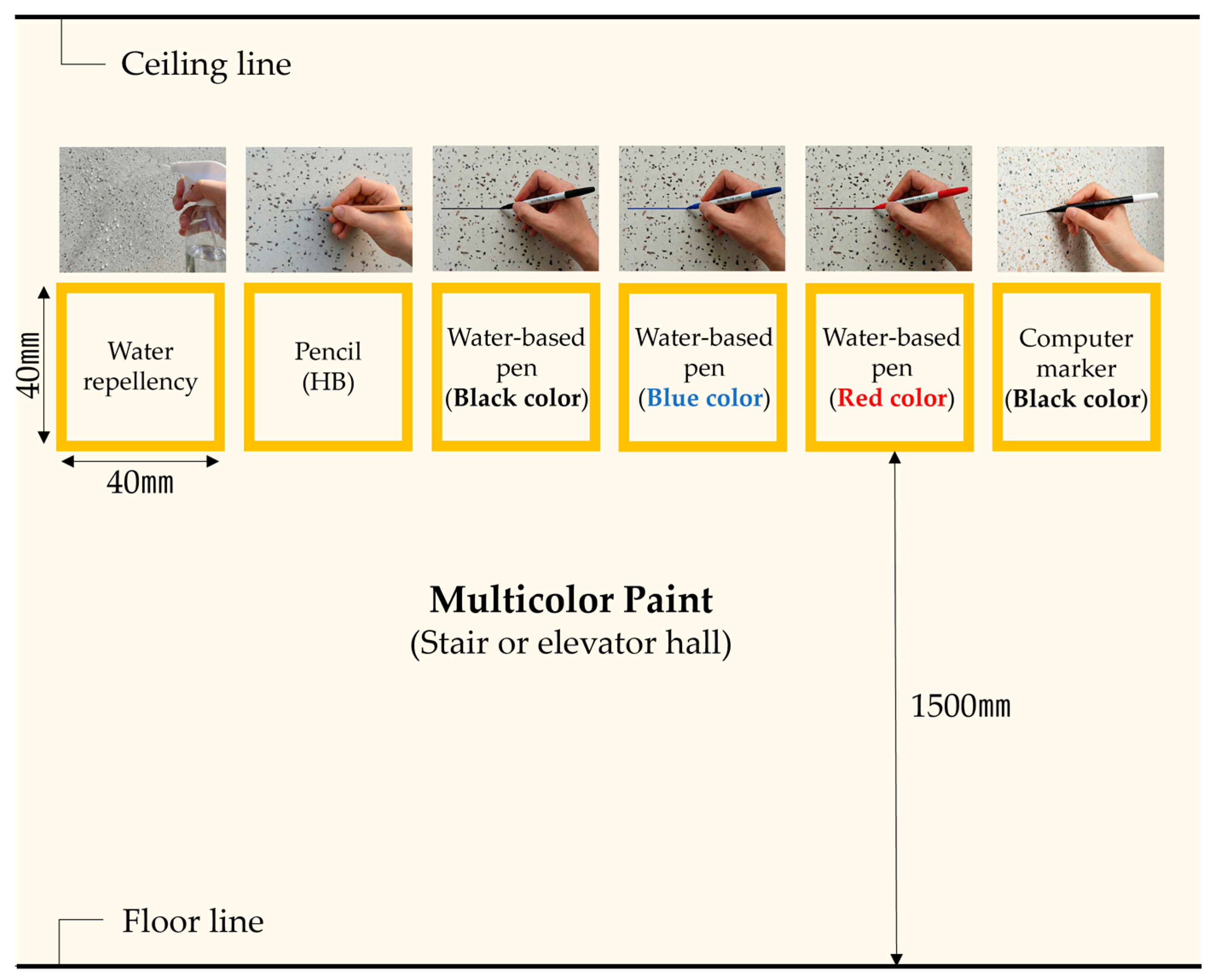
As shown in
Figure 2, to ensure consistent experimental conditions, a test location was specified on the wall at a height of 1.5 m from the floor, marked with yellow masking tape to create a 40 mm square. The overall condition and gloss of the Multicolor painting surface were checked, and the experiment was conducted from left to right in the following order.
- ①
A sprayer was used to apply water, and whether water droplets formed and seeped into the wall was observed.
- ②
Lines were drawn with an HB pencil and checked if they could be erased with an eraser.
- ③
A line was drawn with a black water-based pen, water was sprayed on it, and then it was wiped with a tissue to check if the line had been erased.
- ④
The experiment was conducted using the same method as in ③, but with a red water-based pen.
- ⑤
The experiment was conducted using the same method as in ③, but using a blue water-based pen.
- ⑥
Lastly, a computer pen was used to draw lines, water was sprayed on them, and then they were wiped with a tissue paper to check if the lines were erased.
The gloss level was determined by visually checking for reflections from direct sunlight or artificial light. The available market water was used to assess water repellency and anti-graffiti performance against markings made with water-based and computer pens. The sprayer used to evaluate the water-repellent properties was readily available, costing KRW 1000 for a plastic sprayer without a separate spray volume control.
Water repellency was evaluated by spraying water onto the wall surface three or four times with a sprayer, then visually checking whether water droplets formed and ran down the wall or were absorbed into the multi-colored paint surface. According to this empirical method, the former is classified as having water repellency, while the latter is classified as having little to no water repellency.
The tools used to evaluate the anti-graffiti function, i.e., pencils, water-based pens, and a computer pen, were readily available in the market. The pencil used was a Faber-Castell Goldfaber 1222 HB, manufactured in Indonesia. The eraser used was a Pentel Hi-polymer Ain eraser manufactured in Japan. The water-based pen used was a Monami Super marker pen in black, blue, and red, manufactured in Thailand. The computer pen used was a Dong-A Pilseung II black pen manufactured in Korea.
When drawing lines with a writing instrument, applying excessive pressure can damage the paint surface. Therefore, the lines were drawn by holding the pen lightly and making a single horizontal stroke from left to right. At each test location, lines were drawn in two places: one above and one below. The upper line was drawn with the writing pen positioned perpendicular to the Multicolor painting surface, while the lower line was drawn at a 45-degree angle. In addition, given the subjective nature of this empirical method and the expected variations between individuals, one of the co-authors was solely responsible for drawing all the lines with the writing tools.
Lines were drawn on the Multicolor paint surface with each writing tool before leaving them for 3 min. Afterward, water was sprayed three times with a sprayer. Afterwards, it was observed whether the lines were erased or if the water was absorbed. Lastly, the surface was wiped with a tissue, and the line erase status was checked.
The experimental results were evaluated after the video analysis team reviewed the site investigation team’s findings, and a final decision was made. The site investigation team, consisting of three co-authors of this study, immediately assessed the results of the experiment in an apartment complex. Simultaneously, the experiment was videotaped and provided to the video analysis team in a 1920 × 1080 resolution.
The video analysis team, consisting of two other co-authors, made their judgments based on the video data recorded by the site investigation team. However, as discussed in
Section 4, the experimental results sometimes matched between the site investigation team and the video analysis team, but at other times they did not. This was because the site investigation team focused solely on individual test results and failed to conduct a comprehensive analysis comparing them with other test results. Therefore, the video analysis team could supplement the experimental results and derive the final results by repeatedly comparing the site investigation team’s analysis results with the video data. To compare these differences in judgment, a correlation analysis was conducted using IBM SPSS Statistics 21.
To compare the results of previous experiments and to understand the relationships among the empirical methods’ results, a correlation analysis was performed.
4. Results
This chapter examines the results of applying the empirical method described in
Section 3 to determine the application of top coating for Multicolor painting work in actual residential building cases.
4.1. Surface Observation
This section briefly examines the condition check results for the walls in the elevator hall and stairwell, where Multicolor painting was applied in each case. As shown in
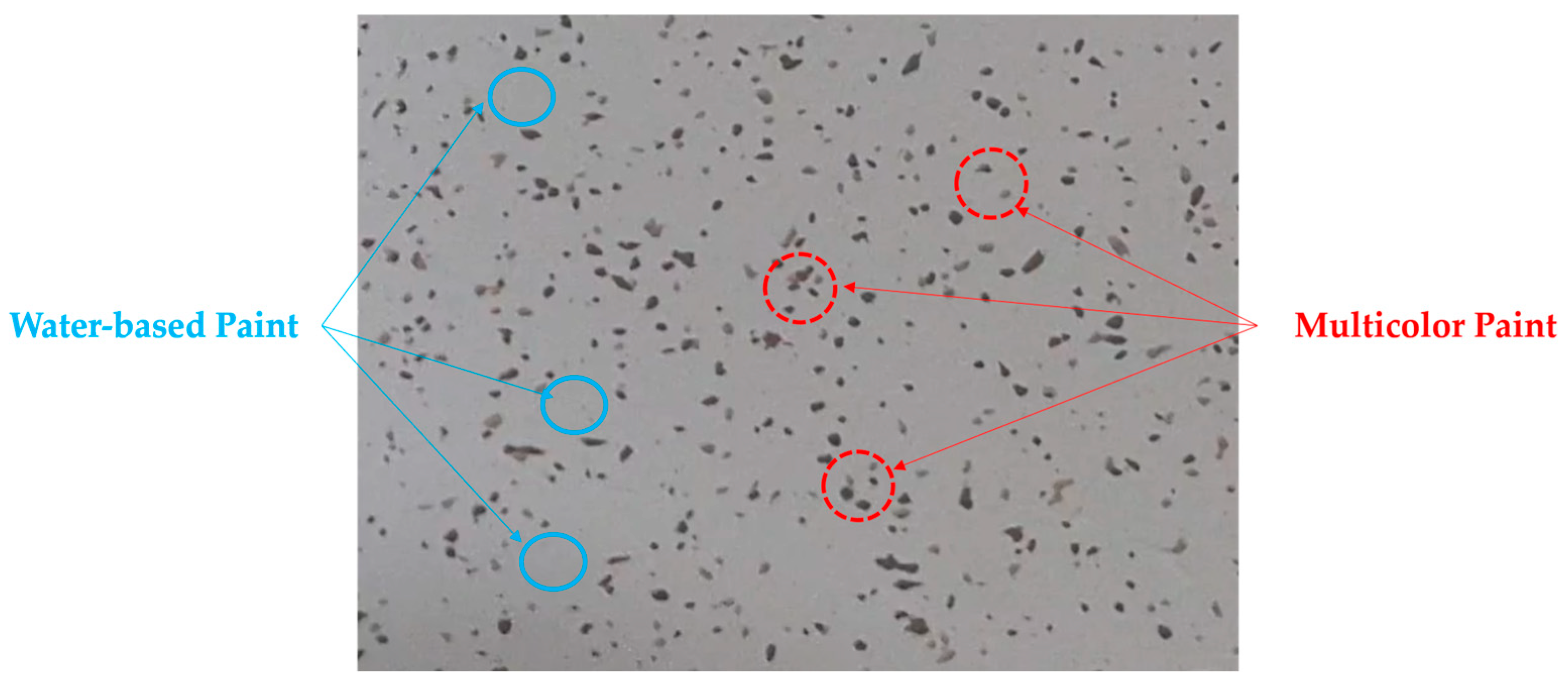
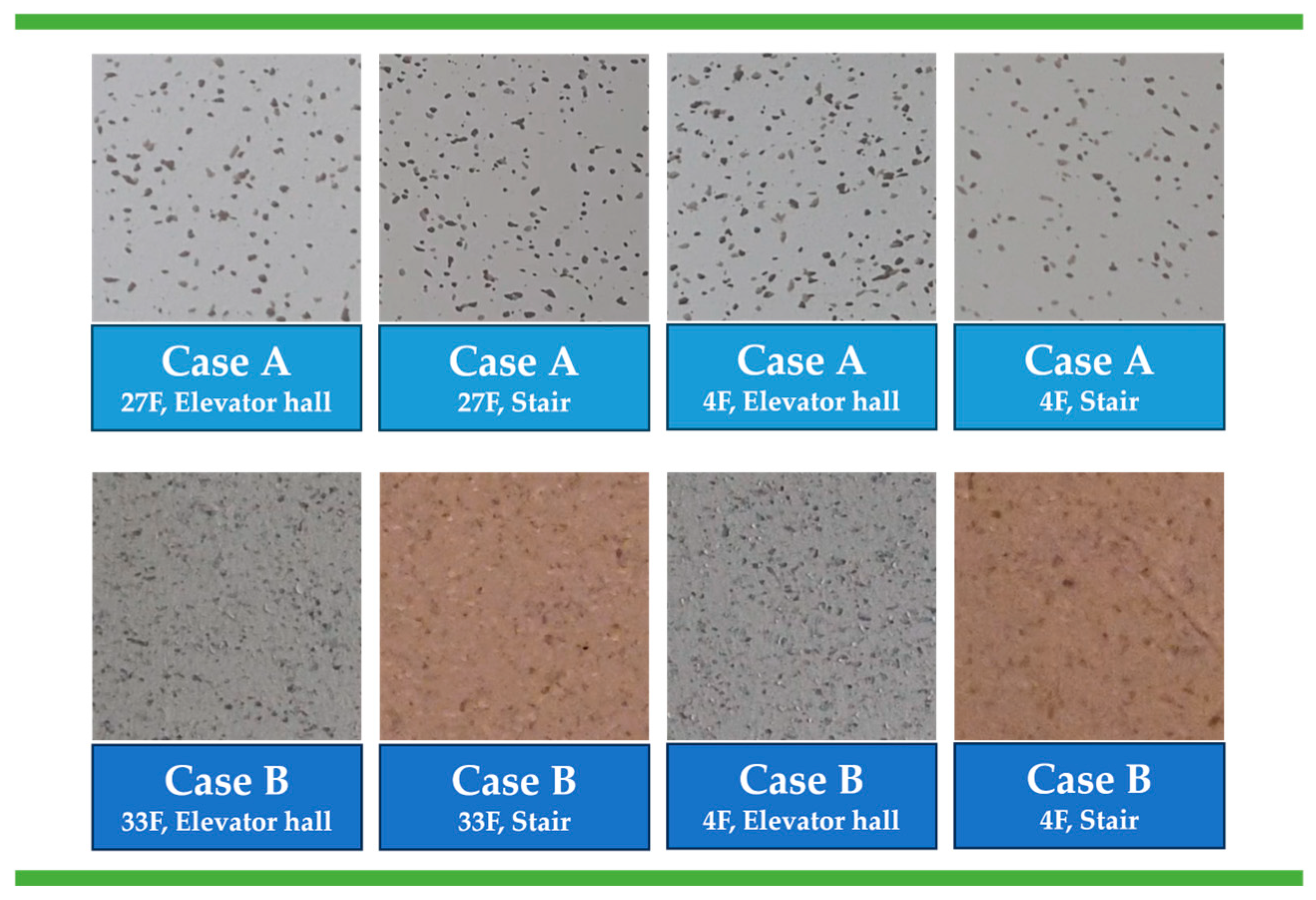
Figure 3, the shape of the Multicolor particles in Case A and Case B was found to be different. In Case A, the base coat is presumed to be white, water-based paint, composed of approximately three or four colors of particles. No particular issues were observed on the surface in Case A, perhaps because only 1 year has passed since the building’s completion, so no signs of deterioration have yet appeared. In Case B, the base coat is also presumed to be white or ivory-colored water-based paint, but the stairwell lighting is daylight-colored, which could cause confusion and make it appear another color. Furthermore, in Case B, the Multicolor painting surface appears rough and uneven, similar to lint on fabric. According to the site investigation team, when touched, it seemed to be paint peeling, and some of it rubbed off or easily detached. Considering these situations, it is estimated that in Case B, the multi-colored paint has deteriorated significantly after 10 years since building completion. Therefore, it is believed that numerous factors, including elapsed time, influence the performance of multi-colored paints and topcoats. However, unlike in a laboratory setting, site experiments cannot directly control these influencing factors, and continuous testing is difficult. Therefore, a more in-depth analysis that takes these factors into account will need to be addressed in a separate study.
4.2. Gloss Test
The gloss test results are summarized as follows. No gloss was observed in any of the samples in either Case A or Case B, and the opinions of the site investigation team and the video analysis team aligned on this point.
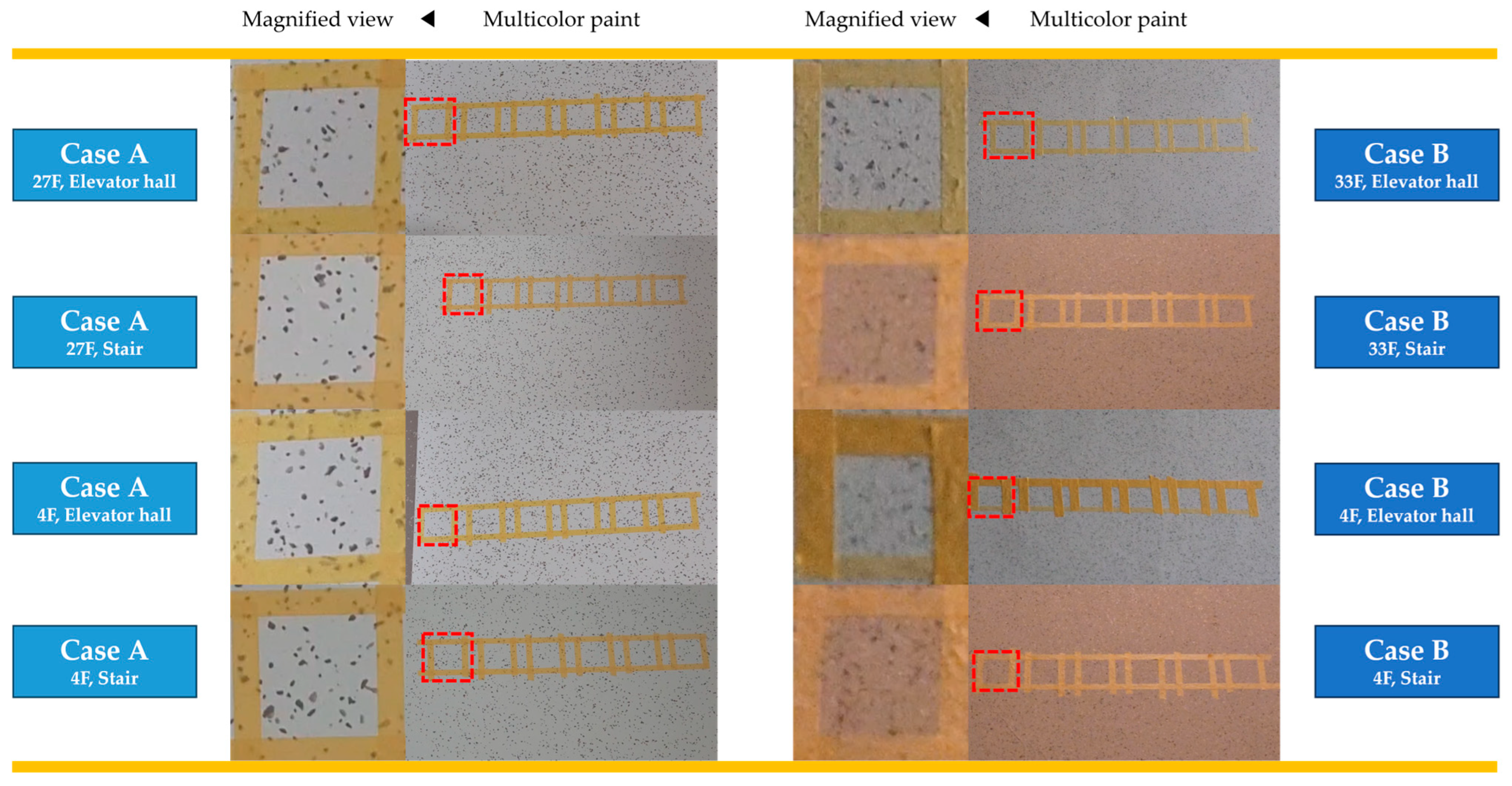
The site investigation team reported that no gloss was observed in any of the test specimens upon visual inspection. The video analysis team reviewed the video data taken by the site investigation team. As shown in
Figure 3 and
Figure 4, no gloss was observed in the enlarged images of the entire wall or parts thereof. Case A, completed one year ago, and with an intact painted surface, makes it difficult to say it has any particular gloss. Case B, completed 10 years ago, has a poor surface condition, so gloss cannot be expected. Moreover, it was difficult to find any circumstances that would suggest that Case A had a higher gloss than Case B.
However, the results of this experiment confirmed only the presence of gloss, concluded that gloss was not observed, and did not determine whether a multicolor paint coating was applied. If the presence of gloss were judged solely based on a glossy surface, all cases where a matte product is used would be mistakenly judged as not having been coated. In addition, as mentioned above, matte products are used for environmental or aesthetic reasons. In addition, as shown in
Table 1, in court appraisals, only 1 in 20 cases was judged solely on gloss, so it is unreasonable to judge the presence of a multicolor paint coating solely on gloss.
4.3. Water Repellency Test
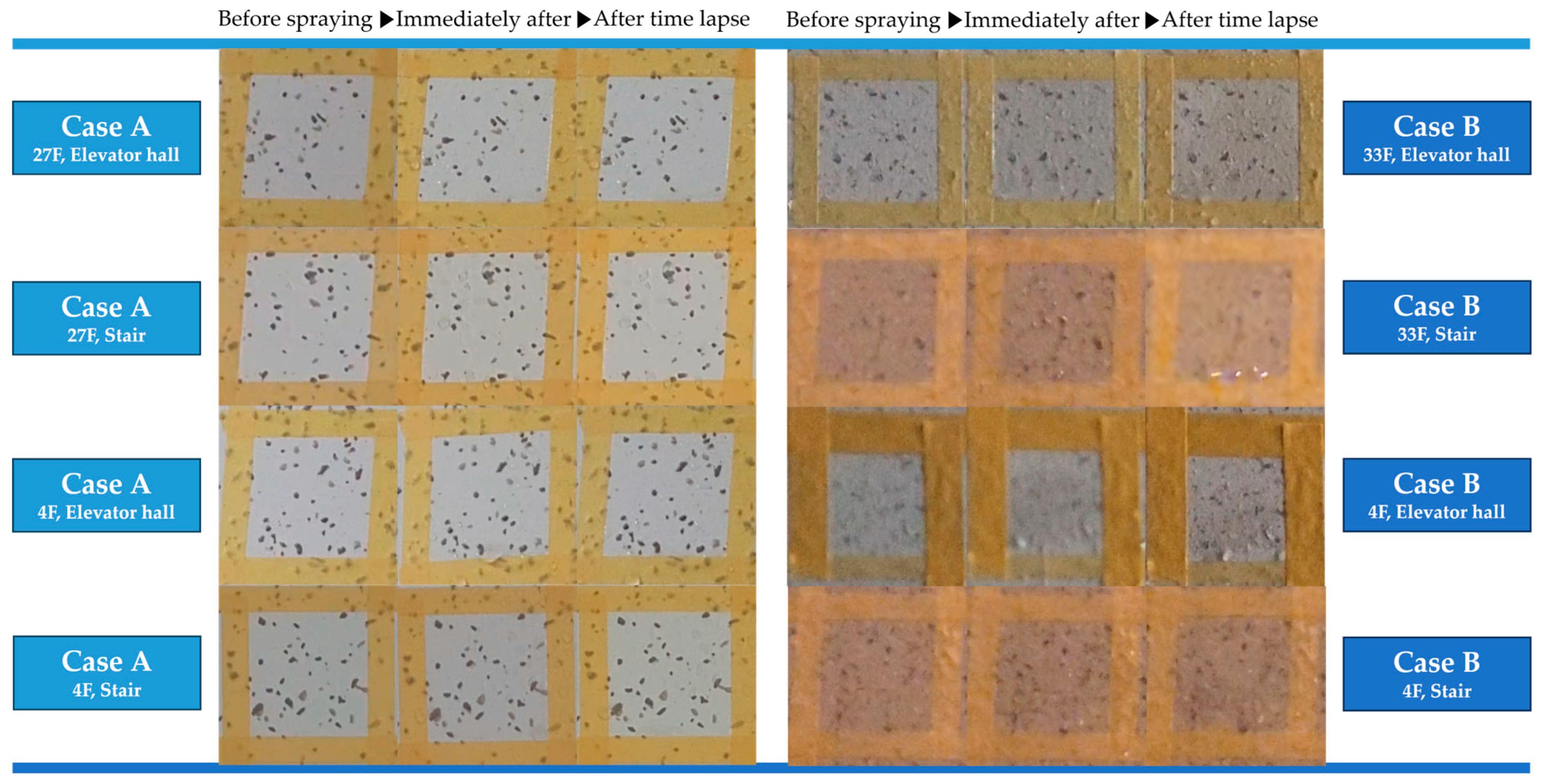
The evaluation results for the topcoat’s water repellency on the multicolor paint material showed that all four locations in Case A were water repellent. In contrast, all four locations in Case B were wet.
During the experiment, the site investigation team reported that the wall became wet in Case A, but not in Case B. However, the video data review results by the video analysis team yielded the opposite trend. As shown on the left side of
Figure 5, in Case A, no significant changes were observed on the painted surface before, immediately after, or even after some time had passed. In contrast, the test results for the elevator hall on the 4th floor on the right side of
Figure 5 are the clearest. This shows that water marks appeared on the wall immediately after water was sprayed and persisted even after some time had passed. The site investigation team’s error in judgment stemmed from their fragmentary assumptions rather than a comprehensive comparison of the different experimental results. Furthermore, this demonstrates that human judgment can lead to errors when using empirical methods.
If water repellency is used to determine whether a topcoat of the multicolor painting was applied, Case A can be classified as having applied the top coating. In contrast, Case B can be classified as not having applied the top coating. However, there are conflicting results with other experimental results described below, and this point will be comprehensively addressed in the discussion in
Section 5.
4.4. Anti-Graffiti Function Test Using Pencils
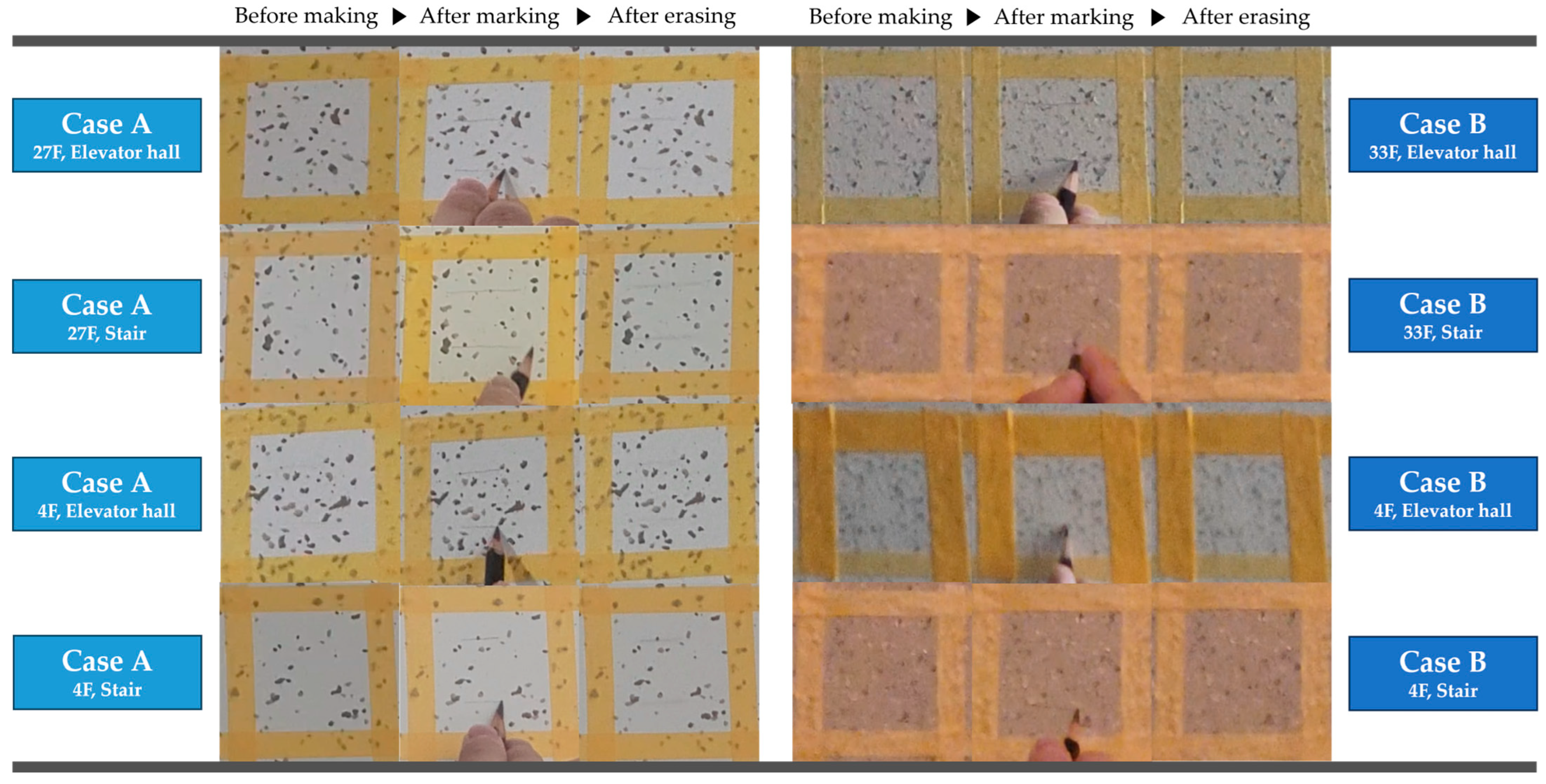
This section reviews the experiment assessing the anti-graffiti function of a top coating on a Multicolor painting, by drawing lines with a pencil and then erasing them. The results showed that in Case A, the pencil lines were not easily erased in all areas, leaving visible marks. In contrast, in Case B, all the pencil lines were erased. The opinions of the site investigation team and the video analysis team were consistent on these findings.
The site investigation team reported that in Case A, the pencil lines were erased with an eraser, leaving traces, whereas in Case B, all traces were erased.
Figure 6 shows the results of the video analysis team’s examination of the site investigation team’s photographic data. In Case A on the left, even after drawing the pencil lines and then erasing them with an eraser, the pencil marks remain clearly visible. In contrast, in Case B on the right of the same image, the pencil lines have been erased, and no traces are left.
If we judge the presence or absence of a topcoat of the multicolor painting based on the results of the pencil experiment, we can conclude that Case A did not apply a top coating at all four locations. In comparison, Case B did apply a top coating at all four locations. However, as mentioned in
Section 4.3, this contradicts the results of the water-repellency test. Moreover, pencils are generally quite hard, raising questions about their suitability as experimental tools. This is also confirmed by the fact that among the 20 court appraisal cases, only one case used the pencil experiment, as shown in
Table 1 above.
4.5. Anti-Graffiti Function Test Using Water-Based Pens
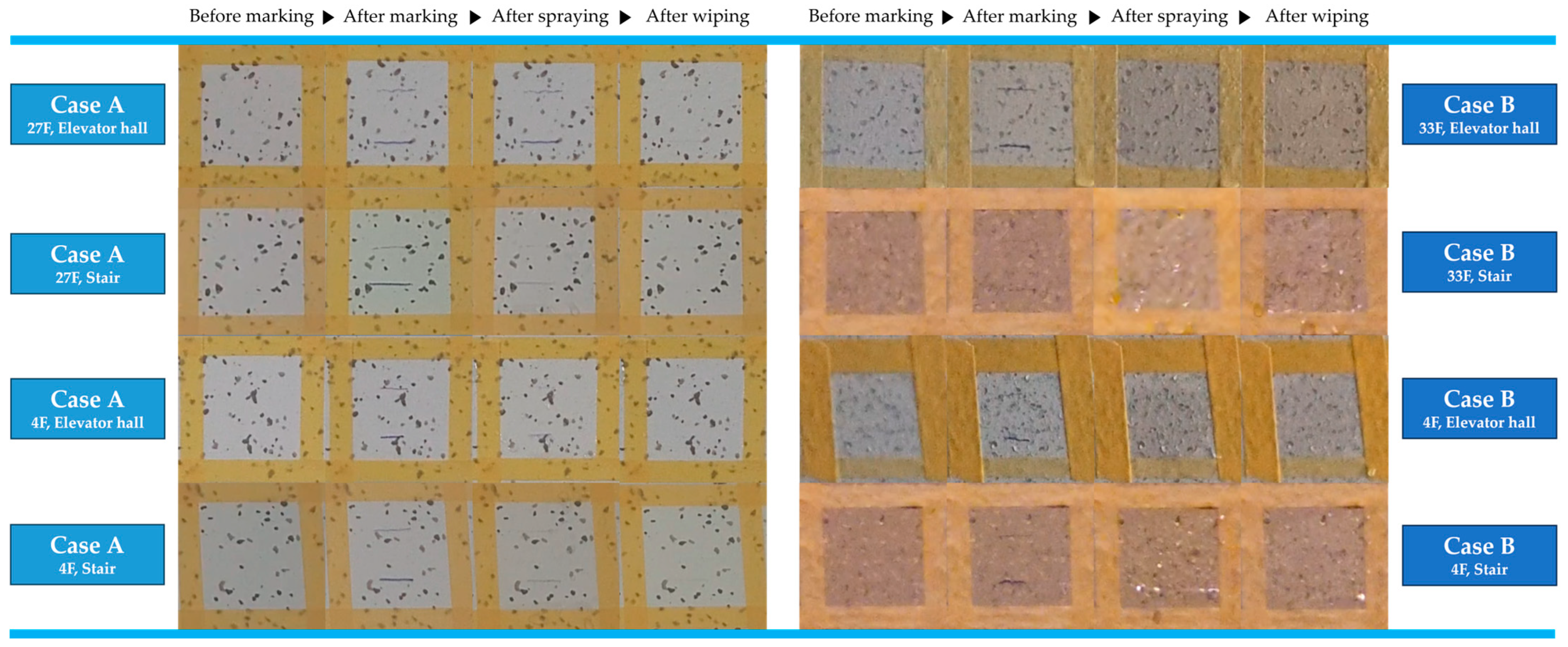
This study examines the anti-graffiti function of a top coating of a Multicolor painting, achieved by drawing lines with a water-based pen, spraying water, and wiping it with a tissue. The results showed variations depending on the Case and pen color. In Case A, differences were observed depending on the pen’s color, whereas in Case B, the water-based pen marks were removed entirely in all instances. The opinions of the site investigation team and the video analysis team differed in 4 locations in Case A, but were consistent in all cases in Case B.
4.5.1. Black Color Pen
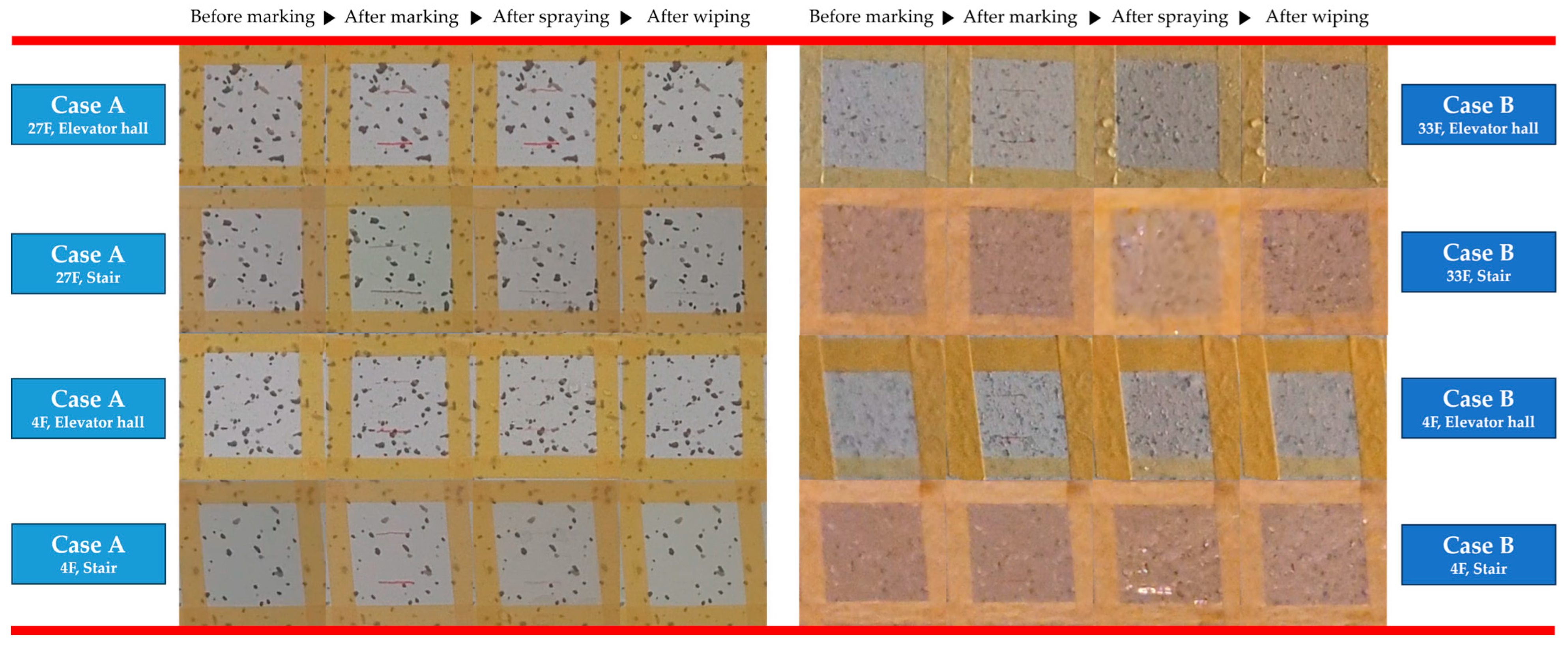
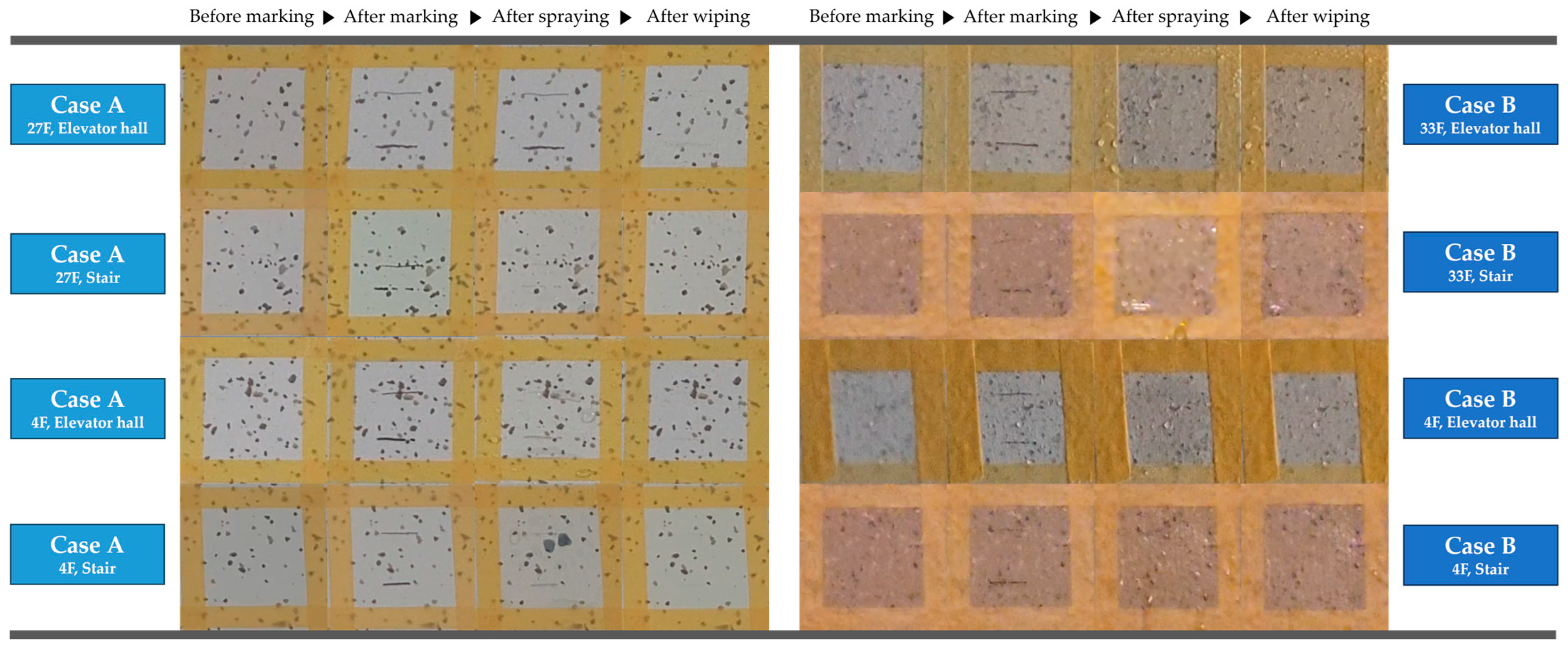
First, let us examine the case involving the use of a black water-based pen. The site investigation team determined that in Case A, all markings except for those in the 27th-floor stairwell were not erased. For Case B, they concluded that all markings had been erased. The video analysis team, after reviewing the evidence, presented the same findings as the site investigation team.
Meanwhile, the video footage of the on-site experiments shows differences in the degree to which the markings were erased. Looking at the experimental results for Case A on the left side of
Figure 7, even after drawing lines with a black water-based pen and spraying water, the lines remain visible. However, there are differences depending on the location: in the 27th-floor stairwell, the lines became very faint after contact with water, whereas in the elevator hall on the same floor, there was only a slight change. In the 4th-floor elevator hall and stairwell, the color faded after contact with the sprayed water. After wiping with a tissue, the lines in the 27th-floor stairwell were erased, while in the other locations, they were not. However, the color became much lighter than the initial markings, and the lines themselves remained visible. This trend was consistently observed in subsequent experiments using blue and red water-based pens.
In contrast, in Case B on the right side of
Figure 7, when water was sprayed onto the lines drawn with a black water-based pen, all of the lines disappeared immediately. Instead, as mentioned in
Section 4.2, the sprayed water was absorbed into the surface. After wiping away the water with a tissue paper in all areas of Case B, it was difficult to identify any remaining lines. This trend was consistently observed in subsequent experiments using both blue and red water-based pens.
If the application of the top coating of Multicolor painting work is judged solely by its anti-graffiti function using a black water-based pen, then in this experiment, Case A would be considered to have not had the top coating of Multicolor painting work applied in three locations (excluding the 27th-floor stairwell). At the same time, Case B would be considered used everywhere. However, considering that in Case A, the lines drawn with the black water-based pen were erased in one location, and the marks in the other three locations were so faint that they were difficult to identify without magnified photographs. It is reasonable to conclude that the Multicolor top coating was not applied in those three locations in Case A.
4.5.2. Blue Color Pen
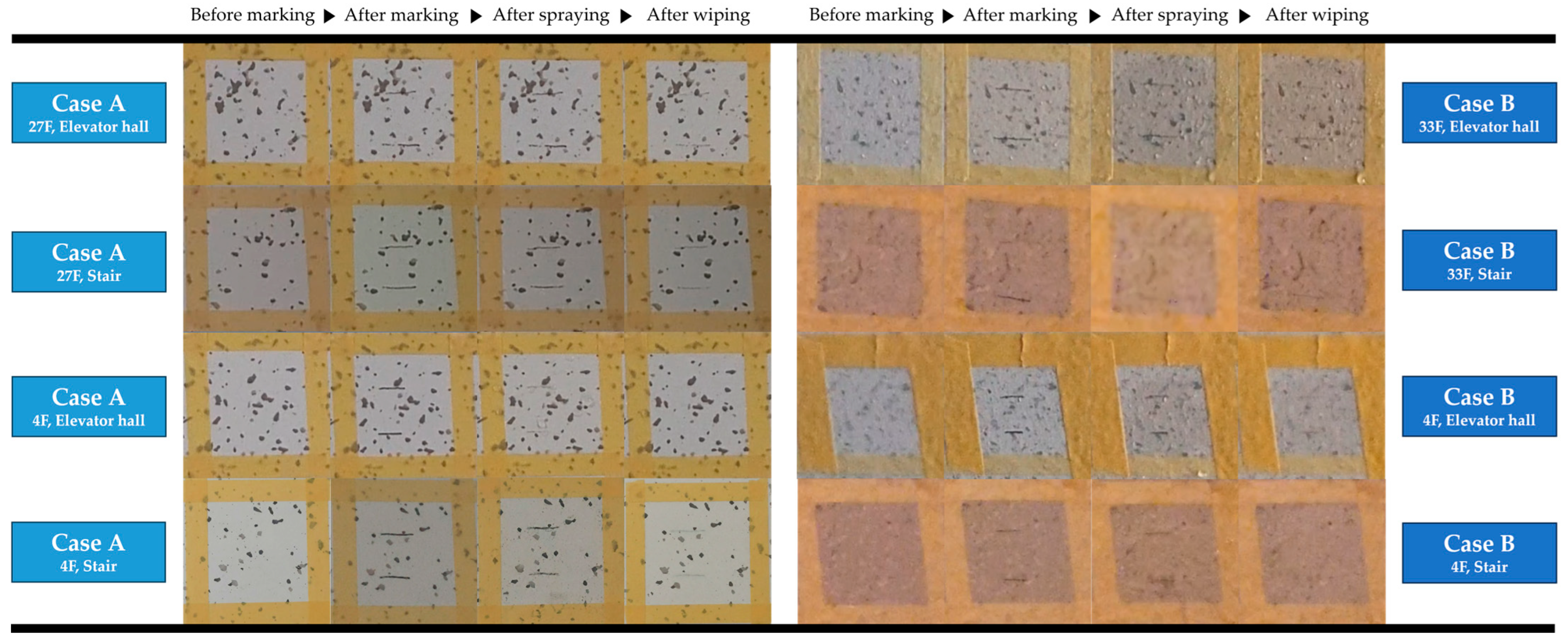
The following examines the results when using a blue water-based pen. For Case B, both the site investigation team and the video analysis team agreed that the pen marks were erased in all four locations. Meanwhile, the site investigation team determined that the blue water-based marker marks in all of Case A were not erased. The video analysis team reviewed the footage multiple times and confirmed that the water-based marker applied in the 27th-floor stairwell and the 4th-floor EV hall in Case A had been erased. The experimental results for Case A on the left side of
Figure 8 showed that when a line was drawn with a blue water-based pen and then sprayed with water, it faded in three locations, except for the 27th-floor elevator lobby. After wiping with a tissue paper, the lines were no longer visible in the 27th-floor stairwell and the 4th-floor elevator lobby. In the 4th-floor stairwell, the line was invisible at the top, with only a faint trace remaining at the bottom. The 27th-floor elevator lobby showed a slight change immediately after spraying with water, but after wiping with a tissue, it exhibited a pattern similar to that of the 4th-floor stairwell.
If the application of the Multicolor paint coating is judged solely by its anti-graffiti function using a blue water-based pen, then, in this experiment, Case A would be considered to have the top coating of Multicolor painting work applied in two locations and not used in the other two. At the same time, Case B would be deemed to have the top coating applied everywhere. However, in Case A, the lines drawn with the blue water-based pen were erased in two locations. In the other two locations, the lines were so faint that they were difficult to identify without magnified photographs. This is similar to the experimental results with the black water-based pen.
4.5.3. Red Color Pen
Now, the case involving the use of a red water-based pen is discussed. For Case B, both the site investigation team and the video analysis team agreed that the lines were erased in all four locations. In contrast, the site investigation team observed that the red water-based marker lines in all of Case A were intact. The video analysis team reviewed the footage multiple times and confirmed that the lines had been erased in the 4th-floor EV hall and stairwell in Case A, as shown in
Figure 9. This is similar to the results of the previous experiment using the blue water-based marker.
Meanwhile, the experimental results in the 27th-floor stairwell show significant differences across pen colors. As observed earlier, the lines drawn with black and blue water-based pens were erased, but the lines drawn with the red water-based pen remained. In the 4th-floor elevator lobby, the blue and red marks were erased, but the black marks remained. This suggests that experiments using water-based pens may show variations by color and by location.
If the presence of the top coating of Multicolor painting work is judged solely by its resistance to graffiti using a red water-based pen, this experiment would lead to the same conclusion as the experiment using a blue water-based pen. However, given that the experimental results varied by pen color and location, it is difficult to conclude that using a water-based pen to determine the color of a multi-colored paint coating is an objective method.
4.6. Anti-Graffiti Function Test Using Computer Markers
The anti-graffiti function of the top coating on the Multicolor painting was examined by drawing lines with a computer pen and then spraying water to see whether the lines were erased. The site investigation team reported that the lines were not erased in either Case A or Case B. However, after the video analysis team reviewed the footage multiple times, it was confirmed that the lines had been erased in the 4th-floor EV hall of Case A and the 4th-floor stairwell of Case B.
Looking at the left side of
Figure 10, which summarizes the experimental results using a computer pen, in Case A, similar to the water-based pen experiment, the lines become fainter after spraying with water. In particular, the lines in the 4th-floor elevator hall became significantly fainter than in other areas, and after wiping with a tissue, the line marks disappeared completely. In the remaining three locations, the line fading was less pronounced than with the water-based pen, and even after wiping with a tissue paper, the line marks remained.
In Case B, as shown on the right side of
Figure 10, the results differ from the water-based pen experiment. In the water-based writing test in Case B, the lines seemed to disappear immediately upon contact with the sprayed water. After wiping with a tissue paper, no trace of the lines remained. In contrast, in the computer-pen experiment, the lines hardly faded even after being sprayed with water. While some fading was observed in Case A, a slight change was observed in Case B. Of course, the lines did weaken after wiping with a tissue. Among the Case B samples, only the lines in the 4th-floor stairwell were erased by wiping with a tissue paper.
If the effectiveness of the top coating in Multicolor painting work is assessed solely based on its anti-graffiti function using a computer pen, the results from this experiment indicate that the top layer was not applied in all cases, except one location in both Case A and Case B. However, even if we set aside Case A—where the experimental results varied inconsistently by location and pen color—it remains questionable whether we can definitively conclude that the top coating was not applied in Case B. This is particularly concerning because only one location showed lines being erased in the computer pen experiment. In contrast, consistent results from pencil and water-based pen tests demonstrated that all lines were effectively erased.
4.7. Comparison
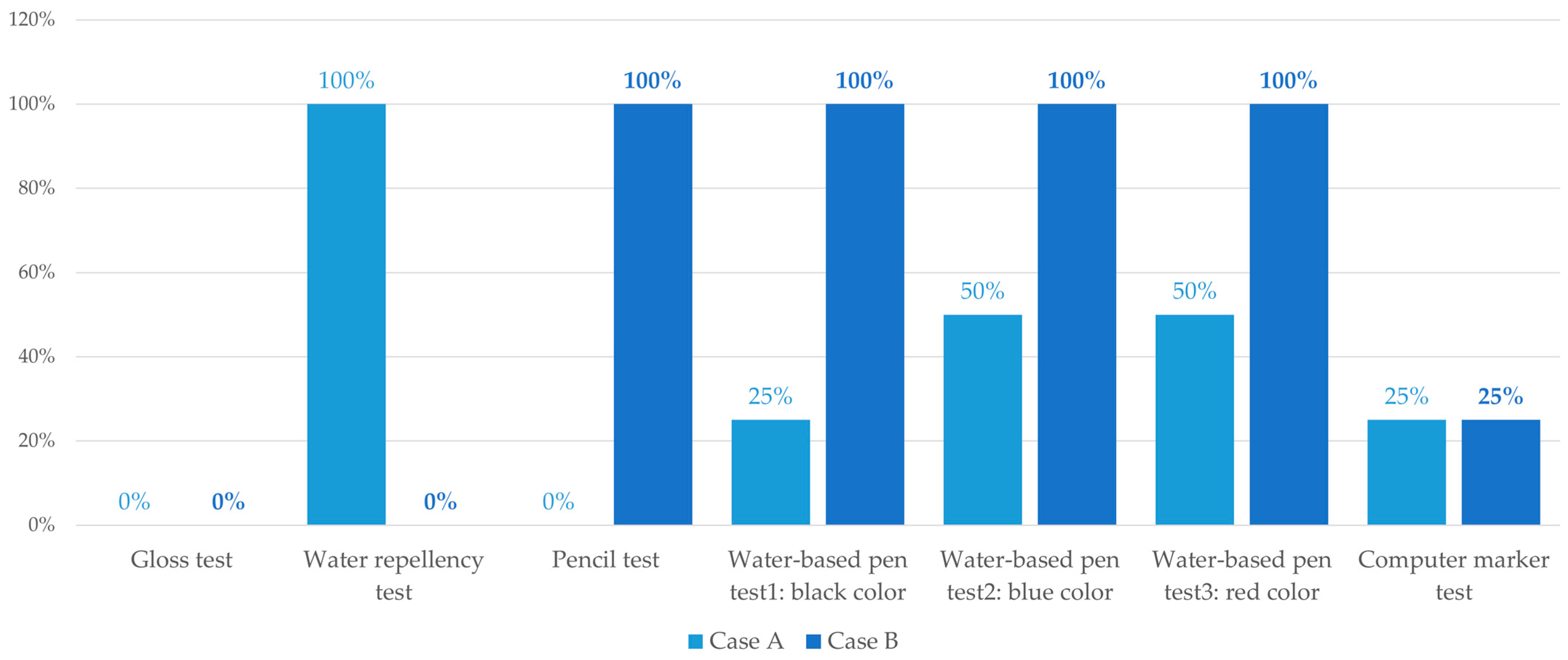
The results of the previous experiments were converted into quantitative evaluations for comparison. Since experiments were conducted at four locations for each case, a 100% rating was assigned to the case in which the Multicolor paint coating was successfully applied at all four locations. A 25% reduction was used whenever the location was reduced by 1, as shown in
Figure 11. This was done to convert it into quantitative variables for statistical analysis.
When judged by glossiness, both Case A and Case B were rated at 0%. Based on water repellency, Case A was rated 100%, while Case B was rated 0%. In the pencil test, Case A was rated at 0%, and Case B at 100%. The results of the water-based pen test varied by color; for the black water-based pen, Case A was rated at 25% and Case B at 100%. For both the blue and red water-based pens, Case A and Case B were both rated at 50% and 100%, respectively. Finally, the computer pen test showed both cases rated at 25%.
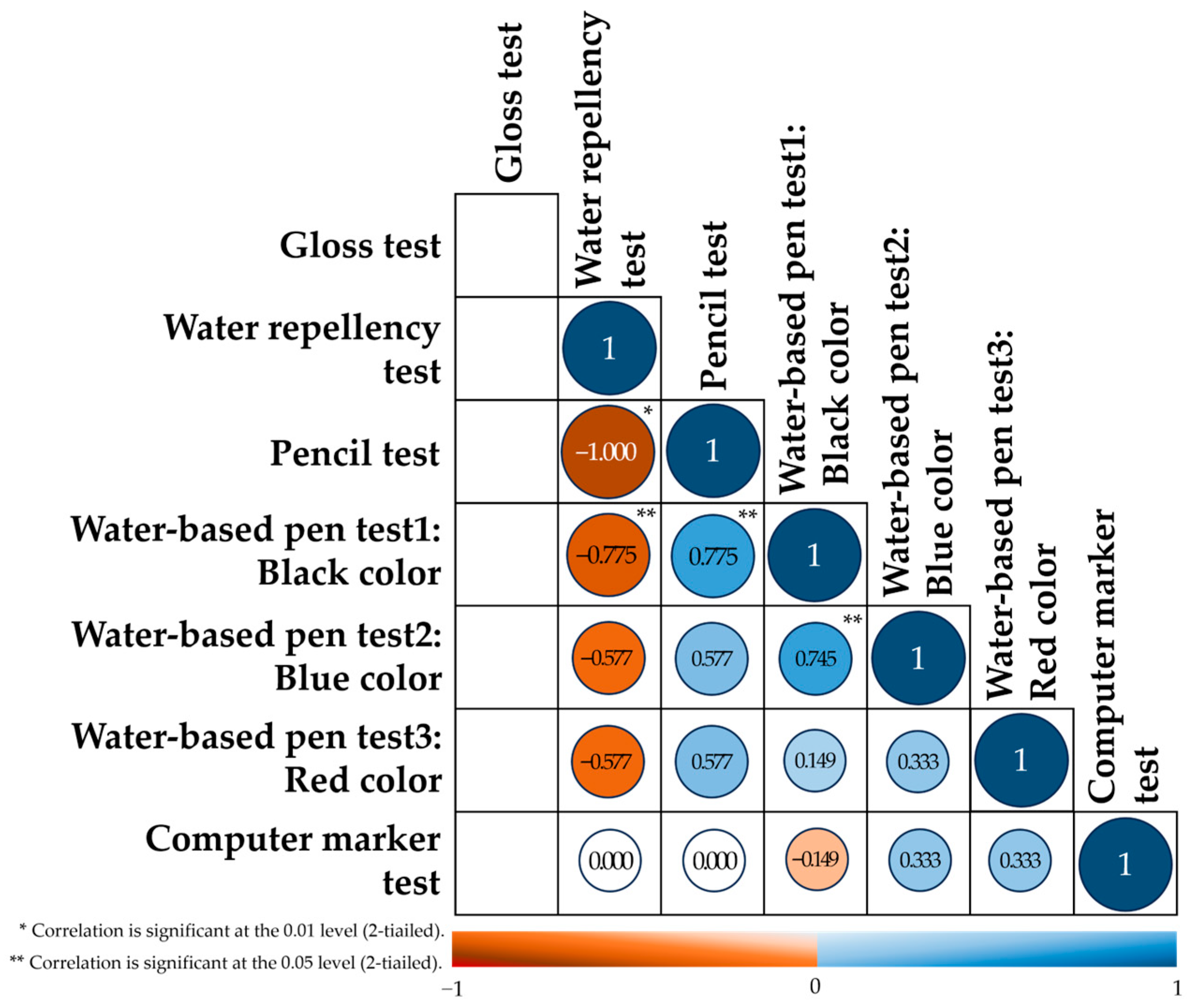
To determine the influence or relationship between the different empirical methods based on the above results, a correlation analysis was performed. For Cases A and B, a total of 8 test locations were analyzed. The data were coded so that 1 indicated that the Multicolor painting was done using each empirical method, and 0 indicated the opposite. This data was then analyzed using SPSS, and the results are presented as a correlation heatmap in
Figure 12.
First, the relationship between the gloss level and other empirical methods was examined. The correlation analysis showed no significant correlation between the gloss level and the other empirical methods for which coefficients could be calculated. This might be because the gloss level was not confirmed in any of the cases, making it difficult to establish any relationship with other empirical methods.
Secondly, examining the relationship between the water repellency test and other methods, the correlation coefficient between the water repellency test and the pencil test was −1. Therefore, these two methods can be considered to have opposite tendencies. Meanwhile, comparing the water repellency with the results of the water-based pen test, only the black water-based pen showed a correlation with water repellency. The correlation coefficient between the two was −0.775, indicating a strong negative correlation. Although the correlation coefficients for the other colored water-based pens were also relatively high, they were not statistically significant. The correlation coefficient between the water repellency test and the computer pen test results was 0.000, indicating no relationship.
Third, the relationship between the pencil experiment and other methods was examined. The black-water-based pen experiment correlated with the pencil experiment. The correlation coefficient between the two was 0.775, indicating a strong positive correlation. The correlation coefficients with the remaining experiments were not statistically significant.
Fourth, the relationship between the water-based pen experiment and other methods indicated that the black water-based pen experiment had a strong positive correlation of 0.775 with the pencil experiment and 0.745 with the blue water-based pen experiment. Conversely, there was a strong negative correlation of −0.775 with the water repellency experiment. The blue water-based pen experiment showed a significant correlation with the black water-based pen experiment, but none with the others. Meanwhile, the red water-based pen experiment showed no correlation with any of the other experiments.
Fifth, the correlation coefficients between the results of the computer pen experiment and those of other experiments were low, and no cases showed a statistically significant difference.
In summary, the correlation analysis indicates that the water repellency test results are highly likely to be the opposite of the anti-graffiti function test results using pencils or black water-based pens. That is, if the water repellency test suggests that, in the judgment case, concluding a top coating of Multicolor painting work has been applied, the anti-graffiti function test using pencils or black water-based pens may yield an opposite result. Conversely, the results of the tests using pencils and black water-based pens are likely to be similar. Similarly, comparable results can be expected when using black and blue water-based pens.
5. Discussion
Based on the earlier experimental results, each research question selected in
Section 2 is discussed.
The first issue is whether the application of the top coating in Multicolor painting can be verified empirically, and what the significance of this empirical investigation is. In Korean litigation, five empirical methods were used to determine whether the top coat of a Multicolor painting had been applied. These methods will be discussed in conjunction with the experimental results of this study as follows.
It was challenging to draw meaningful conclusions about the gloss level because none of the samples or test specimens showed gloss. As a result, we could not determine its relationship to other methods. Relying solely on visual observation for gloss does not seem to be an appropriate approach. However, this method could be effective when a product with a strong gloss is used or when there is a short time lapse after building completion. The effectiveness of gloss assessment is inherently limited if it is based solely on visual inspection, as is currently the practice. Even when gloss is observed, it is essential to differentiate between varying levels of gloss. Therefore, quantification using a gloss meter is required, and it is important to discuss the relationship between gloss levels and other empirical methods. These aspects should be considered in future research.
While the water repellency test is a helpful method, it shows conflicting results compared to other performance tests, requiring caution in its use. If the water-repellency test used in litigation can truly determine whether a Multicolor paint coating has been applied, it has advantages over other testing methods. This is because spraying water in the water repellency test does not damage the painted surface, nor does it cause problems such as the traces left behind occurring in the anti-graffiti function test. Furthermore, although the water repellency test, used as an empirical method, deviates from industrial standards such as JIS or KS, given that applying these standards to Multicolor painting on buildings is impossible, an adapted water repellency test suited to construction site conditions is meaningful. However, the conflicting results observed compared to the anti-graffiti function test, which will be discussed later, need to be complemented. Therefore, testing methods and processes should be standardized, and detailed specifications should be prepared.
In the experiment evaluating the anti-graffiti function using pencils, the results were the exact opposite of those from the water repellency test. This discrepancy highlights the urgent need for further research into both methods. Contrary to the authors’ expectations, the results of the water repellency and pencil tests were conflicting. In the initial water repellency test, Case A demonstrated water-repellent properties, so it was expected that similar results would be observed in the subsequent pencil test. However, the outcomes were opposite. In Case A, which was anticipated to exhibit water-repellent properties, none of the pencil marks could be erased. Conversely, in Case B, which was presumed to lack water-repellent properties, the pencil marks were erased. It is important to note that the Multicolor painting surface in Case B was significantly deteriorated, which may have contributed to its removal during the drawing and erasing of the pencil lines. Unfortunately, the authors were unable to observe or record this aspect. Also, graphite, the main component of pencils, is not hydrophilic by nature, so it may leave complex and hydrophobic marks, which may be more persistent marks than those from other writing tools.
In experiments using water-based pens, the results differed from those of the water repellency test, and differences were also observed depending on pen color. Given variations in location even within the same sample, this method should be used with greater caution, as multiple factors influence it. In Case B, consistent results were obtained regardless of location or color, but in Case A, results varied from test to test. Even though we set the pencil test aside from the discussion, the water-based pen test was expected to yield results comparable to those of the water repellency test. However, despite Case A appearing to exhibit water-repellent properties, the water-based pen test results did not meet expectations. Furthermore, in Case A, it was frequently observed that some colors were erased in the exact location while others were not. This suggests that differences may depend on the dye components of the water-based pen ink, and that other conditions may also influence the results.
Regarding the computer pen, based on the results of individual experiments and correlation analyses, it appears unsuitable for use alongside other empirical methods. The experimental results using the computer pen showed no correlation with the results of the water-repellent and pencil experiments. They were also different from those of the water-based pen experiments, which were expected to be similar. When we examined the cases individually, Case A showed lower anti-graffiti capabilities than Case B, so Case A was excluded, and Case B was focused on. In Case B, the marks from both the pencil and water-based pen experiments were erased. Nevertheless, the experiment with a computer pen yielded the same result as Case A, with 25% of the marks removed. This indicates that using a computer pen to determine whether a top coating of Multicolor painting work has been applied is not related to other methods. Computer pens use special pigments that are easily recognized by optical devices. Furthermore, it was much more difficult to erase the writing with this tool than with others. Considering these characteristics, a computer pen should not be used to determine the application of a topcoat for Multicolor painting. However, the sample size in this study was small, and the specific factors underlying the observed differences could not be identified through additional tests. Therefore, further research that controls and varies factors is needed to investigate this issue thoroughly.
It is expected that all methods except for gloss level checking and experiments using a computer pen will yield the desired results. However, again, further research is needed to determine which method is more transparent and more objective.
Secondly, it was examined whether different results could be obtained even when using the same empirical method. This relates to the experiment with water-based pens; since water-based pens come in diverse colors, whether there would be differences depending on the pigment components that determine the color was examined. In Case B, it was difficult to say there were differences because the lines drawn with the water-based pens were erased in all cases. On the other hand, in Case A, the experimental results varied across all four locations. From these results, the results may vary depending on the color of the water-based pen. Furthermore, since the results differed even with the same color at different test locations, it is suspected that other factors were at play.
The correlation analysis results showed a strong positive correlation between the experimental results for black and blue water-based pens. Therefore, it is suggested that these two can be used as complementary experimental tools. On the other hand, the experimental results for the red water-based pen showed a lower correlation coefficient than those for the black and blue water-based pens. Therefore, the red water-based pen should be used differently from the black and blue water-based pens.
Third, it must be considered whether the results might vary depending on the person conducting the investigation and making the judgment, and whether empirical methods are used. In this study’s experiment, the site investigation team and the video analysis team each made their own judgments. The experimental results for each case, excluding the gloss observation method, are as follows:
Method that yielded contradictory results: Water repellency test.
Methods that showed some differences: Blue water-based pen experiment, red water-based pen experiment, and computer pen experiment.
Methods that yielded the same results: Pencil experiment and black water-based pen experiment.
The site investigation team made immediate visual observations but did not immediately compare their findings with results from experiments conducted elsewhere. While the video analysis team relied on video footage captured by the site investigation team, they were able to compare their findings with results from experiments conducted elsewhere at the same time. The difference was most evident in the water-repellency test. The video footage showed that in Case B, water absorption was clearly visible on the painted surface. In contrast, this phenomenon was not observed in Case A. It is suspected that during the site investigation, assessing water repellency in Case A was challenging because of the white water-based paint on the adhesive surface, and that there may have been confusion in Case B due to lighting conditions. This suggests that, when using empirical methods, judgments can vary across individual investigators and site conditions. Therefore, it is necessary to supplement observations of only a portion of the painting surface with a comprehensive assessment of the entire area.
Lastly, it is essential to interpret the results of each empirical method accurately. This includes assessing whether a specific process is the most reliable or whether the best approach is to use multiple methods in complementary ways. This discussion summarizes the key issues highlighted in prior research. Unfortunately, it is difficult to provide a clear answer to this question based solely on current research. While the small number of cases studied in this research is a limitation, considering the experimental results, it is suspected that the differences are not solely due to differences in the empirical methods themselves, but also due to variations in site conditions.
6. Conclusions
Multicolor paints are used as finishing materials for the interior and exterior of buildings. Still, the application of these top coatings has become a significant point of contention in lawsuits in Korea. Court-appointed appraisers are using empirical methods to determine whether the top layer of Multicolor painting work has been applied by checking factors such as gloss, water repellency, and resistance to graffiti using pencils, water-based pens, and computer pens. While these empirical methods are easy to perform on-site and allow for intuitive judgment, they also suffer from subjectivity and qualitative bias.
This study conducted direct experiments on apartment buildings to determine whether the empirical methods currently used to assess the application status of the top coating of Multicolor painting work are appropriate. The results showed that checking the gloss levels was complicated and unreliable in all cases, making it impossible to compare with other methods. Nevertheless, the tests for water repellency and resistance to graffiti with pencils and water-based pens proved meaningful. However, the water repellency test method yielded results opposite those of the pencil test. It also showed a strong tendency to contradict the results of the writing test with a water-based pen. Therefore, it is difficult to make a judgment based solely on water repellency, and applying other methods in combination also showed contradictory issues. In the water-based pen experiment, similar trends were observed with black and blue ink, but red ink showed a weaker correlation. According to the correlation analysis, the experimental results of the anti-graffiti function using a computer pen showed no correlation with the water repellency test results or the anti-graffiti function test results with a pencil. Furthermore, there was no significant correlation between the computer pen and the anti-graffiti function test results using a water-based pen. In summary, empirical methods for assessing the effectiveness of the top coating in Multicolor painting yielded unique results, and some methods may contradict or complement others. Of course, these empirical methods also have their own limitations and are influenced by site conditions.
This study is meaningful as the first to comprehensively examine the empirical methods used to determine the top-coating status of Multicolor paintings in legal disputes, by directly evaluating all processes at a single site and comparing the results. These empirical methods are subjective and qualitative, so their current application may be discontinued. They must be reformed through scientific efforts to establish objective criteria and procedures before being utilized. However, this study was conducted with a limited number of cases and test samples and did not consider all the complexities of real-world site conditions. Therefore, further in-depth and continuous research should be conducted with sufficient public support.





 ,
,