


Highlights
What are the main findings?
- The treatment based on boron-CuO reduced the after-flame time of Pinus sylvestris L. wood and eliminated afterglow.
- Treated wood formed a compact char with a glass-like layer and up to 42.3% residue at 500 °C.
- 1 wt.% CuO NPs preserved char stability while 3 wt.% gave a 20 mm inhibition zone against S. aureus.
What are the implications of the main findings?
- A single water-based formulation provides both fire protection and antibacterial activity to Pinus sylvestris L. wood.
- CuO NP content can be tailored to prioritize char stability or antibacterial performance.
Abstract
The present study examines the modification of Pinus sylvestris L. wood (PW) using a water-based boron–nitrogen–silica–PVA-CuO NPs flame-retardant (FR) system, and its effects on the flame retardancy, char structure and antibacterial activity. The microwave-prepared FR formulation, containing 0, 1, or 3 wt.% green-synthesized CuO nanoparticles (NPs) dispersed by ultrasonication, was applied to PW by ultrasound-assisted impregnation. The untreated and FR-treated PW were characterized by SEM-EDX, FTIR, XRD and TG/DTG. Fire performance was evaluated by the vertical flame test (VFT), and antibacterial activity was assessed against Staphylococcus aureus. SEM-EDX revealed a continuous FR coating on the wood surface, while FTIR indicated interactions between the coating components and the wood substrate. The FR treatment reduced flammability, decreasing the after-flame time from 37 s for untreated wood to 1–12 s for the treated samples. Increasing the CuO NP content further shortened the after-flame time and enhanced antibacterial activity, although at the highest loading, CuO NPs may catalyze char oxidation during thermo-oxidative decomposition. Raman spectroscopy of the char residues revealed characteristic D and G bands, confirming the formation of a protective carbonaceous char layer. The boron–nitrogen–silica–PVA–CuO FR formulation thus provides a multifunctional approach to wood protection.
1. Introduction
Wood is a renewable, lightweight, and structurally versatile material extensively used in construction and interiors; however, its flammability and vulnerability to microbial degradation limit safe, long-term applications [1,2].
Electrical faults, cooking and heating equipment, and open flames commonly cause fires in residential and commercial buildings. Wood-based structures are particularly vulnerable to fire because cellulose, a major component of wood, is combustible. At elevated temperatures, cellulose decomposes and releases flammable volatile compounds that contribute to flame spread and fire development [3,4]. Improving wood fire resistance is therefore an important area of ongoing research [5,6].
To address these limitations, researchers have developed various strategies to improve wood fire resistance and durability. These approaches generally include physical modification, such as mechanical densification [7], and chemical modification through incorporating flame-retardant (FR) systems via surface treatments or impregnation into the wood structure [8,9].
Surface treatment methods, such as brush coatings, are widely used to enhance wood’s fire resistance while preserving its natural appearance. However, despite achieving effective flame retardancy, their application efficiency is often limited by susceptibility to mechanical wear, moisture, high temperatures, and UV exposure, which can reduce their protective effectiveness over time [10]. In contrast, impregnating FR directly into the wood structure provides a deeper, more uniform distribution of FR within the wood and helps overcome some of these limitations, although leaching of water-soluble FRs under exterior exposure remains a concern [11].
Traditional FR systems often contain halogenated compounds that raise environmental and health concerns. Thus, recent research has focused on environmentally friendly alternatives based on inorganic materials and biocompatible polymers.
FRs based on boron, phosphorus, nitrogen, and silicon compounds currently represent the predominant technologies for wood protection [12,13,14]. Once applied to wood, these compounds lower its pyrolysis temperature and accelerate surface char formation [15].
Among these, boron-based FRs offer many advantages, including excellent flame retardancy, antibacterial and insecticidal properties, lower toxicity, and lower cost [16].
Che et al. [17] developed an FR system based on graphene oxide and boric acid using a graded-penetration impregnation strategy which showed excellent flame-retardant and antibacterial performance, attributed to the synergistic effect of graphene oxide and boric acid coating on the wood surface, as well as the presence of boric acid molecules within the wood cells.
A further drawback of wood is that microorganisms break it down easily. Conventional inorganic preservatives have long served to prevent this decay, yet many rely on toxic heavy metals that harm both people and the environment [18].
Boron-based systems are considered highly effective wood preservatives due to their broad-spectrum activity against fungi and insecticidal properties [19]. In recent years, nanomaterials have been developed as a new generation of preservatives that can prolong the service life of wood products. Metal nanoparticles such as Zn, Cu, and Ag, as well as metal oxides including ZnO, CuO, and TiO2, have demonstrated improved antimicrobial performance when incorporated into wood matrices [20,21]. Copper-based formulations, including alkaline copper quaternary and micronized copper systems, are already widely used in commercial wood protection [22]. Combining low loadings of CuO NPs with boron-based systems may therefore offer a favorable compromise between biological performance and environmental impact by reducing the required amount of copper.
Besides fire, wood used in indoor applications such as furniture, flooring, and surfaces in public buildings, schools, and healthcare facilities is exposed to microbial colonization. Because of its porous, hygroscopic structure, wood can retain moisture and organic contaminants that favor bacterial adhesion and survival on its surface [23]. S. aureus, a common Gram-positive pathogen frequently found on contact surfaces, is therefore a relevant model organism for evaluating the antibacterial performance of treated wood [24]. Combining flame retardancy and antibacterial activity in a single treatment is thus of practical interest, as it avoids successive treatments with separate products [10,17].
This study investigates the multifunctional modification of PW using a microwave-irradiated boron–nitrogen–silica–PVA FR formulation containing green-synthesized CuO NPs, applied by ultrasound-assisted impregnation. Although boron and nitrogen compounds, silica, and PVA have been investigated individually or in binary combinations for wood protection, to the best of our knowledge, no study has reported their combination with biosynthesized CuO NPs in a single water-based formulation prepared under microwave irradiation and applied by ultrasound-assisted impregnation. In this system, boric acid acts as the main FR and biocidal component; urea acts as a nitrogen source that releases non-flammable gases (NH3, CO2) on decomposition, diluting the combustible volatiles, and is expected to act synergistically with boron in promoting char formation [12,16], fumed silica contributes to the formation of a thermally stable protective barrier; PVA acts as a film-forming binder that improves the retention of the inorganic components; and CuO NPs provide antibacterial activity and may catalyze char formation. Microwave irradiation was used to promote interactions among the components during formulation preparation, whereas ultrasound was used to disperse the CuO NPs and to assist the impregnation of the formulation into the wood. Together, these components are designed to act synergistically, improving thermal stability, flame resistance, and biological protection of pine wood.
This study therefore aimed to evaluate how the loading of green-synthesized CuO NPs (0, 1, and 3 wt.%) affects fire behavior, the structure of the char formed during combustion, and the antibacterial activity of the boron-based FR system applied to PW.
2. Materials and Methods
2.1. Materials
PW was purchased from a local commercial supplier Dedeman SRL, Bucharest, Romania. Boric acid (Sigma-Aldrich, Darmstadt, Germany), urea (Sigma-Aldrich, Darmstadt, Germany), fumed silica (Sigma-Aldrich, Darmstadt, Germany), triethanolamine (TEA) (Carl Roth, Karlsruhe, Germany), and poly (vinyl alcohol) (PVA; Mowiol® 4-88, average molecular weight ~31,000 g mol−1, Sigma-Aldrich, Darmstadt, Germany) were used to prepare the FR formulation. Deionized water was used throughout all experiments. CuO NPs were biosynthesized by mixing an aqueous solution of CuSO4·5H2O (Sigma-Aldrich, Darmstadt, Germany) with Mentha piperita extract at a volume ratio of 1:1, following the procedure described in our previous work [25], where their detailed characterization is reported. Briefly, XRD analysis confirmed single-phase monoclinic CuO, with an average crystallite size of 8 nm calculated using the Scherrer equation, while TEM revealed agglomerated particles of irregular polyhedral shape, with an average size of 14.2 ± 3.1 nm. All chemicals were of analytical grade and used as received without further purification.
2.2. Synthesis of the FR
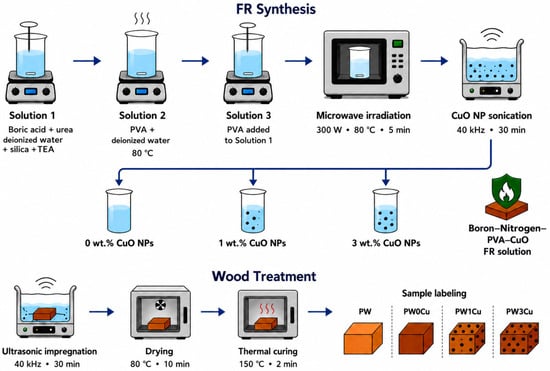
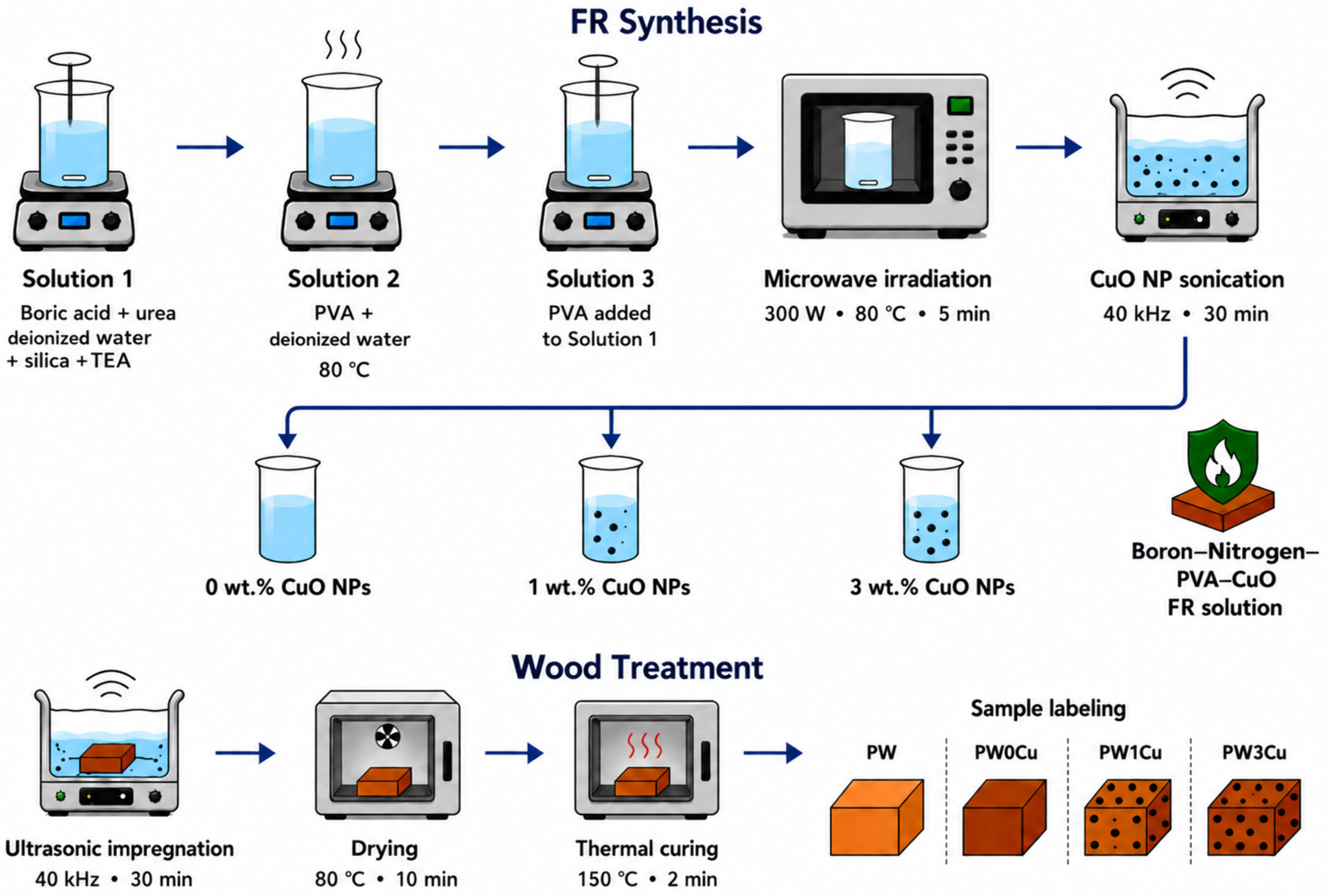
First, 10 g of boric acid was dissolved in deionized water under continuous magnetic stirring until a clear solution was formed. Next, 10 g of urea and 1 g of fumed silica were added sequentially, and the mixture was stirred to ensure homogeneous dispersion. Triethanolamine (TEA, 4 mL) was then added dropwise under continuous stirring to facilitate homogenization and obtain a viscous, homogeneous FR formulation. The final volume was adjusted to 60 mL with deionized water (Solution 1). In a separate step, PVA was dissolved in deionized water at 80 °C using a ratio of 1 g PVA to 40 mL water until a transparent solution was obtained (Solution 2). The PVA solution was then added to Solution 1 under continuous stirring. The resulting solution was microwave-irradiated in a microwave reactor at 300 W and 80 °C for 5 min to promote interactions among the FR system components. After microwave-irradiation, the solution was allowed to cool to room temperature.
The CuO NPs were then incorporated into the FR formulation at loadings of 1 and 3 wt.% relative to the total mass of the final formulation. The resulting mixtures were subjected to ultrasonic dispersion in an ultrasonic bath (40 kHz, 30 min) to achieve a homogeneous distribution of the NPs.
2.3. Deposition of FR onto PW
Ultrasound-assisted impregnation was used to apply the FR formulations, with and without CuO NPs, to the PW samples (50 × 50 × 5 mm3 and 125 × 13 × 5 mm3): the samples were fully immersed in the corresponding FR formulation and ultrasonicated at 40 kHz for 30 min. The acoustic cavitation induced by the ultrasonic field is expected to facilitate penetration of the solution into the wood cell lumens and pit membranes, promoting the distribution of the FR components within the wood and limiting the sedimentation of the CuO NPs during impregnation. After ultrasound-assisted impregnation, the treated wood samples were dried at 80 °C for 10 min, followed by a short thermal curing step at 150 °C for 2 min to consolidate the deposited coating. The samples were then conditioned under ambient conditions for 24 h before further analysis.
The obtained wood samples were labeled as follows: PW (untreated pine wood), PW0Cu (pine wood impregnated with FR formulation without CuO NPs), PW1Cu (pine wood impregnated with FR formulation containing 1 wt.% CuO NPs), and PW3Cu (pine wood impregnated with FR formulation containing 3 wt.% CuO NPs). Figure 1 shows the preparation flowchart.
Figure 1.
Flowchart of the preparation procedure for the Boron–Nitrogen–Silica–PVA–CuO FR formulation and the treated PW.
2.4. Characterization Methods
The weight gain (WG) of the FR-treated PW samples was calculated using Equation (1):
where W0 and W1 represent the weights of the samples before and after impregnation, respectively. Before treatment, the wood specimens were oven-dried at 100 °C to constant mass, cooled in the desiccator, and weighed (W0) on an analytical balance (precision ± 0.0001 g). After ultrasound-assisted impregnation, the specimens were oven-dried again at 100 °C to constant mass and weighed (W1). WG was determined on three independent specimens per formulation, and the results are reported as mean ± standard deviation (n = 3).
WG (%) = ((W1 − W0)/W0) × 100
X-ray patterns of the untreated and FR-treated PW samples were recorded on one specimen per sample using a Rigaku Ultima IV diffractometer (Rigaku Corp., Tokyo, Japan), operating in parallel-beam geometry with Cu Kα radiation (λ = 1.5406 Å) over a 2θ range of 10–70°, a step size of 0.02° and a scanning rate of 5° min−1.
A JASCO FT/IR 4700 spectrophotometer (Tokyo, Japan) equipped with a monolithic diamond ATR accessory was used to record the FT-IR spectra of the FR-treated PW samples, at an incident angle of 45° and a spectral resolution of 4 cm−1. FTIR spectra were recorded on one specimen per sample.
The morphology of the CuO NPs and the treated wood samples was investigated by scanning electron microscopy (SEM) using a Quanta FEI 200 model (FEI, Brno, Czech Republic) coupled with energy-dispersive X-ray (EDX) analysis. Prior to analysis, all samples were gold-coated. SEM observations were performed on one specimen per sample. Several areas of each specimen were examined, and the micrographs shown are representative of the observed morphology.
The thermal behavior of the prepared samples was investigated using thermogravimetric analysis and derivative thermogravimetry (TG/DTG) on a Mettler Toledo TGA/SDTA 851e instrument. Measurements were carried out in an air atmosphere at a flow rate of 80 mL min−1. The samples were heated from room temperature to 500 °C at a heating rate of 10 °C min−1. The initial FR formulations (without and with 1 and 3 wt.% CuO NPs) were dried at 80 °C and analyzed under the same conditions as the PW-coated samples. The resulting FR formulations without and with 1 and 3 wt.% CuO NPs were labeled FR0Cu, FR1Cu and FR3Cu, respectively. TG/DTG analyses on untreated and FR-treated wood, as well as on the dried FR formulations, were performed using one run per sample.
The vertical burning behavior of untreated and FR-treated PW was evaluated using a laboratory-scale vertical flame test (VFT) adapted from the UL 94 methodology. Rectangular wood specimens (125 × 13 × 5 mm3; length × width × thickness) were mounted vertically using a clamping system. A laboratory gas lamp was used as the ignition source. The flame was applied to the lower end of each specimen for 10 s. After removal of the ignition source, the first after-flame time (t1) was recorded. The flame was then reapplied for another 10 s, and the second after-flame time (t2) and subsequent after-glow time (t3) were measured. The total after-flame time was calculated as t1 + t2. Three specimens were tested for each formulation, and the results are reported as mean ± standard deviation. The test compared the burning behavior of untreated and treated wood specimens rather than assigning UL 94 flammability classifications.
The char residues obtained after the VFT were characterized by scanning electron microscopy and Raman spectroscopy. Raman analysis was performed using a Renishaw inVia Qontor Spectrometer System (Renishaw PLC, Wotton-under-Edge, Gloucestershire, UK) equipped with a 532 nm green laser for confocal Raman spectral imaging. The laser power was set to 0.5% of the nominal value (0.25 mW) to avoid laser-induced carbonization or damage of the samples; it was verified that this power did not further carbonize the substrate. Raman spectra were collected from multiple locations on the same specimen.
Optical micrographs at 50× magnification were acquired using the microscope objective integrated into the Raman confocal spectrometer (Leica N PLAN L 50×/0.50). The ID/IG ratio was determined from at least six Raman spectra and reported as the average value. The ratio was calculated from the peak intensities after baseline correction and spectral smoothing.
The antibacterial activity of the treated PW samples against S. aureus (ATCC 25923) was assessed using the agar diffusion assay, performed on a single plate per sample as a preliminary qualitative screening, and quantitatively evaluated by the bacterial growth assay (OD600). Microbial suspensions, standardized to the 0.5 McFarland standard (approximately 1–2 × 10⁸ CFU/mL), were prepared from 24-hour S. aureus cultures grown on Mueller–Hinton (MH) agar under aerobic conditions at 37 °C.
For the agar diffusion assay, wood specimens of approximately 8 × 3 mm2 (PW0Cu), 9 × 8 mm2 (PW1Cu) and 6 × 5 mm2 (PW3Cu) were placed on the inoculated agar plates (54 mm diameter) and incubated at 37 °C for 24 h. Following incubation, the plates were photographed, and the inhibition zone diameters (mm), including the specimen, were measured.
For the bacterial growth assay, the wood samples were incubated in the bacterial suspension in MH broth at 37 °C for 24 h, and bacterial growth was quantified by measuring the optical density at 600 nm (OD600) using a SpectroStar Nano microplate reader (BMG LabTech). The bacterial suspension without wood samples served as the growth control (100%). Each sample was tested in triplicate. Data are presented as mean ± standard deviation (SD). Statistical analysis was performed using one-way ANOVA followed by Student’s t-test for comparisons with the control (Microsoft Excel v10), with p < 0.05 considered statistically significant.
3. Results and Discussion
3.1. Evaluation of Weight Gain (WG) (%)
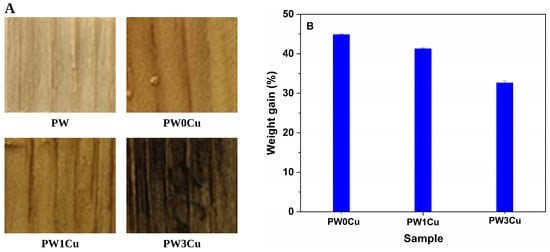
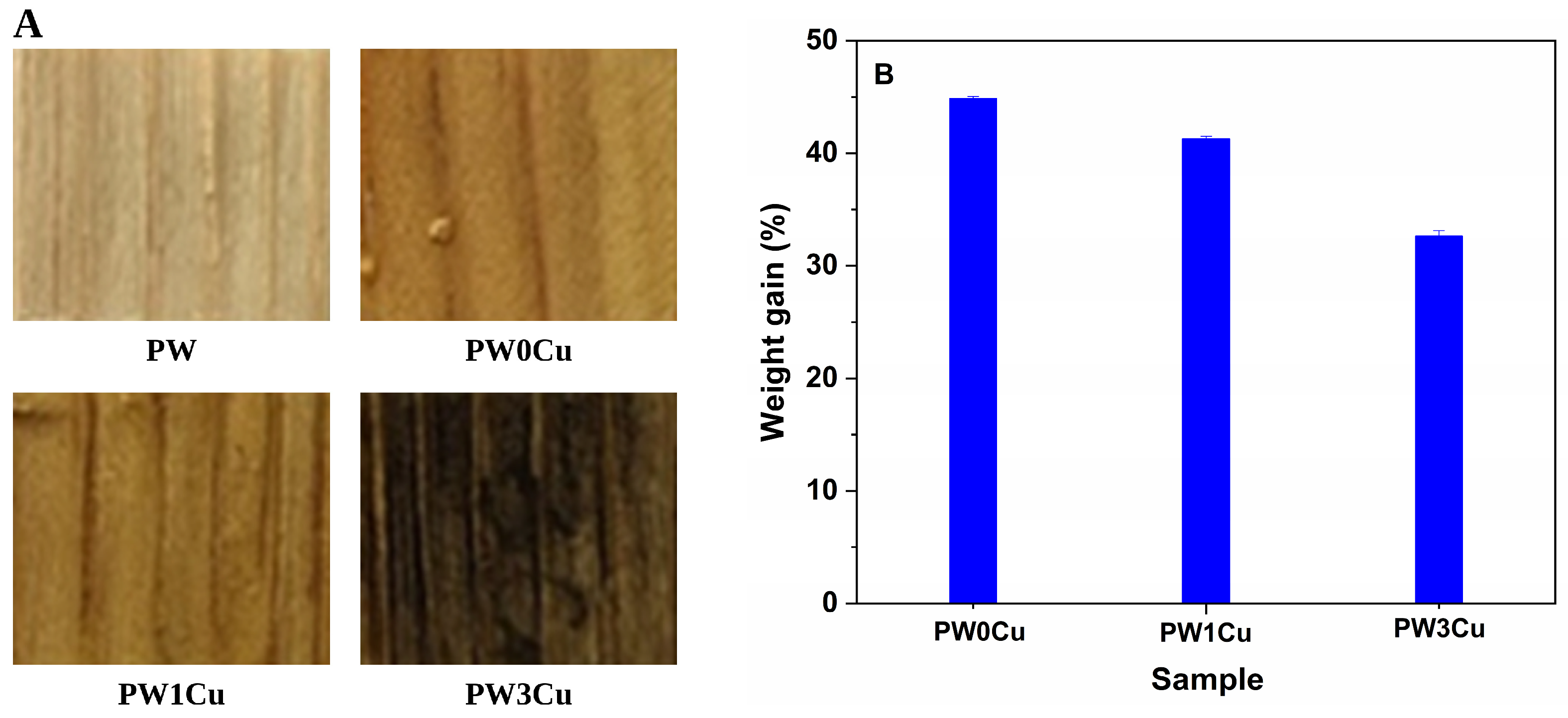
Figure 2A,B present the visual appearance of the PW before and after impregnation with the FR formulation without and with CuO NPs, together with the corresponding WG. As shown in Figure 2A, the PW treated with the CuO NP-containing FR formulation exhibited a darker coloration compared to both the untreated PW and the FR-treated PW without CuO NPs, consistent with the presence of CuO NPs in the wood matrix. No visible surface defects or signs of degradation were observed after treatment. The WG values ranged from 32.62% to 44.85% (PW0Cu: 44.85 ± 0.21%, PW1Cu: 41.27 ± 0.23%, PW3Cu: 32.62 ± 0.5%), indicating effective uptake of the FR within the wood matrix. Differences in WG among the treated groups indicate variation in the amount of retained formulation. Consequently, the effects of CuO NP concentration on the thermal behavior of the treated wood cannot be fully separated from those associated with differences in FR formulation retention, and the results should be interpreted accordingly.
Figure 2.
Photographs of PW samples before and after impregnation with the FR formulation (A) and the corresponding WG values obtained after impregnation (B). The values are means ± standard deviation of three independent specimens (n = 3).
3.2. X-Ray Diffraction
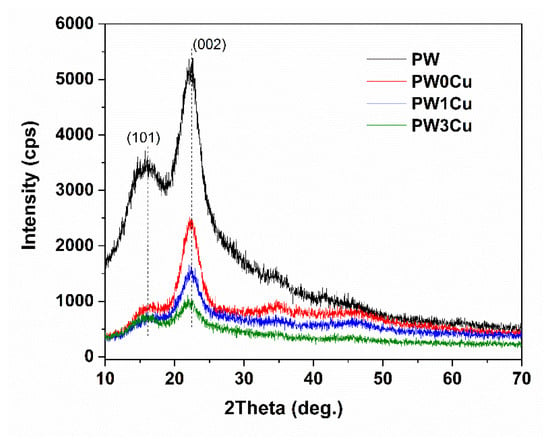
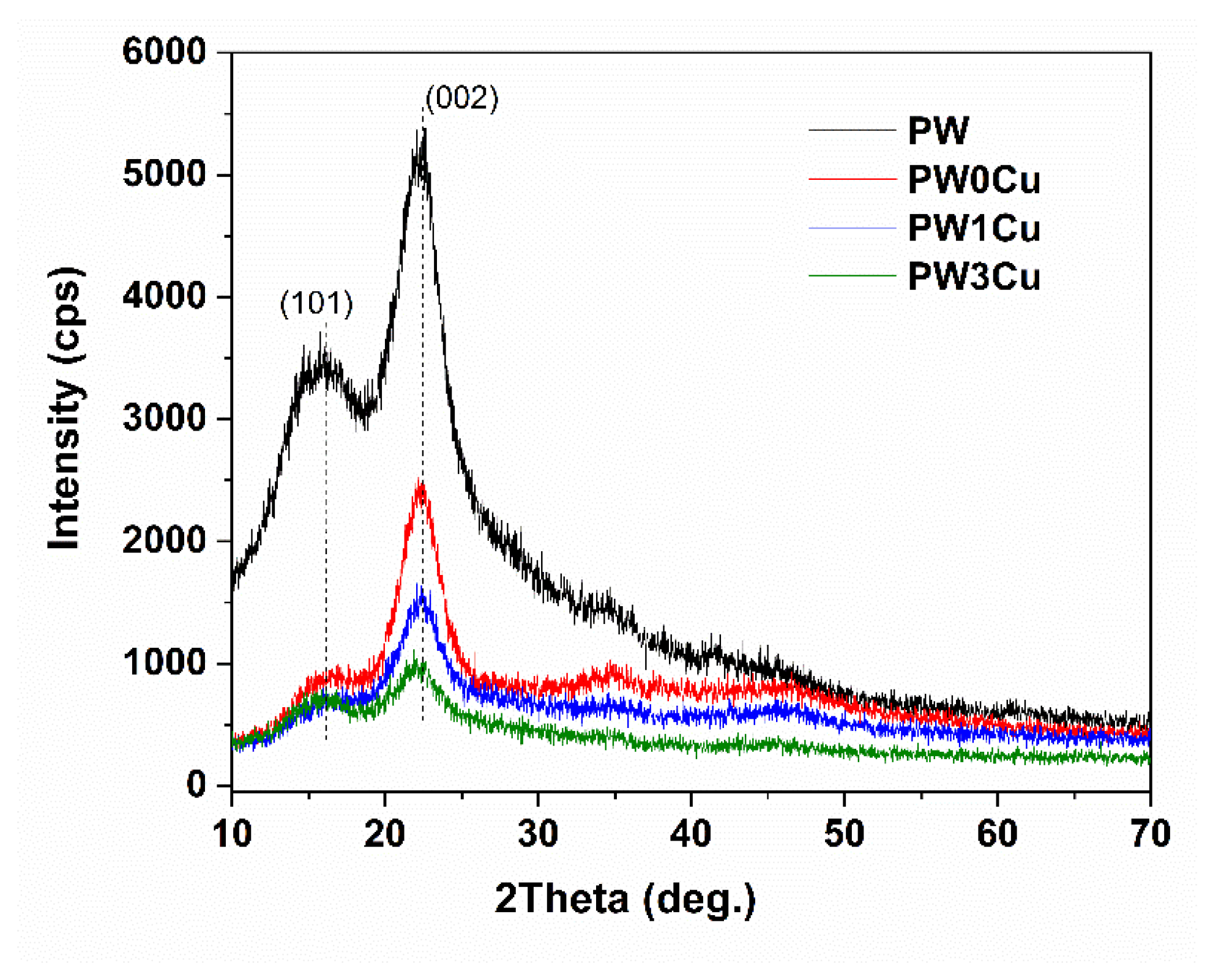
XRD analysis was performed to investigate the effect of the ultrasound-assisted FR impregnation and CuO NP incorporation on the crystalline structure of the PW. Figure 3 presents the XRD patterns of untreated wood and FR-treated wood samples. The diffraction pattern of untreated wood exhibits two characteristic diffraction peaks at approximately 15.7° and 22.6° (2θ), corresponding to the (101) and (002) crystallographic planes of cellulose I, respectively [26,27]. Similar diffraction peaks were observed for all FR-treated samples, indicating that the cellulose I crystalline structure was preserved after treatment.
Figure 3.
XRD patterns of the PW sample before and after impregnation with the FR formulation.
All samples exhibited a broad diffraction halo associated with the amorphous components of the wood matrix, including hemicellulose, lignin, and the FR coating. No additional diffraction peaks attributable to crystalline CuO were detected, suggesting that the CuO NPs were either highly dispersed within the FR coating or present at concentrations below the detection limit of XRD.
3.3. FTIR
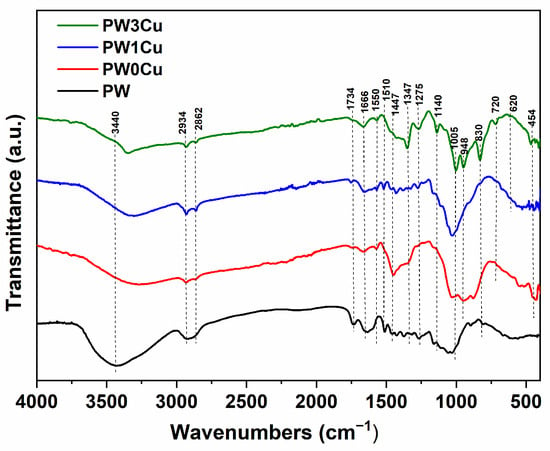
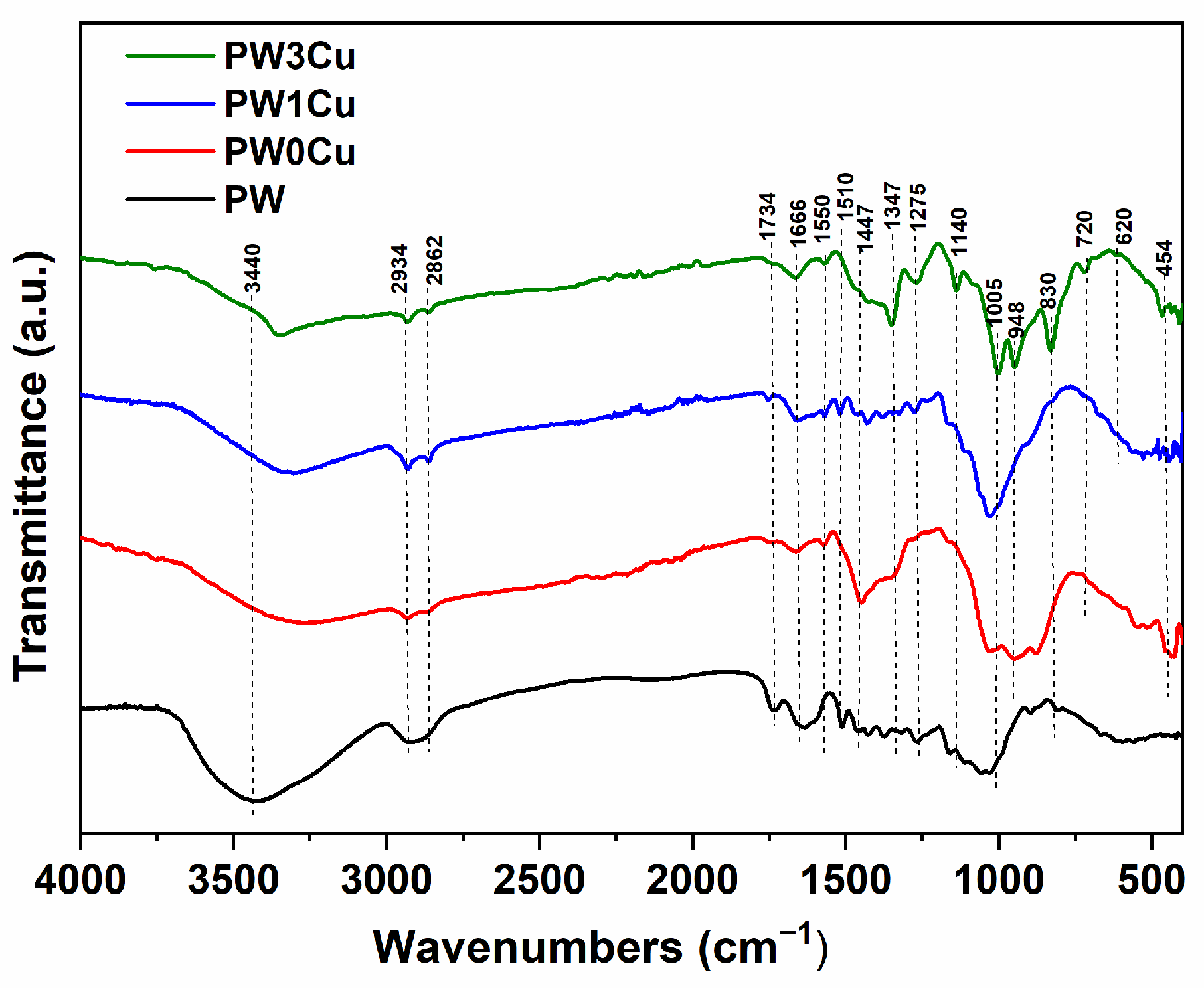
Figure 4 displays the FTIR spectra of untreated PW and of FR-treated PW containing different amounts of CuO NPs (PW0Cu, PW1Cu, and PW3Cu). The spectrum of untreated PW displays a broad absorption band centered at 3440 cm−1, ascribed to the O–H stretching vibrations of hydroxyl groups in cellulose, hemicelluloses, and lignin, as well as of adsorbed water. The bands at 2934 and 2862 cm−1 correspond to the asymmetric and symmetric C–H stretching vibrations of CH2 groups, respectively [28,29]. The band at 1734 cm−1 is assigned to the C=O stretching of unconjugated carbonyl and ester groups, mainly the acetyl groups of hemicelluloses [28,30], while the band at 1666 cm−1 arises mainly from the bending vibration of adsorbed water (δ(H–O–H)), with possible contributions from conjugated carbonyl groups of lignin [30]. The band at 1510 cm−1 is characteristic of the aromatic skeletal vibrations of lignin, and the band at 1275 cm−1 is assigned to the C–O stretching of guaiacyl units, typical of softwood lignin. The band at 1447 cm−1 is attributed to CH2 scissoring and C–H deformation vibrations of lignin and carbohydrates [28].
Figure 4.
FTIR spectra of untreated PW and FR-treated PW with different CuO NP contents.
The FR treated PW show significant spectral changes. In the treated samples, the broad band at ~3440 cm−1 and that at ~1666 cm−1 may also contain contributions from the N–H stretching and from the C=O stretching and NH2 bending vibrations of urea, respectively, which overlap with the bands of the wood components and adsorbed water [31]. The band at 1347 cm−1 is assigned to the asymmetric B–O stretching of trigonal BO3 units, and the band at 720 cm−1 to B–O–B bending vibrations, consistent with the presence of boron species in the FR treated PW [27,32,33]. The new band at approximately 1550 cm−1, absent in untreated wood, may be attributed to asymmetric COO− stretching vibrations of carboxylate groups or to vibrations associated with nitrogen-containing species introduced by the FR formulation [34,35].
The bands at 1140 and 1005 cm−1 are located in a region where Si–O–Si vibrations overlap with the C–O–C and C–O stretching bands of cellulose and hemicelluloses, which appear at approximately 1160 and 1030 cm−1. The band at 1005 cm−1 may also contain contributions from the B–O stretching of tetrahedral BO4 units and from B–O–Si linkages, suggesting interactions between the boron and silica components of the FR formulation [15,36]. The bands at 948 and 830 cm−1 are assigned to Si–OH (silanol) groups and to symmetric Si–O–Si vibrations, respectively, with possible contributions from B–O–C linkages formed through the complexation of borate species with the hydroxyl groups of PVA and of the wood polymers [27,33,36]. For the Cu-containing FR, the absorption band at approximately 620 cm−1 may be assigned to Cu–O vibrational modes, suggesting the incorporation of CuO NPs into the FR formulation [37,38].
3.4. Morphological Characterizations
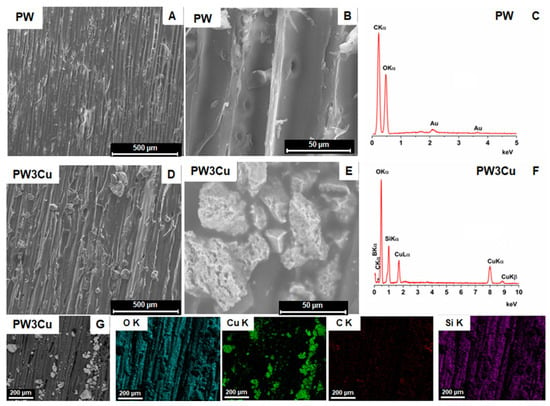
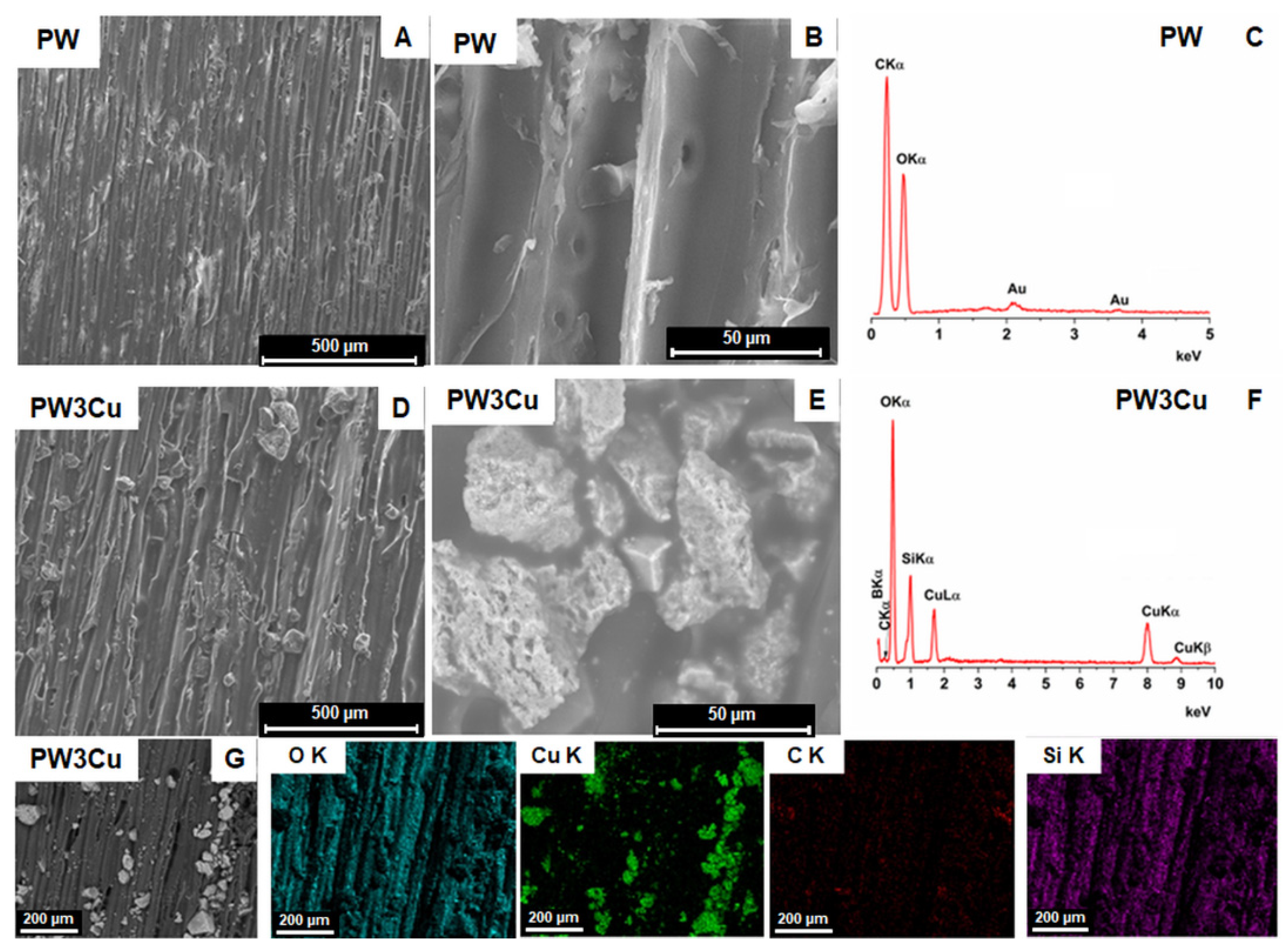
The surface morphology and elemental composition of untreated and FR-treated PW were examined by SEM-EDX (Figure 5A–G). The longitudinal surface of untreated PW (Figure 5A,B) shows characteristic softwood microstructural features, with parallel tracheids, relatively smooth cell walls, and visible bordered pits, along with some fibrillar fragments generated during sample preparation. The corresponding EDX spectrum (Figure 5C) shows only C Kα and O Kα signals, characteristic of the lignocellulosic matrix, while the Au peaks originate from the conductive coating.
Figure 5.
SEM micrographs of untreated PW at (A) low and (B) high magnification and (C) the corresponding EDX spectrum; SEM micrographs of PW3Cu at (D) low and (E) high magnification and (F) the corresponding EDX spectrum; (G) SEM image of PW3Cu and the corresponding EDX elemental maps of O, Cu, C and Si. In the EDX spectra (C,F), Kα, Kβ and Lα denote the characteristic X-ray emission lines of the respective elements; in the elemental maps (G), “K” indicates that each map was acquired from the K-line signal of the element shown.
After impregnation with the FR formulation containing 3 wt.% CuO NPs, the tracheid structure of the wood was retained (Figure 5D), indicating that the treatment did not visibly damage the wood microstructure. However, the PW surface was covered by a continuous coating, with numerous particles and aggregates deposited on it and partially filling the grooves between tracheids (Figure 5E).
The EDX spectrum of PW3Cu (Figure 5F) indicates the presence of B, Si, and Cu in addition to C and O. The marked increase in the O Kα signal relative to C Kα, compared with untreated wood, indicates that the wood surface is largely covered by the oxygen-rich inorganic–polymeric FR layer.
Elemental mapping of PW3Cu (Figure 5G) shows a homogeneous distribution of O and Si, while the weak C signal is consistent with the FR coating covering the PW surface. In contrast, Cu is concentrated in discrete clusters that correspond to the bright particles observed in the SEM image, indicating that CuO NPs tend to agglomerate within the FR matrix despite ultrasonic dispersion. Boron could not be mapped reliably because EDX has low sensitivity for light elements; therefore, its detection in the spectrum should be regarded as qualitative.
3.5. Thermal Characterization
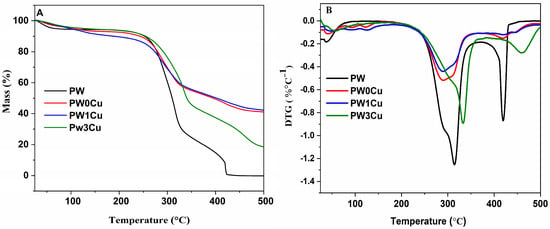
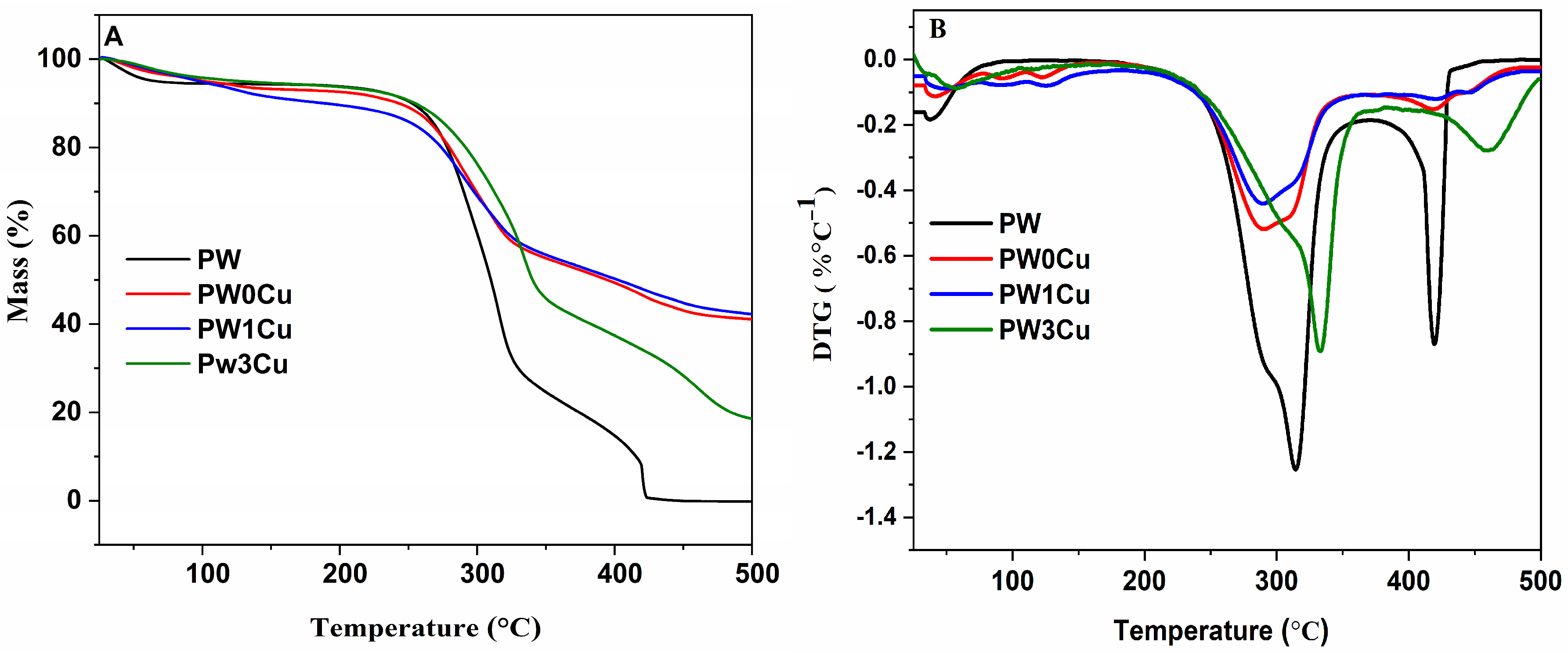
The thermal behavior of untreated and FR-treated PW was evaluated by TG/DTG analysis in air (Figure 6A,B), and the mass losses in the main temperature ranges are summarized in Table 1. All samples showed a mass loss below ~150 °C, attributed to the evaporation of adsorbed water. For the FR-treated samples, this step extended to ~200 °C, most evident in PW1Cu (14.2% mass loss in the 25–250 °C range, compared with 9.6% for PW), which can be attributed to the dehydration of boric acid to metaboric acid and to the decomposition of urea, which begins above its melting point (~133 °C) with the release of NH3 and isocyanic acid [39,40,41].
Figure 6.
TG (A) and DTG (B) curves of untreated PW and FR-treated PW.
Table 1.
Mass loss in different temperature ranges and residual mass at 500 °C of untreated and FR-treated PW.
Untreated PW exhibited the typical two-stage thermo-oxidative decomposition. The main stage, between ~250 and 350 °C, corresponds to the degradation of hemicelluloses and cellulose, with a maximum decomposition rate at ~315 °C. The second stage, marked by a sharp DTG peak at ~420 °C, involves oxidation of the char formed in the first stage and leads to near-complete mass loss at 500 °C.
The FR treatment modified this thermal behavior. For PW0Cu and PW1Cu, the main decomposition stage shifted to lower temperatures (Tmax ≈ 295 and 290 °C, respectively), while the maximum decomposition rate decreased compared with PW. This earlier but slower decomposition is characteristic of boron-based FRs, which catalyse the dehydration of cellulose and promote char formation at the expense of flammable volatile products [16,39,41]. In addition, the distinct char-oxidation DTG peak disappeared, and the mass loss between 400 and 500 °C decreased to ~8% compared with 14.9% for PW, while the residues at 500 °C reached ~41%–42%.
PW3Cu showed a different thermal behavior. Its main decomposition stage shifted to a higher temperature (Tmax ≈ 333 °C). A second mass loss occurred between ~400 and 500 °C (DTG peak at ~460 °C), resulting in a lower residue (~19%). This behavior suggests that, at higher CuO NP loadings, CuO NPs may promote oxidation of the carbonaceous residue through their catalytic activity, consistent with their reported activity in oxidation reactions [37,42]. However, the lower flame-retardant uptake of PW3Cu may also contribute to the reduced residual mass. Notably, the second DTG peak of PW3Cu occurred approximately 40 °C above that of untreated PW, indicating a shift in the main char-oxidation event to higher temperatures. Similar effects involving Cu-containing compounds have been reported for wood treated with Cu-based preservatives, although the direction and magnitude of the temperature shift depend on the treatment chemistry [1]. The dried FR formulations (Figure S1) showed different mass losses below 150 °C, mainly due to differences in absorbed moisture from the hygroscopic nature of urea. Since the formulations were not analyzed immediately after drying and urea is hygroscopic, their thermal behavior was compared above 150 °C.
Above 150 °C, however, their behavior was nearly identical: the mass loss, associated mainly with the decomposition of urea (DTG peak at ~213–218 °C) and with the final dehydration of metaboric acid to boron oxide, was similar for all formulations. In the CuO NPs-containing FRs, urea decomposed more abruptly, as indicated by a sharper DTG peak, although the corresponding mass loss was similar. For the formulation containing 3 wt.% CuO NPs, the urea decomposition region showed two distinct DTG peaks (~190 and ~215 °C), consistent with the stepwise thermal decomposition of urea, in which urea thermolysis and biuret formation are followed by biuret decomposition at 190–250 °C [40,43]. The partial separation of these steps may reflect CuO NPs modifying the decomposition pathway, as metal oxides are known to affect urea decomposition [44], although this aspect was not investigated further. The residues of all formulations considerably exceeded the value expected from boron oxide and silica alone, suggesting the formation of non-volatile boron–nitrogen–oxygen species through the reaction between urea and boric acid [45], and/or of carbonaceous residues from TEA and PVA. No significant mass loss or DTG peak was observed above 250 °C for any of the formulations, indicating that CuO NPs do not modify the thermal decomposition of the FR itself.
Part of the residue of the treated wood corresponds to the inorganic FR components. However, the residues of PW0Cu (41.1%) and PW1Cu (42.3%) were considerably higher than could be accounted for by the FR loading alone, indicating that the FR treatment substantially promoted char formation from the wood itself. In contrast, the much lower residue of PW3Cu (18.6%) indicates that most of the wood-derived char was oxidized at 500 °C. Because PW3Cu also had a lower FR retention (WG of 32.62% compared with 44.85% and 41.27% for PW0Cu and PW1Cu, respectively), the contributions of the lower FR loading and of CuO NPs to this difference cannot be fully separated. Nevertheless, the catalytic activity of CuO NPs in oxidation reactions [37,42] makes the CuO-promoted oxidation of the char a plausible contributing factor. Since the dried formulations showed no mass loss in this temperature range, the second mass loss of PW3Cu at ~460 °C clearly originates from the wood-derived char.
The comparison with the dried formulations also shows that all DTG peaks above 250 °C in the treated PW originate from wood decomposition. In contrast, the sharp DTG peak of urea at ~215 °C observed for the dried formulations was not detected in the treated PW; instead, the treated PW showed a gradual mass loss between ~100 and 250 °C, particularly for PW1Cu. This suggests that, when dispersed in the wood and cured at 150 °C, urea decomposes more gradually, possibly owing to its interactions with the hydroxyl groups of the wood polymers and with borate species.
3.6. Vertical Flame Test (VFT)
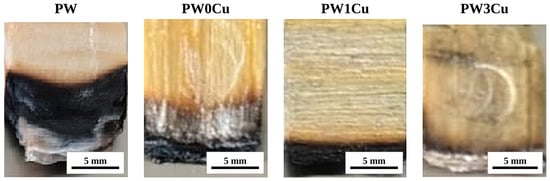
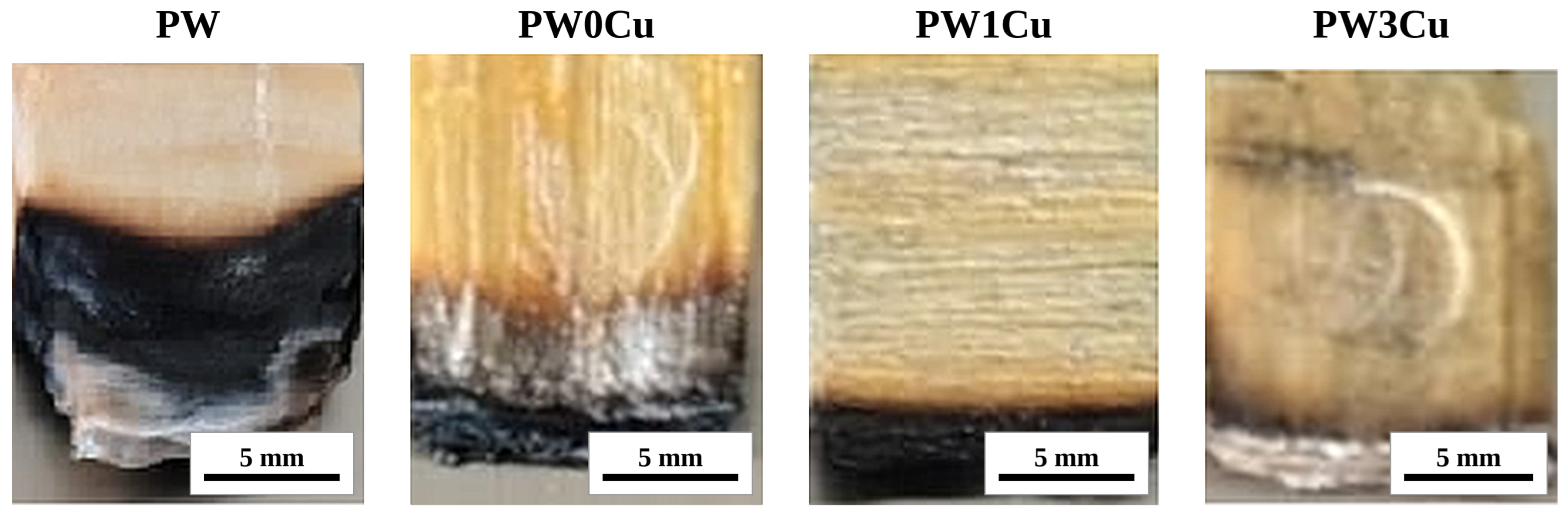
Table 2 summarizes the results of the modified VFT, while Figure 7 shows the specimens after testing. Untreated PW exhibited a total after-flame time (t1 + t2) of 37 ± 2 s and an after-glow time (t3) of 15 ± 1 s, leaving an extensively charred and deformed residue. FR treatment markedly improved the burning behavior, reducing the total after-flame time to 12 s for PW0Cu, 5 s for PW1Cu, and 1 s for PW3Cu. Notably, PW3Cu exhibited the shortest total after-flame time despite having a lower weight gain (WG = 32.62%) than PW0Cu (WG = 44.85%), suggesting that CuO NPs contribute to the enhanced FR performance. No afterglow was observed for any of the FR-treated samples. This behavior is consistent with the protective action of boron-based FRs, which can promote the formation of a glassy B2O3 layer that limits oxygen access and char oxidation [16,39,41]. As illustrated in Figure 7, damage to the treated specimens was largely confined to a narrow-charred region near the lower edge. The progressive reduction in total after-flame time with increasing CuO NP content suggests an additional beneficial contribution of CuO NPs to the FR performance of the boron–nitrogen–silica–PVA system under the modified test conditions.
Table 2.
After-flame and after-glow times of untreated PW and FR-treated PW in the VFT.
Figure 7.
Photographs of the PW, PW0Cu, PW1Cu and PW3Cu samples after the VFT (scale bars: 5 mm).
It should be noted that the VFT is a small-scale screening test that provides information on ignitability, flame spread and after-flame/afterglow behavior, but not on heat release. A complete assessment of the fire performance of the treated wood requires cone calorimeter testing according to ISO 5660-1, which provides key parameters such as the time to ignition, heat release rate (HRR), peak HRR, total heat release and smoke production. No smoldering was observed for any of the FR-treated samples during the VFT. However, since copper compounds are known to catalyze the oxidation of carbonaceous residues [37,42], over longer time scales this cannot be completely excluded at the higher CuO NP loading, given the short duration of the test. This consideration, together with the char oxidation observed for PW3Cu in TG, supports 1 wt.% CuO NPs as the compromise loading.
A known limitation of boron-based FRs is their high-water solubility, which causes leaching under exterior or humid exposure and reduces long-term fire-retardant effectiveness [11,19]. Approaches to mitigate borate leaching can be classified into: chemical fixation of boron through complexation with polyols or reaction with wood components, precipitation of boron (e.g., metal borates), and encapsulation or immobilization of boron within polymeric or inorganic networks formed in situ, such as melamine–formaldehyde resins or silica sol–gel systems [11,14,15,19]. The formulation proposed in this study crosslinks borate ions with PVA by forming borate–diol complexes [33], which may partly immobilize boron within the PVA network. Additionally, the silica component may also help encapsulate boron species [14,15]. However, borate–diol complexes are reversible and susceptible to hydrolysis in water, so this crosslinking is expected to reduce, but not prevent, boron leaching. Future work will therefore evaluate the leaching resistance of the FR components using standardized leaching procedures.
3.7. Char Characterization
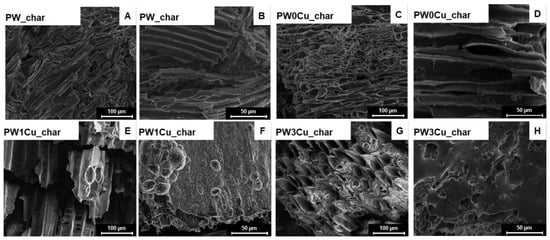
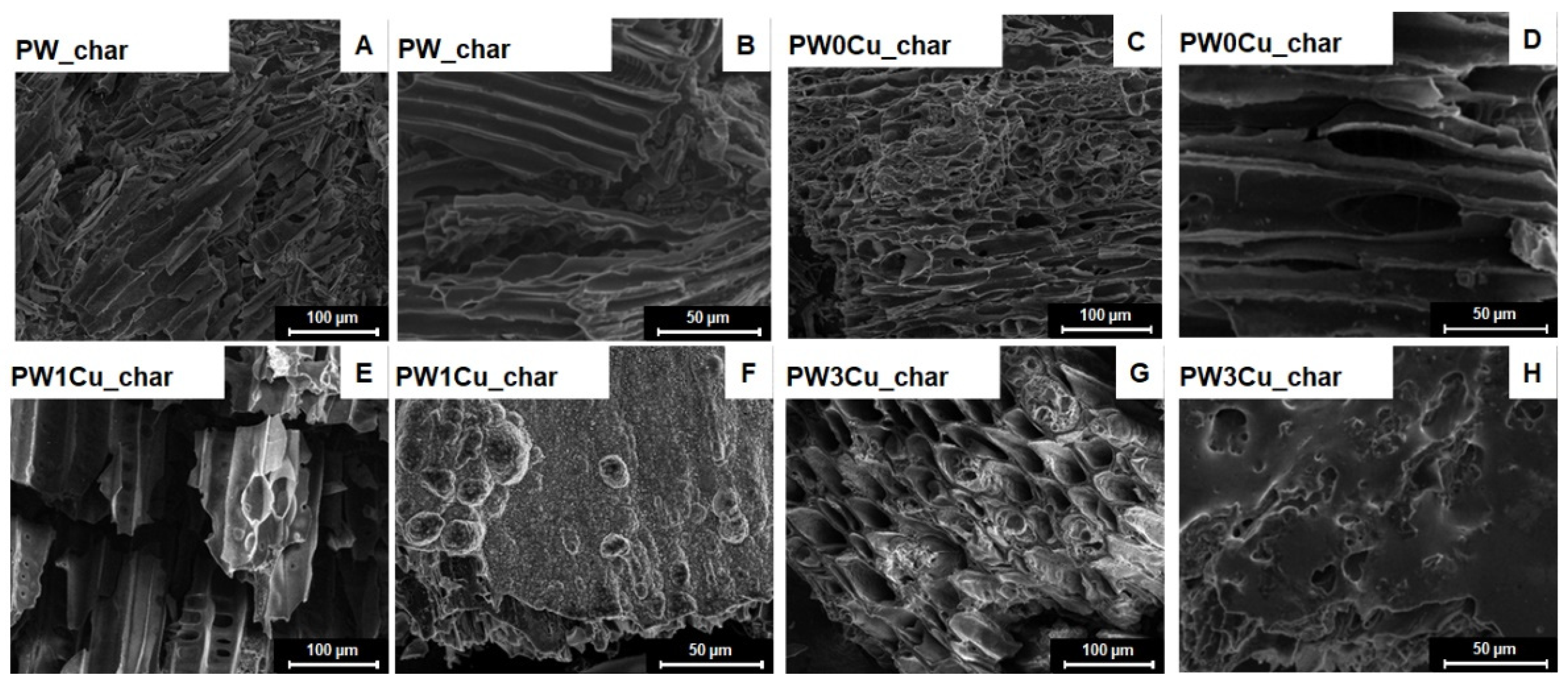
Figure 8 shows SEM micrographs of the chars obtained after VFT. The char of untreated PW (Figure 8A,B) exhibits a fragmented and brittle carbonaceous structure: the tracheid walls are broken into thin, plate-like fragments with sharp edges, separated by large voids. No protective layer is formed on the surface, so this loose, porous char offers little resistance to heat and oxygen transfer or to the release of volatile products.
Figure 8.
SEM micrographs at different magnifications of the chars obtained after the VFT: (A,B) untreated PW; (C,D) PW0Cu; (E,F) PW1Cu; (G,H) PW3Cu.
In contrast, the chars of all FR-treated samples are compact and coherent, and the wood’s cellular architecture is largely preserved. For PW0Cu (Figure 8C,D), the cell walls appear thickened, with smooth, rounded edges, and are fused into a continuous containing numerous rounded, bubble-like cavities. This morphology suggests that a molten phase, most likely boron oxide/glass-like phase formed by the dehydration and melting of boric acid, coated the cell walls during combustion and solidified upon cooling [15,39,41].
The char of PW1Cu also retains the wood’s microstructural features, with continuous tracheid walls and clearly preserved bordered pits (Figure 8E). Extended regions are covered by a continuous crust-like layer (Figure 8F), beneath which the porous carbonaceous char is visible at the fractured edge, indicating that this layer formed on top of the char during combustion. The surface of the layer shows cauliflower-like nodules and a granular texture composed of densely packed spherical particles, suggesting the formation from a molten phase [15,16].
The char of PW3Cu (Figure 8G) likewise shows a compact structure with well-preserved, honeycomb-like cell walls, partially covered by rough, porous deposits. At higher magnification (Figure 8H), a smooth, continuous glass-like layer covers the surface and contains irregular pores and cavities, likely formed by gas release through the molten layer. The good preservation of the PW3Cu char after the VFT, despite its lower residual mass in TG, can be attributed to the different exposure conditions: in the VFT, the sample was exposed to the flame for only 20 s, whereas the catalytic effect of CuO NPs on char oxidation is expected to become significant only during prolonged heating in air at 400–500 °C, as observed by TG.
SEM results show that the FR treatment transforms the brittle, fragmented char of untreated wood into a compact, reinforced char covered by a glassy protective layer. This layer can limit heat and oxygen transfer to the underlying material and the release of volatile products, consistent with the improved fire performance and high char residues of the treated samples.
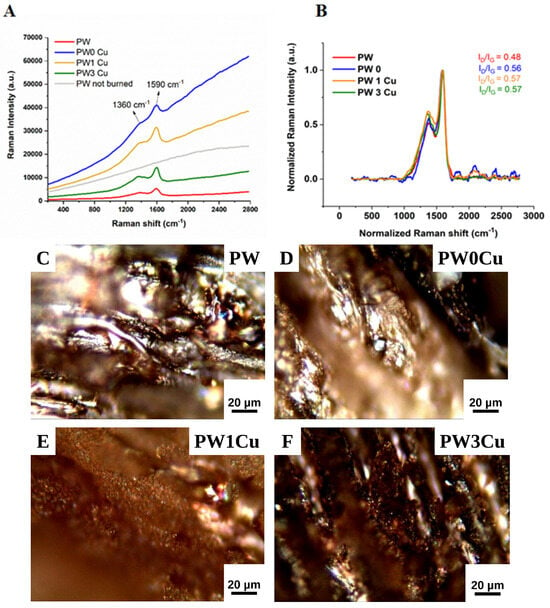
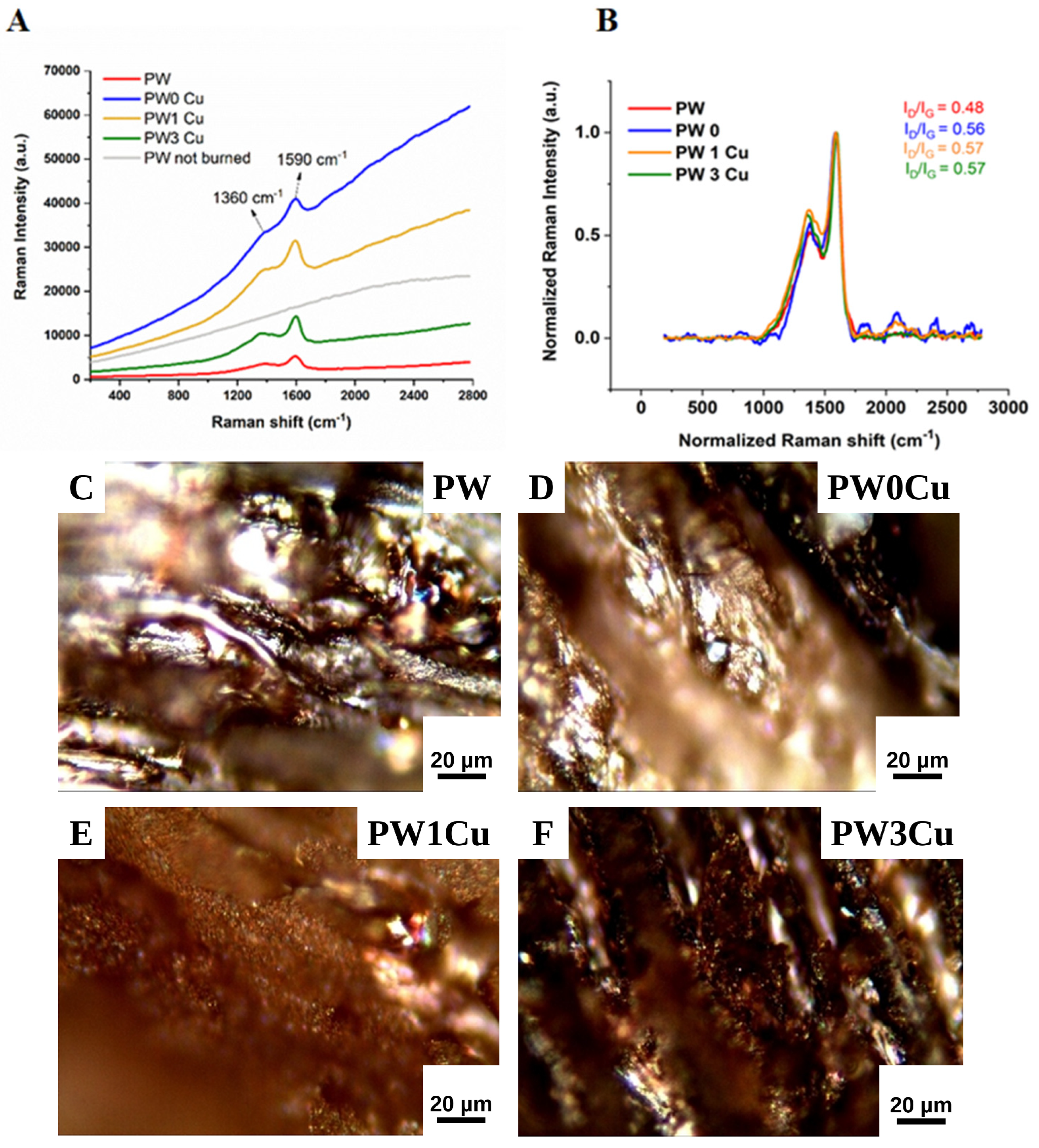
Figure 9A shows Raman spectra of the chars and unburned PW. The Raman spectrum of unburned PW shows no bands in the 190–2780 cm−1 range, but exhibits a broad background likely arising from fluorescence of wood components, including lignin, under 532 nm excitation. All chars exhibit the D band at ~1360 cm−1, associated with the breathing mode of sp2 carbon rings activated by structural defects and domain edges, and the G band at ~1590 cm−1, corresponding to the in-plane stretching of sp2 carbon pairs [46,47,48]. The bands are broad and strongly overlapping, and no second-order (2D) band is observed at ~2700 cm−1. These spectral features are consistent with predominantly disordered carbonaceous structures, without clear evidence of well-developed graphitic ordering [46,48,49].
Figure 9.
(A) Raman spectra of the chars of PW, PW0Cu, PW1Cu and PW3Cu and of unburned PW; (B) normalized Raman spectra with the corresponding average ID/IG values; (C–F) optical micrographs (50× objective) of the chars of (C) PW, (D) PW0Cu, (E) PW1Cu and (F) PW3Cu.
The ID/IG ratio, obtained from the band heights of the smoothed, baseline-corrected spectra, was 0.48 ± 0.08 for PW and slightly higher for the treated samples: 0.56 ± 0.07 for PW0Cu, 0.57 ± 0.08 for PW1Cu and 0.57 ± 0.07 for PW3Cu (Figure 9B). The similar ID/IG ratios and overlapping standard deviations indicate that the present Raman data cannot resolve clear differences in carbon structural order among the treated chars. In particular, PW3Cu did not exhibit a distinct Raman response despite its different thermo-oxidative behavior observed by TG. Thus, the additional thermo-oxidative mass-loss event observed for PW3Cu was not accompanied by a clearly distinguishable Raman signature in the char recovered after the VFT.
The interpretation of the slightly higher ID/IG values observed for the FR-treated PW is not straightforward, because the relationship between ID/IG and structural order depends on the degree of carbonization. For nanocrystalline graphitic carbon, a higher ID/IG ratio is generally associated with a higher defect density and smaller crystallite size, whereas in highly disordered carbon, the development of aromatic ring structures may lead to an increase in ID/IG as structural ordering progresses [46]. Consistent with this behavior, the HD/HG band-height ratio of pine wood charcoals has been reported to increase with carbonization temperature between approximately 500 and 1200 °C [49]. Therefore, the slightly higher ID/IG ratios of the FR-treated chars could reflect either differences in defect density or changes in the development of aromatic carbon domains. However, given the small differences and overlapping standard deviations, the present Raman data do not allow these possibilities to be distinguished or specific structural changes to be attributed to individual FR components.
Higher ID/IG values for FR-treated wood than for untreated wood have also been reported by Deng et al. [50] for wood treated with a copper–boron preservative and an intumescent coating, associated with the formation of a more compact char layer, and for wood coated with a polyvinyl acetate/biochar/kaolin/trimethylsilyl polyphosphate composite, in which the more disordered char layer was associated with delayed combustion and reduced heat and smoke release [51]. In contrast, other systems have shown lower ID/IG values after FR treatment, interpreted as a higher degree of graphitization (e.g., a decrease from 3.99 to 2.83 for a chitosan/ammonium polyphosphate/montmorillonite coating) [10]. These apparently opposite trends reflect differences in carbonization conditions and in data processing (band heights versus integrated areas obtained by multi-band fitting [47]), so that absolute ID/IG values from different studies are not directly comparable. Raman spectroscopy revealed no clearly distinguishable differences in carbon structural order among the FR-treated chars. Together with the SEM observations, these findings suggest that the improved FR performance may be associated with a more compact char and a glass-like surface layer, rather than with substantial changes in carbon structural order detectable by Raman spectroscopy. This interpretation is consistent with the char composition reported for Pinus sylvestris L. wood treated with boric acid and graphene oxide, in which aromatic C=C and cross-linked C–O–C structures coexisted with B2O3 [52].
The optical micrographs (Figure 9C–F) complement the SEM observations. The PW char consists of fragmented, highly reflective carbon flakes with sharp edges (Figure 9C), whereas the chars of the treated samples show a more continuous surface covered by a brownish, partially translucent layer, most evident for PW0Cu and PW1Cu (Figure 9D,E). For PW1Cu, a fine granular texture, consistent with the spherical particles observed by SEM (Figure 8F), is also discernible, while for PW3Cu the fibrous anatomical structure of the wood remains recognizable beneath the surface deposits (Figure 9F).
3.8. Antibacterial Activity
The antibacterial activity against S. aureus of the wood samples treated with the FR formulation without and with 1 and 3 wt.% CuO NPs (PW0Cu, PW1Cu and PW3Cu) was evaluated by a preliminary agar diffusion assay and by bacterial growth monitoring at 600 nm (OD600).
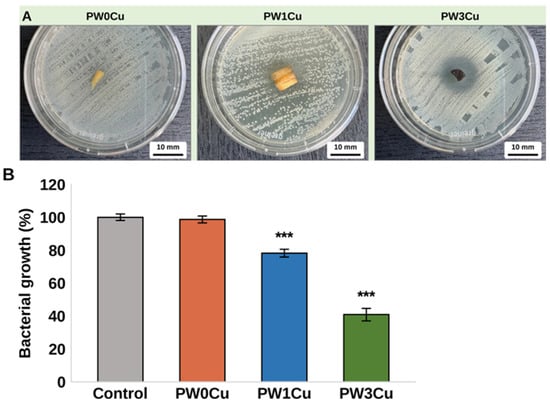
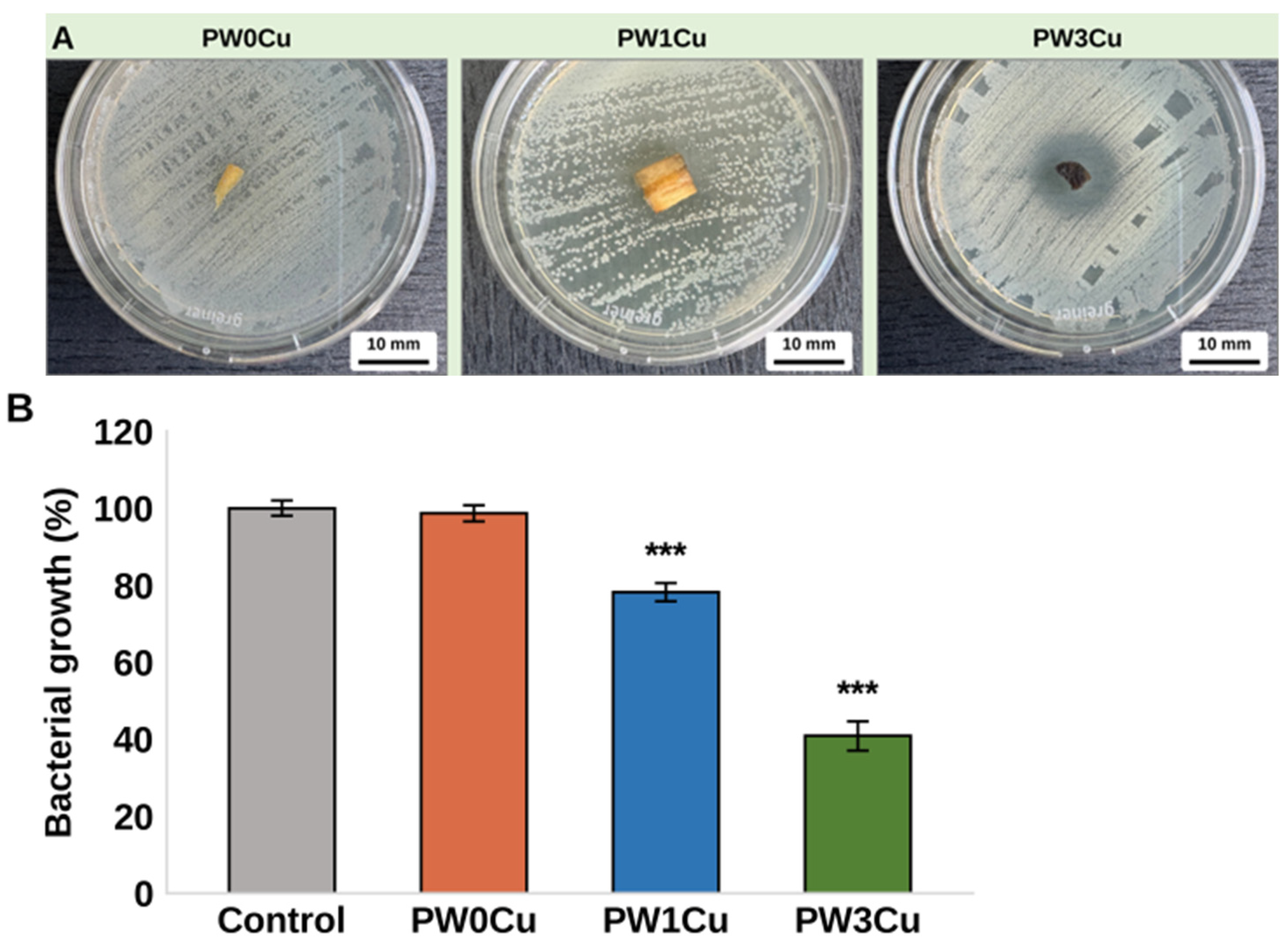
The agar diffusion assay (Figure 10A) revealed that PW0Cu did not produce a visible inhibition zone, indicating the absence of significant antibacterial activity. In contrast, PW1Cu and PW3Cu generated inhibition zones of 12 mm and 20 mm in diameter, respectively, demonstrating a concentration-dependent antibacterial activity against S. aureus. This effect can be attributed to the CuO NPs, which are known to damage bacterial cell membranes, promote the generation of reactive oxygen species (ROS), and interfere with essential intracellular processes. The absence of an inhibition zone for PW0Cu, despite the known biocidal activity of boron compounds, may be explained by the limited diffusion of boron species from the PVA-bound coating into the agar medium during the test.
Figure 10.
Antibacterial activity of FR-treated PW samples without (PW0Cu) and with CuO NPs (PW1Cu, PW3Cu) against S. aureus ATCC 25923: (A) agar plates showing the inhibition zones after 24 h of incubation (preliminary screening; scale bars: 10 mm); (B) bacterial growth determined by OD600 measurements after 24 h of incubation. Bacterial cultures without wood samples served as the control (100%). Data are presented as mean ± SD (n = 3); *** p < 0.001 vs. control.
The antibacterial activity was further assessed by monitoring bacterial growth through OD600 measurements after 24 h of incubation (Figure 10B). Both Cu-containing samples (PW1Cu and PW3Cu) reduced bacterial growth compared with the growth control, with PW3Cu showing the strongest inhibitory effect, indicating a concentration-dependent antibacterial response. The higher activity of PW3Cu is consistent with its higher CuO NP content, which likely leads to greater release of copper species and a larger surface area available for interaction with bacterial cells.
The obtained results show that incorporating CuO NPs into the FR formulation enhances its antibacterial performance, with PW3Cu exhibiting the highest activity among the investigated FR formulations.
4. Conclusions
This study investigated the effect of CuO NPs (0, 1, and 3 wt.%) on the flame retardancy, char structure, and antibacterial activity of a water-based, microwave-irradiated boron–nitrogen–silica–PVA FR formulation applied to PW by ultrasound-assisted impregnation. The FR formulations were impregnated into the PW at WG values of 32.62%–44.85%, forming a continuous coating on the wood surface without visible modification of the wood microstructural features, and the cellulose I structure was preserved after treatment. CuO NPs had a dual effect on the fire behavior. They shortened the after-flame time in the VFT, but at 3 wt.% an additional thermo-oxidative mass-loss event was observed, and the residue at 500 °C decreased from ~41%–42% (PW0Cu, PW1Cu) to ~19% (PW3Cu). This decrease is consistent with enhanced oxidation of the carbonaceous residue, possibly involving a catalytic contribution from CuO NPs, although the lower FR retention of PW3Cu may also have contributed. SEM observation revealed that all FR-treated PW formed a compact, coherent char covered by a glass-like surface layer, in contrast to the brittle, fragmented char of untreated PW. Raman spectroscopy showed that all chars consisted of disordered carbon with similar ID/IG ratios (0.56–0.57), suggesting that the protective effect arises mainly from the glass-like surface layer rather than from changes in the carbon nanostructure. CuO NPs conferred antibacterial activity against S. aureus, which increased with CuO NP content; PW3Cu produced a 20 mm inhibition zone and the strongest reduction in bacterial growth. Overall, 1 wt.% CuO NPs preserved the char stability of the boron-based system and represents the most balanced loading, whereas 3 wt.% provided the highest antibacterial activity; therefore, the CuO NP loading can be selected according to the targeted application. Future work will address the leaching resistance of the FR components, cone calorimeter testing according to ISO 5660-1 to quantify heat release, and the antibacterial activity against Gram-negative bacteria and wood-decay fungi.
Supplementary Materials
The following supporting information can be downloaded at https://www.mdpi.com/article/10.3390/coatings16111327/s1, Figure S1. TG curves (A), and DTG curves (B) of the FR formulations without and with 1 and 3 wt.% CuO NPs, dried at 80 °C.
Author Contributions
M.P.: methodology, writing—original draft preparation, funding acquisition; J.P.-C.: investigation, formal analysis; S.P. (Simona Petrescu): formal analysis; S.P. (Silviu Preda): investigation, formal analysis; M.E.S.: formal analysis; R.A.M.: investigation, formal analysis; A.M.S.G.: investigation, formal analysis, writing—original draft preparation; I.S.H.: investigation, formal analysis, writing—original draft preparation; G.M.: investigation, formal analysis; I.A.: conceptualization, methodology, data curation, writing—review and editing, funding acquisition, project administration. All authors have read and agreed to the published version of the manuscript.
Funding
This research was funded by the Executive Agency for Higher Education, Research, Development and Innovation Funding (UEFISCDI), grant number PN-IV-P7-7.1-PED-2024-0582, no. 21 PED/2025.
Institutional Review Board Statement
Not applicable.
Informed Consent Statement
Not applicable.
Data Availability Statement
Data will be made available on request.
Acknowledgments
This study was supported by the National Authority of Research, Core Program, project no. 23020201 (AMSG).
Conflicts of Interest
Author Mariana Pătrașcu was employed by the company Safety Integrated Solutions S.R.L. The remaining authors declare that the research was conducted in the absence of any commercial or financial relationships that could be construed as potential conflicts of interest.
References
- Winandy, J.E.; Wiesner, F.; Hassan, B.; Morrell, J.J. Fire performance of timber: Review for use in wildland-urban interfaces. Holzforschung 2022, 76, 679–698. [Google Scholar] [CrossRef] [Scilit]
- Broda, M. Natural compounds for wood protection against fungi—A review. Molecules 2020, 25, 3538. [Google Scholar] [CrossRef] [Scilit] [PubMed]
- Kodur, V.; Kumar, P.; Rafi, M.M. Fire hazard in buildings: Review, assessment and strategies for improving fire safety. PSU Res. Rev. 2020, 4, 1–23. [Google Scholar] [CrossRef] [Scilit]
- Mensah, R.A.; Jiang, L.; Renner, J.S.; Xu, Q. Characterisation of the fire behaviour of wood: From pyrolysis to fire retardant mechanisms. J. Therm. Anal. Calorim. 2023, 148, 1407–1422. [Google Scholar] [CrossRef] [Scilit] [PubMed]
- Popescu, C.-M.; Pfriem, A. Treatments and modification to improve the reaction to fire of wood and wood-based products—An overview. Fire Mater. 2020, 44, 100–111. [Google Scholar] [CrossRef] [Scilit]
- Sauerbier, P.; Mayer, A.K.; Emmerich, L.; Militz, H. Fire retardant treatment of wood—State of the art and future perspectives. In Wood & Fire Safety; Springer: Cham, Switzerland, 2020; pp. 97–102. [Google Scholar] [CrossRef] [Scilit]
- Xu, Z.; Zhao, W.; Feng, Y.; Tang, X.; Yan, L. Flame-retardant, heat-insulating and char formation properties of densified Pinus sylvestris treated with different compression pressures. Eur. J. Wood Wood Prod. 2022, 80, 1321–1331. [Google Scholar] [CrossRef] [Scilit]
- Lainioti, G.C.; Koukoumtzis, V.; Andrikopoulos, K.S.; Tsantaridis, L.; Östman, B.; Voyiatzis, G.A.; Kallitsis, J.K. Environmentally friendly hybrid organic–inorganic halogen-free coatings for wood fire-retardant applications. Polymers 2022, 14, 4959. [Google Scholar] [CrossRef] [Scilit] [PubMed]
- Fan, C.; Gao, Y.; Li, Y.; Yan, L.; Zhu, D.; Guo, S.; Ou, C.; Wang, Z. A flame-retardant densified wood as robust and fire-safe structural material. Wood Sci. Technol. 2023, 57, 111–134. [Google Scholar] [CrossRef] [Scilit]
- Jian, H.; Liang, Y.; Deng, C.; Xu, J.; Liu, Y.; Shi, J.; Wen, M.; Park, H.J. Research progress on the improvement of flame retardancy, hydrophobicity, and antibacterial properties of wood surfaces. Polymers 2023, 15, 951. [Google Scholar] [CrossRef] [Scilit] [PubMed]
- Lin, C.F.; Karlsson, O.; Mantanis, G.I.; Sandberg, D. Fire performance and leach resistance of pine wood impregnated with guanyl-urea phosphate/boric acid and a melamine-formaldehyde resin. Eur. J. Wood Wood Prod. 2020, 78, 107–111. [Google Scholar] [CrossRef] [Scilit]
- Qin, S.; Liu, Y.; Shi, X.; Shen, X.; Chu, D.; Liu, S. Phytic acid-based NP fire retardant and its effect on combustion property of poplar wood. BioResources 2024, 19, 955–972. [Google Scholar] [CrossRef] [Scilit]
- Deng, C.; Ji, Y.; Zhu, M.; Liang, Y.; Jian, H.; Yan, Z.; Wen, M.; Park, H. Preparation of organic-inorganic phosphorus-nitrogen-based flame retardants and their application to plywood. Polymers 2023, 15, 3112. [Google Scholar] [CrossRef] [Scilit] [PubMed]
- Altun, S.; Özçifçi, A.; Şenel, A.; Baysal, E.; Toker, H. Effects of silica gel on leaching resistance and thermal properties of impregnated wood. Wood Res. 2010, 55, 101–112. [Google Scholar]
- Liu, Q.; Chai, Y.; Ni, L.; Lyu, W. Flame retardant properties and thermal decomposition kinetics of wood treated with boric acid modified silica sol. Materials 2020, 13, 4478. [Google Scholar] [CrossRef] [Scilit] [PubMed]
- Dogan, M.; Dogan, S.D.; Savas, L.A.; Ozcelik, G.; Tayfun, U. Flame retardant effect of boron compounds in polymeric materials. Compos. Part B Eng. 2021, 222, 109088. [Google Scholar] [CrossRef] [Scilit]
- Che, W.; Li, Z.; Huo, S.; Dinh, T.; Hong, M.; Maluk, C.; Yu, Y.; Xie, Y. Fire-retardant anti-microbial robust wood nanocomposite capable of fire-warning by graded-penetration impregnation. Compos. Part B Eng. 2024, 280, 111482. [Google Scholar] [CrossRef] [Scilit]
- Morais, S.; Fonseca, H.M.A.C.; Oliveira, S.M.R.; Oliveira, H.; Gupta, V.K.; Sharma, B.; Pereira, M.L. Environmental and health hazards of chromated copper arsenate-treated wood: A review. Int. J. Environ. Res. Public Health 2021, 18, 5518. [Google Scholar] [CrossRef] [Scilit] [PubMed]
- Obanda, D.N.; Shupe, T.F.; Barnes, H.M. Reducing leaching of boron-based wood preservatives—A review of research. Bioresour. Technol. 2008, 99, 7312–7322. [Google Scholar] [CrossRef] [Scilit] [PubMed]
- Spavento, E.; de Troya-Franco, M.T.; Acuña-Rello, L.; Murace, M.; Santos, S.M.; Casado-Sanz, M.; Martínez-López, R.D.; Martín-Gil, J.; Álvarez-Martínez, J.; Martín-Ramos, P. Silver nanoparticles and chitosan oligomers composites as poplar wood protective treatments against wood-decay fungi and termites. Forests 2023, 14, 2316. [Google Scholar] [CrossRef] [Scilit]
- Woźniak, M. Antifungal agents in wood protection—A review. Molecules 2022, 27, 6392. [Google Scholar] [CrossRef] [Scilit] [PubMed]
- Zelinka, S.L.; Kirker, G.T.; Sterbinsky, G.E.; Bourne, K.J. Oxidation states of copper in preservative treated wood as studied by X-ray absorption near edge spectroscopy (XANES). PLoS ONE 2022, 17, e0263073. [Google Scholar] [CrossRef] [Scilit] [PubMed]
- Munir, M.T.; Pailhoriès, H.; Aviat, F.; Lepelletier, D.; Le Pape, P.; Dubreil, L.; Irle, M.; Buchner, J.; Eveillard, M.; Federighi, M.; et al. Hygienic Perspectives of Wood in Healthcare Buildings. Hygiene 2021, 1, 12–23. [Google Scholar] [CrossRef] [Scilit]
- Kramer, A.; Schwebke, I.; Kampf, G. How Long Do Nosocomial Pathogens Persist on Inanimate Surfaces? A Systematic Review. BMC Infect. Dis. 2006, 6, 130. [Google Scholar] [CrossRef] [Scilit] [PubMed]
- Seciu-Grama, A.-M.; Lazăr, S.E.; Petrescu, S.; Mocioiu, O.C.; Culiță, D.; Voicescu, M.; Trică, B.; Pandele Cușu, J.; Crăciunescu, O.; Atkinson, I. Green Synthesis of Copper Oxide Nanoparticles Using Mentha piperita: Influence of the Precursor-to-Extract Ratio on Physicochemical and Biological Properties. Surf. Interfaces 2026, 101, 111115. [Google Scholar] [CrossRef] [Scilit]
- Segal, L.; Creely, J.J.; Martin, A.E.; Conrad, C.M. An empirical method for estimating the degree of crystallinity of native cellulose using the X-ray diffractometer. Text. Res. J. 1959, 29, 786–794. [Google Scholar] [CrossRef] [Scilit]
- Lin, M.; Guo, X.; Xu, Y.; Zhang, X.; Hu, D. A top-down approach to the fabrication of flame-retardant wood aerogel with in situ-synthesized borax and zinc borate. Materials 2024, 17, 2638. [Google Scholar] [CrossRef] [Scilit] [PubMed]
- Pandey, K.K. A study of chemical structure of soft and hardwood and wood polymers by FTIR spectroscopy. J. Appl. Polym. Sci. 1999, 71, 1969–1975. [Google Scholar] [CrossRef]
- Traoré, M.; Kaal, J.; Martínez Cortizas, A. Differentiation between pine woods according to species and growing location using FTIR-ATR. Wood Sci. Technol. 2018, 52, 487–504. [Google Scholar] [CrossRef] [Scilit] [PubMed]
- Schwanninger, M.; Rodrigues, J.C.; Pereira, H.; Hinterstoisser, B. Effects of short-time vibratory ball milling on the shape of FT-IR spectra of wood and cellulose. Vib. Spectrosc. 2004, 36, 23–40. [Google Scholar] [CrossRef] [Scilit]
- Keuleers, R.; Desseyn, H.O.; Rousseau, B.; Van Alsenoy, C. Vibrational analysis of urea. J. Phys. Chem. A 1999, 103, 4621–4630. [Google Scholar] [CrossRef] [Scilit]
- Peak, D.; Luther, G.W.; Sparks, D.L. ATR-FTIR spectroscopic studies of boric acid adsorption on hydrous ferric oxide. Geochim. Cosmochim. Acta 2003, 67, 2551–2560. [Google Scholar] [CrossRef] [Scilit]
- Aliasgharlou, N.; Asghari Sana, F.; Khoshbakht, S.; Zolfaghari, P.; Charkhian, H. Fabrication and characterization of boric acid-crosslinked ethyl cellulose and polyvinyl alcohol films as potential drug release systems for topical drug delivery. Turk. J. Chem. 2020, 44, 1723–1732. [Google Scholar] [CrossRef] [Scilit] [PubMed]
- Lu, Y.; Miller, J.D. Carboxyl stretching vibrations of spontaneously adsorbed and LB-transferred calcium carboxylates as determined by FTIR internal reflection spectroscopy. J. Colloid Interface Sci. 2002, 256, 41–52. [Google Scholar] [CrossRef] [Scilit]
- Diaz-Granados, K.; Price, R.; McBride, J.R.; Moffett, D.; Kavich, G.M.; Caldwell, J.D. Identification of surface coatings on Central African wooden sculptures using nano-FTIR spectroscopy. ACS Photonics 2024, 11, 3131. [Google Scholar] [CrossRef] [Scilit]
- Peña-Alonso, R.; Rubio, F.; Rubio, J. Estudio de la hidrólisis del trietilborato por espectroscopía infrarroja: Evaluación de geles de borosilicato. Bol. Soc. Esp. Ceram. V. 2007, 46, 247–252. [Google Scholar] [CrossRef] [Scilit]
- Zhang, Q.; Zhang, K.; Xu, D.; Yang, G.; Huang, H.; Nie, F.; Liu, C.; Yang, S. CuO nanostructures: Synthesis, characterization, growth mechanisms, fundamental properties, and applications. Prog. Mater. Sci. 2014, 60, 208–337. [Google Scholar] [CrossRef] [Scilit]
- Alavi, M.; Dehestaniathar, S.; Mohammadi, S.; Maleki, A.; Karimi, N. Antibacterial activities of phytofabricated ZnO and CuO NPs by Mentha pulegium leaf/flower mixture extract against antibiotic resistant bacteria. Adv. Pharm. Bull. 2021, 11, 497–504. [Google Scholar] [CrossRef] [Scilit] [PubMed]
- Uner, I.H.; Deveci, I.; Baysal, E.; Turkoglu, T.; Toker, H.; Peker, H. Thermal analysis of Oriental beech wood treated with some borates as fire retardants. Maderas Cienc. Tecnol. 2016, 18, 293–304. [Google Scholar] [CrossRef] [Scilit]
- Schaber, P.M.; Colson, J.; Higgins, S.; Thielen, D.; Anspach, B.; Brauer, J. Thermal decomposition (pyrolysis) of urea in an open reaction vessel. Thermochim. Acta 2004, 424, 131–142. [Google Scholar] [CrossRef] [Scilit]
- Wang, X.; Shi, S.Q. Boron-based fire retardancy for natural polymeric materials. Front. Chem. 2026, 14, 1777619. [Google Scholar] [CrossRef] [Scilit] [PubMed]
- Zheng, C.; Wu, X.; Li, Z.; Ran, R.; Weng, D. Enhanced soot oxidation activity of a CuO-doped CeO2 catalyst via acid etching. Catalysts 2023, 13, 1463. [Google Scholar] [CrossRef] [Scilit]
- Tischer, S.; Börnhorst, M.; Amsler, J.; Schoch, G.; Deutschmann, O. Thermodynamics and reaction mechanism of urea decomposition. Phys. Chem. Chem. Phys. 2019, 21, 16785–16797. [Google Scholar] [CrossRef] [Scilit] [PubMed]
- Bernhard, A.M.; Peitz, D.; Elsener, M.; Schildhauer, T.; Kröcher, O. Catalytic urea hydrolysis in the selective catalytic reduction of NOx: Catalyst screening and kinetics on anatase TiO2 and ZrO2. Catal. Sci. Technol. 2013, 3, 942–951. [Google Scholar] [CrossRef] [Scilit]
- Gross, P.; Höppe, H.A. Unravelling the urea-route to boron nitride: Synthesis and characterization of the crucial reaction intermediate ammonium bis(biureto)borate. Chem. Mater. 2019, 31, 8052–8061. [Google Scholar] [CrossRef] [Scilit]
- Ferrari, A.C.; Robertson, J. Interpretation of Raman spectra of disordered and amorphous carbon. Phys. Rev. B 2000, 61, 14095–14107. [Google Scholar] [CrossRef] [Scilit]
- Sadezky, A.; Muckenhuber, H.; Grothe, H.; Niessner, R.; Pöschl, U. Raman microspectroscopy of soot and related carbonaceous materials: Spectral analysis and structural information. Carbon 2005, 43, 1731–1742. [Google Scholar] [CrossRef] [Scilit]
- Xu, J.; Liu, J.; Ling, P.; Zhang, X.; Xu, K.; He, L.; Wang, Y.; Su, S.; Hu, S.; Xiang, J. Raman spectroscopy of biochar from the pyrolysis of three typical Chinese biomasses: A novel method for rapidly evaluating the biochar property. Energy 2020, 202, 117644. [Google Scholar] [CrossRef] [Scilit]
- Deldicque, D.; Rouzaud, J.-N.; Velde, B. A Raman–HRTEM study of the carbonization of wood: A new Raman-based paleothermometer dedicated to archaeometry. Carbon 2016, 102, 319–329. [Google Scholar] [CrossRef] [Scilit]
- Deng, Z.-P.; Fu, T.; Song, X.; Wang, Z.-L.; Guo, D.-M.; Wang, Y.-Z.; Song, F. Highly flame-retardant and low heat/smoke-release wood materials: Fabrication and properties. Polymers 2022, 14, 3944. [Google Scholar] [CrossRef] [Scilit] [PubMed]
- Kolya, H.; Hasegawa, M.; Kang, C.-W. Sustainable flame-retardant composite coating for wood using biochar, kaolin, polyvinyl acetate, and trimethylsilyl polyphosphate. Prog. Org. Coat. 2026, 215, 110124. [Google Scholar] [CrossRef] [Scilit]
- Xu, Z.; Zhao, W.; Yan, L.; Tang, X.; Feng, Y.; Wang, Z. Processing of Pinus sylvestris L. into a heat-insulating, thermally stable, and flame-retarded material by combining the flame-retardant impregnation and densification treatment. Holzforschung 2023, 77, 762–775. [Google Scholar] [CrossRef] [Scilit]

Disclaimer/Publisher’s Note: The statements, opinions and data contained in all publications are solely those of the individual author(s) and contributor(s) and not of MDPI and/or the editor(s). MDPI and/or the editor(s) disclaim responsibility for any injury to people or property resulting from any ideas, methods, instructions or products referred to in the content. |
© 2026 by the authors. Licensee MDPI, Basel, Switzerland. This article is an open access article distributed under the terms and conditions of the Creative Commons Attribution (CC BY) license.