


Highlights
- Oyster-shell waste was valorized into a functional marine antifouling coating.
- AZO@SiO2-containing coatings reached 42.1 ± 1.8 °C under laboratory illumination.
- Calcined oyster shells motivate a proposed odor-associated deterrence pathway.
- Coated panels showed markedly reduced visible macrofouling after 12 months.
- Cu, Zn, Sn, and Fe remained below detection limits in 28-day leaching tests.
Abstract
Oyster-shell waste represents an abundant biogenic calcium carbonate resource with potential for conversion into functional marine coatings. This study investigates a waterborne acrylic coating incorporating oyster-shell powder thermally treated at 600 °C and AZO@SiO2 core–shell nanoparticles. During a 12-month natural-seawater deployment at Anping Harbor, the three coated panels showed markedly lower visible macrofouling than the uncoated controls, although localized deposits were visible, whereas uncoated controls exhibited substantially greater visible surface coverage. Adjacent uncoated structures also showed spatial differences in fouling coverage, although these field observations do not establish the underlying biological mechanisms. Under laboratory illumination of 100 W m−2, the coated surface reached an apparent temperature of 42.1 ± 1.8 °C at 90 s, compared with 31.2 ± 0.8 °C for the uncoated control, corresponding to an apparent temperature difference of +10.9 °C. Preliminary gas chromatography–mass spectrometry (GC-MS) measurements revealed time-dependent and spatially varying analytical signals tentatively associated with low-molecular-weight amines. The proposed volatile-amine-mediated deterrence and photothermal antifouling mechanisms remain hypotheses requiring controlled biological validation. In preliminary 28-day leaching tests, Cu, Zn, Sn, and Fe concentrations were below the corresponding instrumental detection limits under the tested conditions. The estimated material and basic processing cost was approximately US$4.50 m−2, subject to further economic validation. These findings demonstrate the potential of oyster-shell waste valorization for developing functional marine coating systems while identifying the analytical, ecological, and durability investigations required before broader practical deployment.
1. Introduction
Marine biofouling, defined as the undesirable accumulation of microorganisms, algae, and marine invertebrates on submerged artificial surfaces, presents substantial economic, operational, and ecological challenges worldwide [1,2]. In maritime applications, biological colonization increases surface roughness and hydrodynamic resistance, thereby increasing the propulsion power and fuel consumption required to maintain vessel speed [2,3]. Conventional antifouling technologies have historically relied on biocidal coatings, initially incorporating organotin compounds such as tributyltin (TBT) and subsequently employing copper-based biocides and other active antifouling agents [4,5]. Although these systems can provide effective protection against marine colonization, the release of active substances into surrounding seawater raises concerns regarding non-target toxicity, environmental persistence, and the accumulation of contaminants in coastal ecosystems [6,7,8]. Increasing environmental scrutiny and regulatory restrictions have consequently stimulated research into alternative antifouling technologies with reduced ecological impacts [9,10,11].
Among established commercial approaches, self-polishing copolymer (SPC) coatings provide antifouling protection through controlled surface renewal and the release of incorporated active substances [4,10]. In contrast, silicone-based and fluoropolymer foul-release coatings (FRCs) primarily exploit low surface energy and interfacial properties to reduce organism adhesion and facilitate detachment under suitable hydrodynamic conditions [12,13,14,15]. ZnO-containing composite antifouling surfaces have also been investigated [16]. These technologies represent important advances in marine surface protection, although their practical performance depends on formulation, substrate preparation, mechanical durability, operating conditions, and maintenance requirements. Accordingly, the development of alternative coating architectures remains relevant, particularly for selected stationary or sheltered marine installations where operating conditions differ from those encountered by moving vessel hulls.
Recent research has also investigated responsive surface technologies that exploit externally applied physical stimuli, including light-induced thermal responses, to modify interfacial conditions [17,18]. Photothermally active materials offer opportunities for producing localized temperature changes under illumination. However, the biological effectiveness of such responses depends on the magnitude and duration of heating, heat transfer to the surrounding environment, and the sensitivity of colonizing organisms. In particular, laboratory measurements of surface temperature under illumination cannot independently establish antifouling effectiveness under submerged, flowing, or intermittently wetted marine conditions.
Aluminum-doped zinc oxide (AZO) is of interest for functional coating applications because its optical response can be modified through doping, particle morphology, and synthesis conditions [19,20,21]. Incorporation of AZO into polymer-based coatings may therefore provide additional opportunities for engineering illumination-dependent surface properties. Nevertheless, nanoparticle dispersion, interfacial compatibility, and long-term stability remain important considerations. Core–shell architectures incorporating silica have been investigated as a means of modifying particle interfaces and improving compatibility within composite systems [22,23]. Although a silica-containing shell may influence the exposure of an inorganic core to its surrounding environment, the existence of a core–shell morphology alone does not establish complete chemical immobilization or the absence of long-term metal release.
In parallel, the aquaculture industry generates substantial quantities of discarded oyster shells and marine shell residues. These wastes contain predominantly biogenic calcium carbonate (CaCO3) and represent potentially valuable mineral resources [24,25,26]. Improper disposal can create local waste-management challenges, while recovery and reuse offer opportunities to reduce waste accumulation and increase material resource efficiency. Previous studies have demonstrated the use of waste shells in environmental treatment, mineral recovery, construction materials, and other value-added applications [27,28,29].
The recovery and functionalization of shell-derived calcium carbonate are already well-established research areas. Águila-Almanza et al. investigated the recovery and characterization of calcium carbonate from residual oyster and clam shells and its incorporation into a residential finishing material [30]. Magnabosco et al. demonstrated covalent functionalization as a route toward expanding the applications of waste seashell-derived materials [31]. Azarian and Sutapun reviewed the potential of biogenic calcium carbonate from discarded shells for functional material applications [32], while Basile et al. investigated stearate-coated biogenic calcium carbonate as a sustainable filler for polymer composites [33]. Collectively, these studies establish the feasibility of transforming shell waste into functional mineral resources and highlight the importance of controlling particle characteristics, surface chemistry, and compatibility with host matrices. However, the use of recovered shell-derived calcium carbonate as a component in a marine coating that also exhibits modified wettability and an illumination-dependent apparent thermal response represents a distinct material-integration approach. The contribution of such a system must nevertheless be evaluated in relation to established antifouling technologies and supported by direct experimental evidence rather than by the assumption that waste-derived mineral components inherently provide biological deterrence.
An additional consideration is that oyster shells are naturally associated with the settlement of oyster larvae and have long been used as substrates in aquaculture spat-collection practices [34]. Consequently, incorporating oyster-shell-derived material into an engineered coating does not, by itself, establish antifouling functionality. Surface morphology, polymer composition, interfacial chemistry, and environmental exposure conditions may all influence the resulting biological response. Previous investigations of engineered antifouling surfaces and polymeric nanocomposite coatings further demonstrate that surface wettability alone cannot establish resistance to biological colonization or foul-release performance [35,36].
In the present study, thermally treated oyster-shell powder was incorporated into a waterborne acrylic coating containing AZO@SiO2 core–shell nanoparticles and fumed silica. The oyster-shell component was treated at 600 °C to modify its physicochemical characteristics, while the inorganic nanoparticles were incorporated to investigate their potential contribution to the coating’s functional surface properties. The resulting coating was characterized through structural, morphological, surface-wettability, and laboratory thermal measurements, together with a 12-month natural-seawater field deployment at Anping Harbor, Taiwan.
A central exploratory hypothesis of this study is that oyster-shell-derived composite coatings may establish a localized chemical microenvironment containing odor-associated compounds that could influence the settlement behavior of selected marine macrofouling organisms, particularly barnacles. This hypothesis motivated the preliminary GC-MS investigation of potentially associated chemical signals; it is not presented as evidence of an established biological deterrence mechanism.
The study also examined preliminary chemical signals tentatively associated with low-molecular-weight amines and their spatial variation under controlled laboratory conditions. A possible relationship between these signals, the formulated coating, and a localized chemical microenvironment is considered as a mechanistic hypothesis. However, the chemical identities and formation pathways require further analytical confirmation, and the biological relevance of the proposed volatile-amine-mediated deterrence has not been established through controlled settlement assays. Similarly, the illumination-dependent apparent temperature response is investigated as a physical property of the coating rather than as direct evidence of photothermal antifouling effectiveness. Its potential contribution to biological protection under realistic wet, flowing, and splash-zone conditions remains to be determined.
The principal contribution of this work therefore lies in integrating thermally treated oyster-shell material, modified surface wettability, and an illumination-dependent apparent thermal response within a waterborne coating architecture, together with long-term field observations of visible macrofouling. The study distinguishes these experimentally observed properties from the proposed chemical and photothermal mechanisms and identifies the additional analytical, biological, environmental, and durability assessments required to establish their practical significance. By positioning the findings within the existing literature on shell-waste valorization and established marine antifouling technologies, this work explores a circular-economy approach to functional marine coating development while maintaining explicit boundaries around the current experimental evidence.
2. Experimental Section
2.1. Materials and Formulation
A J-611 waterborne organosilicon-modified acrylic resin (Qingdao Jinwanli Fine Chemical Co., Ltd., Qingdao, China), characterized by a solids content of approximately 40 wt%, a pH of 8.0–8.5, and a glass transition temperature (Tg) of approximately 20 °C, was used as received as the primary polymeric matrix.
Waste oyster shells were collected and subjected to sequential washing, drying, thermal treatment, and particle-size reduction. The cleaned shells were dried at 80 °C for 12 h and subsequently calcined at 600 °C for 2 h. The thermal treatment was intended to reduce residual organic constituents and modify the physicochemical characteristics of the shell-derived mineral material. Following calcination, the treated shells were ball-milled to obtain powder with a particle size below 10 µm. The resulting mineral phase composition and chemical characteristics were evaluated using X-ray diffraction (XRD) and Fourier-transform infrared spectroscopy (FT-IR).
The thermally treated oyster-shell powder was incorporated into the waterborne acrylic coating formulation at 15 wt% of the total dry solids.
Aluminum-doped zinc oxide nanoparticles encapsulated within a silica shell (AZO@SiO2) were incorporated at 5 wt% of the total dry solids. The overall core–shell particle diameter was approximately 30–60 nm, comprising a crystalline AZO-rich core surrounded by a conformal SiO2 shell with an estimated thickness of 5–14 nm, as evaluated from transmission electron microscopy (TEM) images.
Hydrophobic fumed silica (Aerosil R972) was additionally incorporated at 0.8 wt% of the total dry solids.
Poly(methyl methacrylate) (PMMA) micro-powder (grade DWT-7, Röhm, Darmstadt, Germany) was additionally incorporated as a secondary polymeric component at 40 wt% of the total dry solids in the waterborne acrylic coating formulation. The total solids content of the prepared coating slurry was adjusted to 50 wt%. The PMMA micro-powder was incorporated to modify the polymeric matrix and investigate its potential contribution to coating integrity and mechanical properties. Detailed material specifications are provided in Table S6 (Supplementary Materials).
All component loading percentages were calculated relative to the total dry solids of the formulated coating. The waterborne acrylic binder and PMMA micro-powder constituted the polymeric components, while the thermally treated oyster-shell powder, AZO@SiO2 nanoparticles, and fumed silica constituted the inorganic functional components.
The formulation was designed to investigate the combined effects of shell-derived mineral incorporation, nanoparticle modification, PMMA incorporation, and surface engineering on the resulting coating properties. The individual contributions of these components to biological antifouling performance were not assumed to be independently established by their incorporation into the formulation.
2.2. Characterization
The analytical techniques employed in this study included X-ray diffraction (XRD), scanning electron microscopy (SEM), energy-dispersive X-ray spectroscopy (EDS), transmission electron microscopy (TEM), Fourier-transform infrared spectroscopy (FT-IR), and water contact angle (WCA) measurements. Detailed instrumental specifications and actual experimental parameters are summarized in Table S7 (Supplementary Materials).
2.3. Slurry Preparation
Additives were pre-blended; powders were added in stages. Mixing was performed at 1500 rpm for 20 min, followed by ultrasonication (200 W, 10 min). Viscosity was adjusted to 1200–1500 mPa·s with a butyl-cellosolve: dipropylene glycol monomethyl ether mixture (9:1, v/v).
2.4. Substrates, Coating, and Curing
Al-6061 and glass substrates were degreased, sand-blasted (arithmetic mean surface roughness (Ra) ≈ 0.3 µm), and ethanol-rinsed. Coatings were sprayed using a 0.3 mm nozzle at 0.25 MPa with two cross-passes (0.3 m s−1) to achieve a dry-film thickness (DFT) of 45–55 µm. Curing was conducted at 120 °C for 60 min. Cross-cut adhesion was 5B; pencil hardness was HB-H.
2.5. Infrared Thermography (Emissivity-Calibrated Apparent Temperature, ΔT_app)
Infrared measurements used ε = 0.95 and 100 W m−2 xenon illumination with 5 Hz acquisition (0–120 s). Each panel carried a black-tape patch (ε ≈ 0.95) adjacent to the region of interest (ROI = 1 × 1 cm2) for on-panel emissivity calibration. Apparent IR temperature differences (ΔT_app) were referenced to the tape patch and to bare-substrate controls. It is noted that tape-based calibration provides an apparent surface temperature estimation rather than absolute thermometry under complex marine exposure. Results are mean ± s.d. (n = 3).
2.6. Preliminary GC-MS Analysis of Amine-Associated Signals and Spatial Concentration Gradients
Preliminary GC-MS measurements were performed to investigate analytical signals tentatively associated with methylamine (MA), dimethylamine (DMA), and trimethylamine (TMA). External calibration was used to estimate apparent analyte-equivalent concentrations under the specified analytical conditions. Spatial sampling was conducted at 0, 5, 10, and 20 cm from the coated surface in a 50 L artificial seawater tank after 24 h of static immersion. These measurements were intended to characterize the spatial distribution of preliminary chemical signals rather than establish a biologically effective deterrence halo. Control formulations (binder only, calcined shell only, and binder with raw shell) were evaluated in parallel under identical conditions.
2.7. Field-Scale Spatial Associations and Image-Based Macrofouling Analysis
To evaluate the potential macro-scale spatial association of the proposed chemical diffusion gradient, relative biofouling coverage on the non-coated angle iron frames proximate to the test panels was quantified. High-resolution field photographs of both the experimental group frame (holding coated panels) and the control group frame (holding uncoated panels) were evaluated using ImageJ software. Coverage percentages were calculated based on the area of visible macrofouling versus the total exposed area of the adjacent structural framework.
2.8. Field Immersion and Fouling Quantification
Panels were immersed at ≈ 1 m depth in Anping Harbor for 12 months with quarterly imaging. Upon retrieval at the 12-month mark, the retrieved panels were photographed without prior rinsing, cleaning, or mechanical wiping. Fouling coverage was quantified in ImageJ under fixed thresholding; results are mean ± s.d. (n = 3).
2.9. Metal-Leaching and Preliminary Biological Toxicity Assays
Leaching of Cu, Zn, Sn, and Fe was evaluated by ICP-OES (inductively coupled plasma optical emission spectrometry) after 28-day static immersion under the conditions described in the Supplementary Materials. Furthermore, preliminary acute biological toxicity was evaluated using a standard Artemia salina (brine shrimp) lethality assay. Test organisms were exposed to the coating leachate (generated by immersing 10 cm2 of coated panel in 1 L of artificial seawater for 48 h). Survival rates were recorded against a blank seawater control.
2.10. Statistical Analysis
Quantitative data, including apparent temperature differences (ΔT_app) and volatile amine concentrations, are expressed as the mean ± standard deviation (s.d.) of independent replicates. The number of replicates (n) varies by experiment and is specified in the corresponding figure legends or methods. Due to the limited sample size in the field evaluation (n = 3), no inferential statistical testing was performed on the macrofouling coverage data. Descriptive statistics (mean ± s.d.) are used to characterize the observed physical and analytical properties.
3. Results
3.1. Structural and Morphological Characterization of Active Fillers
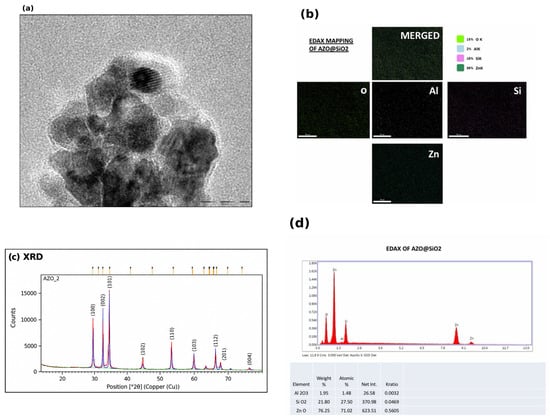
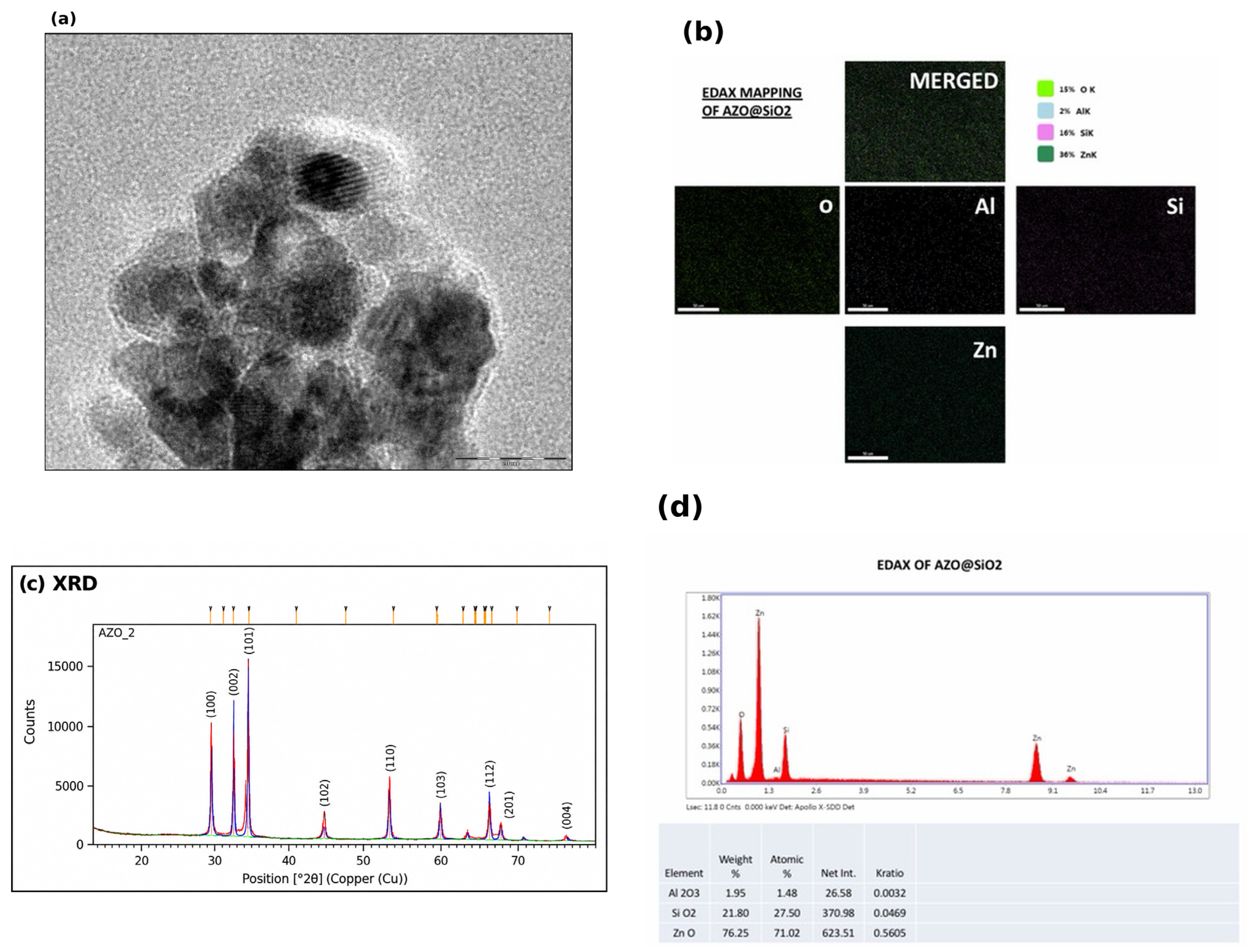
To establish a robust foundation for the dual-deterrence mechanism, the active fillers were thoroughly characterized. Figure 1 presents the morphological, structural, and compositional characteristics of the synthesized AZO@SiO2 nanoparticles. The high-resolution transmission electron microscopy (HRTEM) image (Figure 1a) reveals crystalline lattice fringes within the AZO-rich domains together with a surrounding lower-contrast amorphous region, consistent with the intended core–shell architecture. The SiO2 shell was incorporated to modify the nanoparticle interface and potentially improve compatibility with the polymeric matrix. However, its independent contribution to dispersion stability and agglomeration suppression was not quantitatively evaluated in the present study. Elemental mapping (Figure 1b) confirms the spatial distribution of Zn, Al, Si, and O throughout the analyzed region. The XRD pattern (Figure 1c) is dominated by reflections characteristic of hexagonal wurtzite ZnO, while no distinct crystalline Al2O3 phase is observed, consistent with Al incorporation into the ZnO-based phase. EDX spectroscopy and quantitative elemental analysis (Figure 1d) further confirm the presence of Zn, Al, Si, and O, supporting successful preparation of the AZO@SiO2 hybrid nanoparticles [37,38].
Figure 1.
Morphological, structural, and compositional characterization of AZO@SiO2 nanoparticles: (a) HRTEM image showing crystalline AZO-rich nanodomains surrounded by a lower-contrast amorphous region. (b) EDX elemental maps of O, Al, Si, and Zn. (c) XRD pattern showing the characteristic reflections of hexagonal wurtzite ZnO. (d) Representative EDX spectrum and corresponding quantitative elemental composition. Elemental-map colors identify the labeled elements; XRD peak markers indicate indexed diffraction reflections.
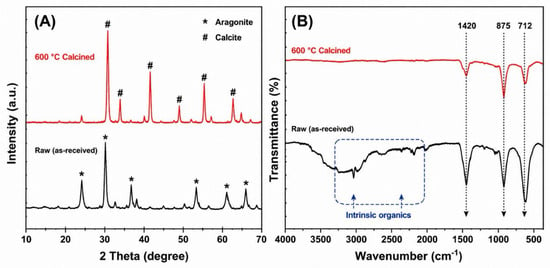
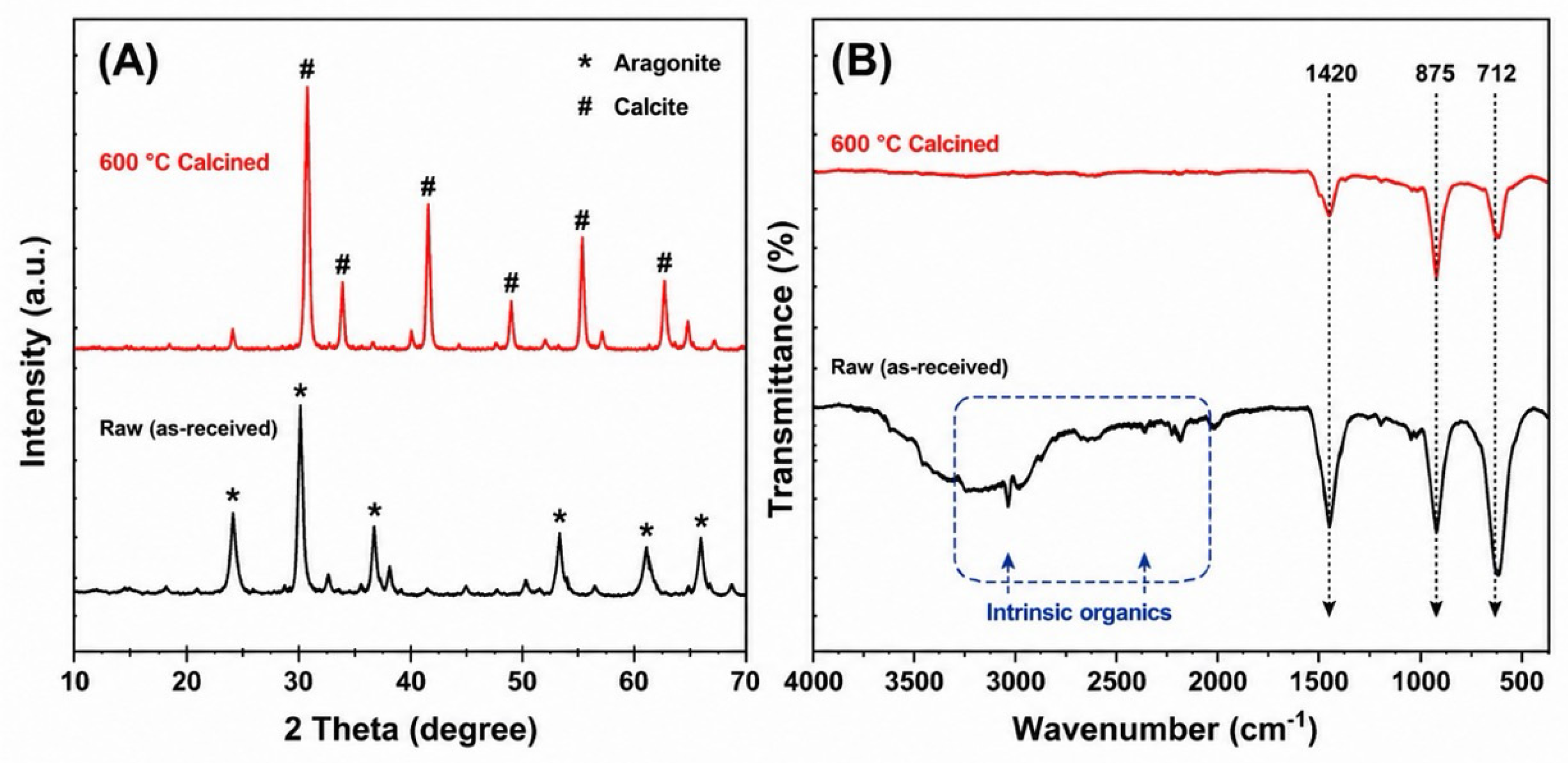
Concurrently, the biogenic oyster shells underwent targeted thermal treatment. As shown in Figure 2, calcination at 600 °C removed the detectable organic signatures, as evidenced by the attenuation/disappearance of the corresponding FT-IR bands. XRD further indicated transformation toward a calcite-dominated CaCO3 phase, consistent with the known thermally induced transformation behavior of CaCO3 polymorphs [39].
Figure 2.
Structural and chemical transitions of oyster shells following thermal treatment. (A) XRD patterns comparing raw (as-received) oyster shells with shells calcined at 600 °C, showing a transition from aragonite-dominated to calcite-dominated CaCO3 phases. (B) FT-IR spectra of raw and calcined oyster shells, showing attenuation of organic-associated absorption bands following thermal treatment, together with characteristic carbonate absorption bands at approximately 1420, 875, and 712 cm−1. Arrows indicate the labeled spectral bands or features.
3.2. Surface Morphology and Wettability of the Coating
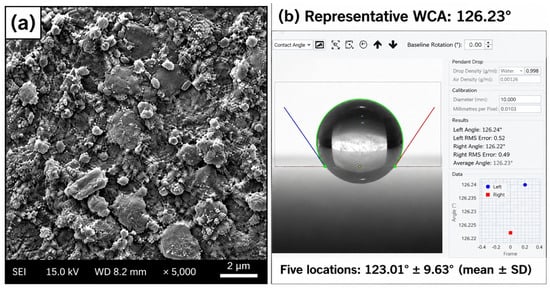
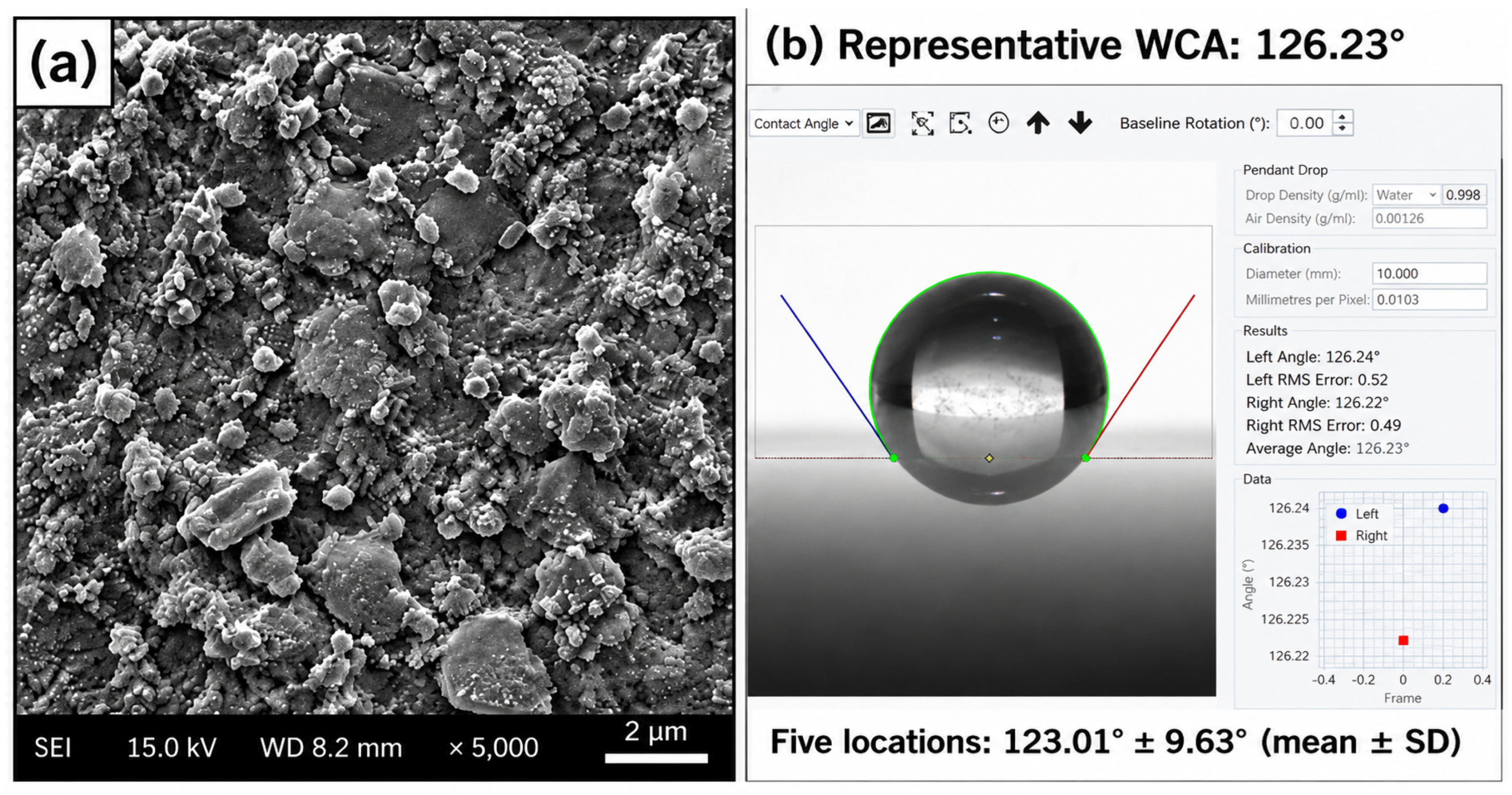
The surface morphology and wettability of the coating may influence its interfacial behavior. Figure 3 illustrates the surface architecture of the fully cured bio-derived coating. The SEM micrograph shows a roughened topography with embedded micro- and nanoparticles. A new specimen prepared using the original coating formulation was measured at five independent locations using water droplets. The resulting static water contact angle was 123.01° ± 9.63° (mean ± sample s.d., n = 5; individual position means: 126.23°, 130.94°, 107.29°, 120.79°, and 129.79°). For comparison, the measured contact angles of uncoated Al-6061 were approximately 90.8° before sandblasting and 72.1° after sandblasting. These measurements support a hydrophobic apparent surface-wetting response, but wettability alone does not establish biological antifouling or foul-release effectiveness.
Figure 3.
Surface morphology and wettability of the bio-derived antifouling coating: (a) SEM image showing the roughened coating surface with embedded micro- and nanoparticles. (b) Representative water-droplet profile from a newly prepared specimen using the original coating formulation. The static water contact angle measured at five independent locations was 123.01° ± 9.63° (mean ± sample s.d., n = 5). The representative droplet image and its individually measured angle are distinguished from the five-location mean.
3.3. Long-Term Field Performance
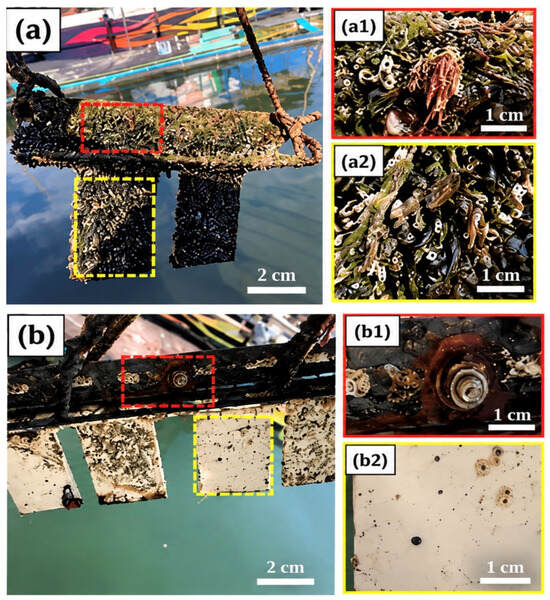
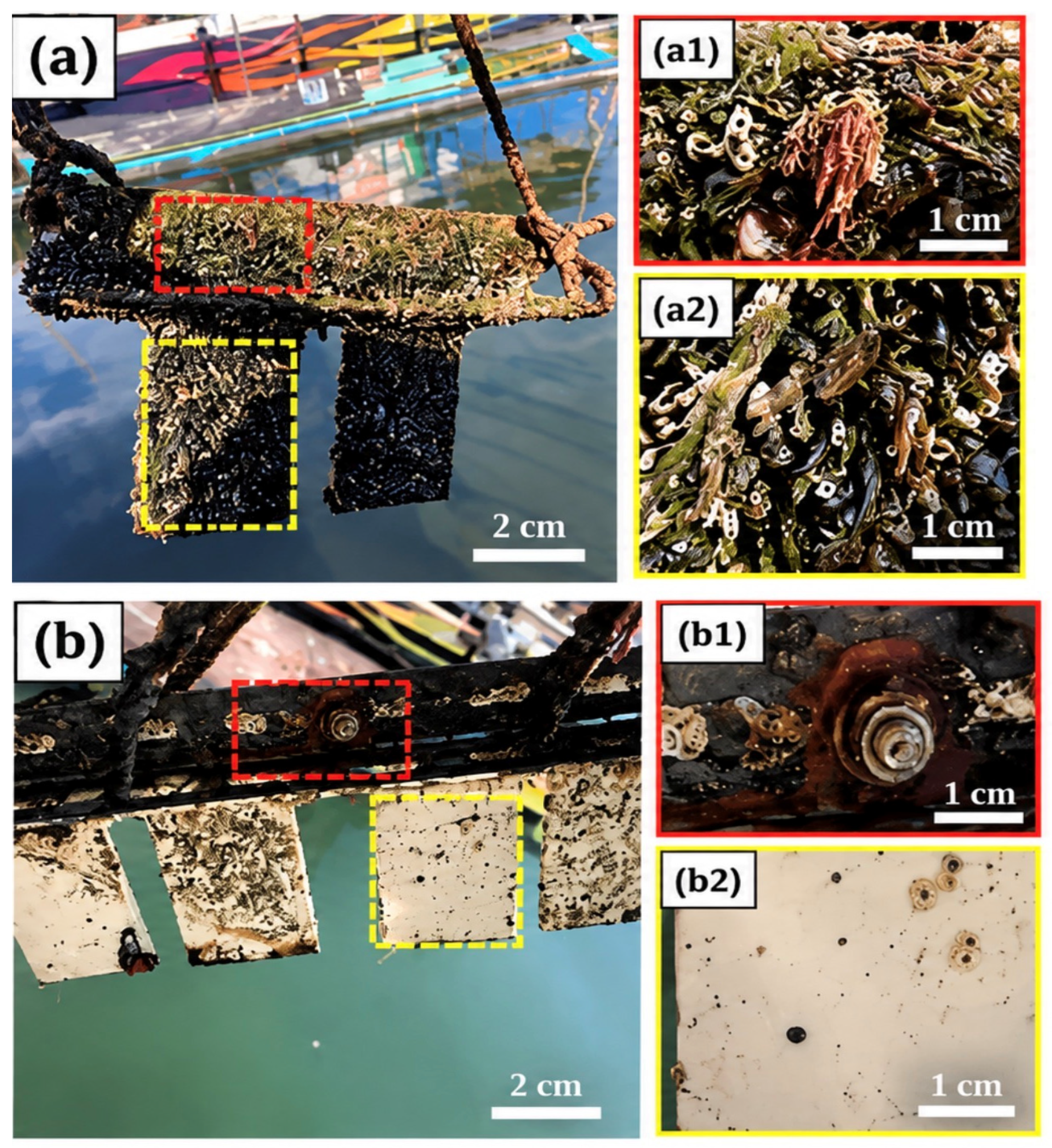
After 12 months of natural-seawater immersion, the three coated panels showed markedly less visible macrofouling than the uncoated controls (approximately 77% coverage). The original image-based assessment recorded 0% macrofouling coverage for coated panels; however, enlarged views reveal scattered particulates and localized small barnacle-like deposits. The identity of these deposits and whether they were included in the ImageJ classification require verification against the original images and analysis masks before the 0% value can be treated as a confirmed quantitative endpoint. Representative photographs and provisional coverage statistics are provided in Figure 4 and Table S1 (Supplementary Materials). Visual inspection showed no obvious large-scale coating detachment. These observations do not independently establish the antifouling mechanism.
Figure 4.
Field immersion performance of uncoated control and coated panels after 12 months of natural seawater exposure at Anping Harbor, Taiwan: (a) Uncoated control showing dense visible marine macrofouling on the horizontal supporting bar and vertical panels, including mussels, barnacles, and filamentous algae. (a1,a2) Enlarged views of the regions indicated by the red and yellow dashed boxes in (a), respectively, illustrating extensive biological colonization. (b) Coated panels exhibiting substantially reduced visible macrofouling compared with the uncoated control, with scattered surface particulates and localized small barnacle-like deposits of unconfirmed identity. (b1,b2) Enlarged views of the regions indicated by the red and yellow dashed boxes in (b), respectively, showing localized deposits on the supporting structure and coated surface. Scale bars: 2 cm in the main images (a,b) and 1 cm in the enlarged images (a1,a2,b1,b2). Provisional image-based coverage statistics are summarized in Table S1 (Supplementary Materials); the original 0% coated-panel classification requires verification against the analysis masks and visible deposits.
3.4. Illumination-Dependent Apparent Thermal Response
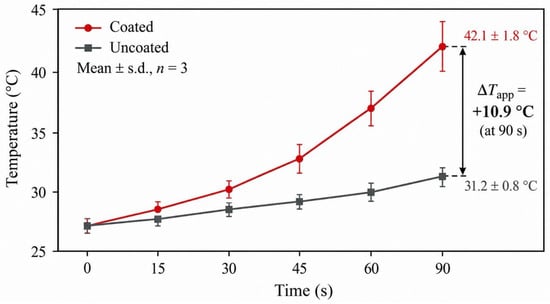
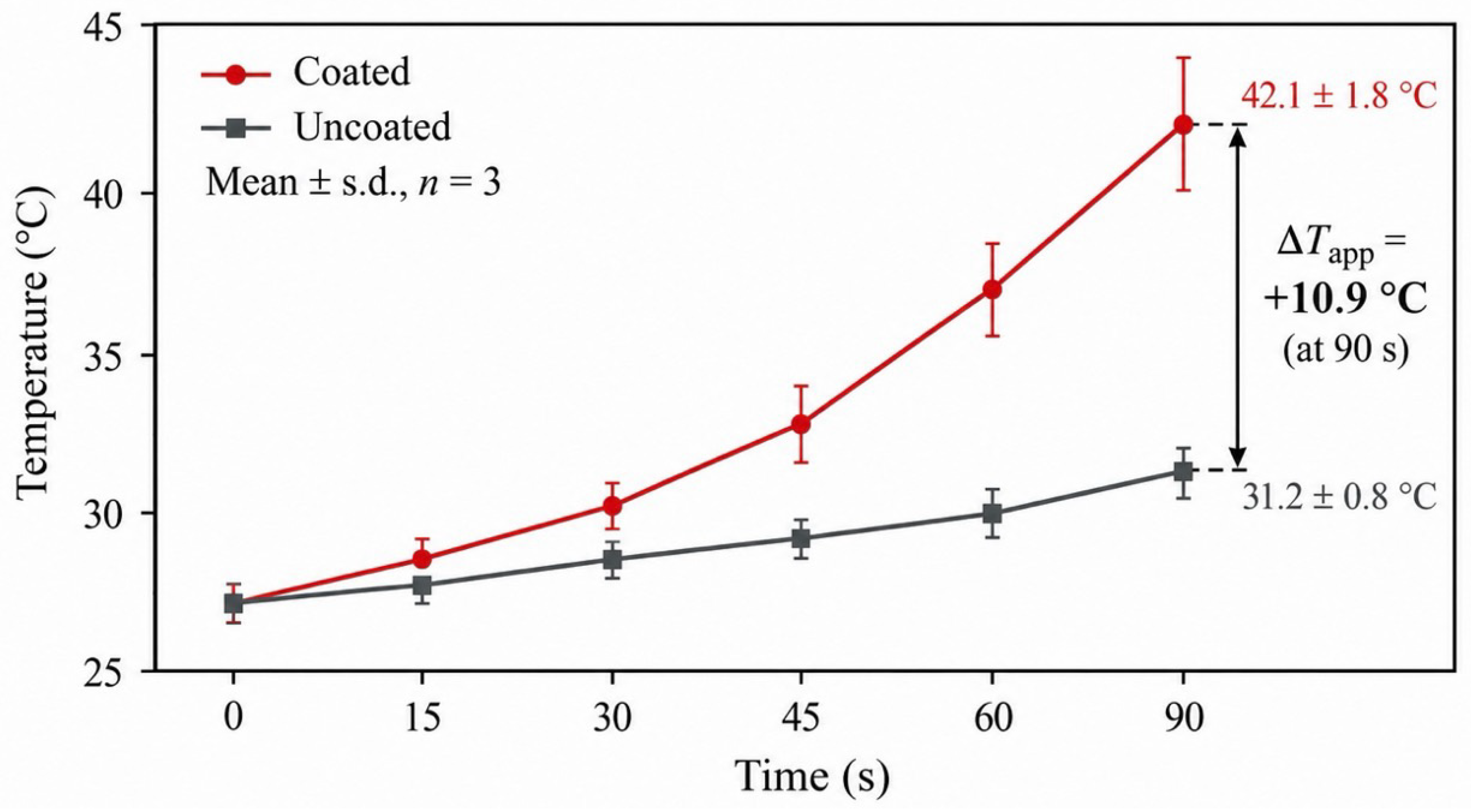
Under 100 W m−2 illumination (Figure 5), the coated surface exhibited rapid localized heating, reaching 42.1 ± 1.8 °C at 90 s, compared with 31.2 ± 0.8 °C for the uncoated control, corresponding to a calibrated apparent temperature difference of ΔT_app = +10.9 °C. This result demonstrates an illumination-dependent apparent thermal response under the specified laboratory conditions. Although such a response may influence interfacial thermal conditions on intermittently exposed surfaces, its magnitude, persistence, and biological consequences under realistic wet, flowing, or splash-zone environments have not been established.
Figure 5.
Infrared thermography under 100 W m−2 illumination (ε ≈ 0.95, tape-calibrated; ROI ≈ 1 × 1 cm). Temperature–time profiles (mean ± s.d., n = 3 panels) show rapid photothermal heating of the coated surface. At 90 s, the coated and uncoated surfaces reached 42.1 ± 1.8 °C and 31.2 ± 0.8 °C, respectively, corresponding to an apparent temperature difference of ΔT_app = +10.9 °C.
3.5. Preliminary GC-MS Observations of Amine-Associated Signals
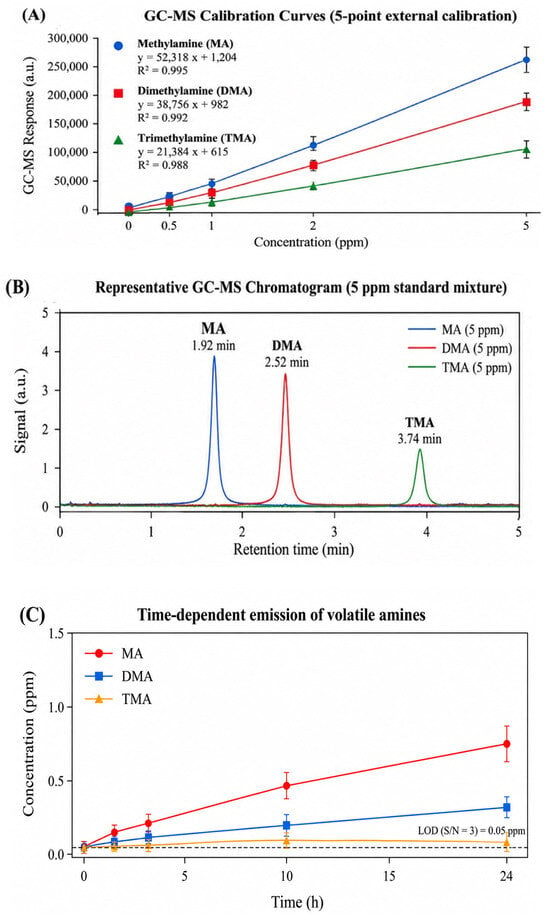
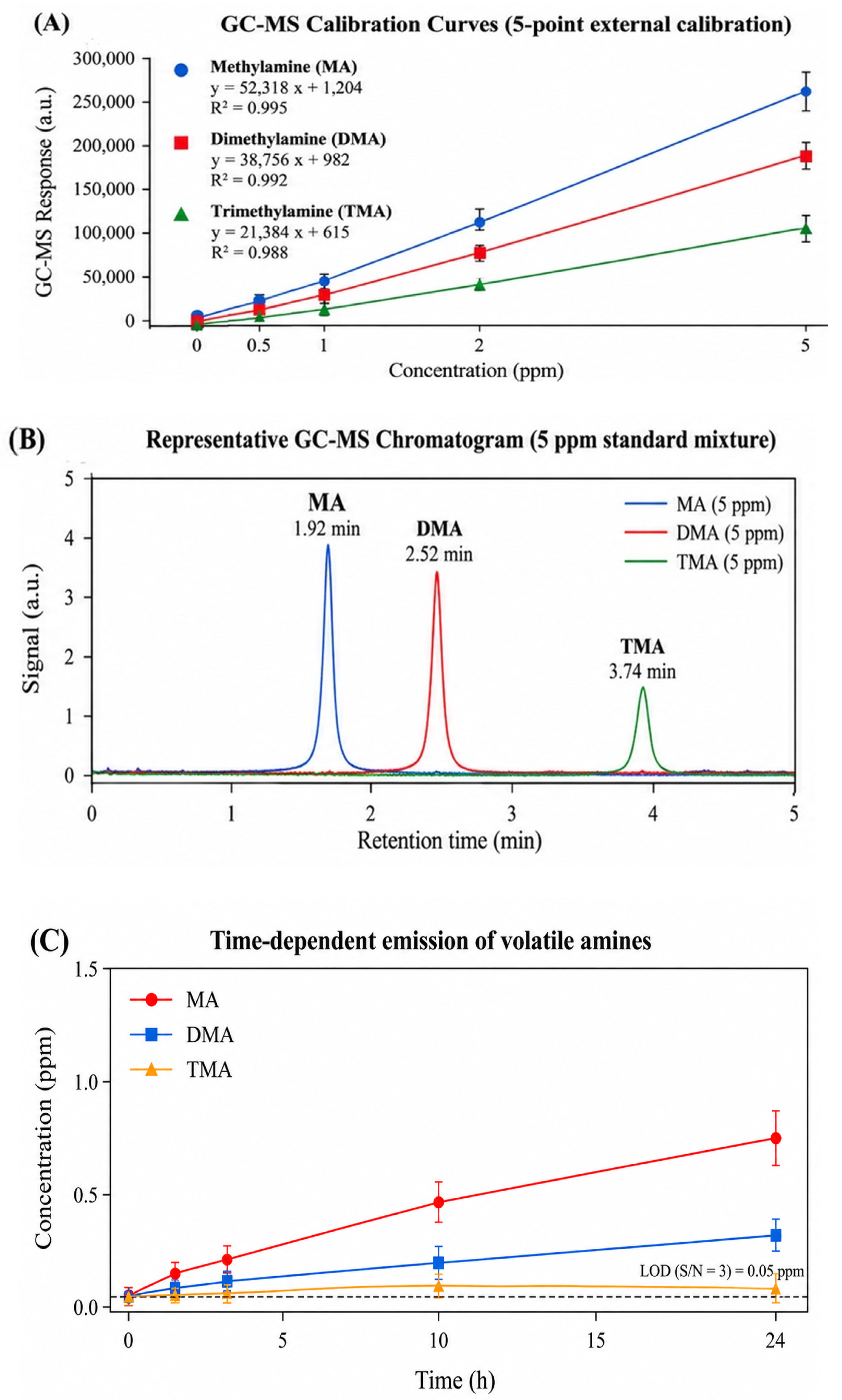
Preliminary gas chromatography–mass spectrometry (GC-MS) measurements were conducted to investigate time-dependent analytical signals tentatively associated with three low-molecular-weight amines: methylamine (MA), dimethylamine (DMA), and trimethylamine (TMA). These measurements were intended to characterize potential formulation-associated chemical release processes rather than to establish a definitive reaction mechanism or biologically effective antifouling pathway.
The chemical origins of the observed analytical signals remain unresolved. Although the thermally treated oyster-shell component and the waterborne acrylic matrix may influence the observed chemical profiles, the specific nitrogen-containing precursors and corresponding formation pathways have not been independently identified. Consequently, catalytic, hydrolytic, or decomposition reactions cannot be considered experimentally established based on the present measurements.
To examine the temporal behavior of these preliminary chemical signals, samples were collected from both the immediate headspace (gaseous phase) and the surrounding aqueous environment under the specified experimental conditions.
Time-resolved headspace measurements conducted over 24 h (Figure 6) revealed progressively increasing analytical signals tentatively assigned to MA, DMA, and TMA. These observations indicate a time-dependent process associated with the formulated coating. However, the increasing signals alone cannot distinguish between chemical generation, release of pre-existing constituents, accumulation within the sampling environment, or other formulation-dependent processes.
Figure 6.
Preliminary gas chromatography–mass spectrometry (GC-MS) characterization of amine-associated analytical signals: (A) Five-point external calibration responses for methylamine (MA), dimethylamine (DMA), and trimethylamine (TMA) reference compounds. (B) Illustrative reference-standard chromatographic profiles showing separately labeled retention-time peaks; these are not chromatograms of coating-derived samples. (C) Time-dependent preliminary headspace analytical responses over 24 h (reported LOD = 0.05 ppm). In contrast, Figure S2d (Supplementary Materials) displays overlapping illustrative signal traces that do not resolve three individual peaks. The two panels are not interchangeable evidence of chromatographic separation, and their acquisition/processing relationship has not been verified from the original instrument files. Compound assignments and apparent concentrations in coating-derived samples remain tentative; signals near or below the LOD are not reliably quantified.
To further investigate the possible contributions of individual formulation components, comparative measurements were performed using binder-only, calcined-shell-only, binder/raw-shell, and binder/calcined-shell formulations under comparable experimental conditions.
The binder-only and calcined-shell-only controls exhibited negligible analytical signals under the reported measurement conditions. In contrast, the binder/raw-shell formulation produced weaker signals than the binder/calcined-shell formulation. This comparative behavior suggests an association between the observed chemical signals and the combined presence of the polymeric matrix and thermally treated oyster-shell material.
Nevertheless, these formulation-dependent differences do not independently establish the chemical identities of the detected species, their specific formation pathways, or the existence of a catalytic interaction between the acrylic binder and the mineral component.
Complementary aqueous-phase measurements over the same 24 h observation period revealed time-dependent analytical signals associated with the surrounding liquid environment. These results provide additional information regarding the distribution of the tentatively identified compounds between the gaseous and aqueous sampling phases, as summarized in Table S2 (Supplementary Materials). The corresponding release-rate plot (Figure S2e) has been replotted using the appropriate apparent time-averaged release-rate unit (ng cm−2 h−1) and the provisional concentrations and calculated values in Table S2. The mathematical conversion and plotting consistency have been checked under the stated closed-batch assumptions; however, the original GC-MS acquisition records, compound identities, and sampling conditions remain to be independently verified before the release rates can be considered experimentally validated.
Taken together, the preliminary GC-MS observations indicate that the formulated coating exhibits time-dependent chemical signals whose apparent intensities vary with formulation composition and sampling conditions. The stronger responses observed for the binder/calcined-shell formulation provide a basis for further investigation of possible interactions between the polymer matrix and thermally treated biogenic mineral components.
However, definitive identification of the detected compounds, verification of their chemical origins, and assessment of their biological relevance require additional analytical confirmation and controlled biological experiments. Accordingly, the present findings are interpreted as preliminary formulation-associated chemical observations rather than direct evidence of a volatile-amine-mediated antifouling mechanism.
3.6. Spatial Chemical Signals and Field Fouling Associations
To investigate whether formulation-associated chemical signals exhibited spatial variation beyond the coating surface, aqueous-phase samples were collected at defined distances under controlled static-tank conditions. These measurements were designed to characterize preliminary chemical distributions rather than to demonstrate a biologically effective deterrence halo. Under the laboratory static-tank conditions, GC-MS analytical signals tentatively assigned to methylamine (MA), dimethylamine (DMA), and trimethylamine (TMA) exhibited a distance-dependent decrease in apparent analyte-equivalent concentration. The combined apparent concentration was approximately 0.82 ppm at the coating–water interface (0 cm), decreasing to approximately 0.35 ppm at 5 cm, while the analytical signals at 20 cm were below the reported detection threshold of 0.05 ppm.
These observations suggest the presence of a spatially varying chemical microenvironment under the specified static laboratory conditions. However, the definitive identities of the detected compounds, their chemical origins, and their potential biological activities require further independent verification. In particular, the measured apparent concentration gradient does not establish biologically effective deterrence concentrations or demonstrate inhibition of marine organism settlement.
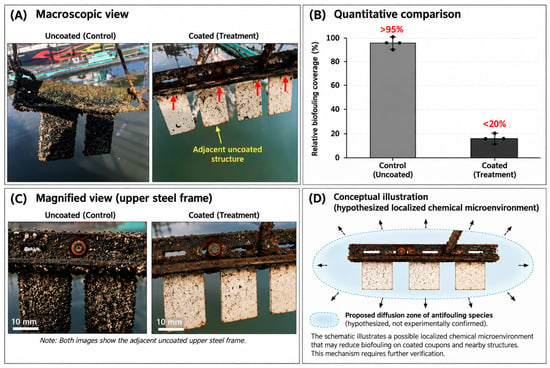
The field observations presented in Figure 7 revealed differences in visible macrofouling coverage between uncoated structural frames positioned adjacent to coated panels and corresponding control structures. Image-based analysis indicated visible macrofouling coverage exceeding 95% on the control frames, compared with less than 20% on the uncoated structural regions adjacent to the coated panels. Although these observations are consistent with spatial differences in marine colonization, the field measurements were conducted under environmental conditions distinct from those of the laboratory chemical-gradient experiments. Consequently, the observed field patterns cannot be directly attributed to the preliminary amine-associated analytical signals. Alternative explanations, including local hydrodynamic conditions, illumination, surface orientation, substrate history, and environmental variability, cannot be excluded. Therefore, the laboratory chemical-gradient observations and the field-scale differences in visible macrofouling coverage are interpreted as complementary but independent findings. Their potential mechanistic relationship remains a testable hypothesis requiring definitive chemical identification, controlled biological settlement assays, and replicated experiments under representative marine flow conditions.
Figure 7.
Spatial differences in visible macrofouling coverage on uncoated structural frames during the field deployment: (A) Representative photographs of uncoated structural frames adjacent to coated panels and corresponding control structures. (B) Image-based comparison of visible macrofouling coverage between the experimental and control regions. (C) Representative close-up images illustrating differences in visible surface deposits and biological colonization. (D) Conceptual illustration of the hypothesized localized chemical microenvironment. The observed spatial differences do not independently establish volatile-amine-mediated biological deterrence or exclude the influence of local environmental conditions. Arrows in panel (D) schematically indicate the proposed spatial dispersion pathway, not experimentally confirmed transport.
4. Discussion
4.1. Environment-Dependent Dual-Deterrence Behavior
The proposed antifouling concept integrates two potentially complementary interfacial pathways: an illumination-dependent apparent thermal response and a hypothesized chemical microenvironment associated with the thermally treated oyster-shell component. These pathways are considered within distinct environmental and spatial boundary conditions. However, their individual and combined contributions to biological settlement inhibition have not yet been independently established. Accordingly, the term dual-deterrence is used here to describe the proposed functional framework rather than a conclusively demonstrated biological mechanism.
Photothermal response under intermittently exposed conditions. Under laboratory xenon illumination of 100 W m−2, the coated surface reached an apparent temperature of 42.1 ± 1.8 °C after 90 s, compared with 31.2 ± 0.8 °C for the uncoated control, corresponding to an apparent temperature difference (ΔT_app) of +10.9 °C. This result demonstrates a measurable illumination-dependent apparent thermal response under the specified laboratory conditions.
Such a response may influence local interfacial thermal conditions on intermittently exposed surfaces, including selected splash-zone or waterline applications. Nevertheless, the magnitude and persistence of the thermal response under natural marine conditions will depend on incident solar irradiance, spectral distribution, surface emissivity, wetting state, convective heat transfer, and repeated wet–dry cycling.
In particular, seawater contact and flow may substantially reduce the temperature difference observed under laboratory conditions. Furthermore, no controlled biological settlement experiments were performed to determine whether the measured apparent thermal elevation is sufficient to inhibit larval attachment, microbial colonization, or subsequent macrofouling development.
Consequently, photothermal gating is considered a proposed auxiliary mechanism rather than an experimentally established antifouling pathway. Its potential biological effectiveness under realistic splash-zone conditions requires further validation through controlled wet-surface thermal measurements and organism-specific settlement assays.
Chemical microenvironment under submerged conditions. During continuous seawater immersion, heat transfer to the surrounding water may attenuate the illumination-induced surface temperature response. Under these conditions, the coating’s observed field performance may be influenced by its surface morphology, wettability, polymeric matrix, and local interfacial chemistry.
Preliminary GC-MS measurements revealed time-dependent analytical signals tentatively associated with methylamine (MA), dimethylamine (DMA), and trimethylamine (TMA). Under controlled static-tank conditions, the apparent concentrations of these signals decreased with increasing distance from the coated surface, suggesting the presence of a spatially varying chemical microenvironment.
The thermally treated oyster-shell component may contribute to local chemical conditions through its mineral composition and surface characteristics. However, the specific nitrogen-containing precursors, chemical formation pathways, and biological relevance of the tentatively identified amine-associated signals remain unresolved.
Importantly, the laboratory chemical-gradient measurements and the field observations of reduced visible macrofouling on adjacent uncoated structures were obtained under different environmental conditions. Therefore, their spatial correspondence cannot establish a causal relationship between the preliminary chemical signals and biological deterrence.
Alternative explanations, including local hydrodynamics, surface orientation, illumination, substrate characteristics, and environmental variability, cannot be excluded.
The proposed volatile-amine-mediated deterrence mechanism must therefore be regarded as a hypothesis requiring independent analytical confirmation and concentration-controlled biological settlement experiments.
Environmental boundaries and potential application scenarios. The relative contributions of the proposed thermal and chemical pathways are expected to depend strongly on environmental conditions. Illumination-dependent thermal responses are inherently intermittent and cannot be assumed to remain active during nighttime, prolonged cloud cover, or complete shading. Similarly, localized chemical gradients may be altered or dispersed by seawater circulation and hydrodynamic transport.
Accordingly, the current experimental findings are most relevant to evaluating potential applications in selected sheltered or low-flow marine installations, such as stationary monitoring equipment and protected harbor structures. Nevertheless, even nominally stationary marine infrastructure can experience variable currents, wave action, sediment transport, and mechanical abrasion.
The present study does not establish the effectiveness of either proposed deterrence pathway under dynamic vessel-hull conditions, nor does it demonstrate continuous 24-h biological protection.
Future investigations should therefore include controlled-flow chemical measurements, illuminated and dark biological settlement assays, repeated wet–dry thermal cycling, and component-specific coating controls. These experiments will be necessary to determine whether the proposed pathways provide measurable biological protection independently or in combination.
4.2. Environmental Screening, Biological Safety, and Circularity Assessment
The formulation is designed to be free of intentionally incorporated conventional leachable metallic biocides. The AZO nanoparticles are incorporated within a SiO2-containing core–shell architecture and securely embedded in the waterborne acrylic matrix. Although this structural arrangement may limit direct exposure of the AZO-rich domains to the surrounding medium, its long-term effectiveness in preventing zinc release has not been established. The 28-day ICP-OES results are therefore interpreted strictly as preliminary leaching-screening data under the specified experimental conditions. ICP-OES analysis confirmed that Cu, Zn, Sn, and Fe concentrations remained below their respective instrumental detection limits under the test conditions (Table S3 (Supplementary Materials)). Beyond chemical leaching, the preliminary Artemia salina biological lethality assay demonstrated a >98% survival rate after 48 h of exposure to the coating leachate, which is comparable to the blank seawater control.
The preliminary environmental screening results provide information on the monitored metal concentrations and acute biological responses under the specified test conditions. However, these measurements do not establish the mechanisms responsible for the observed field fouling differences or demonstrate comprehensive environmental safety. Longer-term leaching measurements, multispecies ecotoxicological testing, and controlled biological settlement experiments remain necessary. The initial material cost is provisionally estimated at approximately US$4.50 m−2 (Table 1; Table S4 (Supplementary Materials)), subject to further economic validation, including mass-balance verification of oyster shell consumption and scalable manufacturing considerations.
Table 1.
Literature-based qualitative comparison of representative marine antifouling coating technologies and the present oyster-shell-derived coating. Performance observations and material-cost estimates were obtained under different experimental and operational conditions and should not be interpreted as directly equivalent commercial benchmarks.
4.3. Limitations and Future Work
The present study has several limitations that should be considered when interpreting its findings.
First, the 12-month field assessment was conducted at a single marine site using three coated panels. Larger replicated studies across different locations, seasons, and hydrodynamic conditions are required to establish reproducibility.
Second, the proposed volatile-amine-mediated deterrence mechanism remains unverified by controlled biological settlement assays. Additional chemical identification, concentration-controlled biological exposure experiments, and component-specific formulation controls are required.
Third, the apparent photothermal response was evaluated under laboratory illumination rather than representative wet, flowing, or splash-zone conditions. Its biological relevance under natural marine exposure remains uncertain.
Fourth, static water contact angle measurements do not independently establish foul-release behavior. Additional surface free energy measurements, organism adhesion tests, and hydrodynamic durability evaluations are necessary.
Finally, the short-term metal-leaching and acute toxicity assessments do not establish long-term ecological safety. Extended leaching measurements and multispecies ecotoxicological studies will be required before broader industrial deployment.
These investigations will help determine the practical suitability of the proposed coating for selected sheltered or low-flow marine installations.
5. Conclusions
This study investigated the valorization of thermally treated oyster-shell waste as a functional component in a waterborne acrylic coating for potential marine antifouling applications.
Under the specific conditions of a 12-month natural-seawater deployment at Anping Harbor, the three evaluated coated panels showed markedly reduced visible macrofouling relative to uncoated controls, although localized surface deposits were visible. The originally reported 0% image-based coverage requires confirmation of the classification criteria for these deposits. These observations are promising within the limited sample size and deployment conditions but do not establish universal antifouling effectiveness.
Under laboratory illumination of 100 W m−2, the coating exhibited an apparent temperature difference of +10.9 °C relative to the uncoated control at 90 s. This response demonstrates an illumination-dependent apparent thermal property; its biological significance under realistic marine splash-zone conditions remains unverified.
Preliminary GC-MS measurements revealed time-dependent and spatially varying analytical signals tentatively associated with low-molecular-weight amines. However, the chemical origins, definitive identities, and biological deterrence effects of these signals have not yet been established. Similarly, differences in fouling coverage on adjacent uncoated structures represent field associations rather than direct evidence of a chemically mediated protection halo.
The 28-day ICP-OES screening and preliminary Artemia assay provide initial environmental information under the tested conditions but do not establish long-term metal-release behavior or comprehensive ecological safety.
The estimated material and basic processing cost of approximately US$4.50 m−2 remains provisional and requires further validation under industrial manufacturing and maintenance conditions.
Overall, the results demonstrate the potential of oyster-shell waste valorization for developing functional marine coating systems. Further controlled biological assays, analytical confirmation, component-specific controls, hydrodynamic durability testing, and replicated field evaluations are required to establish the underlying antifouling mechanisms and assess practical deployment suitability.
Supplementary Materials
The following supporting information can be downloaded at: https://www.mdpi.com/article/10.3390/coatings16111304/s1, The Supplementary Materials include infrared thermography and emissivity calibration (Figure S1), preliminary GC-MS calibration and analytical profiles (Figure S2), field immersion and coating durability information, metal-leaching assay details, experimental procedures, environmental and economic assessment, material specifications, and instrumental parameters (Tables S1–S7).
Funding
This research was supported by Hugee Materials Co., Ltd. through internal research and development resources, materials, experimental support, and publication-related expenses. No research funding or experimental resources were provided by National Taiwan University.
Institutional Review Board Statement
Not applicable. This study did not involve human participants or vertebrate animals. The preliminary biological toxicity assessment was conducted using Artemia salina (brine shrimp), an invertebrate species.
Data Availability Statement
The data supporting the findings of this study are included in the article and its Supplementary Materials. Additional supporting data are available from the corresponding author upon reasonable request, subject to applicable proprietary and commercial confidentiality restrictions. Proprietary formulations, confidential manufacturing information, and commercially sensitive technical data are not publicly available.
Conflicts of Interest
The author declares that he is the legal representative and President of HUGEE MATERIALS CO., LTD., which provided financial, technical, and material support for the research presented in this manuscript. The author discloses this commercial affiliation and associated corporate support as a potential competing financial interest. The author declares no other known competing financial interests or personal relationships that could have appeared to influence the work reported in this manuscript.
References
- Callow, M.E.; Callow, J.A. Marine biofouling: A sticky problem. Biologist 2002, 49, 10–14. [Google Scholar] [PubMed]
- Schultz, M.P. Effects of coating roughness and biofouling on ship resistance and powering. Biofouling 2007, 23, 331–341. [Google Scholar] [CrossRef] [Scilit] [PubMed]
- Townsin, R.L. The ship hull fouling penalty. Biofouling 2003, 19, 9–15. [Google Scholar] [CrossRef] [Scilit] [PubMed]
- Chambers, L.D.; Stokes, K.R.; Walsh, F.C.; Wood, R.J.K. Modern approaches to marine antifouling coatings. Surf. Coat. Technol. 2006, 201, 3642–3652, Correction in Surf. Coat. Technol. 2007, 202, 412–413. [Google Scholar] [CrossRef] [Scilit]
- Almeida, E.; Diamantino, T.C.; de Sousa, O. Marine paints: The particular case of antifouling paints. Prog. Org. Coat. 2007, 59, 2–20. [Google Scholar] [CrossRef] [Scilit]
- Turner, A. Marine pollution from antifouling paint particles. Mar. Pollut. Bull. 2010, 60, 159–171. [Google Scholar] [CrossRef] [Scilit] [PubMed]
- Dafforn, K.A.; Lewis, J.A.; Johnston, E.L. Antifouling strategies: History and regulation, ecological impacts and mitigation. Mar. Pollut. Bull. 2011, 62, 453–465. [Google Scholar] [CrossRef] [Scilit] [PubMed]
- Amara, I.; Miled, W.; Ben Slama, R.; Ladhari, N. Antifouling processes and toxicity effects of antifouling paints on marine environment: A review. Environ. Toxicol. Pharmacol. 2018, 57, 115–130. [Google Scholar] [CrossRef] [Scilit] [PubMed]
- Clare, A.S. Marine natural product antifoulants: Status and potential. Biofouling 1996, 9, 211–229. [Google Scholar] [CrossRef] [Scilit]
- Yebra, D.M.; Kiil, S.; Dam-Johansen, K. Antifouling technology—Past, present and future steps towards efficient and environmentally friendly antifouling coatings. Prog. Org. Coat. 2004, 50, 75–104. [Google Scholar] [CrossRef] [Scilit]
- Qian, P.-Y.; Xu, Y.; Fusetani, N. Natural products as antifouling compounds: Recent progress and future perspectives. Biofouling 2010, 26, 223–234. [Google Scholar] [CrossRef] [Scilit] [PubMed]
- Lejars, M.; Margaillan, A.; Bressy, C. Fouling release coatings: A nontoxic alternative to biocidal antifouling coatings. Chem. Rev. 2012, 112, 4347–4390. [Google Scholar] [CrossRef] [Scilit] [PubMed]
- Selim, M.S.; El-Safty, S.A.; Fatthallah, N.A.; Shenashen, M.A. Silicone/graphene oxide sheet-alumina nanorod ternary composite for superhydrophobic antifouling coating. Prog. Org. Coat. 2018, 121, 160–172. [Google Scholar] [CrossRef] [Scilit]
- Hu, P.; Xie, Q.; Ma, C.; Zhang, G. Silicone-based fouling-release coatings for marine antifouling. Langmuir 2020, 36, 2170–2183. [Google Scholar] [CrossRef] [Scilit] [PubMed]
- Lagerström, M.; Wrange, A.-L.; Oliveira, D.R.; Granhag, L.; Larsson, A.I.; Ytreberg, E. Are silicone foul-release coatings a viable and environmentally sustainable alternative to biocidal antifouling coatings in the Baltic Sea region? Mar. Pollut. Bull. 2022, 184, 114102. [Google Scholar] [CrossRef] [Scilit] [PubMed]
- Selim, M.S.; Yang, H.; Wang, F.Q.; Fatthallah, N.A.; Huang, Y.; Kuga, S. Silicone/ZnO nanorod composite coating as a marine antifouling surface. Appl. Surf. Sci. 2019, 466, 40–50. [Google Scholar] [CrossRef] [Scilit]
- Wang, W.; Luo, Q.; Li, J.; Li, L.; Li, Y.; Huo, X.; Du, X.; Li, Z.; Wang, N. Photothermal-amplified single atom nanozyme for biofouling control in seawater. Adv. Funct. Mater. 2022, 32, 2205461. [Google Scholar] [CrossRef] [Scilit]
- Liu, Y.; Waterhouse, G.I.N.; Jiang, X.; Zhang, Z.; Yu, L. Smart antibiofouling composite coatings based on photothermally-active polyaniline and thermo-responsive poly(N-isopropylacrylamide). Chem. Eng. J. 2024, 490, 151669. [Google Scholar] [CrossRef] [Scilit]
- Zhou, H.; Wang, H.; Zheng, K.; Gu, Z.; Wu, Z.; Tian, X. Aluminum-doped zinc oxide nanoparticles with tunable near-infrared absorption/reflectance by a simple solvothermal process. RSC Adv. 2014, 4, 42758. [Google Scholar] [CrossRef] [Scilit]
- Wang, Y.; Yu, M.; Huang, C.; Zheng, Q.; Zhou, H.; Zhang, Z.; Zhao, S. Infrared emission characteristic and microwave loss property of aluminum doped zinc oxide nanoparticles. Ceram. Int. 2021, 47, 2456–2462. [Google Scholar] [CrossRef] [Scilit]
- Teng, R.; Li, Y.; Dong, L.; Zhou, T.; Zhao, B.; Han, X.; Ruan, W.; Jung, Y.M. From alcohol ligand content to doping level, morphology, and optical absorption in the synthesis process of aluminum-doped zinc oxide nanoparticles. J. Phys. Chem. Lett. 2025, 16, 5488–5495. [Google Scholar] [CrossRef] [Scilit] [PubMed]
- Chen, Z.; Zhao, Y.; Zhu, X.; Möller, M. Formation of monodisperse polymer@SiO2 core–shell nanoparticles via polymerization in emulsions stabilized by amphiphilic silica precursor polymers: HLB dictates the reaction mechanism and particle size. Macromolecules 2019, 52, 5670–5678. [Google Scholar] [CrossRef] [Scilit]
- Wang, N.; Zhou, H.; Ren, J.; Gao, G.; Zhao, G.; Yang, Y.; Wang, H.; Wang, J. Polymer@SiO2 core–shell composite particles: Preparation and application. Coatings 2023, 13, 334. [Google Scholar] [CrossRef] [Scilit]
- Barros, M.C.; Bello, P.M.; Bao, M.; Torrado, J.J. From waste to commodity: Transforming shells into high purity calcium carbonate. J. Clean. Prod. 2009, 17, 400–407. [Google Scholar] [CrossRef] [Scilit]
- Alvarenga, R.A.F.; Galindro, B.M.; Helpa, C.F.; Soares, S.R. The recycling of oyster shells: An environmental analysis using Life Cycle Assessment. J. Environ. Manag. 2012, 106, 102–109. [Google Scholar] [CrossRef] [Scilit] [PubMed]
- Topić Popović, N.; Lorencin, V.; Strunjak-Perović, I.; Čož-Rakovac, R. Shell waste management and utilization: Mitigating organic pollution and enhancing sustainability. Appl. Sci. 2023, 13, 623. [Google Scholar] [CrossRef] [Scilit]
- Kwon, H.-B.; Lee, C.-W.; Jun, B.-S.; Yun, J.-D.; Weon, S.-Y.; Koopman, B. Recycling waste oyster shells for eutrophication control. Resour. Conserv. Recycl. 2004, 41, 75–82. [Google Scholar] [CrossRef] [Scilit]
- Lertwattanaruk, P.; Makul, N.; Siripattarapravat, C. Utilization of ground waste seashells in cement mortars for masonry and plastering. J. Environ. Manag. 2012, 111, 133–141. [Google Scholar] [CrossRef] [Scilit] [PubMed]
- Summa, D.; Lanzoni, M.; Castaldelli, G.; Fano, E.A.; Tamburini, E. Trends and opportunities of bivalve shells’ waste valorization in a prospect of circular blue bioeconomy. Resources 2022, 11, 48. [Google Scholar] [CrossRef] [Scilit]
- Águila-Almanza, E.; Hernández-Cocoletzi, H.; Rubio-Rosas, E.; Calleja-González, M.; Lim, H.R.; Khoo, K.S.; Singh, V.; Maldonado-Montiel, J.; Show, P.L. Recuperation and characterization of calcium carbonate from residual oyster and clamshells and their incorporation into a residential finish. Chemosphere 2022, 288, 132550. [Google Scholar] [CrossRef] [Scilit] [PubMed]
- Magnabosco, G.; Giuri, D.; Di Bisceglie, A.P.; Scarpino, F.; Fermani, S.; Tomasini, C.; Falini, G. New Material Perspective for Waste Seashells by Covalent Functionalization. ACS Sustain. Chem. Eng. 2021, 9, 6203–6208. [Google Scholar] [CrossRef] [Scilit]
- Azarian, M.H.; Sutapun, W. Biogenic calcium carbonate derived from waste shells for advanced material applications: A review. Front. Mater. 2022, 9, 1024977. [Google Scholar] [CrossRef] [Scilit]
- Basile, M.L.; Triunfo, C.; Gärtner, S.; Fermani, S.; Laurenzi, D.; Maoloni, G.; Mazzon, M.; Marzadori, C.; Adamiano, A.; Iafisco, M.; et al. Stearate-Coated Biogenic Calcium Carbonate from Waste Seashells: A Sustainable Plastic Filler. ACS Omega 2024, 9, 11232–11242. [Google Scholar] [CrossRef] [Scilit] [PubMed]
- Poirier, L.A.; Clements, J.C.; Davidson, J.D.P.; Miron, G.; Davidson, J.; Comeau, L.A. Sink before you settle: Settlement behaviour of Eastern oyster (Crassostrea virginica) larvae on artificial spat collectors and natural substrate. Aquac. Rep. 2019, 13, 100181. [Google Scholar] [CrossRef] [Scilit]
- Banerjee, I.; Pangule, R.C.; Kane, R.S. Antifouling coatings: Recent developments in the design of surfaces that prevent fouling by proteins, bacteria, and marine organisms. Adv. Mater. 2011, 23, 690–718. [Google Scholar] [CrossRef] [Scilit] [PubMed]
- Selim, M.S.; Shenashen, M.A.; El-Safty, S.A.; Higazy, S.; Selim, M.; Isago, H.; Elmarakbi, A. Recent progress in marine foul-release polymeric nanocomposite coatings. Prog. Mater. Sci. 2017, 87, 1–32. [Google Scholar] [CrossRef] [Scilit]
- Zhao, X.; Shen, H.; Zhang, Y.; Li, X.; Zhao, X.; Tai, M.; Li, J.-F.; Li, J.; Lin, H. Aluminum-doped zinc oxide as highly stable electron collection layer for perovskite solar cells. ACS Appl. Mater. Interfaces 2016, 8, 7826–7833. [Google Scholar] [CrossRef] [Scilit] [PubMed]
- Matthews, R.; Glasser, E.; Sprawls, S.C.; French, R.H.; Peshek, T.J.; Pentzer, E.; Martin, I.T. Organofunctional silane modification of aluminum-doped zinc oxide surfaces as a route to stabilization. ACS Appl. Mater. Interfaces 2017, 9, 17620–17628. [Google Scholar] [CrossRef] [Scilit] [PubMed]
- Perić, J.; Vučak, M.; Krstulović, R.; Brečević, L.; Kralj, D. Phase transformation of calcium carbonate polymorphs. Thermochim. Acta 1996, 277, 175–186. [Google Scholar] [CrossRef] [Scilit]
- Lagerström, M.; Ytreberg, E.; Wiklund, A.-K.E.; Granhag, L. Antifouling paints leach copper in excess—Study of metal release rates and efficacy along a salinity gradient. Water Res. 2020, 186, 116383. [Google Scholar] [CrossRef] [Scilit] [PubMed]
- Ytreberg, E.; Lagerström, M.; Nöu, S.; Wiklund, A.-K.E. Environmental risk assessment of using antifouling paints on pleasure crafts in European Union waters. J. Environ. Manag. 2021, 281, 111846. [Google Scholar] [CrossRef] [Scilit]

Disclaimer/Publisher’s Note: The statements, opinions and data contained in all publications are solely those of the individual author(s) and contributor(s) and not of MDPI and/or the editor(s). MDPI and/or the editor(s) disclaim responsibility for any injury to people or property resulting from any ideas, methods, instructions or products referred to in the content. |
© 2026 by the author. Licensee MDPI, Basel, Switzerland. This article is an open access article distributed under the terms and conditions of the Creative Commons Attribution (CC BY) license.