


Highlights
What are the main findings?
- Self-crosslinking acrylate increased the apparent colour intensity of naturally dyed cotton.
- The 10 g/L self-crosslinking acrylate treatment increased K/S by 54.5% compared with untreated dyed cotton.
- The 10 g/L treatment produced the most uniform colour distribution (CV = 2.42%; maximum = 0.58)
- Higher self-crosslinking acrylate concentrations caused no further concentration-dependent improvement and increased spatial variability.
What are the implications of the main findings?
- A low self-crosslinking acrylate concentration was more effective than higher concentrations.
- Self-crosslinking acrylate finishing may reduce reliance on conventional metallic mordants.
- Onion-skin waste can be converted into a value-added textile colourant.
Abstract
Onion-skin waste is a readily available source of flavonoid-based natural colourants; however, their limited affinity for cotton can restrict practical application. This study investigated a self-crosslinking acrylate post-treatment for improving the colour properties and fastness of cotton exhaust-dyed with red onion-skin extract. Unmordanted fabrics were treated with 10, 30, or 50 g/L self-crosslinking acrylate by a pad–dry–cure process and compared with untreated and aluminium sulfate-mordanted samples. SEM revealed film-like coverage and localised inter-fibre polymer bridges, while FTIR supported acrylate deposition through a characteristic ester carbonyl band at approximately 1730 cm−1. Aluminium sulfate mordanting produced a darker, more saturated yellow shade but resulted in the greatest washing-induced colour difference ( = 22.14). In contrast, 10 g/L self-crosslinking acrylate increased K/S from 3.44 to 5.31 and provided the lowest post-washing colour difference (= 6.63). All acrylate-treated fabrics exhibited dry and wet rubbing fastness ratings of 5 and 4–5, respectively. Increasing the self-crosslinking acrylate concentration above 10 g/L provided no additional improvement. Overall, treatment with a low concentration of self-crosslinking acrylate improved colour retention and rubbing fastness of onion-skin-dyed cotton without metallic mordanting, with no benefit from increasing the treatment concentration.
1. Introduction
Growing environmental concerns associated with textile wet processing have increased interest in renewable raw materials, waste-derived colourants, and less hazardous finishing technologies. Although synthetic dyes offer a wide colour range, high reproducibility, and generally satisfactory fastness properties, their production and wet application commonly require substantial quantities of process water, thermal energy, and chemical auxiliaries, which can contribute to the pollutant load of textile effluents [1,2]. Natural colourants derived from renewable plant sources and agricultural by-products have therefore attracted renewed attention as alternatives that may contribute to resource efficiency and waste valorisation within the textile industry.
Agricultural and food-processing wastes, including fruit peels, leaves, bark, seeds, and outer vegetable skins, contain phenolic compounds that can impart colour to textile materials [3]. Onion (Allium cepa L.) skins are an abundant household, market, and food-processing by-product and a readily available source of natural colourants. Their dry outer layers contain flavonoids, which are polyphenolic compounds, including quercetin and its glycosidic derivatives [4,5,6]. Quercetin (3,3′,4′,5,7-pentahydroxyflavone) is a flavonol aglycone and one of the major colouring constituents of onion skins [7,8]. These compounds can produce yellow, golden-brown, and brownish shades on cellulose substrates; however, their limited affinity for cotton often necessitates mordanting or post-treatment to improve colour fixation and durability [5].
Previous studies on onion-skin dyeing of cotton have shown that colour yield and fastness are strongly dependent on the dyeing formulation. Vankar et al. [5] reported that stepwise dyeing of cotton with dry A. cepa skin extract (5% owf) in the presence of 2% metal mordant resulted in 65%–68% dye uptake and improved dye adherence and fastness properties. Studies comparing natural and synthetic mordants in onion-skin-dyed cotton have likewise shown that mordant selection can substantially affect the obtained shade and fastness behaviour [4]. In addition, cationisation and biopolymeric treatments have been explored to enhance fibre–colourant affinity and reduce colourant loss during wet processing [9]. Nevertheless, direct comparison of reported K/S and fastness values is limited because they depend on the onion-skin source, extraction conditions, dye concentration, fabric construction, treatment chemistry, and test protocol.
Despite the advantages of natural dyes in textile applications, their industrial use remains limited by several technical challenges, including variations in chemical composition, poor colour reproducibility, insufficient affinity for certain fibres, and inadequate washing and rubbing fastness [1]. These limitations are particularly important for cotton because the molecular structure of cellulose provides relatively weak interactions with many plant-derived colourant molecules [10]. Consequently, a considerable proportion of the colourant may remain weakly adsorbed on the fibre surface and can be removed during subsequent washing. Metallic mordants are commonly used to improve colour intensity fastness by forming coordination complexes between the colourant and the textile substrate. However, the additional consumption of metallic salts and the resulting wastewater load may diminish the environmental benefits expected from natural dyeing processes [11]. Aluminium sulfate was selected as a conventional mordant reference because aluminium salts are widely used in natural dyeing and are generally regarded as relatively lower-concern alternatives to chromium- and tin-based mordants. Nevertheless, aluminium sulfate remains an inorganic metal salt, and its environmental burden depends on the applied dosage, process-water management, and effluent treatment [12].
Polymeric treatments can improve the retention of natural colourants on cotton through different mechanisms. Cationic biopolymers, such as chitosan, can enhance fibre–colourant affinity, whereas film-forming binders can physically immobilise adsorbed colourants after drying and curing. Rani et al. [9] reported that chitosan treatment improved the colour retention and fastness performance of cotton fabric dyed with a natural colourant derived from lotus seeds. In contrast, the present work evaluates a self-crosslinking acrylate as a post-dyeing film-forming treatment.
Acrylic binders are widely used in textile finishing due to their film-forming ability, flexibility, adhesion, and resistance to laundering [13,14]. Self-crosslinking acrylic polymers contain reactive functional groups that undergo intra- or intermolecular reactions during film formation and subsequent curing, thereby producing a three-dimensional polymer network without requiring the separate addition of an external crosslinking agent during application [15]. Behary and Volle [16] applied self-crosslinking acrylic copolymers as a binder for natural indigo-based pigments on cotton using the padding method and reported that this binder enabled effective pigment fixation on both cotton and polyester fabrics. In a previous study, a self-crosslinking acrylic binder was incorporated into a printing paste containing a natural dye extract to form a polymeric film on the fibre surface, resulting in improved colour fastness of the printed cotton fabrics [17]. Although the self-crosslinking acrylate used in this study is formaldehyde-free, this characteristic alone does not establish an overall environmental advantage relative to aluminium sulfate mordanting. The environmental profile of a polymeric finishing treatment depends on its chemical composition, polymer add-on, curing energy, durability, and potential release during use or disposal, whereas aluminium-based systems may contribute to inorganic salt loading in textile effluents. Since wastewater composition, chemical release, and life-cycle impacts were not evaluated in the present study, no direct comparative environmental claim is made.
Although previous studies have investigated natural-dye fixation using conventional mordants, biopolymeric treatments, or acrylic binders incorporated directly into printing formulations, limited attention has been paid to the use of a formaldehyde-free self-crosslinking acrylate as a distinct post-dyeing treatment for exhaust-dyed cotton fabrics. The present study was therefore designed as a concentration-dependent investigation of this treatment rather than as a direct comparison with cationisation or biopolymeric mordants.
Based on the film-forming characteristic of self-crosslinking acrylates, it was hypothesised that a low-to-moderate post-dyeing acrylate concentration would improve the apparent retention of onion-skin colourants on cotton and thereby enhance colour strength, colour uniformity, and washing/rubbing fastness relative to untreated dyed cotton. It was further hypothesised that concentrations above an optimum level might not provide further improvement because non-uniform polymer deposition or excessive surface coverage could affect the optical response and spatial distribution of colour intensity. Accordingly, the colour characteristics, fastness properties, surface morphology, and chemical features of the treated fabrics were evaluated.
2. Materials and Methods
2.1. Materials
An undyed, pretreated 100% cotton woven fabric with a mass per unit area of 240.7 g/m2 was supplied by Bossa Ticaret ve Sanayi İşletmeleri T.A.Ş. (Adana, Türkiye) and used in this study. The warp (Ne 16) and weft (Ne 12.5) yarns were produced by ring spinning. The fabric had a 3/1 Z-twill construction, with warp and weft densities of 44 and 20 threads/cm, respectively. After weaving, the fabric was subjected to bleaching, washing, drying, and singeing. Rectangular specimens measuring 10 cm × 20 cm were cut with their longer dimension parallel to the weft direction.
Red onion skins (Allium cepa L.) were selected as the natural dye source because they are a readily available food-processing and household waste material and have been reported to contain flavonoid colourants, including quercetin derivatives. The selection was based on their local availability and reported colourant potential; comparison among different onion varieties was beyond the scope of this study. Red onion skins (Allium cepa L.) were obtained from a local grocery market in Adana, Türkiye, air-dried in the shade, and stored in sealed bags until extraction. A formaldehyde-free, aqueous self-crosslinking acrylate polymer dispersion (PERICOAT AC 225, Dr. Petry GmbH, Reutlingen, Germany) was used as received for the post-dyeing treatment. The product was used as supplied; its solids content was not independently determined in this study. Aluminium sulfate (Al2(SO4)3;, Kimyalab, İstanbul, Türkiye; CAS No. 10043-01-3, purity: 98%) was used as the mordant. Among the various mordants traditionally employed in natural dyeing, aluminium sulfate was selected in this study due to its favourable environmental and toxicological profile compared with heavy-metal mordants such as chromium, copper, cobalt, and nickel salts, which are classified as objectionable or hazardous under textile eco-mark regulations [18].
2.2. Preparation of Red Onion-Skin Extract
For the extraction process, the red onion skins (Allium cepa L.) were mechanically cut into small pieces to improve extraction efficiency. To minimise variation in dye composition between samples, a single bulk red onion-skin extract was prepared before dyeing. An aqueous red onion-skin extract was prepared by boiling 10 g of shade-dried red onion skins in 1 L of distilled water for 45 min and the mixture was filtered through Whatman No. 1 filter paper. The resulting homogeneous filtrate was used as the dye liquor and aliquots from this same extract batch were transferred to the individual IR dyeing tubes for all experimental samples. Dyeing was performed at a liquor ratio of 1:100. Accordingly, the nominal raw-material dosage corresponded to 1.0 g of dried onion skin per gram of fabric, i.e., 100% owf. The prepared dye extract was divided into mordanted and unmordanted dyebaths according to the experimental design presented in Table 1.
Table 1.
Sample codes and process details.
For the mordanted dyeing process, aluminium sulfate was added to the dyebath at 5 g/L (simultaneous mordanting), whereas no mordant was added to the unmordanted dyebaths. The final pH values of the dyebaths were measured using a pH meter (Hanna Instruments, Woonsocket, RI, USA) and recorded before dyeing. The pH values of the unmordanted and aluminium sulfate-mordanted extracts were measured as 3.5 and 2.8, respectively.
2.3. Dyeing Procedure
The dyebaths were transferred into dyeing tubes at a liquor-to-material ratio of 1:20. Dyeing was performed by the exhaustion method using an IR dyeing machine operating at a rotational speed of 20 rpm (Termal, Türkiye). The dyeing program consisted of three stages. First, the temperature was gradually increased to 90 °C over 30 min. Dyeing was then continued at 90 °C for 20 min. Finally, the temperature was reduced from 90 °C to 45 °C over 30 min to complete the dyeing process. After dyeing, the tubes were removed from the machine, and the samples were thoroughly rinsed with distilled water to remove unfixed colourants and residual bath components. The samples were subsequently allowed to air-dry under ambient conditions.
2.4. Self-Crosslinking Acrylate Post-Treatment
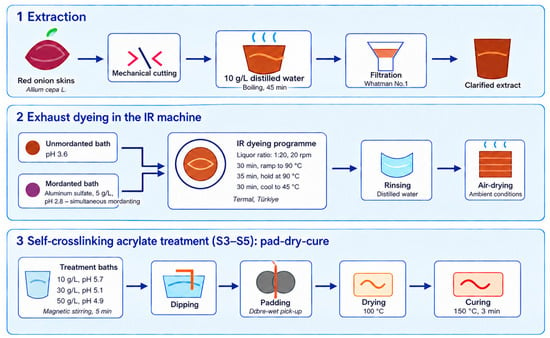
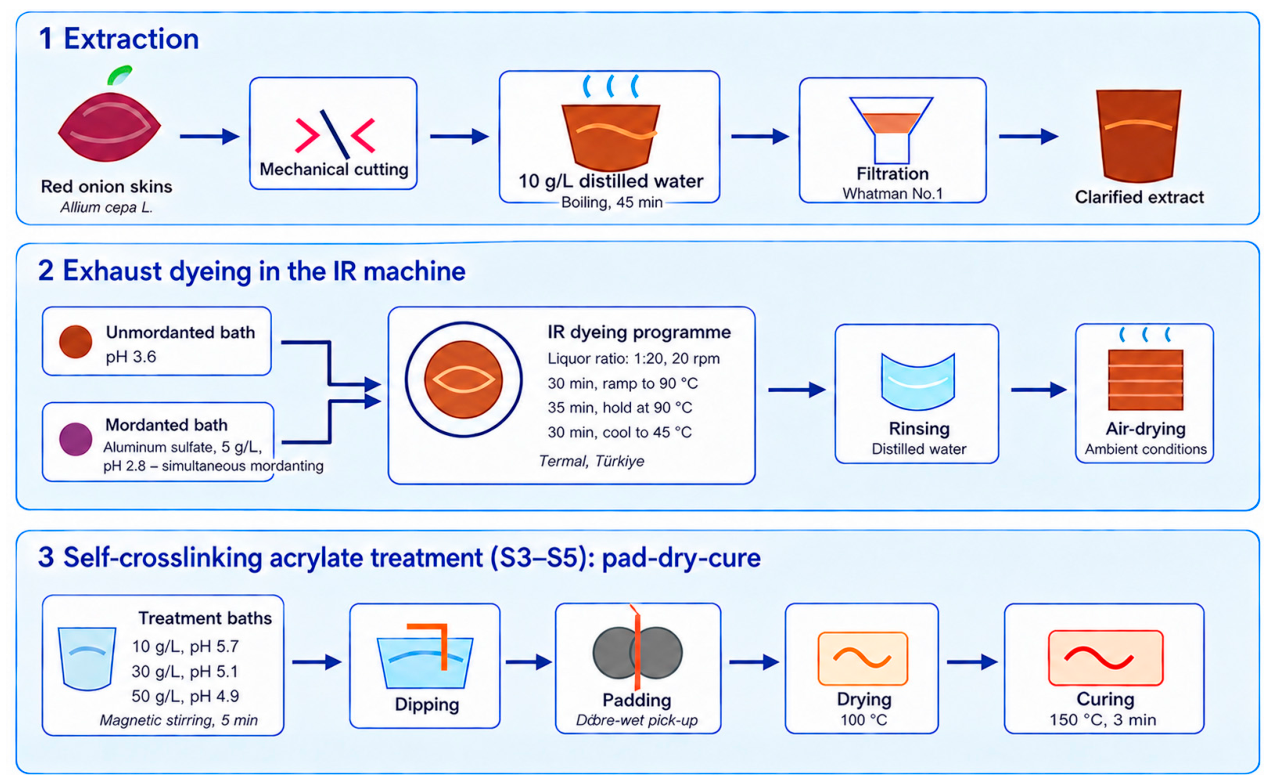
Following natural dyeing, the unmordanted dyed fabrics assigned as S3–S5 were treated with 10, 30, and 50 g/L self-crosslinking acrylate, respectively, using the pad–dry–cure method. Treatment baths containing the as-supplied self-crosslinking acrylate dispersion at the concentrations listed in Table 1 were prepared with distilled water and stirred magnetically for 5 min to obtain homogeneous dispersions. The pH values of the treatment baths decreased with increasing acrylate-dispersion concentration, from 5.7 at 10 g/L to 5.1 and 4.9 at 30 and 50 g/L, respectively. The samples were dipped in self-crosslinking acrylate dispersion and then passed between rollers at 80% pick up. Following padding, the specimens were dried in an oven at 100 °C. No predetermined drying time was applied; instead, the specimens were inspected at regular intervals and removed from the oven immediately after reaching a visually dry condition. The subsequent curing step was then performed at 150 °C for 3 min. The processing procedures were performed in duplicate to confirm reproducibility of the treatment conditions. For the detailed spatial colour-uniformity analysis, five measurement locations were evaluated on one specimen from each treatment group; these measurements therefore represent within-specimen variation rather than independent replicate measurements. Figure 1 presents the schematic representation of dyeing and finishing process.
Figure 1.
Schematic representation of the red onion-skin extraction, exhaust dyeing, and self-crosslinking acrylate application processes (prepared using an AI-assisted image generation tool).
2.5. Characterisation Tests
The absorption spectroscopy of the onion-skin extract was obtained between 350 and 820 nm wavelengths using UV-Vis spectroscopy (Agilent, Cary 100, Santa Clara, CA, USA). The surface morphology of the fabric samples was examined using a FEI Quanta 650 field-emission scanning electron microscope (FEI, Hillsboro, OR, USA). Prior to SEM observation, the fabric specimens were sputter-coated with a thin gold layer to minimise charging. The micrographs were acquired using an Everhart–Thornley detector at an accelerating voltage of 5.0 kV, a working distance of 10.9 mm, and a chamber pressure of 5.49 × 10⁻⁴ Pa. FTIR spectra were recorded using a JASCO FT/IR-6800 spectrometer (Hachioji, Tokyo, Japan) equipped with a TGS detector and an ATR-PRO-ONE accessory, over the range of 4000–400 cm−1 at a spectral resolution of 4 cm−1. The spectra were acquired in ATR mode and converted to transmittance for graphical presentation. All SEM and FTIR measurements were performed on as-prepared specimens prior to washing.
2.6. Colour Measurements, Spatial Uniformity Evaluation and Colour Fastness Testing
The colourimetric properties of the dyed cotton fabrics were evaluated using a Minolta CM-3600d spectrophotometer (Konica Minolta, Tokyo, Japan) over the wavelength range of 400–700 nm. Measurements were performed on a single fabric layer using the medium measurement aperture under D65 illumination and the 10° standard observer. The specimens were positioned with their longer dimension, corresponding to the weft direction, oriented horizontally. The measurement data were processed using RealColor 1.3 software. The CIELAB colour coordinates, including lightness (L*), red–green coordinate (a*), and yellow–blue coordinate (b*), were determined. Chroma (C*), representing colour saturation, was calculated from the corresponding a* and b* values.
The apparent colour intensity of the dyed samples was evaluated using the K/S value, calculated according to the Kubelka–Munk relationship at the wavelength of maximum absorption (λmax). Higher K/S values indicate greater apparent colour intensity. K/S values were determined at 400 nm for S1 and S3–S5 and at 410 nm for S2. This wavelength was selected because it represents the strongest absorption response of the dyed fabrics and is therefore the most sensitive wavelength for evaluating treatment-related changes in apparent colour strength. The difference in the selected wavelength is consistent with the change in spectral response associated with aluminium-sulfate mordanting.
To evaluate the spatial uniformity of the colour distribution, five locations were measured on one specimen from each treatment group. The four-corner-adjacent measurements were taken at least 1 cm inward from the fabric edges. Spatial variability within each specimen was characterised using the mean K/S, sample standard deviation (SD), coefficient of variation (CV), minimum and maximum K/S value, K/S range, and the colour difference between each measurement location and the mean colour coordinates of the corresponding specimen. The five measurements represent spatial locations within a single specimen and were not treated as independent experimental replicates.
The CV of the K/S values was calculated according to Equation (1):
where SD is the sample standard deviation calculated from the five spatial K/S measurements using n − 1, and is their arithmetic mean. A lower CV value was considered to indicate a more uniform relative distribution of colour intensity across the measured fabric area. Because each CV value derived from five measurement points, these estimates are associated with a relatively wide margin of uncertainty (particularly for closely spaced CV values) and should be interpreted as indicative of relative spatial uniformity rather than as precise, statistically distinguishable quantities. The pointwise colour difference was calculated according to Equation (2):
where , , represent the colour coordinates at an individual measurement location, while , and represent the mean coordinates calculated from the five locations of the corresponding specimen. The maximum pointwise was used to represent the greatest local colour deviation within each specimen.
Colour fastness to washing was evaluated according to ISO 105-C06, method A1S [19]. Each dyed cotton specimen was placed in contact with a standard multifibre adjacent fabric comprising cellulose acetate, cotton, polyamide, polyester, acrylic, and wool. The composite specimens were washed at 40 °C for 30 min under the detergent conditions specified for the A1S procedure, using 10 stainless-steel balls in each test tube to provide the prescribed mechanical action. After washing, the specimens were rinsed and air-dried under ambient conditions. The multifibre adjacent fabric was used solely to assess staining during the washing-fastness test and was not included as an experimental textile substrate. Colour change in the dyed cotton specimens was evaluated using the grey scale for assessing change in colour (ISO 105-A02), whereas staining on each fibre component of the adjacent fabric was evaluated using the grey scale for assessing staining (ISO 105-A03) [20,21]. To quantitatively evaluate the colour change caused by washing, the CIELAB colour coordinates of each dyed cotton specimen were measured before and after washing using the spectrophotometer described above. Instrumental colour difference (ΔE*ab) was calculated as the Euclidean distance between the corresponding pre- and post-washing L*, a*, and b* coordinates. The grey-scale grades and ΔE*ab values represent complementary visual and instrumental assessments, respectively, and were not treated as directly interchangeable measures. No instrumental colour-difference measurement was performed on the multifibre adjacent fabric.
Colour fastness to rubbing was evaluated in the dry and wet states according to ISO 105-X12 using a laboratory crockmeter [22]. One specimen was tested for each fabric condition. A load of 9 N (approximately 900 g) was applied, and the rubbing finger was moved through 10 reciprocating cycles over 10 s. Colour change in the dyed cotton specimens was evaluated using the grey scale for assessing change in colour (ISO 105-A02), colour transfer to the white cotton rubbing cloth was assessed using the grey scale for assessing staining (ISO 105-A03) [20,21].
3. Results and Discussion
3.1. UV–Vis Spectroscopy
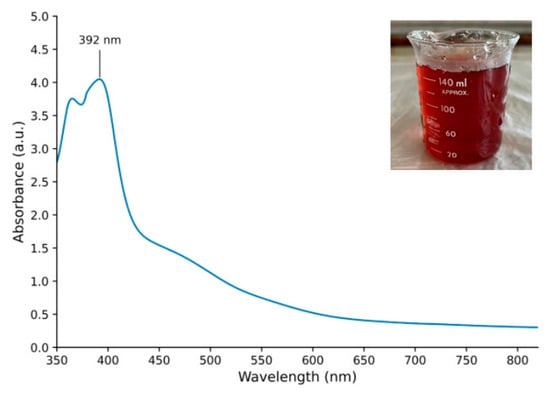
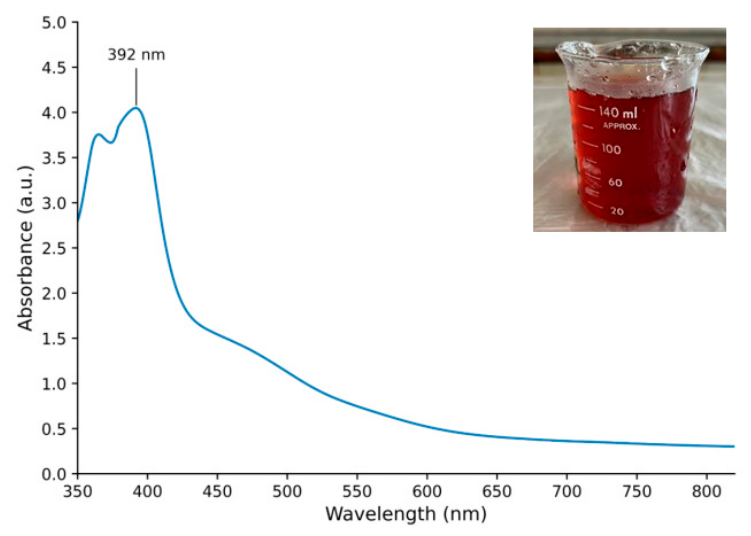
The UV–Vis absorption spectrum of the onion-skin extract is presented in Figure 2. A pronounced absorption band was observed in the near-visible region, with a maximum absorption wavelength (λmax) at approximately 392 nm. The relatively high absorption intensity in this region indicates the presence of chromophoric compounds capable of absorbing radiation at the boundary between the UV and visible regions. Onion skins are known to contain various phenolic compounds and flavonoid-based natural colourants, particularly quercetin and its derivatives, which contribute to their characteristic yellow-brown colour [23]. A comparable spectral behaviour has been reported for onion-derived extracts in previous studies. Puišo et al. [24] reported absorption bands in red onion peel extract within the ranges of 240–280 nm and 300–380 nm, which were associated with flavonoid compounds, while an additional strong absorption in the visible region (approximately 420–465 nm) was attributed to anthocyanin-related chromophores. Red onions may also contain anthocyanins, depending on the cultivar and onion tissue, and these compounds can contribute to red-to-purple colouration [25]. However, because the present study did not include targeted chromatographic analysis of anthocyanins or other individual extract constituents, the observed colour and spectral responses cannot be assigned specifically to anthocyanins. Furthermore, anthocyanins are known to undergo rapid thermal degradation during aqueous extraction, with degradation rates increasing markedly with temperature [26]; the prolonged boiling step (45 min) used in the present extraction may therefore have substantially reduced or eliminated any anthocyanin content originally present in the red onion skins. Although the position of the absorption maximum observed in the present study (approximately 392 nm) is slightly shifted relative to the 300–380 nm range reported in that study, the broad absorption profile extending towards the visible region suggests the presence of conjugated phenolic/flavonoid chromophores in the onion-skin extract. Differences in the position and intensity of the absorption bands may arise from variations in onion variety, pigment composition, extraction conditions, extract concentration, and pH. The broad absorption profile observed around 350–420 nm can be associated with electronic transitions within the conjugated structures of the colourant molecules present in the extract [27]. In particular, the absorption maximum at approximately 392 nm suggests the contribution of flavonoid-type chromophores containing extended conjugated π-electron systems. Following the maximum, the absorbance decreased progressively with increasing wavelength, with considerably lower absorption observed above approximately 500 nm. This spectral behaviour is consistent with the predominance of colourant components absorbing mainly in the violet/near-UV region of the electromagnetic spectrum and is compatible with the yellowish to yellow-brown appearance expected from onion-skin-derived colourants.
Figure 2.
UV-Vis spectrum of the onion-skin extract.
3.2. Scanning Electron Microscope (SEM)
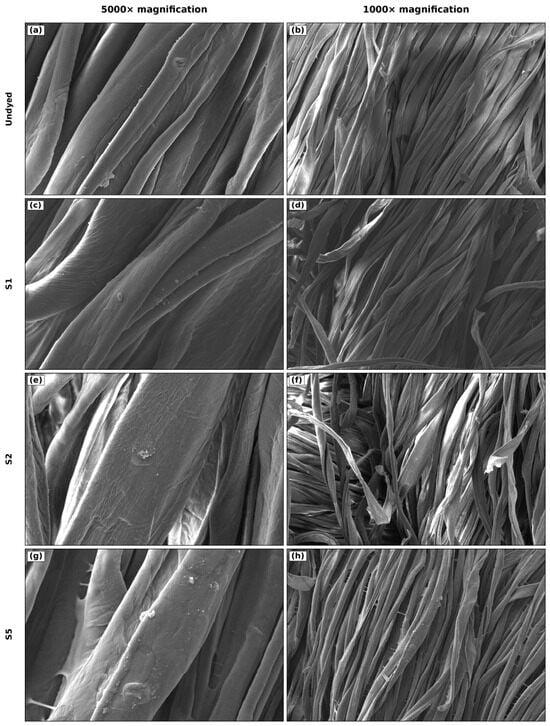
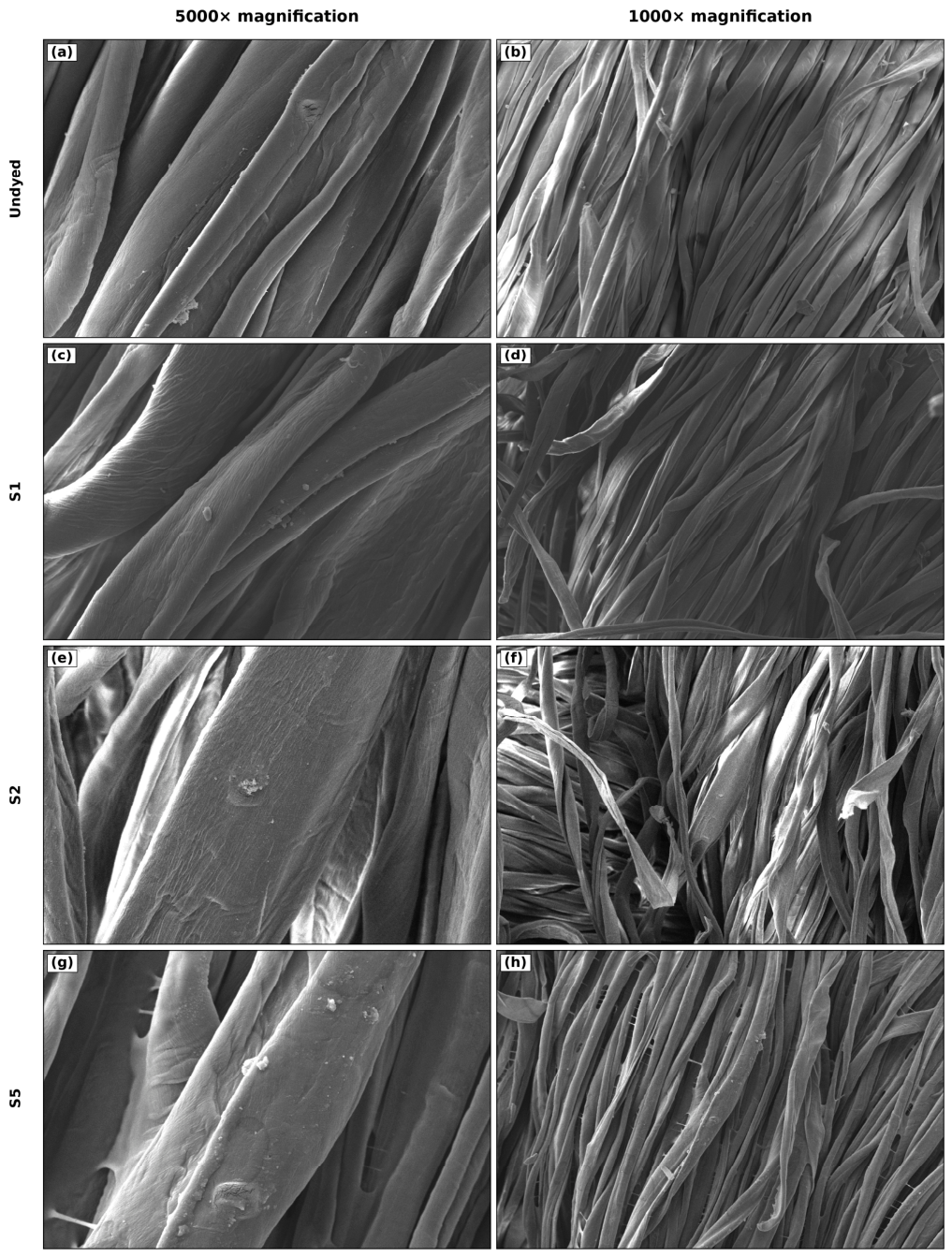
The surface morphologies of the undyed, S1, S2, and S5 samples at 5000× and 1000× magnifications are presented in Figure 3. The undyed cotton fibres exhibited the characteristic longitudinal grooves and convolutions of cellulose, with relatively smooth surfaces and clearly distinguishable inter-fibre spaces. Compared with S1, the aluminium sulfate-mordanted sample (S2) displayed a somewhat rougher and more heterogeneous surface, including isolated granular deposits and irregular features on the fibres. These deposits may be associated with aluminium–colourant complexes or residual mordant-containing species retained on the textile surface. The most pronounced morphological change was observed for S5, which was treated with 50 g/L self-crosslinking acrylate. At 5000× magnification, the fibre surfaces appeared partially covered by a smoother, film-like layer, while localised deposits and filled surface grooves were also visible. At 1000× magnification, adjacent fibres appeared to be joined at several contact points by film-like connections. These features can be interpreted as inter-fibre polymer bridges formed during drying and curing, when the dispersed acrylate particles coalesced and developed a crosslinked polymeric network. Comparable morphological changes have been reported for polymer-finished cotton fabrics. Yan et al. [28] observed that untreated cotton fibres had relatively smooth surfaces and clearly defined boundaries, whereas copolymer treatment produced a uniform film and partially filled the gaps between fibres while largely preserving the original pore structure.
Figure 3.
SEM micrographs of the undyed cotton (a,b), S1 (c,d), S2 (e,f), and S5 (g,h) samples at 5000× and 1000× magnifications.
3.3. Fourier Transform Infrared Spectroscopy (FTIR)
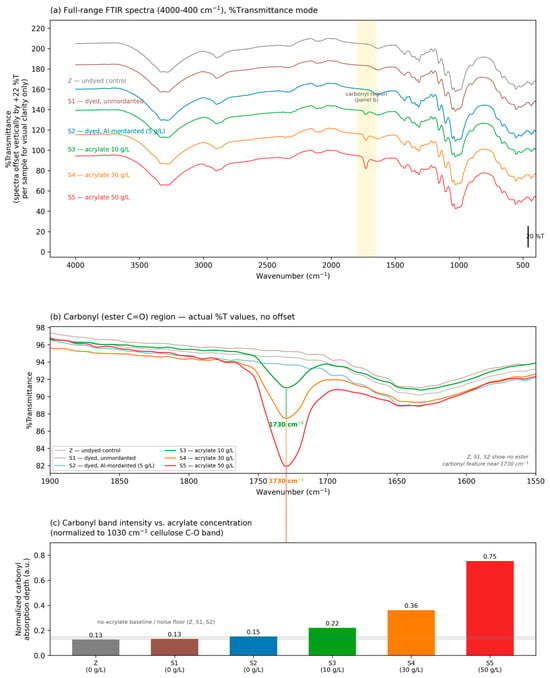
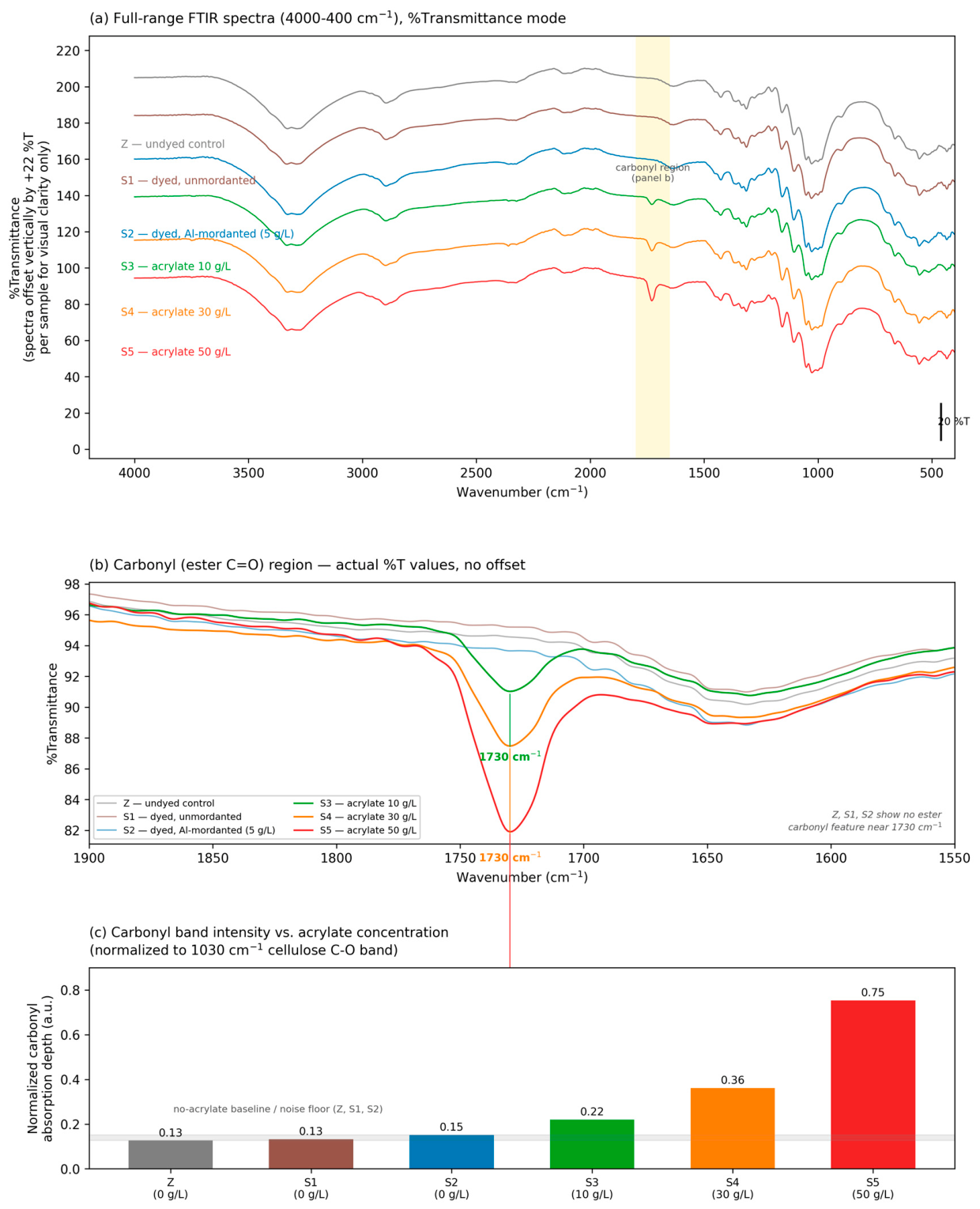
The FTIR spectra of the undyed, S1, S2, S3, S4, and S5 cotton samples are presented in Figure 4. The spectrum of the undyed cotton fabric exhibited the characteristic absorption profile of cellulose. The broad band centred at approximately 3330–3340 cm−1 was assigned to O–H stretching vibrations associated with intra- and intermolecular hydrogen bonding within the cellulose structure [29]. The band at approximately 2890–2900 cm−1 corresponded to the stretching vibrations of aliphatic C–H groups. The absorption observed at approximately 1635–1645 cm−1 was attributed mainly to the bending vibration of absorbed water. The bands located around 1425, 1365–1370, and 1315 cm−1 were associated with CH2 bending, C–H deformation, and O–H in-plane bending vibrations, respectively. In the fingerprint region, the bands at approximately 1160, 1105, 1055–1030, and 895–900 cm−1 were assigned to the asymmetric C–O–C stretching of the β-1,4-glycosidic linkage, skeletal C–O vibrations, C–O stretching of the cellulose alcohol groups, and the β-glycosidic linkage, respectively. These bands confirmed that the fundamental chemical structure of cotton cellulose was retained following the applied treatments.
Figure 4.
FTIR spectra (JASCO FT/IR-6800, TGS detector, 4 cm−1 resolution) of undyed (Z), dyed (S1, S2), and acrylate-treated (S3, S4, S5) cotton fabrics: (a) full-range spectra (4000–400 cm−1), (b) baseline-corrected carbonyl region (1900–1550 cm−1), and (c) normalised carbonyl-band intensity as a function of acrylate concentration.
The spectrum of the unmordanted onion-skin-dyed sample (S1) remained highly similar to that of the undyed cotton. Minor variations were observed in the broad O–H stretching region and in the relative intensities of the bands between approximately 1650 and 1300 cm−1. These changes may reflect hydrogen-bonding interactions between the hydroxyl groups of cellulose and the hydroxyl and carbonyl-containing flavonoid compounds present in the onion-skin extract. Slight modifications in the fingerprint region, particularly around 1050–1000 cm−1, may also be associated with the overlapping C–O vibrations of cellulose and polyphenolic colourant molecules. The aluminium sulfate-mordanted sample (S2) also retained the principal cellulose bands, indicating that simultaneous mordanting and dyeing did not produce detectable degradation of the cellulose backbone.
The most distinct spectral alteration was observed for the acrylate-treated samples S3, S4, and S5. In addition to the characteristic cellulose bands, all three samples displayed a comparatively pronounced absorption near 1730 cm−1, assigned to the stretching vibration of ester carbonyl groups in the acrylate-derived polymer layer, providing direct evidence of acrylate deposition on the cotton surface. To confirm that this band reflects a genuine spectral feature rather than baseline noise, the absorbance of the 1600–1850 cm−1 region was baseline-corrected for all six samples and the resulting carbonyl-band depth-expressed directly as a decrease in %Transmittance relative to the local linear baseline- was normalized to the depth of the reference cellulose C-O stretching band at approximately 1030 cm−1, as shown in Figure 4b. In the undyed, S1, and S2 spectra, no resolvable depression was detected at 1730 cm−1: the local transmittance value at this wavenumber did not fall below in the interpolated baseline, and the residual (−0.6 to −0.8%T) was of the same order as the instrumental noise level (±0.6%–0.7%T, estimated from the standard deviation of a flat, band-free region of the spectrum, 2050–2150 cm−1). In contrast, S3, S4, and S5 exhibited a well-resolved baseline-corrected depressions of 3.0, 5.4, and 11.2%T, respectively, at 1730 cm−1, corresponding to signal-to-noise ratios of approximately 5-, 8-, and 17-fold above the noise floor. When normalised to the internal cellulose reference band, the carbonyl-to-reference ratio increased monotonically with acrylate concentration, from 0.22 (S3, 10 g/L) to 0.36 (S4, 30 g/L) and 0.75 (S5, 50 g/L), against a baseline of 0.13–0.15 for the untreated and dyed-only samples. This concentration-dependent increase in carbonyl-band intensity confirms that the 1725–1735 cm−1 absorption is a genuine, quantifiable, and dose-dependent spectral feature specific to the acrylate-treated fabrics rather than a baseline artefact, and it directly demonstrates that the extent of acrylate deposition detected by FTIR scales with the applied acrylate concentration.
Changes in the approximately 1450–1380 cm−1 region can be related to bending vibrations of aliphatic CH2 and CH3 groups within the acrylate-derived polymer, while the modifications observed between approximately 1250 and 1150 cm−1 may originate from ester C–O–C and C–O stretching vibrations. The partial overlap of these polymer-related bands with the strong cellulose fingerprint bands explains why the differences are less distinct in this region. Kert et al. [30] similarly identified an absorption band at approximately 1730 cm−1 in acrylic-binder-treated cotton and attributed it to the C=O stretching vibration of the acrylic polymer. The broad O–H band remained visible in S3, S4, and S5, although its shape and relative intensity differed slightly from those of the undyed and dyed-only samples. This observation suggests that the acrylate-derived polymer layer coating did not completely mask the cellulose surface and that hydroxyl-containing regions of the substrate remained detectable. The result is consistent with the SEM observations, which revealed partial film-like coverage and localised inter-fibre polymer bridges rather than the complete encapsulation of the fibres.
3.4. Colour Measurements
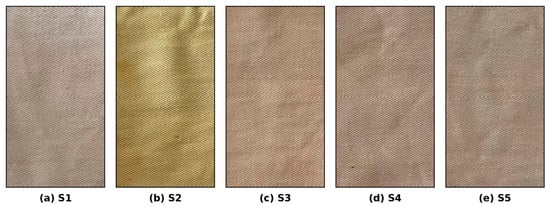
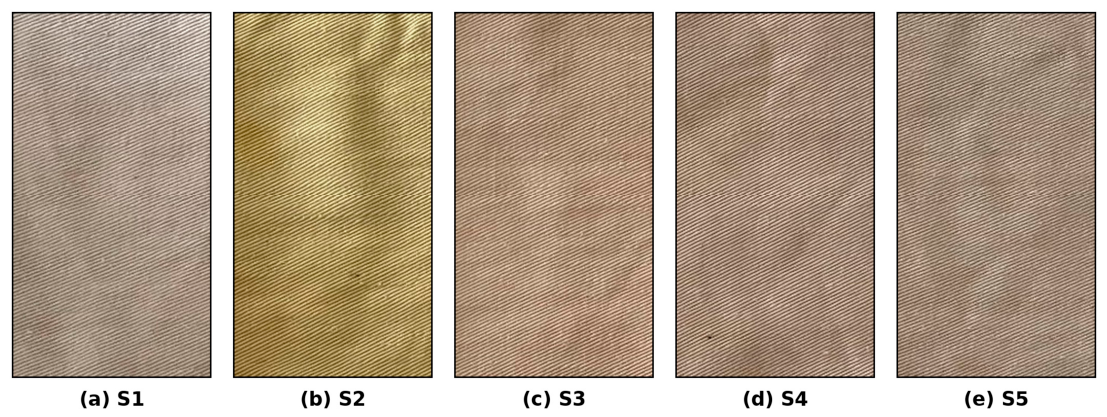
Table 2 presents quantitative colour values. The aluminium sulfate mordant and self-crosslinking acrylate treatments produced distinctly different effects on the colour characteristics of the onion-skin-dyed cotton fabrics (Figure 5). Quercetin, one of the principal flavonoid colourants in onion skin, is known to form 1:1 coordination complexes with Al3+ through its hydroxyl and carbonyl groups, producing a bathochromic shift in the absorption spectrum and a shift toward brighter, more intense yellow tones [31]. Compared with the unmordanted and untreated sample (S1), simultaneous mordanting with 5 g/L aluminium sulfate (S2) decreased the L* and a* values from 71.27 and 6.82 to 70.04 and 4.69, respectively, while markedly increasing b* from 18.83 to 34.97 and C* from 20.02 to 35.28. These results indicate that aluminium mordanting produced a darker, considerably more yellow and saturated shade, which may be attributed to complex formation between aluminium ions and the flavonoid colourants present in onion skin. In a natural dyeing study using onion-skin extract with aluminium sulfate as a mordant, cotton fabrics were observed to acquire a yellowish hue [32]. Similar coordination interactions between Al3+ ions and functional groups of natural colourants have also been proposed in other naturally dyed cotton systems [33]. Nevertheless, the K/S value decreased slightly from 3.44 to 3.02, suggesting that mordanting primarily altered the hue and chroma rather than increasing the measured colour intensity.
Table 2.
Colour coordinates and colour intensity of the samples.
Figure 5.
Digital images of S1, S2, S3, S4, and S5 samples. Each panel represents an approximately 5 cm × 9 cm central fabric area.
Among the acrylate-treated samples, S3, treated with 10 g/L self-crosslinking acrylate, exhibited the highest mean K/S value (5.31), corresponding to an increase of approximately 54.5% compared with the acrylate-free S1 sample. This enhancement may be attributed to the formation of a polymeric network around the fibres during drying, which can restrict the migration and removal of the adsorbed onion-skin colourants. The acrylate-derived polymer layer may also modify the optical response of the fibre surface by altering the absorption and scattering of incident light. Accordingly, the increase in apparent colour intensity probably resulted from the combined effects of improved colourant retention and changes in the surface optical properties. Similar increases in K/S have been reported for film-forming polymers, including PVA, CMC, and chitosan, applied to dyed cotton fabrics; this effect was associated with the filling of surface irregularities and reduced diffuse light scattering from the coated fibre surface [34].
Increasing the self-crosslinking acrylate concentration above 10 g/L did not produce a proportional increase in K/S. This behaviour may be associated with localised polymer-rich regions and an optical shielding effect. A thicker or less uniformly distributed polymer layer may partially encapsulate the colourants and alter the refractive-index contrast between the fibres, polymer, and surrounding air, thereby affecting both the absorption and scattering terms of the Kubelka–Munk relationship. Thus, the measured K/S value appear to be governed by the combined effects of colourant retention, polymer distribution, and surface morphology rather than by the self-crosslinking acrylate concentration alone. Compared with S1, S3 exhibited higher a*, b*, and C* values, increasing from 6.82 ± 0.34 to 8.46 ± 0.17, from 18.83 ± 0.58 to 20.30 ± 0.27, and from 20.02 ± 0.66 to 21.99 ± 0.30, respectively. The accompanying increases in a*, b*, and C* indicated that the low self-crosslinking acrylate concentration produced a stronger and more saturated reddish-yellow shade without causing a substantial change in lightness. Increasing the self-crosslinking acrylate concentration from 10 to 30 g/L decreased the mean K/S value from 5.31 to 3.84, while a slight increase to 3.97 was observed at 50 g/L. Despite the slightly higher K/S value of S5 compared with S4, both values remained lower than that of S3. Overall, 10 g/L appeared to be the most favourable self-crosslinking acrylate concentration in terms of colour intensity, while the similar results obtained for S4 and S5 indicated no further concentration-dependent improvement when the self-crosslinking acrylate concentration was increased from 30 to 50 g/L. This behaviour may be associated with partial masking of the colourants, increased surface reflection, or changes in the optical uniformity of the polymeric film at higher self-crosslinking acrylate concentrations. The progressive decrease in the bath pH with increasing self-crosslinking acrylate concentration may also have contributed to these differences. Quercetin possesses several ionisable phenolic hydroxyl groups, and its UV-Vis absorption behaviour is known to be pH-dependent, with protonation/deprotonation of these groups shifting the absorption spectrum and, consequently, the perceived colour [35]. At the comparatively lower pH values associated with self-crosslinking acrylate concentrations, a larger proportion of the residual quercetin may have remained in its protonated, a less bathochromically shifted form, which could partly explain why increasing self-crosslinking acrylate concentration beyond 10 g/L did not produce a proportional increase in K/S.
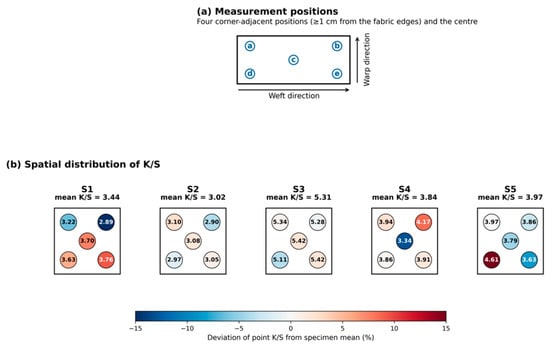
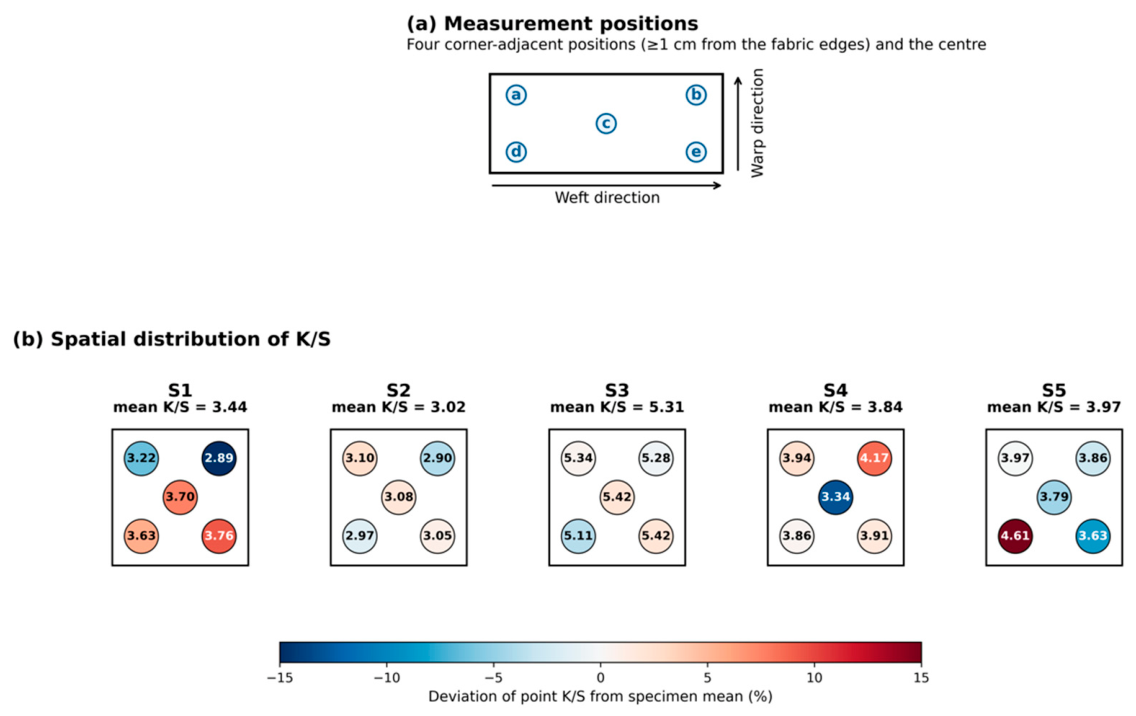
The locations of the five measurements and the spatial distribution of the corresponding K/S values across the fabric plane are presented in Figure 6. Five locations were measured on one specimen from each treatment group: upper left (a), upper right (b), centre (c), lower left (d), and lower right (e). The five-point measurements revealed distinct differences in within-specimen spatial variability. The statistical parameters describing this variability, including the mean K/S, standard deviation, coefficient of variation, K/S range, and maximum pointwise , are summarized in Table 3. The acrylate-free S1 sample exhibited the highest overall relative K/S variability (CV = 10.85%), indicating a non-uniform distribution of colour intensity across the measured fabric area. In contrast, the lowest CV was obtained for S3 (2.42%), followed by S2 (2.76%). Although S2 exhibited the narrowest absolute K/S range (0.20), its maximum pointwise was 1.43, compared with only 0.58 for S3. The K/S range describes the absolute variation in colour intensity, whereas CV expresses this variation relative to the mean K/S, and accounts for the combined spatial variation in the L*, a*, and b* coordinates. Therefore, the concurrently low CV and maximum pointwise values indicate that S3, treated with 10 g/L self-crosslinking acrylate, exhibited the most homogeneous overall colour distribution among the investigated samples. In a related coating system, Behary and Volle [17] similarly reported that acrylic-based binders produced more uniform coloured coatings on cotton than a polyurethane binder associated with inadequate pigment dispersion.
Figure 6.
Spatial variability of colour intensity across the fabric plane: (a) schematic representation of the five measurement positions and (b) spatial distribution of K/S values for samples S1–S5. Marker colours represent the percentage deviation of each measurement from the corresponding specimen mean, while the labels indicate the measured K/S values.
Table 3.
Within-specimen spatial variability of colour intensity based on five measurement positions.
Increasing the self-crosslinking acrylate concentration to 30 and 50 g/L increased the K/S coefficients of variation to 7.96% and 9.50% for S4 and S5, respectively. The relatively low central K/S value of S4 (3.34) and the high lower-left value of S5 (4.61) indicate localised differences in colour intensity. These findings suggest that the 10 g/L treatment provided a favourable balance between polymer availability, surface coverage, and colourant retention. At this concentration, the acrylate may have been distributed comparatively evenly over the fibre and yarn surfaces during the post-treatment, followed by more uniform film formation during the subsequent drying and curing stages.
The increased spatial variability observed at higher self-crosslinking acrylate concentrations is consistent with migration effects occurring during the drying stage of the pad–dry–cure process. During padding, the fabric retains liquor within inter-fibre and inter-yarn capillary spaces at a wet pick-up of 80%. As water evaporates during subsequent drying, capillary flow transports dissolved and dispersed solutes—including the acrylate-derived polymer layer toward the fabric surface—and locally uneven drying rates across the fabric plane can further direct this flow toward regions that dry fastest [36]. This migration tendency is expected to scale with the amount of binder present in the liquor: at 10 g/L, the relatively low solids content limited the extent of migration, whereas at 30 and 50 g/L a larger mass of self-crosslinking acrylate was available for capillary transport before crosslinking was completed at 150 °C, favouring the formation of locally binder-rich and binder-depleted zones. This is consistent with the elevated K/S value at the lower-left position of S5 alongside the comparatively depleted central position of S4, and with the classical observation that reagent migration in pad–dry–cure finishing of cotton fabrics is strongly influenced by drying conditions and reagent add-on level [36]. Although the actual acrylate add-on on the fabric was not measured, increasing the acrylate concentration in the treatment bath increased the amount of polymer available in the liquor. Therefore, the observed spatial differences at higher treatment concentrations may be associated with greater potential for polymer redistribution during drying, although this interpretation remains mechanistic rather than a direct measurement of acrylate migration or add-on.
In addition to migration effects, the progressive decrease in bath pH with increasing acrylate concentration (from 5.7 at 10 g/L to 4.9 at 50 g/L) may have influenced the rate of self-crosslinking. Self-crosslinking acrylate systems are typically cured under acidic catalysis, with lower pH accelerating the crosslinking reaction [37]. A faster crosslinking rate at higher self-crosslinking acrylate concentrations could promote earlier fixation of the polymer network during drying, effectively “locking in” any migration-induced non-uniformity before it could level out, thereby reinforcing the increased spatial variability observed for S4 and S5.
3.5. Wash Fastness
The washing fastness results of the onion-skin-dyed cotton fabrics are presented in Table 4. The untreated dyed sample (S1) exhibited limited resistance to colour change, with a colour-change rating of 2 and an instrumental colour difference of 8.51. Staining was low on polyester and relatively limited on wool and polyamide, with ratings of 5 and 4–5, respectively. However, lower ratings were obtained for cotton and diacetate, indicating that the colourants released during washing had a greater tendency to stain these adjacent fibres. Simultaneous mordanting with 5 g/L aluminium sulfate (S2) resulted in the poorest overall washing performance. The colour-change rating decreased to 1, while increased markedly to 22.14. Moreover, staining ratings decreased to 3–4 on acrylic, 2–3 on cotton, and 2 on diacetate. These findings indicate that aluminium mordanting caused substantial colour alteration during washing and did not sufficiently prevent the migration of colourant components. The high value may reflect not only colourant loss but also washing-induced changes in the structure or distribution of aluminium–flavonoid complexes. The fixation of the Al3+-dye complex largely relies on weak hydroxyl interactions [38]. Furthermore, since the mordant and natural dye are present in the same bath in the simultaneous method, the mordant, with its complexing properties, can react with the dye in the bath environment, leading to precipitation; this results in the formation of an irregular and poorly adherent dye-mordant layer on the fibre surface, thus reducing wash fastness.
Table 4.
Washing fastness of the dyed cotton samples: staining grades on the multifibre adjacent fabric, grey-scale colour-change ratings, and instrumental colour differences in the dyed cotton specimens.
The self-crosslinking acrylate treatment provided a modest improvement in washing fastness. S3, treated with 10 g/L self-crosslinking acrylate, showed the highest colour-change rating of 3–4 and the lowest value of 6.63. Compared with S1, this represents an approximately 22% reduction in total colour difference. However, despite this improvement, the colour-change rating indicates that the washing fastness remained below a level generally considered satisfactory for commercial application. Staining on cotton and diacetate also improved to grade 4, while staining on polyester remained excellent at grade 5. These findings suggest that the polymeric film formed during drying and curing may have restricted the release and transfer of weakly bound colourant molecules. Increasing the self-crosslinking acrylate concentration to 30 and 50 g/L did not provide any additional improvement. S4 and S5 showed identical colour-change ratings of 3, while their values increased slightly to 7.15 and 7.47, respectively. Their staining results were also comparable, with ratings of 4–5 on wool and polyamide, 5 on polyester, 4 on acrylic and cotton, and 3–4 on diacetate. Overall, the self-crosslinking acrylate treatment improved washing fastness to some extent, particularly at 10 g/L, but the improvement was limited and did not result in fully satisfactory washing fastness for potential commercial application.
3.6. Rubbing Fastness
The rubbing fastness results are presented in Table 5. The untreated onion-skin-dyed sample (S1) exhibited very good resistance to colour change under both dry and wet rubbing conditions, with ratings of 4–5. Its staining ratings were 5 under dry conditions and 4 under wet conditions, indicating that moisture slightly promoted the transfer of weakly bound colourant molecules from the fabric surface to the adjacent material. Simultaneous mordanting with 5 g/L aluminium sulfate (S2) did not improve rubbing fastness. Although the colour-change ratings remained relatively high at 4–5 and 4 under dry and wet conditions, respectively, the wet-staining rating decreased to 3. This result suggests that aluminium–colourant complex formation altered the colour characteristics of the fabric but did not sufficiently prevent the release of surface-bound colourants in the presence of moisture. The lower wet-staining rating may be associated with the increased mobility of unfixed or weakly bound colourant–mordant complexes during wet rubbing.
Table 5.
Rubbing fastness of the cotton samples.
In contrast, all acrylate-treated samples (S3–S5) achieved excellent dry rubbing fastness and very good to excellent wet rubbing fastness. The colour-change and staining ratings were 5 under dry conditions and 4–5 under wet conditions, regardless of whether the self-crosslinking acrylate concentration was 10, 30, or 50 g/L. These improvements may be attributed to the formation of an insoluble crosslinked polymeric film during curing, which restricted the mechanical removal and transfer of colourant molecules from the fibre surface. During curing, the self-crosslinking acrylate formed an insoluble three-dimensional polymeric network on the fibre surface, thereby physically immobilising the colourant molecules and restricting their mechanical removal [16]. These findings agree with those of Klančnik [18], who reported dry and wet rubbing fastness ratings of 5 and 4–5, respectively, for cotton fabrics printed with a natural dye extract using a self-crosslinking acrylate. Accordingly, the film formation and localised inter-fibre bridging observed for S5 provide morphological support for the improved rubbing fastness of the acrylate-treated samples, as the crosslinked polymer layer can restrict the mechanical detachment and transfer of weakly bound colourant molecules.
4. Conclusions
This study investigated the effects of a formaldehyde-free self-crosslinking acrylate post-treatment at different concentrations (10, 30 and 50 g/L) on the colour properties, colour uniformity, and fastness performance of cotton fabric dyed with red onion-skin extract. Aluminium sulfate mordanting produced the most saturated yellow shade and the narrowest absolute K/S range (0.20); however, it did not improve colour retention during washing. The mordanted sample exhibited the highest instrumental colour difference ( = 22.14) and increased staining of several adjacent fibres. In contrast, the self-crosslinking acrylate treatment improved colour intensity and provided a modest improvement in washing fastness compared with the untreated dyed fabric. The most favourable overall performance was obtained at 10 g/L self-crosslinking acrylate. At this concentration, the K/S value increased from 3.44 to 5.31, while the total colour difference after washing decreased from 8.51 to 6.63. Among all samples, the 10 g/L treated sample (S3) exhibited the most homogeneous colour distribution, as evidenced by the lowest K/S coefficient of variation (CV = 2.42%) across the five measurement positions. The treatment also provided dry and wet rubbing-fastness ratings of 5 and 4–5, respectively.
The novelty of this study lies in demonstrating the concentration-dependent effects of a formaldehyde-free self-crosslinking acrylate post-treatment on colour intensity, colourant retention, and spatial colour uniformity in cotton fabric dyed with red onion-skin extract.
Taken together, the colourimetric, spatial, FTIR, and SEM findings indicate that the effect of the self-crosslinking acrylate was concentration-dependent and point to a consistent physical mechanism: FTIR spectra revealed a characteristic ester carbonyl band at approximately 1730 cm−1, confirming acrylate deposition, while SEM showed a corresponding film-like surface layer and localised inter-fibre polymer bridges—most pronounced at the highest concentration tested (50 g/L, S5)—consistent with physical immobilisation of weakly bound colourant molecules within the crosslinked polymer network. At 10 g/L, the self-crosslinking acrylate treatment provided the most favourable combination of apparent colour intensity and spatial uniformity, consistent with comparatively balanced polymer and colourant distribution. Further increases in self-crosslinking acrylate concentration did not improve K/S proportionally and increased spatial variability; collectively, these findings suggest that excessive self-crosslinking acrylate can generate localised differences in polymer deposition and optical response, whereas a moderate concentration provides more effective control of colourant retention and surface uniformity. Nevertheless, the improvement in washing fastness achieved by the self-crosslinking acrylate treatment was only partial, and further optimisation is required before the approach can be considered suitable for commercial application.
These findings indicate that the self-crosslinking acrylate post-treatment may provide an alternative strategy for improving colourant retention in naturally dyed cotton, rather than serving as a direct substitute for aluminium sulfate mordanting. Before broader textile application or a full environmental comparison with conventional alum mordanting can be established, further work should quantify polymer add-on and coating thickness, and evaluate repeated laundering durability, light fastness, fabric handle, air permeability, effluent composition, and life-cycle impact. A systematic comparison of the self-crosslinking acrylate treatment with cationisation and chitosan-based treatments, alongside optimisation of aluminium sulfate concentration and pre-, meta-, and post- mordanting approaches, would further help establish an optimised conventional mordant benchmark for future studies.
Funding
This research received no external funding.
Institutional Review Board Statement
Not applicable.
Informed Consent Statement
Not applicable.
Data Availability Statement
The data presented in this study are available on request from the corresponding author.
Acknowledgments
The author gratefully acknowledges BOSSA (Adana, Türkiye) for supplying the cotton fabric.
Conflicts of Interest
The author declares no conflicts of interest.
References
- Saxena, S.; Raja, A. Natural Dyes: Sources, Chemistry, Application and Sustainability Issues. In Roadmap to Sustainable Textiles and Clothing; Muthu, S., Ed.; Textile Science and Clothing Technology; Springer: Singapore, 2014; pp. 37–80. [Google Scholar] [CrossRef] [Scilit]
- Khatri, A.; Peerzada, M.H.; Mohsin, M.; White, M. A review on developments in dyeing cotton fabrics with reactive dyes for reducing effluent pollution. J. Clean. Prod. 2015, 87, 50–57. [Google Scholar] [CrossRef] [Scilit]
- Singhee, D. Review on Natural Dyes for Textiles from Wastes. In Chemistry and Technology of Natural and Synthetic Dyes and Pigments; IntechOpen: London, UK, 2020. [Google Scholar] [CrossRef] [Scilit]
- Dutta, P.; Mahjebin, S.; Sufian, M.A.; Razaya Rabbi, M.; Chowdhury, S.; Imran, I.H. Impacts of natural and synthetic mordants on cotton knit fabric dyed with natural dye from onion skin in perspective of eco-friendly textile process. Mater. Today Proc. 2021, 47, 2633–2640. [Google Scholar] [CrossRef] [Scilit]
- Vankar, P.S.; Shanker, R.; Wijayapala, S. Dyeing of cotton, wool and silk with extract of Allium cepa. Pigment. Resin Technol. 2009, 38, 242–247. [Google Scholar] [CrossRef] [Scilit]
- Gümrükçü, G.; Özgür, M.U.; Gültekin, C. Extraction of Anthocyanin Pigments from Red Onion (Allium cepa L.) and Dyeing Woolen Fabrics. Asian J. Chem. 2008, 20, 2891–2902. [Google Scholar]
- Viera, V.B.; Piovesan, N.; Rodrigues, J.B.; Mello, R.; Prestes, R.C.; Santos, R.C.; Vaucher, R.A.; Hautrive, T.P.; Kubota, E.H. Extraction of phenolic compounds and evaluation of the antioxidant and antimicrobial capacity of red onion skin (Allium cepa L.). Int. Food Res. J. 2017, 24, 990–999. [Google Scholar]
- Deveoğlu, O. A Review on Onion Skin, a Natural Dye Source. J. Text. Colouration Polym. Sci. 2022, 19, 307–319. [Google Scholar] [CrossRef] [Scilit]
- Rani, J.; Guru, R.; Singh, J.; Santanam, S. Eco-Dyeing and Functional Finishing of Cotton Fabric Using a Natural Colour Derived From Lotus Seed: Enhanced Fastness Properties with Chitosan. Text. Leather Rev. 2024, 7, 1039–1060. [Google Scholar] [CrossRef] [Scilit]
- Shahin, A.; Nabil-Adam, A.; Shreadah, M.A.; Elnagar, K.; Osman, H. Application of Printing and Finishing Cotton Fabrics with Natural Dyes (A Review). Egypt. J. Chem. 2022, 65, 341–358. [Google Scholar] [CrossRef] [Scilit]
- Islam, S.; Belowar, S.; Das, S.; Rahamatolla, M.; Datta, S.C. Chemistry of natural and synthetic dye materials with metal mordants in various fabrics for sustainable textile applications: A comprehensive review. Environ. Sci. Pollut. Res. 2025, 32, 25511–25540. [Google Scholar] [CrossRef] [Scilit] [PubMed]
- Shahid, M.; Islam, S.; Mohammad, F. Recent advancements in natural dye applications: A review. J. Clean. Prod. 2013, 53, 310–331. [Google Scholar] [CrossRef] [Scilit]
- Feldtman, H.D.; McPhee, J.R. The treatment of wool with aqueous dispersions of self-crosslinking polyacrylates. Text. Res. J. 1965, 35, 150–159. [Google Scholar] [CrossRef] [Scilit]
- Sezgin Bozok, S. Investigation of the effects of self-crosslinking acrylate with TiO2 nanoparticles on cotton denim fabrics. Pigment. Resin Technol. 2025, 54, 273–282. [Google Scholar] [CrossRef] [Scilit]
- Parvate, S.; Mahanwar, P. Insights into the preparation of water-based acrylic interior decorative paint: Tuning binder’s properties by self-crosslinking of allyl acetoacetate–hexamethylenediamine. Prog. Org. Coat. 2019, 126, 142–149. [Google Scholar] [CrossRef] [Scilit]
- Behary, N.; Volle, N. Durable Textile Dyeing/Printing Using Natural Indigo Dyes and Leaves, and Mayan-Inspired Blue Indigo Pigments. Colorants 2025, 4, 2. [Google Scholar] [CrossRef] [Scilit]
- Klančnik, M. Printing with Natural Dye Extract from Japanese Knotweed Leaves. Fibers Polym. 2024, 25, 4771–4785. [Google Scholar] [CrossRef] [Scilit]
- Mahmud-Ali, A.; Fitz-Binder, C.; Bechtold, T. Aluminium based dye lakes from plant extracts for textile colouration. Dye. Pigment. 2012, 94, 533–540. [Google Scholar] [CrossRef] [Scilit]
- ISO 105-C06:2010; Textiles—Tests for Colour Fastness. Part C06: Colour Fastness to Domestic and Commercial Laundering. ISO: Geneva, Switzerland, 2010.
- ISO 105-A02:1993; Textiles—Tests for Colour Fastness. Part A02: Grey Scale for Assessing Change in Colour. ISO: Geneva, Switzerland, 1993.
- ISO 105-A03:2019; Textiles—Tests for Colour Fastness. Part A03: Grey Scale for Assessing Staining. ISO: Geneva, Switzerland, 2019.
- ISO 105-X12:2016; Textiles—Tests for Colour Fastness. Part X12: Colour Fastness to Rubbing. ISO: Geneva, Switzerland, 2016.
- Črnivec, I.G.O.; Skrt, M.; Polak, T.; Šeremet, D.; Mrak, P.; Komes, D.; Vrhovšek, U.; Ulrih, N.P. Aspects of quercetin stability and its liposomal enhancement in yellow onion skin extracts. Food Chem. 2024, 459, 140347. [Google Scholar] [CrossRef] [Scilit] [PubMed]
- Puišo, J.; Paškevičius, A.; Žvirgždas, J.; Dimitrova, T.L.; Litvakas, A.; Adliene, D. Application of Red Onion Peel Extract for Green Synthesis of Silver Nanoparticles in Hydrogels Exhibiting Antimicrobial Properties. Gels 2023, 9, 498. [Google Scholar] [CrossRef] [Scilit] [PubMed]
- Gonzales-de-Peredo, A.V.; Maroto, A.; Memboeuf, A. Efficient Extraction of Anthocyanins from Red Onion (Allium cepa L.) Using Natural Deep Eutectic Solvents. Food Anal. Methods 2026, 19, 152. [Google Scholar] [CrossRef] [Scilit]
- Petersson, E.V.; Liu, J.; Sjöberg, P.J.R.; Danielsson, R.; Turner, C. Pressurized Hot Water Extraction of Anthocyanins from Red Onion: A Study on Extraction and Degradation Rates. Anal. Chim. Acta 2010, 663, 27–32. [Google Scholar] [CrossRef] [Scilit] [PubMed]
- Suh, H.J.; Lee, J.M.; Cho, J.S.; Kim, Y.S.; Chung, S.H. Radical scavenging compounds in onion skin. Food Res. Int. 1999, 32, 659–664. [Google Scholar] [CrossRef] [Scilit]
- Yan, X.; Zhu, C.; Huang, J.; Qi, D.; Li, J. Synthesis of Betaine Copolymer for Surface Modification of Cotton Fabric by Enhancing Temperature-Sensitive and Anti-Protein Specific Absorption Performance. Materials 2021, 14, 6793. [Google Scholar] [CrossRef] [Scilit] [PubMed]
- Abidi, N.; Cabrales, L.; Haigler, C.H. Changes in the cell wall and cellulose content of developing cotton fibers investigated by FTIR spectroscopy. Carbohydr. Polym. 2014, 100, 9–16. [Google Scholar] [CrossRef] [Scilit] [PubMed]
- Kert, M.; Forte Tavčer, P.; Hladnik, A.; Spasić, K.; Puač, N.; Petrović, Z.L.; Gorjanc, M. Application of Fragrance Microcapsules onto Cotton Fabric after Treatment with Oxygen and Nitrogen Plasma. Coatings 2021, 11, 1181. [Google Scholar] [CrossRef] [Scilit]
- Corrente, G.A.; Malacaria, L.; Beneduci, A.; Furia, E.; Marino, T.; Mazzone, G. Experimental and theoretical study on the coordination properties of quercetin towards aluminum(III), iron(III) and copper(II) in aqueous solution. J. Mol. Liq. 2021, 325, 115171. [Google Scholar] [CrossRef] [Scilit]
- Zubairu, A.; Mshelia, Y.M. Effects of Selected Mordants on the Application of Natural Dye from Onion Skin (Allium cepa). Sci. Technol. 2015, 5, 26–32. [Google Scholar]
- Sarker, A.; Nizam, M.E.H.; Morshed, M.; Datta, M.K.; Jiang, H.; Hussain, F.; Khan, I.A.; Khan, A.; Javed, K. Exploring Gardenia jasminoides Seed-Derived Natural Dyes for the Development of Functional Textiles. Chemistry 2026, 8, 19. [Google Scholar] [CrossRef] [Scilit]
- Abd El-Aziz, E.; Zayed, M.; Mohamed, A.L.; Hassabo, A.G. Enhancement of the Functional Performance of Cotton and Polyester Fabrics upon Treatment with Polymeric Materials Having Different Functional Groups in the Presence of Different Metal Nanoparticles. Polymers 2023, 15, 3047. [Google Scholar] [CrossRef] [Scilit] [PubMed]
- Biler, M.; Biedermann, D.; Valentová, K.; Křen, V.; Kubala, M. Quercetin and its analogues: Optical and acido–basic properties. Phys. Chem. Chem. Phys. 2017, 19, 26870–26879. [Google Scholar] [CrossRef] [Scilit] [PubMed]
- Rowland, S.P.; Bertoniere, N.R.; King, W.D. Reagent Migration in Fabric Thickness in Pad-Dry-Cure Finishing. Text. Res. J. 1984, 54, 318–320. [Google Scholar] [CrossRef] [Scilit]
- Bereck, A. Shrink-Resist Treatments of Wool Fabrics with Water-Soluble Acrylic Copolymers. Part I: Relationships Between Polymer Composition and Shrink Resistance. Text. Res. J. 1979, 49, 233–238. [Google Scholar] [CrossRef] [Scilit]
- Gupta, V.K. Fundamentals of Natural Dyes and Its Application on Textile Substrates. In Chemistry and Technology of Natural and Synthetic Dyes and Pigments; IntechOpen: London, UK, 2020. [Google Scholar] [CrossRef] [Scilit]

Disclaimer/Publisher’s Note: The statements, opinions and data contained in all publications are solely those of the individual author(s) and contributor(s) and not of MDPI and/or the editor(s). MDPI and/or the editor(s) disclaim responsibility for any injury to people or property resulting from any ideas, methods, instructions or products referred to in the content. |
© 2026 by the author. Licensee MDPI, Basel, Switzerland. This article is an open access article distributed under the terms and conditions of the Creative Commons Attribution (CC BY) license.