You are currently viewing a new version of our website. To view the old version click .

Nanomaterials, Volume 8, Issue 11

November 2018 - 97 articles

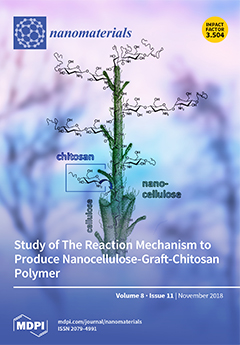
Cover Story: Cellulose and chitin are the most abundant polymeric materials in nature and are capable of replacing conventional synthetic polymers. Cellulose nano/microfibers (CNFs/CMFs) and chitosan (CH) can be obtained from them. Both polymers have been used separately in graft copolymerization. However, there are not many studies on the use of cellulose and chitosan together, as copolymers, to produce new eco-friendly polymeric materials from renewable sources that are more biodegradable, biocompatible, and have a high chance of replacing conventional synthetic polymers. Chemical modification through graft copolymerization is an effective method to improve polymer properties and to obtain a product with new properties and promising applications, such as the removal of water soluble inks from waste waters. View Paper here.
  • Issues are regarded as officially published after their release is announced to the table of contents alert mailing list .
  • You may sign up for email alerts to receive table of contents of newly released issues.
  • PDF is the official format for papers published in both, html and pdf forms. To view the papers in pdf format, click on the "PDF Full-text" link, and use the free Adobe Reader to open them.

Articles (97)

  • Article
  • Open Access
13 Citations
5,655 Views
11 Pages

Size Fractionation of Fluorescent Graphene Quantum Dots Using a Cross-Flow Membrane Filtration System

  • Sang-Gu Yim,
  • Yong Jin Kim,
  • Ye-Eun Kang,
  • Byung Kee Moon,
  • Eun Sang Jung and
  • Seung Yun Yang

21 November 2018

Graphene quantum dots (GQDs) have received great attention as optical agents because of their low toxicity, stable photoluminescence (PL) in moderate pH solutions, and size-dependent optical properties. Although many synthetic routes have been propos...

  • Review
  • Open Access
178 Citations
14,210 Views
15 Pages

Scaffold Structural Microenvironmental Cues to Guide Tissue Regeneration in Bone Tissue Applications

  • Xuening Chen,
  • Hongyuan Fan,
  • Xiaowei Deng,
  • Lina Wu,
  • Tao Yi,
  • Linxia Gu,
  • Changchun Zhou,
  • Yujiang Fan and
  • Xingdong Zhang

21 November 2018

In the process of bone regeneration, new bone formation is largely affected by physico-chemical cues in the surrounding microenvironment. Tissue cells reside in a complex scaffold physiological microenvironment. The scaffold should provide certain ci...

  • Article
  • Open Access
36 Citations
4,460 Views
12 Pages

21 November 2018

Functional ions and drug factors play a vital role in stimulating bone tissue regeneration as we understand it. In this work, europium-containing mesoporous bioactive glass nanospheres (Eu/MBGs), composed of 60% SiO2—(36–x)%CaO—x%Eu...

  • Article
  • Open Access
81 Citations
10,602 Views
10 Pages

Optical Properties of Graphene/MoS2 Heterostructure: First Principles Calculations

  • Bin Qiu,
  • Xiuwen Zhao,
  • Guichao Hu,
  • Weiwei Yue,
  • Junfeng Ren and
  • Xiaobo Yuan

21 November 2018

The electronic structure and the optical properties of Graphene/MoS2 heterostructure (GM) are studied based on density functional theory. Compared with single-layer graphene, the bandgap will be opened; however, the bandgap will be reduced significan...

  • Article
  • Open Access
52 Citations
7,072 Views
16 Pages

A Raman Imaging Approach Using CD47 Antibody-Labeled SERS Nanoparticles for Identifying Breast Cancer and Its Potential to Guide Surgical Resection

  • Ryan M. Davis,
  • Jos L. Campbell,
  • Sean Burkitt,
  • Zhen Qiu,
  • Soyoung Kang,
  • Mana Mehraein,
  • Dominie Miyasato,
  • Helen Salinas,
  • Jonathan T. C. Liu and
  • Cristina Zavaleta

20 November 2018

Raman spectroscopic imaging has shown great promise for improved cancer detection and localization with the use of tumor targeting surface enhanced Raman scattering (SERS) nanoparticles. With the ultrasensitive detection and multiplexing capabilities...

  • Article
  • Open Access
4 Citations
4,585 Views
10 Pages

Growth and Self-Assembly of Silicon–Silicon Carbide Nanoparticles into Hybrid Worm-Like Nanostructures at the Silicon Wafer Surface

  • Manuel Alejandro Perez-Guzman,
  • Rebeca Ortega-Amaya,
  • Yasuhiro Matsumoto,
  • Andres Mauricio Espinoza-Rivas,
  • Juan Morales-Corona,
  • Jaime Santoyo-Salazar and
  • Mauricio Ortega-Lopez

20 November 2018

This work describes the growth of silicon–silicon carbide nanoparticles (Si–SiC) and their self-assembly into worm-like 1D hybrid nanostructures at the interface of graphene oxide/silicon wafer (GO/Si) under Ar atmosphere at 1000 °C....

  • Article
  • Open Access
13 Citations
4,693 Views
12 Pages

20 November 2018

The Pt particles within diameters of 1–3 nm known as Pt nanoclusters (NCs) are widely considered to be satisfactory oxygen reduction reaction (ORR) catalysts due to higher electrocatalytic performance and cost effectiveness. However, the utiliz...

  • Article
  • Open Access
20 Citations
3,860 Views
14 Pages

20 November 2018

Space charge injection and accumulation is attracting much attention in the field of dielectric insulation especially for electronic devices, power equipment and so on. This paper proposes using the inhibition effect of graphene for the injection and...

  • Article
  • Open Access
124 Citations
7,329 Views
15 Pages

20 November 2018

In this study, we fabricated a porous calcium alginate/graphene oxide composite aerogel by using polystyrene colloidal particles as sacrificial template and graphene oxide as a reinforcing filler. Owing to the excellent metal chelation ability of cal...

  • Article
  • Open Access
21 Citations
6,924 Views
16 Pages

A DFT Screening of M-HKUST-1 MOFs for Nitrogen-Containing Compounds Adsorption

  • Shibiao Zong,
  • Yajing Zhang,
  • Na Lu,
  • Pan Ma,
  • Jianguo Wang and
  • Xue-Rong Shi

20 November 2018

To develop promising adsorbent candidates for adsorptive denitrogenation, we screened the adsorption of NO, NO2, and NH3 in 19 M-HKUST-1 (M = Be, Fe, Ni, Cr, Co, Cu, V, Zn, Mo, Mn, W, Sn, Ti, Cd, Mg, Sc, Ca, Sr, and Ba) systematically using first-pri...

of 10

Get Alerted

Add your email address to receive forthcoming issues of this journal.

XFacebookLinkedIn
Nanomaterials - ISSN 2079-4991