


Abstract
Indoor air filtration received significant attention owing to the growing threat to the environment and human health caused by air pollutants such as volatile organic compound (VOC) gases. However, owing to the limited adsorption capacity of VOC adsorbents, such as activated carbon, a rapid breakthrough can occur, reducing the service life of the filter. Therefore, TiO2-coated zeolite (TiO2/zeolite) was utilized as a photo-regenerative VOC adsorbent to increase the service life of VOC filters. In particular, with photoactive TiO2 forms on zeolite, efficient and repetitive photo-regeneration is attainable through the dissociation of VOC molecules by the photocatalytic reaction. We optimized the TiO2 coating amount to obtain TiO2/zeolite particles with a high surface area (BET surface area > 500 m2/g) and high adsorption capacity. A VOC filter with an adsorption efficiency of 72.1% for formaldehyde was realized using TiO2/zeolite as the adsorbent. Furthermore, the TiO2/zeolite filter exhibits a photo-regeneration efficiency of >90% for the initial two regeneration cycles using ultraviolet illumination, and >60% up to five cycles. Based on these observations, we consider that TiO2/zeolite is a potential adsorbent candidate for photo-regenerative VOC filters.
1. Introduction
Recently, indoor air filtration received significant attention owing to the growing threat to the environment and human health caused by small-size air pollutants such as volatile organic compound (VOC) gases [1,2,3,4,5]. However, due to the limited adsorption capacity of VOC adsorbents, including activated carbon, a fast breakthrough can occur, which reduces the service life of the filters [6]. For example, in the case of activated carbon fiber (ACF) filters, full saturation and breakthrough can occur within several hours in a 50–500 ppm toluene environment [7]. Therefore, a new strategy that substantially extends the service life of VOC filters is required; in this regard, the regeneration of VOC filters is a feasible strategy. In particular, through the regeneration process, the adsorbed VOC molecules on the filter media can be desorbed or dissociated, thereby recovering the initial filter performance. Thus, the service life can be extended without increasing adsorption capacity. Various adsorbents and regeneration processes were demonstrated previously. For example, Sidheswaran et al. reported on ACF-based VOC filters regenerated via a thermal desorption process [8]. By heating the filter at approximately 150 °C to provide sufficient energy to remove the VOC molecules from the filter, 70–80% regeneration efficiency was achieved. Lv et al. demonstrated a microwave-based regeneration process using hydrophobically modified NaY zeolite filters [9], wherein microwave irradiation induced heating of water molecules, which desorbed toluene molecules and restored the adsorption capacity. Further, Coss et al. reported microwave-regenerated activated carbon filters [10], in which solvent molecules, such as those of tetrachloroethylene, were desorbed from the inner pores of the active carbon via microwave treatment, recovering the surface area and adsorption capacity. Next, Liu et al. reported hybrid TiO2/zeolite composite synthesized for H2S removal and SO2 capture [11]. Here, regeneration was achieved by washing and calcination. Although these previous approaches for regenerative VOC filters are significant, the thermal regeneration process may cause serious issues, such as overheating of the filter system and large energy consumption, hindering the implementation of these approaches in indoor air filtration. Additionally, the microwave-based regeneration process requires a sophisticated microwave generation unit embedded in the filter system. From this perspective, a simple regeneration process is desired for indoor air filtration to eliminate the possible causes of overheating, and reduce energy consumption and system complexity.
Among the various approaches for regeneration of VOC filters, light-induced photocatalytic regeneration (photo-regeneration) is promising, because the process is simple and does not require complex equipment. The VOC molecules adsorbed on the filter media can be readily desorbed or dissociated by light irradiation, owing to the photocatalytic reaction. Therefore, the use of a heater or a microwave can be excluded. In addition, selecting an appropriate adsorbent that can induce photocatalytic reactions is essential for achieving a high regeneration efficiency. Among the various adsorbents, zeolites have high adsorption efficiency for VOC gases due to their nanoporous structure and charge-compensating cations, which promote the adsorption of polar molecules [11]. However, zeolites are mainly composed of insulating oxides such as Al2O3 and SiO2 [12]. Therefore, light-induced photocatalytic reactions are significantly limited. To circumvent this limitation and realize sufficient photo-regeneration using zeolites, a combination with photocatalytic materials such as TiO2 is essential [13]. Furthermore, since TiO2 can be activated by irradiating ultraviolet (UV) or near-UV visible light, photo-regeneration can be enabled using the TiO2/zeolite composite as the adsorbent. For instance, Ichiura et al. prepared a TiO2–zeolite sheet by applying a papermaking technique to perform the effective removal of toluene and formaldehyde [14]. Also, Takeuchi et al. suggested TiO2/Y-zeolite hybrid photocatalysts by simple impregnation to remove toluene and benzene [15]. Hydrophobic USY zeolite enabled the smooth transfer of aromatic compounds to TiO2 surfaces, which resulted in high adsorption efficiency. Meanwhile, acid leaching was applied to perform high adsorption and photoactivities of TiO2/zeolite composite, according to Zhang et al.’s research [16]. The dealumination and decalcification processes during the acid leaching created more micropores, enhancing the degradation rate of RhB, MO, phenol, and HCHO [16].
To realize photo-regenerative VOC filters, we used TiO2-coated zeolite (TiO2/zeolite) as the filter medium. TiO2 was directly formed on the zeolite particles using a sol–gel process, which allowed uniform and conformal coating of the TiO2 layer on the zeolites. We optimized the TiO2-to-zeolite (T:Z) ratio in the TiO2 coating process to obtain a high surface area and adsorption capacity. UV-regenerative VOC filters were then fabricated on corrugated paper substrates using TiO2/zeolite via spray-coating. The TiO2/zeolite VOC filters exhibit an adsorption efficiency of 72.1% for formaldehyde; the regeneration efficiency is above 90% for up to two regeneration cycles, and above 60% for five regeneration cycles. These results indicate that TiO2/zeolite is a promising candidate for use as a VOC adsorbent in photo-regenerative air filtration systems.
2. Materials and Methods
TiO2 coating on zeolite particles was carried out using a sol–gel method. Initially, 7.5 g of zeolite powder (Zeolite 13X, Jishim Tech, Cheongwon, Chungbuk, South Korea) was added to a mixed solution of ethanol (396 mL) and deionized (DI) water (4 mL). The solution was then stirred at 750 rpm for 30 min to form a zeolite suspension. For the TiO2 precursor solution, 2.5, 5, 10, or 15 g of titanium (IV) isopropoxide (97% gravimetric, Sigma-Aldrich, St. Louis, MO, United States) was dissolved in 100 mL of ethanol, and mixed using a vortex mixer. The TiO2 precursor solution was then added dropwise to the zeolite suspension. The mixed solution of the zeolite suspension and the TiO2 precursor was stirred at 750 rpm for 30 min, and aged for 3 h to form precipitates. The mass ratio of the TiO2 (T) precursor solution and zeolite (Z) suspension solution varied in the range 0.5:1–2:1. Subsequently, to remove the excess TiO2 precursor that was not coated on the zeolite, centrifugation was performed at 6000 rpm for 10 min. Finally, the collected particles were dried in an oven at 80 °C for 12 h to remove the residual solvent and calcined at 350 °C for 3 h on a hot plate. To investigate the surface morphology and specific surface area of the TiO2/zeolite particles, field-emission scanning electron microscopy (FESEM; JSM-7600F, JEOL, Akishima, Tokyo, Japan) and the Brunauer–Emmett–Teller (BET) method (ASAP 2460, Micromeritics, Norcross, GA, USA) were used, respectively. The atomic composition of TiO2/zeolite was analyzed using energy-dispersive X-ray spectroscopy (EDS).
VOC filters were fabricated using the synthesized TiO2/zeolite particles. A 5 cm × 5 cm corrugate-shaped paper was used as the base substrate. To prepare the solution for spray-coating, DI water and styrene butadiene rubber were used as the solvent and binder, respectively. After a brief stirring of DI water and the binder, the prepared TiO2/zeolite particles were added to the solution. The TiO2/zeolite particles, binder, and solvent mixture had a mass ratio of 10:1:30. A reference solution was fabricated using bare zeolite particles without TiO2. Next, using spray-coating, the prepared solutions were coated on corrugated paper substrates. Finally, the coated samples were dried at 150 °C for 15 min in an oven. The coating and drying processes were repeated three times to achieve an adequate thickness of the zeolite or TiO2/zeolite particles on the paper substrate.
The adsorption efficiencies of formaldehyde and toluene were analyzed using a closed test chamber with a volume of ~0.19 m3. First, the fabricated VOC filter was placed inside the chamber, where a fan was installed to circulate air. The formaldehyde or toluene solution was evaporated by placing the solution on a hot plate (80 °C). The initial concentrations of formaldehyde and toluene were measured using a gas detection tube (Gastec detector tube, Gastech, Wangara, WA, Australia). Then, the fan was operated to initiate the air circulation and adsorption of VOC gases. The gas concentration was measured periodically to evaluate the concentration change, and the adsorption efficiency was calculated. For the photo-regeneration of VOC filters, the tested VOC filters were exposed to additional formaldehyde or toluene until the samples became saturated. Then, UV light with a peak emission wavelength of ~253 nm was irradiated onto the filter using a UV lamp (UVT-8CC, Boteck, Gunpo, Gyeonggi, South Korea) for 3 h. After regeneration, adsorption and regeneration efficiencies were evaluated.
3. Results
3.1. Fabrication and Characterization of TiO2/Zeolite Particles
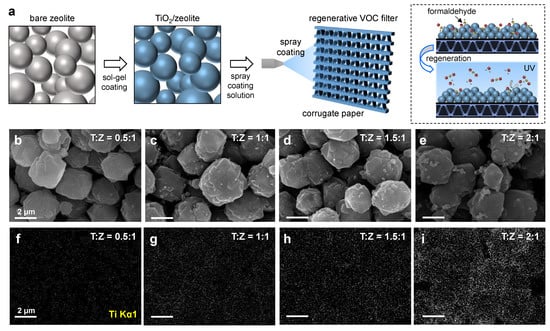
Figure 1a shows the fabrication procedure and schematic photo-regeneration process for TiO2/zeolite-based VOC filters. The TiO2 layer was coated on bare zeolite particles using a sol–gel process. Then, the fabricated TiO2/zeolite particles were dispersed in DI water and spray-coated on a corrugated paper substrate. As described, the TiO2 layer plays a crucial role in the photo-regeneration process. However, the surface structure of zeolite can be altered during the TiO2 coating process, which may degrade its adsorption properties [17]. Therefore, we first investigated the influence of TiO2 coating on the surface morphology, surface area, and pore structure of the zeolites. Figure 1b–e show FESEM images of TiO2/zeolite particles synthesized with different TiO2-to-zeolite (T:Z) ratios. Here, the T:Z ratio represents the mass ratio of the TiO2 (T) precursor solution to the zeolite (Z) suspension solution used for the synthesis, which varies in the range of 0.5:1–2:1. As shown in the FESEM images, the zeolite surface becomes rougher as the T:Z ratio increases. In particular, when the T:Z ratio is 0.5:1, the surface is relatively smooth, without large precipitates (Figure 1b). EDS elemental mapping for Ti Ka1 (Figure 1f–i) suggests that a relatively small amount of TiO2 is coated on the surface. By increasing the T:Z ratio, the amount of TiO2 coated on the surface increases, which is confirmed by the EDS analysis, and the surface of the zeolite becomes rougher, owing to the precipitates formed on the surface. The size of the precipitates is a few hundred nanometers. Furthermore, the number of precipitates tends to increase with the T:Z ratio, and at T:Z = 2:1, the partial agglomeration of TiO2 particles is observed, as shown in Figure 1e.
Figure 1.
(a) Fabrication process and schematic photo-regeneration process of TiO2/zeolite-based VOC filters. FESEM images of TiO2/zeolite particles fabricated with different T:Z ratios, (b) T:Z = 0.5:1, (c) 1:1, (d) 1.5:1, and (e) 2:1. Corresponding EDS elemental mapping images (Ti Ka1) of TiO2/zeolite particles fabricated with different T:Z ratios, (f) T:Z = 0.5:1, (g) 1:1, (h) 1.5:1, and (i) 2:1. The scale bars in the images indicate 2 μm.
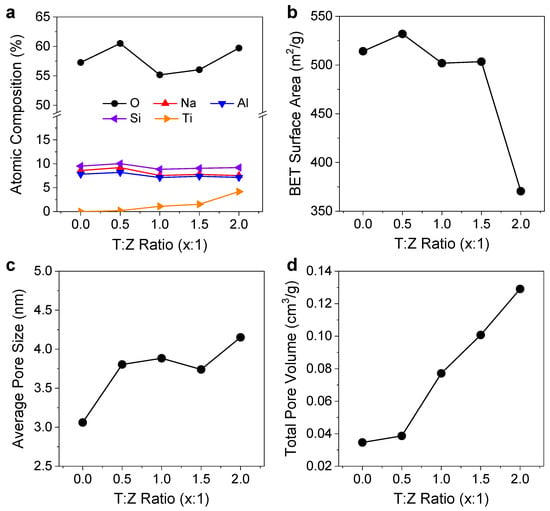
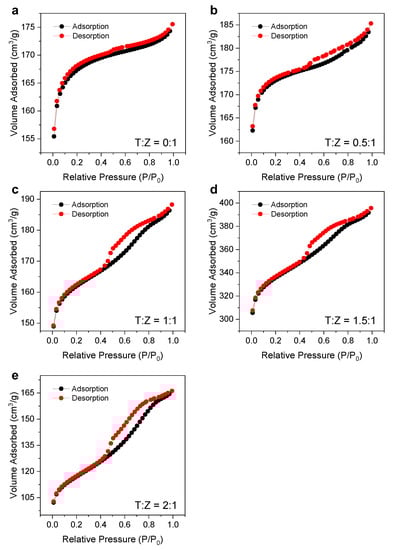
The amount of TiO2 coating based on the T:Z ratio was investigated using atomic composition analysis. Figure 2a and Table 1 show the atomic composition ratios of zeolite and TiO2/zeolite particle surfaces as a function of T:Z ratio. Ti shows an increasing tendency with the T:Z ratio. For instance, when the T:Z ratio changes from 0.5:1 to 2:1, the Ti composition ratio increases from 0.21% to 4.18%. This indicates that the amount of TiO2 formed on the zeolite can be controlled by the T:Z ratio, which affects the degree of photocatalytic reaction under UV illumination. Despite this, we examined the variation in the specific surface area, total pore volume, and pore size of TiO2/zeolite particles depending on the T:Z ratio, since the formation of TiO2 can alter the surface structures of zeolite. Figure 2b shows the BET surface areas of the bare zeolite (T:Z = 0:1) and TiO2/zeolite fabricated with different T:Z ratios. Corresponding nitrogen adsorption and desorption isotherm data are shown in Figure 3a–e. The BET surface area of the TiO2/zeolite particles shows a relatively small variation when the T:Z ratio is in the range of 0.5:1–1.5:1, maintaining a value over 500 m2/g, which is similar to that of bare zeolite (514 m2/g). However, when the T:Z ratio is further increased to 2:1, the BET surface area decreases to 370 m2/g, implying that the surface structure of the zeolite is significantly altered. Furthermore, the average pore size shows a significant increase from ~3.06 nm to ~4.15 nm when the T:Z ratio is increased to 2:1 (Figure 2c). This indicates that the surface structure is modified at this ratio, which can be attributed to the overloading of the TiO2 precursor. Further, the total pore volume shows a monotonous increase with the T:Z ratio, as shown in Figure 2d. Therefore, considering the efficiency of VOC adsorption and the regeneration capability, we consider 1.5:1 as the optimal T:Z ratio for regeneratable VOC filters.
Figure 2.
(a) Variation in atomic composition of zeolite and TiO2/zeolite particle surfaces synthesized with different T:Z ratios (elements: O, Na, Al, Si, and Ti). T:Z ratio of 0:1 indicates bare zeolite particles. Variations in (b) BET surface area, (c) average pore size, and (d) total pore volume of TiO2/zeolite particles as a function of T:Z ratio.
Table 1.
Atomic compositions of zeolite and TiO2/zeolite particle surfaces synthesized with different T:Z ratios (in %).
Figure 3.
BET nitrogen adsorption and desorption isotherm data of zeolite and TiO2/zeolite particles fabricated with different T:Z ratios, (a) T:Z = 0:1, (b) 0.5:1, (c) 1:1, (d) 1.5:1, and (e) 2:1.
3.2. Fabrication of TiO2/Zeolite-Based VOC Filters
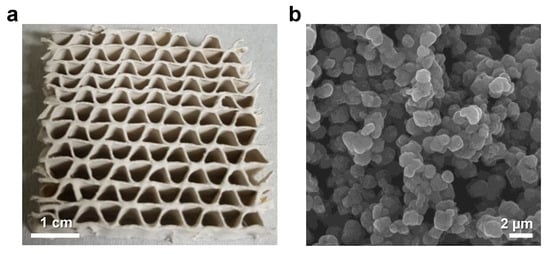
Using the optimized TiO2/zeolite particles (T:Z ratio of 1.5:1), VOC filters were fabricated using the spray-coating method. Here, corrugated paper was used as the filter substrate. Owing to the web-like flute structure of the corrugated paper, a relatively large area for VOC adsorption can be provided, allowing a higher adsorption capacity compared to flat substrates. Figure 4a shows the optical images of the fabricated TiO2/zeolite-based VOC filter. TiO2/zeolite particles were uniformly coated on the corrugated paper, including the inner parts of the core flute, owing to the advantage of the spray-coating method. Figure 4b shows the FESEM image of the filter surface. The TiO2/zeolite formed on the corrugated paper has an open stacking structure. This enabled easy penetration of VOC gases into the bottom parts of the TiO2/zeolite layer, and enlarged the adsorption area. Furthermore, concerning the mechanism of photocatalytic regeneration process, the following photocatalytic reaction can take place. Initially, when the TiO2/zeolite filter is exposed to VOC gases, including formaldehyde (HCHO), VOC molecules are adsorbed physically or chemically on the surface depending on the molecular structure of the VOC gas [18,19]. For instance, in the case of formaldehyde, the molecules adsorbed on the TiO2 surface can be explained with monodentate and bidentate adsorption configurations [18]. Generally, a monodentate configuration depicts the O atom of HCHO (OF) bound to the surface under-coordinated Ti atom. For the five-fold Ti5 atom, binding with the OF atom shows the adsorption energy of 0.472 eV and the bond length of 2.271 Å. For the four-fold Ti4 atom, adsorption energy of 0.907 eV and bond length of 2.168 Å are shown [18]. Based on the Bader charge analysis, part of the electron diffuses during the interaction between HCHO molecules and Ti atom surface. This process results in the weakening of the π bond and the elongation of C=OF. Further, chemical changes in the O and C atoms of formaldehyde differ with coverages [19]. At low coverages below the 0.25 monolayer, as in the case of VOC gases, the HCHO molecule binds to surface 5-coordinated Ti atoms via the O atom. However, after continuous exposure to formaldehyde, adsorption saturates, and a breakthrough occurs; thus, the VOC filtration ability is lost. UV illumination was applied to the filter to regenerate it and recover its adsorption capability. Under UV irradiation, TiO2 induces the oxidation of formaldehyde molecules via the following reactions [20]:
dissociating the adsorbed formaldehyde molecules. In particular, under UV irradiation, electron–hole (e–h) pairs are generated in the TiO2 layer. The photogenerated holes then contribute to the conversion of formaldehyde into formic acid (HCOOH), and finally to CO2 [20]. In addition, partial oxidation byproducts such as HCOOH are oxidized to CO2 with sufficient UV illumination.
Figure 4.
(a) Optical images of TiO2/zeolite VOC filter fabricated using the spray-coating method. (b) FESEM images of TiO2/zeolite particles coated on the VOC filter.
3.3. Adsorption Efficiency and Regeneration Efficiency for Formaldehyde
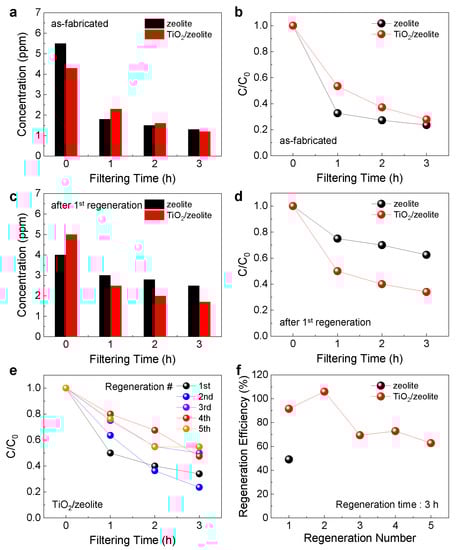
For the TiO2/zeolite VOC filter, the adsorption efficiency for formaldehyde was evaluated. To analyze the adsorption efficiency, the filter was placed inside a chamber, and the change in formaldehyde concentration (C) was measured every 1 h for up to 3 h. Figure 5a shows the variation in formaldehyde concentration as a function of filtering time for bare zeolite- and TiO2/zeolite-based VOC filters. Figure 5b shows the relative concentration (C/C0) change as a function of the filtering time, where C0 denotes the initial concentration of formaldehyde before filtering. For both filters, the concentration of formaldehyde decreases as the filtering time increases, indicating the effective capture of formaldehyde by the zeolite-based filters. After 3 h of filtering, the C/C0 values decrease to 0.236 and 0.279 for the zeolite and TiO2/zeolite VOC filters, respectively. The slightly higher C/C0 value for the TiO2/zeolite VOC filter can be attributed to the decrease in the BET surface area after TiO2 coating. To evaluate the regeneration efficiency, both the zeolite and TiO2/zeolite VOC filters were first saturated with formaldehyde gas by placing the filters in a formaldehyde-rich environment. Next, UV exposure was performed for 3 h, and the filtering tests were repeated. Figure 5c,d show the formaldehyde concentration and C/C0 as functions of the filtering time after the first regeneration. The decrease in C/C0 for the bare zeolite filter is significantly reduced, indicating degradation of the adsorption efficiency. In contrast, in the case of the TiO2/zeolite VOC filter, the decrease in C/C0 is similar to that before regeneration. To evaluate the repetitive regeneration of TiO2/zeolite VOC filters, the regeneration process was performed for five cycles. Figure 5e,f show the C/C0 and regeneration efficiencies, respectively, for five regeneration cycles. Regeneration efficiency is defined as the following equation:
Figure 5.
(a) Variation in formaldehyde concentration for bare zeolite and TiO2/zeolite VOC filters as a function of filtering time. (b) Relative formaldehyde concentration (C/C0) changes as a function of filtering time. Here, C0 and C indicate formaldehyde concentration before and during the filtering process, respectively. (c) The variation in formaldehyde concentration and (d) C/C0 as a function of filtering time after the first regeneration process. (e) Relative formaldehyde concentration (C/C0) change for five regeneration processes (TiO2/zeolite filter). (f) Variation in regeneration efficiency as a function of regeneration number.
In the absence of TiO2 (bare zeolite filter), the regeneration efficiency after the first regeneration cycle is below 50% (Figure 5f). This indicates that UV irradiation may have limited effects on dissociating or desorbing the formaldehyde molecules adsorbed on the zeolite surface. However, with TiO2, the adsorption efficiency is restored close to its initial value, particularly in the first two regeneration processes, indicating the efficient removal of formaldehyde by the photocatalytic reaction. The regeneration efficiency is over 90% during the first two regeneration cycles, and decreases to approximately 60% afterwards. The decrease in regeneration efficiency after repeated cycles is attributed to non-uniform UV irradiation on the VOC filter owing to the corrugated structure of the paper substrate. Nevertheless, the results show that TiO2 on zeolite has a significant effect on enhancing the regeneration efficiency of zeolite-based VOC filters.
3.4. Adsorption Efficiency and Regeneration Efficiency for Toluene
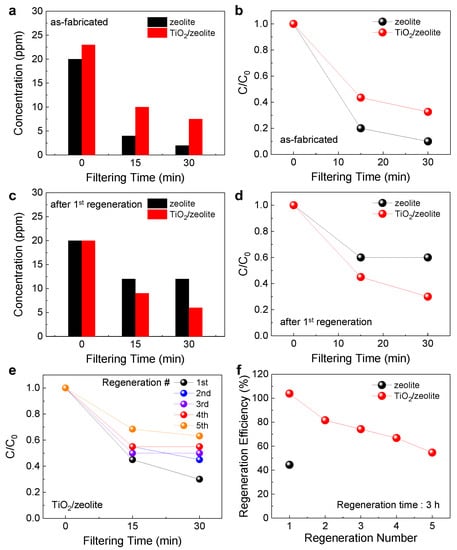
In addition to formaldehyde, the toluene adsorption and regeneration efficiencies were investigated. Similarly, adsorption efficiency was measured using a closed test chamber. However, in this case, the change in toluene concentration was measured every 15 min for up to 30 min, because of the relatively rapid adsorption of toluene molecules. Figure 6a,b show the toluene concentration change and relative concentration (C/C0) variation for the bare zeolite and TiO2/zeolite VOC filters, respectively, as a function of filtering time. Similar to formaldehyde, the bare zeolite filter exhibits a relatively higher adsorption efficiency before regeneration. However, after regeneration by UV exposure for 3 h, the TiO2/zeolite VOC filter shows higher adsorption efficiency, as shown in Figure 6c,d. In particular, the bare zeolite filter has a limited adsorption capability, with the C/C0 value saturated at approximately 0.6. In contrast, the adsorption efficiency of the TiO2/zeolite filter is close to that of the as-fabricated filter. The repetitive regeneration performance for toluene was also evaluated. Figure 6e,f show the C/C0 and corresponding regeneration efficiencies of the bare zeolite and TiO2/zeolite filters for five regeneration cycles, respectively. Similar to that of formaldehyde, the regeneration efficiency is significantly lower for the bare zeolite filter, owing to the absence of the TiO2 photocatalytic layer. In particular, after the first regeneration, the regeneration efficiency of the bare zeolite filter is 44.4%, whereas in the case of TiO2/zeolite filters, the regeneration efficiency is above 80% during the initial two cycles, and above 50% up to five cycles. Although further improvements in achieving a high regeneration efficiency are still required, for example, through the optimization of the regeneration process, the implementation of the TiO2 photocatalytic layer has a substantial influence on improving the regeneration efficiency for various VOC gases. Also, it is of note that the regeneration efficiency obtained by photo-regeneration is comparable to that using thermal- or microwave-assisted regeneration processes, indicating that the synergetic combination of TiO2/zeolite adsorbent and photo-regeneration is promising for extending the service life of VOC filters.
Figure 6.
(a) Variation in toluene concentration for bare zeolite and TiO2/zeolite VOC filters as a function of filtering time. (b) Relative toluene concentration (C/C0) changes as a function of filtering time. Here, C0 and C indicate toluene concentration before and during the filtering process, respectively. (c) Variation in toluene concentration and (d) C/C0 as a function of filtering time after the first regeneration process. (e) Relative toluene concentration (C/C0) change for five regeneration processes (TiO2/zeolite filter). (f) Variation in regeneration efficiency as a function of regeneration number.
4. Conclusions
In this study, we demonstrate UV-regenerative VOC filters using TiO2/zeolite adsorbents. TiO2/zeolite particles with surface properties similar to those of bare zeolite are achieved by employing a solution-based coating method and an optimized synthesis protocol. Furthermore, using the spray-coating method, VOC filters were fabricated on a corrugated paper membrane. From the VOC adsorption and UV-mediated regeneration tests for formaldehyde and toluene, the TiO2/zeolite filters show ameliorated regeneration efficiency compared to the bare zeolite-based filters. Based on these results, we propose that the TiO2/zeolite VOC filter is a potential adsorbent candidate for multi-use UV-regenerative air filtration systems.
Author Contributions
Conceptualization, M.-G.K. and Y.-H.K.; methodology, T.K., K.Y., M.-G.K. and Y.-H.K.; software, T.K. and Y.-H.K.; validation, T.K., K.Y. and Y.-H.K.; formal analysis, T.K. and K.Y.; investigation, T.K. and K.Y.; resources, M.-G.K. and Y.-H.K.; data curation, T.K. and Y.-H.K.; writing—original draft preparation, T.K., M.-G.K. and Y.-H.K.; writing—review and editing, T.K. and Y.-H.K.; visualization, T.K. and Y.-H.K.; supervision, Y.-H.K.; project administration, M.-G.K. and Y.-H.K.; funding acquisition, M.-G.K. and Y.-H.K. All authors have read and agreed to the published version of the manuscript.
Funding
This study was supported by the Technology Innovation Program (20004977) funded by the Ministry of Trade, Industry, and Energy (MOTIE, Korea) and by the Korea Basic Science Institute (KBSI) National Research Facilities and Equipment Center (NFEC) grant funded by the Korean government (Ministry of Education) (No. 2019R1A6C1010031).
Institutional Review Board Statement
Not applicable.
Informed Consent Statement
Not applicable.
Data Availability Statement
Not applicable.
Conflicts of Interest
The authors declare no conflict of interest.
References
- Wang, Z.Q.; Zhang, J.S. Characterization and performance evaluation of a full-scale activated carbon-based dynamic botanical air filtration system for improving indoor air quality. Build. Environ. 2011, 46, 758–768. [Google Scholar] [CrossRef] [Scilit]
- Chen, W.H.; Zhang, J.S.S.; Zhang, Z.B. Performance of air cleaners for removing multiple volatile organic compounds in indoor air. ASHRAE Trans. 2005, 111, 1101–1114. [Google Scholar]
- Polidori, A.; Fine, P.M.; White, V.; Kwon, P.S. Pilot study of high-performance air filtration for classroom applications. Indoor Air 2013, 23, 185–195. [Google Scholar] [CrossRef] [Scilit] [PubMed]
- Bai, Y.; Han, C.B.; He, C.; Gu, G.Q.; Nie, J.H.; Shao, J.J.; Xiao, T.X.; Deng, C.R.; Wang, Z.L. Washable Multilayer Triboelectric Air Filter for Efficient Particulate Matter PM2.5 Removal. Adv. Funct. Mater. 2018, 28, 1706680. [Google Scholar] [CrossRef] [Scilit]
- Liu, C.; Hsu, P.-C.; Lee, H.-W.; Ye, M.; Zheng, G.; Liu, N.; Li, W.; Cui, Y. Transparent air filter for high-efficiency PM2.5 capture. Nat. Commun. 2015, 6, 6205. [Google Scholar] [CrossRef] [Scilit] [PubMed]
- Ligotski, R.; Sager, U.; Schneiderwind, U.; Asbach, C.; Schmidt, F. Prediction of VOC adsorption performance for estimation of service life of activated carbon based filter media for indoor air purification. Build. Environ. 2019, 149, 146–156. [Google Scholar] [CrossRef] [Scilit]
- Balanay, J.A.G.; Floyd, E.L.; Lungu, C.T. Breakthrough Curves for Toluene Adsorption on Different Types of Activated Carbon Fibers: Application in Respiratory Protection. Ann. Occup. Hyg. 2015, 59, 481–490. [Google Scholar] [PubMed]
- Sidheswaran, M.A.; Destaillats, H.; Sullivan, D.P.; Cohn, S.; Fisk, W.J. Energy efficient indoor VOC air cleaning with activated carbon fiber (ACF) filters. Build. Environ. 2012, 47, 10. [Google Scholar] [CrossRef] [Scilit]
- Lv, Y.T.; Sun, J.; Yu, G.Q.; Wang, W.L.; Song, Z.L.; Zhao, X.Q.; Mao, Y.P. Hydrophobic design of adsorbent for VOC removal in humid environment and quick regeneration by microwave. Micropor. Mesopor. Mat. 2020, 294, 109869. [Google Scholar] [CrossRef] [Scilit]
- Coss, P.M.; Cha, C.Y. Microwave regeneration of activated carbon used for removal of solvents from vented air. J. Air Waste Manag. 2000, 50, 529–535. [Google Scholar] [CrossRef] [Scilit] [PubMed]
- Liu, C.G.; Zhang, R.; Wei, S.; Wang, J.; Liu, Y.; Li, M.; Liu, R.T. Selective removal of H2S from biogas using a regenerable hybrid TiO2/zeolite composite. Fuel 2015, 157, 183–190. [Google Scholar] [CrossRef] [Scilit]
- Bellat, J.P.; Weber, G.; Bezverkhyy, I.; Lamonier, J.F. Selective adsorption of formaldehyde and water vapors in NaY and NaX zeolites. Micropor. Mesopor. Mat. 2019, 288, 109563. [Google Scholar] [CrossRef] [Scilit]
- Zhang, X.; Tang, D.X.; Zhang, M.; Yang, R.C. Synthesis of NaX zeolite: Influence of crystallization time, temperature and batch molar ratio SiO2/Al2O3 on the particulate properties of zeolite crystals. Powder Technol. 2013, 235, 322–328. [Google Scholar] [CrossRef] [Scilit]
- Ichiura, H.; Kitaoka, T.; Tanaka, H. Removal of indoor pollutants under UV irradiation by a composite TiO2-zeolite sheet prepared using a papermaking technique. Chemosphere 2003, 50, 79–83. [Google Scholar] [CrossRef] [Scilit]
- Takeuchi, M.; Hidaka, M.; Anpo, M. Efficient removal of toluene and benzene in gas phase by the TiO2/Y-zeolite hybrid photocatalyst. J. Hazard. Mater. 2012, 237, 133–139. [Google Scholar] [CrossRef] [Scilit] [PubMed]
- Zhang, G.X.; Song, A.K.; Duan, Y.W.; Zheng, S.L. Enhanced photocatalytic activity of TiO2/zeolite composite for abatement of pollutants. Micropor. Mesopor. Mat. 2018, 255, 61–68. [Google Scholar] [CrossRef] [Scilit]
- Xu, J.; Sun, M.; Mi, Y.M.; Xu, L.F. The formaldehyde adsorption on anatase TiO2 (211) surface. Chem. Phys. Lett. 2021, 778, 138771. [Google Scholar] [CrossRef] [Scilit]
- Kim, K.-J.; Ahn, H.-G. The effect of pore structure of zeolite on the adsorption of VOCs and their desorption properties by microwave heating. Microporous Mesoporous Mater. 2012, 152, 78–83. [Google Scholar] [CrossRef] [Scilit]
- Setvin, M.; Hulva, J.; Wang, H.H.; Simschitz, T.; Schmid, M.; Parkinson, G.S.; Di Valentin, C.; Selloni, A.; Diebold, U. Formaldehyde Adsorption on the Anatase TiO2(101) Surface: Experimental and Theoretical Investigation. J. Phys. Chem. C 2017, 121, 8914–8922. [Google Scholar] [CrossRef] [Scilit]
- Noguchi, T.; Fujishima, A. Photocatalytic degradation of gaseous formaldehyde using TiO2 film. Environ. Sci. Technol. 1998, 32, 3831–3833. [Google Scholar] [CrossRef] [Scilit]







Publisher’s Note: MDPI stays neutral with regard to jurisdictional claims in published maps and institutional affiliations. |
© 2022 by the authors. Licensee MDPI, Basel, Switzerland. This article is an open access article distributed under the terms and conditions of the Creative Commons Attribution (CC BY) license (https://creativecommons.org/licenses/by/4.0/).