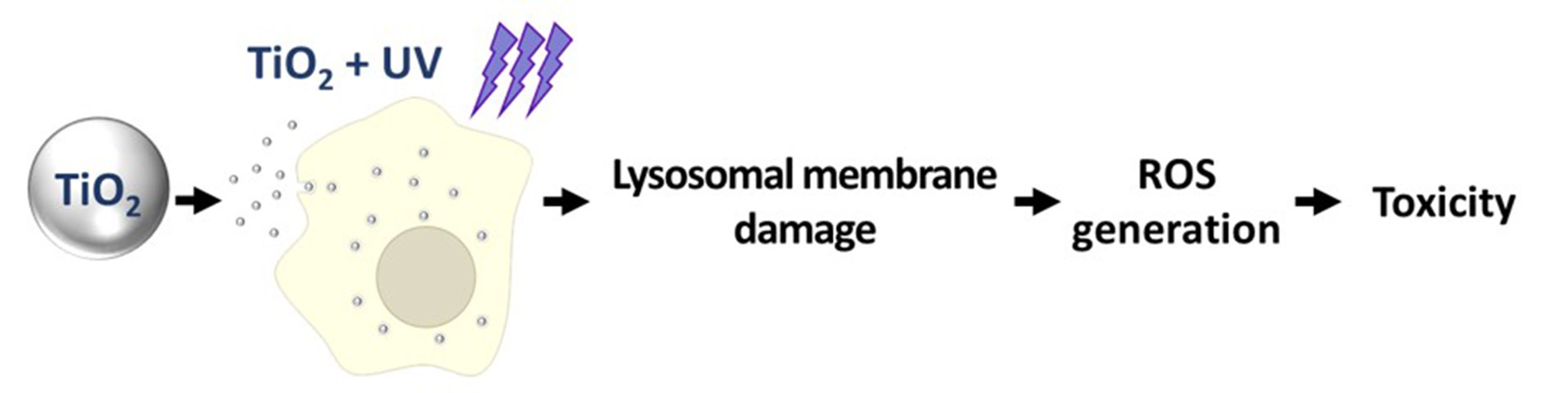
Titanium Dioxide Induces Apoptosis under UVA Irradiation via the Generation of Lysosomal Membrane Permeabilization-Dependent Reactive Oxygen Species in HaCat Cells

Abstract
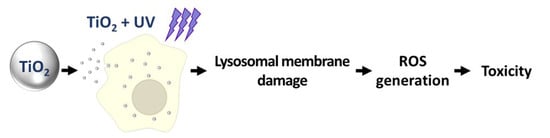
Share and Cite
Kim, I.Y.; Lee, T.G.; Reipa, V.; Heo, M.B. Titanium Dioxide Induces Apoptosis under UVA Irradiation via the Generation of Lysosomal Membrane Permeabilization-Dependent Reactive Oxygen Species in HaCat Cells. Nanomaterials 2021, 11, 1943. https://doi.org/10.3390/nano11081943
Kim IY, Lee TG, Reipa V, Heo MB. Titanium Dioxide Induces Apoptosis under UVA Irradiation via the Generation of Lysosomal Membrane Permeabilization-Dependent Reactive Oxygen Species in HaCat Cells. Nanomaterials. 2021; 11(8):1943. https://doi.org/10.3390/nano11081943
Chicago/Turabian StyleKim, In Young, Tae Geol Lee, Vytas Reipa, and Min Beom Heo. 2021. "Titanium Dioxide Induces Apoptosis under UVA Irradiation via the Generation of Lysosomal Membrane Permeabilization-Dependent Reactive Oxygen Species in HaCat Cells" Nanomaterials 11, no. 8: 1943. https://doi.org/10.3390/nano11081943
APA StyleKim, I. Y., Lee, T. G., Reipa, V., & Heo, M. B. (2021). Titanium Dioxide Induces Apoptosis under UVA Irradiation via the Generation of Lysosomal Membrane Permeabilization-Dependent Reactive Oxygen Species in HaCat Cells. Nanomaterials, 11(8), 1943. https://doi.org/10.3390/nano11081943