


Abstract
Currently, the increase in devices capable of continuously collecting data on non-stationary and dynamic variables affects predictive models, particularly if they are not equipped with algorithms capable of adapting their parameters and structure, causing them to be unable to perceive certain time-varying properties or the presence of missing data in data streams. A constantly developing solution to such problems is evolving fuzzy inference systems. The aim of this work was to systematically review forecasting models implemented through evolving fuzzy inference systems, identifying the most common structures, implementation outcomes, and predicted variables to establish an overview of the current state of this technique and its possible applications in other unexplored fields. This research followed the PRISMA methodology of systematic reviews, including scientific articles and patents from three academic databases, one of which offers free access. This was achieved through an identification, selection, and inclusion workflow, obtaining 323 records on which analyses were carried out based on the proposed review questions. In total, 62 investigations were identified, proposing 115 different system structures, mainly focused on increasing precision, in addition to addressing eight main fields of application and some optimization techniques. It was observed that these systems have been successfully implemented in forecasting variables with dynamic behavior and handling missing values, continuous data flows, and non-stationary characteristics. Thus, their use can be extended to phenomena with these properties.
1. Introduction
1.1. Forecasting Models
Forecasting models enable control and decision-making over the modeled environment. A model with a high degree of complexity can add significant computational difficulty to this task, while a model that is too simple may reduce the performance or incorrectly represent the phenomenon [1]. The dynamics of the modeled phenomena can vary over time, implying the need for models to adapt during their operation through data-based approaches and continuous learning [2]. This requires that models have evolutionary dynamic structures capable of capturing variations in the data flow [1,3,4].
Currently, most forecasting methods tend to use limited historical information to generate their initial configurations, and obtaining this information can be difficult or expensive. This approach can hinder models from responding to unexpected changes in the modeled phenomenon. Moreover, some machine learning approaches often rely on offline training, leading to long training cycles, increased computational complexity, and error propagation, which can impair the forecast accuracy [5,6].
Implementing an effective online prediction method becomes imperative to improve the model’s response strategy, enabling the transformation of learned knowledge in a highly intuitive and interpretable way [3,6]. Models must respond quickly and learn from situations with varying system conditions, such as drifts, outliers, missing values, shifts, or non-stationary environments. They must also handle unlimited data streams, operating online and in real time [7].
1.2. Evolving Fuzzy Inference Systems
Evolving fuzzy inference systems (EFSs) have recently emerged as a modeling solution for highly complex, nonlinear, online, and non-stationary processes. They can adapt their parameters and alter their internal structures incrementally with new, incoming data samples—for example, by modifying the set of rules or the number of inputs or outputs of the system. This allows them to accommodate new states or changes in behavior over time, without necessitating time-intensive retraining phases or modeling interruptions [8,9,10,11].
EFSs provide a flexible structure with incremental and continuous learning, processing data flow samples only once, thus reducing the memory consumption [7]. Moreover, they are fuzzy-rule-based systems (FRSs) capable of self-updating along with their meta-parameters. This involves identifying and refining the antecedent and consequent parts of the rules, as well as dynamically adapting the parameters of the membership functions from the continuous data flow [3,9,12,13]. To date, various EFSs with different evolutionary structures and parameter learning schemes have been proposed to tackle real-world classification, identification, and regression problems, where model interpretability plays a key role [3,9,14].
EFSs are currently employed as practical tools in data streaming applications such as autonomous driving, weather forecasting, and high-frequency trading [15]. As a result, numerous EFSs have been introduced, with notable flexibility, linguistic interoperability, and dynamic autonomy. These systems enable the representation of information with efficient computational performance for continuous self-learning in non-stationary processes [10,11], in addition to offering fast training speeds and high precision compared to other nonlinear prediction strategies [6].
This work provides a systematic review of EFSs for forecasting problems, highlighting that their importance has been indicated by other review works that have covered other approaches, such as control theory [16], heuristic design [14], interpretability [17], their application in data flows [18], and the challenges at the beginning of their development [19]. Thus, a systematic review of forecasting models using EFSs is given to provide an overview of the current state of the art and explore potential applications in unexplored domains. To achieve this, the review aims to address the following questions:
- Who are the authors with the greatest impact on the development of EFSs?
- What are the trends in the topics, concepts, or keywords associated with forecasting models using EFSs?
- How has the frequency of research on forecasting models using EFSs evolved?
- Which variables or phenomena are predicted by EFSs?
- What are the structures of EFSs applicable to forecasting?
- Which optimization methods are implemented in EFSs to enhance their forecasting accuracy?
- What performance results have been obtained in forecasting models using EFSs?
This manuscript presents an analysis of the state of the art of the technique of EFS for forecasting problems, describing the existing structures, the fields in which they have been applied, and their variables, along with the results of their implementation based on the answers to the questions considered in the review. This allows us to visualize new opportunities for research, innovation, and development and possible applications in problems that have the same characteristics.
This systematic review follows a clear and orderly structure, adapting the PRISMA methodology for systematic reviews, which is described in the following sections of the document. The Materials and Methods section details the methodology used; in the Results and Discussion, the findings obtained are presented and analyzed; in the Conclusions, the main conclusions of the review are summarized; and, finally, the Future Directions section describes future fields of research and existing challenges.
2. Materials and Methods
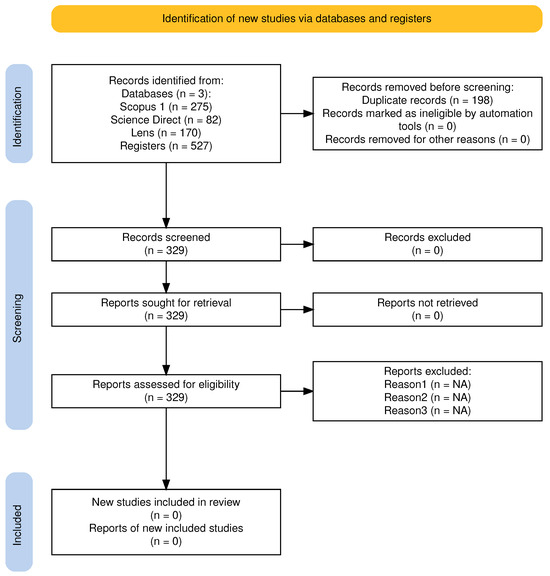
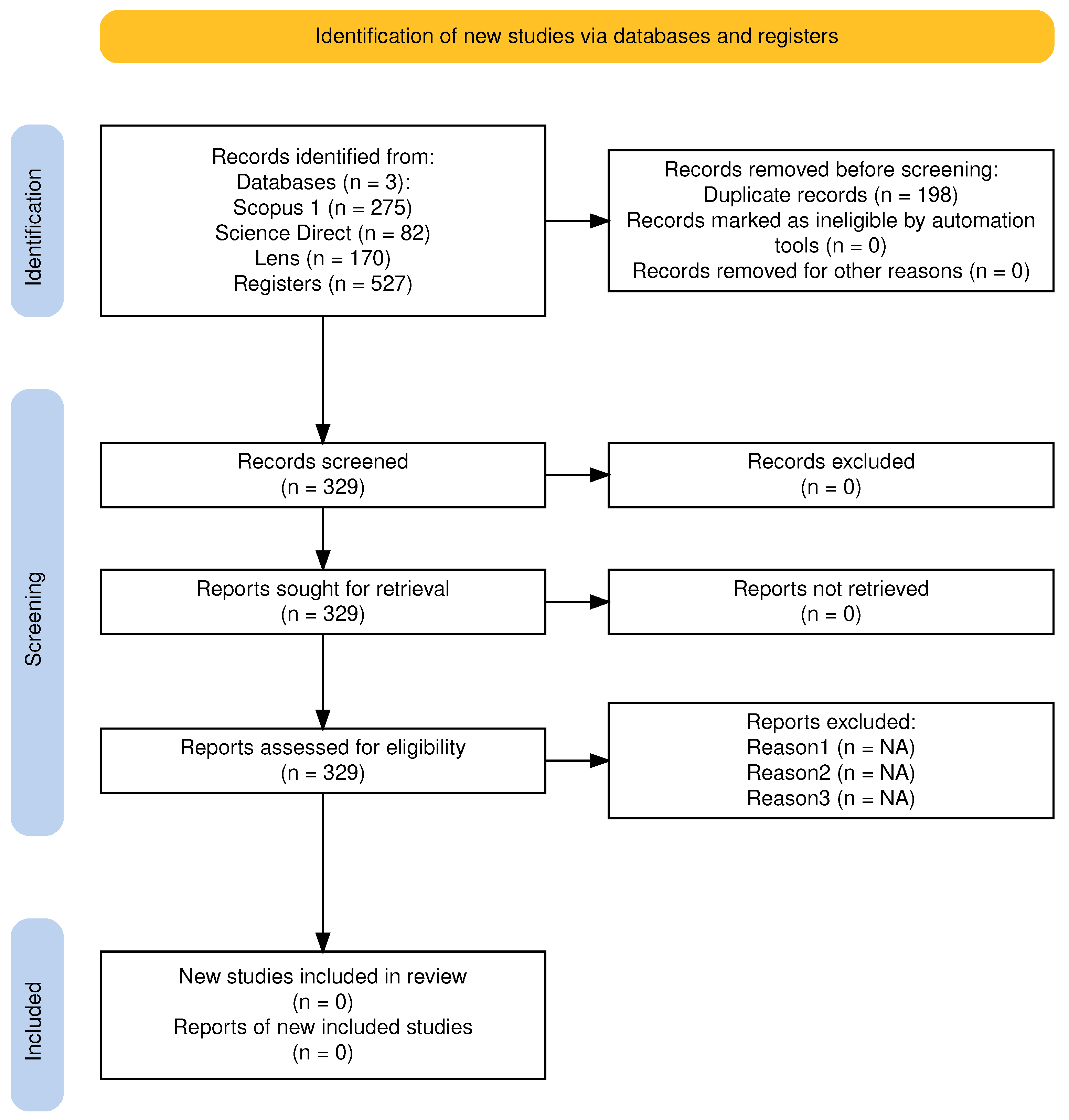
The present review adheres to the PRISMA workflow guide for systematic reviews [20]. This process is organized into three phases: identification, selection, and inclusion (Figure 1).
Figure 1.
Description of the methodology following the systematic review flow chart according to PRISMA [20,21].
- The identification phase involves defining the eligibility criteria, selecting the information sources, and developing a search strategy.
- The selection phase encompasses the selection and collection of data, including the description of the collected data items and the synthesis method.
- The inclusion phase does not entail any specific development, as it focuses on conducting a thorough search to avoid overlooking relevant records throughout the workflow.
2.1. Eligibility Criteria, Information Sources, and Search Strategy
All studies and research conducted throughout the first two months of 2024 on forecasting models involving EFSs are considered under the admissibility criteria. The data sources used are the scientific databases Scopus, Science Direct, and Lens. In Table 1, the corresponding search equation is provided for each source, along with the number of records found in each repository.
Table 1.
Description of search strategy for the systematic review.
After removing duplicates from the 527 initial records, 323 unique records remain for use in the review process.
2.2. Selection Process and Data Collection Process
Each document was exported from the database in comma-separated values and RIS format for bibliometric analysis. The method used to determine the inclusion criteria specifically for the investigative analysis is described as follows.
- Only patents and articles are selected.
- Articles must be published in scientific journals.
- A time window indicating an increase or progress in the field of study is chosen based on bibliometric analysis.
- Any records unrelated to the research topic—forecasting with EFSs—are excluded.
2.3. Data Items and Synthesis Methods
From the total number of records, the following data were extracted and grouped according to their relevance to the review.
- Bibliometrics
- Authors: Used to analyze collaborations and author relevance.
- Keywords: Used for term co-occurrence analysis.
- Year of publication: Used to review the temporal distribution of publications on the topic.
- Investigative
- Analyzed variable: Corresponds to the modeled variable or phenomenon.
- Fuzzy inference system type: Indicates the type of fuzzy inference system used.
- Optimization: Indicates the method or type of optimization applied.
- Model Description: Provides detailed information on the structure of the developed model.
- Precision: Indicates the measurement and performance value of the obtained model.
- Filtering fields for investigative analysis
- Title, Abstract: Used to determine whether the documents correspond to the topic.
- Type of publication: Indicates the medium of publication, such as a journal, book, conference, or other.
2.4. Data Analysis Tools
The VOSviewer tool was utilized to conduct the bibliometric analysis. This tool enables the visualization of relationships that address the review questions. Specifically, it facilitates the analysis of co-authorship and keyword co-occurrence with a temporal focus. The investigative analysis also involves tabulating each article according to the investigative fields of the analyzed variables, the fuzzy inference system type, optimization, and the results.
3. Results
The results were categorized into two sections based on their objectives: one focusing on bibliometric data to address review questions 1 to 3 and the other requiring a more comprehensive investigative analysis to answer questions 4 to 7.
3.1. Bibliometric Analysis
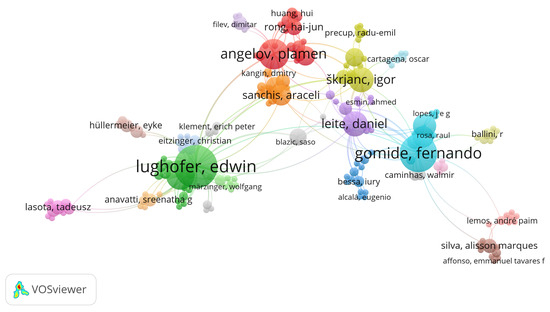
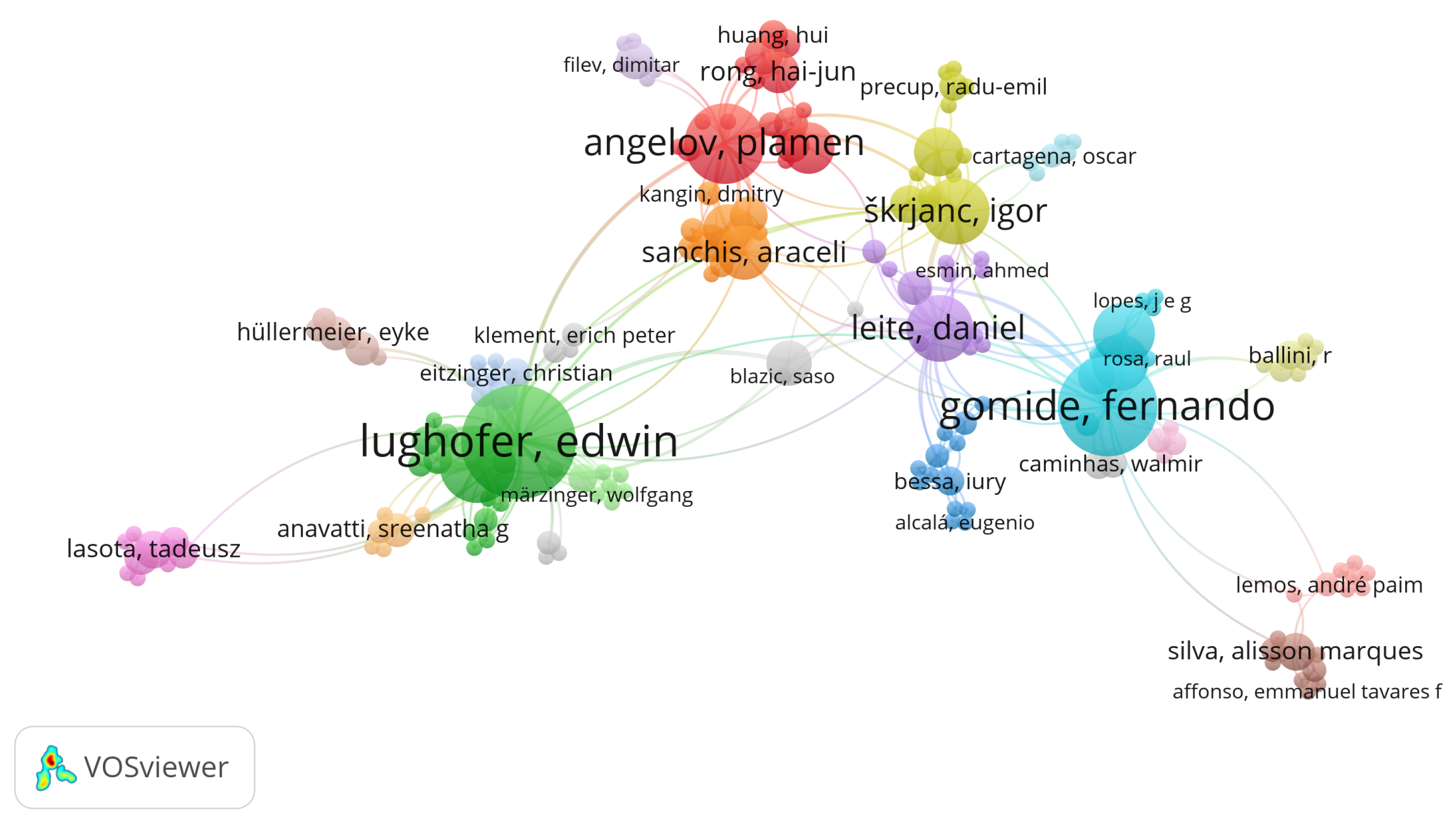
Commencing with the co-authorship analysis depicted in Figure 2, all authors are listed, with three main clusters identified as the most prominent. These clusters represent the researchers Fernando Gomide (light blue), Edwin Lughofer (green), and Plamen Angelov (red).
Figure 2.
Co-authorship network by number of documents on EFSs.
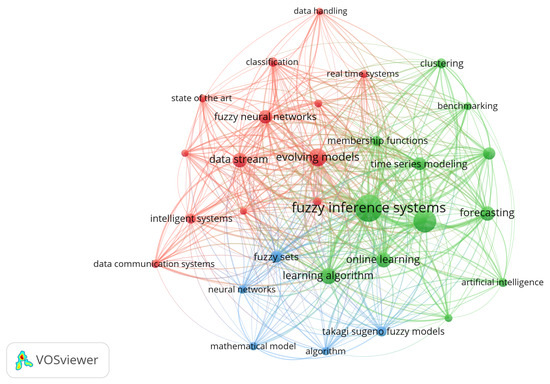
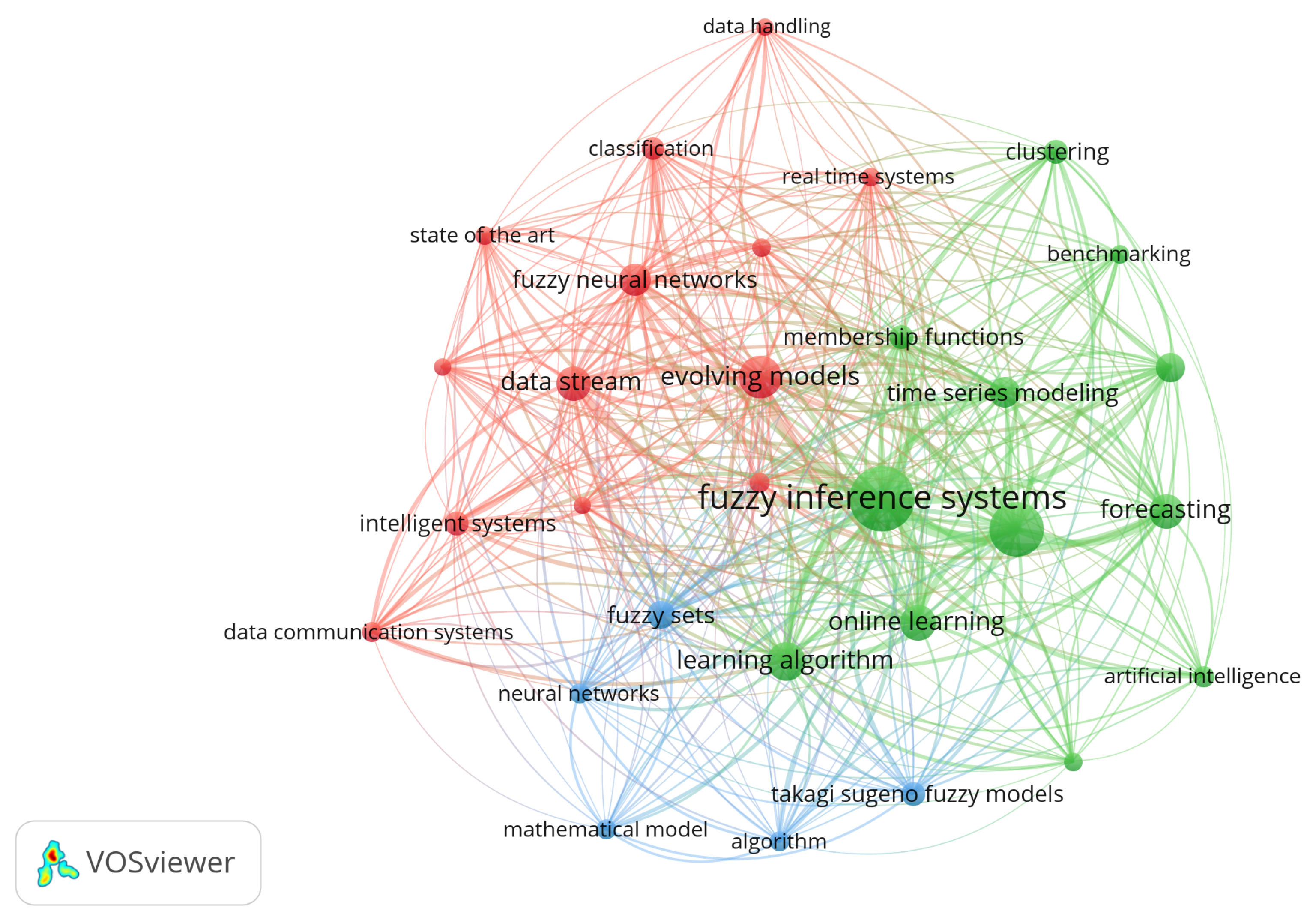
In Figure 3, the co-occurrence of keywords is examined, with the minimum occurrence threshold set at 13 repetitions to identify the most relevant topics within the scope of the review. In addition to EFSs, it is observed that there are elements related to applications such as real-time systems, data streams, and communication systems (highlighted in red). Furthermore, implementations such as mathematical modeling, Takagi–Sugeno models, and neural networks are noted (highlighted in blue), along with approaches such as prediction, classification, online learning, and artificial intelligence (highlighted in green).
Figure 3.
Keyword co-occurrence map of each document on EFSs.
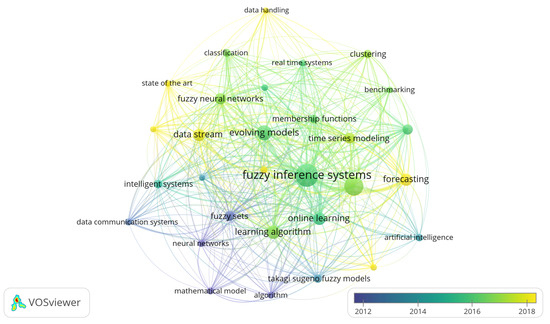
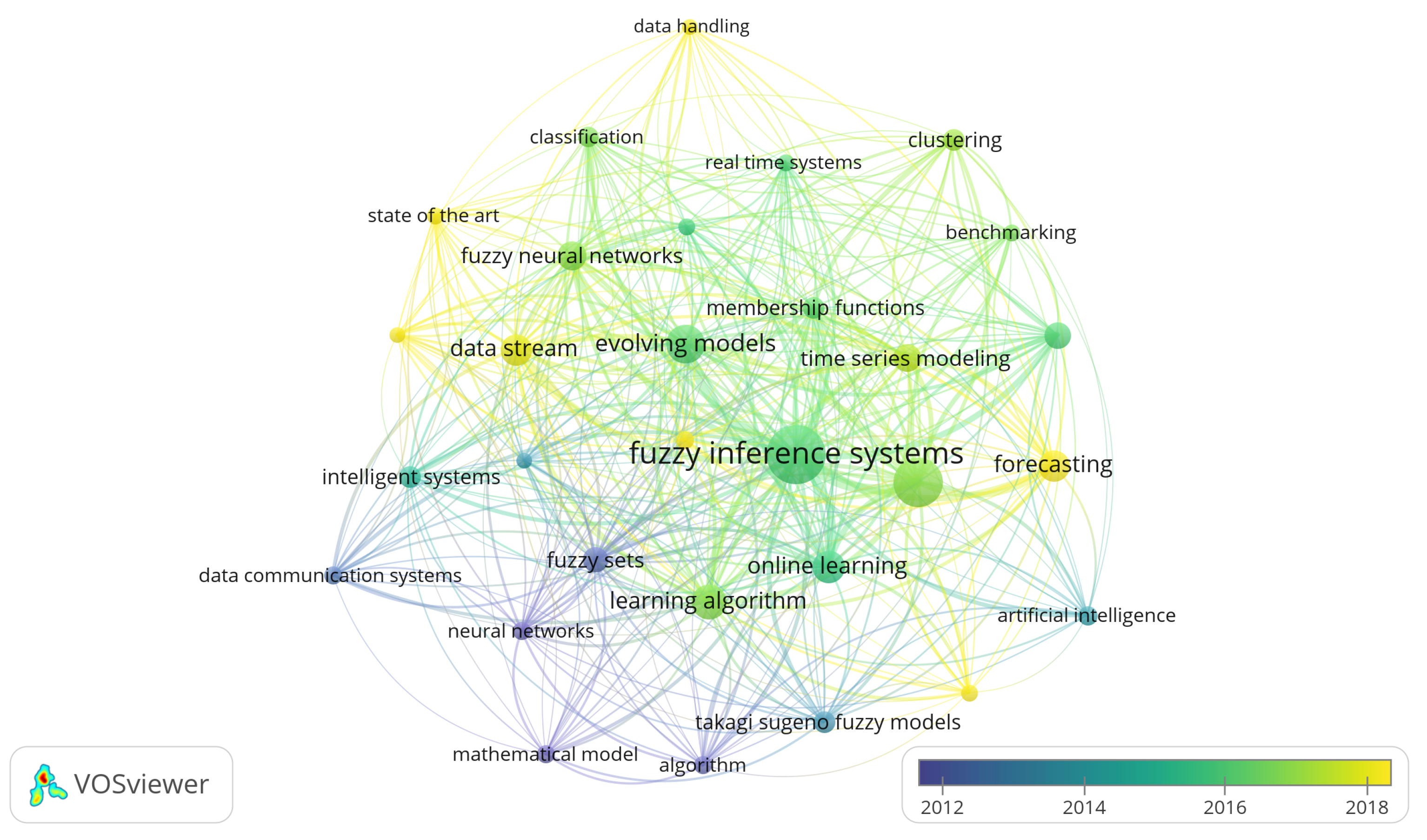
In Figure 4, the co-occurrence of keywords over time is examined, with the minimum occurrence threshold set at 13 repetitions. Research topics with the most recent development include data streams, information classification, forecasting, and time series.
Figure 4.
Keyword co-occurrence map of each document on EFSs over time.
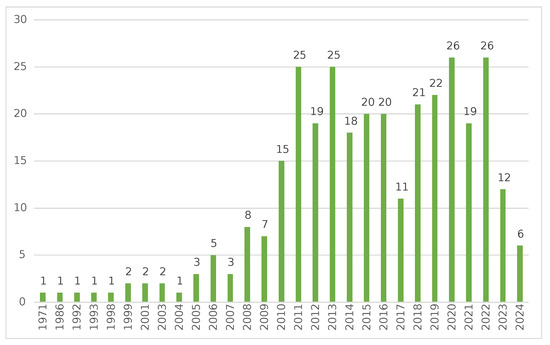
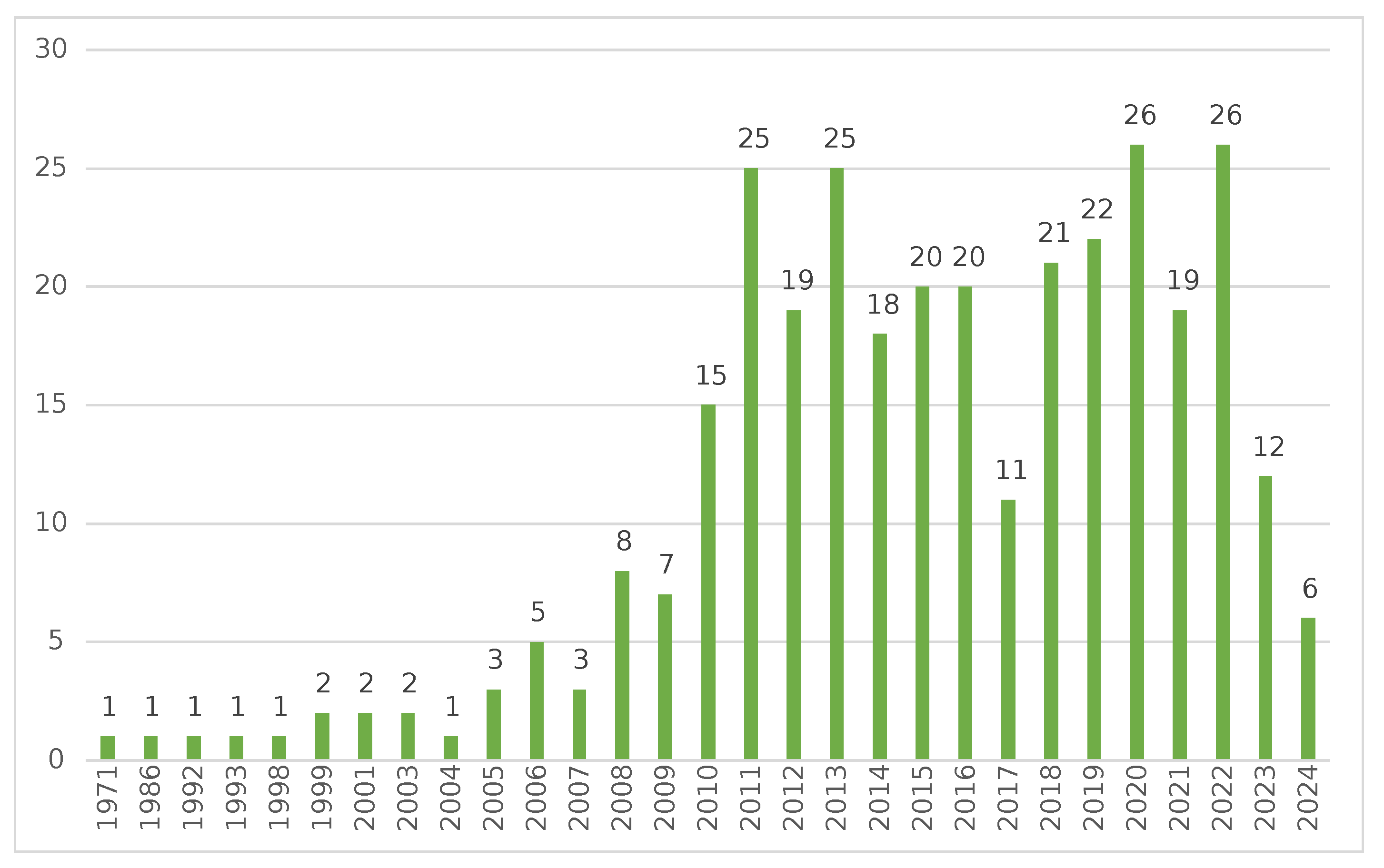
Figure 5 illustrates the frequency of research on forecasting models using EFSs over time. A growth trend has been observed since 2010, with an approximate average of 20 studies per year. This growth is attributed to the maturation of the technology and supporting computer tools.
Figure 5.
Histogram of the distribution of the amount of research on EFSs over time.
3.2. Investigative Analysis
Out of the total number of investigations, 82 studies have been selected through filtering since 2010, focusing on journal articles and patent registrations, as stipulated by the selection methodology. Among these, 20 studies were discarded due to not corresponding to forecasting models or not utilizing EFSs.
Table 2 analyzes the remaining 62 investigations and briefly describes the implemented models. Notably, the first five entries correspond to patents.
Table 2.
Types of EFS implemented by each investigation.
Table 3 displays the variables or phenomena predicted by EFSs, with each variable grouped according to its respective field of study. The fields with the most significant applications include economics or finance, health, manufacturing, and technology. Particularly in the technological field, a considerable portion is dedicated to applying synthetic variables to verify and validate new model developments.
Table 3.
List of variables predicted using EFSs by number of investigations.
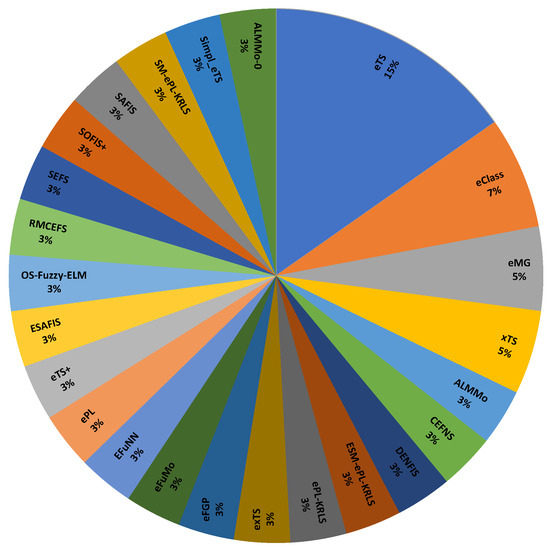
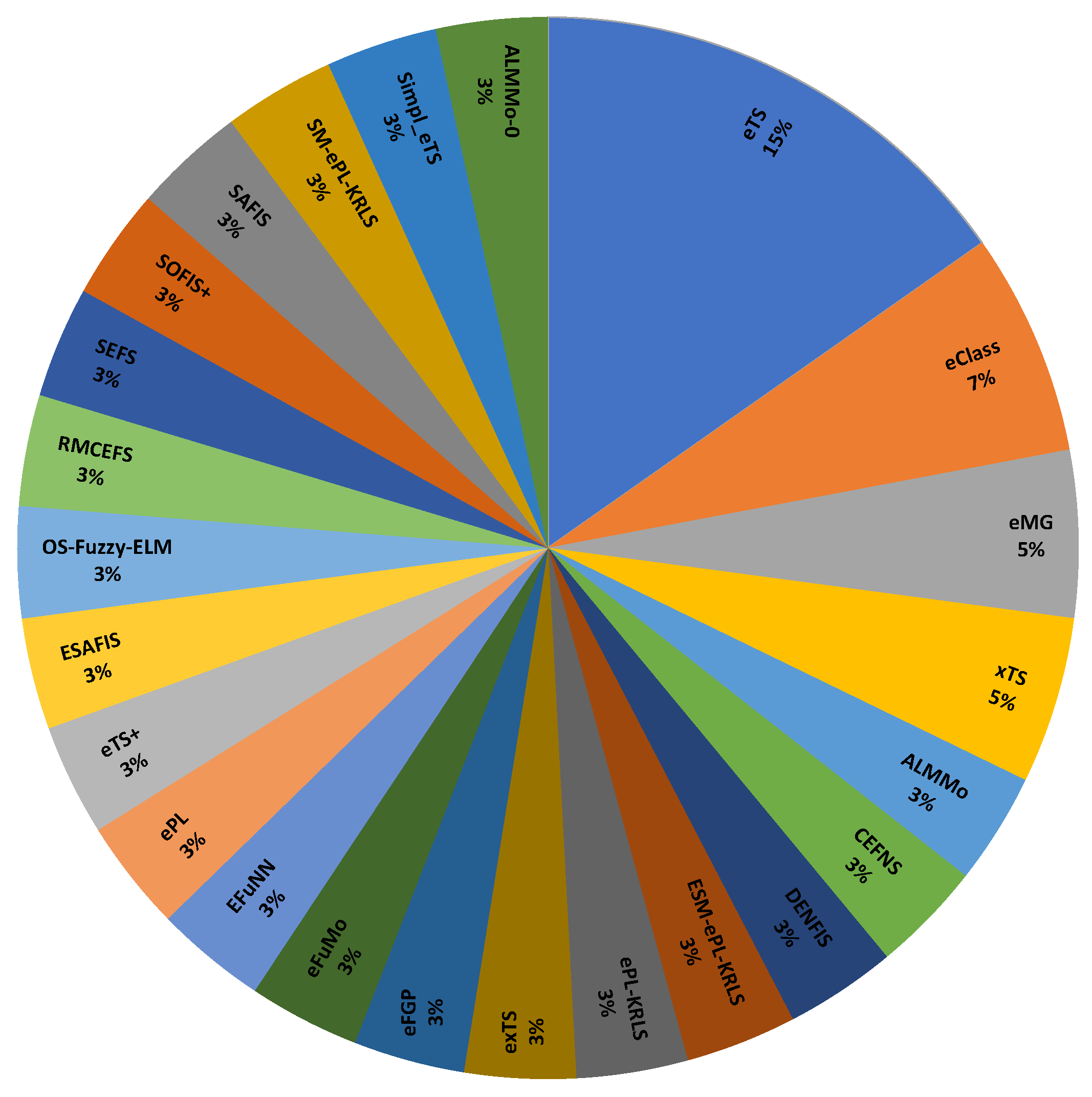
Table 2 describes the 115 evolutionary fuzzy inference system structures applicable to forecasting. Additionally, Figure 6 illustrates the usage percentages of various EFSs, considering a minimum of two applications. eTS has the highest frequency of application, followed by eClass, eMG, and xTS, in predicting the variables indicated in Table 3.
Figure 6.
Pie chart of the distribution of EFS types applied to prediction problems.
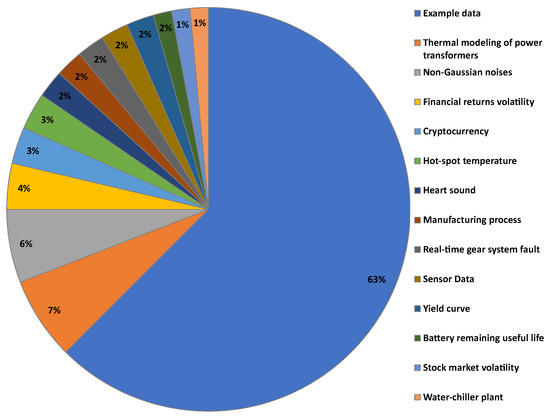
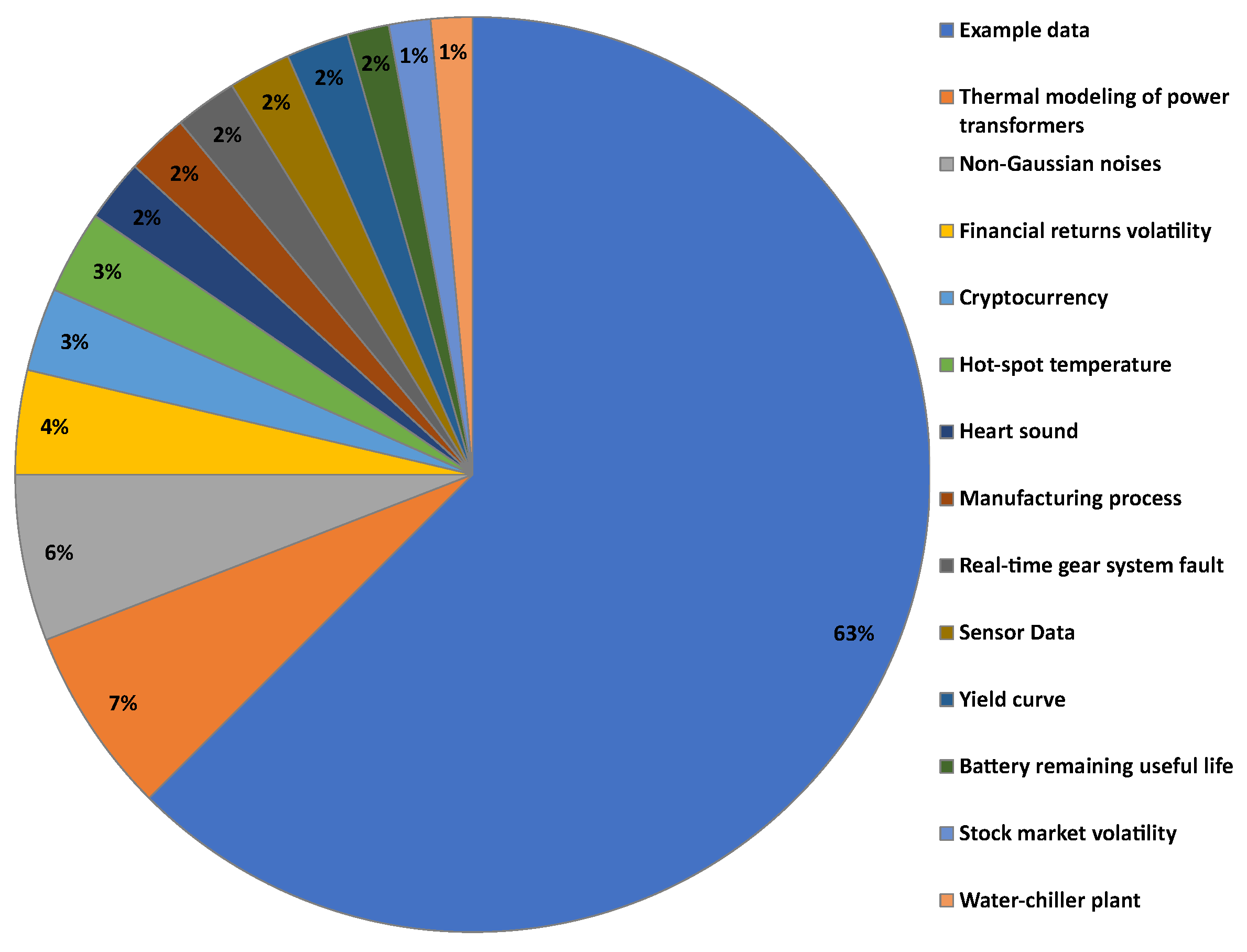
Moreover, Figure 7 displays the different EFSs applied in forecasting the identified variables at least twice. Notably, example data, the thermal modeling of power transformers, and non-Gaussian noise are the variables predicted by the largest number of different EFSs.
Figure 7.
Pie chart of the distribution of the variable types in research that applies EFSs.
Regarding the optimization methods implemented in EFSs to enhance the forecasting precision, Table 4 shows that 12 investigations include optimization elements, specifying which methods have been implemented and their frequency.
Table 4.
List of optimization methods by number of investigations that apply them.
Furthermore, forecasting models using EFSs employ various performance measures. Notably, the root mean squared error (RMSE) is mentioned in 23 investigations, while the mean squared error (MSE) is considered in five. The obtained values are 0.0662 and 0.0561, respectively.
4. Discussion
In this section, we discuss relevant elements derived from the analyses carried out, focusing on the findings of the common structures, the results of the implementation of the models, and the variables used for forecasting with EFSs.
Within the types of EFS structures applicable to forecasting, the most used and referenced are eGNN, FLEXFIS, eTS, and eClass, proposed by Fernando Gomide, Edwin Lughofer, and Plamen Angelov, respectively, which provide a point of comparison for future research, in which they may be implemented, contrasted, and improved. Additionally, various authors have presented new proposals over the last decade that introduce novel approaches or enhancements to previous implementations, indicating a burgeoning and expanding field.
Even now, new proposals are being developed from the approaches analyzed—for example, seeking to increase their interpretability, such as X-Fuzz [81]; handling missing data [82]; using other approaches, such as the use of multiple layers in hierarchical evolving fuzzy systems [83]; or improving existing approaches, such as dynamic rule generation [84].
When analyzing the current trends, it is observed that the structures of the EFSs applicable to forecasting are predominantly based on Takagi–Sugeno-type fuzzy inference systems. These systems address approaches such as the creation or dynamic adjustment of rules [31,38,41,45] and the configuration or monitoring of input or output flows [59,65]. However, there are a few configurations focused on managing missing data [36,48] and likewise based on Mamdani-type fuzzy inference systems [62,63,74], which offer higher interpretability.
This trend shows that there are currently many proposals focused on precision but few on interpretability or the handling of missing data, providing a research opportunity. This is evidenced, for example, by the fact that of the 115 proposals analyzed, only 10 use Mamdani-type systems:
- Evolving output-context fuzzy system (EOCFS);
- Evolving construction scheme for fuzzy systems (ECSFS);
- Evolving information granule (EIG);
- Evolving type-2 neural fuzzy inference system (eT2FIS);
- Fuzzy adaptive learning control network applying adaptive resonance theory (FALCON-ART);
- Evolving fuzzy neural network (EFuNN);
- Evolving neural–fuzzy semantic memory (eFSM);
- Generic SOFNN (GenSoFNN);
- Rough-set-based pseudo outer product (RSPOP);
- Type-2 self-organizing neural fuzzy system (T2SONFS).
The precision values obtained in the various approaches addressed by EFSs demonstrate their robustness in implementation. Notably, these systems continually adapt their structures to accommodate new data flows or variations in the behavior of the analyzed variable.
It is observed that by implementing optimization methods, the characteristics of the existing systems are improved, thereby increasing their precision or reducing the algorithmic complexity and time. However, their limited implementation stems from the technique’s current maturity level; therefore, an increase in its implementation is expected in the future. Currently, the focus is on developing new proposals with diverse characteristics, rather than implementing optimization mechanisms in existing structures.
Within the application field of data flow forecasting, several research opportunities related to the forecasted variables or phenomena are observed:
- Variables that exhibit non-stationary and dynamic characteristics over time—for example, climatic or meteorological variables, such as those in the heat exchanger system [30];
- Phenomena that demonstrate strong fluctuations over time and are interdependent on unknown variables—for example, in economic phenomena, such as stock market volatility [60,76];
- Variables in continuous data streams, such as real-time gear system faults [31] and network traffic [55];
- Time series with missing data [36] within dynamic and non-stationary data streams, such as in cryptocurrency [48].
5. Conclusions
Applications of EFSs are found in fields such as the climate, economics, energy, health, manufacturing, the social sciences, and transportation, with high-performance values in forecasting dynamic, non-stationary variables, even with continuous data flows and missing data. It is evident that it is feasible to obtain high accuracy values when forecasting phenomena with these properties, particularly in conjunction with optimization methods, which are currently of limited use, mainly due to the technique’s current maturity level.
It is found that there is significant variety in the configuration and assembly proposals for EFSs for data flow forecasting. It is suggested that if higher accuracy is desired, Sugeno-type structures are the most common structures. On the other hand, if we focus on higher interpretability, only a small proportion, approximately 8.6957%, of the proposals are based on Mamdani-type fuzzy inference systems, and only two on missing data management.
6. Future Directions
In this section, we explore the possible future research avenues and advances in the field of EFSs in forecasting problems based on the review carried out. Emerging trends and unresolved problems that can advance the field are highlighted.
- Emerging Trends
- –
- The forecasting of dynamic, non-stationary data flows and with missing data such as economic indices, real-time health statuses, environmental data, consumer behavior, interactions on social networks, data from interactions on educational platforms, mobility data, and sensor data, among others.
- –
- The implementation of optimization algorithms to increase the precision of the models, seeking to maintain the levels of interpretability obtained and without modifying the semantics of the model.
- –
- The development of new proposals that focus on guaranteeing the forecasting of data flows with high interpretability and the handling of missing data or continuous data flows.
- Unresolved Issues
- –
- Regarding the classification of existing structures, more than 100 proposals for evolutionary fuzzy inference systems were found, so it is necessary to develop a classification system to make it easier to implement and compare them. For example, some proposals identified in this review are grouped by their approach, i.e., precision or interpretability, or focused on modifying rules or inputs and outputs.
- –
- It is necessary to efficiently combine proposals that combine high levels of interpretability and high precision in a way that is simple to implement.
Author Contributions
Conceptualization, S.-C.V.-A. and J.B.-V.; methodology, E.R.-R.; software, S.-C.V.-A.; validation, S.-C.V.-A., J.B.-V., and E.R.-R.; investigation, S.-C.V.-A.; resources, E.R.-R.; data curation, S.-C.V.-A.; writing—original draft preparation, S.-C.V.-A.; writing—review and editing, S.-C.V.-A.; visualization, E.R.-R.; supervision, J.B.-V. All authors have read and agreed to the published version of the manuscript.
Funding
This research received no external funding.
Data Availability Statement
The raw data supporting the conclusions of this article will be made available by the authors on request.
Conflicts of Interest
The authors declare no conflicts of interest.
References
- Alcalá, E.; Bessa, I.; Puig, V.; Sename, O.; Palhares, R. MPC using an on-line TS fuzzy learning approach with application to autonomous driving. Appl. Soft Comput. 2022, 130, 109698. [Google Scholar] [CrossRef] [Scilit]
- Andonovski, G.; Costa, B.S.J.; Blažič, S.; Škrjanc, I. Robust evolving controller for simulated surge tank and for real two-tank plant. Automatisierungstechnik 2018, 66, 725–734. [Google Scholar] [CrossRef] [Scilit]
- Gu, X.; Angelov, P.; Shen, Q. Self-Organizing Fuzzy Belief Inference System for Classification. IEEE Trans. Fuzzy Syst. 2022, 30, 5473–5483. [Google Scholar] [CrossRef] [Scilit]
- Lughofer, E.; Angelov, P. Handling drifts and shifts in on-line data streams with evolving fuzzy systems. Appl. Soft Comput. 2011, 11, 2057–2068. [Google Scholar] [CrossRef] [Scilit]
- Gu, X. A dual-model semi-supervised self-organizing fuzzy inference system for data stream classification. Appl. Soft Comput. 2023, 136, 110053. [Google Scholar] [CrossRef] [Scilit]
- Sun, J.; Gan, X.; Gong, D.; Tang, X.; Dai, H.; Zhong, Z. A self-evolving fuzzy system online prediction-based dynamic multi-objective evolutionary algorithm. Inf. Sci. 2022, 612, 638–654. [Google Scholar] [CrossRef] [Scilit]
- Rodrigues, F.; Silva, A.; Lemos, A. Evolving fuzzy predictor with multivariable Gaussian participatory learning and multi-innovations recursive weighted least squares: eFMI. Evol. Syst. 2022, 13, 667–686. [Google Scholar] [CrossRef] [Scilit]
- Lughofer, E.; Skrjanc, I. Evolving Error Feedback Fuzzy Model for Improved Robustness under Measurement Noise. IEEE Trans. Fuzzy Syst. 2022, 31, 997–1008. [Google Scholar] [CrossRef] [Scilit]
- Škrjanc, I.; Iglesias, J.A.; Sanchis, A.; Leite, D.; Lughofer, E.; Gomide, F. Evolving fuzzy and neuro-fuzzy approaches in clustering, regression, identification, and classification: A Survey. Inf. Sci. 2019, 490, 344–368. [Google Scholar] [CrossRef] [Scilit]
- Ferdaus, M.; Pratama, M.; Anavatti, S.; Garratt, M. PALM: An Incremental Construction of Hyperplanes for Data Stream Regression. IEEE Trans. Fuzzy Syst. 2019, 27, 2115–2129. [Google Scholar] [CrossRef] [Scilit]
- Yang, Z.X.; Rong, H.J.; Angelov, P.; Yang, Z.X. Statistically Evolving Fuzzy Inference System for Non-Gaussian Noises. IEEE Trans. Fuzzy Syst. 2021, 30, 2649–2664. [Google Scholar] [CrossRef] [Scilit]
- Angelov, P.; Filev, D. An approach to online identification of Takagi-Sugeno fuzzy models. IEEE Trans. Syst. Man Cybern. Part B Cybern. 2004, 34, 484–498. [Google Scholar] [CrossRef] [Scilit] [PubMed]
- Dell’Anna, D.; Jamshidnejad, A. Evolving Fuzzy logic Systems for creative personalized Socially Assistive Robots. Eng. Appl. Artif. Intell. 2022, 114, 105064. [Google Scholar] [CrossRef] [Scilit]
- Ojha, V.; Abraham, A.; Snášel, V. Heuristic design of fuzzy inference systems: A review of three decades of research. Eng. Appl. Artif. Intell. 2019, 85, 845–864. [Google Scholar] [CrossRef] [Scilit]
- Huang, H.; Rong, H.J.; Yang, Z.X.; Vong, C.M. Recursive least mean dual p-power solution to the generalization of evolving fuzzy system under multiple noises. Inf. Sci. 2022, 609, 228–247. [Google Scholar] [CrossRef] [Scilit]
- Radu-Emil Precup, A.T.N.; Blažič, S. A survey on fuzzy control for mechatronics applications. Int. J. Syst. Sci. 2024, 55, 771–813. [Google Scholar] [CrossRef] [Scilit]
- Lughofer, E. On-line assurance of interpretability criteria in evolving fuzzy systems—Achievements, new concepts and open issues. Inf. Sci. 2013, 251, 22–46. [Google Scholar] [CrossRef] [Scilit]
- Baruah, R.D.; Angelov, P. Evolving fuzzy systems for data streams: A survey. WIREs Data Min. Knowl. Discov. 2011, 1, 461–476. [Google Scholar] [CrossRef] [Scilit]
- Pedrycz, W. Evolvable fuzzy systems: Some insights and challenges. Evol. Syst. 2010, 1, 73–82. [Google Scholar] [CrossRef] [Scilit]
- Page, M. PRISMA 2020 explanation and elaboration: Updated guidance and exemplars for reporting systematic reviews. BMJ 2021, 372, 160. [Google Scholar] [CrossRef]
- Haddaway, N.; Page, M.; Pritchard, C.; McGuinness, L. PRISMA2020: An R package and Shiny app for producing PRISMA 2020-compliant flow diagrams, with interactivity for optimised digital transparency and Open Synthesis. Campbell Syst. Rev. 2022, 18, 1230. [Google Scholar] [CrossRef] [Scilit] [PubMed]
- Charles, D.M. Method and System for Discovering Ancestors Using Genomic and Genealogic Data. US 2017/0213127 A1, 27 July 2017. [Google Scholar]
- Edmund, R.A.; Erwin, F.M.; James, S.M.; Kirilov, K.N.; John, G.P. Medical Applications of Adaptive Learning Systems Using Gene Expression Data. US 7370021 B2, 6 May 2008. [Google Scholar]
- Edmund, R.A.; Erwin, F.M.; James, S.M.; Kirilov, K.N.; John, G.P. Medical Applications of Adaptive Learning Systems and Diagnostic Kits. NZ 547894 A, 6 May 2008. [Google Scholar]
- Kirilov, K.N.; Erwin, F.M.; James, S.M.; Edmund, R.A. Medical Decision Support Systems Utilizing Gene Expression and Clinical Information and Method for Use. EP 1534122 B1, 20 July 2016. [Google Scholar]
- Flinn, S.D.; Moneypenny, N.F. Adaptive Recombinant Systems. WO 2005/054982 A2, 16 June 2005.
- Xiao, F.; Liu, H.; Lu, J. A new approach based on a 1D + 2D convolutional neural network and evolving fuzzy system for the diagnosis of cardiovascular disease from heart sound signals. Appl. Acoust. 2024, 216, 109723. [Google Scholar] [CrossRef] [Scilit]
- Li, H.; Zhao, T. A dynamic similarity weighted evolving fuzzy system for concept drift of data streams. Inf. Sci. 2024, 659, 120062. [Google Scholar] [CrossRef] [Scilit]
- Gu, X.; Angelov, P.; Shen, Q. Semi-Supervised Fuzzily Weighted Adaptive Boosting for Classification. IEEE Trans. Fuzzy Syst. 2024, 32, 2318–2330. [Google Scholar] [CrossRef] [Scilit]
- Cartagena, O.; Ožbot, M.; Sáez, D.; Škrjanc, I. Evolving fuzzy prediction interval for fault detection in a heat exchanger. Appl. Soft Comput. 2023, 145, 110625. [Google Scholar] [CrossRef] [Scilit]
- Shah, J.; Wang, W. An evolving neuro-fuzzy classifier for fault diagnosis of gear systems. ISA Trans. 2022, 123, 372–380. [Google Scholar] [CrossRef] [Scilit] [PubMed]
- Ye, F.; Perrett, J.; Zhang, L.; Laili, Y.; Wang, Y. A self-evolving system for robotic disassembly sequence planning under uncertain interference conditions. Robot. Comput. Integr. Manuf. 2022, 78, 102392. [Google Scholar] [CrossRef] [Scilit]
- Ahwiadi, M.; Wang, W. An Adaptive Evolving Fuzzy Technique for Prognosis of Dynamic Systems. IEEE Trans. Fuzzy Syst. 2021, 30, 841–849. [Google Scholar] [CrossRef] [Scilit]
- Cordovil, L.; Coutinho, P.; Bessa, I.; Peixoto, M.; Palhares, R. Learning event-triggered control based on evolving data-driven fuzzy granular models. Int. J. Robust Nonlinear Control 2022, 32, 2805–2827. [Google Scholar] [CrossRef] [Scilit]
- Rocha, M.; Alves, K.; Queiroz, E.; Oliveira, F.; Hell, M.; Aguiar, E. Power Transformers Thermal Modeling Based on the Modified Set-Membership Evolving Multivariable Gaussian and Variable Step-Size Evolving Multivariable Gaussian. J. Control. Autom. Electr. Syst. 2022, 33, 1044–1055. [Google Scholar] [CrossRef] [Scilit]
- da Silva Júnior, G.A.; Silva, A. A simple and efficient incremental missing data imputation method for evolving neo-fuzzy network. Evol. Syst. 2022, 13, 201–220. [Google Scholar] [CrossRef] [Scilit]
- Lughofer, E.; Pratama, M. Online sequential ensembling of predictive fuzzy systems. Evol. Syst. 2022, 13, 361–386. [Google Scholar] [CrossRef] [Scilit]
- Gu, X.; Shen, Q. A self-adaptive fuzzy learning system for streaming data prediction. Inf. Sci. 2021, 579, 623–647. [Google Scholar] [CrossRef] [Scilit]
- Pratama, M.; Za’in, C.; Lughofer, E.; Pardede, E.; Rahayu, D.A. Scalable teacher forcing network for semi-supervised large scale data streams. Inf. Sci. 2021, 576, 407–431. [Google Scholar] [CrossRef] [Scilit]
- Gu, X. Multilayer Ensemble Evolving Fuzzy Inference System. IEEE Trans. Fuzzy Syst. 2020, 29, 2425–2431. [Google Scholar] [CrossRef] [Scilit]
- Shaker, A.; Hüllermeier, E. TSK-Streams: Learning TSK fuzzy systems for regression on data streams. Data Min. Knowl. Discov. 2021, 35, 1941–1971. [Google Scholar] [CrossRef] [Scilit]
- Ge, D.; Zeng, X.J. Learning data streams online—An evolving fuzzy system approach with self-learning/adaptive thresholds. Inf. Sci. 2020, 507, 172–184. [Google Scholar] [CrossRef] [Scilit]
- Júnior, S.; Oliveira Serra, G. Intelligent forecasting of time series based on evolving distributed Neuro-Fuzzy network. Comput. Intell. 2020, 36, 1394–1413. [Google Scholar] [CrossRef] [Scilit]
- Alves, K.; Hell, M.; Oliveira, F.; Aguiar, E. An enhanced set-membership evolving participatory learning with kernel recursive least squares applied to thermal modeling of power transformers. Electr. Power Syst. Res. 2020, 184, 106334. [Google Scholar] [CrossRef] [Scilit]
- Soares, E.; Angelov, P.; Gu, X. Autonomous Learning Multiple-Model zero-order classifier for heart sound classification. Appl. Soft Comput. J. 2020, 94, 106449. [Google Scholar] [CrossRef] [Scilit]
- Blazic, S.; Skrjanc, I. Incremental Fuzzy C-Regression Clustering from Streaming Data for Local-Model-Network Identification. IEEE Trans. Fuzzy Syst. 2019, 28, 758–767. [Google Scholar] [CrossRef] [Scilit]
- Zhao, J.; Yang, L.; Wang, L.; Wang, W. A Generalized Heterogeneous Type-2 Fuzzy Classifier and Its Industrial Application. IEEE Trans. Fuzzy Syst. 2019, 28, 2287–2301. [Google Scholar] [CrossRef] [Scilit]
- Garcia, C.; Esmin, A.; Leite, D.; Škrjanc, I. Evolvable fuzzy systems from data streams with missing values: With application to temporal pattern recognition and cryptocurrency prediction. Pattern Recognit. Lett. 2019, 128, 278–282. [Google Scholar] [CrossRef] [Scilit]
- Pires, D.; Serra, G.O. Methodology for Evolving Fuzzy Kalman Filter Identification. Int. J. Control Autom. Syst. 2019, 17, 793–800. [Google Scholar] [CrossRef] [Scilit]
- Shahparast, H.; Mansoori, E.; Jahromi, M. AFCGD: An adaptive fuzzy classifier based on gradient descent. Soft Comput. 2019, 23, 4557–4571. [Google Scholar] [CrossRef] [Scilit]
- Maciel, L.; Ballini, R.; Gomide, F. Evolving fuzzy modelling for yield curve forecasting. Int. J. Econ. Bus. Res. 2018, 15, 290–311. [Google Scholar] [CrossRef] [Scilit]
- Sa’ad, H.; Isa, N.; Ahmed, M.M.; Sa’d, A. A robust structure identification method for evolving fuzzy system. Expert Syst. Appl. 2018, 93, 267–282. [Google Scholar] [CrossRef] [Scilit]
- Za’in, C.; Pratama, M.; Lughofer, E.; Ferdaus, M.; Cai, Q.; Prasad, M. Big Data Analytics based on PANFIS MapReduce. Procedia Comput. Sci. 2018, 144, 140–152. [Google Scholar] [CrossRef] [Scilit]
- Andonovski, G.; Mušič, G.; Blažič, S.; Škrjanc, I. Evolving model identification for process monitoring and prediction of non-linear systems. Eng. Appl. Artif. Intell. 2018, 68, 214–221. [Google Scholar] [CrossRef] [Scilit]
- Abdullah, S.; AL-Hashmi, A. TiSEFE: Time series evolving fuzzy engine for network traffic classification. Int. J. Commun. Netw. Inf. Secur. 2018, 10, 116–124. [Google Scholar] [CrossRef] [Scilit]
- Hu, Z.; Bodyanskiy, Y.; Tyshchenko, O.; Boiko, O. Adaptive Forecasting of Non-Stationary Nonlinear Time Series Based on the Evolving Weighted Neuro-Neo-Fuzzy-ANARX-Model. arXiv 2016, arXiv:1610.06486. [Google Scholar] [CrossRef] [Scilit]
- Pratama, M.; Lu, J.; Anavatti, S.; Lughofer, E.; Lim, C.P. An incremental meta-cognitive-based scaffolding fuzzy neural network. Neurocomputing 2016, 171, 89–105. [Google Scholar] [CrossRef] [Scilit]
- Pratama, M.; Lu, J.; Lughofer, E.; Zhang, G.; Anavatti, S. Scaffolding type-2 classifier for incremental learning under concept drifts. Neurocomputing 2016, 191, 304–329. [Google Scholar] [CrossRef] [Scilit]
- Alizadeh, S.; Kalhor, A.; Jamalabadi, H.; Araabi, B.; Ahmadabadi, M. Online local input selection through evolving heterogeneous fuzzy inference system. IEEE Trans. Fuzzy Syst. 2016, 24, 1364–1377. [Google Scholar] [CrossRef]
- Maciel, L.; Gomide, F.; Ballini, R. Evolving Fuzzy-GARCH Approach for Financial Volatility Modeling and Forecasting. Comput. Econ. 2016, 48, 379–398. [Google Scholar] [CrossRef] [Scilit]
- Iglesias, J.; Tiemblo, A.; Ledezma, A.; Sanchis, A. Web news mining in an evolving framework. Inf. Fusion 2016, 28, 90–98. [Google Scholar] [CrossRef] [Scilit]
- Ahmed, M.M.; Isa, N. Evolving output-context fuzzy system for effective rule base. Expert Syst. Appl. 2015, 42, 1972–1986. [Google Scholar] [CrossRef] [Scilit]
- Ahmed, M.M.; Isa, N. Information granularity model for evolving context-based fuzzy system. Appl. Soft Comput. J. 2015, 33, 183–196. [Google Scholar] [CrossRef] [Scilit]
- Lughofer, E.; Cernuda, C.; Kindermann, S.; Pratama, M. Generalized smart evolving fuzzy systems. Evol. Syst. 2015, 6, 269–292. [Google Scholar] [CrossRef] [Scilit]
- Moshtaghi, M.; Bezdek, J.; Leckie, C.; Karunasekera, S.; Palaniswami, M. Evolving fuzzy rules for anomaly detection in data streams. IEEE Trans. Fuzzy Syst. 2014, 23, 688–700. [Google Scholar] [CrossRef] [Scilit]
- Bodyanskiy, Y.; Dolotov, A.; Vynokurova, O. Evolving spiking wavelet-neuro-fuzzy self-learning system. Appl. Soft Comput. 2014, 14, 252–258. [Google Scholar] [CrossRef] [Scilit]
- Jesús Rubio, J.; Pérez-Cruz, J. Evolving intelligent system for the modelling of nonlinear systems with dead-zone input. Appl. Soft Comput. J. 2014, 14, 289–304. [Google Scholar] [CrossRef] [Scilit]
- Iglesias, J.; Ledezma, A.; Sanchis, A. Evolving classification of UNIX users’ behaviors. Evol. Syst. 2014, 5, 231–238. [Google Scholar] [CrossRef] [Scilit]
- Pratama, M.; Anavatti, S.; Lughofer, E. Genefis: Toward an effective localist network. IEEE Trans. Fuzzy Syst. 2013, 22, 547–562. [Google Scholar] [CrossRef] [Scilit]
- Ramasso, E.; Gouriveau, R. Remaining useful life estimation by classification of predictions based on a neuro-fuzzy system and theory of belief functions. IEEE Trans. Reliab. 2014, 63, 555–566. [Google Scholar] [CrossRef] [Scilit]
- Maciel, L.; Gomide, F.; Ballini, R. Enhanced evolving participatory learning fuzzy modeling: An application for asset returns volatility forecasting. Evol. Syst. 2014, 5, 75–88. [Google Scholar] [CrossRef] [Scilit]
- Lemos, A.; Caminhas, W.; Gomide, F. Adaptive fault detection and diagnosis using an evolving fuzzy classifier. Inf. Sci. 2013, 220, 64–85. [Google Scholar] [CrossRef] [Scilit]
- Ordóñez, F.J.; Iglesias, J.; Toledo, P.; Ledezma, A.; Sanchis, A. Online activity recognition using evolving classifiers. Expert Syst. Appl. 2013, 40, 1248–1255. [Google Scholar] [CrossRef] [Scilit]
- Tung, S.; Quek, C.; Guan, C. eT2FIS: An Evolving Type-2 Neural Fuzzy Inference System. Inf. Sci. 2013, 220, 124–148. [Google Scholar] [CrossRef] [Scilit]
- Kalhor, A.; Araabi, B.; Lucas, C. Evolving Takagi-Sugeno fuzzy model based on switching to neighboring models. Appl. Soft Comput. J. 2013, 13, 939–946. [Google Scholar] [CrossRef] [Scilit]
- Zarandi, M.; Hadavandi, E.; Turksen, I. A hybrid fuzzy intelligent agent-based system for stock price prediction. Int. J. Intell. Syst. 2012, 27, 947–969. [Google Scholar] [CrossRef] [Scilit]
- Leng, G.; Zeng, X.J.; Keane, J. An improved approach of self-organising fuzzy neural network based on similarity measures. Evol. Syst. 2012, 3, 19–30. [Google Scholar] [CrossRef] [Scilit]
- Lasota, T.; Telec, Z.; Trawinski, B.; Trawinski, K. Investigation of the eTS evolving fuzzy systems applied to real estate appraisal. J. -Mult.-Valued Log. Soft Comput. 2011, 17, 229–253. [Google Scholar]
- Iglesias, J.; Angelov, P.; Ledezma, A.; Sanchis, A. Evolving classification of agents’ behaviors: A general approach. Evol. Syst. 2010, 1, 161–171. [Google Scholar] [CrossRef] [Scilit]
- Angelov, P.; Kordon, A. Adaptive inferential sensors based on evolving fuzzy models. IEEE Trans. Syst. Man, Cybern. Part B Cybern. 2009, 40, 529–539. [Google Scholar] [CrossRef] [Scilit]
- Ferdaus, M.M.; Dam, T.; Alam, S.; Pham, D.T. X-Fuzz: An Evolving and Interpretable Neurofuzzy Learner for Data Streams. IEEE Trans. Artif. Intell. 2024, 1–12. [Google Scholar] [CrossRef] [Scilit]
- Yan, L.; Zhao, T.; Xie, X.; Precup, R.E. OSSEFS: An online semi-supervised ensemble fuzzy system for data streams learning with missing values. Expert Syst. Appl. 2024, 255, 124695. [Google Scholar] [CrossRef] [Scilit]
- Hu, L.; Xu, X.; Ren, W.; Han, M. Hierarchical Evolving Fuzzy System: A Method for Multidimensional Chaotic Time Series Online Prediction. IEEE Trans. Fuzzy Syst. 2024, 32, 3329–3341. [Google Scholar] [CrossRef] [Scilit]
- Mei, Z.; Zhao, T.; Gu, X. A Dynamic Evolving Fuzzy System for Streaming Data Prediction. IEEE Trans. Fuzzy Syst. 2024, 1–14. [Google Scholar] [CrossRef] [Scilit]

Disclaimer/Publisher’s Note: The statements, opinions and data contained in all publications are solely those of the individual author(s) and contributor(s) and not of MDPI and/or the editor(s). MDPI and/or the editor(s) disclaim responsibility for any injury to people or property resulting from any ideas, methods, instructions or products referred to in the content. |
© 2024 by the authors. Licensee MDPI, Basel, Switzerland. This article is an open access article distributed under the terms and conditions of the Creative Commons Attribution (CC BY) license (https://creativecommons.org/licenses/by/4.0/).