
Task Offloading of Parked Vehicles Edge Computing Based on Differential Privacy Hotstuff

Abstract
1. Introduction
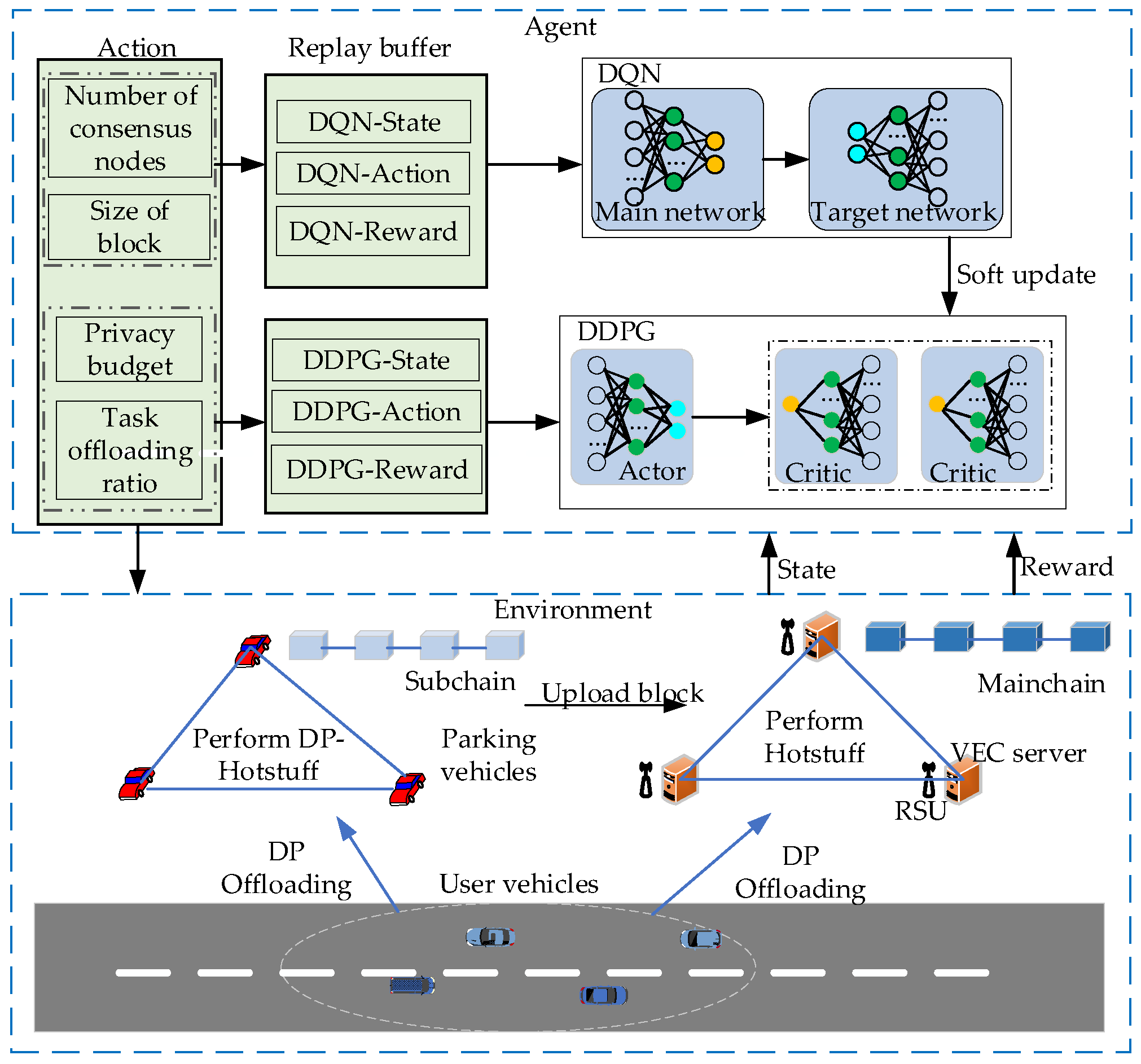
- We propose a novel BPVEC task offloading framework with location differential privacy. In this framework, parked vehicles are introduced as consensus nodes and, together with RSUs, form a dual-blockchain architecture. This architecture establishes a trusted task offloading environment while improving scalability. In addition, it incorporates the location differential privacy to protect the location privacy of both users and consensus nodes, thereby effectively ensuring the security of task offloading.
- We design a location differential privacy mechanism based on the Laplace mechanism. Considering the impact of location perturbation on the wireless communication quality, we leverage the low communication complexity of the Hotstuff consensus. We then integrate the location differential privacy mechanism with the Hotstuff consensus to construct a novel location privacy-enhanced Hotstuff consensus algorithm. Specifically, before the parked vehicle consensus nodes execute the Hotstuff consensus, their locations are perturbed with a consideration of the consensus energy consumption and latency to mitigate the impact on system performance.
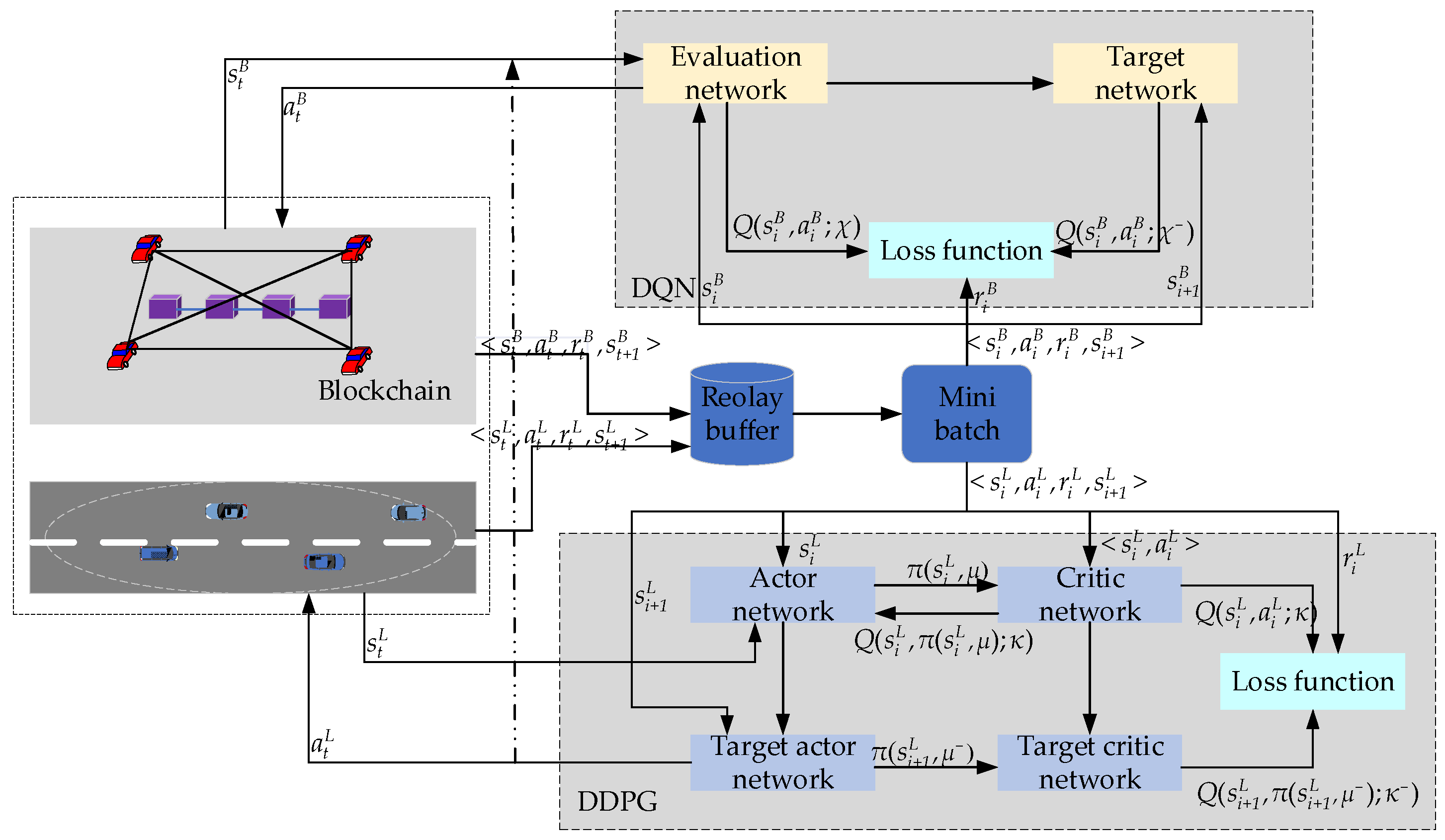
- We build a joint optimization problem based on the system energy consumption, latency and privacy strength. By adopting DQN as the upper layer and DDPG as the lower layer, a two-layer DRL model is established to determine the optimal offloading to roadside unit ratio, privacy budget, number of consensus nodes and block size.
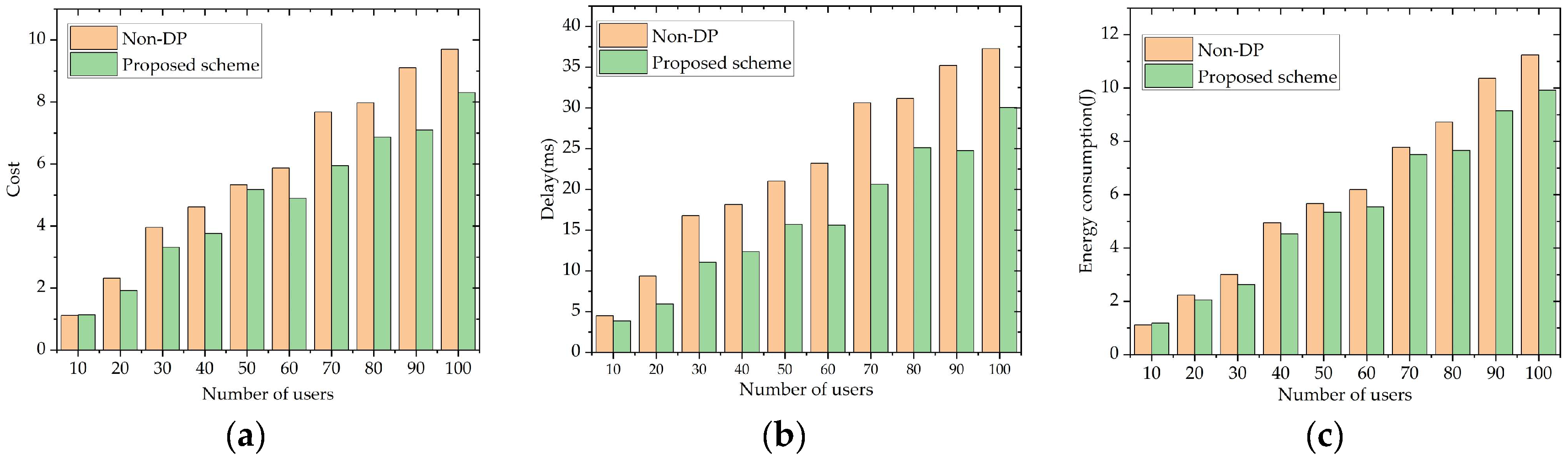
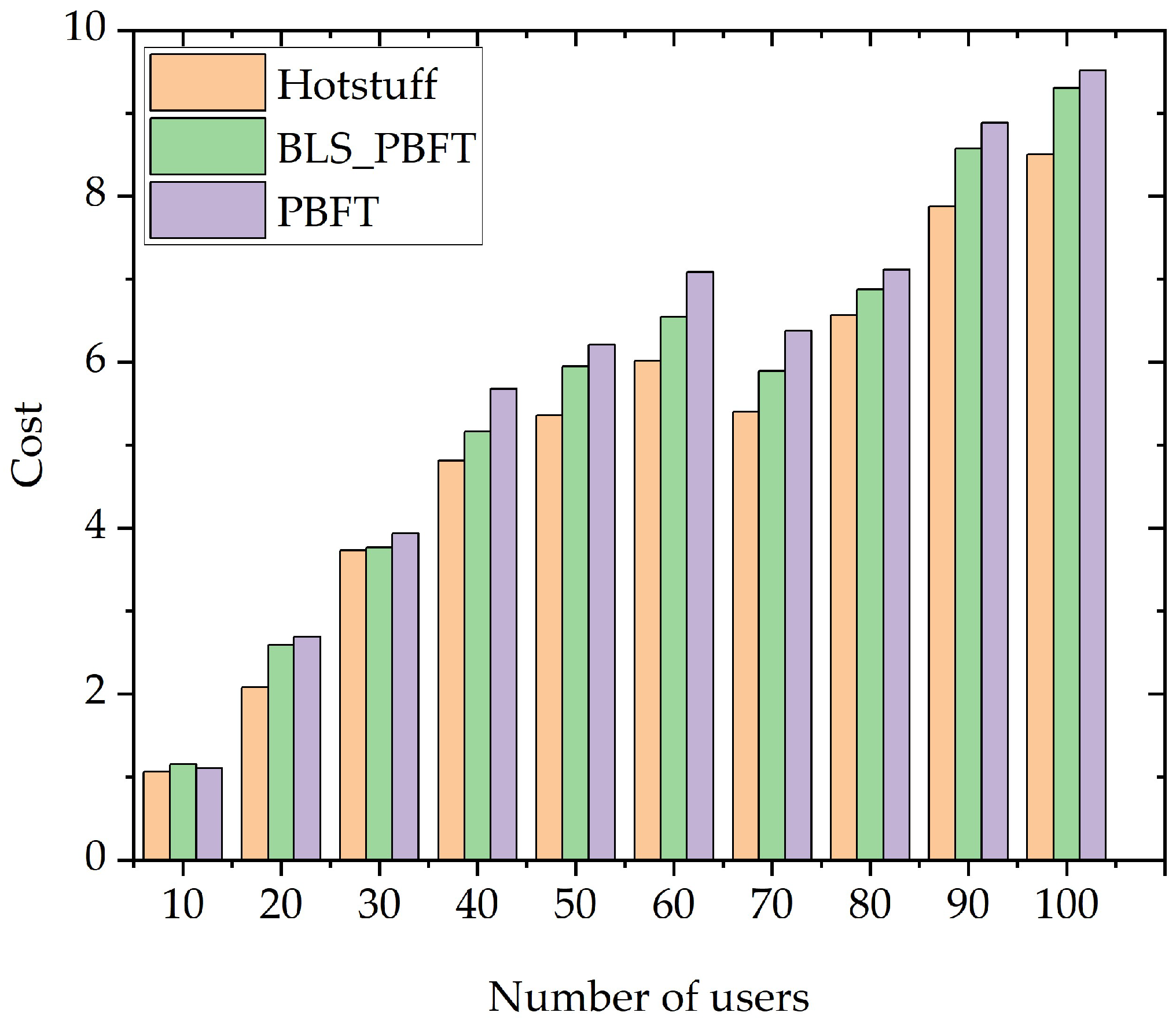
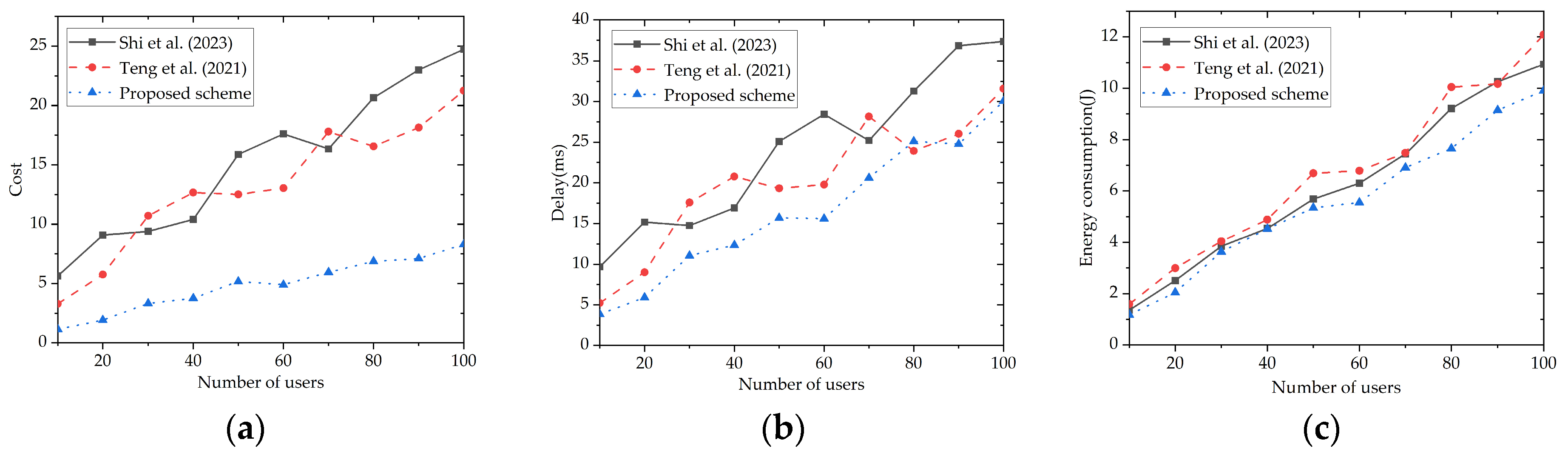
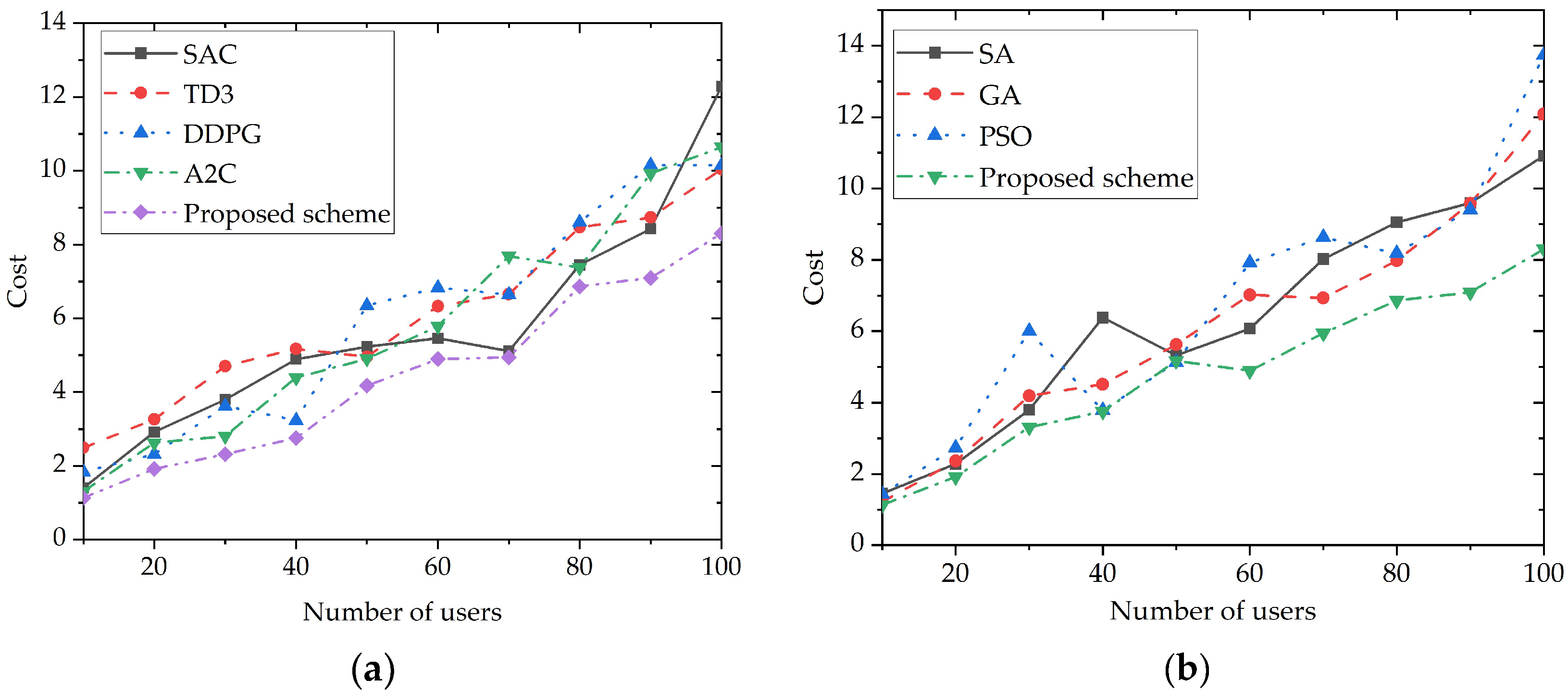
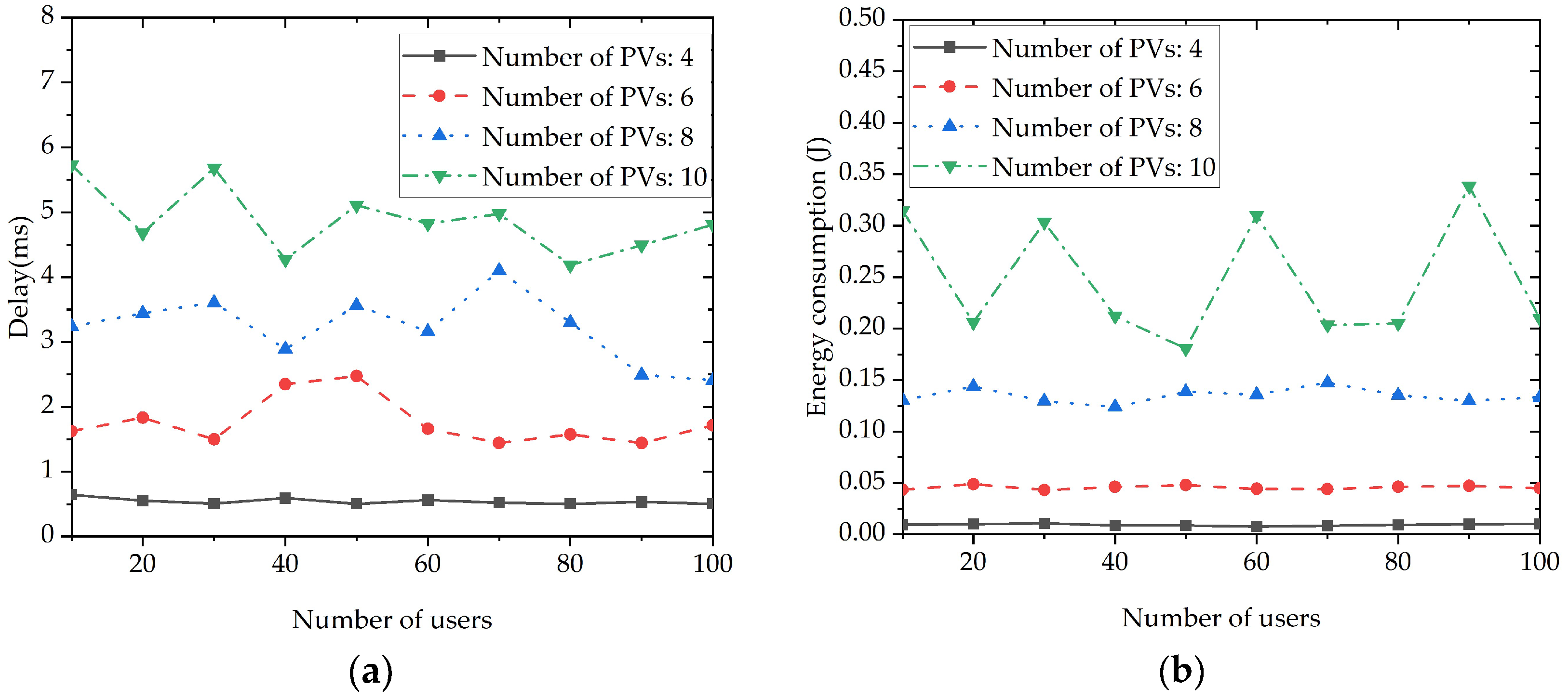
- We conduct simulation experiments to evaluate the performance of our proposed scheme. The results demonstrate that our approach not only preserves the vehicle’s location privacy during task offloading and consensus, but also achieves favorable performance in terms of energy consumption and latency.
2. Related Work
2.1. Blockchain for Task Offloading
2.2. Differential Privacy for Task Offloading
3. Differential Privacy Mechanism
4. System Model
4.1. DBPVEC Offloading System Framework
4.2. Network Model
4.3. Location Differential Privacy Model
4.4. Task Offloading Model
4.5. Blockchain Model
5. Optimization Problem Form
6. DBPVEC Task Offloading Strategy
6.1. Location Differential Privacy Hotstuff Algorithm
| Algorithm 1. Location differential privacy Hotstuff algorithm | |
| Input: Block size DBv; Privacy budget ε; Sample number N; PV true position (xpa,ypa); PV number P. | |
| Output: PV consensus energy consumption PV consensus delay | |
| 1: | Initialize the energy consumption weight a1 and delay weight a2. |
| 2: | for i = 1:N do |
| 3: | for j = 1:P do |
| 4: | Obtain perturbed position (xpert(j), ypert(j)) by Formula (8). |
| 5: | end for |
| 6: | Compute SINR of PV by perturbed position (xpert, ypert), using Formula (4) |
| 7: | Select consensus nodes by SINR, parking time and computing capability. |
| 8: | Compute and based on Hotstuff model. |
| 9: | Calculate |
| 10: | end for |
| 11: | Select the index of min(u) |
| 12: | Return |
6.2. Two-Tier DRL Task Offloading Algorithm
6.2.1. State Space
6.2.2. Action Space
6.2.3. Reward Function
6.2.4. Algorithm Design
| Algorithm 2. Two-layer DRL-based DBPVEC offloading strategy algorithm | |
| Input: Upper-layer state Lower-layer state Episode count Nk; Step count Nt. | |
| Output: Optimized policy for task offloading φRSUi; Privacy budget ε; Block size DBv; Number of PV consensus nodes B. | |
| 1: | Initialize DQN and DDPG networks parameters |
| 2: | for k = 1:Nk do |
| 3: | Reset environment and obtain initial states |
| 4: | for t = 1:Nt do |
| 5: | Select a random number ρ |
| 6: | If ρ < ζ |
| 7: | Choose by Formula (35) |
| 8: | else |
| 9: | Choose a random action |
| 10: | endif |
| 11: | Take action in the environment, observe the next state st and the reward |
| 12: | Put the experience <st, at, st+1> into replay buffer |
| 13: | Select a batch sample from upper-layer replay buffer randomly |
| 14: | Calculate target Q-values by Formula (36) |
| 15: | Update χ by minimizing loss L(χ) |
| 16: | χ− ← τχ + (1−τ)χ− |
| 17: | Sample random batch from lower-layer replay buffer |
| 18: | Compute target actions and target Q-values |
| 19: | Update κ by minimizing loss function L(κ) |
| 20: | Compute policy gradient by Formula (40) |
| 21: | Update μ using gradient ascent |
| 22: | μ− ← τμ + (1−τ)μ− |
| 23: | κ− ← τκ + (1−τ)κ− |
| 24: | end for |
| 25: | end for |
7. Experimental Results and Analysis
8. Conclusions
Author Contributions
Funding
Institutional Review Board Statement
Informed Consent Statement
Data Availability Statement
Conflicts of Interest
References
- Huang, X.; Yu, R.; Liu, J.; Shu, L. Parked Vehicle Edge Computing: Exploiting Opportunistic Resources for Distributed Mobile Applications. IEEE Access 2018, 6, 66649–66663. [Google Scholar] [CrossRef]
- Zhang, J.; Huang, X.; Yu, R. Optimal Task Assignment with Delay Constraint for Parked Vehicle Assisted Edge Computing: A Stackelberg Game Approach. IEEE Commun. Lett. 2020, 24, 598–602. [Google Scholar] [CrossRef]
- Zhai, X.; Pang, S.; Wang, N.; Gui, H.; He, X. Optimal Strategy for Task Offloading and Resource Pricing Behavior Based on Blockchain. IEEE Trans. Consum. Electron. 2025, 71, 7290–7303. [Google Scholar] [CrossRef]
- Shi, J.; Du, J.; Shen, Y.; Wang, J.; Yuan, J.; Han, Z. DRL-Based V2V Computation Offloading for Blockchain-Enabled Vehicular Networks. IEEE Trans. Mob. Comput. 2023, 22, 3882–3897. [Google Scholar] [CrossRef]
- Devarajan, G.G.; S, T.; Alenazi, M.J.F.; U, K.; Chandran, G.; Bashir, A.K. Federated Learning and Blockchain-Enabled Framework for Traffic Rerouting and Task Offloading in the Internet of Vehicles (IoV). IEEE Trans. Consum. Electron. 2025, 71, 3817–3825. [Google Scholar] [CrossRef]
- Huang, X.; Huang, T.; Zhao, S.; Xiang, W.; Zhang, W.; Zhang, G. Joint Optimization of Task Partial Offloading and Resource Allocation in a Dual-Blockchain-Enabled MEC System with Parallelism Constraints. IEEE Trans. Commun. 2025, 73, 13725–13740. [Google Scholar] [CrossRef]
- Luo, B.; Li, X.; Weng, J.; Guo, J.; Ma, J. Blockchain Enabled Trust-Based Location Privacy Protection Scheme in VANET. IEEE Trans. Veh. Technol. 2020, 69, 2034–2048. [Google Scholar] [CrossRef]
- Xu, C.; Wu, H.; Liu, H.; Gu, W.; Li, Y.; Cao, D. Blockchain-Oriented Privacy Protection of Sensitive Data in the Internet of Vehicles. IEEE Trans. Intell. Veh. 2023, 8, 1057–1067. [Google Scholar] [CrossRef]
- Lv, P.; Xie, L.; Xu, J.; Wu, X.; Li, T. Misbehavior Detection in Vehicular Ad Hoc Networks Based on Privacy-Preserving Federated Learning and Blockchain. IEEE Trans. Netw. Serv. Manag. 2022, 19, 3936–3948. [Google Scholar] [CrossRef]
- Liu, H.; Zhang, P.; Pu, G.; Yang, T.; Maharjan, S.; Zhang, Y. Blockchain Empowered Cooperative Authentication With Data Traceability in Vehicular Edge Computing. IEEE Trans. Veh. Technol. 2020, 69, 4221–4232. [Google Scholar] [CrossRef]
- Wang, S.; Yang, D.; Sheng, H.; Shen, J.; Zhang, Y.; Ke, W. A Blockchain-Enabled Distributed System for Trustworthy and Collaborative Intelligent Vehicle Re-Identification. IEEE Trans. Intell. Veh. 2024, 9, 3271–3282. [Google Scholar] [CrossRef]
- Meng, X.; Liu, B.; Meng, X.; Liang, Y.; Deng, H. A Lightweight Group Authentication Protocol for Blockchain-Based Vehicular Edge Computing Networks. IEEE Trans. Intell. Transp. Syst. 2024, 25, 8556–8567. [Google Scholar] [CrossRef]
- Ren, Y.; Chen, X.; Guo, S.; Guo, S.; Xiong, A. Blockchain-Based VEC Network Trust Management: A DRL Algorithm for Vehicular Service Offloading and Migration. IEEE Trans. Veh. Technol. 2021, 70, 8148–8160. [Google Scholar] [CrossRef]
- Fardad, M.; Muntean, G.; Tal, I. A Blockchain-Enabled Vehicular Edge Computing Framework for Secure Performance-Oriented V2X Service Delivery. IEEE Trans. Veh. Technol. 2024, 73, 13853–13867. [Google Scholar] [CrossRef]
- Wang, S.; Ye, D.; Huang, X.; Yu, R.; Wang, Y.; Zhang, Y. Consortium Blockchain for Secure Resource Sharing in Vehicular Edge Computing: A Contract-Based Approach. IEEE Trans. Netw. Sci. Eng. 2021, 8, 1189–1201. [Google Scholar] [CrossRef]
- Liang, F. Decentralized and Network-Aware Task Offloading for Smart Transportation via Blockchain. Sensors 2025, 25, 5555. [Google Scholar] [CrossRef] [PubMed]
- Li, J.; Liu, R.; Liu, W. FBMTO: Fusion of Blockchain and Multi-Agent Reinforcement Learning for Task Offloading in edge computing. Inf. Fusion 2025, 124, 103344. [Google Scholar] [CrossRef]
- Xu, C.; Zhang, P.; Xia, X.; Kong, L.; Zeng, P.; Yu, H. Digital-Twin-Assisted Intelligent Secure Task Offloading and Caching in Blockchain-Based Vehicular Edge Computing Networks. IEEE Internet Things J. 2025, 12, 4128–4143. [Google Scholar] [CrossRef]
- Huang, X.; Ye, D.; Yu, R.; Shu, L. Securing parked vehicle assisted fog computing with blockchain and optimal smart contract design. IEEE/CAA J. Autom. Sin. 2020, 7, 426–441. [Google Scholar] [CrossRef]
- Teng, Y.; Cao, Y.; Liu, M.; Yu, F.R.; Leung, V.C.M. Efficient Blockchain-Enabled Large Scale Parked Vehicular Computing With Green Energy Supply. IEEE Trans. Veh. Technol. 2021, 70, 9423–9436. [Google Scholar] [CrossRef]
- Kong, M.; Zhao, J.; Sun, X.; Nie, Y. Secure and efficient computing resource management in blockchain-based vehicular fog computing. China Commun. 2021, 18, 115–125. [Google Scholar] [CrossRef]
- Qashlan, A.; Nanda, P.; He, X.; Mohanty, M. Privacy-Preserving Mechanism in Smart Home Using Blockchain. IEEE Access 2021, 9, 103651–103669. [Google Scholar] [CrossRef]
- Mu, Y.; Hao, B.; He, M. Privacy-preserving cooperative hierarchical caching approach based on federated deep reinforcement learning for vehicular edge computing. J. Supercomput. 2025, 81, 532. [Google Scholar] [CrossRef]
- Tchaye-Kondi, J.; Zhai, Y.; Shen, J.; Zhu, L. Privacy-Preserving Offloading in Edge Intelligence Systems With Inductive Learning and Local Differential Privacy. IEEE Trans. Netw. Serv. Manag. 2023, 20, 5026–5037. [Google Scholar] [CrossRef]
- Wei, D.; Xi, N.; Ma, X.; Shojafar, M.; Kumari, S.; Ma, J. Personalized Privacy-Aware Task Offloading for Edge-Cloud-Assisted Industrial Internet of Things in Automated Manufacturing. IEEE Trans. Ind. Inform. 2022, 18, 7935–7945. [Google Scholar] [CrossRef]
- Wang, S.; Li, J.; Wu, G.; Chen, H.; Sun, S. Joint Optimization of Task Offloading and Resource Allocation Based on Differential Privacy in Vehicular Edge Computing. IEEE Trans. Comput. Soc. Syst. 2022, 9, 109–119. [Google Scholar] [CrossRef]
- Zhang, P.; Gan, P.; Chang, L.; Wen, W.; Selvi, M.; Kibalya, G. DPRL: Task Offloading Strategy Based on Differential Privacy and Reinforcement Learning in Edge Computing. IEEE Access 2022, 10, 54002–54011. [Google Scholar] [CrossRef]
- Zhang, G.; Zhang, S.; Man, Z.; Cui, C.; Hu, W. Location Privacy Protection in Edge Computing: Co-Design of Differential Privacy and Offloading Mode. Electronics 2024, 13, 2668. [Google Scholar] [CrossRef]
- Liu, Z.; Wang, J.; Gao, Z.; Wei, J. Privacy-preserving edge computing offloading scheme based on whale optimization algorithm. J. Supercomput. 2023, 79, 3005–3023. [Google Scholar] [CrossRef]
- Wang, Z.; Sun, Y.; Liu, D.; Hu, J.; Pang, X.; Hu, Y.; Ren, K. Location Privacy-Aware Task Offloading in Mobile Edge Computing. IEEE. Trans. Mob. Comput. 2024, 23, 2269–2283. [Google Scholar] [CrossRef]
- Zhang, G.; Du, J.; Yuan, X.; Zhang, K. Differential Privacy-Based Location Privacy Protection for Edge Computing Networks. Electronics 2024, 13, 3510. [Google Scholar] [CrossRef]
- Min, M.; Liu, Z.; Duan, J.; Zhang, P.; Li, S. Safe-Learning-Based Location-Privacy-Preserved Task Offloading in Mobile Edge Computing. Electronics 2024, 13, 89. [Google Scholar] [CrossRef]
- Dwork, C. Differential Privacy. In Proceedings of the 33rd International Colloquium on Automata, Languages and Programming, Venice, Italy, 10–14 July 2006; Bugliesi, M., Prennel, B., Sassone, V., Wegener, I., Eds.; Springer: Berlin/Heidelberg, Germany, 2006; Volume 4052, pp. 1–12. [Google Scholar]
- Dwork, C.; Roth, A. The Algorithmic Foundations of Differential Privacy. Found. Trends® Theor. Comput. Sci. 2014, 9, 211–487. [Google Scholar] [CrossRef]
- Ma, X.; Zhao, J.; Wang, Y.; Zhang, T.; Li, Z. A New Approach to SINR-Based Reliability Analysis of IEEE 802.11 Broadcast Ad Hoc Networks. IEEE Commun. Lett. 2021, 25, 651–655. [Google Scholar] [CrossRef]
- Ma, X.; Trivedi, K.S. SINR-Based Analysis of IEEE 802.11p/bd Broadcast VANETs for Safety Services. IEEE Trans. Netw. Serv. Manag. 2021, 18, 2672–2686. [Google Scholar] [CrossRef]
- van Erven, T.; Harremoes, P. Rényi Divergence and Kullback-Leibler Divergence. IEEE Trans. Inf. Theory 2014, 60, 3797–3820. [Google Scholar] [CrossRef]
- Australian Government. Smart Parking Stays Dataset. Available online: https://data.gov.au/data/dataset/3vsj-zpk7 (accessed on 1 January 2023).
- Lang, P.; Tian, D.; Duan, X.; Zhou, J.; Sheng, Z.; Leung, V.C.M. Blockchain-Based Cooperative Computation Offloading and Secure Handover in Vehicular Edge Computing Networks. IEEE Trans. Intell. Veh. 2023, 8, 3839–3853. [Google Scholar] [CrossRef]
- Feng, J.; Yu, F.R.; Pei, Q.; Du, J.; Zhu, L. Joint Optimization of Radio and Computational Resources Allocation in Blockchain-Enabled Mobile Edge Computing Systems. IEEE Trans. Wirel. Commun. 2020, 19, 4321–4334. [Google Scholar] [CrossRef]





| Study | Blockchain | Privacy Mechanism | Optimization Technique | Limitations |
|---|---|---|---|---|
| [10,11,12] | Consortium Blockchain | None | None | Only focuses on identity authentication |
| [13] | Consortium Blockchain | None | None | Complex network architecture |
| [14] | DPoS | None | DRL | Lacks incentive mechanism |
| [15] | BFT-based PoS consensus, Smart Contract | None | Contract-Based Approach | Lacks joint optimization of system performance |
| [16,17] | PoS consensus, DPoS | None | DQN | Ignores the impact of consensus |
| [4,18] | Improved PBFT | None | DRL | Ignores information leakage during consensus |
| [19,20,21] | Smart Contract, PBFT, PoW | None | Game Theory, DRL | Ignores sensitive information privacy leakage |
| [22,23,24] | None | Differential Privacy | None | Only protects data content |
| [25] | None | Differential Privacy (Deep Learning Parameters) | DRL | Treats privacy as an external constraint |
| [26] | None | Local Differential Privacy (Histogram-Driven) | K-NJTA | Treats privacy as an external constraint |
| [27,28,29] | None | Differential Privacy (Geographic Location Perturbation) | WOPP, RL | Only focuses on location privacy in single-edge server scenarios |
| [30,31,32] | None | Differential Privacy | DRL | Does not directly describe user location |
| Notations | Explanation |
|---|---|
| CPU cycles per unit task size required for RSU and PV computing | |
| d0 | Wireless far-field reference distance |
| Distance from perturbed PV to the receiving vehicle and the interfering vehicle | |
| Dqi | Task size for useri |
| DBv | Block size |
| DKL | Kullback–Leibler (KL) divergence of differential privacy |
| Consensus energy consumption | |
| Epai, ERSUi | RSU and PV energy consumption for computational tasks |
| Etotal | Total energy consumption of the system |
| fpk, frj | Computational capacity of PVk and RSUj |
| N0 | Noise power of the wireless channel |
| Pt | Wireless transmission power |
| Ri,j | Communication transmission rate after location perturbation |
| Ttotal | Total delay of the system |
| Tpai, TRSUi | PV and RSU delay for processing computational tasks |
| Wb | Wireless communication bandwidth |
| α | Path loss factor |
| σ | CPU cycles required for generating or verifying signatures |
| φRSUi | Proportion of task offloading to RSU by useri |
| η | Transceiver decision factor |
| θ | CPU cycles required for generating or verifying the Message Authentication Code (MAC) |
| κv, κr | Capacitive switching coefficients for vehicles and RSUs |
| ϖ | Average transaction size of blockchain |
Disclaimer/Publisher’s Note: The statements, opinions and data contained in all publications are solely those of the individual author(s) and contributor(s) and not of MDPI and/or the editor(s). MDPI and/or the editor(s) disclaim responsibility for any injury to people or property resulting from any ideas, methods, instructions or products referred to in the content. |
© 2026 by the authors. Licensee MDPI, Basel, Switzerland. This article is an open access article distributed under the terms and conditions of the Creative Commons Attribution (CC BY) license.
Share and Cite
Liang, G.; Su, Z.; Li, C.; Chen, M.; Zhao, F. Task Offloading of Parked Vehicles Edge Computing Based on Differential Privacy Hotstuff. Information 2026, 17, 339. https://doi.org/10.3390/info17040339
Liang G, Su Z, Li C, Chen M, Zhao F. Task Offloading of Parked Vehicles Edge Computing Based on Differential Privacy Hotstuff. Information. 2026; 17(4):339. https://doi.org/10.3390/info17040339
Chicago/Turabian StyleLiang, Guoling, Zhaoyu Su, Chunhai Li, Mingfeng Chen, and Feng Zhao. 2026. "Task Offloading of Parked Vehicles Edge Computing Based on Differential Privacy Hotstuff" Information 17, no. 4: 339. https://doi.org/10.3390/info17040339
APA StyleLiang, G., Su, Z., Li, C., Chen, M., & Zhao, F. (2026). Task Offloading of Parked Vehicles Edge Computing Based on Differential Privacy Hotstuff. Information, 17(4), 339. https://doi.org/10.3390/info17040339